Showing posts with label F.W. Murnau. Show all posts

Monday, August 19, 2024

This week: music for MGM late silent 'The Pagan' (1929), then Murnau's 'The Last Laugh' (1924)

An original lobby card promoting MGM's 'The Pagan' (1929).

This week finds me creating music for a silent film I've never before accompanied, then two well-known favorites: one a drama, the other a comedy.

First up is 'The Pagan' (1929) a late MGM silent starring Ramon Novarro and Renée Adorée, which I'm accompanying on Wednesday, Aug. 21 at 6:30 p.m. at the Flying Monkey Moviehouse and Performance Center, 39 South Main St., Plymouth, N.H.

This is the one I've never done before. (By my count, it'll be #396 on my list of film titles I've accompanied in theatrical screenings.) It's an exotic tale of romance and adventure set in the South Pacific, which means plenty of opportunities for Novarro to go shirtless.

Like many late silents, 'The Pagan' was released with a recorded musical soundtrack (but without dialogue) that could be used by theater that had the ability to handle synchronized sound. 

Interestingly, the recorded soundtrack featured a tune called “Pagan Love Song” composed by Arthur Freed and Nacio Herb Brown, the same team responsible for “Singing in the Rain” and so many other popular songs of the era.

However, for the many theaters not yet "wired for sound," music was provided the same way it had been throughout the silent era: by live musicians playing whatever music they felt would help support what was on the screen.

That's what I'll be doing on Wednesday night for 'The Pagan,' a film I've never seen before. Despite the title, pray it goes well. 

Then, on Saturday, Aug. 24, it's up to Ludlow, Vt. for my annual appearance at 'Silent Film Night' at Ludlow Town Hall. This year's films is F.W. Murnau's 'The Last Laugh' (1924) starring Emil Jannings in a towering performance as a doorman who loses his job at a fancy downtown hotel.

Showtime for 'The Last Laugh' is 7 p.m.; more info in the press release below.

And on Sunday, Aug. 25, we turn to comedy with Buster Keaton's 'Spite Marriage' (1929), which I'm accompanying at the Town Hall Theatre in Wilton, N.H. Showtime there is 2 p.m. Admission is free, with donations welcome to support this independent theater.

All the best and enjoy this last stretch of summer before Labor Day weekend arrives!

*    *    *

Promotional poster for 'The Last Laugh' (1924) starring Emil Jannings.

WEDNESDAY, JULY 31, 2024 / FOR IMMEDIATE RELEASE
Contact Jeff Rapsis • (603) 236-9237 • jeffrapsis@gmail.com

'The Last Laugh' to screen with live music at Ludlow Town Hall on Saturday, Aug. 24

Oscar-winning actor Emil Jannings stars in ground-breaking 1924 silent drama from German director F.W. Murnau

LUDLOW, Vt.—'The Last Laugh' (1924), a German silent film drama about a hotel doorman demoted to washroom attendant, will be screened with live music on Saturday, Aug. 24 at 7 p.m. in Heald Auditorium in Ludlow Town Hall, 37 Depot St., Ludlow.

Presented by the Friends of Ludlow Auditorium, the screening will feature accompaniment by Jeff Rapsis, a New Hampshire-based composer who specializes in creating live music for silent film presentations.

Admission is free and all are welcome to this family-friendly event. Donations are accepted at the door to support the Friends of Ludlow Auditorium.

In 'The Last Laugh,' regarded as one of German director F.W. Murnau's best pictures, the story is told entirely in visual terms, without the use of title cards.

The film, a character study that chronicles the mental breakdown of an aging man who loses his position of authority, is also noted for its revolutionary use of camera movement.

Playing the lead role is Swiss/German actor Emil Jannings, widely recognized as one of the most versatile actors of early cinema.

Jannings would later move to Hollywood, where he earned the first-ever Best Actor Oscar at the inaugural Academy Awards for his towering performances in 'The Last Command' (1928) and 'The Patriot' (1928).

Critics and film writers regard 'The Last Laugh' as a landmark of early cinema.

" 'The Last Laugh' is a masterpiece of psychological study, perhaps the best ever portrayal of what goes through one man's mind under varying situations ... It is absolutely mind-boggling to see Emil Jannings age at least 10 or 15 years right in front of our eyes in the course of a couple of minutes," wrote author Robert K. Klepner in 'Silent Films' (2005).

Critic David Kehr of the Chicago Reader described 'The Last Laugh' as "the 1924 film in which F.W. Murnau freed his camera from its stationary tripod and took it on a flight of imagination and expression that changed the way movies were made."

The film's director of photography, Karl Freund, set new standards of cinematography in 'The Last Laugh,' setting up the camera to move through corridors and "see" action through a character's eye-view.

Freund's long career later included work in television in the 1950s in Hollywood, when he developed the "three camera" system for the "I Love Lucy" show, which became the standard format for shooting situation comedies.

'The Last Laugh' will be accompanied by live music by Jeff Rapsis, a New Hampshire-based silent film accompanist who performs at venues across the region and beyond.

"Films such as 'The Last Laugh' were created to be shown on the big screen and in a theater as a communal experience," Rapsis said. "With an audience and live music, they still come to life in the way their makers intended them to.

'The Last Laugh' (1924) will be screened with live music on Saturday, Aug. 24 at 7 p.m. in Heald Auditorium in Ludlow Town Hall, 37 Depot St., Ludlow.

Admission is free and all are welcome to this family-friendly event. Donations are accepted at the door to support the Friends of Ludlow Auditorium.
 
A scene from F.W. Murnau's 'The Last Laugh' (1924) starring Emil Jannings.

Thursday, May 2, 2024

Next up: Emil Jannings in 'The Last Laugh' (1924) at Epsilon Spires on Friday, 5/10 in Brattleboro, Vt.

A French language poster for F.W. Murnau's film 'The Last Laugh' (1924).

April showers may bring May flowers, and May brings the start of two season series of silent film screenings. 

On Saturday, May 11, I return to Brandon Town Hall and Community Center in Brandon, Vt. for a 13th year of presenting silent films with live music. First up is Chaplin's 'The Gold Rush' (1925).

Later, on Wednesday, May 29, I'll be at the Leavitt Theatre in Ogunquit, Maine for the start of another season of silents with live music. First up: Buster Keaton in 'The General' (1926).

All the rest of each series are listed on my "Upcoming Silent Film Screenings" page, which is linked at the top right of this page.

But before any of that takes place, I'll be at Epsilon Spires in Brattleboro, Vt. on Friday, May 10, where I'll accompany F.W. Murnau's 'The Last Laugh' (1924).

More details on that screening in the press release below. Hope to see you there!

*    *    *

Emil Jannings wearing the uniform that plays such an important role in 'The Last Laugh' (1924)

MONDAY, APRIL 29, 2024 / FOR IMMEDIATE RELEASE
Contact Jeff Rapsis • (603) 236-9237 • jeffrapsis@gmail.com

'The Last Laugh' to screen with live music at Epsilon Spires on Friday, May 10

Oscar-winning actor Emil Jannings stars in ground-breaking 1924 silent drama from German director F.W. Murnau

BRATTLEBORO, Vt.—'The Last Laugh' (1924), a German silent film drama about a hotel doorman demoted to washroom attendant, will be screened with live music on Friday, May 10 at 8 p.m. at Epsilon Spires, 190 Main St., Brattleboro, Vt.

Admission is $20 per person. Tickets may be purchased in advance at www.epsilonspires.org or at the door.

The screening will feature live accompaniment on the venue's Estey pipe organ by Jeff Rapsis, a New Hampshire-based silent film musician.


In 'The Last Laugh,' regarded as one of German director F.W. Murnau's best pictures, the story is told entirely in visual terms, without the use of title cards.

The film, a character study that chronicles the mental breakdown of an aging man who loses his position of authority, is also noted for its revolutionary use of camera movement.

Playing the lead role is Swiss/German actor Emil Jannings, widely recognized as one of the most versatile actors of early cinema.

Jannings would later move to Hollywood, where he earned the first-ever Best Actor Oscar at the inaugural Academy Awards for his towering performances in 'The Last Command' (1928) and 'The Patriot' (1928).

Critics and film writers regard 'The Last Laugh' as a landmark of early cinema.

" 'The Last Laugh' is a masterpiece of psychological study, perhaps the best ever portrayal of what goes through one man's mind under varying situations ... It is absolutely mind-boggling to see Emil Jannings age at least 10 or 15 years right in front of our eyes in the course of a couple of minutes," wrote author Robert K. Klepner in 'Silent Films' (2005).

Critic David Kehr of the Chicago Reader described 'The Last Laugh' as "the 1924 film in which F.W. Murnau freed his camera from its stationary tripod and took it on a flight of imagination and expression that changed the way movies were made."

The film's director of photography, Karl Freund, set new standards of cinematography in 'The Last Laugh,' setting up the camera to move through corridors and "see" action through a character's eye-view.

Freund's long career later included work in television in the 1950s in Hollywood, when he developed the "three camera" system for the "I Love Lucy" show, which became the standard format for shooting situation comedies.


'The Last Laugh' will be accompanied by live music by Jeff Rapsis, a New Hampshire-based silent film accompanist who performs at venues across the region and beyond.

"Films such as 'The Last Laugh' were created to be shown on the big screen and in a theater as a communal experience," Rapsis said. "With an audience and live music, they still come to life in the way their makers intended them to.

'The Last Laugh' (1924) will be screened with live music on Friday, May 10 at 8 p.m. at Epsilon Spires, 190 Main St., Brattleboro, Vt.


Admission is $20 per person. Tickets may be purchased in advance at www.epsilonspires.org or at the door.

Thursday, October 19, 2023

Pre-Halloween spookfest: 'Nosferatu' on Sunday, Oct. 22 at Town Hall Theatre, Wilton, N.H.

Just one word today:

Nosferatu!

We're screening it on Sunday, Oct. 22 at 2 p.m. at the Town Hall Theatre in Wilton N.H.

More details in the press release below.

And remember—in silent film, no one can hear you scream!

*   *   *

A modern poster for 'Nosferatu' (1922).

WEDNESDAY, OCT. 18, 2023 / FOR IMMEDIATE RELEASE
Contact Jeff Rapsis • (603) 236-9237 • jeffrapsis@gmail.com

Creepy classic thriller 'Nosferatu' to screen at Town Hall Theatre on Sunday, Oct. 22

Prepare for Halloween with silent horror movie and live music—see it if you dare!

WILTON, N.H.— Get into the Halloween spirit with a classic silent film thriller.

'Nosferatu' (1922), the first screen adaptation of Bram Stoker's novel 'Dracula,' will be shown with live music on Sunday, Oct. 22 at 2 p.m. at the Town Hall Theatre, 40 Main St., Wilton, N.H.

Admission is free; donations are accepted, with $10 per person suggested to defray expenses.

The screening will feature live musical accompaniment by Jeff Rapsis, a New Hampshire-based silent film musician.

'Nosferatu' (1922), directed by German filmmaker F.W. Murnau, remains a landmark of the cinematic horror genre. It was among the first movies to use visual design to convey unease and terror.

To modern viewers, the passage of time has made 'Nosferatu' seem even more strange and otherworldly.

It's an atmosphere that silent film accompanist Jeff Rapsis will enhance by improvising live music on the spot for the screening.

"The original 'Nosferatu' is a film that seems to get creepier as more time goes by," said Rapsis, a resident of Bedford, N.H. who accompanies silent film screenings at venues across the nation.

"It's a great way to celebrate Halloween and the power of silent film to transport audiences to strange and unusual places," Rapsis said.

In 'Nosferatu,' actor Max Schreck portrays the title character, a mysterious count from Transylvania who travels to the German city of Bremen to take up residence.

In the town, a rise in deaths from the plague is attributed to the count's arrival. Only when a young woman reads "The Book of Vampires" does it become clear how to rid the town of this frightening menace.

Director Murnau told the story with strange camera angles, weird lighting, and special effects that include sequences deliberately speeded up.

Although 'Nosferatu' is suitable for all family members, the overall program may be too intense for very young children to enjoy.

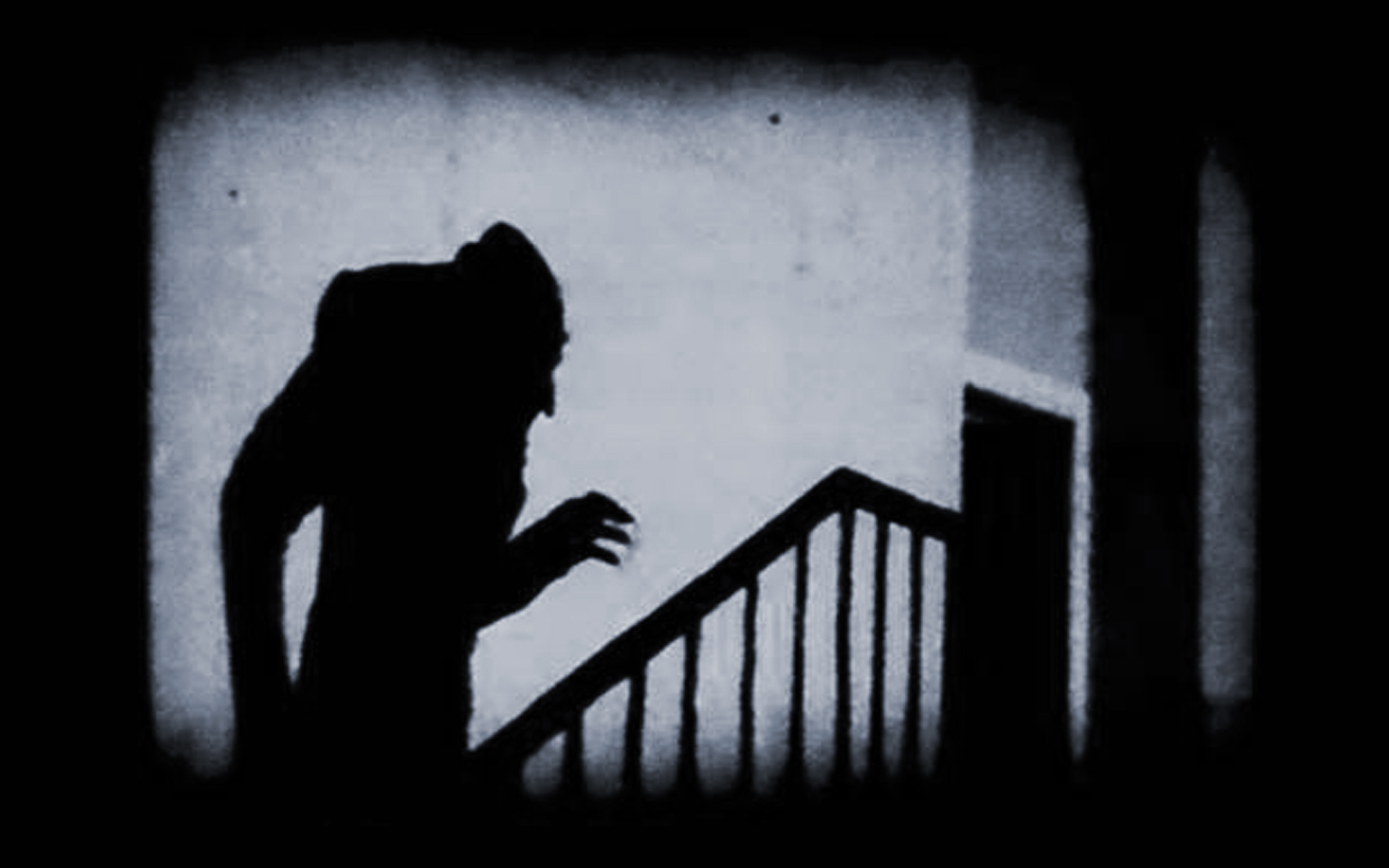
From 'Nosferatu' (1922): a shadowy character.

Modern critics say the original 'Nosferatu' still packs a powerful cinematic punch.

“Early film version of Dracula is brilliantly eerie, full of imaginative touches that none of the later films quite recaptured,” Leonard Maltin wrote recently.

Critic Dave Kehr of the Chicago Reader called 'Nosferatu' "...a masterpiece of German silent cinema and easily the most effective version of Dracula on record.”

Despite the status of 'Nosferatu' as a landmark of early cinema, another scary aspect of the film is that it was almost lost forever.

The film, shot in 1921 and released in 1922, was an unauthorized adaptation of Stoker's novel, with names and other details changed because the studio could not obtain rights to the novel.

Thus "vampire" became "Nosferatu" and "Count Dracula" became "Count Orlok." After the film was released, Stoker's widow filed a copyright infringement lawsuit and won; all known prints and negatives were destroyed under the terms of settlement.

However, intact copies of the film would surface later, allowing 'Nosferatu' to be restored and screened today as audiences originally saw it. The image of actor Max Schreck as the vampire has become so well known that it appeared in a recent 'Sponge Bob Squarepants' episode.

Out of the box: A scene from 'Nosferatu' (1922).

In screening silent films at the Town Hall Theater, organizers aim to show early cinema as it was meant to be seen—in restored prints, on a large screen, with live music, and with an audience.

"All those elements are important parts of the silent film experience," said Rapsis, who will accompany the film. "Recreate those conditions, and classics of early cinema such as 'Nosferatu' leap back to life in ways that audiences still find entertaining."

Rapsis performs on a digital synthesizer that reproduces the texture of the full orchestra, creating a traditional "movie score" sound. He improvises the complete score in real time during the screening.

"Creating a movie score on the fly is kind of a high-wire act, but it can often make for more excitement than if everything is planned out in advance," Rapsis said.

The classic early horror thriller ‘Nosferatu’ will be shown with live music on Sunday, Oct. 22 at 2 p.m. at the Town Hall Theatre, 40 Main St., Wilton, N.H.

Admission is free; donations are accepted, with $10 per person suggested to defray expenses. For more information, call the theater at (603) 654-3456.


Thursday, October 27, 2022

Tonight: 'Nosferatu' flies into the Jane Pickens Theatre in Newport, R.I. for 100th anniversary

 
The vampire mounts the stairs in 'Nosferatu' (1922.)

 If you're looking for the "big audience" experience of silent film, look no further than tonight's screening of 'Nosferatu' (1922) at the Jane Pickens Theatre in Newport, R.I.

I'm told that already well over 100 tickets have been sold for tonight's show. Wow! So it should be a packed house, which I think always makes for a screening.

The fun starts at 7:30 p.m.; more details in the press release below.


Last night's screening of 'The Cat and the Canary' (1927) drew a good-sized crowd to the Rex Theatre in downtown Manchester, N.H.

Most had never seen (or heard of) the film; indeed many were first-timers at the Rex, which was recently renovated and reopened by the Palace Theatre, the city's main downtown performing arts organization.

For this film, I make a point of describing it as it was originally promoted: as a "comedy thriller." 

I think it's important for people to know that's what director Paul Leni was going for, thus giving them permission to laugh. Which they did!

Okay, here's info on tonight's screening of 'Nosferatu' in Newport, R.I. 

By the way, yesterday's Newport Daily News carried an extensive write-up of the screening. Nice job by writer Robert Duguay!

And I can't help but observe that for me, it's the second-to-last 'Nosferatu' of this 100th anniversary Halloween season.

Accompanying it repeatedly is beginning to feel like silent film aerobics: "Two more, one more..."

*    *    *

The creature emerges: Nosferatu disembarks from his shipboard accommodations..

MONDAY, OCT. 3, 2022 / FOR IMMEDIATE RELEASE
Contact Jeff Rapsis • (603) 236-9237 • jeffrapsis@gmail.com

Creepy classic thriller 'Nosferatu' to screen at Jane Pickens Theater on Thursday, Oct. 27

Prepare for Halloween with 100-year-old silent horror movie with live music—see it if you dare!

NEWPORT, R.I.— Get into the Halloween spirit with a classic silent horror film celebrating the 100th anniversary of its release.

'Nosferatu' (1922), the first screen adaptation of Bram Stoker's novel 'Dracula,' will be shown with live music on Thursday, Oct. 27 at 7:30 p.m. at the Jane Pickens Theatre and Event Center, 49 Touro St., Newport.

General admission $15; members $13. Tickets available online or at the door.

The screening will feature live musical accompaniment by Jeff Rapsis, a New Hampshire-based silent film musician.

'Nosferatu' (1922), directed by German filmmaker F.W. Murnau, remains a landmark of the cinematic horror genre. It was among the first movies to use visual design to convey unease and terror.

To modern viewers, the passage of time has made this unusual film seem even more strange and otherworldly.

It's an atmosphere that silent film accompanist Jeff Rapsis will enhance in improvising live music on the spot for the screening.

"The original 'Nosferatu' is a film that seems to get creepier as more time goes by," said Rapsis, a resident of Bedford, N.H. who accompanies silent film screenings at venues across the nation.

"It's a great way to celebrate Halloween and the power of silent film to transport audiences to strange and unusual places," Rapsis said.

In 'Nosferatu,' actor Max Schreck portrays the title character, a mysterious count from Transylvania who travels to the German city of Bremen to take up residence.

In the town, a rise in deaths from the plague is attributed to the count's arrival. Only when a young woman reads "The Book of Vampires" does it become clear how to rid the town of this frightening menace.

Director Murnau told the story with strange camera angles, weird lighting, and special effects that include sequences deliberately speeded up.

Although 'Nosferatu' is suitable for all family members, the overall program may be too intense for very young children to enjoy.

Modern critics say the original 'Nosferatu' still packs a powerful cinematic punch.

“Early film version of Dracula is brilliantly eerie, full of imaginative touches that none of the later films quite recaptured,” Leonard Maltin wrote recently.

Critic Dave Kehr of the Chicago Reader called 'Nosferatu' "...a masterpiece of German silent cinema and easily the most effective version of Dracula on record.”

Despite the status of 'Nosferatu' as a landmark of early cinema, another scary aspect of the film is that it was almost lost forever.

The film, shot in 1921 and released in 1922, was an unauthorized adaptation of Stoker's novel, with names and other details changed because the studio could not obtain rights to the novel.

Thus "vampire" became "Nosferatu" and "Count Dracula" became "Count Orlok." After the film was released, Stoker's widow filed a copyright infringement lawsuit and won; all known prints and negatives were destroyed under the terms of settlement.

However, intact copies of the film would surface later, allowing 'Nosferatu' to be restored and screened today as audiences originally saw it. The image of actor Max Schreck as the vampire has become so well known that it appeared in a recent 'Sponge Bob Squarepants' episode.

In screening silent films at the Jane Pickens Theater, organizers aim to show early cinema as it was meant to be seen—in restored prints, on a large screen, with live music, and with an audience.

"All those elements are important parts of the silent film experience," said Rapsis, who will accompany the film. "Recreate those conditions, and classics of early cinema such as 'Nosferatu' leap back to life in ways that audiences still find entertaining."

Rapsis performs on a digital synthesizer that reproduces the texture of the full orchestra, creating a traditional "movie score" sound. He improvises the complete score in real time during the screening.

"Creating a movie score on the fly is kind of a high-wire act, but it can often make for more excitement than if everything is planned out in advance," Rapsis said.

The classic early horror thriller ‘Nosferatu’ will be shown with live music on Thursday, Oct. 27 at 7:30 p.m. at the Jane Pickens Theater and Event Center, 49 Touro St., Newport.

General admission $15; members $13. Tickets available online at www.janepickens.com or at the door. For more information about the JPT Film & Event Center, call (401) 846-5474. 

Have a nice trip!

Wednesday, October 19, 2022

Tonight in Plymouth, N.H.: Emil Jannings as 'Mephisto' in Murnau's dark epic 'Faust' (1926)

Emil Jannings doesn't hold back as 'Mephisto' (a.k.a. Satan) in 'Faust' (1926). 

As the days grow shorter, and the list of screenings for Halloween grows longer. 

Tonight, it's Murnau's 'Faust' (1926), which I'll accompany at the Flying Monkey Moviehouse and Performance Center in Plymouth, N.H.  Showtime is 6:30 p.m. 

See you there! Lots more info in the press release below.

For now, a brief report on the first of several 'Nosferatu' (1922) screenings coming up in the next two weeks.

With this year marking the 100th anniversary of the film's release, interest is heavier than usual.

Last Sunday afternoon, I accompanied 'Nosferatu' to the largest crowd we've attracted so far to the silent film series at the Center for the Arts in Natick, Mass.

The Center for the Arts screening room just before 'Nosferatu.'

About 40 people took in the film, with many staying afterwards for an extended question-and-answer session.

Most had never seen 'Nosferatu,' so I need to keep that in mind when I start thinking that the film gets programmed too often. 

'Faust' certainly doesn't run as often, so if you're interested in seeing Murnau's last film made in Germany prior to his move to Hollywood, join us this evening. 

Here's the press release:

*  *  *

An original German poster for F.W. Murnau's adaptation of 'Faust' (1926).

TUESDAY, SEPT. 20, 2022 / FOR IMMEDIATE RELEASE
Contact Jeff Rapsis • (603) 236-9237 • jeffrapsis@gmail.com

Rarely shown 'Faust' adaptation on Wednesday, Oct. 19 at Flying Monkey

Silent film thriller starring Emil Jannings to be shown on the big screen with live music for Halloween program

PLYMOUTH, N.H.—It's been a novel, a stage play, and an opera. When movies first appeared a century ago, it was only a matter of time before they tackled 'Faust,' the tale of a man who consigns his soul to the devil to obtain power in the present.

At the height of the silent era, German director F.W. Murnau created a cinematic version of 'Faust' filled with stunning images that maintain their power to astonish.

See for yourself with 'Faust' (1926), the original silent film adaptation of the classic legend, to be shown on Wednesday, Oct. 19 at 6:30 p.m. at the Flying Monkey Moviehouse and Performance Center, 39 Main St., Plymouth, N.H.

Admission is $10 per person, general seating.

'Faust' is a 1926 silent film produced by German studio UFA, directed by F. W. Murnau, starring Gösta Ekman as Faust, Emil Jannings as Mephisto, and Camilla Horn as Gretchen.

As the film opens, the demon Mephisto has a bet with an Archangel that he can corrupt a righteous man's soul and destroy in him what is divine. If he succeeds, the Devil will win dominion over earth.

A scene from F.W. Murnau's adaptation of 'Faust.'

The Devil delivers a plague to the village where Faust, an elderly alchemist, lives. Though he prays to stop the death and starvation, nothing happens. Disheartened, Faust throws his alchemy books in the fire, and then the Bible too. One book opens, showing how to have power and glory by making a pact with the Devil.

Faust goes to a crossroads as described in the book and conjures up the forces of evil. When Mephisto appears, he induces Faust to make a trial, 24-hour bargain. Faust will have Mephisto's service till the sand runs out in an hourglass, at which time the Devil will rescind the pact.

At first, Faust uses his new power to help the people of the village, but they shun him when they find out that he cannot face a cross. They stone him and he takes shelter in his home. Mephisto then uses the lure of restored youth and love to convince Faust to sign over his soul once and for all.

The remainder of the film follows the grim consequences for everyone, all depicted with vivid visual imagination in the last film Murnau made in Germany before making the move to Hollywood.

'Faust' continues to impress modern critics, including Roger Ebert.

"Murnau had a bold visual imagination, distinctive even during the era of German Expressionism with its skewed perspectives and twisted rooms and stairs," Ebert wrote in 2005. " 'Faust,' with its supernatural vistas of heaven and hell, is particularly distinctive in the way it uses the whole canvas."

A scene from F.W. Murnau's adaptation of 'Faust.'

In screening F.W. Murnau's version of 'Faust,' the Flying Monkey aims to recreate all essential elements of silent film experience: high quality prints shown on a large screen, with live music and an audience.

"These films caused people to fall in love with the movies for a very good reason," said Jeff Rapsis, who will improvise a musical score during the screening. "They were unique experiences, and if you can recreate the conditions under which they were shown, they have a great deal of life in them.

"Though they're the ancestors of today's movies, silent film is a very different art form than what you see at the multiplex today, so it's worth checking out as something totally different," Rapsis said.

Rapsis performs on a digital synthesizer that reproduces the texture of the full orchestra and creates a traditional "movie score" sound.

F.W. Murnau's ‘Faust' will be shown on Wednesday, Oct. 19 at 6:30 p.m. at the Flying Monkey Moviehouse and Performance Center, 39 Main St., Plymouth, N.H.

Admission is $10 per person. For more info, call (603) 536-2551 or visit www.flyingmonkeynh.com.

Monday, April 26, 2021

At the Center for the Arts in Natick, Mass.: 'Sunrise' in late afternoon on Sunday, May 2; plus, the 'real' mystery of Paul Leni's 'The Last Warning'

George O'Brien and 'The Other Woman' in 'Sunrise' (1927).

Random thoughts as we slowly emerge from the ongoing pandemic. 

- At a screening of 'The Last Warning' (1928) today in Wilton, N.H., I made my usual remarks about how we'll all putting the silent film experience back together: the theater, the big screen, the live music, and the audience. 

But then I added this thought, which only just occurred to me: the last major pandemic we endured was during the silent era, so we've got that going for us, too.

Well, so we do. We also have a booming stock market, so there's that, too. All we have to do now is ban alcohol and the atmosphere will be complete.

Sometimes I talk too much.

- 'The Last Warning' was our choice for the "half-way to Halloween" screening. Hey, they celebrate Christmas in July, so why not Halloween in late April? 

It was the first time I've done music for 'The Last Warning,' which was certainly worth running. The last film of director Paul Leni before his untimely death, it's filled with startling images and memorable sequences.

However...the restoration Universal did in 2016 seems to be missing material that would better explain the plot. 

An actor is murdered during a play and the body disappears. The theater is then closed for five years and considered haunted. Okay, I'm with you so far.

But then suddenly the theater is being opened and the cast members are rounded up for a reenactment. Great, but it's just not clear how this all comes about, why its being done, and what's at stake. 

Carrie Daumery's close encounter with cobwebs makes for a memorable image in 'The Last Warning.'

Why do all the performers return to a theater when they're clearly all terrified to be there? How is it possible for the producer to be someone no one has ever heard of? And how do the detectives force the production to go on when the theater owners would clearly object? And so on.

Running times for 'The Last Warning' are listed as long as 89 minutes. The Universal restoration clocks in at 78 minutes. I know length is subject to variables such as projection speed. But from what we saw on screen this afternoon, clearly there's footage missing that might answer some of the questions.

Where it is? Perhaps that's the real mystery of 'The Last Warning.'

- I'm pleased to announce that starting in July, I'll be accompanying a new series of silent films with live music at the Rex Theatre in Downtown Manchester, N.H. 

And this past week I was invited to accompany films at the recently relaunched 'Buster Keaton Celebration' next September in Iola, Kansas.

And this summer will see reinstated series (all canceled last year) at the Leavitt Theatre in Ogunquit, Maine; at Brandon Town Hall in Brandon, Vt., and other venues.

So maybe this whole pandemic thing really is loosening up. I get my follow-up Moderna shot on Thursday, May 6 but will observe precautions as long as the CDC guidance calls for it. Hope everyone stays healthy.

- Random rant: why, why, WHY does no Web site ever "remember me" despite me always checking the box when I enter my password and type in the authentication code and recite the Hebrew alphabet backwards to prove who I am?

- Next up: 'Sunrise' (1927) at the Natick Center for the Performing Arts, which I'm accompanying on Sunday, May 2 at 4 p.m. More details in the press release below.

I did this film some years ago, and the screening was attended by a friend who had somehow mixed it up with 'Metropolis,' I think. Afterwards, he asked me what kind of futuristic city has an amusement park where pigs slide down a chute?

You can see those same pigs, and a whole lot more, by seeing 'Sunrise' at the somewhat counter-intuitive time of 4 p.m. It's like showing 'London After Midnight' at high noon.

Anyway, hope to see you there!

*  *  *

Janet Gaynor and George O'Brien in 'Sunrise' (1927).

MONDAY, APRIL 19, 2021 / FOR IMMEDIATE RELEASE
Contact Jeff Rapsis • (603) 236-9237 • jeffrapsis@gmail.com

Academy Award-winning drama 'Sunrise' to be screened on Sunday, May 2 at Center for the Arts in Natick

Silent film won three honors at first-ever Academy Awards, including 'Best Actress'; show features live musical accompaniment

NATICK, Mass.—Silent film on the big screen with live music returns to the Center for the Arts in Natick with the Academy Award-winning romantic drama 'Sunrise' (1927) on Sunday, May 2 at 4 p.m.

The screening of 'Sunrise,' starring Janet Gaynor and George O'Brien, will feature music by silent film composer Jeff Rapsis, who will accompany the film live at the venue, which is located at 14 Summer St., Natick.

Tickets are $18; Center for the Arts members $15, with limited seating due to Covid-19 capacity restrictions.

Gaynor, a popular female star of the silent film era, won the first-ever Academy Award for Best Actress for her performance in 'Sunrise.' The movie took top honors in cinematography and was also recognized for "Unique and Artistic Production" at the inaugural awards.

"It's a great way to follow the annual Academy Awards, which take place the week before on Sunday, April 25," said Rapsis, who creates live original scores for TCAN's silent film series. "If you've never experienced silent film with live music in a theater, 'Sunrise' is a good opportunity to check it out."

'Sunrise' tells the story of a young country couple (played by Gaynor and O'Brien) whose marriage is threatened by the presence of a woman from the city (Margaret Livingston) who convinces the man to abandon his wife. Will the young husband go through with a plan to kill his wife? Will true love overcome the obstacles of temptation and the promise of short-term pleasure?

'Sunrise' was made by F. W. Murnau, a German director and one of the leading figures in German Expressionism, a style that uses distorted art design for symbolic effect. 'Sunrise' was made when Murnau was invited by studio chief William Fox to make an Expressionist film in Hollywood.

The resulting movie features enormous stylized sets that create an exaggerated, fairy-tale world. The city street set alone reportedly cost over $200,000 to build, a huge sum at the time. Much of the exterior shooting was done at Lake Arrowhead, Calif.

Full of cinematic innovations, the groundbreaking cinematography (by Charles Rosher and Karl Struss) featured moving cameras and impressive tracking shots. Titles appear sparingly, with long sequences of pure action and most of the story told in Murnau's signature visual style. The extensive use of forced perspective is striking, particularly in a shot of the city with normal-sized people and sets in the foreground and smaller figures in the background by much smaller sets.

The story of 'Sunrise' is told as a visual allegory with few specific details. The characters have no names, and the setting is not named in order to make the tale more universal and symbolic.

With a full title of 'Sunrise: A Song of Two Humans,' the film is regarded as one of the high points of the silent cinema. In 1988, it was selected for preservation in the National Film Registry of the U.S. Library of Congress for films that are "culturally, historically, or aesthetically significant." The Sight and Sound poll of 2012 for the British Film Institute named 'Sunrise' the fifth-best film in the history of motion pictures by critics, and 22nd by directors.

Critics continue to hail 'Sunrise' as one of the best films of all time.

"F.W. Murnau's 'Sunrise' conquered time and gravity with a freedom that was startling to its first audiences," wrote Roger Ebert in 2004. "To see it today is to be astonished by the boldness of its visual experimentation.

Rapsis, who uses original themes to improvise silent film scores, said great silent film dramas such as 'Sunrise' used their lack of dialogue to create stories that concentrated on the "big" emotions such as Love, Despair, Anger, and Joy. Because of this, audiences continue to respond to them in the 21st century, especially if they're presented as intended — with a live audience and live music.

"Dramas such as 'Sunrise' were created to be shown on the big screen as a communal experience," Rapsis said. "With an audience and live music, they still come to life as their creators intended them to. So the screenings at Natick's Center for the Arts are a great chance to experience films that first caused people to fall in love with the movies," he said.

'Sunrise' will be shown on Sunday, May 2 at 4 p.m. at the Natick Center for the Arts, 14 Summer St., Natick, Mass.

Admission is $18, Center for the Arts members $15. Tickets must be purchased in advance online at www.natickarts.org. For more information, call the Center box office at (508) 647-0097 or visit www.natickarts.org.

Friday, March 18, 2016

Next up: Murnau's 'The Last Laugh' (1924)
on Friday, 3/18 at Red River in Concord, N.H.

Emil Jannings in 'The Last Laugh' (1924).

Tonight brings the chance to do music for one of my personal silent film favorites: 'The Last Laugh' (1924).

The screening is tonight (Friday, March 18) at 7 p.m. at Red River Theatres in Concord, N.H. Admission is $10 per person; for more details, see the press release below.

Many reasons for liking it: the overall concept, the way the story is told visually (with almost no intertitles!), the amazing performance of Emil Jannings in the lead role; the quality of the photography; the way director F.W. Murnau used the then-new medium of cinema so creatively.

But to me, the most important thing about this film is the reaction it inspires. I've accompanied it several times, and each screening provokes a very strong response from an audience. There's something about how Murnau presents the plight of his main character that works on a group of people.

So it's another case of silent film needing its natural environment — live music, and a live audience — to really be experienced as it was intended, I think.

I invite you to come join us tonight in Concord, N.H. and see for yourself!

* * *

Emil Jannings in 'The Last Laugh' (1924).

MONDAY, MARCH 14, 2016 / FOR IMMEDIATE RELEASE
Contact Jeff Rapsis • (603) 236-9237 • jeffrapsis@gmail.com

'The Last Laugh' (1924) to screen with live music at Red River on Friday, March 18


Oscar-winning actor Emil Jannings stars in ground-breaking silent drama from German director F.W. Murnau

CONCORD, N.H.—'The Last Laugh' (1924), a German silent film drama about a hotel doorman demoted to washroom attendant, will be screened with live music on Friday, March 18 at 7 p.m. at Red River Theatres, 11 South Main St., Concord, N.H. Tickets are $10 per person.

In 'The Last Laugh,' regarded as one of German director F.W. Murnau's best pictures, the story is told entirely in visual terms, without the use of title cards.

The film, a character study that chronicles the mental breakdown of an aging man who loses his position of authority, is also noted for its revolutionary use of camera movement.

Playing the lead role is Swiss/German actor Emil Jannings, widely recognized as one of the most versatile actors of early cinema.

Jannings would later move to Hollywood, where he earned the first-ever Best Actor Oscar at the inaugural Academy Awards for his towering performances in 'The Last Command' (1928) and 'The Patriot' (1928).

Critics and film writers regard 'The Last Laugh' as a landmark of early cinema.

" 'The Last Laugh' is a masterpiece of psychological study, perhaps the best ever portrayal of what goes through one man's mind under varying situations ... It is absolutely mind-boggling to see Emil Jannings age at least 10 or 15 years right in front of our eyes in the course of a couple of minutes," wrote author Robert K. Klepner in 'Silent Films' (2005).

Critic David Kehr of the Chicago Reader described 'The Last Laugh' as "the 1924 film in which F.W. Murnau freed his camera from its stationary tripod and took it on a flight of imagination and expression that changed the way movies were made."

The film's director of photography, Karl Freund, set new standards of cinematography in 'The Last Laugh,' setting up the camera to move through corridors and "see" action through a character's eye-view.

Freund's long career later included work in television in the 1950s in Hollywood, when he developed the "three camera" system for the "I Love Lucy" show, which became the standard format for shooting situation comedies.

'The Last Laugh' will be accompanied by live music by Jeff Rapsis, a New Hampshire-based silent film accompanist who performs at venues across the region and beyond.

Using a digital synthesizer to reproduce the texture of the full orchestra, Rapsis will improvise the score on the spot during the screening.

"Films such as 'The Last Laugh' were created to be shown on the big screen and in a theater as a communal experience," Rapsis said. "With an audience and live music, they still come to life in the way their makers intended them to.

"So Red River's silent film screenings are a great chance for people to experience films that caused people to first fall in love with the movies," he said.

'The Last Laugh' is the latest in an monthly series of great silent films with live music at Red River. Upcoming programs include:

• Friday, April 15: 'Underworld' (1928); Josef von Sternberg's high-stepping crime drama started the gangster movie craze and paved the way for Film Noir.

• Friday, May 13: 'The Golem' (1920), a pioneering German fantasy in which a rabbi brings a statue to life protect the Jews of 16th century Prague from persecution.

• Friday, June 10: 'The General' (1927), Buster Keaton's classic comic adventure epic of an Southern engineer and his locomotive during the U.S. Civil War.

• Friday, July 15: 'Bardelys the Magnificent' (1926) starring John Gilbert in a big MGM historical swashbuckling adventure thought lost for decades until a print was found recently in France.

Red River Theatres, an independent cinema, is a non-profit 501(c)(3) organization dedicated to screening a diverse program of first-run independent films, cult favorites, classics, local and regional film projects, and foreign films.

The member-supported theater’s mission is to present film and the discussion of film as a way to entertain, broaden horizons and deepen appreciation of life for New Hampshire audiences of all ages.

'The Last Laugh' (1924) will be shown at Red River Theatres, 11 South Main St., Concord, N.H. on Friday, March 18 at 7 p.m. in the Jaclyn Simchik Screening Room at Red River Theatres, 11 South Main St., Concord, N.H. Admission is $10 per person; for more info, call (603) 224-4600 or visit www.redrivertheatres.org. For more information about the music, visit www.jeffrapsis.com.

Thursday, September 10, 2015

Tonight: John Ford's silent 'Hangman's House'
at Flying Monkey theater in Plymouth, N.H.

Okay, here's one I've been looking forward to.

Tonight (Thursday, Sept. 10) our monthly silent film series in Plymouth, N.H. takes a turn for the dramatic with 'Hangman's House' (1928).

It's the final silent film from young director named John Ford, who would go on to win four Academy Awards for his later work.

'Hangman's House' isn't regarded a masterpiece. But that's what I find exciting about it.

Unencumbered by legend or expectations, it's a picture that simply shows silent film at the top of its expressive power.

To me, it's a prime example of how filmmakers had learned how to naturally use the motion picture medium to tell a story visually, and for maximum effect.

And it helped that German director F.W. Murnau had come to Hollywood to make 'Sunrise' at Fox studios at the same time Ford was working there.

'Sunrise,' widely regarded as one of the most beautiful pictures of any era, set new standards for what a silent film could look like.

'Hangman's House,' set in Ireland, shows Murnau's influence in the scenes played out amid the ground-hugging fog and shadows.

A fireplace becomes a window into terrifying visions for a dying judge in 'Hangman's House.'

There's also a terrific visual fluidity to 'Hangman's House.' Although the story proceeds naturally, Ford is able to weave in vivid fantasy images that show the inner feelings of characters and underscore the drama.

'Hangman's House' is one of those late silents that came and went quickly, released when talking pictures were already the rage.

At the time, I think few people appreciated how absorbing even a non-masterpiece silent could be.

So it's a special pleasure to present a film such as 'Hangman's House' to audiences today. Uncorked after all these years, it's a time-capsule of drama that plays just as strongly as when it was new—perhaps even more so, because silent film is such an unusual experience for modern audiences.

People are often surprised to find a well-made movie with all the techniques of silent film story-telling at its disposal, and a director who knew how to use them.

And I'm so pleased to do accompaniment that I hope helps facilitate this discovery. The music will definitely be of the "less is more" school, with just a hint of Irish coloring.

Another attraction of 'Hangman's House' is that it includes one of the earliest on-camera appearances by a clearly identifiable John Wayne.

There he is!

Wayne shows up in a crowd of lively villagers watching a horse race. The Duke's response is so exuberant that he destroys the fence holding back the crowd!

It's a perfect cameo for Wayne, who indeed would not be held back. He'd later work with Ford on 14 major motion pictures, including classics such as 'Stagecoach' (1939) and 'The Searchers' (1956).

One major Ford/Wayne collaboration would be 'The Quiet Man' (1952), taking the pair back full circle to a story set in Ireland.

So join us tonight for a rarely screened movie that you may never have heard of—but which you surely won't forget.

Showtime is 6:30 p.m., so you'll be out in time for the Patriots kick-off.

More info is in the press release below. Hope to see you there!

* * *


MONDAY, AUG. 24, 2015 / FOR IMMEDIATE RELEASE
Contact Jeff Rapsis • (603) 236-9237 • jeffrapsis@gmail.com

Silent drama 'Hangman's House' with live music at Flying Monkey on Thursday, Sept. 10


Early John Ford horse-racing story set in Ireland features prominent cameo by very young John Wayne

PLYMOUTH, N.H.—The silent film era returns to the big screen at the Flying Monkey Moviehouse and Performance Center with a showing of 'Hangman's House' (1928), a classic silent drama accompanied by live music.

Showtime is Thursday, Sept. 10, at 6:30 p.m. at the Flying Monkey, 39 Main St., Plymouth. All are welcome to this family-friendly event; admission is $10 per person general admission.

The screening, the latest in the Flying Monkey's silent film series, will feature live accompaniment by Jeff Rapsis, a New Hampshire-based composer who specializes in creating scores for silent films.

Set in Ireland, 'Hangman's House' follows wanted man Denis Hogan (Victor McLaglen) who returns in disguise to his Irish homeland to seek revenge.

Once back, he becomes embroiled in an intense romantic drama involving a local judge (Hobart Bosworth), his daughter (June Collyer), a forced marriage and surprising revelations about his own sister.

The film is highlighted by a high-stakes horse race. Among the spectactors is a very young John Wayne, clearly visible as an extra who gets so excited he single-handedly destroys a fence.

The story culminates in a spectacular fire sequence that mesmerized the film's original audiences and still maintains its power today.

'Hangman's House' is praised for taut story-telling and evocative camerawork. Ford returned to Ireland as a setting in his later film 'The Quiet Man' (1952), this time starring John Wayne.

The screening of 'Hangman's House' is the latest in the Flying Monkey's monthly series of great silent films shown on the big screen with live music.

Accompanist Jeff Rapsis will improvise an original musical score for 'Hangman's House' live as the film is shown.

"When the score gets made up on the spot, it creates a special energy that's an important part of the silent film experience," said Rapsis, who uses a digital synthesizer to recreate the texture of a full orchestra for the accompaniment.

The Flying Monkey originally opened as a silent film moviehouse in the 1920s, and showed first-run Hollywood films to generations of area residents until closing several years ago.

The theater has since been renovated by Alex Ray, owner of the Common Man restaurants, who created a performance space that hosts a wide range of music acts.

But movies of all types are still a big part of the Flying Monkey's offerings, and the silent film series is a way for the theater to remain connected to its roots.

‘Hangman's House’ (1928), a classic silent drama directed by John Ford, will be shown with live music on Thursday, Sept. 10 at 6:30 p.m. at the Flying Monkey Moviehouse and Performance Center, 39 Main St., Plymouth. Admission $10 per person. For more info, call (603) 536-2551 or visit www.flyingmonkeynh.com. For more on the music, visit www.jeffrapsis.com.