Showing posts with label Caligari. Show all posts

Wednesday, August 3, 2022

This Friday, 'Safety Last' in Newport R.I.; last Saturday, 'Caligari' in Brookline, Mass.

Accompanying a midnight screening of 'The Cabinet of Dr. Caligari' (1920) at the Coolidge Corner Theatre.

It's down to Rhode Island this Friday to accompany a screening of 'Safety Last' (1923) at the Jane Pickens Theatre in downtown Newport. 

Showtime is 7 p.m.; lots more detail in the press release below.

But before going onward to the Ocean State, let us go backward to the Bay State, where this past weekend I accompanied a midnight screening of 'The Cabinet of Dr. Caligari' (1920). 

It was at the Coolidge Corner Theatre in Brookline, Mass. (right outside of Boston), and to everyone's surprise, attendance was strong—something like 150 people, most of whom had never seen the film before.

I had a few simple motifs in mind, and enjoyed playing with them to help support the film. I don't "Mickey Mouse" the action, but I do tend to track pretty closely to the film's changing moods, which I think helps a modern audience stay with the film.

The film is divided into six "acts," which give the accompanist a chance to reset the music and signal that something different is coming. I don't know 'Caligari' that well, but I managed to reach some kind finality at the end of each act, and then went off in a total different direction, even if I wasn't sure what was coming next. It worked!

One thing no one expected was my big brass handbell, which I use exactly three times during the movie, when Caligari uses one to summon spectators. 

Great comments afterwards, which mean it was 2 a.m. and I'm not sure how coherent I was. (I'm never that coherent right after a film. Or before.) But I was delighted to find out that the sequence I picked to really build the music to a big climax—when Caligari hears voices saying he "must be Caligari"—was enough to send shivers up the spine of one attendee. Nice!

Shivers of a different kind are in store for those who attend Harold Lloyd's 'Safety Last' on Friday in Newport, R.I. Hope to see you there! If you're in California, an early morning flight into Providence, R.I. will get you there in plenty of time. 

So there's no excuse. What are you waiting for?

*    *    *
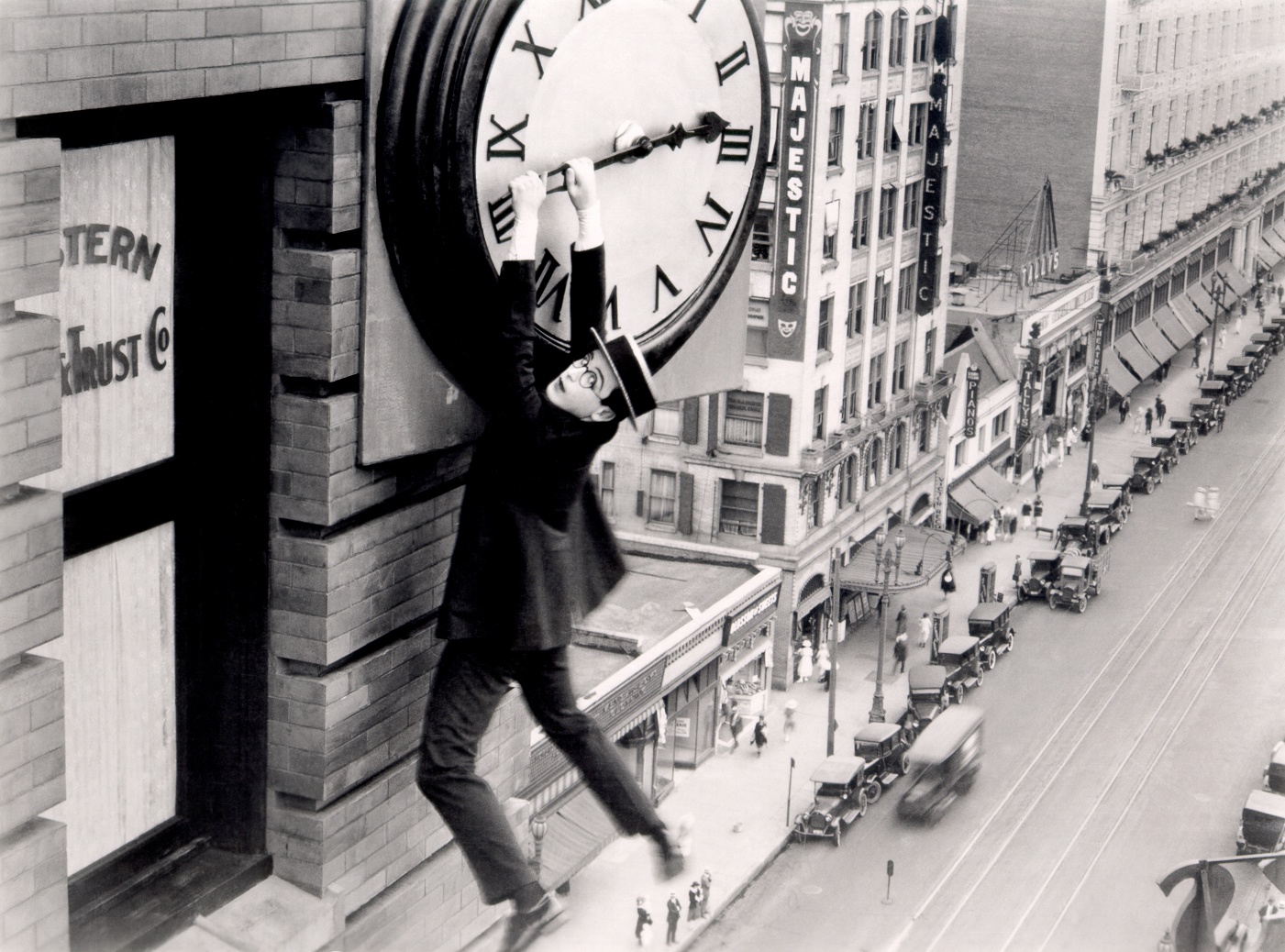
From 'Safety Last': the image everyone remembers.

MONDAY, JULY 11, 2022 / FOR IMMEDIATE RELEASE
Contact Jeff Rapsis • (603) 236-9237 • jeffrapsis@gmail.com

Silent film classic 'Safety Last' on Friday, Aug. 5 at Jane Pickens Theatre

Thrill comedy climaxed by Harold Lloyd's iconic building climb; shown with live music

NEWPORT, R.I.—It's a cinematic image so powerful, people who've never seen the movie instantly recognize it.

The vision of Harold Lloyd hanging from the hands of a huge clock, from the climax of his silent comedy 'Safety Last,' (1923), has emerged as a symbol of early Hollywood and movie magic.

See how Harold gets into his high-altitude predicament with a screening of 'Safety Last,' one of Lloyd's classic comedies, on Friday, Aug. 5 at 7:30 p.m. at the Jane Pickens Theatre and Event Center, 49 Touro St., Newport.

General admission $15; members $13. Tickets available online or at the door.

The screening will feature live musical accompaniment by Jeff Rapsis, a New Hampshire-based silent film musician.

'Safety Last' follows young go-getter Lloyd to the big city, where he hopes to make his mark in business and send for his small town sweetheart.

His career at a downtown department store stalls, however, until he gets a chance to pitch a surefire publicity idea—hire a human fly to climb the building's exterior.

However, when the human fly has a last-minute run-in with the law, Harold is forced to make the climb himself, floor by floor, with his sweetheart looking on.

The result is an extended sequence blending comedy and terror that holds viewers spellbound.

Lloyd, along with Charlie Chaplin and Buster Keaton, is regarded as one of the silent screen's three great clowns.

Lloyd's character, a young go-getter ready to struggle to win the day, proved hugely popular in the 1920s.

While Chaplin and Keaton were always favored by the critics, Lloyd's films reigned as the top-grossing comedies throughout the period.

Silent film at the Jane Pickens Theatre gives today's audiences the chance to experience early cinema as it was intended: on the big screen, with live music, and with an audience.

"Put the whole experience back together, and you can see why people first fell in love with the movies," said Rapsis, who practices the nearly lost art of silent film accompaniment.

Rapsis performs on a digital synthesizer that reproduces the texture of the full orchestra, creating a traditional "movie score" sound.

"Seeing 'Safety Last' with an audience is one of the great thrill rides of the cinema of any era, silent or sound," Rapsis said. "Harold's iconic building climb, filmed without trick photography, continues to provoke audience responses nearly 100 years after film was first released."

Tributes to the clock-hanging scene have appeared in several contemporary films, most recently in Martin Scorsese's 'Hugo' (2011), which includes clips from 'Safety Last.'

See Harold Lloyd's iconic thrill comedy 'Safety Last' (1923) on Friday, Aug. 5 at 7:30 p.m. at the Jane Pickens Theatre and Event Center, 49 Touro St., Newport.

General admission $15; members $13. Tickets available online at www.janepickens.com or at the door. For more information about the JPT Film & Event Center, call (401) 846-5474.

Nearing the top.

CRITIC COMMENTS ON ‘SAFETY LAST’:

"Impossible to watch without undergoing visitations of vertigo, Safety Last's climactic sequence is all it's reputed to be.”
—TV Guide

"Harold Lloyd manages to make the characters sympathetic enough to carry the audience's concern on his journey of crazy stunts and mishaps. One of the best of this era."
—David Parkinson, Empire Magazine

"The climb has both comic and dramatic weight because it is both a thrilling exercise in physical humor and a thematically rich evocation of the pressures men feel to succeed, lest they be viewed as less than a man."
—James Kendrick, Q Network Film Desk

Thursday, July 28, 2022

Stay up late this Saturday, July 30 for midnight screening of 'Dr. Caligari' at Coolidge Corner

Stay awake to see Cesar the Somnambulist in 'The Cabinet of Dr. Caligari' (1920)

I'm looking forward to this weekend's midnight screening of 'The Cabinet of Dr. Caligari' (1920) at the Coolidge Corner Theater in Brookline, Mass.

For those who've never experienced this very important (and very strange) piece of early cinema, I can't think of a better environment in which to do so.

In a theater? Check! With live music? Check! With an audience? Check! 

And finally, the middle of the night? Check and double check!

Really: semi-drowsiness might be the ideal state to appreciate the dream-like visual world in which 'Caligari' takes place. 

So hope to see you at the Coolidge on Saturday, July 30 when the clock strikes 12! More details in the press release below...

*     *     *

'Caligari' takes place entirely in a dream-like visual world.

MONDAY, JULY 25, 2022 / FOR IMMEDIATE RELEASE
Contact Jeff Rapsis • (603) 236-9237 • jeffrapsis@gmail.com

Coolidge to unleash late night silent film horror classic on Saturday, July 30

Midnight screening of breakthrough thriller 'Cabinet of Dr. Caligari' to feature live musical accompaniment

BROOKLINE, Mass.—A creepy silent film regarded as the forerunner of all horror movies will be shown at a midnight screening at the Coolidge Corner Theatre, 290 Harvard St., Brookline, Mass.

'The Cabinet of Dr. Caligari' (1920) will be shown at midnight on Saturday, July 30 as part of the Coolidge's ongoing 'Carnival of Horror' series.

The screening will feature live music by silent film accompanist Jeff Rapsis. General admission is $15.50 per person.
 
Set in an insane asylum, 'The Cabinet of Dr. Caligari,' is considered a landmark in early cinema. Nearly a century after its release, the film still has the capacity to creep out audiences.

"A case can be made that 'Caligari' was the first true horror film, critic Roger Ebert wrote in 2007.

'Caligari,' made in Germany after World War I and directed in expressionist style by Robert Wiene, stars Werner Krauss and Conrad Veidt.

The film employs stylized sets, with abstract, jagged buildings painted on canvas backdrops and flats.

To add to its strange visual design, the actors used an exaggerated technique that employed jerky and dancelike movements.

The movie is also cited as having introduced the surprise "twist" ending to cinema.
 
Conrad Veidt and Werner Krauss, two big names of early German cinema, star in 'Cabinet.'
 
"Silents such as 'Dr. Caligari' are films that first caused people to fall in love with the movies," Rapsis said. "The aim is to present them as they were originally intended to be shown: in a theater, on a big screen, with live music, and with an audience. If you can put all those elements together, these films leap to life."

In scoring 'The Cabinet of Dr. Caligari,' Rapsis plans to augment the traditional orchestral sound with the vocabulary of film music from later eras.

"Because I improvise the music, it's hard to know what will happen until the film actually starts running," Rapsis said.

'Caligari,' a forerunner of the 'film noir' genre, has influenced generations of movie-makers.

A sequel of sorts was released in the 1980s with the film 'Dr. Caligari,' which dealt with the granddaughter of the original Dr. Caligari and her illegal experiments on her patients in an asylum.

The Coolidge Corner Theatre is an independent, nonprofit cinema and cultural institution. Since 1933, audiences in the greater Boston area have relied on the Coolidge for contemporary independent film, repertory, and educational programming.

'The Cabinet of Dr. Caligari' (1920) will be shown with live music at midnight on Saturday, July 30 as part of an ongoing "Carnival of Horror" series at the Coolidge Corner Theatre, 290 Harvard St., Brookline, Mass. General admission $15.50; for more info and to buy tickets, visit www.coolidge.org or call (617) 734-2500.

Wednesday, October 28, 2015

The Halloween home stretch: 'Caligari,'
'The Lodger,' and Chaney in 'West of Zanzibar'

Lon Chaney as 'Phroso the Magician' and companion in 'West of Zanzibar' (1928).

Coming up: one final long weekend of Halloween-themed silent film screenings.

Highlights include accompanying a 35mm print of 'West of Zanzibar' (1928), the lurid Chaney/Browning thriller, on Saturday, Oct. 31, and no less than three screenings of Hitchcock's 'The Lodger' (1927).

But the spooky fun starts tonight with 'The Cabinet of Dr. Caligari' (1920) at Wellesley College, just outside Boston. Screening is at 6:30 p.m. at Collins Cinema in the Davis Museum Complex.

Admission is free; the film is part of retrospective on film-making of Weimar-era Germany. 'Cabinet' is a good choice this close to Halloween—the proto-Tim Burton set design alone is worth seeing this film, which probably seems more creepy today than it did when first released.

The twisted visual landscape of 'Caligari.'

One of the challenges of 'Caligari' is that the film has several instances of the title character ringing a sizable (and seemingly very loud) hand bell to attract attention from passersby in a carnival midway.

So for an accompanist, the question becomes: "Should I try to match the obvious on-screen action by ringing a real bell right there during the screening?"

In the case of Caligari, I do actually ring a bell. Specifically, it's a large clangy brass bell that once belonged to my grandmother. It makes quite a racket, and the cues in Caligari are easy to match, so I go for it.

Likewise in the case of the Keaton short 'The Haunted House,' where the ghost traffic is so heavy, Buster ends up playing traffic cop to control a busy hallway. To do this, he uses a whistle to signal stop and go, and blowing an actual whistle (while keeping the music going) helps punch up the gag, I think.

But if I'm unsure of where the cues might be, or if a sound effect might distract from the on-screen moment, I hold off on matching what are often literally the "bells and whistles."

Why? Because if you're even just a little bit off, it breaks the spell that a successful silent movie screening creates. Or if it's a key dramatic moment, you don't want to rob it of any significance by doing something unexpected in the accompaniment.

Anyway, it's my only screening of 'Caligari' this Halloween season, so come to Wellesley College tonight if you're hankering for a Halloween helping of German Expressionism.

Ivor Novello dressed to kill (really?) in Hitchcock's 'The Lodger.'

Then follows three screenings of Alfred Hitchcock's 'The Lodger' (1927), the title I've focused on for this Halloween cycle, having played for it twice already this month.

Let's see. The schedule looks like this:

• Thursday, Oct. 29, 2015, 7 p.m.: 'The Lodger'; Putnam Arts Lecture Hall, Keene State College, Keene, N.H. There's usually an admission charge for these screenings but I just checked and apparently this one is free and open to the public.

• Friday, Oct. 30, 2015, 7 p.m.: 'The Lodger'; Red River Theatres, 11 South Main St., Concord, N.H.; (603) 224-4600; http://www.redrivertheatres.org/. Great small non-profit venue that specializes in offbeat and independent films that otherwise wouldn't get shown in this part of the world. Admission $10 per person.

• Saturday, Oct. 31, 2015, 8 p.m.: 'The Lodger'; Leavitt Theatre, 259 Main St. Route 1, Ogunquit, Maine; (207) 646-3123; http://www.leavittheatre.com. The season-ending show in a vintage seaside resort one-screen theater that opened in 1923 and has barely changed since. Admission $10 per person.

That's a whole lot of Lodgers. But I think I have some good material in the style of Bernard Herrmann that helps bring out the "Hitchcock" qualities of the film, which can be found throughout this early feature from the director.

For more specifics about each screening, check the "Upcoming Silent Film Screenings" link at upper right.

But there's one more: 'West of Zanzibar' (1928), also on Saturday, Oct. 31.

A screening of the Chaney/Browning silent MGM thriller will open a 12-hour Halloween marathon of feature films, all shown in 35mm, at the Somerville Theatre, 55 Davis Square, Somerville, Mass. The marathon is on Halloween Day and runs from noon to midnight.

From what I understand, the 35mm print of 'Zanzibar' is exceptionally well struck and in great shape. Also, it's very difficult to source 35mm prints of any of the MGM/Chaney/Browning pictures, so this is an extremely rare chance to see 'Zanzibar' in its native film format, projected on the enormous screen of the Somerville Theater's vintage 1914 main house.

It's quite a privilege to do live music for a film as bizarre as 'Zanzibar,' with Chaney playing a magician paralyzed from the waist down and bent on revenge against the man who crippled him and stole his beloved—a 20-year quest that leads to a showdown in the remote jungles of Africa. Classic Tod Browning madness, with no less than Lionel Barrymore in a key role.

Lurid, twisted, dark—and perfect for Halloween.

The marathon program begins at noon with 'West of Zanzibar'; other titles (all in 35mm) include 'Dracula' (1931), 'The Monster That Challenged the World' (1957); 'Seconds' (1966); 'Aliens' (1986); and 'The Lost Boys' (1987). Admission is one price for the whole 12-hour program, with tickets $30 per person.

I urge any classic film buffs in the Boston or New England area to consider making a pilgrimage to the Somerville to experience 'West of Zanzibar' on the big screen in 35mm, as well as the other marathon titles, all under the watchful eye and legendarily exacting standards of head projectionist David Kornfeld. It's an event not to be missed.

And then comes November, which brings silent film gigs in California and Virginia, among other places. More on that after Halloween!

One other thought: I'm always eager for new ways to attract audiences to silent cinema. So the other day, a friend suggested promoting the Chaney film as an inspirational tale for the disabled.

Being differently abled didn't prevent him from realizing his dreams of revenge!

Er—still thinking about that one.

Tuesday, February 17, 2015

A little snow can't slow down
the silent film juggernaut of romance

Not even snowpiles like these in the Boston area could stop silent film!

Pleased to report that we went three for three this weekend.

Despite the latest in a series of snowstorms that are collectively burying New England, all three silent film screenings went on as scheduled.

The Aeronaut on a crowded night. We staged the silent film in the area way in the back.

• A Valentine's Day program at the Aeronaut Brewery in Somerville, Mass. attracted a hardy band of the curious (average age maybe half that of mine) who reacted explosively to Buster Keaton in 'Seven Chances' (1925).

We were set up in an unimproved industrial space off to one side of the brewery/bar, and the choice for screen was a large bedsheet or a blank white wall. (I went with the wall.)

Alas, the Saturday night brewery crowd was noticeably thinner compared to my first visit. Blizzard conditions had taken their toll.

But still, there was a good vibe in the place, which features an eclectic line-up of live entertainment. When I arrived, a small combo (I think it included a sousaphone) was playing an arrangement of one of the Gershwin piano preludes while a young woman did interpretive dance on the brewery floor.

And this was followed by some silent film thing!

But come showtime, people began moving over to where I'd set up the keyboard, speakers, and projector, packing in around it in chairs and tables.

By the time we started, it was a good-sized audience. And, as I soon found out, a very responsive one!

You know it's going to be a fun ride when even the opening sequence (in which Keaton repeatedly fails to propose to his beloved) produces gales of laughter.

And after that, it just never let up. People were really into it. And I didn't ask, but I have to think that most people there had never experienced a silent film that way: with live music, and as part of an audience.

So, as we all discovered, what's old can be new again. And it was very gratifying to see it all come together so successfully.

I have to say, it ranked as one of the best silent film experiences I've had in all the years I've been doing this.

My thanks to Christine Platzek, Ben Holmes, and everyone at the Aeronaut Brewery for taking a chance on silent film. Even in the midst of a blizzard, it worked out great!


• Alas, only about a dozen people showed up for a matinee screening of MGM's 'Love' (1927) on Sunday, Feb. 15 at the Wilton Town Hall Theatre.

And that wasn't surprising, as the region was still digging out from another foot of snow, plus contending with Arctic temperatures and winds of 50 mph.

Theatre owner Dennis Markaverich didn't run his usual Sunday shows at 2 p.m., as no one showed up and he was too busy unburying the theater.

But we went ahead with 'Love' at 4:30 p.m., and it seemed especially fitting that the film starts in a howling blizzard!

This isn't one of the immortal silent classics, which I confided in the small group on hand.

MGM basically took a steamroller to Tolstoy's sprawling novel 'Anna Karenina,' boiling it down to a series of scenes that would give maximum face time to Greta Garbo and John Gilbert.

The fact that they threw out just about all of the novel, and then also changed the conclusion to a happy ending, wasn't a concern to the studio. It was designed with one aim: to sell tickets, which it did.

However, 'Love' was produced at the very height of the silent film era. Also, it was made by MGM, at the time the most technically slick studio in Hollywood.

So despite some shortcomings, it contains a lot of interest—sequences that show silent film at the peak of its eloquence.

In previewing the film, I was struck how several intense "dialogue" scenes (where Garbo and Gilbert speak passionately to each other, at some length) are presented utterly without any intertitles.

It's not like 'Love' avoids intertitles. They're used frequently elsewhere.

But in some places, we're left to just watch the faces and the expressions, even as quite a lot is being said, sometimes quite passionately.

I think this is one key to the unique power of silent film. By not getting the details, we're left to imagine what's being said. And that leaves us free to imagine something more intense and personal, perhaps, than could be concocted by any title writer.

By letting us do the work, if we care to, the film absorbs us and draws us in more closely to the characters and the story.

That this is done in a fairly routine (if high profile) release such as 'Love; shows how pervasive this method of presenting a story had become. As the motion picture matured, filmmakers were pushing the technique of visual story-telling in surprisingly abstract directions.

We followed 'Love' with this. Seems fitting, somehow.

• After 'Love,' I raced down snow-covered highways to the Somerville Theatre (just outside Boston, Mass.) to do live music for 'The Cabinet of Dr. Caligari' (1920).

This screening was part of the annual Boston Sci-Fi Marathon, held every President's Day weekend and now in its 40th year. For 24 hours (yes, straight without a break), about 500 hard-core fans take in a continuous diet of big screen sci-fi flicks of all types—the good, the bad, the very bad, with sometimes even a silent thrown in.

I'd been here before, in 2011, when I did live music for the 1916 version of '20,000 Leagues Under the Sea.' Not sure how 'Caligari' qualifies as sci-fi, but I was thrilled at a chance to do live music for it at the "'Thon," as attendees call it.

One reason is that it's a chance to bring a silent film to life for a large audience that's quite separate from the usual silent film crowd.

Somerville was absolutely buried in snow. But despite a parking ban and no public transit, the "Thon" went on as planned, although the start was pushed back from noon to 4 p.m.

Attendance was strong: I arrived just as the main theater's doors burst open at the intermission of '2001: A Space Odyssey,' and was surprised that the place was packed!

Set-up required me to gingerly step around people who'd camped out (sleeping bags and all) in the area below the stage, but everyone was really nice about it.

'Caligari' was preceded by a Thon tradition: the alien tinfoil hat contest.

And after that, we went right into Caligari, shown in DCP. Projectionist David Kornfeld thought the transfer was too slow, but it seems to flow all right in terms of the music.

By this time, I had been sitting at a keyboard so much in the past couple of days that I carried over a certain fluency I had accumulated. So things went well, even though I had nothing specific prepared for 'Caligari.'

The only special effect was that I brought my grandmother's old brass school bell to ring during the three times that Caligari is seen ringing a bell to get attention for his carnival act.

Great ovation at the end! Hope to do it again in years to come.

And then I went out in the cold to start my car, and the Thon moved on without me.


• Last-minute addition to the schedule: I'm doing music for Abel Gance's 'J'Accuse' (1919) on Sunday, Feb. 22 at 7 p.m. at the Harvard Film Archive, 24 Quincy St., Cambridge, Mass. For more info, please click the link.

I just was asked to do this, so haven't had a chance to prepare much. And I'm leaving for London tonight, returning to Boston the afternoon of the screening.

Cutting it close, I suppose, but I'm game.

And then after that, it's off to the Kansas Silent Film Festival on Feb. 27 & 28 in Topeka, Kansas.

More to come on that!