Showing posts with label Harvard. Show all posts

Sunday, April 14, 2019

Helping out my friends at Harvard, then 'Metropolis' at Plymouth's Flying Monkey

Coming on Thursday, April 18: László Moholy-Nagy, American, Still from Lightplay: Black-White-Gray, 1930. © Artists Rights Society (ARS), New York/VG Bild-Kunst, Bonn.

I sometimes joke that I'm the world's most obscure superhero: SILENT FILM ACCOMPANIMENT GUY, ready to respond at a moment's notice to aid any silent film in need of live music.

(Still waiting for the call from Marvel Comics...)

But something like that actually happened last week when I was contacted by the Harvard Museums at Harvard University, where they're in the midst of an ambitious look at the Bauhaus school of design that flourished in Weimar-era Germany.

The program includes a series of film screenings, and turns out a program of short experimental movies scheduled for Thursday, April 18 turned out to be all silent!

Oh no! What to do?

So the call came in to SILENT FILM ACCOMPANIMENT GUY, who immediately agreed to rush to the rescue and create soundtracks for all the various clips.

And as incentive, I was told "...our resident piano is an ebony Bechstein model C, serial number 177972, from 1985 and approximately 7’4” in length."

Wow! A chance to work with an instrument of that caliber is not to be missed. (And it'll be a reminder that I have to get my own piano tuned once again after a long winter of pounding.)

A view of the Harvard Art Museums, which resulted when several adjacent galleries were renovated a few years back and put under one roof. It's next door to the Harvard Film Archive, where I regularly accompany silent films.

If you're interested in attending, the program is free! It's Thursday, April 18 at 6 p.m. at the Harvard Museums, 32 Quincy St., Cambridge, Mass. Here's a link to more details.

Just as other superheros must occasionally engage in mind-boggling feats of strength, this particular show prompted SILENT FILM ACCOMPANIMENT GUY to do some heavy lifting, schedule-wise.

To accommodate Harvard, it was necessary to shift a scheduled screening of Metropolis from that night to another date.

And so Metropolis, originally set for Thursday, April 18 at the Flying Monkey Moviehouse and Performance Center in Plymouth, N.H., is now running one week later, on Thursday, April 25.

(And how appropriate is this "superhero" theme? Superman's city = Metropolis!)

Showtime is 6:30 p.m. for Fritz Lang's epic futuristic quasi-theological cinematic fantasy. I've developed some strong material for this incredible film. It's 2½ hours long and a real workout, but I love scoring it.

Here's the press release with a lot more info. See you there!

An original poster for 'Metropolis,' screening on Thursday, April 25 at the Flying Monkey in Plymouth, N.H.

TUESDAY, APRIL 9, 2019 / FOR IMMEDIATE RELEASE
For more info, contact: Jeff Rapsis • (603) 236-9237 • jeffrapsis@gmail.com

Restored classic film 'Metropolis' to screen at Flying Monkey on Thursday, April 25


Landmark early sci-fi fantasy epic, with half-hour of rediscovered footage, to be shown with live music

PLYMOUTH, N.H.—A silent film hailed as the grandfather of all science fiction fantasy movies will be screened with live music this month at the Flying Monkey Moviehouse and Performance Center.

'Metropolis' (1927), an epic adventure set in a futuristic world, will be shown on Thursday, April 25 at 6:30 p.m. at the Flying Monkey, 39 Main St., Plymouth, N.H. General admission is $10.

Original music for 'Metropolis' will be performed live by Jeff Rapsis, a New Hampshire-based composer and silent film accompanist who performs at venues around the nation.

(The screening was originally scheduled for Thursday, April 18, but has been moved to Thursday, April 25 due to a scheduling conflict.)

'Metropolis' (1927), regarded as German director Fritz Lang's masterpiece, is set in a society where a privileged elite pursue lives of leisure while the masses toil on vast machines and live in poverty.
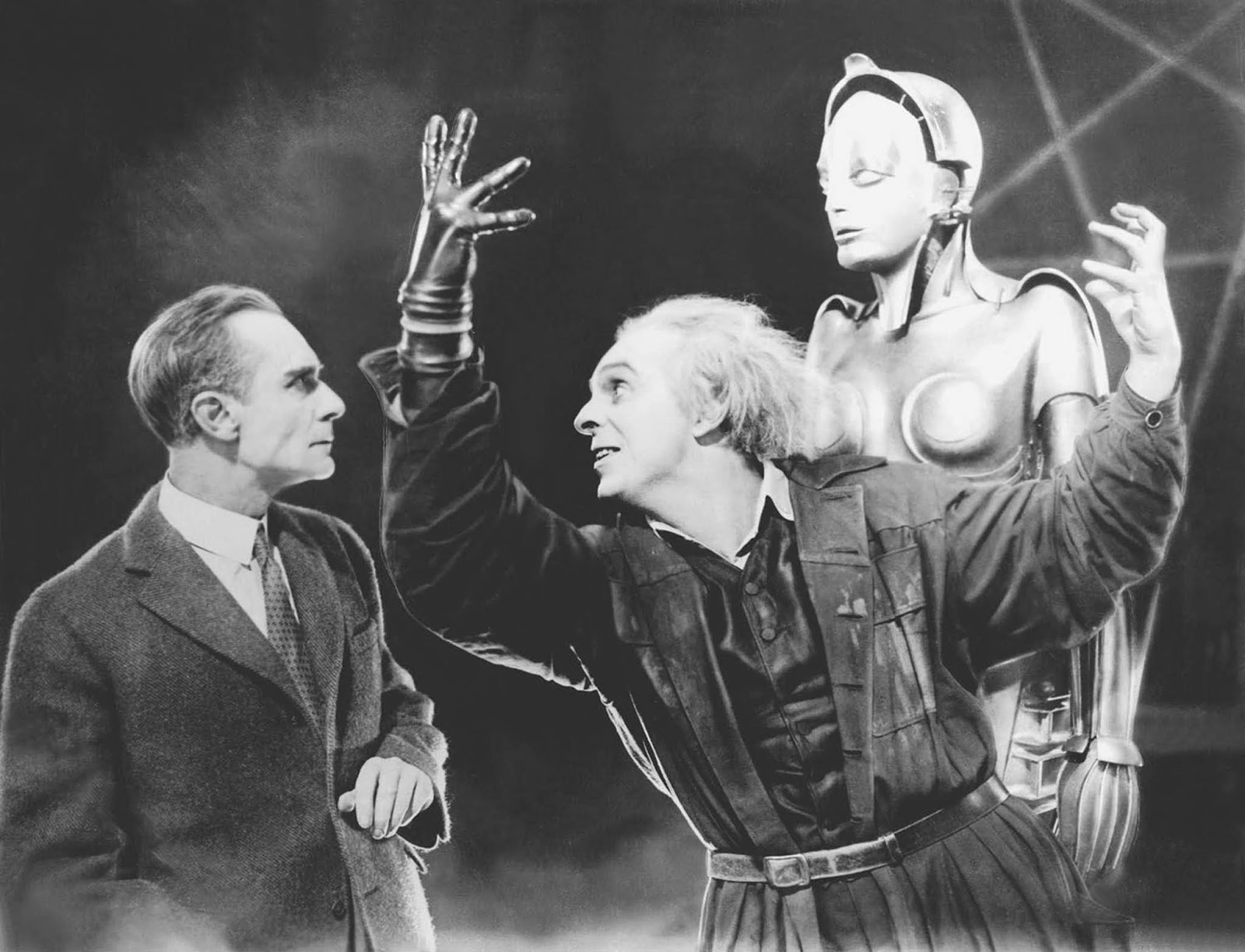
From 'Metropolis': Man meets Machine.

The film, with its visions of futuristic factories and underground cities, set new standards for visual design and inspired generations of dystopian fantasies from Ridley Scott's 'Blade Runner' to Terry Gilliam's 'Brazil.'

In reviving 'Metropolis' and other great films of cinema's early years, the Flying Monkey aims to show silent movies as they were meant to be seen—in high quality prints, on a large screen, with live music, and with an audience.

"All those elements are important parts of the silent film experience," said Rapsis, who will improvise an original live score for 'Metropolis' on the spot. "Recreate those conditions, and the classics of early cinema leap back to life."

In 'Metropolis,' the story centers on an upper class young man who falls in love with a woman who works with the poor. The tale encompasses mad scientists, human-like robots, underground spiritual movements, and industrial espionage, all set in a society divided between haves and have-nots.

The version of 'Metropolis' to be screened at the Flying Monkey is a newly restored edition that includes nearly a half-hour of missing footage cut following the film's premiere in 1927. The lost footage, discovered in 2008 in an archive in Argentina, has since been added to the existing 'Metropolis,' allowing plot threads and characters to be developed more fully.

When first screened in Berlin, Germany on Jan. 10, 1927, the sci-fi epic ran an estimated 153 minutes. After its premiere, the film's distributors (including Paramount in the U.S.) drastically shortened 'Metropolis' to maximize the film's commercial potential. By the time it debuted in the U.S. later that year, the film was only about 90 minutes long.

A scene from 'Metropolis.

Even in its shortened form, 'Metropolis' became a cornerstone of science fiction cinema. Due to its enduring popularity, the film has undergone numerous restorations in the intervening decades in attempts to recover Lang's original vision.

It was widely believed that this would be the most complete version of Lang's film that contemporary audiences could ever hope to see. But, in the summer of 2008, the curator of the Buenos Aires Museo del Cine discovered a 16mm dupe negative of 'Metropolis' that was considerably longer than any existing print.

It included not merely a few additional snippets, but 25 minutes of "lost" footage, about a fifth of the film, that had not been seen since its Berlin debut.

The discovery of such a significant amount of material called for yet another restoration, a 2½-hour version that debuted in 2010 to widespread acclaim. It's this fully restored edition that will be screened at the Flying Monkey.

" 'Metropolis' stands as an stunning example of the power of silent film to tell a compelling story without words, and reach across the generations to touch movie-goers from the real future, which means us," said accompanist Jeff Rapsis, who provides live music for silent film screenings throughout New England.

To accompany a silent film, Rapsis uses a digital synthesizer to recreate the texture of the full orchestra. The score is created live in real time as the movie is screened. Rather than focus exclusively on authentic music of the period, Rapsis creates new music for silent films that draws from movie scoring techniques that today's audiences expect from the cinema.

Other upcoming silent film/live music presentations at the Flying Monkey include:

• Thursday, May 9, 6:30 p.m.: 'Sherlock Holmes' (1916) starring William Gillette. Recently discovered in France after being lost for nearly a century, see this original 1916 adaptation of Sherlock Holmes stories as performed by William Gillette, the actor who created the role on stage and performed it more than 1,000 times. With the blessing of Sir Arthur Conan Doyle, Gillette's play combines elements of four classic short stories into a memorable battle with arch-nemesis, Prof. Moriarty.

• Thursday, June 20, 6:30 p.m.: 'Safety Last' (1923) starring Harold Lloyd. The iconic image of comedian Harold Lloyd dangling from the hands of a downtown clock is only one small piece of a remarkable thrill comedy that has lost none of its power over audiences. See it for yourself on the big screen and with an audience.

The restored 'Metropolis' will be shown on Thursday, April 25 at 6:30 p.m. at the Flying Monkey Moviehouse and Performance Center, 39 Main St., Plymouth. General admission is $10. For more info, visit www.flyingmonkeynh.co or call (603) 536-2551.

For more information on the music, visit www.jeffrapsis.com.

CRITIC'S COMMENTS on ‘METROPOLIS’

“'Metropolis' does what many great films do, creating a time, place and characters so striking that they become part of our arsenal of images for imagining the world.”
—Roger Ebert, 2010, The Chicago Sun-Times

“If it comes anywhere near your town, go see it and thank the movie Gods that it even exists. There’s no star rating high enough.”
—Brian Tallerico, Movieretriever.com

Monday, June 25, 2018

Next up: Summer silent series at the seaside, plus Harvard Magazine silent film music story—and chalk up another great escape for Houdini!


Wow! I finally made it into Harvard! The magazine, that is.

Yes, the current issue of Harvard Magazine includes an in-depth look at the art of silent film accompaniment as practiced at the Harvard Film Archive.

In chronicling the "surprisingly diverse ecosystem" of silent film music, writer Sophia Nguyen was nice enough to include comments by yours truly along with accompanists Robert Humphreville and Martin Marks.

All of us accompany silent film programs at the archive—those on the regular schedule, and sometimes for classes that use silent film in their curriculum.

The story is here.

Me, I'm thrilled to see any attention paid to this little corner of the performing and visual arts.

So thank you, Sophia, for such a great job capturing a slice of this sub-set of the Harvard cultural scene, and serving it so artfully to the magazine's audience.

Next up for me: Thursday is opening night at the Leavitt Theatre, a seaside resort moviehouse where films have been shown every summer since 1923.

The fare remains mostly first-run blockbusters. But each summer, the Clayton family brings me in for a series of silent films with live music, both as a novelty and to honor of the theater's roots as a silent moviehouse.

Amazingly, the building remains virtually unchanged since the theater opened in the 1920s. Under each of the wooden seats, you'll find a loop of thick-gauge wire to give gentlemen a place to stow their hats.

For those wondering, yes, the Leavitt did install digital projection a few years ago, although they maintain one of their 35mm projectors in place just in case.

The Leavitt's original 1923 interior, still intact in 2018. The angle doesn't show the steeply-raked floor, which results in near-stadium seating. Notice the proscenium arch is sized for the original silent film 1:1.33 aspect ratio.

Opening night for the 2018 season is Thursday, June 28 with a screening of Buster Keaton's great comedy 'The Navigator' (1924), plus a Buster short or two.

More details about this screening, as well as the rest of the summer's schedule, are in the press release below.

For now: speaking of hats, I wanted to tip mine to Mr. Harry Houdini, who drew an unexpectedly large crowd to the Town Hall Theatre yesterday (Sunday, June 23) for a screening of 'Haldane of the Secret Service,' his 1923 adventure thriller.

I think the gloomy weather (cloudy, sticky, periodic showers) helped. But in speaking with attendees (and many first-timers), there's no doubt 'Houdini' maintains his magnetism.

It's a continuation, no doubt, of his original appeal.

Consider: our program included newsreel footage of Houdini doing escape routines in various cities—wriggling out of straitjackets while suspended by his feet high above the ground.

Each one was accompanied by shots of enormous numbers of people (all the men wearing hats) gawking at Houdini's exploits. Then and now, the man just knew how to draw a crowd!

About 'Haldane': for me, this was yet another example of previewing a picture and wondering how any audience would be able to follow the action, or take it seriously.

But on the screen and in front of an audience, 'Haldane' came together and came to life! It made total sense, and moments that seemed slow and dull when viewed alone were instead full of edge-of-your-seat suspense.

So chalk up another great escape for Houdini: even when imprisoned by a mediocre film, he managed to break out in triumph!

Hope to see you by the sea in Ogunquit this Thursday. Here's the press release:

* * *


WEDNESDAY, JUNE 13 / FOR IMMEDIATE RELEASE
For more info, contact: Jeff Rapsis • (603) 236-9237 • jeffrapsis@gmail.com

Leavitt Theatre in Ogunquit to host summer silent film series with live music


Classic comedies, action-packed dramas highlight schedule; featured stars include Buster Keaton, Charlie Chaplin

OGUNQUIT, Maine—Classics of the silent film era will return to the big screen starting next month at Ogunquit's Leavitt Theatre, which will host a season of vintage cinema with live music in the historic facility.

The series gives area film fans a chance to see movies from the pioneering days of cinema as they were intended to be shown—on the big screen, with an audience, and accompanied by live music.

Most screenings will be weeknight evenings and will begin on Thursday, June 28 with 'The Navigator' (1924), a classic silent comedy starring Buster Keaton

The series runs through October, concluding with a Halloween screening of F.W. Murnau's chilling silent version of 'Faust' (1926) on Saturday, Oct. 27.

Admission for each screening is $10 per person.

A total of five programs will be offered in the series. Films will include a program of Charlie Chaplin's great short comedies and "Her Sister From Paris" (1925), a sophisticated romantic comedy starring Ronald Colman and Constance Talmadge.

"These are the films that first made people fall in love with the movies, and we're thrilled to present them again on the big screen," said Max Clayton, the Leavitt's manager.

The Leavitt, a summer-only moviehouse, opened in 1923 at the height of the silent film era, and has been showing movies to summertime visitors for nine decades.

The silent film series honors the theater's long service as a moviehouse that has entertained generations of Seacoast residents and visitors, in good times and in bad.

"These movies were intended to be shown in this kind of environment, and with live music and with an audience," Clayton said. "Put it all together, and you've got great entertainment that still has a lot of power to move people."

Live music for each program will be provided by Jeff Rapsis, a New Hampshire-based performer and composer who specializes in scoring silent films.

In accompanying silent films live, Rapsis uses a digital synthesizer to recreate the texture of the full orchestra. He improvises the music in real time, as the movie is shown.

In scoring a movie, Rapsis creates music to help modern movie-goers accept silent film as a vital art form rather than something antiquated or obsolete.

"Silent film is a timeless art form that still has a unique emotional power, as the recent success of 'The Artist' has shown," Rapsis said.

Keaton boils an egg in 'The Navigator' (1924).

First up in the Leavitt's series is Buster Keaton in 'The Navigator' (1924) on Thursday, June 28 at 7 p.m.

Although Keaton never smiled on camera, his comedies rocked theatres with laugher throughout the 1920s.

In 'The Navigator,' Buster sets sail in a comedy about a spoiled rich couple marooned all alone on a drifting ocean liner.

Keaton, famous for visual humor and mechanical gags, acquired a real ocean liner to create 'The Navigator,' turning the vessel into one of the biggest comedy props in movie history.

The film, a smash hit, helped establish Keaton as one of the major comedians and stars of the silent film era.

Other programs in this year's Leavitt silent film series include:

• Wednesday, July 4, 7 p.m.: 'The Yankee Clipper' (1927) starring William Boyd. Two tall ships race from China to Boston to win a lucrative tea contract. Sea-going adventure set in the heyday of the fast "clipper" ships. Starring William Boyd, who would later go on to play beloved sidekick 'Hopalong Cassidy' in innumerable Westerns.

• Wednesday, Aug. 15, 7 p.m. 'Charlie Chaplin's Best Short Comedies.' A selection of classic short comedy films that helped propel the Little Tramp to worldwide fame and rocked the globe with laughter. See the movies that paved the way for Chaplin to go on to make later masterpieces such as 'The Gold Rush' and 'City Lights.'

• Wednesday, Sept. 12, 7 p.m. 'Her Sister From Paris' (1925) starring Ronald Colman, Constance Talmadge. The scene: Europe. The cast: Rich people. Get swept off your feet by not one but two privileged ladies, both played by amazing actress Constance Talmadge, in this effervescent battle-of-the-sexes comedy.

• Saturday, Oct. 27, 7 p.m.: 'Faust' (1926) directed by F.W. Murnau. Just in time for Halloween, our annual "Chiller Theatre" presentation! Oscar-winning actor Emil Jannings stars in F.W. Murnau's terrifying version of the classic tale. A visual tour de force, full of creepy characters and frightening images.

Buster Keaton's 'The Navigator' (1924) will lead off this season's silent film series on Thursday, June 28 at 7 p.m. at the Leavitt Fine Arts Theatre, 259 Main St. Route 1, Ogunquit, Maine; (207) 646-3123; admission is $10 per person, general seating. For more information, visit www.leavittheatre.com.

Wednesday, February 25, 2015

Thoughts on Able Gance's 'J'Accuse';
then off to the Kansas Silent Film Festival


February, a short month, has felt even more abbreviated this time around due to a packed calendar, a multitude of performances, a trip to London, way too much snow to shovel, and lots of other distractions.

And now I'm fighting a cold as I prepare to leave tomorrow for the Kansas Silent Film Festival, to be held on Friday & Saturday, Feb. 27-28 at Washburn University in Topeka, Kansas.

I'm reminded of the Chinese proverb that goes like this: 寧為太平犬,不做亂世人. I'm told it's translated as “Better to be a dog in a peaceful time than be a man in a chaotic period.”

All I can say is, "Woof, woof!"

But out of chaos can come extraordinary things. And into that category I must put a screening of 'J'Accuse' (1919) this past Sunday night at the Harvard Film Archive.

The film, a three-hour Able Gance epic, was part of the HFA's ongoing series exploring World War I as depicted in the movies.

I was thrilled to be asked to accompany 'J'Accuse,' a film I'd never done before. But the screening happened to be on the same day I was scheduled to return from London.

Was it wise to try accompanying a three-hour epic after just getting in from a trans-Atlantic flight? Do you think I even asked that question?

Programmer David Pendleton was a bit dubious about bringing me in under the circumstances. But let me do it, and I'm glad he did!

However, getting to the HFA on time became a worry when we became stuck for more than an hour on the tarmac at Heathrow in London due to a baggage issue.

Stuck on the tarmac at Heathrow's Terminal 5.

We arrived in Boston just before 3 p.m.—more than an hour late. To get back home to New Hampshire and get my digital keyboard, I had to make a 3:25 p.m. bus. Standing in a long slow-moving line for customs, I figured I'd missed my ride. So I was already mentally preparing to head over directly to Harvard and try my best using their acoustic piano.

But by some miracle, I made the bus, got home, loaded the synthesizer and gear, and then drove an hour back down to Boston, arriving at the HFA just as the prior screening was finishing up.

I don't know if this steeplechase-like journey was a contributing factor, but I felt the music I came up with for 'J'Accuse' was very satisfying and effective.

I used two basic themes: one new, but based on the same chord structure as 'When Johnny Comes Marching Home,' and another that I created last year for a screening of the Italian epic 'Cabiria' (1914).

Not having seen the film, I was surprised a few times by Gance's rapid cutting and unexpected transitions. But the film was easy to follow and everything came together quite well, I thought. There were some big moments and I think I caught most of them.

One handicap I was working under was that in London, I had caught a cold. And so on the flight home, my ears got all screwed up. When we landed in Boston, my ears did not get un-screwed up, and so it was difficult to hear what I was doing in full fidelity.

And it didn't help that somewhere in the middle of Part 1, we lost one of the output channels. Thankfully, projectionist John Quackenbush was able to restore the channel for the remainder of the film.

Able Gance (right) on location shooting 'J'Accuse.'

So could I have done a better job if I'd spent a lot of time preparing? Or if I hadn't been on an eight-hour flight? Maybe. But between you and me, I'm not really sure.

Sometimes circumstances conspire so that everything comes together in a certain way. In the case of 'J'Accuse,' the experience began way back in 1919, when Abel Gance made the film.

In contrast, my contribution was all at the last minute, and in real time and under less-than-optimum circumstances. Not only had I not seen the film, but was accompanying it after a long trans-Atlantic flight that same day.

So it was a unique combination of something made long ago and something being made right in the moment, never to be repeated exactly the same ever again.

And that's one of the things that I think will help the art form of silent film remain of interest: the films themselves may not change, but the music performed with them can differ every time.

Tomorrow morning it's off to my 16th consecutive annual visit to the Kansas Silent Film Festival, held each year at this time on the campus of Washburn University in Topeka, Kansas.

Just as February has gone by fast, I can't believe I've been present at this event for enough years now for a newborn to get a driver's license.

I return for many reasons, to the point where it's really become automatic. In February, some people in New England escape to Aruba. I escape to Topeka.

I'm really looking forward to this year's edition because Jon Mirsalis is being brought in as guest accompanist and speaker.

I admire Jon's scoring technique and always learn stuff when I get to hear him play live. What a treat to have him doing music for several features, including part of Griffith's 'Birth of a Nation' (1915) and 'The Seahawk' (1924).

Full report afterwards...and then it's on to a busy March: multitudes of screenings, a trip to Cinefest in Syracuse, N.Y., and probably lots more snow to shovel before this winter is over.

"Woof, woof!" indeed.


Sunday, November 9, 2014

Some good news, a little bad news,
and then heading off to San Francisco

The good news: I survived my "three films in one day" marathon on Sunday, Nov. 2.

But the bad news is that I haven't had time to catch my breath since.

And then on Thursday, Nov. 6, I catch a plane to San Francisco, where I'll do music for a program highlighted by Mary Pickford's 'The Little American' (1917).

So here's a quick report on recent film screenings and a look at what's coming up.

Betty Bronson as Peter Pan, who landed at the Bedford (N.H.) Public Library on Sunday, Nov. 2.

• Sunday, Nov. 2: 'Peter Pan' (1924) at the Bedford (N.H.) Public Library. Fun to do a silent film screening right in your own hometown. I was introduced by Paul Bordeleau, a local legend who's performed for decades and taught generations of students.

I don't know how old Paul is, but I do know he's a D-Day veteran, so he must be at least in his mid-80s. But he's sharp as a tack and still spry enough to carry audio equipment out to my car. He drives everywhere. Age doesn't seem to have slowed him up at all.

It's only a guess, but Paul's involvement in music must be a factor in how active he continues to be. That's a good reason to keep doing silent film accompaniment—to forestall my own descent into decrepitude.

About the film: the audience for this "family friendly" screening was a little short on actual children. But those that attended did a stellar job in the audience participation part of the program, where Peter begs the audience to save Tinkerbell by clapping. Tinkerbell made it, so gold stars for everyone!

And I've often wondered: Did the filmmakers prepare an alternate version of this scene in which a lack of audience response causes our favorite fairy to bite the fairydust?

Tinkerbell doesn't have much to do after this scene, so it wouldn't have really hurt the film. Would have made things just a little more interesting.

A scene from Fritz Lang's 'The Wandering Image' (1920), which for this screening might have been retitled 'The Wandering Accompanist.'

• Sunday, Nov. 2: 'Four Around A Woman' (1921) and 'The Wandering Image' (1920), both directed by Fritz Lang, at the Harvard Film Archive. A double bill of very obscure early Lang efforts, both shown in 35mm prints, illustrated the pitfalls of preparation.

First up was 'Four Around A Woman,' a title that I'd previewed only once, and found it didn't make a lot of sense to. Because I wasn't too inspired, I didn't spend a lot of time developing original material.

'The Wandering Image' followed. With extensive Bavarian Alps location shooting (a rarity for Lang), I responded much more readily to this flick. So, to go along with the expansive landscapes, I plotted out an ambitious soundscape for the picture, making simultaneous use of my digital synthesizer and the hall's Yamaha grand piano.

So come screening time, guess which score went well, and which was a mess? Of course the completely unplanned 'Woman' music fell together perfectly, while the 'Image' score was an avalanche of weak moments and missed opportunities that never quite jelled.

Maybe there's a lesson in that. But the first film, 'Four Around A Woman,' surprised me in that when seen on the big screen and with an audience, it seemed to make perfect sense! Musical themes for characters and situations came easily, and it all built nicely to a melodramatic climax.

With 'The Wandering Image,' it was more like 'The Wandering Accompanist,' as nothing I did seemed to work very effectively with what was happening on screen. And I kept botching the notes when I reached over to get the big bass drum/cymbal sound for lightning strikes, etc.

Part of this might be the result of 'Wandering Image' being my third film of the day, and I'm perfectly willing to admit that at some point an accompanist is going to run out of gas. I might just been tired.

But I also take it as yet another example of how just showing up and going with it seems to be a pretty good strategy for my style of playing. Call it the "Woody Allen School of Accompaniment" after his observation that 90 percent of life is showing up.

Not quite Our Gang: A scene from 'I Was Born, But...' (1932), a silent from Japanese director Yasujiro Ozu.

• Tuesday, Nov. 4: Two days later, it was back to Harvard to accompany an afternoon screening of 'I Was Born, But...' (1932), a film from Japanese director Yasojiro Ozu.

I'd never encountered Ozu's work before this: a delicately observed portrait of two young brothers who discover that their father is not "someone important," but a company salaryman.

It's not all comedy, but the tone is light enough to justify a score that was very different from what I usually do. Using a few simple melodies and a synthesizer setting that blended woodwinds and the sound of a plucked harp, which I think evoked a kind of child-like wonder throughout the film.

Also I avoided the clichéd sound of fifths played on a pentatonic scale, which I've sometimes heard referred to as "chopsticks" music. Tong War, anyone?

Instead, I built the score using a modal scale that incorporated a sharped 4th and a flatted 7th, which sounded vaguely Asian, and also worked in a lot of bright harmonies: chords with several notes of the scale close together all at once.

I was really pleased with how it came out. No big musical gestures, just a modest running accompaniment that I hope evoked the world Ozu was trying to depict.

The course is taught by Prof. Adam Hart, who afterwards said he thought the music for "I Was Born, But..." was the best of what I did for his class. Thank you, Adam! I completely agree!

Me banging the hell out of my Korg synthesizer back in 2010.

• Technical issues: One nice thing about the recent Harvard screenings is that I'm now able to plug my synth output directly into the theater's sound system. It really sounded great, so one less opportunity to stress out my aging speaker/amps.

However, this past weekend I did acquire a second Korg keyboard as a back-up for my 13-year-old machine, which is literally falling apart.

It's the exact same model as mine: a Korg Triton LE with the full 88 keys. But it's much newer and much cleaner , as it has been an indoor Korg.

I got it from a nice guy in Westerly, R.I. who was selling it on Craigslist. When I fit saw it, it was like my old bang-ed up machine had discovered the synthesizer fountain of youth! It was reborn!

Haven't had a chance to really play with it. But as soon as I can check it out thoroughly, the trusty old Korg will be relegated to back-up status, and the new Korg will start being hauled around to venues hither and yon.

I'll eventually get around to deciding on a totally new synth: probably some kind of Kurzweil. But I haven't been satisfied with the keyboard feel of what I've tried out so far, so we'll see.

In the meantime, I at least have a back-up if one or the other of my fleet of aging synthesizers finally shits the bed, if you'll forgive me using a technical term.

The next piece of equipment I really need are new speakers for venues that do not have adequate house sound systems. The two old Rolands I drag around have been great, but they're literally falling apart, and in some ways they're clearly not reliably handling the full output of the synth.

But as with the keyboard, I've yet to find anything quite like my Rolands, which I understand are not made anymore.

It's just like what happens to me with shoes: as soon as I find a style I like, they get discontinued!

Anyone know any speakers for sale?

Wednesday, October 22, 2014

Coming out: Intimate details of
my first bi-keyboardal experience

The set-up at Harvard University's Carpenter Center for a class screening on Tuesday, Oct. 21.

Once you go bi-keyboard, you can't go back.

That's what I discovered this week at Harvard University's Carpenter Center, where I did live music for a class screening of two silent films.

On the program: the Epstein/Buñuel version of 'The Fall of the House of Usher' (1928) and also 'The Smiling Madame Beudet' (1923).

For 'Usher,' I used strings exclusively, augmented by an actual clangy school bell for some key images. I thought it held together well.

In the unexpected challenge department, the Harvard Film Archive's 35mm 'Usher' print turned out to be a French edition with no English subtitles.

So instructor Adam Hart did his best to translate on the fly, which required me to tone down the music each time so he could be heard.

But it was the seductive 'Smiling Madame' who led me to my first bi-keyboard experience.

Unplanned, of course, as all the best adventures seem to be. But it happened, and here's how:

The 'Madame Beudet' film frequently references a performance Gounod's 'Faust.' So for the score, I figured on using the opera's famous waltz in a full orchestral texture throughout the movie, evolving it as the story proceeded.

But early on, the wife character is seen playing dreamy music on a living room piano. (Later, we see the actual sheet music: it's Debussy's "Jardins sous la Pluie," or "Gardens in the Rain.")


Yes, I could evoke the impressionistic feel of this piece (whole tone scales, etc.) on the synthesizer, no problem. (In other words, fake it.)

But right next to me was the Carpenter Center's big Yamaha grand piano. And I couldn't resist the idea of using an acoustic piano for scenes of when the family upright gets played.

It took some finagling to get the big grand positioned so that I could reach it (and its pedals) quickly, and also so the keyboard would be lighted from the screen. (I didn't want to have a light on all during the film just so I could use the piano for a few moments.)

Another view of my set-up, this time showing the screen.

Turned out the synth and the piano were exactly in tune. So, without having to modify the synth's pitch, I could play both instruments together if I wanted to. Which I did.

It took a little getting used to, but I found playing two keyboards, one on either side of me, wasn't impossible.

It was actually kind of fun to mix sustained synth chords to back a melody played with staccato piano notes, or vice versa.

I felt like bandleader Paul Shaffer on the David Letterman show, hemmed in by black and white keys all around me!

Now all I have to do is shave my head.

I found that by straddling the piano bench, I could even use the sustain pedals for each keyboard at the same time. Flexibility exercises would have helped on this.

So when Madame Beudet is seen playing the piano (as at left), the score including the sound of a real piano, even if it was faux Debussy. (Faux sounds so much better than fake. Maybe because it's French.)

And when Monsieur Beudet mocks his wife's preference for Debussy by banging on the family piano—well, I was ready for that, too. I specialize in banging.

So it worked out quite well. And now, when asked to accompany films at Harvard, I'm going to be on the prowl for opportunities to layer in acoustic piano with a synth background, or vice versa.

And what if I also bring along my bass tuba? It may or may not be for a French film, but I can't help but think this combo would be a "menage a trois."

P.S. Wherever there's a piano, there's usually a piano bench. Most piano benches come with a storage space that can be accessed by lifting the hinged seat, somewhat like opening a treasure chest.

And like a treasure chest, you never know what you'll find in the world's piano benches.

I've found everything from tennis balls to sheet music that once belonged to an elderly acquaintance who had died more than a decade ago.

So from now on, I'm taking it upon myself to document to contents of the piano benches I encounter, starting with the one at Harvard University's Carpenter Center.

Think of it as a low-rent version of Geraldo opening Al Capone's safe.

The bench itself clearly contained items of some heft. Upon opening it, I found...


...two large Boston phone directories from 2008-9!

Join us next time for another episode of "Piano Bench Mysteries."

Finally, a high culture alternative to reality television!

Tuesday, October 21, 2014

In which I get into Harvard University;
plus reviews, radio interviews, and more

Phyllis Hart stars in 'Chicago' (1927), a silent film that got a recent thumbs-up from a college newspaper.

Some great Halloween screenings coming up, but first a few updates from the present:

• An unexpected review: I've just found a wonderful review of our screening of the silent film version of 'Chicago' (1927) earlier this month at the Flying Monkey Moviehouse and Performance Center up in Plymouth, N.H.

It's by Sarah Liebowitz of 'The Clock' (the student paper of Plymouth State University) and I think she did a great job capturing the spirit of the film and its ability to reach audiences today, even those unfamiliar with silent cinema.

Me, I'm the choir. I certainly believe in the timeless power of silent film. But it's really heartening and encouraging to seed others discover this on their own.

Thank you for making my day, Sarah. If you come to 'Phantom of the Opera' at the Monkey later this month, please stop by to say hi!

The back end of the Carpenter Center at Harvard, including the doors through which I lug my digital synthesizer and sound gear.

• Playing at Harvard: I continue the head-spinning experience of going down to Harvard University to do live music for a variety of silent film screenings. I've done three in the past few weeks, and three more are coming up, including one later this afternoon.

Why head-spinning? Because as music-crazed teenager in Nashua, N.H., I was immersing myself in material such as Igor Stravinsky's Charles Elliot Norton Lectures at Harvard, and so always thought of the place as a citadel of American musical culture.

I never got to attend, of course, and later shelved my musical ambitions for the word game. So I never expected, all this time later, to be coming down to campus and playing my own stuff where the like of idols such as Leonard Bernstein and Elliot Carter and Aaron Copland and John Adams (the composer, and the founding father) once hung out.

It's a great honor, a real satisfaction, and a genuine thrill. 'Nuf said. (But I want to thank David Pendleton of the Harvard Film Archive, Heidi Bliss of Harvard's Department of Visual and Environmental Studies, and everyone else who has played a part in this adventure so far.)

The screenings take place at the Le Corbius-designed Carpenter Center in an environment that's pretty luxurious compared to the town halls where I often ply my trade. In a real plus for silent film, the booth is equipped with 35mm projectors that can run variable speed! Also, in an unheard-of luxury, able projectionist Clayton Mattos will often check with me (before and during a screening) about a film's running speed.

A classier front-end view of the Carpenter Center, the only structure in North America designed by Le Corbius, the 20th century oracle of architectural modernism (and big fan of concrete.)

Last Wednesday night, I accompanied 'The Big Parade' (1925) for a class taught by Harvard Prof. Tom Conley. The print was the Harvard Film Archive's very own gorgeous 35mm print, and the screening was open to the public, so we had a nice turnout.

Because it was 'The Big Parade,' I pulled out all the stops, bringing down the digital synthesizer and staging what I thought was a suitable soundtrack to scenes of World War I trench fighting. (In other words, KABOOM!)

And, despite my need for a bathroom break just when the soldiers were being called up to the front, it was one of those magical screenings where a film seems to completely absorb an audience.

Even better, it was not the usual silent film crowd, but a mix of people who may not have been expecting the experience that King Vidor and company had planned for them nearly a century ago.

I often say silent film is about the big emotions, as demonstrated here by John Gilbert and Renee Adoree in 'The Big Parade.'

I have to admit I was pleased how most of the score came out. I think I hit all the big moments, and was especially happy at how the well-known "departure" sequence came together, with Renee Adoree hanging onto the truck taking John Gilbert to the front. And I found myself quite overcome (SPOILER ALERT!) during the final sequence, when the pair are finally reunited.

So after "The End," despite three hours at the keyboard, I couldn't help but stand up and thank everyone for helping to collaborate in bringing 'The Big Parade' to life, and encourage them to understand that to really experience the full power of silent film, this was the way to do it: in a theater, on the big screen, with live music, and with an audience.

It was only then that I remembered that this was Prof. Conley's class, not my personal forum. But the professor was nodding his head in agreement, and later thanked me for the performance, so I trust I didn't tred on any Ivy League toes.

And it was a real rush to talk with attendees afterwards, some of whom have actual music backgrounds! One woman, Peggy Wang, a Boston-area violinist, seemed completely enthralled with the whole experience. It's interactions such as this that make all the efforts at creating effective accompaniment worthwhile.

We'll see what I can do later today with screenings of the Epstein/Bunuel version of 'The Fall of the House of Usher' (1928) and 'The Smiling Madame Buedet' (1928). The titles are being run today at 4 p.m. at the Carpenter Center as part of a class in silent cinema led by Adam Hart.

Later, on Sunday, Nov. 2, I'm doing music for a double bill of obscure silent Fritz Lang titles being screened by the Harvard Film Archive, which runs an ambitious schedule of repertory programs in the same theater.

The program is at 7 p.m. and includes 'The Wandering Image' (1921) and 'Fighting Hearts' (1922), both of which are new to me. The Lang films lend themselves to my musical strengths, I think (the big gesture), so I'm looking forward to helping bring them to life.

A scene from Fritz Lang's early film 'The Wandering Image' (1921), considered lost for decades until a print was discovered in Brazil.

And then on Tuesday, Nov. 4, a new challenge beckons at the Carpenter Center: my first-ever Japanese silent, "I Was Born, But..." (1932), directed by Yasujiro Ozu. I'm very much looking forward to scoring this one, as it's an unusual film with a whole different sensibility than most silent cinema. I'm not sure what I'll do just yet, but I hope to create music that brings this quality out.

The only downside to this whole adventure has been fighting the traffic in and out of Boston. The Harvard folks have been great in terms of arranging parking passes and the like. But they can't do much about road construction on Memorial Drive, which I think has been going on since the silent film era.

The upside to this, however, is that I'm developing a much better understanding of the small one-way streets of Cambridge, Mass. Need directions?

Virginia Prescott of New Hampshire Public Radio's 'Word of Mouth.'

• On the radio: Tomorrow (Wednesday, Oct. 22), I've been invited to drop by the studios of New Hampshire Public Radio for a pre-Halloween segment with Virginia Prescott, host of the station's popular "Word of Mouth" program.

It's a real treat to do this. Not only will it provide a nice publicity boost for several upcoming Halloween screenings, but Virginia is one of those people who seem to bring out the best in anyone she speaks with.

I once thought my high point in terms of public radio celebrity interaction was bumping into Tom and Ray Magliozzi (the "Car Talk" brothers) some years ago in an elevator at the studios of WBUR in Boston.

But that encounter has since been surpassed by my interactions with Virginia. For one thing, she has much better hair than either of the Car Talk guys.

I'm not sure when the 'Word of Mouth' segment will air, but I'll post the info here as soon as I know. The station's Web address is: http://www.nhpr.org.

Virginia Prescott making a gesture that I expect to see a lot of tomorrow, given my inability to stop talking.

Tuesday, October 14, 2014

Next at Harvard: 'The Big Parade' (1925)
on Wednesday, Oct. 15; public welcome

A colorful vintage poster for 'The Big Parade' (1925), one of the highest-grossing films of the silent era.

Just a quick note here ahead of a screening coming up of an unusually good silent drama.

Tomorrow night (Wednesday, Oct. 15 at 7 p.m.) I'll be at the keyboard for 'The Big Parade' (1925), MGM's blockbuster drama about U.S. doughboys who brashly head off to fight in World War I, only to return changed forever—if they return at all.

We're running 35mm print of the flick in Harvard University's Carpenter Center for the Visual Arts, which is between Quincy Street and Prescott Street in Cambridge, Mass., just outside Harvard Yard proper. (It's a short walk from the Harvard Square T Station.)

Although the screening is for a class, it's open to the public. And it's free! So if you're within traveling distance, it's a great chance to take in one of the top silents in an actual theater with live music and an audience. (And in 35mm, too!)

It's especially good value, because with 'The Big Parade,' I think you actually get two motion pictures, not one.

King Vidor filmed the first 90 minutes or so of 'The Big Parade' as if it was a standard "join the army" drama, with John Gilbert and his buddies going off to rural France and making light-hearted ooh-la-la with the ladies. You almost expect Constance Talmadge to show up, fleeing the likes of Ronald Colman.

How's this for a meet-cute? Renee Adoree has John Gilbert over a barrel, so to speak, in 'The Big Parade' (1925).

But the mood shifts dramatically for the film's final hour. (Yes, the whole thing runs about 2½ hours long.)

I don't want to get into enough detail to spoil things. But I think a big part of the film's emotional impact is that Vidor first takes enough time to allow us to get to know the characters, and for them to get to know each other, before everything changes.

And so our emotions are fully vested when the characters are suddenly put into the unknown territory that makes up the balance of the film.

We can't not watch. We can't not care. And it makes for some powerfully effective cinema, I think.

A scene from later in 'The Big Parade' (1925).

It also makes for an interesting accompaniment challenge. No matter what happens in the first part, you need to hold back so you have some place to go when things escalate.

To ensure this happens, I'm thinking of deliberately keeping things set at a "chamber orchestra" level during the first part, holding the full orchestra in reserve until it's really justified.

As an incentive, I try to keep in mind that audiences at the time this film was released had really never seen anything like what Vidor depicted on the screen, and many were quite shocked.

Nowadays, of course, we've seen it all, which tends to blunt the impact of what might have been mesmerizing movies were new. But music, if done a certain way, can help the film retain the dramatic punch that I believe Vidor was going for.

Will I be able to pull it off? Find out by joining 'The Big Parade' down at "Hah-vad" tomorrow night!

And after this, it's non-stop Halloween screenings until the first weekend of November, starting with a Lon Chaney "Chiller Theatre" double feature up at Brandon Town Hall in Brandon, Vt. on Saturday, Oct. 18.

It's "Chiller Theatre," by the way, because the building has no heat. But more on that later this week...
