Showing posts with label Marion Davies. Show all posts

Monday, March 31, 2025

'Show People' (1928) on Wednesday, April 2 in Manchester starts a run of silent film screenings

A lobby card promoting 'Show People' (1928).

Starting this Wednesday, I'll do music for five silent film screenings in six days.

The fun starts on Wednesday, April 2, when I accompany a 7 p.m. screening of 'Show People' (1928) at the Rex Theatre, 23 Amherst St. in downtown Manchester, N.H.

'Show People' is a terrific late silent MGM comedy/drama starring Marion Davies and William Haines, and directed by King Vidor. Lots more info in the press release pasted in below.

After that, here's a quick run-down of where I'll be between then and next Monday. 

• Thursday, April 3, 2025, 12:30 p.m.: "The Circus" (1928) starring Charlie Chaplin, part of Cinema Ritrovato 2025; University of N.H, Memorial Union Building (the "MUB"), 83 Main St., Durham, N.H. On this year's program: Chaplin's feature-length comedy set under the Big Top. All Cinema Ritrovato screenings and events are free and open to the public. For more information about the 2025 Il Cinema Ritrovato on Tour in N.H., the full schedule of screenings, and details about the screening locations, visit www.cinemaritrovatonh.com.

• Saturday, April 5, 2025, 7 p.m.: "Straight Is The Way" (1921); at the Blazing Star Grange Hall, North Road in Danbury, N.H. (Preceded by "soup and bread" dinner at 6 p.m.) An early crime drama/comedy set in the small town of "Hampton Center, New Hampshire," released over 100 years ago and not screened again until it transferred  in 2021 from a rare surviving print at the U.S. Library of Congress. Join us for this Cosmopolitan Pictures chestnut from a century ago, and enjoy seeing Hollywood's image of the Granite State back in the day.Join us for a silent film program in a historic (and authentic) small town N.H. Grange Hall. Soup and bread supper served at 6 p.m., $5 per person; movie shown at 7 p.m., suggested donation of $5 per person. 

• Sunday, April 6, 2025, 2 p.m.: "It's the Old Army Game" 91926) starring W.C. Fields, Louise Brooks; Somerville Theatre, 55 Davis Square, Somerville, Mass. In one of his silent features, Fields plays a pharmacist who gets tangled up with real estate con men. Shown via 35mm print from Library of Congress. Silent film on the big screen at the Somerville Theatre, a 1914 moviehouse and theater. For more info, call the theater box office at (617) 625-5700. Tickets $17, with discounts for members/seniors/kids.

• Monday, April 7, 2025, 6:30 p.m.: "The Lost World" (1925) starring Wallace Beery; Greenfield Garden Cinemas, 361 Main St., Greenfield, Mass.; call (413) 773-9260 or visit www.gardencinemas.net. First-ever movie adaptation of Arthur Conan Doyle's legendary tale of British explorers who discover pre-historic creatures still thriving atop a remote South American plateau. Great entertainment; ground-breaking special effects by the same team that later created 'King Kong' mesmerized early movie audiences and remain impressive today. Tickets $10.50 adults; $8.50 students, seniors, and veterans.

Hope to see you at one or all of these! 

For now, here's the press release for the screening of 'Show People' on Wednesday, April 2 at 7 p.m. at the Rex Theatre, 23 Amherst St. in Manchester, N.H.:

*     *     *

William Haines and Marion Davies encounter an out-of-makeup Charlie Chaplin in 'Show People' (1928).

MONDAY, MARCH 17, 2025 / FOR IMMEDIATE RELEASE
Contact Jeff Rapsis • (603) 236-9237 • jeffrapsis@gmail.com

Rex Theatre to screen classic silent rom-com 'Show People' on Wednesday, April 2

William Haines, Marion Davies lead all-star cast in classic silent film romantic comedy shown with live music

MANCHESTER, N.H.—He was the Tom Hanks of his time: a leading man with a winning manner and breezy charm who always got the girl.

But the film career of William Haines, one of early Hollywood's brightest stars, was cut short for an unfortunate reason: at a time when sexual preference was a taboo subject, he was openly gay.

See Haines at the peak of his popularity in 'Show People' (1928), an MGM comedy co-starring Marion Davies that spoofs the movie industry, pitting high drama against low comedy. 

Showtime for 'Show People' is Wednesday, April 2 at 7 p.m. at the Rex Theatre, 23 Amherst St. in downtown Manchester, N.H.

General admission is $10 per person; tickets are available at the door or online at www.palacetheatre.org.

The screening, the latest in the Rex Theatre's silent film series, will feature live accompaniment by Jeff Rapsis, a New Hampshire-based composer who specializes in creating music for silent films.

The show is intended to give audiences the opportunity to experience early cinema as it was intended: on the big screen, with live music, and with an audience.  

A scene from 'Show People' (1928).

'Show People,' directed by King Vidor, shows Haines at the height of his leading-man status. The light-hearted story follows Peggy Pepper (Marion Davies), a beauty queen from Georgia trying to break into the movies as a dramatic actress. Haines plays Billy Boone, lead actor of a slapstick comedy studio where Pepper gets her first break.

Can the young actress yearning for drama survive the indignity of pies in the face? And when her big break finally comes, will it mean sacrificing her growing friendship with Billy? And can Billy rescue the fun-loving Georgia girl from a studio that aims to invent a whole new persona for her as a serious actress, descended from European royalty?

Can low comedy win out over high drama? In answering that question, 'Show People' pokes fun at Hollywood phoniness and the culture of celebrity worship that had already emerged by the 1920s. 'Show People' also offers rare behind-the-scenes glimpses of movie-making at the very end of the silent period, when studios were rushing to prepare for sound.

"It's like they knew an era was ending, and 'Show People' is kind of a Valentine to the whole silent film experience," said Rapsis, who will accompany the screening at the Leavitt. "It's a love letter to all the craziness that went into creating the movie business."

Set in backstage Hollywood, 'Show People' features cameos by dozens of major stars of the period, including Charlie Chaplin, Douglas Fairbanks, Sr., William S. Hart, and John Gilbert.

William Haines, the leading man of 'Show People,' was one of MGM's biggest stars in the late 1920s, often playing the male lead in the studio's romantic comedies. 

But off-screen, Haines was gay—and, unusually for the era, he did not conceal his homosexuality. 
A poster promoting 'Show People' (1928).

Haines made the transition to talkies, but eventually had a falling out with MGM's studio bosses, which led to his firing in 1933. In recent years, Haines has been recognized as a courageous pioneer in gay rights in the early Hollywood community.

In 2003, 'Show People' was selected for preservation in the United States National Film Registry by the Library of Congress as being "culturally, historically, or aesthetically significant."

“These films are still exciting experiences if you show them as they were designed to be screened,” Rapsis said. “There’s a reason people first fell in love with the movies, and we hope to recreate that experience. At their best, silent films were a communal experience very different from today’s movies—one in which the presence of a large audience intensifies everyone’s reactions.”

‘Show People’ (1928), a classic silent comedy starring William Haines and Marion Davies, will be shown with live music on Wednesday, April 2 at 7 p.m. at the Rex Theatre, 23 Amherst St., Manchester, N.H.

General admission is $10 per person; tickets are available at the door or online at www.palacetheatre.org. For more information, call (603) 668-5588.

Friday, June 14, 2024

Starting summer with three silent comedies: one Buster, one Harold, and one Marion Davies

Original promotional art for 'The Cameraman' (1928).

The official start of summer will arrive next week. Before we reach that seasonal milestone, I'll accompany three silent comedies at venues in three states. 

On Friday, June 14 (hey, that's tonight!) at 6 p.m., it's Buster Keaton's 'The Cameraman' (1928) at the Jane Pickens Theatre in Newport, R.I.

Then on Sunday, June 16 at 2 p.m., it's Harold Lloyd's 'The Kid Brother' (1927) at the Town Hall Theatre in Wilton, N.H.

And then on Wednesday, June 19 at 7 p.m., it's Marion Davies and William Haines in 'Show People,' director King Vidor's sparkling comedy about the film business, which is at the Leavitt Theatre in Ogunquit, Maine.

Collect all three! 

For now, I'll post the press release for 'The Kid Brother' below so you can decide if Father's Day is a good time to screen this film.

Happy Father's Day weekend to all, and see you at the movies!

*    *    *

Harold Lloyd stars in 'The Kid Brother' (1927).

MONDAY, JUNE 3, 2024 / FOR IMMEDIATE RELEASE
Contact Jeff Rapsis • (603) 236-9237 • jeffrapsis@gmail.com

Town Hall Theatre to screen 'The Kid Brother' on Sunday, June 16

Harold Lloyd's 1927 comedy masterpiece the latest in venue's series of silent films with live musical accompaniment

WILTON, N.H.—He was the most popular film star of the 1920s, routinely outpacing comic rivals Charlie Chaplin and Buster Keaton at the box office.

He was Harold Lloyd, the boy next door who could wind up hanging from the hands of a clock high atop a skyscraper. Audiences loved Lloyd's mix of visual comedy and thrilling adventures, making him one of the most recognized icons of early Hollywood.

See for yourself when 'The Kid Brother' (1927), a feature-length film regarded as Lloyd's masterpiece, is screened on Sunday, June 16 at 2 p.m. at the Town Hall Theatre, 40 Main St., Wilton, N.H.

Admission is free; donations are accepted, with $10 per person suggested to defray expenses.

The screening, the latest in the venue's silent film series, will feature live accompaniment by Jeff Rapsis, a New Hampshire-based composer who specializes in creating music for silent films.


In 'The Kid Brother,' meek country boy Harold Hickory (Lloyd) looks up to his tough father, but is overshadowed by two burly older brothers. When a traveling circus brings trouble to town and possible disgrace to the Hickory clan, can Harold save the family name?

From that simple situation, Lloyd weaves a roller coaster tale that critics and film historians say show him at the height of his powers as a filmmaker and comedian.

Jobyna Ralston and Harold Lloyd co-star in 'The Kid Brother' (1927).

"The first silent film I ever saw that made me actually stand up and cheer," wrote critic Steven D. Greydanus of The Decent Films Guide. "As a first introduction to silent film, I would pick 'The Kid Brother' over the best of Chaplin or Keaton every time."

"Unlike Chaplin’s Little Tramp, who was as much defined by his bizarre eccentricities as his bowler and cane, Lloyd’s character, with his trademark spectacles, was an instantly likable, sympathetic boy-next-door type, a figure as winsome and approachable as Jimmy Stewart or Tom Hanks," Greydanus wrote.

The film co-stars Jobyna Ralston, Walter James, Eddie Boland, and Constantine Romanoff.

Harold Lloyd, along with Chaplin and Keaton, stands as one of the three masters of silent comedy. Though Lloyd's reputation later faded due to unavailability of his movies, the recent re-release of most of his major films on home media has spurred a reawakening of interest in his work and a renewed interest in theatrical screenings.

"Seeing a Harold Lloyd film in a theater with live music and an audience is one of the great experiences of the cinema of any era," said Jeff Rapsis, a New Hampshire-based silent film musician who will accompany the film.

"Films such as 'The Kid Brother' were designed for a specific environment. If you can put those conditions together again, you can get a sense of why people first fell in love with the movies," Rapsis said.

'The Kid Brother' will be screened with live music on Sunday, June 16 at 2 p.m. at the Town Hall Theatre, 40 Main St., Wilton, N.H.

Admission is free; donations are accepted, with $10 per person suggested to defray expenses. For more information, call the theater at (603) 654-3456.

Tuesday, September 19, 2023

This week: The 'Marion Davies Late Summer Four-Places-in-New England Book Tour' with author Lara Gabrielle plus 'Show People' (1928) with live music


It's here! This week brings the New England book tour of author Lara Gabrielle, whose long-awaited Marion Davies biography 'Captain of Her Soul' came out last year and is winning raves.

Lara will host four book-signing/screening events starting Thursday, Sept. 21. Each will include a screening of 'Show People' (1928), one of Marion's most celebrated silent film hits, with live music by me.

Here's a quick run-down of each of Lara's appearances, which are (in order) in Rhode Island, New Hampshire, Maine, and Massachusetts:

• Thursday, Sept. 21, 2023, 7:30 p.m.: The Jane Pickens Theatre, 49 Touro St., Newport, R.I.; (401) 846-5474; https://janepickens.com/. Tickets $16 per person, available online or at the door. Screening and author book-signing in partnership with Charter Books, 8 Broadway, Newport, R.I.; (401) 236-8678.

• Friday, Sept. 22, 2023, 7:30 p.m.: Town Hall Theatre, 40 Main St., Wilton, N.H.; (603) 654-3456; www.wiltontownhalltheatre.com. Admission free, donations of $10 per person encouraged. Screening and author book-signing in partnership with Balin Books, Somerset Plaza, 375 Amherst St./Route 101A, Nashua, N.H.; (603) 417-7981.

• Saturday, Sept. 23, 2023, 2 p.m.: Harbor Theater, 185 Harbor Avenue, Boothbay Harbor, Maine; 207-633-0438; https://boothbaycinema.org/. Admission $10; members $8. Screening and author book-signing in partnership with Sherman's Books of Boothbay Harbor, 5 Commercial St., Boothbay Harbor, Maine.

• Sunday, Sept. 24, 2023, 2 p.m.: Somerville Theatre, 55 Davis Square, Somerville, Mass.; http://www.somervilletheatreonline.com. Tickets $16 adults, $12 seniors/students; on sale at the door or in advance online. For more info, call the theater box office at (617) 625-5700. Screening and author book-signing in partnership with Porter Square Books, Porter Square Shopping Center, 25 White St., Cambridge, Mass.

I first met Lara when she was the featured speaker at this year's Kansas Silent Film Festival back in February. She's done a great job crafting this long overdue comprehensive biography of Davies, one of the brightest stars of early Hollywood but whose career and life story have been neglected by critics and scholars. 

But don't take my word for it. Here's what critic and film historian Leonard Maltin had to say:

“Author Gabrielle has given us a gift: an honest biography of a woman whose life and career have long been misunderstood. . . .  In short, this is the book Marion Davies has always deserved.”

I think you'll find Lara is an eloquent advocate for all of Marion's accomplishments, both on screen and off. I'm thrilled that she agreed to include New England in her travels to promote the book. It's a real privilege to be working with her.

Each stop on the tour will include opening remarks from Lara to put Marion and her career in context. We'll then screen 'Show People' (1928), a crackerjack Davies comedy for which I'll provide live accompaniment. 

Afterwards, Lara will answer questions, then sign copies of her book, which will be on sale by local bookstores at each appearance. 

For more detail, here's the text of the press release that went out promoting the tour. (Details for each screening are above, if you missed them.) 

*   *   *   

William Haines and Marion Davies meet Charlie Chaplin in 'Show People' (1928).

Author Lara Gabrielle to embark on four-stop New England tour in September to promote new Davies biography

She was among Hollywood's top box office stars of the 1920s. But for many fans, her best-known role was longtime companion of media tycoon William Randolph Hearst.

She was Marion Davies, an actress (and later philanthropist) whose pioneering professional and personal journey was as remarkable as any role she played during a highly successful film career.

Davies's full life story is told for the first time in a new comprehensive biography, 'Captain of Her Soul: The Life of Marion Davies' by author Lara Gabrielle. Published by University of California Press in 2022, the book was the result of a decade of research and writing.

Gabrielle will travel to New England in September for a four-stop book tour that will include screenings of 'Show People' (1928), a popular MGM comedy showing Davies at the peak of her stardom.

Gabrielle will speak about Davies' multi-faceted life, which included significant work in the fields of entertainment, business, and charity. She will also sign copies of her new Davies biography, 'Captain of Her Soul,' in partnership with local independent bookstores at each appearance.

In writing the biography, Gabrielle removed layers of rumor and mistruth that have clung to the actress, who grappled with a stutter and rarely gave interviews. 

The story of Davies' life has long been overshadowed by her relationship with legendary press baron William Randolph Hearst.

Many movie buffs believe that the character of Susan Alexander in Orson Welles' landmark film 'Citizen Kane' (1941) was based on Davies, an assumption that has distorted Davies's reputation for decades. Gabrielle addresses and clarifies this idea in 'Captain of Her Soul,' bringing Davies back into view as she truly was.

"There's a common misconception that Marion Davies allowed Hearst to manipulate her work and her image," Gabrielle explains. "But in fact, Marion overhauled her whole persona when she felt it wasn't working for her, and became one of the greatest comedians of the silent era, entirely on her own. She was an independent, hard-working, exceptionally intelligent woman whose generosity knew no bounds. It's been an immense honor to tell her true life story."

According to the publisher, the book "reveals a woman who navigated disability and social stigma to rise to the top of a young Hollywood dominated by powerful men."

"The title of my book is 'Captain of Her Soul,'" says Gabrielle, "and that comes from a quote that Marion Davies said about herself. She took charge of her own career, negotiated her own contracts, and lived her life, her way."
 
A scene from 'Show People' (1928).
 
'Show People,' directed by King Vidor, shows Davies at the height of her 1920s popularity as a screen icon. The light-hearted story follows Peggy Pepper (Marion Davies), a beauty queen from small-town Georgia who hopes to break into the movies as a dramatic actress. William Haines plays Billy Boone, lead actor at a slapstick comedy studio where Pepper lands her first opportunity.

Can a young actress yearning for drama survive the indignity of pies in the face? When her big chance finally comes, will it mean sacrificing her growing friendship with Billy? Will low comedy win out over high drama?

In pursuing those questions, 'Show People' pokes fun at Hollywood phoniness and the culture of celebrity worship that had emerged by the 1920s. 

'Show People' also offers rare behind-the-scenes glimpses of movie-making at the very end of the silent period, when studios were rushing to prepare for sound.

"They knew an era was ending, and 'Show People' is kind of a Valentine to the whole silent film experience," said Rapsis, who will accompany the screening. "It's a love letter to the movie business."
 
A scene from 'Show People' (1928).

'Show People' features cameos by dozens of major stars of the period, including Charlie Chaplin, Douglas Fairbanks, Sr., William S. Hart, and John Gilbert.

In 2003, 'Show People' was selected for preservation in the United States National Film Registry by the Library of Congress as being "culturally, historically, or aesthetically significant."

For more information about 'Captain of Her Soul: The Life of Marion Davies' and author Marion Davies, visit www.mariondaviesbook.com.

About Lara Gabrielle: Lara Gabrielle is a biographer and researcher, whose work on Marion Davies has been featured in Alta, The San Francisco Chronicle, The Missouri Review, The Wall Street Journal, and on PBS’s American Experience. Gabrielle has spoken at film festivals and retrospectives worldwide, and is acknowledged as the leading authority on Davies’s life and legacy, serving as a consultant on Marion Davies for books, dissertations, and film projects. Gabrielle’s biography, Captain of Her Soul: The Life of Marion Davies, has been included on many top book lists for 2022. She lives in Oakland, California.

Sunday, September 3, 2023

Lara Gabrielle, author of acclaimed new Marion Davies bio, to appear this month at book-signings/screenings in four New England states


Announcing the New England book tour of author Lara Gabrielle, whose long-awaited Marion Davies biography 'Captain of Her Soul' came out last year and is winning raves.

Lara will host four book-signing/screening events later this month. Each will include a screening of 'Show People' (1928), one of Marion's most celebrated silent film hits, with live music by me.

Here's a quick run-down of each of Lara's appearances, which are (in order) in Rhode Island, New Hampshire, Maine, and Massachusetts:

• Thursday, Sept. 21, 2023, 7:30 p.m.: The Jane Pickens Theatre, 49 Touro St., Newport, R.I.; (401) 846-5474; https://janepickens.com/. Tickets $16 per person, available online or at the door. Screening and author book-signing in partnership with Charter Books, 8 Broadway, Newport, R.I.; (401) 236-8678.

• Friday, Sept. 22, 2023, 7:30 p.m.: Town Hall Theatre, 40 Main St., Wilton, N.H.; (603) 654-3456; www.wiltontownhalltheatre.com. Admission free, donations of $10 per person encouraged. Screening and author book-signing in partnership with Balin Books, Somerset Plaza, 375 Amherst St./Route 101A, Nashua, N.H.; (603) 417-7981.

• Saturday, Sept. 23, 2023, 2 p.m.: Harbor Theater, 185 Harbor Avenue, Boothbay Harbor, Maine; 207-633-0438; https://boothbaycinema.org/. Admission $10; members $8. Screening and author book-signing in partnership with Sherman's Books of Boothbay Harbor, 5 Commercial St., Boothbay Harbor, Maine.

• Sunday, Sept. 24, 2023, 2 p.m.: Somerville Theatre, 55 Davis Square, Somerville, Mass.; http://www.somervilletheatreonline.com. Tickets $16 adults, $12 seniors/students; on sale at the door or in advance online. For more info, call the theater box office at (617) 625-5700. Screening and author book-signing in partnership with Porter Square Books, Porter Square Shopping Center, 25 White St., Cambridge, Mass.

I first met Lara when she was the featured speaker at this year's Kansas Silent Film Festival back in February. She's done a great job crafting this long overdue comprehensive biography of Davies, one of the brightest stars of early Hollywood but whose career and life story have been neglected by critics and scholars. 

But don't take my word for it. Here's what critic and film historian Leonard Maltin had to say:

“Author Gabrielle has given us a gift: an honest biography of a woman whose life and career have long been misunderstood. . . .  In short, this is the book Marion Davies has always deserved.”

I think you'll find Lara is an eloquent advocate for all of Marion's accomplishments, both on screen and off. I'm thrilled that she agreed to include New England in her travels to promote the book. It's a real privilege to be working with her.

Each stop on the tour will include opening remarks from Lara to put Marion and her career in context. We'll then screen 'Show People' (1928), a crackerjack Davies comedy for which I'll provide live accompaniment. 

Afterwards, Lara will answer questions, then sign copies of her book, which will be on sale by local bookstores at each appearance. 

For more detail, here's the text of the press release that went out promoting the tour. (Details for each screening are above, if you missed them.) 

*   *   *   

William Haines and Marion Davies meet Charlie Chaplin in 'Show People' (1928).

Author Lara Gabrielle to embark on four-stop New England tour in September to promote new Davies biography

She was among Hollywood's top box office stars of the 1920s. But for many fans, her best-known role was longtime companion of media tycoon William Randolph Hearst.

She was Marion Davies, an actress (and later philanthropist) whose pioneering professional and personal journey was as remarkable as any role she played during a highly successful film career.

Davies's full life story is told for the first time in a new comprehensive biography, 'Captain of Her Soul: The Life of Marion Davies' by author Lara Gabrielle. Published by University of California Press in 2022, the book was the result of a decade of research and writing.

Gabrielle will travel to New England in September for a four-stop book tour that will include screenings of 'Show People' (1928), a popular MGM comedy showing Davies at the peak of her stardom.

Gabrielle will speak about Davies' multi-faceted life, which included significant work in the fields of entertainment, business, and charity. She will also sign copies of her new Davies biography, 'Captain of Her Soul,' in partnership with local independent bookstores at each appearance.

In writing the biography, Gabrielle removed layers of rumor and mistruth that have clung to the actress, who grappled with a stutter and rarely gave interviews. 

The story of Davies' life has long been overshadowed by her relationship with legendary press baron William Randolph Hearst.

Many movie buffs believe that the character of Susan Alexander in Orson Welles' landmark film 'Citizen Kane' (1941) was based on Davies, an assumption that has distorted Davies's reputation for decades. Gabrielle addresses and clarifies this idea in 'Captain of Her Soul,' bringing Davies back into view as she truly was.

"There's a common misconception that Marion Davies allowed Hearst to manipulate her work and her image," Gabrielle explains. "But in fact, Marion overhauled her whole persona when she felt it wasn't working for her, and became one of the greatest comedians of the silent era, entirely on her own. She was an independent, hard-working, exceptionally intelligent woman whose generosity knew no bounds. It's been an immense honor to tell her true life story."

According to the publisher, the book "reveals a woman who navigated disability and social stigma to rise to the top of a young Hollywood dominated by powerful men."

"The title of my book is 'Captain of Her Soul,'" says Gabrielle, "and that comes from a quote that Marion Davies said about herself. She took charge of her own career, negotiated her own contracts, and lived her life, her way."
 
A scene from 'Show People' (1928).
 
'Show People,' directed by King Vidor, shows Davies at the height of her 1920s popularity as a screen icon. The light-hearted story follows Peggy Pepper (Marion Davies), a beauty queen from small-town Georgia who hopes to break into the movies as a dramatic actress. William Haines plays Billy Boone, lead actor at a slapstick comedy studio where Pepper lands her first opportunity.

Can a young actress yearning for drama survive the indignity of pies in the face? When her big chance finally comes, will it mean sacrificing her growing friendship with Billy? Will low comedy win out over high drama?

In pursuing those questions, 'Show People' pokes fun at Hollywood phoniness and the culture of celebrity worship that had emerged by the 1920s. 

'Show People' also offers rare behind-the-scenes glimpses of movie-making at the very end of the silent period, when studios were rushing to prepare for sound.

"They knew an era was ending, and 'Show People' is kind of a Valentine to the whole silent film experience," said Rapsis, who will accompany the screening. "It's a love letter to the movie business."
 
A scene from 'Show People' (1928).

'Show People' features cameos by dozens of major stars of the period, including Charlie Chaplin, Douglas Fairbanks, Sr., William S. Hart, and John Gilbert.

In 2003, 'Show People' was selected for preservation in the United States National Film Registry by the Library of Congress as being "culturally, historically, or aesthetically significant."

For more information about 'Captain of Her Soul: The Life of Marion Davies' and author Marion Davies, visit www.mariondaviesbook.com.

About Lara Gabrielle: Lara Gabrielle is a biographer and researcher, whose work on Marion Davies has been featured in Alta, The San Francisco Chronicle, The Missouri Review, The Wall Street Journal, and on PBS’s American Experience. Gabrielle has spoken at film festivals and retrospectives worldwide, and is acknowledged as the leading authority on Davies’s life and legacy, serving as a consultant on Marion Davies for books, dissertations, and film projects. Gabrielle’s biography, Captain of Her Soul: The Life of Marion Davies, has been included on many top book lists for 2022. She lives in Oakland, California.

Thursday, July 20, 2023

This weekend: Keaton and Davies in Rockland, Maine, then Harold Lloyd in Natick, Mass.

Marion Davies (right) in 'Little Old New York' (1923).

It's a silent film kinda weekend, with a double feature on Saturday, July 22 to help the Strand Theatre in Rockland, Maine celebrate its 100th birthday, and then on Sunday, July 23 one of Harold Lloyd's best pictures at the TCAN Center for the Arts in Natick, Mass.

The Lloyd picture is 'The Kid Brother' (1927), which will be screened on Sunday at 4 p.m. in Natick. Lots more info in the press release below. I hope you'll join us to experience this extraordinary motion picture as it was intended—on the big screen, with live music, and with an audience!

With the program at the Strand, I don't have a press release to share, as it was put together only very recently. But still, it should be a hoot, especially as the theater is charging just 25 cents admission as a throwback ticket price in honor of its centennial.

Highlighting Saturday's Strand program will be Marion Davies, whose 'Little Old New York' (1923) was screened at the Strand during its first year of operation. The film, presented in cooperation with Undercrank Productions and the Library of Congress, will be shown at 4:30 p.m. 

The key to all this coming about is Maine resident Ed Lorusso, a film buff who in recent years has organized Kickstarter campaigns to get hard-to-view motion pictures transferred to digital media so that contemporary audiences can enjoy them.

Ed, a Marion Davies fan, has been responsible for more than a few Davies titles getting transferred and making them available to the public via DVD or Blu-ray. One of those is Marion's 1923 hit 'Little Old New York,' for which Ed worked with a 35mm nitrate print held by the U.S. Library of Congress.

When Ed discovered that 'Little Old New York' played at the Strand in its original release, and that the Strand was marking its centennial this summer—well, the opportunity to run the film again as part of the celebrations was just too good to pass up.

Ed contacted the folks at the Strand, making a case for screening the film with live music. And that's  where I came in. When the dust settled, the Strand decided to show not one but TWO pictures from 1923 as part of "Silent Movie Day," which was scheduled for Saturday, July 22.

The Strand Theatre in Rockland, Maine.

First up at 2 p.m. is Buster Keaton's 'Our Hospitality' (1923), followed at 4:30 p.m. by Marion Davies in 'Little Old New York.' As mentioned above, admission is 25 cents per person. 

I notice that the weather forecast calls for a slight chance of rain this Saturday. However, there's a 100 percent chance of great cinema at the Strand. Hope you'll join us for one or both pictures, which were among 1923's top box office champions.

And the next day, it's Harold Lloyd in 'The Kid Brother' (1927) in Natick, Mass. Below is the press release with lots more info. See you there!

*   *   *

Harold Lloyd climbs aboard in 'The Kid Brother' (1927).

TUESDAY, JUNE 20, 2023 / FOR IMMEDIATE RELEASE
Contact Jeff Rapsis • (603) 236-9237 • jeffrapsis@gmail.com

Natick Center for the Arts to screen 'The Kid Brother' on Sunday, July 23

Harold Lloyd's 1927 comedy masterpiece the latest in venue's series of silent films with live accompaniment

NATICK, Mass.—He was the most popular film star of the 1920s, routinely outpacing comic rivals Charlie Chaplin and Buster Keaton at the box office.

He was Harold Lloyd, the boy next door who could wind up hanging from the hands of a clock high atop a skyscraper. Audiences loved Lloyd's mix of visual comedy and thrilling adventures, making him one of the most recognized icons of early Hollywood.

See for yourself when 'The Kid Brother' (1927), a feature-length film regarded as Lloyd's masterpiece, is screened on Sunday, July 23 at 4 p.m. at TCAN Center for the Arts, 14 Summer St., Natick, Mass.

The screening, the latest in the Center for the Art's silent film series, will feature live accompaniment by Jeff Rapsis, a New Hampshire-based composer who specializes in creating music for silent films.

Admission is $10 per person for members; $12 for non-members. Tickets are available online at www.natickarts.org or at the door.

In 'The Kid Brother,' meek country boy Harold Hickory (Lloyd) looks up to his tough father, but is overshadowed by two burly older brothers. When a traveling circus brings trouble to town and possible disgrace to the Hickory clan, can Harold save the family name?

From that simple situation, Lloyd weaves a roller coaster of a tale that critics and film historians say show him at the height of his powers as a filmmaker and comedian.

"The first silent film I ever saw that made me actually stand up and cheer," wrote critic Steven D. Greydanus of The Decent Films Guide. "As a first introduction to silent film, I would pick 'The Kid Brother' over the best of Chaplin or Keaton every time."

"Unlike Chaplin’s Little Tramp, who was as much defined by his bizarre eccentricities as his bowler and cane, Lloyd’s character, with his trademark spectacles, was an instantly likable, sympathetic boy-next-door type, a figure as winsome and approachable as Jimmy Stewart or Tom Hanks," Greydanus wrote.

The film co-stars Jobyna Ralston, Walter James, Eddie Boland, and Constantine Romanoff.

Harold Lloyd, along with Chaplin and Keaton, stands as one of the three masters of silent comedy. Though Lloyd's reputation later faded due to unavailability of his movies, the recent re-release of most of his major films on home media has spurred a reawakening of interest in his work and a renewed interest in theatrical screenings. 

Jobyna Ralston and Harold Lloyd in 'The Kid Brother' (1927).

"Seeing a Harold Lloyd film in a theater with live music and an audience is one of the great experiences of the cinema of any era," said Jeff Rapsis, a New Hampshire-based silent film musician who will accompany the film.

"Films such as 'The Kid Brother' were designed for a specific environment. If you can put those conditions together again, you can get a sense of why people first fell in love with the movies," Rapsis said.

'The Kid Brother' will be screened with live music on Sunday, July 23 at 4 p.m. at TCAN Center for the Arts, 14 Summer St., Natick, Mass.

Admission is $10 per person for members; $12 for non-members. Tickets are available online at www.natickarts.org or at the door.

Sunday, March 12, 2023

Start spreadin' the news: 'Silent New York' series begins Sunday, 3/12 in Wilton, N.H. with screening of Marion Davies in 'Little Old New York'

Dennis at the Town Hall Theatre's popcorn machine.

This month marks a major milestone: the 50th anniversary of Dennis Markevarich taking over the stewardship of his hometown moviehouse, the Town Hall Theatre of Wilton N.H.

His tenure opened in grand style with a re-release screening of 'Gone with the Wind' (1939). And he's been at it ever since—through ups and downs, the industry's conversation to digital and, more recently, the pandemic.

Movies had been shown on and off in the old town hall since 1912. But it's unlikely that anyone will match Markevarich's record of five decades and counting of continuous service.

Exterior of the Town Hall Theatre in Wilton, N.H. No, that's not a red carpet, just a crosswalk painted for safety.

In honor of this achievement, we're honoring Dennis with a cinematic tribute to the one place he adores just as much as Wilton, N.H.

It's New York City. Starting this weekend, we're running a series of a half-dozen silent pictures set in the Big Apple, a town that blew young Markevarich's mind when he first visited on the local high school senior class trip.

It was 1964, the year of the World's Fair. And if that wasn't enough, there was Radio City Music Hall, and so much else besides.

First up is 'Little Old New York' (1923) starring Marion Davies (at left), one of 1923's top-grossing films that also happens to be celebrating the 100th anniversary of its original release.

And the only reason we can show 'Little Old New York' is because the film's transfer to digital media was accomplished via a Kickstarter campaign to which Town Hall Theatre silent film patrons contributed!

The film screens today (Sunday, March 12) at 2 p.m. Join us for a vintage historical drama set in New York City of the early 19th century. More info about 'Little Old New York' and the rest of the series is in the press release below.

 *  *  *

An original release poster for 'Little Old New York' (1923).

MONDAY, MARCH 6, 2023 / FOR IMMEDIATE RELEASE
For more info, contact: Jeff Rapsis • (603) 236-9237 • jeffrapsis@gmail.com

'Little Old New York' to open Town Hall Theatre salute to the Big Apple

Top-grossing film of 1923 starring Marion Davies to be shown Sunday, March 12 with live music; first in series of vintage movies set in New York City.

WILTON, N.H.—It's played a starring role in the movies since they were first made.

It's New York City, and the Big Apple is ready for its close-up in the Town Hall Theatre's series of six vintage silent feature films all set in America's largest city, then and now.

First up is 'Little Old New York,' (1923), a historical drama starring Marion Davies that was among the top-grossing films of 1923.

'Little Old New York' will be shown on Sunday, March 12 at 2 p.m. at the Town Hall Theatre, 40 Main St., Wilton, N.H.

The film will be shown with live music by silent film accompanist Jeff Rapsis.

Admission is free; a donation of $10 per person at each screening is suggested to help defray expenses.

In 'Little Old New York,' an Irish girl comes to early 19th century New York disguised as a boy to claim a fortune left to her brother, who has died. 

Marion Davies (at right) masquerades as a young man in 'Little Old New York.'

Lavish production values helped place the film among 1923's highest grossing pictures; the story of an Irish immigrant family makes it a great way to celebrate St. Patrick's Day.

The movie was a triumph for Marion Davies, and she was named "Queen of the Screen" and the #1 female box-office star of 1923 at the annual theater owners ball.

The rarely screened film was recently transferred from a surviving 35mm print held by the Library of Congress via a Kickstarter campaign supported in part by Town Hall Theatre patrons.

The Town Hall Theatre's 'Silent New York' series will run on selected Sunday afternoons from March through May.

The movies range from 'Regeneration' (1915), a gritty melodrama filmed on location in the slums of the Lower East Side, to 'Speedy' (1928), an uproarious Harold Lloyd comedy filmed throughout New York City, and which includes a cameo by Babe Ruth.

Featured stars range from versatile actress Marion Davies to deadpan comedian Buster Keaton.

All films will be shown with live music by silent film accompanist Jeff Rapsis.

"Each of these films is a great way to see what life in New York City was like 100 years ago or more," Rapsis said. "Today, in addition to being great entertainment, they're also a vivid window into the past."

Other films in the series include:

• Sunday, March 26, 2023 at 2 p.m.: 'The Regeneration' (1915). A powerful slum melodrama shot on location on New York's lower East Side, with a gaggle of authentic low-life types performing alongside professional actors. Directed by Raoul Walsh; one of the first U.S. feature-length films, released the same year as D.W. Griffith's 'The Birth of a Nation.'

• Sunday, April 23, 2023 at 2 p.m.: 'Lights of Old Broadway' (1925) starring Marion Davies. Set in late 19th century NYC, Davies plays twins orphaned in childhood who grow up unaware of each other but whose lives intertwine much later on, with comic and dramatic results. Lavishly produced MGM release preserved by the Library of Congress. (Originally scheduled for Sunday, April 16 but moved due to conflict.)

• Sunday, April 30, 2023 at 2 p.m.: 'Speedy' (1928) starring Harold Lloyd. Lloyd's final silent feature finds him at the peak of his career playing a baseball-crazed go-getter forced to rescue the business of his girlfriend's father from being destroyed by thugs. Filled with great scenes of 1920s NYC, with notable cameo by baseball's Babe Ruth.

• Sunday, May 14, 2023 at 2 p.m.: 'The Docks of New York' (1928). Set in late 19th century New York, roughneck stoker Bill Roberts gets into unexpected trouble during a brief shore leave when he falls hard for Mae, a wise and weary dance-hall girl. Intense and moving silent drama from legendary director Josef von Sternberg.

• Sunday, May 21, 2023 at 2 p.m.: 'The Cameraman' (1928) starring Buster Keaton. Keaton tries to impress the gal of his dreams by working as a newsreel photographer. Can he get a break and get the girl? Classic visual comedy with Keaton at the peak of his creative powers; set in NYC and includes 1920s shots of Midtown Manhattan and the old Yankee Stadium.

The Town Hall Theatre strives to show silent film as it was intended to be seen—in restored prints, on a large screen, with live music, and with an audience.

"All those elements are important parts of the silent film experience," said Rapsis, who will accompany the films. "Recreate those conditions, and classics of early Hollywood leap back to life in ways that audiences find surprising."

Rapsis performs on a digital synthesizer that reproduces the texture of the full orchestra, creating a traditional "movie score" sound. He improvises the complete score in real time during the screening.

"Creating a movie score on the fly is kind of a high-wire act, but it can often make for more excitement than if everything is planned out in advance," Rapsis said.

Rapsis encouraged people unfamiliar with silent film to give it a try.

"If you haven't seen a silent film the way it was intended to be shown, then you're missing a unique experience," Rapsis said. "At their best, silent films still connect with cinema-goers. They retain the power to cast a spell, engage an audience, tap into elemental emotions, and provoke strong reactions."

'Little Old New York' (1923) will be screened on Sunday, March 12 at 2 p.m. at the Town Hall Theatre, 40 Main St., Wilton, N.H.

Admission is free; a donation of $10 per person is suggested to help defray expenses. For more information, call (603) 654-3456.

Sunday, February 20, 2022

'When Knighthood Was in Flower' (1922) on Sunday, 2/20 at Town Hall Theatre, Wilton, N.H.

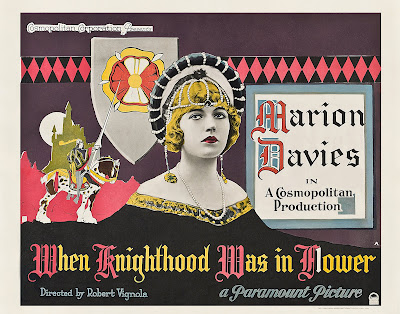
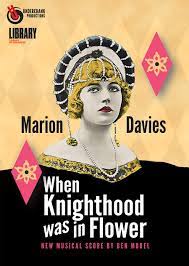
Promotional artwork for 'When Knighthood Was in Flower' (1922).

This afternoon's screening of 'When Knighthood in Flower' is the finale of a five-days-in-a-row series of screenings that saw me doing music for five films in venues across three states.

But what an ending! The Marion Davies costume epic, set during the reign of England's King Henry VIII, was produced on a grand scale. Released in 1922, it was the year's second-highest grossing film.

It's part of our ongoing series at the Town Hall Theatre in Wilton, N.H. celebrating the 100th anniversaries of motion pictures that came out that year. Lots more info in the press release I've pasted in below.

For now, let me report that last night's screening of 'The Last Command' (1928) in Brattleboro, Vt. resulted in some unexpected drama before the film could begin.

In late afternoon, a wall of heavy squalls moved across northern New England, laying down an unexpected coating of snow across the region. 

Brattleboro would normally be a 90-minute drive, so I left around 5 p.m. to arrive in time to set up for the screening, which was scheduled to start at 8 p.m. The snow had cleared out, so I figured that the timing had worked out well.

Well, it hadn't. The main highway (Route 101) across southern N.H. isn't far from my house, and almost immediately traffic on this busy road came to a complete stop. In a weird meteorological phenomenon, somehow the snow had adhered to the pavement, creating a coating of sheer ice that was impossible to drive on.

Seriously! Cars were off the road in both directions, and the rest of us were lined up and moving at a glacial pace, if at all. It took a half hour to just go a couple of miles. 

Stuck in this situation, with no real alternative routes that would be any better, I kept watching my arrival time slip further into the future.

I began pinging Jamie Mohr, who runs the Epsilon Spires venue where I would accompany 'The Last Command,' with updates, wondering if I would ever make it out there. (Jamie said she would get some Chinese food, which gave me confidence.)

My GPS indicated that conditions seemed normal for most of the route ahead, so I held out hope as I crawled along, trying not to slide off into the woods. After awhile, conditions did improve and traffic began to move at a more normal pace. 

Apparently the squalls had seen fit to sock just the area where I lived, as the rest of the ride to Brattleboro was uneventful. But the first five miles had taken 45 minutes, meaning I arrived with just enough time to set up things. 

And the next thing you know, I'm at the organ console, doing music for 'The Last Command,' aided by the digital synthesizer to produce drums and percussion where needed, plus a piano in a couple of key scenes. Oh—and also a brass school bell for when a bell is prominently rung in one scene.

The film, directed by Josef von Sternberg and starring Emil Jannings in an Academy Award-winning performance, drew the usual strong reaction—it's one of the truly great silent dramas, I think, produced when the form was at the peak of its eloquence. 

But this screening brought a new wrinkle: afterwards, people said it was a little unsettling to take in all the Russian military scenes as the present situation unfolds with Russia and Ukraine. I didn't see the parallel, but I could understand how it would be on people's minds.

Well, this afternoon's screening of 'When Knighthood Was in Flower' should provoke no such unease, as King Henry VIII has been off the throne for about 500 years.

I want to point out that the only reason we can show 'Knighthood' is because of the restoration recently released by Ben Model and Undercrank Productions. Ben and his colleagues did a terrific job.

Ben was recently in touch and shared a few notes about the effort that went into reissuing the film, which I had mistakenly called a transfer. I think it's worth including here, and I'll also mention it at this afternoon's screening:

"...the Undercrank edition is a restoration, and not a transfer. Stabilization and clean-up and grading was done on the nitrate scan. 

Also, the tints weren't added to look the way silents did – we reinstated the tinting and hand-coloring to exactly what was seen in theaters in 1922. There are tinting slugs at the heads and tails of several of the reels indicating "light pink", "amber", "light amber" and "blue tone/biscuit" (a combination of tinting and toning). 

We also found a review from Robert E. Sherwood that talks about the hand-coloring of the torches, and ads in the trades for the guy who did the hand-coloring; and so I got Jack Theakston to replicate this digitally, frame-by-frame.

So, you can tell your audience that they're seeing what people saw in the film's original release of the full-length road-show edition (the general release version was about 25 mins shorter). 

And, had Marion Davies not had a print struck of this in the mid-1930s, and then donated all her 35mm nitrate prints to the LoC in the 1950s, we would not be able to see this at all. :)

Who knew...Marion was also a film conservationist!

Thanks so much! Have a great show!

If you'd like more info about the restoration of 'Knighthood,' check out this post from Ben. 

Okay, hope your Sunday plans include a trip back to the splendors of medieval England via 'When Knighthood Was in Flower' starring Marion Davies. The show begins at 2 p.m. More info about the film in the press release below.

*   *   *

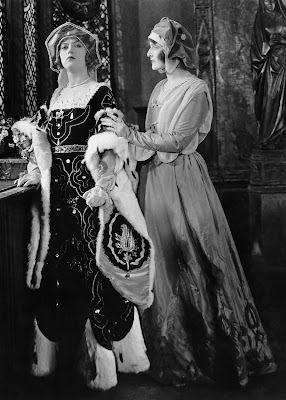
Marion Davies (left) in 'When Knighthood Was in Flower' (1922).

TUESDAY, FEB. 8, 2022 / FOR IMMEDIATE RELEASE
Contact Jeff Rapsis • (603) 236-9237 • jeffrapsis@gmail.com

Marion Davies costume epic 'When Knighthood Was in Flower' to screen at Wilton Town Hall Theatre

Set during the reign of Henry VIII, silent film blockbuster to be shown with live music on Sunday, Feb. 20 to celebrate 100th anniversary of release

WILTON, N.H.—It was a movie that transported audiences back to the reign of England's King Henry VIII, scoring an enormous box office success.

It was 'When Knighthood Was in Flower' (1922), a costume epic starring Marion Davies that became the year's second-highest-grossing film. 

See what all the royal fuss was about when the picture is shown with live music on Sunday, Feb. 20 at 2 p.m. at the Town Hall Theatre, 40 Main St., Wilton, N.H.

Admission is free, with a suggested donation of $10 per person to help support the theater's silent film series.

The classic Tudor-era drama will be shown with live music by silent film accompanist Jeff Rapsis.

In 'When Knighthood Was in Flower,' Marion Davies plays Mary Tudor, younger sister of England's King Henry VIII, who falls in love with a guardsman below her class.

Unfortunately, Mary is already betrothed to the aged King Louis XII of France. Her illicit romance thus touches off a furor with international complications.

Planned from the start as a big budget spectacle, 'When Knighthood Was in Flower' cost $1.8 million to produce, making it among the most expensive movies of the silent era.

The film was directed by Robert G. Vignola and based on a popular 1898 novel by Charles Major. 

A lobby card for 'When Knighthood Was in Flower.'

'When Knighthood Was in Flower' was produced by William Randolph Hearst (through his Cosmopolitan Productions) for Marion Davies and distributed by Paramount Pictures. 

Davies, longtime mistress of publishing magnate Hearst, would go on to become one of the most popular leading ladies of the silent era. 

For 'When Knighthood Was in Flower,' she spent four months learning to fence in order to convincingly perform her own on-screen swordfighting.

Although some exteriors were shot on location at England's Windsor Castle, most of the film was actually made in Connecticut and New York City, where Cosmopolitan was based at the time. 

Ziegfeld Follies designer Joseph Urban planned so many lavish sets, Hearst had to rent space at two other New York studios to complete the film and hire 3,000 extras for the crowd scenes. 
 
For Davies' 15 gowns, Urban's daughter, Gretl Urban Thurlow, duplicated outfits originally worn by Mary Tudor.

The edition of 'When Knighthood Was in Flower' that will be presented is a new digital restoration from Undercrank Productions/Library of Congress.

The screening is part of the Town Hall Theatre's ongoing series honoring the 100th anniversary of significant motion pictures that debuted in 1922.

Programs will include all of 1922's five highest-grossing titles, each shown on the big screen with live music, as well as century-old oddities, short films, cartoons, and more.

"Putting these films back on the big screen is a great way to celebrate the 100th anniversaries of some terrific motion pictures," said Rapsis, the silent film accompanist who will create live music for all screenings.

"These are films that set the standard for Hollywood, and still retain their power to entertain, especially when shown in a theater with live music and an audience," Rapsis said.

Upcoming programs in the Town Hall's 100th anniversary series include:

• Sunday, March 13, 2022 at 2 p.m.: Norma Talmadge in 'Smilin' Through' In honor of St. Patrick's Day, a 1922 romantic drama set in the Emerald Isle.

• Sunday, March 27, 2022 at 2 p.m.: Douglas Fairbanks in 'Robin Hood' Celebrate the 100th anniversary of this blockbuster adaptation. Massive sets, great action, and Doug Fairbanks in the lead made this the top grossing film of 1922!

• Sunday, April 3, 2022 at 2 p.m.: Chaney/Houdini Double Feature. In 'Flesh and Blood' (1922), escaped convict Lon Chaney hides out in Chinatown and plots revenge. In 'The Man From Beyond' (1922) illusionist Harry Houdini plays an Arctic adventurer frozen for 100 years!

• Sunday, April 17, 2022 at 2 p.m.: Emil Jannings in 'Othello' The Bard's immortal tragedy brought to the screen in this early German version. Silent Shakespeare in honor of the author's 458th birthday.

‘When Knighthood Was in Flower' (1922) will be shown live music on Sunday, Feb. 20 at 2 p.m. at the Town Hall Theatre, 40 Main St., Wilton, N.H.

Admission is free, with a suggested donation of $10 per person to help defray expenses. For more info, call (603) 654-3456 or visit www.wiltontownhalltheatre.com.

Monday, March 8, 2021

Sure'n it's time for a St. Paddy's tribute: 'The Bride's Play' on Sunday, 3/14 in Wilton, N.H.

Marion Davies in 'The Bride's Play' (1922), a film set in Ireland. 

There's no silent film equivalent to 'It's A Wonderful Life' (1946), so Christmas is kind of a bust for silent film programming.

But for St. Patrick's Day, we can choose from several films that are as Irish as my great-grandfather from County Cork.

There's intense drama, such as 'Hangman's House' (1928), a dark film set in Ireland and directed by a young John Ford.

And there's comedy: Johnny Hines in 'Conductor 1492' (1924) is full of Irish ethnic humor popular at the time.

This year, for something in-between, I'm accompanying 'The Bride's Play' (1922), a costume drama starring Marion Davies. It's set in Ireland, both modern (meaning 1920s) and medieval, giving Davies a chance to play scenes (and wear outfits) from both eras.

We're screening 'The Bride's Play' on Sunday, March 14 at 2 p.m. at the Town Hall Theatre in Wilton, N.H. Lots more info in the press release, pasted in below.

But the fact that we're able to show the film at all is due to a gentleman in Maine who has taken on the task of getting the work of Davies out of the archives and making her films available for modern audiences to see.

His name is Ed Lorusso, and he's recently been in the news for his work. Check out this recent article from a Maine newspaper that explores his work. It's great that he's doing this.

For a look at specifically how 'The Bride's Play' went from the film vaults of the Library of Congress and back onto the screen, check out this blog post from silent film accompanist Ben Model, who was commissioned to create a recorded score to go with Lorusso's restoration.

From left, that's me, volunteer Larry Stendebach, and Ben Model at the Kansas Silent Film Festival in 2017. 

Speaking of music: Ben does great work, and has been especially active doing virtual live shows during the pandemic. Check out his weekly 'Silent Comedy Watch Party.' But I'll be doing my own music live for our screening next Sunday of 'The Bride's Play.' 

It's surprising to many people, but most silent films do not have one "official" score, then or now. Rather, it was up to local theater musicians to come up with accompaniment that helped a film work. So the music for a film would usually be completely different from one theater to the next. 

Thus is it possible for someone like Ben, or me, to create new music nearly a century after the film was released, when people who made it are long gone. But it works, I think, as long as an accompanist does what musicians back in the day would have done—try to support the film and help it work with an audience. 

That's what I do. And because it implies the presence of an audience, it's what you do as well. Join me on Sunday, March 14 for 'The Bride's Play' and we'll all get in the mood for St. Patrick's Day.

And if 'The Bride's Play' doesn't work, there's always green beer.

*   *   *

A vintage lobby card promoting Marion Davies in 'The Bride's Play.'
 
SUNDAY, MARCH 7, 2021 / FOR IMMEDIATE RELEASE
Contact: Jeff Rapsis • (603) 236-9237 • jeffrapsis@gmail.com

Celebrate St. Patrick's Day at Town Hall Theatre with classic drama set in Ireland

'The Bride's Play,' classic silent film romance starring Marion Davies, to screen with live music on Sunday, March 14

WILTON, N.H.—The ancient Irish custom of interrogating all male wedding guests highlights 'The Bride's Play' (1922), a silent romantic drama starring Marion Davies and set in the Emerald Isle.

To celebrate St. Patrick's Day, a restored print of 'The Bride's Play' will be screened with live music on Sunday, March 14 at 2 p.m. at the Town Hall Theatre, 40 Main St., Wilton, N.H.

The screening is free to the public; a donation of $10 per person is suggested to support the Town Hall Theatre's silent film series.

The Town Hall Theatre continues to observe procedures to comply with all state and CDC public health guidelines. Capacity is limited to 50 percent; patrons are required to maintain social distance and wear masks until seated.

Live music will be provided by Jeff Rapsis, a New Hampshire-based silent film accompanist.

'The Bride's Play' gives Marion Davies two roles to play: contemporary Irish lass Aileen Barrett and her distant ancestor from medieval times, the noble Lady Enid of Cashel.

On their wedding day, both carry out the Irish custom of 'The Bride's Play,' which calls for the bride to make the rounds of all male guests, asking each in turn if he is the one she loves best, until she reaches the groom.

In medieval times, this honored custom led to a scandal at Lady Enid's elaborate marriage ceremony. Now, centuries later, Aileen Barrett faces trouble with her own impending nuptials.

Carried out at her ceremony, will the ancient custom of 'The Bride's Play' reveal the identity of her true love? And will it be the man everyone expects?

'The Bride's Play' was one of a series of lavishly produced costume dramas made by studio Cosmopolitan Pictures and financed by Davies' long-time lover, newspaper magnate William Randolph Hearst.

The film, shot on the California coast, was noted for its massive medieval castle set designed by John Urban. Directed by George Terwilliger, 'The Bride's Play' was released through Paramount Pictures.

Cosmopolitan, founded by Hearst, heavily promoted the career of Davies, who appeared in 29 silent and 17 talking films with the company.

The story for 'The Bride's Play,' like many Cosmopolitan Pictures, was originally published in Hearst's well-read newspapers and magazines.

Though popular at the box office, Davies' films were often dismissed by critics as Hearst vanity projects intended to showcase his lover in exotic tales and elaborate costumes.

Long unavailable for public viewing, in recent years, her silent films have been rediscovered as well-produced vehicles for Davies' acting talent and big screen appeal.

"Davies had an on-screen magnetism that still comes through today, a century after her career was in full swing," said Rapsis, the Town Hall Theatre's silent film accompanist. "To see a film like 'The Bride's Play' on the big screen is to understand why she was so popular."

"Plus, it's set in Ireland, so it's a fun—and Covid-19-safe—way to get in the mood for St. Patrick's Day," Rapsis said.

Rapsis improvises scores for silent films using a digital synthesizer to recreate the texture of the full orchestra.

"It's kind of a high wire act," Rapsis said. "But for me, the energy of live performance is an essential part of the silent film experience."

Irish romantic drama 'The Bride's Play' will be screened with live music on Sunday, March 14 at 2 p.m. at the Town Hall Theatre, 40 Main St., Wilton, N.H. Free admission; a donation of $10 per person is suggested to support the Town Hall Theatre's silent film series.

For more information, visit www.wiltontownhalltheatre.com or call (603) 654-3456.