Showing posts with label Nanook of the North. Show all posts

Tuesday, April 26, 2022

To Cleveland and back: 3 days, 5 films, 1,650 miles—and Keaton's 'Butler' on Wednesday, 4/27

Buster shows off an old-time boxing stance in 'Battling Butler.' Get those gloves up, Keaton!

Ding!

Next up is Buster Keaton's boxing comedy 'Battling Butler' (1926), which I'm accompanying on Wednesday, April 27 at the Flying Monkey Moviehouse and Performance Center in Plymouth, N.H.

Hope you'll join us for this screening, part of a series of films released in 1926 that became public domain as of Jan. 1, 2022. 

You the public now own 'Battling Butler.' Aren't you interested in seeing it?

The complete press release with more info is at the bottom of this post. 

For now, a few thoughts about my recent three-day visit to Cleveland, Ohio. (I'd call it a "flying visit" but I actually drove out there and back—about 10 hours each way.)

The reason was the 47th annual sci-fi marathon at Case Western Reserve University, where I accompanied the early German film 'Der Golem' (1920). The festival usually takes place in January, but was postponed this year due to the Coronavirus spike at that time.

It got rescheduled to last weekend, and it worked out that I could get out there as planned. 

I then reached out to the folks at the Cleveland Cinematheque, where I've been privileged to accompany silents, with news that I'd be in town, and so they asked me to do 'Nanook of the North' (1922).

Thus I drove to Cleveland—out on Friday for shows that night at the Cinemathèque, then the next day at the sci-fi festival, then back east to arrive in time to accompany a 2 p.m. screening of the silent 'La Bohème' (1926) at the Somerville Theatre.

Why drive? Because I used my big-ass digital synthesizer at each of the venues, and it's really not practical to put that on a plane. 

Plus, even with gas more expensive and the absurdly high tolls on the New York State Thruway, it's cheaper to drive. That includes wear and tear on my Subaru Forester, which recently passed the 240,000 mile mark.

Plus, if I flew, I could not stop in Erie, Pennsylvania at the one Krispy Kreme donut franchise along the way. 

So it's silent film accompaniment, with a little bit of long haul trucking thrown in. Ah, the glamour of show biz!

The Cinematheque drew a respectable audience for 'Nanook,' for which I used a light texture (mostly harp) for the first 20 minutes but then switched to full orchestral sound for the sea lion hunt and then for the rest of the picture.

'Nanook' was preceded by a Buster Keaton short, 'The Frozen North,' thus creating a theme for the program. I wondered aloud if we should turn up the air conditioning.

As always, John Ewing and Genevieve Schwartz and everyone else at the Cinematheque were terrific hosts. As usual, I took the opportunity (as an outsider) to remind everyone how fortunate Cleveland was to have a theater committed to running such diverse programming all year round.

I had told John about 'Straight is the Way' (1921), the obscure Cosmopolitan Pictures comedy/drama set in my home state of New Hampshire and recently pried loose from the Library of Congress vaults via a Kickstarter project by Ed Lorusso.

So John decided to run it as an unofficial bonus feature following 'Nanook.' Only a few people stayed, but together we witnessed the "Midwest Re-Premiere" of a film that hasn't been seen anywhere for more than a century. 

An unknown film with no one famous in it does not make for great expectations. But once again, 'Straight is the Way' proved moderately entertaining, much to everyone's surprise. So I plan to keep programming it, and say thanks again to Ed L. for making the title available.

As for the sci-fi marathon: what a blast from the past! People getting together for a 36-hour shared experience—a real throwback to the era not just prior to the pandemic, but also before streaming and everything available at any time.

An attendee arrives at the sci-fi marathon with her Mystery Science Theatre 3000 companion. 

While I appreciate the convenience of digital-streaming-everything-on-demand-in-the-comfort-of-your-home-when-you-want-it, I remain a complete slave to cinema as a shared experience.

I think it's the best and most satisfying way to experience cinema, and especially films from the silent era. For me, it's certainly the most rewarding way to accompany them. And personally, I just like it better.  

So it did my heart good to see people fussing over film prints in a projection booth, setting up camp among the seats of Case Western's Strosacker Auditorium, and just generally being enthused at the idea of seeing favorite and not-so-favorite flicks on the big screen.

A peek inside the booth, with impromptu conference in progress.

Getting to be a rare sight: actual cans of actual film!

'Der Golem' was set for Saturday at 4:30 p.m., about halfway through the marathon. I arrived about halfway through the previous film. It was billed as a "surprise" and turned out to be an original 35mm release print of Star Wars (1977), now retitled "Episode 4: A New Hope."

So after readying all my stuff backstage for quick deployment, I went around and took a seat in back to catch the last 30 minutes of this film, which I hadn't seen in decades. Although the print was badly faded, people were into it. People were shouting comments and wisecracks, as often happens in this kind of setting, and which is all part of the fun. 

I then set up for 'Der Golem' and was once again thrilled to hear how good my beat-up Roland speakers sound when placed on the Strosacker's wooden stage. The music just leaps to life. After running through a few chord progressions, I heard someone behind me say, "Awesome!" 

After running through a Koko the Clown cartoon as a warm-up, we went straight into 'Der Golem' and I have to say, everything just fell into place. There was something about the silent image and the live music and that audience that gave everything a majesty and portentousness that otherwise would not have happened. 

Things got especially powerful during the amazing sequence when the Rabbi conjures up evil spirits to find the secret word to bring life to the inanimate. I used a steady 3/4 beat throughout, starting very simply, over which I wove increasingly frenetic figures until finally reaching something like the spirit of Ravel's "La Valse," described somewhere as a dance on the edge of a volcano. 

You could tell there was genuine audience engagement, especially when the creature begins to turn on its creators. Wow! You just can't experience tension, anticipation, and energy like that at home. And 'Der Golem' is a very satisfying film in that respect, as it all gets released in the film's climactic sequence. 

I was gratified to receive a hearty ovation, but gestured to the screen behind me, as that's what it's all about. 
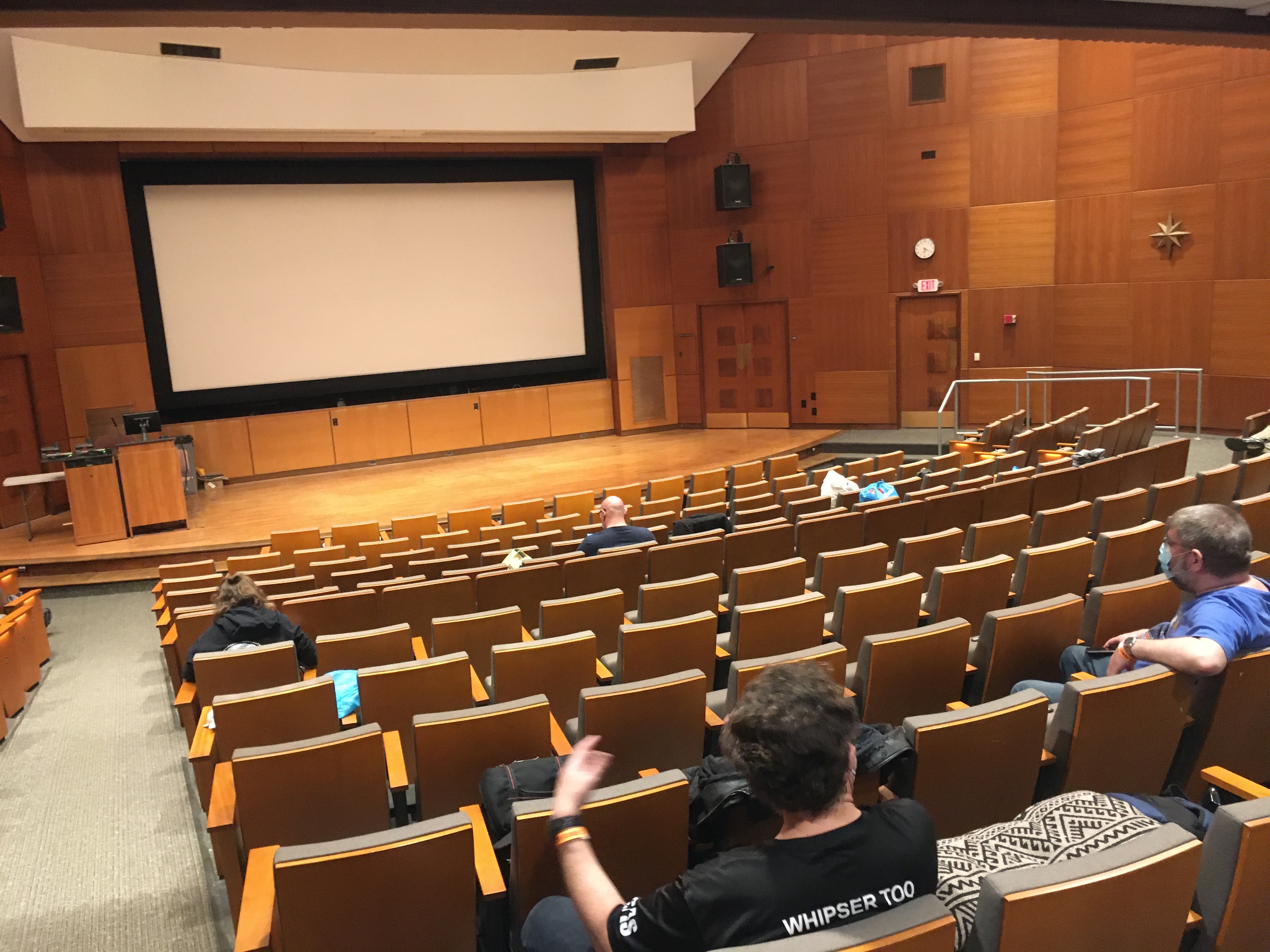
A view of the auditorium Friday afternoon, before most attendees arrived.

Alas, attendance at the sci-fi festival was clearly down from my last appearance here, in January 2020, just before the pandemic took hold. Then, for a screening of 'Aelita, Queen of Mars' (1924), we had to move people (and their sleeping bags) around to make room for my keyboard. This time, there were acres of open space. 

Yes, the pandemic has had an effect. And yes, times are changing. 

A stuffed cat in the Strosacker Auditorium.

But I hope the spirit that's part of the DNA of this festival and similar ones—the sense of wonder and love of cinema that prompted people to create such communal events in the era before VCRs and DVDs and everything-on-demand—will persist as we all march forward. 

Afterwards, I pointed the Subaru Forester east towards Boston, arriving in time (with an overnight stay in Syracuse, N.Y.) for the matinee of 'La Bohème' at the Somerville Theatre.

Silent film on the Somerville's big marquee! 

The screening marked the return of the venue's 'Silents, Please!' series after a long pandemic-induced hiatus. In welcoming back the audience, I recalled how the last silent at the Somerville was on Sunday, March 15, 2020, when the theater screened Rin Tin Tin in 'Clash of the Wolves' (1925) to a smaller-than-usual crowd. 

"I remember at the time talking with Ian Judge, the Somerville's manager, and thinking that this pandemic thing might cause theaters to have to close for as much as two weeks, or maybe even a month," I said, to knowing laughter. 

I also got laughs with an off-the-cuff remark about the music.

"If you're expecting to hear Puccini's immortal music, I'm afraid you're going to be disappointed," I said. "What I do will be mostly improvised, and I'm not Italian, so it wouldn't sound like Puccini even if I tried. I'm Polish and Lithuanian, so I might be able to go for Witold Lutosławski."

Of course it's a real question: for a silent film version of a famous opera such as  'La Bohème,' what role should music play? My answer: same as always. The accompaniment should support the story, the characters, the action, the emotions, the changes of mood, and everything else happening on the screen.

At its best, the music helps a silent film cast a spell on an audience—and that's true for 'La Bohème' as much as any other story. In fact, I think if I did try to channel Puccini, that would only take people out of the on-screen narrative, which would be a distraction.

So I didn't channel Puccini, nor Lutosławski, nor anyone else. I just reached into my own reservoir of strong feelings and emotions and tried to conjure music that helped the film connect. 

As usual, it was a mix of deliberate calculation and in-the-moment reaction. 

Prior to the screening, I had decided an all strings texture was right for this kind of film, which gives audiences a chance to soak in a prolonged emotional bath. 

But for those big moments with Lillian Gish and John Gilbert filling up the screen—where the soaring melody over lush chords came from, I really couldn't tell you.

It certainly wasn't the hotel in Syracuse.

Okay, enough about the road trip. Here's all you need to know about 'Battling Butler' on Wednesday, April 27 at the Flying Monkey. Hope to see you there!

*   *   *

Buster gets physical in 'Battling Butler' (1926).

TUESDAY, APRIL 12, 2022 / FOR IMMEDIATE RELEASE
Contact Jeff Rapsis • (603) 236-9237 • jeffrapsis@gmail.com

Buster Keaton's 'Battling Butler' at Flying Monkey Moviehouse on Wednesday, April 27

Silent film series continues with knockout boxing comedy focusing on the fight game, accompanied by live music

PLYMOUTH, N.H.—He never smiled on camera, earning him the nickname of "the Great Stone Face." But Buster Keaton's comedies rocked Hollywood's silent era with laughter throughout the 1920s.

Acclaimed for their originality, clever visual gags, and amazing stunts, Keaton's films remain popular crowd-pleasers today.

See for yourself with a screening of 'Battling Butler' (1926), one of Keaton's landmark feature films, on Wednesday, April 27 at 6:30 p.m. at the Flying Monkey Moviehouse and Performance Center, 39 Main St., Plymouth, N.H.

Admission is $10 per person. Live music will be provided by accompanist Jeff Rapsis, a New Hampshire-based performer who specializes in creating music for silent film presentations.

'Battling Butler' tells the story of pampered millionaire Alfred Butler (Keaton) who tries to impress the girl of his dreams (Sally O'Neil) by pretending to be a championship boxer with the same name.

The masquerade leads to knockout comedy both in and outside the ring, giving Keaton ample opportunity to display his gifts for physical and visual comedy.

The screening is the latest installment of the Flying Monkey's series showcasing the best films of 1926, all of which entered the public domain on Jan. 1, 2022.

In the 1920s, boxing rivaled baseball as the nation's most popular sport. Neighborhoods, communities, and ethnic groups all rooted for their favorite fighters, and heavyweight champion Jack Dempsey ranked as an international celebrity.

Because of this, boxing stories were popular with early movie audiences as well.

"As an elemental contest between two opponents, boxing inspired early filmmakers to do some great work," Rapsis said. "It's a visual sport that doesn't require a lot of dialogue or commentary to understand, and so was perfect for silent movies."

Keaton, along with Charlie Chaplin and Harold Lloyd, stands as one of the silent screen's three great clowns.

Many critics regard Keaton as the best of all; Roger Ebert wrote in 2002 that "in an extraordinary period from 1920 to 1929, (Keaton) worked without interruption on a series of films that make him, arguably, the greatest actor-director in the history of the movies." But while making films, Keaton never thought he was an artist, but an entertainer trying to use the then-new art of motion pictures to tell stories and create laughter.

All those talents are on display in 'Battling Butler,' which holds the distinction of being the top-grossing title of Keaton's silent features.

Buster on the ropes—literally—in 'Battling Butler' (1926).

The Flying Monkey's silent film screenings provide local audiences the opportunity to experience silent film as it was intended to be shown: on the big screen, in restored prints, with live music, and with an audience.

“These films are still exciting experiences if you can watch them as they were designed to be shown,” said Rapsis, accompanist for the screenings.

“There’s a reason people first fell in love with the movies, and we hope to recreate that spirit. At their best, silent films were communal experiences in which the presence of a large audience intensifies everyone’s reactions.”

The screening of 'Battling Butler' is the latest in the Flying Monkey's series celebrating films that recently entered the public domain.

Copyright protection for all U.S. films released in 1926 expired on Jan. 1, 2022.

To mark the occasion, the Flying Monkey is showcasing vintage 1926 comedies, dramas, and adventure films, all with live music, and all now in the public domain.

Upcoming screenings in the Flying Monkey's "Public Domain Extravaganza" series include:

• Wednesday, May 11, 2022, 6:30 p.m.: "Bardelys the Magnificent" (1926) starring John Gilbert. Gilbert tries his hand at swashbuckling in this big-budget MGM historical extravaganza about exploits of an unjustly disgraced French nobleman. A major film long thought lost until a single print was recently discovered in France.

• Wednesday, June 8, 2022, 6:30 p.m.: "The Black Pirate" (1926) starring Douglas Fairbanks, Sr. The original pirate swashbuckler, with Fairbanks sword-fighting his way through a period adventure tale set during the age of sailing ships.

"By 1926, the movies had matured enough to offer a wide range of great entertainment that still holds up today," Rapsis said. "Come see for yourself as we screen some of the year's best flicks, all of which recently entered the public domain and now belong to us all."

Buster Keaton stars in 'Battling Butler,' to be shown on Wednesday, April 27 at 6:30 p.m. at the Flying Monkey Moviehouse and Performance Center, 39 South Main St., Plymouth, N.H.

Admission is $10 per person. For more info, call (603) 536-2551 or visit www.flyingmonkeynh.com.

Monday, January 24, 2022

Wednesday, 1/26: New Flying Monkey film series starts with comedy 'For Heaven's Sake' (1926)

Harold Lloyd as "J. Harold Manners" in 'For Heaven's Sake' (1926).

Next up: a screening of Harold's Lloyd's great comedy 'For Heaven's Sake' (1926) in Plymouth, N.H.

Complete info on that in the press release below. But first, an update from the front lines. 

We enjoyed great turnout and good reaction yesterday afternoon at a screening of 'Nanook of the North' (1922) at the Town Hall Theatre in Wilton, N.H. 

The show was part of an ongoing series celebrating the 100th anniversary of significant films, including the year's top five box office hits, all of which survive.

Nanook was not among them, but was popular and influential to be included. Plus, what better film to show in the dead of a New England winter?

A century after its release, people are still drawn to director Robert Flaherty's images of Inuit people living among the Arctic ice floes and snow drifts. 

For the music, I used piano with sustained strings to create a soundtrack that seemed to mirror the landscapes and environments seen in 'Nanook.' 

It was the same thinking used by legendary composer Bernard Herrmann when he used strings only for Hitchcock's 'Pyscho' because he wanted a "black and white score for a black and white movie."

Just about everyone stayed after for what turned out to be an extended Q & A session, with people using their phones to look up information on topics about which I proved clueless.

The film was preceded by the Chaplin two-reeler 'Pay Day' (1922), which we ran in contrast to 'Nanook.' 

Where Flaherty's 'Nanook' marked the beginning of documentary films, 'Pay Day' was the last of Chaplin's short comedies. 

Speaking of beginnings: this Wednesday's screening of Harold Lloyd's comedy 'For Heaven's Sake' marks the start of another series—this one celebrating titles from 1926 that as of this month (January 2022) are now in the public domain.

Hope you'll join us for this uproarious comedy, which was actually Lloyd's top-grossing film of the silent era, although it doesn't get shown nearly as often as 'Safety Last' (1923) or 'The Freshman' (1925).

One other thing: 'For Heaven's Sake' is one of the films in which Lloyd starts at the top, rather than having to climb his way up. (Another one is 1923's 'Why Worry?')

So if you think Lloyd always followed the same "young man has to prove himself to win the girl" formula, then 'For Heaven's Sake' might surprise you.

Press release is below. Showtime is 6:30 p.m. See you there!

*   *   *

An original poster promoting Harold Lloyd in 'For Heaven's Sake' (1926).

MONDAY, JAN. 10, 2022 / FOR IMMEDIATE RELEASE
Contact Jeff Rapsis at (603) 236-9237 • e-mail jeffrapsis@gmail.com

Flying Monkey series to highlight films that entered public domain on Jan. 1, 2022

Venue to screen classic comedies, dramas, and adventure films released 1926, all newly in the public domain

First up: Harold Lloyd's classic comedy 'For Heaven's Sake' with live music on Wednesday, Jan. 26

PLYMOUTH, N.H. — On New Year's Day, hundreds of movies became a lot easier to show and to watch.

That's because copyright protection for all films released in 1926 expired on Jan. 1, 2022, putting them in the public domain.

To mark the occasion, starting this month the Flying Monkey Moviehouse and Performance Center will revive the top motion pictures of 1926.

The Flying Monkey's first-ever "Public Domain Extravaganza" will showcase vintage comedies, dramas, and adventure films, all with live music.

First up: Harold Lloyd's classic romantic comedy 'For Heaven's Sake' (1926), to be shown on Wednesday, Jan. 26 at 6:30 p.m.

General admission is $10. The screening will feature live accompaniment by silent film musician Jeff Rapsis.

In 'For Heaven's Sake,' Lloyd plays a wealthy young man smitten with the daughter of an impoverished clergyman who ministers to the urban poor.

On the day Lloyd and the girl plan to marry, Lloyd's wealthy country club friends kidnap him to prevent what they see as an embarrassing mistake.

Can the urban mission's petty criminals and chronic alcoholics rescue Harold and get him to the church on time?

Lloyd and friends atop an open-air double-decker bus in 'For Heaven's Sake.'

'For Heaven's Sake,' promoted with the tagline 'A Man With A Mansion, A Miss with a Mission,' became the year's 4th-highest grossing film, earning $2.6 million.

Critic Leonard Maltin described 'For Heaven's Sake' as "...a screamingly funny silent comedy."

Silent film accompanist Jeff Rapsis will improvise a musical score to the film in real time as the movie is screened.

In creating music for 'For Heaven's Sake' and other vintage classics, Rapsis tries to bridge the gap between silent film and modern audiences.

"Live music adds an element of energy to a silent film screening that's really crucial to the experience," Rapsis said.

Upcoming screenings in the Flying Monkey's "Public Domain Extravaganza" include:

• Wednesday, Feb. 16, 2022, 6:30 p.m.: "The Temptress" (1926) starring Greta Garbo. MGM drama with Garbo destroying the lives of men everywhere. The perfect antidote for Valentine's Day.

• Wednesday, March 9, 2022, 6:30 p.m.: "The Winning of Barbara Worth" (1926) starring Ronald Colman, Vilma Banky, and Gary Cooper. Epic Western drama about the settling and irrigation of California's Imperial Valley, once a wasteland but now an agricultural paradise. Shot on location by director Henry King in Nevada's Black Rock desert, one of the first films to take audiences to the wide open spaces of the great American West. With a young Gary Cooper playing a key role.

• Wednesday, April 27, 2022, 6:30 p.m.: "Battling Butler" (1926) starring Buster Keaton. In an uproarious boxing comedy, Keaton plays Alfred Butler, a pampered rich idler with the same name as a feared boxing champion. When a girl he's pursuing thinks he's the fighter, Keaton has no choice but to start training.

• Wednesday, May 11, 2022, 6:30 p.m.: "Bardelys the Magnificent" (1926) starring John Gilbert. Gilbert tries his hand at swashbuckling in this big-budget MGM historical extravaganza about exploits of an unjustly disgraced French nobleman. A major film long thought lost until a single print was recently discovered in France.

• Wednesday, June 8, 2022, 6:30 p.m.: "The Black Pirate" (1926) starring Douglas Fairbanks, Sr. The original pirate film, with Fairbanks sword-fighting his way through a period adventure tale set during the age of sailing ships.

"By 1926, the movies had matured enough to offer a wide range of great entertainment that still holds up today," Rapsis said. "Come see for yourself as we screen some of the year's best flicks, all of which recently entered the public domain and now belong to us all."

Harold Lloyd's romantic comedy ‘For Heaven's Sake’ will be shown with live music on Wednesday, Jan. 26 at 6:30 p.m. at the Flying Monkey Moviehouse and Performance Center, 39 Main St., Plymouth, N.H.

Admission to the screening is $10, general admission seating. For more info, call (603) 536-2551 or visit www.flyingmonkeynh.com.

Monday, January 17, 2022

Coming Sunday, 1/23: 'Nanook of the North' (1922), plus report from Detroit and Cleveland

'Spies' (1928), which received a memorable screening on Thursday, Jan. 13 at Cinema Detroit.

Just returned to home base in New Hampshire after a road-trip that took me 1,775 miles to performances in Detroit and Cleveland. 

Right now I feel more like a long-haul trucker than a silent film accompanist!

But the trip was well worth it, as each show was successful on several fronts.

Congrats to Cinema Detroit and the Cleveland Cinematheque for bringing their audiences the experience of silent cinema with live music.

And thanks to their audiences for coming out (during the recent pandemic spike, no less) in numbers healthy enough to make the whole effort worthwhile.

In Detroit, an audience of about 40 people turned out for Fritz Lang's espionage epic 'Spies' (1928), which just one person in the group had ever seen before. 

And that one person, a true Lang devotee, had never seen it in a theater with live music. 

So that's why he flew all the way from New York City just to experience it on the big screen, thus easily taking the "traveled the farthest" prize. (Not including the accompanist.)

Paula and Tim Guthat of Cinema Detroit pitched 'Spies' as an alternative to Lang's much-better-known 'Metropolis' (1927), which they feel has frequent screenings has rendered over-familiar, overshadowing his other work of the period.

I think they have a point. And Lang pulled through, with 'Spies' holding the screen for 2½ hours without a single person leaving. 

One reason for this is that 'Metropolis' and 'Spies' and another sprawling Lang late silent, 'Woman in the Moon' (1929), all share a common feature. 

Each is about very different things, but underneath they're all old-fashioned melodramas.

Yes! Despite their surface differences, each is driven by a pot-boiling page-turning barn-burner of a story. And like the D.W. Griffith epics, the narrative pulls the audience through. The story is structured so that you simply must keep watching. You can't help it. 

That's what happened last Thursday night (Jan. 13) at Cinema Detroit. You could tell—people were hooked. That, coupled with Lang's incredible visual story-telling, made for a memorable evening in a darkened theatre.

It went so well, the Guthats are thinking about screening another lesser-known Lang, such as the aforementioned 'Woman in the Moon.' I hope they do! 

Why? Not just because I would love to do music for it (although that's one reason), but also because the Lang pictures are great examples of films that really must be seen in a theatre with an audience for it to have its full effect. 

It was the same thing the next evening (Friday, Jan. 14) in Cleveland. 

Raymond Griffith shows off some dance steps in 'Hands Up!'

At the Cinematheque, a 35mm print of Raymond Griffith's 'Hands Up!' (1926) was greeted with continuous laughter right from the start. As with most silent comedy, being part of an audience that's enjoying the on-screen action gives you permission to laugh as well.

And if all goes well, you might just get that wonderful spontaneous combustion of laughter that's one of the great glories of the silent cinema, even today. 

And that's what we got at the Cinematheque. Once Griffith taught a tribe of Native Americans to forsake their wardance for the Charleston, there was no turning back. 

This was followed by a quieter but no less appreciative response for a screening of Ernst Lubitsch's 'The Marriage Circle' (1924), which I'd never accompanied before. 

In this case, I think audience members don't expect to find this kind of polished and sophisticated society comedy in silent pictures. For most people, silent comedy = Buster Keaton or the Keystone Cops.

But there it was! Long before Hollywood began cranking out so-called "screwball" comedies in the 1930s, it was producing polished society farces in quantity, starring the likes of Ronald Colman or (in 'The Marriage Circle') Adolphe Menjou. 

They just didn't have dialogue. But that didn't stop talented performers such as Colman or Menjou from saying all they needed via facial expressions, gestures, pantomine, and the artfully turned head or raised eyebrow. (And the occasional craftily-written intertitle.)

Both venues, by the way, were closed for 16 months (16 months!) starting in March 2020 at the pandemic's onset. Can you believe it?

That both endured the prolonged closure, and are now riding out the current surge with creative programming that includes silent pictures with live music, gives me a lot of confidence.

In an age where new options such as in-home streaming are gaining in popularity, I feel sure that as long as we have cinema, there will be an audience for motion pictures to be shown in a theater.

By the way, the reason I drove out there (rather than flew) is that for these performances I used my Korg digital synthesizer, which isn't exactly air-travel-friendly even with its sturdy (but monstrously heavy) carrying case.

And there's all the sound equipment and cabling I lug around. It's nothing I can't fit into my Subaru Forester with room to spare, but a LOT to send through the nation's air transport system. 

More to come, including a screening of 'Nanook of the North' later this month at the Town Hall Theatre in Wilton, N.H. to celebrate the 100th anniversary of the film's release. 

The film is showing on Sunday, Jan. 23 at 2 p.m. More info in the press release below. 

And there will be cake! 

*  *  *

A vintage poster for the documentary 'Nanook of the North' (1922).

MONDAY, JAN. 10, 2022 / FOR IMMEDIATE RELEASE

Contact Jeff Rapsis • (603) 236-9237 • jeffrapsis@gmail.com

Pioneering documentary 'Nanook of the North' to screen at Wilton Town Hall Theatre

Ground-breaking silent film to be shown with live music on Sunday, Jan. 23 to celebrate 100th anniversary of release

WILTON, N.H.—It's hailed as one of the first films to show the potential of the movie camera to take audiences to distant lands.

It's 'Nanook of the North' (1922), a ground-breaking movie about life among Eskimos above the Arctic Circle, to be screened on Sunday, Jan. 23 at 2 p.m. at the Town Hall Theatre, 40 Main St., Wilton, N.H.

Admission is free, with a suggested donation of $10 per person to help cover expenses.

The classic silent documentary will be shown with live music by silent film accompanist Jeff Rapsis.

Director Robert Flaherty’s film tells the story of Inuit hunter Nanook and his family as they struggle to survive in the harsh conditions of Canada’s Hudson Bay region.

Remarkably matter-of-fact in its depiction of the everyday struggle to stay alive in the Arctic hinterlands of Canada’s Hudson Bay, 'Nanook of the North' shows Flaherty’s interest in his Inuit subjects in each carefully framed shot.

'Nanook' was completed only after film from a previous expedition caught fire and was destroyed. Flaherty had to repeat his entire visit to the frozen north to reshoot the movie.

'Nanook' unfolds as a series of long takes interspersed by occasionally poetic intertitles, all of which serve to highlight seemingly mundane tasks required for survival in the frigid terrain.

Beyond its educational function, though, Flaherty’s profoundly empathetic intimacy with his subjects—the resilient, prodigious seal-and-walrus-hunter Nanook and his weathered clan—heightens what seems on the surface to be merely a dry informational pamphlet.

A scene from 'Nanook of the North' (1922).

To make the film, Flaherty built an ad-hoc film processing lab in the challenging Arctic conditions and trained his Inuit friends to be his technicians.

Immersed in the culture for over two years, Flaherty embraced the new art form as a way to show modern audiences that without all the complications and trappings of modern civilization, lives could be happily lived—even under nature’s harshest conditions.

Enormously popular when released in 1922, 'Nanook of the North' is a cinematic milestone that continues to enchant audiences.

In 1989, 'Nanook of the North' was one of the first 25 films to be selected for preservation in the U.S. National Film Registry by the Library of Congress as being "culturally, historically, or aesthetically significant."

The screening is part of the Town Hall Theatre's ongoing series honoring the 100th anniversary of significant motion pictures that debuted in 1922.

Programs will include all of 1922's five highest-grossing titles, each shown on the big screen with live music, as well as century-old oddities, short films, cartoons, and more.

"Putting these films back on the big screen is a great way to celebrate the 100th anniversaries of some terrific motion pictures," said Rapsis, the silent film accompanist who will create live music for all screenings.

"These are films that set the standard for Hollywood, and still retain their power to entertain, especially when shown in a theater with live music and an audience," Rapsis said.

Upcoming programs in the Town Hall's 100th anniversary series include:

• Sunday, Feb. 6, 2022 at 2 p.m.: Rudolph Valentino in 'Blood and Sand.' Film's 'Latin Lover' in his first starring role, as a sexy bullfighter in this 1922 romantic thriller.

• Sunday, Feb. 20, 2022 at 2 p.m.: 'When Knighthood was in Flower.' Marion Davies goes medieval in this epic big budget costume picture from 1922 that put her on the map as a top Hollywood star.

• Sunday, March 13, 2022 at 2 p.m.: Norma Talmadge in 'Smilin' Through.' In honor of St. Patrick's Day, a 1922 romantic drama set in the Emerald Isle.

• Sunday, March 27, 2022 at 2 p.m.: Douglas Fairbanks in 'Robin Hood.' Celebrate the 100th anniversary of this blockbuster adaptation. Massive sets, great action, and Doug Fairbanks in the lead made this the top grossing film of 1922!

• Sunday, April 3, 2022 at 2 p.m.: Chaney/Houdini Double Feature. In 'Flesh and Blood' (1922), escaped convict Lon Chaney hides out in Chinatown and plots revenge. In 'The Man From Beyond' (1922) illusionist Harry Houdini plays an Arctic adventurer frozen for 100 years!

• Sunday, April 17, 2022 at 2 p.m.: Emil Jannings in 'Othello' The Bard's immortal tragedy brought to the screen in this early German version. Silent Shakespeare in honor of the author's 458th birthday.

Following the screening of 'Nanook of the North,' cake will be offered on a first-come, first-served basis.

‘Nanook of the North' (1922) will be shown live music on Sunday, Jan. 23 at 2 p.m. at the Town Hall Theatre, 40 Main St., Wilton, N.H.

Admission is free, with a suggested donation of $10 per person to help defray expenses. For more info, call (603) 654-3456 or visit www.wiltontownhalltheatre.com.


Sunday, January 25, 2015

Coming up: Two chances to see documentary
'Nanook of the North' in the dead of winter

Nanook prepares to launch his harpoon in 'Nanook of the North' (1922).

As I write this, New England is about to be buried under anywhere from one to two feet of snow.

Your mileage may vary, but forecasts call for a significant storm on Tuesday, Jan. 27.

Well, it's winter here. And what better setting to take in a ground-breaking documentary about life north of the Arctic Circle?

Yes, coming up are two chances to see 'Nanook of the North' (1922), Robert Flaherty's hit 1922 look at Nanook and his family as they struggle to survive.

You can see it on Friday, Jan. 30 at 7 p.m. at the Harvard Film Archive in Cambridge, Mass.

And it's being screened again on Tuesday, Feb. 3 at 6 p.m. at the Manchester (N.H.) City Library.

More info about the screenings and the film is in the press release below.

But let me say I'm really looking forward to these screenings, as 'Nanook' is one of the "big" silent film titles that I've yet to tackle—until now.

As a documentary, it lends itself to a very different approach for music than a traditional narrative story.

Rather than straight-up melodies or tunes, I'll probably head in the direction of "textures." By that, I mean repeated patterns, cells, and cycling chord progressions.

For a documentary, I do think there's quite a bit of emotion that can be mined from finding a suitable texture and then adjusting it as the scenes change.

So what kind of texture for 'Nanook?'

Well, I keep thinking of how Puccini created an atmosphere of "cold" in La Boheme by harmonizing things in open fifths.

Snow in a scene from Puccini's 'La Boheme.'

That may play a role in what happens next Friday night at the Harvard Film Archive.

We'll see. In any case, you might want to bring an extra coat.

* * *

The man himself. Like Elvis or Liberace, he needs only one name.

SUNDAY, JAN. 25, 2015 / FOR IMMEDIATE RELEASE
Contact Jeff Rapsis • (603) 236-9237 • jeffrapsis@gmail.com

Pioneering documentary 'Nanook of the North' coming to Harvard Film Archive


Ground-breaking silent film to be screened in 35mm with live music on Friday, Jan. 30 at 7 p.m.

CAMBRIDGE, Mass.—A film hailed as the one of the first to show the potential of the movie camera to take audiences to distant lands will be shown this week at the Harvard Film Archive.

'Nanook of the North' (1922), a ground-breaking film about life among Eskimos above the Arctic Circle, will be screened on Friday, Jan. 30 at 7 p.m. at the Harvard Film Archive in Cambridge, Mass.

The classic silent documentary, to be screened in 35mm, will be shown with live music by silent film accompanist Jeff Rapsis.

Director Robert Flaherty’s film tells the story of Inuit hunter Nanook and his family as they struggle to survive in the harsh conditions of Canada’s Hudson Bay region.

The screening is part of a retrospective of Flaherty's work and career that continues through March 1 at the Harvard Film Archive.

Remarkably matter-of-fact in its blow-by-blow depiction of the everyday struggle to stay alive in the Arctic hinterlands of Canada’s Hudson Bay, 'Nanook of the North' expresses Flaherty’s reverence for his Inuit subjects in every carefully framed shot.

The film, which emerged from a return trip up North after celluloid from a preceding adventure went up in flames, unfolds as a series of long takes interspersed by occasionally poetic intertitles, all of which serve to highlight seemingly mundane tasks required for survival in the frigid terrain.

Beyond its educational function, though, Flaherty’s profoundly empathetic intimacy with his subjects—the resilient, prodigious seal-and-walrus-hunter Nanook and his weathered clan—heightens what seems on the surface to be merely a dry informational pamphlet.

Another classic spear-throwing image from 'Nanook of the North.'

To make the film, Flaherty built an ad-hoc film processing lab in the challenging Arctic conditions and trained his Inuit friends to be his technicians.

Immersed in the culture for over two years, Flaherty embraced the new artform as a transformative vehicle to show modern audiences that without all the complications and trappings of modern civilization, lives could be happily lived—even under nature’s harshest conditions.

Enormously popular when released in 1922, 'Nanook of the North' is a cinematic milestone that continues to enchant audiences.

In 1989, 'Nanook of the North' was one of the first 25 films to be selected for preservation in the U.S. National Film Registry by the Library of Congress as being "culturally, historically, or aesthetically significant."

‘Nanook of the North' (1922) will be shown in 35mm with live music on Friday, Jan. 30 at 7 p.m. at the Harvard Film Archive, located in Carpenter Center for the Visual Arts, 24 Quincy St., Cambridge, Mass. Tickets are $9 per person/$7 students & seniors. For more information on the screening, visit http://hcl.harvard.edu/hfa/ or call 617-495-4700. For more information on the music, visit www.jeffrapsis.com.