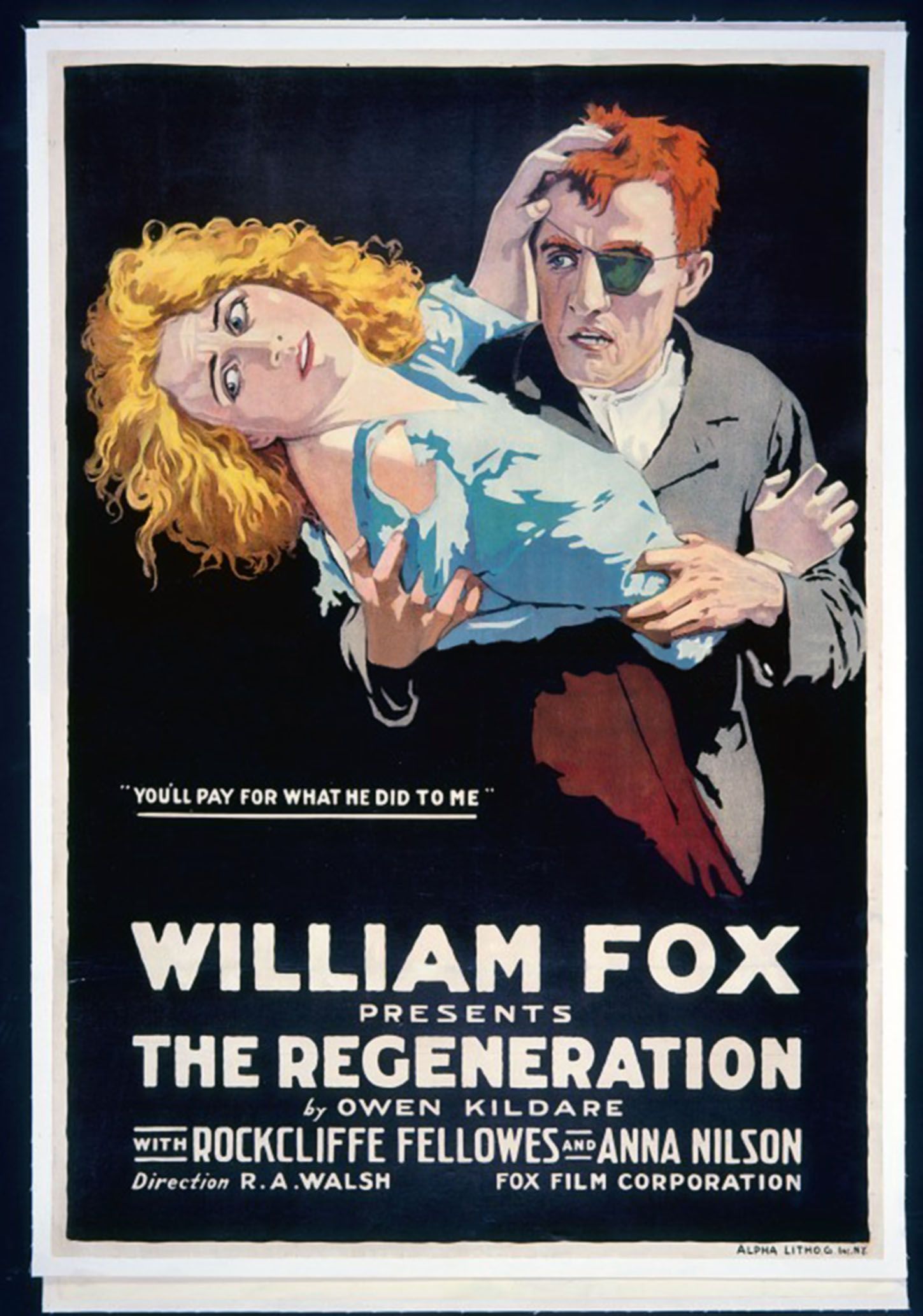
This Sunday, I invite you to take in a rarely screened early crime drama.
It's 'The Regeneration' (1915), which we're running on Sunday, March 26 at 2 p.m. as part of the "Salute to Silent New York" series at the Town Hall Theatre in Wilton, N.H.
I'll accompany the film, which I last played for in 2015 at the Niles Essanay Silent Film Museum in Niles, Calif.
I remember not expecting much, as early films tend to be a bit stagy and awkward.
But 'The Regeneration' surprised me, as it really held the screen and produced a lot of dramatic tension.
It's no wonder that it was a box office smash, and still worth seeing today.
Also, 'The Regeneration' was filmed in the tenements and slums of New York City's Lowest East Side. Today, in addition to telling a strong story, it's an eye-opening look at what life in that area more than a century ago.
More details in the press release below. Hope to see you Sunday afternoon!
* * *

MONDAY, MARCH 20, 2023 / FOR IMMEDIATE RELEASE
For more info, contact: Jeff Rapsis • (603) 236-9237 • jeffrapsis@gmail.com
Silent crime drama 'The Regeneration' to continue Town Hall Theatre salute to the Big Apple
Early feature film to be shown Sunday, March 26 with live music; latest in series of vintage movies set in New York City.
WILTON,
N.H.—Start spreadin' the news! New York City is the star of the Town
Hall Theatre's series of vintage silent feature films all set in the Big
Apple.
Next up is 'The Regeneration,' (1915), an early
feature-length crime drama filmed on location among the slums and
tenements of the city's Lower East Side.
'The Regeneration' will be shown on Sunday, March 26 at 2 p.m. at the Town Hall Theatre, 40 Main St., Wilton, N.H.
The film will be shown with live music by silent film accompanist Jeff Rapsis.
Admission is free; a donation of $10 per person at each screening is suggested to help defray expenses.

Cited as one of the first full-length gangster films, 'The Regeneration' tells the story of a poor orphan who rises to control the mob until he meets a woman for whom he wants to change.
The film was adapted from the autobiography of Owen Frawley Kildare, then known as "the Kipling of the Bowery."
The story follows the life of Owen (Rockliffe Fellowes), a young Irish American boy who is forced into a life of poverty after his mother dies.
As a result, Owen is forced to live on the street eventually turning to a life of crime.
Owen is eventually reformed, however, by the benevolent social worker Marie Deering (Anna Q. Nilsson). Also featured is a fire aboard an excursion ferry, much like the General Slocum disaster of 1904.
'The Regeneration' was the first film directed by Raoul Walsh, an actor whose previous roles included John Wilkes Booth in D.W. Griffith's epic 'The Birth of a Nation' (1915). Walsh would go on to direct more than 140 motion pictures.
The film was released in September 1915 to critical acclaim and was a box office hit.
In
2000, 'The Regeneration' was selected for preservation in the United
States National Film Registry by the Library of Congress as being
"culturally, historically or aesthetically significant."
The Town Hall Theatre's 'Silent New York' series will run on selected Sunday afternoons from March through May.
The
movies range from 'The Docks of New York' (1928), a gritty melodrama
set in New York's waterfront, to 'Speedy' (1928), an uproarious Harold
Lloyd comedy filmed throughout New York City, and which includes a cameo
by Babe Ruth.
Featured stars range from versatile actress Marion Davies to deadpan comedian Buster Keaton.
All films will be shown with live music by silent film accompanist Jeff Rapsis.
"Each
of these films is a great way to see what life in New York City was
like 100 years ago or more," Rapsis said. "Today, in addition to being
great entertainment, they're also a vivid window into the past."
Other films in the series include:
•
Sunday, April 23, 2023 at 2 p.m.: 'Lights of Old Broadway' (1925)
starring Marion Davies. Set in late 19th century NYC, Davies plays twins
orphaned in childhood who grow up unaware of each other but whose lives
intertwine much later on, with comic and dramatic results. Lavishly
produced MGM release preserved by the Library of Congress. (Originally
scheduled for April 16.)
• Sunday, April 30, 2023 at 2 p.m.:
'Speedy' (1928) starring Harold Lloyd. Lloyd's final silent feature
finds him at the peak of his career playing a baseball-crazed go-getter
forced to rescue the business of his girlfriend's father from being
destroyed by thugs. Filled with great scenes of 1920s NYC, with notable
cameo by baseball's Babe Ruth.
• Sunday, May 14, 2023 at 2 p.m.:
'The Docks of New York' (1928). Set in late 19th century New York,
roughneck stoker Bill Roberts gets into unexpected trouble during a
brief shore leave when he falls hard for Mae, a wise and weary
dance-hall girl. Intense and moving silent drama from legendary director
Josef von Sternberg.
• Sunday, May 21, 2023 at 2 p.m.: 'The
Cameraman' (1928) starring Buster Keaton. Keaton tries to impress the
gal of his dreams by working as a newsreel photographer. Can he get a
break and get the girl? Classic visual comedy with Keaton at the peak of
his creative powers; set in NYC and includes 1920s shots of Midtown
Manhattan and the old Yankee Stadium.
The Town Hall Theatre
strives to show silent film as it was intended to be seen—in restored
prints, on a large screen, with live music, and with an audience.
"All
those elements are important parts of the silent film experience," said
Rapsis, who will accompany the films. "Recreate those conditions, and
classics of early Hollywood leap back to life in ways that audiences
find surprising."
Rapsis performs on a digital synthesizer that
reproduces the texture of the full orchestra, creating a traditional
"movie score" sound. He improvises the complete score in real time
during the screening.
"Creating a movie score on the fly is kind
of a high-wire act, but it can often make for more excitement than if
everything is planned out in advance," Rapsis said.

Rapsis encouraged people unfamiliar with silent film to give it a try.
"If
you haven't seen a silent film the way it was intended to be shown,
then you're missing a unique experience," Rapsis said. "At their best,
silent films still connect with cinema-goers. They retain the power to
cast a spell, engage an audience, tap into elemental emotions, and
provoke strong reactions. They may be from another time, but they're new
to us."
'Regeneration' (1915) will be screened on Sunday, March 26 at 2 p.m. at the Town Hall Theatre, 40 Main St., Wilton, N.H.
Admission
is free; a donation of $10 per person is suggested to help defray
expenses. For more information, call (603) 654-3456.