Showing posts with label The Flying Ace. Show all posts

Friday, February 7, 2025

Changed date for 'The Strong Man' this weekend; classic comedy now showing on Saturday, Feb. 8, plus Boston Globe coverage of 'The Flying Ace'

Harry Langdon in 'The Strong Man' (1926), now showing on Saturday, Feb. 8 at the Town Hall Theater in Wilton, N.H.

Alert! This weekend's screening of 'The Strong Man' (1926) at the Town Hall Theatre in Wilton, N.H. has been changed to Saturday, Feb. 8 at 2 p.m.

Let's get fancy and paste in some JavaScript to create blinking text, like it's 1999 all over again.

Originally scheduled for Sunday, Feb. 9, the screening had to be moved a day earlier. So if you'd like to see what's widely regarded as Harry Langdon's best feature film, come on Saturday, Feb. 8.

More details about the film and the show are in the press release pasted in below. 

Before that, however, I need to thank Boston Globe film critic Odie Henderson for a terrific preview of last Sunday's screening of 'The Flying Ace' at the Somerville Theatre, and also for a follow-up essay published this past Wednesday.

It's rare these days for what's left of local media to devote resources to covering cinema. And it's rarer still for anyone to pay attention to vintage film. 

But Odie, who's been the Globe's film writer and critic for a few years now, took an interest in 'The Flying Ace,' writing about the film both before and after the screening.

Check out his preview, which ran on the front of the Globe's Weekend section:

The results of this kind of attention can be gratifying. Nearly 200 people turned out for the matinee screening, which took place on Sunday, Feb. 2 in the Somerville's main theatre. 

In introducing 'The Flying Ace,' I asked how many people had seen Odie's piece in the Globe? Nearly every hand shot up! (A lot of people also had seen coverage on the website of WBUR, a Boston-area NPR station.)

Odie attended the screening, and wrote a follow-up about the experience that included some kind words about my accompaniment:

"As Rapsis played the final notes of his outstanding, boisterous, and improvised accompaniment, I realized just how well his score complemented the film."

Thanks, Odie! Your work helped this film and our screening reach a lot more people that it otherwise might have.

*    *    *

Harry Langdon finds himself over a barrel in 'The Strong Man' (1926).

MONDAY, JAN. 27, 2025 / FOR IMMEDIATE RELEASE
Contact Jeff Rapsis • (603) 236-9237 • jeffrapsis@gmail.com

Frank Capra's very first movie highlights Town Hall Theatre silent film program on Saturday, Feb. 8

Screening features Harry Langdon's classic comedy 'The Strong Man' shown with live music; fun family activity suitable for all ages

WILTON, N.H. — Silent film with live music returns to the Town Hall Theatre in February with the showing of an uproarious comedy starring Harry Langdon.

The screening of 'The Strong Man' on Saturday, Feb. 8 at 2 p.m., gives families a chance to enjoy a fun activity suitable for all ages. The Town Hall Theatre is located at 40 Main St., Wilton, N.H.

Admission is free; donations are accepted, with $10 per person suggested to defray expenses.

Due to scheduling requirements, the screening date differs from the Town Hall Theatre's usual Sunday afternoon silent film time slot.

The screening, the latest in the Town Hall Theatre's silent film series, will feature live accompaniment by Jeff Rapsis, a New Hampshire-based composer who specializes in creating scores for silent films.

Directing 'The Strong Man' was young first-timer Frank Capra, who would later go on to create such Hollywood classics as 'Mr. Smith Goes to Washington' (1939) and 'It's a Wonderful Life' (1946).

'The Strong Man' tells the story of a World War I soldier (Langdon) who, following his discharge, finds work as assistant to a circus strong man. As the act travels the country, Langdon continually searches for a girl he corresponded with while stationed overseas in the military.

The search leads to a town controlled by Prohibition-era gangsters, which forces Harry to test the limits of his own inner strength even as he looks for his dream girl. Can Harry triumph over the bad guys? And is love more powerful than brute strength?

The feature-length film showcases the unique child-like personality of Langdon, who is largely forgotten today. For a brief time in the 1920s, however, he rivaled Charlie Chaplin as Hollywood's top movie clown.

Langdon's popularity, which grew quickly in the last years of the silent era, fizzled as the movie business abruptly switched to talkies starting in 1929.

'The Strong Man' was selected in 2007 for preservation in the U.S. National Film Registry by the Library of Congress as being "culturally, historically, or aesthetically significant."

In recent years, 'The Strong Man' has been recognized as a major achievement of the silent film era—a satisfying and timeless balance of emotion and comedy.

"A little tragedy and a lot of laughs can be seen in 1926's The Strong Man," wrote critic Richard von Busack in 2007. "Director Frank Capra's energy and sturdy plot sense counterpoint Langdon's wonderful strangeness."

A trade ad promoting the release of Harry Langdon's 'The Strong Man' (1926).

'The Strong Man' will be accompanied by live music by Jeff Rapsis, a New Hampshire-based silent film accompanist who performs at venues across the region and beyond.

"These films were created to be shown on the big screen as a communal experience," Rapsis said. "With an audience and live music, they still come to life in the way their makers intended them to.

"The silent film screenings at the Town Hall Theatre are a great chance for people to experience films that first caused people to first fall in love with the movies," he said.

Frank Capra's 'The Strong Man' will be screened with live music on Saturday, Feb. 8 at 2 p.m. at the Town Hall Theatre, 40 Main St., Wilton, N.H. 

Admission is free; donations are accepted, with $10 per person suggested to defray expenses. For more information, call the theater at (603) 654-3456.
 
Harry Langdon encounters the mysteries of the opposite sex in 'The Strong Man' (1926).
 

Saturday, February 1, 2025

This weekend: 'Battling Butler' in Campton, N.H., then 'The Flying Ace' in Somerville, Mass.

The front page of this week's 'Weekend' section of the Boston Globe.

Our planned screening of 'The Flying Ace' (1926) on Sunday, Feb. 2 at the Somerville Theatre has generated significant interest from Boston media.

On Friday, the Boston Globe made it the cover story of their Weekend Section, with a preview by critic Odie Henderson going in-depth about the film as well as the live music I'll be doing.

(The screening is at 2 p.m at the Somerville Theatre, 55 Davis Square, Somerville.; a press release with more info is pasted in below.)

On the same day, WBUR (a big-time NPR station in Boston) ran a substantial story by reporter Amelia Mason about the cultural climate that produced "race" films such as 'The Flying Ace,' which was intended for segregated cinemas of the era.

Here's a link to the Boston Globe piece. And here's the WBUR story.

I'm grateful to both journalists for their interest in the film as well as my work, and to their respective media outlets for the willingness to devote resources to covering this corner of Boston's cultural scene. Thank you!

And thank you (in advance) to all for making the trek to the Somerville to see this picture the way it was intended: on the big screen, in a great-looking print, with live music, and (most importantly) with an audience.

The main difference this time is that the audience, unlike when the film was originally released, will likely include some non-Black film-goers. I think that's a good thing—and I believe the people who produced 'The Flying Ace' nearly 100 years ago would agree. 

Prior to this, I'm heading north this afternoon for one of my favorite gigs of the season: the Campton (N.H.) Historical Society's Annual Pot Luck Supper and Silent Movie Night.

This year's attraction: Buster Keaton's boxing comedy 'Battling Butler' (1926), preceded by a communal supper made up of dishes that everyone brings in. (That's the actual admission price: something for the pot luck.)

Buster Keaton trains in the boxing ring; from 'Battling Butler' (1926).

If you're in the vicinity and want to join in, everyone's welcome. Supper begins at 5 p.m.; the film program usually starts by 6:30 p.m. or so. It's at the Campton Town Historical Society, Route 149 in Campton, N.H. Bring a dish—and your appetite!

*     *     *

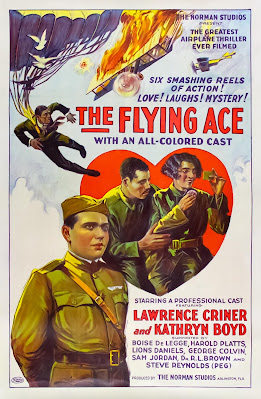
Original trade advertisement for 'The Flying Ace' (1926).

MONDAY, JAN. 27, 2025 / FOR IMMEDIATE RELEASE
Contact Jeff Rapsis • (603) 236-9237 • jeffrapsis@gmail.com

Honoring Black History Month

Somerville Theatre to screen rare vintage crime thriller with all-Black cast

'The Flying Ace' (1926), added to U.S. National Film Registry, to be shown with live music on Sunday, Feb. 2

SOMERVILLE, Mass. — Can discrimination exist in an America where everyone is Black?

That's among the questions posted by 'The Flying Ace' (1926), a rare surviving example of movies produced early in the 20th century for Black audiences in segregated cinemas.

'The Flying Ace,' named to the U.S. National Film Registry in 2021, will be screened in honor of Black History Month on Sunday, Feb. 2 at 2 p.m. at the Somerville Theatre, 55 Davis Square, Somerville, Mass.

Admission $17 adults; $13 members; $12 seniors/children. Tickets are available at somervilletheatre.com or at the door. 

The screening will feature live music by Jeff Rapsis, a New Hampshire-based silent film accompanist.

'The Flying Ace' was produced by Norman Studios in Jacksonville, Fla., using professionals such as Laurence Criner, a veteran of Harlem’s prestigious all-black theater troupe the Lafayette Players, but also many non-professionals for minor roles.

In 'The Flying Ace,' Criner plays Capt. Billy Stokes, a World War I fighter pilot known as "The Flying Ace" because of his downing of seven enemy aircraft in France.

Returning home to resume his former job as a railroad detective, he's assigned to locate a stationmaster who's gone missing along with the $25,000 company payroll.

While investigating, Stokes begins romancing the stationmaster's daughter Ruth (Kathryn Boyd), causing a rivalry with another suitor which leads to a break in the case.

With Ruth's safety now at risk, Stokes' dogged pursuit of the suspects leads to climax highlighted by a dramatic airborne chase which calls upon his piloting prowess.

Films such as 'The Flying Ace' were shown specifically to African-American audiences in areas of the U.S. where theaters were segregated.

Norman Studios was among the nation's top film production companies making feature length and short films for this market from the 1920s to the 1940s.

Featuring all-Black casts in stories meant to inspire and uplift, such films were popular with African-American audiences at the time. In Norman Studios films, the stories often took place in a world without the racial barriers that existed at the time.

In 'The Flying Ace,' Capt. Stokes is a pilot returning home from serving honorably in World War I—but Blacks were not allowed to fly aircraft in the U.S. military until 1940.

In an essay for the San Francisco Silent Film Festival, critic Megan Pugh wrote that Capt. Billy Stokes "...is a model for the ideals of racial uplift, fulfilling aspirations that Black Americans were not yet allowed to achieve."

"At a time when Hollywood employed white actors in blackface to play shuffling servants and mammies, the Norman Film Manufacturing Company...hired all-black casts to play dignified roles."
 
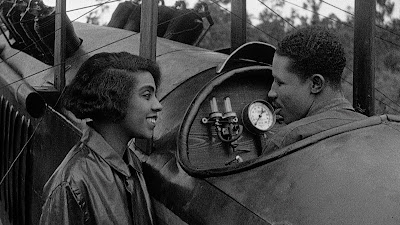
Kathryn Boyd and Laurence Criner star in 'The Flying Ace' (1926).
 
"Instead of tackling discrimination head-on in his films, Norman created a kind of segregated dream world where whites—and consequently, racism—didn’t even exist," Pugh wrote.

"While it’s impossible to measure the influence The Flying Ace had on its viewers, it is reasonable to assume that audiences found its lead character inspirational. Billy Stokes was a black male hero who would have never made it onscreen in a Hollywood movie of the time," Pugh wrote.

Filmed in the Arlington area of Jacksonville, Fla., 'The Flying Ace' is a unique aviation melodrama in that no airplanes actually leave the ground. The mid-air scenes were filmed in a studio in front of neutral backdrops.

Although 'The Flying Ace' may appear crudely made to modern audiences, in 2021 the movie was named to the U.S. National Film Registry by the Library of Congress as being "culturally, historically, or aesthetically significant."

Of films produced for Black-only audiences in segregated theaters, very few survive. 'The Flying Ace' is unusual in that it survives complete, and in pristine condition. The film was included in 'Pioneers of African American Cinema," a DVD collection released in 2016 by Kino-Lorber.

A live musical score for 'The Flying Ace' will be created by accompanist Jeff Rapsis, a New Hampshire-based performer who specializes in music for silent film presentations.

Rapsis said the Red River screening is a rare chance to see the film as it was meant to be experienced—on the big screen, with live music, and with an audience.

'The Flying Ace' (1926), a silent crime melodrama with an all-Black cast, will be shown in honor of Black History Month on Sunday, Feb. 2 at 2 p.m. at the Somerville Theatre, 55 Davis Square, Somerville, Mass.

Admission $17 adults; $13 members; $12 seniors/children. For more information and to purchase tickets, visit www.somervilletheatre.com or call the box office at (617) 625-5700.

Tuesday, February 6, 2024

On Thursday, Feb. 8: 'The Flying Ace' (1926) for Black History Month at Aviation Museum of N.H.

Kathryn Boyd and Laurence Criner star in 'The Flying Ace' (1926).

Up next, it's 'The Flying Ace' (1926), an aviation thriller with an all-Black cast that I'm accompanying at the Aviation Museum of N.H. for Black History Month.

Lots more about the film and details about the screening are in the press release pasted in below.

It's an unusual one for me because when I'm not accompanying silent films, I work as executive director of, yes, the Aviation Museum of N.H.!

People sometimes ask how I get booked to accompany screenings. In this case, I know someone on the inside.

Actually, because aviation was an exciting new thing in the 1920s, there are quite a few films that feature pilots and adventure. And newsreels of the time were full of mid-air stunts staged for the cameras.

So once in awhile, I bring my traveling circus/dog-and-pony show/silent film music addiction to the museum. Over the years, we've screened well-known films such as 'Wings' (1927) and not-so-well-known films such as 'The Flying Fleet' (1929) starring Ramon Novarro or the Monty Banks comedy 'Flying Luck' (1927).

I first encountered 'The Flying Ace' when it was included in "Pioneers of African-American Cinema," a collection issued in  2016 by Kino-Lorber.

I've since accompanied it many times, but I've been waiting to program it at the Aviation Museum of N.H. as a way to honor Black History Month.

This year seemed right. So on Thursday, Feb. 8, I hope you'll join us to experience one of the very films that survive from a time when film production was segregated—just like the cinemas themselves. 

*    *    *

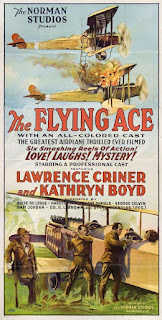
An original poster for 'The Flying Ace' (1926).

TUESDAY, JAN. 30, 2024 / FOR IMMEDIATE RELEASE
Contact Jeff Rapsis • (603) 236-9237 • jeffrapsis@gmail.com

Honoring Black History Month
Aviation Museum of N.H. to screen rare vintage aviation thriller with all-Black cast

'The Flying Ace' (1926), recently added to U.S. National Film Registry, to be shown with live music on Thursday, Feb. 8

LONDONDERRY, N.H. — Would discrimination exist in an America where everyone is Black?

That's among the questions posted by 'The Flying Ace' (1926), a rare surviving example of movies produced early in the 20th century for Black audiences in segregated cinemas.

'The Flying Ace,' recently named to the U.S. National Film Registry, will be screened in honor of Black History Month on Thursday, Feb. 8 at 7 p.m. at the Aviation Museum of N.H., 27 Navigator Road, Londonderry, N.H.

General admission is $10 per person. Member discounts do not apply to this event.

The screening will feature live music by Jeff Rapsis, a New Hampshire-based silent film accompanist and the museum's executive director.

'The Flying Ace' was produced by Norman Studios in Jacksonville, Fla., using professionals such as Laurence Criner, a veteran of Harlem’s prestigious all-black theater troupe the Lafayette Players, but also many non-professionals for minor roles.

Kathryn Boyd and Laurence Criner star in 'The Flying Ace.'

In 'The Flying Ace,' Criner plays Capt. Billy Stokes, a World War I fighter pilot known as "The Flying Ace" because of his downing of seven enemy aircraft in France.

Returning home to resume his former job as a railroad detective, he's assigned to locate a stationmaster who's gone missing along with the $25,000 company payroll.

While investigating, Stokes begins romancing the stationmaster's daughter Ruth (Kathryn Boyd), causing a rivalry with another suitor which leads to a break in the case.

With Ruth's safety now at risk, Stokes' dogged pursuit of the suspects leads to climax highlighted by a dramatic airborne chase which calls upon his piloting prowess.

Films such as 'The Flying Ace' were shown specifically to African-American audiences in areas of the U.S. where theaters were segregated.

Norman Studios was among the nation's top film production companies making feature length and short films for this market from the 1920s to the 1940s.

Featuring all-Black casts in stories meant to inspire and uplift, such films were popular with African-American audiences at the time. In Norman Studios films, the stories often took place in a world without the racial barriers that existed at the time.

In 'The Flying Ace,' Capt. Stokes is a pilot returning home from serving honorably in World War I—but Blacks were not allowed to fly aircraft in the U.S. military until 1940.

In an essay for the San Francisco Silent Film Festival, critic Megan Pugh wrote that Capt. Billy Stokes "...is a model for the ideals of racial uplift, fulfilling aspirations that Black Americans were not yet allowed to achieve."

"At a time when Hollywood employed white actors in blackface to play shuffling servants and mammies, the Norman Film Manufacturing Company...hired all-black casts to play dignified roles."

"Instead of tackling discrimination head-on in his films, Norman created a kind of segregated dream world where whites—and consequently, racism—didn’t even exist," Pugh wrote.

"While it’s impossible to measure the influence The Flying Ace had on its viewers, it is reasonable to assume that audiences found its lead character inspirational. Billy Stokes was a black male hero who would have never made it onscreen in a Hollywood movie of the time," Pugh wrote.

Filmed in the Arlington area of Jacksonville, Fla., 'The Flying Ace' is an unusual aviation melodrama in that no airplanes in the movie actually leave the ground. The mid-air scenes were filmed in a studio in front of neutral backdrops.

Although 'The Flying Ace' may appear crudely made to modern audiences, in 2021 the movie was named to the U.S. National Film Registry by the Library of Congress as being "culturally, historically, or aesthetically significant."

Of films produced for Black-only audiences in segregated theaters, very few survive. 'The Flying Ace' is unusual in that it survives complete, and in pristine condition. The film was included in 'Pioneers of African American Cinema," a DVD collection released in 2016 by Kino-Lorber.

A live musical score for 'The Flying Ace' will be created by accompanist Jeff Rapsis, a New Hampshire-based performer who specializes in music for silent film presentations.

Rapsis, who is also executive director of the Aviation Museum, said the screening is a rare chance to see the film as it was meant to be experienced—on the big screen, with live music, and with an audience.

The Aviation Museum is open Fridays and Saturdays 10 a.m. to 4 p.m. and Sundays 1 to 4 p.m. Admission is $10 age 13 and up; $5 age 6-12, seniors 65 and over, and veterans/active military; kids 5 and under free.

The Aviation Museum of N.H., located at 27 Navigator Road, Londonderry, N.H., is a non-profit 501(c)3 tax-exempt organization dedicated to celebrating New Hampshire’s role in aviation history and inspiring tomorrow’s aerospace professionals.

Named “Best Place to Take Kids” in southern New Hampshire in the 2023 HippoPress Readers Poll, the Aviation Museum of N.H. was recently awarded the prestigious ‘Non-Profit Impact Award’ by the Center for N.H. Non-Profits.

'The Flying Ace' (1926), a silent aviation melodrama with an all-Black cast, will be shown with live music in honor of Black History Month on Thursday, Feb. 8 at 7 p.m. at the Aviation Museum of N.H., 27 Navigator Road, Londonderry, N.H.

Tickets are $10 per person at the door. Member discounts do not apply. Advance tickets are available by phone at (603) 669-4877.

For more information, visit www.aviationmuseumofnh.org or call (603) 669-4820. Follow the Aviation Museum on social media at www.facebook.com/nhahs.

Sunday, September 11, 2022

Coming up: 'The Flying Ace,' then 'Les Vampyres' complete, then off to Kansas, Detroit, Cleveland

Brandon Town Hall in Brandon, Vt., where I accompanied 'The Flying Ace' yesterday. The film will also be screened on Wednesday, Sept. 14 in Ogunquit, Maine.

A bit of a lull in screenings around Labor Day weekend. But things pick up in a big way with screenings hither and thither, near and far, as we approach Silent Movie Day (Thursday, Sept. 29) and then the mad steeplechase of Halloween.

Coming up next is 'The Flying Ace' (1926), a crime thriller that was named last year to the National Film Registry. It's a rare surviving all-Black "race" film produced for segregated theaters. 

It's Wednesday, Sept. 14 at 7 p.m. at the Leavitt Theatre in Ogunquit, Maine. More details in the press release below. 

This coming weekend, I tackle something fairly ambitious: the entire series of films known as 'Les Vampyres,' which run over 7 hours and which were produced in France in 1915 by Louis Feuillade. 

They'll be shown at the Town Hall Theatre in Wilton, N.H. in two gulps: the first six films on Saturday, Sept. 17, and then the final four on Sunday, Sept. 18. Both programs start at 2 p.m.

This is a rare chance to see the series in its entirety on the big screen and with live music. I'm looking forward to seeing what kind of audience we get, and also what the cumulative effect of the films will be.

Later this month, I head out to Iola, Kansas from Sept. 22 to Sept. 25 for the latest iteration of the long-running Keaton Celebration, held annually in honor of Buster's nearby birthplace of Piqua, Kansas.

The original Keaton Celebration, which had an academic focus, faded out in recent years, but the folks at the Bowlus Center for the Arts (the Celebration's longtime venue) have decided to reinvent it as a more community-minded event.

So this year's event will be highlighted by a local filmmaker competition, a window display content among local businesses, and more. 

One carryover from the original Keaton Celebration is a theme linking Keaton with other entertainment luminaries. This year's theme is one that's been discussed before and is now finally happening: Keaton and Hollywood dance icon Gene Kelley.

Subtitled "Gotta Dance," the program will bring Kelly's widow, Patricia Kelly, to town for a talk about her late husband, plus an exploration of the Keaton/Kelly connection, which is more substantial than you might think.

A highlight for me will be on Saturday, Sept. 24, when fellow silent film accompanist Ben Model will explore (via video link) similarities between Keaton's wistful walk in the rain in 'The Cameraman' (1928) and Kelly's famous scene in 'Singin' in the Rain' (1952). 

I'll get to accompany 'The Cameraman' as well as 'Steamboat Bill Jr.' (1928) live, plus a few shorts. Also on the bill is author Dana Stevens, who's coming to Iola to discuss her book "Camera Man," published earlier this year. 

The week after that, I head out to Cinema Detroit, where they're celebrating Silent Film Day (and also the Artemis project) with Fritz Lang's silent sci-fi epic 'Woman in the Moon' (1929). The next day, it's 'Greed' (1924) at the Cleveland Cinematheque.

So lots to look forward to. But first, it's 'The Flying Ace' (1926) this Wednesday, Sept. 14 at the Leavitt Theatre in Ogunquit, Maine. For more details, check out the press release below. 

 *   *   *

An original release poster promoting 'The Flying Ace' (1926).

MONDAY, SEPT. 5, 2022 / FOR IMMEDIATE RELEASE
Contact Jeff Rapsis • (603) 236-9237 • jeffrapsis@gmail.com

Leavitt Theatre to screen rare vintage crime melodrama with all-Black cast

'The Flying Ace' (1926), recently added to U.S. National Film Registry, to be shown with live music on Wednesday, Sept. 14

OGUNQUIT, Maine — Can discrimination exist in an America where everyone is Black?

That's among the questions posted by 'The Flying Ace' (1926), a rare surviving example of movies produced early in the 20th century for Black audiences in segregated cinemas.

'The Flying Ace,' recently named to the U.S. National Film Registry, will be screened on Wednesday, Sept. 14 at 7 p.m. at the historic Leavitt Theatre, 259 Main St., Route 1, in Ogunquit, Maine.

General admission is $12 per person.

The rarely screened movie will be shown with live music by silent film accompanist Jeff Rapsis, a New Hampshire-based performer and composer who specializes in scoring and presenting silent films.

'The Flying Ace' was produced by Norman Studios in Jacksonville, Fla., using professionals such as Laurence Criner, a veteran of Harlem’s prestigious all-Black theater troupe the Lafayette Players, but also many non-professionals for minor roles.

Laurence Criner and Kathryn Boyd star in 'The Flying Ace' (1926).

In 'The Flying Ace,' Criner plays Capt. Billy Stokes, a World War I fighter pilot known as "The Flying Ace" because of his downing of seven enemy aircraft in France.

Returning home to resume his former job as a railroad detective, he's assigned to locate a stationmaster who's gone missing along with the $25,000 company payroll.

While investigating, Stokes begins romancing the stationmaster's daughter Ruth (Kathryn Boyd), causing a rivalry with another suitor which leads to a break in the case.

With Ruth's safety now at risk, Stokes' dogged pursuit of the suspects leads to climax highlighted by a dramatic airborne chase which calls upon his piloting prowess.

Films such as 'The Flying Ace' were shown specifically to African-American audiences in areas of the U.S. where theaters were segregated.

Norman Studios was among the nation's top film production companies making feature length and short films for this market from the 1920s to the 1940s.

Featuring all-Black casts in stories meant to inspire and uplift, such films were popular with African-American audiences at the time. In Norman Studios films, the stories often took place in a world without the racial barriers that existed at the time.

In 'The Flying Ace,' Capt. Stokes is a pilot returning home from serving honorably in World War I—but Blacks were not allowed to fly aircraft in the U.S. military until 1940.

In an essay for the San Francisco Silent Film Festival, critic Megan Pugh wrote that Capt. Billy Stokes "...is a model for the ideals of racial uplift, fulfilling aspirations that Black Americans were not yet allowed to achieve."

"At a time when Hollywood employed white actors in blackface to play shuffling servants and mammies, the Norman Film Manufacturing Company...hired all-Black casts to play dignified roles."

"Instead of tackling discrimination head-on in his films, Norman created a kind of segregated dream world where whites—and consequently, racism—didn’t even exist," Pugh wrote.

"While it’s impossible to measure the influence The Flying Ace had on its viewers, it is reasonable to assume that audiences found its lead character inspirational. Billy Stokes was a black male hero who would have never made it onscreen in a Hollywood movie of the time," Pugh wrote.

Filmed in the Arlington area of Jacksonville, Fla., 'The Flying Ace' is a unique aviation melodrama in that no airplanes actually leave the ground. The mid-air scenes were filmed in a studio in front of neutral backdrops.

A scene from 'The Flying Ace.'

Although 'The Flying Ace' may appear crudely made to modern audiences, in 2021 the movie was named to the U.S. National Film Registry by the Library of Congress as being "culturally, historically, or aesthetically significant."

Of films produced for Black-only audiences in segregated theaters, very few survive. 'The Flying Ace' is unusual in that it survives complete, and in pristine condition. The film was included in 'Pioneers of African American Cinema," a DVD collection released in 2016 by Kino-Lorber.

A live musical score for 'The Flying Ace' will be created by accompanist Jeff Rapsis, a New Hampshire-based performer who specializes in music for silent film presentations.

Rapsis said the Leavitt Theatre screening is a rare chance to see the film as it was meant to be experienced—on the big screen, with live music, and with an audience.

The Leavitt, a summer-only moviehouse, opened in 1923 at the height of the silent film era, and has been showing movies for nearly a century.

The silent film series honors the theater's long service as a moviehouse that has entertained generations of Seacoast residents and visitors, in good times and in bad.

Following 'The Flying Ace' on Wednesday, Sept. 14 at 7 p.m., other programs in this year's Leavitt silent film series include:

• Saturday, Oct. 29 at 7 p.m.: 'Der Golem' (1920). Prepare for Halloween with one very weird flick! In 16th-century Prague, a rabbi creates a giant creature from clay, called the Golem. Using sorcery, he brings the creature to life in order to protect the Jews of Prague from persecution.

The all-Black crime melodrama 'The Flying Ace' will be shown on Wednesday, Sept. 14 at 7 p.m. at the historic Leavitt Theatre, 259 Main St, Route 1 in Ogunquit, Maine.

Admission is $12 per person, general seating. For more info, call (207) 646-3123 or visit www.leavittheatre.com.

Monday, February 21, 2022

Red River Theatres to screen 'The Flying Ace,' silent 'race' drama for Black History Month

A poster for 'The Flying Ace' (1926), screening with live music at Red River Theatres in Concord, N.H. 

I've just finished a five-shows-in-five-days marathon, and boy are my fingers tired. 

Actually, not really—foe me, silent film accompaniment is more mentally taxing than physically demanding.

So, to borrow a phrase from Monty Python: "Oooh, my brain hurts!"

Yesterday's screening of 'When Knighthood Was in Flower' (1922) at the Town Hall Theater in Wilton, N.H. drew raves from the 40 or so people who attended.

Starring Marion Davies, it's quite the movie and holds up well. You can see why it was the year's second-highest grossing picture, exceeded only by Douglas Fairbanks in 'Robin Hood,' another adventure set in Merrie Old England.

'Knighthood' would not have been available at all if not for Ben Model's rescue project a few years ago, which got the film out of the Library of Congress vaults, transferred to digital media, and then restored for enjoyment and exhibition. 

I was delighted to contribute to the Kickstarter effort that made the film's reissue possible. Thanks to Ben and everyone else who worked on this edition. 

So what's next for me?

On Wednesday, I do music for 'The Flying Ace' (1926), a "race" drama being screened at Red River Theatres in Concord, N.H. 

Then it's off to the three-day Kansas Silent Film Festival, where I'll accompany Oscar Micheaux's 'Within Our Gates' (1921) and a passel of short comedies. 

No rest for the wicked. So I must be very wicked indeed.

For now, here's the press release about the Red River screening of 'The Flying Ace,' with a lot more info about the film, which was recently added to the National Film Registry by the Library of Congress.

It's worth seeing, as it's an artifact from a time not that long ago when it was common for movie theaters in some parts of the U.S. to be segregated by race. 

Water fountains, too. 

What were they thinking? 

See you in Concord on Wednesday night, or in Topeka next weekend!

*  *  *

Kathryn Boyd and Laurence Criner in 'The Flying Ace' (1926).

MONDAY, FEB. 14, 2022 / FOR IMMEDIATE RELEASE
Contact Jeff Rapsis • (603) 236-9237 • jeffrapsis@gmail.com

Honoring Black History Month

Red River Theatres to screen rare vintage crime melodrama with all-Black cast

'The Flying Ace' (1926), recently added to U.S. National Film Registry, to be shown with live music on Wednesday, Feb. 23

CONCORD, N.H. — Can discrimination exist in an America where everyone is Black?

That's among the questions posted by 'The Flying Ace' (1926), a rare surviving example of movies produced early in the 20th century for Black audiences in segregated cinemas.

'The Flying Ace,' recently named to the U.S. National Film Registry, will be screened in honor of Black History Month on Wednesday, Feb. 23 at 7 p.m. at Red River Theatres, 11 South Main St., Concord.

General admission is $12 per person, $10 for Red River members.

The screening will feature live music by Jeff Rapsis, a New Hampshire-based silent film accompanist.

'The Flying Ace' was produced by Norman Studios in Jacksonville, Fla., using professionals such as Laurence Criner, a veteran of Harlem’s prestigious all-black theater troupe the Lafayette Players, but also many non-professionals for minor roles.

In 'The Flying Ace,' Criner plays Capt. Billy Stokes, a World War I fighter pilot known as "The Flying Ace" because of his downing of seven enemy aircraft in France.

Returning home to resume his former job as a railroad detective, he's assigned to locate a stationmaster who's gone missing along with the $25,000 company payroll.

While investigating, Stokes begins romancing the stationmaster's daughter Ruth (Kathryn Boyd), causing a rivalry with another suitor which leads to a break in the case.

With Ruth's safety now at risk, Stokes' dogged pursuit of the suspects leads to climax highlighted by a dramatic airborne chase which calls upon his piloting prowess.

Films such as 'The Flying Ace' were shown specifically to African-American audiences in areas of the U.S. where theaters were segregated.

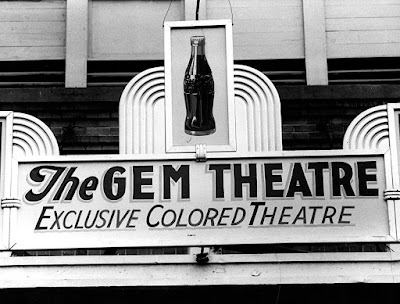
A segregated movie theater in Waco, Texas in 1939.

Norman Studios was among the nation's top film production companies making feature length and short films for this market from the 1920s to the 1940s.

Featuring all-Black casts in stories meant to inspire and uplift, such films were popular with African-American audiences at the time. In Norman Studios films, the stories often took place in a world without the racial barriers that existed at the time.

In 'The Flying Ace,' Capt. Stokes is a pilot returning home from serving honorably in World War I—but Blacks were not allowed to fly aircraft in the U.S. military until 1940.

In an essay for the San Francisco Silent Film Festival, critic Megan Pugh wrote that Capt. Billy Stokes "...is a model for the ideals of racial uplift, fulfilling aspirations that Black Americans were not yet allowed to achieve."

"At a time when Hollywood employed white actors in blackface to play shuffling servants and mammies, the Norman Film Manufacturing Company...hired all-black casts to play dignified roles."

"Instead of tackling discrimination head-on in his films, Norman created a kind of segregated dream world where whites—and consequently, racism—didn’t even exist," Pugh wrote.

"While it’s impossible to measure the influence The Flying Ace had on its viewers, it is reasonable to assume that audiences found its lead character inspirational. Billy Stokes was a black male hero who would have never made it onscreen in a Hollywood movie of the time," Pugh wrote.

Filmed in the Arlington area of Jacksonville, Fla., 'The Flying Ace' is a unique aviation melodrama in that no airplanes actually leave the ground. The mid-air scenes were filmed in a studio in front of neutral backdrops.

Although 'The Flying Ace' may appear crudely made to modern audiences, in 2021 the movie was named to the U.S. National Film Registry by the Library of Congress as being "culturally, historically, or aesthetically significant."

Of films produced for Black-only audiences in segregated theaters, very few survive. 'The Flying Ace' is unusual in that it survives complete, and in pristine condition. The film was included in 'Pioneers of African American Cinema," a DVD collection released in 2016 by Kino-Lorber.

A live musical score for 'The Flying Ace' will be created by accompanist Jeff Rapsis, a New Hampshire-based performer who specializes in music for silent film presentations.

Rapsis said the Red River screening is a rare chance to see the film as it was meant to be experienced—on the big screen, with live music, and with an audience.

'The Flying Ace' (1926), a silent crime melodrama with an all-Black cast, will be shown in honor of Black History Month on Wednesday, Feb. 23 at 7 p.m. at Red River Theatres, 11 South Main St. in Concord.

Tickets are general admission $12; Red River Theatres members $10. For more info and to purchase advance tickets, visit www.redrivertheatres.org or call (603) 224-4600. 


Saturday, February 19, 2022

Tonight: Emil Jannings in 'The Last Command' at Epsilon Spires in Brattleboro, Vt., w/pipe organ

Original promotional art for Josef von Sternberg's 'The Last Command' (1928).

Quick post in advance of heading out to Brattleboro, Vt., where tonight I'll accompany the great Josef Sternberg drama 'The Last Command' (1928).

Come join us! The show starts at 8 p.m. at Epsilon Spires performance space, with music on the venue's Estey pipe organ augmented by digital synthesizer. 

It's worth attending, as the performance of Emil Jannings is one for the ages. Playing a deposed Czarist general forced to act out his personal drama on a Hollywood set, it's really something to see him go completely berzerk.

See for yourself. More info in the press release below.

For now, let me thank Leland Stein and the staff at the Regent Theater in Arlington, Mass. for their willingness to screen 'The Flying Ace' (1926) in observance of Black History Month.

Last night's show attracted a small audience, which surprised me. 'The Flying Ace' was recently added to the National Film Registry by the Library of Congress. As a rare surviving "race drama" intended for segregated movie theaters, you'd think it would be of more interest. After all these years, I think it has a lot to say to us

Well—I'll accompany it again on Wednesday, Feb. 23 up at Red River Theatres in Concord, N.H. But right now I have to hit the road to make it through snow squalls over the river (the Connecticut River) and through the woods to Brattleboro and 'The Last Command.' 

See you there tonight!

*   *   *

Evelyn Brent and Emil Jannings in 'The Last Command' (1928).
 
MONDAY, FEB. 7, 2022 / FOR IMMEDIATE RELEASE
Contact Jeff Rapsis • (603) 236-9237 • jeffrapsis@gmail.com

Silent epic 'The Last Command' with live pipe organ score at Epsilon Spires on Saturday, Feb. 19

Josef von Sternberg's groundbreaking psychological drama won 'Best Actor' for Emil Jannings at first-ever Academy Awards

BRATTLEBORO, Vt.—'The Last Command' (1928), a silent film drama that won Emil Jannings 'Best Actor' honors at the first-ever Academy Awards, will be screened with live music on Saturday, Feb. 19 at 8 p.m. at Epsilon Spires, 190 Main St., Brattleboro, Vt.

Admission is $15 per person. Tickets may be purchased in advance at www.epsilonspires.org or at the door.

The screening will feature live accompaniment on the venue's Estey pipe organ by Jeff Rapsis, a New Hampshire-based silent film musician.

'The Last Command,' directed by Josef von Sternberg, tells the sweeping story of a powerful general in Czarist Russia (Jannings) forced to flee his homeland during the Bolshevik Revolution. He emigrates to America, where he is reduced to living in poverty.

Finding work as an extra at a Hollywood studio, the former general lands the part of a commanding officer in a movie about the Revolution, causing flashbacks to his traumatic experiences. The conflict leads to a spectacular climax and a towering performance that earned Jannings 'Best Actor' honors.

The film takes audiences on a journey through big emotions as well as issues of history, time, power, and especially a man's duty to his country and to his fellow citizens—and what happens when the two obligations diverge.

'The Last Command' is also one of early Hollywood's most creative and challenging looks at the global conflicts that contributed to World War I.

The film also stars a young William Powell as a Hollywood movie director who crosses paths with the general during the Revolution, and 1920s starlet Evelyn Brent as a seductive Russian revolutionary.

Rapsis, the accompanist, will create the film's score live as the movie is shown by improvising on the venue's historic Estey pipe organ, built in Brattleboro and installed in 1906.

"Making up the music on the spot is kind of a high wire act," Rapsis said. "But there's nothing like the energy and excitement that comes with improvised live performance, especially when accompanying a silent film."

Critic Leonard Maltin hailed 'The Last Command' as "a stunning silent drama...a fascinating story laced with keen observations of life and work in Hollywood." Time Out of London called it "the first Sternberg masterpiece, expertly poised between satire and 'absurd' melodrama. The cast are fully equal to it; Jannings, in particular, turns the characteristic role of the general into an indelible portrait of arrogance, fervor and dementia."

Director Sternberg, a master of lighting and black-and-white photography, created 'The Last Command' as a visual tour de force. The film is often cited as a prime example of the emotional range and visual accomplishment of silent films at their height, just prior to the coming of pictures with recorded soundtracks.

Rapsis said great silent film dramas such as 'The Last Command' told stories that concentrate on the "big" emotions such as Love, Despair, Anger, and Joy. Because of this, audiences continue to respond to them in the 21st century, especially if they're presented as intended—in a theater on the big screen, with a live audience and live music.

"Dramas such as 'The Last Command' were created to be consumed as a communal experience," Rapsis said. "With an audience and live music, they come to life as their creators intended them to. This screening at Epsilon Spires is a great chance to experience films that first caused people to fall in love with the movies."

The non-profit Epsilon Spires, housed in Brattleboro's former Baptist church, builds connections between art and science by offering provocative performances and events, interactive art installations, and opportunities to engage in civil discourse by addressing current topics through the integration of diverse forms of expression. 

'The Last Command' (1928) will be screened with live music on Saturday, Feb. 19 at 8 p.m. at Epsilon Spires, 190 Main St., Brattleboro, Vt. Admission is $15 per person. Tickets may be purchased in advance at www.epsilonspires.org or at the door.


Friday, February 18, 2022

Rare all-Black drama, 'The Flying Ace' (1926), tonight at the Regent Theatre in Arlington, Mass.

A not-very-subtle promotional poster for the all-Black drama 'The Flying Ace' (1926).

In honor of Black History Month, tonight (Friday, Feb. 18) the Regent Theater of Arlington, Mass. is screening 'The Flying Ace' (1926), with live music by me. 

It's a rare surviving example of what some scholars call "Race Cinema," meaning movies made for segregated theaters that were part of the American movie landscape in the first half of the 20th century.

'The Flying Ace,' a rare surviving example of this type of film, was recently added to the National Film Registry by the Library of Congress for being either "culturally, historically, or aesthetically significant."

I think 'The Flying Ace,' produced by Norman Studios of Jacksonville, Fla., applies to the first two distinctions: cultural and historic. It's a vivid reminder of racism that permeated everyday life in its era—so much so that people set up separate theaters for people of different skin color!

In terms of being "aesthetically significant"—well, you can make up your own mind on that. But I believe that any film from a century ago, no matter what its level of aesthetic achievement, has a lot to say to us today, if only for just the passing of time. 

And let's be clear about one thing. By screening 'The Flying Ace,' neither I nor the Regent Theatre are celebrating the fact that for many decades, movie theaters in the United States were segregated by race. 

No. 'The Flying Ace' is a concrete artifact of a shameful legacy of racism that pervaded society at the time, and with which we still grapple today.  

But by acknowledging that it once existed, and preserving this artifact from the era (and I believe screening vintage film before the public is part of preservation), we can be better equipped to confront racism in our own time.

So hope to see you at the Regent tonight at 7:30 p.m. Much more info in the press release below.

*      *      *

Kathryn Boyd and Laurence Criner star in 'The Flying Ace' (1926).

MONDAY, FEB. 14, 2022 / FOR IMMEDIATE RELEASE

Contact Jeff Rapsis • (603) 236-9237 • jeffrapsis@gmail.com

Honoring Black History Month

Regent Theatre to screen rare vintage crime melodrama with all-Black cast

'The Flying Ace' (1926), recently added to U.S. National Film Registry, to be shown with live music on Friday, Feb. 18

ARLINGTON, Mass. — Can discrimination exist in an America where everyone is Black?

That's among the questions posted by 'The Flying Ace' (1926), a rare surviving example of so-called "race" movies produced early in the 20th century for Black audiences in segregated cinemas.

'The Flying Ace,' recently named to the U.S. National Film Registry, will be screened in honor of Black History Month on Friday, Feb. 18 at 7:30 p.m. at the Regent Theatre, 7 Medford St., Arlington, Mass.

General admission is $15 per person. Tickets available at the door or online at www.regenttheatre.com.

The screening will feature live music by Jeff Rapsis, a New Hampshire-based silent film accompanist.

'The Flying Ace' was produced by Norman Studios in Jacksonville, Fla., using professionals such as Laurence Criner, a veteran of Harlem’s prestigious all-black theater troupe the Lafayette Players, but also many non-professionals for minor roles.

In 'The Flying Ace,' Criner plays Capt. Billy Stokes, a World War I fighter pilot known as "The Flying Ace" because of his downing of seven enemy aircraft in France.

Returning home to resume his former job as a railroad detective, he's assigned to locate a stationmaster who's gone missing along with the $25,000 company payroll.

While investigating, Stokes begins romancing the stationmaster's daughter Ruth (Kathryn Boyd), causing a rivalry with another suitor which leads to a break in the case.

With Ruth's safety now at risk, Stokes' dogged pursuit of the suspects leads to climax highlighted by a dramatic airborne chase which calls upon his piloting prowess.

Films such as 'The Flying Ace' were shown specifically to African-American audiences in areas of the U.S. where theaters were segregated.

Norman Studios was among the nation's top film production companies making so-called "race" films for this market from the 1920s to the 1940s.

Featuring all-Black casts in stories meant to inspire and uplift, such films were popular with African-American audiences at the time. In Norman Studios films, the stories often took place in a world without the racial barriers that existed at the time.

In 'The Flying Ace,' Capt. Stokes is a pilot returning home from serving honorably in World War I—but Blacks were not allowed to fly aircraft in the U.S. military until 1940.

In an essay for the San Francisco Silent Film Festival, critic Megan Pugh wrote that Capt. Billy Stokes "...is a model for the ideals of racial uplift, fulfilling aspirations that Black Americans were not yet allowed to achieve."

"At a time when Hollywood employed white actors in blackface to play shuffling servants and mammies, the Norman Film Manufacturing Company...hired all-black casts to play dignified roles."

"Instead of tackling discrimination head-on in his films, Norman created a kind of segregated dream world where whites—and consequently, racism—didn’t even exist," Pugh wrote.

"While it’s impossible to measure the influence The Flying Ace had on its viewers, it is reasonable to assume that audiences found its lead character inspirational. Billy Stokes was a black male hero who would have never made it onscreen in a Hollywood movie of the time," Pugh wrote.

Filmed in the Arlington area of Jacksonville, Fla., 'The Flying Ace' is a unique aviation melodrama in that no airplanes actually leave the ground. The mid-air scenes were filmed in a studio in front of neutral backdrops.

A monochrome lobby card for 'The Flying Ace' (1926).

Although 'The Flying Ace' may appear crudely made to modern audiences, in 2021 the movie was named to the U.S. National Film Registry by the Library of Congress as being "culturally, historically, or aesthetically significant."

Of films produced for Black-only audiences in segregated theaters, very few survive. 'The Flying Ace' is unusual in that it survives complete, and in pristine condition. The film was included in 'Pioneers of African American Cinema," a DVD collection released in 2016 by Kino-Lorber.

A live musical score for 'The Flying Ace' will be created by accompanist Jeff Rapsis, a New Hampshire-based performer who specializes in music for silent film presentations.

Rapsis said the Regent Theatre screening is a rare chance to see the film as it was meant to be experienced—on the big screen, with live music, and with an audience.

'The Flying Ace' (1926), a silent crime melodrama with an all-Black cast, will be shown in honor of Black History Month on Friday, Feb. 18 at 7:30 p.m. at the Regent Theatre, 7 Medford St., Arlington, Mass.

General admission is $15 per person. Tickets available at the door or online at www.regenttheatre.com. For more information, call the theater at (781) 646-4849.