Showing posts with label Cameraman. Show all posts

Thursday, June 20, 2024

Next up: Buster Keaton's 'The Cameraman' (1928) on Saturday, July 20 at Brandon (Vt.) Town Hall

A promotional still from Buster Keaton's 'The Cameraman' (1928).

Timing is everything!

Consider: I've developed a case of severe tendonitis in my right arm just as I'm starting a one-month hiatus from silent film accompaniment.

Hope that gives the arm time to heal and get back to normal by the time I resume in July.

First film then will be Keaton's 'The Cameraman' (1928), which I'll accompany on Saturday, July 20 at Brandon (Vt.) Town Hall.

For now, thank you to all who attended screenings during the first half of 2024. Looking forward to 'Part 2' when I get back on the accompaniment circuit.

For now, here's a preview of 'The Cameraman.' Hope to see you there!

*    *    *

Original lobby card for 'The Cameraman' (1928).

MONDAY, JUNE 10, 2024 / FOR IMMEDIATE RELEASE
For more info, contact: Jeff Rapsis • (603) 236-9237 • jeffrapsis@gmail.com

'The Cameraman' with live music on Saturday, July 20 at Brandon Town Hall

Buster Keaton's classic silent comedy set in 1920s New York City to be shown on the big screen

BRANDON, Vt.—He never smiled on camera, earning him the nickname of "the Great Stone Face." But Buster Keaton's comedies rocked Hollywood's silent era with laughter throughout the 1920s.

See for yourself with a screening of 'The Cameraman' (1928) one of Keaton's landmark feature films, on Saturday, July 20 at 7 p.m. at the Brandon Town Hall and Community Center.

All are welcome to this family-friendly event. Admission is free, with free will donations accepted in support of ongoing Town Hall renovations.

The screening, the latest in the venue's silent film series, will feature live accompaniment by Jeff Rapsis, a New Hampshire-based composer who specializes in creating music for silent films.

'The Cameraman' tells the story of a young man (Keaton) who tries to impress the girl of his dreams (Marceline Day) by working as a freelance newsreel cameraman.

His efforts fail spectacularly, but then a lucky break gives him an unexpected chance to make his mark. Can Buster parlay the scoop of the year into a secure job and successful romance?

'The Cameraman' includes several classic Keaton sequences, including a disastrous first date at a public swimming pool, an unusual baseball sequence filmed at Yankee Stadium, and a dramatic water rescue following a boat accident.

In 'The Cameraman,' Keaton uses the movie business itself to create comedy that plays with the nature of film and reality.

"Keaton's films are audience favorites, and people continue to be surprised at how engrossing and exhilarating they can be when shown as they were intended: in a theater, and with live music," said accompanist Jeff Rapsis, who performs at more than 100 screenings each year at venues around the nation and abroad.

Rapsis, who lives in Bedford, N.H., improvises live scores for silent films using a digital synthesizer to recreate the texture of the full orchestra.

"It's kind of a high wire act," Rapsis said. "But for me, the energy of live performance is an essential part of the silent film experience."

The screening of 'The Cameraman' is sponsored by Donna Malewicki; Barbara and Tom White; and Gary and Nancy Meffe. 

Other films in this year's Brandon Town Hall silent film series include:

• Saturday, Aug. 10, 2024, 7 p.m.: "Four Horsemen of the Apocalypse" (1921) starring Rudolph Valentino. Sweeping drama of a divided family with members caught up on oppositessides during World War I. Breakthrough film for Rudolph Valentino, introducing the sultry tango and launching him to stardom. The real deal! Shown both in honor of the 110th anniversary of World War I's outbreak and the anniversary of Valentino's untimely death in 1926. 

 • Saturday, Sept. 21, 2024, 7 p.m.: "Speedy" (1928) starring Harold Lloyd. Harold's final silent feature cis a tribute to New York City, baseball, and the idea that nice guys can indeed finish first, highlighted by one of the most exciting races to the finish in all silent cinema. Complete with an extended cameo from none other than Babe Ruth!

• Saturday, Oct. 19, 2024, 7 p.m.: "Phantom of the Opera" (1925) starring Lon Chaney. Long before Andrew Lloyd Webber created the hit stage musical, this silent film adaptation starring Lon Chaney put 'Phantom' firmly in the pantheon of both horror and romance. Just in time for Halloween!

• Saturday, Nov. 16, 2024, 7 p.m.: "Barbed Wire" (1927) starring Pola Negri, Clive Brook. During World War I, the French government commandeers a family farm for use as a camp for German POWs, setting the local population at each other. Intense drama about forbidden love and the human condition, with a special holiday twist. 

See Buster Keaton in the 'The Cameraman' (1928) with live music on Saturday, July 20 at 7 p.m. at the Brandon Town Hall and Community Center, Route 7, in Brandon, Vt. Admission is free, with free will donations accepted in support of ongoing Town Hall renovations.For information, visit www.brandontownhall.com.


Wednesday, April 26, 2023

Last-minute switcheroo: This weekend, it's Buster Keaton, not Harold Lloyd, in New York City

A lobby card for Buster Keaton's feature 'The Cameraman' (1928).

Apologies in advance for changing the schedule of silent film screenings at the Town Hall Theatre in Wilton, N.H.

This Sunday, April 20, we'll screen Buster Keaton's 'The Cameraman' (1928) at 2 p.m. as part of our ongoing 'Silent New York' series.

The Keaton comedy will be shown in place of Harold Lloyd's comedy 'Speedy' (1928), which we had to postpone until later in the series. The new date for the Lloyd film will be Sunday, May 28 at 2 p.m.

This switch comes on the heels of having to reschedule a Marion Davies feature, 'The Lights of Old Broadway' (1925), earlier this month due to my ever-changing schedule.

Apologies to those who ventured to the Town Hall Theatre on Sunday, April 16, only to find the film scheduled for a week later. (We had changed the date two months earlier, and even updated the fliers, but some people still had the old fliers.)

We did run 'Lights' on Sunday, April 23, with the film getting an extremely positive reaction. It's the first time I've accompanied this title; it's another Marion Davies film that seems to have solid staying power.

This weekend, it's Buster's turn in the spotlight as our series of silent films set the Big Apple continues. See you Sunday, April 30 for 'The Cameraman' (1928)!

*    *    *

Buster Keaton stars in 'The Cameraman' (1928).

MONDAY, APRIL 24, 2023 / FOR IMMEDIATE RELEASE
For more info, contact: Jeff Rapsis • (603) 236-9237 • jeffrapsis@gmail.com

Buster Keaton in 'The Cameraman' as Town Hall Theatre continues Big Apple salute

Classic silent comedy to screen Sunday, April 30 with live music; latest in series of vintage movies set in New York City

WILTON, N.H.—He never smiled on camera, earning him the nickname of "the Great Stone Face." But Buster Keaton's comedies rocked Hollywood's silent era with laughter throughout the 1920s.

See for yourself with a screening of 'The Cameraman' (1928) one of Keaton's landmark feature films, on Sunday, April 30 at 2 p.m. at the Town Hall Theatre, 40 Main St., Wilton, N.H.

Admission is free; a donation of $10 per person at each screening is suggested to help defray expenses.

The family-friendly screening is the latest in the Town Hall Theatre's series of vintage silent feature films all set in the Big Apple.

The film will be shown with live music by silent film accompanist Jeff Rapsis.

'The Cameraman' tells the story of a young man (Keaton) who tries to impress the girl of his dreams (Marceline Day) by working as a freelance newsreel cameraman.

His efforts fail spectacularly, but then a lucky break gives him an unexpected chance to make his mark. Can Buster parlay the scoop of the year into a secure job and successful romance?

'The Cameraman' will be preceded by 'Sherlock Jr.' (1924), in which Buster plays a small-town movie projectionist who dreams of working as a detective.

But then Buster's romantic rival frames him for stealing a watch from his girlfriend's father.

Fortunately, the situation mirrors the plot of the movie currently playing at Buster's theater. Inspired by the film, can Buster find the real thief and win back his girl?

Both films focus on exploring the potentials of the motion picture, then a brand-new medium.

In 'The Cameraman,' Keaton uses the movie business itself to create comedy that plays with the nature of film and reality.

"These films are audience favorites, and people continue to be surprised at how engrossing and exhilarating they can be when shown as they were intended: in a theater, and with live music," said accompanist Jeff Rapsis, who performs at more than 100 screenings each year at venues around the nation and abroad.

Rapsis, who lives in Bedford, N.H., improvises live scores for silent films using a digital synthesizer to recreate the texture of the full orchestra.

"It's kind of a high wire act," Rapsis said. "But for me, the energy of live performance is an essential part of the silent film experience."

'The Cameraman' was originally scheduled to be shown at the Town Hall Theatre on Sunday, May 21, but was moved to Sunday, April 30 due to a scheduling conflict.

Upcoming films in the series include:

• Sunday, May 14, 2023 at 2 p.m.: 'The Docks of New York' (1928). Set in late 19th century New York, roughneck stoker Bill Roberts gets into unexpected trouble during a brief shore leave when he falls hard for Mae, a wise and weary dance-hall girl. Intense and moving silent drama from legendary director Josef von Sternberg.

• Sunday, May 28, 2023 at 2 p.m.: 'Speedy' (1928) starring Harold Lloyd. Lloyd's final silent feature finds him at the peak of his career playing a baseball-crazed go-getter forced to rescue the business of his girlfriend's father from being destroyed by thugs. Filled with great scenes of 1920s NYC, with notable cameo by baseball's Babe Ruth. ('Speedy' was originally scheduled for Sunday, April 30 but was moved to Sunday, May 28 due to a scheduling conflict.)

'The Cameraman' (1928), preceded by 'Sherlock Jr.' (1924), will be screened on Sunday, April 30 at 2 p.m. at the Town Hall Theatre, 40 Main St., Wilton, N.H.

Admission is free; a donation of $10 per person is suggested to help defray expenses. For more information, call (603) 654-3456.

Sunday, September 20, 2020

Dziga Vertov's 'Man With a Movie Camera' to screen on Wednesday, 9/30 in Plymouth, N.H.

A poster for the Russian film 'Man With a Movie Camera' (1929), which I'll accompany on Wednesday, Sept. 30 in Plymouth, N.H.

Had a lot of fun today accompanying Keaton's 'Sherlock Jr.' (1924) and 'The Cameraman' (1928) to an audience of about 40 people at the Town Hall Theatre in Wilton, N.H.

As a sign of how strange things are right now in the movie exhibition business: this summer, silent films with live music have been the top box office attraction at the Town Hall Theatre.

Today's audience included several families with children. In welcoming everyone, I announced the presence of the youngsters by urging all adults to behave themselves so as to make a good impression on the kids. 

The two Keaton pictures were both about the movies, and so is the next one: 'Man With a Movie Camera' (1929), Russian avant garde director Dziga Vertov's extraordinary documentary about daily life as captured on film. 

I say "extraordinary" because unlike a narrative film that tells a story, 'Man With a Movie Camera' instead plays like a piece of music: fast, slow, and then fast, and so on. It's like a visual symphony. 

Lots more info in the press release, which I'm pasting in below. Hope to see you next week at the Flying Monkey in Plymouth!

P.S. Want to drive your spellcheck function crazy? Try typing in this film title: Koyaanisqatsi

*    *    *

The eyes have it: an image from 'Man With a Movie Camera' (1929).
 

MONDAY, SEPT. 14, 2020 / FOR IMMEDIATE RELEASE
Contact Jeff Rapsis • (603) 236-9237 • jeffrapsis@gmail.com

'Man With A Movie Camera' with live music on Wednesday, Sept. 30 in Plymouth, N.H.

Feature-length silent documentary about Russian city life regarded as world's first extended music video

PLYMOUTH, N.H.—It has no story, but it tells everyone's story. It's a silent film, but it's the world's first music video. It has no actors because the star is you, the audience.

It's 'Man With A Movie Camera' (1929), Russian director Dziga Vertov's celebration of city life via a dizzying collage of images and kinetic cinematography that's left audiences breathless for nearly a century.

'Man With A Movie Camera' will be shown on Wednesday, Sept. 30 at 6:30 p.m. at the Flying Monkey Moviehouse and Performance Center, 39 S. Main St., Plymouth, N.H. General admission $10 per person.

The screening will feature live accompaniment by Jeff Rapsis, a New Hampshire-based composer who specializes in creating scores for silent films.

Vertov's experimental documentary caused a sensation when it was released at the end of the 1920s, when motion pictures were still a new artistic medium.

Even with no story and no actors, 'Man With A Movie Camera' was filled with eye-popping visuals that anticipate later music/image films such as 'Koyaanisqatsi.'

Although no official score was composed for the silent feature, director Vertov specified the type of music that he wanted played wherever the film was screened. Rapsis will create music that follows those guidelines.

"Vertov wanted a kind of kinetic, energetic music to be played with the film, rather than unobtrusive background music," Rapsis said. "The goal is to create music that acts as an equal partner in conveying a kind of exhilaration that I think Vertov was going for."

Filmed mostly in the bustling city of Odessa in the late 1920s, the film features a wide range of slice-of-life scenes showing everything from streetcars to sports contests. Vertov took his camera everywhere, from a birth hospital to a divorce court.

Most spectacularly, Vertov experimented with filming ordinary scenes (such as a crowded public square) at a very slow frame rate. When run at a normal speed, the result was a speeded-up view of reality that few had ever seen or studied before.

Vertov's wife, Yelizaveta Svilova, was an equal partner in creating 'Man With A Movie Camera,' editing the film. She also appears in the film, editing it as we're watching it.

Editor Yelizaveta Svilov, wife of director Dziga Vertov, is seen editing the film in 'Man With A Movie Camera' (1929).

"It's a film filled with self-referential puzzles and meta moments," Rapsis said. "It also plays like a piece of visual music, with fast sequences followed by slow ones and moods that often change."

"Although 'Man With A Movie Camera' has some dark scenes, ultimately it's a celebration — of life in what was then the fast-changing Soviet Union, but also in a way that speaks to life regardless of time or place," Rapsis said.

"That's what I'll try to capture in the musical score, which will be performed live and largely improvised," Rapsis said.

At the reopened Flying Monkey, accommodations are in place to keep patrons safe in the Covid-19 era.

Face-coverings are required to enter the theater, and should remain on at all times until movie-goers take their seats. Capacity will be limited to 50 percent; audience members are asked to observe social distancing in choosing seats.

"Films from the silent era were designed to be seen with an audience, and it's totally safe to do so," Rapsis said.

'Man With A Movie Camera' continues a monthly series of silent film programs at the Flying Monkey that include comedy, plus drama, horror, and an unusual Russian documentary. On the schedule:

• Wednesday, Oct. 28 at 6:30 p.m.: The original 'Nosferatu' (1922). Celebrate Halloween by experiencing the original silent film adaptation of Bram Stoker's famous 'Dracula' story. Still scary after all these years—in fact, some critics believe this version is the best ever done, and has become creepier with the passage of time.

• Wednesday, Nov. 18 at 6:30 p.m.: 'Broken Blossoms' (1919). Can two outcasts in Edwardian London find peace and happiness in a cruel world? Will Lillian Gish overcome her abusive father? Can Richard Barthelmess find love in a forbidden relationship? Great D.W. Griffith drama, with stellar performance from iconic silent actress Gish.

• Wednesday, Dec. 30 at 6:30 p.m.: Planes, Trains and Monty Banks. Rediscover forgotten silent comedian Monty Banks, born "Mario Bianchi" in Italy. In 'Flying Luck,' (1927), hapless aviator joins the U.S. Army Air Corps, with hilarious results. Preceded by an excerpt from 'Play Safe' (1927), a hair-raising chase sequence set aboard an out-of-control freight train.

‘Man With A Movie Camera’ will be shown with live music on Wednesday, Sept. 30 at 6:30 p.m. at the Flying Monkey Moviehouse and Performance Center, 39 S. Main St., Plymouth, N.H. General admission $10 per person. For more info, visit www.flyingmonkeynh.com or call (603) 536-2551.

Monday, September 14, 2020

Next: Two silent film programs that look at movies themselves. First up: Keaton's 'Sherlock Jr.' and 'Cameraman' on Sat., 9/20 in Wilton, N.H.


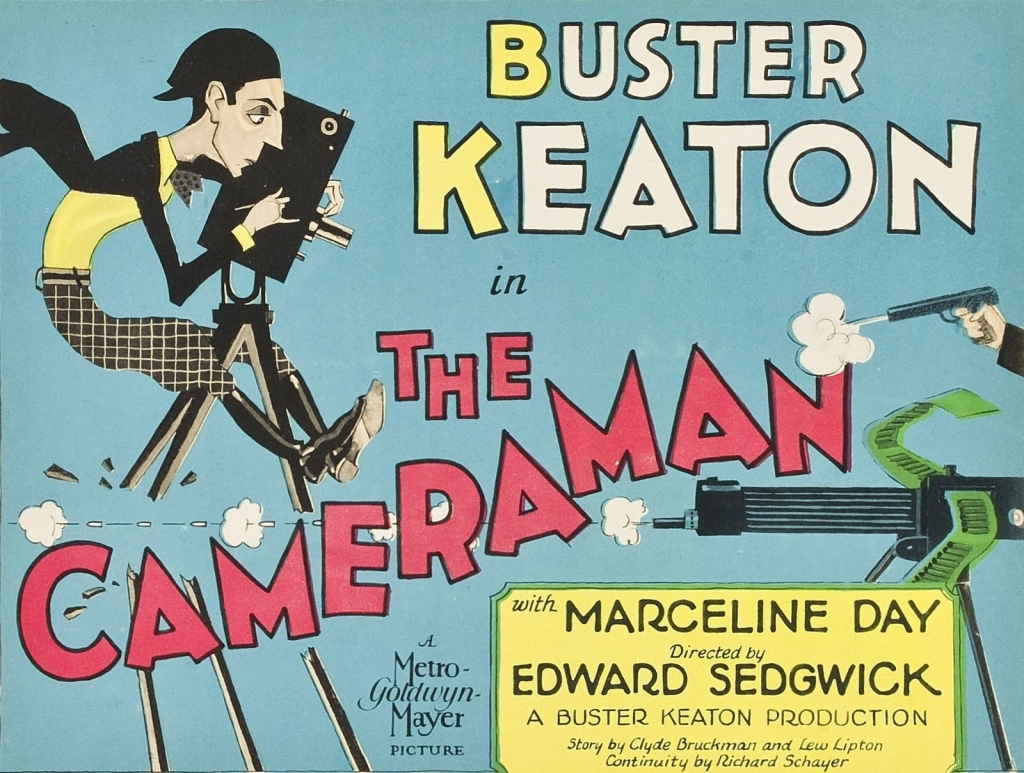
Original promotional art for Buster Keaton's 'The Cameraman' (1928).

In Kurt Vonnegut's novel 'Slaughterhouse Five,' there's a British officer who's been in a German prison camp since the very start of World War II. His survival routine included looking in a mirror each morning to frankly evaluate his appearance, posture, and bearing.

Wow! If I had a survival routine, it wouldn't involve looking in a mirror, as that would almost certainly rob me of my will to live. 

But holding up a mirror can be a good thing, despite unexpected results — especially when it's someone like Buster Keaton holding up a mirror to the then-new medium of motion pictures. 

And it's also a good thing when an artist such as Dziga Vertov holds up mirror to life in the then-new Soviet Union, using the art of cinema to create a reflection of life itself.

Movies from both filmmakers are on the silent film calendar in the next couple of weeks. On Sunday, Sept. 20, I'll accompany a double-feature of Keaton's 'Sherlock Jr.' (1924) and 'The Cameraman' (1928), a pair of films with stories rooted in the movie business.

The screening is at 2 p.m. at the Town Hall Theatre in Wilton, N.H. 

And on Wednesday, Sept. 30, I'll do music for a screening of Vertov's 'Man With A Movie Camera' (1929), a head-spinning slice-of-life documentary with no traditional narrative or story itself, unless you count the story of life itself, which I believe was Vertov's subject. 

The screening is at 6:30 p.m. at the Flying Monkey Moviehouse in Plymouth, N.H. More details are on the "Upcoming Screenings" page, and I'll get the press release into a later post. 

For now, the focus (another movie term!) is on Buster, who plays with motion picture reality in both films we're running on Sunday, Sept. 20. 

As with all of Buster's films, the main goal was laughter. Keaton's style of comedy, however, led him to naturally to explore the strange new world of the motion picture, which he does in both 'Sherlock Jr.' (1924) and 'The Cameraman' (1928).

While many people marvel at the technical wizardry that enabled Keaton to put some eye-popping special effects into 'Sherlock Jr.,' I think 'The Cameraman' shows equal ingenuity in another way: in its story construction.

In 'The Cameraman,' Keaton creates a simple tale of a would-be newsreel cameraman that allows all manner of commentary (and laughter) about the business he's in. 

Example: a producer watches exciting newsreel footage of a dramatic event (not knowing that it was captured by an organ grinder's monkey), and shouts "That's the best camera work I've seen in years!" 

Knowing the truth of the matter, we laugh at the producer's assessment. But by holding up a mirror to the motion picture business, in 'The Cameraman' Keaton creates an insider's fun-house that transcends laughter and triggers infinity again and again. 

Hope you'll join us! Here's the press release with more info and all the details.

*   *   *


Buster Keaton in 'The Cameraman' (1928).

MONDAY, SEPT. 14, 2020 / FOR IMMEDIATE RELEASE
Contact Jeff Rapsis • (603) 236-9237 • jeffrapsis@gmail.com

Buster Keaton double feature at Town Hall Theatre on Sunday, Sept. 20

Silent film comedy classics return to the big screen with live musical accompaniment; venue following procedures to be Covid-19 compliant

WILTON, N.H.—He never smiled on camera, earning him the nickname of "the Great Stone Face." But Buster Keaton's comedies rocked Hollywood's silent era with laughter throughout the 1920s.

See for yourself with a screening of 'Sherlock Jr.' (1924) and 'The Cameraman' (1928), two of Keaton's landmark feature films, on Sunday, Sept. 20 at 2 p.m. at the Town Hall Theatre, 40 Main St., Wilton, N.H.

The screening, the latest in the Town Hall Theatre's silent film series, will feature live accompaniment by Jeff Rapsis, a New Hampshire-based composer who specializes in creating music for silent films.

Admission is free; a donation of $10 per person is suggested to help defray expenses.

The Town Hall Theatre is observing procedures to comply with all state and CDC public health guidelines, including reduced seating capacity. For complete information about safety protocols, visit www.wiltontownhalltheatre.com

In 'Sherlock Jr.,' Buster plays a small-town movie projectionist who dreams of working as a detective. But then Buster's romantic rival frames him for stealing a watch from his girlfriend's father.

Fortunately, the situation mirrors the plot of the movie currently playing at Buster's theater. Inspired by the movie, can Buster find the real thief and win back his girl?

'The Cameraman' tells the story of a young man (Keaton) who tries to impress the girl of his dreams (Marceline Day) by working as a freelance newsreel cameraman.

His efforts fail spectacularly, but then a lucky break gives him an unexpected chance to make his mark. Can Buster parlay the scoop of the year into a secure job and successful romance?

Both films focus on exploring the potentials of the motion picture, then a brand-new medium.

In 'The Cameraman,' Keaton uses the movie business itself to create comedy that plays with the nature of film and reality.

Keaton, along with Charlie Chaplin and Harold Lloyd, stands as one of the three great clowns of the silent screen. Many critics regard Keaton as the most timeless; Roger Ebert wrote in 2002 that "in an extraordinary period from 1920 to 1929, (Keaton) worked without interruption on a series of films that make him, arguably, the greatest actor-director in the history of the movies."

As a performer, Keaton was uniquely suited to the demands of silent comedy. Born in 1895, he made his stage debut as a toddler, joining his family's knockabout vaudeville act and learning to take falls and do acrobatic stunts at an early age. He spent his entire childhood and adolescence on stage, attending school for exactly one day.

A remarkable pantomime artist, Keaton naturally used his whole body to communicate emotions ranging from sadness to surprise. In an era when movies had few special effects, Keaton's acrobatic talents enabled him to perform all his own stunts.

All those talents are on display in 'Sherlock Jr.' and 'The Cameraman,' which was selected in 2005 for preservation in the U.S. National Film Registry by the Library of Congress as being "culturally, historically, or aesthetically significant."

"These films are audience favorites, and people continue to be surprised at how engrossing and exhilarating they can be when shown as they were intended: in a theater, and with live music," said Rapsis, who accompanies more than 100 screenings each year at venues around the nation and abroad.

Rapsis, who lives in Bedford, N.H., improvises live scores for silent films using a digital synthesizer to recreate the texture of the full orchestra.

"It's kind of a high wire act," Rapsis said. "But for me, the energy of live performance is an essential part of the silent film experience."

'Sherlock Jr.' (1924) and 'The Cameraman' (1928) will be shown with live music on Sunday, Sept. 20 at 2 p.m. at the Town Hall Theatre, 40 Main St., Wilton, N.H. Admission is free; a donation of $10 per person is suggested. For more information, call (603) 654-3456 of visit www.wiltontownhalltheatre.com.

Wednesday, June 20, 2018

Harry Houdini adventure film this weekend; plus notes on promotion and the weather

Houdini stars in 'Haldane of the Service Service' (1923), showing Sunday, June 24 at the Town Hall Theatre in Wilton, N.H.

Next up: a Harry Houdini film I've never accompanied before.

'Haldane of the Secret Service' (1923) will be screened on Sunday, June 24 at 4:30 p.m. at the Town Hall Theatre in Wilton, N.H.

More details in the press release below, but it's supposed to be Harry's best (and best-preserved) full-length adventure. Looking forward to it!

For now: pleasantly surprised by fairly strong turnouts for silent film events this past weekend.

On Saturday night, about 50 people enjoyed a double feature of Buster Keaton's 'Sherlock Jr.' (1924) and 'The Cameraman' (1928) in the basement of the First Congregational Church in Nashua, N.H.

And on Sunday afternoon, about an equal number were on hand (despite beautiful weather) for Buster's 'College' (1927) at the Center for the Arts in Natick, Mass.

Usually good weather means low turnout, especially this time of year. But not this time!

Both shows were highlighted by strong audience reaction. Lots of big laughs!

'College' worked especially well, garnering repeated applause, and not just for the climactic "rescue" sequence.

Even Buster's "complete-somersault-while-holding-a-full-cup-of-coffee-and-saucer-upright" move earned an ovation.

Why the good turnout? I think a key reason is that both venues extensively promoted the screenings to their respective bases, and actively encouraged people to attend.

At the First Church, committee members apparently got out the word in a big way. The screening even won a mention in the church bulletin, and promotion on the day of show included sandwich boards on the front lawn.

And in Natick, they took vintage original posters for 'College' and reworked them into wonderfully handsome promotional pieces for the screening, which is part of a series they're trying to build.

It seems to be working. Our first two screenings drew just a handful of folks. But word-of-mouth, coupled with the promotional efforts (and Buster Keaton, too) helped swell attendance.

From the point of view of an accompanist, I always try to give it everything I've got when the lights go down, regardless of audience size.

But I have to say, it really makes a difference when a room is packed, or even half full, compared to having a lot of empty seats.

Hope you can help fill up the Town Hall Theatre for Harry Houdini in 'Haldane of the Secret Service' (1923) on Sunday, June 24 at 4:30 p.m.

We're supposed to get showers—so the weather's in our favor, if the forecast holds.

* * *

Houdini tied up again in 'Haldane of the Secret Service' (1923).

WEDNESDAY, JUNE 13, 2018 / FOR IMMEDIATE RELEASE
Contact Jeff Rapsis • (603) 236-9237 • jeffrapsis@gmail.com

Rare Houdini film 'Haldane of the the Secret Service' at Town Hall Theatre on Sunday, June 24


Legendary 'Handcuff King' escape artist returns to the big screen with live music in stunt-filled early silent adventure movie

WILTON, N.H.—He reigned for decades as the legendary "Handcuff King," famous for daring and impossible escapes staged around the world.

But Harry Houdini also had a brief movie career, starring in a series of silent adventure films that showed off his athletic prowess and his talent for illusion, stunts, and escape.

See Houdini back on the big screen in 'Haldane of the Secret Service' (1923), one of his few surviving feature films.

The film will be run on Sunday, June 24 at 4:30 p.m. at the Town Hall Theatre, 40 Main St., Wilton, N.H.

Admission is free, with a suggested donation of $5 per person to defray expenses.

The rarely screened film will be shown with live musical accompaniment by Jeff Rapsis, a New Hampshire-based performer regarded as one of the nation's leading silent film musicians.

Houdini made only a handful of movies in the 1910s and 1920s, and much of his film work is lost.

But enough escaped oblivion to provide a glimpse of the world-renowned escape artist at the peak of his worldwide fame.

In 'Haldane of the Secret Service,' U.S. Government agent Heath Haldane is determined to bring to justice the mysterious Dr. Yu, all-powerful head of the Chinese underworld

Dr. Yu is suspected of international counterfeiting, narcotics smuggling and the murder of Haldane's father.

Haldane soon encounters the beautiful Adele Ormsby, whose family might be connected to Yu's criminal activities.

The pursuit of justice then takes the story from New York to Scotland, London, and Paris.

Time and again, the bad guys trap Haldane in ropes, chains and strongboxes. Each time, our hero wriggles out of his predicaments with the skill of—well, Harry Houdini.

Although Houdini's films were well-received, he eventually abandoned his movie career, preferring live performance.

Houdini, born Erik Weisz, was a Hungarian-born, American-Jewish illusionist and stunt performer noted for his sensational escape acts.

He first attracted notice in vaudeville in the U.S. and then as "Harry Handcuff Houdini" on a tour of Europe, where he challenged police forces to keep him locked up.

Soon he extended his repertoire to include chains, ropes slung from skyscrapers, straitjackets under water, and having to escape from and hold his breath inside a sealed milk can with water in it.

In 1904, thousands watched as he tried to escape from special handcuffs commissioned by London's Daily Mirror, keeping them in suspense for an hour.

Another stunt saw him buried alive and only just able to claw himself to the surface, emerging in a state of near-breakdown.

In 1913, Houdini introduced the Chinese Water Torture Cell, in which he was suspended upside-down in a locked glass-and-steel cabinet full to overflowing with water, holding his breath for more than three minutes. He would go on performing this escape for the rest of his life.

Houdini died prematurely in 1926, at age 52, of peritonitis following a burst appendix that may have been caused by blows received to the abdomen by a visitor backstage at a performance in Montreal.

Following his death, Houdini's reputation as a legendary performer continued to make his name a household world in the decades that followed.

Although not well known as a film actor, Houdini's work in motion pictures was not forgotten. In a posthumous ceremony on Oct. 31, 1975, Houdini was given a star on the Hollywood Walk of Fame at 7001 Hollywood Blvd.

Houdini is one of several "big name" performers featured on this year's silent film schedule at the Town Hall Theatre.

"These films are audience favorites, and people continue to be surprised at how engrossing and exhilarating they can be when shown as they were intended: in a theater, and with live music," said Rapsis, who accompanies more than 100 screenings each year at venues around the nation.

Rapsis improvises live scores for silent films using a digital synthesizer to recreate the texture of the full orchestra.

"It's kind of a high wire act," Rapsis said. "But for me, the energy of live performance is an essential part of the silent film experience."

Harry Houdini in 'Haldane of the Secret Service' (1923) will be shown with live music on Sunday, June 24 at 4:30 p.m. at the Town Hall Theatre, 40 Main St., Wilton, N.H. Admission is free, with a suggested donation of $5 person to defray expenses.

For more information, visit www.wiltontownhalltheatre.com.

Friday, May 19, 2017

Up in Mascoma Valley, it's 'Comedy Tonight': a Buster Keaton double feature with live music

Buster Keaton in 'Sherlock Jr.' (1924).

Yes, it's Comedy Tonight up at Mascoma Valley Regional High School, but not the song from 'A Funny Thing Happened on the Way to the Forum.'

It's a pair of silent film comedies starring that most silent of silent film comedies, Buster Keaton.

First up is 'Sherlock Jr.' (1924), and then it's 'The Cameraman' (1928). I like this pairing because both films are about film itself.

The fun starts at 7 p.m. More information in the press release below.

And let me record things I learned from doing live music last night (Thursday, May 18) for the MGM drama 'Speedway' (1929) at the Flying Monkey Moviehouse in Plymouth, N.H.

The movie was shot on location at the actual Indy 500 track as it existed in 1929, so it's of great interest to auto racing and antique car enthusiasts.

• Actress Anita Page, who lived to be 98 years old (she died in 2008), was the last known surviving attendee of the first-ever Academy Awards ceremony in 1929.

• Page also holds the record for the most-delayed comeback. She quit films back in 1936, but then when in her 90s returned to take roles in direct-to-DVD horror films such as 'Witchcraft XI: Sisters in Blood' (2000) and 'The Crawling Brain' (2002).

• Lacking radios, pit crews and drivers on the track communicated by means of large chalkboards with room for just one or two words. Hence absurdly abbreviated commands such as FASTER. Really?

• Attending last night's screening was Mr. Robert W. Valpey, a soft-spoken gentleman who happens to own a Studebaker Family Team Car that came within a few laps of winning the 1931 Indy 500 before it skidded and wasn't able to continue.


But the car went onto glory, winning the Pike's Peak Challenge that same year and enjoying a solid career at the Indy 500 and other high-profile venues. Long retired from active racing, the car has been maintained ever since. Valpey keeps it in New Hampshire, and recent local appearances have included the Mount Washington Auto Road.

I asked him what it ran on, thinking he would say leaded gas. He said it was originally a mix of gasoline and benzine, but he now uses aircraft fuel.

You never know what to expect at a silent film screening. In this case, I now have an invitation to sit behind the wheel of a former champion race car. Brmmmmm brrrrmmmmmm.

But first, there's Comedy Tonight up at Mascoma Valley Regional High School:

* * *


MONDAY, MAY 1, 2017 / FOR IMMEDIATE RELEASE
Contact Jeff Rapsis • (603) 236-9237 • jeffrapsis@gmail.com

Buster Keaton double feature at Mascoma High School on Friday, May 19


Classic silent film comedy masterpieces to be screened with live musical accompaniment

CANAAN, N.H.—He never smiled on camera, earning him the nickname of "the Great Stone Face." But Buster Keaton's comedies rocked Hollywood's silent era with laughter throughout the 1920s.

See for yourself with a screening of 'Sherlock Jr.' (1924) and 'The Cameraman' (1928), two of Keaton's landmark feature films, in the new auditorium of Mascoma Valley Regional High School, 27 Royal Road, Canaan, N.H. on Friday, May 19 at 7 p.m.

The show is free and open to the public; donations will be accepted.

The program will be accompanied by live music performed by silent film composer Jeff Rapsis.

The silent film show is a great chance for the public to check out the high school building, which recently underwent a $21.5 million renovation and expansion project.

In 'Sherlock Jr.,' Buster plays a small-town movie projectionist who dreams of working as a detective. But then Buster's romantic rival frames him for stealing a watch from his girlfriend's father. Fortunately, the situation mirrors the plot of the movie currently playing at Buster's theater. Inspired by the movie, can Buster find the real thief and win back his girl?

Buster and Marceline Day in 'The Cameraman' (1928).

'The Cameraman' tells the story of a young man (Keaton) who tries to impress the girl of his dreams (Marceline Day) by working as a freelance newsreel cameraman. His efforts result in spectacular failure, but then a lucky break gives him an unexpected chance to make his mark. Can Buster parlay the scoop of the year into a secure job and successful romance?

Both films focus on exploring the potentials of the motion picture, then a brand-new medium.

In 'The Cameraman,' Keaton uses the movie business itself to create comedy that plays with the nature of film and reality.

Keaton, along with Charlie Chaplin and Harold Lloyd, stands as one of the three great clowns of the silent screen. Many critics regard Keaton as the best of all; Roger Ebert wrote in 2002 that "in an extraordinary period from 1920 to 1929, (Keaton) worked without interruption on a series of films that make him, arguably, the greatest actor-director in the history of the movies."

As a performer, Keaton was uniquely suited to the demands of silent comedy. Born in 1895, he made his stage debut as a toddler, joining his family's knockabout vaudeville act and learning to take falls and do acrobatic stunts at an early age. He spent his entire childhood and adolescence on stage, attending school for exactly one day.

A remarkable pantomime artist, Keaton naturally used his whole body to communicate emotions ranging from sadness to surprise. In an era when movies had few special effects, Keaton's acrobatic talents meant he performed all his own stunts.

All those talents are on display in 'Sherlock Jr.' and 'The Cameraman,' which was selected in 2005 for preservation in the U.S. National Film Registry by the Library of Congress as being "culturally, historically, or aesthetically significant."

"These films are audience favorites, and people continue to be surprised at how engrossing and exhilarating they can be when shown as they were intended: in a theater, and with live music," said Rapsis, who accompanies more than 100 screenings each year at venues around the nation.

Rapsis improvises live scores for silent films using a digital synthesizer to recreate the texture of the full orchestra.

"It's kind of a high wire act," Rapsis said. "But for me, the energy of live performance is an essential part of the silent film experience."

'Sherlock Jr.' (1924) and 'The Cameraman' (1928) will be shown with live music at Mascoma Valley Regional High School, 27 Royal Road, Canaan, N.H. on Friday, May 19 at 7 p.m. Admission is free and the program is open to the public. Donations gratefully accepted.

Wednesday, April 26, 2017

Is smaller better? Find out with Buster Keaton
at a local N.H. Grange Hall on Friday, April 28

Original promotional material for 'The Cameraman.'

When introducing movies, I often point out that silent films were made to be enjoyed by a large audience.

Pacing, story organization, narrative arc—all of it was geared from the ground up for a big crowd to respond to.

Even if the turnout is just eight people, I usually point out that's still more people than can fit in my living room. And off we go!

But I have to say: some of my most memorable silent film experiences have not been with dependent on heavy turnout.

And now I realize there's another key variable in the formula: the size of the room.

I've seen it happen many times now: turnout might be, say, 40 people for a screening in a small town.

But if the venue is small enough to create a "standing room only" feeling, there's an energy present that equals what happens in a truly large and packed theater.

There's a good chance to see this dynamic in action with a program coming up on Friday, April 28.

It's a double-feature of Buster Keaton comedies at Antrim (N.H.) Grange #98. Showtime if 7 p.m.

'Sherlock Jr' (1924) and 'The Cameraman' (1928) will be shown, in part to honor the recent 100th anniversary of Buster's first appearance on a movie screen.

But the main objective is to just laugh. And if it's anything like screenings I've done in other Grange Halls and small rural venues, we'll be doing a lot of that.

Also, for years 'The Cameraman' was MGM's comedy training film. If anyone at the studio was going to work on a comedy, he or she had to watch 'The Cameraman,' regarded by studio bosses as the perfect comedy.

So just the other day, I watched 'It's a Mad, Mad, Mad, Mad World' (1963). And I'll be darned if it isn't full of Keaton references I'd never picked up before, including some from 'The Cameraman.'

Example: when Sid Caesar and Edie Adams are trapped in the cellar of a hardware store, at one point Caesar stands on a raised platform that collapses to the ground, sending him sprawling.

It's exactly what Buster did during the Tong War sequence in The Cameraman, although on a grander scale.

Someone ought to compile all the Keaton references in 'Mad World,' in which Keaton himself has a cameo. (Ironically, Keaton's role was originally more prominent, but got cut during editing.)

More info about 'Sherlock' and 'Cameraman' in the press release below. Hope to see you there!

* * *

Buster Keaton and co-star in 'The Cameraman' (1928).

MONDAY, APRIL 17, 2017 / FOR IMMEDIATE RELEASE
Contact Jeff Rapsis • (603) 236-9237 • jeffrapsis@gmail.com

Buster Keaton double feature at Antrim Grange #98 on Friday, April 28


Classic silent film comedy masterpieces to be screened with live musical accompaniment

ANTRIM, N.H.—He never smiled on camera, earning him the nickname of "the Great Stone Face." But Buster Keaton's comedies rocked Hollywood's silent era with laughter throughout the 1920s.

See for yourself with a screening of 'Sherlock Jr.' (1924) and 'The Cameraman' (1928), two of Keaton's landmark feature films, on Friday, April 28 at 7 p.m. at the Antrim Grange #98, 253 Clinton Road, Antrim.

The films will be shown with live musical accompaniment by Jeff Rapsis, a New Hampshire-based performer regarded as one of the nation's leading silent film musicians.

The public is welcome to attend. Suggested donation for this family-friendly event is $5 per person to help defray expenses.

In 'Sherlock Jr.,' Buster plays a small-town movie projectionist who dreams of working as a detective. But then Buster's romantic rival frames him for stealing a watch from his girlfriend's father. Fortunately, the situation mirrors the plot of the movie currently playing at Buster's theater. Inspired by the movie, can Buster find the real thief and win back his girl?

'The Cameraman' tells the story of a young man (Keaton) who tries to impress the girl of his dreams (Marceline Day) by working as a freelance newsreel cameraman. His efforts result in spectacular failure, but then a lucky break gives him an unexpected chance to make his mark. Can Buster parlay the scoop of the year into a secure job and successful romance?

Both films focus on exploring the potentials of the motion picture, then a brand-new medium.

In 'The Cameraman,' Keaton uses the movie business itself to create comedy that plays with the nature of film and reality.

Keaton, along with Charlie Chaplin and Harold Lloyd, stands as one of the three great clowns of the silent screen. Many critics regard Keaton as the best of all; Roger Ebert wrote in 2002 that "in an extraordinary period from 1920 to 1929, (Keaton) worked without interruption on a series of films that make him, arguably, the greatest actor-director in the history of the movies."

As a performer, Keaton was uniquely suited to the demands of silent comedy. Born in 1895, he made his stage debut as a toddler, joining his family's knockabout vaudeville act and learning to take falls and do acrobatic stunts at an early age. He spent his entire childhood and adolescence on stage, attending school for exactly one day.

A remarkable pantomime artist, Keaton naturally used his whole body to communicate emotions ranging from sadness to surprise. In an era when movies had few special effects, Keaton's acrobatic talents meant he performed all his own stunts.

All those talents are on display in 'Sherlock Jr.' and 'The Cameraman,' which was selected in 2005 for preservation in the U.S. National Film Registry by the Library of Congress as being "culturally, historically, or aesthetically significant."

"These films are audience favorites, and people continue to be surprised at how engrossing and exhilarating they can be when shown as they were intended: in a theater, and with live music," said Rapsis, who accompanies more than 100 screenings each year at venues around the nation.

Rapsis improvises live scores for silent films using a digital synthesizer to recreate the texture of the full orchestra.

"It's kind of a high wire act," Rapsis said. "But for me, the energy of live performance is an essential part of the silent film experience."

The Antrim Grange #98 will present Buster Keaton in 'Sherlock Jr.' (1924) and 'The Cameraman' (1928) on Friday, April 28 at 7 p.m. at Antrim Grange #98, 253 Clinton Road, Antrim. The public is welcome to attend this family-friendly event, which features live musical accompaniment for both films. Suggested donation is $5 per person to defray expenses.

Friday, March 31, 2017

This weekend: Buster Keaton's 'Cameraman'
in the country, then 'Peter Pan' in the city

This weekend's venues for silent film cover a wide range: a Catholic college in rural New Hampshire, and then a hipster brewery in urban Boston.

On Saturday night, it's Keaton's 'The Cameraman' (1928) at Northeast Catholic College way up in Warner, N.H.

And then on Sunday, it's the original silent film adaptation of 'Peter Pan' (1924) at the Aeronaut Brewing Co. in Somerville, Mass.

Our part of New England is getting a good amount of snow now through Saturday. But that shouldn't impede this pair of silent film shows.

One nice thing about this weekend's screenings has been the publicity.

I always send out press materials, but you never know what will be used, and when, and how.

For this weekend, I've lucked out with some good coverage.

For the Keaton screening, the Concord (N.H.) Monitor, a highly respected daily paper, devoted quite a bit of space to this story. Thanks!

And for the Aeronaut 'Peter Pan' screening, writer Sean Burns did a great job pulling together a fairly lengthy piece, especially by Metro standards.

Also, here's a screen capture of the story in the print edition:


So whether it's country-style silent film you crave, or if you prefer a more urban setting, there's something for every taste this weekend.

Press releases for both films (with a lot more info) are pasted in below. See, I really do send out press materials!

* * *

An original poster for Keaton's 'The Cameraman' (1928), running on April Fool's Day (Saturday, April 1) at Northeast Catholic College.

TUESDAY, MARCH 14, 2017 / FOR IMMEDIATE RELEASE
Contact Jeff Rapsis • (603) 236-9237 • jeffrapsis@gmail.com

Buster Keaton's 'The Cameraman' at Northeast Catholic on Saturday, April 1


Classic silent film comedy masterpiece to be screened with live music; program open to the public

WARNER, N.H. — Silent film with live music returns to the big screen at Northeast Catholic College in April with a showing of an acclaimed comedy starring Buster Keaton.

The screening, on Saturday, April 1 at 7 p.m., will feature Keaton's classic comedy 'The Cameraman' (1928). Admission is free for Northeast Catholic students and any others with college ID; general public admission is $5 per person

Live music will be provided by silent film accompanist Jeff Rapsis. The program will include a short comedy, 'Cops,' also starring Buster Keaton.

'The Cameraman' tells the story of a young man (Keaton) who tries to impress the girl of his dreams (Marceline Day) by working as a freelance newsreel cameraman. His efforts result in spectacular failure, but then a lucky break gives him an unexpected chance to make his mark. Can he parlay the scoop of the year into a secure job and successful romance?

Buster Keaton's self-referential world of 'The Cameraman.'

In 'The Cameraman,' Keaton uses the movie business to create comedy that plays with the nature of film and reality. The movie contains classic sequences often cited as among Keaton's best.

Keaton, along with Charlie Chaplin and Harold Lloyd, stands as one of the three great clowns of the silent screen. Many critics regard Keaton as the best of all; Roger Ebert wrote in 2002 that "in an extraordinary period from 1920 to 1929, (Keaton) worked without interruption on a series of films that make him, arguably, the greatest actor-director in the history of the movies."

As a performer, Keaton was uniquely suited to the demands of silent comedy. Born in 1895, he made his stage debut as a toddler, joining his family's knockabout vaudeville act and learning to take falls and do acrobatic stunts at an early age. He spent his entire childhood and adolescence on stage, attending school for exactly one day.

A remarkable pantomime artist, Keaton naturally used his whole body to communicate emotions ranging from sadness to surprise. In an era when movies had few special effects, Keaton's acrobatic talents meant he performed all his own stunts.

All those talents are on display in 'The Cameraman,' which was selected in 2005 for preservation in the U.S. National Film Registry by the Library of Congress as being "culturally, historically, or aesthetically significant."

'The Cameraman' will be accompanied by live music by Jeff Rapsis, a New England-based silent film accompanist who performs at venues across the region and beyond.

"These films were created to be shown on the big screen as a sort of communal experience," Rapsis said. "With an audience and live music, they still come to life in the way their makers intended them to.

"So the screening at Northeast Catholic College is a great chance to experience films that first caused people to first fall in love with the movies," he said.

Established as a residential, Catholic liberal arts college in 1973 and located in Warner, N.H., the Northeast Catholic College (formerly the College of Saint Mary Magdalen) seeks to call students to the life-long pursuit of intellectual and moral virtue through the rigorous study and discussion of primary texts and through its vibrantly Catholic student life.

Buster Keaton's 'The Cameraman' (1928) will be screened with live music on Saturday, April 1 at 7 p.m. at Northeast Catholic College (formerly Magdalen College), 511 Kearsarge Mountain Road, Warner, N.H. Admission is free to students with a college ID; general public is $5 per person.

For more information about Northeast Catholic College, visit www.northeastcatholic.edu/ For more info on the music, visit www.jeffrapsis.com.

* * *

An original poster for the original screen adaptation of 'Peter Pan' (1924).

WEDNESDAY, MARCH 22, 2017 / FOR IMMEDIATE RELEASE
For more info, contact: Jeff Rapsis • (603) 236-9237 • jeffrapsis@gmail.com

Silent film version of 'Peter Pan' at Aeronaut on Sunday, April 2


Original adaptation of magical fantasy classic to be shown with live musical score

SOMERVILLE, Mass.—It was the film that introduced movie-goers to visions of flying children, magical fairies, human-like animals and menacing pirates.

It was the original silent film adaptation of 'Peter Pan,' a picture personally supervised by author J.M. Barrie. The film was a major hit when released in 1924, with audiences eager to get their first big-screen look at the wonders of Neverland.

Movie fans can see for themselves when the first 'Peter Pan' (1924) is screened on Sunday, April 2 at 7 p.m. at the Aeronaut Brewing Co., 14 Tyler St., Somerville.

The program will feature live music for the movie by silent film accompanist Jeff Rapsis, and will include a classic silent comedy short film. Admission is $10 per person. Tickets are available online at www.eventbrite.com; search on "Aeronaut Brewery."

Thought lost for many years, and overshadowed by more recent adaptations, the original silent 'Peter Pan' maintains its freshness and charm 90 years after its original release.

In the story, first presented as a stage play in 1904, three children in London are visited one night by Peter Pan, a youth in search of his shadow. Pan shows his new friends how to fly, and then convinces them to join him in a journey to Neverland.

There they encounter Indians, mermaids, and a band of pirates whose leader, Captain Hook, is Pan's sworn enemy. The children are captured by Hook and taken prisoner aboard his pirate ship, setting the stage for an epic battle, the outcome of which will determine if the children may ever return home.

Betty Bronson in the title role.

Though the Peter Pan story is well-known today due to subsequent adaptations (and also merchandising that includes a ubiquitous brand of peanut butter), the tale was virtually new when Hollywood first brought it to film in the early 1920s.

In England, author Barrie gave his blessing to the first-ever screen adaptation, though he retained control over casting and insisted that any written titles in the film be taken directly from his own text.

After a major talent search, Barrie settled on unknown 18-year-old actress Betty Bronson for the title role, and filming began in 1924. The role of Captain Hook was played by noted character actor Ernest Torrence, who invented the now-iconic villainous pirate persona that would become a Hollywood legend.

The film's highlights include special effects that maintain their ability to dazzle even today. The film's memorable images include a group of mermaids entering the sea, a miniature Tinkerbell interacting with full-sized children and adults, and a pirate ship lifting out of the water and taking flight.

'Peter Pan' also includes a cast of animal characters played by humans in costume, including the family dog Nana and an alligator who serves as Hook's nemesis, lending the film a magical quality.

After the film's release, no copies of the original 'Peter Pan' were known to exist, and for many years the film was regarded as lost. However, in the 1950s a single surviving print turned up in the George Eastman Archives in Rochester, N.Y., from which all copies today have descended.

Accompanist Jeff Rapsis specializes in creating live musical scores for films made prior to the introduction of recorded sound. Based in New Hampshire, Rapsis specializes in improvising music for silent film screenings at venues ranging from Harvard University in Cambridge, Mass. to the Niles Essanay Silent Film Museum in San Francisco, Calif.

Rapsis creates film scores in real time, as a movie is running, using a digital synthesizer to reproduce the texture of a full orchestra. He averages about 100 performances per year, and has created music for more than 250 different silent feature films.

"Improvising a movie score is a bit of a high wire act, but it can result in music that fits a film's mood and action better than anything that can be written down in advance," Rapsis said. "It also lends a sense of excitement and adventure to the screening, as no two performances are exactly alike."

The screening is part of the Aeronaut's commitment to give local artists and audiences a chance to connect in the brewery's performance space.

Just as beer aficionados appreciate a good hand-crafted brew, movie-goers are rediscovering the joys of silent cinema presented as it was intended: on a big screen, with live music, and with an audience.

"If you can put all the original elements together, the films of early Hollywood still come to life," said Rapsis, who performs regularly at the Aeronaut. "These are the films that caused people to first fall in love with the movies."

‘Peter Pan’ (1924) will be shown on Sunday, April 2 at 7 p.m. at the Aeronaut Brewing Co., 14 Tyler St., Somerville, Mass. Admission is $10 per person. Tickets are available online at www.eventbrite.com; search on "Aeronaut Brewery." For more info about Aeronaut Brewing, visit www.aeronautbrewing.com. For more information about the music, visit www.jeffrapsis.com.


Friday, March 17, 2017

Weekend update: Buster Keaton in a church,
then Lon Chaney's 'Phantom' in a Grange Hall

Tonight: Come see 'The Cameraman' in Concord Center, Mass.

After a month that took me to such far-flung venues as the Kennington Bioscope in London, the Orpheum Theatre in Sioux City, Iowa, and the Cleveland Museum of Art, it's back to silent film accompaniment reality.

Consider: the locations for this weekend's screenings are a church in suburban Boston, and then a Grange Hall in rural New Hampshire.

But that's where most of my screenings happen—at places no more than a few hours from home base.

And that pattern resumes this weekend with a Buster Keaton program tonight (Friday, March 17) at the Trinitarian Congregational Church in Concord, Mass., and then Lon Chaney in 'The Phantom of the Opera' (1925) on Saturday night at the Blazing Star Grange Hall in Danbury, N.H.

Complete info on each show is on the Upcoming Screenings page (link at right), or in the summaries below:

• Friday, March 17, 2017, 7 p.m.: "Sherlock Jr." (1924) and "The Cameraman" (1928) starring Buster Keaton; Trinitarian Congregational Church, 54 Walden St., Concord Center, Mass.
978-369-4837. Tonight's program features Buster Keaton in a pair of his great starring films, both centering on the subject of movies themselves. In 'Sherlock Jr.,' Buster breeches the fourth wall big-time as a movie projectionist who dreams himself into a crime thriller In 'The Cameraman,' to impress the girl of his dreams, mild-mannered portrait photographer Buster takes up the glamorous profession of newsreel cameraman. One of the best comedies of the silent era. The film program is open to the public; $5 per person admission.

Halloween in March: 'The Phantom of the Opera' (1925) screens on Saturday night in Danbury, N.H.

• Saturday, March 18, 2017, 7 p.m.: Silent Film Program: Halloween in March! at the Blazing Star Grange Hall, North Road in Danbury, N.H. You've heard of "Christmas in July?" Well, welcome to "Halloween in March," a program of spooky silent film with live music presented by the local Grange chapter. Rumor has it the main attraction will be Lon Chaney in 'Phantom of the Opera' (1925), but check back for details. Free and open to the public; suggested donation of $5 at the door.

I've been doing local programs such as these for almost 10 years now. Why?

For one thing, I've found the only way I could really learn how to do silent film accompaniment was to really do it.

And that means for real, in real time, and in front of an audience.

No bathroom breaks, no trips to the fridge, no letting dogs in or out, no breaking concentration, all of which seem to happen when you're doing it on your own at home.

Also, I've found that challenging myself to create so much music under these conditions has enabled me, bit by bit, to work out a kind of musical language that I can call my own.

That's huge, because it's given me a vocabulary to begin putting music together that I feel reflects my—well, whatever it is I have to offer.

The results of this process are beginning to show up in written-out pieces such as the 'Kilimanjaro Suite' that the New Hampshire Philharmonic recently played.

More projects are in the works. So it's a very exciting time for me—as long as I can find time to get done all I hope to do.

But none of it would be happening, I'm sure, if I hadn't sat down and accompanied literally hundreds of silent films in the past 10 years or so.

And the process, such as it is, continues this weekend. Hope to see you, either at the church or at the Grange Hall. Or both!

Wednesday, July 13, 2016

'Spite Marriage' (1929), Keaton's last silent,
on Thursday, July 14 in Plymouth, N.H.

An original lobby card for 'Spite Marriage.'

'Spite Marriage,' Buster Keaton's last silent feature, is often looked at as his 'transition' film.

It came after the brilliance of 'The Cameraman' (1928), and led directly to the alleged mediocrity of his MGM talkies, which in turn led to his career unraveling.

For me as a teenager, this was reinforced by a book on Keaton I found in the public library of my hometown of Nashua, N.H.

David Robinson's 'The Films of Buster Keaton' was an eye-opener. It introduced me to the basic plots and settings of all of Keaton's feature films, none of which I had seen.

(At age 13, I was just beginning to order 8mm prints of Keaton's short films such as 'Cops,' which in 1977 was the only way you could see them.)

Robinson's book, published in 1971, focused on the features Keaton produced independently for producer Joseph Schenk up through 1928's 'Steamboat Bill, Jr.'

Keaton signed with MGM after that, and for some reason Robinson glossed over Keaton's two MGM silents, 'The Cameraman' and 'Spite Marriage.'

Of the two, at least 'The Cameraman' got some analysis and commentary. But 'Spite Marriage' merited barely a mention, with Robinson admitting it wasn't available for viewing and that he'd never seen it.

So this planted on my impressionable mind the idea that 'Spite Marriage' was somehow a lame horse, a misfire, a mistake that wasn't up to Keaton's standards and perhaps not even a real "Keaton" film at all.

And this didn't change until many years later, when I finally, actually saw the picture. And I was surprised to find it quite polished (it was MGM, after all) and with no shortage of what seemed to be great Keaton sequences and gags. It was like discovering Beethoven had written a symphony that no one knew about.

This was confirmed when I ran the picture with an audience a few years ago. People roared!

Pretty good for Buster's "transition," film, I thought. But I've accompanied it several times since, and it always kills. Maybe I'd been selling 'Spite Marriage' short all this time.

Well, I'm now delighted to accompany Buster's last silent feature whenever and wherever. And that means tomorrow night (Thursday, July 14) at 6:30 p.m. at the Flying Monkey Moviehouse and Performance Center in downtown Plymouth, N.H.

Hope you can join us! More info in the press release below.

* * *

Dorothy Sebastian and Buster in 'Spite Marriage.'

TUESDAY, JULY 5, 2016 / FOR IMMEDIATE RELEASE
For more info, contact: Jeff Rapsis • (603) 236-9237 • jeffrapsis@gmail.com

Classic Buster Keaton farce 'Spite Marriage' at Flying Monkey on Thursday, July 14


Pioneering comedian's final silent feature film to be screened with live musical accompaniment

PLYMOUTH, N.H.—He never smiled on camera, earning him the nickname of "the Great Stone Face." But Buster Keaton's comedies rocked Hollywood's silent era with laughter throughout the 1920s.

Acclaimed for their originality and timeless visual humor, Keaton's films remain popular crowd-pleasers today.

See for yourself with a screening of 'Spite Marriage' (1929), Keaton's last silent feature film, on Thursday, July 14 at 6:30 p.m. at the Flying Monkey Moviehouse and Performance Center, 39 South Main St., Plymouth, N.H.

Admission is $10 per person.

The program will be accompanied by live music performed by silent film composer Jeff Rapsis.

'Spite Marriage' finds the poker-faced comic smitten by stage actress Trilby Drew (Dorothy Sebastian)—so much so that he joins the cast of her current production, a Civil War melodrama.

The fun begins when she unexpectedly asks Buster to marry her, but only to get even with an old flame. Complications with gangsters lead to a climax at sea, making for a classic Keaton comedy full of memorable routines.

Buster in the play-within-a-movie in 'Spite Marriage.'

The program opens with short comedy films Keaton made earlier in his career.

Keaton, along with Charlie Chaplin and Harold Lloyd, stands as one of the three great comics of the silent screen. Many critics regard Keaton as the best of all; Roger Ebert wrote in 2002 that "in an extraordinary period from 1920 to 1929, (Keaton) worked without interruption on a series of films that make him, arguably, the greatest actor-director in the history of the movies."

"Buster Keaton was the stone-faced comic who never smiled on camera, so he's sometimes thought of as the most silent of the silent clowns," Rapsis said.

"But seen today, his films are remarkable for their effective story construction, their innovative cinematography, and their ability to still produce gales of laughter," Rapsis said. "A chance to see a Keaton film as originally presented—in a theater, with live music and an audience—is not to be missed."

'Spite Marriage' is the latest in a monthly series of silent films presented with live music at the Flying Monkey. The series provides local audiences the opportunity to experience silent film as it was intended to be shown: on the big screen, in good-looking prints, with live music, and with an audience.

Rapsis said it's currently a new golden age for silent film because so many titles have been restored, and are now available to watch at home or via online streaming.

However, the Flying Monkey series enables film fans to really understand the power of early cinema, which was intended to be shown on a big screen, with live music, and with an audience.

"Put those elements together like we do at the Flying Monkey, and films from the silent era spring right back to life in a way that helps you understand why people first fell in love with the movies," Rapsis said.

Upcoming programs in the Flying Monkey's silent film series include:

• Thursday, Aug. 18, 2016, 6:30 p.m.: Rudolph Valentino Double Feature! On the 90th anniversary of the heartthrob's shocking and untimely death, we pay tribute with 'The Sheik' (1921) and 'Son of the Sheik' (1926). Bring tissues!

Buster Keaton's comedy 'Spite Marriage' will be shown on Thursday, July 14 at 6:30 p.m. at the Flying Monkey Moviehouse and Performance Center, 39 South Main St., Plymouth, N.H. Admission is $10 per person. For more info, call (603) 536-2551 or visit www.flyingmonkeynh.com. For more info on the music, visit www.jeffrapsis.com.