Showing posts with label Keaton. Show all posts

Friday, August 9, 2024

Join us Sunday, Aug. 11 for Keaton double feature—and help the West Newton Cinema stay open!

The West Newton Cinema in West Newton, Mass.

Coming up on Sunday, Aug. 11: I'll accompany a 1 p.m. program of two Buster Keaton comedies at the venerable West Newton Cinema, a family-owned independent moviehouse in a Boston suburb.

The films: Keaton's 'Sherlock Jr.' (1924), celebrating its 100th anniversary, and 'Our Hospitality' (1923).

It's my first appearance at the West Newton venue, which is currently in the midst of a fundraising campaign to remain open and serving the community, which it's been doing since 1937.

Fundraising is happening via the West Newton Foundation, and they're tackling quite a task: to raise $14 million to save the theater from demolition by acquiring it, renovating it, and converting its operation to a not-for-profit model.

It seems to be workng. Earlier this year, the group received a pledge of $5.2 million from a local philanthropist. Other donations have been made. For details, check out a story from last spring in the Boston Globe.

And then there's Sunday's silent film program. It's also a fundraiser—and at $20 per ticket, I hope you'll consider joining us. Not only are Keaton's films worth seeing with an audience, but you'll be helping keep the West Newton Cinema open and showing movies. (Presumably some silent titles, too!)

Here's a brief press release about the program with more info on each film. See you on Sunday at the West Newton Cinema!

*     *     *

Buster Keaton in the projection booth in 'Sherlock Jr.' (1924)

MONDAY, JULY 15, 2024 / FOR IMMEDIATE RELEASE
Contact Jeff Rapsis • (603) 236-9237 • jeffrapsis@gmail.com

Buster Keaton double feature, live music on Sunday, Aug. 11 at West Newton Cinema

Classic silent comedies 'Sherlock Jr.' and 'Our Hospitality' to run on the big screen as fundraiser to keep theatre open

WEST NEWTON, Mass.—He never smiled on camera, earning him the nickname of "the Great Stone Face."

But Buster Keaton's comedies rocked Hollywood's silent era with laughter throughout the 1920s, and remain popular crowd-pleasers today.

See for yourself with a screening of two Keaton comedies, 'Sherlock Jr.' (1924) and 'Our Hospitality' (1923) on Sunday, Aug. 11 at 1 p.m. at the West Newton Cinema, 1296 Washington St., West Newton, Mass.; (617) 964-8074. Admission $20 per person; buy tickets online at Eventbrite.

The screening will feature live accompaniment by Jeff Rapsis, a New Hampshire-based composer who specializes in creating music for silent films.

In 'Sherlock Jr.,' Buster plays a small-town movie projectionist who dreams of working as a detective. But then Buster's romantic rival frames him for stealing a watch from his girlfriend's father.

Fortunately, the situation mirrors the plot of the movie currently playing at Buster's theater. Inspired by the movie, can Buster find the real thief and win back his girl?

This year, 'Sherlock Jr.' is celebrating the 100th anniversary of its release.

A vintage trade ad for the original release of 'Our Hospitality' (1923).

Set in the 1830s, 'Our Hospitality' tells the tale of a young man (Keaton) raised in New York City but unknowingly at the center of a long-running backwoods family feud.

Resolving to return and claim his family homestead, he sets in motion a perilous cat-and-mouse game in which every move could be his last.

Highlights of the picture include Keaton's extended journey on a vintage train of the era, as well as a climatic river rescue scene.

The film stars Keaton's then-wife, Natalie Talmadge, as his on-screen love interest; their first child, newborn James Talmadge Keaton, makes a cameo appearance, playing Buster as an infant. Keaton's father also plays a role in the film.

The Keaton program is designed to showcase classic early movies as they were meant to be seen—in restored prints, on a large screen, with live music, and with an audience.

"All those elements are important parts of the silent film experience," said Rapsis, who will improvise a musical score for both films, which was how the films were originally presented.

"For most silent films, there was never any sheet music and no official score," Rapsis said. "So creating original music on the spot to help the film's impact is all part of the experience."

"That's one of the special qualities of silent cinema," Rapsis said. "Although the films themselves are often over a century old, each screening is a unique experience—a combination of the movie, the music, and the audience reaction."

Buster Keaton and co-star in 'Our Hospitality' (1923).

Keaton entered films in 1917 and was quickly fascinated with the then-new medium. After apprenticing with popular comedian Roscoe "Fatty" Arbuckle, Keaton set up his own studio in 1920, making short comedies that established him as one of the era's leading talents.

A remarkable pantomime artist, Keaton naturally used his entire body to communicate emotions from sadness to surprise. And in an era without special effects, Keaton's acrobatic talents enabled him to perform all his own stunts.

Although not all of Keaton's films were box office successes, critics later expressed astonishment at the sudden leap Keaton made from short comedies to the complex story and technical demands required for full-length features.

'Sherlock Jr.' and ‘Our Hospitality’ will be shown with live music on Sunday, Aug. 11 at 1 p.m. at the West Newton Cinema, 1296 Washington St., West Newton, Mass.; (617) 964-8074. Admission $20 per person; buy tickets online at Eventbrite.

Tuesday, July 11, 2023

This week: Buster Keaton in Maine and Vermont—but first, an update on the recent flooding

I'm just back from two weeks in France, but never mind about that. 

More important: a shout-out to all my friends in Vermont, who are right now grappling with some really bad flooding. 

I do a lot of shows in the Green Mountain State, and over the years I've gotten to know a lot of terrific people who live in some equally terrific small cities and towns.

One of those towns is Ludlow, Vt., where next month I'll make my annual appearance as part of their monthly movie series at the Ludlow Town Hall Auditorium.

So it was more than a little disconcerting to see today's New York Times home page carry an image of a flooded downtown Ludlow that included the very building where the movies get shown!

Wow! All best wishes to everyone for a quick drying out and fast recovery. 

Okay, up next in this summer's silent film hit parade: Buster Keaton in two states—Maine and (I hope) Vermont!

On Wednesday, July 12, I'll accompany 'Our Hospitality' (1923) at the Leavitt Theatre in Ogunquit, Maine. More details in the press release below. 

And on Saturday, July 15, it's 'The General' (1926) at the Brandon (Vt.) Town Hall and Community Center. 

Brandon was hard hit by flooding caused by Hurricane Irene in 2011. I haven't heard from anyone up there yet, but I assume the show is still on. Will update if needed. 

If the show is a go, I expect a strong reaction, because by Saturday I think all Vermonters will be in need of a laugh. 

Here's info 'Our Hospitality' on Wednesday, July 12 at 6 p.m. in Ogunquit, Maine. See you there!

*  *  *

An original release poster for Buster Keaton's 'Our Hospitality' (1923).

TUESDAY, JUNE 20, 2023 / FOR IMMEDIATE RELEASE
Contact Jeff Rapsis • (603) 236-9237 • jeffrapsis@gmail.com

Buster Keaton stars in 'Our Hospitality' on Wednesday, July 12 at Leavitt Theatre

Classic feature-length silent comedy to be screened on the big screen with live music

OGUNQUIT, Maine—He never smiled on camera, earning him the nickname of "the Great Stone Face."

But Buster Keaton's comedies rocked Hollywood's silent era with laughter throughout the 1920s, and remain popular crowd-pleasers today.

See for yourself with a screening of 'Our Hospitality' (1923), one of Keaton's landmark features, on Wednesday, July 12 at 6 p.m. at the historic Leavitt Theatre, 259 Main St., Route 1, Ogunquit, Maine.

(Please note the start time of 6 p.m. is earlier than in prior seasons.)

Admission is $12 per person. Live music will be provided by accompanist Jeff Rapsis, a New Hampshire-based performer who specializes in creating music for silent film presentations.

The show is the latest in the Leavitt Theatre's silent film series, which gives audiences the opportunity to experience early cinema as it was intended: on the big screen, with live music, and with an audience.

Buster Keaton and friend in 'Our Hospitality' (1923).

Set in the 1830s, 'Our Hospitality,' tells the tale of a young man (Keaton) raised in New York City but unknowingly at the center of a long-running backwoods family feud.

Highlights of the picture include Keaton's extended journey on a vintage train of the era, as well as a climatic river rescue scene.

The film stars Keaton's then-wife, Natalie Talmadge, as his on-screen love interest; their first child, newborn James Talmadge Keaton, makes a cameo appearance, playing Buster as an infant. Keaton's father also plays a role in the film.

'Our Hospitality' is part of the Leavitt Theatre's silent film series, which aims to show early movies as they were meant to be seen—in high quality prints, on a large screen, with live music, and with an audience.

"All those elements are important parts of the silent film experience," said Rapsis, who will improvise a musical score for 'Our Hospitality.'

"Recreate those conditions, and the classics of early Hollywood leap back to life," he said.

Keaton entered films in 1917 and was quickly fascinated with them. After apprenticing with popular comedian Roscoe "Fatty" Arbuckle, Keaton went on to set up his own studio in 1920, making short comedies that established him as one of the era's leading talents.

A remarkable pantomime artist, Keaton naturally used his whole body to communicate emotions from sadness to surprise. And in an era with no special effects, Keaton's acrobatic talents enabled him to perform all his own stunts.

In 1923, Keaton made the leap into full-length films with 'Our Hospitality,' which proved popular enough for him to continue making features for the rest of the silent era.

Husband and wife Buster Keaton and Natalie Talmadge in 'Our Hospitality' (1923).
 
Although not all of Keaton's films were box office successes, critics later expressed astonishment at the sudden leap Keaton made from short comedies to the complex story and technical demands required for full-length features.

This season's Leavitt Theatre silent film schedule features movies all celebrating their 100th anniversaries. Upcoming shows include:

• Wednesday, July 26 at 6 p.m.: 'Zaza' (1923) starring Gloria Swanson. Romance set in France in which Swanson plays a hot-tempered provincial actress who gets entangled with a married diplomat.

• Wednesday, Aug. 16 at 6 p.m.: 'The Pilgrim' (1923) starring Charlie Chaplin. As a convict on the lam, Chaplin impersonates a man of the cloth, with unexpected results.

• Wednesday, Aug. 23 at 6 p.m.: 'A Woman of Paris' (1923). Chaplin's drama about a kept woman (Edna Purviance) who runs into her former fiancĂ© and finds herself torn between love and comfort.

Accompanist Jeff Rapsis will create musical scores for each film live during its screening, in the manner of theater organists during silent cinema's peak years in the 1920s.

"For most silent films, there was never any sheet music and no official score," Rapsis said. "So creating original music on the spot to help the film's impact is all part of the experience."

"That's one of the special qualities of silent cinema," Rapsis said. "Although the films themselves are often over a century old, each screening is a unique experience — a combination of the movie, the music, and the audience reaction."

‘Our Hospitality’ will be shown with live music on Wednesday, July 12 at 6 p.m. at the historic Leavitt Theatre, 259 Main St., Route 1, Ogunquit, Maine.

Admission is $12 per person. For more info, call (207) 646-3123 or visit www.leavittheatre.com.

Friday, January 15, 2021

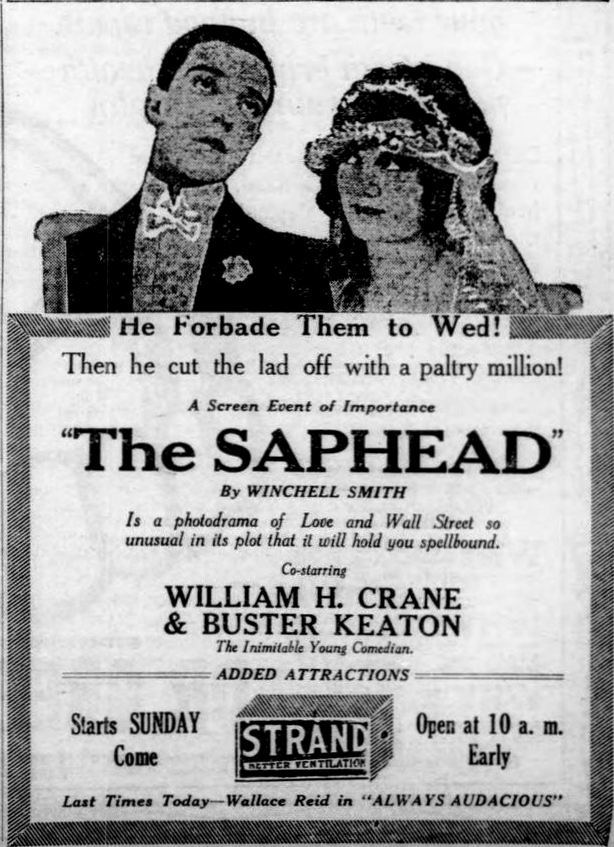
Tonight! Final round of 'The Storytellers' with Buster Keaton starring in 'The Saphead' (1920)

Buster returns from the millinery in 'The Saphead' (1920).

Hi everyone! I feel like I'm reporting from between rounds in a title fight going the distance.

We're nearly through our week-long 'Story Tellers' series at the Town Hall Theatre in Wilton, N.H.

And it's been an endurance test because three of the pictures are each about three hours: on Tuesday, it was Griffith's 'Intolerance' (1916); an Wednesday, it was Lang's 'The Spiders' (1919), and last night it was another three-hour Griffith, 'Way Down East' (1920).

So today I feel like I'm entering the later stages of a 12-round bout with Rocky Graziano. But like Jake LaMotta, I'll take the hits and intend to keep on coming.

Fortunately, tonight we finish with 'The Saphead' (1920), a much lighter (and shorter!) movie from 1920 that has the distinction of being the first starring feature role of a very young Buster Keaton.

I included 'The Saphead' as a kind of dessert to the series, and also because it's a good example of how many early full-length pictures were stories adapted from the stage. 

In this case, it was a Wall Street comedy called 'The New Henrietta' that originally starred Douglas Fairbanks Sr. when produced on stage in 1913. Fairbanks also starred in an earlier film version, 'The Lamb' (1915).

But when it was time for a remake retitled 'The Saphead,' Fairbanks wasn't available. To take his role, he suggested Buster Keaton, who until that time had been Fatty Arbuckle's understudy in slapstick mayhem.

Buster turned in a superbly understated performance, quite different from his over-the-top physical comedy antics with Arbuckle. It marked the real start of his career as an independent performer, which would lead to his series of starring features in the 1920s. 

Because it's not an official "Keaton" film, however, it's not screened as often as the others. So here's your chance to see it as intended—on the big screen, with live music, and with an audience.

And that's where you come in. (Actually, the door is where you come in.) Please join us for this evening's finale to 'The Storytellers.' With silent film—and especially with silent comedy—the more, the merrier!


Saturday, January 9, 2021

Next week: 'The Storytellers,' five days of film that pioneered the full-length motion picture

Showing on Tuesday, Jan. 12: D.W. Griffith's 'Intolerance' (1916).

I've known of D.W. Griffith as 'The Father of Film' since at least the 1970s, when I'd eagerly await my monthly Blackhawk Films catalog in the mail.

But for many years, I just didn't understand his work. The films—either the short dramas for Biograph, or the longer features—either weren't interesting, or left me cold. 

Okay, I thought: Griffith is the father of film. But as a teenager, I'd rather run my Super-8 print of Keaton's 'Cops' (1922) for the 80th time rather than sit through 'Way Down East' (1920), the legendary Griffith melodrama. (That's Lillian Gish on the ice floes below, at the climax of 'Way Down East.')

My first sense of what I was missing, however, came thanks to the Kansas Silent Film Festival, which I began attending back in 2000. Every year, they'd run at least one Griffith title (usually one of the Biograph shorts) in honor of his role as an industry pioneer.

So I got to see some of Griffith's work on the big screen, with an audience, and with live music—in other words, the way it was intended to be shown. And I found that under those circumstances, the Griffith films had a certain elemental quality that I hadn't picked up on until then.

By elemental, I mean they could hold a crowd. Through simple, basic stories, they got your attention quickly, and then held it.

Later, when I began accompanying silent film programs, I found a curious thing: the Griffith films—even the famous ones regarding as classics—seemed really lame when viewed in isolation to prepare for a screening. 

But in front of an audience in a theater, they leaped to life. People would hoot and holler at what they saw. They'd stamp their feet, totally engaged in what they were seeing unfold in front of them.

As I learned more about Griffith's background and career, I realized what as going on. Griffith was the father of film, yes, but not for technical innovations such as close-ups and such. It was because of his ability to lay out a story to get an audience's attention right away, and then keep them on the edge of their seats.

That, as demonstrated more or less throughout his work, I feel was Griffith's most valuable contribution to cinema. He showed how full-length feature films could hold an audience's attention throughout an entire evening-long narrative journey.

And he did it so well that the films still work today, if you can show them as intended. 

The big "Ancient Babylon" set for Griffith's 'Intolerance.'

I remember once when we ran 'Birth of a Nation' (1915), Griffith's incredibly racist blockbuster set in post-Civil War America. The film climaxes with the Ku Klux Klan riding to the rescue,  and I remember of friend of mine saying afterwards, "You're like, 'Yes, ride to the rescue,' and then 'But no, it's the Klan!' " Such was (and is) the elemental narrative power of Griffith's tales.

Of course this is evident only if one experiences the films as intended, of which there are precious few opportunities these days. But not next week, when the Town Hall Theatre in Wilton, N.H. presents 'The Storytellers,' a five-day festival of early films that still keep audiences on the edge of their seats.

The festival includes two big Griffith films: 'Intolerance' (1916) and 'Way Down East' (1920). We're also running two early films made in Germany by Fritz Lang: 'Destiny' (1921) and 'The Spiders' (1919).

For details, check out this info sheet for the series. 

Or you can peruse the press release below. Either way, I hope you'll join us for some or all of the series. It's a rare chance to see some terrific cinema that still holds up well if you experience it as intended—in a theater, with live music, and with an audience.

*    *    *


A scene from Fritz Lang's 'Destiny' (1921), being shown Monday, Jan. 11.

MONDAY, JAN. 4, 2021 / FOR IMMEDIATE RELEASE
Contact Jeff Rapsis • (603) 236-9237 • jeffrapsis@gmail.com

Week-long film series at Town Hall Theatre turns spotlight on early directors, great stories

'The Storytellers,' Jan. 11-15, highlights talent of D.W. Griffith, Fritz Lang to mesmerize movie audiences with terrific tales

WILTON, N.H.—Everyone loves a good story.

In early cinema, a talent for story-telling was a key factor in popularizing feature-length movies.

Pioneering directors such as D.W. Griffith in the U.S. and Fritz Lang in Germany helped transform the motion picture from a sideshow novelty into a major art form—and a big business.

See for yourself when the Town Hall Theatre presents a week-long series, 'The Storytellers,' designed to highlight filmmakers who told tales that kept early movie-goers coming back for more.

With programs every evening from Monday, Jan. 11 to Friday, Jan. 15, 'The Storytellers' will showcase five spectacular full-length movies that helped build the audience for feature films.

Two are directed by Griffith: the mega-epic 'Intolerance' (1916) and the melodrama 'Way Down East' (1920). Two are from Lang: the afterlife drama 'Destiny' (1921) and action-adventure film 'The Spiders' (1919).

Although produced in Germany, the Lang films will be shown with titles translated into English.

The series finishes with Wall Street comedy 'The Saphead' (1920), the first feature-length film starring Buster Keaton. (There's a poster at right, although without Buster in it.)

All shows in 'The Storytellers' begin each night at 7:30 p.m. Each screening will be accompanied by live music by Jeff Rapsis, a New Hampshire-based silent film musician.

Admission is free; a donation of $10 per person is suggested to support the Town Hall Theatre's silent film series.


The Town Hall Theatre ordinarily programs the latest first-run feature films. But the ongoing pandemic, plus Hollywood's resistance to releasing new material to theaters, has prompted the highly regarded venue to focus on alternative programming.

The aim of 'The Storytellers' is to highlight a factor in the rapid growth of the movie business that's often overlooked: the power of the narrative.

Early directors such as D.W. Griffith and Fritz Lang are often noted for their technical innovations or sense of visual design, which helped establish the basic grammar of cinema.

But another major factor in audiences returning for more was the story itself.

"In early cinema, the best directors had a knack for laying out a story that could keep people on their edges of their seats for an entire evening," Rapsis said. 

"Up until the mid 1910s, most movies were 10 or 20 minutes long," Rapsis said. "Griffith and Lang were among the directors who led the way to feature-length films, and their stories were the foundation of their success."

'The Storytellers' aims to highlight this enduring quality of the tales that brought cinema from a carnival sideshow attraction to an art form that would dominate the 20th century.

A scene from Fritz Lang's action-adventure 'The Spiders' (1919).

"The films were so well built with audience reaction in mind that they still work when shown as intended: on the big screen, with live music, and in a darkened theatre with other people joining in a shared experience," Rapsis said.

Among early directors, Griffith was uniquely positioned to understand how to engage an audience for an evening of story-telling.

Prior to his motion picture work, Griffith spent two decades directing stage melodramas in small towns across the U.S., where keeping an audience occupied was an essential skill.

"In Griffith's stage experience, if you didn't hook the crowd right away, and keep them hooked, they'd throw things at you—or worse," Rapsis said.

This experience honed his story-telling skills, which became essential when creating movies in studios where no audience was present during the filming and editing.

"Griffith knew in his bones how large crowds would react to a story, and built that into his most popular films," Rapsis said.

"His ability to hold an audience was based on a profound understanding of human nature, and how people react, especially when part of a crowd," Rapsis said. "Because of this, his films still work today when presented as intended, which we'll do at the Town Hall Theatre."

Lang exploited a similar knack for story-telling to expand the scope of full-length movies in his native Germany.

Lang was among the first to exploit the ability of cinema to take viewers to exotic places or to travel in time. This helped him craft stories that showed early audiences the power of cinema. 

A scene from Lang's 'Destiny' (1921), screening on Monday, Jan. 11.

'The Storytellers' will focus on five early feature films. It's a rare chance to experience them as intended: on the big screen, with live music, and in a darkened theater with an audience present:

• Monday, Jan. 11 at 7:30 p.m.: Fritz Lang's 'Destiny' (1921). Years before his classic 'Metropolis,' German director Fritz Lang brought this ground-breaking expressionist fantasy to the big screen. It's a powerful tale in which human lives are each represented by a candle, and a figure representing 'Death' grants a woman three chances to rescue her lover from a premature demise.

• Tuesday, Jan. 12 at 7:30 p.m.: D.W. Griffith's 'Intolerance' (1916). D.W. Griffith's early blockbuster about man's inhumanity to man weaves together four stories spanning four eras of civilization. Filmed on a vast scale, setting a new standard for Hollywood extravagance, and new levels of editing fluency in pulling together four story climaxes simultaneously. A movie made for the big screen.

• Wednesday, Jan. 13 at 7:30 p.m.: Fritz Lang's 'Spiders' (1919). Early Lang opus that anticipates Indiana Jones by three generations. An intrepid explorer looking for an Incan diamond must stay ahead of a criminal syndicate known as 'The Spiders,' which seeks it for nefarious purposes.

• Thursday, Jan. 14 at 7:30 p.m.: Griffith's 'Way Down East' (1920). One of the most popular films of the silent era features Lillian Gish as a wronged woman in old-time New England who can't escape her past. Still-thrilling climax on ice floes heading towards the falls was filmed on location on the Connecticut River.

• Friday, Jan. 15 at 7:30 p.m.: Buster Keaton in 'The Saphead' (1920). Buster Keaton's debut in a feature-length picture, although not a Keaton film. Rather, a stage adaptation in which the comedian was hired to play a role originated by Douglas Fairbanks Sr. A rare chance to see this seldom-screened landmark picture on the big screen.

The Town Hall Theatre continues to observe procedures to comply with all state and CDC public health guidelines, including reduced seating capacity.

For complete information about safety protocols, visit www.wiltontownhalltheatre.com

'The Storytellers,' a five-day series of early motion pictures from directors D.W. Griffith and Fritz Lang, will run from Monday, Jan. 11 through Friday, Jan. 15 at the Town Hall Theatre, 40 Main St., Wilton, N.H. Screenings start at 7:30 p.m.; live music will accompany each film. Admission is free; a donation of $10 per person is suggested to support the Town Hall Theatre's silent film series.

For more info, call (603) 654-3456 or visit www.wiltontownhalltheatre.com.   

Monday, September 14, 2020

Next: Two silent film programs that look at movies themselves. First up: Keaton's 'Sherlock Jr.' and 'Cameraman' on Sat., 9/20 in Wilton, N.H.


Original promotional art for Buster Keaton's 'The Cameraman' (1928).

In Kurt Vonnegut's novel 'Slaughterhouse Five,' there's a British officer who's been in a German prison camp since the very start of World War II. His survival routine included looking in a mirror each morning to frankly evaluate his appearance, posture, and bearing.

Wow! If I had a survival routine, it wouldn't involve looking in a mirror, as that would almost certainly rob me of my will to live. 

But holding up a mirror can be a good thing, despite unexpected results — especially when it's someone like Buster Keaton holding up a mirror to the then-new medium of motion pictures. 

And it's also a good thing when an artist such as Dziga Vertov holds up mirror to life in the then-new Soviet Union, using the art of cinema to create a reflection of life itself.

Movies from both filmmakers are on the silent film calendar in the next couple of weeks. On Sunday, Sept. 20, I'll accompany a double-feature of Keaton's 'Sherlock Jr.' (1924) and 'The Cameraman' (1928), a pair of films with stories rooted in the movie business.

The screening is at 2 p.m. at the Town Hall Theatre in Wilton, N.H. 

And on Wednesday, Sept. 30, I'll do music for a screening of Vertov's 'Man With A Movie Camera' (1929), a head-spinning slice-of-life documentary with no traditional narrative or story itself, unless you count the story of life itself, which I believe was Vertov's subject. 

The screening is at 6:30 p.m. at the Flying Monkey Moviehouse in Plymouth, N.H. More details are on the "Upcoming Screenings" page, and I'll get the press release into a later post. 

For now, the focus (another movie term!) is on Buster, who plays with motion picture reality in both films we're running on Sunday, Sept. 20. 

As with all of Buster's films, the main goal was laughter. Keaton's style of comedy, however, led him to naturally to explore the strange new world of the motion picture, which he does in both 'Sherlock Jr.' (1924) and 'The Cameraman' (1928).

While many people marvel at the technical wizardry that enabled Keaton to put some eye-popping special effects into 'Sherlock Jr.,' I think 'The Cameraman' shows equal ingenuity in another way: in its story construction.

In 'The Cameraman,' Keaton creates a simple tale of a would-be newsreel cameraman that allows all manner of commentary (and laughter) about the business he's in. 

Example: a producer watches exciting newsreel footage of a dramatic event (not knowing that it was captured by an organ grinder's monkey), and shouts "That's the best camera work I've seen in years!" 

Knowing the truth of the matter, we laugh at the producer's assessment. But by holding up a mirror to the motion picture business, in 'The Cameraman' Keaton creates an insider's fun-house that transcends laughter and triggers infinity again and again. 

Hope you'll join us! Here's the press release with more info and all the details.

*   *   *


Buster Keaton in 'The Cameraman' (1928).

MONDAY, SEPT. 14, 2020 / FOR IMMEDIATE RELEASE
Contact Jeff Rapsis • (603) 236-9237 • jeffrapsis@gmail.com

Buster Keaton double feature at Town Hall Theatre on Sunday, Sept. 20

Silent film comedy classics return to the big screen with live musical accompaniment; venue following procedures to be Covid-19 compliant

WILTON, N.H.—He never smiled on camera, earning him the nickname of "the Great Stone Face." But Buster Keaton's comedies rocked Hollywood's silent era with laughter throughout the 1920s.

See for yourself with a screening of 'Sherlock Jr.' (1924) and 'The Cameraman' (1928), two of Keaton's landmark feature films, on Sunday, Sept. 20 at 2 p.m. at the Town Hall Theatre, 40 Main St., Wilton, N.H.

The screening, the latest in the Town Hall Theatre's silent film series, will feature live accompaniment by Jeff Rapsis, a New Hampshire-based composer who specializes in creating music for silent films.

Admission is free; a donation of $10 per person is suggested to help defray expenses.

The Town Hall Theatre is observing procedures to comply with all state and CDC public health guidelines, including reduced seating capacity. For complete information about safety protocols, visit www.wiltontownhalltheatre.com

In 'Sherlock Jr.,' Buster plays a small-town movie projectionist who dreams of working as a detective. But then Buster's romantic rival frames him for stealing a watch from his girlfriend's father.

Fortunately, the situation mirrors the plot of the movie currently playing at Buster's theater. Inspired by the movie, can Buster find the real thief and win back his girl?

'The Cameraman' tells the story of a young man (Keaton) who tries to impress the girl of his dreams (Marceline Day) by working as a freelance newsreel cameraman.

His efforts fail spectacularly, but then a lucky break gives him an unexpected chance to make his mark. Can Buster parlay the scoop of the year into a secure job and successful romance?

Both films focus on exploring the potentials of the motion picture, then a brand-new medium.

In 'The Cameraman,' Keaton uses the movie business itself to create comedy that plays with the nature of film and reality.

Keaton, along with Charlie Chaplin and Harold Lloyd, stands as one of the three great clowns of the silent screen. Many critics regard Keaton as the most timeless; Roger Ebert wrote in 2002 that "in an extraordinary period from 1920 to 1929, (Keaton) worked without interruption on a series of films that make him, arguably, the greatest actor-director in the history of the movies."

As a performer, Keaton was uniquely suited to the demands of silent comedy. Born in 1895, he made his stage debut as a toddler, joining his family's knockabout vaudeville act and learning to take falls and do acrobatic stunts at an early age. He spent his entire childhood and adolescence on stage, attending school for exactly one day.

A remarkable pantomime artist, Keaton naturally used his whole body to communicate emotions ranging from sadness to surprise. In an era when movies had few special effects, Keaton's acrobatic talents enabled him to perform all his own stunts.

All those talents are on display in 'Sherlock Jr.' and 'The Cameraman,' which was selected in 2005 for preservation in the U.S. National Film Registry by the Library of Congress as being "culturally, historically, or aesthetically significant."

"These films are audience favorites, and people continue to be surprised at how engrossing and exhilarating they can be when shown as they were intended: in a theater, and with live music," said Rapsis, who accompanies more than 100 screenings each year at venues around the nation and abroad.

Rapsis, who lives in Bedford, N.H., improvises live scores for silent films using a digital synthesizer to recreate the texture of the full orchestra.

"It's kind of a high wire act," Rapsis said. "But for me, the energy of live performance is an essential part of the silent film experience."

'Sherlock Jr.' (1924) and 'The Cameraman' (1928) will be shown with live music on Sunday, Sept. 20 at 2 p.m. at the Town Hall Theatre, 40 Main St., Wilton, N.H. Admission is free; a donation of $10 per person is suggested. For more information, call (603) 654-3456 of visit www.wiltontownhalltheatre.com.

Monday, January 6, 2020

Dialing up Keaton's 'Seven Chances' on 1/19
for the New Hampshire Telephone Museum

Buster Keaton checks the time in 'Seven Chances (1925).

Later this month, it'll be my pleasure to bring silent film with live music to a brand new venue for me—the New Hampshire Telephone Museum!

Yes, New Hampshire has a telephone museum. And yes, we're screening a telephonic silent film program on Sunday, Jan. 19.

Actually, the screening will take place in nearby Warner (N.H.) Town Hall, as the museum itself (also in Warner) isn't quite the set up to hold a screening.

On the program: Buster Keaton's great comedy 'Seven Chances' (1925), in which the telephone plays a key role in the plot, and which includes scenes of vintage switchboards and phone booths.

Also: Harold Lloyd's phone-heavy short comedy 'Number, Please' (1920).

If reading this has made you realize there is such as thing as a New Hampshire Telephone Museum—well, then we've accomplished our goal already.

Located at 1 Depot Street, the Telephone Museum ("Where History Talks!") is worth a visit. Check them out online at www.nhtelephonemuseum.org.

And our screening? It's Sunday, Jan. 19 at 2 p.m. at Warner Town Hall. More info in the press release below. Hope to see you at the movies!

* * *

A Swedish poster for 'Seven Chances' (1925).

MONDAY, DEC. 30, 2019 / FOR IMMEDIATE RELEASE
Contact: Jeff Rapsis • (603) 236-9237 • jeffrapsis@gmail.com

Buster Keaton comedy 'Seven Chances' (1925) on Sunday, Jan. 19 at Warner Town Hall


Silent film presentation by New Hampshire Telephone Museum features classic race-to-the-finish romantic farce with live music

WARNER, N.H.—He never smiled on camera, earning him the nickname of "the Great Stone Face." But Buster Keaton's comedies rocked Hollywood's silent era with laughter throughout the 1920s.

Acclaimed for their originality and clever visual gags, Keaton's films remain popular crowd-pleasers today.

See for yourself with a screening of 'Seven Chances' (1925), one of Keaton's landmark feature films, on Sunday, Jan. 19 at the Warner Town Hall, 5 East Main St., Warner, N.H.

The program starts at 2 p.m. and is open to the public. Admission is $10 per person; $5 for N.H. Telephone Museum members.

Live music for the movie will be provided by silent film accompanist Jeff Rapsis.

Adapted from a stage play, the story finds Buster learning that he'll inherit $7 million if he's married by 7 p.m. on his 27th birthday—that very day!

Buster's hurried attempts to tie the knot on his own go awry, but then a newspaper story changes the game, creating an avalanche of would-be brides who relentlessly pursue Buster as he searches for his one true love before the deadline.

Buster surrounded by brides-a-plenty in 'Seven Chances' (1925).

'Seven Chances' was the first screen adaptation of the now-familiar story, since used in movies ranging from the Three Stooges in 'Brideless Groom' (1947) to Gary Sinyor's 'The Bachelor' (1999), a romantic comedy starring Chris O'Donnell and Renee Zellwinger.

"Also, a missed telephone call plays a key role in the plot, so 'Seven Chances' was of interest to the Telephone Musuem," Rapsis said. "It also had several scenes showing vintage telephone switchboards and phone booths that were common in that era."

The program also includes 'Number, Please' (1920), a telephone-themed short comedy starring Harold Lloyd.

Keaton, along with Charlie Chaplin and Harold Lloyd, stands today as one of the silent screen's three great clowns. Some critics regard Keaton as the best of all; Roger Ebert wrote in 2002 that "in an extraordinary period from 1920 to 1929, (Keaton) worked without interruption on a series of films that make him, arguably, the greatest actor-director in the history of the movies."

As a performer, Keaton was uniquely suited to the demands of silent comedy. Born in 1895, he made his stage debut as a toddler, joining his family's knockabout vaudeville act and learning to take falls and do acrobatic stunts at an early age.

A remarkable pantomime artist, Keaton naturally used his whole body to communicate emotions from sadness to surprise. And in an era with no post-production special effects, Keaton's acrobatic talents enabled him to perform all his own stunts, including some spectacular examples in 'Seven Chances.'

In reviving Keaton's 'Seven Chances,' the Telephone Museum aims to present silent film as it was meant to be seen—using restored prints, on a large screen, with live music, and with an audience.

"All those elements are important parts of the silent film experience," said Rapsis, who will accompany the film. "Recreate those conditions, and classics of early Hollywood such as 'Seven Chances' leap back to life in ways that audiences still find entertaining."

Rapsis performs on a digital synthesizer that reproduces the texture of the full orchestra, creating a traditional "movie score" sound. He improvises the complete score in real time during the screening.

"Creating a movie score on the fly is kind of a high-wire act, but it can often make for more excitement than if everything is planned out in advance," Rapsis said.

Buster Keaton's 'Seven Chances' (1925) will be screened on Sunday, Jan. 19 at 2 p.m. at the Warner Town Hall, 5 East Main St., Warner, N.H.

The program is presented by the New Hampshire Telephone Museum and is open to the public. Admission is $10 per person; $5 for N.H. Telephone Museum members. For more information, call the museum at (603) 456-2234.

Tuesday, February 5, 2019

Tubas and pot luck and movies, oh my! Plus thoughts on scoring 'Woman in the Moon' at this year's Boston Sci-Fi Marathon

First, if you're wondering what a concert looks like from the perspective of a tuba player, here you go:


On the podium is Dani Rimoni, director of the Dino Anagnost Youth Symphony Orchestra of New Hampshire. We're just finishing the first movement of Beethoven's 5th Symphony, which has no tuba part, which allowed me to take the picture.

This is at a concert on Saturday, Feb. 2 at the Manchester (N.H.) Community Music School in which my Yamaha concert bass tuba and I sat in with the low brass during the group's winter performance.

I'm technically not qualified to be in the youth orchestra, as I'm not a youth. (Also, I don't play nearly at the level as these kids do!) But there's apparently a something of a shortage of low brass players, and it must be truly severe if they called me to sit in.

And although there's no tuba in Beethoven's 5th, there IS in the Academic Festival Overture by Brahms, which was also on the program. And so I got to bomp along with the trombones when Brahms got frisky with his orchestration.

Also on the program was a medley of music from 'West Side Story,' but somehow no tuba part was printed. So I played off a string bass part, coming in judiciously to avoid making it sound like an oompah band during "I Feel Pretty."

Maestro Rimoni, conducting from a piano score, seemed to like what I was doing: at rehearsal, at one point during a soft transition, I hit it just right doubling the double bass, and he mentioned later that it sounded really powerful.

But I had no time to bask in the glow of the only compliment I've ever received for my tuba playing, as I had to dash an hour north to make it in time for the Campton Historical Society's annual Pot Luck and Silent Film event!

Yes, this is what winter in New Hampshire looks like, both scenically and culturally.

I was there to accompany the silent film, which was Buster Keaton's 'Our Hospitality' (1923).

But the pot luck supper is a highlight, and there's always a few surprises. This time it was a shepherd's pie in which taco sauce was used. It worked!

Buster killed, as usual. As the years go by, I've found that of all the Keaton features, 'Our Hospitality' seems to get perhaps the strongest overall response from audiences.

Yes, 'The General' and 'Steamboat Bill Jr.' are popular and always get a reaction. 'The Navigator' is among my personal favorites, but only once have I seen it produce a sustained laugh-out-loud response. And whatever else happens, 'Seven Chances' always springs to life when the brides start marching down the streets.

But 'Our Hospitality' has emerged as the most all-around sure-fire Keaton opus. Why? Well, it's a great balance of story and comedy, and a great introduction to Buster's unique visual humor, and perhaps its historic setting (in the 1820s) helps it seem somehow universal and accessible to our modern eyes. ('The General,' set in the 1860s, has this going for it as well.)

Well, for whatever reason, it happened again last Saturday night. 'Our Hospitality' was greeted with constant outbursts of astonished laughter (to use Walter Kerr's phrase), and a foot-stomping ovation at the waterfall rescue. I mean, it just really works.

This weekend brings a pre-Valentines Day screening of Rudolph Valentino is 'The Eagle' (1925), and then the weekend after that brings a screening that represents the culmination of eight years of badgering.

Ever since I discovered Fritz Lang's 'Woman in the Moon' (1929) and the Boston Sci-Fi Marathon (held every Presidents Day weekend, now in its 44th year), I've wanted to bring them together.

And now, after eight years of badgering, and wheedling, and imploring, and other words I'm too lazy to look up in a thesaurus, my dream is finally happening.

On Sunday, Feb. 17, I will enter the Somerville Theatre sometime after 6 p.m to accompany 'Woman in the Moon' before an audience of 700 hard core sci-fi fanatics.

It's not your usual silent film crowd. But that's the point!

Some people dream of getting the Congressional Medal of Honor. Some people just want their kids to respect them. For me, this is it — for years now, accompanying 'Woman in the Moon' at the Boston Sci-Fi Marathon is all I've ever aspired to do.

And now it's about to happen. And if you'd like to be on hand to witness this transit, I'm pasting in a press release below that has all the info.

For me, I'm elated. I'm ecstatic. I'm, I'm...hey, get me that thesaurus!

* * *

A promotional poster for 'Frau im Mond' (1929).

TUESDAY, FEB. 5, 2019 / FOR IMMEDIATE RELEASE
Contact Jeff Rapsis • (603) 236-9237 • jeffrapsis@gmail.com

Boston Sci-Fi Marathon highlighted by early silent German space travel epic that predicted Apollo program

'Woman in the Moon,' Fritz Lang's pioneer fantasy about mankind's first lunar voyage, to be shown with live music during 44th annual Presidents Day weekend event

SOMERVILLE, Mass.—A sci-fi adventure hailed as the first feature film to depict realistic space travel will be screened this month as part of the annual Boston Sci-Fi Marathon over Presidents Day weekend.

'Woman in the Moon' (1929), directed by German filmmaker Fritz Lang ('Metropolis,' 1927), will be shown with live music during the 24-hour event, which starts at noon on Sunday, Feb. 17 at the Somerville Theatre, 55 Davis Square, Somerville.

The screening is a highlight of the 44th year of the Science Fiction Marathon, which bills itself as the nation's longest-running genre film event. This year's marathon includes a total of 11 feature films, many presented using 35mm or 70mm prints from studio vaults.

In addition to 'Woman in the Moon,' titles include 'Rollerball' (1975), 'Andromeda Strain' (1991), and 'Inner Space' (1987), and Dr. Cyclops (1940).

'Woman in the Moon' holds a special place in this year's line-up, in part because of the 50th anniversary of the actual Apollo 11 moon landing in 1969, which it anticipated in many remarkable ways.

On the lunar surface: 'Woman in the Moon.'

" 'Woman in the Moon' is a great and at-times bizarre film, one that must be seen to be believed," said Jeff Rapsis, a New Hampshire-based silent film accompanist who will create live music for the screening.

Director Fritz Lang, responsible for the groundbreaking sci-fi epic 'Metropolis' (1927), planned 'Woman in the Moon' as another step in his quest to stretch cinema's visual, story-telling, and imaginative capabilities.

The rarely seen full-length version of 'Woman in the Moon' follows an intrepid band of German space pioneers as they attempt mankind's first voyage to the lunar surface, where they hope to find large deposits of gold.

The film, made with German rocket experts as technical advisers, anticipated many of the techniques used by NASA for the Apollo moon launch program 40 years later. For example, a multi-stage rocket is employed to escape Earth's gravity, and a separate capsule is used to reach the lunar surface.

Willy Fritsch prepares to pull the lever.

The film is also noted for introducing the idea of a dramatic "countdown" prior to launch, which later became standard procedure in actual space flight. Critics regard the film's extended launch sequence as a masterpiece of editing and dramatic tension.

But 'Woman in the Moon,' with its melodramatic plot, also stands as the forerunner of many sci-fi soap opera elements that quickly became clichés: the brilliant but misunderstood professor; a love triangle involving a female scientist and her two male colleagues; a plucky young boy who yearns to join the expedition; fistfights and gunfire and treachery on the lunar surface.

Added to the mix is a vision of the moon (created entirely on a massive studio set in Berlin, Germany) that features a breathable atmosphere, giant sand dunes, distant mountain peaks, and bubbling mud pits.

The moon as imagined by Fritz Lang.

"Including 'Woman in the Moon' in this year's Sci-Fi Marathon, with its foreshadowing of the Apollo program, is a great way to acknowledge this year's 50th anniversary of mankind's actual landing on the moon," Rapsis said.

"And as a past vision of a future that didn't quite come to be, it really gets you thinking of time and how we perceive it."

Rapsis, a resident of Bedford, N.H., will improvise live musical accompaniment during the screening, using a digital synthesizer to recreate the sound of a full orchestra and other more exotic textures.

'Woman in the Moon,' a full-length feature than runs more than 2½ hours, should not be confused with the much earlier film 'A Trip to Moon,' a primitive "trick" short movie made by French filmmaker George MĂ©liès in 1902 and famous for the image of a space capsule hitting the eye of an imaginary moon man.

"Unlike the Méliès film, there's nothing primitive about 'Woman in the Moon,' " Rapsis said. "It's silent film story-telling at the peak of its eloquence, with lively performances, imaginative camera angles, and superb photography."

Bad timing is one reason that 'Woman in the Moon' (titled 'Frau im Mond' in German) is not as well known today as 'Metropolis,' its legendary predecessor. Lang completed 'Woman in the Moon' just as the silent film era was coming to a close.

As one of the last silent films of German cinema, 'Woman in the Moon' was unable to compete with new talking pictures then in theaters, making it a box office flop at its premiere in October, 1929.

However, German rocket scientist Hermann Oberth worked as an adviser on the movie, and it developed cult status among the rocket scientists in Wernher von Braun's circle starting in the 1930s. During World War II, the first successfully launched V-2 rocket at the German rocket facility in PeenemĂĽnde had the "Woman in the Moon" logo painted on its base.

During the war, the Nazis tried to recall and destroy all prints of 'Woman in the Moon' due to its detailed depiction of state-of-the-art rocket propulsion technology; in later years, this served to make the film even more hard to find. For many years, the film was available only in cut-down 16mm versions that ran as short as one hour.

But pristine and complete 35mm copies of 'Woman in the Moon' did survive in several European archives. Today, restored prints are amazingly clear and sharp, Rapsis said.

" 'Woman in the Moon' is technically one of the best-looking silent films I've ever seen," he said. "If you think all silent films are grainy and scratchy-looking, 'Woman in the Moon' will change your mind. It's like an Ansel Adams photograph come to life."

"Although 'Woman in the Moon' is available for home viewing, this is a motion picture that should be experienced as intended: on the big screen, with live music, and with an audience," Rapsis said. "There's nothing like it."

'Woman in the Moon' will be shown as part of the 44th Annual Boston Science Fiction Marathon, which begins on Sunday, Feb. 17 at noon at the Somerville Theatre, 55 Davis Square, Somerville, Mass.

Tickets to the 24-hour marathon are $90 per person and available at www.bostonscifi.com. Tickets for individual movies shown during the Sci-Fi Marathon are not available.

Tuesday, October 9, 2018

You always remember your first time: The comedy calm before the Halloween avalanche

A Swedish poster for Keaton's 'Seven Chances.'

So I'm doing music for Buster Keaton's great comedy 'Seven Chances' (1925) on Wednesday night.

And it's fitting that the comedy includes an avalanche, as it will be followed by an avalanche of Halloween-themed screenings starting this weekend.

But before we can get to 'Nosferatu' and 'Phantom' and 'Hunchback' and 'Faust' (all of which I'm doing before the month is out), we first must see if Buster can find a bride no later than 7 p.m.—today!

It's a first-time screening for the nice folks up in Grantham, N.H., and for this situation I've found 'Seven Chances' is a dependable and crowd-pleasing intro into the world of silent film.

One of the first rules of show biz is to always leave 'em wanting more. And I've yet to encounter an audience that, after experiencing 'Seven Chances,' wants less of Buster.

The screening is free and open to the public. So if you happen to find yourself in Grafton County, N.H. tomorrow night and are looking for something to do, please join us!

Details in the press release below...

* * *

Buster checks the waning moments of his bachelorhood in 'Seven Chances' (1925).

TUESDAY, OCT. 2, 2018 / FOR IMMEDIATE RELEASE
Contact: Jeff Rapsis • (603) 236-9237 • jeffrapsis@gmail.com

Buster Keaton comedy 'Seven Chances' (1925) on Wednesday, Oct. 10 at Center at Eastman


Silent film presentation features classic race-to-the-finish romantic farce with live music

GRANTHAM, N.H.—He never smiled on camera, earning him the nickname of "the Great Stone Face." But Buster Keaton's comedies rocked Hollywood's silent era with laughter throughout the 1920s.

Acclaimed for their originality and clever visual gags, Keaton's films remain popular crowd-pleasers today.

See for yourself with a screening of 'Seven Chances' (1925), one of Keaton's landmark feature films, on Wednesday, Oct. 10 in the Draper Room at the Center at Eastman, 1 Clubhouse Lane, Grantham, N.H.

The program starts at 7:30 p.m. and is free and open to the public. Live music for the movie will be provided by silent film accompanist Jeff Rapsis.

Adapted from a stage play, the story finds Buster learning that he'll inherit $7 million if he's married by 7 p.m. on his 27th birthday—that very day!

Buster's hurried attempts to tie the knot on his own go awry, but then a newspaper story changes the game, creating an avalanche of would-be brides who relentlessly pursue Buster as he searches for his one true love before the deadline.

Here come the brides...

'Seven Chances' was the first screen adaptation of the now-familiar story, since used in movies ranging from the Three Stooges in 'Brideless Groom' (1947) to Gary Sinyor's 'The Bachelor' (1999), a romantic comedy starring Chris O'Donnell and Renee Zellwinger.

The program will open with a short Keaton comedy as a warm-up to the main feature.

Keaton, along with Charlie Chaplin and Harold Lloyd, stands today as one of the silent screen's three great clowns. Some critics regard Keaton as the best of all; Roger Ebert wrote in 2002 that "in an extraordinary period from 1920 to 1929, (Keaton) worked without interruption on a series of films that make him, arguably, the greatest actor-director in the history of the movies."

As a performer, Keaton was uniquely suited to the demands of silent comedy. Born in 1895, he made his stage debut as a toddler, joining his family's knockabout vaudeville act and learning to take falls and do acrobatic stunts at an early age.

A remarkable pantomime artist, Keaton naturally used his whole body to communicate emotions from sadness to surprise. And in an era with no post-production special effects, Keaton's acrobatic talents enabled him to perform all his own stunts, including some spectacular examples in 'Seven Chances.'

In reviving Keaton's 'Seven Chances,' organizers of the Music Department's concert series aim to show silent film as it was meant to be seen—in restored prints, on a large screen, with live music, and with an audience.

"All those elements are important parts of the silent film experience," said Rapsis, who will accompany the film. "Recreate those conditions, and classics of early Hollywood such as 'Seven Chances' leap back to life in ways that audiences still find entertaining."

Rapsis performs on a digital synthesizer that reproduces the texture of the full orchestra, creating a traditional "movie score" sound. He improvises the complete score in real time during the screening.

"Creating a movie score on the fly is kind of a high-wire act, but it can often make for more excitement than if everything is planned out in advance," Rapsis said.

Buster Keaton's 'Seven Chances' (1925) will be screened on Wednesday, Oct. 10 in the Draper Room at the Center at Eastman, 1 Clubhouse Lane, Grantham, N.H.

The program starts at 7:30 p.m. and is free and open to the public.

And now, notes on a curiosity.

This still below from 'Seven Chances'...

...reminded me of this still from 'Wings' (1927)...


Was there a thing in the 1920s for despondent poses, or what?

Sunday, April 1, 2018

April Fool's Day rewinding, fast forwarding:
Past projects, future possibilities

Recording music last month for videos supporting 'The White Mountain,' a new book by author Dan Szczesny.

Back with a blog post after a long silence.

It's not for lack of material—the month just past has actually been full of projects and performances.

Among the highlights: a last-minute score for 'The Lost World' (1925) at the annual 24-hour Boston Sci-Fi Marathon. (At left is a photo by Tony Joe Stemme of me taking a bow); and music for Nazimova's 'Camille' (1921) at the Kansas Silent Film Festival, for which I channeled my inner Rachmaninoff.

Rather, it's more lack of time. With so much going on, there's rarely a chance to sit down and chronicle it.

But as we finish up the first quarter of 2018, time to look back as well as look at what lies ahead.

In April, highlights include a spate of Buster Keaton performances in mid-month, including 'The General' (1926) at the Capitol Theatre in Arlington, Mass.

And the month ends with a particularly big challenge: doing music for Fritz Lang's two 'Die Nibelungen' films over a single weekend. More on that below.

For now, let me take stock. (Never understood this phrase—what am I, soup?)

Rewinding:

In the first three months of this year, I've reduced the pace of live accompaniment performances.

This slowdown has been deliberate. It's not because I don't enjoy doing music for films, but because my schedule was leaving little time for anything else.

For one thing, as part-owner of a publishing business that's branching in new directions, my "day job" is more than enough to keep anyone hopping.

Music does remain a necessary artistic outlet. But I need to balance it with all the other things going on in my life, plus leave room for eating (no problem there!) and sleeping. (Sometimes more troublesome.)

Also, I'm now making a concerted effort (pun!) to write down music so that it might be performed by others.

I had a great time putting together the unexpectedly large-scale 'Kilimanjaro Suite' for orchestra, which was performed last year by the New Hampshire Philharmonic.

I'd like to do more. And I find I'm now ready to take the musical vocabulary I've developed (in part by more than a decade of improv-based silent film accompaniment) and put it to work in written-down music.

In the past year, however, I've found precious few opportunities to make progress on a number of written-down projects.

The only recent non-silent-film music I've done was background scoring for some video work by filmmaker Bill Millios in support of 'The White Mountain,' a new book by author Dan Szczesny.

Filmmaker Bill Millios shoots footage during the 'White Mountain' recording session at the Unitarian-Universalist Church in Nashua, N.H.

And although I created what I thought was some effective material for this, I never got a chance to sit down and write out exactly what I wanted.

It ended up as usual—going in on the day (or actually night) of the recording session and improvising based on the melodic and harmonic material I'd put together.

And it went okay, I suppose (I never like it when I'm recorded), but it was frustrating because I think the material would make for a good 20-minute or 30-minute written-out score.

Author Dan Szczesny and me.

And I could do it if I had the time, which I still don't, despite reducing my performance schedule. It's been an unusually intense time for our business and that's been taking me away from day-to-day music.

I have been making an effort to get out. This past month, I went to Symphony Hall to hear the Boston Symphony under Andris Nelsons play the rarely heard Shostakovich Symphony No. 4, which I think is one of the great 20th century scores and which I've always wanted to hear live.

The concert (on Saturday, March 24) didn't disappoint—in fact, it was so worthwhile I actually went down again on Tuesday, March 27 for a repeat performance.

Fast-Forwarding:

Although recent weeks haven't been too fruitful regarding music, on this Easter Sunday morning I feel a kind of renewed energy. (Maybe it's no coincidence that it's also April Fool's Day?)

You know how sometimes you encounter something at just the right time? This week, I've had that happen not once but twice.

First encounter: It's a magazine piece from 2010, but I just found it now.

Hopelessly behind the curve as usual, I know—but BOY did I need to hear what author Heather MacDonald had to say: that we actually live in a "golden age" for so-called classical music.


Really! Despite financial troubles, declining attendance, and an ossified playlist dominated by dead white guys, it's an amazing time for anyone who cares about music, performers and listeners alike!

I'll let you read it yourself if you want Heather's full low-down. But one thing I got from her piece was the sense that there really is a need for new new music.

I don't agree with her that concert-goers or music directors will be satisfied with mining the archives for forgotten works instead of finding new music that actually connects with audiences and fully expresses the experience of living in our times, now.

Second encounter: This weekend the New York Times ran a profile of Saul Lipshutz, an astonishing violin prodigy who gave up on music at age 16. Fifty years later, the Times tracked him down.


It's a terrific read. And it was especially interesting to me because of what Lipshutz did. Facing the classical music infrastructure at an early age, rejected almost as if by instinct. He said he didn't want to be "a trained monkey."

I felt a shock of recognition. I'm no prodigy, but even as I was sensing a growing passion for music in my high school years, something about pursuing it at the university level put me off.

For one thing, it was lack of confidence in my own talent. Not to make too much of this, but I once heard a high school music teacher, not knowing I was standing behind him, as "That Jeffrey would light the world on fire—if he only had a match!"

Wow! But more significantly, I sensed that with the academic study of music, something was off. Composition departments at schools like Boston University seemed full of teachers and students devoted to atonalism, serialism, and other 'isms' that left me cold.

So I majored in English and went into journalism and publishing, steering clear of the classical music infrastructure that seemed so daunting to Saul Lipshutz, although for other reasons.

And here it is, three decades later, and I've found my own extremely unorthodox path to where I feel I'm ready to do music that I want to do, and I'm just not hearing from anyone else.

Rather than continue to stay away, I've come back to it having never been put through the process of whatever the classical music infrastructure would have done.

It wasn't like I chose the road less traveled. Instead, I've bushwhacked my way through a ragged landscape with no road at all. And with apologies to Robert Frost, will that make any difference?

Time will tell—and I hope to devote more of it to writing things down in the months to come.

But upcoming silent film shows beckon, including a screening of Keaton's 'The General' (1926) on Thursday, April 12 at the Capitol Theatre in Arlington, Mass.; Keaton's 'Our Hospitality' (1923) on Saturday, April 14 at the Antrim (N.H.) Grange Hall; and then 'Peter Pan' (1924) on Sunday, April 15 at the TCAN Center for the Arts in Natick, Mass.

The 'Peter Pan' screening is the first in a new series of silent films with live music in a terrific arts facility in downtown Natick, Mass. Housed in a former fire station, the Center for the Arts boasts first-class screening facilities plus a terrific grand piano that I hope to make plentiful use of.

But first up is 'The General,' so here's the press release. More about the other screenings as the days roll by.

* * *


MONDAY, APRIL 2, 2018 / FOR IMMEDIATE RELEASE
Contact Jeff Rapsis • (603) 236-9237 • jeffrapsis@gmail.com

Buster Keaton's 'The General' with live music at Capitol Theatre on Thursday, April 12


Civil War railroading adventure film lauded as comic moviemmaker's masterpiece

ARLINGTON, Mass.—He never smiled on camera, earning him the nickname of "the Great Stone Face." But Buster Keaton's comedies rocked Hollywood's silent era with laughter throughout the 1920s.

Acclaimed for their originality and timeless visual humor, Keaton's films remain popular crowd-pleasers today.

See for yourself with a screening of 'The General' (1926), one of Keaton's landmark feature films, on Thursday, April 12 at the Capitol Theatre, 204 Massachusetts Ave., Arlington, Mass.

Showtime is 8 p.m. Admission is $12 adults, $10 kids and seniors.

The screening, the latest in the Capitol's silent film series, will feature live accompaniment by Jeff Rapsis, a New Hampshire-based composer who specializes in creating scores for silent films.

'The General,' set during the U.S. Civil War, tells the story of a southern locomotive engineer (Keaton) whose engine (named 'The General') is hijacked by Northern spies with his girlfriend onboard.

Keaton, commandeering another train, races north in pursuit behind enemy lines. Can he rescue his girl? And can he recapture his locomotive and make it back to warn of a coming Northern attack?


Critics call 'The General' Keaton's masterpiece, praising its authentic period detail, ambitious action and battle sequences, and its overall integration of story, drama, and comedy.

It's also regarded as one of Hollywood's great railroad films, with much of the action occurring on or around moving steam locomotives.

Accompanist Jeff Rapsis will improvise an original musical score for 'The General' live as the film is shown.

"When the score gets made up on the spot, it creates a special energy that's an important part of the silent film experience," said Rapsis, who uses a digital synthesizer to recreate the texture of a full orchestra for the accompaniment.

With the Capitol's screening of 'The General,' audiences will get a chance to experience silent film as it was meant to be seen—in a high quality print, on a large screen, with live music, and with an audience.

"All those elements are important parts of the silent film experience," Rapsis said. "Recreate those conditions, and the classics of early Hollywood leap back to life in ways that can still move audiences today."

Rapsis performs on a digital keyboard that reproduces the texture of the full orchestra and creates a traditional "movie score" sound.

Keaton, along with Charlie Chaplin and Harold Lloyd, stands today as one of the silent screen's three great clowns. Some critics regard Keaton as the best of all; Roger Ebert wrote in 2002 that "in an extraordinary period from 1920 to 1929, (Keaton) worked without interruption on a series of films that make him, arguably, the greatest actor-director in the history of the movies."

As a performer, Keaton was uniquely suited to the demands of silent comedy. Born in 1895, he made his stage debut as a toddler, joining his family's knockabout vaudeville act and learning to take falls and do acrobatic stunts at an early age.

A remarkable pantomime artist, Keaton naturally used his whole body to communicate emotions from sadness to surprise. And in an era with no post-production special effects, Keaton's acrobatic talents enabled him to perform all his own stunts.


Critics review 'The General':

"The most insistently moving picture ever made, its climax is the most stunning visual event ever arranged for a film comedy."
—Walter Kerr

"An almost perfect entertainment!"
—Dave Kehr, Chicago Reader

"What makes the film so special is the way the timing, audacity and elegant choreography of its sight gags, acrobatics, pratfalls and dramatic incidents is matched by Buster's directorial artistry, his acute observational skills working alongside the physical élan and sweet subtlety of his own performance."
—Time Out (London)

Upcoming titles in the Capitol's silent film series include:

• Thursday, May 17, 8 p.m.: 'The Black Pirate' (1926) starring Douglas Fairbanks Sr. The granddaddy of all pirate films, with Fairbanks as an athletic young aristrocrat who seeks revenge by joining the pirate band responsible for his father's death.

• Thursday, June 14, 8 p.m.: 'The Iron Horse' (1924). Young director John Ford's breakthrough film tells the story of the building of the transcontinental railroad through the untamed West.

• Thursday, July 5, 8 p.m.: 'The Beloved Rogue' (1926) starring John Barrymore. Epic costume adventure based on the life of the 15th century French poet, François Villon

• Thursday, Aug. 16, 8 p.m.: 'Her Sister from Paris' (1925) starring Constance Talmadge, Ronald Colman. Talmadge in top form playing two very different sisters in this effervescent battle-of-the-sexes romantic comedy.

• Thursday, Sept. 13, 8 p.m.: 'The Last Laugh' (1924). In this ground-breaking character study from director F. W. Murnau, Emil Jannings delivers a tour-de-force performance as a doorman in a swanky Berlin hotel.

• Thursday, Oct 18, 8 p.m.: 'The Hunchback of Notre Dame' (1923). Just in time for Halloween: Lon Chaney stars as Quasimodo in this sprawling silent film adaptation of Victor Hugo's classic story.

‘The General’ (1926) starring Buster Keaton will be shown with live music on Thursday, April 12 at 8 p.m. Capitol Theatre, 204 Massachusetts Ave., Arlington, Mass. Admission is $12 adults, $10 kids and seniors. For more info, call (781) 648-6022 or visit www.capitoltheatreusa.com. For more information on the music, visit www.jeffrapsis.com.