Showing posts with label Merrimack College. Show all posts

Monday, March 20, 2017

Coming up: 'The Passion of Joan of Arc'
on Wednesday, March 22 at Rogers Center

Maria Falconetti in 'The Passion of Joan of Arc.'

I hope you'll join us on Wednesday this week for a movie that will change your mind about silent film.

It's 'The Passion of Joan of Arc' (1928), a feature from Danish director Carl Dreyer. I'm doing music for it on Wednesday, March 22 at the Rogers Center for the Arts in North Andover, Mass.

Why will this change your mind about silent film?

Because more than any other film I can think of from that era, it demonstrates how cinema (a brand new art form at the time) had qualities that were distinct from other art forms that came before it.

And it did all this without dialogue or a sound track. It did this through images alone.

In doing so, Dreyer's film hinted at the true potential for this new art form in its purest state, meaning a story told through pictures that moved.

Alas, a cinema of images (and without dialogue) was already in the process of being swept aside by cinema with synchronized dialogue, sound, and effects.

But still, Dreyer was able to give us a sense of what was possible, even without all these added attractions. And in that sense, he helped change my mind about silent film, and I hope 'Joan of Arc' has the same effect on you.

To find out, come see it! Showtime is 7 p.m. at the Rogers Center, which is on the campus of Merrimack College in North Andover, Mass.

And if all that's not enough, how about this? Admission is free!

* * *

An original poster for Carl Dreyer's 'The Passion of Joan of Arc' (1928).

FRIDAY, MARCH 17, 2017 / FOR IMMEDIATE RELEASE
Contact Jeff Rapsis • (603) 236-9237 • jeffrapsis@gmail.com

Rediscovered silent religious drama to be shown at Rogers Center for the Arts on Wednesday, March 22


'The Passion of Joan of Arc' (1928), long thought lost until a copy was found in Norway, to be screened with live music

NORTH ANDOVER, Mass.—A ground-breaking European feature film—considered lost for decades until a copy surfaced in Oslo, Norway—will soon return to the big screen at the Rogers Center for the Arts.

'The Passion of Joan of Arc' (1928), a film noted for its innovative camera work and an acclaimed performance by actress Maria Falconetti, will be screened on Wednesday, March 22 at 7 p.m. as part of the Tambakos Film Series at the Rogers Center for the Arts in North Andover, Mass.

Admission is free and the program is open to the public. Live music for the movie will be provided by silent film accompanist Jeff Rapsis.

Directed by Denmark's Carl Theodor Dreyer, 'The Passion of Joan of Arc' chronicles the trial of Jeanne d'Arc on charges of heresy, and the efforts of her ecclesiastical jurists to force Jeanne to recant her claims of holy visions.

The film’s courtroom scenes are shot almost exclusively in close-up, situating all the film’s meaning and drama in the slightest movements of its protagonist’s face.

Of Falconetti's performance in the title role, critic Pauline Kael wrote that her portrayal "may be the finest performance ever recorded on film." Her performance was ranked 26th in Premiere Magazine's 100 Greatest Performances of All Time, the highest of any silent performance on the list. Falconetti, a legendary French stage actress, made only two films during her career.

The film has a history of controversy. The premiere of 'The Passion of Joan of Arc' in Paris on Oct. 25, 1928 was delayed because of the longtime efforts of many French nationalists, who objected to the fact that Dreyer was not Catholic and not French and to the then-rumored casting of Lillian Gish as Joan.

Before the premiere, several cuts were made by order of the Archbishop of Paris and by government censors. Dreyer had no say in these cuts and was angry about them. Later that year, a fire at UFA studios in Berlin destroyed the film's original negative and only a few copies of Dreyer's original cut of the film existed.

Dreyer was able to patch together a new version of his original cut using alternate takes not initially used. This version was also destroyed in a lab fire in 1929. Over the years it became hard to find copies of Dreyer's second version and even harder to find copies of the original version of the film.

It was banned in Britain for its portrayal of crude English soldiers who mock and torment Joan in scenes that mirror Biblical accounts of Christ's mocking at the hands of Roman soldiers. The Archbishop of Paris was also critical, demanding changes be made to the film.

'The Passion of Joan of Arc' was released near the end of the silent film era. About 70 percent of all movies made during that time are now lost due to decomposition, carelessness, fire, or neglect. But copies of "missing" films still occasionally turn up in archives and collections around the world, so researchers and archivists continue to make discoveries.

In the case of 'The Passion of Joan of Arc,' the original version of the film was lost for decades after a fire destroyed the master negative. In 1981, an employee of the Kikemark Sykehus mental institution in Oslo, Norway found several film cans in a janitor's closet that were labeled as being The Passion of Joan of Arc.

The cans were sent to the Norwegian Film Institute where they were first stored for three years until finally being examined. It was then discovered that the prints were of Dreyer's original cut of the film before government or church censorship had taken place. No records exist of the film being shipped to Oslo, but film historians believe that the then-director of the institution may have requested a special copy.

For 'The Passion of Joan of Arc,' Rapsis will improvise a score from original musical material that he creates beforehand, using a digital synthesizer to recreate the sound and texture of a full orchestra.

"What I try to do," Rapsis said, "is create music that bridges the gap between a film that might be 80 or 90 years old, and the musical expectations of today's audiences."

'The Passion of Joan of Arc' continues another season of silent films presented with live music at the Rogers. The series provides local audiences the opportunity to experience silent film as it was intended to be shown: on the big screen, in good-looking prints, with live music, and with an audience.

“These films are still exciting experiences if you can show them as they were designed to be screened,” said Rapsis, accompanist for the screenings.

'The Passion of Joan of Arc' will be shown on Wednesday, March 22 at 7 p.m. as part of the Tambakos Film Series at the Rogers Center for the Arts, Merrimack College, 315 North Turnpike St., North Andover, Mass.

Admission is free and the program is open to the public. For more information, call the Rogers box office at (978) 837-5355 or visit www.merrimack.edu/rogers.

Tuesday, January 24, 2017

Next: 'The Winning of Barbara Worth' (1926)
on Wednesday, Jan. 25 at Rogers Center


Next up on the accompaniment calendar: a movie that I can't believe I didn't know about for such a long time.

It's 'The Winning of Barbara Worth' (1926) and despite the clunky title, it's a real winner, with something for everyone.

And you can see for yourself when the film is screened on Wednesday, Jan. 25 at 7 p.m. at the Rogers Center for the Arts at Merrimack College in North Andover, Mass.

Admission is free and the program is open to the public. A lot more info about the film and the screening is in the press release I've pasted in below.

Why am I so up on 'The Winning of Barbara Worth'?

Consider:

• It has stars whose names are still recognized today, including Gary Cooper and Ronald Colman. (And, to a lesser extent, Vilma Banky.)

• It was filmed in Nevada's remote Black Rock Desert, which gave director Henry King incredible vistas and unsurpassed location shooting.

• Although it's a high-stakes drama, it's filled with warm comic touches that are so typical of director King's style, and which greatly enrich the film.

• It's a Western, but not about injuns and bandits. Instead, it's a story about agriculture and water and the settling of the American West.

I know that last point doesn't sound too compelling, but it makes all difference.

The story of 'Winning' takes place amid the first attempts to irrigate California's arid Imperial Valley—the vast area west of Los Angeles and San Diego.

Pioneering settlers recognized the valley could be an agricultural paradise if only water could be brought to it.

So in the late 19th century, grand plans were made to reroute the nearby Colorado River so it would flow into and through the valley.

However, in 1905, the Colorado famously overflowed the dikes and canals under construction and an out-of-control deluge caused extensive flooding and the inadvertent creation of the land-locked Salton Sea, which we still have with us today.

The river was eventually controlled, and today the Imperial Valley is indeed is one of the most productive growing regions in the world.

In 'The Winning of Barbara Worth,' this series of events provides the setting for human drama that takes place among the heroic efforts to transform the valley.

Unlike so many films from long ago, this one rings true even today, I think. The cast, the setting, the story—all combine to show the narrative power of silent film at the peak of the form.

And for some reason, it's not as well known as it should be, even among film fans. I only discovered it a few years ago, when working with Kevin Brownlow on a presentation about the American West in silent cinema.

It could be the title, which is a mouthful and doesn't do much to convey the scale and scope of this production.

Well, whatever the reason, here's your chance to catch up with one of the silent era's under-appreciated gems.

See you at the screening! For more info, check out the press release below.

* * *

Vilma Banky and Gary Cooper in 'The Winning of Barbara Worth' (1926).

THURSDAY, JAN. 12, 2017 / FOR IMMEDIATE RELEASE
Contact Jeff Rapsis • (603) 236-9237 • jeffrapsis@gmail.com

Rip-roaring epic silent Western with live music at Rogers Center for the Arts on Wednesday, Jan. 25


'The Winning of Barbara Worth' (1926), ground-breaking outdoor drama starring Gary Cooper and Ronald Colman, to be screened at Merrimack College

NORTH ANDOVER, Mass.—A film that helped create Hollywood's love affair with the American West will continue this season's silent film programming, part of the Tambakos Film Series at the Rogers Center for the Arts in North Andover, Mass.

'The Winning of Barbara Worth' (1926), a silent drama starring Gary Cooper, Ronald Colman, and Vilma Banky, will be shown on Wednesday, Jan. 25 at 7 p.m.

Admission is free and the screening is open to the public. Live music will be provided by accompanist Jeff Rapsis, a New England-based performer who specializes in creating music for silent film presentations.

Directed by Henry King, 'The Winning of Barbara Worth' chronicles the epic story of pioneer settlers who dreamed of irrigating California's parched Imperial Valley in the early 20th century. Filmed on location in Nevada's Black Rock desert, the movie is noted for its extensive use of vast open spaces and wild scenery.

The story centers on a rivalry for the affections of Barbara Worth (Vilma Banky), adopted daughter of a powerful rancher. A local cowboy (Gary Cooper) finds himself competing with a newly arrived engineer (Ronald Colman), who has come to the rural valley to work on plans to harness the Colorado River for irrigation.

Will the local ranch hand prevail over the city slicker engineer? Can citizens of the parched region prevail over nature and transform their lands into an agricultural paradise? Will rumors of shortcuts taken in constructing a massive dam lead to disaster?

All these questions combine to create a film that showed Hollywood and movie-goers the power of a drama set in the rural American west.

The film is also noted for its camerawork by Greg Toland, who would later go on to do principal photography for 'Citizen Kane' in 1941.

For 'The Winning of Barbara Worth,' Rapsis will improvise a score from original musical material that he composes beforehand, using a digital synthesizer to recreate the sound and texture of a full orchestra.

"What I try to do," Rapsis said, "is create music that bridges the gap between a film that might be 80 or 90 years old, and the musical expectations of today's audiences."

'The Winning of Barbara Worth' continues another season of silent films presented with live music at the Rogers. The series provides local audiences the opportunity to experience silent film as it was intended to be shown: on the big screen, in good-looking prints, with live music, and with an audience.

“These films are still exciting experiences if you can show them as they were designed to be screened,” said Rapsis, accompanist for the screenings.

“There’s a reason people first fell in love with the movies, and we hope to recreate that spirit. At their best, silent films were communal experiences in which the presence of a large audience intensifies everyone’s reactions.”

For each film, Rapsis improvises a music score using original themes he creates beforehand. None of the the music is written down; instead, the score evolves in real time based on audience reaction and the overall mood as the movie is screened.

"If you haven't seen a silent film the way it was intended to be shown, then you're missing a unique experience," Rapsis said. "At their best, silent films can be surprisingly sophisticated. They still retain a tremendous ability to cast a spell, engage an audience, tap into elemental emotions, and provoke strong reactions."

The 2016-17 Tambakos Film Series, which runs most Wednesday nights during the semester, focuses on Silent Films with live musical accompaniment, Hollywood classics and foreign masterworks. It continues on February 1st with crime thriller ‘The Grandmaster’ followed by A Clockwork Orange, Taxi Driver, and Jules et Jim. The next masterpiece in the Silent film Series is "The Passion of Joan of Arc" (1928). Danish director Carl Dreyer's intense recreation of the trial of Joan of Arc. 'The Passion of Joan of Arc' will screen on Wednesday, March 22, 2017.

All films are screened at the Rogers Center for the Arts, Merrimack College, 315 North Turnpike St., North Andover, Mass.

For more information, call the Rogers box office at (978) 837-5355 or visit www.merrimack.edu/rogers.

For more about the music, visit www.jeffrapsis.com.

Monday, September 19, 2016

Being mistaken for a priest, plus Harold Lloyd's 'The Freshman' on 9/22 in Plymouth, N.H.

Harold Lloyd in 'The Freshman' (1925) on Thursday, Sept. 22 at 6:30 p.m. at the Flying Monkey Moviehouse in Plymouth, N.H. But first, a brain dump from the accompanist.

Random scenes from doing live music for five silent film screenings in five days in four different states.

• Last Wednesday, I was mistaken for a Catholic priest. Because I often wear a black shirt for accompanying a film, I'm surprised this doesn't happen more often.

What was really surprising was that this happened in the men's room of the Rogers Center for the Performing Arts at Merrimack College, where I accompanied 'The Lost World' (1925).

"Father, I want to talk to you," said an elderly gentleman as we both went to wash hands.

Before I could explain I wasn't a man of the cloth (if anything, a man of the paper towel at the moment), he had confessed that he hadn't received his college diploma, but instead went on a trek to the North Pole.

"Sounds like you made a great decision," I said, thus making it his turn to be surprised.

• Reading Jan Swafford's biography of Johannes Brahms, I was surprised that the composer's fatal liver illness had a curious side effect: towards the very end of his life, Brahms actually turned a shade of green.

Interesting and somewhat sad, too. But also the cause of this smart remark: "I'd have thought that if any composer was going to turn green, it would be Giuseppe Verdi."

• Another line that just came out of me at the Western New York Film Expo, held earlier this month: "It's fitting that we're running silent film in Buffalo, famous for its wings, because I'll be completely winging the score for this next movie."

• A turnout of 145 people made last Saturday night's screening of Chaplin's 'The Kid' the most-attended show in six seasons of silent film at the Brandon (Vt.) Town Hall and Community Center.

And it almost didn't happen because the old DVD-R disc on which I have Chaplin's original cut of the film would not cooperate with the town hall's fancy new Blu-Ray player.

After we fiddled with it for what seemed like ages, I resigned myself to going out to the car to get a substitute film. (I always carry spares in case this happens.)

So imagine my surprise (and relief) when I came back in the building and the opening title to 'The Kid' was up there filling the big screen.

"How did you do it?" I asked Dennis Marsden, who manages the town hall's events and its ongoing restoration.

"I just kept pressing buttons until finally I saw 'The Kid' up there on the screen."


• The Chaplin screening was one of those magical evenings where audience response is strong right out of the gate.

First up was the First National sort 'A Dog's Life' (1918), and people were laughing just at the sight of Chaplin, asleep next to a drafty fence.

The very first gag—Chaplin plugging a knothole to keep out the chill—produced a belly laugh. And it went on from there.

So with comedies, when everything's clicking, there are times when you hardly have to play at all.

That happened in the lunch counter scene, where Chaplin matches wits with half-brother Syd over stack of griddle cakes.

For this, I played only the slightest wisp of a melody in 3/4 time, and then went totally silent each time Syd turned to catch Charlie stealing food.

I've done this scene before, and it never seems to get the laughs it deserves.

So in Brandon, I went completely silent. And a funny thing happened to the reaction: after a moment of silence, with both Charlie and Syd holding their poses, the laughter came.

It just took that pause to give the audience a chance to react, and to help bring out the comedy.

Sometimes less really is more.

Led into temptation: a scene from Father Sergius.

• I had the pleasure of returning to the Harvard Film Archive on Sunday, Sept. 18 to do music for two rarely screened Russian silent features: 'The Queen of Spades' (1917) and 'Father Sergis' (1918).

What a pleasure to do music in such a first-class venue. And by that, I mean just music: no projection worries, no publicity chores, no light cuing issues, and so on. For what I do, it's a needed glimpse of a better world. Heck, they even had a native Russian speaker on hand to project translated intertitles on screen!

I was unfamiliar with both films, and had only a chance to quickly preview 'Spades' just before the screening. But both dramas lent themselves to the material I chose to work with and my general style of accompaniment.

For 'Spades,' I used a strings-only texture, and was able to stitch together a compelling score (I thought) out of a pair of motives that transformed themselves and evolved as the story progressed.

Most effective, I thought, was a fantasy sequence in which an elderly woman dreams of herself as a young woman being courted by a dashingly handsome man, only to waken (and returned to old age) when a young man actually does arrive.

For that, I was able to use the simple motifs, but add in strange harmonies and use other techniques such as keeping the rhythm but changing the intervals of the melody. It built up to a nice climax.

With 'Father Sergius,' all I knew was that the Czar was in it, and also that the title character would be tempted by lust and at one point would cut off his finger. For contrast and to up the musical ante, I switch to a full orchestra texture, complete with timpani and cymbal crashes when needed.

For the Czar, I figured I could use the old Russian Imperial Anthem, well-known outside Russia mostly because of Tchaikovsky's 1812 Overture. Using a familiar tune is always a question in music for silent film, because you don't want to take an audience out of a film's spell and start having them play 'Name That Tune.'

But in this case, it worked as a way to project the power and authority of the Czar.

Because 'Father Sergius' is set among the Russian aristocracy, a silent film accompanist should expect some kind of gala ball. And sure enough, there it was, right at the start—and with on-screen references to certain specific dances, no less. Before I knew it, I was running through one fake mazurka after another!

And what about that finger slicing? (This has special significance to anyone at the keyboard.) Well, I had no idea how I would handle it, but it helped to know it was coming.

What I felt the music would need to do, ideally, is express three things at once: the on-screen female temptation, the rising feelings of uncontrollable lust in Father Sergius, and also the inevitability of the ongoing collision.

So it was a kind of musical "ménage à trois"—okay, not the best imagery for the on-screen temptation of a Russian Orthodox clergyman.

To my surprise, it all came together in a way that really worked, I felt.

For the on-screen temptation, I used Dominant 7th chords in the mid-range of the keyboard, holding them for a bit and then sliding one half-step either up or down, and then cut.

This would be followed by a simple but ominous "thud" from deep in the bass, representing the clergyman's lust.

For the left hand, the thumb played a steadily repeating single note, while the pinkie held down the same note an octave above to help hold it all together. Hey, presto: inevitability!

So I kept this going, gradually cycling through all 12 notes in the chromatic scale, and being very careful to resist my own temptation to increase the volume (or the tempo) too fast too soon.

And for variety and to make it fit in with the rest of the score, I actually worked in snatches of the other melodies with the right hand.

And it worked!

Something like this doesn't always come together. And you can't plan it in advance because that robs it of the magic and flexibility of spontaneity.

But when it does, there's nothing like it.

So thanks for to the Harvard Film Archive and Prof. Daria Khitrova of the Slavic Language Department for programming these unusual titles. A good time was had by all, except perhaps Father Sergius.

Looking ahead: it can't be football season without a screening of Harold Lloyd's classic gridiron comedy 'The Freshman' (1925).

Get your fix this Thursday, Sept. 22 when we screen the picture (courtesy the Harold Lloyd Trust) at the Flying Monkey Moviehouse and Performance Center in Plymouth, N.H.

Kickoff time is 6:30 p.m. and tickets are $10 per person.

Worth putting this one on your list because there's nothing like a Harold Lloyd film screened as originally intended: in a theater, with live music, and (most importantly) with a large audience.

This means you! More info in the press release below. Hope to see you there as Harold tackles college life, romance, and...well, you know.

* * *


MONDAY, AUG. 22, 2016 / FOR IMMEDIATE RELEASE
Contact: Jeff Rapsis • (603) 236-9237 • jeffrapsis@gmail.com

Silent film classic 'The Freshman' on Thursday, Sept. 22 at Flying Monkey in Plymouth, N.H.


Celebrate football season with Harold Lloyd's comic masterpiece about college life, with live music

PLYMOUTH, N.H.—What happens when a first-year student's dreams of college collide with the realities of campus life?

The result is Harold Lloyd in 'The Freshman' (1925), one of the most popular comedies of the silent film era. Filled with classic scenes and a great story, 'The Freshman' endures as one of Lloyd's most crowd-pleasing movies.

See for yourself with a screening of 'The Freshman' (1925) on Thursday, Sept. 22 at 6:30 p.m.at the Flying Monkey Moviehouse and Performance Center, 39 South Main St., Plymouth, N.H.

The program will be shown with live music by Jeff Rapsis, a New Hampshire-based silent film accompanist. General admission is $10 per person.

The program is the latest in the Flying Monkey's popular silent film series, which offers audiences a chance to experience silent film as it was intended: on the big screen, with live music, and in a theater with an audience.

"Put the whole experience back together, and you can see why people first fell in love with the movies," Rapsis said.

'The Freshman,' the most successful film of Lloyd's career, was an enormous box office smash. Its release sparked a craze for college films that lasted well beyond the 1920s, and even a popular hit song, the collegiate fox trot "Freshie."

The story follows Lloyd, small town newbie, to Tate College, where he hopes to achieve fame as Big Man on Campus. Instead, his quest to win popularity becomes a humiliating college-wide joke, with Harold getting tricked by upperclassmen into hosting the school's annual "Fall Frolic" at his own expense.

Harold and co-star Jobyna Ralston.

Realizing he's an outcast, Lloyd decides he can make his mark on the college football team, where he holds the lowly position of waterboy and serves as tackling dummy. On the day of the Big Game, can the bespectacled "freshie" somehow save the day and bring gridiron glory to dear old Tate?

For football fans, the film's climactic game sequence was shot on the field at the actual Rose Bowl in 1924. The crowd scenes were shot at halftime at California Memorial Stadium during the November 1924 "Big Game" between UC Berkeley and Stanford University. Other exterior scenes were filmed near the USC campus in Los Angeles.

Beyond its comic appeal, 'The Freshman' today has acquired an additional layer of interest in its depiction of college life in the 1920s—a time of raccoon coats, ukeleles, and many other long-gone fads and fashions.

"It was long before television, the Internet, cellphones, or Facebook," said Rapsis. "To us today, it looks like college on another planet, which I think adds to the appeal of a film like 'The Freshman.' But at its core, 'The Freshman' is still a great story about people, and that's why it remains such an entertaining experience today, especially when shown as Lloyd intended it."

In 1990, 'The Freshman' was selected for preservation in the U.S. National Film Registry by the Library of Congress as being "culturally, historically, or aesthetically significant," named in only the second year of voting and one of the first 50 films to receive such an honor.

Lloyd, along with Charlie Chaplin and Buster Keaton, is recognized as one of the silent screen's three great clowns. Lloyd's character, a young go-getter ready to struggle to win the day, proved hugely popular in the 1920s. While Chaplin and Keaton were always critical favorites, Lloyd's films reigned as the top-grossing comedies throughout the period.

However, Lloyd's public image faded after his retirement in the 1930s, when he turned his energies to charitable causes such as the Shriners. He retained control over his films, refusing to release them for television and only rarely allowing them to be screened at revivals, fearing modern audiences wouldn't know how to respond to his work or to silent films in general. He died in 1971.

In recent years, Lloyd's family has taken steps to restore Harold's reputation and public image. They've released his work on DVD, and arranged for more frequent screenings of his films in the environment for which they were made: in theaters with live music and a large audience.

Despite the passage of time, audiences continue to respond just as strongly as when the films were new, with features such as 'The Freshman' embraced as timeless achievements from the golden era of silent film comedy.

Critics review 'The Freshman':

"Regarded as the quintessential Harold Lloyd vehicle.”
—TV Guide

"Gag for gag, Lloyd was the funniest screen comic of his time. Passionately recommended. "
—Dave Kehr, Chicago Reader

Upcoming programs in the Flying Monkey's silent film series include:

• Thursday, Oct. 13, 6:30 p.m.: 'Woman in the Moon' (1929). The final silent film of director Fritz Lang ('Metropolis') is an amazing sci-fi epic about mankind's first-ever lunar voyage, complete with espionage, romance, stowaways, and spectacular visual design.

• Thursday, Nov. 10, 6:30 p.m.: 'Her Sister From Paris' (1925). The scene: Europe. The cast: Rich people. Get swept off your feet by not one but two privileged ladies, both played by amazing actress Constance Talmadge, who was Buster Keaton's sister-in-law.

• Thursday, Dec. 8, 6:30 p.m.: 'The Kiss' (1929) starring Greta Garbo. Take a break from holiday shopping with this steamy romance and courtroom thriller. Will Garbo resort to murder, risking everything for love? Garbo's last silent role and the final silent film released by MGM.

Head back to school with Harold Lloyd's 'The Freshman' (1925), to be shown on Thursday, Sept. 22 at 6:30 p.m. at the Flying Monkey Moviehouse and Performance Center, 39 South Main St., Plymouth, N.H. General admission $10 per person. For more info, visit www.flyingmonkeynh.com or call (603) 536-2551.

Tuesday, March 22, 2016

If it's Easter, it must be 'Ben Hur' (1925):
two screenings, Wednesday & Easter Sunday

It's not Peter Cottontail, but it does have Francis X. Bushman. This Easter, join us for screenings of the silent version 'Ben Hur' (1925) in Massachusetts and New Hampshire.

Peter Cottontail's annual trip down the Bunny Trail brings with it the chance to uncork some of the silent era's Biblical epics, and Easter 2016 is no exception.

This year, I'm doing music for two separate screenings of the original silent 'Ben Hur' (1925): on Wednesday, March 23 at 7 p.m. at Merrimack College at North Andover, Mass.; and then again on Sunday, March 27 (that's Easter Sunday, folks!) at 4:30 p.m. at the Wilton (N.H.) Town Hall Theatre.

Admission to either screening is free, although we actively encourage a donation of $5 per person for the Wilton screenings to help defray expenses. More details about Wednesday night's showing at Merrimack College is below; I'll post Wilton details later in the week.

Before we give ourselves wholly to Holy Week, here's a quick run-down of recent screenings. Some incredible accompaniment experiences filled the past few days, to wit:

Delay of train: 'Conductor 1492' (1924) will now be shown on Thursday, March 24.

• Thursday, March 17: I had to postpone a planned St. Patrick's Day silent film program due to a sudden onset of flu that gave me a temperature that looked like today's high in Phoenix on any given day in July.

But the folks at the Flying Monkey in Plymouth, N.H. were kind enough to reschedule the show to one week later, meaning Thursday, March 24 at 6:30 p.m. That's when we'll celebrate the wearing o' the green, instead of my face just being that color.

Highlighting the program is 'Conductor 1492' (1924), an Irish-themed comedy starring Johnny Hines. This is one of those films that surprises everyone, including me, every time it's run.

Why? Because no one today has ever heard of Johnny Hines. And yet this film somehow bonds with audiences, and people end up loving him. He becomes our own little discovery, every time.

I'm sure it'll happen again on Thursday night, so I hope you can join us for the screening. Also on the bill: Buster Keaton's short 'My Wife's Relations.' Admission to the program is $10 per person.

A figure of riducule or sympathy? Emil Jannings in 'The Last Laugh' (1924).

• Friday, March 18: In doing music for a screening of 'The Last Laugh' (1924) at Red River Theatres in Concord, N.H., I found our show competing with a 'Phantom of the Opera' sing-along in one of the other rooms.

Can you imagine the confusion that would have ensued if we'd somehow programmed the silent version of 'Phantom' at the same time as the sing-a-long? Now that would have been fun!

A modest turnout of about two dozen people took in the Murnau classic, which I love doing because it's another film no one's ever seen but which always provokes a strong reaction.

That was the case on Friday night, but not quite what I expected. In pre-screening remarks, I often encourage audience members to not be shy about reacting to what happens on screen.

"You'll notice we don't run a notice prior to the film saying No Talking," I say. "I encourage you to react any way you like, as that's all part of the experience."

Well, we had a few people on Friday who took that to mean they could talk among themselves throughout the screening, as if it was taking place in their own living room.

Also, they found Emil Jannings to be absolutely hilarious, which he can be in the lead role of a doorman who unexpectedly loses his job. But not all the time.

So here we were, going through some quite serious footage of Jannings first coming to grips that his life has changed, and these folks are just yukking it up big time, not taking the film seriously and seemingly spoiling it for others.

I kept wanting to say: That's not what I meant! But I kept going with the music, thinking I could quiet them down by playing (or not playing) at the keyboard.

Well, I couldn't. It was one long episode of Mystery Science 3000, more or less, and I really had only myself to blame for encouraging people to react.

Eventually the film asserted itself, starting with the fantasy sequence for the Jannings character. And it really isn't always quite so serious, so on the upside, I've never heard 'The Last Laugh' get as many laughs as it did last Friday night.

And by the time the film's "twist of fate" ending came along, Murnau had everyone eating out of his hand.

Despite the distractions, I pushed through with the music, keeping serious-stuff going where appropriate even if I was being drowned out by guffaws nearby. What else could I do?

Even so, I need to change my pitch: yes, react, but no running commentary, please.

Audience members at the Blazing Star Grange Hall wanted to know if Dick Sutherland (pictured here with Harold Lloyd) was related to Donald Sutherland. Anyone know?

• Saturday, March 19 took me to Danbury, N.H., home of the Blazing Star Grange Hall, for a Saturday-night-at-the-movies program that turned out to be one of the highlights of the season so far.

Why? Because somehow word got out, and before we knew what was happening, the relatively small hall was packed to overflowing with kids, parents, grandparents, and everyone's aunt and uncle besides.

They were there for a good time, so there was a tremendous amount of energy to work with. Plus, a packed house always lends an air of excitement to the screening of even the shabbiest film.

But nothing shabby about Saturday night's program: Harold Lloyd in 'Never Weaken' (1921) and 'Grandma's Boy' (1922).

And it was just one of those perfect nights where explosive laughter greeted the first scene, and then never let up.

I kept the intro to a minimum, just introducing Lloyd and explaining how he came by hi place in the 1920s comedy pantheon—by hard work, mostly, which people could relate to.

And off we went. People loved discovering Harold and his world, and I had a blast creating music to help it all come to life and stick to the screen.

It being a Grange Hall, it was a perfect setting for 'Grandma's Boy' in particular, with its rural small-town atmosphere and its depiction of old-time ways.

So it was one of those magic nights where everything comes together, and the sum becomes something greater than the individual parts.

And me? The closest I think I'll ever come to being a rock star is the resounding ovation I got at the Blazing Star Grange Hall. It really took the chill out of the Saturday evening, let me tell you.

Stage actor William Gillette as the title character in 'Sherlock Holmes' (1916).

• Sunday, March 20: a four-hour drive to the far side of Maine isn't a bad way to spend a Sunday. That's especially true if the weather's clear (which it was) and your destination is the Alamo Theatre in Bucksport, Maine—which for me, it was.

On the program: a 6 p.m. screening of the recently rediscovered original screen adaptation of 'Sherlock Holmes' (1916), which the Alamo was running to kick off its centennial celebration.

I was thrilled to do music for this restoration, which I first saw last year during the 'Mostly Lost' festival at the Library of Congress Packard Center in Culpeper, Va.

Because it was my first time scoring it, and also because it was heavy with possible sound effect cues, I actually sat down and prepared material in advance.

So after making my way through some of the most starkly beautiful countryside in New England (or anywhere, really), I arrived at the Alamo.

The exterior of the Alamo Theatre in Bucksport, Maine.

The Alamo, turning 100 years old this year, is the exhibition arm of Northeast Historic Film, an archive specializing in motion picture materials and which focuses on film of all types shot in northern New England.

After I set up my keyboard, Amber Bertin of Northeast was kind enough to take me on a tour of the facility, which consists of the vintage building housing the Alamo and a fairly new "archive" wing housing modern vaults, complete with climate control, fire suppression—the works!

The rear of Northeast Historic Film, where the modern storage facility was added a few years ago.

It's a fascinating place that does great work. And I hope to return there again soon, because the Alamo itself is a first-class facility for film of all types, including silent film.

And there seems to be an interest. We had probably 40 or 50 people attend the 'Sherlock' screening. It was the kick-off of a series of screenings designed to celebrate cinema throughout the century that Alamo has been in the picture business.

Musically, I thought things started strong, but then went into overdrive as the film progressed. It was one of those occasions where I had just the right themes and materials to work with as the film progressed, and they flexed and bent just enough in the heat of the moment for everything to fit perfectly, one scene after another.

So another rush, making it three nights in a row. As Sherlock hung up his pipe and the film ended, I was greeted by an ovation even louder and more raucous than that from the Grange the night before.

What a privilege to be able to create music to help this rediscovered piece of cinematic history come to life! In a real theater, with real people!

It's weekends like this that remind me why all the work has been worth it so far—that I have developed instincts that are enough to see me through three very different films with three very difference audiences in three different venues, and have them all come out well.

Four, if I hadn't missed St. Patrick's Day due to my fever.

We'll catch up on that one later this week. For now, the next screening is 'Ben Hur' (1925) tomorrow night at the Rogers Center for the Arts at Merrimack College in North Andover, Mass.

Here's a press release with all the details:

* * *

A still from the famous "chariot race" scene in 'Ben Hur' (1925).

MONDAY, MARCH 7, 2016 / FOR IMMEDIATE RELEASE
Contact Jeff Rapsis • (603) 236-9237 • jeffrapsis@gmail.com

Silent film epic ‘Ben Hur’ (1925) at Merrimack College on Wednesday, March 23


Hollywood's original Biblical-era blockbuster to be screened with live music at Rogers Center for the Arts

NORTH ANDOVER, Mass.—One of early Hollywood's greatest epics returns to the big screen with a showing of 'Ben Hur, A Tale of The Christ' (1925) at the Rogers Center for the Performing Arts at Merrimack College on Wednesday, March 23 at 7 p.m.

The program, the latest in the Rogers Center's silent film series, will be accompanied by live music performed by silent film composer Jeff Rapsis. Admission is free.

'Ben Hur,' starring Ramon Novarro and Francis X. Bushman, was among the first motion pictures to tell a Biblical-era story on an enormous scale.

The film, which helped establish MGM as a leading Hollywood studio, employed a cast of thousands and boasted action sequences including a large-scale sea battle. The film is highlighted by a spell-binding chariot race that still leaves audiences breathless.

Set in the Holy Land at the time of Christ's birth, 'Ben Hur' tells the story of a Jewish family in Jerusalem whose fortune is confiscated by the Romans and its members jailed.

The enslaved family heir, Judah Ben Hur (played by Novarro, a leading silent-era heartthrob) is inspired by encounters with Christ to pursue justice, which leads him to a series of epic adventures in his quest to find his mother and sister and restore his family fortune.

The film is particularly appropriate for the week leading up to Easter.

The screening is the latest in Rogers Center's series of silent film screenings. The series aims to showcase the best of early Hollywood the way it was intended to be experienced: on the big screen, with live music, and in a theater with an audience.

"Put together those elements, and it's amazing how much power these films still have. You realize why these films caused people to first fall in love with the movies, said accompanist Jeff Rapsis, who will improvise a full score for the 2½-hour epic.

'Ben Hur,' directed by Fred Niblo, was among the most expensive films of the silent era, taking two years to make and costing between $4 million and $6 million. When released in 1925, it became a huge hit for the newly formed Metro-Goldwyn-Mayer studio.

The chariot race scene in 'Ben Hur,' with Novarro and other cast members driving teams of horses at high speed on a mammoth dirt racetrack in a gigantic replica of a Roman stadium, was among the most complicated and dangerous sequences filmed in the silent era. It remains noted for its tight editing, dramatic sweep, and sheer cinematic excitement.

The chariot race was re-created virtually shot for shot in MGM's 1959 remake, and more recently imitated in the pod race scene in 'Star Wars Episode I: The Phantom Menace.'

Besides Novarro in the title role, the film stars Francis X. Bushman as Messala, the Roman soldier who imprisons the Hur family; Betty Bronson as Mary, mother of Jesus; May McAvoy as Ben Hur's sister Esther; and Claire McDowell as Ben Hur's mother. 'Ben Hur' was based on the best-selling 1880 novel by General Lew Wallace, which interwove the story of Christ's life with the Ben Hur clan, a fictional Jewish merchant family.

Celebrity "extras" in the chariot race scene included stars such as Douglas Fairbanks, Harold Lloyd, Lionel Barrymore, John Gilbert, Joan Crawford, Lillian Gish, Mary Pickford, and a very young Clark Gable.

The film was remade by MGM in the 1950s in a color and wide-screen version starring Charleston Heston that garnered 11 Academy Awards. Some critics believe the original 1925 version offers superior drama and story-telling.

MGM executives at the time, aware of the quality of the original version, attempted to destroy all prints of the 1925 'Ben Hur,' sending the FBI out to confiscate collector copies in the 1950s. However, the studio did preserve the negative of the 1925 version, so the film remains available today.

In creating music for silent films, Rapsis performs on a digital synthesizer that reproduces the texture of the full orchestra and creates a traditional "movie score" sound.

For each film, Rapsis improvises a music score using original themes created beforehand. None of the the music is written down; instead, the score evolves in real time based on audience reaction and the overall mood as the movie is screened.

Upcoming shows in this year's series include:

'Ben Hur' (1925) will be screened with live music on Wednesday, March 23 at 7 p.m. at the Rogers Center for the Arts, Merrimack College, 315 North Turnpike St., North Andover, Mass. The program is free and open to the public. For more information, call the Rogers box office at (978) 837-5355. For more info on the music, visit www.jeffrapsis.com.

For info on the music, visit www.jeffrapsis.com.


Wednesday, January 20, 2016

Happy birthday! 'Intolerance' turns 100;
Celebrate with several upcoming screenings

David Wark Griffith, director of 'Intolerance' (1916).

D.W. Griffith has long enjoyed a reputation as the "father of film."

Example: Each year at the Kansas Silent Film Festival, they show at least one short film of Griffith's to acknowledge his crucial role in motion picture history.

This year, it's no different. For their 20th annual festival next month, the Kansas folks are running 'Those Awful Hats' (1909).

It's a half-reel novelty short, part of Griffith's voluminous Biograph output, when he must have been being paid for his work by the foot.

But it's Griffith, and they have to include at least one title from "the father of film." (And guess who's doing the music?)

So for a long time, I just thought of Griffith as a kind of 'George Washington' of cinema: there at the beginning, as someone had to be.

Yeah, he pioneered some new ideas such as close-ups and telling two stories at once and cutting between them. But others did those things, too. What's the big deal?

And the films themselves seemed hopelessly creaky and old-fashioned. Good enough for their time, perhaps, but cinematic technique rapidly moved on, leaving Griffith epics such as 'Way Down East' (1920) and 'Orphans of the Storm' (1922) as quaint relics from an earlier age.

Well—only recently have I come to really understand the crucial role Griffith played in bringing cinema from a novelty to a fully accepted major art form.

And it wasn't about camera angles and fancy editing, although those played a part.

What it was about was story. Griffith, more than anyone else at the time, really know how to put together a narrative that would grab people's attention and hold it for as long as needed—as much as several hours at a time.

And this, I think, played a huge role in convincing the public and the business community about the power of the motion picture.

How did Griffith learn how to do this? The hard way: by directing third-rate casts in fourth-rate melodramas that toured small town theaters. In these places, you had to be entertaining or you'd risk getting tarred and feathered.

So prior to his film career, Griffith had the best possible training for cinema: a couple of decades of putting on stage plays to extremely unforgiving audiences. By necessity, he became an expert at understanding how to hook an audience and keep it hooked.

This is not easy. It involves understanding the at-times unpredictable nature of how crowds behave, which is very different from how an individual may respond to any given situation. It's part mob psychology, part peer pressure, and a fair helping of intuition, I think.

But little by little, Griffith accumulated an expertise in constructing stories that could and would mesmerize a crowd. He probably came to understand it in his bones: how to structure a story so as to capture the crowd's attention and then manipulate it to a fever-pitch of excitement.

And it was this knowledge, more than anything else, that came in handy when it was time to put together films that went beyond the one-reel dramas that were the mainstay of cinema's early years.

An original poster for 'Intolerance' (1916).

Thanks to his background in theater, Griffith instinctively knew how to lay out a story such as that of 'The Birth of a Nation' so as to work in a crowded theater. He knew how to do this so well, he could do it in the new medium of film, without an audience present.

To his collaborators and to studio executives, it must have seemed like magic. Because for awhile, no one's films sold tickets the way D.W. Griffith's films did. Once he started making "blockbusters" (a term from World War II not in use in Griffith's time), he showed once and for all that it was possible for a motion picture to the be main event of an evening at the theater, rather than just a sideshow novelty.

Today, we can see movies on our own in ways that Griffith wouldn't have imagined: online, on our phones, etc. And. most significantly, alone. And Griffith's work, I think, suffers more than most because his films were designed from the ground up to excite crowds: the bigger the better! It's that very quality that helped make him the "father of film."

Take away that part of the experience, and you rob much of the reason for why Griffith put together his films the way he did.

One of the best examples of Griffith's ability to excite an audience is 'Intolerance' (1916), his four-stories-in-one tour de force. The film turns 100 this year, and I'll be doing music for several upcoming screenings, starting on Wednesday, Jan. 27 at Merrimack College, North Andover, Mass. (Details in the press release below. I'm also doing it in Wilton, N.H. on Sunday, Jan. 31.)

For a long time, I shied away from accompanying this film, intimidated by its length (three hours!) and thinking of its narrative complexity as something of an over-the-top gimmick ripe for satire, which Buster Keaton produced in his 'Three Ages' of 1923. I had better things to do.

But I programmed it for the first time last year, and it turned out to be a highlight of my efforts as an accompanist. Run in front of an audience, the film leaped to life! And the final 30 minutes, in which all four stories are intercut faster and faster, was one of the most exhilarating experiences I've ever had in a theater.

As the pace picked up, everything happened at just the right moment for maximum impact. Griffith's instincts were rock solid, then as now, and the sequence retains its power even to this day. It was incredible. It was inexorable. And I couldn't take my eyes off the screen!

So that's why he's known as the 'Father of Film!'

See for yourself by attending one of our upcoming 100th anniversary screenings of 'Intolerance.' More info below on the Jan. 27th screening at Merrimack College.

* * *

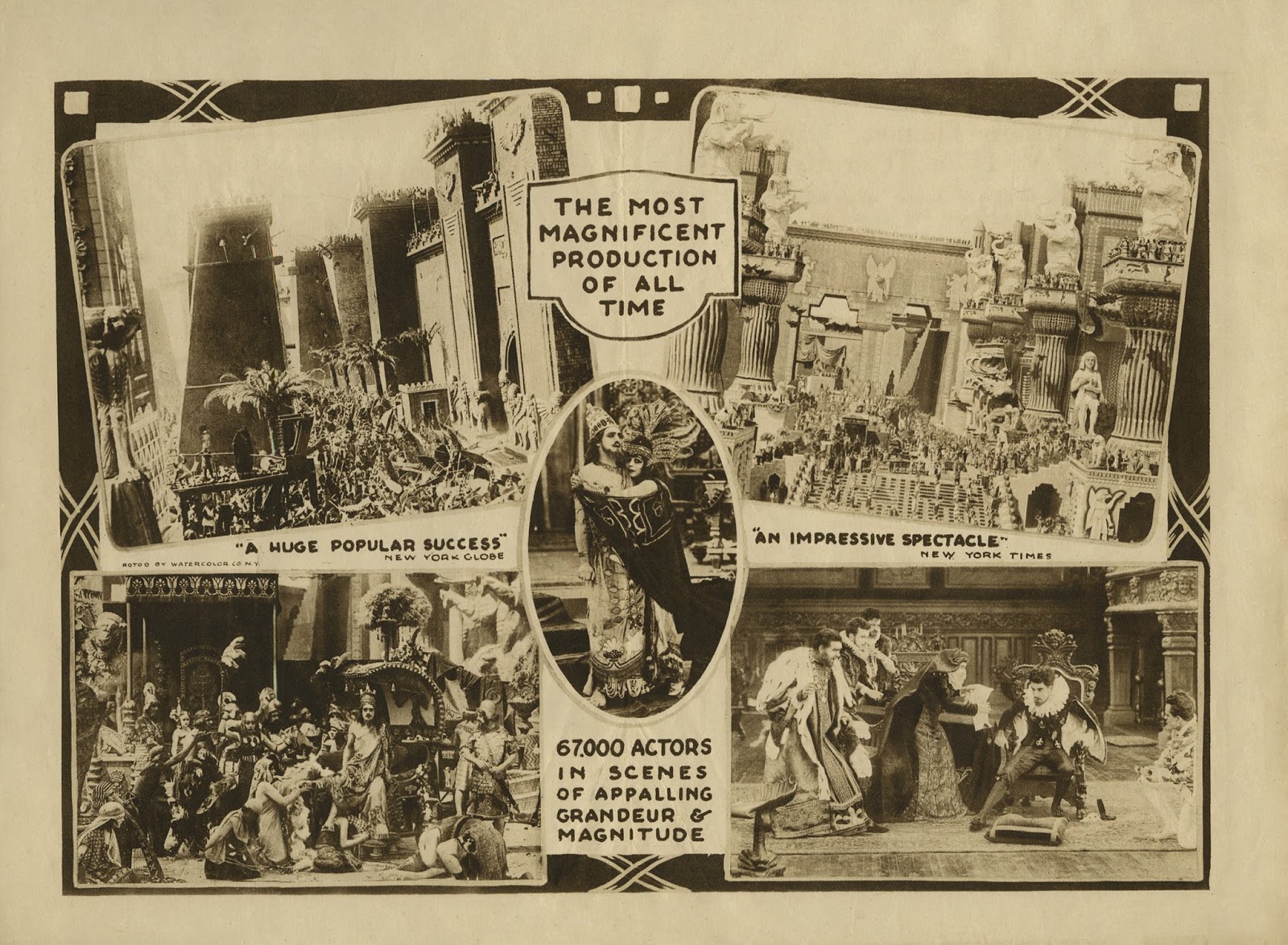
Biggest set ever? Ancient Babylon, as reconstructed in southern California for 'Intolerance.'

MONDAY, JAN. 18, 2016 / FOR IMMEDIATE RELEASE
Contact Jeff Rapsis • (603) 236-9237 • jeffrapsis@gmail.com

At the Rogers Center: With 'Intolerance,'
four stories are better than one


Rarely screened landmark 1916 silent film epic to be shown with live music on Wednesday, Jan. 27 at Merrimack College

ANDOVER, Mass.—It was a breakthrough that changed the movies forever: a three-hour epic knitting together four sweeping stories spanning 2,500 years, all designed to show mankind's struggles and the redeeming power of love throughout human history.

The film was D.W. Griffith's 'Intolerance' (1916), which stunned the movie-going public with its vast scope, enormous sets, large cast, and revolutionary editing. Often named to lists of the 100 best films of all times, critics continue to point to 'Intolerance' as one of the most influential and important milestones of early cinema.

See for yourself with a rare screening of a restored version of 'Intolerance' at the Rogers Center for the Performing Arts at Merrimack College on Wednesday, Jan. 27 at 7 p.m.

The program, the latest in the Rogers Center's silent film series, will be accompanied by live music performed by silent film composer Jeff Rapsis. Admission is free.

In reviving 'Intolerance' and other great films of Hollywood's early years, the Rogers Center aims to show silent movies as they were meant to be seen—in high quality prints, on a large screen, with live music, and with an audience.

"All those elements are important parts of the silent film experience," said Rapsis, who will improvise a live score for 'Intolerance' on the spot. "Recreate those conditions, and the classics of early Hollywood leap back to life. They featured great stories with compelling characters and universal appeal, so it's no surprise that they hold up and we still respond to them."

Rapsis performs on a digital synthesizer that reproduces the texture of the full orchestra and creates a traditional "movie score" sound.

A French poster for a revival of 'Intolerance' (1916).

'Intolerance,' considered one of the great masterpieces of the silent era, intercuts four parallel storylines, each separated by several centuries: A contemporary melodrama of crime and redemption; a Judean story of Christ’s mission and death; a French story about the events surrounding the St. Bartholomew's Day massacre of 1572; and a story depicting the fall of the Babylonian Empire to Persia in 539 BC.

The scenes are linked by shots of a figure representing Eternal Motherhood, rocking a cradle.

Each of the parallel stories are intercut with increasing frequency as the film builds to a climax. The film sets up moral and psychological connections among the different stories.

'Intolerance' was made partly in response to criticism of Griffith's previous film, 'The Birth of a Nation' (1915), which was criticized by the NAACP and other groups as perpetuating racial stereotypes and glorifying the Ku Klux Klan.

One of the unusual characteristics of 'Intolerance' is that many of the characters don't have names. Griffith wished them to be emblematic of human types. Thus, the central female character in the modern story is called The Dear One. Her young husband is called The Boy, and the leader of the local Mafia is called The Musketeer of the Slums.

Because of its four intertwined stories, 'Intolerance' does not feature any one performer in a leading role. However, the enormous cast includes many great names from the silent era, including Lillian Gish, Mae Marsh, Constance Talmadge, Walter Long (a New Hampshire native), and a young Douglas Fairbanks Sr. in an uncredited cameo as a drunken soldier with a monkey.

"This movie was made for the big screen, and this screening at the Rogers Center is a rare chance to see 'Intolerance' the way it was meant to be seen," Rapsis said.

Upcoming feature films in the Rogers Center's silent film series include:

• Wednesday, March 23, 2016, 7 p.m.: 'Ben-Hur: A Tale of the Christ' (1925) starring Ramon Novarro, Francis X. Bushman. Just in time for Easter! In the Holy Land, a Jewish prince is enslaved by the occupying Romans; inspired by encounters with Jesus, he lives to seek justice. One of the great religious epics of Hollywood's silent film era, including a legendary chariot race that's lost none of its power to thrill.

‘Intolerance' will be shown on Wednesday, Jan. 27 at 7 p.m. at the Rogers Center for the Arts, Merrimack College, 315 North Turnpike St., North Andover, Mass. The program is free and open to the public. For more information, call the Rogers box office at (978) 837-5355. For more info on the music, visit www.jeffrapsis.com.

Vintage promotional materials for 'Intolerance.'

Wednesday, September 23, 2015

Tonight 9/23: Opening night at Rogers Center
features double bill of Buster's best pictures

Buster in 'Sherlock Jr.' (1924), showing tonight at the Rogers Center in North Andover, Mass.

Alas, I'm not attending this year's Buster Keaton Celebration in Iola, Kansas, which takes place this weekend.

But I'm doing the next best thing: accompanying a pair of upcoming Keaton programs in my corner of the world.

First up is tonight's season-opener at the Rogers Center for the Arts on the campus of Merrimack College in North Andover, Mass.

The program features 'Sherlock Jr.' (1924) and 'Our Hospitality' (1923), two of Buster's best silents that I think show his remarkable abilities even early in his film career, when these pictures date from.

For more info on this show, and the rest of the season at the Rogers Center, check out the press release below.


And then on Sunday, Sept. 27, I'm accompanying Keaton's last silent feature, the MGM-produced "Spite Marriage" (1929) at the Wilton (N.H.) Town Hall Theatre in Wilton, N.H. Showtime is 4:30 p.m.

Both programs are free and open to the public, although a suggested donation of $5 per person is requested for the Wilton show to help defray expenses.

Buster's silent features still work as well as ever, and remain audience favorites today.

But even just a little historical perspective makes them all the more interesting and amazing, I think.

What I'm thinking about is how I recall someone once described the difference among silent film's "Big Three" of comedy.

Charlie Chaplin's art was essentially rooted in the past—a kind of Victorian sensibility found in the theatrical melodramas of the 19th century. Audiences responded to the timeless and familiar qualities of this kind of story-telling.

Harold Lloyd played a character very much of the present, meaning the Roaring '20s. Audiences responded to him because his adventures were part of the shared experience of contemporary living.

And Keaton? Well, we're still trying to catch up to Buster: his outlook, his attitude, and everything else.

In that sense, I think an important aspect of Buster's work is how he used the film medium.

Watch enough silent films of all types, and you realize how advanced Keaton was for his time.

Remember, it was an era when filmmakers were just beginning to develop the basic grammar of cinema: long shots vs. close-ups, transitions, camera positions, and so much else.

Apparently on instinct alone, Buster knew how to position a camera and frame a shot and edit a sequence for maximum impact.

Timeless appeal: Buster and a sundial in 'Seven Chances' (1925).

So his films are full of techniques that later became common in motion pictures.

But that's something not immediately apparent to modern audiences, who've been marinated in visual story-telling and entertainment our whole lives.

To us, Buster's films look like: well, what films are supposed to look like. But check your calendar: we live in 2015, and Buster was working 90 years ago.

Talk about timeless!

Okay, here's info about tonight's screening and the rest of the 2015-16 season of silent film with live music at the Rogers Center in North Andover, Mass. Hope to see you there!

* * *

Buster Keaton (left) stars in 'Our Hospitality' (1923), part of the 2015-16 silent film series at the Rogers Center for the Arts.

MONDAY, SEPT. 7, 2015 / FOR IMMEDIATE RELEASE
Contact Jeff Rapsis • (603) 236-9237 • jeffrapsis@gmail.com

Rogers Center announces silent film series with live music for 2015-16 season


Classic comedies, dramas to be screened with live accompaniment at Merrimack College, North Andover, Mass.

NORTH ANDOVER, Mass.—Silent film on the big screen and with live music will return to the Rogers Center for the Arts in North Andover, Mass. with a series of shows scheduled for the 2015-16 season. Admission to the screenings is free and the public is welcome.

The schedule includes a double dose of comedy from one of silent era's top funnymen; a creepy thriller to be shown for Halloween; a mind-bending epic drama set in four different time periods; and the original silent version of 'Ben Hur.'

Musical accompaniment will be performed live by silent film composer Jeff Rapsis, regarded as one of the nation's leading silent film musicians.

The series aims to recapture the magic of early Hollywood by presenting silent films as they were intended to be shown: in restored prints, in a theater on a big screen, with live music, and with an audience.

"If you can put together those elements, it's surprising how much power these films still have," said Rapsis, who specializes in improvising live music for silent film screenings throughout New England and beyond. "You realize why these films caused people to first fall in love with the movies."

The series features some of the most-requested titles from the silent film era:

• Wednesday, Sept. 23, 2015, 7 p.m.: 'Buster Keaton Double Feature' starring Buster Keaton. Buster breeches the fourth wall big-time in the imaginative "Sherlock Jr." (1924); an old-time backwoods family feud is the focus of "Our Hospitality" (1923), Keaton's breakthrough feature film. Laugh your way through two of the funniest comedies of the silent era!

• Wednesday, Oct. 14, 2015, 7 p.m.: 'The Lodger' (1927), directed by (a very young) Alfred Hitchcock. The search is on for the man responsible for a series of murders in fog-shrouded London. Legendary filmmaker Alfred Hitchcock's career began in the silent era, when then young director first produced his brand of darkly suspenseful thrillers. Remember: in silent film, no one can hear you scream! See if if you dare!

A poster for 'Intolerance' (1916), part of the 2015-16 silent film series at the Rogers Center in North Andover, Mass.

• Wednesday, Jan. 27, 2016, 7 p.m.: 'Intolerance' (1916), directed by D.W. Griffith and starring (literally) a cast of thousands. D.W. Griffith's early blockbuster about man's inhumanity to man weaves together four stories spanning four eras of civilization. Filmed an a vast scale, setting a new standard for Hollywood extravagance. A movie made for the big screen, and here's your chance to see it!

• Wednesday, March 23, 2016, 7 p.m.: 'Ben-Hur: A Tale of the Christ' (1925) starring Ramon Novarro, Francis X. Bushman. Just in time for Easter! In the Holy Land, a Jewish prince is enslaved by the occupying Romans; inspired by encounters with Jesus, he lives to seek justice. One of the great religious epics of Hollywood's silent film era, including a legendary chariot race that's lost none of its power to thrill.

All films will be screened at the Rogers Center for the Arts, Merrimack College, 315 North Turnpike St., North Andover, Mass.

"If you haven't seen a silent film the way it was intended to be shown, then you're missing a unique experience," Rapsis said. "At their best, silent films can be surprisingly sophisticated. They still retain a tremendous ability to cast a spell, engage an audience, tap into elemental emotions, and provoke strong reactions."

The opening program in this season's silent film series at the Rogers Center will include Buster Keaton's 'Sherlock Jr.' (1924) and 'Our Hospitality' (1923), to be screened on Wednesday, Sept. 23 at 7 p.m. at the Rogers Center for the Arts, located on Walsh Way on the campus of Merrimack College, 315 Turnpike St., North Andover, Mass. Admission is free. For more information, call the Rogers box office at (978) 837-5355.


Tuesday, March 17, 2015

'Four Horsemen of the Apocalypse' (1921)
on Wednesday, March 25 at Merrimack College

How many of the Four Horsemen can you name? Let's see—there's Pestilence, Death, War, and...Irving?

What film introduced silent-era megastar Rudolph Valentino and launched a prolonged tango craze?

Answer: 'The Four Horsemen of the Apocalypse,' a sprawling multi-generational family drama set in the years leading up and then during World War I.

And we're screening it, tangos and all, on Wednesday, March 25 at 7 p.m. at the Rogers Center for the Performing Arts at Merrimack College in North Andover, Mass.

I've only done this film once, and it's quite a workout. Not only is it loooong (with some versions running somewhere between 2½ and 3 hours) but it's also full of big dramatic scenes, including Rudy's steamy 'tango' sequence with its legions of on-screen guitar players.

And then there's the war, which is a menacing presence during most of the film. Somehow the music has to evoke that without growing tiresome. We'll see how I do.

So overall, it's a big film, and a fitting conclusion to our 2014-15 schedule of silent films at the Rogers Center.

I like doing films there and audience attendance has been growing—typically we get 80 to 100 people at these screening, sometimes more.

So I hope to be back with some silent film programs for the 2015-16 season. Please let me know what films you'd like to see run at the Rogers Center.

And in the meantime, I hope you can make it to the Rogers Center for a rare screening of this important and dramatic film.

And I encourage anyone to come down and sit with me on the bench. After all, it takes two to tango!

Okay—if you'd like more info about the picture or the screening, the press release (below) covers all the bases.

* * *

Rudolph Valentino shows off his dancing skills in 'Four Horsemen.'

TUESDAY, MARCH 17, 2015 / FOR IMMEDIATE RELEASE
Contact Jeff Rapsis • (603) 236-9237 • jeffrapsis@gmail.com

Ground-breaking WWI silent film drama on Wednesday, March 25 at Merrimack College


'Four Horsemen of the Apocalypse' introduced Rudolph Valentino, started tango dance craze; to be screened with live musical accompaniment

NORTH ANDOVER, Mass.—A drama that helped launch the career of silent film heartthrob and megastar Rudolph Valentino will be shown in January at Merrimack College.

'The Four Horsemen of the Apocalypse' (1921), a multi-generational family drama that climaxes during World War I, will be screened with live music on Wednesday, March 25 at 7 p.m. at the Rogers Center for the Arts, Merrimack College, 315 North Turnpike St., North Andover, Mass.

The screening is part of the Rogers Center's silent film series. Admission is free and the screening is open to the public.

'Four Horsemen' was originally scheduled to be shown in February at the Rogers Center, but the screening was moved to a March date due to a scheduling conflict.

Based on a novel by Spanish author Vicente Blasco Ibáñez, 'Four Horsemen of the Apocalypse' tells the story of an extended Argentine family with mixed ethnic background: one side is German, while the other is French.

The family get drawn into World War I in far-off Europe, with members ending up on opposing sides. With brothers pitted against one other on the battlefield, the destruction of war changes lives and fortunes forever.

'The Four Horsemen of the Apocalypse' had a huge cultural impact, becoming the top-grossing film of 1921, beating out Charlie Chaplin's 'The Kid,' and going on to become the sixth-best-grossing silent film of all time.

Also, the film turned then-little-known actor Rudolph Valentino into a superstar and associated him with the image of the Latin Lover. In addition, the film inspired a tango craze and such fashion fads as gaucho pants.

In 1995, 'The Four Horsemen of the Apocalypse' was selected for preservation in the United States National Film Registry by the Library of Congress as being "culturally, historically, or aesthetically significant."

Regarding the title: the Four Horsemen of the Apocalypse are mentioned in the Bible in chapter six of the Book of Revelation, which predicts that they will ride during the Apocalypse. The four horsemen are traditionally named War, Famine, Pestilence, and Death.

"This is a big sprawling drama, and a great chance to see the legendary Rudolph Valentino in the picture that launched his celebrity," said Jeff Rapsis, a New Hampshire-based silent film accompanist who will create live music for the screening.

Rapsis, a resident of Bedford, N.H., will improvise live musical accompaniment during the screening, using a digital synthesizer to recreate the sound of a full orchestra and other more exotic textures.

All movies in the Rogers Centers’ silent film series were popular when first released, but are rarely screened today in a way that allows them to be seen at their best.

They were not made to be shown on television; to revive them, organizers aim to show the films at the Rogers Center as they were intended—in top quality restored prints, on a large screen, with live music, and with an audience.

‘The Four Horsemen of the Apocalypse’ will be shown with live music on Wednesday, March 25 at 7 p.m. at the the Rogers Center for the Arts, Merrimack College, 315 North Turnpike St., North Andover, Mass. Admission is free. For more information, call the Rogers box office at (978) 837-5355. For more info on the music, visit www.jeffrapsis.com

Tuesday, January 20, 2015

Coming up: Two separate screenings
of Fritz Lang's 'Woman in the Moon'

Our group's Kilimanjaro summit photo, taken at 6:30 a.m. on Saturday, Jan. 10, 2015.

Okay, I'm back in silent film mode after three weeks in Tanzania, a journey that included a 10-day expedition to the top of Mount Kilimanjaro.

All 12 members of our party made it to the 19,341-foot summit, the highest point on the African continent. I'll post a full account of this adventure as soon as my head stops spinning.

The summit, by the way, is called "Uhuru Peak," using the Swahili word for "freedom."

But prior to Tanzania's independence in the 1960s, it carried the imperialist moniker of "Kaiser Wilheim Spitze."

Why? Because Kilimanjaro was part of Germany's colonial empire when geologist Hans Meyer in 1889 became the first European to reach the top.

The Germans lost their African territories after World War I, ceding control to the British, whose "hands off" policy including letting the Kaiser's name stand. (That's me imitating Cecil B. Demille at the Lava Tower, up at about 15,000 feet on Kilimanjaro.)

But by then, Germans were on their way to creating a new empire—this time in silent cinema.

The 1920s were a time of bold experimentation in German movie-making, and the result was a body of work that would prove much more durable than their colonial empire.

And one of the major achievements of this period, I think, is Fritz Lang's ground-breaking sci-fi espionage soap opera 'Woman in the Moon' (1929).

I feel 'Woman in the Moon' is an underrated film, long overshadowed by Lang's spectacular 'Metropolis' from 1927.

Come to think of it, the lunar landscape of 'Woman in the Moon' doesn't look that much different from parts of Kilimanjaro.

As such, I love presenting it to audiences, as they always seem to come away surprised that a film like this could even be made during the silent era.

It's also a great film for music, and seems to bring out the best in me whenever I accompany it.

In the coming week, we'll screen 'Woman in the Moon' not once but twice in our part of the world.

First up is Wednesday, Jan. 21 at 7 p.m. the Rogers Center for the Arts at Merrimack College, North Andover, Mass.

And then I'll do it again on Sunday, Jan. 25 at 4:30 p.m. at the Wilton Town Hall Theatre in Wilton, N.H.

Both screenings are free and open to the public. Hope you can make it!

For more info about the screenings and the film, below is the press release that went out to promote the screening on Wednesday, Jan. 21 at Merrimack College.

(For the Wilton screening, just change the date and time to Sunday, Jan. 25 at 4:30 p.m.)

* * *

The iconic original poster for Fritz Lang's 'Frau im Mond.'

FRIDAY, DEC. 26, 2014 / FOR IMMEDIATE RELEASE
Contact Jeff Rapsis • (603) 236-9237 • jeffrapsis@gmail.com

Silent sci-fi adventure film on Wednesday, Jan. 21 at Merrimack College


'Woman in the Moon,' pioneer space drama about first moon voyage, to be screened with live musical accompaniment

NORTH ANDOVER, Mass.—A sci-fi adventure hailed as the first feature film to depict realistic space travel will be shown in January at Merrimack College.

'Woman in the Moon' (1929), directed by German filmmaker Fritz Lang ('Metropolis,' 1927), will be screened with live music on Wednesday, Jan. 21 at 7 p.m. at the Rogers Center for the Arts, Merrimack College, 315 North Turnpike St., North Andover, Mass.

The screening is part of the Rogers Center's silent film series. Admission is free and the screening is open to the public.

The rarely seen full-length version of 'Woman in the Moon' follows an intrepid band of space pioneers as they attempt mankind's first voyage to the lunar surface, where they hope to find large deposits of gold.

The film, made with German rocket experts as technical advisers, is noted for anticipating many of the techniques used by NASA for the Apollo moon launch program 40 years later. For example, a multi-stage rocket is employed to escape Earth's gravity, and a separate capsule is used to reach the lunar surface.

The film is also noted for introducing the idea of a dramatic "countdown" prior to launch, which later became standard procedure in actual space flight. Critics regard the film's extended launch sequence as a masterpiece of editing and dramatic tension.

But 'Woman in the Moon,' with its melodramatic plot and colorful characters, also stands as the forerunner of many sci-fi story elements that quickly became clichés: the brilliant but misunderstood professor; a love triangle involving a beautiful female scientist and her two male crewmates; a plucky young boy who yearns to join the expedition; fistfights and gunfire and treachery on the lunar surface.


Added to the mix is a vision of the moon (created entirely on a massive studio set in Berlin, Germany) that features a breathable atmosphere, giant sand dunes, distant mountain peaks, and bubbling mud pits.

"This is a great and at-times bizarre film, one that must be seen to be believed," said Jeff Rapsis, a New Hampshire-based silent film accompanist who will create live music for the screening. "It's as entertaining as any spy-thriller. And as a past vision of a future that didn't quite come to be, it really gets you thinking of time and how we perceive it."

Rapsis, a resident of Bedford, N.H., will improvise live musical accompaniment during the screening, using both an acoustic piano and a digital synthesizer to recreate the sound of a full orchestra and other more exotic textures.

'Woman in the Moon,' a full-length feature than runs more than 2½ hours, should not be confused with the much earlier film 'A Trip to Moon,' a primitive "trick" short movie made by French filmmaker George Méliès in 1902 and famous for the image of a space capsule hitting the eye of an imaginary moon man.

"Unlike the Méliès film, there's nothing primitive about 'Woman in the Moon,' " Rapsis said. "It's silent film story-telling at the peak of its eloquence, with lively performances, imaginative camera angles, and superb photography."

Cast member Willy Fritsch, as "Helius," prepares for launching mankind's first manned moon voyage.

Director Fritz Lang, who was responsible for the groundbreaking sci-fi epic 'Metropolis' (1927), planned 'Woman in the Moon' as another step in his quest to stretch cinema's visual, story-telling, and imaginative capabilities.

Bad timing is one reason that 'Woman in the Moon' (titled 'Frau im Mond' in German) is not as well known today as 'Metropolis,' its legendary predecessor. Lang completed 'Woman in the Moon' just as the silent film era was coming to a close.

As one of the last silent films of German cinema, 'Woman in the Moon' was unable to compete with new talking pictures then in theaters, making it a box office flop at its premiere in October, 1929.

However, German rocket scientist Hermann Oberth worked as an adviser on the movie, and it developed cult status among the rocket scientists in Wernher von Braun's circle. During World War II, the first successfully launched V-2 rocket at the German rocket facility in Peenemünde had the "Woman in the Moon" logo painted on its base.

During the war, the Nazis tried to recall and destroy all prints of 'Woman in the Moon' due to its detailed depiction of state-of-the-art rocket propulsion technology; in later years, this served to make the film even more hard to find. For many years, the film was available only in cut-down 16mm versions that ran as short as one hour.

But pristine and complete 35mm copies of 'Woman in the Moon' did survive in several European archives. Today, restored prints are amazingly clear and sharp, Rapsis said.

" 'Woman in the Moon' is technically one of the best-looking silent films I've ever seen," he said. "If you think all silent films are grainy and scratchy-looking, 'Woman in the Moon' will change your mind. It's like an Ansel Adams photograph come to life."

As their spacecraft nears the moon, the cast of 'Woman in the Moon' look back at the receding Earth.

All movies in the Rogers Center’s silent film series were popular when first released, but are rarely screened today in a way that allows them to be seen at their best. They were not made to be shown on television; to revive them, organizers aim to show the films at the Rogers Center as they were intended—in top quality restored prints, on a large screen, with live music, and with an audience.

‘Woman in the Moon’ will be shown with live music on Wednesday, Jan. 21 at 7 p.m. at the the Rogers Center for the Arts, Merrimack College, 315 North Turnpike St., North Andover, Mass. Admission is free. For more information, call the Rogers box office at (978) 837-5355. For more info on the music, visit www.jeffrapsis.com.