Showing posts with label Rudolph Valentino. Show all posts

Monday, February 17, 2025

Next: Valentino in 'The Sheik' (1921) on Monday, March 3 in Greenfield, Mass.; notes from the 50th annual Boston Sci-Fi Marathon

Rudolph Valentino and Agnes Ayres in a scene from 'The Sheik' (1921).

Next local screening is Monday, March 3 at 6:30 p.m., when I'll accompany Rudolph Valentino in 'The Sheik' (1921) at the Garden Cinemas in Greenfield, Mass.

More about Rudy and the film in the press release pasted in below. 

First, a few notes from this past weekend.

On Saturday, I had the privilege of creating music for a screening of F.W. Murnau's 'Sunrise' (1927) at the Jane Pickens Theatre in Newport, R.I.

About 75 people showed up for this day-after-Valentine's Day screening, which was a surprisingly strong turnout given that a messy winter storm was in the process of arriving at show time.

For this, I got to tell my story of how a friend of mine came to a screening of this film, but thought he was seeing the futuristic fantasy 'Metropolis.' (1927).

Because 'Sunrise' starts out in a stylized urban setting that actually does look weirdly futuristic, and because all of silent film looks a bit alien to untrained eyes, I can see how this could happen.

Afterwards, his question to me was: "What kind of a futuristic amusement park has pigs sliding down a chute and getting drunk on wine?" 

Snow was falling by the time I headed back to New Hampshire. The drive usually takes two hours but thanks to the weather it was 3½ hours. Well, at least I got to hear a whole Boston Symphony concert live from Symphony Hall: Herbert Blomstet at age 97 conducting two symphonies: Schubert's No. 6 and the Brahms No. 1.

I wonder what either composer would have thought of someone listening to their music via an FM radio receiver while driving a motor vehicle at night through a snowstorm. It might have seemed like some kind of science fiction to them.

And that brings us to Sunday's performance: a live score for 'Algol: Tragedy of Power' (1920), a German sci-fi drama that was shown as part of this year's annual 24-hour Boston Science Fiction Marathon.

The Marathon, or 'Thon as some call it, will occasionally program a silent title, and for some time now it's been my privilege to be invited to accompany it.

It's quite a lively audience, with attendees shouting things at the screen and generally whooping it up. I had a great time mashing up some tunes to create a score to help bring the film to life. 

A few scenes from this year's Sci-Fi Marathon, which was the 50th annual edition.

Sci Fi Festival Director Garen Daly chats with someone via Facetime...

Lobby of the Somerville Theatre between screenings.

The view from the keyboard, or from one side of the keyboard, anyway.

Me in front of "Some" theatre...

I will say it's a special thrill to finish a film like 'Algol' and to have a theater just erupt, even if the people in it are there to make noise. 

I ran up on stage to take a bow or two, and then took the opportunity to shout back:

"I saw that yesterday there was a symposium to discuss whether or not the Boston Sci-Fi Marathon would ever get to its 100th anniversary," I said.

"I certainly hope so! Because this is a celebration that brings people together, and now more than ever we need things to bring us together. May this marathon live long and prosper!" Or something like that.

Okay, next week I'll be heading out to Topeka, Kansas for this year's Kansas Silent Film Festival (more on that when I get there), and after that it's Rudolph Valentino in 'The Sheik' at the Garden Cinemas in Greenfield, Mass. 

More about that in the press release below. See you there!

*    *    *

Hey where's Rudy? An original poster for 'The Sheik' (1921).

MONDAY, FEB, 17, 2025 / FOR IMMEDIATE RELEASE
Contact Jeff Rapsis • (603) 236-9237 • jeffrapsis@gmail.com

Valentino in 'The Sheik' on Monday, March 3 at Garden Cinemas

Exotic romance starring iconic silent film actor to be show with live musical accompaniment

GREENFIELD, Mass.—He was the cinema’s first sex symbol, causing hordes of female moviegoers to flock to his pictures throughout the 1920s. He starred in films designed to show off his Latin looks, his smoldering eyes, and his dancer’s body.

He was Rudolph Valentino, who remains an icon for on-screen passion long after his untimely death in 1926 at age 31.

See the Hollywood legend for yourself when 'The Sheik' (1921) starring Rudolph Valentino is screened on Monday, March 3 at 6:30 p.m. at the Garden Cinemas, 361 Main St., Greenfield, Mass.

Admission is $10.50 adults, $8:50 for children, seniors, and students. Tickets are available online or at the door.

The screening, the latest in the Garden Cinemas' silent film series, will feature live accompaniment by Jeff Rapsis, a New Hampshire-based composer who specializes in creating scores for silent films. 

Rudolph Valentino in the title role of 'The Sheik' (1921).

In 'The Sheik,' Valentino plays Paris-educated Sheik Ahmed Ben Hassan, who arranges brides for wealthy Arabs. 

The high-spirited Lady Diana Mayo (Agnes Ayres), learning that the sheik will be in the city of Biskra, Algeria, playfully decides to disguise herself as a dancing girl to become one of the prospective brides. 

Hearing that Diana will be touring the Sahara Desert, Ahmed abducts her, intending to make her fall in love with him, with unexpected consequences.

An Italian immigrant who arrived penniless at Ellis Island in 1913, Valentino rose to superstar status in the silent era. But he was more than a pretty face—during his career, critics praised Valentino as a versatile actor capable of playing a variety of roles; his achievements included popularizing the Argentinian tango in the 1921 drama ‘Four Horsemen of the Apocalypse.’

But Valentino's brief stardom was defined by the ‘Sheik’ roles, which brought a new level of exotic sexuality to the movies, causing a sensation at the time. In theaters, women openly swooned over Valentino’s on-screen image, especially in roles such as the ‘Sheik,’ which featured elaborate costumes. 

At its peak, his popularity was so immense that it inspired a backlash among many male movie-goers, who decried Valentino’s elegant image and mannerisms as effeminate.

Valentino’s sudden death in 1926 fueled his status as a legendary romantic icon of the cinema. For years, a mysterious woman dressed in black would visit his grave at the Hollywood Park Cemetery in Los Angeles, leaving only a single red rose.

Valentino was aware of his effect on audiences, saying that “Women are not in love with me but with the picture of me on the screen. I am merely the canvas upon which the women paint their dreams.”

“These films are still exciting experiences if you can show them as they were designed to be screened,” said Rapsis, the accompanist for the screening. “There’s a reason people first fell in love with the movies, and we hope to recreate that spirit. At their best, silent films were communal experiences in which the presence of a large audience intensifies everyone’s reactions.”

Silent films with live music are screened at the Garden Cinemas the first Monday of each month. Upcoming titles include:

• Monday, April 7, 2025, 6:30 p.m.: "The Lost World" (1925) starring Wallace Beery. First-ever movie adaptation of Arthur Conan Doyle's legendary tale of British explorers who discover pre-historic creatures still thriving atop a remote South American plateau. Great entertainment; ground-breaking special effects by the same team that later created 'King Kong' mesmerized early movie audiences and remain impressive today.

‘The Sheik’ (1921) will be shown on Monday, March 3 at 6:30 p.m. at the Garden Cinemas, 361 Main St., Greenfield, Mass. Admission is $10.50 adults, $8:50 for children, seniors, and students. Tickets available at the door; advance tickets are available at www.gardencinemas.net. For more information, call the box office at (413) 774-4881.

Monday, August 5, 2024

Accompanying 'Four Horsemen of the Apocalypse' on Saturday, Aug. 10 at Brandon (Vt.) Town Hall

Rudolph Valentino introduces the tango in 'Four Horsemen of the Apocalypse' (1921).

Two anniversaries will be honored this weekend when I accompany 'Four Horsemen of the Apocalypse' (1921) on Saturday, Aug. 10 at 7 p.m. at Brandon (Vt.) Town Hall and Community Center.

More details about the film and the screening are in the press release pasted in below.

The first anniversary is that August 2024 marks the 110th anniversary of the start of events that led to what we now call World War I. You know, Sarajevo and all that.

The second is that August 2024 marks the 98th anniversary of the untimely death of Rudolph Valentino, a star whose popularity was such that his name is still recognized today.

'Four Horsemen' is a worthy vehicle to honor both milestones, I think. A sprawling historical drama, I've come to see it as one of the first "breakthrough" films. 

To me, it's one of the earliest films to show and make full use of the unique story-telling capabilities of the motion picture camera.

I also think it has one of the most moving endings in all of cinema: when Nigel De Bruiler stretches out his hands in the vast cemetery, and cries "I knew them all!"

Nigel De Bruiler (at left) waits to say his big line at the end of 'Four Horsemen of the Apocalypse.'

Wow! Come see for yourself next Saturday in Brandon. Details below!

*   *   *

An original lobby card for 'Four Horsemen of the Apocalypse' (1921).

MONDAY, JULY 29, 2024 / FOR IMMEDIATE RELEASE
Contact Jeff Rapsis • (603) 236-9237 • jeffrapsis@gmail.com

Brandon Town Hall to screen epic movie that launched Valentino as silent-era megastar

'Four Horsemen of the Apocalypse,' which introduced both Rudolph Valentino and the tango, to screen with live music on Saturday, Aug. 10

BRANDON, Vt.—The movie that introduced the nation to silent film heartthrob Rudolph Valentino—and also the tango—will be shown on the big screen in Brandon, Vt.

'The Four Horsemen of the Apocalypse' (1921), a multi-generational family saga that climaxes during World War I, will be screened with live music on Saturday, Aug. 10 at 7 p.m. at the Brandon Town Hall and Community Center, Route 7, in Brandon, Vt.  
 
All are welcome to this family-friendly event. Admission is free, with free will donations accepted in support of ongoing Town Hall renovations. 

The screening, the latest in the venue's silent film series, will feature live accompaniment by Jeff Rapsis, a New Hampshire-based composer who specializes in creating music for silent films.

'Four Horsemen of the Apocalypse'  is being shown both in honor of the 110th anniversary of World War I's outbreak and the 98th anniversary of Valentino's untimely death in 1926.

Based on a novel by Spanish author Vicente Blasco Ibañez, 'Four Horsemen of the Apocalypse' tells the story of an extended Argentine family with mixed ethnic background: one side is German, while the other is French.

The family gets drawn into World War I in far-off Europe, with members ending up on opposing sides. With brothers pitted against one another on the battlefield, the destruction of war changes lives forever.

'The Four Horsemen of the Apocalypse' had a huge cultural impact, becoming the top-grossing film of 1921, beating out Charlie Chaplin's 'The Kid,' and going on to become the sixth-best-grossing film of the silent era.

Also, the film turned then-little-known actor Rudolph Valentino into a superstar, associating him with the image of the Latin Lover. In addition, the film inspired a tango craze and fashion fads such as gaucho pants.

Directed by Rex Ingram for Metro Pictures (a predecessor of MGM studios), 'Four Horsemen' grew into a mammoth production: over $1 million was spent in making it and more than 12,000 people were involved. The film was hugely successful at the box office, grossing nearly $5 million during its initial run, an enormous sum at the time.

The film was notable as one of the first major Hollywood productions to include World War I (then known as the 'Great War') in its storyline, and also in that it did not glorify the recent conflict or look past the tragedy that it brought. 
It's also among the first U.S. feature films to make full use of the unlimited visual power of the new motion picture medium.

Although Valentino dominates the film, other actors of note are featured. Alice Terry, the billed co-star as well as Ingram's wife, was a popular actress of her day.

Alan Hale Sr. appears in a supporting role; he was perhaps best known as Errol Flynn's sidekick in numerous films, his role of Little John in several Robin Hood flicks, and as the father of Alan Hale, Jr., who played the Skipper on the television series Gilligan's Island.

In 1995, the silent version of 'The Four Horsemen of the Apocalypse' was selected for preservation in the United States National Film Registry by the Library of Congress as being "culturally, historically, or aesthetically significant."

Regarding the title: the Four Horsemen of the Apocalypse are mentioned in the Bible in chapter six of the Book of Revelation, which predicts that they will ride during the Apocalypse. The four horsemen are traditionally named War, Famine, Pestilence, and Death.

"This is a big sprawling drama, and a great chance to see Rudolph Valentino in the picture that launched his celebrity," said Jeff Rapsis, a New Hampshire-based silent film accompanist who will create live music for the screening.

Rapsis will improvise live musical accompaniment during the show, using a digital synthesizer to recreate the sound of a full orchestra and other more exotic textures.

"Creating the music on the spot is a bit of a high-wire act, but it contributes a level of energy that's crucial to the silent film experience," Rapsis said.

The screening of 'Four Horsemen of the Apocalypse' is sponsored by Jean and Harold Somerset, John and Lynn Wilson; Dorothy Leysath and Edward Loedding; Donna Malewicki; and Pam and Steve Douglass.
Other films in this year's Brandon Town Hall silent film series include: 

• Saturday, Sept. 21, 2024, 7 p.m.: "Speedy" (1928) starring Harold Lloyd. Harold's final silent feature cis a tribute to New York City, baseball, and the idea that nice guys can indeed finish first, highlighted by one of the most exciting races to the finish in all silent cinema. Complete with an extended cameo from none other than Babe Ruth! 

• Saturday, Oct. 19, 2024, 7 p.m.: "Phantom of the Opera" (1925) starring Lon Chaney. Long before Andrew Lloyd Webber created the hit stage musical, this silent film adaptation starring Lon Chaney put 'Phantom' firmly in the pantheon of both horror and romance. Just in time for Halloween! 

• Saturday, Nov. 16, 2024, 7 p.m.: "Barbed Wire" (1927) starring Pola Negri, Clive Brook. During World War I, the French government commandeers a family farm for use as a camp for German POWs, setting the local population at each other. Intense drama about forbidden love and the human condition, with a special holiday twist. 
 
 'The Four Horsemen of the Apocalypse' (1921) will be screened with live music on Saturday, Aug. 10 at 7 p.m. at the Brandon Town Hall and Community Center, Route 7, in Brandon, Vt. 
 
Admission is free, with free will donations accepted in support of ongoing Town Hall renovations. For information, visit www.brandontownhall.com.

Thursday, August 11, 2022

Six days, five screenings, three states: a busy stretch of silent film accompaniment beckons

I guess if you're going to show a silent film to open a new festival, 'Sherlock Jr.' (1924) is a better choice than most.

Well, at least I get Monday off. 

Starting tomorrow (Friday, Aug. 12), I embark on a mini-marathon of silent film accompaniment that will take me to five venues in three states, including three former town halls.

All in a week's work of actively practicing the craft of creating live music for silent film screenings. The way I do it—mostly improv and without significant advance preparation—means iteration is most important.

Thus do I traipse about the landscape of my native northern New England, and sometimes farther afield, to maintain the fluency needed to perform at what I consider an acceptable level. 

I'm not a naturally gifted performer. So I have to work at it, which I'm willing to do, when opportunities present themselves.


The next opportunity comes tomorrow afternoon, where I am, improbably, the opening act in the first annual Manchester (N.H.) International Film Festival. I get to say a few words, and then do music for Buster Keaton's 'Sherlock Jr.' (1924) for my home city's most recent attempt to cultivate a cinema culture. 

Then it's Valentino's 'Blood and Sand' (1922) on Saturday, Aug. 13 in Brandon, Vt.; Marion Davies in 'Beverly of Graustark' (1926) on Sunday, Aug. 14 in Wilton, N.H.; Buster again in 'Steamboat Bill Jr.' (1928) on Tuesday, Aug. 16 in Alton, N.H.; and then 'Blood and Sand' again on Wednesday, Aug. 17 in Ogunquit, Maine.

If you're Somewhere North of Boston (capitalized because it's the name of another local film festival that is no longer active), please join me for one or two or all. 

I didn't do a separate press release for the Manchester International Film Festival, but here's a link to all the action.

Below, I'm pasting in the release for 'Blood and Sand' on Saturday night up in Brandon, Vt., which also works for the screening on Wednesday, Aug. 17 in Ogunquit, Maine except it's at the Leavitt Theatre and admission is $12 per person.

See you in a darkened theater—at least before the lights go down...

*    *    *


MONDAY, AUG. 8, 2022 / FOR IMMEDIATE RELEASE
Contact Jeff Rapsis • (603) 236-9237 • jeffrapsis@gmail.com

Valentino's bullfighting epic  'Blood and Sand' to screen at Brandon Town Hall

Top-grossing silent film to be shown with live music on Saturday, Aug. 13 to celebrate 100th anniversary of box office hit

BRANDON, Vt.—It's an intense romantic drama that helped catapult actor Rudolph Valentino to worldwide fame.

It's 'Blood and Sand' (1922), a bullfighting epic to be screened on Saturday, Aug. 8 at 7 p.m. at the Brandon Town Hall and Community Center, 1 Conant Square, Route 7 in Brandon, Vt.

Admission is free; donations are welcome to help support ongoing Town Hall renovation efforts.

The classic drama will be shown with live music by silent film accompanist Jeff Rapsis, a New Hampshire-based performer and composer who specializes in scoring and presenting silent films.

The No. 3 box office hit of 1922, 'Blood and Sand' combined exotic Spanish locales with Valentino's iconic performance as a bullfighter.

The film tells the story of Juan Gallardo (Valentino), a village boy born into poverty who grows up to become one of Spain's greatest matadors.

Gallardo marries a friend from his childhood, the beautiful and virtuous Carmen. But after achieving fame and fortune, he finds himself drawn to Doña Sol (Naldi), a wealthy, seductive widow.

They embark on a torrid affair. But then Gallardo, feeling guilty over his betrayal of Carmen, tries to free himself of Doña Sol.

Gallardo's troubles spill over to the bullfighting arena, where he becomes reckless.

Can he cope with the gravest challenges of his young life—both in romance, and in the arena?

The movie's immense popularity helped establish Valentino as one of the megastars of the silent film era.

Directed for Paramount Pictures by Fred Niblo, the cast includes leading ladies Lila Lee as Carmen and Nita Naldi as Doña Sol.

'Blood and Sand' was based on the 1909 Spanish novel "Sangre y arena" (Blood and Sand) by Vicente Blasco Ibáñez and the play version of the book by Thomas Cushing.

Unusual for Hollywood at the time, women played key roles in the production of 'Blood and Sand.'

The story was adapted by June Mathis, the screenwriter credited with first recognizing Valentino's appeal, and edited by future director Dorothy Arzner.

The film inspired the 'Blood and Sand' cocktail, a Prohibition-era mixed drink.

The screening is part of the Brandon Town Hall's ongoing silent film series.

"Putting 'Blood and Sand' back on the big screen is a great way to celebrate this classic movie's 100th anniversary," said Rapsis, the silent film accompanist who creates live music for all screenings.

The screening of 'Blood and Sand' is sponsored by Edward Loedding and Dorothy Leysath, the Hanson Family in memory of Pat Hanson, and Sally Wood.

Other films in this year's Brandon Town Hall silent film series include:

• Saturday, Sept. 10, 7 p.m.: 'The Flying Ace' (1926), rare example of movies produced for black-only theaters in segregated parts of the nation; added to the National Film Registry in 2021. Sponsored by Nancy and Gary Meffe.

• Saturday, Oct. 22, 7 p.m.: 'Nosferatu' (1922) Just in time for Halloween! Celebrate the 100th anniversary of F.W. Murnau's original adaptation of Bram Stoker's 'Dracula' story. Sponsored by Bar Harbor Bank and Trust.

• Saturday, Nov. 19, 7 p.m.: 'Her Sister from Paris' (1925) starring Constance Talmadge, Ronald Colman. The scene: Europe. The cast: Rich people. Effervescent battle-of-the-sexes comedy. Sponsored by Harold & Jean Somerset.

"These are the films that set the standard for Hollywood, and still retain their power to entertain, especially when shown in a theater with live music and an audience," Rapsis said.

'Blood and Sand' starring Rudolph Valentino will be screened with live music on Saturday, Aug. 13 at 7 p.m. at the Brandon Town Hall and Community Center, Route 7, in Brandon, Vt.

All are welcome to this family-friendly event. Admission is free, with free will donations accepted in support of ongoing Town Hall renovations.

Sunday, February 6, 2022

Study for Valentine's Day with the master, Rudolph Valentino, in 'Blood and Sand' (1922)

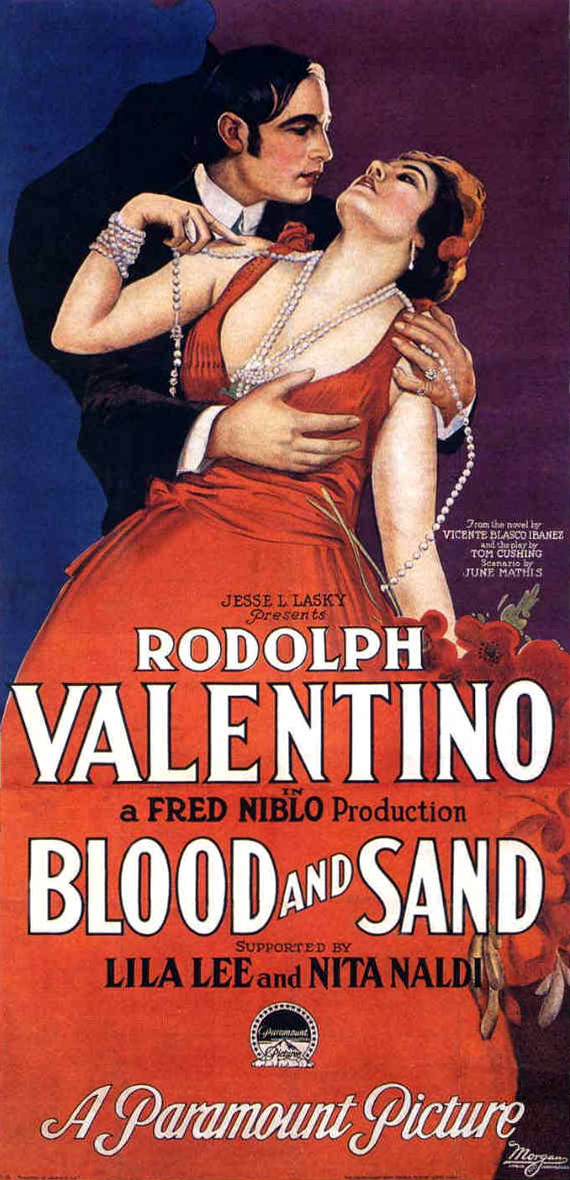
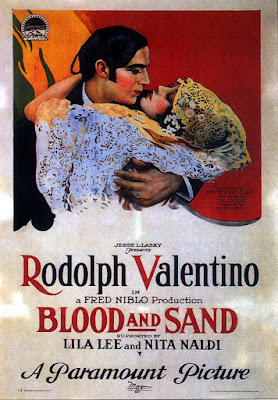
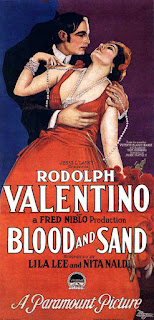
A poster for 'Blood and Sand,' in which Rudolph Valentino's name is spelled with an 'O.'

Nothing says 'Valentine's Day' like Rudolph Valentino risking his life doing battle with an angry charging bull.

And that's no ugly metaphor—it's the premise of 'Blood and Sand' (1922), a sizzling silent romantic drama I'm accompanying on Sunday, Feb. 6 at the Town Hall Theatre in Wilton, N.H.

Showtime is at 2 p.m. Lots more detail in the press release below.

For now, a quick report on last night's screening of a Harry Houdini film at the Garden Cinemas in Greenfield, Mass.

The film was 'The Man from Beyond' (1922), in which our hero plays a sailor frozen on a ship trapped in Arctic ice floes for a full century.

Discovered and unthawed, he enters the modern world (of the 1920s) to search for his lost love from 1820, whom he believes is reincarnated.

The screening was programmed as part of Greenfield's annual Winter Carnival, which, like 'The Man From Beyond,' is celebrating its 100th birthday this year. (Hence the Houdini-on-ice film.)

We've tried running silents with live music at the Garden a few times, with mixed results. For some reason, however, this screening caught the public's imagination—about 60 people attended, enough to really fill the relatively small screening room we were using.

Because virtually everyone there was new to silent film, I went over some basics prior to the screening. That included giving people permission to react openly to what they were about to see: to cheer when something good happened, to boo the villain, and so on.

Well, the audience took that ball and ran with it. Right from the start, people engaged with the film as if it were a sing-a-long musical. Nothing like an energized audience to bring to life a film from the silent era!

(I have to observe: here we were, bringing back to life a film made a century ago, which was about bringing back to life a man frozen a century before that.) 

And yes, there were occasional moments when a few self-appointed smart-alecks felt compelled to yell wisecracks at the screen, a la Mystery Science Theatre 3000. 

But no harm done, and eventually the film's melodrama swept up everyone, just as actress Jane Connolly (playing Houdini's beloved Felice, both in the present and the past) wound up being swept toward Niagara Falls in her canoe. 

And I must say, it was hard to resist my own urge to shout a MST3K-style riff when Connelly decides to escape a pursuer by boarding a canoe and launching herself into a raging cataract just above Niagara Falls, f'rchrissakes!

Casting note: the major role of Gregory Sinclair is played by Erwin Connelly, a round-faced actor who pops up frequently in small roles in Buster Keaton's silent features—most notably as the butler in 'Sherlock Jr.' (1924).

Frequent Keaton screenings have made Connelly's face a familiar one to me. He plays the husband quarreling memorably with his wife in 'Our Hospitality,' and also an offended priest in 'Seven Chances.' 

So it was a treat to see him carrying a lead role outside Buster's world.

There's not much about this performer online, but it turns out we share the same birthday: Jan. 14. His sparse screen credits include 'The Fire Brigade' (1926), which has been newly restored and that I hope to accompany later this year.

And yes, the Jane Connelly in 'The Man From Beyond' turns out to be Erwin's wife. They had appeared in vaudeville together, and were both hired for major roles in the Houdini picture. With Erwin's vaudeville background, it's not surprising he turned up in Keaton's pictures.

Jane, who has no other known screen credits, died just a few years after 'The Man From Beyond'—in 1925, at age 42. Erwin followed her in 1931 at age 53. 

If all this sounds intriguing, I'll be accompanying 'The Man From Beyond' again in April, when it screens at the Town Hall Theater in Wilton, N.H.

But before that, we have Rudy Valentino to get you all hot and bothered for Valentine's Day. Hope to see you there for 'Blood and Sand' on Sunday, Feb. 6 at 2 p.m. Details in the press release below.

*     *     *

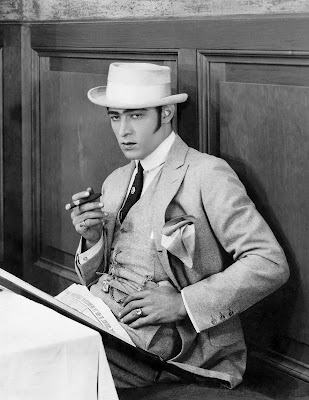
Smoldering sensuality, smoldering cigar: Valentino in 'Blood and Sand' (1922).

MONDAY, JAN. 24, 2022 / FOR IMMEDIATE RELEASE 
Contact Jeff Rapsis • (603) 236-9237 • jeffrapsis@gmail.com 

Valentino's bullfighting epic 'Blood and Sand' to screen at Wilton Town Hall Theatre 

Top-grossing silent film to be shown with live music on Sunday, Feb. 6 to celebrate 100th anniversary of release 

WILTON, N.H.—Just in time for Valentine's Day! It's an intense romantic drama that helped catapult actor Rudolph Valentino to worldwide fame. 

It's 'Blood and Sand' (1922), a bullfighting epic with sadomasochistic overtones to be screened on Sunday, Feb. 6 at 2 p.m. at the Town Hall Theatre, 40 Main St., Wilton, N.H. 

Admission is free, with a suggested donation of $10 per person to help support the theater's silent film series. 

The classic drama will be shown with live music by silent film accompanist Jeff Rapsis. 

The No. 3 box office hit of 1922, 'Blood and Sand' combined exotic Spanish locales with Valentino's iconic performance as a bullfighter. 

The film tells the story of Juan Gallardo (Valentino), a village boy born into poverty who grows up to become one of Spain's greatest matadors. Gallardo marries a friend from his childhood, the beautiful and virtuous Carmen. 

But after achieving fame and fortune, he finds himself drawn to Doña Sol (Naldi), a wealthy, seductive widow. They embark on a torrid affair. 

But then Gallardo, feeling guilty over his betrayal of Carmen, tries to free himself of Doña Sol.

Gallardo's troubles spill over to the bullfighting arena, where he becomes reckless. Can he cope with the gravest challenges of his young life—both in romance, and in the arena? 

The movie's immense popularity helped establish Valentino as one of the megastars of the silent film era. 

Directed for Paramount Pictures by Fred Niblo, the cast includes leading ladies Lila Lee as Carmen and Nita Naldi as Doña Sol. 

The large ensemble of supporting players includes actor Walter Long, a Milford, N.H. native who frequently played "tough guy" character roles in early Hollywood. 

'Blood and Sand' was based on the 1909 Spanish novel "Sangre y arena" (Blood and Sand) by Vicente Blasco Ibáñez and the play version of the book by Thomas Cushing. 

Unusual for Hollywood at the time, women played key roles in the production of 'Blood and Sand.' 

The story was adapted by June Mathis, the screenwriter credited with first recognizing Valentino's appeal, and edited by future director Dorothy Arzner. 

The film inspired the 'Blood and Sand' cocktail, a Prohibition-era mixed drink. 

The screening is part of the Town Hall Theatre's ongoing series honoring the 100th anniversary of significant motion pictures that debuted in 1922. 

Programs will include all of 1922's five highest-grossing titles, each shown on the big screen with live music, as well as century-old oddities, short films, cartoons, and more. 

"Putting these films back on the big screen is a great way to celebrate the 100th anniversaries of some terrific motion pictures," said Rapsis, the silent film accompanist who will create live music for all screenings. 

"These are films that set the standard for Hollywood, and still retain their power to entertain, especially when shown in a theater with live music and an audience," Rapsis said.

Upcoming programs in the Town Hall's 100th anniversary series include: 

• Sunday, Feb. 20, 2022 at 2 p.m.: 'When Knighthood was in Flower' Marion Davies goes medieval in this epic big budget costume picture from 1922 that put her on the map as a top Hollywood star. 

• Sunday, March 13, 2022 at 2 p.m.: Norma Talmadge in 'Smilin' Through' In honor of St. Patrick's Day, a 1922 romantic drama set in the Emerald Isle. 

• Sunday, March 27, 2022 at 2 p.m.: Douglas Fairbanks in 'Robin Hood' Celebrate the 100th anniversary of this blockbuster adaptation. Massive sets, great action, and Doug Fairbanks in the lead made this the top grossing film of 1922! 

• Sunday, April 3, 2022 at 2 p.m.: Chaney/Houdini Double Feature. In 'Flesh and Blood' (1922), escaped convict Lon Chaney hides out in Chinatown and plots revenge. In 'The Man From Beyond' (1922) illusionist Harry Houdini plays an Arctic adventurer frozen for 100 years! 

• Sunday, April 17, 2022 at 2 p.m.: Emil Jannings in 'Othello' The Bard's immortal tragedy brought to the screen in this early German version. Silent Shakespeare in honor of the author's 458th birthday. 

‘Blood and Sand' (1922) will be shown live music on Sunday, Feb. 6 at 2 p.m. at the Town Hall Theatre, 40 Main St., Wilton, N.H. 

Admission is free, with a suggested donation of $10 per person to help defray expenses. For more info, call (603) 654-3456 or visit www.wiltontownhalltheatre.com.

Thursday, November 11, 2021

This means you! All veterans welcome free to 'Four Horsemen of the Apocalypse' tonight

Rudolph Valentino in 'Four Horsemen of the Apocalypse' (1921). He's the one on the right, by the way.

Tonight I'm doing live music for 'Four Horsemen of the Apocalypse' (1921) at a new venue: the "Showroom," a performance space developed during the pandemic and opened recently by the Colonial Theatre in Keene, N.H.

The Colonial itself has been around since 1924, and among its other distinctions is that it's the theater where a 7-year-old me was traumatized by 'Willy Wonka and the Chocolate Factory' when it played there in 1971. 

If reasons are needed to show 'Four Horsemen,' I can name several: it's the 100th anniversary of the film's release; as a World War I epic, it's fitting for Veterans Day; it launched Rudolph Valentino as a megastar and introduced the tango worldwide; it's a terrific motion picture that shows early Hollywood at its most innovative and ambitious.

And for me, there's one personal reason that makes 'Four Horsemen' worth screening. I think the last line delivered by Nigel De Brulier's character is among the most moving in all cinema. It's not spoiling anything when I share it with you now: "I knew them all!" Watch for it, and you'll see.

So if you're in the area, please consider attending. All veterans welcome free of charge as a way to honor your service. Lots more about the film in the press release below. So march yourself on over to Keene and report for duty tonight at 7 p.m. 

That's an order!

*  *  *

From 'Four Horsemen of the Apocalypse' (1921): How's that for an image that fills the screen?
 

TUESDAY, NOV. 2, 2021 / FOR IMMEDIATE RELEASE
Contact Jeff Rapsis • (603) 236-9237 • jeffrapsis@gmail.com

See the epic movie that launched Rudolph Valentino as a megastar

Veterans admitted free to WWI saga 'Four Horsemen of the Apocalypse,' screening with live music on Thursday, Nov. 11 at Colonial Theatre's new 'Showroom' venue

KEENE, N.H.—A movie that launched the career of silent film heartthrob and megastar Rudolph Valentino will be shown on Veterans Day at the Colonial Theatre's new venue in downtown Keene.

'The Four Horsemen of the Apocalypse' (1921), a multi-generational family saga that climaxes during World War I, will be screened with live music on Thursday, Nov. 11 at 7 p.m. the Showroom, 20 Commercial St., Keene, N.H.

Tickets are $13.50 to $15 per person; all veterans will be admitted free to this special Veterans Day screening.

Proof of vaccination or negative results of a COVID-19 PCR test administered within 72 hours are required for admittance to events at Showroom. Also, masks are required to be worn at all times while at the venue.

Based on a novel by Spanish author Vicente Blasco Ibañez, 'Four Horsemen of the Apocalypse' tells the story of an extended Argentine family with mixed ethnic background: one side is German, while the other is French.

The family gets drawn into World War I in far-off Europe, with members ending up on opposing sides. With brothers pitted against one another on the battlefield, the destruction of war changes lives forever.

'The Four Horsemen of the Apocalypse' had a huge cultural impact, becoming the top-grossing film of 1921, beating out Charlie Chaplin's 'The Kid,' and going on to become the sixth-best-grossing film of the silent era.

Also, the film turned then-little-known actor Rudolph Valentino into a superstar, associating him with the image of the Latin Lover. In addition, the film inspired a tango craze and fashion fads such as gaucho pants.

Directed by Rex Ingram for Metro Pictures (a predecessor of MGM studios), 'Four Horsemen' grew into a mammoth production: over $1 million was spent in making it and more than 12,000 people were involved. The film was hugely successful at the box office, grossing nearly $5 million during its initial run, an enormous sum at the time.

The film was notable as one of the first major Hollywood productions to include World War I (then known as the 'Great War') in its storyline, and also in that it did not glorify the recent conflict or look past the tragedy that it brought. It's also among the first U.S. feature films to make full use of the unlimited visual power of the new motion picture medium.

Although Valentino (at left) dominates the film, other actors of note are featured. Alice Terry, the billed star as well as Ingram's wife, was a popular actress of her day. She would be cast in the next Ingram/Valentino flick rushed out in the same year before Rudy's jump to Paramount, The Conquering Power (1921).

Alan Hale Sr. appears in a supporting role; he was perhaps best known as Errol Flynn's sidekick in numerous films, his role of Little John in several Robin Hood flicks, and as the father of Alan Hale, Jr., who played the Skipper on the television series Gilligan's Island.

In 1995, the silent version of 'The Four Horsemen of the Apocalypse' was selected for preservation in the United States National Film Registry by the Library of Congress as being "culturally, historically, or aesthetically significant."

Regarding the title: the Four Horsemen of the Apocalypse are mentioned in the Bible in chapter six of the Book of Revelation, which predicts that they will ride during the Apocalypse. The four horsemen are traditionally named War, Famine, Pestilence, and Death.

"This is a big sprawling drama, and a great chance to see Rudolph Valentino in the picture that launched his celebrity," said Jeff Rapsis, a New Hampshire-based silent film accompanist who will create live music for the screening.

Rapsis will improvise live musical accompaniment during the show, using a digital synthesizer to recreate the sound of a full orchestra and other more exotic textures.

"Creating the music on the spot is a bit of a high-wire act, but it contributes a level of energy that's crucial to the silent film experience," Rapsis said. 
 
'The Four Horsemen of the Apocalypse' (1921) will be screened with live music on Veterans Day, Thursday, Nov. 11 at 7 p.m. at the Colonial Theatre's new Showroom, 20 Commercial St., Keene, N.H. Tickets are $13.50 to $15 and must be purchased online at www.thecolonial.org; veterans admitted free.
 
Veterans may walk up with ID at the door or reserve by calling the box office at (603) 352-2033. Due to limited seating, only the attending veteran can be accommodated at no charge.
For more information, visit www.thecolonial.org.

Monday, November 8, 2021

In this week's hand, two pairs: dramas and comedies—music for four films in five days

Original poster art for 'The Big Parade' (1925).

I've caught my breath after October's marathon of Halloween screenings, and just in time.

Why? Because this week the calendar comes back to life (sounds like Halloween all over again) with two big dramas for Veterans Day, then a pair of comedy programs on the weekend.

Finally—laughter!

First up is MGM's sprawling WWI drama 'The Big Parade' (1925), which steps off at 6:30 p.m. sharp on Wednesday, Nov. 10 at the Flying Monkey Moviehouse and Performance Center in Plymouth, N.H.

The screening is in honor of Veterans Day, and there's a lot more info in the press release I've added to the bottom of this post. 

On Veterans Day itself (Thursday, Nov. 11), it's another biggie: 'The Four Horsemen of the Apocalypse' (1921), starring Rudolf Valentino. 

The large supporting cast includes Alan Hale Sr., father of Alan Hale, Jr., who would go on to play the Skipper in "Gilligan's Island." (Hey, we all have our cultural reference points.)

Showtime for 'Horsemen' is 7 p.m. at the Showroom, a new venue opened during the pandemic by the Colonial Theater in Keene, N.H. See more info by clicking "Upcoming Silent Film Screenings" at the top right hand corner of this page. 

And then we turn the page to comedy. Saturday, Nov. 13 finds Buster Keaton attending 'College' (1927) in Brandon, Vt., while Sunday, Nov. 14 finds Harold Lloyd in 'Hot Water' (1924) in Wilton, N.H.

More details about those screenings once we get past Veterans Day.

For now, here's the press release about 'The Big Parade' (1925) on Wednesday, Nov. 10 at 6:30 p.m. at the Flying Monkey in Plymouth. Hope to see you there!

*  *  *

Renée Adorée and John Gilbert communicate without words in 'The Big Parade' (1925).

TUESDAY, NOV. 2, 2021 / FOR IMMEDIATE RELEASE
Contact Jeff Rapsis at (603) 236-9237 • e-mail jeffrapsis@gmail.com

Epic WWI drama 'The Big Parade' to be screened on Wednesday, Nov. 10 at Flying Monkey

To be shown with live music in honor of Veterans Day; blockbuster silent film changed the way Hollywood depicted war on the screen

PLYMOUTH, N.H. — It was the 'Saving Private Ryan' of its time — a movie that showed audiences war as experienced by a front line soldier whose life is changed forever by the experience

It was 'The Big Parade' (1925), a sprawling World War I epic and a box office sensation that made MGM into a powerhouse studio. It's the latest installment of the silent film series at the Flying Monkey Moviehouse and Performance Center, 39 Main St., Plymouth, N.H.

'The Big Parade' will be screened one time only on Wednesday, Nov. 10 at 6:30 p.m. General admission is $10.

The show will feature live accompaniment by silent film musician Jeff Rapsis.

'The Big Parade,' released just a few years after World War I ended, was hailed by critics as the first Hollywood film to depict the harsh reality of combat and its impact on troops. Its battle scenes were staged on a massive scale and still retain their ability to shock audiences.

The picture, based on the best-selling novel "What Price Glory?", follows the story of a young man (John Gilbert) who rebels against his privileged background by enlisting in the army just before the U.S. enters World War I.

He is shipped out to France, where he falls in love with a local French woman before being transferred to the front. There, he and his squadmates face the German war machine, where they must endure the ultimate tests of duty and honor in a battle they come to see as meaningless.

A scene from 'The Big Parade' (1925).

In addition to vivid war scenes, the film contains a famous dramatic sequence in which the French woman (Renée Adorée) realizes her love for the soldier, and tries to find him to say goodbye as the massive convoy of troops pulls out for the front. Another celebrated sequence depicts the light-hearted first meeting of the soldier and the girl, in which he teaches her how to chew gum.

'The Big Parade' went on to become the top-grossing movie of the entire silent film era, earning $6.4 million domestically and making director King Vidor into the Steven Spielberg of his day. It stood as MGM's biggest single box office hit until the release of 'Gone With the Wind' in 1939.

"We felt screening 'The Big Parade' was a suitable way to mark Veterans Day," said Flying Monkey manager Brooks Bartlett. "World War I is now part of history, but this picture is from a time when it was foremost in people's minds. What was then called 'The Great War' was the 9/11 of its day, and this film captures that intensity and allows us to experience it today."

Rapsis will improvise a musical score to the film in real time. In creating accompaniment for the 'The Big Parade' and other vintage classics, Rapsis tries to bridge the gap between silent film and modern audiences.

"Live music adds an element of energy to a silent film screening that's really crucial to the experience," Rapsis said. " 'The Big Parade' is filled with great scenes that lend themselves well to music. It's a real privilege to create a score to help this great picture come back to life," Rapsis said.

MGM's silent blockbuster ‘The Big Parade’ will be shown with live music on Wednesday, Nov. 10 at 6:30 p.m. at the Flying Monkey Moviehouse and Performance Center, 39 Main St., Plymouth, N.H.

Admission to the screening is $10, general admission seating. For more info, call (603) 536-2551 or visit www.flyingmonkeynh.com.

Saturday, December 28, 2019

Coming on Sunday, 12/29 in Wilton, N.H.:
'Four Horsemen of the Apocalypse' (1921)

Rudolph Valentino introduces the Tango in 'Four Horsemen of the Apocalypse.'

Final screening of the year is Sunday afternoon at the Town Hall Theatre at Wilton, N.H., and it's a doozy.

'Four Horsemen of the Apocalypse' (1921) is one of my favorite silent dramas, and I'm not alone: it was the sixth-highest grossing picture of the era.

To me, it's one of the first mainstream Hollywood pictures to make full use of the visual and imaginative powers of cinema, which were still being discovered.

D.W. Griffith and other first-generation directors knew how to tell stories, which was often the main strength of their work.

But Rex Ingram, who helmed 'Four Horsemen,' and his collaborators were able to take it a step further by weaving visual allegory into their drama in a way that only movies could.

The Four Horsemen of the title aren't just abstract metaphors or symbols. In Ingram's realization of the tale, we get to see them on screen, brought to life before our eyes as they come to life in some kind of steamy underworld, and then ride together through the skies.

And with a giant fire-breathing dragon to boot!

None of this is part of the reality of War I in France, which the movie depicts with documentary realism. But the Four Horsemen are still seamlessly woven into the fabric of the tale, giving the narrative a visual impact that's part of the power of cinema, I think.

Come see for yourself! On top of everything else, 'Four Horsemen' also has Rudolph Valentino introducing the tango, launching a craze that endures to this very day.

Here's the press release with more info about the film and our screening:

* * *

A scene from 'Four Horsemen of the Apocalypse' (1921).

MONDAY, DEC. 9, 2019 / FOR IMMEDIATE RELEASE
Contact Jeff Rapsis • (603) 236-9237 • jeffrapsis@gmail.com

Rudolph Valentino in 'Four Horsemen of the Apocalypse' on Sunday, Dec. 29 at Town Hall Theatre


Ground-breaking silent film epic launched 'Latin Lover' to stardom, started tango dance craze; to be screened with live musical accompaniment

WILTON, N.H.—An epic drama that launched the career of silent film heartthrob and megastar Rudolph Valentino will be shown this month at the Town Hall Theatre.

'The Four Horsemen of the Apocalypse' (1921), a multi-generational family saga that climaxes during World War I, will be screened with live music on Sunday, Dec. 29 at 4:30 p.m. at the Wilton Town Hall Theatre, 40 Main St., Wilton, N.H.

The screening is free and open to the public; a donation of $5 per person is requested to defray expenses.

Based on a novel by Spanish author Vicente Blasco Ibañez, 'Four Horsemen of the Apocalypse' tells the story of an extended Argentine family with mixed ethnic background: one side is German, while the other is French.

The family get drawn into World War I in far-off Europe, with members ending up on opposing sides. With brothers pitted against one another on the battlefield, the destruction of war changes lives forever.

'The Four Horsemen of the Apocalypse' had a huge cultural impact, becoming the top-grossing film of 1921, beating out Charlie Chaplin's 'The Kid,' and going on to become the sixth-best-grossing silent film of all time.

Also, the film turned then-little-known actor Rudolph Valentino into a superstar, associating him with the image of the Latin Lover. In addition, the film inspired a tango craze and fashion fads such as gaucho pants.

Directed by Rex Ingram for Metro Pictures (an ancestor of MGM studios), 'Four Horsemen' grew into a mammoth production: over $1 million was spent in making it and more than 12,000 people were involved. The film was hugely successful at the box office, grossing nearly $5 million during its initial run, an enormous sum at the time.

The film was notable as one of the first major Hollywood productions to include World War I (then known as the 'Great War') in its storyline, and also in that it did not glorify the recent conflict or look past the tragedy that it brought. It's also among the first U.S. feature films to make full use of the unlimited visual power of the new motion picture medium.

Although Valentino dominates the film, other actors of note are featured. Alice Terry, the billed star as well as Ingram's wife, was a popular actress of her day. She would be cast in the next Ingram/Valentino flick rushed out in the same year before Rudy's jump to Paramount, The Conquering Power (1921).

Alan Hale Sr. appears in a supporting role; he was perhaps best known as Errol Flynn's sidekick in numerous films, his role of Little John in several Robin Hood flicks, and as the father of Alan Hale, Jr., who played the Skipper on the television series Gilligan's Island.

'The Four Horsemen of the Apocalypse' was the brainchild of Metro screenwriter June Mathis, who went on to become one of the most powerful woman in early Hollywood, helping Valentino manage his career until his untimely death of peritonitis at age 31 in 1926.

The film was remade as '4 Horsemen of the Apocalypse' in 1962, with the setting changed to World War II.

In 1995, the silent version of 'The Four Horsemen of the Apocalypse' was selected for preservation in the United States National Film Registry by the Library of Congress as being "culturally, historically, or aesthetically significant."

Regarding the title: the Four Horsemen of the Apocalypse are mentioned in the Bible in chapter six of the Book of Revelation, which predicts that they will ride during the Apocalypse. The four horsemen are traditionally named War, Famine, Pestilence, and Death.

"This is a big sprawling drama, and a great chance to see Rudolph Valentino in the picture that launched his celebrity," said Jeff Rapsis, a New Hampshire-based silent film accompanist who will create live music for the screening.

Rapsis will improvise live musical accompaniment during the show, using a digital synthesizer to recreate the sound of a full orchestra and other more exotic textures.

"Creating the music on the spot is a bit of a high-wire act, but it contributes a level of energy that's crucial to the silent film experience," Rapsis said.

‘The Four Horsemen of the Apocalypse’ (1921) starring Rudolph Valentino will be shown with live music on Sunday, Dec. 29 at 4:30 p.m. at the Town Hall Theatre, 40 Main St., Wilton, N.H. Admission is free; a donation of $5 per person is suggested to defray expenses. For more info, call (603) 654-3456 or visit www.wiltontownhalltheatre.com.

Thursday, January 31, 2019

Cheap eats and cheap seats in Keene, N.H., plus Keaton, Valentino screenings coming soon

The marquee last Tuesday night at the Colonial Theatre in downtown Keene, N.H.

I can't wait to tell you all about this week's screening of 'The Hunchback of Notre Dame' (1923) at the Colonial Theatre in Keene, N.H.

But it says a lot about my priorities when I have to say first that I was flat-out amazed by the meal I had just before the show down the street at Lindy's Diner.

Really! Two chicken croquettes, mashed potatoes with gravy, a generous helping of carrots—mind you, all served piping—plus two rolls and butter, and coffee with refills, all for...$8.18!

Can you believe it? I actually took a picture:


On a cold night with snow starting to fall, this was just what the doctor ordered. Really—if prescribed, I believe it would mitigate the symptoms of most afflictions, physical or mental.

In any case, it was great show prep for the on-screen visual feast to come at the Colonial.

And, given my inexpensive meal, would it not seem equally amazing that the admission price for our screening of 'Hunchback' was the sum of...35 cents!

Really? 'Hunchback' on a cold Tuesday night in Keene, N.H., and an absurdly low admission price? What's going on here?

What was going on is that the Colonial's grand opening night was exactly 95 years ago: Jan. 29, 1924. And the opening night attraction, yes, was 'Hunchback,' the Universal blockbuster starring Lon Chaney.

And yes, admission that night was 35 cents per person.

So last Tuesday night in Keene, the audience and I all joined in to recreate not just the early movie-going experience, but also opening night at the Colonial, a terrific medium-sized theater which continues to serve Keene and the surrounding Monadnock Region as a first-class (and now non-profit) performing arts center.

And the comedian in me has to observe that a 35-cent ticket price isn't about to endanger their non-profit status. Har! (Rim shot here, please.)

With a snowstorm looming, no one was sure who might show up, despite the bargain entrance fee. But we got a healthy crowd, and it didn't take long for 'Hunchback' to get everyone absorbed. Reaction was gratifyingly strong throughout.

I think it's a great film for music: lots of scenes that lend themselves to the big lines that I like to spin.

I've done the film quite a few times, but not recently. One element with which I've never been satisfied is the music I create for Esmeralda, the gypsy girl, which always ends up sounding too slow and too much like the Habanara from 'Carmen.'

This time, I deliberately used different material: specifically, a 3/4 riff that I created for action scenes in 'Zorro' (1920) starring Douglas Fairbanks. It worked really well as a theme for Esmeralda! Specifically, it has a modal flavor, and so I could use it to shape some of the big scenes so "her" music was referenced, at least harmonically.

Anyway: another reason to support recycling!

The film got a big ovation, and I had some great conversations afterwards with people who couldn't believe the score was improvised live.

I try to illustrate how it's not all that unusual by pointing out that we're doing it right now: we're having a conversation in real time, and we're not following a script.

The folks at the Colonial were excellent to work with, and there's been enough of an audience interest to merit exploring a regular series of screenings to round out the Colonial's offerings.

I would love to work with them on this, as I love how a venue such as the Colonial are perfect places to exhibit films from a century ago in the way they were intended to be shown.

Plus, these films were designed from the ground up to be experienced by a group of people coming together. And a hundred years later, we need that kind of experience more than ever!

And in the theater world, which faces more and more competition from so many other sources of entertainment (most of it consumed at home), it's important to offer experiences that only a theater can do: such as silent film with live music!

So we'll see what the schedule brings for Keene, N.H. Me—I'd be delighted at the chance to eat regularly at Lindy's. :)

Before that happens, two upcoming screenings might warm you up during this cold spell that's now hit New England. (It's 10 below outside as I write.)

On Saturday, Feb. 2, the good folks at the Campton Historical Society (in Campton N.H.) will hold their now-annual pot luck summer/silent movie night. It's free and the public is welcome, especially if you bring a dish to share at the supper, which starts at 5 p.m. (Here we go with food again, but every year some excellent dishes turn up at this event.)

The movie program, highlighted by Buster Keaton's 'Our Hospitality' (1923), begins at whatever time everyone finished eating. Usually that's about 6:15 p.m. or so.

The post-food attraction in Campton, N.H. on Saturday, Feb. 2.

It'll be interesting this year because I've volunteered to play bass tuba (my other instrument) for a youth concert in Manchester, N.H. that afternoon. It's about an hour and some change up to get to Campton, so if you see a green Subaru Forester bombing up Interstate 93 that afternoon, that'll be me trying to make it to Campton before all the vittles is gone.

More details about this show are on the "Upcoming Screenings" page. Hope to see you there, but make sure you leave some dinner for me, willya?

And then the week after that, it's Rudolph Valentino in 'The Eagle' (1925), a pre-Valentine's Day show on Sunday, Feb. 10 at 4:30 p.m. at the Wilton (N.H.) Town Hall Theatre.

At Wilton, we usually run silents the last Sunday of the month, but that weekend I'm making my annual pilgrimage to the Kansas Silent Film Festival, so we moved the Wilton date up to take advantage of Valentino/Valentine's Day synergy.

Hope to see you at that one as well. For more info, check out the press release below.

* * *

Vilma Banky and Rudy Valentino generate heat in 'The Eagle' (1925).

THURSDAY, JAN. 31, 2019 / FOR IMMEDIATE RELEASE
Contact Jeff Rapsis • (603) 236-9237 • jeffrapsis@gmail.com

Warm up for Valentine's Day with Valentino at the Town Hall Theatre


'The Eagle' (1925), starring silent film icon Rudolph Valentino, to screen in Wilton, N.H. on Sunday, Feb. 10 with live music

WILTON, N.H.—He was the cinema’s first sex symbol, causing hordes of female moviegoers to flock to his pictures throughout the 1920s. He starred in films designed to show off his Latin looks, his smoldering eyes, and his dancer’s body. And his untimely death in 1926 prompted mob scenes at his funeral.

He was Rudolph Valentino, who remains an icon for on-screen passion long after he caused a sensation in the 1920s.

To celebrate Valentine’s Day, one of Valentino’s most acclaimed films will be screened with live music on Sunday, Feb. 10 at 4:30 p.m. at the Town Hall Theatre, 40 Main St., Wilton, N.H.

‘The Eagle’ (1925), a racy story set in Czarist Russia, proved one of his most popular features and marked a peak in his brief career.

Based on the novel Dubrovsky by Alexander Pushkin, ‘The Eagle’ casts Valentino as a lieutenant and expert horseman in the Russian army who catches the eye of Czarina Catherine II. After he rejects her advances and flees, she puts out a warrant for his arrest, dead or alive. When he learns that his father has been persecuted and killed in his hometown, he dons a black mask and becomes an outlaw, finding unexpected romance along the way.

The screening of ‘The Eagle’ will be accompanied by live music by local composer Jeff Rapsis. Admission is free, with a suggested donation of $5 per person to defray expenses.

An Italian immigrant who arrived penniless at Ellis Island in 1913, Valentino rose to superstar status in a series of silent pictures that enflamed the passions of female movie-goers from coast to coast and around the world.

But he was more than a pretty face—during his career, critics praised Valentino as a versatile actor capable of playing a variety of roles; his achievements included popularizing the Argentinian tango in the 1921 drama ‘Four Horsemen of the Apocalypse.’

‘The Eagle’ was Valentino’s next-to-last film, released the year before his unexpected death at age 31 from complications from peritonitis. Valentino's death in August 1926 occurred at the height of his career, inspiring mourning across the globe and a day-long mob scene at the actor’s New York City funeral.

But Valentino's brief stardom was defined by roles that brought a new level of exotic sexuality to the movies, causing a sensation at the time. In theaters, women openly swooned over Valentino’s on-screen image, especially in pictures such as ‘The Eagle,’ which featured foreign locales and elaborate costumes.

At its peak, Valentino's popularity was so immense that it inspired a backlash among many male movie-goers, who decried Valentino’s elegant image and mannerisms as effeminate.

Valentino’s sudden death fueled his status as a legendary romantic icon of the cinema. For years, a mysterious woman dressed in black would visit his grave at the Hollywood Park Cemetery in Los Angeles, leaving only a single red rose.

Valentino was aware of his effect on audiences, saying that “Women are not in love with me, but with the picture of me on the screen. I am merely the canvas upon which the women paint their dreams.”

‘The Eagle’ is the latest in the Town Hall Theatre's series of monthly silent film screenings with live music. The series aims to recreate the lost magic of early cinema by bringing together the elements needed for silent film to be seen at its best: superior films in best available prints; projection on the big screen; live musical accompaniment; and an audience.

“These films are still exciting experiences if you can show them as they were designed to be screened,” said Jeff Rapsis, the accompanist for the screenings. “There’s a reason people first fell in love with the movies, and we hope to recreate that spirit. At their best, silent films were communal experiences in which the presence of a large audience intensifies everyone’s reactions.”

Live music is a key element of each silent film screening, Rapsis said. Silent movies were never shown in silence, but were accompanied by live music made right in each theater. Most films were not released with official scores, so it was up to local musicians to provide the soundtrack, which could vary greatly from theater to theater.

"Because there's no set soundtrack for most silent films, musicians are free to create new music as they see fit, even today," Rapsis said. "In bringing a film to life, I try to create original 'movie score' music that sounds like what you might expect in a theater today, which helps bridge the gap between today's audiences and silent films that are in some cases nearly 100 years old."

For each film, Rapsis improvises a music score using original themes he creates beforehand. None of the the music is written down; instead, the score evolves in real time based on audience reaction and the overall mood as the movie is screened.

‘The Eagle’ will be shown on Sunday, Feb. 10 at 4:30 p.m. at the Town Hall Theatre, 40 Main St., Wilton, N.H.

Upcoming features in the Town Hall Theater's silent film series include:

• Sunday, March 24, 2019, 4:30 p.m.: "Seven Chances" (1925) starring Buster Keaton. In this 1925 farce, Buster is about to be saved from bankruptcy by an unexpected inheritance of $7 million—but only if he gets married by 7 p.m. that very day. One of Keaton's best comedies, climaxed by one of the great chase scenes in all film, silent or otherwise.

The next installment in the Town Hall Theatre's silent film series will be ‘The Eagle’ (1925), to be screened with live music by Jeff Rapsis on Sunday, Feb. 10 at 4:30 p.m. at the Town Hall Theatre, 40 Main St., Wilton, N.H. Admission is free; a donation of $5 per person is suggested to help defray expenses. For more info, visit www.wiltontownhalltheatre.com or call (603) 654-3456.

Friday, August 26, 2016

This Saturday: Valentino's 'Son of the Sheik'
with live music at Brandon (Vt.) Town Hall

Valentino in 'Son of the Sheik.' Showtime at Brandon (Vt.) Town Hall is Saturday, Aug. 27 at 7 p.m.

It's been a good month for media attention!

Earlier this month, I got a nice write-up in the Boston Globe. (See the link on the right of this page.)

This week, the Addison Independent, a twice-weekly paper in Middlebury, Vt., published a terrific piece by Charmaine Lam, a young writer on their staff.

What's great about Charlene's piece is not that it's about me. It's great because Charmaine was able to turn a long and rambling phone interview into a piece that covered a lot of ground, is easy to read, and completely and totally accurate. (Even more miraculously, it made me sound something like coherent!)

I've had to do this, and let me tell you: it's not easy, especially if the subject is totally new to you, which was the case with Charmaine.

So congratulations to her on a job well done. I expect it will bring new folks to our next screening in nearby Brandon, Vt., which is coming up this weekend.

For this one, we turn to drama: Rudolph Valentino in 'Son of the Sheik' (1926). Showtime is Saturday, Aug. 27 at 7 p.m. at Brandon Town Hall.

More details in the press release pasted in below. Hope to see you there!

And special thanks to the many sponsors who support the Brandon series, including Pam and Steve Douglass, sponsors of the Valentino program.

* * *

Valentino and Vilma Banky in 'Son of the Sheik' (1926).

WEDNESDAY, JULY 27, 2016 / FOR IMMEDIATE RELEASE
Contact Jeff Rapsis • (603) 236-9237 • jeffrapsis@gmail.com

Iconic screen lover Rudolph Valentino stars at Brandon (Vt.) Town Hall on Saturday, Aug. 27


Silent romantic epic 'Son of the Sheik' to be screened with live music on 90th anniversary of star's tragic early death

BRANDON, Vt.—He was the cinema’s first sex symbol, causing hordes of female moviegoers to flock to his pictures throughout the 1920s.

He starred in films designed to show off his Latin looks, his smoldering eyes, and his dancer’s body. And his untimely death in August, 1926 prompted mob scenes at funeral in New York.

He was Rudolph Valentino, who remains an icon for on-screen passion long after he caused a sensation in the 1920s.

One of Valentino’s most acclaimed films will be screened with live music on Saturday, Aug. 27 at 7 p.m. at Brandon Town Hall and Community Center, Route 7 in Brandon, Vt.

The screening is free and open to the public. Donations are accepted to help support the town hall's ongoing renovation and restoration. The screening is sponsored by Brandon residents Pam and Steve Douglass.

Live music will be provided by accompanist Jeff Rapsis, a New England-based composer who specializes in creating music for silent film presentations.

In 'Son of the Sheik' Valentino tackles two roles, as a father and his son.

Ahmed (Rudolph Valentino), the son of an Arab sheik and a kidnapped English gentlewoman (Agnes Ayres), loves local dancing girl Yasmin (Vilma Banky).

When he slips out of his father's heavily guarded compound to woo her, he is kidnapped and held for ransom by a group of bandits led by Yasmin's father (George Fawcett) and Ghabah (Montagu Love), the Moor to whom she is betrothed.

Can Valentino escape the clutches of his enemies and win the heart of his true love?

'Son of the Sheik' will be preceded by selected short subjects.

'Son of the Sheik' was a sequel to 1921's 'The Sheik,' an immensely popular film that established Valentino as the silent screen's great lover.

Then actor's final film, ‘Son of the Sheik’ was released following his death on Aug. 23, 1926 from complications from peritonitis. Valentino was only 31 years old.

The death took place at the height of his career, inspiring a day-long mob scene at the actor’s New York funeral.

An Italian immigrant who arrived penniless at Ellis Island in 1913, Valentino rose to superstar status in a series of silent pictures that enflamed the passions of female movie-goers from coast to coast and around the world. But he was more than a pretty face—during his career, critics praised Valentino as a versatile actor capable of playing a variety of roles; his achievements included popularizing the Argentinian tango in the 1921 drama ‘Four Horsemen of the Apocalypse.’

But Valentino's brief stardom was defined by the ‘Sheik’ roles, which brought a new level of exotic sexuality to the movies, causing a sensation at the time. In theaters, women openly swooned over Valentino’s on-screen image, especially in roles such as the ‘Sheik,’ which featured elaborate costumes. At its peak, his popularity was so immense that it inspired a backlash among many male movie-goers, who decried Valentino’s elegant image and mannerisms as effeminate.

Valentino’s sudden death fueled his status as a legendary romantic icon of the cinema. For years, a mysterious woman dressed in black would visit his grave at the Hollywood Park Cemetery in Los Angeles, leaving only a single red rose.

Valentino was aware of his effect on audiences, saying that “Women are not in love with me but with the picture of me on the screen. I am merely the canvas upon which the women paint their dreams.”

The Valentino program continues another season of silent films presented with live music at the Brandon Town Hall and Community Center. The series provides local audiences the opportunity to experience silent film as it was intended to be shown: on the big screen, in good-looking prints, with live music, and with an audience.

“These films are still exciting experiences if you can show them as they were designed to be screened,” said Rapsis, accompanist for the screenings. “There’s a reason people first fell in love with the movies, and we hope to recreate that spirit. At their best, silent films were communal experiences in which the presence of a large audience intensifies everyone’s reactions.”

For each film, Rapsis improvises a music score using original themes he creates beforehand. None of the the music is written down; instead, the score evolves in real time based on audience reaction and the overall mood as the movie is screened.

Upcoming events in Brandon Town Hall's 2016 silent film series include:

• Saturday, Sept. 17, 2016: Charlie Chaplin in 'The Kid' (1921). In Chaplin's breakthrough feature, a story with "a smile, and perhaps a tear," the Little Tramp raises an orphan. Sponsored by Bill and Kathy Mathis in memory of Maxine Thurston.

• Saturday, Oct. 15, 2016: Chiller Theatre, 'The Man Who Laughs' (1928). Get into the Halloween spirit with this creepy Gothic thriller starring Conrad Veidt. Sponsored by Omya, Inc.

Rudolph Valentino is 'Son of the Sheik' will be shown on Saturday, Aug. 27 at 7 p.m. at Brandon Town Hall and Community Center, Route 7, in Brandon, Vt.

Admission is free; free will donations are encouraged, with proceeds to support ongoing renovation of the town hall. For more information, visit www.brandontownhall.org. For more info on the music, visit www.jeffrapsis.com.