Friday, July 8, 2016

Hosting W.C. Fields' granddaughter for show
at Somerville Theatre on Sunday, July 10

Dr. Harriet Fields, granddaughter of W.C.

One of the perks of doing silent film music is that you occasionally get to rub elbows with descendants of the on-screen luminaries.

Yes, the stars themselves may be gone, but their families are with us—living links of a sort to the vanished era of movies without soundtracks.

Many take an active role in tending the legacy of their famous fore-bearers, the family of W.C. Fields being one of the best examples.

The four Fields grandchildren collectively manage W.C. Fields Productions, Inc., and they continue to cultivate interest in their grandfather's long and storied career.

Part of that legacy was the substantial amount of work Field did during the silent film era. Few people realize it today because his later "talkie" appearances are what ensured his immortality.

But the silent films hold up well, and I'm pleased to say they'll be front and center of a program we're running at the Somerville Theatre on Sunday, July 10.

And I'm ever more pleased to say our special guest will be Dr. Harriet Fields, the only granddaughter of W.C., who will be on hand to speak of her granddad's achievements and answer questions.

The program is highlighted by pristine 35mm prints (from the Library of Congress) of two of the best Fields silents: 'So's Your Old Man' and 'It's the Old Army Game,' both from 1926.

But, courtesy the detective work of master projectionist David Kornfeld, we also have prints of Fields' first-ever movie appearance in 'Pool Sharks' (1915) as well as other goodies.

It promises to be a memorable program. And the lousy weekend forecast (rainy and damp) in these parts bodes well for attendance.

So I hope you can join the Field-centric fun, which starts at 2 p.m. on Sunday, July 10 at the Somerville Theatre. More info in the press release below.

* * *

A lobby card for W.C. Fields in 'So's Your Old Man.'

THURSDAY, JUNE 30, 2016 / FOR IMMEDIATE RELEASE
Contact Jeff Rapsis • (603) 236-9237 • jeffrapsis@gmail.com

Somerville Theatre to screen rare silent films starring comic icon W.C. Fields


• Program on Sunday, July 10 hosted by Dr. Harriet Fields, comedian's granddaughter and advocate for his work

• Double feature shows legendary performer in earlier prime as younger man; program accompanied by live music

SOMERVILLE, Mass.—He was a performer who could be recognized by just the nasal twang of his voice.

But prior to reaching iconic fame in talking pictures, W.C. Fields starred successfully in a popular series of silent feature films for Paramount Pictures and other studios in the 1920s.

Rediscover the non-talking W.C. Fields in and 'So's Your Old Man' (1926) and 'It's The Old Army Game' (1926), two of Fields' best silent pictures, in a double-bill screening on Sunday, July 10 at 2 p.m. at the Somerville Theatre, 55 Davis Square, Somerville, Mass.

Both films will be screened using 35mm prints from the U.S. Library of Congress. General admission to the double feature is $15 per person.

Special guest for the event will be Dr. Harriet A. Fields, granddaughter of W.C. Fields. Dr. Fields, a longtime advocate of her grandfather's work, will share stories of her family and answer questions about W.C. Fields, his achievements, and his films.

Dr. Fields currently serves as vice president of W.C. Fields Productions, Inc., which maintains a Web site at www.wcfields.com.

Live musical scoring for the movies will be provided by silent film accompanist Jeff Rapsis.

W.C. Fields remains famous today for his comic persona as a misanthropic and hard-drinking egotist with a snarling contempt for dogs, children and women.

Although Fields achieved lasting fame as a movie star in talking pictures of the 1930s, his long career encompassed decades on the vaudeville stage as well as a series of silent film roles in the 1920s.

W.C. Fields co-starred with a young Louise Brooks in 'It's the Old Army Game.'

"People find it hard to think of W.C. Fields in silent films, but he was actually quite successful," Rapsis said. "As a vaudeville performer and juggler, Fields cultivated a form of visual comedy and pantomime that transferred well to the silent screen.

"Also, as a middle-aged man during the silent film era, he was able to play a family father figure—the kind of role that wasn't open to younger comic stars such as Charlie Chaplin or Buster Keaton," Rapsis said.

In all, Fields starred in 10 silent features in the mid-1920s. Several are lost; in those that survive, Fields sports a thick mustache, part of his vaudeville costume as a "vagabond juggler" which he dropped in later years.

The Fields double feature is the latest installment of the Somerville Theatre's monthly "Silents, Please!" series, designed to showcase the silent era's best feature films the way they were intended to be shown—using actual 35mm film prints projected on the big screen, with live music, and with an audience.

"If you can put all these elements together, the films come to life in a way that's surprising to modern audiences," said Ian Judge, the Somerville's general manager. "Our silent film series has been very successful at attracting an audience, we're thrilled to continue it on a monthly basis."

In 'So's Your Old Man' (1926), Fields plays Sam Bisbee, inventor of a new shatter-proof windshield glass and regarded as a crackpot by the townsfolk. After a demonstration of his glass to auto executives goes awry, he faces ridicule and shame. On the way home, Bisbee encounters a woman he thinks is trying to commit suicide, and so prevents her.

The woman is really Princess Lescaboura, member of a family of European royalty, who later arrives in Bisbee's home town to thank him, upending Bisbee's life and setting the small town aflame with gossip. The film includes a version of Fields' famous "golf" routine.

The film was remade as a talkie in 1934, with W.C. Fields again starring, under the title 'You're Telling Me!" In 2008, 'So's Your Old Man' was added to the U.S. National Film Registry.

A lobby card for 'It's the Old Army Game.'

In 'It's The Old Army Game' (1926), Fields portrays Elmer Prettywillie, a small-town pharmacist beset with large-scale frustrations—his nagging sister and her brat of a kid; annoying customers; self-centered, middle-aged women; and uncooperative inanimate objects of all kinds.

Prettywillie’s lovely shop assistant (legendary silent beauty Louise Brooks) gets the harried shopkeeper even further over his head, when she encourages him to take part in a land-selling scheme being promoted by a slick salesman (George Parker).

The druggist helps the salesman make a heap of cash, selling his parcels of land; but when a detective hauls the salesman out of town, it’s Elmer who is left holding the bag.

The result is a timeless domestic farce that foreshadows Fields' later talking films and continues to delight audiences when screened as intended: in a theater, with live music and an audience.

Both features were made not in Hollywood, but at the Paramount studios in Astoria, Queens, a popular production facility for New York-based stage performers who also appeared in film.

Fields appears as an even younger man in 'Pool Sharks' (1915), a short comedy also on the program. The film marks the first appearance of Fields on screen, and will be included as a bonus extra in the Somerville's program.

The program will also include rare 35mm prints of several Fields short subjects with synchronized sound.

Fields (at left) during the golf routine that concludes 'So's Your Old Man.'

For the silent films, Rapsis improvises the music in real time, while the film is running, using a synthesizer that allow him to recreate the "movie score" texture of a full orchestra.

"Improvising a score live is a bit of a high-wire act, but it allows me to follow and support the film a lot more effectively than if I was buried in sheet music," Rapsis said. "Instead, I'm free to follow the film right in the moment. Each time it's different, which lends a certain energy and immediacy and excitement to the experience."

A W.C. Fields silent double feature, with special guest Dr. Harriet A. Fields, will be screened in 35mm with live music on Sunday, July 10 at 2 p.m. at the Somerville Theater, 55 Davis Square, Somerville, Mass. Admission is $15 adults, $12 students/seniors; general admission seating. For more information, call (617) 625-5700 or visit http://www.somervilletheatreonline.com. For more info on the music, visit www.jeffrapsis.com.

Tuesday, July 5, 2016

Set sail for a sea of laughter with Harold Lloyd
on Thursday, July 7 at the Leavitt Theatre

A French poster for Harold Lloyd's famous comedy...well, 'Despite Her Sailor,' according to Google translate.

With the Atlantic Ocean just a short stroll from the theater, what better venue to show Harold Lloyd's fun 1921 comedy 'A Sailor-Made Man'?

So that's just what we'll do. On Thursday, July 7, please join me for a silent film comedy program at the Leavitt Theatre in Ogunquit, Maine that features Lloyd's sea-faring comedy.

Several surprise short subjects will round out the bill, with live music by yours truly.

The weather today is just too nice to keep typing, so hope you don't mind if I hit 'Publish' without going any further.

I will, however, paste in the text of the press release that went out for this screening. Hope to see you there!

Lloyd and spouse-to-be Mildred Davis smoke up some comedy in 'A Sailor-Made Man.'

* * *

THURSDAY, JUNE 30, 2016 / FOR IMMEDIATE RELEASE
Contact Jeff Rapsis • (603) 236-9237 • jeffrapsis@gmail.com

'Silent Comedy with Harold Lloyd' at Leavitt Theatre on Thursday, July 7


'A Sailor-Made Man' (1921), other vintage classics to be screened with live music at historic Ogunquit venue

OGUNQUIT, Me.—He was the boy next door who yearned to make good, but instead had a knack for getting into spectacular trouble.

He was Harold Lloyd, whose upbeat and fast-paced comedies never failed to convulse audiences, making him the most popular movie star of Hollywood's silent film era.

See for yourself why Lloyd was the top box office attraction of the 1920s in a program featuring some of his best comedies, including 'A Sailor-Made Man' (1921), all shown with live music.

A program of Silent Comedy with Harold Lloyd will be shown on Thursday, July 7 at 8 p.m. at the historic Leavitt Theatre, 259 Main St. in downtown Ogunquit.

Admission is $10 per person, general admission.

Live music will be provided by accompanist Jeff Rapsis, a New England-based composer who specializes in creating music for silent film presentations.

"There's nothing like silent film comedy shown on the big screen with a live audience," said Rapsis, who regularly accompanies silent film screenings around the region.

Lloyd's optimistic go-getter character was extremely popular throughout the 1920s, as audiences eagerly followed him from one adventure to the next. His pictures mixed comedy, sentiment, and thrills in a winning combination that has stood the test of time.

Hijinks on the high seas in 'A Sailor-Made Man' (1921).

In 'A Sailor-Made Man,' Harold plays a wealthy young man who signs up for the U.S. Navy to prove himself worthy of the girl he loves. The Navy proves less than a picnic, until Harold gets an opportunity to save his girl when she gets kidnapped. Harold races to the rescue in classic silent comedy style!

The evening-long program at the Leavitt will be rounded out with other Harold Lloyd titles.

The Harold Lloyd program continues another season of silent films presented with live music at the Leavitt. The series provides local audiences the opportunity to experience silent film as it was intended to be shown: on the big screen, in good-looking prints, with live music, and with an audience.

"If you can put pieces of the experience back together again, it's surprising how these films snap back to life," Rapsis said. "By showing the films under the right conditions, you can really get a sense of why people first fell in love with the movies."

The Leavitt, a summer-only moviehouse, opened in 1923 at the height of the silent film era, and has been showing movies to summertime visitors for nine decades.

The silent film series honors the theater's long service as a moviehouse that has entertained generations of Seacoast residents and visitors, in good times and in bad.

Comedy programs have been especially popular with audiences at the Leavitt. In addition to Lloyd, other silent film comedians highlighted in this season's series are Charlie Chaplin and Harry Langdon.

Upcoming shows in this year's series include:

• Thursday, July 21 at 8 p.m.: Christmas in July! 'Tess of the Storm Country' (1922), Mary Pickford's intense melodrama with a classic Yuletide finish.

• Thursday, Aug. 11 at 8 p.m.: 'Tramp Tramp Tramp' (1926); comic Harry Langdon enters a cross-country foot race to impress his dream girl, Joan Crawford! Shown in honor of hurricane season: you'll see why.

• Thursday, Aug. 25 at 8 p.m.: 'The Sheik' (1921) and 'Son of the Sheik' (1926), two popular films of silent screen icon Rudolph Valentino on the 90th anniversary of his death.

• Thursday, Sept. 15 at 8 p.m.: 'The Winning of Barbara Worth' (1927); Ronald Colman and Gary Cooper compete for a woman's favor in this epic Western filmed on location.

• Saturday, Oct. 29 at 8 p.m.: 'The Man Who Laughs' (1928); celebrate Halloween with this creepy but riveting historical tale about a man forced to go through life with a maniacal grin.

‘A Sailor-Made Man’ and other Harold Lloyd films will be shown on Thursday, July 7 at 8 p.m. at the Leavitt Theatre, 259 Main St., Route 1, Ogunquit, Maine. Admission $10 per person. For more info, call (207) 646-3123 or visit www.leavittheatre.com.


Thursday, June 30, 2016

Encore screening of Keaton's 'The General'
on Friday, July 1 at Red River Theatres

What's the most expensive shot of the silent era? Here's a hint.

Coming up this Friday, July 1: an encore presentation of Buster Keaton's 'The General' (1926) at Red River Theatres in Concord, N.H.

A screening of 'The General' earlier in June sold out, prompting this reboot. The show starts at 7 p.m. and admission is $10 per person. See you there!

More details in the press release pasted at the end of this post.

And then Sunday, July 3 brings the next installment of our series of silent boxing films at the Wilton (N.H.) Town Hall Theatre.

The 4:30 p.m. show is a double feature of two obscure dramas: 'Battling Bunyan' (1924) and 'The Shock Punch' (1925). Admission is free!

When I mention we're running a series of boxing films, some people crinkle up their nose in disapproval. It's understandable, I suppose.

The sad state of Muhammad Ali's health prior to his recent death has renewed calls to ban the sport outright as too harmful and dangerous.

Boxing: a sport on the canvas.

But films from the 1920s offer a glimpse into a bygone era—a time when boxing was arguably the nation's most popular sport.

Consider: Just today, I came across a review of a book, “Stars in the Ring: Jewish Champions in the Golden Age of Boxing,” by Mike Silver.

Here's the context the reviewer, Robert Cassidy, used in putting boxing in perspective during the 1920s:
The book also states that in the Roaring Twenties, the most famous Jewish person in America was not a scientist, entertainer, author or Supreme Court justice. It was lightweight champion Benny Leonard.

That breakdown provides the historical backdrop for the book. At the time, only baseball and horse racing rivaled boxing in popularity. Not just world champions, but even main-event fighters were considered national sports heroes.
You can see that popularity throughout films of the silent era—and especially in the boxing-specific films we're running this summer.

It's a sub-genre that was definitely a product of its time. And so I think films about boxing are worth focusing on for a series, in the same way we've run past series on trains, sailing ships, and melodramatic romance.

I'm of two minds about boxing. Of course I dislike the idea of any sport where brain injury is the essential aim.

But I have to admit, the idea of two equally matched men or women facing off against each other in a defined space, and not part of any team, is elemental and fascinating.

I guess it speaks to one of the fundamental human paradoxes: of being intelligent enough to know when something isn't good for us or the people involved, but being depraved enough to still want it.

Death by chocolate, anyone? Or, more topically, Brexit? We're not always such rational creatures, are we?

Okay, here's the press release about 'The General' this Friday, July 1 at 7 p.m. at Red River Theatres in Concord, N.H.

* * *

A vintage poster for 'The General.'

FRIDAY, JUNE 24, 2016 / FOR IMMEDIATE RELEASE
Contact Jeff Rapsis • (603) 236-9237 • jeffrapsis@gmail.com

Encore presentation of silent film classic
'The General' at Red River on Friday, July 1


Repeated due to earlier June sell-out: Buster Keaton's comic Civil War masterpiece screened with live music

CONCORD, N.H.—He never smiled on camera, earning him the nickname of "the Great Stone Face." But Buster Keaton's comedies rocked Hollywood's silent era with laughter throughout the 1920s.

Acclaimed for their originality and timeless visual humor, Keaton's films remain popular crowd-pleasers today.

See for yourself with an encore screening of 'The General' (1926), one of Keaton's landmark feature films, at Red River Theatre, 11 South Main St., Concord, N.H. on Friday, July 1 at 7 p.m. Tickets are $10 per person.

The program will be accompanied by live music performed by silent film composer Jeff Rapsis.

The encore screening was scheduled following a sell-out show earlier in June.

Buster and his locomotive co-star, The General.

'The General,' set during the U.S. Civil War, tells the story of a southern locomotive engineer (Keaton) whose engine (named 'The General') is hijacked by Northern spies with his girlfriend onboard.

Keaton, stealing another train, races north in pursuit behind enemy lines. Can he rescue his girl? And can he steal his locomotive and make it back to warn of a coming Northern attack?

Critics call 'The General' Keaton's masterpiece, praising its authentic period detail, ambitious action and battle sequences, and its overall integration of story, drama, and comedy.

It's also regarded as one of Hollywood's great train films, with much of the action occurring on or around moving steam locomotives.

Rapsis, a New Hampshire-based silent film musician who has accompanied shows at venues across New England, said Keaton's films were not made to be shown on television or viewed at home.

In screening 'The General,' Red River will give the public a chance to experience silent film as it was meant to be seen—in a high quality print, on a large screen, with live music, and with an audience.

"All those elements are important parts of the silent film experience," said Rapsis, who improvises the score on the spot as a film screens. "Recreate those conditions, and the classics of early Hollywood leap back to life in ways that can still move audiences today."

Buster readies for his close-up in 'The General.'

Rapsis performs on a digital keyboard that reproduces the texture of the full orchestra and creates a traditional "movie score" sound.

Keaton, along with Charlie Chaplin and Harold Lloyd, stands today as one of the silent screen's three great clowns. Some critics regard Keaton as the best of all; Roger Ebert wrote in 2002 that "in an extraordinary period from 1920 to 1929, (Keaton) worked without interruption on a series of films that make him, arguably, the greatest actor-director in the history of the movies."

As a performer, Keaton was uniquely suited to the demands of silent comedy. Born in 1895, he made his stage debut as a toddler, joining his family's knockabout vaudeville act and learning to take falls and do acrobatic stunts at an early age.

A remarkable pantomime artist, Keaton naturally used his whole body to communicate emotions from sadness to surprise. And in an era with no post-production special effects, Keaton's acrobatic talents enabled him to perform all his own stunts.

Red River Theatres, an independent cinema, is a non-profit 501(c)(3) organization dedicated to screening a diverse program of first-run independent films, cult favorites, classics, local and regional film projects, and foreign films.

The member-supported theater’s mission is to present film and the discussion of film as a way to entertain, broaden horizons and deepen appreciation of life for New Hampshire audiences of all ages.

'The General' is the latest in an monthly series of great silent films with live music at Red River. Upcoming programs include:

• Friday, July 15: 'Bardelys the Magnificent' (1926) starring John Gilbert in a big MGM historical swashbuckling adventure thought lost for decades until a print was found recently in France.

• Friday, Aug. 12: 'The Yankee Clipper' (1927) starring William Boyd. Period drama set in the 19th century; two clipper ships race from China to Boston to compete for a lucrative tea contract.

• Friday, Sept. 16: 'Spies' (1928). Director Fritz Lang followed his futuristic saga 'Metropolis' with this pioneering espionage thriller that created the template for all future James Bond movies.

Critics review 'The General':

"The most insistently moving picture ever made, its climax is the most stunning visual event ever arranged for a film comedy."
—Walter Kerr

"An almost perfect entertainment!"
—Dave Kehr, Chicago Reader

"What makes the film so special is the way the timing, audacity and elegant choreography of its sight gags, acrobatics, pratfalls and dramatic incidents is matched by Buster's directorial artistry, his acute observational skills working alongside the physical élan and sweet subtlety of his own performance."
—Time Out (London)

'The General' (1926) will be shown at Red River Theatres, 11 South Main St., Concord, N.H. on Friday, July 1 at 7 p.m. in the Jaclyn Simchik Screening Room. Admission is $10 per person; for more info, call (603) 224-4600 or visit www.redrivertheatres.org.

For more information about the music, visit www.jeffrapsis.com.

Friday, June 24, 2016

Back to the piano bench: four days, four shows,
three states, and one foreign country...

Accompanying 'The Iron Horse' (1924) in Brandon, Vt. on Saturday, June 25.

...if you count Canada as a truly foreign country.

Well, either way, I'm back at it, having last night done music for 'Don Q, Son of Zorro' (1925) at the Leavitt Theatre in Ogunquit, Maine.

A strong turnout of about 60 folks cheered and hooted and hollered as Doug battled rivals to clear his name. Great flick!

Later today I head up to the Franklin (N.H.) Opera House, a new venue for me, to do music for Keaton's 'Sherlock Jr.' (1924).

On Saturday, it's up to Vermont for 'The Iron Horse' (1924), the next installment in a monthly program of silents at the Brandon (Vt.) Town Hall.

And then it's off to Toronto on Sunday, June 26 for a quick out-and-back to play for King Vidor's 'Show People' (1928) at the Revue Cinema.

From 'Show People' (1928): William Haines and Marion Davies meet a funny little man, name of Chaplin.

Yes, and I guess somewhere in there I'll have to make room for eating and sleeping. And updating this blog. :)

I will say that the weekend will be highlighted by two people I'm looking forward to seeing.

On Saturday, when I'm up in Vermont, silent film accompanist Ben Model is also in Vermont, playing for a screening of 'Steamboat Bill Jr.' not far away from my Brandon Town Hall show.

Ben's show is in the afternoon, so I'm hoping to stop by on my way to Brandon. How odd to have two silent film shows in nearby locations, but on the same day in rural Vermont!

And on Sunday, I'll get to see Alicia Fletcher and other members of Toronto's vintage film community. They're a nice bunch and looking forward to hanging with them, if only briefly.

On the to-do list in Canada: get a haircut! This will allow me to continue to observe my "domestic haircut boycott" while Mr. Trump remains a candidate for the presidency. Expect a photo album on Facebook.

And that's all I have time for right now.

If you'd like more info about this weekend's shows, details are posted my schedule page, which is accessible via the right-hand links on the home page.

But to help orient you (and for me to keep track as well), here's a quick thumbnail schedule of the weekend's upcoming performances:

• Thursday, June 23, 8 p.m.: Don Q, Son of Zorro (1925) starring Douglas Fairbanks Sr., at the Leavitt Theatre, Ogunquit, Maine.

• Friday, June 24, 7 p.m.: Sherlock Jr. (1924) starring Buster Keaton, at the Franklin (N.H.) Opera House.

• Saturday, June 25, 7 p.m.: The Iron Horse (1924) directed by a very young John Ford, at the Brandon Town Hall in Brandon, Vt.

• Sunday, June 26, 4 p.m.: Show People (1928) starring Marion Davies and William Haines at the Revue Cinema, Toronto, Canada.

You know how on 'Wheel of Fortune' you can buy a vowel?

Well, in the game show called "Life," I wish i could buy an hour so that I can continue writing.

But I can't, and time is up for this installment. See you next time!

Tuesday, June 14, 2016

Turning Mount Kilimanjaro into music—
with help from the N.H. Philharmonic

Our team greets the sunrise on the summit of Mount Kilimanjaro on January 10, 2015. I'm kneeling in front, mostly due to exhaustion.

Heading into a quiet stretch for silent film accompaniment: no shows until a four-day stretch in late June that includes a return gig at the wonderful Revue Cinema in Toronto, Canada.

But I'm thankful for the break because it'll give me a chance to make progress on another musical project I'm pursuing: an orchestral piece about Mount Kilimanjaro.

I got a chance to climb Mount Kilimanjaro last year as part of a group of 12 people. Our nine-day trek, climaxed by an overnight slog to reach the summit at sunrise, was an awesome experience.

It was also an unexpectedly musical experience. Singing of all types takes place on the slopes of Africa's highest mountain: folk songs, spirituals, hymns, and so much more.

And I found the snow-capped mountain makes its own kind of music, too.

So now I find myself pulling together an orchestral score that captures something, I hope, of the Kilimanjaro experience.

Our team and some of our guides on the way up. Still a ways to go!

And just as Kilimanjaro looms over the countryside, a read-through of my score-in-progress looms over my own day-to-day activities. Sometime this fall, members of the New Hampshire Philharmonic expect to play through it in preparation for a performance during their 2016-17 season.

I'm very excited by this opportunity, and grateful to music director Mark Latham and the orchestra for their willingness to encourage new music.

How did this happen? It's one of those "it was meant to be" series of events, I guess.

Prior to departing for Africa, I was contacted by the Philharmonic to be involved with a program of film music they were planning.

Alas, I couldn't join in because the concert date was when I would be on Kilimanjaro. (Now there's an excuse you don't get to use very often.)

After leaving Barranco Camp, our team negotiates the "Breakfast Wall" on Day 6.

Well, it turned out that music director Latham has extensive family ties to the legendary mountain, which is Africa's highest and also the tallest free-standing mountain in the world.

Mark comes from a family of medical officers who were among the first British officials to settle in Tanzania after Germany ceded control of its African territories following World War I.

So Mark's immediate ancestors were among the first English settlers to explore the slopes and summit of Kilimanjaro. Mark's grandfather was actually the first Englishmen to summit the mountain, back in 1926. (Germans had been on the peak before that, but prior to European settlement, there's no record of anyone venturing to the top.)

Today, several features on the mountain carry the name of Latham family members. For example: a spot we passed on the summit rim, Stella Point, is named in honor of Mark's great aunt, the first woman to reach the summit.

And Mark's grandfather was the guy who came across (and photographed) the leopard carcass high on the peak, which inspired Ernest Hemingway's 'The Snows of Kilimanjaro.'

I learned all this because prior to our trip, Mark graciously sat down and showed some of us his Kilimanjaro photo album and other priceless heirlooms from the family's days in what was then British East Africa.

He also shared his own experiences of climbing the mountain with his father back in 1976, on the 50th anniversary of his grandfather's first ascent.

We were stunned and grateful to get this insider's perspective on Kilimanjaro prior to departing. (Mark was actually born in Tanzania.) Imagine climbing a world-famous peak with a number of features named after family members of someone you had dinner with!

There's even a book about the family's experiences. It's called Kilimanjaro Tales: The Saga of a Medical Family in Africa.

After we scaled the peak in January of last year, Mark and I talked about the mountain, and he was willing to take a chance on Kilimanjaro made into music.

So I've been sketching out some notions in the hopes of capturing some of the experience in score.

As I understand it, the Phil (as it's called by its close friends) plans to include it in a concert that features visual elements: in this case, images of Kilimanjaro projected on a screen while the music gets played.

Me, I'm thrilled at the opportunity to work on music that's getting written down.

Most of my silent film work is improv-based, which is the best way for me to work in that field. For quite some time now, I've been developing my own musical idiom, such as it is.

But I'm at a point where I have a sense of what kind of music I want to write down, and to try to get performed.

Our guide Elly Anase, who got us all to the summit safely, with the help of a lot of Diamox.

So I've been refining some ideas and also recently updated my Finale scoring software. Last time I used it was in creating the score for 'Dangerous Crosswinds' (2005), a feature-length drama directed by New Hampshire filmmaker Bill Millios.

And in another coincidence, back then the film's cues were played by members of...The New Hampshire Philharmonic. So we go way back, this orchestra and me. :)

So I have a stretch of time coming up to push ahead with the Kilimanjaro score. And I think going public with it will help me stay focused and ensure that I'm motivated to get it done, rather than keep thinking I'll get to it when I have that most elusive object, "more time."

For me, getting anything done is very similar to how we got to the top of Kilimanjaro: one step at a time.

More updates to come.

Friday, June 10, 2016

This weekend, it's Mozart and Beethoven
...I mean, Charlie Chaplin and Buster Keaton

Buster Keaton and his co-star in 'The General' (1926), showing on Friday, June 10 at Red River Theatres in Concord, N.H.

Back to basics this weekend with two well-known classics: Keaton's 'The General' on Friday night in Concord, N.H., and then Chaplin's 'The Kid' (1921) in Somerville, Mass.

More details below in press releases I've attached to this post.

But accompanying these titles reminds me: I have this theory that the silent films that have come down to us will at some point attain the same cultural status as other forms of fine art: sculpture, paintings, theatre, literature.

All of these forms are interesting to us today in part because of their timeless beauty, but also because of what they say about the cultures that produced them.

Motion pictures made during the silent era aren't any different. Presented properly, they maintain their ability to entertain and inspire audiences. And they say tons about the culture that produced them, sometimes intentionally but often by accident.

They're just not old enough to be seen as "fine art" just yet, I think. In time, that will happen—as long as we preserve the films and keep showing them.

Mozart and Beethoven = Chaplin and Keaton?

So in that sense, I sometimes think of how Chaplin is kind of like the Mozart of silent film comedy—a miraculous wunderkind whose 'Tramp' character allowed him to create material in his own distinctive comic language.

Although a lot of hard work went on behind the scenes, what Chaplin brought to the screen always seemed graceful and effortless.

So, much as Mozart took the existing harmonic language and structure of music of his time and vastly enlarged its possibilities, so did Chaplin with cinema.

Keaton, on the other head, is more like Beethoven. Each was an innovator who worked largely on instinct to build large structures. And each pushed their art to new levels of expression.

It's an interesting way to look at silent film comedy. Taking it further, I guess that means Harold Lloyd would be Josef Haydn?

And does that mean an obscure performer such as Johnny Hines would be...say, Friedrich Kalkbrenner?

But the comparison starts to break down, I think, when you consider Mack Sennett, legendary slapstick comedy pioneer and father of Keystone Studios. He'd have to Johann Sebastian Back, and I somehow don't think Sennett and Bach operated on quite the same level.


Chaplin, Keaton, and...Sennett?

And now that I think of it, I've already compared Raymond Griffith's 'Paths to Paradise' (1925) with the Venus de Milo due to its missing final reel.

Well, whatever your tastes in film or music, I hope you'll join us for screenings of Keaton's 'The General' on Friday and Chaplin's 'The Kid' on Sunday. More info below!

* * *


WEDNESDAY, JUNE 1, 2016 / FOR IMMEDIATE RELEASE
Contact Jeff Rapsis • (603) 236-9237 • jeffrapsis@gmail.com

Silent film classic 'The General' at Red River on Friday, June 10


Buster Keaton's comic Civil War masterpiece set to be screened with live music

CONCORD, N.H.—He never smiled on camera, earning him the nickname of "the Great Stone Face." But Buster Keaton's comedies rocked Hollywood's silent era with laughter throughout the 1920s.

Acclaimed for their originality and timeless visual humor, Keaton's films remain popular crowd-pleasers today.

See for yourself with a screening of 'The General' (1926), one of Keaton's landmark feature films, at Red River Theatre, 11 South Main St., Concord, N.H. on Friday, June 10 at 7 p.m. Tickets are $10 per person.

The program will be accompanied by live music performed by silent film composer Jeff Rapsis.

'The General,' set during the U.S. Civil War, tells the story of a southern locomotive engineer (Keaton) whose engine (named 'The General') is hijacked by Northern spies with his girlfriend onboard.

Keaton, stealing another train, races north in pursuit behind enemy lines. Can he rescue his girl? And can he steal his locomotive and make it back to warn of a coming Northern attack?

Critics call 'The General' Keaton's masterpiece, praising its authentic period detail, ambitious action and battle sequences, and its overall integration of story, drama, and comedy.

It's also regarded as one of Hollywood's great train films, with much of the action occurring on or around moving steam locomotives.

Rapsis, a New Hampshire-based silent film musician who has accompanied shows at venues across New England, said Keaton's films were not made to be shown on television or viewed at home.

In screening 'The General,' Red River will give the public a chance to experience silent film as it was meant to be seen—in a high quality print, on a large screen, with live music, and with an audience.

"All those elements are important parts of the silent film experience," said Rapsis, who improvises the score on the spot as a film screens. "Recreate those conditions, and the classics of early Hollywood leap back to life in ways that can still move audiences today."

Rapsis performs on a digital keyboard that reproduces the texture of the full orchestra and creates a traditional "movie score" sound.

Keaton, along with Charlie Chaplin and Harold Lloyd, stands today as one of the silent screen's three great clowns. Some critics regard Keaton as the best of all; Roger Ebert wrote in 2002 that "in an extraordinary period from 1920 to 1929, (Keaton) worked without interruption on a series of films that make him, arguably, the greatest actor-director in the history of the movies."

As a performer, Keaton was uniquely suited to the demands of silent comedy. Born in 1895, he made his stage debut as a toddler, joining his family's knockabout vaudeville act and learning to take falls and do acrobatic stunts at an early age.

A remarkable pantomime artist, Keaton naturally used his whole body to communicate emotions from sadness to surprise. And in an era with no post-production special effects, Keaton's acrobatic talents enabled him to perform all his own stunts.

Red River Theatres, an independent cinema, is a non-profit 501(c)(3) organization dedicated to screening a diverse program of first-run independent films, cult favorites, classics, local and regional film projects, and foreign films.

The member-supported theater’s mission is to present film and the discussion of film as a way to entertain, broaden horizons and deepen appreciation of life for New Hampshire audiences of all ages.

'The General' is the latest in an monthly series of great silent films with live music at Red River. Upcoming programs include:

• Friday, July 15: 'Bardelys the Magnificent' (1926) starring John Gilbert in a big MGM historical swashbuckling adventure thought lost for decades until a print was found recently in France.

• Friday, Aug. 12: 'The Yankee Clipper' (1927) starring William Boyd. Period drama set in the 19th century; two clipper ships race from China to Boston to compete for a lucrative tea contract.

• Friday, Sept. 16: 'Spies' (1928). Director Fritz Lang followed his futuristic saga 'Metropolis' with this pioneering espionage thriller that created the template for all future James Bond movies.

Critics review 'The General':

"The most insistently moving picture ever made, its climax is the most stunning visual event ever arranged for a film comedy."
—Walter Kerr

"An almost perfect entertainment!"
—Dave Kehr, Chicago Reader

"What makes the film so special is the way the timing, audacity and elegant choreography of its sight gags, acrobatics, pratfalls and dramatic incidents is matched by Buster's directorial artistry, his acute observational skills working alongside the physical élan and sweet subtlety of his own performance."
—Time Out (London)

'The General' (1926) will be shown at Red River Theatres, 11 South Main St., Concord, N.H. on Friday, June 10 at 7 p.m. in the Jaclyn Simchik Screening Room. Admission is $10 per person; for more info, call (603) 224-4600 or visit www.redrivertheatres.org.

And....


FRIDAY, MAY 20, 2016 / FOR IMMEDIATE RELEASE
Contact Jeff Rapsis • (603) 236-9237 • jeffrapsis@gmail.com

Chaplin's 'The Kid' (1921) to screen for Father's Day at Aeronaut Brewing Co.


Landmark silent film comedy/drama to be presented with live music on Sunday, June 12

SOMERVILLE, Mass.—Silent film with live music returns to the Aeronaut Brewery with a screening of Charlie Chaplin's classic comedy/drama 'The Kid' (1921) on Sunday, June 12 at 8 p.m.

The special pre-Father's Day program, which also includes several Chaplin short comedies, with be presented with live music by Jeff Rapsis, a composer who specializes in creating live silent film accompaniment.

Admission is $10 per person. Tickets are available online at www.eventbrite.com; search on "Aeronaut Brewery."

The program of silent film with live music is open to the public and is part of the Aeronaut's commitment to showcase local music, art, and performance.

Chaplin was already the world's most popular comedian and filmmaker when he produced 'The Kid,' his first feature-length project.

The movie, with its daring mix of intense drama and slapstick comedy, proved an instant sensation and marked one of the high points of Chaplin's long career.

Chaplin and Coogan in 'The Kid.'

'The Kid' follows the story of a tramp (Chaplin) who attempts to raise an orphaned boy on his own. It includes several classic scenes, and is highlighted by a sequence in which Chaplin battles authorities attempting to return the child to an orphanage.

Co-starring with Chaplin in 'The Kid' was five-year-old Jackie Coogan, who turned in what many critics rank as the best child performance of the entire silent film era. Chaplin himself worked closely with the young Coogan for more than a year to develop the youngster's acting abilities.

Coogan went on to a long career that much later included the role of "Uncle Fester" (left) in the popular 1960s Addams Family television show.

The Chaplin program continues the series of silent films presented with live music at the Aeronaut. The series provides local audiences the opportunity to experience silent film as it was intended to be shown: on the big screen, in restored prints, with live music, and with an audience.

"If you can put pieces of the experience back together again, it's surprising how these films snap back to life," Rapsis said. "By showing the films under the right conditions, you can really get a sense of why people first fell in love with the movies."

In creating music for silent films, Rapsis performs on a digital synthesizer that reproduces the texture of the full orchestra and creates a traditional "movie score" sound.

'The Kid' will be preceded by shorter Chaplin comedies made earlier in his career that helped establish his worldwide popularity.

Upcoming programs of silent film with live music at the Aeronaut include:

• Sunday, July 17 at 8 p.m., 'The Thief of Bagdad' (1924) starring Douglas Fairbanks Sr. Eye-popping fantasy based on stories from 1001 Arabian Nights; a film that brought cinematic story-telling and visual design to new heights.

Charlie Chaplin's 'The Kid' (1921) will be shown on Sunday, June 12 at 8 p.m. at the Aeronaut Brewery, 14 Tyler St. (near Union Square), Somerville, Mass. Admission is $10 per person. Tickets are available online at www.eventbrite.com; search on "Aeronaut Brewery." For more info, visit www.aeronautbrewing.com.

For more information on the music, visit www.jeffrapsis.com.

Monday, June 6, 2016

Great movie, unfortunate title: 'The Winning
of Barbara Worth' on Thursday, June 9

When I first heard the title of the movie 'The Winning of Barbara Worth,' I thought it must be something about auctioning off women to the highest bidder.

And when I learned it was actually a drama that centered on irrigation, it moved further down my list of "must-see" films.

Well, yes, it's a terrible title. And yes, it is about irrigation.

But all that disguises a terrific silent film with a whole lot going for it:

• A cast led by Ronald Colman, Vilma Banky, and a very young Gary Cooper.

• Great location shooting in Nevada's Black Rock Desert.

• Direction by Henry King at the height of his powers.

• Great cinematography from Greg Toland, who would later shoot 'Citizen Kane' for Orson Welles.

• A spectacular flood sequence that never fails to mesmerize an audience.

I first saw parts of this film thanks to Kevin Brownlow, who included sequence from it in his "Hollywood" documentary series about the silent film era.

Brownlow, the legendary British film preservationist and advocate, included the material in a presentation he gave a few years ago at the University of Arkansas, for which I was privileged to supply musical accompaniment.

I was amazed at the flooding sequence, and so sought out the whole picture.

'The Winning of Barbara Worth' (1926) turned out to be one of the many forgotten gems from the silent era—pictures never get included in the list of timeless classics or studied in film class, but which nevertheless achieve excellence on their own terms and hold up very well when screened today.

Well, you have a chance to discover this great flick this week. I'll be accompanying a screening of it on Thursday, June 9 at the Flying Monkey Moviehouse and Performance Center in Plymouth, N.H.

Showtime is 6:30 p.m. More details about the film and the screening are in the press release below this.

After that, it's two "unforgotten" gems.

• On Friday, June 10 at 7 p.m., it's Buster Keaton in 'The General' (1926) at Red River Theatres in Concord, N.H.

• And on Sunday, June 12 at 8 p.m., it's Charlie Chaplin and Jackie Coogan in 'The Kid' (1921) at the Aeronaut Brewery in Somerville, Mass.

But first up is 'Barbara Worth' (1926), and below is more info. Hope to see you there!

* * *

Vilma Banky and Gary Cooper in 'The Winning of Barbara Worth' (1926).

TUESDAY, MAY 17, 2016 / FOR IMMEDIATE RELEASE
Contact Jeff Rapsis • (603) 236-9237 • jeffrapsis@gmail.com

Rip-roaring epic silent Western to be shown at Flying Monkey on Thursday, June 9


'The Winning of Barbara Worth,' starring Ronald Colman and Gary Cooper, to be screened with live music in Plymouth, N.H.

PLYMOUTH, N.H.—A film that helped set the stage for Hollywood's love affair with the American West will be shown next month at The Flying Monkey Moviehouse and Performance Center.

'The Winning of Barbara Worth' (1926), a silent drama starring Gary Cooper, Ronald Colman, and Vilma Banky, will be screened on Thursday, June 9 at 6:30 p.m. at 39 South Main St., Plymouth, N.H.

Live music for the movie will be provided by silent film accompanist Jeff Rapsis. Admission is $10 per person.

Directed by Henry King, 'The Winning of Barbara Worth' chronicles the epic story of pioneer settlers who dreamed of irrigating California's parched Imperial Valley in the early 20th century. Filmed on location in Nevada's Black Rock desert, the movie is noted for its extensive use of vast open spaces and wild scenery.

The story centers on a rivalry for the affections of Barbara Worth (Vilma Banky), adopted daughter of a powerful rancher. A local cowboy (Gary Cooper) finds himself competing with a newly arrived engineer (Ronald Colman), who has come to the rural valley to work on plans to harness the Colorado River for irrigation.

Will the local ranch-hand prevail over the city slicker engineer? Can citizens of the parched region prevail over nature and transform their lands into an agricultural paradise? Will rumors of shortcuts taken in constructing a massive dam lead to disaster?

All these questions combine to create a film that showed Hollywood and movie-goers the power of a drama set in the rural American west. The film is also noted for its camerawork by Greg Toland, who would later go on to do principal photography for 'Citizen Kane' in 1941.

For 'The Winning of Barbara Worth,' Rapsis will improvise a score from original musical material that he composes beforehand, using a digital synthesizer to recreate the sound and texture of a full orchestra.

"What I try to do," Rapsis said, "is create a score that bridges the gap between a film that might be 80 or 90 years old, and the musical expectations of today's audiences."

'The Winning of Barbara Worth' is the latest in a monthly series of silent films presented with live music at the Flying Monkey. The series provides local audiences the opportunity to experience silent film as it was intended to be shown: on the big screen, in good-looking prints, with live music, and with an audience.

"If you can put pieces of the experience back together again, it's surprising how these films snap back to life," Rapsis said. "By showing the films under the right conditions, you can get a sense of why people first fell in love with the movies."

Upcoming programs in the Flying Monkey's silent film series include:

• Thursday, July 14, 2016, 6:30 p.m.: 'Spite Marriage' (1929). Buster Keaton's final silent film finds the stone-faced comic so in love with a stage actress that he joins the cast of her hit play to be close to her. What could go wrong?

• Thursday, Aug. 18, 2016, 6:30 p.m.: Rudolph Valentino Double Feature! On the 90th anniversary of the hearthrob's shocking and untimely death, we pay tribute with 'The Sheik' (1921) and 'Son of the Sheik' (1926). Bring tissues!

'The Winning of Barbara Worth' (1926) will be screened with live music on Thursday, June 9 at 6:30 p.m. at the Flying Monkey Moviehouse and Performance Center, 39 South Main St., Plymouth, N.H. Admission is $10 per person. For more info, call (603) 536-2551 or visit www.flyingmonkeynh.com. For more info on the music, visit www.jeffrapsis.com.

Friday, June 3, 2016

Next up: 'Flesh and the Devil' in 35mm
on Sunday, June 5 at Somerville Theatre

Greta Garbo and John Gilbert get close in 'Flesh and the Devil.'

Great screening coming up on Sunday, June 5.

But first: this morning (Friday, June 3) saw one of my favorite events on the calendar.

Each year about this time, I haul myself out to the Antrim (N.H.) Town Hall and do a silent film program for maybe 80 kids from Great Brook Middle School.

It's set up as a "reward" for the good work that students do year round.

So on movie day, they march down the hill from the school and then climb up the bell tower stairs and into the second-floor auditorium.

This morning it was Buster Keaton: the short 'One Week' and then the full-length 'The Cameraman.'

Why Buster? In the five or six years I've been doing this, we've tried other comedians. But for some reason the Great Brook Middle Schoolers have bonded with Buster.

About half the students on hand had attended in earlier years, and Mrs. Cullinan said it was pretty much unanimous: More Buster!

And the good news is that Buster can hold the attention of a room full of middle school students before 9 a.m. on a warm June morning.

Wow! I've taught middle school, and so let me tell you how impressive and amazing that is. Congrats, Buster!

What's more, they always come up with interested comments and questions.

This morning, before the screening I forgot to mention that there's footage of famous aviator Charles Lindbergh in 'The Cameraman,' just in case they didn't recognize him.

So afterwards, we asked: can anyone name who the guy in the parade waving to the crowd?

Hands shot up. First guess: "John F. Kennedy!"

Not a bad guess—after all, it was a younger guy waving from a limo in old film footage.

Thanks to Maryanne Cullinan and the other faculty and staff from Great Brook for keeping this program going. You're the best!

And the kids—always a great audience. Thanks for the opportunity to get together each year and bring Buster's films to life.

Okay, and now for completely different.

No, not Monty Python. It's Greta Garbo and John Gilbert in 'Flesh and the Devil' (1926), which I'm accompanying on Sunday, June 5 at 2 p.m. at the Somerville Theatre.

More details in the press release below.

But I'm told the 35mm print is complete and looks pretty good. Also, in case anyone's wondering, it has the "traditional" ending, not the "happy" ending that MGM allegedly filmed to make the film more commercial.

I've never seen the alternate ending, but I asked to have the print looked at just to be prepared in case it had it.

Well, it doesn't. But it has everything else you'd want in this kind of picture: exotic settings, some light comedy, great atmosphere, and acres and acres of Garbo and Gilbert in close-up.

See you there! Bring tissues!

* * *


FRIDAY, MAY 20, 2016 / FOR IMMEDIATE RELEASE
Contact Jeff Rapsis • (603) 236-9237 • jeffrapsis@gmail.com

Garbo, Gilbert heat up the big screen in 'Flesh and the Devil' at Somerville Theatre


Celebrity couple fell passionately in love during filming of legendary silent classic, to be shown in 35mm and with live music on Sunday, June 5

SOMERVILLE, Mass. - Rediscover the passionate romance between early superstars Greta Garbo and John Gilbert in 'Flesh and the Devil' (1926), the classic MGM silent melodrama that first brought the legendary Hollywood couple together.

'Flesh and the Devil' will be shown on Sunday, June 5 at 2 p.m. at the Somerville Theatre, 55 Davis Square, Somerville, Mass. Admission is $15 per person or $12 seniors/students.

The film will be shown using a 35mm print. Live music will be provided by Jeff Rapsis, a New Hampshire-based silent film accompanist.

Set in Germany, 'Flesh and the Devil' tells the story of a love triangle between two boyhood friends (Gilbert and Lars Hansen) and the amoral seductress (Garbo) who comes between them.

The two men are eventually forced into a violent struggle over the woman, who marries one but carries on an affair with the other.

A kinda scary original poster. Faust, anyone?

During the shooting, Garbo and Gilbert developed their own highly charged off-screen romantic affair, the passion of which director Clarence Brown delighted in capturing on camera.

Though Garbo and Gilbert eventually went their separate ways, 'Flesh and the Devil' marked the very public beginning of of one of the legendary romances of early Hollywood.

He's perfect—but he doesn't speak any Swedish!

'Flesh and the Devil' is the latest installment of 'Silents, Please!'. a monthly series silent film screenings at the Somerville Theatre. The series aims to recreate the lost magic of early cinema by bringing crucial elements needed for silent film to work: classic films in best available 35mm prints; projection on the big screen; live musical accompaniment; and a live audience.

"These films are still moving and intense experiences if you can show them as they were designed to be screened," said Jeff Rapsis, who provides musical accompaniment for the screenings. "There's a reason people first fell in love with the movies. At their best, they were communal experiences in which the presence of a large audience intensifies everyone's reactions."

The appeal of 'Flesh and the Devil' has withstood the test of time. In 2006, the film was selected for preservation in the United States National Film Registry by the Library of Congress as being "culturally, historically, or aesthetically significant."

Reviewers have continued to praise the picture's many good qualities, often singling out Garbo's performance as particularly memorable.

"Pulsatingly romantic, beautifully filmed, probably the best Garbo-Gilbert love match," wrote critic Leonard Maltin, while David Parkinson of Empire Magazine wrote that "Garbo is mesmerizing in this wild and heated romance..." Carol Cling of the Las Vegas Review proclaimed 'Flesh and the Devil' as "Garbo & Gilbert at their steamy, sultry silent peak."

Upcoming screenings in the Somerville Theatre's 'Silents Please!' series include:

• Sunday, July 10: 'So's Your Old Man' (1926) and 'It's the Old Army Game' (1926). A pair of vintage W.C. Fields silent feature comedies; program hosted by the great man's granddaughter, Dr. Harriet Fields.

• Sunday, Aug. 14: 'Stella Maris' (1924) starring Mary Pickford. A beautiful but disabled girl, cared for by a rich family that shields her from the world's harsh realities falls in love with a married man.

'Flesh and the Devil' will be shown in 35mm and with live music on Sunday, June 5 at 2 p.m. at the Somerville Theatre, 55 Davis Square, Somerville, Mass. Admission to the screening is $15 or $12 seniors/students. For more info, call (617) 625-5700 or visit www.somervilletheatreonline.com. For more info on the music, visit www.jeffrapsis.com.

Tuesday, May 31, 2016

This week at Ogunquit's Leavitt Theatre:
Step into the ring with Buster Keaton

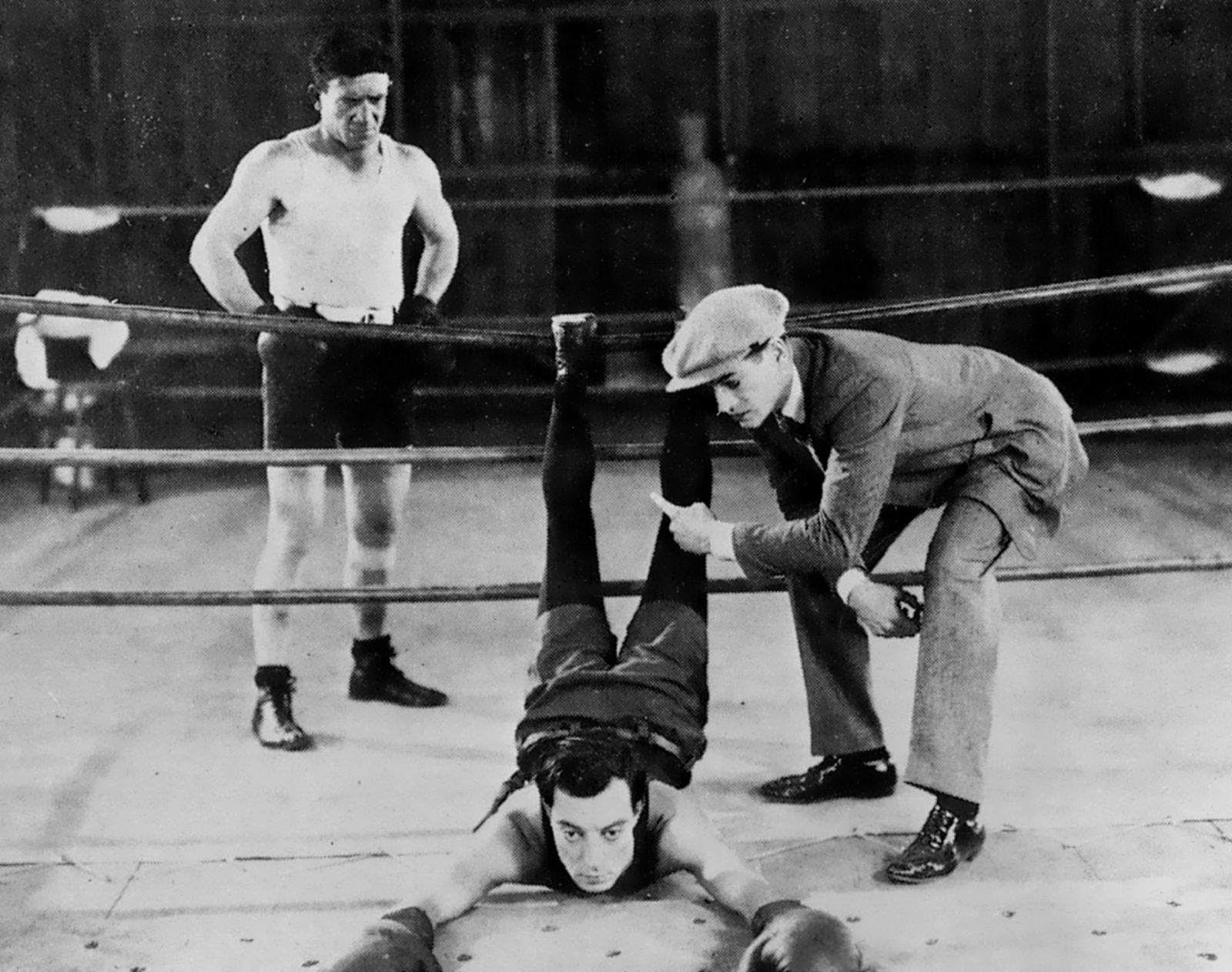
A vintage poster for 'Battling Butler' that renders the athletic Keaton as unusually scrawny.

Next up: Buster Keaton's boxing comedy 'Battling Butler' (1926).

I'm doing live music for this film on Thursday, June 2 at the Leavitt Theatre in Ogunquit, Maine.

Details about the screening are in the press release below.

But one thing about this film that has always impressed me is how it shows Keaton's sure instinct for story construction.

The storyline for 'Battling Butler' was taken from a popular stage play about a meek millionaire who must train to fight a champion in the ring.

In the play, the story climaxes in the dressing room just before the fight, when the millionaire finds out he doesn't have to face the champion. Happy ending!

However, in transferring the story to the screen, Keaton knew his character and his audience well enough to know the non-fight ending just wasn't going to work.

To quote Keaton himiself in a late-in-life interview: "But we knew better than to do that to a motion-picture audience. We couldn’t promise ’em for seven reels that I was goin’ to fight in the ring and then not fight. We knew that we had to fight."

So they changed the story accordingly—and the result was Keaton's highest-grossing film of the 1920s.

Keaton in 'Battling Butler' (1926).

How did Keaton know to do this? There was no film school at the time, and Keaton never went to any traditional school, either. He spent his childhood touring in the family vaudeville act.

I suspect that over the years, he absorbed so much about how theater audiences react that his sense of what would work in a story and what wouldn't was instinctual. He just knew.

Same thing with his masterpiece, 'The General' (1926), made right after 'Battling Butler.'

Keaton structured his Civil War story to put his role on the Confederate side, because he said (again, in a late-in-life interview) "You can always make villains out of the Northerners, but you cannot make a villain out of the South."

Why? Because the South lost? I don't know.

By the way, I'm accompanying a screening of 'The General' on Friday, June 10 at Red River Theatres in Concord, N.H. More about later.

For now, I hope you'll join us this Thursday to see Buster Keaton lace up the gloves in 'Battling Butler' (1926).

The press release is below. See you there!

* * *

A vintage poster for 'Battling Butler' (1926).

TUESDAY, MAY 24, 2016 / FOR IMMEDIATE RELEASE
For more info, contact: Jeff Rapsis • (603) 236-9237 • jeffrapsis@gmail.com

Buster Keaton comedy 'Battling Butler' at Leavitt Theatre on Thursday, June 2


Classic silent film farce set in the boxing world to be screened with live music in historic downtown Ogunquit venue

OGUNQUIT, Maine—He never smiled on camera, earning him the nickname of "the Great Stone Face." But Buster Keaton's comedies rocked Hollywood's silent era with laughter throughout the 1920s.

See for yourself with a screening of 'Battling Butler' (1926), one of Keaton's landmark feature films, on Thursday, June 2 at 8 p.m. at the Leavitt Theatre, 259 Main St. Route 1, Ogunquit, Maine

The one-time screening will feature live music performed by Jeff Rapsis. Tickets are $10 per person.

In 'Battling Butler,' Keaton plays Alfred Butler, a pampered millionaire who is mistaken for a boxer with a similar name.

The mix-up gives the meek Butler the chance to pretend he's a prizefighter to impress the family of the woman he loves.

But then Keaton is forced to enter training for a high-stakes championship bout, with surprising results.

The boxing scenes gave Keaton ample opportunity to wring physical comedy out of the fight game, which at the time rivaled baseball in popularity.

Based on a story adapted from a popular stage play, 'Battling Butler' was Keaton's highest-grossing silent feature film and the high point of his 1920s stardom.

Keaton takes a pratfall in 'Battling Butler.'

Today Keaton, along with Charlie Chaplin and Harold Lloyd, stands as one of the three great clowns of the silent screen.

Many critics regard Keaton as the best of all; Roger Ebert wrote in 2002 that "in an extraordinary period from 1920 to 1929, (Keaton) worked without interruption on a series of films that make him, arguably, the greatest actor-director in the history of the movies."

As a performer, Keaton was uniquely suited to the demands of silent comedy. Born in 1895, he made his stage debut as a toddler, joining his family's knockabout vaudeville act and learning to take falls and do acrobatic stunts at an early age. He spent his entire childhood and adolescence on stage, attending school for exactly one day.

A remarkable pantomime artist, Keaton naturally used his whole body to communicate emotions ranging from sadness to surprise. In an era when movies had few special effects, Keaton's acrobatic talents meant he performed all his own stunts.

In reviving 'Battling Butler' and other great films of cinema's early years, organizers of Leavitt's silent film series aim to show classic movies as they were meant to be seen—in high quality prints, on a large screen, with live music, and with an audience.

"These are the films that first made people fall in love with the movies, and we're thrilled to present them again on the big screen," said Peter Clayton, the Leavitt's long-time owner.

The Leavitt, a summer-only moviehouse, opened in 1923 at the height of the silent film era, and has been showing movies to summertime visitors for nine decades.

The silent film series honors the theater's long service as a moviehouse that has entertained generations of Seacoast residents and visitors, in good times and in bad.

Live music for each program will be provided by Jeff Rapsis, a New Hampshire-based performer and composer who specializes in scoring silent films.

In accompanying silent films live, Rapsis uses a digital synthesizer to recreate the texture of the full orchestra. He improvises the music in real time, as the movie is shown.

In scoring a movie, Rapsis creates music to help modern movie-goers accept silent film as a vital art form rather than something antiquated or obsolete.

Other feature films in this year's series include:

• Thursday, June 23 at 8 p.m.: 'Don Q, Son of Zorro' (1925), Douglas Fairbanks Sr. stars in this sequel to his immensely popular 'Mark of Zorro,' which opened this season's silent film series.

• Thursday, July 7 at 8 p.m.: 'A Sailor-Made Man' (1921), uproarious send-up of Navy life helped establish Harold Lloyd as a top-tier silent film comic.

• Thursday, July 21 at 8 p.m.: 'Tess of the Storm Country' (1922), Mary Pickford's intense melodrama with a classic Yuletide finish. Christmas in July!

• Thursday, Aug. 11 at 8 p.m.: 'Tramp Tramp Tramp' (1926); comic Harry Langdon enters a cross-country foot race to impress his dream girl, Joan Crawford!

• Thursday, Aug. 25 at 8 p.m.: 'Son of the Sheik' (1926), final appearance of silent screen icon Rudolph Valentino on the 90th anniversary of his death.

• Thursday, Sept. 15 at 8 p.m.: 'The Winning of Barbara Worth' (1927); Ronald Colman and Gary Cooper compete for a woman's favor in this epic Western filmed on location.

• Saturday, Oct. 29 at 8 p.m.: 'The Man Who Laughs' (1928); celebrate Halloween with this creepy but riveting historical tale about a man forced to go through life with a maniacal grin.

Buster Keaton's comedy 'Battling Butler' (1926) will be shown with live music on Thursday, June 2 at 8 p.m. at the Leavitt Fine Arts Theatre, 259 Main St. Route 1, Ogunquit, Maine; (207) 646-3123; admission is $10 per person, general seating. For more information, visit www.leavittheatre.com. For more info on the music, visit www.jeffrapsis.com.

Friday, May 27, 2016

In this corner—a summer of the 'sweet science'
of boxing on the silent screen in Wilton, N.H.

Buster Keaton in 'Battling Butler' (1926).

Even if boxing isn't your bag, I hope you'll join us for a series of silent films this summer that center on the sweet science.

Heck, even if you're not into silent film, I hope you'll check out this series. :)

It's at the Wilton (N.H.) Town Hall Theatre, where we'll run boxing-related dramas, comedies, and love stories in the coming months.

Several heavyweight filmmakers headline the action, with Alfred Hitchcock and Buster Keaton among them.

But the undercard includes many other hopefuls and wanna-bes, all eager for their shot in the ring.

First up is 'Dress Parade' (1927), a Cecil B. DeMille drama starring William Boyd as a prizefighter who falls for the daughter of a West Point Commandant.


Boyd would later go on to lasting fame as cowboy hero Hopalong Cassidy. "Dress Parade" was filmed on location at West Point, and so doubles as our annual Memorial Day weekend silent film tribute.

Actually, it's more of a military story than a boxing tale, and so it'll serve as a transition into the boxing flicks.

The screening is Sunday, May 29 at 4:30 p.m, at the Town Hall Theatre, 40 Main St., Wilton, N.H. Live music is by me.

Admission is free, with a suggested donation of $5 per person to defray expenses.

A full line-up of the other contenders in our boxing series is found in the press release below.

Taken as a whole, these movies form a time capsule into an era when boxing rivaled baseball as the nation's most popular sport.

That's no longer the case, of course, especially with today's emphasis on safety and injury prevention.

But back in the 1920s, the fight game enjoyed a national popularity that extended right down to the grassroots.

Neighborhoods, ethnic groups, you name it: every town had a fight arena, and just about everyone had a favorite fighter to root for.

And kids idolized champions such as Jack Dempsey, whose "long count" bout with Gene Tunney in 1927 was one of the era's big stories.

This popularity is reflected in the movies of the time. Watch films from the silent era, and you'll find boxing a constant presence.

Consider that all the great silent comedians—Chaplin, Keaton, Lloyd, Langdon—spent time in the prize ring.

Just last night at Red River Theatres in Concord, N.H., I introduced a screening of Chaplin's 'City Lights' (1931).

Judging from audience reaction, the superbly choreographed boxing scene was the highlight of the evening.

So boxing, and the struggle it symbolized, was regarded as part of everyday life.

Moreover, boxing was visual. Words weren't necessary to tell the story of two men pushed to their physical limits and striving to beat each other into submission.

So moviemakers were naturally inclined to use boxing and its world as a setting for their stories.

By the way, I say "men" because at the time, boxing was completely male-dominated. Female boxing, if it occurred at all, was considered a novelty. In an era of sharply defined gender roles, a woman just didn't do such things as fight in the ring.

Surprisingly, female boxing does show up in some silent films, although usually as a gimmick. One example is Clara Bow's 'Roughhouse Rosie' (1927), in which Bow gets her men "by treating them rough!" It's a film that, alas, no longer survives.

Clara Bow in 'Roughhouse Rosie.'

Filmmakers also sometimes used boxing's raw physicality to punch up the visuals, so to speak.

There's a remarkable night club scene in Fritz Lang's film 'Spies' (1928) where two boxers in a makeshift ring beat each other senseless while a glittering society crowd looks on.

From Fritz Lang's 'Spies' (1928).

When one finally succumbs, a band strikes up, and dancing couples immediately crowd onto the floor to foxtrot. Among them are the protagonist and the mysterious woman he is battling, so I can see where Lang was going.

Well, boxing is no longer mainstream. But the elemental nature of the sport retains its fascination, I think, and also its status as a vivid metaphor for—well, everything.

It's sport reduced to its essence: two competitors facing each other in a battle for victory. What could be simpler?

And it was George Foreman who observed that boxing is "the sport to which all other sports aspire."

It continues to inspire writers, including Joyce Carol Oates, whose "On Boxing" is a minor modern classic, I think.

And it's still with us. Even if you've never set foot in a fight arena, you've used the language and imagery of boxing, which pervades everyday conversation.

Consider: a beautiful woman is a knockout. A supportive friend is in your corner.

To persevere is to go the distance. A setback is a body blow. To give up is to throw in the towel.

All these are boxing phrases.

To do something against the rules is hitting below the belt. And if you want to really hurt someone, the gloves come off.

That last phrase is a strange one. In boxing, the gloves actually allow more damage because they protect a fighter's hands.

I once thought to show someone the ropes was a boxing phrase, but it actually comes from sailing.

Well, whatever phrasing you use...I find that in a complex world of uncertainties and interdependencies and compromises, the direct simplicity of boxing can be refreshing.

I'm no fan of violence, and don't wish a concussion on anyone.

But to me, boxing is a way for us to explore and express the aggressive side of our nature. Just as the simplicity of silent film allows us to reconnect with big primal emotions, boxing allows us to experience being alive in a physical way that's intense and riveting and unlike any other.

The bell rings this weekend with 'Dress Parade' on Sunday, May 29 at 4:30 p.m. at the Town Hall Theatre in Wilton, N.H. Below is the press release with info about other films in the series.

On the fight card: Hitchcock's early drama 'The Ring' (1927).

WEDNESDAY, MAY 11, 2016 / FOR IMMEDIATE RELEASE
Contact Jeff Rapsis • (603) 236-9237 • jeffrapsis@gmail.com

Put up your dukes! Wilton (N.H.) Town Hall Theatre to screen series of vintage boxing movies


Bell rings this summer on line-up of silent films spotlighting the fight game; all screened with live musical accompaniment

WILTON, N.H.—Alfred Hitchcock and Buster Keaton are among filmmakers featured in a summer series of vintage boxing movies at the Town Hall Theatre.

The series opens on Memorial Day weekend with a screening on Sunday, May 29 of 'Dress Parade' (1927), a drama filmed on location at the U.S. Military Academy at West Point.

All movies in the series are from the silent film era, and will be presented with live music by Jeff Rapsis, a New Hampshire-based silent film accompanist.

"At the time these films were made, boxing rivaled baseball in mainstream popularity in the United States," Rapsis said. "So early on, filmmakers naturally turned to the boxing world as a great source of drama, action, and visual excitement. In the silent era, it was a popular sub-genre."

The boxing films are part of the Wilton Town Hall Theatre's ongoing monthly silent film series. Admission to the screenings is free; a donation of $5 per person is suggested.

The Town Hall Theatre's "Summer Boxing Series" opens on Sunday, May 29 at 4:30 p.m. with 'Dress Parade' (1927).

Produced by Cecil B. Demille and released by MGM, 'Dress Parade' is the story of an amateur boxer who enrolls in West Point, where he must battle for the affection of the Commandant's daughter.

The film stars a young William Boyd, who would later achieve enduring fame as Hopalong Cassidy in countless Hollywood Westerns.

'Dress Parade' includes scenes filmed on location at West Point, which prompted its screening on Memorial Day weekend.

Other titles in the Summer Boxing Series include Alfred Hitchcock's early boxing drama 'The Ring' (1927) on Sunday, July 24.

A scene from Hitchcock's 'The Ring.'

"Hitchcock's drama of two fighters in love with the same woman shows many of the characteristics that would later earn him the nickname 'The Master of Suspense,' " Rapsis said.

The series concludes on Sunday, Aug. 28 with 'Battling Butler' (1926), Buster Keaton's uproarious boxing comedy about a pampered millionaire mistaken for a champion fighter.

The series will also include several vintage boxing-themed short films.

Silent-era boxing dramas are of particular interest to sports buffs because they're filled with scenes of the fight game at the height of its mainstream popularity.

"As an elemental contest between two people, boxing inspired early filmmakers to do some of their best work," Rapsis said. "It's a very visual sport that lends itself to the movies."

All shows in the silent film series start at 4:30 p.m. The Town Hall Theatre's screenings are free and open to the public; a donation of $5 per person is suggested to help defray expenses.

Each film in the series has been selected for its overall story quality and lasting audience appeal.

"Even if you're not a boxing fan, each of these movies offers a great story told at a fast pace," Rapsis said. "These films were designed to be crowd-pleasers, and they still work today. They're the kind of films that caused audiences to first fall in love with the movies."

The Wilton Town Hall Theatre has been showing films since 1912. In addition to running the best current releases on its two screens, the theater remains committed to alternative programming such as its ongoing series of silent films with live music.

The silent series gives local audiences to experience great work of early cinema as it was intended to be seen: on the big screen, with live music, and with an audience.

The complete line-up of films in this summer's boxing series includes:

• Sunday, May 29, 4:30 p.m.: 'Dress Parade' (1927) starring William Boyd, Bessie Love. An amateur boxing champ visits the U.S. Military Academy and falls for the commandant's daughter. He wins an appointment to the Academy and then begins a rivalry for her affection. Our annual Memorial Day weekend program, filmed on location at West Point!

• Sunday, July 3, 4:30 p.m.: A Boxing Double Feature. A two-fisted pair of vintage silent boxing tales. In 'Battling Bunyan' (1924), a young mechanic turns to the prize ring to earn money to start his auto repair business; in 'The Shock Punch' (1925), a boxer takes a construction job only to find his boss is a former opponent he once defeated in the ring.

ADDITIONAL SHOW! • Sunday, July 17, 4:30 p.m.: Melodramas that Pack a Punch! Up first is 'The Battling Fool' (1924), in which a minister's son takes up boxing. In 'American Pluck' (1925), a cowboy-turned-prizefighter comes to the rescue of a visiting foreign princess.

• Sunday, July 24, 4:30 p.m.: 'The Ring' (1927) directed by Alfred Hitchcock. The master of suspense was very young, and still in England, when he made this silent drama about two boxers in love with the same woman. Who will win the fight for her heart? Full of trademark Hitchcock touches even at this early stage in his career.

• Sunday, Aug. 28, 4:30 p.m.: 'Battling Butler' (1926) starring Buster Keaton. Our series of silent boxing movies concludes with Keaton's riotous comedy. Keaton plays Alfred Butler, a pampered rich idler with the same name as a feared boxing champion. When a girl he fancies thinks he's the fighter, Keaton has no choice but to start training.

The Summer Silent Boxing Film Series will begin with a screening of 'Dress Parade' (1927) on Sunday, May 29 at 4:30 p.m. at the Wilton Town Hall Theatre, 60 Main St., Wilton, N.H. Admission is free; a donation of $5 per person is suggested.

For more info, call (603) 654-3456 or visit www.wiltontownhalltheatre.com. For more info on the music, visit www.jeffrapsis.com.