Showing posts with label Joe Yranski. Show all posts

Monday, November 4, 2024

Thoughts on 'Daughter of the Dawn' in San Francisco, and remembering Joe Yranski

Me and silent film accompanist Rodney Sauer at the Essanay Silent Film Museum in Niles, Calif.

Saturday, Nov. 2 brought a double-helping of my favorite dish: silent film delight.

I got to accompany 'Daughter of the Dawn' (1920), an unusual Native American drama, at the Niles Essanay Silent Film Museum in Niles, Calif.

And I also got to see and visit with all the folks who maintain the Niles museum, the only venue I know of that runs a silent film program with live music every week all year round.

Really! Sometimes the programs can be quite creative. Later this month, Jon Mirsalis (a Bay area resident and Niles regular) will accompany the classic drama 'The Wind' (1928) in what's being described as 'Blow-A-Rama.'

All I know is that it involves the use of fans in the Niles venue, which is an original 1913 Edison theater. Wish I could be on hand. Still, it's a good enough idea that I'm considering stealing it.

Niles is a natural gathering place for the silent film community, which is why I've been journeying out there off and on (thank you, frequent flier miles!) for the past 10 years or so.

This time, I was joined by another guest accompanist: Rodney Sauer of the Mont Alto Motion Picture Orchestra, who was on hand to help out with a program honoring Native American Heritage Month, which happens to be November.

It was Rodney and his Mont Alto group (a five-member combo that specializes in scoring silent films) that first got me pointed toward exploring the craft on my own—almost 25 years ago now!

It was March 2000. On a whim, I attended the Kansas Silent Film Festival (this time, thank you Delta flight passes!) in Topeka, Kansas, where I'd never been before. There, I heard the Mont Alto group accompany the silent 'Peter Pan' (1924) and Buster Keaton's 'The Cameraman' (1928).

And I met people, including Rodney, who were so encouraging and welcoming that it eventually led to my trying my hand (or rather, both hands) at it. And here we are.

I've since had occasion to appear on the same program as Rodney, mostly at subsequent Kansas festivals, and it's always great to see him and the other Mont Alto members, catch up, and trade stories. 

Rodney helped me find sheet music for when I recorded a score for Gloria Swanson's 'Zaza' (1923), and he's always been friendly and encouraging and bemused and generous.

Rodney was visiting Niles to speak about and accompany 'Ramona' (1929), starring Delores Del Rio and directed by Edwin Carewe, one of the few motion picture directors of Native American heritage, then or now.

He also introduced 'Daughter of the Dawn' (1920), the film I accompanied, providing the Saturday afternoon audience a good summary of how the film came to be, and how it was rediscovered only recently as part of a business legal settlement in Oklahoma. 

Although the film has been reissued with a recorded score using appropriate and authentic Native American music, Niles is committed to showing silent films with live accompaniment. Since I qualify as live, I got the assignment. 

But the thing is, I don't qualify as Native American. With me, you can take your pick: I'm one quarter Irish, Polish, Lithuanian, and/or French-Canadian. Call my ethnicity "assorted."

So my musical heritage, such as it is, is a melange of Polish polkas played on accordian (which Rodney could do, if needed), Irish step-dancing, and what I'll call Quebec-style country & western. Plus all the marching band music I absorbed in high school.

But it was Rodney who gave me a clue about how to approach 'Daughter of the Dawn'—not at Niles, but years ago at a Kansas Silent Film Festival, when he accompanied the wilderness docu-drama 'Chang' (1928) on solo piano.

I don't think Rodney's heritage includes any of the indigenous tribal peoples of southeast Asia, where the film was shot. 

But I remember Rodney saying that to create an effective atmosphere, he tried to avoid "Western-style" chord progressions and modal scales—scales that to our ears might sound somewhat medieval, as in a Gregorian chant.

It seemed to work for Rodney back then. So that's what I did for 'Daughter of the Dawn.'

I took a handful of melodic scraps heavy with intervals of fourths, some flourishes built on modal scales, and wove it together as best I could to support what unfolded on the screen.

I think I struck paydirt right away with a simple device during the opening titles: a single note repeated twice, alternating off the beat in octaves, pulsing steadily along, over and over.

This not only provided a way to enter the world of the movie, but became a kind of textural signal that could be brought back whenever needed. And just by dumb luck, it worked really well when the movie went in a "two hearts that beat as one" direction. 

Under this pulsing note figure, I began weaving different harmonies, mostly using minor chords or often just open fifths. Then I could shift from the pulsing notes, bring in my melodies and work up music as the movie unfolded. 

The one really prominent dance in 'Daughter of the Dawn' is not some kind of theatrical call to war, but was a quiet and modest 'Dance of Thanksgiving' after a successful hunt. Shown onscreen, it consisted of a modest shuffling in a circle, with little footwork and no arm movement. 

For music, this was a lucky break. I was able to do it justice, I think, but a quiet percussive shifting of chords deep in the piano's bass notes. 

In the end, the music for 'Dawn of the Dead' fell together pretty well, I thought. I neither overplayed or underplayed—a balance it's taken me some time to achieve. And thus I created music for my 399th silent feature film. (Yes, I keep track right on this blog.)

And now it's back to New England for a run of shows leading into the holiday season, highlighted by a 100th anniversary screening of 'The Thief of Bagdad' (1924) on Tuesday, Nov. 26 at the Coolidge Corner Theatre in Brookline, Mass., and later (in December) what will be my 400th film: the silent 'Oliver Twist' (1922), starring Jackie Coogan and Lon Chaney, which I'll accompany on Friday, Dec. 13 as part of a Dickens festival at the Park Theatre in Jaffrey, N.H.

Joe Yranski, 1951-2024.

Before moving on, I would be remiss to not mention the recent passing of Joe Yranski, well-known and well-loved film buff who died unexpectedly on Oct. 31.

Joe was one of the major figures in the vintage film community. To account for the scope of Joe's work over the years in any complete way would be nearly impossible. 

Organizations he worked with include the Library of Congress, the Academy of Motion Picture Arts and Sciences, the Mary Pickford Foundation, and Warner Bros. Joe helped preserve and reclaim an untold number of classic films.

On a personal note: like Rodney Sauer, Joe was a person whose generosity and friendliness and overall example encouraged me to take up the practice of silent film accompaniment.

I first encountered Joe in 2008 through fellow accompanist Ben Model, who at the time was working with Joe in programming silent film screenings at the old Donnell Library Center branch of the New York City Public Library on West 53rd St.

Through Ben, I was invited to participate in a "Meet the Music Makers" series that Joe was running, even though at the time I had just started accompanying silent film programs and hadn't made much music at all.

Still, Joe invited me to come down to Manhattan and accompany 'Lessons in Love' (1921), a Constance Talmadge film that hadn't been available since it probably first ran, but which Joe had resurrected and was screening as part of the series, which took place in the facility's basement auditorium.

(I had never heard of 'Lessons in Love' before this, but Joe provided a screener on VHS in advance of the show. I remember my big idea was to play off the 'Lessons in Love' idea by basing large parts of the accompaniment on my Hanon piano technical exercises.)

It turned out Joe and I were both graduates of Fordham University in New York. Based on that, and a mutual interest in vintage film, Joe and I struck up a friendship and correspondence that never flagged over the years. Although a die-hard New Yorker, he occasionally took vacation trips to New England, so we shared that in common as well, though our paths never crossed during these travels.

As I got to know Joe, he revealed himself as a man fully in thrall with life. This took various forms: most obviously his zest for cinema, and in particular his strong connection to silent-era star Colleen Moore, whom he befriended, and whose family he remained in contact with.

But there was more. I could see he had a passion for New York City—its history, its presence, all that it offered. He was part of it and it was part of him. Throughout his life, he held the same wonder that I recall having as a high school kid from New Hampshire arriving at Fordham, except Joe never outgrew that.

I'm sure Joe's life wasn't always easy, but he never failed to be anything less than courteous and solicitous and gracious and charming. These are all qualities in short supply, in our times especially, but not when Joe Yranski was present.

Soon after my Donnell Library debut, Joe invited me to accompany films at Cinefest, the annual vintage film confab that used to take place every March in Syracuse, N.Y. 

I still consider this my "big break," in that I was able to finally meet and work alongside many other accompanists, film scholars, authors, and all the characters that make up the vintage film community.

Under Joe's guidance, I remained in the rotation at Syracuse until the final blow-out year in 2015, when no less than eight accompanists were brought in to share the duties as a kind of last hurrah. 

I'll never forget sitting in the room before the film screenings started, as legendary accompanists including Phil Carli and Gabriel Thibaudeau and Makia Matsumura and Judy Rosenberg and Andrew Simpson and the aforementioned Jon Mirsalis and Ben Model were dividing up the films, and thinking to myself, "What am I doing here?"

But Joe felt I should be included, and that was all I needed to jump in and do my best with a film no one wanted: the silent film version of Harold Lloyd's early talkie, 'Welcome Danger' (1929). It came together marvelously, I thought, and remains a highlight of my silent film accompaniment career—all thanks to Joe.

After a long run, Cinevent ended in 2015. But the years rolled on, and Joe kept in touch. Holidays brought friendly notes. Sending out my schedule of upcoming performances often brought encouraging remarks. I didn't get to see Joe very often, but he was always there.

Until now. All I can say is that I'm very sorry that he's no longer among us. I don't think it's really quite sunk in yet. 

But I do know this: the example of good cheer and friendly openness that Joe Yranski always set is something that I will continue to try to emulate.

And with a nod to our Fordham connection, I will say one more time: Go Rams!

Tuesday, March 18, 2014

Some notes from Cinefest 2014;
and next up, 'The Lost World' (1925)

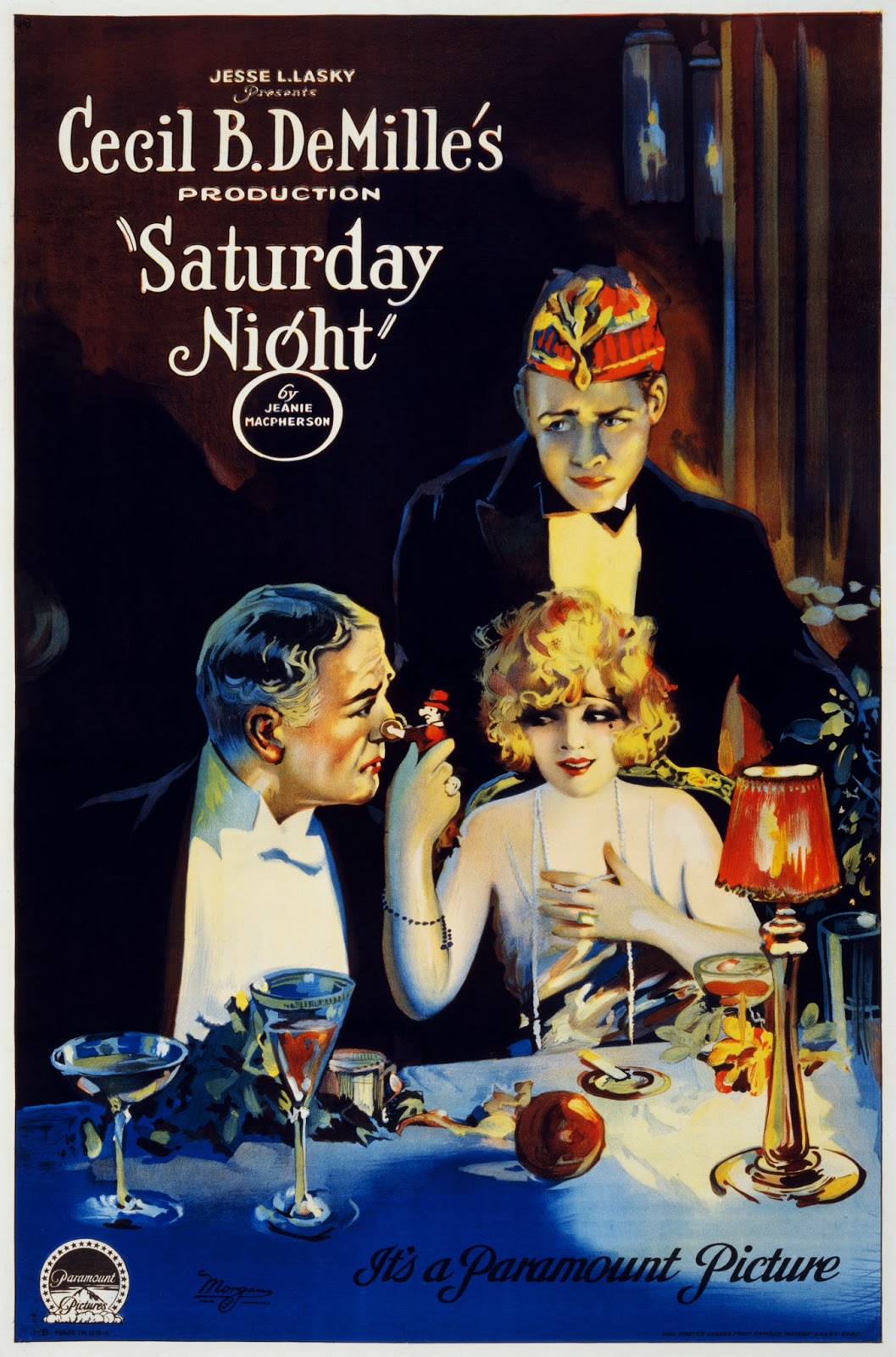
'Saturday Night' (1922), shown on Thursday morning, was the opening silent at this year's Cinefest.

I've just come back from Cinefest in Syracuse. And although I didn't fly, boy are my arms tired!

Well, not really, even though I accompanied six feature films in four days. I just couldn't resist the chance to give new life to humor from another era.

And that captures the spirit of Cinefest, I think: giving life (on screen, anyway) to older motion pictures that otherwise aren't screened anywhere. By "older," I mean features and short films from the silent and early talkie era, up until about World War II.

Some are surprisingly compelling. Others turn out to be real turkeys. But all get a chance to live again, shown as they were intended: on a big screen, with an attentive audience, and with live music for the silent films.

The more I think about it, the more important I realize such events are in terms of understanding the impact that early motion pictures had on the culture of their era. Much of their energy and excitement comes from the effect they produced on an audience, and the people who created them had this in mind all along.

They were never intended to be consumed in private or in solitude, either on a screen in someone's basement or, God help us, on a cell phone.

So the chance to see older pictures, good or bad, with an audience, can be a revelation in that a key element of their original power is restored. To see any motion picture from before World War II without an audience is like standing outside the Louvre Museum in Paris and saying you've experienced the Mona Lisa.

This year's Cinefest, which ran from Thursday, March 13 through Sunday, March 16, 2014, offered a wonderfully mixed grabbag of titles, including a group of a half-dozen Fox talkies from the early 1930s and a bigger-than-normal proportion of silent films.

In fact, the silent schedule was heavy enough for this year's Cinefest to have four accompanists on hand to supply music, rather than the usual three. And that was good news for me, because one of the big attractions of Cinefest is the chance to hear other accompanists ply the trade in live performance for a lot of different films.

This year, my colleagues were Makia Matusmura, a highly regarded New York-based accompanist whom I'd never had the chance to hear before; Judy Rosenberg, a wonderful accompanist from San Francisco whose recorded work I've long admired but whom I also hadn't heard in live performance; and the great Jon Mirsalis, also from the San Francisco area, whose style and approach I think makes him one of the most effective accompanists in the field.

All three turned in multiple memorable performances—in fact, there was so much music and so many movies, at this point I would be hard-pressed single out one moment over another. There was also a richness to the accompaniment in that everyone was able to adapt quite readily to all the different styles and genres of the many silents on the program.

Even accompanist Ben Model was on hand for his "undercranking" presentation, and sat in to play for many of the comedy short subject programs, so I got to hear him in action as well. Five accompanists in one spot must be some kind of record.

I always learn so much, I think, from hearing what other accompanists do and now they approach the task. It's one of the great pleasures of being part of Cinefest these past three years.

As for me, I had some good moments, but also some weak stretches. Compiling a log of what I did might help me tie together what I got out of the experience, so here goes. (Keep in mind that there's no chance to preview these films, so they're played "cold" by the accompanists.)

• Thursday, March 13: 'Saturday Night' (1922): The very first silent feature of this year's Cinefest was this Cecil B. DeMille society comedy/drama that went pretty well. I had good material to accompany the constrasting worlds of the upper and lower class characters, and the story flowed quite naturally, so the music stayed on target, I thought. The best thing about it was that you could see the comedy scenes coming from a mile away, so I was able to get music under them that was pretty effective, I thought. It wasn't hard to capture even small details, such as how the elevated train ran right outside a tenement flat.

• Thursday, March 13: 'Fanchon, the Cricket' (1915): This recently restored early Mary Pickford feature was another effort that held together well, I thought. Unusual in that it was set in a kind of medieval fantasy world, which I tried to match with a light "music box" style of accompaniment that seemed to do the trick.Kind of a weak film in that I found it hard to find much to be sympathetic about in Mary's character or situation, but I did my best to "cast a spell" and help put the film over.

Fannie Ward and Jack Dean in 'For the Defense' (1916)

• Friday, March 14: 'For the Defense' (1916): This early Paramount drama was perhaps my favorite of those I accompanied, in that it was totally unknown to me, but somehow I felt in synch with it right from the start. The material I chose seemed to fit well, I could follow the story with ease, and I paced it right so that the last 20 minutes of the film seemed to be very effective. No less a person than film preservation guru David Shepard said I did a good job "heightening the dramatic tension" of the film's climax. High praise indeed! It also won the award for the best intertitle of the festival: "I have to tell you ..... I murdered a man.... and I love you."

• Friday, March 14: 'Buck Privates' (1928): No, not the Abbott and Costello film, but a silent World War I army comedy about doughboys in Europe. I tried to keep it light, which was the right approach, but somehow the material I had didn't seem to help the film jell. (The fact that the film started just before midnight might have been a factor.) However, a frantic chase finale came as a nice surprise, allowing me to kick the material I'd been using into high velocity mode. Too bad so few attendees were on hand for it! But this served as a great example to me of how comedy is harder to do effectively. A chance to see this beforehand would have really helped with the pacing, as the humor was not as easily discerned on sight as in, say, 'Saturday Night.'

• Saturday, March 15: 'The Live Wire' (1925): This Johnny Hines comedy should have been a highlight of the festival, but it produced only sparse reaction, I think in part because the material I chose just wasn't a great fit for the film, and also I couldn't seem to get in synch with the film's spirit. Because of this, I began pushing tempos too soon, further confusing things and leaving me with nowhere to go when the climax finally did play out. Leonard Maltin, sitting right behind me for the screening, commented afterwards that I had "set quite a pace for myself" on that one. Definitely my weakest entry, I felt, and not helped by two cups of wine I had earlier in the evening. :)

• Sunday, March 16: 'The Devil Horse' (1926): I considered this action-packed Western drama starring Rex the Wonder Horse my grand finale, and so got permission to hook up the digital synthesizer and speakers to go all out. Everyone seemed really impressed, if only because the palette of the full orchestra (including big percussion, appropriate for a horse opera full of scenes of "injuns" on the warpath) was undoubtedly a constrast to the piano texture that is otherwise the soundtrack for silents at Cinefest. However, like 'The Live Wire,' I felt out of synch with this one as well, and found myself playing too much too soon. All went okay, however, despite a blown projection bulb during the climactic battle to save the fort. I pushed forward in the darkness, playing underscoring that vamped us until the movie started up again—now tinted pink because the new bulb hadn't warmed up yet!

What did I learn? Take your time. Resist the temptation to overplay. And don't drink wine prior to accompanying. A continuous line of melody can be better than abrupt transitions. Matching the right material is important, so don't be afraid to abandon music that's not working and go with something else. Avoid AUI, or Accompanying Under the Influence. 

Cinefest follows a pattern of inviting accompanists for a three-year commitment on a rotating basis. And because this was my third year, 'The Devil Horse' really was the grand finale of my involvement for now, at least as an accompanist. It's been a great experience, as I've learned a lot and made contacts that will help me continue to pursue this unusual craft.

So I want to thank everyone associated with this grand affair for the chance to contribute music and get to know some wonderful people. Thanks especially to Joe Yranski for first inviting me as an accompanist, and to organizers Rick Scheckman and Gerry Orlando for all they do it getting the films programmed and the festival planned, and also to the projection and house crew in the theater who make it easy to concentrate on the music alone—something that's quite a luxury for me. :)

And now...looking ahead! A screening of 'The Lost World' (1925) will take place on Thursday, March 20 at 6:30 p.m. at the Flying Monkey Moviehouse and Performance Center in Plymouth, N.H. Tickets are $10 and hoping for a good crowd to be on hand for this grandpappy of all dinosaur movies.

I've been so busy that I haven't had a chance to get out a press release on this one, which is a shame, because I think it has a natural audience, given the enduring popularity of our prehistoric friends. Still, hope to see you there!

Tuesday, March 19, 2013

From the piano: 33rd Annual Cinefest
vintage film confab March 14-17, 2013

My usual state between films at Cinefest.

What happens when several hundred movie buffs get together to enjoy four straight days of obscure vintage cinema?

By "straight," I mean from 9 a.m. to midnight Thursday through Saturday, followed by a lighter schedule of just 9 hours of viewing on Sunday. And by "vintage," I mean little-known flicks from way back in the silent and early sound era.

What happens is you get Cinefest, one of the high points of the vintage entertainment calendar. Every March, the film faithful gather at a Holiday Inn outside Syracuse, N.Y. for a multi-day buffet of comedies, dramas, westerns, thrillers, propaganda films, musicals, home movies of Curly Howard, and more. They're often bizarre, but they're always interesting.

To learn more about this annual confab, check out a write-up by critic and author Leonard Maltin, who attends every year with his wife Alice.

Hey! That's me with Leonard Maltin and Alice.

But for a more limited view—my perspective from the piano bench as one of the accompanists, or just wandering the halls—read on.

It might seem a little disjointed, but that's what happens when you score five completely different films (and plenty of shorts) in a few days. Reality begins blurring with what occurred on screen. Also, the place where the music comes from is tapped so often and steadily that it becomes hard to turn off, or starts to behave like a leaky faucet. You begin imagining music while, say, walking across the parking lot to the pharmacy to buy beer or headache tablets.

• Thursday, March 14: Day One of Cinefest was proceeded by the previous night's customary trip to the hospitality suite, where I scarfed a couple of sandwiches and helped carry in Leonard Maltin's luggage across the hall. Ah, show business.

Also in the musical line-up: Andrew Simpson, who was here last year, and Jon Mirsalis, one of the big names in the field and someone whose work I really admire. What a privilege to be playing on the same program with two heavy hitters!

And also a little intimidating. But I've found that my own style is what it is. So I can't get too self-conscious or try to be something I'm not — specifically, a concert pianist. Heck, I'd even make a lousy rehearsal pianist! Helpfully, Jon recounted how he felt he was terrible when he started out, which I actually found comforting.

On Thursday morning, accompaniment duties began at 10:45 a.m. with the first installment of 'Lame Brains and Lunatics,' a program of obscure silent short comedies from the Library of Congress compiled by Rob Stone and Steve Massa. Andrew took the lead on this; I followed along with tunes for a couple of shorts in between. Jon had asked to be excused from playing for silent film comedies, which seem to be pretty low on his list of good ways to spend what time we have on this planet, and I can understand.

After lunch, I got to hear Jon play (for me, the first time live) for 'Wild Beauty' (1926), an absurd horse drama that Jon's music transformed into compelling cinema. In live performance, Jon's style and musical vocabulary are instantly recognizable. I kept thinking: present at the creation. It's why people visit Niagara Falls in person rather just look at pictures of it. I was especially impressed with some deep and consistent rumbling that Jon produced for a stampede sequence — it all seemed to be coming from the bottom octave of the keyboard. Later, Jon said the effect was produced by "a lot of notes."

Andrew drew a difficult drama, 'The Whip,' (1917), another horse-related story (more about the humans) but a hodgepodge of scenes that didn't quite make sense and in some cases were clearly in the wrong order. He made it bearable with some great playing, I thought. Things fell together for him much more naturally in 'My Boy' (1921), a melodrama featuring child star Jackie Coogan, then fresh off his triumph in Chaplin's 'The Kid' the year before.

Andrew, with his quadro-textured Italian suitcoat, warms up for 'My Boy' on Thursday afternoon. Note the four buttons in different colors on his coat sleeve.

As cute as Coogan is as a child actor, my problem is that I can't help thinking of him as Uncle Fester in old 'The Addams Family' TV show. (As seen on right.) But Andrew's music helped sweep all that away, creating a score that wrung maximum emotional value from the film.

When the lights came up at the end, I was surprised to see Andrew in tears! How great to witness such genuine emotion, for a silent film or for anything, really. He mentioned that thoughts of his own two-year-old son prompted the response, and the film really got to him. Wow! In the presence of some powerful stuff there.

And me? I'd just spent the whole day listening to two masterful accompanists, with occasional breaks to wonder what I was doing on the same program.

But there I was. And my first at-bat came Thursday night after dinner, with music for a program of seldom-screened Mary Pickford pics: the short 'So Near and Yet So Far' (1912) and the early feature 'The Foundling' (1916), an unusual film because it was made twice — the original footage burned in a fire before the picture was released, so they went back and shot it all over again!

Alas, I was really all over the place for the short. Neither film nor accompanist seemed to settle down. But I had some "A List" ideas ready for 'The Foundling,' and once it started, I was relieved when things came together pretty quickly. The film was easy to follow, so I never lost the story thread, which makes a big difference. Things kept clicking, with one nice moment after another. As we approached the two-thirds mark, I got the feeling I was nailing it, and so headed into the last part playing with confidence.

And yes, at the big climax, I uncorked the full treatment of my main theme, cycling the first two bars of it (C Major and E minor) until Mary revealed her true identity to her father, which was my cue to push the melody forward to what Rachmaninoff would identify as the "purple moment," that one high point that everything else is leading to, in one way or another. It was one of those moments that worked out in a way that would have been impossible to plan for in advance, and I thought it was a fitting way to handle what was clearly the big emotional moment.

As the film ended, I rolled into a closing cadence and finished with a flourish. Lights up, generous applause, and the great relief that in my initial outing, I'd hit a home run. So many nice comments afterwards, especially from the Pickford people, who hadn't realized I was improvising the score and had never seen the picture before. And I was especially pleased when Jon Miralis said he thought the music was "haunting." Wow!

Afterwards, a kindly older gentleman complimented me on the way I had used a theme from a Schubert string quartet. This was surprising because I hadn't used one—well, at least not that I was aware of. But it's entirely possible that some fragment of melody I heard long ago lodged somewhere in my head and was only jarred loose by Mary Pickford's curls. You never know. Hey, with only 12 notes to work with, things are bound to sound similar once in awhile.

Andrew and Jon during the first day.

• Friday, March 15: Long day for me, making up for the drought on Thursday: two features plus another round of short comedies from the Library of Congress under the 'Lame Brains and Lunatics' banner. I lucked out on the first feature, 'Ladies of Leisure' (1926), a generally light comedy with a few serious scenes salted in, but ultimately played for laughs. The material I picked for this seemed to fit well, and also got to do some faux-minimalist stuff during the dramatic scenes, which were pretty predictable. When the distraught woman hails a streetcar that says "To Brooklyn Bridge," you know what's going to happen. So the score held together, but just barely. By the ending, I was ready for lunch.

For that, we hauled down the road to Heidi's of Liverpool, an iconic hot dog stand, where I accidentally stuck my foot in wet cement in fine silent comedy style. After that adventure, I was next up for 'Bolshevism on Trial' (1919), a strange propaganda film for which I had high hopes. But entering the darkened room about 15 minutes before showtime, I was thrown when I found the audience watching a silent film being projected with no music! What?! Was I supposed to be up there? What was happening?

I made my way up to the front, thinking I'd somehow disappointed everyone by not being on hand, and was just about to sit down at the keyboard when the film clip ended, and then started again, this time with recorded sound. I immediately realized that the previous clip was unrestored film that lacked the synchronized discs, and was just being shown to give audiences an idea of what the materials looked like before they were put back together.

Still, it was enough to rattle me so that I had trouble finding my groove for the propaganda film. It ought to have been easy to play for, as the plot was transparent and the action entirely predictable. But the material I'd chosen to work with just wasn't a good match, and my efforts todo things like twist around phrases of the Star-Spangled Banner didn't generate much energy, either. I was glad when it ended, and felt it had been my low point so far. (Three features down, two to go.)

The highlight of Friday, I thought, was Jon Mirsalis playing for 'The Ice Flood' (1926), a Universal drama centered on exactly that: a big ice jam in logging country in the Pacific Northwest. Not any kind of classic, but the kind of picture you can imagine people getting really excited about when this was first released. It's in the same category of the fire film that Kevin Brownlow uses to start off his great "Pioneers" documentary of silent film.

Film archivist Bruce Lawton and me in the sprawling dealers' room.

After dinner, another session of 'Lame Brains and Lunatics' short comedies, and I wasn't happy with how this worked out, either. Andrew is a natural for this sort of thing, spinning out honky-tonk accompaniment without apparent effort, and I gain a lot from hearing what he does. I think I just need to sit and do one or two of these a day just to get into the habit of responding to them. Maybe it's just nerves—the unfamiliar room and the big and knowledgeable audience made it that much harder to forget myself and get inside these films.

Friday night gabfast in the Holiday Inn lobby. In plaid is Rob Stone from the Library of Congress; at his left is silent comedy guru Steve Massa, about to be author of 'Lame Brains and Lunatics,' a newly published book on the field.

• Saturday, March 16: An early day. Hearty breakfast at Carl's Kountry Kitchen on Teall Avenue, then fellow accompanist Andrew Simpson and I arrived at the Palace Theater on James Street at 8 a.m. for a day of 35mm prints. Me, I was in what I can now identify as my 'mid-Cinefest funk' — that place where you feel you've done your best work and it's going to be tough to try to summon up the energy (and the ideas) to equal or surpass the mark.

As organizer Joe Yranski jokes, a theater sporting the name 'Palace' is often anything but. And yes, the Palace on James Street is far from grand. It's a modest one-screen affair in a funky neighborhood that somehow endured into the age of the multiplex, and only this past May ceased running first-run films when the economics finally gave out.

But I like the place, which wears the understated quirkiness of another era. Inside, there's just enough architectural schmaltz to make it endearing without being ridiculous. And the 38th anniversary wishes to Leonard and Alice Maltin on the marquee was a nice touch.

However, since they pulled the plug on first-run shows, the projection booth discipline has apparently deteriorated somewhat. We had films out of order and appear when they weren't supposed to, including one I was supposed to play, 'Come On Over,' a 1922 Colleen Moore vehicle about a gal from the Emerald Isle. 'Come On Over' started in the middle of a collection of technicolor fragments that Jon Mirsalis was playing. When it came on, Jon sat and waited, but when it was apparent the Moore film wasn't going to stop, he invited me to jump in, which I did.

Not the best set-up for effective film scoring, but I had some material in mind and was surprised when I picked up the film no problem and things began to jell. (I later joked that I'm one-quarter Irish, and the score reflected about that ratio.) I kept it light, as the film itself was light as a feather, driven by misunderstandings and with no real villain. Plot threads were tied up without much drama, and then it was time to party.

Joe Yranski had tipped me off in advance that 'Come On Over' contained an Irish jig near the end. Sure enough, when the old guy with the bagpipes was brought in, I was ready with open fifths droning in the bass and 6/8 figures whirling above, with a sharped fourth to add a little sparkle to the racket.

What surprised me, however, was the jig was not just a scene, but turned out to be the actual ending of the film. I didn't expect this, but as it unfolded and kept going, it became increasingly clear that we were done with the story and now it was time for everyone to dance. And one by one, they each got a turn—young folks, old folks, everyone. It was structured like a Bollywood movie!

This realization dawned on me at about the time the Colleen Moore character brought out a door to dance on as her final statement of jig superiority. This is the film's real climax! I had been holding back, but at that point I sensed it was time to amp things up, so began building to a climax, with the right hand working its way up the keyboard.

And sure enough, just as I got the place where there ain't no place else to go, the frantic jig scene faded out to 'The End.' So I poured on what little I had left, keeping the energy going for a few more bars to finish out with a clanging 6/8 flourish, tone clusters and all, including that sharped fourth. And as I realized I'd nailed it, I was overcome with a happiness and satisfaction that's hard to describe. But I can say that it ranks as one of the most satisfying moments I've had in accompanying silent films.

I even ended with a showy downward glissando!

And before I move on, let me tip my non-existent cap to Andrew Simpson, who opened the morning with a completely polished and totally compelling score for 'Three Women' (1924), a sophisticated Ernst Lubitsch drama. I thought this was Andrew's very best stuff of the event, a flawless match of music and movie.

After 'Come On Over,' we then played round robin for the Library of Congress 'Mostly Lost' presentation, with me drawing a Hank Mann comedy and a fragment of a Western that I thought was a comedy for the first few minutes until I realized it was being played straight. Luckily, I had chosen a strategy of "straight music" instead of comic in the hopes that it would bring out the comedy, so I wasn't in too bad a place when the comedy never came.

I went back to the hotel for the afternoon, and so missed one of the great moments of Cinefest 2013. Jon Mirsalis was accompanying the Norma Talmadge drama 'The Woman Disputed' (1928), and during a climactic battle scene, somehow the lamp fell off the keyboard. Not only that — it crashed onto the microphone that had been set up behind the keyboard, causing the bulb to break with a resounding smash that was broadcast to the entire theater.

Amazingly, all this happened in exact synchronization with a huge on-screen explosion, making it one of the most well-timed technical disasters in the history of live film scores. When we reconvened at the hotel on Saturday night, I had the honor of saying a few words to the crowd, and presented Jon a new bulb to make up for the one lost during his performance.

Accompanist Jon Mirsalis holds up his replacement light bulb.

Back at the hotel that night, my last feature was 'Partners Again' (1926), a "middle class Jewish" comedy that I don't think I had the right material for. But I kept things light and staccato throughout, which helped, and then did my best to lend some high velocity thrills to an airborne climax that seemed to last about five minutes longer than really necessary. Later, I was amazed to learn that I was playing for the first public screening of this film since its original release in 1926!

Still, I sensed I wasn't quite pulling off the approach I had chosen, so not the most satisfying experience of the event. As Groucho Marx said, "Sorry folks, they can't all be gems."

But afterwards, I was surprised when no less a film authority than Scott Margolin, who leads the Vitaphone Project, came over and congratulated me on what he said was a superb performance! I was grateful for his remarks, which were a reminder that people hear and respond to a score in many different ways.

Jon then sat down for a bravura score to 'Behind the Door' (1919), an intense 'atrocity' film from the Ince studios. Highlighted by incredible photography (especially at sea) and appallingly gruesome subject matter, Jon's music to this was the highlight of the festival for me.

Andrew finished the night with 'The Quarterback' (1926), a college football comedy starring Richard Dix and Esther Ralston. Andrew had started the day at 8:30 a.m. at the Palace, and here he was playing the last flick of the day, starting after 11 p.m. At some point this ceases to be fun, and as the opening titles rolled for 'The Quarterback,' I got the sense that we'd reached that spot. Still, Andrew turned in an energetic "rah rah" football score, which really impressed me with its effectiveness as well as its musicianship.

Your three accompanists: Jon, Andrew, and someone who should know better than to wear that much black. (Festival organizer Gerry Orlando is in back.)

• Sunday, March 17: I had to get an early start back to home base in New Hampshire, so bid everyone goodbye without attending events of screenings. (Jon handled the one silent film that afternoon.) Surprisingly, I found myself reluctant to leave. Despite the ups and downs of wrestling with accompaniment, I had come to feel at home in this environment. What if this was really my job and I had to do this every day? If it was like the most recent Cinefest, I wouldn't mind at all!

But for now, I'll have to wait until March 13, 2014 to return for the final installment of my three-year engagement. Better start practicing.

Tuesday, March 13, 2012

On the road to Cinefest in Syracuse, N.Y.

I'll be in Syracuse, N.Y. from Wednesday, March 14 through Sunday, March 18 as one of the musicians at this year's Cinefest. This is one of the big annual gatherings of vintage film buffs in the U.S., and I'm thrilled to be helping out. To any new friends, welcome to this running journal of adventures in silent film accompaniment!

Our first task comes Wednesday night, when the three accompanists gather with organizer Joe Yranski and decide who gets to do which film over the next four days. (Above: a scene from 'Hail the Woman' (1921), a melodrama on this year's program.)

Accompanists this year include veteran Phil Carli, whose work I find just phenomenal and who inspired me to start doing this, and Andrew Simpson, a very accomplished musician and composer from the Washington, D.C. area with a lot of silent film work to his credit.

Frankly, I'm amazed to be on the same program with talent of this caliber. I can only assume I was invited to serve as a "control factor" in some kind of experiment I'll learn about only later. "Hey, here's a study where they deliberately put a mediocre musician in among pros to see how listeners would respond." Or maybe they've worked out a promotional deal with a local grocer for low-priced vegetables, and want to ensure there's something to throw them at.

Seriously, I'm grateful to Joe Yranski, Ben Model, and other folks who've made this appearance possible. A public thanks to all!

Cinefest focuses on rare silents or early talkies that aren't generally available. In fact, many of the titles weren't announced until just last week, and the schedule is always subject to change. As for silents, this year's four-day program includes 12 features and a bevy of shorts, too, and yes, I've never seen any of them!

(If you're interested, here's the schedule; the festival is online at www.syracusecinefest.com.)

So in terms of music, that means creating a score on the fly, which is always an interesting challenge. Sometimes things fall together surprisingly well; other times, not so much. As they say when you go car-shopping, mileage my vary.

How do we decide who gets to tackle which film? From what Joe outlined, we simply take turns claiming titles until they're all spoken for. I wonder if it'll devolve into a silent film version of "Let's Make a Deal?" I'll give you a couple of Mack Sennett two-reelers in exchange for the Tom Mix feature... As a native New Hampshirite, I find myself drawn to 'Hail the Woman' (1921), which, according to Joe Yranski's notes, features "a bigoted New England farmer," a character type I feel qualified to conjure through music. But we'll see.

I'll report on things as I'm able. If you're at Cinefest, please say hello!

Update from Cinefest: Well, I'm here and it's Wednesday night. We've divided up the films and the features I'm playing are:

- Thursday, March 15, 9:55 a.m.: 'Bell Boy 13' (1923)
- Friday, March 16, 10:05 p.m.: 'The Dark Mirror' (1920)
- Saturday, March 17, sometime during 35mm show: 'Get Your Man' (1927)

Hey! That's only three. Somehow fellow accompanist Andrew Simpson wound up with five features instead of the four apiece. So I'll have to see what he'd like to do about this tomorrow...