Showing posts with label Niles Essanay Silent Film Museum. Show all posts

Sunday, May 4, 2025

Back from California, next to Brandon, Vt. to open the 2025 season with 'The Strong Man'

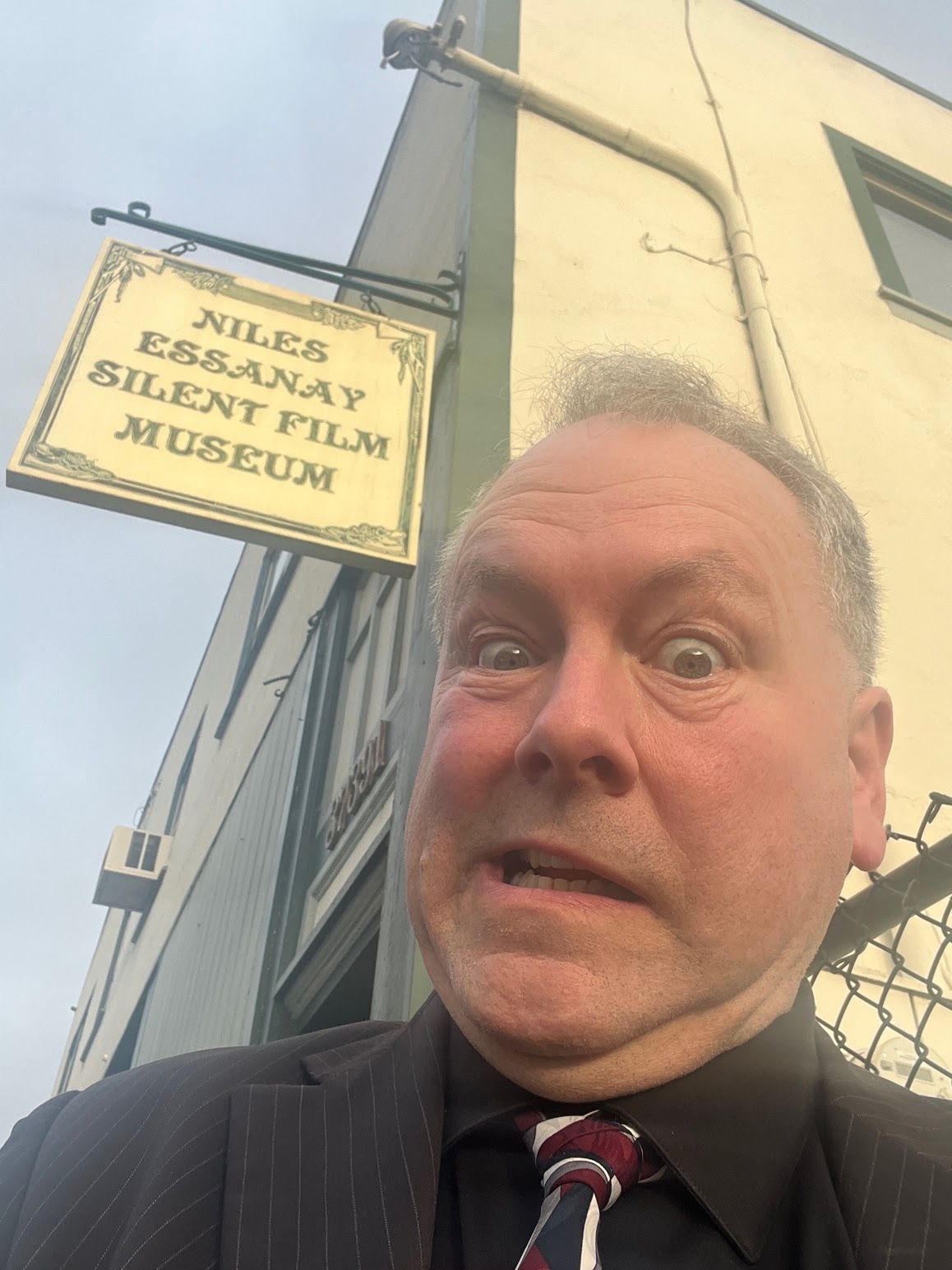
Me outside the Niles Essanay Silent Film Museum in Niles, Calif., doing my best to capture the Expressionist spirit of 'Algol' (1920), at least in the promotional art below.

A quick trip to the San Francisco Bay Area this weekend found me at the keyboard to do music for a screening of the German sci-fi film 'Algol' (1920) at the Niles Essanay Silent Film Museum. 

I scored this formerly-lost-but-recently-rediscovered movie for the Boston Sci-Fi Marathon this past February, which led to the chance to accompany it in Niles this weekend. 

All went well, although I was without the Korg LE 88 digital synthesizer I used for the Boston screening. Instead, I used the trusty Niles Essanay Silent Film Museum upright piano, which worked out fine. Sometimes less really is more.

Thanks to all my friends at the Niles Essanay museum for bringing me out there for Saturday night's program, and for all they do to present regular programs of silent film with live music to the public—and in a genuine Edison theater to boot!

Next up: I travel up to Brandon, Vt. on Saturday, May 10 to kick off the 2025 Silent Film Series at Brandon Town Hall and Community Center, where I've accompanied silents since 2010.

First up: Harry Langdon in 'The Strong Man' (1926), directed by a very young Frank Capra.

More about the screening, as well as the other films we have planned for Brandon Town Hall this season, is in the press release below. 

*     *     *

Harry Langdon at the top of his game in 'The Strong Man' (1926).

TUESDAY, APRIL 29, 2025 / FOR IMMEDIATE RELEASE
Contact Jeff Rapsis • (603) 236-9237 • jeffrapsis@gmail.com

Classic comedy 'The Strong Man' with live music on Saturday, May 10 in Brandon, Vt.

Brandon Town Hall's 2025 silent film series kicks off with classic comedy starring Harry Langdon—and the first movie directed by a very young Frank Capra

BRANDON, Vt.—Classics from the silent film era will return to the big screen at the Brandon Town Hall and Community Center, which will host another season of vintage cinema with live music.

First up is Harry Langdon in 'The Strong Man' (1926), a comedy that marked Frank Capra's directorial debut. The film screens on Saturday, May 10 at 7 p.m. at the Brandon Town Hall and Community Center, Route 7, in Brandon, Vt.

Admission is free; donations are welcome to help defray expenses.

Live music for each silent film program will be provided by Jeff Rapsis, a New Hampshire-based performer and composer who specializes in scoring and presenting silent films.

'The Strong Man' tells the story of a World War I soldier (Langdon) who, following his discharge, finds work as assistant to a circus strong man. As the act travels the country, Langdon continually searches for a girl he corresponded with while stationed overseas in the military.

The search leads to a town controlled by Prohibition-era gangsters, which forces Harry to test the limits of his own inner strength even as he looks for his dream girl. Can Harry triumph over the bad guys? And is love more powerful than brute strength?

The feature-length film showcases the unique child-like personality of Langdon, who is largely forgotten today. For a brief time in the 1920s, however, he rivaled Charlie Chaplin as Hollywood's top movie clown.

Langdon's popularity, which grew quickly in the last years of the silent era, fizzled as the movie business abruptly switched to talkies starting in 1929.

'The Strong Man' was selected in 2007 for preservation in the U.S. National Film Registry by the Library of Congress as being "culturally, historically, or aesthetically significant."

In recent years, 'The Strong Man' has been recognized as a major achievement of the silent film era—a satisfying and timeless balance of emotion and comedy.

"A little tragedy and a lot of laughs can be seen in 1926's The Strong Man," wrote critic Richard von Busack in 2007. "Director Frank Capra's energy and sturdy plot sense counterpoint Langdon's wonderful strangeness."

Harry Langdon tries flirting with a gangster's moll in 'The Strong Man' (1926).

'The Strong Man' will be accompanied by live music by Jeff Rapsis, a New Hampshire-based silent film accompanist who performs at venues across the region and beyond.

"These films were created to be shown on the big screen as a communal experience," Rapsis said. "With an audience and live music, they still come to life in the way their makers intended them to.

"The silent film screenings at Brandon Town Hall are a great chance for people to experience films that first caused people to first fall in love with the movies," he said.

Rapsis achieves a traditional movie score sound for silent film screenings by using a digital synthesizer that reproduces the texture of the full orchestra.

It's the 14th year of the Brandon Town Hall silent film series, which gives residents and visitors a chance to see great movies from the pioneering days of cinema as they were meant to be shown—on the big screen, with an audience, and accompanied by live music.

Screenings are held once a month, generally on Saturday nights starting in May and running through November. Admission is free; donations are encouraged to defray expenses.

Over the years, silent film donations have helped support projects including handicapped access to the 19th century building; renovating the bathrooms; and restoring the structure's original slate roof.

Other films in this year's Brandon Town Hall silent film series include:

• Saturday, June 7, 2025, 7 p.m.: "Underworld" (1927) starring George Bancroft, Evelyn Brent. Director Josef von Sternberg's groundbreaking tale of big city mobsters, widely considered the father of all gangster pictures. Tale follows crime boss "Bull" Weed as he battles rival 1920s gangsters. Incredible black-and-white photography; winner of first-ever Oscar for original story by Ben Hecht.

• Saturday, July 19, 2025, 7 p.m.: "Grandma's Boy" (1922) starring Harold Lloyd, Mildred Davis.  A cowardly young man must learn to conquer his fears before dealing with a larger menace to his community. Riotous small town comedy that helped propel Harold Lloyd into the most popular movie comedian of the 1920s.

• Saturday, Aug. 16, 2025, 7 p.m.: "Manhandled" (1924) starring Gloria Swanson. Uproarious comedy from silent screen legend Swanson tells the story of a down-on-her-luck salesgirl who climbs the social ladder by pretending to be a Russian countess.

• Saturday, Sept. 20, 2025, 7 p.m.: "Spies" (1928) directed by Fritz Lang. Director Fritz Lang's tale of espionage was the forerunner of all movie spy sagas, packed with double agents, hi-tech gadgets, beautiful (and dangerous) women, and an evil genius with a plan to take over the world, mwah-ha-ha-ha!

• Saturday, Oct. 18, 2025, 7 p.m.: "The Magician" (1926) starring Paul Wegener, Alice Terry, directed by Rex Ingram. Just in time for Halloween: a scientist uses an ancient spell to reanimate a dead body. The secret missing ingredient is, of course, the blood of a virgin, making it a good bet for all kinds of creepy goings-on.

• Saturday, Nov. 15, 2025, 7 p.m.: "Seven Chances" (1925) starring Buster Keaton. Buster is about to be saved from bankruptcy by an unexpected inheritance of $7 million—but only if he gets married by 7 p.m. that very day. Can Buster somehow find the girl of his dreams while being pursued by an army of women eager to marry a soon-to-be millionaire?

See Harry Langdon in the 'The Strong Man' (1926) with live music on Saturday, May 10 at 7 p.m. at the Brandon Town Hall and Community Center, Route 7, in Brandon, Vt. All are welcome to this family-friendly event. Admission is free, with free will donations accepted to defray expenses.


Monday, November 4, 2024

Thoughts on 'Daughter of the Dawn' in San Francisco, and remembering Joe Yranski

Me and silent film accompanist Rodney Sauer at the Essanay Silent Film Museum in Niles, Calif.

Saturday, Nov. 2 brought a double-helping of my favorite dish: silent film delight.

I got to accompany 'Daughter of the Dawn' (1920), an unusual Native American drama, at the Niles Essanay Silent Film Museum in Niles, Calif.

And I also got to see and visit with all the folks who maintain the Niles museum, the only venue I know of that runs a silent film program with live music every week all year round.

Really! Sometimes the programs can be quite creative. Later this month, Jon Mirsalis (a Bay area resident and Niles regular) will accompany the classic drama 'The Wind' (1928) in what's being described as 'Blow-A-Rama.'

All I know is that it involves the use of fans in the Niles venue, which is an original 1913 Edison theater. Wish I could be on hand. Still, it's a good enough idea that I'm considering stealing it.

Niles is a natural gathering place for the silent film community, which is why I've been journeying out there off and on (thank you, frequent flier miles!) for the past 10 years or so.

This time, I was joined by another guest accompanist: Rodney Sauer of the Mont Alto Motion Picture Orchestra, who was on hand to help out with a program honoring Native American Heritage Month, which happens to be November.

It was Rodney and his Mont Alto group (a five-member combo that specializes in scoring silent films) that first got me pointed toward exploring the craft on my own—almost 25 years ago now!

It was March 2000. On a whim, I attended the Kansas Silent Film Festival (this time, thank you Delta flight passes!) in Topeka, Kansas, where I'd never been before. There, I heard the Mont Alto group accompany the silent 'Peter Pan' (1924) and Buster Keaton's 'The Cameraman' (1928).

And I met people, including Rodney, who were so encouraging and welcoming that it eventually led to my trying my hand (or rather, both hands) at it. And here we are.

I've since had occasion to appear on the same program as Rodney, mostly at subsequent Kansas festivals, and it's always great to see him and the other Mont Alto members, catch up, and trade stories. 

Rodney helped me find sheet music for when I recorded a score for Gloria Swanson's 'Zaza' (1923), and he's always been friendly and encouraging and bemused and generous.

Rodney was visiting Niles to speak about and accompany 'Ramona' (1929), starring Delores Del Rio and directed by Edwin Carewe, one of the few motion picture directors of Native American heritage, then or now.

He also introduced 'Daughter of the Dawn' (1920), the film I accompanied, providing the Saturday afternoon audience a good summary of how the film came to be, and how it was rediscovered only recently as part of a business legal settlement in Oklahoma. 

Although the film has been reissued with a recorded score using appropriate and authentic Native American music, Niles is committed to showing silent films with live accompaniment. Since I qualify as live, I got the assignment. 

But the thing is, I don't qualify as Native American. With me, you can take your pick: I'm one quarter Irish, Polish, Lithuanian, and/or French-Canadian. Call my ethnicity "assorted."

So my musical heritage, such as it is, is a melange of Polish polkas played on accordian (which Rodney could do, if needed), Irish step-dancing, and what I'll call Quebec-style country & western. Plus all the marching band music I absorbed in high school.

But it was Rodney who gave me a clue about how to approach 'Daughter of the Dawn'—not at Niles, but years ago at a Kansas Silent Film Festival, when he accompanied the wilderness docu-drama 'Chang' (1928) on solo piano.

I don't think Rodney's heritage includes any of the indigenous tribal peoples of southeast Asia, where the film was shot. 

But I remember Rodney saying that to create an effective atmosphere, he tried to avoid "Western-style" chord progressions and modal scales—scales that to our ears might sound somewhat medieval, as in a Gregorian chant.

It seemed to work for Rodney back then. So that's what I did for 'Daughter of the Dawn.'

I took a handful of melodic scraps heavy with intervals of fourths, some flourishes built on modal scales, and wove it together as best I could to support what unfolded on the screen.

I think I struck paydirt right away with a simple device during the opening titles: a single note repeated twice, alternating off the beat in octaves, pulsing steadily along, over and over.

This not only provided a way to enter the world of the movie, but became a kind of textural signal that could be brought back whenever needed. And just by dumb luck, it worked really well when the movie went in a "two hearts that beat as one" direction. 

Under this pulsing note figure, I began weaving different harmonies, mostly using minor chords or often just open fifths. Then I could shift from the pulsing notes, bring in my melodies and work up music as the movie unfolded. 

The one really prominent dance in 'Daughter of the Dawn' is not some kind of theatrical call to war, but was a quiet and modest 'Dance of Thanksgiving' after a successful hunt. Shown onscreen, it consisted of a modest shuffling in a circle, with little footwork and no arm movement. 

For music, this was a lucky break. I was able to do it justice, I think, but a quiet percussive shifting of chords deep in the piano's bass notes. 

In the end, the music for 'Dawn of the Dead' fell together pretty well, I thought. I neither overplayed or underplayed—a balance it's taken me some time to achieve. And thus I created music for my 399th silent feature film. (Yes, I keep track right on this blog.)

And now it's back to New England for a run of shows leading into the holiday season, highlighted by a 100th anniversary screening of 'The Thief of Bagdad' (1924) on Tuesday, Nov. 26 at the Coolidge Corner Theatre in Brookline, Mass., and later (in December) what will be my 400th film: the silent 'Oliver Twist' (1922), starring Jackie Coogan and Lon Chaney, which I'll accompany on Friday, Dec. 13 as part of a Dickens festival at the Park Theatre in Jaffrey, N.H.

Joe Yranski, 1951-2024.

Before moving on, I would be remiss to not mention the recent passing of Joe Yranski, well-known and well-loved film buff who died unexpectedly on Oct. 31.

Joe was one of the major figures in the vintage film community. To account for the scope of Joe's work over the years in any complete way would be nearly impossible. 

Organizations he worked with include the Library of Congress, the Academy of Motion Picture Arts and Sciences, the Mary Pickford Foundation, and Warner Bros. Joe helped preserve and reclaim an untold number of classic films.

On a personal note: like Rodney Sauer, Joe was a person whose generosity and friendliness and overall example encouraged me to take up the practice of silent film accompaniment.

I first encountered Joe in 2008 through fellow accompanist Ben Model, who at the time was working with Joe in programming silent film screenings at the old Donnell Library Center branch of the New York City Public Library on West 53rd St.

Through Ben, I was invited to participate in a "Meet the Music Makers" series that Joe was running, even though at the time I had just started accompanying silent film programs and hadn't made much music at all.

Still, Joe invited me to come down to Manhattan and accompany 'Lessons in Love' (1921), a Constance Talmadge film that hadn't been available since it probably first ran, but which Joe had resurrected and was screening as part of the series, which took place in the facility's basement auditorium.

(I had never heard of 'Lessons in Love' before this, but Joe provided a screener on VHS in advance of the show. I remember my big idea was to play off the 'Lessons in Love' idea by basing large parts of the accompaniment on my Hanon piano technical exercises.)

It turned out Joe and I were both graduates of Fordham University in New York. Based on that, and a mutual interest in vintage film, Joe and I struck up a friendship and correspondence that never flagged over the years. Although a die-hard New Yorker, he occasionally took vacation trips to New England, so we shared that in common as well, though our paths never crossed during these travels.

As I got to know Joe, he revealed himself as a man fully in thrall with life. This took various forms: most obviously his zest for cinema, and in particular his strong connection to silent-era star Colleen Moore, whom he befriended, and whose family he remained in contact with.

But there was more. I could see he had a passion for New York City—its history, its presence, all that it offered. He was part of it and it was part of him. Throughout his life, he held the same wonder that I recall having as a high school kid from New Hampshire arriving at Fordham, except Joe never outgrew that.

I'm sure Joe's life wasn't always easy, but he never failed to be anything less than courteous and solicitous and gracious and charming. These are all qualities in short supply, in our times especially, but not when Joe Yranski was present.

Soon after my Donnell Library debut, Joe invited me to accompany films at Cinefest, the annual vintage film confab that used to take place every March in Syracuse, N.Y. 

I still consider this my "big break," in that I was able to finally meet and work alongside many other accompanists, film scholars, authors, and all the characters that make up the vintage film community.

Under Joe's guidance, I remained in the rotation at Syracuse until the final blow-out year in 2015, when no less than eight accompanists were brought in to share the duties as a kind of last hurrah. 

I'll never forget sitting in the room before the film screenings started, as legendary accompanists including Phil Carli and Gabriel Thibaudeau and Makia Matsumura and Judy Rosenberg and Andrew Simpson and the aforementioned Jon Mirsalis and Ben Model were dividing up the films, and thinking to myself, "What am I doing here?"

But Joe felt I should be included, and that was all I needed to jump in and do my best with a film no one wanted: the silent film version of Harold Lloyd's early talkie, 'Welcome Danger' (1929). It came together marvelously, I thought, and remains a highlight of my silent film accompaniment career—all thanks to Joe.

After a long run, Cinevent ended in 2015. But the years rolled on, and Joe kept in touch. Holidays brought friendly notes. Sending out my schedule of upcoming performances often brought encouraging remarks. I didn't get to see Joe very often, but he was always there.

Until now. All I can say is that I'm very sorry that he's no longer among us. I don't think it's really quite sunk in yet. 

But I do know this: the example of good cheer and friendly openness that Joe Yranski always set is something that I will continue to try to emulate.

And with a nod to our Fordham connection, I will say one more time: Go Rams!
Thursday, October 31, 2024

Up next: Native dancing in San Francisco, then accompanying 'The General' on Monday, Nov. 4

In front of the Rex Theatre in downtown Manchester, N.H. prior to last night's screening.

Last night's Lon Chaney Double Feature marked the last event of this year's Halloween silent film decathalon. After a dozen shows over the past two weeks, I can relate to Lon Chaney's character in 'The Unknown' (1927), a circus performer with no arms.

Well, even so, I'd better find them as I'm off to San Francisco (and boy are my arms tired!), where on Saturday, Nov. 2, I'll accompany a screening of 'Daughter of the Dawn' (1920) at the Niles Essanay Silent Film Museum.

The showing is part of weekend of programming celebrating National Native American Heritage Month. Also on hand will be Rodney Sauer of the Mont Alto Motion Picture Orchestra, who will accompany the Delores Del Rio drama 'Ramona' (1928) on piano.

A scene from 'Daughter of the Dawn' (1920).

I've never done music for 'Daughter of the Dawn' before, and it's a real honor to be asked to score the film at the Niles Essenay museum, one of the premier venues in the nation for what I do. Thanks in advance to Rena Azevedo Kiehn and everyone there for giving me this opportunity!

'Daughter of the Dawn' stands as one of the very few motion pictures made by and for Native Americans during the silent era. It's a trove of authentic practices of the time, and includes rare scenes of traditional tribal dancing. 

I'll do my best to do justice to these scenes, which will be interesting, considering my own personal heritage of native dance is Polish polkas and Irish step dancing.

Then it's back East, where on Monday night I'll accompany a film about the Old South: Buster Keaton's 'The General' (1926) at the Garden Cinemas in Greenfield, Mass.

Below is a press release with details about the film and the screening. Hope to see you there!

*    *    *

Buster and his costar in 'The General' (1926).

MONDAY, OCT. 28, 2024 / FOR IMMEDIATE RELEASE
Contact: Jeff Rapsis • (603) 236-9237 • jeffrapsis@gmail.com

Buster Keaton's 'The General' with live music at Garden Cinemas on Monday, Nov. 4

Civil War railroading comedy/adventure film lauded as stone-faced comic moviemaker's masterpiece

GREENFIELD, Mass.— He never smiled on camera, earning him the nickname of "the Great Stone Face." But Buster Keaton's comedies rocked Hollywood's silent era with laughter throughout the 1920s.

See for yourself with a screening of 'The General' (1926), one of Keaton's landmark feature films, on Monday, Nov. 4 at 6:30 p.m. at the Greenfield Garden Cinemas, 361 Main St., Greenfield, Mass..

The screening will feature live accompaniment by Jeff Rapsis, a New Hampshire-based composer who specializes in creating music for silent films.

Admission is $10.50 adults, $8:50 for children, seniors, and students. Tickets are available online or at the door.

The show is intended to give area movie-goers the opportunity to experience early cinema as it was intended: on the big screen, with live music, and with an audience.

'The General,' set during the U.S. Civil War, tells the story of a southern locomotive engineer (Keaton) whose engine (named 'The General') is hijacked by Northern spies with his girlfriend on board.

Keaton, commandeering another train, races north in pursuit behind enemy lines. Can he rescue his girl? And can he recapture his locomotive and make it back to warn of a coming Northern attack?

Buster Keaton astride a cowcatcher sporting a period-authentic haircut in 'The General' (1926).

 Critics call 'The General' Keaton's masterpiece, praising its authentic period detail, ambitious action and battle sequences, and its overall integration of story, drama, and comedy.

It's also regarded as one of Hollywood's great railroad films, with much of the action occurring on or around moving steam locomotives.

Accompanist Jeff Rapsis will improvise an original musical score for 'The General' live as the movie is shown, as was typically done during the silent film era.

"When the score gets made up on the spot, it creates a special energy that's an important part of the silent film experience," said Rapsis, who uses a digital synthesizer to recreate the texture of a full orchestra for the accompaniment.

With the Garden Cinema's screening of 'The General,' audiences will get a chance to experience silent film as it was meant to be seen—in a high quality print, on a large screen, with live music, and with an audience.

"All those elements are important parts of the silent film experience," Rapsis said. "Recreate those conditions, and the classics of early Hollywood leap back to life in ways that can still move audiences today."

Keaton, along with Charlie Chaplin and Harold Lloyd, stands today as one of the silent screen's three great clowns. Some critics regard Keaton as the best of all; Roger Ebert wrote in 2002 that "in an extraordinary period from 1920 to 1929, (Keaton) worked without interruption on a series of films that make him, arguably, the greatest actor-director in the history of the movies."

A remarkable pantomime artist, Keaton naturally used his whole body to communicate emotions from sadness to surprise. And in an era with no post-production special effects, Keaton's acrobatic talents enabled him to perform all his own stunts.

Critics review 'The General':

"The most insistently moving picture ever made, its climax is the most stunning visual event ever arranged for a film comedy."
—Walter Kerr, author of 'The Silent Clowns'

"An almost perfect entertainment!"
—Dave Kehr, Chicago Reader

"What makes the film so special is the way the timing, audacity and elegant choreography of its sight gags, acrobatics, pratfalls and dramatic incidents is matched by Buster's directorial artistry, his acute observational skills working alongside the physical élan and sweet subtlety of his own performance."
—Time Out (London)

The Keaton films are a great introduction to silent films for modern audiences, accompanist Rapsis said.

"Keaton's comedy is as fresh today as it was a hundred years ago — maybe more so, because his kind of visual humor is a lost art," Rapsis said.

‘The General’ (1926) starring Buster Keaton will be shown with live music on Monday, Nov. 4 at 6:30 p.m. at the Greenfield Garden Cinemas, 361 Main St., Greenfield, Mass..

Admission is $10.50 adults, $8:50 for children, seniors, and students.

Tickets available at the door; advance tickets are available at www.gardencinemas.net. For more information, call the box office at (413) 774-4881.


Wednesday, November 1, 2023

Monday, Nov. 6: Lillian Gish plus some Puritan-era hanky panky in 'The Scarlet Letter' (1926)

An original lobby card promoting Lillian Gish in 'The Scarlet Letter' (1926).

With Halloween in the rear view mirror, time for a break from the annual marathon of spooky silent film screenings. 

But not for long! 

The pace resumes again on Monday, Nov. 6, when I'll accompany the MGM's big-budget adaptation of 'The Scarlet Letter' (1926) at the Garden Cinemas in Greenfield, Mass. 

Showtime is 6:30 p.m. Lots more info about the film and the screening is in the press release pasted at the end of this post.

Then on Tuesday, it's Chaplin's 'The Gold Rush' (1925) in Newport, R.I., then 'The Three Musketeers' (1921) in Plymouth, N.H., then a total of four shows on the weekend around Veterans Day, including three biggies: one 'Wings' (1927) and two screenings of 'The Big Parade' (1925).

But before any of that, this weekend I have the privilege of sitting in as accompanist at the Niles Essanay Silent Film Museum in Niles, Calif. 

On Saturday, Nov. 4, I'll do live music for a program highlighted by the 1925 feature film 'Raffles, the Amateur Cracksman.' 

By the way, what a film this is for names. It stars "House Peters," which sounds like a name out of Monty Python's Flying Circus. And it's directed by "King Baggot," who was actually quite a big name in early cinema. 

The cast also includes Hedda Hopper and stalwart character actor Walter Long, a New Hampshire native.

It's the first time since the pandemic that I've gone out to Niles, which is in on the east side of San Francisco Bay, about halfway between Oakland and San Jose.

Prior to everything shutting down, I'd generally go out there twice a year to accompany programs. It's the only venue I know of that runs silent film programs each week all year round, so it's worth the pilgrimage to do my part. 

Let's hope this weekend's screening marks the resumption of this ritual. I like going out to San Francisco to do this. The whole area reminds me of the model railroad layouts I dreamed about as a child. And the ramen is much better than anything you can get in New England.

Speaking of which: I invite you to join me for MGM's adaptation of Nathaniel Hawthorne's classic novel set in 1600s Puritan Massachusetts Bay Colony on Monday, Nov. 6 at 6:30 a.m. 

*    *    *

Lillian Gish stars in 'The Scarlet Letter' (1926)

MONDAY, OCT. 30, 2023 / FOR IMMEDIATE RELEASE
Contact Jeff Rapsis • (603) 236-9237 • jeffrapsis@gmail.com

Greenfield's Garden Cinemas to screen 1926 silent film version of 'The Scarlet Letter'

Early adaptation of Nathanial Hawthorne classic tale of old New England features Lillian Gish in lead role; shown with live music on Monday, Nov. 6.

GREENFIELD, Mass.— It was a picture that MGM studio boss Louis B. Mayer didn't want to make, fearing the scandalous story of adultery in old New England would offend the movie-going public.

But silent screen star Lillian Gish, then at the height of her fame, insisted that 'The Scarlet Letter' by Nathaniel Hawthorne would be her next film.

Gish prevailed, and the result was MGM's splashy big budget adaptation of a classic literary tale anchored by Gish's landmark performance as Hester Prynne.

See it for yourself when 'The Scarlet Letter' (1926) will be shown with live music on Monday, Nov. 6 at 6:30 p.m. at the Greenfield Garden Cinemas, 361 Main St., Greenfield.

The screening will feature live accompaniment by Jeff Rapsis, a New Hampshire-based composer who specializes in creating music for silent films.

Admission is $10.50 adults, $8:50 for children, seniors, and students. Tickets are available online or at the door.

Adapted from Hawthorne's 1850 classic novel set in the Puritan Massachusetts Bay Colony from 1642 to 1649, 'The Scarlet Letter' featured Lillian Gish in the leading role as Hester Prynne.

Hester is married to Roger Prynne, whom she does not love. During her husband's long absence she walks in the woods with her pastor, the Rev. Arthur Dimmesdale, and they soon fall in love.

When a child is born to her, she is condemned to wear upon her breast the brand of Adulteress and is shunned when she refuses to divulge the name of the child's father.

The situation leads to a shattering climax in which a community is forced to confront its own hypocrisy and double standards.

'The Scarlet Letter' was directed by Victor Seastrom, a Swedish filmmaker brought to Hollywood by MGM.

Seastrom's talent for memorable visuals is evident throughout 'The Scarlet Letter.'

Film critic Paul Malcolm observed that “early in the film Gish, as Prynne, loses her bonnet chasing a songbird through a summer glade. When the wind catches her waist-long tresses, Gish appears for an instant as if she had stepped into a painting by Botticelli."

The film was the second that Gish made under her contract with MGM and a departure from the ingénue roles she had performed in service to director D.W. Griffith. 

Her first MGM picture was an adaption of 'La Bohème' with co-star John Gilbert, in which she played the pathetic consumptive Mimi.

Although 'The Scarlet Letter' cost MGM nearly $500,000 to make, it proved a solid box office hit, earning a profit of just under $300,000.

An exhibition trade ad promoting 'The Scarlet Letter' (1926).

In screening 'The Scarlet Letter,' the Garden Cinemas aim to recreate all essential elements of silent film experience: high quality prints shown on a large screen, with live music and an audience.

"These films caused people to fall in love with the movies for a very good reason," said Jeff Rapsis, who will improvise a musical score during the screening. "They were unique experiences, and if you can recreate the conditions under which they were shown, they have a great deal of life in them.

"Though they're the ancestors of today's movies, silent film is a very different art form than what you see at the multiplex today, so it's worth checking out as something totally different," Rapsis said.

Rapsis performs on a digital synthesizer that reproduces the texture of the full orchestra and creates a traditional "movie score" sound.

The Garden Theatre's silent film schedule features vintage Hollywood dramas, thrillers, and adventure flicks, all with live music. Upcoming shows include:

• Monday, Dec. 4 at 6:30 p.m.: 'Robin Hood' (1922). Douglas Fairbanks Sr. stars in the original big screen adaptation of 'Robin Hood,' one of the biggest box office hits of the silent era.

• Monday, Jan. 1 at 6:30 p.m.: 'The Gold Rush' (1925). Charlie Chaplin's beloved 'Little Tramp' character tries his hand at prospecting in the Yukon, finding romance instead. All-time classic comedy!

• Monday, Feb. 5 at 6:30 p.m.: 'Flesh and the Devil' (1926). Just in time for Valentine's Day! Garbo and Gilbert steam up the camera lens in this torrid romance set in 19th century European high society.

• Monday, March 4 at 6:30 p.m.: 'The Passion of Joan of Arc' (1928). Danish director Carl Dreyer's intense recreation of the trial of Joan of Arc set new standards for cinematography and expanded the language of film in new directions.

• Monday, April 1 at 6:30 p.m.: 'Safety Last' (1923). The iconic image of Harold Lloyd dangling from the hands of a downtown clock is only one small piece of a remarkable thrill comedy that has lost none of its power over audiences.

The silent film version of 'The Scarlet Letter' (1926) will be screened with live music on Monday, Nov. 6 at 6:30 p.m. at the Greenfield Garden Cinemas, 361 Main St., Greenfield.

The screening will feature live accompaniment by Jeff Rapsis, a New Hampshire-based composer who specializes in creating music for silent films.

Admission is $10.50 adults, $8:50 for children, seniors, and students. Tickets are at the door; advance tickets are available at www.gardencinemas.net. For more information, call the box office at (413) 774-4881.

Karl Dane provides some comic relief in 'The Scarlet Letter' (1926).
 

Monday, May 20, 2019

Three birthday parties were celebrated,
but yours truly received the best gift of all

Future fans of past movies at the Essanay Silent Film Museum in Niles, Calif. this weekend.

The big news this weekend at the Niles Essanay Silent Film Museum was not one but three kids' birthday parties at the Saturday night comedy show.

So I got to play 'Happy Birthday' three different times, with each version up a key for dramatic emphasis.

Really, it was a joy to see so many young folks in attendance at a silent film program. And what's more, they reacted.

Chaplin's 'The Cure' (1917) and Keaton's 'Neighbors' (1920) started things off strong.

But the films of the second half — Charley Chase in 'Dog Shy' (1926) and Laurel & Hardy's early 'The Second Hundred Years' (1927) — provoked a reaction that truly soared off the Richter Scale for laughter.

The Chase film, which I'd never accompanied before, is a crackerjack comedy that brought the comedy pot to a high boil.

That set the stage for 'The Second Hundred Years,' which I've always felt was Laurel & Hardy lite, or at least unformed, as it's from the time before their characters had been fully developed.

Well, that didn't matter last Saturday night. Seldom have I heard such laughter in a theater! And right from the very start, too. Everything the two did was capital F FUNNY! And everything everyone else did was funny, too.

I love it when this happens, just for the sheer joy of conjuring up laughter from the ghosts of comedians who worked nearly a century ago now. There's nothing quite like it.

But for an accompanist, it's also a gift because once the laughter barn starts burning, there are stretches where it doesn't matter what you play due to the uproarious, sustained laughter.

Really. I couldn't believe the laughs that Stan Laurel could get from using a spoon to chase a cherry around a saucer, again and again and again. Amazing!

So a good time was had by all, including the many young folks who crowded the front rows. What a pleasure to bring a silent film program to life for tomrorow's film fanatics. There may have been three birthdays being celebrated, but I felt like I was the one getting the gift.

Speaking of which, this weekend's performance resulted in a much-appreciated shout-out on Twitter from L.D. Writer, who was in attendance:
"@jeffrapsis was incredible by the way. Easily some of the best silent film accompaniment I've ever enjoyed. Thanks for flying out West!"
No, thank you for such kind words!

I'll be back on the West Coast on Friday, June 28 to accompany a Chaplin program at the Niles museum.

But right now it's time to focus on what's coming up later this week. Performances include a special pre-Memorial Day program on Thursday, May 23 at the Aviation Museum of New Hampshire, and then Harold Lloyd's classic comedy 'Safety Last' (1923) at the Wilton (N.H.) Town Hall Theatre.

More info coming!

You know you've arrived when your name gets written on cardboard! In permanent ink!


Tuesday, May 14, 2019

A long trip to accompany short films at the Niles (Calif.) Essanay Silent Film Museum

On this weekend's California-style menu: short comedies, including Chaplin's 'The Cure' (1917).

Before we talk film, let's hear it for frequent flier miles!

And also for cutthroat competition in the Boston-to-San Francisco market, where no less than four airlines are duking it out. Delta, United, JetBlue, Alaska. And I might be leaving one out.

That means something like 15 daily non-stops each way (I'm not kidding) between the two cities. And that in turn means low fares.

But who actually pays cash? Instead, I cross the continent with a paltry outlay of frequent flier miles. Take that, Lewis & Clark!

And this confluence of competition and machines that travel at 550 mph enables me to occupy a semi-regular schedule at the Niles Essanay Silent Film Museum, across the bay from San Francisco.

Why Niles? Well, it's the only theater I can think of that runs a different full-evening program of silent films (shorts and features) each and every week all year round. And they've kept that pace going for more than a decade!

So just as religious pilgrims follow Spain's Camino de Santiago, as a silent film accompanist eager to practice the craft, I make my own pilgrimage to silent film holy ground. Plus, they often run William S. Hart features than never get shown anywhere else.

I love sitting in the dark and getting absorbed by an obscure drama that might have thrilled my great-grandparents.

By semi-regular, my visits work out to twice a year: usually May and then November. But this year, a scheduling quirk has enabled me to also be at Niles for their annual "Chaplin Days" festival in June.

But first up: Saturday, May 18, where I'll sit in for a program of comedy shorts starring many of the big names: Chaplin's 'The Cure'; Keaton's 'Neighbors'; Laurel & Hardy's 'Second Hundred Years,' and Charley Chase in 'Dog Shy.'

It's an honor to do music for these pictures, which for me and so many others were the gateway drug that got us into silent film. I love to think that the audience for Saturday night's show might be a few folks who will make their own discovery of this unusual art form.

That's important to remember. The films may be familiar, or even old hat, to long-time silent film fans (although I don't think I've ever accompanied the Chase comedy), but not to most other people. So a key part of accompanying them, I think, is to remember the spirit of surprise and delight that often also accompanies seeing them for the first time.

Well, if you're in the Bay Area, please stop in for a visit. And if you miss this weekend, I'll be back on Friday, June 28 to accompany Chaplin's 'Shoulder Arms' (1918) as part of the Museum's annual "Chaplin Days" celebration.

See, while under contract with the Essanay Film Co., everyone's favorite tramp filmed several comedies (including 'The Tramp') at the firm's studio in Niles, in and around the neighborhood. (Hence the "Holy Ground" reference above.

It's really quite a connection to Chaplin's early years, and the museum makes the most of it. And I'm delighted to be helping out with this year's edition.

For more info on the Niles Essanay museum, visit http://nilesfilmmuseum.org/. And for an idea of what "Chaplin Days" is like in Niles, check out the photo below:


Sunday, November 4, 2018

'Wings' and other silent films set in WWI:
often the drama is about returning home


The silent film 'Wings' is all about airplanes.

So it's fitting that I'm posting this preview of the film (which I'm accompanying this week in Concord, N.H.) from an eastbound JetBlue Airbus 321 somewhere high above Nebraska.

Actually, the altitude is now exactly 34,793 feet, according the readout on the seatback video screen in front of me.


I'm heading home after accompanying a William S. Hart drama, 'The Cradle of Courage' (1920), last night at the Niles Essanay Silent Film Museum in Fremont, Calif.

Before I get to 'Wings,' a few thoughts about the Hart drama, which was unusual. Unlike so many of his features, it's not a Western. Instead, it's about doughboys returning home to city life (in this case, San Francisco) after World War I.

And with the 100th anniversary of Armistice Day coming up next weekend, I was glad for the chance to see this rarely screened Hart opus, in which our hero gives up his pre-war occupation as a crook to become a policeman instead. And the 16mm print at the Niles Museum was a stunner: sharp, with great tonal values throughout.

'The Cradle of Courage' offers a strong dose of life as it was lived in the nation's cities a century ago. The settings are real and grim, including many exterior shots filmed on location in the city by the Bay. Dialogue in the intertitles is filled with antique argot and colorful tough-guy slang.

A not-so-young soldier William S. Hart (he was over 50 at the time) wanders the streets of old San Francisco after returning home in 'Cradle of Courage.'

But it's especially powerful as a reminder that those who served in what we now call World War I often faced fresh battles upon returning home. And that's worth remembering as we approach the centennial of the day the guns went silent.

You can see that same dynamic in other World War I movies of the silent era. It's in 'Wings' (1927), which I'm accompanying this Wednesday, and also 'The Big Parade' (1925), which I'm doing music for on Sunday, Nov. 11 at the Somerville Theatre. Both have powerful and bittersweet "returning home" scenes.

My own homecoming later today will involve mostly getting licked by two dogs. So as centennial of Armistice Day approaches, it's worth remembering how so many did not have it so easy.

And one way to remember those who served, and to honor their sacrifices, is to take in a movie such as 'Wings.' I think a mainstream film aimed at a general audience captures some of the excitement and also the dread of the war in a manner quite different from any history book or documentary.

Well, this week, you can see for yourself. More info about our screening of 'Wings' at Red River Theatres in Concord, N.H. is in the press release below. Hope to see you there!

* * *


MONDAY, OCT. 15, 2018 / FOR IMMEDIATE RELEASE
Contact Jeff Rapsis • (603) 236-9237 • jeffrapsis@gmail.com

Epic silent film 'Wings' (1927) on Wednesday, Nov. 7 at Red River Theatres

Story of U.S. aviators in World War I won first-ever 'Best Picture'; screening to feature live musical accompaniment

CONCORD, N.H.—It won 'Best Picture' at the very first Academy Awards, with spectacular airborne sequences and a dramatic story that still mesmerizes audiences today.

'Wings' (1927), a drama about U.S. aviators in the skies over Europe during World War I, will be shown on Wednesday, Nov. 7 at Red River Theatres, 11 South Main St., Concord, N.H.

The screening is in honor of the 100th anniversary of the Armistice of Nov. 11, 1918, which ended the "Great War" and which led to our modern observance of Veterans Day.

Showtime is 7 p.m. Tickets are $12 per person, general admission.

The screening, the latest in Red River's silent film series, will feature live accompaniment by Jeff Rapsis, a New Hampshire-based composer who specializes in creating music for silent films.

The show will allow audiences to experience 'Wings' the way its makers originally intended: on the big screen, with live music, and with an audience.

'Wings,' a blockbuster hit in its original release, recounts the adventures of U.S. pilots flying combat missions behind enemy lines at the height of World War I in Europe. 'Wings' stunned audiences with its aerial dogfight footage, vivid and realistic battle scenes, and dramatic love-triangle plot.

'Wings' stars Clara Bow, Charles 'Buddy' Rogers, and Richard Arlen. The rarely-seen film also marked one of the first screen appearances of Gary Cooper, who plays a supporting role. Directed by William Wellman, 'Wings' was lauded by critics for its gripping story, superb photography, and technical innovations.

'Wings' is notable as one of the first Hollywood films to take audiences directly into battlefield trenches and vividly depict combat action. Aviation buffs will also enjoy 'Wings' as the film is filled with scenes of vintage aircraft from the early days of flight.

Seen today, the film also allows contemporary audiences a window into the era of World War I, which was underway in Europe a century ago.

" 'Wings' is not only a terrific movie, but seeing it on the big screen is also a great chance to appreciate what earlier generations of servicemen and women endured," accompanist Jeff Rapsis said. "It's a war that has faded somewhat from our collective consciousness, but it defined life in the United States for a big chunk of the 20th century. This film captures how World War I affected the nation, and also shows in detail what it was like to serve one's country a century ago."

Rapsis, a composer who specializes in film music, will create a score for 'Wings' on the spot, improvising the music as the movie unfolds to enhance the on-screen action as well as respond to audience reactions. Rapsis performs the music on a digital synthesizer, which is capable of producing a wide range of theatre organ and orchestral textures.

"Live music was an integral part of the silent film experience," Rapsis said. "At the time, most films weren't released with sheet music or scores. Studios relied on local musicians to come up with an effective score that was different in every theater. At its best, this approach created an energy and a connection that added a great deal to a film's impact. That's what I try to recreate," Rapsis said.

'Wings' is about 2½ hours long. The film is a family-friendly drama but not suitable for very young children due to its length and intense wartime battle scenes.

‘Wings’ (1927) starring Clara Bow, Buddy Rogers and Richard Arlen will be shown with live music on Wednesday, Nov. 7 at 7 p.m. at Red River Theatres, 11 South Main St., Concord, N.H.

Tickets $12 adults, general admission. For more info, visit www.redrivertheatres.org. or call (603) 224-4600.

Monday, April 30, 2018

'Who's supposed to be the hero?' and other questions about Fritz Lang's Nibelungen films

All is not sunny in the lands of the Nibelungen.

After the grim ending of 'Kriemheld's Revenge' (1924), maybe we were all in need of a chuckle.

During the audience Q & A following the film, a young fan got a loud laugh with this simple question.

"Just who is supposed to be the hero in this film?"

I had to say: beats me! With so much treachery, the Nibelungen tales as realized by Fritz Lang in his two-part silent extravaganza don't lend themselves to easy answers.

Probably the best response came later: a guy came up to me afterwards and suggested that perhaps the story's true hero was the dragon, who gets sacrificed in the first 10 minutes of the five-hour saga.

Siegfried bathes in the blood of the just-slain dragon.

Maybe. He's just about the only creature, human or otherwise, who doesn't do anything bad to anyone in the story. He's just there minding his own dragon business, but of course he has to be slain. He's a dragon, after all.

Such were the conversations following this weekend's screening of both parts of Lang's Nibelungen epic: 'Siegfried' (1924) on Saturday, April 28 and 'Kriemheld's Revenge' (1924) on Sunday, April 29.

Both screenings took place at the Town Hall Theatre in Wilton, N.H., which I consider my home field and where we run a monthly series of silent films with live music.

This was quite a challenge to take on. But it would not have happened at all without the support of long-time theater owner/operator Dennis Markaverich. Thanks, Dennis!

Dennis, a life-long film fanatic, is the reason the Town Hall Theater often shows up on lists of New England's best places to see a movie.

Creating music for these two films, which really do add up to about five hours of running time, was a really satisfying experience.

Musically, I tend to go for the big gesture, and the Nibelungen legends and Lang's approach both lend themselves to this approach. There's a reason Wagner turned to the same material for his four-opera Ring cycle!

So for me, the films were a chance to take a set of themes and really work with them over a long narrative arc.

As an example: I came up with a melody associated with Kriemheld that underwent quite a transformation as the story progressed.

In the first film, she's the woman of Siegfried's dreams. In the second film, she's pissed and out for revenge.

So her theme at first was a classic eight-bar "love" melody in the style of Tchaikovsky or Andrew Lloyd Weber.

But later, as things turned dark, the melody turned sour, and then got chopped up and became something of a war cry.

It was still Kriemheld's tune, however, and I think that helped everything hold together.

Overall, I enjoyed the two-part challenge, and received a lot of good comments afterwards. So if Dennis is up for it, we might try some others at the Town Hall Theatre.

Such as?

Well, I think the two Zorro films—'The Mark of Zorro' (1920) and 'Don Q, Son of Zorro' (1925) would make for a good back-to-back screenings over two days.

Same with Valentino's 'The Sheik' (1921) and 'Son of the Sheik' (1926).

In both cases, the first film is a little creaky, while the second is much more polished, which shows how far film technique had come in such a short time.

And if it's more Fritz Lang you want, how about running his also-five-hours-long film 'Dr. Mabuse, the Gambler' (1922) in two parts over two days?

Any other ideas?


Looking ahead: next performance for me will be piano accompaniment for 'The Phantom Bullet' (1926), a Universal Western starring Hoot Gibson.

It's screening on Saturday, May 4 at the Niles Essanay Silent Film Museum in Fremont, Calif., so redeem those frequent flyer miles and join me!

After that, May has a crowded calendar of shows back home here in New England. The schedule is heavy with comedies and Westerns, so hope to see you at an upcoming screening.

Friday, November 3, 2017

California, here I come—to do music for a show at the Niles Essanay Silent Film Museum


This Saturday night (Nov. 4) I'm at the Niles Essanay Silent Film Museum in Niles, Calif., just across the bay from San Francisco.

Featured attraction is 'The Border Sheriff' (1926), a Jack Hoxie Western from Universal. It's one of those obscure titles that Niles sometimes programs because, after all, they run a different silent film program every week.

There's also 'Ice Cold Cocos' (1926), a Sennett two-reeler with Billy Bevan hauling ice up the same long flight of steps that would later bedevil piano movers Laurel & Hardy in 'The Music Box' (1932). And a Koko the Clown 'Out of the Inkwell' cartoon as well.

The visit to Niles is a nice change of pace (and scenery) from the recent marathon of Halloween screenings around New England, which saw a dozen programs in 14 days in venues across four states.

By Halloween night, when I accompanied 'Nosferatu' (1922) for an enthusiastic crowd at Red River Theatres in Concord, N.H., I felt just about spooked out.

Things will quiet down now, in part because the pace of screenings slows somewhat as we enter the holiday season.

But it'll also be by design. Things will stay slow in 2018 because I have a number of longer-term projects in the works. So fewer screenings means more time (finally!) for significant progress, I hope.

I'm in Phoenix right now, where I plan to do a longish run first thing Friday morning. Later in the day I'll fly to San Francisco, where I'll attend a San Francisco Symphony concert that night and then make my own music on Saturday night in Niles.

If you're in the Bay area, please drop by! Besides the film screenings, the Niles Essanay museum houses an extensive collection of early movie memorabilia, a store, and many other interesting things. Really worth checking out!

The front door of the Niles museum.

One claim to fame is that Niles is where a certain British-born comedian began experimenting with pathos in his short comedies, especially in one from 1915 called 'The Tramp.'

It's the first one of his that ends with a scene of him ambling off down the road to further adventures:


And if you want to, you can still see the spot where this scene was filmed, not far from the Niles museum.

One of the things about Niles that's a hoot is that because of this connection, the whole town has embraced its inner Charlie Chaplin. You'll see his image all over: on stores, on sidewalks, on murals, and more.

And then on Sunday it's back to New Hampshire, where I'll start hunkering down for the holidays.

Monday, October 31, 2016

Wrapping up a silent film Halloween...
...or are the scariest days yet to come?

A pseudo-audience member awaits 'The Man Who Laughs' at the Leavitt Theatre.

Okay, finished the annual Halloween marathon strong with three very intense screenings this past weekend:

• On Friday, Oct. 28, created a live score for 'Nosferatu' (1922) at the Regent Theatre in Arlington, Mass.

• On Saturday, Oct. 29, did music for 'The Man Who Laughs' (1928) at the Leavitt Theatre in Ogunquit, Maine.

• And finally, on Sunday, Oct. 30, accompanied 'The Phantom of the Opera' (1925) at the Town Hall Theatre in Wilton, N.H.

For each of these shows, the music fell together a very satisfying way. I felt I was able to come up with suitably dramatic and/or spooky music when needed, but also stuff that allowed the humor in each film to come out.

Put another way: each of the films was able to breathe.

Pre-show prep at the Leavitt Theatre, with fog and fake attendees.

For 'Nosferatu,' it was the only time this year I played for this film, so it had a freshness and excitement that's sometimes difficult to manage when you've already accompanied a title, say, three times in two weeks.

I know the movie well enough, so I didn't even preview it prior to the screening, which drew a huge crowd to the Regent.

I actually did remember one thing about 'Nosferatu': that I need a musical signature for the images of a rooster crowing, which form an important part of the film's climax.

This time I remembered, and it all worked very effectively. But on the other hand, I muffed one of the two scenes where the clock is striking midnight.

The first time, it's pretty easy: the camera cuts to a clock, which is when I start the chimes: in my case, a small bellhop bell tapped steadily 12 time, if I count right.

But the second time (on the next night), the character of Hutter hears the chimes sounding, and reacts to them, before the scene cuts to the same clock, with the ringing in progress.

On Friday night, poor Hutter reacted quite visibly to chimes that couldn't be heard until the camera cut to them. Ooops!

The perils of trying to time sound effects to on-screen action. But afterwards, a guy said he thought I totally nailed it. So go figure!

The next night, the screening of 'The Man Who Laughs' up at the Leavitt Theatre in Ogunquit, Maine was memorable as much for the atmosphere as for the music.

Patrons of the Leavitt Theatre had to negotiate this display outside the lobby.

As a gay-friendly seaside resort, Ogunquit doesn't hold back at Halloween. The costumes of people bar-hopping downtown are amazing: I saw several men dressed as Las Vegas chorus girls tottering

And at the Leavitt Theatre, the Clayton family had transformed their vintage building (opened in 1923), into a "haunted theater," filling the interior with cobwebs and stage fog.

During the day, visitors brave enough to enter were taken inside, where mannequins sat motionless in the chairs and spirits were liable to pop out from anywhere!

The tours continued past 7 p.m., and all the decorations were left in place, so the theater just sort of morphed into a movie theater at some point prior to our show, with me using a pipe organ patch to play spooky funeral parlor music on my keyboard.

Ian Clayton of the Leavitt on stage above my cob-webby keyboard in the pit.

That night's screening of 'The Man Who Laughs' was the last of four I'd accompanied in the past two weeks. (Strangely, all four were in different stages: Maine, New Hampshire, Vermont, and Massachusetts!)

I had accumulated some good material, I thought, and so was able work it up into something pretty effective for Saturday's final go-round. Very gratifying to help this great film come to life and connect with audiences.

For 'Phantom of the Opera' on Sunday, I was able to once more use the opening line that I developed for this season's screenings: "Nothing is more appropriate for Halloween than a silent film because EVERYONE in this picture is DEAD!"

It produces laughs. What can I say?

Well, in Wilton, I said that until very recently, everyone in 'Phantom' was NOT dead. Carla Laemmle, niece of Universal Studios boss Carl Laemmle, danced in 'Phantom' as a teenager. And by God if she still wasn't with us all the way up until 2014, when she died at age 104.

This earned Carla a spontaneous round of applause!

Carla still going strong in her later years.

I also tried out the "audience participation" approach I've developed with Phantom screenings.

The Wilton crowd, one of the largest we've ever hosted, was into it: they applauded lustily during the on-screen opera house ovations, and shrieked pretty convincingly when the chandelier dropped and you-know-who got unmasked.

And with that we enter November, and with that the calendar lightens up a bit.

But not right away. Tomorrow night, I have a "fire and water" double feature at the Manchester (N.H.) City Library. The two flicks on the program are firefighting drama 'The Third Alarm' (1922) and Coast Guard adventure 'Coast Patrol' (1925).

And then I take a deep breath before tackling 'Wings' on Friday night for the Aviation Museum of N.H., which is screening the film as a benefit in their hanger on the grounds of Manchester-Boston Regional Airport. More on that in a follow-up post.

And then the next morning, I return to the same airport to fly out on my way to San Francisco, where that night I'm accompanying William S. Hart's very first film, 'The Bargain' (1914) at the wonderful Niles Essanay Silent Film Museum.

Ronald Colman matches wits with Constance Talmadge in 'Her Sister From Paris' (1925).

And then I'm doing 'Her Sister From Paris' (1925) on Thursday, Nov. 10 at the Flying Monkey Moviehouse and Performance Center in Plymouth, N.H. And then...

So what was I saying about slowing down?

Maybe I was mistaken. Maybe Halloween isn't really over yet.

After all, with the Presidential election just eight days away, perhaps the scariest times are yet to come!

Wednesday, May 11, 2016

Accompanying 'The Square Deal Man'
at ... wait, where is this place again?

Show yer cards, stranger!

Had a great time out in Niles, Calif. this weekend doing music for 'The Square Deal Man' (1917), a typically grim William S. Hart western.

The show was Saturday, May 7 at the venerable Niles Essanay Silent Film Museum.

That afternoon, I stopped by the museum to find myself pressed into service manning the front counter while a tour was given to a visiting group.

I was there long enough to give a phone caller bad info about using public transportation to reach the Museum. But he called back later, and all was sorted out.

I usually confine my damage to the keyboard, thank you very much.

As is often the case at Niles, the evening program opened with a pair of short comedies.

First up was 'Two-Gun Gussie' (1918), an early Lloyd "glasses character" one-reeler notable for its beginning.

The film opens with a close-up of hands on a piano keyboard in the midst of playing something devilishly complicated.

We discover it's Harold, a concert pianist. In full Paderewski mode, he wows the ladies by flinging himself at the keyboard, pausing for drama, and displaying a technique worthy of Chico Marx.

Harold tickles the ivories in 'Two-Gun Gussie.'

For this, I basically improvised a dissonant farrago on the opening theme of Beethoven's 5th Symphony, doing my best to match Lloyd's flamboyant gestures.

But I have to wonder how musicians handled this when the film was brand new, almost a century ago now. Probably the same way: not so much music but some kind of concert-hall sonic chaos to help the humor come across.

More challenging was 'Curses' (1925) a two-reel Al St. John parody of dramatic serials that even then were seen as full of clichés and conventions.

In scoring a film, I usually steer clear of what the general public might think of as "silent film music"—you know, that over-dramatic jangly piano sound.

But in this case, the goofy satire cried out for exactly that. So off I went, channeling all the Dudley Do-right music I recall absorbing as a child.

The best thing about this frantic parody (directed by no less than Roscoe 'Fatty' Arbuckle under the pseudonym William Goodrich) is how it's broken into several chapters, just like a real serial.

Although instead of waiting until next week, we just have to wait a few seconds for the film to resume. It's very well done and lends a meta-air to the film that comes across as knowing and snarky even today.

I'm familiar with this film in a DVD version produced by Paul Gierucki, which comes with intertitles that really punch up the comedy, I think.

However, Niles showed an older 16mm print with intertitles that lacked the same impact, I felt.

I don't believe either set of intertitles was original to 'Curses.'

But it's a good example of how a sensitive restoration can make a difference in how a film plays. 'Curses' was enjoyed by all last Saturday night, but I felt the Gierucki titles would have made it click even more.

The Hart film, which I'd never seen, turned out to be just as over-the-top as the Al St. John comedy. But in Hart's case, he really meant it.

So I played it straight, building the score out of a pair melodic lines I brought with me: a "masculine" modal-sounding signature for Hart, and a "feminine" motif for more tender moments.

(There I go gender-stereotyping again.)

A third unplanned melody, for the Mexican antagonist, added some Latin flavor to the scoring. So it all came together nicely.

Although Hart films come across as a bit austere, I think people slowly became absorbed as the story unfolded.

By the end, I think the audience was with 'The Square Deal Man,' and deservedly so. Although it's no 'Hell's Hinges,' it's one I'd certainly program and run again.

Hart, by the way, is one of those performers I've yet to fully discover and appreciate.

I've never done 'Tumbleweeds' (1925), his final film, which is supposed to be good. And although many titles are lost, enough survive so that there's plenty to explore.

But you know Hart's one of the biggies because he and his middle initial show up in lyrics to 'Movies Were Movies,' the opening number of Jerry Herman's musical 'Mack and Mabel.'
And Swanson and Keaton and Dressler and William S. Hart!
No one pretended that what we were doing was art!
Let me tell you, I can relate to that.

By the way, kudos to my brother-in-law, who managed to get not one but two of his Facebook colleagues to attend the screening and check out the Niles Essanay Silent Film Museum.

Employer-matched contributions can't be far behind, right?

Looking forward to possibly being out there again in the fall: the first week of November seems to be my time.

Depending on who gets elected, I may be in the process of fleeing. We'll have to see.
