Showing posts with label Rodney Sauer. Show all posts

Monday, November 4, 2024

Thoughts on 'Daughter of the Dawn' in San Francisco, and remembering Joe Yranski

Me and silent film accompanist Rodney Sauer at the Essanay Silent Film Museum in Niles, Calif.

Saturday, Nov. 2 brought a double-helping of my favorite dish: silent film delight.

I got to accompany 'Daughter of the Dawn' (1920), an unusual Native American drama, at the Niles Essanay Silent Film Museum in Niles, Calif.

And I also got to see and visit with all the folks who maintain the Niles museum, the only venue I know of that runs a silent film program with live music every week all year round.

Really! Sometimes the programs can be quite creative. Later this month, Jon Mirsalis (a Bay area resident and Niles regular) will accompany the classic drama 'The Wind' (1928) in what's being described as 'Blow-A-Rama.'

All I know is that it involves the use of fans in the Niles venue, which is an original 1913 Edison theater. Wish I could be on hand. Still, it's a good enough idea that I'm considering stealing it.

Niles is a natural gathering place for the silent film community, which is why I've been journeying out there off and on (thank you, frequent flier miles!) for the past 10 years or so.

This time, I was joined by another guest accompanist: Rodney Sauer of the Mont Alto Motion Picture Orchestra, who was on hand to help out with a program honoring Native American Heritage Month, which happens to be November.

It was Rodney and his Mont Alto group (a five-member combo that specializes in scoring silent films) that first got me pointed toward exploring the craft on my own—almost 25 years ago now!

It was March 2000. On a whim, I attended the Kansas Silent Film Festival (this time, thank you Delta flight passes!) in Topeka, Kansas, where I'd never been before. There, I heard the Mont Alto group accompany the silent 'Peter Pan' (1924) and Buster Keaton's 'The Cameraman' (1928).

And I met people, including Rodney, who were so encouraging and welcoming that it eventually led to my trying my hand (or rather, both hands) at it. And here we are.

I've since had occasion to appear on the same program as Rodney, mostly at subsequent Kansas festivals, and it's always great to see him and the other Mont Alto members, catch up, and trade stories. 

Rodney helped me find sheet music for when I recorded a score for Gloria Swanson's 'Zaza' (1923), and he's always been friendly and encouraging and bemused and generous.

Rodney was visiting Niles to speak about and accompany 'Ramona' (1929), starring Delores Del Rio and directed by Edwin Carewe, one of the few motion picture directors of Native American heritage, then or now.

He also introduced 'Daughter of the Dawn' (1920), the film I accompanied, providing the Saturday afternoon audience a good summary of how the film came to be, and how it was rediscovered only recently as part of a business legal settlement in Oklahoma. 

Although the film has been reissued with a recorded score using appropriate and authentic Native American music, Niles is committed to showing silent films with live accompaniment. Since I qualify as live, I got the assignment. 

But the thing is, I don't qualify as Native American. With me, you can take your pick: I'm one quarter Irish, Polish, Lithuanian, and/or French-Canadian. Call my ethnicity "assorted."

So my musical heritage, such as it is, is a melange of Polish polkas played on accordian (which Rodney could do, if needed), Irish step-dancing, and what I'll call Quebec-style country & western. Plus all the marching band music I absorbed in high school.

But it was Rodney who gave me a clue about how to approach 'Daughter of the Dawn'—not at Niles, but years ago at a Kansas Silent Film Festival, when he accompanied the wilderness docu-drama 'Chang' (1928) on solo piano.

I don't think Rodney's heritage includes any of the indigenous tribal peoples of southeast Asia, where the film was shot. 

But I remember Rodney saying that to create an effective atmosphere, he tried to avoid "Western-style" chord progressions and modal scales—scales that to our ears might sound somewhat medieval, as in a Gregorian chant.

It seemed to work for Rodney back then. So that's what I did for 'Daughter of the Dawn.'

I took a handful of melodic scraps heavy with intervals of fourths, some flourishes built on modal scales, and wove it together as best I could to support what unfolded on the screen.

I think I struck paydirt right away with a simple device during the opening titles: a single note repeated twice, alternating off the beat in octaves, pulsing steadily along, over and over.

This not only provided a way to enter the world of the movie, but became a kind of textural signal that could be brought back whenever needed. And just by dumb luck, it worked really well when the movie went in a "two hearts that beat as one" direction. 

Under this pulsing note figure, I began weaving different harmonies, mostly using minor chords or often just open fifths. Then I could shift from the pulsing notes, bring in my melodies and work up music as the movie unfolded. 

The one really prominent dance in 'Daughter of the Dawn' is not some kind of theatrical call to war, but was a quiet and modest 'Dance of Thanksgiving' after a successful hunt. Shown onscreen, it consisted of a modest shuffling in a circle, with little footwork and no arm movement. 

For music, this was a lucky break. I was able to do it justice, I think, but a quiet percussive shifting of chords deep in the piano's bass notes. 

In the end, the music for 'Dawn of the Dead' fell together pretty well, I thought. I neither overplayed or underplayed—a balance it's taken me some time to achieve. And thus I created music for my 399th silent feature film. (Yes, I keep track right on this blog.)

And now it's back to New England for a run of shows leading into the holiday season, highlighted by a 100th anniversary screening of 'The Thief of Bagdad' (1924) on Tuesday, Nov. 26 at the Coolidge Corner Theatre in Brookline, Mass., and later (in December) what will be my 400th film: the silent 'Oliver Twist' (1922), starring Jackie Coogan and Lon Chaney, which I'll accompany on Friday, Dec. 13 as part of a Dickens festival at the Park Theatre in Jaffrey, N.H.

Joe Yranski, 1951-2024.

Before moving on, I would be remiss to not mention the recent passing of Joe Yranski, well-known and well-loved film buff who died unexpectedly on Oct. 31.

Joe was one of the major figures in the vintage film community. To account for the scope of Joe's work over the years in any complete way would be nearly impossible. 

Organizations he worked with include the Library of Congress, the Academy of Motion Picture Arts and Sciences, the Mary Pickford Foundation, and Warner Bros. Joe helped preserve and reclaim an untold number of classic films.

On a personal note: like Rodney Sauer, Joe was a person whose generosity and friendliness and overall example encouraged me to take up the practice of silent film accompaniment.

I first encountered Joe in 2008 through fellow accompanist Ben Model, who at the time was working with Joe in programming silent film screenings at the old Donnell Library Center branch of the New York City Public Library on West 53rd St.

Through Ben, I was invited to participate in a "Meet the Music Makers" series that Joe was running, even though at the time I had just started accompanying silent film programs and hadn't made much music at all.

Still, Joe invited me to come down to Manhattan and accompany 'Lessons in Love' (1921), a Constance Talmadge film that hadn't been available since it probably first ran, but which Joe had resurrected and was screening as part of the series, which took place in the facility's basement auditorium.

(I had never heard of 'Lessons in Love' before this, but Joe provided a screener on VHS in advance of the show. I remember my big idea was to play off the 'Lessons in Love' idea by basing large parts of the accompaniment on my Hanon piano technical exercises.)

It turned out Joe and I were both graduates of Fordham University in New York. Based on that, and a mutual interest in vintage film, Joe and I struck up a friendship and correspondence that never flagged over the years. Although a die-hard New Yorker, he occasionally took vacation trips to New England, so we shared that in common as well, though our paths never crossed during these travels.

As I got to know Joe, he revealed himself as a man fully in thrall with life. This took various forms: most obviously his zest for cinema, and in particular his strong connection to silent-era star Colleen Moore, whom he befriended, and whose family he remained in contact with.

But there was more. I could see he had a passion for New York City—its history, its presence, all that it offered. He was part of it and it was part of him. Throughout his life, he held the same wonder that I recall having as a high school kid from New Hampshire arriving at Fordham, except Joe never outgrew that.

I'm sure Joe's life wasn't always easy, but he never failed to be anything less than courteous and solicitous and gracious and charming. These are all qualities in short supply, in our times especially, but not when Joe Yranski was present.

Soon after my Donnell Library debut, Joe invited me to accompany films at Cinefest, the annual vintage film confab that used to take place every March in Syracuse, N.Y. 

I still consider this my "big break," in that I was able to finally meet and work alongside many other accompanists, film scholars, authors, and all the characters that make up the vintage film community.

Under Joe's guidance, I remained in the rotation at Syracuse until the final blow-out year in 2015, when no less than eight accompanists were brought in to share the duties as a kind of last hurrah. 

I'll never forget sitting in the room before the film screenings started, as legendary accompanists including Phil Carli and Gabriel Thibaudeau and Makia Matsumura and Judy Rosenberg and Andrew Simpson and the aforementioned Jon Mirsalis and Ben Model were dividing up the films, and thinking to myself, "What am I doing here?"

But Joe felt I should be included, and that was all I needed to jump in and do my best with a film no one wanted: the silent film version of Harold Lloyd's early talkie, 'Welcome Danger' (1929). It came together marvelously, I thought, and remains a highlight of my silent film accompaniment career—all thanks to Joe.

After a long run, Cinevent ended in 2015. But the years rolled on, and Joe kept in touch. Holidays brought friendly notes. Sending out my schedule of upcoming performances often brought encouraging remarks. I didn't get to see Joe very often, but he was always there.

Until now. All I can say is that I'm very sorry that he's no longer among us. I don't think it's really quite sunk in yet. 

But I do know this: the example of good cheer and friendly openness that Joe Yranski always set is something that I will continue to try to emulate.

And with a nod to our Fordham connection, I will say one more time: Go Rams!

Tuesday, February 28, 2023

About this year's Kansas Silent Film Festival:
Give me more, please!

Denise Morrison at the podium during this year's Kansas Silent Film Festival, held Friday, Feb. 24 and Saturday, Feb. 25 at Washburn University in Topeka, Kansas.

Is it just me, or is the Kansas Silent Film Festival each time going by faster and faster?

Really—in recent years, it seems like things have just barely gotten started when the musicians get called up for the final end-of-show bows.

It didn't used to be that way. When I began attending the Kansas festival (on a whim back in 2000, and every year ever since), the event was confined to Saturdays only. But with one movie after another, the day seemed to stretch to infinity. 

Now it's two days (and last year was three!), but it still seems to zip by at a more rapid pace every time I head out to Topeka.

My theory about this: it has to do with how we perceive time as time itself goes by. 

As an example: remember those long endless summer days when you were a kid? Now, it seems we're no sooner done with Memorial Day when the Fourth of July whizzes past, and wait—there goes Labor Day, and it's over.

What happened? You got older, which changes your perception of time. When you were young, a single summer was a good percentage of your entire life experience. Now, many years later, a single summer is just one of many you've lived through, and proportionally a much smaller part of your overall life experience.

Familiarity may or may not breed contempt. But certainly breeds acceleration. 

In the same way, attending the Kansas Silent Festival two dozen times in a row means each time is proportionately a smaller part of the whole. And I think as the iterations accumulate, it has an effect on how each additional one is experienced.

And by and large, it seems to speed it up, even if the elapsed time is the same as always. A similar thing happens on a smaller scale when you drive somewhere new. Doesn't the drive home often seem shorter? 

Well, all of this is kind of a backhanded way of giving the Kansas Silent Film Festival a compliment. What I'm saying is, "It's over too fast. I wish there was more!"

And isn't it one of the eternal truths of show business to always leave them wanting more?

And so it is with me. I want more films with live accompaniment by the likes of Ben Model and Marvin Faulwell and Rodney Sauer and Bill Beningfield.

I want to play the White Concert Hall's gorgeous Steinway D concert grand (the best piano I play all year) more, especially as a long feature film unfolds on the big screen and I have time to develop and really work with material. 

I want to do more last-minute collaborations with percussionist Bob Keckeisen such as what we did this year with Douglas MacLean's 'Bell Boy 13,' working a sprightly tune with dingy bell punctuation into the score.

I want more ridiculously friendly Kansas hospitality. I want more breaded fried pickle spears at the Hanover Pancake House. (This year's serving is at right.) I want to browse local real estate listings and laugh at the inexpensive housing. (Compared to New England.) I want to buy more ties at Topeka's many fine thrift stores.

I want to sit in the dark and lose myself in films I've never seen before. (Even after nearly a quarter century — almost as long as the silent era itself — they always program titles I've not seen before.) I want to hear the big audience reaction, such a rare thing to behold these days but an essential element of the silent film experience.

I want to spend more time with the festival volunteers—people I see online all the time, but I actually see just once a year. 

I want to hog the attention of festival guests such as this year's Lara Gabrielle (at left), author of the recently published 'Captain of Her Soul: The Life of Marion Davies,' which I am now devouring. It's a terrific book.

In this last case, I may get my wish, as Lara is open to coming out to New England for screenings/book signings if we can arrange it. Stay tuned! 

I also want more time to take photos. This time, I managed to only get a handful, in between watching films and chatting with people out front and at the cinema dinner and running on-stage to pound the horse teeth for yet another short comedy or drama. 

It's a good thing that several volunteers never fail to take a huge number of images during the festival. They'll get edited and posted pretty soon at the festival's Web site: http://www.kssilentfilmfest.org/

Am I being selfish to just want more, more, more? (Or just sounding like Daffy Duck?)

Well—lucky for me, and for all of us, they've already set the dates for the next one. Mark your calendars for Friday, Feb. 23 and Saturday, Feb. 24, 2024. Only 361 days to go!

Seriously: thanks to everyone at the Kansas Silent Film Festival for making me, a once-a-year blow-in, feel like part of the family. 

There are just too many to name without the risk of leaving someone out. I thank you all for a creating a brief but important ritual that has become a mainstay of my annual calendar.

Which brings us back to where we started: at the end. I've come to think it's unfair, kind of, that only the musicians get to take a bow at the festival's conclusion. 

The dozens and dozens of people who work all year to make this festival possible should all take a bow, too. 

I know that would add time to the festival...but with it flying by so fast, that would suit me just fine!

And in a final nod to time flying, how about something unexpected? I discovered that the Hanover Pancake House had just taken on board its first-ever robotic server. Check out the video:


Monday, March 7, 2022

Neither snow, nor kidney stones, nor talking cars, kept me from the 2022 Kansas Silent Film Festival

After more than two decades, I remain a big fan of the "biohazard" pattern of the carpeting in the White Concert Hall at Washburn University.

This year's Kansas Silent Film Festival was memorable in part for a few things I hope to soon forget.

For me, it was two things in particular: a pair of kidney stones, which made their unexpected presence known the day before I planned to depart for Kansas.

The announcement came in the form of intense pain coming from the lower right part of my abdomen. Ouch!

I thought it was my appendix. Whatever it was, the pain quickly grew to where I just wanted it to stop.

So instead of heading for the airport to fly out to Kansas, I went to the emergency room. Tests and a scan revealed the culprits: two stones making their way from kidney to bladder.

In no condition to travel, I reached out to festival director Bill Shaffer and let him know I'd be unable to make it this year.

Although really disappointed in myself for not being able to honor a commitment, I knew that the other accompanists there could cover the films I'd been assigned.

It wouldn't be the first time this happened—in 2013, members of the Mont Alto group made it only about half way across Kansas before a blizzard forced them to turn back to their Colorado home.

So the rest of us divvied up their films and the festival went on as scheduled.

How is this possible at the last minute? Well, live film accompaniment encompasses a lot of approaches, and that includes the “I hadn't planned on playing for this title but I'll give it a go” school of music.

At this year's Kansas festival, I knew that my fellow accompanist Ben Model would be on hand. (He'd bring both his hands, actually. Har!) I was hoping Ben would be willing to cover for me, and was glad to hear that he would. 


Accompanists Marvin Faulwell, Bill Beningfield, and Ben Model at the console of the White Concert Hall's organ.

The festival is blessed with other musicians who would fill in as well: longtime music director and organist Marvin Faulwell and his sidekick, percussionist Bob Keckeisen; organist Bill Beningfield; and Rodney Sauer, director of the Mont Alto Motion Picture Orchestra.

So I stayed home that Thursday, dosed with Toredal to numb the pain, and also ameliorate the unhappiness of missing my first Kansas Silent Film Festival since first attending in 2000.

But then Thursday turned into Friday, and I felt much better. The pain was gone. It snowed all day in New Hampshire, making travel difficult. But by late afternoon I felt well enough to make a break for it. Turned out Southwest Airlines was still running flights out of Manchester, and I could get the last out of the day (to Chicago Midway, connecting to Kansas City) at 6:30 p.m.

That would put me in Topeka really late Friday night, but at least I'd be on hand for the whole day Saturday, when the bulk of my films (and the one feature) were scheduled to screen.

Proud of myself for making the effort, we were about a half-hour from landing at Midway when the pain happened again. It put me on the floor of an airport gate area, pretending to stretch but actually trying to find a position to lessen the agony.

Here I was, 800 miles from home and writhing in pain. I'd taken the opioid they'd given me in case the pain came back, but it didn't seem to be working. What to do? There was a flight back to Manchester at a nearby gate, so I went over to find that boarding had completed and the plane was already pushing back.

I was close to calling my in-laws (who live in Chicago) to get me to an emergency room (no way was I paying for an ambulance—that would cause a different and more lasting kind of pain) when the boarding announcement was made for the Kansas City flight.

Rising up, I felt a little better, so decided to board. (What I would do when I got there, I had no idea.) Once seated, the pain returned with a vengeance. A song lyric started going through my mind: "Should I stay or should I go?"

I finally just had to get up, as sitting was intolerable, and made my way to the rear of the plane. I explained what was going on to two flight attendants, who could not have been more sympathetic. They said we had about a half-hour before departure, so a decision didn't have to be made right away.

They let me walk up and down the aisle, which helped, although I'm sure my fellow passengers concluded they were flying to Kansas City with a lunatic. Even the captain got involved, wanting to know what drugs I'd taken and making sure I wasn't an in-flight medical liability, which of course is his job. (I passed—although the kidney stones hadn't.)

Finally it came time to leave, and I chose to tough it out. Once the door closed, there was no turning back. "Prepare to build some character," I thought to myself, as we pushed back from the gate. At least I was next to an empty seat, enabling me to writhe and contort myself within the limits of a seat belt.

How long would this last? Well, I guess the opioid finally kicked in, as the pain began to lessen during the flight. By the time we landed it had mostly subsided. Maybe I would make it after all. 

But what would I do when I got there? What if this happened during a film? Well, we'd find out.

As I sat on the bus to the rental car center, I contemplated one remaining challenge: it was after midnight, and I still had to drive an hour to Topeka, opioids and all.

And then I dodged a bullet. It was so late that all the rental car desks were shut except one: Avis—by some stroke of divine magic, the company I'd booked with. They gave me a brand new (less than 300 miles) Kia Soul, which was equipped with nanny software that bings at you if it doesn't like how you change lanes.

"Consider taking a break!" read a dashboard display panel, with a coffee cup icon complete with little heat lines rising above it.

"Mind your own business," I responded, looking for the switch to disable this annoying feature.

Bing bing bing! "32 degrees! Watch for ice ahead!" said the display, which included pictures of snowflakes falling.  

"Stop hounding me!," I shot back. "How do I turn you off?"


My ride. I never did figure out how to turn off the nanny function.

I got on the Kansas Turnpike (I-70) and headed west to Topeka, being extra careful to keep at the speed limit. The last thing the Kansas Silent Film Festival needed was a headline like:

VISITING MUSICIAN JAILED FOR OPIOID POSSESSION AND YELLING AT CAR

Why am I telling you all this? Maybe it's a window into the ups and downs of the glamorous life of a silent film accompanist. Maybe it'll prompt you to take better care of yourself: drink more water, don't lapse into winter inactivity, and cut down on the cheese!

But I made it, and by the time I pulled into the parking lot of the Hyatt in Topeka, the pain was gone. For now. That's the thing. I'd had two episodes of intense pain. When might it happen again?

Next thing I knew, it was the next morning and I was downstairs at breakfast chatting with Rodney Sauer of Mont Alto and greeting all the familiar folks who are such a huge part of why even malfunctioning kidneys can't keep me from coming back to this festival.

And I found that I my problems were minor indeed when compared to what others had faced or were facing. 

Like how? Rodney's house in Colorado just missed being burned to the ground last year in a wildfire. (A cellist he knows lost everything.) Long-time festival supporter Paul Post had been severely injured in a bicycle accident earlier that week and was hospitalized. (He continues to recover.) Festival attendee Jim Reid made it all the way up from Texas (in an ice storm) only to slip on the hotel walkway, landing on his face. (He seemed to be doing okay.)

So Saturday's festival activities started up, and I was able to get through each film I'd been assigned. Ben Model later mentioned the syndrome of how the body seems to somehow postpone problems during a performance, and I've found that to be true. 


From Oscar Micheaux's drama 'Within Our Gates' (1920).

My big film was the one feature I'd been assigned: The Oscar Micheaux drama 'Within Our Gates' (1921), a 90-minute drama that closed the afternoon program. I asked Ben to stand by, or at least be in the hall somewhere, during this screening in case I wasn't able to get through it.

But the film started, and I pressed a big "C" in four octaves on the White Concert Hall's wonderful Steinway grand, and off we went. Before long, I'd become completely engaged—it's actually a tough film to score and requires concentration to bring it off.

Because of that, I completely forgot that less than 24 hours ago I was face down on the carpeted floor of a gate area in Chicago. Another example of how silent film can transport a viewer to an alternate (and pain-free) state of mind.

(For an excellent essay on 'Within Our Gates,' check out this piece by Shari Kizirian from the San Francisco Silent Film Festival.)

Well—if you'd like a run-down of this year's Kansas Silent Film Festival, attendee and adviser Bruce Calvert always posts a write-up of what screened. It's posted on Nitrateville and I encourage you to check it out.

Many thanks to festival director Bill Shaffer for putting up with my last-minute plan changes. We joke that at the Kansas Silent Film Festival, sometimes there's more drama off-screen than on.

And thanks to everyone at the festival for their kind comments and wishes of good health—too many folks to mention by name for fear of leaving someone out, but all very much appreciated.

As Stan says to Ollie in 'Blockheads' (1938): I'm better now. Truth is, although my two stones are still "in transit," I haven't had any more severe attacks since this year's visit to Topeka.

So we can add that to the many reasons the Kansas Silent Film Festival is worth attending: "Known to Reduce Kidney Stone Pain."

Now—if only I could have gotten that car to shut up.

Monday, October 11, 2021

All this and root beer, too! A report from the revived Keaton Celebration in Iola, Kansas

Proof I made it to Iola, Kansas—taken not at the Bowlus Fine Arts Center, but at a long-closed movie theater just off the town's main square.

There's nothing more American than a second act. Buster Keaton certainly enjoyed one, reinventing himself as a TV performer after falling from movie stardom.

So it's only fitting that an annual gathering bearing his name should have a second act as well.

I'm referring to the Buster Keaton Celebration, held each year in late September in the small town of Iola, Kansas, not far from Keaton's rural birthplace.

The annual gathering ground to a halt in 2017 after 24 years. It was good run—but nothing goes on forever, right?

However, this year saw the reemergence of the Keaton Celebration. What's more, organizers intend to resume holding the event on an annual basis.

They also plan to remake the event's format to involve the local community and create more interest among Keaton fans.

Can this be done? That remains to be seen. But for now, here's a report on this year's Celebration, which I attended on Friday and Saturday, Sept. 24 & 25.

As a silent film accompanist, I had been to several past Keaton Celebrations, including what everyone thought was the final one in 2017, where the mood was one of rueful acceptance. 

In 2018, a one-off Keaton program was held in Kansas City. But it really wasn't a continuation of the Iola event. And after that, all was quiet on the Kansas Keaton front, at least publicly.

But behind the scenes, talks were underway to resume Iola's Keaton Celebration. The relaunch might have taken place in 2020 if not for the Covid-19 pandemic.

I didn't know about this until about a year ago (word travels slow from Kansas to New Hampshire), when I learned the event was being revived for 2021. Later, I was thrilled to be invited to accompany some of films, with the prestigious Mont Alto Motion Picture Orchestra also appearing. 

Along the way, the lingering pandemic nearly torpedoed the 2021 gathering. For a time, organizers considered an all-virtual model. 

But in the end, a hybrid approach was taken, with the Celebration going ahead as scheduled on Friday, Sept. 24 and Saturday, Sept. 25.

The program unfolded at its longtime Iola home, the Bowlus Fine Arts Center. At the same time, all events were streamed and available online for virtual attendees. 

The theme? "Buster Keaton in Changing Times," with a classy logo done as always by the talented Carol Yoho, who has attended every Keaton Celebration since the very first one back in 1993.

What was it like? Here's a brief and idiosyncratic report from the perspective of a piano player invited to accompany some of the silent films on the program. 

First, it was nice to be back. After the "last" Keaton Celebration in 2017, I thought I'd never see Iola again. But here I was, among landmarks such as the town square ("biggest west of the Mississippi River!") and the A&W Restaurant. 

Iola, by the way, is home to an enormous facility that produces Russell Stover candies for shipment all over the nation. So if you've ever wondered where all those boxes of Whitman's Samplers at your local CVS come from, it's likely Iola. 

Iola: Proud origin of Russell Stover candies!

I was eager to meet Dan Kays, director of the Bowlus Center, whose hiring in 2018 was an important step on the road to reviving the Keaton Celebration. Working with many long-time Celebration supporters, Dan has proposed a 10-year plan to help the event thrive and take it in new directions.

When I arrived at the Bowlus late Thursday afternoon, I didn't find Dan, but I did find my way (via an unlocked back door) into the darkened main auditorium, where the Celebration would take place. So I sat down and got reacquainted with the Henry Miller grand piano that lives in the "pit" area. 

I'm glad I did. The Miller is a fine instrument, but its touch is really heavy, or at least heavier than I'm used to, and without the graceful action of a Steinway. So just working with it for a half-hour can go a long way toward calibrating one's playing, of which I would do a lot over the next two days.

Friday morning I arrived before the 9 a.m. start to find Dan up on the podium testing the sound system. Throughout the two days, Dan was a whirlwind of activity, dealing with all aspects of the Keaton program plus the whole online version, which turned out to be a real challenge. 

In the small world department, turns out Dan's wife was recently an administrator at Mary Magdalen College, a small Catholic liberal arts school in Warner, N.H., where I've played for several silent film programs!

I was engaged primarily as the "day" pianist, brought in to provide live music for a grab bag of short comedies on Friday and Saturday. Rodney Sauer and Mont Alto handled the evening programs, although Rodney and I did swap around a bit.

Besides accompanying the movies, I also contributed occasional fill-in music for the program, such as playing "Hail to the Chief" when Iola's mayor took the podium.

Me at the Henry Miller. Photo by Jim Reid.

First up was Keaton's short 'The Playhouse' (1921), in celebration of the 100th anniversary of its release. You never quite know how things will go until a film starts, but I had good material ready and the music came together nicely, I thought. 

What was really interesting, though, was a presentation after by Prof. Frank Scheide, longtime Keaton Celebration participant and chairman of the committee, who walked us all through the actual vaudeville acts that Buster was sending up in 'The Playhouse.'

'The Playhouse,' which I first became acquainted with via a Super-8mm print from Blackhawk Films in the 1970s, is funny on its own terms. But there's so much more to it when you learn about the well-known acts that Buster was parodying in his comedy, and which audiences of the day would have recognized.

Take the "Zouaves" precision marching act that appears in 'The Playhouse.' Totally unknown today, in the 1920s they were a popular vaudeville touring act, descended from a U.S. Civil War regiment that itself was based on French military units in Algeria during the 19th century.

Frank, who is on the University of Arkansas faculty, dug up a film of the original Zouave troupe going through its routines—and astonishingly, they were almost exactly as depicted in Keaton's comedy. (Although in 'The Playhouse,' things soon go disastrously wrong.) 

The film was silent promotional footage, and after it started running, Frank beckoned to me from the stage: "Jeff, do you know any Zouave music?" So I hopped over to the piano and rattled off what I hoped was convincing Zouave music for the rest of the footage. 

Later that morning, I jumped in again when the sound system failed to function for a live on-stage rendition of the famous "Nairobi Trio" routine of Ernie Kovacs. Involving three performers dressed as apes, the pantomime routine is always done to "Solfeggio," a bizarre Robert Maxwell 1950s recording for harp, singers, orchestra, and bongo drums. 

A vintage video clip of the 'Nairobi Trio.'

The performers (wearing ape masks and heavy coats) entered and assumed their positions. But the music didn't happen. It wasn't clear at first what was going on, but after much confused gesturing, the troupe got up and left the stage.

As a lifelong Kovacs fan, I knew the routine well enough, and felt I could find my way on the piano, even without having ever played it before. So I volunteered to do it live, and Dan (who was at the podium) said okay, so off we went.

It didn't quite come out totally right, but was enough to get the players through most of the routine. I can't imagine how it came across to the online audience, but those at the Bowlus seemed to enjoy it.

The other short that morning was 'Backstage' (1919), one of the better Fatty Arbuckle comedies with Keaton in a supporting role. This one is full of dance, all of it played for pure comedy, so on the spur of the moment I started out with the famous 'Swan Lake' theme from Tchaikovsky's well-known ballet score.

I felt it provided a nice ironic introduction to all the wildness to come. And eventually, when thing did get wild, 'Swan Lake' returned in a rag-timey version with jacked-up tempo that I thought was pretty effective.  

Another unexpected task came that afternoon. Rodney Sauer of Mont Alto gave a presentation on silent film scoring, and he asked me to demonstrate an improvised score to a short passage from King Vidor's 'The Patsy' (1928). So I did!

Rodney then ran the same sequence with Mont Alto's compiled score, and then again with a full orchestra taking a very different approach, underlining all the action with musical outbursts that's sometimes called "Mickey Mousing" in the accompaniment world.

Buster, best friend (at left) and mortal enemy in 'Our Hospitality.'

The evening's program was 'Our Hospitality' (1923) with music by Mont Alto. I was surprised to learn many attendees had never seen the film before! I think I've accompanied it four times this year so far, and seen it several other times with other music. It's as familiar to me as my back yard, but it's important to remember how this is definitely not the case for 99.9% of people.

The next day saw two more Keaton shorts in the morning: 'Convict 13' and 'Neighbors,' both from 1920. Both were a lot of fun, with a jazzy underscoring working well for Buster's prison scenes in 'Convict 13.'

A Saturday highlight was lunch with Rodney Sauer and well-known film collector Jim Reid, who came up from Dallas to attend the Celebration. We drove to, yes, the Iola A&W Restaurant, where we enjoyed root beer served in frosted glass mugs.

That evening, I got to do music for the Keaton short 'Cops' (1922), which I felt went okay. I really tried hard to take a "less is more" approach, using the simplest possible texture to start and then build gradually as Buster's misadventures spiral wider and wider. 

Playing for 'Cops' (1922). The sheet music belongs to Rodney Sauer, who would lead Mont Alto in a compiled score for Keaton's 'Three Ages.'

Mont Alto then delivered a crackerjack score for Buster's feature 'Three Ages' (1923), and that was it. The 26th annual Keaton Celebration was in the books—thanks to the pandemic, not exactly what organizers had envisioned, but still revived and back in business. 

But for how long? Dan Kays has spoken of a ten-year plan, and that's probably a good thing, because it takes time for a long-running event to evolve to reflect different needs and changing times. 

So, in an effort to be helpful, here are some uninvited observations.

It's my observation that a lot of what drove the Keaton Celebration for its first 20 years was the special opportunity for attendees, both fans and scholars, to interact with major figures from the entertainment world who knew or worked with Keaton, who died in 1966.

Such folks were still around in quantity when the festival started in 1993. But time has passed, and almost anyone who knew or worked with Buster has now joined him in the great Green Room in the Sky. That direction connection has faded.

Keaton family members also made regular appearances, which was always a special element of the Iola event. This continues: this year was attended in person by Keaton's nephew Harry Keaton Jr., while Buster's daughter-in-law Barbara Talmadge and granddaughter Melissa Talmadge Cox attended virtually.

Still, time is passing. Keaton's widow Eleanor attended the event twice in the 1990s before she passed away in 1998. Harry is now past 80. Barbara is 96. It would be great if Keaton family members continue to be involved, but the Celebration can't rely too heavily on that element year after year without it getting to seem a little repetitive.

On screen: Keaton's daughter-in-law Barbara Talmadge and her daughter Melissa Talmadge Cox, committee member Hooman Mehran, and emcee Bruce Symes; on stage, from left: Lisa Geisler, daughter of Keaton's nephew Harry Keaton Jr., and Frank Scheide.

At the same time: just as I have to remember that most people have never seen 'Our Hospitality' (1923), most people interested in Keaton have not had a chance to meet any members of his family. It's a rare treat (I remember how thrilled I was to take Melissa out to lunch one day about 10 years ago) and their tradition of being part of the Iola event is a strong card in the Celebration's hand.

So I think here it's really a question of striking the right balance.

One curious element of the Keaton Celebration is that for many years, it was supported financially by the Kansas Humanities Council. This meant it was always been heavy on lectures and talks from visiting academics, and panel discussions among experts—all worthwhile, but not as entertaining as a Keaton comedy on the screen.

As a relative newcomer to the event (first attending in 2012), I felt this need to structure it as  something of a scholarly symposium, or at least to conform to an academic view of the humanities, was a curious way to put together a Buster Keaton Celebration.

Why? Because academic conferences are fine, but they're not ever going to draw or satisfying large general audiences. They really can't be the basis of a popular, well-attended event of this type. In this instance, less could be more.  

However, the presentation by Frank Scheide on the vaudeville routines in 'The Playhouse' was lively and informative and really added value to the event. So there's a balance to be struck here too, it seems.

I was given an unexpected chance to speak during this year's Celebration, and the one point I tried to make was that the event has a future. 

Me yakking from the piano bench. Another photo by Jim Reid. I didn't get a chance to take many photos, other than of the Russell Stover candy plant, so apologies for the lack of images.

Why? Because of Buster. His audience isn't shrinking or fading out. Rather, a century after what's recognized as his best work, his audience seems to be growing.

Really. I accompany more than 100 silent film programs each year, and the Keaton titles are the most frequently requested and the most well-attended.  

Young people (who generally believe any film before 'Star Wars' is pre-history) love Keaton and respond readily to his work. 

In this sense, it was great to see some high school students attend for a brief period on Friday afternoon. I think it would have been much better for them to see one of the Keaton features with live music, which is what young people really respond to, I've found. But it's a start.

So the Keaton Celebration holds another crucial card in its hand: Buster himself. If it can evolve to continue to showcase his work to new generations of fans, the event will thrive and prosper for a long time to come. 

The proximity to his birthplace is great, and can always be used to keep a sense of "pilgrimage" associated with the event. It's a claim that no other event or place can make. 

But more important are the basics: show Buster's films as they were intended to be shown: on a big screen, in the best restored prints, with live music, and—most importantly—an audience. 

When I talked with him, Dan Kays spoke of future Keaton programs that involve the local community more, in keeping with the original mission of the Bowlus to serve as a cultural resource for the region.

So ideas for future Buster Keaton Celebrations include showcasing the work of local filmmakers, involving students from local high schools, and just finding ways for the Iola community to become engaged. 

More of that, and the Keaton Celebration will not just be revived, but reinvented. 

After all, Keaton's motion picture artistry is timeless. Why can't this annual event possess the same quality?

And let's finish off with some A&W root beer served in a frosty cold mug. Wonder if they get this in Pordenone?

Saturday, March 22, 2014

Finishing out March with a comedy,
a drama, and then another comedy

See 'The Wind' (1928) on Thursday, March 27 at 7 p.m. at Keene State College in Keene, N.H.

March is supposed to go out like a lion, so maybe it's appropriate we're screening the great MGM silent drama 'The Wind' (1928) on Thursday, March 27 at 7 p.m. at Keene State College in Keene, N.H. (In addition to having a weather-related title, it begins with Leo, the MGM lion, in silent roar.)

This Lillian Gish classic will be bookended by screenings of two Harry Langdon films: 'The Strong Man' (1926) on Wednesday, March 26 at 7 p.m. at Merrimack College in North Andover, Mass., and then the rarely screened 'Long Pants' (1927) on Sunday, March 30 at 4:30 p.m. at the Wilton Town Hall Theatre in Wilton, N.H.

Right now, I'm in the post-tour let-down period following appearances in the past month at the Kansas Silent Film Festival in Topeka, Kansas and then Cinefest in Syracuse, N.Y. In recent years, these two back-to-back festivals have served as the annual climax of my accompaniment calendar. It's a lot of film to accompany, and now that's it's over, I kinda feel like smoking a cigarette.

Accompanist Rodney Sauer and I showed up at the Kansas Silent Film Festival in nearly identical performing garb, with me furthering the illusion with eyewear borrowed from festival director Bill Shaffer.

These festivals cut both ways. Because I get to hear other accompanists, see films that are new to me, and interact with a lot of people, they inspire me to want to improve my craft. But the stress of performing in unfamiliar places, and sometimes to films that I've never seen (five different features at Cinefest!), wears me out for a time.

The four accompanists at Cinefest 2014: me, Makia Matsumura, Judy Rosenberg, and Jon Mirsalis. Thanks for the photo, Makia!

The calendar beckons, however, with places to go and shows to do, and silent films to help bring to life for today's audiences. And so I soldier on, having already done music for 'The Lost World' (1925) this past Thursday at the Flying Monkey Moviehouse and Performance Center in Plymouth, N.H. And now these three upcoming shows to finish out the month.

(If you'd like more info on the Langdon films or 'The Wind,' check out the "Upcoming Screenings" page on this site. I haven't had time for press releases just yet.)

Coming out of this period, I feel the need to do fewer screenings, and work a bit more on material for screenings that I do commit to. Until now, I wanted to do as many shows as possible, if only so the feel of performing live would become second nature, and to get experience winging it if I had to.

Okay, so I'm not always relaxed and in control at the keyboard.

I think I've gotten where I want to in that area. Now the challenge, I believe, is to work at further forging my own personal musical language for silent film accompaniment, which has developed somewhat but has a long way to go.

The main way to do that, I sense, is by taking time to work up consciously new material even for films I've done many times before. Less winging it, more careful preparation prior to sitting down on the bench, even though I'll still be mostly improvising during the actual screening. 

In the coming months, I'd like to develop a suite of melodic material built on elements that I'm attracted to: the call of the sharped fourth or the flatted seventh is beckoning. And I'd like to get better at producing material on demand that reflects this language.

Plus I might acquire a real piano to replace the spinet I've been pounding for well nigh 40 years now. And the Korg synth and speakers are showing their age, too. We'll see about upgrading them as well.

Lots to do, but the main thing is—fewer gigs, and a little more time spent preparing for each. I'm really looking forward to it!

Sunday, February 26, 2012

Notes on the 2012 Kansas Silent Film Festival


It's Sunday afternoon following this year's Kansas Silent Film Festival, so time for a few quick impressions.

What it is: The Kansas Silent Film Festival is a wonderful annual gathering of people who enjoy silent film, held the last weekend in February at Washburn University in Topeka, Kansas. Films are screened on Friday night and then all day Saturday. (Sometimes there are additional screenings on Sundays, but not this year.) All films are shown with live music, with the acclaimed Mont Alto Motion Picture Orchestra contributing several performances each year.

How they do it: Unlike most vintage film events, admission is free, and most films are selected for general interest rather than rarity or obscurity. As a result, attendance is huge: usually at least 400 and sometimes more than 700 people (mostly local folks) fill Washburn University's White Concert Hall, where the films are shown. It's a terrific chance to experience these films the way they were intended to be seen. A large audience and live music really makes a difference.


The people are great: The folks who stage this festival are a friendly bunch who go out of their way to welcome newcomers to the event and to silent film in general. The first year I came to Topeka (back in 2000, on a complete whim), I was invited to the after-festival party, and wound up carrying the prints of several of that year's films in the trunk of my rental car. My wife and I have been made to feel welcome every year since, and even now (13 years later), the organizers make an effort to welcome first-timers and include them in activities or events.

A lot of this stems, I think, from the efforts of founder Jim Rhodes (who welcomed me the first time I attended) and longtime director Bill Shaffer, who both have set a tone of friendliness that's a big part of the festival. It's shared among the many festival volunteers who make it all happen, Brigadoon-like, every year. Below, here's Bill Shaffer and longtime volunteer Enid Stendebach talking film with two fans at Bobo's Drive-In on Friday.


Also, it's a chance to socialize with silent film devotees from other parts of the country, although it's definitely not a collector-dominated gathering.


Texas film collector Jim Reid and me, in a snapshot by fellow Texan Bruce Calvert.

Interesting films: Every Kansas Silent Film Festival introduces me to at least a few worthy films that I wasn't familiar with, and this year was no exception. Leatrice Joy in 'The Clinging Vine' (1926), the featured Friday night attraction, was a revelation. What an audience reaction this gender-bender comedy got. And Fritz Lang's 'Spies' (1928), screened Saturday afternoon, was a film I would like to accompany someday as well. On Saturday night, the 1922 'Monte Cristo' featuring John Gilbert wasn't quite the barn-burner I'd hoped for, but still worth watching.


Greg Foreman accompanies the opening titles for 'Spies.' Photo by Melodie Foreman.

And you haven't really seen silent comedy unless you've seen it with a large audience. This year's program included Chaplin's 'The Cure' (1917) and 'Sugar Daddies' (1927), a pre-team Laurel & Hardy comedy actually starring James Finlayson; both were greeted by gales of rowdy laughter. Seeing the familiar films at the Kansas Silent Film Festival was like seeing them for the first time!

My "coming out" performance: In the "big news for to me" department, this year marked my debut as a feature-length accompanist at the festival. On Saturday morning, I got to sit down at the White Concert Hall's big Steinway and do music for Harry Langdon's great comedy 'Tramp Tramp Tramp' (1926).

What a kick to be on the same program with some talented accompanists! There's Rodney Sauer and the Mont Alto Motion Picture Orchestra. And there's Marvin Faulwell, a theater organ enthusiast who's well known locally and an old hand at bringing silent films to life. And Greg Foreman, a pianist and organist who draws extensively from virtuoso keyboard works to create remarkable live scores. And Phil Figgs, the festival's volunteer coordinator, who also contributes music.


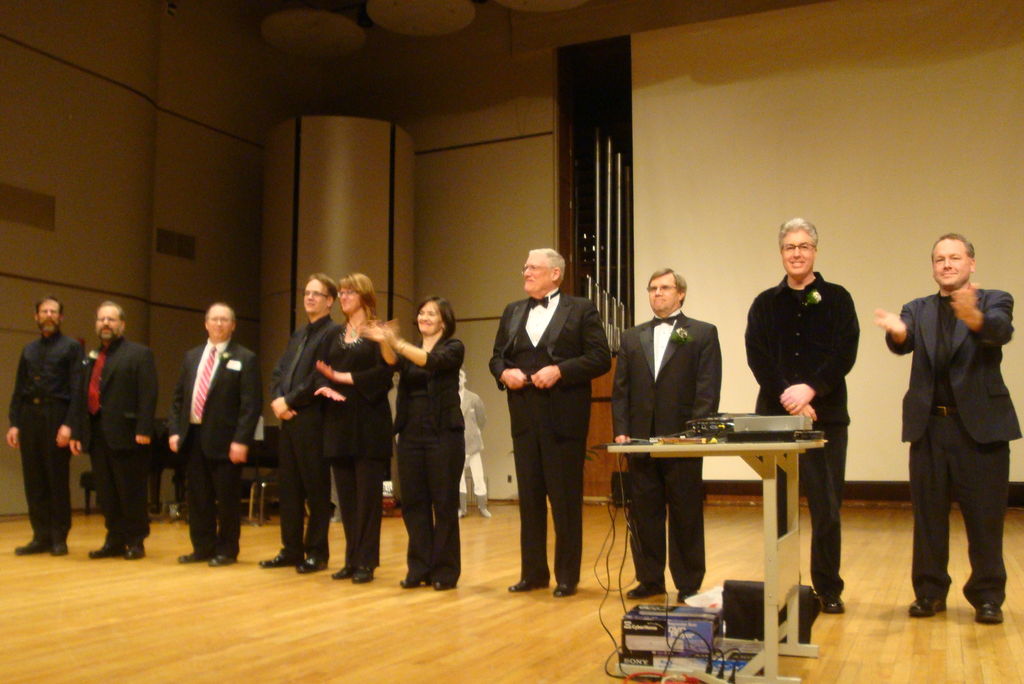
The musicians take a bow at the festival's conclusion. Photo by Melodie Foreman.

I'm not sure where I fit in. (In the above photo, I'm at far right.) For the past few years I've been doing "fill-in" keyboard work at the festival, happy to help with shorts and cartoons. But this year, I was thrilled to be given the chance to work up music for the Langdon film. His comedy seems to lend itself to my approach, and I figured it would be good practice for doing music at Cinefest in Syracuse, N.Y. next month.

So on Saturday, I sat down and off we went! 'Tramp Tramp Tramp' was shown via a good 16mm print, and almost immediately I got into the zone, forgetting about the audience (maybe about 400 folks, pretty good for a Saturday morning) and going with the film. It was just the movie, the keyboard, and me. Less was more: I found that by keeping things simple, I came up with what seemed to be delicate but effective underscoring for some of Langdon's antics. I think things got out of hand a little bit during the climactic cyclone sequence, but otherwise it seemed to work well, with the themes and melodies morphing quite effectively, I thought, as the film progressed.

I'm not often pleased with what I do, especially on solo piano, but this turned out quite well, I thought. I worked with a selection of a half-dozen tunes, including the "title" song, a lilting 6/8 tune for Harry himself, a stronger 4/4 melody (usually in the bass) for Harry's rival, a pompous chord progression for scenes set in a business conference room, and a theme for the romance between Harry and co-star Joan Crawford.

I also made use of an "evil" theme, though this is a picture without much evil in it. I used it only for the "landlord" scene near the beginning and for when some gun-toting deputies nab Harry for stealing a chicken. That's about it for "evil" in 'Tramp Tramp Tramp,' a film that still manages a rousing climax courtesy a cyclone.


Fellow accompanist Greg Foreman and me outside the hall. Photo by Melodie Foreman.

You don't go hungry: There may not be food allowed in the White Concert Hall, but there's plenty available outside it. In fact, so many breakfasts, brunches, lunches, and dinners are associated with the festival that I joke with Bill Shaffer that it should be renamed the "Kansas Silent Film and Food Festival. Here's me captured by festival volunteer Carol Yoho in a typical scene, about to sample apple pie with "satin freeze" (the local term for soft-serve ice cream) at Bobo's Drive-In on Friday:


It's personal: Finally, a key reason I keep coming back to Topeka is because The Kansas Silent Film Festival helped reconnect me with silent film. I've had an interest since adolescence, but hadn't been very active for quite some time until I came out to this event for the first time in 2000.

At first, I attended with the idea of writing a book that would draw heavily on the silent film era (and I still plan to), but that gradually morphed into doing music to help bring the films to life and get them in front of modern audiences. I tell my wife I've finally found my artistic niche: "collaborating with dead people." And it was the Kansas Silent Film Festival, and its concentrated dose of great films, music, and people, that pointed me in that direction.

What else can I say? Well, other than the dates are already set for the next Kansas Silent Film Festival. Mark your calendars: Friday, Feb. 22 and Saturday, Feb. 23, 2013, will be here before we know it!

Oh yeah, the carpeting: I'm always mesmerized by the carpeting used in the White Concert Hall. It's an unusual pattern -- kind of like a floral variation on the international biohazard symbol -- that I've never seen elsewhere, and each year I don't really feel like I'm in Topeka until I've seen it once again.


I think it's the coolest carpeting ever. May it never need replacing.

For lots more on the Kansas Silent Film Festival, visit www.kssilentfilmfest.org.