Showing posts with label Topeka. Show all posts

Thursday, March 5, 2026

Making the annual pilgrimage to Kansas to commune with the best piano I play all year

The Steinway D concert grand piano on stage at White Concert Hall at Washburn University, Topeka, Kansas.

And the star of the show is...the piano!

Well, not entirely. Each year, the Kansas Silent Film Festival is worth experiencing for the films, and also the fine people who organize it and attend it, and the community that hosts it.

And this year was no exception. 

The 29th annual edition of the event featured a wide-ranging program of great movies accompanied by live music, strong audience response, plus special guest Melissa Talmadge Cox, granddaughter of Buster Keaton.

Melissa Talmadge Cox carrying a picture of her famous grandfather into the White Concert Hall at Washburn University, home of the Kansas Silent Film Festival.

(29 years! The Kansas festival has now been running longer than the silent film era it celebrates.)

But then there's that piano. 

The films may change from year to year, but one thing remains constant: the enormous Model D Steinway grand piano that lives on the stage of White Concert Hall at Topeka's Washburn University, where the festival takes place.

How else can I put it? It's the best piano I play all year. 

As you may know, not all pianos are the same—each carries its own special blend of sound, action, touch, and many other variables. Even with identical models from the same manufacturer, each will have a different personality.

For me, the D Model Steinway I've been privileged to play at Washburn University for nearly 20 years now is a dream to work with. It has weight and power, but also lightness of touch. It responds well to my at-times percussive style of playing, but can also make lyrical passages sound like a human voice.

It feels exactly right under my fingers. I can do things on it that I can't do on other pianos.

I remember once the festival brought in a well-known guest accompanist who had heard me play years before, when I was just starting out. In Kansas, he heard me play again, and afterwards congratulated me on doing a good job—wondering aloud if it was the instrument that made the difference. 

Frankly, it probably was! 

So why not get one for myself? The Steinway D is the firm's top-of-the-line concert grand piano, and currently retails for between $200,000 and $250,000. Should I start a crowd-funding campaign?

From the podium, host Denise Morrison snaps a photo of the audience at this year's Kansas Silent Film Festival.

Outside of Kansas, most of my film accompaniment work is done using a Korg digital keyboard, which has 88 keys but is small enough to be portable (just barely!), and enables me to score films with the texture of a full orchestra. The Korg boasts a weighted-action keyboard that has a nice feel to it, and is useful in calling up different settings just based on how "hard" I play. 

But it's totally unlike performing on a mighty all-acoustic Steinway, with the tangible physical connection between your fingers and the keys and the hammers and the strings. Nothing to plug in except the built-in humidity control system and the piano light. 

There's talk of the Kansas Silent Film Festival at long last taking place in the Jayhawk Theatre in downtown Topeka. If that ever happens, I sure hope they'll haul the Steinway over as a crucial part of the festival.

A still from 'The Toll Gate' (1920) with costars Anna Q. Nilsson and William S. Hart. In the "small world" department, Nilsson would much later be one of the "waxworks" silent-era stars playing poker in 'Sunset Boulevard' (1950).

Of the films I accompanied, 'The Toll Gate' (1920), a dark Western starring William S. Hart, was the most satisfying and came off the best, I thought. It's a strong film for music, with moments of intense emotion that music can augment very effectively, and action sequences that pair well with busy minor-key passages.

There's also something unusual in the film's structure. The first two-thirds of the movie is filled with men and guns and horses and everything else you'd associated with an outlaw in the Old West. But then, for the final third, we meet a woman and her young boy living alone in a remote cabin.

It's through them that the hard heart of William S. Hart begins to soften. And with that, a whole new type of music seemed called for: something more gentle and tender than anything that had come before.

What I came up with was a simple diatonic phrase built of six notes. With light accompaniment underneath, it sounded like the beginning of a Chopin Etude. Quite a contrast with all the musical drama that preceded it—but which made it stand out all the more.

As I worked through the last two reels, it became one of those times I savor as an accompanist: when you have good material to work with, and you're "ahead of the film" (meaning you have a strong sense of what's coming and what you want to do with it), and the right pieces are falling into place for it to all come together. 

Those in attendance seemed to enjoy the results. "Jeff Rapsis provided a hauntingly beautiful score," commented Bruce Calvert in his annual write-up of the festival's program, found online at the Nitrateville silent film site. Thanks, Bruce!

The busy lobby between screenings at this year's Kansas Silent Film Festival.

Next year will mark a significant milestone for the little Kansas festival that could: its 30th year!

I hope you'll join me in marking your calendar for Feb. 26 & 27, 2027—and joining me in Topeka when those dates roll around!

For now, thanks and congratulations to all the people who work all year around to make the Kansas Silent Film Festival a success. I remain grateful to all that this event has given me in the 27 years I've been attending—and not just the chance to play that piano! 

The amazing "bio-hazard" pattern carpeting used throughout the White Concert Hall at Washburn University, home of the Kansas Silent Film Festival. 

Tuesday, February 28, 2023

About this year's Kansas Silent Film Festival:
Give me more, please!

Denise Morrison at the podium during this year's Kansas Silent Film Festival, held Friday, Feb. 24 and Saturday, Feb. 25 at Washburn University in Topeka, Kansas.

Is it just me, or is the Kansas Silent Film Festival each time going by faster and faster?

Really—in recent years, it seems like things have just barely gotten started when the musicians get called up for the final end-of-show bows.

It didn't used to be that way. When I began attending the Kansas festival (on a whim back in 2000, and every year ever since), the event was confined to Saturdays only. But with one movie after another, the day seemed to stretch to infinity. 

Now it's two days (and last year was three!), but it still seems to zip by at a more rapid pace every time I head out to Topeka.

My theory about this: it has to do with how we perceive time as time itself goes by. 

As an example: remember those long endless summer days when you were a kid? Now, it seems we're no sooner done with Memorial Day when the Fourth of July whizzes past, and wait—there goes Labor Day, and it's over.

What happened? You got older, which changes your perception of time. When you were young, a single summer was a good percentage of your entire life experience. Now, many years later, a single summer is just one of many you've lived through, and proportionally a much smaller part of your overall life experience.

Familiarity may or may not breed contempt. But certainly breeds acceleration. 

In the same way, attending the Kansas Silent Festival two dozen times in a row means each time is proportionately a smaller part of the whole. And I think as the iterations accumulate, it has an effect on how each additional one is experienced.

And by and large, it seems to speed it up, even if the elapsed time is the same as always. A similar thing happens on a smaller scale when you drive somewhere new. Doesn't the drive home often seem shorter? 

Well, all of this is kind of a backhanded way of giving the Kansas Silent Film Festival a compliment. What I'm saying is, "It's over too fast. I wish there was more!"

And isn't it one of the eternal truths of show business to always leave them wanting more?

And so it is with me. I want more films with live accompaniment by the likes of Ben Model and Marvin Faulwell and Rodney Sauer and Bill Beningfield.

I want to play the White Concert Hall's gorgeous Steinway D concert grand (the best piano I play all year) more, especially as a long feature film unfolds on the big screen and I have time to develop and really work with material. 

I want to do more last-minute collaborations with percussionist Bob Keckeisen such as what we did this year with Douglas MacLean's 'Bell Boy 13,' working a sprightly tune with dingy bell punctuation into the score.

I want more ridiculously friendly Kansas hospitality. I want more breaded fried pickle spears at the Hanover Pancake House. (This year's serving is at right.) I want to browse local real estate listings and laugh at the inexpensive housing. (Compared to New England.) I want to buy more ties at Topeka's many fine thrift stores.

I want to sit in the dark and lose myself in films I've never seen before. (Even after nearly a quarter century — almost as long as the silent era itself — they always program titles I've not seen before.) I want to hear the big audience reaction, such a rare thing to behold these days but an essential element of the silent film experience.

I want to spend more time with the festival volunteers—people I see online all the time, but I actually see just once a year. 

I want to hog the attention of festival guests such as this year's Lara Gabrielle (at left), author of the recently published 'Captain of Her Soul: The Life of Marion Davies,' which I am now devouring. It's a terrific book.

In this last case, I may get my wish, as Lara is open to coming out to New England for screenings/book signings if we can arrange it. Stay tuned! 

I also want more time to take photos. This time, I managed to only get a handful, in between watching films and chatting with people out front and at the cinema dinner and running on-stage to pound the horse teeth for yet another short comedy or drama. 

It's a good thing that several volunteers never fail to take a huge number of images during the festival. They'll get edited and posted pretty soon at the festival's Web site: http://www.kssilentfilmfest.org/

Am I being selfish to just want more, more, more? (Or just sounding like Daffy Duck?)

Well—lucky for me, and for all of us, they've already set the dates for the next one. Mark your calendars for Friday, Feb. 23 and Saturday, Feb. 24, 2024. Only 361 days to go!

Seriously: thanks to everyone at the Kansas Silent Film Festival for making me, a once-a-year blow-in, feel like part of the family. 

There are just too many to name without the risk of leaving someone out. I thank you all for a creating a brief but important ritual that has become a mainstay of my annual calendar.

Which brings us back to where we started: at the end. I've come to think it's unfair, kind of, that only the musicians get to take a bow at the festival's conclusion. 

The dozens and dozens of people who work all year to make this festival possible should all take a bow, too. 

I know that would add time to the festival...but with it flying by so fast, that would suit me just fine!

And in a final nod to time flying, how about something unexpected? I discovered that the Hanover Pancake House had just taken on board its first-ever robotic server. Check out the video:


Thursday, February 23, 2023

From the Kansas Silent Film Festival to gigs at Harvard University, Cinema Ritrovato, and beyond

The Carpenter Center at Harvard University, where I accompanied 'Man With a Movie Camera' (1928) in the basement lecture hall/theater.

Well, at the risk of jinxing it all for us, I'm ready to declare the pandemic officially over.

Why? Because in recent weeks, I've received requests to accompany silent films in the last two places that had suspended activities starting in March 2020, and only now are they resuming.

So this past Tuesday, I went down to the Harvard Film Archive for the first time in four years to do music—in this case for a class screening of Dziga Vertov's 'Man With a Movie Camera' (1928).

And in early March, I'll return to the University of New Hampshire for the first time since the pandemic. On Tuesday, March 7, I'll do music for a film class screening of 'The Cabinet of Dr. Caligari' (1920) at the UNH-Manchester campus (where I used to teach).

And in late March (the date isn't yet set), I'll accompany silent films at the university's main campus in Durham, N.H. for the annual appearance of the travelling 'Cinema Ritrovato' festival of restored films.

In retrospect, the pandemic caused only about four months of total inactivity before a few venues began showing film again in the summer of 2020. 

Since then, it's a been a long, slow climb to back to normal, with some new places being added to the roster along the way, including Epsilon Spires in Brattleboro, Vt., the Jane Pickens Theatre in Newport, R.I., and the Greenfield Garden Cinema in Greenfield, Mass.

And then there are long-established traditions, including the annual Kansas Silent Film Festival, the latest edition of which starts...tomorrow! Yes, the 2023 version takes place on Friday, Feb. 24 and Saturday, Feb. 25 at Washburn University in Topeka.

I've attended every Kansas festival since 2000, making this my 24th year in a row.  What keeps me coming back are the people (both with the festival and the general public), the chance to see big films with big audiences, and also the chance to hear some of the best silent film accompanists in the business do their stuff.

It was attending this festival back at the turn of the century that first pointed me in the direction of accompanying silent films. I'll never forget hearing the Mont Alto Motion Picture Orchestra for the first time there, doing music for Keaton's 'The Cameraman' (1928) and for 'Peter Pan' (1924).

Continued attendance in Kansas was one reason I began accompanying films myself in 2006, and which I found was something I could do. (Some people go to Aruba in February. I go to Topeka.) 

The basement lecture hall for Harvard University's Carpenter Center, which doubles as the screening room for the Harvard Film Archive, where I accompanied 'Man With A Movie Camera' (1928) last Tuesday evening.

Today, I do music for about 120 silent film screenings per year, in places ranging from junior high school all-purpose rooms to Harvard University.  Accompanying films, and creating music to help keep silent-era films before the public, has become a big thing for me. It's my primary creative outlet, other than stilt-walking. (Just kidding. There's nothing creative about stilt-walking. It's all data processing.)

So it's always a pleasure to head out to Kansas each February, as I feel it's like returning to my roots, at least in terms of music and film. As someone who once had aspirations to pursue a career in music (which I didn't), I'm grateful for how the Kansas festival showed me a way to bring out the music I had in me after all.

I'll be thinking of that as I once again make my way to the Sunflower State and a weekend of silent film and live music. Hope to see you there!

Me at the keyboard in Kansas—not in Topeka, but at the Keaton Festival in Iola, Kansas. Photo by  Steve Friedman.

Thursday, March 5, 2015

A grand time at the Kansas Silent Festival;
plus, an impromptu Chaplin stress test

That's me on stage, caressing the big Steinway grand during a slide presentation about Kansas-born actress Claire Windsor.

Last weekend brought my 16th annual trip to the Kansas Silent Film Festival, to which I've made pilgrimages each year since the turn of the century.

As I say: in February, some folks go to Aruba. I go to Topeka!

But I do it gladly, because the Kansas Silent Film Festival is one of those rare events set up to run mainstream silent films (as opposed to obscure rarities) to large audiences of just plain folks, rather than just plain film buffs. (Who are all nice people, by the way.)

One reason it attracts big crowds is the magical four-letter word: FREE! No admission is charged, so there's no barrier to the curious. There's no registration or badge required, and no tickets, either. You can come and go as you please.

The result is an environment that I find probably mimics the conditions under which silent films were really intended to be shown: on the big screen, with live music, and with a large audience.

And the White Concert Hall at Washburn University, where the films are screened on Friday nights and all day Saturday, is big enough to hold even an enormous turnout. Big crowds do turn up, depending on the program. So far, no capacity constraints.

And there's the people. Too many staffers and volunteers to list here, but all terrific folks who assemble each year, Brigadoon-like, to bring forth this event. You know who you are, and you're all great. (Many thanks to Carol Yoho for most of the photos used in this post.)

Another reason to go is the music. Usually, it's a rare chance to hear the Mont Alto Motion Picture Orchestra live for several titles in one go, not to mention other regulars such as long-time theater organist Marvin Faulwell and his percussionist sidekick Bob Keckeisen.

Marvin Faulwell and Bob Keckeisen in action on Friday night.

This year, Mont Alto couldn't attend. But organizers brought in an equally compelling guest performer: accompanist (and film collector) Jon Mirsalis. Jon is one of the big names in silent film music, and his accompaniment style is one that I really respond to. So I was thrilled that he'd be part of this year's festival. More on Jon in a moment.

My own involvement is to provide piano accompaniment as needed for all manner of odds and ends, with the occasional feature thrown in.

This time around, my big number was 'The Little Church Around the Corner' (1923), an early Warner Bros. melodrama starring Claire Windsor, a Kansas native who attended Washburn University for a time.


Prior to the Saturday morning screening, I got together with percussionist Bob K. and worked out some key moments when his services would add oomph to the proceedings. Any film that features a mine collapse could stand some extra help from the percussion department, and Bob came through in spades.

He also used his crash box to nail a brick thrown through a glass window (another key scene), and also got some nice suspended cymbal action underneath some of the big emotional moments at the keyboard. Bravo, Bob!

'Little Church' turned out to be a good match for the material I'd selected: a big gushing emotional theme for the dramatic moments, a percussive dirge for mining and labor sequences, and some hymn-like chord progressions for the spiritual and religious scenes.

Heading down into the collapsed mine. Yes, that's a canary they're taking with them.

The picture had an unusual structure. The climactic mine collapse actually happens probably about two-thirds through the picture, after which there's an extended sequence showing the townspeople waiting to find out who, if anyone, survived.

For that, I drew back from the big "collapse" music to just playing quiet but steady repeated notes, some high up in the treble, but always simply, like a clock ticking, while the bass wandered slowly below, creating weird tonal relationships that added tension as the sequence progressed. To my delight, I found it becoming one of those impossible-to-plan-for times when everything comes together surprisingly well.

But then out came the gushing emotional theme for the rescue, and then the percussive dirge whipped up into a busy agitato for labor strife. And then the hymn-like music when an unexpected miracle takes place (don't let me spoil it for you) and then more gushing emotional theme for the inevitable happy ending.

A display of Claire Windsor artifacts included 'Little Church' sheet music! Which I didn't see until after the film!

I was really pleased with how it came out. Unlike short comedies, a feature like that gives an accompanist room to work with the material and develop it as the story progresses. I was thrilled to have some long-time film buffs tell me afterwards that they thought it was outstanding. Nice! Yay for me!

But the real highlight of the festival for me was Jon Mirsalis, who did music for three features during the festival: Harold Lloyd's 'Grandma's Boy' (1922) on Friday night; the first part of 'The Birth of a Nation' (1915) on Saturday afternoon, and then 'The Seahawk' (1924) on Saturday night.

Jon brought with him his Kurzweil synthesizer/keyboard—yes, actually checked as baggage for the flight from San Francisco, the first time he ever took it on a plane, he said.

Carrying the Kurzweil across the White Concert Hall stage.

We happened to arrive at the Kansas City airport on Thursday afternoon at the same time Jon came in, and so were assigned duty to pick up him—and the keyboard—and drive them both to Topeka.

I have to say it was a real treat to bring Jon to Topeka, and then act as his chauffeur for much of his time there.

Jon has been into vintage film for a long time, and is just bursting with stories and lore from decades worth of accompanying, collecting, and obsessing over early cinema.

So get him talking, and there's no end to all the experiences and adventures he's willing to share. He's funny, articulate, and opinionated in the best kind of way.

But music is what he came to Kansas to make. And his work in creating live music for three very different films showed a level of musicianship and a sense of narrative that for my money is just unequaled.

Jon introduces his print of 'The Seahawk' on Saturday night.

And it's not that the Kurzweil can produce a wide variety of orchestral textures that all sounded pretty impressive in the White Concert Hall. (In fact, he used the house piano, a marvelous Steinway concert grand, for most of 'Grandma's Boy.')

No—Jon has a recognizable style that he can adapt effortlessly, it seems, to whatever is happening on screen, lending it just what it needs at the time: profundity, wistfulness, rhythmic energy, tension, relief, you name it.

It's nearly always right, I think—not just in the moment, but also in the context of the entire film. Jon knows when to go big, when to draw back, when to come to the foreground, and when to disappear. When he plays for a film, it's an ongoing magic act that we were all privileged to enjoy at this year's Kansas Silent Film Festival.

Another highlight was seeing 'The Birth of a Nation' very close to the film's actually 100th anniversary. I know festival organizers were a little nervous about screening this title and all its racist baggage, even making sure a few security guards were on hand just in case.

But as it turned out, there was no controversy that I could detect. Alas, I think attendance was actually down slightly for the afternoon segment in which the film ran.

How can you go wrong with 'Birth of a Nation' action figures?

A panel discussion following the film was lively, but had to end prematurely due to time limits, I thought. For my part, all I could do was make wisecracks about the irony of screening 'Birth' in the White Concert Hall. Har!

Chaplin stress test: One new wrinkle this time around was a one-day outreach program that found the musicians fanning out on Friday to do impromptu silent film programs.

For my part, I rode shotgun with festival organizer Bill Shaffer about 20 minutes west of Topeka to Auburn Elementary School in Auburn, Kansas for a morning assembly.

It's a great-looking modern school, and much larger than I expected for rural Kansas. (Turns out it draws students from a huge area.)

We were in the gym, and everyone couldn't be nicer as hundreds of kids orderly filed in and sat on the floor, eventually filling up nearly the entire basketball court.

But our screening of Chaplin's two-reeler 'The Rink' (1916) unexpectedly turned into a good example of how you just need to be ready to make the best of whatever you're given to work with.

In this case, it was an upright piano with an unusual handicap: for all keys below middle C, the piano's sustain mechanism was stuck in the "on" position, and couldn't be released. Press a note, and it would sound for as long as the strings vibrate, like a gong. Bonnnnnnnnnnnnnnngggggggggggggggggg!

Bill Shaffer and me working the elementary school circuit.

I opened up the piano and tried to figure out what was wrong—maybe a pencil had been dropped into it? But I could NOT get it fixed, and then it was showtime, and off we went.

And so the music for 'The Rink' (1916) was quite a bit more "rinky-tink" than usual, in that I had to be very sparing on the low notes, lest their sound accumulate into a kind of sonic welter.

Also, the gig demonstrated one of the pitfalls of screening films in the digital age. When you use a laptop to run a DVD, it seems there's a very good chance that the player will not be up to the task of reading or transmitting data at a steady rate. And so you get variations in rendering where the on-screen image slows down for a bit and then speeds back up to catch up.

In a comedy such as 'The Rink,' where timing and motion are its chief merits, this can really diminish a film's impact. Not to mention the "bonging" piano.

But you know what? None of this seemed to interfere with the ability of 'The Rink' and Chaplin to capture the attention of youngsters nearly a full century after it was made. As soon as the film started running, the reaction was immediate.

So consider it a kind of stress test. Can silent film appeal to kids in the age of digital distraction and instant gratification, even when hampered by a handicapped piano and an unsteady image speed?

The answer, as I witnessed in Auburn, Kansas on Friday, Feb. 27, is a resounding YES.

At the annual Cinema Dinner: characteristic pose with open mouth.

Property note: During a few spare moments on Saturday morning, we went looking at real estate. The local market seems like another planet compared to New England. In Topeka, you can get a substantial house and lot for just over $30,000!

I was curious to see what a $30,000 house looked like, so we went and found one. It needed work, but didn't seem half bad!

Maybe we could buy the place for our annual Topeka sojourn, and rent it out the rest of the year. I could then add "Topeka Slumlord" to my resume.

Publicity notes: Well, back home I've just enjoyed an unexpected burst of what they call "earned media."

Last night, our local ABC affiliate (WMUR-TV Channel 9 in Manchester, N.H.) re-ran a feature segment they produced a year ago about me and silent film music.

Why again? I can only guess something else fell through. Either that, or there's a continuing shortage of interesting people to profile in these parts.

Then this morning, the Concord (N.H.) Monitor ran a pretty extensive profile of yours truly. This lavish write-up led the front of the D section, but also had a teaser right on the front page!

Well, if you're going to be on the front page, it might as well be for playing the piano. As the Car Talk guys would say: "It could be worse!"

If you're interested, here's a link to the story online.

Pretty good, considering I used to be night editor of the paper some (well, many) years ago.

It really is a small state I live in.

Friday, February 28, 2014

At the Kansas Silent Film Festival:
The importance of the audience

In February, most people go to places like Aruba. Me, I go to Topeka, where each year the Kansas Silent Film Festival takes place over two days i the dead of winter at Washburn University. And that's where I am right now.

This year, it's Friday, Feb. 28 (hey, that's today!) and Saturday, March 1. On the bill are a wide range of films, all shown with live accompaniment, and most of which I've never seen before.

And that's unusual, because one of the things that's a little different about this festival is that it doesn't focus on "rare" or "unusual" films or prints.

Rather, the pattern in Kansas has been to give audiences a chance to see some of the more mainstream classics in the way they were intended to be experienced: on film (in this case, 16mm), on the big screen, with live music, and as part of a large audience.

That last part (the live audience) is key. Because the Kansas Silent Film Festival is free and open to the public, the screenings tend to attract a fairly heavy turnout of local folks who aren't necessarily vintage film fanatics, but just looking for a good night out.

And so attendance can be immense: 500 people or sometimes more, depending on the vagaries of the weather and what else might be going on in town.

Inside the White Concert Hall at Washburn University, home of the Kansas Silent Film Festival.

And that allows all of us, vintage film freaks included, to experience something that was an essential part of the early cinema experience, but which is devilishly difficult to accomplish today: the reaction of a large group of "just plain folks" to an art form that was once part of pop culture, but is no more.

And it really makes a difference. It's one thing to chuckle along with other film folks at Charley Chase in 'Limousine Love' (1928) or Max Davidson in 'Pass the Gravy' (1927). But it's something else again to be part of a large crowd absolutely rollicking with laughter at these very same films.

It no less than restores to them the power they once had (and still do have) and provides the necessary context to understand why people first fell in love with the movies.

I've been interested in cinema of the silent era since I was a kid buying 8mm prints out of the Blackhawk Films catalog. But it was a trip to the Kansas Silent Film Festival back in 2000 that showed me first-hand how the films play with a large audience present, and how important that piece of the equation is (and continues to be) to the silent film experience.

To me, it was a revelation. These films leap to a whole different level of life when the missing ingredient of the large audience is supplied. It indirectly led to my own efforts to stage silent film events in my part of the world, which in turn has given me first-hand experience in how difficult it is to attract a large audience of "just plain folks" to a silent film screening. (In Boston, the best we seem to be able to do is about 250 tops. That's good, but not as good as Topeka.)

Sure, it's great that so many silent shorts and features have been restored and made available on digital media for home use or on YouTube. It's never been easier (and I include the silent era itself in that statement) to see not just the classics, but also obscure films and rare items that until now had been impossible to experience without trekking to the world's archives.

However, if you don't experience the films as part of a large audience (and live music, but that's a whole other topic), you can't really say you've seen them. As the Kansas Silent Film Festival continues to show me (this will be my 15th year in a row), the large audience can make all the difference, whether it's with a well-established classic or just some obscure program filler.

But back to the original point: this year's Kansas festival has a relatively high proportion of "rare" films, most of which I haven't seen before.

Yes, there's 'Modern Times' (1936) in honor of the centenary of Chaplin's 'Tramp' character, and also Marion Davies in 'The Patsy' (1928). Otherwise, it's a real grab bag of shorts and features that I'm looking forward to experiencing, especially with an audience present.

One added wrinkle this time around is that I have the honor of presenting a until-now-lost Mary Pickford film at this year's annual cinema dinner on Saturday night.

I know what you're thinking: there must be a real shortage of prominent people in the vintage film world for me to be asked to do this.

But the film was found in New Hampshire, so I have a geographic connection to it, at least. And so it will be my pleasure to present and accompany 'Their First Misunderstanding' (1911) as part of tomorrow night's dinner, which I'm told is sold out. Thanks to Bill Shaffer and everyone who helps organize and carry out this great festival for all the hard work that goes into making it look easy.

For the other events today and tomorrow, the White Concert Hall at Washburn University holds maybe 1,000 people. So even if the dinner is at capacity, there's plenty of room at the screenings, and the more the merrier. So come join us starting tonight at 7 p.m. More info is online at the Kansas Silent Film Festival's Web site. See you there!

Monday, September 30, 2013

Sunday, Sept. 29, 2013:
Day 6 on the road / Topeka, Kansas

The Hanover Pancake House in Topeka, Kansas.

Here's a post that's not really about silent film. We'll see.

Driving back from the Keaton Celebration in Iola, Kansas to Kansas City, I stopped in Topeka for lunch at the Hanover Pancake House, a local restaurant to which I have a strange attachment.

This is where I came for lunch all by myself one rainy Saturday back in March, 2000, during my first visit to the Kansas Silent Film Festival.

I had just seen Buster Keaton's 'The Cameraman' (1928) with live music from the Mont Alto Motion Picture Orchestra, which I'd never heard live before.

The picture resonated with me profoundly for many reasons, but mostly because it reawakened me to the immense possibilities that are all around us if we're just creative enough to recognize them.

I was at a low ebb and it was exactly what I needed.

By the way, I've just read the most perceptive analysis of 'The Cameraman' I've ever encountered. It's by a young cinema enthusiast and blogger I met earlier this month in Brandon, Vt., and it's really, really worthwhile and filled with insightful comments. Check it out.

So there I was, sitting in a booth as rain pelted the window, a sense of optimism and even excitement about life growing within me thanks to the film I'd just come 1,000 miles to see.

I picked up the menu and saw something unexpected: fried and breaded pickle spears. Really? Why not?

And so they came: five of them, with a small dish of ranch dressing. I didn't know what to expect, just as I didn't know what to expect from the Kansas Silent Film Festival, but went anyway.

I found I really liked fried pickles. And ever since, they've been synonymous with rebirth and renewal. And not just any fried pickles, but the way they do them at the Hanover Pancake House, which is unusual: they serve complete spears, each breaded and fried, with the pickle inside often too hot to eat for a little while.

I went back to the festival, made new friends, and started on a fresh path that eventually led to founding a new business and so many other things. Somehow the Kansas Silent Film Festival and the Hanover Pancake House became tangible touchstones of renewal and positive energy for me.

So of course I went back, both to the festival and to the Hanover Pancake House, which hasn't changed (except there's now no smoking) and the fried pickles, which they continue to carry. And I went back not just once, but every since year since. (And sometimes in the off-season, such as this pit stop.) We all need our rituals, and this has become one of mine.

And it's odd that a restaurant that hasn't changed, seemingly, since it opened in 1969, would emerge as a personal symbol of renewal. But it did, and it felt right, and I just accepted that as one more random aspect of life that need not conform to some pattern or expectation. Why should it have to? Not everything needs to be explained, you know.

But a few years ago, I saw a photo of the the aftermath of the great F5 tornado that struck Topeka in 1966. It came at the city from the southwest, destroying a lot of Washburn University (home of the silent film festival) and carving a wide swath of devastation right up to the southern part of Topeka's downtown on Kansas Ave.

In fact, right up to where the Hanover Pancake House was.

The large cement water tower survived the tornado and still stands today. The Hanover Pancake House is located right across the street in the photo on the right.

And then it all made sense. I had wondered why Topeka's old downtown core just stopped on the south end, giving way to a random collection of low buildings and open spaces, including the Hanover Pancake House. Now I knew. It was because the whole area had been wiped off the map in 1966.

Talk about a place for renewal!

I pondered this during my off-season visit while the staff coped with a gigantic church group that arrived in two vans. It was Sunday, and the church-goers had already had their religious experience. As the fried pickles came out, I was just about to have mine.

Wednesday, September 25, 2013

Tuesday, Sept. 24, 2013:
Day 1 on the road / Topeka, Kansas

The lime green chick magnet that I'm tooling around Kansas in this week. Otherwise known as a Ford Fiesta.

Here I am in Topeka, Kansas, preparing for the four-hour trek down to Bentonville, Ark. later today.

That's where the four-day "Art for the Citizen" symposium opens tonight at the Crystal Bridges Museum of American Culture. I'm doing live accompaniment for at least one Chaplin short, maybe more. We'll see.

But before that happens, here's an up-to-date account of events so far on the Great Early Fall 2013 Silent Film Accompaniment Road Trip:

Yesterday saw an early flight (6 a.m.) out of Manchester, N.H., putting me in the Kansas City airport just after 10 a.m. local time. Nice to get so far so early in the day. I often wonder what the covered wagon folks would think of covering so much ground so quickly -- in this case, half a continent before lunch!

The airport has a good free wireless signal, so I worked there until mid-afternoon, also scoring a nifty shoe shine for $7.

I then hopped in my rented car (a lime green Ford Fiesta!) and sped across the prairie to the Candlewood Suites in Topeka, which I selected because the rooms have DVD players (to preview discs I brought) and also because this morning I wanted to go over to Washburn University and use one of the piano practice rooms.

Arriving in Topeka under rainclouds, I stopped at my favorite thrift store on the city's north side. I went in without any intention of buying anything, but came out with two sport jackets, a black shirt, two neckties, swim trunks, and a t-shirt from Omaha, Neb. Total cost: $14.60.

This is the same place where I purchased the now-legendary "Mulatto Chaplin" statue several years ago and presented to Bill Shaffer of the Kansas Silent Film Festival.

I was exhausted by then, so took a nap. Then, instead of working on Tuesday night, I met Bill Shaffer (the Mulatto Chaplin caretaker) for what turned out to be a two-hour dinner at the Tuptim Thai Restaurant, during which we consumed an enormous amount of some of the best Thai food I've had outside of Thailand itself.

My wife jokes that the only reason I do silent film music is because of the dining possibilities. I'm beginning to think she's right.

This morning, I'm equally as excited at the prospect of visiting the Hanover Pancake House in Topeka as doing music for the Chaplin short later on. (But now that I look at the schedule, and consider how full I am from last night, I realize the Hanover Pancake House might have to wait until the return leg.)

Big news in Topeka: what for a long time was the Holidome on Fairlawn Boulevard, site of the very first Kansas Silent Film Festival afterglow that I attended back in 2000, has recently been rebranded a Ramada Inn!

As Yeats wrote, things fall apart, the center cannot hold. Funny how things change around you, bit by bit, until at some point you find yourself in a different place, even if you've been standing still.

But then you've changed as well, haven't you? So a large part of life, I think, consists of celebrating the present, as it's a place that we'll only visit once in our lifetime. May as well make the most of it!

So today's agenda consists of going out for a short run, packing up, heading to Washburn University to use a piano room until noon, and then hitting the road to get to Bentonville by 4 p.m. if possible to allow time to get ready for Opening Night!

More later.

Thursday, March 7, 2013

Notes from the Kansas Silent Film Festival

Accompanist Greg Foreman (at left) and I flank a familiar figure at this year's Kansas Silent Film Festival in Topeka, Kansas.

You know, I've come to think of the Kansas Silent Festival as my own personal Brigadoon.

Once a year, I parachute into Topeka, Kansas, a community to which I have absolutely no connection whatsoever, and take part in a two-day silent film festival. (Sometimes my wife joins in.) And then I disappear for 363 days, until it happens again. And there it all is again: the organizers, the volunteers, the musicians, the fans, the White Concert Hall at Washburn University, the fried pickles at the Hanover Pancake House, and eternally-under-renovation state capitol building.

I don't know what the Topekans make of this annual pilgrimage, but I really get a lot out of it. I think going somewhere different and working with people for a limited time on something you all care about is good for soul. It's kinda like having grandchildren, I guess: all the pleasure of shared experience but without the week-in, week-out slog of day-to-day responsibilities. Or maybe it's the same attraction offered by a cause like 'Habitat for Humanity,' but instead of affordable housing being the common denominator, it's the cinematic accomplishments of Mack Swain and Fatty Arbuckle

This year's festival (Friday, Feb. 22 and Saturday, Feb. 23, 2013) was more of a bonding experience than ever due to bad winter weather augmented by personal mishaps. The Mont Alto Motion Picture Orchestra, regular featured performers at the festival, made it about halfway from Colorado before getting stranded in Hays, Kansas on Thursday, the day before the festival opened. Facing full-blown blizzard conditions, a partial shut-down of Interstate 70, and then one of the musicians getting ill, band leader Rodney Sauer made the tough decision to turn back.

Wow! You'd think that the loss of the marquee musical act would put a crimp in a festival featuring live music as one of the chief attractions . But the remaining musicians (Marvin Faulwell, Greg Foreman, Phil Figgs, and yours truly) were able to fill in, and the schedule went on as planned. Yes, the snow delayed my arrival from Thursday to Friday, but I got there in time. Yes, Greg Foreman's car broke down outside Lawrence, Kansas, but a new battery did the trick. And yes, the head projectionist couldn't make it up from Wichita, but other folks filled in.


 Attendance was down a bit due to the snow, but there was a certain "the show must go on" energy that lent an edge to the proceedings. (Above, that's Karl Mischler from New York and Trevor Jost from Kansas putting up a banner on Washburn University's snow-covered White Concert Hall.) Just about everyone I expect to encounter each year was there, and I had the privilege of meeting some new folks, too, including guests of honor Paul Gierucki and Brittany Valente of Cinemusem, Inc., invited because of their work restoring a collection of 100 Keystone films in honor of the pioneering slapstick studio's recent 100th birthday.

My first "sub" work came Friday night on 'Fatty and Mabel Adrift' (1916), an ambitious Keystone comedy that Mont Alto was scheduled to play. Sitting at the piano, I was worried that it might come across as 'Fatty and Mabel and Accompanist Adrift,' but it seemed to hold together, and no one threw anything. (Except on screen—it was a Keystone film, after all.) Funny, but this situation was tailor-made for my seat-of-the-pants improv-heavy approach, so it was actually kind of fun to be of service.

Saturday was marked by real-life slapstick, in the form of festival director Bill Shaffer slipping on ice, an accident that left him with several stitches, a horribly swollen eye, and a sore shoulder and upper arm where he fell. But thankfully, it wasn't any worse. It's good that my wife came along this year; as an occupational therapist, she helped Bill with some exercises for his shoulder, and is now the festival's unofficial on-call first aid and rehab specialist.

Even with Bill injured, we all soldiered on through the day's programs, with organist Marvin Faulwell doing an impressive job filling in for some of the bigger Mont Alto gaps (features such as Keaton's 'The Three Ages' (1923) and William S. Hart in 'The Narrow Trail' (1917), and me taking some of the shorter flicks.

I got a chance to take in Raymond Griffith's film 'Hands Up!' as an audience member instead of accompanist (as Greg Foreman did the music), and I was surprised at what a difference film speed seemed to make. I've done the film several times off a disc that plays at probably 21 frames per second, and it never fails to produce gales of laughter as Griffith works his way out of jam after jam.

Raymond Griffith teaches more up-to-date dance steps to his captors in one of the best moments, I think, from 'Hands Up!' (1926).

But the festival ran a 16mm print at 24 frames per second, which speeded up the action noticeably and made the whole affair much more cartoon-like. Alas, I think that short-circuited a lot of the timing and pacing of Griffith's comedy, which rushed by before the audience could process and respond. Was it the speed, or some other factor? Well, for whatever reason, the film didn't get the strong reaction I thought it would. Interesting how sometimes the reaction happens, and sometimes it doesn't. Film speed? Sun spots? The next snowstorm coming in on Sunday?

For me, a highlight of this year's edition was improvising accompaniment to Gierucki's Keystone presentation at the festival's Cinema Dinner, held on Saturday before the evening's program. I came up with upbeat material that seemed to fit the films quite nicely, which is a really satisfying thing when it happens—especially at such a prominent event. Some people yearn to score a hole-in-one; I seek that perfect off-the-cuff one-reel piano score. (Some people go to Aruba in February; I go to Topeka.)

I'm pleased to report that festival director Bill Shaffer is on the mend, and also that the dates have been set for next year's Kansas Silent Film Festival. It's Friday, Feb. 28 and Saturday, March 1, 2014. See you there! We'll bring the bandages!

Sunday, February 26, 2012

Notes on the 2012 Kansas Silent Film Festival


It's Sunday afternoon following this year's Kansas Silent Film Festival, so time for a few quick impressions.

What it is: The Kansas Silent Film Festival is a wonderful annual gathering of people who enjoy silent film, held the last weekend in February at Washburn University in Topeka, Kansas. Films are screened on Friday night and then all day Saturday. (Sometimes there are additional screenings on Sundays, but not this year.) All films are shown with live music, with the acclaimed Mont Alto Motion Picture Orchestra contributing several performances each year.

How they do it: Unlike most vintage film events, admission is free, and most films are selected for general interest rather than rarity or obscurity. As a result, attendance is huge: usually at least 400 and sometimes more than 700 people (mostly local folks) fill Washburn University's White Concert Hall, where the films are shown. It's a terrific chance to experience these films the way they were intended to be seen. A large audience and live music really makes a difference.


The people are great: The folks who stage this festival are a friendly bunch who go out of their way to welcome newcomers to the event and to silent film in general. The first year I came to Topeka (back in 2000, on a complete whim), I was invited to the after-festival party, and wound up carrying the prints of several of that year's films in the trunk of my rental car. My wife and I have been made to feel welcome every year since, and even now (13 years later), the organizers make an effort to welcome first-timers and include them in activities or events.

A lot of this stems, I think, from the efforts of founder Jim Rhodes (who welcomed me the first time I attended) and longtime director Bill Shaffer, who both have set a tone of friendliness that's a big part of the festival. It's shared among the many festival volunteers who make it all happen, Brigadoon-like, every year. Below, here's Bill Shaffer and longtime volunteer Enid Stendebach talking film with two fans at Bobo's Drive-In on Friday.


Also, it's a chance to socialize with silent film devotees from other parts of the country, although it's definitely not a collector-dominated gathering.


Texas film collector Jim Reid and me, in a snapshot by fellow Texan Bruce Calvert.

Interesting films: Every Kansas Silent Film Festival introduces me to at least a few worthy films that I wasn't familiar with, and this year was no exception. Leatrice Joy in 'The Clinging Vine' (1926), the featured Friday night attraction, was a revelation. What an audience reaction this gender-bender comedy got. And Fritz Lang's 'Spies' (1928), screened Saturday afternoon, was a film I would like to accompany someday as well. On Saturday night, the 1922 'Monte Cristo' featuring John Gilbert wasn't quite the barn-burner I'd hoped for, but still worth watching.


Greg Foreman accompanies the opening titles for 'Spies.' Photo by Melodie Foreman.

And you haven't really seen silent comedy unless you've seen it with a large audience. This year's program included Chaplin's 'The Cure' (1917) and 'Sugar Daddies' (1927), a pre-team Laurel & Hardy comedy actually starring James Finlayson; both were greeted by gales of rowdy laughter. Seeing the familiar films at the Kansas Silent Film Festival was like seeing them for the first time!

My "coming out" performance: In the "big news for to me" department, this year marked my debut as a feature-length accompanist at the festival. On Saturday morning, I got to sit down at the White Concert Hall's big Steinway and do music for Harry Langdon's great comedy 'Tramp Tramp Tramp' (1926).

What a kick to be on the same program with some talented accompanists! There's Rodney Sauer and the Mont Alto Motion Picture Orchestra. And there's Marvin Faulwell, a theater organ enthusiast who's well known locally and an old hand at bringing silent films to life. And Greg Foreman, a pianist and organist who draws extensively from virtuoso keyboard works to create remarkable live scores. And Phil Figgs, the festival's volunteer coordinator, who also contributes music.


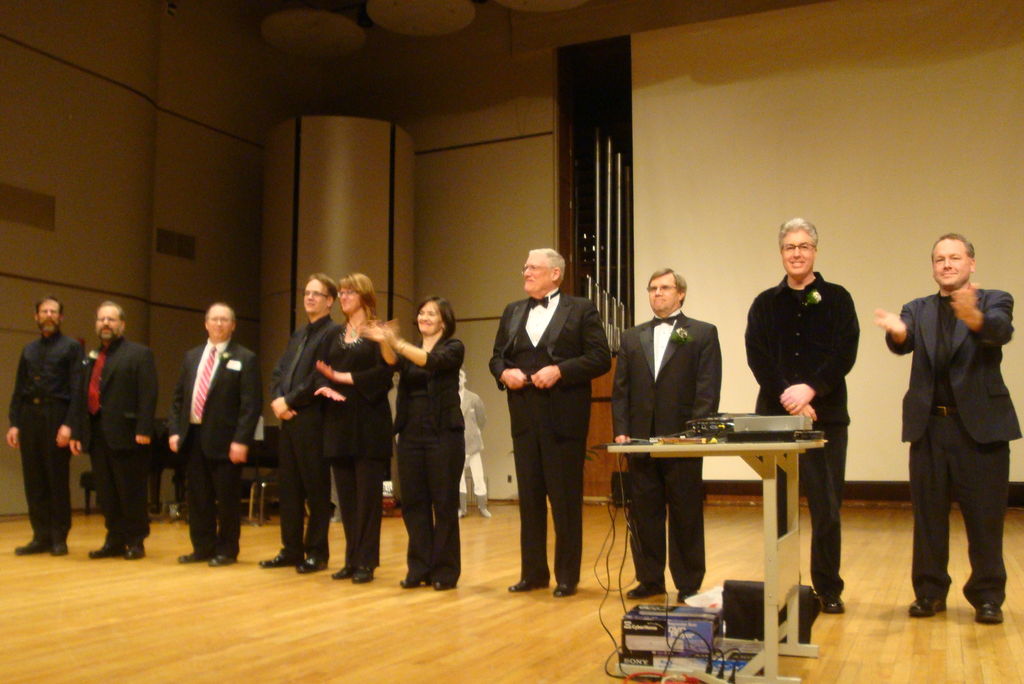
The musicians take a bow at the festival's conclusion. Photo by Melodie Foreman.

I'm not sure where I fit in. (In the above photo, I'm at far right.) For the past few years I've been doing "fill-in" keyboard work at the festival, happy to help with shorts and cartoons. But this year, I was thrilled to be given the chance to work up music for the Langdon film. His comedy seems to lend itself to my approach, and I figured it would be good practice for doing music at Cinefest in Syracuse, N.Y. next month.

So on Saturday, I sat down and off we went! 'Tramp Tramp Tramp' was shown via a good 16mm print, and almost immediately I got into the zone, forgetting about the audience (maybe about 400 folks, pretty good for a Saturday morning) and going with the film. It was just the movie, the keyboard, and me. Less was more: I found that by keeping things simple, I came up with what seemed to be delicate but effective underscoring for some of Langdon's antics. I think things got out of hand a little bit during the climactic cyclone sequence, but otherwise it seemed to work well, with the themes and melodies morphing quite effectively, I thought, as the film progressed.

I'm not often pleased with what I do, especially on solo piano, but this turned out quite well, I thought. I worked with a selection of a half-dozen tunes, including the "title" song, a lilting 6/8 tune for Harry himself, a stronger 4/4 melody (usually in the bass) for Harry's rival, a pompous chord progression for scenes set in a business conference room, and a theme for the romance between Harry and co-star Joan Crawford.

I also made use of an "evil" theme, though this is a picture without much evil in it. I used it only for the "landlord" scene near the beginning and for when some gun-toting deputies nab Harry for stealing a chicken. That's about it for "evil" in 'Tramp Tramp Tramp,' a film that still manages a rousing climax courtesy a cyclone.


Fellow accompanist Greg Foreman and me outside the hall. Photo by Melodie Foreman.

You don't go hungry: There may not be food allowed in the White Concert Hall, but there's plenty available outside it. In fact, so many breakfasts, brunches, lunches, and dinners are associated with the festival that I joke with Bill Shaffer that it should be renamed the "Kansas Silent Film and Food Festival. Here's me captured by festival volunteer Carol Yoho in a typical scene, about to sample apple pie with "satin freeze" (the local term for soft-serve ice cream) at Bobo's Drive-In on Friday:


It's personal: Finally, a key reason I keep coming back to Topeka is because The Kansas Silent Film Festival helped reconnect me with silent film. I've had an interest since adolescence, but hadn't been very active for quite some time until I came out to this event for the first time in 2000.

At first, I attended with the idea of writing a book that would draw heavily on the silent film era (and I still plan to), but that gradually morphed into doing music to help bring the films to life and get them in front of modern audiences. I tell my wife I've finally found my artistic niche: "collaborating with dead people." And it was the Kansas Silent Film Festival, and its concentrated dose of great films, music, and people, that pointed me in that direction.

What else can I say? Well, other than the dates are already set for the next Kansas Silent Film Festival. Mark your calendars: Friday, Feb. 22 and Saturday, Feb. 23, 2013, will be here before we know it!

Oh yeah, the carpeting: I'm always mesmerized by the carpeting used in the White Concert Hall. It's an unusual pattern -- kind of like a floral variation on the international biohazard symbol -- that I've never seen elsewhere, and each year I don't really feel like I'm in Topeka until I've seen it once again.


I think it's the coolest carpeting ever. May it never need replacing.

For lots more on the Kansas Silent Film Festival, visit www.kssilentfilmfest.org.