Showing posts with label Wings. Show all posts

Sunday, November 12, 2023

Coming up: Chaplin's 'The Gold Rush' on Thanksgiving weekend, then a reduced performing schedule starting in 2024

A poster for 'The Gold Rush' (1925) starring Charlie Chaplin.

Just finished a busy weekend of accompanying four shows in three days, including two separate screenings of 'The Big Parade' (1925) and also 'Wings' (1927)—both big gulps.

With Halloween and now Veterans Day in the rear-view mirror, the performance schedule quiets down, with just a few screenings between now and New Year's Day.

And it's likely to stay quiet in 2024, as I cut back on my live performance commitments in order to focus on my day job and other creative pursuits. More on that as things take shape.

In the meantime, next up is Charlie Chaplin's 'The Gold Rush' (1925), which I'm accompanying on Thanksgiving weekend (on Sunday, Nov. 26 at 2 p.m.) at the Town Hall Theatre in Wilton, N.H.

More on that screening in the press release below.

And now, a few notes on this past weekend's shows.

'Wings' was screened Friday night at the Epsilon Spires venue in Brattleboro, Vt., where I got to play their Etsey pipe organ. (It's a former Baptist church and the organ came with it.) Small turnout but attentive movie-goers, judging from the reactions throughout.

Afterwards, a couple told me they attended only because the husband likes vintage planes, and didn't expect to stay more than a half-hour because, you know, those "silent movies."

But the experience was nothing like what they expected, and they ended up staying for the whole thing. So, small audience, but at least one small victory for the form.

Saturday found me navigating unexpectedly closed roads over mountain passes to get to the Residences at Otter Creek, a retirement and assisted living community in Middlebury, Vt.

I made it just in time to present a 2 p.m. Veterans Day program of silent film comedies: 'A Sailor-Made Man' (1921) starring Harold Lloyd and Chaplin's 'Shoulder Arms' (1918). 

Alas, another small turnout. Interestingly, although the average age of those in the room was well above 80, nobody had heard of Harold Lloyd. Nobody! 

I guess not everyone has attended Pordenone or the San Francisco Silent Film Festival. (Neither have I, for that matter.)

The screenings were enjoyed by all, it seems, including the gentleman who decided to get up and walk right in front of the keyboard during the Lloyd film, getting his shoes caught up in my cables and nearly falling down before I stopped playing to help untangle him. 

I'm guessing this doesn't happen too often at Pordenone or the San Francisco Silent Film Festival. But it's the world I work in—all part of bringing silent film to life for people outside the big venues.

Speaking of which: I then drove down Route 7 to Brandon (birthplace of Stephen Douglas, the "Little Giant," who debated Abraham Lincoln), where we ended the 2023 Brandon Town Hall Silent Film Series with a Veterans Day screening of 'The Big Parade' (1925).

The screening almost didn't happen because yours truly didn't realize 'The Big Parade' was on a Blu-ray disc, and I hadn't put the Blu-ray player in the traveling crate. Ooops!

But a call to Dennis Marsden of the town hall produced a work-around (using their own disc player and projector) kept me from having to haul ass down to Rutland in hopes of finding a Blu-ray player with RCA connectors to use for the show. 

Knowing that I would accompany a 35mm print of the 'The Big Parade' in Boston the next day, I thought of the Brandon screening as my opportunity to reacquaint myself with the film, which I hadn't accompanied in some time.

A whimsical moment from 'The Big Parade' (1925).

Funny thing, though—despite a complete lack of preparation, music for the Brandon screening fell together just perfectly, I thought. I had good stuff for almost every scene and sequence, and material I used early was enough to hold the score together for the remainder of the movie. 

And the audience (about 60 people) was into it! Laughs at all the right places; open-mouthed silence at other moments. 

By the time we finished our 2½-hour journey together, everyone was spent, including me. The film received a huge ovation. Afterwards, more than one person told me they couldn't believe the movie was 2½ hours long.

Neither could I. When accompanying, once you get into "the zone," time seems to be suspended, or something happens to you perception of it passing.

So that got me ready for 'The Big Parade' on Sunday, Nov. 12 at the Somerville Theatre in Somerville, Mass. Right?

Well, wrong. As sometimes happens, for whatever reason, this time the score didn't fall together naturally. It went okay, yes, but not like the night before, when I felt I was hitting every moment just right.

Maybe it was fatigue. You don't play 10 hours of film in three days and not start to get—well, a little fuzzy sometimes, especially in hours 9 and 10.

And, unlike in Brandon, the audience was very quiet. Of the nearly 100 people who attended, utterly no laughs in places where there should be, and little reaction of any kind evident.

Example: there's that incredible sustained take (about five minutes, I think) in which John Gilbert shows Renée Adorée how to chew gum. In Brandon, it produced an increasing amount of laughter as it progressed. In Somerville, nothing.

Why? Beats me. 

It wasn't because I was overplaying or stepping on the film. In both cases, I kept the underscoring as light as a feather, frequently using actual silence to punctuate moments when either character registered confusion or incomprehension. 

(That's what I hear accompanists do at places like Pordenone or San Francisco. For us folks working the provinces, it's in our tool kit, too.)

Well, that's that. 

And now, details on 'The Gold Rush' (1925), coming on Sunday, Nov. 26 at 2 p.m. to a theater near you, if you happen to live near the Town Hall Theatre in Wilton, N.H....

*   *   *

Thanksgiving Dinner, anyone? Charlie Chaplin in 'The Gold Rush' (1925).

SATURDAY, NOV. 4, 2023 / FOR IMMEDIATE RELEASE
Contact Jeff Rapsis • (603) 236-9237 • jeffrapsis@gmail.com

Charlie Chaplin's 'The Gold Rush' in Wilton, N.H. on Sunday, Nov. 26

Family fun on Thanksgiving weekend: Little Tramp's silent film comedy classic set in the frozen Arctic to be screened with live music

WILTON, N.H. — Classic silent film comedy returns to the big screen this month in Wilton with 'The Gold Rush' (1925), a classic comedy starring Charlie Chaplin.

The screening will take place on Sunday, Nov. 26 at 2 p.m. at the Town Hall Theatre, 40 Main St., Wilton, N.H.

Admission is free; donations are accepted, with $10 per person suggested to defray expenses.

The screening, the latest in the venue's silent film series, will feature live accompaniment by Jeff Rapsis, a New Hampshire-based composer who specializes in creating music for silent films.

'The Gold Rush,' a landmark comedy and one of the top-grossing films of the silent era, finds Chaplin's iconic 'Little Tramp' character journeying to the frozen wastelands of the Yukon. There as a prospector, the Tramp's search for gold turns into a pursuit of romance, but with plenty of laughs along the way.

The film contains several famous scenes, both comic and dramatic, including a starving Chaplin forced to eat his shoe for Thanksgiving dinner and a heart-breaking New Year's Eve celebration.

As a comedian, Chaplin emerged as the first superstar in the early days of cinema. From humble beginnings as a musical hall entertainer in England, he came to Hollywood and used his talents to quickly rise to the pinnacle of stardom in the then-new medium of motion pictures. His popularity never waned, and his image remains recognized around the world to this day.

Chaplin warms up his feet in 'The Gold Rush' (1925).

'The Gold Rush,' regarded by many critics as Chaplin's best film, is a prime example of his unique talent for combining slapstick comedy and intense dramatic emotion.

" 'The Gold Rush' is still an effective tear-jerker," wrote critic Eric Kohn of indieWIRE. "In the YouTube era, audiences — myself included — often anoint the latest sneezing panda phenomenon as comedic gold. Unless I’m missing something, however, nothing online has come close to matching the mixture of affectionate fragility and seamless comedic inspiration perfected by the Tramp."

Rapsis, who uses original themes to improvise silent film scores, said the best silent film comedies often used visual humor to create laughter out of simple situations. Because of this, audiences continue to respond to them in the 21st century, especially if they're presented as intended — with an audience and live music.

"These comedies were created to be shown on the big screen as a communal experience," Rapsis said. "With an audience and live music, they still come to life as their creators intended them to. So this screening is a great chance to experience films that first caused people to fall in love with the movies," he said.

Rapsis achieves a traditional movie score sound for silent film screenings by using a digital synthesizer that reproduces the texture of the full orchestra.

'The Gold Rush' will be screened on Sunday, Nov. 26 at 2 p.m. at the Town Hall Theatre, 40 Main St., Wilton, N.H.

Admission is free; donations are accepted, with $10 per person suggested to defray expenses. For more information, call the theater at (603) 654-3456.

Thursday, November 9, 2023

Slow news day! Boston's WBUR-FM runs piece on my silent film accompaniment work; plus: 'Wings' in Brattleboro, Vt. on Friday, Nov. 10

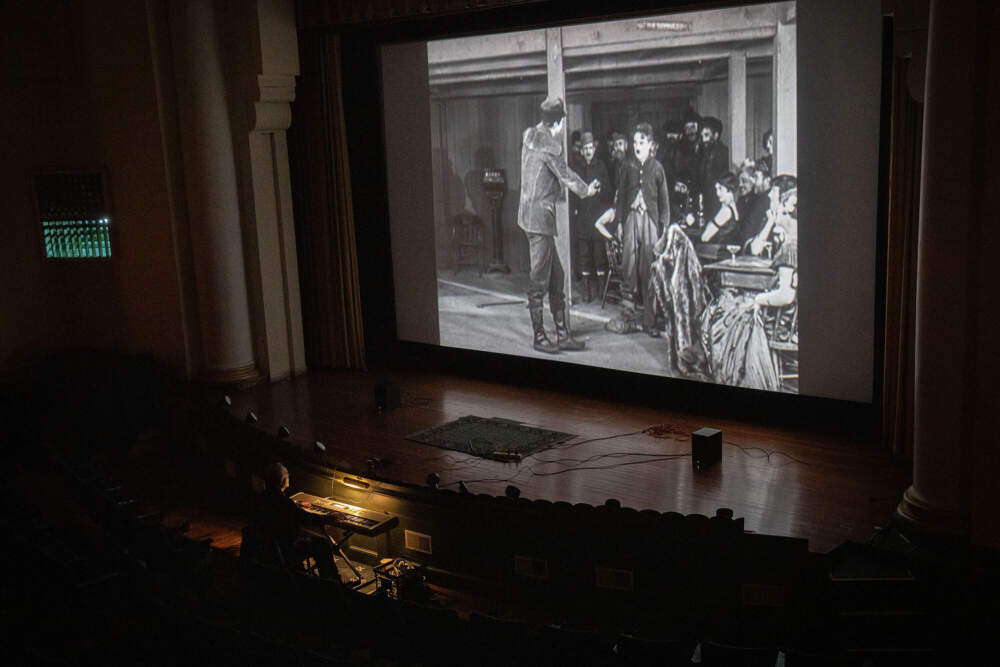
Accompanying 'The Gold Rush' at the Jane Pickens Theater in Newport, R.I. Photo by Robin Lubbock /WBUR 90.9 FM.

I want to thank Amelia Mason of WBUR 90.0 FM in Boston for all the effort that went into putting together a story about me that aired today during Morning Edition.

Amelia took the trouble to come all the way down to Newport for a recent screening of 'Phantom of the Opera' (1925) that I accompanied there. 

We talked a great deal, and she was somehow able to edit my rambling into a coherent story. 

She also got me talking about my larger life journey—about how I chose not to pursue music in college, but then came back to it decades later via silent film accompaniment.

Two weeks later, WBUR photographer Robin Lubbock came down to the same venue to photograph me doing music for the 1925 version of Chaplin's 'The Gold Rush.'

It's not easy to get usable images from inside a darkened theatre. Photo by Robin Lubbock /WBUR 90.9 FM. 

The result was a piece that went beyond the usual "live music for old movies" angle and instead explored how a person (me!) unexpectedly discovered a mid-life outlet for creative energy. 

So thanks to Amelia and Robin and all their colleagues at WBUR for taking time to put together a wonderful piece. Although the focus was on me, I hope it helps raise awareness for vintage cinema and all the people and venues that keep it before the public.

Here's a link to the audio file:

https://dcs-spotify.megaphone.fm/BUR9058007314.mp3

And here's a link to the online piece, which has significant differences from the radio story:

https://www.wbur.org/news/2023/11/09/silent-film-music-composer-jeff-rapsis

And as an added bonus, they spelled my name right! You'd be surprised how often that doesn't happen.


Me at the Jane Pickens Theater in Newport, R.I. Photo by Robin Lubbock /WBUR 90.9 FM

Today is a "day off" from silent film accompaniment, which I need because starting tomorrow it's four shows in three days—mostly screenings designed to salute Veterans Day, which is Saturday, Nov. 11.

After I do 'Wings' (1927) on Friday night in Brattleboro, Vt., then it's a 'two-fer' on Saturday: at 2 p.m., program of comedies at the Residence at Otter Creek, a retirement community in Middlebury, Vt., then at 7 p.m. it's 'The Big Parade' (1925) at 7 p.m. at Brandon (Vt.) Town Hall.

The weekend concludes with another 'Big Parade,' this one on Sunday, Nov. 12 at 2 p.m. at the Somerville Theatre in Davis Square, Somerville.

 The Somerville screening will be via a 35mm print from the Library of Congress. I've accompanied this print before and it's truly gorgeous. 

But next up: 'Wings' (1927) on Friday, Nov. 10 at 7:30 p.m. at Epsilon Spires, Brattleboro, Vt.

More info and details in the press release below. See you at the movies!

*     *     *

An original poster for Paramount's 'Wings' (1927).

SATURDAY, NOV. 4, 2023 / FOR IMMEDIATE RELEASE
Contact Jeff Rapsis • (603) 236-9237 • jeffrapsis@gmail.com

Epic silent film 'Wings' (1927) on Friday, Nov. 10 at Brattleboro's Epsilon Spires

Story of U.S. aviators in World War I won first-ever 'Best Picture'; screening to feature live organ accompaniment

BRATTLEBORO, Vt.—It won 'Best Picture' at the very first Academy Awards, with spectacular midair flying sequences and a dramatic story that still mesmerizes audiences today.

'Wings' (1927), a drama about U.S. pilots in the skies over Europe during World War I, will be shown with live music on Friday, Nov. 10 at 7:30 p.m. at Epsilon Spires, 190 Main St., Brattleboro, Vt.

Admission is $20 per person, with all veterans admitted free in honor of Veterans Day. Tickets may be purchased in advance at www.epsilonspires.org or at the door. Doors open at 7 p.m.

The screening will feature live accompaniment on the venue's Estey pipe organ by Jeff Rapsis, a New Hampshire-based silent film musician.

The show will allow audiences to experience 'Wings' the way its makers originally intended: on the big screen, with live music, and with an audience.

'Wings,' a blockbuster hit in its original release, recounts the adventures of U.S. pilots flying combat missions behind enemy lines at the height of World War I in Europe. 'Wings' stunned audiences with aerial dogfight footage, vivid and realistic battle scenes, and dramatic love-triangle plot.

'Wings' stars Clara Bow, Charles 'Buddy' Rogers, and Richard Arlen. The rarely-seen film also marked one of the first screen appearances of Gary Cooper, who plays a supporting role. 
 
Buddy Rogers, Gary Cooper, and Richard Arlen in 'Wings' (1927).

Directed by William Wellman, 'Wings' was lauded by critics for its gripping story, superb photography, and technical innovations.


'Wings' is notable as one of the first Hollywood films to take audiences directly into battlefield trenches and vividly depict combat action. Aviation buffs will also enjoy 'Wings' as the film is filled with scenes of vintage aircraft from the early days of flight.

Seen today, the film also allows contemporary audiences a window into the era of World War I, which was fought in Europe from 1914 to 1918.

" 'Wings' is not only a terrific movie, but seeing it on the big screen is also a great chance to appreciate what earlier generations of servicemen and women endured," accompanist Jeff Rapsis said.

"It's a war that has faded somewhat from our collective consciousness, but it defined life in the United States for a big chunk of the 20th century. This film captures how World War I affected the nation, and also shows in detail what it was like to serve one's country a century ago."

Rapsis, a composer who specializes in film music, will create a score for 'Wings' on the spot, improvising the music as the movie unfolds to enhance the on-screen action as well as respond to audience reactions. Rapsis performs the music on a digital synthesizer, which is capable of producing a wide range of theatre organ and orchestral textures.

"Live music was an integral part of the silent film experience," Rapsis said. "At the time, most films weren't released with sheet music or scores. Studios relied on local musicians to come up with an effective score that was different in every theater. At its best, this approach created an energy and a connection that added a great deal to a film's impact. That's what I try to recreate," Rapsis said.

'Wings' runs about 2½ hours and will be shown with one intermission. The film is a family-friendly drama but not suitable for very young children due to its length and intense wartime battle scenes.

‘Wings’ (1927) starring Clara Bow, Buddy Rogers and Richard Arlen will be shown with live music in honor of Veterans Day on Friday, Nov. 10 at 7:30 p.m. at Epsilon Spires, 190 Main St., Brattleboro, Vt.

Admission is $20 per person, with all veterans receiving free admission. Tickets may be purchased in advance at www.epsilonspires.org or at the door. Doors open at 7 p.m.

Monday, March 6, 2023

Yesterday: 'Annie Laurie' and 'Cinderella'; tonight: 'Wings' at Garden Cinema in Greenfield, Mass.

Lillian Gish in 'Annie Laurie' (1927).

Yesterday saw me do music for two films I'd never accompanied before: Lillian Gish in 'Annie Laurie' (1927) and 'Cinderella' (1914), with Mary Pickford in the title role.

Tonight, it's an familiar favorite: 'Wings' (1927), which I'm accompanying at the Garden Cinemas in Greenfield, Mass. Showtime is 6:30 p.m.; more info is in the press release pasted in below.

Yesterday's double bill at the Somerville Theatre was something of an endurance test, and not because of the length of the program, which was nearly three hours.

What I mean is: I recently pulled or strained muscle tissue in my shoulder. In the past couple of weeks, this has made it intermittently painful to use my right arm for typing or, yes, playing keyboard. 

But the show must go on. And I've found if I dose myself with Ibuprofin and Naproxen prior to accompanying a film, I can get through it okay. In the meantime, I'm doing exercises to heal and strengthen the injured area, which I believe happened when I was tossing a tree branch over a fence. (Don't ask.)

I greatly enjoyed doing music for 'Annie Laurie,' a lavishly produced historical romance set among the still-feuding clans of Scotland after the union with England. 

It's full of scenes that naturally lend themselves to broad musical gestures. Big action scenes, even bigger "love" scenes between Gish and Norman Kerry, who came across in the movie as a kind of combination of Douglas Fairbanks and Clark Gable.

Also, the way the film was paced and structured provided ample opportunity to work over the basic melodic ideas I brought to the theater: one theme for the Campbells, one for the MacDonalds, and other subsidiary motifs. 

I know there's an actual Annie Laurie song that goes with the movie, but I came up with my own melody for what's sung on screen. As the film progressed, it actually morphed into a melodic cell that came in handle during battle and action scenes. That's one of the things about improvisational accompaniment: how it unfolds can sometimes surprise even the accompanist.

One challenge was recreating the ambiance of bagpipe music on the keyboard. I found what worked was a drone of open fifths, not too low, and then topped by diatonic melodic material with a hint of flatted 7ths in the scale.

And now my right arm is acting up (as I type), so I'll pack it in and just invite you to experience 'Wings' (1927) on the big screen tonight in Greenfield, Mass.

It's the very first 'Best Picture' winner, and so a great way to get ready for this year's Academy Awards, coming up this weekend.

*  *  *

Original poster art for 'Wings' (1927).

Epic silent film 'Wings' (1927) on Monday, March 6 at Greenfield's Garden Cinema

Story of U.S. aviators in World War I won first-ever 'Best Picture'; screening to feature live musical accompaniment

GREENFIELD, N.H.—It won 'Best Picture' at the very first Academy Awards, with spectacular midair flying sequences and a dramatic story that still mesmerizes audiences today.

'Wings' (1927), a drama about U.S. pilots in the skies over Europe during World War I, will be shown on Monday, March 6 at 6:30 p.m. at the Greenfield Garden Cinema, 361 Main St., Greenfield.

The screening will feature live accompaniment by Jeff Rapsis, a New Hampshire-based composer who specializes in creating music for silent films.

Admission is $10.50 adults, $8:50 for children, seniors, and veterans. Tickets are available online or at the door. The screening is sponsored by Precision Driving School of Greenfield.

The show will allow audiences to experience 'Wings' the way its makers originally intended: on the big screen, with live music, and with an audience.

'Wings,' a blockbuster hit in its original release, recounts the adventures of U.S. pilots flying combat missions behind enemy lines at the height of World War I in Europe. 'Wings' stunned audiences with aerial dogfight footage, vivid and realistic battle scenes, and dramatic love-triangle plot.

'Wings' stars Clara Bow, Charles 'Buddy' Rogers, and Richard Arlen. The rarely-seen film also marked one of the first screen appearances of Gary Cooper, who plays a supporting role. Directed by William Wellman, 'Wings' was lauded by critics for its gripping story, superb photography, and technical innovations.

'Wings' is notable as one of the first Hollywood films to take audiences directly into battlefield trenches and vividly depict combat action. Aviation buffs will also enjoy 'Wings' as the film is filled with scenes of vintage aircraft from the early days of flight.

Seen today, the film also allows contemporary audiences a window into the era of World War I, which was fought in Europe from 1914 to 1918.

" 'Wings' is not only a terrific movie, but seeing it on the big screen is also a great chance to appreciate what earlier generations of servicemen and women endured," accompanist Jeff Rapsis said.

"It's a war that has faded somewhat from our collective consciousness, but it defined life in the United States for a big chunk of the 20th century. This film captures how World War I affected the nation, and also shows in detail what it was like to serve one's country a century ago."

Rapsis, a composer who specializes in film music, will create a score for 'Wings' on the spot, improvising the music as the movie unfolds to enhance the on-screen action as well as respond to audience reactions. Rapsis performs the music on a digital synthesizer, which is capable of producing a wide range of theatre organ and orchestral textures.

"Live music was an integral part of the silent film experience," Rapsis said. "At the time, most films weren't released with sheet music or scores. Studios relied on local musicians to come up with an effective score that was different in every theater. At its best, this approach created an energy and a connection that added a great deal to a film's impact. That's what I try to recreate," Rapsis said.

'Wings' runs about 2½ hours. The film is a family-friendly drama but not suitable for very young children due to its length and intense wartime battle scenes.

‘Wings’ (1927) starring Clara Bow, Buddy Rogers and Richard Arlen will be shown with live music on Monday, March 6 at 6:30 p.m. at the Greenfield Garden Cinema, 361 Main St., Greenfield, Mass. Admission is $10.50 for adults; $8.50 for children, seniors, and veterans.

Tickets are available online at www.gardencinemas.net or at the door. For more information, call the box office at (413) 774-4881.

Friday, October 1, 2021

Benefit screening of 'Wings' (1927) to land at Manchester's Rex Theatre on Tuesday, Oct. 5

Arriving on Tuesday, Oct. 5: the epic Academy Award-winning  drama 'Wings' (1927).

Creating music for silent films is separate from my "day job," which is managing a local non-profit organization.

In that light, I'm a big admirer of the composer Charles Ives (pictured below, at left). A century ago, he worked full-time as partner in a very successful insurance business, while continuing his musical activities on the side.

It was a choice he made early in life, recognizing that his at-times bizarre avant garde compositions were never going to provide an income. And he didn't want his family to "starve on his dissonances," as he said.

However, Ives saw advantages in this double life. He claimed his work in business helped his art, and his work in art helped his business. I subscribe to that outlook, which I've found to be true for me as well.

And the two lives aren't always separate. Occasionally, they overlap. In the case of Ives, he would sometimes try to supply music for insurance industry events, often with mixed results. After all, he wasn't about to write music like the State Farm Insurance "Like a Good Neighbor" jingle, which was actually composed by...Barry Manilow! 

(Manilow, by the way, also composed the "Stuck on Band-Aid" jingle, and, most famously, "You Deserve a Break Today" for McDonalds, but that's is a whole other topic.)

And every now and then, my own two lives collide—such as on Tuesday, Oct. 5, when I'll provide live music for a screening of 'Wings' (1927) to benefit the Aviation Museum of N.H., where I'm executive director. (That's the non-profit I manage.)

For me, it's a nice coincidence that aviation and the movies grew up at roughly the same time, during the first decades of the 20th century. Early cinema is filled with flying stories, especially following Lindbergh's 1927 solo journey across the Atlantic.

So there's a lot of synergy. Over the years, I've done several aviation-themed silent film programs in support of the museum or other organizations. As the first 'Best Picture' in Academy Award history, 'Wings' is far and away the favorite title. 

But other titles include the Al Wilson stunt picture 'The Phantom Flyer' (1928), an airborne melodrama titled 'The Sky Rider' (1928) starring Champion the Dog, and the goofy Monty Banks feature-length comedy 'Flying Luck' (1927). 

Ironically, Ives himself was no fan of either airplanes or the movies. He would famously shake his fist at airplanes that flew overhead, intruding on the rural quiet of his native Connecticut. And he felt movies were a form of dissipation that weakened the collective American spirit.

Well, even if Ives might not approve, 'Wings' is on the bill next Tuesday. If you're in the Manchester area, I invite you to join us. If you've never had a chance to see this picture on the big screen, and with live music, and with an audience—well, it's a flight you don't want to miss.

More details in the press release below. Hope to see you for an on-time departure on Tuesday, Oct. 5 at  p.m.

*   *   *

Another colorful poster for 'Wings' (1927), to be shown with live music on Tuesday, Oct. 5 at 7 p.m. at the Rex Theatre in Manchester, N.H.

FRIDAY, SEPT. 17, 2021 / FOR IMMEDIATE RELEASE
Contact Jeff Rapsis • (603) 236-9237 • jeffrapsis@gmail.com

Epic silent film 'Wings' (1927) on Tuesday, Oct. 5 at Manchester's Rex Theatre

Story of U.S. aviators in World War I won first-ever 'Best Picture'; Aviation Museum benefit screening to feature live musical accompaniment

MANCHESTER, N.H.—It won 'Best Picture' at the very first Academy Awards, with spectacular midair flying sequences and a dramatic story that still mesmerizes audiences today.

'Wings' (1927), a drama about U.S. pilots in the skies over Europe during World War I, will be shown on Tuesday, Oct. 5 at the Rex Theatre, 23 Amherst St., Manchester, N.H.

The screening, part of the Rex Theatre's "Movies for a Cause" program, will benefit the non-profit Aviation Museum of N.H. and the Rex Theatre.

Showtime is 7 p.m. Tickets are $12 per person, general admission.

The screening will feature live accompaniment by Jeff Rapsis, a New Hampshire-based composer who specializes in creating music for silent films.

The show will allow audiences to experience 'Wings' the way its makers originally intended: on the big screen, with live music, and with an audience.

'Wings,' a blockbuster hit in its original release, recounts the adventures of U.S. pilots flying combat missions behind enemy lines at the height of World War I in Europe. 'Wings' stunned audiences with aerial dogfight footage, vivid and realistic battle scenes, and dramatic love-triangle plot.

Looking glum: a downcast still from 'Wings' with stars Buddy Rogers, Clara Bow, and Richard Arlen.

'Wings' stars Clara Bow, Charles 'Buddy' Rogers, and Richard Arlen. The rarely-seen film also marked one of the first screen appearances of Gary Cooper, who plays a supporting role. Directed by William Wellman, 'Wings' was lauded by critics for its gripping story, superb photography, and technical innovations.

'Wings' is notable as one of the first Hollywood films to take audiences directly into battlefield trenches and vividly depict combat action. Aviation buffs will also enjoy 'Wings' as the film is filled with scenes of vintage aircraft from the early days of flight.

Seen today, the film also allows contemporary audiences a window into the era of World War I, which was underway in Europe a century ago.

" 'Wings' is not only a terrific movie, but seeing it on the big screen is also a great chance to appreciate what earlier generations of servicemen and women endured," accompanist Jeff Rapsis said.

"It's a war that has faded somewhat from our collective consciousness, but it defined life in the United States for a big chunk of the 20th century. This film captures how World War I affected the nation, and also shows in detail what it was like to serve one's country a century ago."

Rapsis, a composer who specializes in film music, will create a score for 'Wings' on the spot, improvising the music as the movie unfolds to enhance the on-screen action as well as respond to audience reactions. Rapsis performs the music on a digital synthesizer, which is capable of producing a wide range of theatre organ and orchestral textures.

"Live music was an integral part of the silent film experience," Rapsis said. "At the time, most films weren't released with sheet music or scores. Studios relied on local musicians to come up with an effective score that was different in every theater. At its best, this approach created an energy and a connection that added a great deal to a film's impact. That's what I try to recreate," Rapsis said.

Rapsis is executive director of the Aviation Museum of N.H., which is co-sponsoring the screening.

'Wings' will be followed on Wednesday, Oct. 6 with "The McConnell Story" (1955), a Warner Bros. dramatization of the life and career of N.H. native Joseph C. McConnell, a U.S. Air Force pilot who became the top American ace during the Korean War.

'Wings' runs about 2½ hours. The film is a family-friendly drama but not suitable for very young children due to its length and intense wartime battle scenes.

‘Wings’ (1927) starring Clara Bow, Buddy Rogers and Richard Arlen will be shown with live music on Tuesday, Oct. 5 at 7 p.m. at the Rex Theatre, 23 Amherst St., Manchester, N.H.

Tickets $12 adults, general admission. For more information and to buy tickets, visit www.palacetheatre.org or call (603) 668-5588.


Sunday, October 11, 2020

Yesterday, the Moon and UFO Festival; today, 'Caligari' in Natick, Mass., then 'Wings' in Wilton, N.H. later this week

It's not easy being green. For some reason, you just don't fit in.

It's a beautiful Columbus Day weekend here in northern New England. The foliage is at its peak, but there's also spectacular color inside, such as this alien glimpsed as part of the Greater New England UFO Conference in Wilton, N.H. (More on that below.)

First up: this afternoon (Sunday, Oct. 11) it's 'The Cabinet of Dr. Caligari' (1920) at the Center for the Arts, 14 Summer St. in Natick, Mass. Screening time is 6 p.m., so guess it's technically this evening. 

I haven't promoted this one heavily because the Center, like all venues in Massachusetts, is limited to just 25 people due to Covid-19 restrictions. But if you'd like to go, check www.natickarts.org, as tickets are available only online and in advance.

But then we swing back to New Hampshire later this week with a screening of the epic World War I picture 'Wings' (1927) on Thursday, Oct. 15. Showtime is 7:30 p.m. at the Town Hall Theatre in Wilton, N.H., and it's the opening title in a three-day festival of classics brought to you by the Aviation Museum of N.H.

More on 'Wings' and the festival below. Before that, let's tackle the alien. (Not literally, as he may have a raygun, or be sticky.) He/she/it was spotted in the Town Hall Theatre lobby as part of, yes, the Greater New England UFO Conference, which is taking place this weekend.

In fact, it's still going on today: Sunday, Oct. 11. So there's still time to check it out if you're within driving or bicycling distance to Wilton, N.H. Among other attractions, the theater is enforcing social distancing by placing blow-up aliens (similar to the one above) in selected seats.

As an incentive, it's also a confab of "Big Foot" fans, one of whom can make plaster casts for you to take home:

Casting call: Take home your very own big feet!

I wish to apologize to all Bigfoot fans, plus the Native American community in general, for mistakenly referring to Big Foot in my opening remarks as "Sacajawea" instead of "Sasquatch." Wow, I'm turning into my malaprop-prone mother. God rest her soul. (Apologies to her, too, by the way. Just because.)

Anyway: I love doing music for Lang's 'Frau im Mond' (the original German title) because it's such a surprise for audiences, and also because the whole story and treatment are a good fit for the kind of music I make: that of the big gesture. 

Things always start off with a bang due to a flashback near the beginning: Prof. Manfeldt is seen more than three decades earlier, lecturing on his "gold on the moon" theory to fellow academics, who promptly riot. Lang then shows close-ups of a bell being rung and a whistle being blown to quell the fracas: literally, bells and whistles!

And that's what I use: my grandmother's old brass school bell, and a referee's whistle, to kick up a nice sonic riot to go with Lang's visuals. And it's really effective, I think, especially when the flashback ends and Lang dissolves back to Prof. Manfeldt, now impoverished and living in a garret: all the noise dies down and I just leave soft high note sustained, hanging there.

When I accompany 'Woman in the Moon,' the entire score is built out of original motifs for characters and situations. You need material to hold together a nearly three-hour film. But also, in just one instance, I use an identifiable tune that I think helps the film's emotional line.

The tune: 'Gaudeamus igitur,' the classic student anthem. I work it in during Manfeldt's flashback lecture to establish atmosphere, and then we don't hear it again until much later, when he reaches the moon and actually finds, yes, GOLD! 

Lang illustrates the moment visually by showing the Professor's shouts echoing among the lunar caverns, and I add a note of musical triumph by folding in the chords to 'Gaudeamus' on top of the by-then-rhythmic accompaniment in the bass. 

Lot of interesting comments from the 30 or so people who attended the screening. One I'd never heard before: "NASA could use you to add drama to their launches."

By the way, I mentioned bicycling because after yesterday's trip to the moon, I got on my trusty road bike and pedaled a late afternoon loop from the theater into the hills of bucolic Lyndeborough, N.H. (Pronounced "line-boro" for all you flatlanders.) 

And I mean hills. It was all up, up, up to what's called "Lyndeborough Center," with its meetinghouse and parsonage and open fields and views for miles. And then, as dusk gathered, I enjoyed my own rocket ship ride down the road to a place called "Fitch's Corner" in Milford, then back to the theater.

Distance was only about 15 miles, but the uphills made for slow going, while the downhills couldn't be taken advantage of entirely because it was getting dark and you have to be careful on these back roads.

But the air was still warm, even in the growing twilight, so it made for a spectacular communion with this year's foliage, which will be gone soon enough. 

Okay, here's more info about 'Wings' on Thursday and the other classic aviation films we're showing later this week. See you at the theater!

*   *   *

'Wings' to be screened with live music on Thursday, Oct. 15 at the Town Hall Theatre.

WEDNESDAY, SEPT. 30, 2020 / FOR IMMEDIATE RELEASE
Contact Jeff Rapsis • (603) 236-9237 • jrapsis@nhahs.org

Three-day festival of classic aviation adventure films coming to Wilton, N.H.

John Wayne, Jimmy Stewart among stars featured in Academy Award-winning pictures presented by Aviation Museum of N.H.

WILTON, N.H.—Fly off to high-altitude adventure with a festival of classic aviation films at the Town Hall Theatre, 40 Main St., Wilton, N.H.

The three-day event, which runs from Thursday, Oct. 15 through Saturday, Oct. 17, gives local audiences a chance to see timeless aviation movies as they were intended—on the big screen and in a theater.

The festival will include four large-scale features from Hollywood's Golden Age, ranging from the classic World War I aviation drama 'Wings' (1927) to the all-star wide-screen desert survival blockbuster 'The Flight of the Phoenix' (1965).

Other titles include '12 O'Clock High' (1949), an intense thriller about U.S. pilots in World War II, and 'The High and the Mighty' (1954), a ground-breaking airborne drama about a stricken commercial airliner starring John Wayne.

All films in the festival were nominated for multiple Academy Awards. Each captures the public's fascination with flight in a different setting, as pilots and passengers alike face danger in the sky and also on the ground. Aviation buffs will enjoy the vintage aircraft featured in each production.

All screenings are free and open to the public. Donations will be accepted, with all proceeds used to support the education outreach program of the Aviation Museum of N.H.

The Town Hall Theatre is observing procedures to comply with all state and CDC public health guidelines, including reduced seating capacity. For complete information about the venue's safety protocols, visit www.wiltontownhalltheatre.com.


• On Thursday, Oct. 15 at 7:30 p.m., the festival opens with the silent classic 'Wings' (1927), a drama about World War I aviation that won 'Best Picture' at the very first Academy Awards ceremony. The film stars Clara Bow, Charles 'Buddy' Rogers, and Richard Arlen. Live music for 'Wings' will be provided by Jeff Rapsis, a silent film accompanist and also executive director of the Aviation Museum of New Hampshire.


• On Friday, Oct. 16 at 7:30 p.m. brings '12 O'Clock High' (1949), a classic bout aircrews in the United States Army's Eighth Air Force, who flew daylight bombing missions against Nazi Germany and occupied France during the early days of American involvement in World War II. Starring Gregory Peck, '12 O'Clock High' received four Academy Award nominations, winning Best Supporting Actor for co-star Dean Jagger and Best Sound Recording.


• Saturday, Oct. 17 at 2 p.m., it's 'The High and the Mighty' (1954), a drama about a troubled commercial flight starring John Wayne and Robert Stack. With its intertwined stories of passengers on a doomed commercial flight, 'The High and the Mighty' served as a template for the Hollywood 'disaster' genre. The film earned six Academy Award nominations, winning for composer Dmitri Tiomkin's dramatic musical score.


• Saturday, Oct. 17 at 7:30 p.m., the festival concludes with 'The Flight of the Phoenix' (1965), a drama about survivors of a plane crash in the Sahara Desert. Starring Jimmy Stewart, Peter Finch, and Ernest Borgnine, 'The Flight of the Phoenix' was nominated for two Academy Awards: Ian Bannen for Supporting Actor and Michael Luciano for Film Editing.

"These are all terrific pictures with great stories set in the earlier days of aviation, before air travel became commonplace for so many people," said Jeff Rapsis, the Aviation Museum's executive director.

"They're a great way to recapture the romance and excitement of flight, and the Aviation Museum's festival is a rare chance to see them as intended: on a big screen and in a movie theater," Rapsis said.

The Aviation Museum of N.H., located at 27 Navigator Road, Londonderry, N.H., is a non-profit 501(c)3 tax-exempt organization. Housed in the vintage 1937 passenger terminal at Manchester-Boston Regional Airport, the Aviation Museum is dedicated to preserving the Granite State's rich aviation past, and also inspiring today's students to become the aviation pioneers of tomorrow.

For more information about the Aviation Museum, visit www.aviationmuseumofnh.org or call (603) 669-4820. Follow the Aviation Museum on social media at www.facebook.com/nhahs.

For more about the Town Hall Theatre, visit www.wiltontownhalltheatre.com or call (603) 654-3456.

Wednesday, March 6, 2019

What if Disney's songwriting duo the Sherman brothers had been born in Beijing, not NYC?


I've been remiss in updating my silent film adventures due to a big grant-writing deadline.

But now, before heading off to London to accompany a screening of 'The Cat and the Canary' at the Kennington Bioscope next week, it's time to catch up.

Since returning from the Kansas Silent Film Festival, I've had the pleasure of doing live music for two very different motion pictures: one a familiar warhorse, and the other completely unknown to me.

The former: 'Wings' (1927), the grand epic of the skies that won Best Picture at the very first Academy Awards.

The latter: 'The Stormy Night' (1925), a Chinese silent comedy/drama that was considered lost until just recently.

With 'Wings,' I was on familiar ground. (Har!)

Booked by the Center for the Arts in Natick, Mass. for an afternoon screening on Sunday, Feb. 24, it was intended as a warm-up for that evening's Oscars ceremony.

For me, the circumstances were hard to beat. That morning, I had flown from Kansas City through Detroit and then into Manchester, N.H., arriving in plenty of time to swing down to Natick and load in my gear for the 4 p.m. show.

So what better prep for 'Wings' than flying not one but two commercial flights right before the screening?

We enjoyed a healthy turnout, and a pre-show poll found most people new not only to 'Wings' but also the silent film experience. (And the theater, managed by Josh Valentine and Nicola Anderson, always does such a great job promoting the screenings, putting up vintage posters to build excitement.)

Located in a beautifully refurbished firehouse, the Center for the Arts boasts a gleaming Yamaha grand piano in its upstairs performance space, where movies are shown.

It's been beckoning me since I started performing in Natick. One of these days I'll use it, but so far all the films in Natick have been better served by digital synthesizer, I think.

This time around I found the piano up on the risers that constitute the "stage." And even though I wasn't going to use it, I couldn't resist opening the lid and playing a bit...and then realized that it was at the perfect height for me to use while standing up!

Now there's an idea! It's sitting down at a desk bad for you? Isn't the human body designed to function most efficiently in a standing position?

So why do people sit at a piano to play it? Wouldn't it make more sense for the player to stand?

We have stand-up comedians. Why not stand-up pianists?

Quick, get me a patent lawyer so I can protect my innovative new "pedal extendeder," which allows you to easily convert an old-fashioned sit-down piano into a modern, up-to-date, ergonomically superior STAND UP PIANO!

Order before midnight tonight and we'll throw in a VHS bootleg tape of Buster Keaton's 'The General'!

And then...

Last Saturday I had the privilege (and the challenge) of creating music for a newly rediscovered Chinese silent film that's been making the rounds of elite film venues.

In this case, it was for a screening of 'The Stormy Night' (1925) at the Harvard Film Archive.

The film, a light-hearted comedy/drama about the upper classes in pre-Maoist China, had been missing since its release.

This was par for the course. As the Harvard Film Archive notes tell us:
More than 650 films were reportedly made in China between 1921 and 1931, yet no more than twenty have survived the wars that followed. The serendipitous rediscovery of Zhu Shouju’s 1925 film 'The Stormy Night' gives us a rare opportunity to learn about this significant yet forgotten era of Chinese silent cinema.
That's a pretty rotten record, even for silent film!

But yes, a nearly complete print of 'The Stormy Night' was discovered some years back in a Japanese archive. After repatriation to China, it was restored by Shi Chuan, a Shanghai-based film scholar. It's now available for screening for the first time in nearly a century.

A special treat for this screening was an introduction by Shi Chuan himself, with translation by Jie Li of Harvard's Department of East Asian Languages and Civilizations.

A scene from 'The Stormy Night' (1925).

Unsurprisingly, the audience was packed with Chinese students. Surprisingly, the accompanist was an occidental of Irish-Lithuanian-French-Canadian extraction with no cultural connection to the film's milieu short of an appetite for General Tso's chicken.

But I looked at it as a challenge: how could I create appropriate music for a film made in a completely different cultural context compared to my own?

This, after all, was not the Chinatown riot sequence from Buster Keaton's 'The Cameraman' (1928). Nor was it the seedy faux Chinese opium den depicted in Raymond Griffith's 'Paths to Paradise' (1925).

With cultural references like those in his head, what's an accompanist to do?

My approach was to back off and keep it light. It was a comedy, after all. And it seems to me no matter what the cultural context, with comedy, less is more.

Also, I tried to use a musical language that was separate from the familiar Western/classical harmonies and chord progressions.

Melody, yes. But not the way you'd encounter it in Mozart or Beethoven. More like a modal sound,

My overriding attitude was this question: "What would it sound like if Disney songwriters Robert B. and Richard M. Sherman had been born in Beijing instead of New York?" That's what I was going for.

Songwriting brothers Richard M. and Robert B. Sherman with their patron, Walt Disney.

(I think the Sherman brothers were among the best songwriters of all time, and I'll fight anyone who disagrees.)

But back to pre-Maoist China. To help get my mind in the right place for this, I opted for a synthesizer texture that was light and airy and heavy on the strings and harp.

Just by hitting a single note, you could hear we were in a different place. But it wasn't the plinkety-plink of xylophones or the tired and not-very-exotic crash of a gong. It was more of clean sweep, giving me implicit license to work in a fresh style.

That's what I was going for. And from the reaction to the film, I think I wasn't too far off.

I mean, people actually laughed at this formerly lost comedy from a lost world. It engaged them, drew them in, and they enjoyed it.

Thus I'm really glad I didn't go with my original plan, which was to play variations on 'Chopsticks' for 90 minutes.

Thanks to Haden Guest and Karin Kolb of the Harvard Film Archive for continuing to program a wide variety of silents with live music.

And special thanks to Shi Chuan for rescuing this rare film from oblivion, and for coming all the way to Boston to share it with us!

Thursday, November 8, 2018

Armistice Day +100: Sunday, Nov. 11 at 2 p.m.:
scoring 'The Big Parade' at Somerville Theatre

Tom O'Brien, John Gilbert, and Karl Dane sharing a foxhole in the World War I drama 'The Big Parade' (1925).

In introducing films lately, I've found myself choking up a bit when I get to the upcoming 100th anniversary of Armistice Day, when the guns in Europe went silent.

Well, the long march to the big day is nearing an end. On Sunday, Nov. 11, 2018, it will be a full century since World War I ended.

On that day, I'm honored to do live music for one of the great films about that conflict, 'The Big Parade' (1925) at the Somerville Theatre in Davis Square, Somerville, Mass.

We're using a 35mm print for the screening, which starts at 2 p.m. More info is available in the press release I've pasted in below, and I hope you'll attend.

The emotional thing happened again last night prior to a screening of 'Wings' (1927) for a packed house at Red River Theatres in Concord, N.H. Introducing the film, I kinda choked up for a moment.


Just before the show: a full house settles in for 'Wings.'

I thought about it, and I recognized a pattern: it always happens when I say that no one is among us who was there: who wore the uniform, who shipped off to Europe, who fought alongside others, who awoke 100 years ago this Sunday to the blessed sound of silence.

And that gets to me, I think, because it so vividly illustrates the impermanence of what we as human beings experience.

On Nov. 11, 1918, the entire human race, more or less, shared the experience knowing that a huge and unthinkably awful war had finally ended. It was a conflict that would cast a shadow over the next century and beyond, influencing events around us even day.

But now, just a few generations later, the human experience of World War I produces a silence that's different from that heard on the European battlefields that morning. It's the eternal silence that subsumes everything as the present becomes the past—the past which every passing day and month and year bury deeper and deeper, as it inevitably must.

It's a process that humans grapple with in many different ways. It's the root of everything from hoarding to ancestor worship. We don't want to lose the past. But the passage of time divorces us from it just the same.

I think that's a big reason why I'm drawn to films of the silent era. When we run them, for just a little while, the past is not lost. We breathe life into it and can get a sense of what it was like when the past was the present.

In a way, by showing these films, we're able to hear from people who can no longer speak for themselves. And I find that's what stirs my emotions.

To me, it's a certain kind of special magic that I think is worth experiencing—especially if it involves a good story, a good cast, and a director with an eye for the visual.

'Wings' has all that, and generated a huge reaction from our sold-out house last night at Red River Theatres.


I want to thank my colleagues at the Aviation Museum of New Hampshire for supporting the event, and Red River for continuing to find room for silent film with live music in their schedule.

So as the actual 100th anniversary of Armistice Day approaches, I hope you'll join me at the Somerville Theatre for a 35mm print of one of the great World War I flicks: 'The Big Parade.'

Details below!

* * *

An original poster for 'The Big Parade.'

OCT. 21, 2018 / FOR IMMEDIATE RELEASE
Contact Jeff Rapsis at (603) 236-9237 • e-mail jeffrapsis@gmail.com

Epic WWI drama 'The Big Parade' to be screened in 35mm on Sunday, Nov. 11 at Somerville Theatre


To be shown with live music on 100th anniversary of 1918 Armistice; blockbuster silent film changed the way Hollywood depicted battle on the screen

SOMERVILLE, Mass. — It was the 'Saving Private Ryan' of its time — a movie that showed audiences war as experienced by a front line soldier whose life is changed forever by its horrors.

It was 'The Big Parade' (1925), a sprawling World War I epic and a box office sensation that made MGM into a powerhouse studio. It's the latest installment of 'Silents, Please!,' a silent film series with live music at the Somerville Theatre.

'The Big Parade' will be screened in 35mm one time only at the Somerville Theatre on Sunday, Nov. 11 at 2 p.m. General admission is $15; seniors/students $12.

The Veterans Day screening coincides with the 100th anniversary of the Armistice of Nov. 11, 1918, which ended the fighting of World War I.

The show will feature live accompaniment by silent film musician Jeff Rapsis.

'The Big Parade,' released just a few years after World War I ended, was hailed by critics as the first Hollywood film to depict the harsh reality of combat and its impact on troops. Its hellish battle scenes were staged on a massive scale and still retain their ability to shock audiences.

The picture, based on the best-selling novel "What Price Glory?", follows the story of a young man (John Gilbert) who rebels against his privileged background by enlisting in the army just before the U.S. enters World War I.

He is shipped out to France, where he falls in love with a local French woman before being transferred to the front. There, he and his squadmates face the German war machine, where they must endure the ultimate tests of duty and honor in a battle they come to see as meaningless.

Renée Adorée and John Gilbert in 'The Big Parade.'

In addition to vivid war scenes, the film contains a famous dramatic sequence in which the French woman (Renée Adorée) realizes her love for the soldier, and tries to find him to say goodbye as the massive convoy of troops pulls out for the front. Another celebrated sequence depicts the light-hearted first meeting of the soldier and the girl, in which he teaches her how to chew gum.

'The Big Parade' went on to become the top-grossing movie of the entire silent film era, earning $6.4 million domestically and making director King Vidor into the Steven Spielberg of his day. It stood as MGM's biggest single box office hit until the release of 'Gone With the Wind' in 1939.

"We felt screening 'The Big Parade' on Sunday, Nov. 11 was a suitable way to mark the 100th anniversary of the Armistice," said Somerville manager Ian Judge. "World War I is now part of history, but this picture is from a time when it was foremost in people's minds. What was then called 'The Great War' was the 9/11 of its day, and this film captures that intensity and allows us to experience it today."

Rapsis will improvise a musical score to the film in real time. In creating accompaniment for the 'The Big Parade' and other vintage classics, Rapsis tries to bridge the gap between silent film and modern audiences.

"Live music adds an element of energy to a silent film screening that's really crucial to the experience," Rapsis said. " 'The Big Parade' is filled with great scenes that lend themselves well to music. It's a real privilege to create a score to help this great picture come back to life," Rapsis said.

All entries in the Somerville's silent film series are shown using 35mm prints, the native film format that few theaters are now equipped to run following Hollywood's transition to digital formats.

MGM's silent blockbuster ‘The Big Parade’ will be shown in 35mm and with live music on Sunday, Nov. 11 at 2 p.m. at Somerville Theatre, 55 Davis Square, Somerville, Mass.

Admission to the screening is $15 or $12 seniors/students; general admission seating. For more info, call (617) 625-5700 or visit www.somervilletheatre.com. For more info on the music, visit www.jeffrapsis.com.


Sunday, November 4, 2018

'Wings' and other silent films set in WWI:
often the drama is about returning home


The silent film 'Wings' is all about airplanes.

So it's fitting that I'm posting this preview of the film (which I'm accompanying this week in Concord, N.H.) from an eastbound JetBlue Airbus 321 somewhere high above Nebraska.

Actually, the altitude is now exactly 34,793 feet, according the readout on the seatback video screen in front of me.


I'm heading home after accompanying a William S. Hart drama, 'The Cradle of Courage' (1920), last night at the Niles Essanay Silent Film Museum in Fremont, Calif.

Before I get to 'Wings,' a few thoughts about the Hart drama, which was unusual. Unlike so many of his features, it's not a Western. Instead, it's about doughboys returning home to city life (in this case, San Francisco) after World War I.

And with the 100th anniversary of Armistice Day coming up next weekend, I was glad for the chance to see this rarely screened Hart opus, in which our hero gives up his pre-war occupation as a crook to become a policeman instead. And the 16mm print at the Niles Museum was a stunner: sharp, with great tonal values throughout.

'The Cradle of Courage' offers a strong dose of life as it was lived in the nation's cities a century ago. The settings are real and grim, including many exterior shots filmed on location in the city by the Bay. Dialogue in the intertitles is filled with antique argot and colorful tough-guy slang.

A not-so-young soldier William S. Hart (he was over 50 at the time) wanders the streets of old San Francisco after returning home in 'Cradle of Courage.'

But it's especially powerful as a reminder that those who served in what we now call World War I often faced fresh battles upon returning home. And that's worth remembering as we approach the centennial of the day the guns went silent.

You can see that same dynamic in other World War I movies of the silent era. It's in 'Wings' (1927), which I'm accompanying this Wednesday, and also 'The Big Parade' (1925), which I'm doing music for on Sunday, Nov. 11 at the Somerville Theatre. Both have powerful and bittersweet "returning home" scenes.

My own homecoming later today will involve mostly getting licked by two dogs. So as centennial of Armistice Day approaches, it's worth remembering how so many did not have it so easy.

And one way to remember those who served, and to honor their sacrifices, is to take in a movie such as 'Wings.' I think a mainstream film aimed at a general audience captures some of the excitement and also the dread of the war in a manner quite different from any history book or documentary.

Well, this week, you can see for yourself. More info about our screening of 'Wings' at Red River Theatres in Concord, N.H. is in the press release below. Hope to see you there!

* * *


MONDAY, OCT. 15, 2018 / FOR IMMEDIATE RELEASE
Contact Jeff Rapsis • (603) 236-9237 • jeffrapsis@gmail.com

Epic silent film 'Wings' (1927) on Wednesday, Nov. 7 at Red River Theatres

Story of U.S. aviators in World War I won first-ever 'Best Picture'; screening to feature live musical accompaniment

CONCORD, N.H.—It won 'Best Picture' at the very first Academy Awards, with spectacular airborne sequences and a dramatic story that still mesmerizes audiences today.

'Wings' (1927), a drama about U.S. aviators in the skies over Europe during World War I, will be shown on Wednesday, Nov. 7 at Red River Theatres, 11 South Main St., Concord, N.H.

The screening is in honor of the 100th anniversary of the Armistice of Nov. 11, 1918, which ended the "Great War" and which led to our modern observance of Veterans Day.

Showtime is 7 p.m. Tickets are $12 per person, general admission.

The screening, the latest in Red River's silent film series, will feature live accompaniment by Jeff Rapsis, a New Hampshire-based composer who specializes in creating music for silent films.

The show will allow audiences to experience 'Wings' the way its makers originally intended: on the big screen, with live music, and with an audience.

'Wings,' a blockbuster hit in its original release, recounts the adventures of U.S. pilots flying combat missions behind enemy lines at the height of World War I in Europe. 'Wings' stunned audiences with its aerial dogfight footage, vivid and realistic battle scenes, and dramatic love-triangle plot.

'Wings' stars Clara Bow, Charles 'Buddy' Rogers, and Richard Arlen. The rarely-seen film also marked one of the first screen appearances of Gary Cooper, who plays a supporting role. Directed by William Wellman, 'Wings' was lauded by critics for its gripping story, superb photography, and technical innovations.

'Wings' is notable as one of the first Hollywood films to take audiences directly into battlefield trenches and vividly depict combat action. Aviation buffs will also enjoy 'Wings' as the film is filled with scenes of vintage aircraft from the early days of flight.

Seen today, the film also allows contemporary audiences a window into the era of World War I, which was underway in Europe a century ago.

" 'Wings' is not only a terrific movie, but seeing it on the big screen is also a great chance to appreciate what earlier generations of servicemen and women endured," accompanist Jeff Rapsis said. "It's a war that has faded somewhat from our collective consciousness, but it defined life in the United States for a big chunk of the 20th century. This film captures how World War I affected the nation, and also shows in detail what it was like to serve one's country a century ago."

Rapsis, a composer who specializes in film music, will create a score for 'Wings' on the spot, improvising the music as the movie unfolds to enhance the on-screen action as well as respond to audience reactions. Rapsis performs the music on a digital synthesizer, which is capable of producing a wide range of theatre organ and orchestral textures.

"Live music was an integral part of the silent film experience," Rapsis said. "At the time, most films weren't released with sheet music or scores. Studios relied on local musicians to come up with an effective score that was different in every theater. At its best, this approach created an energy and a connection that added a great deal to a film's impact. That's what I try to recreate," Rapsis said.

'Wings' is about 2½ hours long. The film is a family-friendly drama but not suitable for very young children due to its length and intense wartime battle scenes.

‘Wings’ (1927) starring Clara Bow, Buddy Rogers and Richard Arlen will be shown with live music on Wednesday, Nov. 7 at 7 p.m. at Red River Theatres, 11 South Main St., Concord, N.H.

Tickets $12 adults, general admission. For more info, visit www.redrivertheatres.org. or call (603) 224-4600.

Thursday, November 1, 2018

Marking a century since the Armistice with shows in San Francisco, Boston, and more

'Barbed Wire' (1927), a World War I drama starring Pola Negri, to be screened at the Manchester (N.H.) Historic Association on Wednesday, Nov. 28.

And now for today's almanac: It's Thursday, Nov. 1. Halloween is over, and a new month beckons.

And this November is a little different because it contains a major milestone: the 100th anniversary of the Armistice.

Yes—it was on Nov. 11, 1918 that the horrific fighting in Europe and elsewhere came to a halt. And here we are, headed to Nov. 11, 2018, just a few days away.

Over the years, Armistice Day morphed into Veterans Day—still observed each Nov. 11, but not specifically in honor of those who served in World War I.

Now, a century after the guns went silent, there's no one among us who was actually there. It's become history.

But not quite.

Because World War I was the 9/11 of its day, it's no surprise that films throughout the 1920s used the conflict as a setting for stories of all types.

In fact, some of the biggest hits of the silent era were movies set during what was then called "the Great War."

John Gilbert (center) with his buddies in a foxhole in 'The Big Parade' (1925).

So although there's no direct human connection anymore, we can get a sense of the experience through the films that have come down to us.

And I'm pleased to report that I'll be doing live music this month for the screening of several World War I pictures—some classics, some not so well-known.

But each of them is a record of how World War I shaped a generation, and also cast a shadow over the remainder of the 20th century and beyond.

I hope you'll join me for some of these screenings. And I hope they allow us to reflect on events that may have come before all of us, but which helped shape us and the world we live in.

Here's a quick run-down of World War I films I'm doing this month. Updates and more info will come as each screening draws near.


• Saturday, Nov. 3, 2018, 7:30 p.m. "The Cradle of Courage" (1920) starring William S. Hart; the Edison Theatre at the Niles Essanay Silent Film Museum, 37417 Niles Boulevard, Niles, Calif. Former crook 'Square' Kelly (William S. Hart) serves in the First World War. When he returns from the war, one of his comrades-in-arms convinces him to join the police force. But Kelly finds himself confronting the very criminals who made up his old gang. Also: newsreel battle footage from World War I. Wonderful vintage Edison theater from 1913 now fully restored; shows silent films with live music every week. Suggested admission $5 per person for members, $7 for "not yet members."


• Wednesday, Nov. 7, 2018, 7 p.m.: "Wings" (1927) starring Clara Bow, Buddy Rogers, Richard Arlen; in the Stonyfield Theatre at Red River Theatres, 11 South Main St., Concord, N.H.; (603) 224-4600; http://www.redrivertheatres.org/. In honor of Veterans Day as well as the 100th anniversary of the Armistice of Nov. 11, 1918 that ended World War I. Sweeping drama about fighter pilots in World War I; one of the great achievements of the silent cinema, winner of "Best Picture" at the first-ever Academy Awards. Compelling story, great performances, battle scenes filmed on an immense scale, and in-air aviation sequences that remain thrilling even today. With a young Gary Cooper playing a key role. Silent film with live music at this popular venue for independent and arthouse cinema in New Hampshire's state capital. Admission $12 per person.

• Sunday, Nov. 11, 2018, 2 p.m.: "The Big Parade" (1925), directed by King Vidor, starring John Gilbert and Renee Adoree; Somerville Theatre, 55 Davis Square, Somerville, Mass. Special Veterans Day screening on the 100th anniversary of the Armistice that ended the fighting of World War I. Sweeping saga about U.S. doughboys signing up and shipping off to France in 1917, where they face experiences that will change their lives forever—if they return. Print from the Library of Congress. The real deal! Silent film shown in 35mm on the big screen with live music.Join us for 'Silents, Please!' at the Somerville Theatre, a 100-year-old moviehouse committed to keeping alive the experience of 35mm film on the big screen. Featuring outstandingly exacting work of legendary projectionist David Kornfeld. For more info, call the theater box office at (617) 625-5700.

• Sunday, Nov. 25, 2018, 4:30 p.m.: "Charlie Chaplin Short Comedies" starring Charlie Chaplin; Wilton Town Hall Theatre, Main Street, Wilton, N.H.; (603) 654-3456; www.wiltontownhalltheatre.com. Chaplin's fame as a filmmaker rests largely on his great feature-length films. But what about the short comedies that first rocketed him to fame? See for yourself what first made the Little Tramp a world-renowned icon as we run a family-friendly selection of his best short comedies. highlighted by Chaplin's World War I comedy 'Shoulder Arms' (1918). Monthly series of silent films with live music at a theater where movies have been shown since 1912! Admission free, donations of $5 per person encouraged.


• Wednesday, Nov. 28, 2018, 7 p.m.: "Barbed Wire" (1927) starring Pola Negri, Clive Brook. During World War I, the French government commandeers a family farm for use as a camp for German POWs, setting the local population at each other. Intense drama about forbidden love and the human condition with a special holiday twist. Silent film with live music at the Manchester (N.H.) Historic Association's Millyard Museum, 200 Bedford St., Manchester, N.H. Programmed in conjunction with current exhibit "Manchester and the Great War." Cost is $10 for MHA Members, $12 for general guests and includes refreshments. Call to reserve your spot (603) 622-7531 or visit www.manchesterhistoric.org to buy tickets online.

• Thursday, Nov. 29, 2018, 7 p.m.: "The Big Parade" (1925), directed by King Vidor; Rogers Center for the Arts, Merrimack College, 315 North Turnpike St., North Andover, Mass. (978) 837-5355. Commemorate the 100th anniversary of the Armistice with MGM's 'The Big Parade' (1925), the epic World War I adventure starring John Gilbert and Renee Adoré. Silent film with live music on the campus of Merrimack College. Free admission. For more information, visit the Rogers Center online.
