Monday, February 14, 2022

Two endings better than one? Find out with 'The Temptress' (1926) at Flying Monkey 2/16

An original lobby card promoting 'The Temptress'

With MGM's 'The Temptress' (1926), the ending is just the beginning. 

What I mean by that is the film has two endings, and that's the one thing that seems to capture people's imaginations.

Also, the endings are completely different. One concludes the tale as a tragedy, while the other finishes in triumph. Huh? How did this happen?

The story goes that MGM studio boss Louis B. Mayer found the ending of the original version so depressing, he ordered a different (and happier) ending on the spot.

What Louis wants, Louis gets. And so director Fred Niblo reshot the past five minutes in order to create a completely different (and much more upbeat) finished to 'The Temptress.'

Which is better? Judge for yourself when we show both endings as part of a screening of 'The Temptress' on Wednesday, Feb. 16 at the Flying Monkey Moviehouse in Plymouth, N.H.

Showtime is 6:30 p.m. and more details are in the press release below. 

I understand the "tragic" ending was used for European prints, while the "happy" ending was shown mostly in the United States, where tragic endings have always been box office poison.

We'll show the original sad ending first. Then we'll run the second more upbeat ending, and then the second more upbeat conclusion to finish things out. 

And we'll try to answer the question: if two heads are better than one, is the same true for two endings?

And here's the press release:

*   *   *

Greta Garbo and Antonio Moreno in 'The Temptress' (1926).

TUESDAY, FEB. 1, 2022 / FOR IMMEDIATE RELEASE
Contact Jeff Rapsis at (603) 236-9237 • e-mail jeffrapsis@gmail.com


Greta Garbo stars in 'The Temptress' (1926), a film with two endings, on Wednesday, Feb. 16 at Flying Monkey

Both conclusions to be shown when steamy silent romantic drama is screened with live musical accompaniment

PLYMOUTH, N.H. — It's a film with two completely different endings: one sad and tragic, and the other uplifting and positive.

It's 'The Temptress' (1926), an MGM romantic drama starring Greta Garbo, then just starting a legendary Hollywood career.

Studio boss Louis B. Mayer found the original ending to 'The Temptress' so depressing, he ordered a second—and much happier—conclusion.

Theaters were then allowed to choose which ending to show to audiences.

See both conclusions when 'The Temptress' is screened with live music on Wednesday, Feb. 16 at the Flying Monkey Moviehouse and Performance Center, 39 South Main St., Plymouth, N.H.

Showtime is 6:30 p.m. General admission is $10. The screening will feature live accompaniment by silent film musician Jeff Rapsis.

In 'The Temptress,' Garbo plays Elena, the wife of Monsieur Canterac (Lionel Barrymore) and the mistress of rich Parisian banker Monsieur Fontenoy (Marc MacDermott).

When the banker's friend Robledo (Antonio Moreno), a dynamic young engineer building a massive dam in Argentina, pays a visit to Paris, the fickle Elena immediately falls in love with him.

Elena follows Robledo to Argentina, where her presence leads to a whip duel between Robledo and his rival, Manos Duros (Roy D'Arcy).

She then indirectly causes the collapse of Robledo's dam, which is where the two versions of the film diverge.

In the original version, Elena returns to Paris and the movie concludes tragically.

The revised version sees the film end in Argentina on a much happier note.

Both endings will be screened at the Flying Monkey: first the original "tragic" conclusion, then the more optimistic ending.

Garbo in 'The Temptress.'

Garbo, who first won notice in her native Sweden, came to Hollywood at age 19. 'The Temptress,' her second film for MGM, helped establish her as a major star.

Initially, the director of 'The Temptress' was Garbo's mentor-lover, the brilliant Mauritz Stiller. But he was replaced halfway through by Fred Niblo, giving 'The Temptress' two different styles.

Silent film accompanist Jeff Rapsis will improvise a musical score to 'The Temptress' in real time as the movie is screened.

In creating music for 'The Temptress' and other vintage classics, Rapsis tries to bridge the gap between silent film and modern audiences.

"Live music adds an element of energy to a silent film screening that's really crucial to the experience," Rapsis said.

The screening is the latest in the Flying Monkey's series celebrating films that recently entered the public domain.

Copyright protection for all U.S. films released in 1926 expired on Jan. 1, 2022.

To mark the occasion, the Flying Monkey is showcasing vintage comedies, dramas, and adventure films, all with live music, and all now in the public domain.

Upcoming screenings in the Flying Monkey's "Public Domain Extravaganza" include:

• Wednesday, March 9, 2022, 6:30 p.m.: "The Winning of Barbara Worth" (1926) starring Ronald Colman, Vilma Banky, and Gary Cooper. Epic Western drama about the settling and irrigation of California's Imperial Valley, once a wasteland but now an agricultural paradise. Shot on location by director Henry King in Nevada's Black Rock desert, one of the first films to take audiences to the wide open spaces of the great American West. With a young Gary Cooper playing a key role.

• Wednesday, April 27, 2022, 6:30 p.m.: "Battling Butler" (1926) starring Buster Keaton. In an uproarious boxing comedy, Keaton plays Alfred Butler, a pampered rich idler with the same name as a feared boxing champion. When a girl he's pursuing thinks he's the fighter, Keaton has no choice but to start training.

• Wednesday, May 11, 2022, 6:30 p.m.: "Bardelys the Magnificent" (1926) starring John Gilbert. Gilbert tries his hand at swashbuckling in this big-budget MGM historical extravaganza about exploits of an unjustly disgraced French nobleman. A major film long thought lost until a single print was recently discovered in France.

• Wednesday, June 8, 2022, 6:30 p.m.: "The Black Pirate" (1926) starring Douglas Fairbanks, Sr. The original pirate film, with Fairbanks sword-fighting his way through a period adventure tale set during the age of sailing ships.

"By 1926, the movies had matured enough to offer a wide range of great entertainment that still holds up today," Rapsis said. "Come see for yourself as we screen some of the year's best flicks, all of which recently entered the public domain and now belong to us all."

The romantic drama ‘The Temptress’ starring Greta Garbo will be shown with live music on Wednesday, Feb. 16 at 6:30 p.m. at the Flying Monkey Moviehouse and Performance Center, 39 South Main St., Plymouth, N.H.

Admission to the screening is $10, general admission seating. For more info, call (603) 536-2551 or visit www.flyingmonkeynh.com.

Sunday, February 13, 2022

Five screenings in five days, but first: a case of 'Music' turning into 'Magic' in Campton, N.H.

The parking lot will soon be full of cars. Next month, it'll be full of mud!

This week brings an unusual happening—a rare mid-winter stretch of five straight days of silent film screenings in venues across three states.

It's like I'll be in training for the Kansas Silent Film Festival, which is coming up at the end of this month.

But before we look forward, let's look back with a report on last night's showing of 'Straight is the Way' (1921) at the Campton N.H. Historical Society. 

This "Silent Movie Night" screening, which has become an annual event, is highlighted by the community pot luck supper that always precedes it, and this year was no exception.

However, this time we enjoyed a truly special added attraction: an hour's worth of music from young people who are part of the Fiddlehead Field Orchestra. A pot luck supper accompanied by music!

Young people in the Fiddlehead Field Orchestra program wait to go on stage.

This local Fiddlehead program, directed by flat-out amazing folk musician/fiddler and educator Jessye Bartlett, gives young people the chance to learn an instrument and play together in groups. 

That's what they did during Saturday night's pot luck supper, and did marvelously. One ensemble after another took the stage to play through a wide range of music, all of it infused with joy, compassion, and humanity.

I don't know about you, but something about the sight and sound of young kids making music together gives me hope in a way that nothing else does.

Yes, we have problems. But hearing these kids—some of whom are only just starting to learn their instruments—play through pieces, I feel increasingly confident that all will be okay.

And here's something weird: it seems that the more local or homegrown the music, the most intensely I feel this reaction. 

Fiddlehead leader Jessye Bartlett coaxes a performance out of two youngsters in the program.

Really! Compare: two weeks ago I joined about 1,500 people at Symphony Hall to hear the Boston Symphony. The concert was superb. But the great playing, and the presence of so many people gathered together to share music, didn't affect me the way the Fiddlehead players did. 

I was thrilled to learn that the Fiddlehead group is planning a trip to Ireland in 2024. Imagine that! Young musicians traveling to the Emerald Isle to meet other young musicians and play together. Why can't we as a nation do more of that, instead of starting wars in the Mideast?

That's a question for another blog. For now, if you'd like to contribute to the Fiddlehead group, visit them online and get in touch. They're worth your attention and support. 

I got so carried away, I couldn't help but get up and make an announcement, which went something like this:

"If you want hope for the future, don't watch the news. Instead, listen to this. What we're hearing here tonight reminds me that if you take the word 'Music' and change just two of the letter, it becomes 'Magic.' They're that close!"

I don't think I ever heard that "music is close to magic" thought ever before. So I may have invented it right there on the spot. Hey, it happens. 

Saturday night's Fiddlehead performances included some impromptu dancing.

Also invented on the spot: an entire score to 'Straight is the Way,' the Cosmopolitan Pictures comedy/drama set in New Hampshire and rescued from obscurity last year by film historian Ed Lorusso. 

Last night's screening marked on the second known public screening of the film since its original release more than a century ago. (The first was our 'World Repremiere' in Concord, N.H this past December.)

Audience reaction was strong—in fact, a lot stronger than what we got back in December when I accompanied the film in Concord. 

I think one reason was the kids in the audience. The young people (mostly kids in the Fiddlehead program, but also others) found the story and characters surprisingly hilarious. The scenes in which attempts are made to contact Uncle Henry via a Ouija boardprodued gales of laughter.

And that really carried along the rest of the audience, as sometimes happens at a silent film screening. With the young people in effect giving everyone permission to laugh, the intensity of reactions grew as the film progressed.

Further stirring the pot (appropriate for an event featuring a pot luck supper) were my pre-movie comments, which included instructions for people to react openly to what they were seeing. If a character does something bad, feel free to boo—which they did, at times quite lustily.

The Campton audience found the Ouija board scenes unexpectedly hilarious.

The music fell together nicely, I thought, with good contrasting music for the thieves, the innocent locals, and the romance that eventually develops

The one cue I missed was right at the end, when a character tries to summon help by ringing a handbell. Alas, the handbell I always travel with (which belonged to my grandmother) was out of reach in the darkness below me and couldn't be retrieved in time. 

But it didn't seem to hurt the film, which earned a tumultuous ovation. Thanks again to Ed Lorusso for getting 'Straight is the Way' out of the vault and available for people to enjoy, which they certainly did last night in Campton, N.H. 

Funny how some screenings really click. Maybe what it takes is a pot luck supper and several dozen young musicians for the magic to happen. 

Up next: Greta Garbo in 'The Temptress' (1926), which we're showing on Wednesday, Feb. 16 at 6:30 p.m. at the Flying Monkey Moviehouse and Performance Center in Plymouth, N.H. 

The film has two different endings, and we're showing them both. I'll do a separate post on this flick, but wanted to mention it here to whet your appetite. See you at the movies! (And bring your violin if you want to play before the show.)

Saturday, February 12, 2022

Tonight: 'Straight is the Way' in Campton, N.H., plus report on 'The General' in Newport, R.I.

Exhibitor trade journal ad promoting 'Straight is the Way' (1921).

Tonight the "Homecoming Tour" of the silent comedy/drama 'Straight is the Way' (1921) continues with a screening in Campton, N.H. for the Campton Historical Society, complete with pot luck supper starting at 5 p.m.

The film, reissued last year via a Kickstarter campaign organized by Ed Lorusso, has the distinction of being the only silent feature film I know of with a story set specifically in New Hampshire.

Hence the "Homecoming Tour" of Granite State screenings, which is up to two so far: the "world re-premiere" of 'Straight is the Way' in the big city (and state capital) of Concord, and now tonight's screening in genuinely small-town New Hampsha'.

And never mind that the movie, set in "Hampton Center, N.H.," was actually filmed in either Long Island or New Jersey. It's still an interesting look at how the nation regarded small-town New Hampshire long before Yankee Magazine started publishing (in 1935) or Thornton Wilder's play 'Our Town.' (in 1938).

Even back then, on the cusp of the Roaring '20s, we were country bumpkins. Citizens consulted their Ouija boards to communicate with long-dead ancestors, and the local constable rode around town in a horse and buggy. Har! 

Well, here we are again, on the cusp of another '20s, although it's hard to say if they'll be "roaring" or anything else. And New Hampshire is still regarded as a slightly backwards place, complete with pot luck suppers and all that.

The press release for the screening, with a lot more info, is pasted in below.

This past Thursday, a journeyed to a new venue for me—the Jane Pickens Theater and Event Center in downtown Newport, R.I, site of a book-signing and film show celebrating the publication of 'Camera Man,' a new Buster Keaton book by Slate critic Dana Stevens. 

I had a ball accompanying 'The General' in this wonderful vintage one-screen theater, which has somehow remained intact and functioning for a century. It's really the perfect venue for silent film with live accompaniment, and I'm pleased to say that response was strong enough to merit possible future screenings. We'll see.

The interior of the Jane Pickens Theatre, a 1920s moviehouse in Newport, R.I. that looks remarkably like the movie theater in Buster Keaton's 'Sherlock Jr.' (1924), columns and all:

It was a pleasure to meet a lot of people: author Dana Stevens, of course, but also Steve Iwanski of Charter Books, which organized the event, and Alex Whitney, the theater's operations manager. Everyone could not have been more helpful, and audience reaction was strong throughout.

Looking ahead: this week I'm in for a rare mid-winter run of five screenings five days in a row. (This usually only happens in the summer, when I'm doing seasonal series in several venues.) It starts on Wednesday, Feb. 16 with Greta Garbo in 'The Temptress' (1926) at the Flying Monkey Moviehouse and Performance Center in Plymouth, N.H. 

Subsequent evenings see screenings in Manchester, N.H.; Arlington, Mass., Brattleboro, Vt.; and Wilton, N.H. It's like I'm in training for the Kansas Silent Film Festival, which happens at the end of this month. 

But for now, bring a dish with you and attend tonight's pot luck supper / screening of 'Straight is the Way' (1921) at the Campton Historical Society in Campton, N.H. Details below!

*    *    *

A vintage sedan sports a N.H. license plate in 'Straight is the Way' (1921).

TUESDAY, FEB. 1, 2022 / FOR IMMEDIATE RELEASE

Contact Jeff Rapsis • (603) 236-9237 • jeffrapsis@gmail.com

Vintage feature film with story set in N.H. to be screened on Saturday, Feb. 12

Rare surviving comedy/drama 'Straight is the Way' (1921) to be shown with live music at Campton Historical Society

CAMPTON, N.H. — It's a film that's not been seen in theaters since its original release more than a century ago. And it's set in fictional 'Hampton Center, N.H.,' a small town where a pair of big-city crooks hide out from the law.

It's 'Straight is the Way,' a Paramount release that proved a modest box office success in the spring of 1921.

The film then completely disappeared—until now.

This month, the Campton Historical Society will host a screening of 'Straight is the Way,' which boasts a screenplay by two-time Academy Award-winning writer Frances Marion.

The event, which is free and open to all, takes place at Campton Town Hall, 529 Route 175, Campton, N.H.

It starts with a pot luck dinner at 5 p.m., with the film program to begin at 6 p.m.

Those attending the pot luck dinner are asked to bring one of the following: soup, bread, salad, main dish, dessert or beverage.

Live music for the silent film program will be provided by silent film accompanist Jeff Rapsis.

The story of 'Straight is the Way' follows two burglars who flee to rural "Hampton Center, N.H." to hide out in the unused wing of a mansion, where an impoverished family faces eviction.

Exposed to small town values, the pair resolve to change their ways.

'Straight is the Way' was promoted with the tagline: "They came to lift the silver, but they stayed to lift the mortgage."

"It should be a fun screening because the filmmakers depict 'Hampton Center' as a small rural Granite State community—rather like Campton today," Rapsis said.

The film, a comedy/drama, features scenes in which a Ouija board is used to contact the spirits of long-dead relatives.

Ouija boards had become popular in the years following World War I, when 'Straight is the Way' was released.

How does a film disappear for 100 years, and then resurface?

Produced by Cosmopolitan Pictures, 'Straight is the Way' was one of dozens of titles on Paramount's 1921 release schedule. After its initial run, the film was never reissued or rereleased.

This was the fate of nearly all motion pictures of the era, most of which were lost to neglect, decay, or accident. Today, about 75 percent of all silent films no longer exist in any form.

But 'Straight is the Way' is among the survivors. A single 35mm print of the film is in the collection of the U.S. Library of Congress. The print was part of a hoard of film material donated long ago by 1920s star Marion Davies, whose pictures were produced by Cosmopolitan.

However, the print is on fragile and flammable nitrate cellulose film stock, meaning it can't be safely projected or loaned out. To keep the film from deteriorating, the print is kept in long-term storage at the Library of Congress media center in Culpeper, Va.

In 2021, Maine-based film archivist Ed Lorusso organized an online Kickstarter program to raise funds to transfer the surviving print of 'Straight is the Way' to digital media. The fundraiser was successful, and the transfer was completed earlier this year.

Lorusso made the film available on DVD to fellow vintage film enthusiasts, including accompanist Rapsis, who felt the film's Granite State setting merited a revival, complete with live music.

The film's "world re-premiere" took place in December 2021 at Red River Theatres in Concord, N.H., which hosted the first theatrical showing of the film since its original run.

"Very few films are set in New Hampshire, then or now," Rapsis said. "What's interesting about 'Straight is the Way' is that it shows how the state was viewed at the time—a place of small towns and old-fashioned ways, including a constable patrolling the town in a horse and buggy."

Although 'Straight is the Way' contains authentic details such as New Hampshire license plates on the few autos that appear, Lorusso has found no evidence that any part of the film was shot in the state.

Instead, 'Straight is the Way' was produced in New York City, where Cosmopolitan Pictures was based, and which continued to host film production even after most movie-making moved to California in the 1910s.

'Straight is the Way' features several location shots of Manhattan scenes such as Washington Square in Greenwich Village as it appeared in 1921.


Another car in 'Straight is the Way'—sporting the same identical license plate as the other vehicle above!) 

Lorusso believes the New Hampshire scenes were most likely filmed in the rural countryside of Long Island or New Jersey, just outside the city, as was common practice at the time.

Lorusso has identified one location: the mansion shown in the film is the summer home of author Ethel Watts Mumford in Sands Point, Long Island. Mumford wrote 'The Manifestations of Henry Ort,' on which 'Straight is the Way' was based.

The screenplay was by Frances Marion, the one recognizable name associated with the production.

Marion, a prolific writer, authored more than 300 screenplays in a career that spanned three decades. Her credits include silent classics such as 'The Wind' (1928); she would later win Academy Awards for writing the prison drama 'The Big House' (1930) and the iconic boxing story 'The Champ' (1931).

'Straight is the Way' features a cast of solid performers, all unknown today: Matt Moore, Mabel Bert, Gladys Leslie, George Parsons, Henry Sedley, Van Dyke Brooke, and Emily Fitzroy.

The film was directed by Robert Vignola; the following year, he would direct Marion Davies in 'When Knighthood Was in Flower' (1922) a big budget costume drama.

Rapsis said the Campton Historical Society screening of 'Straight is the Way' is a rare chance to see the film as it was meant to be experienced—on the big screen, with live music, and with an audience.

'Straight is the Way' (1921), a silent comedy/drama set in New Hampshire, will be screened with live music at Campton Town Hall, 529 Route 175, Campton, on Saturday, Feb. 12 at 6 p.m. 

The screening is free and open to the public, with donations accepted to support the Campton Historical Society.

The program will be preceded by a pot luck supper starting at 5 p.m. Those attending the pot luck dinner are asked to bring one of the following: soup, bread, salad, main dish, dessert or beverage.

For more information, visit www.camptonhistorical.org.

Tuesday, February 8, 2022

Small state, big occasion: Accompanying 'The General' in Rhode Island at Keaton book-signing

Buster leans into his art in 'The General' (1926), to be screened on Thursday, Feb. 10 in Newport, R.I.

I sometimes think that Buster Keaton's feature films have become the Beethoven symphonies of silent cinema. 

Individually, each has its own characteristics and place in Keaton's body of work. Taken as a whole, they form a rich world—one that had a major influence on what followed.

In Beethoven's case, his influence was on concert music, and the overall "romantic" movement in the general sense. (The General! Ha!) With Keaton, it was movies, up to and including Jackie Chan films.

And if all that's true, then 'The General' is probably the equivalent of Beethoven's 5th: the one everyone seems to know about, and which gets played most frequently. 

And so it is that I've been asked to head down to Newport, R.I. to accompany 'The General' as part of a book tour event promoting Camera Man: Buster Keaton, the Dawn of Cinema, and the Invention of the Twentieth Century, a recently published Buster Keaton book by critic Dana Stevens.

The event, organized by Charter Books of Newport and held at the Jane Pickens Theatre, includes an on-stage interview with the author. It's Thursday, Feb. 10 at 7:30 p.m. I encourage you to attend if you're in the area. 

First up will be 'The General,' followed by an on-stage conversation between Stevens and Prof. Matt Ramsey, head of the film department at Salve Regina University. Admission is $12; for $40, you also get a signed copy of the book. The theater is at 49 Touro St. in Newport.  

From what I understand, Stevens' book is a look at Keaton in the context of the rapidly changing world of the early 20th century. It's gotten good reviews, and I'm looking forward to reading it.

The Stevens book is one of two recently published about Keaton. The other, a more traditional biography, is 'Buster Keaton: A Filmmaker's Life' by James Curtis that's due out mid-February. I'm looking forward to this one as well.

For more info, here's a recent New York Times review of both volumes.

Two Buster Keaton books at once! I guess I know what I'll be doing when not watching or accompanying films at the upcoming Kansas Silent Film Festival in Topeka later this month. 

And so if Buster's 'The General' is the equivalent of Beethoven's 5th Symphony, which of Buster's films is the Keaton equivalent of Beethoven's 9th?

Your comments, please.

Sunday, February 6, 2022

Study for Valentine's Day with the master, Rudolph Valentino, in 'Blood and Sand' (1922)

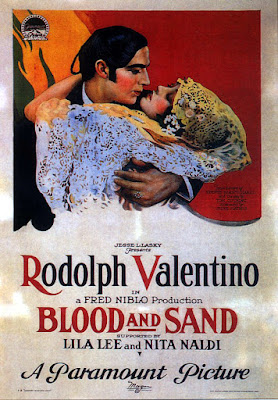
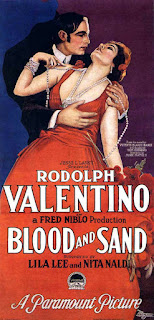
A poster for 'Blood and Sand,' in which Rudolph Valentino's name is spelled with an 'O.'

Nothing says 'Valentine's Day' like Rudolph Valentino risking his life doing battle with an angry charging bull.

And that's no ugly metaphor—it's the premise of 'Blood and Sand' (1922), a sizzling silent romantic drama I'm accompanying on Sunday, Feb. 6 at the Town Hall Theatre in Wilton, N.H.

Showtime is at 2 p.m. Lots more detail in the press release below.

For now, a quick report on last night's screening of a Harry Houdini film at the Garden Cinemas in Greenfield, Mass.

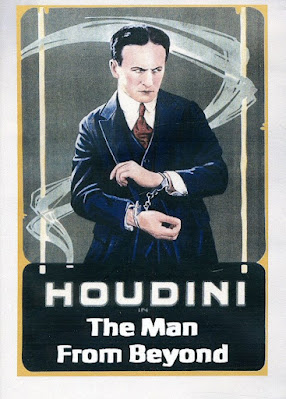
The film was 'The Man from Beyond' (1922), in which our hero plays a sailor frozen on a ship trapped in Arctic ice floes for a full century.

Discovered and unthawed, he enters the modern world (of the 1920s) to search for his lost love from 1820, whom he believes is reincarnated.

The screening was programmed as part of Greenfield's annual Winter Carnival, which, like 'The Man From Beyond,' is celebrating its 100th birthday this year. (Hence the Houdini-on-ice film.)

We've tried running silents with live music at the Garden a few times, with mixed results. For some reason, however, this screening caught the public's imagination—about 60 people attended, enough to really fill the relatively small screening room we were using.

Because virtually everyone there was new to silent film, I went over some basics prior to the screening. That included giving people permission to react openly to what they were about to see: to cheer when something good happened, to boo the villain, and so on.

Well, the audience took that ball and ran with it. Right from the start, people engaged with the film as if it were a sing-a-long musical. Nothing like an energized audience to bring to life a film from the silent era!

(I have to observe: here we were, bringing back to life a film made a century ago, which was about bringing back to life a man frozen a century before that.) 

And yes, there were occasional moments when a few self-appointed smart-alecks felt compelled to yell wisecracks at the screen, a la Mystery Science Theatre 3000. 

But no harm done, and eventually the film's melodrama swept up everyone, just as actress Jane Connolly (playing Houdini's beloved Felice, both in the present and the past) wound up being swept toward Niagara Falls in her canoe. 

And I must say, it was hard to resist my own urge to shout a MST3K-style riff when Connelly decides to escape a pursuer by boarding a canoe and launching herself into a raging cataract just above Niagara Falls, f'rchrissakes!

Casting note: the major role of Gregory Sinclair is played by Erwin Connelly, a round-faced actor who pops up frequently in small roles in Buster Keaton's silent features—most notably as the butler in 'Sherlock Jr.' (1924).

Frequent Keaton screenings have made Connelly's face a familiar one to me. He plays the husband quarreling memorably with his wife in 'Our Hospitality,' and also an offended priest in 'Seven Chances.' 

So it was a treat to see him carrying a lead role outside Buster's world.

There's not much about this performer online, but it turns out we share the same birthday: Jan. 14. His sparse screen credits include 'The Fire Brigade' (1926), which has been newly restored and that I hope to accompany later this year.

And yes, the Jane Connelly in 'The Man From Beyond' turns out to be Erwin's wife. They had appeared in vaudeville together, and were both hired for major roles in the Houdini picture. With Erwin's vaudeville background, it's not surprising he turned up in Keaton's pictures.

Jane, who has no other known screen credits, died just a few years after 'The Man From Beyond'—in 1925, at age 42. Erwin followed her in 1931 at age 53. 

If all this sounds intriguing, I'll be accompanying 'The Man From Beyond' again in April, when it screens at the Town Hall Theater in Wilton, N.H.

But before that, we have Rudy Valentino to get you all hot and bothered for Valentine's Day. Hope to see you there for 'Blood and Sand' on Sunday, Feb. 6 at 2 p.m. Details in the press release below.

*     *     *

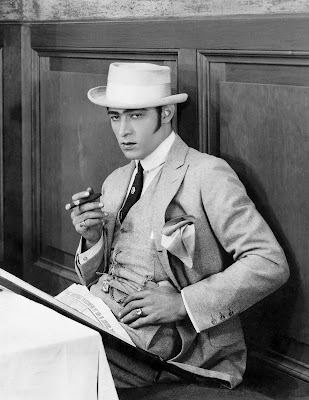
Smoldering sensuality, smoldering cigar: Valentino in 'Blood and Sand' (1922).

MONDAY, JAN. 24, 2022 / FOR IMMEDIATE RELEASE 
Contact Jeff Rapsis • (603) 236-9237 • jeffrapsis@gmail.com 

Valentino's bullfighting epic 'Blood and Sand' to screen at Wilton Town Hall Theatre 

Top-grossing silent film to be shown with live music on Sunday, Feb. 6 to celebrate 100th anniversary of release 

WILTON, N.H.—Just in time for Valentine's Day! It's an intense romantic drama that helped catapult actor Rudolph Valentino to worldwide fame. 

It's 'Blood and Sand' (1922), a bullfighting epic with sadomasochistic overtones to be screened on Sunday, Feb. 6 at 2 p.m. at the Town Hall Theatre, 40 Main St., Wilton, N.H. 

Admission is free, with a suggested donation of $10 per person to help support the theater's silent film series. 

The classic drama will be shown with live music by silent film accompanist Jeff Rapsis. 

The No. 3 box office hit of 1922, 'Blood and Sand' combined exotic Spanish locales with Valentino's iconic performance as a bullfighter. 

The film tells the story of Juan Gallardo (Valentino), a village boy born into poverty who grows up to become one of Spain's greatest matadors. Gallardo marries a friend from his childhood, the beautiful and virtuous Carmen. 

But after achieving fame and fortune, he finds himself drawn to Doña Sol (Naldi), a wealthy, seductive widow. They embark on a torrid affair. 

But then Gallardo, feeling guilty over his betrayal of Carmen, tries to free himself of Doña Sol.

Gallardo's troubles spill over to the bullfighting arena, where he becomes reckless. Can he cope with the gravest challenges of his young life—both in romance, and in the arena? 

The movie's immense popularity helped establish Valentino as one of the megastars of the silent film era. 

Directed for Paramount Pictures by Fred Niblo, the cast includes leading ladies Lila Lee as Carmen and Nita Naldi as Doña Sol. 

The large ensemble of supporting players includes actor Walter Long, a Milford, N.H. native who frequently played "tough guy" character roles in early Hollywood. 

'Blood and Sand' was based on the 1909 Spanish novel "Sangre y arena" (Blood and Sand) by Vicente Blasco Ibáñez and the play version of the book by Thomas Cushing. 

Unusual for Hollywood at the time, women played key roles in the production of 'Blood and Sand.' 

The story was adapted by June Mathis, the screenwriter credited with first recognizing Valentino's appeal, and edited by future director Dorothy Arzner. 

The film inspired the 'Blood and Sand' cocktail, a Prohibition-era mixed drink. 

The screening is part of the Town Hall Theatre's ongoing series honoring the 100th anniversary of significant motion pictures that debuted in 1922. 

Programs will include all of 1922's five highest-grossing titles, each shown on the big screen with live music, as well as century-old oddities, short films, cartoons, and more. 

"Putting these films back on the big screen is a great way to celebrate the 100th anniversaries of some terrific motion pictures," said Rapsis, the silent film accompanist who will create live music for all screenings. 

"These are films that set the standard for Hollywood, and still retain their power to entertain, especially when shown in a theater with live music and an audience," Rapsis said.

Upcoming programs in the Town Hall's 100th anniversary series include: 

• Sunday, Feb. 20, 2022 at 2 p.m.: 'When Knighthood was in Flower' Marion Davies goes medieval in this epic big budget costume picture from 1922 that put her on the map as a top Hollywood star. 

• Sunday, March 13, 2022 at 2 p.m.: Norma Talmadge in 'Smilin' Through' In honor of St. Patrick's Day, a 1922 romantic drama set in the Emerald Isle. 

• Sunday, March 27, 2022 at 2 p.m.: Douglas Fairbanks in 'Robin Hood' Celebrate the 100th anniversary of this blockbuster adaptation. Massive sets, great action, and Doug Fairbanks in the lead made this the top grossing film of 1922! 

• Sunday, April 3, 2022 at 2 p.m.: Chaney/Houdini Double Feature. In 'Flesh and Blood' (1922), escaped convict Lon Chaney hides out in Chinatown and plots revenge. In 'The Man From Beyond' (1922) illusionist Harry Houdini plays an Arctic adventurer frozen for 100 years! 

• Sunday, April 17, 2022 at 2 p.m.: Emil Jannings in 'Othello' The Bard's immortal tragedy brought to the screen in this early German version. Silent Shakespeare in honor of the author's 458th birthday. 

‘Blood and Sand' (1922) will be shown live music on Sunday, Feb. 6 at 2 p.m. at the Town Hall Theatre, 40 Main St., Wilton, N.H. 

Admission is free, with a suggested donation of $10 per person to help defray expenses. For more info, call (603) 654-3456 or visit www.wiltontownhalltheatre.com.

Saturday, February 5, 2022

Escape to Houdini's 'The Man From Beyond' in Greenfield, Mass. on Saturday, Feb. 5

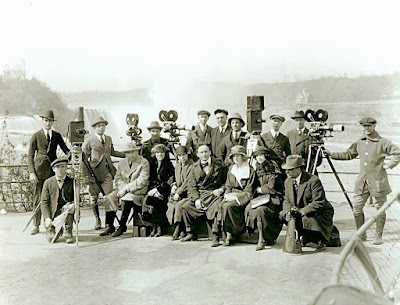
Houdini and crew shooting 'The Man From Beyond' (1922) at Niagara Falls.

Today's riddle: What happens when you program a 100-year-old silent film starring legendary illusionist and escape artist Harry Houdini in a theater that once employed a young man who idolized Houdini and would go on to become one of today's most acclaimed magicians?

The answer, of course, is that you get a video promo from Penn Jillette, the talking half of "Penn & Teller" and native of Greenfield, Mass., where he once worked at the Garden Cinema, which is showing 'The Man From Beyond' (1922) starring Harry Houdini, with live music by me. 

The screening is tonight: Saturday, Feb. 5 at 6 p.m. at the Garden Cinemas, 361 Main St., Greenfield, Mass. More info and details are in the press release below.

And yes, Penn Gillette, a Greenfield native, did once work at the Garden Cinemas as a teenager, and did have a thing for Harry Houdini even way back then, which led to a long and illustrious career.

The Garden is running 'The Man From Beyond' in honor of the 100th anniversary of the Greenfield Winter Carnival. So yes, it seemed appropriate to run a film featuring a man (Houdini) frozen in ice for 100 years. 

And it just happens to be the film's 100th anniversary. So lots to celebrate!

If you're in the area, I invite you to attend this rare screening of Harry Houdini's 'The Man From Beyond' at the venerable Garden Cinemas in downtown Greenfield, Mass. 

And if you'd like to see it, here's the Penn Jillette promo. Enjoy! 

Although for a silent film, wouldn't it have been more appropriate for it to be pitched by the usually mute partner Teller?

*    *    *

MONDAY, JAN. 17, 2022 / FOR IMMEDIATE RELEASE

Contact Jeff Rapsis • (603) 236-9237 • jeffrapsis@gmail.com

For 100th Winter Carnival: Rare 100-year-old Harry Houdini film with live music at Garden Cinemas on Saturday, Feb. 5

Legendary 'Handcuff King' escape artist plays frozen Arctic explorer in stunt-filled silent adventure movie released 100 years ago

GREENFIELD, Mass.—He reigned for decades as the legendary "Handcuff King," famous for daring escape stunts staged around the world.    

But Harry Houdini also had a brief movie career, starring in a series of silent adventure films that showed off his talent for illusion and escape.

See Houdini back on the big screen in 'The Man From Beyond' (1922) on Saturday, Feb. 5 at 6 p.m. at Greenfield Garden Cinemas, 361 Main St., Greenfield, Mass.  

The century-old film, in which Houdini plays an Arctic explorer frozen for 100 years and then thawed out, is being shown in honor of Greenfield's annual Winter Carnival, which runs Feb. 4-6.  

“This was the perfect film to feature for Greenfield’s 100th Winter Carnival” said Garden Cinemas owner Isaac Mass. “It was the 'Frozen' of 1922.”

The rarely screened film will be shown with live musical accompaniment by Jeff Rapsis, a New Hampshire-based performer regarded as one of the nation's leading silent film musicians.  

It's the third time Rapsis has been to the Garden Cinemas.  

“His performances are quickly becoming a fan favorite.” Mass said. “It turns out silent film is pretty noisy and the crowd just loves to engage.”

Houdini made only a handful of movies in the 1910s and 1920s, and much of his film work is lost.  

But enough escaped oblivion to provide a glimpse of the world-renowned escape artist at the peak of his worldwide fame.  

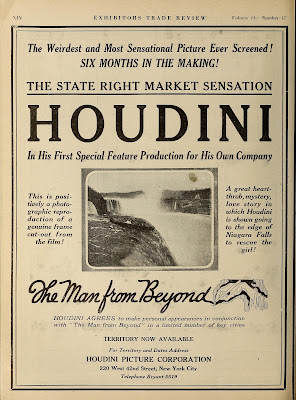
The ‘Man From Beyond’ took six months to produce, unheard-of in 1922, and was the first film made by Houdini’s own production company.

In 'The Man From Beyond' (1922), Houdini plays a man frozen 100 years in the Arctic who returns to civilization to reclaim his reincarnated love.  

Once he's thawed out, Houdini tries to straighten out the lives of the descendants of his old friends and lost loves. The film includes a daring climax filmed at Niagara Falls.  

Although Houdini's films were well-received, he eventually abandoned his movie career, preferring live performance.

Houdini, born Erik Weisz, was a Hungarian-born, American-Jewish illusionist and stunt performer noted for his sensational escape acts.  

He first attracted notice in vaudeville in the U.S. and then as "Harry Handcuff Houdini" on a tour of Europe, where he challenged police forces to keep him locked up.  

Soon he extended his repertoire to include chains, ropes slung from skyscrapers, straitjackets under water, and having to escape from and hold his breath inside a sealed milk can with water in it.

Houdini also built a career debunking spiritualists, psychics and mediums.  

As a member of the Scientific American Committee, he offered a large cash prize to any medium that could demonstrate supernatural abilities. The prize was never collected.

“He truly was one of the original Ghostbusters," Mass explained.  

Inspired by Houdini, Greenfield native magician Penn Gillette also exposed unscrupulous mediums.

Houdini died prematurely in 1926, at age 52, of peritonitis following a burst appendix that may have been caused by blows received to the abdomen by a visitor backstage at a performance in Montreal.  

Following his death, Houdini's reputation as a legendary performer continued to make his name a household world in the decades that followed.

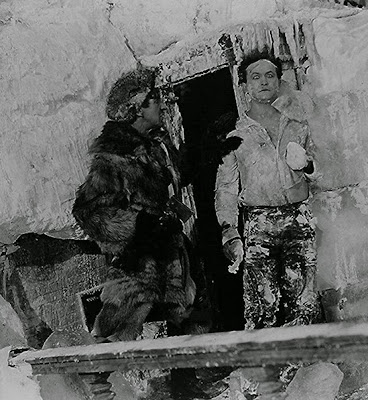
Houdini (right) after being chopped from a century's worth of ice.

Although not well known as a film actor, Houdini's work in motion pictures was not forgotten. In a posthumous ceremony on Oct. 31, 1975, Houdini was given a star on the Hollywood Walk of Fame at 7001 Hollywood Blvd.  

Houdini’s star is near that of Greenfield native magician and movie star Penn Jillette, which was dedicated in 2013.

"These films are audience favorites, and people continue to be surprised at how engrossing and exhilarating they can be when shown as they were intended: in a theater, and with live music," said Rapsis, who accompanies more than 100 screenings each year at venues around the nation.

Rapsis improvises live scores for silent films using a digital synthesizer to recreate the texture of the full orchestra.  

"It's kind of a high wire act," Rapsis said. "But for me, the energy of live performance is an essential part of the silent film experience."

'The Man From Beyond' (1922) will be shown with live music on Saturday, Feb. 5 at 6 p.m. at Greenfield Garden Cinemas, 361 Main St., Greenfield, Mass. Admission is $10 adults; $8.50 seniors, students and veterans. Tickets available online at  www.gardencinemas.net. For more information, call (413) 773-9260 or visit www.gardencinemas.net

Wednesday, January 26, 2022

Thursday, Jan. 27: 'Simba, King of the Beasts' (1928) w/live music at Wilton's Town Hall Theatre

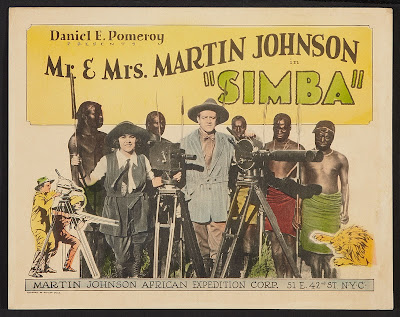
A lobby card for 'Simba' (1928), a wildlife documentary produced by Martin and Osa Johnson, who pioneered airborne wildlife photography.

Sometimes two of my many separate lives crash into each other—like tonight!

This evening, as executive director of the Aviation Museum of N.H., I'll present a lecture on the lives of Martin and Osa Johnson, pioneer wildlife photographers and aviators.

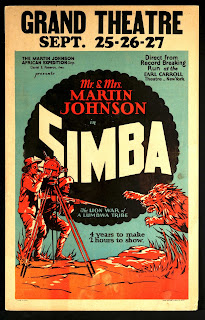
And then, as silent film accompanist, I'll create music for 'Simba: King of the Beasts' (1928) a documentary made by the Johnsons that mesmerized audiences around the world.

All this takes place at the Town Hall Theatre, 40 Main St. in Wilton, N.H. Showtime is 7:30 p.m. 

However, I understand that tomorrow's edition of our statewide daily newspaper, The Union Leader, will carry a big feature on our program. 

That's great, but the Town Hall Theatre is not exactly Radio City Music Hall in terms of capacity. 

So if you plan to attend, come early!

And if you're not aware of the Johnsons, it's not surprising. Although they enjoyed worldwide fame a hundred years ago, their name has faded from public awareness.

I wasn't aware of them at all until just a few years ago, when the Kansas Silent Film Festival programmed 'Simba.' (The Johnsons hailed from the Sunflower state.)

Wow! I was impressed and intrigued at the time. It's no wonder the Johnsons were celebrities—their life of adventure maintains a strong pull even in our "we've seen it all" age.

Heck, maybe the appeal is even stronger today!

Well, find out for yourself by attending tonight's program. Admission $10 per person, with all proceeds to benefit the Aviation Museum's youth aviation education programs.

Press release is below. See you tonight in Wilton!

*   *   *


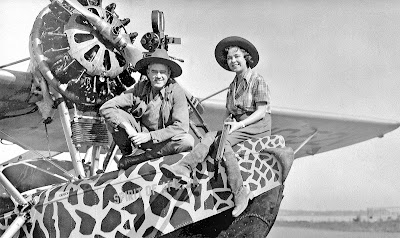
Martin and Osa Johnson with the Sikorsky S-39 float plane they flew around Africa in the 1930s to film exotic animals in their natural habitat.

WEDNESDAY, JAN. 19, 2022 / FOR IMMEDIATE RELEASE

Contact Jeff Rapsis • (603) 236-9237 • jrapsis@nhahs.org

Take off to adventure! Celebrating the Johnsons, pioneering aviators who captured first movies of African wildlife

Aviation museum program on Thursday, 1/27 spotlights globe-spanning adventures of Martin and Osa Johnson, whose plane had N.H. connection; includes screening of early documentary 'Simba: King of the Beasts' (1928) with live music

WILTON, N.H. — Want to see a century-old safari movie made in Africa by pioneering aviators whose special plane would later boast a Granite State connection?

Then take off to Wilton's Town Hall Theatre on Thursday, Jan. 27, when the Aviation Museum of N.H. presents 'Martin and Osa Johnson: Adventure's First Couple,' a combination lecture and movie screening.

The program starts at 7:30 p.m. and is open to the public. Tickets available at the door: $10 per person, general admission. All proceeds support the non-profit Aviation Museum's education programming.

The Town Hall Theatre is located at 40 Main St., Wilton, N.H. For directions, visit www.wiltontownhalltheatre.com.

The evening opens with a review of the extraordinary career of the Johnsons, a Kansas couple who gained worldwide fame in the early 20th century for far-flung exploits that combined adventure, aviation and wildlife photography.

Often wearing classic safari outfits and topped by pith helmets, the duo journeyed deep into Africa and Asia in the 1920s and 1930s, getting the first motion pictures of exotic wildlife in its native habitat.

Back home and in Europe, they achieved great popularity on the lecture circuit by recounting their exploits in foreign lands.

After Martin Johnson learned to fly, they used Sikorsky float planes painted with zebra and giraffe markings to reach remote regions of Africa and Asia, and also photograph wildlife from the air.

As filmmakers, the couple produced several wildlife documentary films chronicling their adventures. These also proved immensely popular, laying the groundwork for all wilderness filmmaking to follow.

The program will include with a screening of 'Simba: King of the Beasts" (1928), a documentary the Johnsons compiled from film they shot in Africa from 1923 to 1927. The silent film will be shown with live musical accompaniment.

The program will be presented by Jeff Rapsis, executive director of the Aviation Museum of N.H. Rapsis prepared the program with assistance from the Martin and Osa Johnson Safari Museum of Chanute, Kansas—Osa Johnson's hometown.

Rapsis, who moonlights as a silent film accompanist, will also provide the live music for the screening "Simba: King of the Beasts."

The 'Simba' documentary is not recommended for children due to graphic scenes of violence that include the shooting and killing of animals.

"Martin and Osa Johnson: Adventure's First Couple" is the first in a series of humanities programs planned for 2022 by the Aviation Museum of N.H.. The series is supported in part by Grappone Auto and the Sidore Foundation.

"The story of the Johnsons is one that combines aviation with so much else that humans find fascinating," Rapsis said. "Their work is worth looking at today because it's about topics that remain compelling: animals, wildlife, adventure, and exotic places."

"But now, so many decades later, their work has an added layer because it displays attitudes that prevailed a century ago in topics such as gender roles, treatment of animals, and race," Rapsis said. "As such, it can teach us a lot."

At the height of their fame, Martin Johnson was killed in 1937 in an airplane crash in California. Osa Johnson later wrote a best-selling book, "I Married Adventure," which recounted the couple's exotic and at-times dangerous expeditions.

Following her death in 1953, the couple's fame faded and their achievements were largely forgotten as new wilderness stars emerged in the television era, including Marlin Perkins (producer of 'Wild Kingdom') and undersea explorer Jacques Cousteau.

But one of the aircraft they used in their adventures—the Sikorsky S-39, a single-engine float plane—captured the imagination of Dick Jackson, a pilot and mechanic from Rochester, N.H.

Only 21 such aircraft were built in 1930-31, and by the early 1960s all had been lost or junked.

Looking for a project, in 1963 Jackson chose to restore a Sikorsky S-39 to flyable condition. The painstaking effort took more than four decades, but in 2003 Jackson completed the work and the world's only remaining S-39 made its maiden flight.

In honor of the Johnsons, the plane was painted in exactly the same giraffe pattern used by the famous couple during their African adventures. Today the aircraft remains airworthy, and is part of the collection housed at the "Fantasy of Flight" museum in Polk City, Fla.

The program will include recent scenes of the restored Sikorsky in flight—and on the water—in its Florida environs.

The Aviation Museum of N.H. is a non-profit 501(c)3 tax-exempt organization dedicated to celebrating New Hampshire's role in aviation history and inspiring tomorrow's pioneers, innovators and aerospace professionals.

For more information, visit www.aviationmuseumofnh.org or call (603) 669-4820. Follow the Aviation Museum on social media at www.facebook.com/nhahs.

Monday, January 24, 2022

Wednesday, 1/26: New Flying Monkey film series starts with comedy 'For Heaven's Sake' (1926)

Harold Lloyd as "J. Harold Manners" in 'For Heaven's Sake' (1926).

Next up: a screening of Harold's Lloyd's great comedy 'For Heaven's Sake' (1926) in Plymouth, N.H.

Complete info on that in the press release below. But first, an update from the front lines. 

We enjoyed great turnout and good reaction yesterday afternoon at a screening of 'Nanook of the North' (1922) at the Town Hall Theatre in Wilton, N.H. 

The show was part of an ongoing series celebrating the 100th anniversary of significant films, including the year's top five box office hits, all of which survive.

Nanook was not among them, but was popular and influential to be included. Plus, what better film to show in the dead of a New England winter?

A century after its release, people are still drawn to director Robert Flaherty's images of Inuit people living among the Arctic ice floes and snow drifts. 

For the music, I used piano with sustained strings to create a soundtrack that seemed to mirror the landscapes and environments seen in 'Nanook.' 

It was the same thinking used by legendary composer Bernard Herrmann when he used strings only for Hitchcock's 'Pyscho' because he wanted a "black and white score for a black and white movie."

Just about everyone stayed after for what turned out to be an extended Q & A session, with people using their phones to look up information on topics about which I proved clueless.

The film was preceded by the Chaplin two-reeler 'Pay Day' (1922), which we ran in contrast to 'Nanook.' 

Where Flaherty's 'Nanook' marked the beginning of documentary films, 'Pay Day' was the last of Chaplin's short comedies. 

Speaking of beginnings: this Wednesday's screening of Harold Lloyd's comedy 'For Heaven's Sake' marks the start of another series—this one celebrating titles from 1926 that as of this month (January 2022) are now in the public domain.

Hope you'll join us for this uproarious comedy, which was actually Lloyd's top-grossing film of the silent era, although it doesn't get shown nearly as often as 'Safety Last' (1923) or 'The Freshman' (1925).

One other thing: 'For Heaven's Sake' is one of the films in which Lloyd starts at the top, rather than having to climb his way up. (Another one is 1923's 'Why Worry?')

So if you think Lloyd always followed the same "young man has to prove himself to win the girl" formula, then 'For Heaven's Sake' might surprise you.

Press release is below. Showtime is 6:30 p.m. See you there!

*   *   *

An original poster promoting Harold Lloyd in 'For Heaven's Sake' (1926).

MONDAY, JAN. 10, 2022 / FOR IMMEDIATE RELEASE
Contact Jeff Rapsis at (603) 236-9237 • e-mail jeffrapsis@gmail.com

Flying Monkey series to highlight films that entered public domain on Jan. 1, 2022

Venue to screen classic comedies, dramas, and adventure films released 1926, all newly in the public domain

First up: Harold Lloyd's classic comedy 'For Heaven's Sake' with live music on Wednesday, Jan. 26

PLYMOUTH, N.H. — On New Year's Day, hundreds of movies became a lot easier to show and to watch.

That's because copyright protection for all films released in 1926 expired on Jan. 1, 2022, putting them in the public domain.

To mark the occasion, starting this month the Flying Monkey Moviehouse and Performance Center will revive the top motion pictures of 1926.

The Flying Monkey's first-ever "Public Domain Extravaganza" will showcase vintage comedies, dramas, and adventure films, all with live music.

First up: Harold Lloyd's classic romantic comedy 'For Heaven's Sake' (1926), to be shown on Wednesday, Jan. 26 at 6:30 p.m.

General admission is $10. The screening will feature live accompaniment by silent film musician Jeff Rapsis.

In 'For Heaven's Sake,' Lloyd plays a wealthy young man smitten with the daughter of an impoverished clergyman who ministers to the urban poor.

On the day Lloyd and the girl plan to marry, Lloyd's wealthy country club friends kidnap him to prevent what they see as an embarrassing mistake.

Can the urban mission's petty criminals and chronic alcoholics rescue Harold and get him to the church on time?

Lloyd and friends atop an open-air double-decker bus in 'For Heaven's Sake.'

'For Heaven's Sake,' promoted with the tagline 'A Man With A Mansion, A Miss with a Mission,' became the year's 4th-highest grossing film, earning $2.6 million.

Critic Leonard Maltin described 'For Heaven's Sake' as "...a screamingly funny silent comedy."

Silent film accompanist Jeff Rapsis will improvise a musical score to the film in real time as the movie is screened.

In creating music for 'For Heaven's Sake' and other vintage classics, Rapsis tries to bridge the gap between silent film and modern audiences.

"Live music adds an element of energy to a silent film screening that's really crucial to the experience," Rapsis said.

Upcoming screenings in the Flying Monkey's "Public Domain Extravaganza" include:

• Wednesday, Feb. 16, 2022, 6:30 p.m.: "The Temptress" (1926) starring Greta Garbo. MGM drama with Garbo destroying the lives of men everywhere. The perfect antidote for Valentine's Day.

• Wednesday, March 9, 2022, 6:30 p.m.: "The Winning of Barbara Worth" (1926) starring Ronald Colman, Vilma Banky, and Gary Cooper. Epic Western drama about the settling and irrigation of California's Imperial Valley, once a wasteland but now an agricultural paradise. Shot on location by director Henry King in Nevada's Black Rock desert, one of the first films to take audiences to the wide open spaces of the great American West. With a young Gary Cooper playing a key role.

• Wednesday, April 27, 2022, 6:30 p.m.: "Battling Butler" (1926) starring Buster Keaton. In an uproarious boxing comedy, Keaton plays Alfred Butler, a pampered rich idler with the same name as a feared boxing champion. When a girl he's pursuing thinks he's the fighter, Keaton has no choice but to start training.

• Wednesday, May 11, 2022, 6:30 p.m.: "Bardelys the Magnificent" (1926) starring John Gilbert. Gilbert tries his hand at swashbuckling in this big-budget MGM historical extravaganza about exploits of an unjustly disgraced French nobleman. A major film long thought lost until a single print was recently discovered in France.

• Wednesday, June 8, 2022, 6:30 p.m.: "The Black Pirate" (1926) starring Douglas Fairbanks, Sr. The original pirate film, with Fairbanks sword-fighting his way through a period adventure tale set during the age of sailing ships.

"By 1926, the movies had matured enough to offer a wide range of great entertainment that still holds up today," Rapsis said. "Come see for yourself as we screen some of the year's best flicks, all of which recently entered the public domain and now belong to us all."

Harold Lloyd's romantic comedy ‘For Heaven's Sake’ will be shown with live music on Wednesday, Jan. 26 at 6:30 p.m. at the Flying Monkey Moviehouse and Performance Center, 39 Main St., Plymouth, N.H.

Admission to the screening is $10, general admission seating. For more info, call (603) 536-2551 or visit www.flyingmonkeynh.com.

Monday, January 17, 2022

Coming Sunday, 1/23: 'Nanook of the North' (1922), plus report from Detroit and Cleveland

'Spies' (1928), which received a memorable screening on Thursday, Jan. 13 at Cinema Detroit.

Just returned to home base in New Hampshire after a road-trip that took me 1,775 miles to performances in Detroit and Cleveland. 

Right now I feel more like a long-haul trucker than a silent film accompanist!

But the trip was well worth it, as each show was successful on several fronts.

Congrats to Cinema Detroit and the Cleveland Cinematheque for bringing their audiences the experience of silent cinema with live music.

And thanks to their audiences for coming out (during the recent pandemic spike, no less) in numbers healthy enough to make the whole effort worthwhile.

In Detroit, an audience of about 40 people turned out for Fritz Lang's espionage epic 'Spies' (1928), which just one person in the group had ever seen before. 

And that one person, a true Lang devotee, had never seen it in a theater with live music. 

So that's why he flew all the way from New York City just to experience it on the big screen, thus easily taking the "traveled the farthest" prize. (Not including the accompanist.)

Paula and Tim Guthat of Cinema Detroit pitched 'Spies' as an alternative to Lang's much-better-known 'Metropolis' (1927), which they feel has frequent screenings has rendered over-familiar, overshadowing his other work of the period.

I think they have a point. And Lang pulled through, with 'Spies' holding the screen for 2½ hours without a single person leaving. 

One reason for this is that 'Metropolis' and 'Spies' and another sprawling Lang late silent, 'Woman in the Moon' (1929), all share a common feature. 

Each is about very different things, but underneath they're all old-fashioned melodramas.

Yes! Despite their surface differences, each is driven by a pot-boiling page-turning barn-burner of a story. And like the D.W. Griffith epics, the narrative pulls the audience through. The story is structured so that you simply must keep watching. You can't help it. 

That's what happened last Thursday night (Jan. 13) at Cinema Detroit. You could tell—people were hooked. That, coupled with Lang's incredible visual story-telling, made for a memorable evening in a darkened theatre.

It went so well, the Guthats are thinking about screening another lesser-known Lang, such as the aforementioned 'Woman in the Moon.' I hope they do! 

Why? Not just because I would love to do music for it (although that's one reason), but also because the Lang pictures are great examples of films that really must be seen in a theatre with an audience for it to have its full effect. 

It was the same thing the next evening (Friday, Jan. 14) in Cleveland. 

Raymond Griffith shows off some dance steps in 'Hands Up!'

At the Cinematheque, a 35mm print of Raymond Griffith's 'Hands Up!' (1926) was greeted with continuous laughter right from the start. As with most silent comedy, being part of an audience that's enjoying the on-screen action gives you permission to laugh as well.

And if all goes well, you might just get that wonderful spontaneous combustion of laughter that's one of the great glories of the silent cinema, even today. 

And that's what we got at the Cinematheque. Once Griffith taught a tribe of Native Americans to forsake their wardance for the Charleston, there was no turning back. 

This was followed by a quieter but no less appreciative response for a screening of Ernst Lubitsch's 'The Marriage Circle' (1924), which I'd never accompanied before. 

In this case, I think audience members don't expect to find this kind of polished and sophisticated society comedy in silent pictures. For most people, silent comedy = Buster Keaton or the Keystone Cops.

But there it was! Long before Hollywood began cranking out so-called "screwball" comedies in the 1930s, it was producing polished society farces in quantity, starring the likes of Ronald Colman or (in 'The Marriage Circle') Adolphe Menjou. 

They just didn't have dialogue. But that didn't stop talented performers such as Colman or Menjou from saying all they needed via facial expressions, gestures, pantomine, and the artfully turned head or raised eyebrow. (And the occasional craftily-written intertitle.)

Both venues, by the way, were closed for 16 months (16 months!) starting in March 2020 at the pandemic's onset. Can you believe it?

That both endured the prolonged closure, and are now riding out the current surge with creative programming that includes silent pictures with live music, gives me a lot of confidence.

In an age where new options such as in-home streaming are gaining in popularity, I feel sure that as long as we have cinema, there will be an audience for motion pictures to be shown in a theater.

By the way, the reason I drove out there (rather than flew) is that for these performances I used my Korg digital synthesizer, which isn't exactly air-travel-friendly even with its sturdy (but monstrously heavy) carrying case.

And there's all the sound equipment and cabling I lug around. It's nothing I can't fit into my Subaru Forester with room to spare, but a LOT to send through the nation's air transport system. 

More to come, including a screening of 'Nanook of the North' later this month at the Town Hall Theatre in Wilton, N.H. to celebrate the 100th anniversary of the film's release. 

The film is showing on Sunday, Jan. 23 at 2 p.m. More info in the press release below. 

And there will be cake! 

*  *  *

A vintage poster for the documentary 'Nanook of the North' (1922).

MONDAY, JAN. 10, 2022 / FOR IMMEDIATE RELEASE

Contact Jeff Rapsis • (603) 236-9237 • jeffrapsis@gmail.com

Pioneering documentary 'Nanook of the North' to screen at Wilton Town Hall Theatre

Ground-breaking silent film to be shown with live music on Sunday, Jan. 23 to celebrate 100th anniversary of release

WILTON, N.H.—It's hailed as one of the first films to show the potential of the movie camera to take audiences to distant lands.

It's 'Nanook of the North' (1922), a ground-breaking movie about life among Eskimos above the Arctic Circle, to be screened on Sunday, Jan. 23 at 2 p.m. at the Town Hall Theatre, 40 Main St., Wilton, N.H.

Admission is free, with a suggested donation of $10 per person to help cover expenses.

The classic silent documentary will be shown with live music by silent film accompanist Jeff Rapsis.

Director Robert Flaherty’s film tells the story of Inuit hunter Nanook and his family as they struggle to survive in the harsh conditions of Canada’s Hudson Bay region.

Remarkably matter-of-fact in its depiction of the everyday struggle to stay alive in the Arctic hinterlands of Canada’s Hudson Bay, 'Nanook of the North' shows Flaherty’s interest in his Inuit subjects in each carefully framed shot.

'Nanook' was completed only after film from a previous expedition caught fire and was destroyed. Flaherty had to repeat his entire visit to the frozen north to reshoot the movie.

'Nanook' unfolds as a series of long takes interspersed by occasionally poetic intertitles, all of which serve to highlight seemingly mundane tasks required for survival in the frigid terrain.

Beyond its educational function, though, Flaherty’s profoundly empathetic intimacy with his subjects—the resilient, prodigious seal-and-walrus-hunter Nanook and his weathered clan—heightens what seems on the surface to be merely a dry informational pamphlet.

A scene from 'Nanook of the North' (1922).

To make the film, Flaherty built an ad-hoc film processing lab in the challenging Arctic conditions and trained his Inuit friends to be his technicians.

Immersed in the culture for over two years, Flaherty embraced the new art form as a way to show modern audiences that without all the complications and trappings of modern civilization, lives could be happily lived—even under nature’s harshest conditions.

Enormously popular when released in 1922, 'Nanook of the North' is a cinematic milestone that continues to enchant audiences.

In 1989, 'Nanook of the North' was one of the first 25 films to be selected for preservation in the U.S. National Film Registry by the Library of Congress as being "culturally, historically, or aesthetically significant."

The screening is part of the Town Hall Theatre's ongoing series honoring the 100th anniversary of significant motion pictures that debuted in 1922.

Programs will include all of 1922's five highest-grossing titles, each shown on the big screen with live music, as well as century-old oddities, short films, cartoons, and more.

"Putting these films back on the big screen is a great way to celebrate the 100th anniversaries of some terrific motion pictures," said Rapsis, the silent film accompanist who will create live music for all screenings.

"These are films that set the standard for Hollywood, and still retain their power to entertain, especially when shown in a theater with live music and an audience," Rapsis said.

Upcoming programs in the Town Hall's 100th anniversary series include:

• Sunday, Feb. 6, 2022 at 2 p.m.: Rudolph Valentino in 'Blood and Sand.' Film's 'Latin Lover' in his first starring role, as a sexy bullfighter in this 1922 romantic thriller.

• Sunday, Feb. 20, 2022 at 2 p.m.: 'When Knighthood was in Flower.' Marion Davies goes medieval in this epic big budget costume picture from 1922 that put her on the map as a top Hollywood star.

• Sunday, March 13, 2022 at 2 p.m.: Norma Talmadge in 'Smilin' Through.' In honor of St. Patrick's Day, a 1922 romantic drama set in the Emerald Isle.

• Sunday, March 27, 2022 at 2 p.m.: Douglas Fairbanks in 'Robin Hood.' Celebrate the 100th anniversary of this blockbuster adaptation. Massive sets, great action, and Doug Fairbanks in the lead made this the top grossing film of 1922!

• Sunday, April 3, 2022 at 2 p.m.: Chaney/Houdini Double Feature. In 'Flesh and Blood' (1922), escaped convict Lon Chaney hides out in Chinatown and plots revenge. In 'The Man From Beyond' (1922) illusionist Harry Houdini plays an Arctic adventurer frozen for 100 years!

• Sunday, April 17, 2022 at 2 p.m.: Emil Jannings in 'Othello' The Bard's immortal tragedy brought to the screen in this early German version. Silent Shakespeare in honor of the author's 458th birthday.

Following the screening of 'Nanook of the North,' cake will be offered on a first-come, first-served basis.

‘Nanook of the North' (1922) will be shown live music on Sunday, Jan. 23 at 2 p.m. at the Town Hall Theatre, 40 Main St., Wilton, N.H.

Admission is free, with a suggested donation of $10 per person to help defray expenses. For more info, call (603) 654-3456 or visit www.wiltontownhalltheatre.com.