Tuesday, March 22, 2022

Up next: Cinema Ritrovato 'L'Inferno' on 3/25 in Portsmouth, then 'Robin Hood' on 3/27 in Wilton

A big film means a big megaphone: Alan Dwan directing 'Robin Hood' with star Douglas Fairbanks Sr. observing. 

This Sunday, it's 'Robin Hood' (1922), the culmination of a series of 100th anniversary screenings at the Town Hall Theatre in Wilton, N.H.

But first, on Friday we venture to the underworld, as I accompany a screening of 'L'Inferno' (1911), an early adaptation of Dante's iconic work and a landmark early feature film from Italy.

'L'Inferno' is part of "Il Cinema Ritrovato on Tour in New Hampshire," a program brought to the Granite State each year by foreign language department staffers at the University of New Hampshire. (It's where I earned my MBA, and also taught as an adjunct for many years.)

Friday being opening night, the screening will take place at the prestigious Music Hall in Portsmouth, N.H. Showtime is at 7 p.m. Complete info can be found at the program's website.

Screenings continue at the Music Hall through Sunday, after which the program moves to the UNH campus in Durham for more films through March 31.

It's quite a privilege to be asked to create live music for a film in the touring "Ritrovato" program. Three cheers to organizers for recognizing the value of live music for pictures from the silent era.

And it's also a thrill to be performing in the Music Hall, a legendary venue in my home state. 

Although they don't run much silent film with live music, it's where I first took in the Alloy Orchestra doing their thing to Buster Keaton's 'Steamboat Bill Jr.' back in about 1991 or so, which helped rekindle my interest in early cinema.

It's also where I saw (and heard) Philip Glass perform in person, and where I first experienced the John Adams opera 'Nixon in China' via simulcast. (Small world: Adams grew up in New Hampshire not far from my home base.) 

Looking forward to hearing what my digital synthesizer sounds like in the storied old hall, which dates from the 1870s. I usually do pretty well with halls built in the era when acoustics were a priority, so I'm hopeful.

Okay, and now off to Sherwood Forest!

As the year's top box office hit, 'Robin Hood' forms  the culmination of our series of screenings celebrating the 100th anniversary of movies released in 1922.

In a silent film version of Casey Kasem's Top 40 countdown (remember that?), since January we've been showing the year's top five grossing pictures more or less in reverse order, starting Harold Lloyd's 'Grandma's Boy' (No. 5) in January.

Since then, we've run Valentino's 'Blood and Sand' (No. 4), Norma Talmadge in 'Smilin' Through' (No. 3), and Marion Davies in 'When Knighthood Was in Flower' (No. 2), with occasional detours for special titles such as 'Nanook of the North,' which also hit screens in 1922.

But as 1922's box office champ, 'Robin Hood' topped them all. And then as now, this big-time historical swashbuckler is best experienced on the big screen with live music and an audience. 

This means you! So I invite all to join us Sunday afternoon to escape with Robin Hood and his Merry Men, even if just for the afternoon. 

Lots more info in the press release below. Hope to see you this Sunday in Sherwood Forest—er, I mean the Town Hall Theatre in Wilton, N.H.!

*    *    *

Original artwork promoting 'The Adventures of Robin Hood' (1922).

MONDAY, MARCH 14, 2022 / FOR IMMEDIATE RELEASE
Contact Jeff Rapsis • (603) 236-9237 • jeffrapsis@gmail.com

'Robin Hood' leaps into action at Town Hall Theatre on Sunday, March 27

It's off to Sherwood Forest for the 100th anniversary of legendary silent blockbuster, screened with live music

WILTON, N.H.—He robbed from the rich, gave to the poor, and was the top box office attraction of 1922.

He was Douglas Fairbanks Sr. starring in 'Robin Hood,' the original movie adaptation of the legendary tale.

See it for yourself on the big screen on Sunday, March 27 at 2 p.m. at the Town Hall Theatre in Wilton, N.H., 40 Main St., Wilton, N.H.

Admission is free; a donation of $10 per person is suggested to help defray expenses.

The screening will be accompanied with live music by Jeff Rapsis.

Set in medieval England, 'Robin Hood' tells the tale of the Earl of Huntingdon (Fairbanks, at right), a dashing nobleman who joins King Richard the Lion-Hearted (Wallace Beery) on a Crusade to the Holy Land.

Huntingdon later returns to England to find Richard's cruel brother, Prince John (Sam De Grasse), falsely claiming the throne, enriching his aristocratic cronies and tyrannizing the citizenry.

Huntingdon takes to the woods and becomes 'Robin Hood,' soon joined by a band of merry men who undermine Prince John's reign by robbing from the rich and giving to the poor.

Can Robin Hood and his men vanquish their enemy, the High Sheriff of Nottingham (William Lowery)? And can they rescue Lady Marian Fitzwalter (Enid Bennett), Huntingdon's betrothed, from the evil clutches of Prince John?

Along the way, Fairbanks has ample opportunity to demonstrate his skills in archery, fencing, and acrobatics.

Directed by Allan Dwan, 'Robin Hood' amazed audiences with its enormous sets that recreated in full scale the castles and villages of medieval England.

At a time when $200,000 was a hefty movie budget, 'Robin Hood' cost $1 million to produce.

But the film proved an enormous hit, becoming the top box office attraction of 1922 and earning $2.5 million in its initial release through United Artists, the distribution company Fairbanks formed with fellow stars Charlie Chaplin, D.W. Griffith, and his wife, Mary Pickford.

Douglas Fairbanks as Robin Hood romances Lady Marian Fitzwalter (Enid Bennett).

Fairbanks, among the most popular stars of the 1920s, was the inspiration for the character of George Valentin in the Oscar-winning Best Picture 'The Artist' (2011). Fairbanks was known for films that used the then-new medium of motion pictures to transport audiences to historical time periods for grand adventures and athletic stunts.

He's often referred to as "Douglas Fairbanks Sr." to avoid confusion with his son, the actor Douglas Fairbanks Jr.

Also in the cast for 'Robin Hood' is Alan Hale Sr., who made such an impression at Little John that he was cast in the same role in the 1938 remake starring Errol Flynn. (Hale's son, Alan Hale Jr., played the role of the Skipper on the 1960s television series "Gilligan's Island.")

Live music for 'Robin Hood' will be provided by silent film accompanist Jeff Rapsis, who uses a digital synthesizer to create a traditional full orchestra "movie score" sound.

"Seeing a Fairbanks picture in a theater with live music and an audience is a classic movie experience," Rapsis said.

Rapsis (at right) emphasized the unique value of seeing early cinema as it was originally presented.

"These films were designed for the big screen, live music, and large audiences. Put it all together again, and you get a sense of why people first fell in love with the movies," Rapsis said.

The screening of 'Robin Hood' is part of the Town Hall Theatre's ongoing series honoring the 100th anniversary of significant motion pictures that debuted in 1922.

Programs will include all of 1922's five highest-grossing titles, each shown on the big screen with live music, as well as century-old oddities, short films, cartoons, and more.

Upcoming programs in the Town Hall's 100th anniversary series include:

• Sunday, April 3, 2022 at 2 p.m.: Chaney/Houdini Double Feature. In 'Flesh and Blood' (1922), escaped convict Lon Chaney hides out in Chinatown and plots revenge. In 'The Man From Beyond' (1922) illusionist Harry Houdini plays an Arctic adventurer frozen for 100 years!

• Sunday, April 17, 2022 at 2 p.m.: Emil Jannings in 'Othello' (1922). The Bard's immortal tragedy brought to the screen in this early German version. Silent Shakespeare in honor of the author's 458th birthday.

'Robin Hood' (1922) starring Douglas Fairbanks Sr., will be screened with live music on Sunday, March 27 at 2 p.m. at the Town Hall Theatre, 40 Main St., Wilton, N.H. Admission is free; a donation of $10 per person is suggested to defray expenses.

For more info, visit www.wiltontownhalltheatre.com or call (603) 654-3456.


Monday, March 14, 2022

Today's puzzler: What happens when you promote 'Smilin' Through' (1922) for St. Patrick's Day but then find out the film is not set in Ireland?

A poster for 'Smilin' Through,' a top box office attraction of 1922.

A few months ago, I scheduled the Norma Talmadge drama 'Smilin' Through' (1922) for this past Sunday in honor of St. Patrick's Day later this week. 

After all, what better way to mark the occasion, and honor my heritage (I'm one quarter Irish!) than a film set in the Emerald Isle?

And that was all great, except there was one little problem—it turned out the film wasn't set in Ireland!

To quote unsuccessful presidential candidate Rick Perry: Oops! 

Yes, a short flashback near the beginning of the film takes place in Ireland. But the bulk of the story happens in Dunstable, England, just north of London. 

I discovered this only after all the press releases had been out, and we'd gotten some nice exposure in the local media, promising everyone a fun and memorable way to mark St. Patrick's Day.

Faith and begorrah—I was off by only a couple of hundred miles!

What to do? Of course I fessed up to yesterday's audience, which was understanding and found the mix-up amusing. No pitchforks or lighted torches were evident. Whew!

But how to make up for this? The screening of 'Smilin' Through' was part of a series we're running celebrating the 100th anniversary of pictures released in 1922. ('Smilin' Through' was the No. 3 box office attraction that year.)

And for some programs, we liven things up with short films, newsreels, and other oddities from the same year.

So for Sunday's program, I took an "All in the Family" approach, inserting a short comedy starring Norma Talmadge's brother-in-law, Buster Keaton.

Lucky for me, one of Keaton's 1922 comedies was 'My Wife's Relations,' which contains a significant quotient of what I would call "Irish ethnic humor," which was fairly common at the time. 

So THAT was how we made good on the St. Patrick's Day crisis: Buster to the rescue!

'Smilin' Through,' although complete sentimental hogwash, proved to be very effective on the big screen. 

You can see why people bought tickets in such quantity in 1922: it's very well put together and has a great multi-hankie uplifting ending.

Ultimately, the film's message is quite dark: for many of us, the only real happiness we will ever experience is in the afterlife. Until then, we have to go "Smilin' Through" our earthly existence, knowing that a better time awaits in the great beyond.

Thinking about it, I'm not so sure I can buy into that whole idea.

Norma Talmadge, one of the silent era's most popular stars—and sister-in-law of Buster Keaton.

But to its credit, 'Smilin' Through' never really asks us to think. It's all about feeling. It's a 90-minute warm bath in emotion and sentiment—and a century after its release, maybe that's something we now need more than ever.

Alas, the film hasn't been reissued or ever been given a decent transfer. Of 1922's top five movies, 'Smilin' Through' proved to be the most difficult to source.

But because the film is public domain, leave it to low budget purveyor Alpha Video to have released the film on DVD as part of their "Lost Silent Classics" series. 

Surprisingly, Alpha's version looked pretty good on the big screen. In the print they used, two stretches showed evidence of serious decomposition, and whites were really blown out in some parts of the transfer. 

But way better than other Alphas I've seen, so we were fortunate it came out so well.

Next up in our 100th anniversary series: starring Douglas Fairbanks Sr., it's 1922 box office champ 'The Adventures of Robin Hood,' which will screen on Sunday, March 27 at the Town Hall Theatre.

Press release below. And with this one, I know it's set in England (mostly), so no geographic slip-ups expected.

*    *    *

Original poster art for 'The Adventures of Robin Hood,' the top-grossing film of 1922.

MONDAY, MARCH 14, 2022 / FOR IMMEDIATE RELEASE
Contact Jeff Rapsis • (603) 236-9237 • jeffrapsis@gmail.com

'Robin Hood' leaps into action at Town Hall Theatre on Sunday, March 27

It's off to Sherwood Forest for the 100th anniversary of legendary silent blockbuster, screened with live music

WILTON, N.H.—He robbed from the rich, gave to the poor, and was the top box office attraction of 1922.

He was Douglas Fairbanks Sr. starring in 'Robin Hood,' the original movie adaptation of the legendary tale.

See it for yourself on the big screen on Sunday, March 27 at 2 p.m. at the Town Hall Theatre in Wilton, N.H., 40 Main St., Wilton, N.H.

Admission is free; a donation of $10 per person is suggested to help defray expenses.

The screening will be accompanied with live music by Jeff Rapsis.

Set in medieval England, 'Robin Hood' tells the tale of the Earl of Huntingdon (Fairbanks), a dashing nobleman who joins King Richard the Lion-Hearted (Wallace Beery) on a Crusade to the Holy Land.

Huntingdon later returns to England to find Richard's cruel brother, Prince John (Sam De Grasse), falsely claiming the throne, enriching his aristocratic cronies and tyrannizing the citizenry.

Huntingdon takes to the woods and becomes 'Robin Hood,' soon joined by a band of merry men who undermine Prince John's reign by robbing from the rich and giving to the poor.

Douglas Fairbanks Sr. in the title role as 'Robin Hood.'

Can Robin Hood and his men vanquish their enemy, the High Sheriff of Nottingham (William Lowery)? And can they rescue Lady Marian Fitzwalter (Enid Bennett), Huntingdon's betrothed, from the evil clutches of Prince John?

Along the way, Fairbanks has ample opportunity to demonstrate his skills in archery, fencing, and acrobatics.

Directed by Allan Dwan, 'Robin Hood' amazed audiences with its enormous sets that recreated in full scale the castles and villages of medieval England.

At a time when $200,000 was a hefty movie budget, 'Robin Hood' cost $1 million to produce.

Directing 'Robin Hood': a big megaphone for a big production.

But the film proved an enormous hit, becoming the top box office attraction of 1922 and earning $2.5 million in its initial release through United Artists, the distribution company Fairbanks formed with fellow stars Charlie Chaplin, D.W. Griffith, and his wife, Mary Pickford.

Fairbanks, among the most popular stars of the 1920s, was the inspiration for the character of George Valentin in the Oscar-winning Best Picture 'The Artist' (2011). Fairbanks was known for films that used the then-new medium of motion pictures to transport audiences to historical time periods for grand adventures and athletic stunts.

He's often referred to as "Douglas Fairbanks Sr." to avoid confusion with his son, the actor Douglas Fairbanks Jr.

Also in the cast for 'Robin Hood' is Alan Hale Sr., who made such an impression at Little John that he was cast in the same role in the 1938 remake starring Errol Flynn. (Hale's son, Alan Hale Jr., played the role of the Skipper on the 1960s television series "Gilligan's Island.")

Live music for 'Robin Hood' will be provided by silent film accompanist Jeff Rapsis, who uses a digital synthesizer to create a traditional full orchestra "movie score" sound.

"Seeing a Fairbanks picture in a theater with live music and an audience is a classic movie experience," Rapsis said.

Rapsis emphasized the value of seeing early cinema as it was originally presented.

"These films were designed for the big screen, live music, and large audiences. Put it all together again, and you get a sense of why people first fell in love with the movies," Rapsis said.

The screening of 'Robin Hood' is part of the Town Hall Theatre's ongoing series honoring the 100th anniversary of significant motion pictures that debuted in 1922.

Programs will include 1922's five highest-grossing titles, each shown on the big screen with live music, as well as century-old oddities, short films, cartoons, and more.

Upcoming programs in the Town Hall's 100th anniversary series include:

• Sunday, April 3, 2022 at 2 p.m.: Chaney/Houdini Double Feature. In 'Flesh and Blood' (1922), escaped convict Lon Chaney hides out in Chinatown and plots revenge. In 'The Man From Beyond' (1922) illusionist Harry Houdini plays an Arctic adventurer frozen for 100 years!

• Sunday, April 17, 2022 at 2 p.m.: Emil Jannings in 'Othello' (1922). The Bard's immortal tragedy brought to the screen in this early German version. Silent Shakespeare in honor of the author's 458th birthday.

'Robin Hood' (1922) starring Douglas Fairbanks Sr., will be screened with live music on Sunday, March 27 at 2 p.m. at the Town Hall Theatre, 40 Main St., Wilton, N.H. Admission is free; a donation of $10 per person is suggested to defray expenses.

For more info, visit www.wiltontownhalltheatre.com or call (603) 654-3456. 

Thursday, March 10, 2022

Coming Sunday, March 13 for St. Paddy's Day: silent drama 'Smilin' Through' set in Ireland

An original release poster for 'Smilin' Through' (1922), the year's No. 3 box office attraction.

If you can't make it to Ireland for St. Patrick's Day, consider visiting Wilton, N.H.

That's where we'll present 'Smilin' Through' (1922), a silent drama starring Norma Talmadge, at the Town Hall Theatre on Sunday, March 13 at 2 p.m.

Set in the Emerald Isle, 'Smilin' Through' is a sentimental tale of love lost and then found across the generations. I'll provide live music.

Please join us to celebrate St. Patrick's Day just a little early by taking in one of the most popular movies of 1922 on the occasion of its 100th birthday. 

Sure'n we'll see you at the movies then!

*  *  *

Norma Talmadge in 'Smilin' Through' (1922).

MONDAY, MARCH 7, 2022 / FOR IMMEDIATE RELEASE
Contact Jeff Rapsis • (603) 236-9237 • jeffrapsis@gmail.com

Rarely screened silent drama set in Ireland returns to big screen for St. Paddy's Day

'Smilin' Through,' 1922 box office hit, to be shown with live music on Sunday, March 13 at Town Hall Theatre to celebrate film's 100th anniversary

WILTON, N.H.—Just in time for St. Patrick's Day, a classic film set in Ireland full of romance, drama, and the haunting atmosphere of the Emerald Isle.

It's 'Smilin' Through' (1922), starring legendary actress Norma Talmadge, whose legions of fans made the movie the No. 3 box office attraction of 1922. 

See what made 'Smilin' Through' so popular when the picture returns to the big screen to celebrate the 100th anniversary of its release.

'Smilin' Through' will be shown on Sunday, March 13 at 2 p.m. at the Town Hall Theatre, 40 Main St., Wilton, N.H.

Admission is free, with a suggested donation of $10 per person to help support the theater's silent film series.

The classic drama, set in the years before and after World War I, will be shown with live music by silent film accompanist Jeff Rapsis.
 
Norma Talmadge, then at the peak of her career, plays the dual role of Kathleen, a young Irish woman, and Moonyean, Kathleen's aunt who died many years ago under tragic circumstances.

Kathleen is in love with Kenneth Wayne, but is prevented from marrying him by her guardian John Carteret, who remains haunted by memories of his thwarted love for Mooneyan.

In a drama that combines romance with the world of spirits, can the tragic fate of Moonyean point the way for Kathleen to find true love at last?

The story, based on a 1919 stage play, was filmed twice more by MGM: in 1932 with Norma Shearer and 1941 with Jeanette MacDonald.

The film was strongly associated with the song 'Smilin' Through,' a sentimental 1919 ballad with lyrics and music by Arthur A. Penn.

The song, inspired by the stage play, remained popular for several decades, recorded by performers ranging from Judy Garland to Bing Crosby.

The screening of 'Smilin' Through' is part of the Town Hall Theatre's ongoing series honoring the 100th anniversary of significant motion pictures that debuted in 1922.

Programs will include all of 1922's five highest-grossing titles, each shown on the big screen with live music, as well as century-old oddities, short films, cartoons, and more.

"Putting these films back on the big screen is a great way to celebrate the 100th anniversaries of some terrific motion pictures," said Rapsis, the silent film accompanist who will create live music for all screenings.

"These are films that set the standard for Hollywood, and still retain their power to entertain, especially when shown in a theater with live music and an audience," Rapsis said.

Upcoming programs in the Town Hall's 100th anniversary series include:

• Sunday, March 27, 2022 at 2 p.m.: Douglas Fairbanks in 'Robin Hood' Celebrate the 100th anniversary of this blockbuster adaptation. Massive sets, great action, and Doug Fairbanks in the lead made this the top grossing film of 1922!

• Sunday, April 3, 2022 at 2 p.m.: Chaney/Houdini Double Feature. In 'Flesh and Blood' (1922), escaped convict Lon Chaney hides out in Chinatown and plots revenge. In 'The Man From Beyond' (1922) illusionist Harry Houdini plays an Arctic adventurer frozen for 100 years!

• Sunday, April 17, 2022 at 2 p.m.: Emil Jannings in 'Othello' The Bard's immortal tragedy brought to the screen in this early German version. Silent Shakespeare in honor of the author's 458th birthday.

‘Smilin' Through' (1922) will be shown live music on Sunday, March 13 at 2 p.m. at the Town Hall Theatre, 40 Main St., Wilton, N.H.

Admission is free, with a suggested donation of $10 per person to help defray expenses. For more info, call (603) 654-3456 or visit www.wiltontownhalltheatre.com.

Monday, March 7, 2022

Neither snow, nor kidney stones, nor talking cars, kept me from the 2022 Kansas Silent Film Festival

After more than two decades, I remain a big fan of the "biohazard" pattern of the carpeting in the White Concert Hall at Washburn University.

This year's Kansas Silent Film Festival was memorable in part for a few things I hope to soon forget.

For me, it was two things in particular: a pair of kidney stones, which made their unexpected presence known the day before I planned to depart for Kansas.

The announcement came in the form of intense pain coming from the lower right part of my abdomen. Ouch!

I thought it was my appendix. Whatever it was, the pain quickly grew to where I just wanted it to stop.

So instead of heading for the airport to fly out to Kansas, I went to the emergency room. Tests and a scan revealed the culprits: two stones making their way from kidney to bladder.

In no condition to travel, I reached out to festival director Bill Shaffer and let him know I'd be unable to make it this year.

Although really disappointed in myself for not being able to honor a commitment, I knew that the other accompanists there could cover the films I'd been assigned.

It wouldn't be the first time this happened—in 2013, members of the Mont Alto group made it only about half way across Kansas before a blizzard forced them to turn back to their Colorado home.

So the rest of us divvied up their films and the festival went on as scheduled.

How is this possible at the last minute? Well, live film accompaniment encompasses a lot of approaches, and that includes the “I hadn't planned on playing for this title but I'll give it a go” school of music.

At this year's Kansas festival, I knew that my fellow accompanist Ben Model would be on hand. (He'd bring both his hands, actually. Har!) I was hoping Ben would be willing to cover for me, and was glad to hear that he would. 


Accompanists Marvin Faulwell, Bill Beningfield, and Ben Model at the console of the White Concert Hall's organ.

The festival is blessed with other musicians who would fill in as well: longtime music director and organist Marvin Faulwell and his sidekick, percussionist Bob Keckeisen; organist Bill Beningfield; and Rodney Sauer, director of the Mont Alto Motion Picture Orchestra.

So I stayed home that Thursday, dosed with Toredal to numb the pain, and also ameliorate the unhappiness of missing my first Kansas Silent Film Festival since first attending in 2000.

But then Thursday turned into Friday, and I felt much better. The pain was gone. It snowed all day in New Hampshire, making travel difficult. But by late afternoon I felt well enough to make a break for it. Turned out Southwest Airlines was still running flights out of Manchester, and I could get the last out of the day (to Chicago Midway, connecting to Kansas City) at 6:30 p.m.

That would put me in Topeka really late Friday night, but at least I'd be on hand for the whole day Saturday, when the bulk of my films (and the one feature) were scheduled to screen.

Proud of myself for making the effort, we were about a half-hour from landing at Midway when the pain happened again. It put me on the floor of an airport gate area, pretending to stretch but actually trying to find a position to lessen the agony.

Here I was, 800 miles from home and writhing in pain. I'd taken the opioid they'd given me in case the pain came back, but it didn't seem to be working. What to do? There was a flight back to Manchester at a nearby gate, so I went over to find that boarding had completed and the plane was already pushing back.

I was close to calling my in-laws (who live in Chicago) to get me to an emergency room (no way was I paying for an ambulance—that would cause a different and more lasting kind of pain) when the boarding announcement was made for the Kansas City flight.

Rising up, I felt a little better, so decided to board. (What I would do when I got there, I had no idea.) Once seated, the pain returned with a vengeance. A song lyric started going through my mind: "Should I stay or should I go?"

I finally just had to get up, as sitting was intolerable, and made my way to the rear of the plane. I explained what was going on to two flight attendants, who could not have been more sympathetic. They said we had about a half-hour before departure, so a decision didn't have to be made right away.

They let me walk up and down the aisle, which helped, although I'm sure my fellow passengers concluded they were flying to Kansas City with a lunatic. Even the captain got involved, wanting to know what drugs I'd taken and making sure I wasn't an in-flight medical liability, which of course is his job. (I passed—although the kidney stones hadn't.)

Finally it came time to leave, and I chose to tough it out. Once the door closed, there was no turning back. "Prepare to build some character," I thought to myself, as we pushed back from the gate. At least I was next to an empty seat, enabling me to writhe and contort myself within the limits of a seat belt.

How long would this last? Well, I guess the opioid finally kicked in, as the pain began to lessen during the flight. By the time we landed it had mostly subsided. Maybe I would make it after all. 

But what would I do when I got there? What if this happened during a film? Well, we'd find out.

As I sat on the bus to the rental car center, I contemplated one remaining challenge: it was after midnight, and I still had to drive an hour to Topeka, opioids and all.

And then I dodged a bullet. It was so late that all the rental car desks were shut except one: Avis—by some stroke of divine magic, the company I'd booked with. They gave me a brand new (less than 300 miles) Kia Soul, which was equipped with nanny software that bings at you if it doesn't like how you change lanes.

"Consider taking a break!" read a dashboard display panel, with a coffee cup icon complete with little heat lines rising above it.

"Mind your own business," I responded, looking for the switch to disable this annoying feature.

Bing bing bing! "32 degrees! Watch for ice ahead!" said the display, which included pictures of snowflakes falling.  

"Stop hounding me!," I shot back. "How do I turn you off?"


My ride. I never did figure out how to turn off the nanny function.

I got on the Kansas Turnpike (I-70) and headed west to Topeka, being extra careful to keep at the speed limit. The last thing the Kansas Silent Film Festival needed was a headline like:

VISITING MUSICIAN JAILED FOR OPIOID POSSESSION AND YELLING AT CAR

Why am I telling you all this? Maybe it's a window into the ups and downs of the glamorous life of a silent film accompanist. Maybe it'll prompt you to take better care of yourself: drink more water, don't lapse into winter inactivity, and cut down on the cheese!

But I made it, and by the time I pulled into the parking lot of the Hyatt in Topeka, the pain was gone. For now. That's the thing. I'd had two episodes of intense pain. When might it happen again?

Next thing I knew, it was the next morning and I was downstairs at breakfast chatting with Rodney Sauer of Mont Alto and greeting all the familiar folks who are such a huge part of why even malfunctioning kidneys can't keep me from coming back to this festival.

And I found that I my problems were minor indeed when compared to what others had faced or were facing. 

Like how? Rodney's house in Colorado just missed being burned to the ground last year in a wildfire. (A cellist he knows lost everything.) Long-time festival supporter Paul Post had been severely injured in a bicycle accident earlier that week and was hospitalized. (He continues to recover.) Festival attendee Jim Reid made it all the way up from Texas (in an ice storm) only to slip on the hotel walkway, landing on his face. (He seemed to be doing okay.)

So Saturday's festival activities started up, and I was able to get through each film I'd been assigned. Ben Model later mentioned the syndrome of how the body seems to somehow postpone problems during a performance, and I've found that to be true. 


From Oscar Micheaux's drama 'Within Our Gates' (1920).

My big film was the one feature I'd been assigned: The Oscar Micheaux drama 'Within Our Gates' (1921), a 90-minute drama that closed the afternoon program. I asked Ben to stand by, or at least be in the hall somewhere, during this screening in case I wasn't able to get through it.

But the film started, and I pressed a big "C" in four octaves on the White Concert Hall's wonderful Steinway grand, and off we went. Before long, I'd become completely engaged—it's actually a tough film to score and requires concentration to bring it off.

Because of that, I completely forgot that less than 24 hours ago I was face down on the carpeted floor of a gate area in Chicago. Another example of how silent film can transport a viewer to an alternate (and pain-free) state of mind.

(For an excellent essay on 'Within Our Gates,' check out this piece by Shari Kizirian from the San Francisco Silent Film Festival.)

Well—if you'd like a run-down of this year's Kansas Silent Film Festival, attendee and adviser Bruce Calvert always posts a write-up of what screened. It's posted on Nitrateville and I encourage you to check it out.

Many thanks to festival director Bill Shaffer for putting up with my last-minute plan changes. We joke that at the Kansas Silent Film Festival, sometimes there's more drama off-screen than on.

And thanks to everyone at the festival for their kind comments and wishes of good health—too many folks to mention by name for fear of leaving someone out, but all very much appreciated.

As Stan says to Ollie in 'Blockheads' (1938): I'm better now. Truth is, although my two stones are still "in transit," I haven't had any more severe attacks since this year's visit to Topeka.

So we can add that to the many reasons the Kansas Silent Film Festival is worth attending: "Known to Reduce Kidney Stone Pain."

Now—if only I could have gotten that car to shut up.

Monday, February 21, 2022

Red River Theatres to screen 'The Flying Ace,' silent 'race' drama for Black History Month

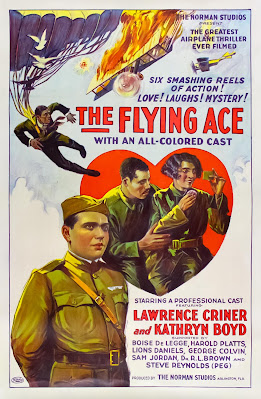
A poster for 'The Flying Ace' (1926), screening with live music at Red River Theatres in Concord, N.H. 

I've just finished a five-shows-in-five-days marathon, and boy are my fingers tired. 

Actually, not really—foe me, silent film accompaniment is more mentally taxing than physically demanding.

So, to borrow a phrase from Monty Python: "Oooh, my brain hurts!"

Yesterday's screening of 'When Knighthood Was in Flower' (1922) at the Town Hall Theater in Wilton, N.H. drew raves from the 40 or so people who attended.

Starring Marion Davies, it's quite the movie and holds up well. You can see why it was the year's second-highest grossing picture, exceeded only by Douglas Fairbanks in 'Robin Hood,' another adventure set in Merrie Old England.

'Knighthood' would not have been available at all if not for Ben Model's rescue project a few years ago, which got the film out of the Library of Congress vaults, transferred to digital media, and then restored for enjoyment and exhibition. 

I was delighted to contribute to the Kickstarter effort that made the film's reissue possible. Thanks to Ben and everyone else who worked on this edition. 

So what's next for me?

On Wednesday, I do music for 'The Flying Ace' (1926), a "race" drama being screened at Red River Theatres in Concord, N.H. 

Then it's off to the three-day Kansas Silent Film Festival, where I'll accompany Oscar Micheaux's 'Within Our Gates' (1921) and a passel of short comedies. 

No rest for the wicked. So I must be very wicked indeed.

For now, here's the press release about the Red River screening of 'The Flying Ace,' with a lot more info about the film, which was recently added to the National Film Registry by the Library of Congress.

It's worth seeing, as it's an artifact from a time not that long ago when it was common for movie theaters in some parts of the U.S. to be segregated by race. 

Water fountains, too. 

What were they thinking? 

See you in Concord on Wednesday night, or in Topeka next weekend!

*  *  *

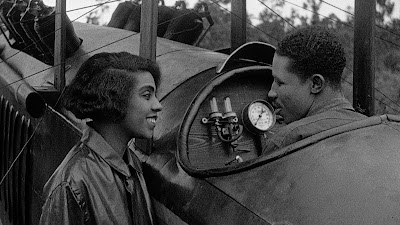
Kathryn Boyd and Laurence Criner in 'The Flying Ace' (1926).

MONDAY, FEB. 14, 2022 / FOR IMMEDIATE RELEASE
Contact Jeff Rapsis • (603) 236-9237 • jeffrapsis@gmail.com

Honoring Black History Month

Red River Theatres to screen rare vintage crime melodrama with all-Black cast

'The Flying Ace' (1926), recently added to U.S. National Film Registry, to be shown with live music on Wednesday, Feb. 23

CONCORD, N.H. — Can discrimination exist in an America where everyone is Black?

That's among the questions posted by 'The Flying Ace' (1926), a rare surviving example of movies produced early in the 20th century for Black audiences in segregated cinemas.

'The Flying Ace,' recently named to the U.S. National Film Registry, will be screened in honor of Black History Month on Wednesday, Feb. 23 at 7 p.m. at Red River Theatres, 11 South Main St., Concord.

General admission is $12 per person, $10 for Red River members.

The screening will feature live music by Jeff Rapsis, a New Hampshire-based silent film accompanist.

'The Flying Ace' was produced by Norman Studios in Jacksonville, Fla., using professionals such as Laurence Criner, a veteran of Harlem’s prestigious all-black theater troupe the Lafayette Players, but also many non-professionals for minor roles.

In 'The Flying Ace,' Criner plays Capt. Billy Stokes, a World War I fighter pilot known as "The Flying Ace" because of his downing of seven enemy aircraft in France.

Returning home to resume his former job as a railroad detective, he's assigned to locate a stationmaster who's gone missing along with the $25,000 company payroll.

While investigating, Stokes begins romancing the stationmaster's daughter Ruth (Kathryn Boyd), causing a rivalry with another suitor which leads to a break in the case.

With Ruth's safety now at risk, Stokes' dogged pursuit of the suspects leads to climax highlighted by a dramatic airborne chase which calls upon his piloting prowess.

Films such as 'The Flying Ace' were shown specifically to African-American audiences in areas of the U.S. where theaters were segregated.

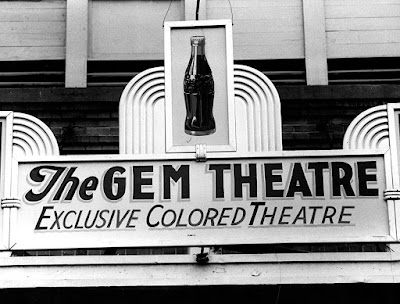
A segregated movie theater in Waco, Texas in 1939.

Norman Studios was among the nation's top film production companies making feature length and short films for this market from the 1920s to the 1940s.

Featuring all-Black casts in stories meant to inspire and uplift, such films were popular with African-American audiences at the time. In Norman Studios films, the stories often took place in a world without the racial barriers that existed at the time.

In 'The Flying Ace,' Capt. Stokes is a pilot returning home from serving honorably in World War I—but Blacks were not allowed to fly aircraft in the U.S. military until 1940.

In an essay for the San Francisco Silent Film Festival, critic Megan Pugh wrote that Capt. Billy Stokes "...is a model for the ideals of racial uplift, fulfilling aspirations that Black Americans were not yet allowed to achieve."

"At a time when Hollywood employed white actors in blackface to play shuffling servants and mammies, the Norman Film Manufacturing Company...hired all-black casts to play dignified roles."

"Instead of tackling discrimination head-on in his films, Norman created a kind of segregated dream world where whites—and consequently, racism—didn’t even exist," Pugh wrote.

"While it’s impossible to measure the influence The Flying Ace had on its viewers, it is reasonable to assume that audiences found its lead character inspirational. Billy Stokes was a black male hero who would have never made it onscreen in a Hollywood movie of the time," Pugh wrote.

Filmed in the Arlington area of Jacksonville, Fla., 'The Flying Ace' is a unique aviation melodrama in that no airplanes actually leave the ground. The mid-air scenes were filmed in a studio in front of neutral backdrops.

Although 'The Flying Ace' may appear crudely made to modern audiences, in 2021 the movie was named to the U.S. National Film Registry by the Library of Congress as being "culturally, historically, or aesthetically significant."

Of films produced for Black-only audiences in segregated theaters, very few survive. 'The Flying Ace' is unusual in that it survives complete, and in pristine condition. The film was included in 'Pioneers of African American Cinema," a DVD collection released in 2016 by Kino-Lorber.

A live musical score for 'The Flying Ace' will be created by accompanist Jeff Rapsis, a New Hampshire-based performer who specializes in music for silent film presentations.

Rapsis said the Red River screening is a rare chance to see the film as it was meant to be experienced—on the big screen, with live music, and with an audience.

'The Flying Ace' (1926), a silent crime melodrama with an all-Black cast, will be shown in honor of Black History Month on Wednesday, Feb. 23 at 7 p.m. at Red River Theatres, 11 South Main St. in Concord.

Tickets are general admission $12; Red River Theatres members $10. For more info and to purchase advance tickets, visit www.redrivertheatres.org or call (603) 224-4600. 


Sunday, February 20, 2022

'When Knighthood Was in Flower' (1922) on Sunday, 2/20 at Town Hall Theatre, Wilton, N.H.

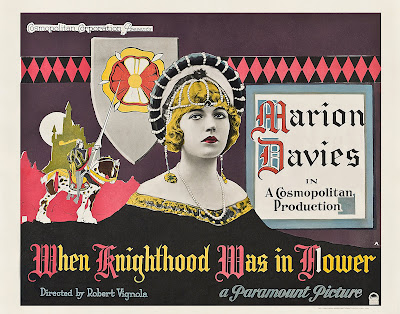
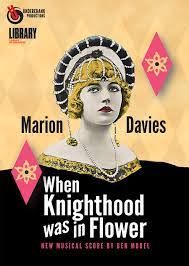
Promotional artwork for 'When Knighthood Was in Flower' (1922).

This afternoon's screening of 'When Knighthood in Flower' is the finale of a five-days-in-a-row series of screenings that saw me doing music for five films in venues across three states.

But what an ending! The Marion Davies costume epic, set during the reign of England's King Henry VIII, was produced on a grand scale. Released in 1922, it was the year's second-highest grossing film.

It's part of our ongoing series at the Town Hall Theatre in Wilton, N.H. celebrating the 100th anniversaries of motion pictures that came out that year. Lots more info in the press release I've pasted in below.

For now, let me report that last night's screening of 'The Last Command' (1928) in Brattleboro, Vt. resulted in some unexpected drama before the film could begin.

In late afternoon, a wall of heavy squalls moved across northern New England, laying down an unexpected coating of snow across the region. 

Brattleboro would normally be a 90-minute drive, so I left around 5 p.m. to arrive in time to set up for the screening, which was scheduled to start at 8 p.m. The snow had cleared out, so I figured that the timing had worked out well.

Well, it hadn't. The main highway (Route 101) across southern N.H. isn't far from my house, and almost immediately traffic on this busy road came to a complete stop. In a weird meteorological phenomenon, somehow the snow had adhered to the pavement, creating a coating of sheer ice that was impossible to drive on.

Seriously! Cars were off the road in both directions, and the rest of us were lined up and moving at a glacial pace, if at all. It took a half hour to just go a couple of miles. 

Stuck in this situation, with no real alternative routes that would be any better, I kept watching my arrival time slip further into the future.

I began pinging Jamie Mohr, who runs the Epsilon Spires venue where I would accompany 'The Last Command,' with updates, wondering if I would ever make it out there. (Jamie said she would get some Chinese food, which gave me confidence.)

My GPS indicated that conditions seemed normal for most of the route ahead, so I held out hope as I crawled along, trying not to slide off into the woods. After awhile, conditions did improve and traffic began to move at a more normal pace. 

Apparently the squalls had seen fit to sock just the area where I lived, as the rest of the ride to Brattleboro was uneventful. But the first five miles had taken 45 minutes, meaning I arrived with just enough time to set up things. 

And the next thing you know, I'm at the organ console, doing music for 'The Last Command,' aided by the digital synthesizer to produce drums and percussion where needed, plus a piano in a couple of key scenes. Oh—and also a brass school bell for when a bell is prominently rung in one scene.

The film, directed by Josef von Sternberg and starring Emil Jannings in an Academy Award-winning performance, drew the usual strong reaction—it's one of the truly great silent dramas, I think, produced when the form was at the peak of its eloquence. 

But this screening brought a new wrinkle: afterwards, people said it was a little unsettling to take in all the Russian military scenes as the present situation unfolds with Russia and Ukraine. I didn't see the parallel, but I could understand how it would be on people's minds.

Well, this afternoon's screening of 'When Knighthood Was in Flower' should provoke no such unease, as King Henry VIII has been off the throne for about 500 years.

I want to point out that the only reason we can show 'Knighthood' is because of the restoration recently released by Ben Model and Undercrank Productions. Ben and his colleagues did a terrific job.

Ben was recently in touch and shared a few notes about the effort that went into reissuing the film, which I had mistakenly called a transfer. I think it's worth including here, and I'll also mention it at this afternoon's screening:

"...the Undercrank edition is a restoration, and not a transfer. Stabilization and clean-up and grading was done on the nitrate scan. 

Also, the tints weren't added to look the way silents did – we reinstated the tinting and hand-coloring to exactly what was seen in theaters in 1922. There are tinting slugs at the heads and tails of several of the reels indicating "light pink", "amber", "light amber" and "blue tone/biscuit" (a combination of tinting and toning). 

We also found a review from Robert E. Sherwood that talks about the hand-coloring of the torches, and ads in the trades for the guy who did the hand-coloring; and so I got Jack Theakston to replicate this digitally, frame-by-frame.

So, you can tell your audience that they're seeing what people saw in the film's original release of the full-length road-show edition (the general release version was about 25 mins shorter). 

And, had Marion Davies not had a print struck of this in the mid-1930s, and then donated all her 35mm nitrate prints to the LoC in the 1950s, we would not be able to see this at all. :)

Who knew...Marion was also a film conservationist!

Thanks so much! Have a great show!

If you'd like more info about the restoration of 'Knighthood,' check out this post from Ben. 

Okay, hope your Sunday plans include a trip back to the splendors of medieval England via 'When Knighthood Was in Flower' starring Marion Davies. The show begins at 2 p.m. More info about the film in the press release below.

*   *   *

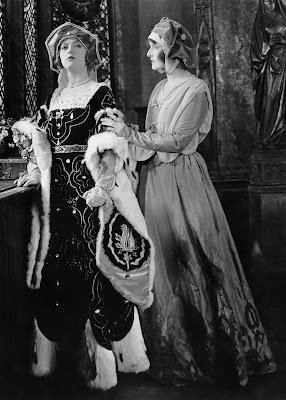
Marion Davies (left) in 'When Knighthood Was in Flower' (1922).

TUESDAY, FEB. 8, 2022 / FOR IMMEDIATE RELEASE
Contact Jeff Rapsis • (603) 236-9237 • jeffrapsis@gmail.com

Marion Davies costume epic 'When Knighthood Was in Flower' to screen at Wilton Town Hall Theatre

Set during the reign of Henry VIII, silent film blockbuster to be shown with live music on Sunday, Feb. 20 to celebrate 100th anniversary of release

WILTON, N.H.—It was a movie that transported audiences back to the reign of England's King Henry VIII, scoring an enormous box office success.

It was 'When Knighthood Was in Flower' (1922), a costume epic starring Marion Davies that became the year's second-highest-grossing film. 

See what all the royal fuss was about when the picture is shown with live music on Sunday, Feb. 20 at 2 p.m. at the Town Hall Theatre, 40 Main St., Wilton, N.H.

Admission is free, with a suggested donation of $10 per person to help support the theater's silent film series.

The classic Tudor-era drama will be shown with live music by silent film accompanist Jeff Rapsis.

In 'When Knighthood Was in Flower,' Marion Davies plays Mary Tudor, younger sister of England's King Henry VIII, who falls in love with a guardsman below her class.

Unfortunately, Mary is already betrothed to the aged King Louis XII of France. Her illicit romance thus touches off a furor with international complications.

Planned from the start as a big budget spectacle, 'When Knighthood Was in Flower' cost $1.8 million to produce, making it among the most expensive movies of the silent era.

The film was directed by Robert G. Vignola and based on a popular 1898 novel by Charles Major. 

A lobby card for 'When Knighthood Was in Flower.'

'When Knighthood Was in Flower' was produced by William Randolph Hearst (through his Cosmopolitan Productions) for Marion Davies and distributed by Paramount Pictures. 

Davies, longtime mistress of publishing magnate Hearst, would go on to become one of the most popular leading ladies of the silent era. 

For 'When Knighthood Was in Flower,' she spent four months learning to fence in order to convincingly perform her own on-screen swordfighting.

Although some exteriors were shot on location at England's Windsor Castle, most of the film was actually made in Connecticut and New York City, where Cosmopolitan was based at the time. 

Ziegfeld Follies designer Joseph Urban planned so many lavish sets, Hearst had to rent space at two other New York studios to complete the film and hire 3,000 extras for the crowd scenes. 
 
For Davies' 15 gowns, Urban's daughter, Gretl Urban Thurlow, duplicated outfits originally worn by Mary Tudor.

The edition of 'When Knighthood Was in Flower' that will be presented is a new digital restoration from Undercrank Productions/Library of Congress.

The screening is part of the Town Hall Theatre's ongoing series honoring the 100th anniversary of significant motion pictures that debuted in 1922.

Programs will include all of 1922's five highest-grossing titles, each shown on the big screen with live music, as well as century-old oddities, short films, cartoons, and more.

"Putting these films back on the big screen is a great way to celebrate the 100th anniversaries of some terrific motion pictures," said Rapsis, the silent film accompanist who will create live music for all screenings.

"These are films that set the standard for Hollywood, and still retain their power to entertain, especially when shown in a theater with live music and an audience," Rapsis said.

Upcoming programs in the Town Hall's 100th anniversary series include:

• Sunday, March 13, 2022 at 2 p.m.: Norma Talmadge in 'Smilin' Through' In honor of St. Patrick's Day, a 1922 romantic drama set in the Emerald Isle.

• Sunday, March 27, 2022 at 2 p.m.: Douglas Fairbanks in 'Robin Hood' Celebrate the 100th anniversary of this blockbuster adaptation. Massive sets, great action, and Doug Fairbanks in the lead made this the top grossing film of 1922!

• Sunday, April 3, 2022 at 2 p.m.: Chaney/Houdini Double Feature. In 'Flesh and Blood' (1922), escaped convict Lon Chaney hides out in Chinatown and plots revenge. In 'The Man From Beyond' (1922) illusionist Harry Houdini plays an Arctic adventurer frozen for 100 years!

• Sunday, April 17, 2022 at 2 p.m.: Emil Jannings in 'Othello' The Bard's immortal tragedy brought to the screen in this early German version. Silent Shakespeare in honor of the author's 458th birthday.

‘When Knighthood Was in Flower' (1922) will be shown live music on Sunday, Feb. 20 at 2 p.m. at the Town Hall Theatre, 40 Main St., Wilton, N.H.

Admission is free, with a suggested donation of $10 per person to help defray expenses. For more info, call (603) 654-3456 or visit www.wiltontownhalltheatre.com.

Saturday, February 19, 2022

Tonight: Emil Jannings in 'The Last Command' at Epsilon Spires in Brattleboro, Vt., w/pipe organ

Original promotional art for Josef von Sternberg's 'The Last Command' (1928).

Quick post in advance of heading out to Brattleboro, Vt., where tonight I'll accompany the great Josef Sternberg drama 'The Last Command' (1928).

Come join us! The show starts at 8 p.m. at Epsilon Spires performance space, with music on the venue's Estey pipe organ augmented by digital synthesizer. 

It's worth attending, as the performance of Emil Jannings is one for the ages. Playing a deposed Czarist general forced to act out his personal drama on a Hollywood set, it's really something to see him go completely berzerk.

See for yourself. More info in the press release below.

For now, let me thank Leland Stein and the staff at the Regent Theater in Arlington, Mass. for their willingness to screen 'The Flying Ace' (1926) in observance of Black History Month.

Last night's show attracted a small audience, which surprised me. 'The Flying Ace' was recently added to the National Film Registry by the Library of Congress. As a rare surviving "race drama" intended for segregated movie theaters, you'd think it would be of more interest. After all these years, I think it has a lot to say to us

Well—I'll accompany it again on Wednesday, Feb. 23 up at Red River Theatres in Concord, N.H. But right now I have to hit the road to make it through snow squalls over the river (the Connecticut River) and through the woods to Brattleboro and 'The Last Command.' 

See you there tonight!

*   *   *

Evelyn Brent and Emil Jannings in 'The Last Command' (1928).
 
MONDAY, FEB. 7, 2022 / FOR IMMEDIATE RELEASE
Contact Jeff Rapsis • (603) 236-9237 • jeffrapsis@gmail.com

Silent epic 'The Last Command' with live pipe organ score at Epsilon Spires on Saturday, Feb. 19

Josef von Sternberg's groundbreaking psychological drama won 'Best Actor' for Emil Jannings at first-ever Academy Awards

BRATTLEBORO, Vt.—'The Last Command' (1928), a silent film drama that won Emil Jannings 'Best Actor' honors at the first-ever Academy Awards, will be screened with live music on Saturday, Feb. 19 at 8 p.m. at Epsilon Spires, 190 Main St., Brattleboro, Vt.

Admission is $15 per person. Tickets may be purchased in advance at www.epsilonspires.org or at the door.

The screening will feature live accompaniment on the venue's Estey pipe organ by Jeff Rapsis, a New Hampshire-based silent film musician.

'The Last Command,' directed by Josef von Sternberg, tells the sweeping story of a powerful general in Czarist Russia (Jannings) forced to flee his homeland during the Bolshevik Revolution. He emigrates to America, where he is reduced to living in poverty.

Finding work as an extra at a Hollywood studio, the former general lands the part of a commanding officer in a movie about the Revolution, causing flashbacks to his traumatic experiences. The conflict leads to a spectacular climax and a towering performance that earned Jannings 'Best Actor' honors.

The film takes audiences on a journey through big emotions as well as issues of history, time, power, and especially a man's duty to his country and to his fellow citizens—and what happens when the two obligations diverge.

'The Last Command' is also one of early Hollywood's most creative and challenging looks at the global conflicts that contributed to World War I.

The film also stars a young William Powell as a Hollywood movie director who crosses paths with the general during the Revolution, and 1920s starlet Evelyn Brent as a seductive Russian revolutionary.

Rapsis, the accompanist, will create the film's score live as the movie is shown by improvising on the venue's historic Estey pipe organ, built in Brattleboro and installed in 1906.

"Making up the music on the spot is kind of a high wire act," Rapsis said. "But there's nothing like the energy and excitement that comes with improvised live performance, especially when accompanying a silent film."

Critic Leonard Maltin hailed 'The Last Command' as "a stunning silent drama...a fascinating story laced with keen observations of life and work in Hollywood." Time Out of London called it "the first Sternberg masterpiece, expertly poised between satire and 'absurd' melodrama. The cast are fully equal to it; Jannings, in particular, turns the characteristic role of the general into an indelible portrait of arrogance, fervor and dementia."

Director Sternberg, a master of lighting and black-and-white photography, created 'The Last Command' as a visual tour de force. The film is often cited as a prime example of the emotional range and visual accomplishment of silent films at their height, just prior to the coming of pictures with recorded soundtracks.

Rapsis said great silent film dramas such as 'The Last Command' told stories that concentrate on the "big" emotions such as Love, Despair, Anger, and Joy. Because of this, audiences continue to respond to them in the 21st century, especially if they're presented as intended—in a theater on the big screen, with a live audience and live music.

"Dramas such as 'The Last Command' were created to be consumed as a communal experience," Rapsis said. "With an audience and live music, they come to life as their creators intended them to. This screening at Epsilon Spires is a great chance to experience films that first caused people to fall in love with the movies."

The non-profit Epsilon Spires, housed in Brattleboro's former Baptist church, builds connections between art and science by offering provocative performances and events, interactive art installations, and opportunities to engage in civil discourse by addressing current topics through the integration of diverse forms of expression. 

'The Last Command' (1928) will be screened with live music on Saturday, Feb. 19 at 8 p.m. at Epsilon Spires, 190 Main St., Brattleboro, Vt. Admission is $15 per person. Tickets may be purchased in advance at www.epsilonspires.org or at the door.


Friday, February 18, 2022

Rare all-Black drama, 'The Flying Ace' (1926), tonight at the Regent Theatre in Arlington, Mass.

A not-very-subtle promotional poster for the all-Black drama 'The Flying Ace' (1926).

In honor of Black History Month, tonight (Friday, Feb. 18) the Regent Theater of Arlington, Mass. is screening 'The Flying Ace' (1926), with live music by me. 

It's a rare surviving example of what some scholars call "Race Cinema," meaning movies made for segregated theaters that were part of the American movie landscape in the first half of the 20th century.

'The Flying Ace,' a rare surviving example of this type of film, was recently added to the National Film Registry by the Library of Congress for being either "culturally, historically, or aesthetically significant."

I think 'The Flying Ace,' produced by Norman Studios of Jacksonville, Fla., applies to the first two distinctions: cultural and historic. It's a vivid reminder of racism that permeated everyday life in its era—so much so that people set up separate theaters for people of different skin color!

In terms of being "aesthetically significant"—well, you can make up your own mind on that. But I believe that any film from a century ago, no matter what its level of aesthetic achievement, has a lot to say to us today, if only for just the passing of time. 

And let's be clear about one thing. By screening 'The Flying Ace,' neither I nor the Regent Theatre are celebrating the fact that for many decades, movie theaters in the United States were segregated by race. 

No. 'The Flying Ace' is a concrete artifact of a shameful legacy of racism that pervaded society at the time, and with which we still grapple today.  

But by acknowledging that it once existed, and preserving this artifact from the era (and I believe screening vintage film before the public is part of preservation), we can be better equipped to confront racism in our own time.

So hope to see you at the Regent tonight at 7:30 p.m. Much more info in the press release below.

*      *      *

Kathryn Boyd and Laurence Criner star in 'The Flying Ace' (1926).

MONDAY, FEB. 14, 2022 / FOR IMMEDIATE RELEASE

Contact Jeff Rapsis • (603) 236-9237 • jeffrapsis@gmail.com

Honoring Black History Month

Regent Theatre to screen rare vintage crime melodrama with all-Black cast

'The Flying Ace' (1926), recently added to U.S. National Film Registry, to be shown with live music on Friday, Feb. 18

ARLINGTON, Mass. — Can discrimination exist in an America where everyone is Black?

That's among the questions posted by 'The Flying Ace' (1926), a rare surviving example of so-called "race" movies produced early in the 20th century for Black audiences in segregated cinemas.

'The Flying Ace,' recently named to the U.S. National Film Registry, will be screened in honor of Black History Month on Friday, Feb. 18 at 7:30 p.m. at the Regent Theatre, 7 Medford St., Arlington, Mass.

General admission is $15 per person. Tickets available at the door or online at www.regenttheatre.com.

The screening will feature live music by Jeff Rapsis, a New Hampshire-based silent film accompanist.

'The Flying Ace' was produced by Norman Studios in Jacksonville, Fla., using professionals such as Laurence Criner, a veteran of Harlem’s prestigious all-black theater troupe the Lafayette Players, but also many non-professionals for minor roles.

In 'The Flying Ace,' Criner plays Capt. Billy Stokes, a World War I fighter pilot known as "The Flying Ace" because of his downing of seven enemy aircraft in France.

Returning home to resume his former job as a railroad detective, he's assigned to locate a stationmaster who's gone missing along with the $25,000 company payroll.

While investigating, Stokes begins romancing the stationmaster's daughter Ruth (Kathryn Boyd), causing a rivalry with another suitor which leads to a break in the case.

With Ruth's safety now at risk, Stokes' dogged pursuit of the suspects leads to climax highlighted by a dramatic airborne chase which calls upon his piloting prowess.

Films such as 'The Flying Ace' were shown specifically to African-American audiences in areas of the U.S. where theaters were segregated.

Norman Studios was among the nation's top film production companies making so-called "race" films for this market from the 1920s to the 1940s.

Featuring all-Black casts in stories meant to inspire and uplift, such films were popular with African-American audiences at the time. In Norman Studios films, the stories often took place in a world without the racial barriers that existed at the time.

In 'The Flying Ace,' Capt. Stokes is a pilot returning home from serving honorably in World War I—but Blacks were not allowed to fly aircraft in the U.S. military until 1940.

In an essay for the San Francisco Silent Film Festival, critic Megan Pugh wrote that Capt. Billy Stokes "...is a model for the ideals of racial uplift, fulfilling aspirations that Black Americans were not yet allowed to achieve."

"At a time when Hollywood employed white actors in blackface to play shuffling servants and mammies, the Norman Film Manufacturing Company...hired all-black casts to play dignified roles."

"Instead of tackling discrimination head-on in his films, Norman created a kind of segregated dream world where whites—and consequently, racism—didn’t even exist," Pugh wrote.

"While it’s impossible to measure the influence The Flying Ace had on its viewers, it is reasonable to assume that audiences found its lead character inspirational. Billy Stokes was a black male hero who would have never made it onscreen in a Hollywood movie of the time," Pugh wrote.

Filmed in the Arlington area of Jacksonville, Fla., 'The Flying Ace' is a unique aviation melodrama in that no airplanes actually leave the ground. The mid-air scenes were filmed in a studio in front of neutral backdrops.

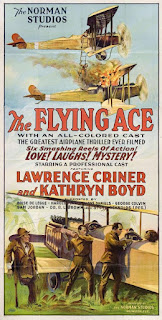
A monochrome lobby card for 'The Flying Ace' (1926).

Although 'The Flying Ace' may appear crudely made to modern audiences, in 2021 the movie was named to the U.S. National Film Registry by the Library of Congress as being "culturally, historically, or aesthetically significant."

Of films produced for Black-only audiences in segregated theaters, very few survive. 'The Flying Ace' is unusual in that it survives complete, and in pristine condition. The film was included in 'Pioneers of African American Cinema," a DVD collection released in 2016 by Kino-Lorber.

A live musical score for 'The Flying Ace' will be created by accompanist Jeff Rapsis, a New Hampshire-based performer who specializes in music for silent film presentations.

Rapsis said the Regent Theatre screening is a rare chance to see the film as it was meant to be experienced—on the big screen, with live music, and with an audience.

'The Flying Ace' (1926), a silent crime melodrama with an all-Black cast, will be shown in honor of Black History Month on Friday, Feb. 18 at 7:30 p.m. at the Regent Theatre, 7 Medford St., Arlington, Mass.

General admission is $15 per person. Tickets available at the door or online at www.regenttheatre.com. For more information, call the theater at (781) 646-4849.

Thursday, February 17, 2022

Tonight! 'Girl Shy' in Manchester, N.H. But first, Mayer to Shakespeare: 'Lose all that death at the end'

If the shoe hits...Harold Lloyd and anonymous flapper in 'Girl Shy' (1924).

I'm looking forward to doing music tonight for Harold Lloyd's 'Girl Shy' (1924), which is screening tonight (Thursday, Feb. 17) at 7:30 p.m. at the Rex Theater in downtown Manchester, N.H.

Complete info is below in the press release. Hope to see you there for one of the great audience-pleasing comedies of the 1920s. 

And now, a report on last night's screening of 'The Temptress' (1926) starring Greta Garbo and Antonio Moreno, which I accompanied at the Flying Monkey Moviehouse and Performance Center in Plymouth, N.H.

Here's something you don't get to announce every day: DOUBLE SPOILER ALERT!

It's one of those films with two endings—an original tragic denouement, and also an upbeat and completely different boy-gets-girl happy ending ordered by studio boss Louis B. Mayer, who found the original finish unacceptable. 

(You can hear Mayer advising new screenwriter Billy Shakespeare: "Forbidden romance—great story, kid! But lose all the death at the end. Have them settle in a bungalow in the suburbs, and show at least one infant in the closing scenes. Then you got yourself a picture!")

Well, Mr. Mayer. I'm here to report that posterity, at least in the form of last night's audience, vastly prefers the original ending, in which Garbo abandons lead Antonio Moreno, descends into a boozy haze, and supports herself apparently by prostitution.

As much of a downer as that seems, it's far more fitting to this dark and edgy drama than what Mayer cooked up: an ending in which Garbo and Moreno join forces to build a giant dam in South America, and then publicly celebrate their love at the opening ceremonies in front of what seems to be the entire Argentine army. 

I have to say, this is a challenging film to accompany, as it veers from sophisticated Paris to back country Argentina. The fact that it had two directors makes it seem a little schizophrenic, too, similar to how the first Christopher Reeve 'Superman' (1978) had two directors, and shifts completely in tone and mood once Clark Kent starts working at the Daily Planet.

And never mind Greta Garbo—how about that Antonio Moreno? I'd only ever seen him before alongside Clara Bow in 'It' (1927), his one well-known role. But in 'The Temptress,' he gives a whale of a performance, both emotionally and physically. 

Antonio Moreno with Greta Garbo in 'The Temptress.'

Consider: He dances, he throws knives, he shoots things, he gets whipped and does some whipping himself, gets washed away in a flood, and nearly goes berzerk. MGM certainly got their money's worth from Moreno in this picture. 

I looked, and Moreno appeared in dozens upon dozens of lesser-known pictures, both in the silent and sound era. Of the few titles I recognized, he has a small role in Laurel & Hardy's 'The Bohemian Girl' (1936), but that's about it. (Apologies to Clara.) 

Besides the story itself, another tragedy associated with last night's screening of 'The Temptress' (not to be confused with 'The Tempest' (1928) starring John Barrymore) was yours truly requesting an ill-advised adjustment to the aspect ratio prior to the show.

With older films on oldish discs being run on much newer players and digital projectors or even off laptops, aspect ratio is always a "hold your breath" issue. You just never know what's going to appear on screen until you hit 'Play.'

Sometimes it's dead on, and hallelujah when that happens. But most often, modern projection systems want to play everything at 16:9 or some other wide-screen ratio. And as you may know, films a century ago were shot almost exclusively using a 4:3 ratio.

So when that happens, everyone gets wider. Buster Keaton looks fat. Fatty Arbuckle looks morbidly obese!

Last night at the Flying Monkey, the aspect ratio was clearly being stretched horizontally, so changes were in order. We narrowed the horizontal by 10 percent, and it seemed better. (I usually can tell right away if there's an FBI anti-piracy slide, as the FBI logo should be perfectly round. Same with tires on cars, etc.)

But after playing it a bit longer, I felt the typeface for the titles looked off. With many discs, we need to narrow the horizontal by 20 percent to make it look right, but in this case, the most we could go was 16 percent before the disc/player/projector/whatever halted. That's as far as it would go!

So that's what we kept, which was unfortunate, because once the picture started for real, it was apparent that we had gone too far. Really! Greta Garbo, who should look pretty svelte, looked positively anorexic! 

Well, it wasn't so bad as to prompt me to stop and get it adjusted yet again. And there's always another screening—in this case, Harold Lloyd's 'Girl Shy' tonight at the Rex Theatre in downtown Manchester. We'll see if we can get the ratio right this evening. 

And at the Rex, they have a new all-digital LED projection system that adds yet another layer of complexity to the whole equation. Cross your fingers!

*  *  *

The original "meet cute": Jobyna Ralston, Harold Lloyd and exasperated railroad conductor in 'Girl Shy' (1924).

MONDAY, FEB. 7, 2022 / FOR IMMEDIATE RELEASE

Contact Jeff Rapsis • (603) 236-9237 • jeffrapsis@gmail.com

First-ever rom-com! Harold Lloyd comedy 'Girl Shy' at Rex Theatre on Thursday, Feb. 17

Live music to accompany uproarious silent film classic; to be shown on big screen using restored edition

MANCHESTER, N.H.—It's a candidate for Hollywood's first-ever "rom-com": a silent film comedy that pioneered an enduring cinematic genre.

It's 'Girl Shy,' a frenetic, kinetic, get-me-to-the-church-on-time Harold Lloyd silent comedy classic, to be screened on Thursday, Feb. 17 at 7:30 p.m. at the Rex Theatre, 23 Amherst St., Manchester, N.H.

Admission is $10 per person. Tickets are available at the door or online at www.palacetheatre.com in advance.

A live musical score for the movie will be performed by Jeff Rapsis, a New Hampshire-based silent film accompanist.

'Girl Shy' (1924) stars Harold Lloyd as a timid young man from a small town who pens a book about imaginary female conquests.

Trouble begins when bashful Harold falls in love for real, and then must rescue his beloved from marrying the wrong man in the big city.

" 'Girl Shy' is a great film to show around Valentine's Day, because it's all about the ageless human experience of love," Rapsis said.

Harold's dilemma prompts a climactic race to the altar that stands as one of the great chases in all of cinema. The sequence was so successful that MGM used it as a model for the famous chariot race in the original silent film version of 'Ben Hur' (1925).

The film is bursting with visual comedy typical of the silent era, but the romantic storyline was strong enough to act as a counterweight, creating a new hybrid genre now known as the romantic comedy, or "rom-com."

Co-starring in 'Girl Shy' is actress Jobyna Ralston, who often played Lloyd's leading lady, including in later Lloyd masterpieces 'The Freshman' (1925) and 'The Kid Brother' (1927).

'Girl Shy,' directed by Lloyd's colleagues Fred C. Newmeyer and Sam Taylor, was among the 10 top-grossing films of 1924.

Harold Lloyd, along with Charlie Chaplin and Buster Keaton, stands today as one of the three masters of silent comedy. Throughout the 1920s, Lloyd's films enjoyed immense popularity, ranking regularly among the highest-grossing of the era.

Though Lloyd's reputation later faded due to unavailability of his movies, the recent re-release of most of his major films on DVD and other media has spurred a reawakening of interest in his work and has led to more screenings of his work in moviehouses, where it was designed to be shown.

"Seeing a Harold Lloyd film in a theater with live music and an audience is one of the great experiences of the cinema of any era," said Jeff Rapsis, the Rex Theatre's resident silent film accompanist.

The Rex Theatre's silent film series is intended to give local audiences a chance to experience the best of early Hollywood the way it was meant to be seen—on the big screen, with live music, and with an audience.

"These films weren't intended to be shown on a laptop," Rapsis said. "It's worth putting the whole experience together, because you can still see why audiences first fell in love with the movies," Rapsis said.

Upcoming screenings include:

• Thursday, April 21, 2022, 7:30 p.m.: 'Ben Hur' (1925) starring Ramon Novarro and a cast of thousands. In the Holy Land, a Jewish prince is enslaved by the occupying Romans; inspired by encounters with Jesus, he lives to seek justice. One of the great religious epics of Hollywood's silent film era, including a legendary chariot race that's lost none of its power to thrill.

‘Girl Shy’ will be shown on Thursday, Feb. 17 at 7:30 p.m. at the Rex Theatre, 23 Amherst St., Manchester, N.H. Admission is $10 per person. For more info and to buy tickets, visit www.palacetheatre.org or call (603) 668-5588.