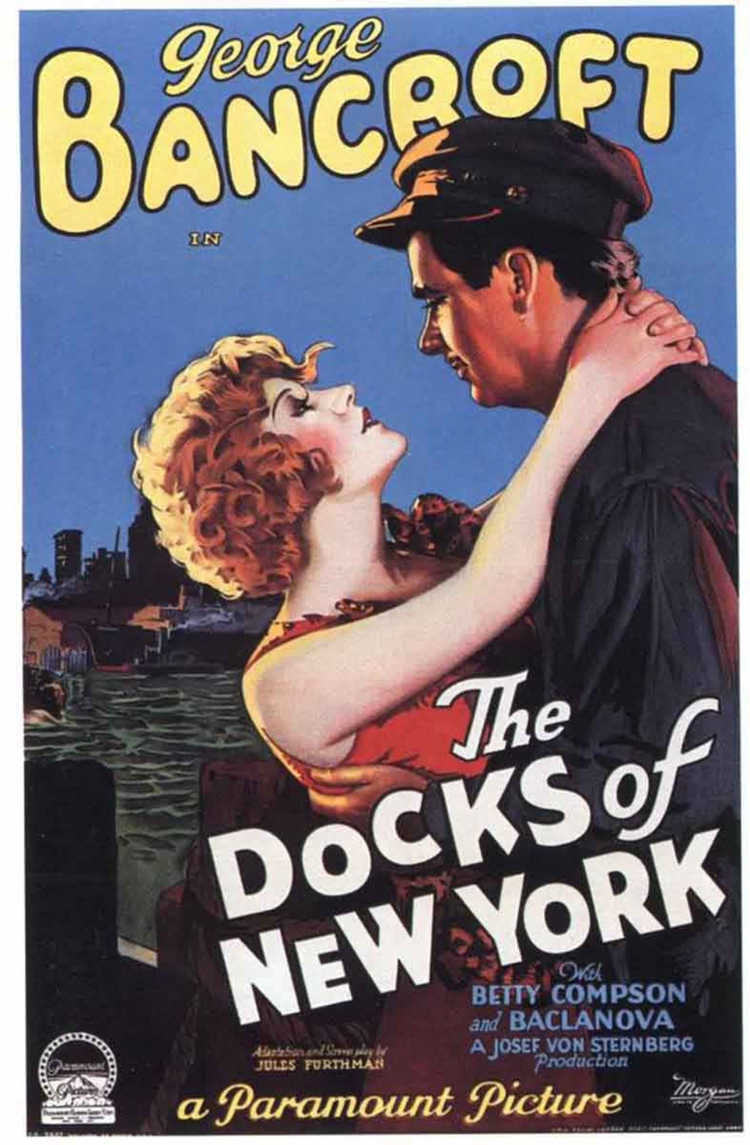
Betty Compson and George Bancroft in 'The Docks of New York' (1928), directed by Josef von Sternberg.
It's one of the very best films from the silent era. And I get to do live music for it tomorrow.
It's 'The Docks of New York' (1928), a drama running in 35mm at the Somerville (Mass.) Theatre on Sunday, July 8 at 2 p.m.
More details about the movie and the screening in the press release pasted in below.
It's the latest installment of the Somerville's 'Silents, Please!' series, and I've been looking forward to this one for awhile.
Why? Because it's a late silent (one of the last from Paramount) that shows the medium at the height of its power and eloquence.
Directed by Josef von Sternberg, the movie uses light and shadow, camera placement and atmosphere, and features a cast of great faces: George Bancroft, Betty Compson, Clive Cook, Olga Baclanova, and Gustav von Seffertitz, among others.
Extras seem to have been chosen in a kind of reverse beauty pageant, and the whole run-down waterfront saloon atmosphere and its ballet of light and shadow is captured in masterful black & white by cinematographer Harold Rosson, who would go on to win an Academy Award a decade later for his work on MGM's 'The Wizard of Oz' (1939).
To add to the anticipation, legendary Somerville Theatre projectionist David Kornfeld reports that the print (from the UCLA Archive) looks
fantastic.
To quote David:
"We have a gorgeous print, with ravishing density, courtesy of our friends at UCLA. I ran it last night & it will blow you away!
Well, you can't get better marks than that.
So if you think movies from the silent era were all primitive "flickahs" accompanied by rinky-tink piano music, please attend.
(Weirdly, there are two long sequences in 'Docks' that really
do call for rinky-tink piano music. But it's in the context of a run-down waterfront saloon.)
Later the same day, I'm at the Aeronaut Brewing Co. (also in Somerville), where we're screening a Western double feature that's half drama and half comedy.
For drama, it's the deadly serious 'Hell's Hinges' (1916), an early William S. Hart effort.
And for comedy, it's 'Go West' (1925), Buster Keaton's send-up of the genre.
I've wanted to try something like this for a long time—to see if running a serious film first, and then a parody after it, makes any difference in the comedy.
A lot of silent film comedy consists of sending up popular films of the period. So, after John Barrymore's 'Dr. Jekyll & Mr. Hyde' came out, Stan Laurel starred in 'Dr. Pyckle and Mr. Pride.'
To audiences at the time, the comedy was playing off a popular film that most people had recently seen.
But to us today, it's hard to recreate that context unless you show both films. And that's a problematic thing to do.
Why? Because the comedy/parody is usually 20 minutes or less, while the film it mocks is often a full-length feature.
So if you show the comedy first (the usual position in a program), the audience hasn't yet seen the feature.
But if you show the comedy
after the feature...well, a short film doesn't seem like the way to end a program, does it?
My solution was to take two relatively short features (both are about one hour) and run them back-to-back.
So on Sunday, night, Hart's 'Hell's Hinges' will function as the set-up, while Keaton's 'Go West' will be the pay off.
Will it work? Join us and find out. In addition to the press release for 'Docks of New York,' I'm also pasting in the press release for the Aeronaut screening as well.
See you at one, the other, or both!
* * *
TUESDAY, JUNE 26, 2018 / FOR IMMEDIATE RELEASE
Contact Jeff Rapsis • (603) 236-9237 • jeffrapsis@gmail.com
Cinematic masterpiece 'Docks of New York' to screen Sunday, July 8 at Somerville Theatre
Josef von Sternberg's silent working class drama to be shown in 35mm on the big screen with live music
SOMERVILLE, Mass.—It's a rare chance to see a masterpiece of early cinema presented as intended: via 35mm film, on the big screen, with live music and in an actual theater.
It's 'The Docks of New York' (1928), a working class drama directed by Josef Von Sternberg, to be shown at the Somerville Theatre on Sunday, July 8 at 2 p.m.
Live music will be provided by silent film accompanist Jeff Rapsis. Admission is $15 per person, $12 students/seniors.
It's the latest installment of the Somerville's 'Silents, Please!' series, which gives movie-goers a chance to experience great pictures of the silent era as originally presented.
"Seeing these great pictures on actual 35mm film and in a theater with live music is an opportunity that's increasingly rare," said Ian Judge, manager of the Somerville Theatre.
"But it's the only way to really understand why people first fell in love with movies, and why these pictures were so popular in their day."
Betty Compson and George Bancroft in 'The Docks of New York' (1928).
'The Docks of New York,' one of the last silent films released by Paramount Pictures, explores the lives and loves of lower-class waterfront denizens.
Roughneck stoker Bill Roberts (George Bancroft) falls for Mae (Betty Compson), a wise and weary dance-hall girl. But the relationship changes Roberts' hard-luck life in unexpected ways.
Fog-shrouded cinematography by Harold Rosson ('The Wizard of Oz'), expressionist set design by Hans Dreier ('Sunset Boulevard'), and sensual performances by Bancroft and Compson make this one of the legendary director Joseph von Sternberg’s finest works.
The film was daring for a Hollywood picture at the time for its realism: the unflinching and unromantic portrayal of working class people, and its refusal to rely on traditional story formulas and outcomes.
Unlike many early movie directors, von Sternberg emphasized the visual quality of his pictures, using lighting and scene composition in new and innovative ways.
Working as a studio director for Paramount, the native Austrian was aided by the increasing ability of black-and-white film stock by the mid-1920s to capture light and shadows.
The result was a series of ground-breaking dramas at the very end of the silent era, including 'Underworld' (1927) and 'The Last Command' (1928), the latter which helped Emil Jannings win "Best Actor" at the first-ever Academy Awards ceremony.
After the transition to talking pictures, von Sternberg discovered German actress Marlene Dietrich, inviting her to Hollywood to make a series of highly successful pictures under his direction.
With their moody lighting and extensive use of shadows, von Sternberg's films are widely acknowledged as paving the way for the "film noir" look that took hold in Hollywood in subsequent decades.
Although von Sternberg's directing career faded in the 1950s, his legacy continues today in surprising places—including the field of early rock music.
Between 1959 and 1963, Sternberg taught a course on film aesthetics at the University of California at Los Angeles, based on his own works. His students included Jim Morrison and Ray Manzarek, who went on to form the rock group The Doors.
The group recorded songs referring to Sternberg. Manzarek has described Sternberg as "perhaps the greatest single influence on The Doors."
'Docks of New York' was released at the very end of the silent era, causing it to be overlooked by critics at the time.
Previewed by the New York City press during the same week that saw the fanfare opening of Al Jolson’s 'The Singing Fool,' Sternberg’s film was ignored in the excitement over competing talking pictures.
Film critic Andrew Sarris lamented that Sternberg’s film “quickly vanished in undeserved oblivion...confirm[ing] Chaplin’s observation that the silent movies learned their craft just about the time they went out of business.”
Museum of Modern Art film curator Charles Silver ranked The Docks of New York as “probably the last genuinely great silent film made in Hollywood [rivaling] Chaplin’s masterpieces of the 1930s.”
Upcoming programs in the Somerville's silent film series include:
• Sunday, Aug. 12: a selection of Laurel & Hardy's rarely screened silent comedies, all in 35mm prints from the Library of Congress, including 'Big Business' (1929), 'The Finishing Touch' (1928), 'You're Darn Tootin'' (1928), and 'Call of the Cuckoos' (1927).
‘The Docks of New York' (1928) will be shown on Sunday, July 8 at 2 p.m. at the Somerville Theatre, 55 Davis Square, Somerville, Mass. Tickets are $15 adults, $12 students/seniors. For more information, visit www.somervilletheatre.com or call (617) 625-4088.
* * *
And here's a release for the Aeronaut double feature...
Buster and his co-star Brown Eyes in 'Go West' (1925).
THURSDAY, JUNE 7, 2018 / FOR IMMEDIATE RELEASE
Contact Jeff Rapsis • (603) 236-9237 • jeffrapsis@gmail.com
'Go West' with Buster Keaton at Aeronaut Brewing Co. on Sunday, July 8
Classic silent film comedy masterpiece to be screened with live musical accompaniment
SOMERVILLE, Mass.—He never smiled on camera, earning him the nickname of "the Great Stone Face." But Buster Keaton's comedies rocked Hollywood's silent era with laughter throughout the 1920s.
See for yourself with a screening of 'Go West' (1925), one of Keaton's landmark feature films, on Sunday, July 8 at 7:30 p.m. at the Aeronaut Brewing Co., 14 Tyler St., Somerville, Mass. Admission $10 per person, limited seating. Tickets available through eventbrite.com
Facebook: www.facebook.com/events/377955156024833/
Eventbrite: www.aeronaut-film.eventbrite.com
The film will be shown with live musical accompaniment by Jeff Rapsis, a New Hampshire-based performer regarded as one of the nation's leading silent film musicians.
The program will include an early western, 'Hell's Hinges' (1916), starring William S. Hart.
The screening is part of the Aeronaut's commitment to give local artists and audiences a chance to connect in the brewery's performance space.
In 'Go West,' Buster heads out to ranch country, where the stone-faced comedian encounters romance with—a cow! Can he save his love from a trip to the livestock yards? Rustle up some belly laughs as Buster must once again prove himself worthy to all those who doubt him.
Buster Keaton heeds the title in 'Go West.'
'Go West' was an unusual film for Keaton. With its portrayal of a down-and-out wanderer who becomes a reluctant hero, 'Go West' could have been a vehicle for Charlie Chaplin’s Little Tramp.
The film was praised by critics and did well at the box office, but today is lesser known than Keaton classics such as 'The Navigator' (1924) and 'The General' (1926).
Co-starring in 'Go West' is a mourn-faced cow named Brown Eyes, with whom Keaton worked extensively prior to the filming. Brown Eyes received a credit in the movie, and even got a salary of $13 a week for her acting.
Keaton's female co-star is actress Kathleen Myers. Joe Keaton, the comedian's father and a popular vaudeville performer, appears briefly in a barbershop scene.
Much of 'Go West' was shot on location in Kingman, Ariz., during the summer of 1925, in temperatures approaching 120 degrees.
"These films are audience favorites, and people continue to be surprised at how engrossing and exhilarating they can be when shown as they were intended: in a theater, and with live music," said Rapsis, who accompanies more than 100 screenings each year at venues around the nation.
Rapsis improvises live scores for silent films using a digital synthesizer to recreate the texture of the full orchestra.
"It's kind of a high wire act," Rapsis said. "But for me, the energy of live performance is an essential part of the silent film experience."
‘Go West' (1925) starring Buster Keaton will be shown with live music on Sunday, July 8 at 7:30 p.m. at the Aeronaut Brewing Co., 14 Tyler St., Somerville, Mass. Admission $10 per person, limited seating; tickets available through eventbrite.com.
Facebook: www.facebook.com/events/377955156024833/
Eventbrite: www.aeronaut-film.eventbrite.com
For more information, visit www.aeronautbrewing.com.