Showing posts with label Josef Von Sternberg. Show all posts

Friday, May 12, 2023

Classic drama 'Docks of New York' (1928) at Town Hall Theatre in Wilton, N.H. on Sunday, 5/14

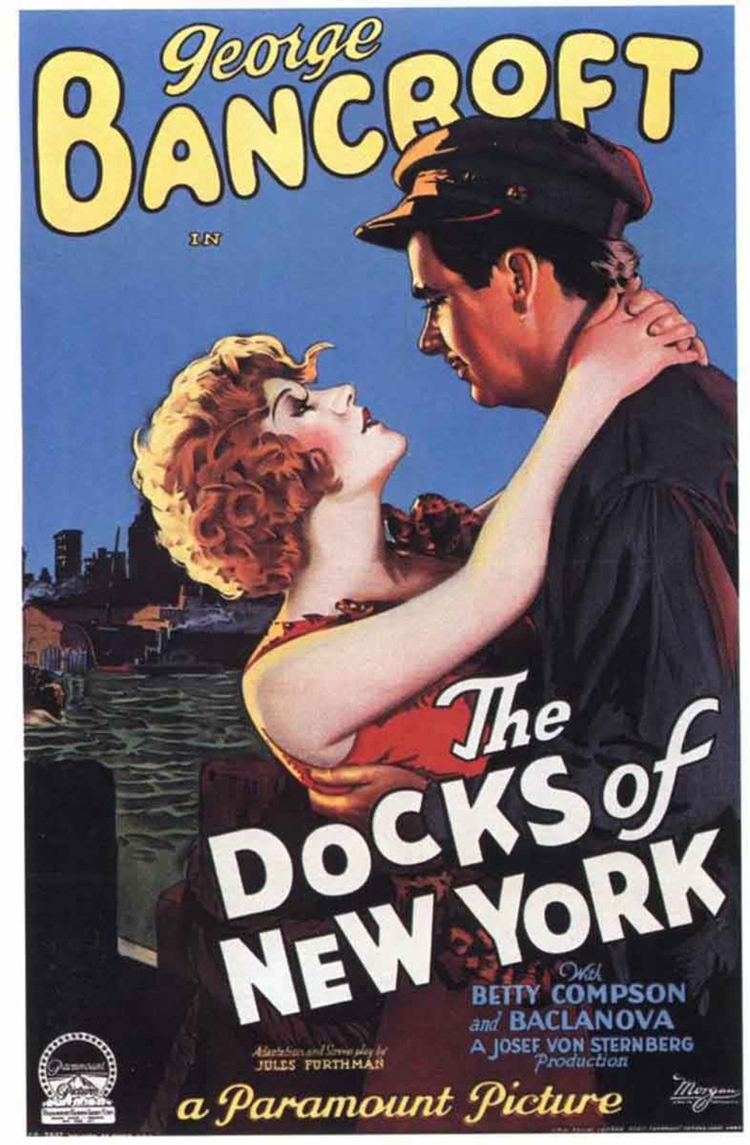
Betty Compson and George Bancroft in 'The Docks of New York' (1928).

This weekend, our "Silent New York' series continues with 'The Docks of New York' (1928) on Sunday, May 14 at 2 p.m.

If you've never seen a silent film on the big screen and with live music, this would be a good one to check out. 

Why? Because it really dispels the myth of silent film being a primitive ancestor of talking pictures. It's a good example of how silent cinema developed a story-telling power that was unique to the medium, and which still works today.

Plus the film stock had improved to the point where all kinds of light and shadow could be used in making a motion picture—something director Josef von Sternberg exploited to great effect.

So, for a different kind of Mother's Day experience, take in 'The Docks of New York' at the Town Hall Theatre in Wilton, N.H. More details in the press release below.

*    *    *

Betty Compson and George Bancroft in 'The Docks of New York' (1928).

TUESDAY, MAY 2, 2023 / FOR IMMEDIATE RELEASE
Contact Jeff Rapsis • (603) 236-9237 • jeffrapsis@gmail.com

Cinematic masterpiece 'Docks of New York' to screen Sunday, May 14 at Town Hall Theatre

Big Apple tribute continues: Josef von Sternberg's silent working class drama to be shown on big screen with live musical accompaniment

WILTON, N.H.—It's a rare chance to see a masterpiece of early cinema presented as intended: on the big screen, with live music and with an audience in a theater.

It's 'The Docks of New York' (1928), a working class drama directed by Josef Von Sternberg, to be shown at the Town Hall Theatre, 40 Main St., Wilton, N.H. on Sunday, May 14 at 2 p.m.

Live music will be provided by silent film accompanist Jeff Rapsis. Admission is free; a donation of $10 per person is suggested to help defray expenses.

The screening is the latest installment of the Town Hall Theatre's 'Silent New York' series, which shows the Big Apple as depicted in movies a century ago.

'The Docks of New York,' one of the last silent films released by Paramount Pictures, explores the lives and loves of lower-class waterfront denizens.

Roughneck stoker Bill Roberts (George Bancroft) falls for Mae (Betty Compson), a wise and weary dance-hall girl. But the relationship changes Roberts' hard-luck life in unexpected ways.

Fog-shrouded cinematography by Harold Rosson ('The Wizard of Oz'), expressionist set design by Hans Dreier ('Sunset Boulevard'), and sensual performances by Bancroft and Compson make this one of the legendary director Joseph von Sternberg’s finest works.

The film was daring for a Hollywood picture at the time for its realism: the unflinching and unromantic portrayal of working class people, and its refusal to rely on traditional story formulas and outcomes.

Unlike many early movie directors, von Sternberg emphasized the visual quality of his pictures, using lighting and scene composition in new and innovative ways.

Working as a studio director for Paramount, the native Austrian was aided by the increasing ability of black-and-white film stock by the mid-1920s to capture light and shadows.

The result was a series of ground-breaking dramas at the very end of the silent era, including 'Underworld' (1927) and 'The Last Command' (1928), the latter which helped Emil Jannings win "Best Actor" at the first-ever Academy Awards ceremony.

After the transition to talking pictures, von Sternberg discovered German actress Marlene Dietrich, inviting her to Hollywood to make a series of highly successful pictures under his direction.

With their moody lighting and extensive use of shadows, von Sternberg's films are widely acknowledged as paving the way for the "film noir" look that took hold in Hollywood in subsequent decades.

Although von Sternberg's directing career faded in the 1950s, his legacy continues today in surprising places—including the field of early rock music.

Between 1959 and 1963, Sternberg taught a course on film aesthetics at the University of California at Los Angeles, based on his own works. His students included Jim Morrison and Ray Manzarek, who went on to form the rock group The Doors.

The group recorded songs referring to Sternberg. Manzarek has described Sternberg as "perhaps the greatest single influence on The Doors."

'Docks of New York' was released at the very end of the silent era, causing it to be overlooked by critics at the time.

Previewed by the New York City press during the same week that saw the fanfare opening of Al Jolson’s 'The Singing Fool,' Sternberg’s film was ignored in the excitement over competing talking pictures.

Film critic Andrew Sarris lamented that Sternberg’s film “quickly vanished in undeserved oblivion...confirm[ing] Chaplin’s observation that the silent movies learned their craft just about the time they went out of business.”

Museum of Modern Art film curator Charles Silver ranked 'The Docks of New York' as “probably the last genuinely great silent film made in Hollywood [rivaling] Chaplin’s masterpieces of the 1930s.”

Upcoming programs in the Town Hall Theatre's 'Silent New York' series include:

• Sunday, May 28, 2023 at 2 p.m.: 'Speedy' (1928) starring Harold Lloyd. Lloyd's final silent feature finds him at the peak of his career playing a baseball-crazed go-getter forced to rescue the business of his girlfriend's father from being destroyed by thugs. Filled with great scenes of 1920s NYC, with notable cameo by baseball's Babe Ruth. ('Speedy' was originally scheduled for Sunday, April 30 but was moved to Sunday, May 28 due to a scheduling conflict.)

‘The Docks of New York' (1928) will be screened on Sunday, May 14 at 2 p.m. at the Town Hall Theatre, 40 Main St., Wilton, N.H.

Admission is free; a donation of $10 per person is suggested to help defray expenses. For more information, call (603) 654-3456.

Friday, April 15, 2016

Celebrate Tax Day with gangster movie
'Underworld' at Red River on Friday, 4/15

Clive Brook and Evelyn Brent on a poster for 'Underworld.'

When programming a silent film series, I sometimes look for occasions to celebrate.

If a screening is around July 14 (Bastille Day), then that's a good reason to run 'Orphans of the Storm' (1922), D.W. Griffith's French Revolution epic.

So in putting together this year's schedule for Red River Theatres in Concord, N.H., I saw one of the dates was April 15.

April 15? Well, there's a day that's well-known to all U.S. residents, as it's the deadline for federal income tax filings.

What silent film would be appropriate for that? There's none about IRS agents that I can think of.

So I settled for a picture that would be something of a catharsis: a movie in which people battle government agents.

It's 'Underworld' (1927), a Josef von Sternberg drama set in the world of 1920s urban gangsters.

They're always one step ahead of the law, of course. What's more, the movie has extended shoot-outs with federal agents.

So what better way to blow off some steam after ponying up to the federal government to pay your share for all it does?

Clive Brook and Evelyn Brent in 'Underworld.'

Plus, it's one of those pictures I put in the category of "mature" silent film: the really polished productions that were hitting theaters in the last three or four years before talkies took over.

Well worth a look see. So pull the trigger and come join us this evening at Red River Theatres for 'Underworld.' You're sure to get a bang out of it.

More details? Check out the press release I've included below.

* * *

A color-enhanced still for 'Underworld.'

THURSDAY, APRIL 7, 2016 / FOR IMMEDIATE RELEASE
Contact Jeff Rapsis • (603) 236-9237 • jeffrapsis@gmail.com

'Underworld' to screen with live music at Concord's Red River Theatres on Friday, April 15


Oscar-winning silent crime drama directed by Josef von Sternberg was forerunner of Hollywood 'gangster' movies

CONCORD, N.H.—'Underworld' (1927), a silent drama that spurred a boom in 'gangster' movies, will be screened with live music on Friday, April 15 at 7 p.m. at Red River Theatres, 11 South Main St., Concord, N.H.

The film will be accompanied live by silent film musician Jeff Rapsis. Admission is $10 per person.

'Underworld,' directed by Josef von Sternberg and starring George Bancroft, is notable for being the first major motion picture to portray a criminal in a sympathetic light instead of as a villain. Its popularity touched off a Prohibition-era boom in Hollywood gangster pictures that reached its peak following the stock market crash of 1929.

"We figured a fitting way to mark the date our taxes are due was to screen a picture full of people battling federal agents," Rapsis said.

The story of 'Underworld' follows gangster Bull Weed (George Bancroft), who becomes entangled in a love triangle involving a reformed drunkard, “Rolls Royce” (Clive Brook) whom he takes on as his right-hand man, and Bull’s girlfriend “Feathers” (Evelyn Brent). Bull Weed's imprisonment leads to a dramatic climax.

Bancroft's performance in 'Underworld' set the stage for memorable characterizations of gangster protagonists by Jimmy Cagney ('Public Enemy,' 1931), Paul Muni ('Scarface,' 1932), and Edward G. Robinson ('Little Caesar,' 1930), which all follow directly on from the model created by 'Underworld.'

The film's script, by Chicago newspaperman Ben Hecht, earned an Oscar for Best Screenwriting at the first-ever Academy Awards. The film is also noted for director von Sternberg's innovative use of black-and-white photography, which presaged many film noir techniques in following decades.

Director Von Sternberg was obsessed by light, and developed methods of “painting” his compositions with the arrangements of lamps, scrims, and reflectors on the set. Today he is remembered most for having used that skill in a series of films he made with Marlene Dietrich, starting with 'The Blue Angel' (1930) and continuing in six more star vehicles made in Hollywood, including 'Morocco' (1930) and 'Shanghai Express' (1932).

'Underworld' will be accompanied by live music by Jeff Rapsis, a New Hampshire-based silent film accompanist who performs at venues across the region and beyond.

Using a digital synthesizer to reproduce the texture of the full orchestra, Rapsis will improvise the score on the spot during the screening.

"Films such as 'Underworld' were created to be shown on the big screen and in a theater as a shared experience," Rapsis said. "With an audience and live music, they still come to life in the way their makers intended them to.

"So Red River's silent film screenings are a great chance for people to experience films that caused people to first fall in love with the movies," he said.

'Underworld' is the latest in an monthly series of great silent films with live music at Red River. Upcoming programs include:

• Friday, May 13: 'The Golem' (1920), a pioneering German fantasy in which a rabbi brings a statue to life protect the Jews of 16th century Prague from persecution.

• Friday, June 10: 'The General' (1927), Buster Keaton's classic comic adventure epic of an Southern engineer and his locomotive during the U.S. Civil War.

• Friday, July 15: 'Bardelys the Magnificent' (1926) starring John Gilbert in a big MGM historical swashbuckling adventure thought lost for decades until a print was found recently in France.

Red River Theatres, an independent cinema, is a non-profit 501(c)(3) organization dedicated to screening a diverse program of first-run independent films, cult favorites, classics, local and regional film projects, and foreign films.

The member-supported theater’s mission is to present film and the discussion of film as a way to entertain, broaden horizons and deepen appreciation of life for New Hampshire audiences of all ages.

'Underworld' (1927) will be shown at Red River Theatres, 11 South Main St., Concord, N.H. on Friday, April 15 at 7 p.m. in the Jaclyn Simchik Screening Room at Red River Theatres, 11 South Main St., Concord, N.H. Admission is $10 per person; for more info, call (603) 224-4600 or visit www.redrivertheatres.org. For more information about the music, visit www.jeffrapsis.com.

Sunday, October 11, 2015

An upcoming schedule like a popular
guesthouse—absolutely packed with 'Lodgers'

A French poster for Hitchcock's 'The Lodger' (1927), which translates as 'Golden Hair.'

The weeks leading up to Halloween are among the busiest for a silent film accompanist. Screenings abound!

To make it manageable, and to not overdo familiar warhorses such as 'Nosferatu' and 'The Phantom of the Opera,' each year I try to pick a lesser-known silent that would work well for Halloween and put it into the rotation for the season.

This time around it's Alfred Hitchcock's 'The Lodger' (1927), which I'm accompanying at no less than five different screenings before the end of October.

First up is a show this Wednesday, Oct. 14 at 7 p.m. at the Rogers Center for the Performing Arts in North Andover, Mass. More info is in a press release tacked onto the end of this.

It's then followed by 'Lodger' screenings on Saturday, Oct. 17 in Brandon, Vt.; on Thursday, Oct. 29 in Keene, N.H.; on Friday, Oct. 30 in Concord, N.H.; and then on Sunday, Oct. 31 in Ogunquit, Maine.

This is one "Lodger" that won't stay put!

In addition, there's a half-dozens screenings of other titles on the docket, including 'The Cat and the Canary' on Thursday, Oct. 22 in Plymouth, N.H.; 'Nosferatu' on Saturday, Oct. 24 in Somerville, Mass.; and the original silent 'Dr. Jekyll and Mr. Hyde' on Sunday, Oct. 25 in Wilton, N.H.

Also on Sunday, Oct. 25: Lon Chaney's 'The Unknown' at the Aeronaut Brewery in Somerville, Mass.; 'The Cabinet of Dr. Caligari' on Wednesday, Oct. 28 at Wellesley College in Wellesley, Mass.; and another Chaney film, 'West of Zanzibar' as part of a day-long Halloween Marathon on Sunday, Oct. 31 in Somerville, Mass.

But before we plunge headlong into Halloween silent film mayhem, a few notes about an unusual booking yesterday (Saturday, Oct. 10) at the venerable Brattle Theatre off Harvard Square in Cambridge, Mass.

Yesterday I did live music for not one but two screenings of 'Underworld' (1927), the highly regarded Josef von Sternberg drama widely credited with starting a craze for gangster movies that continued for the duration of the Prohibition era.

The two shows, part of a "proto-film-noir" series at the Brattle, were at 4 p.m. and then 7:30 p.m., with Edgar G. Robinson in 'Little Caesar' (1931) sandwiched in between. Both titles were in 35mm.

It's not often I get a chance to play for the same film twice in one day. Hey, just like in the silent film era! But I did, and found a curious thing happened in trying to create live music on the spot for one show after another of the same movie.

The first screening went superbly, I thought—I had the right material, and it all fell into place just as it should to help the film leap off the screen. Lots of strong moments where the music was just what I would have wanted.

The only thing that didn't work right was that I forgot about the on-screen alarm whistle that's shown sounding when Bancroft, as 'Bull Weed,' attempt to break out of prison. Oh well!

Between screenings, I went for a walk around Harvard Square, where everyone is so young! I was surprised to find the area overrun with tour groups from Japan and China, apparently in our part of the world to catch some foliage. Mt. Auburn Street was lined with tour buses as far as the eye could see.

I stopped in at Boathouse for dinner, but only realized after I sat down surrounded by beer taps that I really shouldn't consume adult beverages in advance of accompanying a film. So it was ginger ale.

I returned to the Brattle for the tail end of 'Little Caesar,' in time to see it conclude in a hail of gunfire. And then had plenty of time to warm up at the keyboard for the second screening of 'Underworld.'

And you know what? No matter what I did, I couldn't seem to recapture the magic "rightness" of the first screening.

Moment after moment passed with the music not quite hitting the mark, I thought. I was using the same melodic material, but it didn't seem to fit as well, and didn't morph fluidly from one emotional moment to the next.

As an example: Brancroft's 'Bull Weed' character inspired a rhythmic pattern of repeated notes that cycled among the musical interval of a minor third. Not so much a theme, but a musical signature for the character. Played without accompaniment, the melody's implied harmony made it sound tough and aggressive.

But if you played the same melody with a dominant seventh chord underneath it (so that the notes fit into the middle part of the chord), it could sound upbeat and jazzy, even jolly.

In the first screening, I made great use of this, I thought, in getting the right kind of music to fit Bull Weed's personality, which is mostly jovial but with occasional outbursts of shocking violence.

But in the second screening, I just couldn't find the chord when I needed it. Too often, it was too stern for what was happening on screen. And this threw my mind out of the moment, and took away from the score, I thought.

Well, the film keeps going, so you have to keep playing. The second screening did have its moments, but far fewer than the first. Too often, I think I was hoping to recreate what had happened at the first show, which takes you out of the moment, which is never a good thing with my method of accompaniment.

And weirdly, although this time I remembered the whistle, by the time it was time to use it, I had "dry mouth" and it didn't come off the way it should have.

If I ever face this two-at-a-time situation again (and I hope I do, as the Brattle is an excellent venue and often runs multiple screenings of titles), I'll have to see what I can do to avoid this trap.

Maybe I should have had a few beers at the Boathouse. Next time, I'll try that—all in the name of science, of course.

Okay, here's more details about 'The Lodger' on Wednesday, Oct. 14. Hope to see you there!

* * *

>Ivor Novello as 'The Lodger' (1927), directed by Alfred Hitchcock.

FRIDAY, OCT. 2, 2015 / FOR IMMEDIATE RELEASE
Contact Jeff Rapsis • (603) 236-9237 • jeffrapsis@gmail.com

Hitchcock's first, 'The Lodger,' to screen Wednesday, Oct. 14 at Rogers Center


Creepy silent thriller about killings in London marked legendary director's debut; to be shown on the big screen with live music

NORTH ANDOVER, Mass.—A half-century of murder has to start somewhere.

And for movie director Alfred Hitchcock, it began with 'The Lodger' (1927), a silent thriller that stunned audiences when it was first released, and contained many of his trademark touches.

'The Lodger: A Story of the London Fog,' will be shown at the Rogers Center for the Arts, Merrimack College, 315 North Turnpike St., North Andover, Mass. on Wednesday, Oct. 14 at 7 p.m.

The program, the latest in the Rogers Center's silent film series, will be accompanied by live music performed by silent film composer Jeff Rapsis. Admission is free and the show is open to the public.

"What better way to get into the Halloween spirit a little early than a silent film from Alfred Hitchcock?" Rapsis asked.

The film, shot in England and based on a story and stage play by Marie Belloc Lowndes, concerns the hunt for a serial killer in London. British matinee idol Ivor Novello plays Jonathan Drew, a quiet, secretive young man who rents a room in a London boarding house. Drew's arrival coincides with the reign of terror orchestrated by a mysterious "Jack The Ripper"-like killer, who murders a blonde woman every Tuesday evening.

As the film progresses, circumstantial evidence begins to mount, pointing to Drew as the murderer. Suspense and drama escalate in true Hitchcock fashion as the viewer wonders if the lodger really could be the killer—and if so, what danger awaits the landlord's daughter, who is falling in love with the mysterious stranger. The all-British cast includes Malcom Keen, Arthur Chesney, and Marie Ault.

'The Lodger' introduced themes that would run through much of Hitchcock’s later work: an innocent man on the run, hunted down by a self-righteous society, a strong link between sexuality and murder, and a fixation on blonde women. About 'The Lodger,' Hitchcock scholar Donald Spoto wrote that for "the first time Hitchcock has revealed his psychological attraction to the association between sex and murder, between ecstasy and death."

'The Lodger' also launched the Hitchcock tradition of making a cameo appearance in each of his films. In 'The Lodger,' Hitchcock appears briefly about three minutes into the film, sitting at a desk in a newsroom with his back to the camera and using a telephone. The cameo appearance tradition, which continued for the rest of his long career, came about in 'The Lodger' when the actor supposed to play the part of the telephone operator failed to turn up, and Hitchcock filled the breach.

The back of Hitchcock's head—look for this first-ever cameo early in 'The Lodger.'

Some critics say 'The Lodger' broke new ground in the previously moribund British cinema, showing a truly cinematic eye at work. In creating the movie, Hitchcock had clearly been watching contemporary films by German directors F.W. Murnau and Fritz Lang, whose influence can be seen in the ominous camera angles and claustrophobic lighting.

While Hitchcock had made two previous films, in later years the director would refer to 'The Lodger,' his first thriller, as the first true "Hitchcock thriller." The movie has since been remade several times, most recently in 2009, in an updated version starring Alfred Molina and Hope Davis.

In reviving the original 'The Lodger,' the Rogers Center aims to show silent movies as they were meant to be seen—in high quality prints, on a large screen, with live music, and with an audience.

"All those elements are important parts of the silent film experience," said Jeff Rapsis, who will improvise a musical score during the screening. "Recreate those conditions, and the classics of early cinema leap back to life. They all featured great stories with compelling characters and universal appeal, so it's no surprise that they hold up and we still respond to them."

Rapsis performs on a digital synthesizer that reproduces the texture of the full orchestra and creates a traditional "movie score" sound.

Upcoming feature films in the Rogers Center's silent film series include:

• Wednesday, Jan. 27, 2016, 7 p.m.: 'Intolerance' (1916), directed by D.W. Griffith and starring (literally) a cast of thousands. D.W. Griffith's early blockbuster about man's inhumanity to man weaves together four stories spanning four eras of civilization. Filmed an a vast scale, setting a new standard for Hollywood extravagance. A movie made for the big screen, and here's your chance to see it!

• Wednesday, March 23, 2016, 7 p.m.: 'Ben-Hur: A Tale of the Christ' (1925) starring Ramon Novarro, Francis X. Bushman. Just in time for Easter! In the Holy Land, a Jewish prince is enslaved by the occupying Romans; inspired by encounters with Jesus, he lives to seek justice. One of the great religious epics of Hollywood's silent film era, including a legendary chariot race that's lost none of its power to thrill.

‘The Lodger' will be shown on Wednesday, Oct. 14 at 7 p.m. at the Rogers Center for the Arts, Merrimack College, 315 North Turnpike St., North Andover, Mass. The program is free and open to the public. For more information, call the Rogers box office at (978) 837-5355. For more info on the music, visit www.jeffrapsis.com.


Friday, October 9, 2015

Live music for Buster in Winchester, N.H.,
but also for 'Underworld' in Cambridge, Mass.

Amateur detective Buster searches for clues about life in 'Sherlock Jr.' (1924)

Tonight (Friday, Oct. 9) brings a fun Buster Keaton double feature with live music in an unusual venue: the Arlington Grange Hall in Winchester, N.H. Details below.

And then Saturday brings two screenings of 'Underworld' (1927), Josef von Sternberg's great silent gangster drama, at the Brattle Theatre in Cambridge, Mass.

Showtimes are 4 p.m. and then again at 7:30 p.m. It's part of a series they're running about films that helped create the "film noir" school of cinema.

Originally, this post announced that I was not accompanying the film. But things were confirmed just today, so I'll be going down to Cambridge tomorrow to do music for both screenings. I'll post more about this in just a bit.

But first, more info about tonight's Keaton program. We've actually received some good publicity in local media, so I'm hoping for a fair turnout. We'll see!

* * *


FRIDAY, OCT. 2, 2015 / FOR IMMEDIATE RELEASE
Contact Jeff Rapsis • (603) 236-9237 • jeffrapsis@gmail.com

Buster Keaton double feature at Winchester's Arlington Grange on Friday, Oct. 9


Classic silent film comedy masterpieces to be screened with live musical accompaniment

WINCHESTER, N.H.—He never smiled on camera, earning him the nickname of "the Great Stone Face." But Buster Keaton's comedies rocked Hollywood's silent era with laughter throughout the 1920s.

See for yourself with a screening of 'Sherlock Jr.' (1924) and 'The Cameraman' (1928), two of Keaton's landmark feature films, on Friday, Oct. 9 at 7 p.m. at the Arlington Grange Building, 9 Mechanic St., Winchester, N.H.

The films will be shown with live musical accompaniment by Jeff Rapsis, a New Hampshire-based performer regarded as one of the nation's leading silent film musicians.

The public is welcome to attend. Suggested donation for this family-friendly event is $7 per person to help defray expenses.

Buster outside the movie theater in 'Sherlock Jr.'

In 'Sherlock Jr.,' Buster plays a small-town movie projectionist who dreams of working as a detective. But then Buster's romantic rival frames him for stealing a watch from his girlfriend's father. Fortunately, the situation mirrors the plot of the movie currently playing at Buster's theater. Inspired by the movie, can Buster find the real thief and win back his girl?

Buster in 'The Cameraman.'

'The Cameraman' tells the story of a young man (Keaton) who tries to impress the girl of his dreams (Marceline Day) by working as a freelance newsreel cameraman. His efforts result in spectacular failure, but then a lucky break gives him an unexpected chance to make his mark. Can Buster parlay the scoop of the year into a secure job and successful romance?

Both films focus on exploring the potentials of the motion picture, then a brand-new medium.

In 'The Cameraman,' Keaton uses the movie business itself to create comedy that plays with the nature of film and reality.

Keaton, along with Charlie Chaplin and Harold Lloyd, stands as one of the three great clowns of the silent screen. Many critics regard Keaton as the best of all; Roger Ebert wrote in 2002 that "in an extraordinary period from 1920 to 1929, (Keaton) worked without interruption on a series of films that make him, arguably, the greatest actor-director in the history of the movies."

As a performer, Keaton was uniquely suited to the demands of silent comedy. Born in 1895, he made his stage debut as a toddler, joining his family's knockabout vaudeville act and learning to take falls and do acrobatic stunts at an early age. He spent his entire childhood and adolescence on stage, attending school for exactly one day.

A remarkable pantomime artist, Keaton naturally used his whole body to communicate emotions ranging from sadness to surprise. In an era when movies had few special effects, Keaton's acrobatic talents meant he performed all his own stunts.

All those talents are on display in 'Sherlock Jr.' and 'The Cameraman,' which was selected in 2005 for preservation in the U.S. National Film Registry by the Library of Congress as being "culturally, historically, or aesthetically significant."

"These films are audience favorites, and people continue to be surprised at how engrossing and exhilarating they can be when shown as they were intended: in a theater, and with live music," said Rapsis, who accompanies more than 100 screenings each year at venues around the nation

Rapsis improvises live scores for silent films using a digital synthesizer to recreate the texture of the full orchestra.

"It's kind of a high wire act," Rapsis said. "But for me, the energy of live performance is an essential part of the silent film experience."

The Arlington Grange of Winchester will present Buster Keaton in 'Sherlock Jr.' (1924) and 'The Cameraman' (1928) on Friday, Oct. 9 at 7 p.m. in Grange Hall, 9 Mechanic St., Winchester, N.H. The public is welcome to attend this family-friendly event, which features live musical accompaniment for both films. Suggested donation is $7 per person to defray expenses.

Tuesday, October 6, 2015

Chaplin, Keaton, and maybe von Sternberg...
plus werewolves & topping 200,000 pageviews

Playing for 'The Cameraman' (1928) in an unusual venue: the Arlington Grange Hall in Winchester, N.H.

There's a high-profile festival of silent film going on this week in Pordenone, Italy. (That's "poor-deh-know-nay" for the very few non-native Italian speakers following this blog.)

Held each year in early October, it attracts the best and the brightest silent film restorers, archivists, scholars—and yes, musicians.

I'd like to check it out someday. But until the invitation comes, we'll just continue having our own silent film festival closer to home, with a bunch of great programs coming up that I hope you'll consider attending.

Tranfusion confusion: an injured man receives wolf blood in 'Wolfblood,' with unexpected consequences.

• Tonight (Tuesday, Oct. 6), I'm doing music for a screening of 'Wolfblood' (1925), a low budget lumbercamp melodrama noteworthy as one of the first examples of the "werewolf" theme in cinema. With Halloween coming up, why not? Showtime is 6 p.m. at the Manchester (N.H.) City Library, 405 Pine St. in downtown Manchester, N.H. Admission free, donations encouraged.

• Thursday, Oct. 8 brings 'The Kid' (1921) and Charlie Chaplin short comedies at 6:30 p.m. at the Flying Monkey Moviehouse and Performance Center, 39 South Main St., Plymouth, N.H. Co-starring a five-year-old Jackie Coogan, 'The Kid' was Chaplin's breakthrough; a full-length picture that successfully combined comedy and drama. Admission $10 per person.

• Friday, Oct. 9 at 7 p.m. brings a Buster Keaton program at the Arlington Grange Hall, 39 Mechanic St., Winchester, N.H. (Ha! Take that, Pordenone attendees.) Free admission but they're suggesting a donation of $7 per person. Two Keaton comedies, both focusing on movies: 'Sherlock Jr.' (1924) and 'The Cameraman' (1928). Can't get much more meta than that.

• Saturday, Oct. 10 brings a tentative gig at the Brattle Cinema, 40 Brattle St., in Cambridge, Mass. A series about the roots of film noir includes two screenings of Josef von Sternberg's ground-breaking crime drama 'Underworld' (1927) in 35mm at 4 p.m. and again at 7:30 p.m. I call it tentative because at at this point, I'm not sure if I'm actually doing accompaniment. As soon as I know yes or no, I'll post an update.

See? Just like Pordenone! Except not in Italy.

After this weekend, we enter the heavy Halloween schedule, which this year features Alfred Hitchcock's early thriller 'The Lodger' (1927) in about a half-dozen different locations around New England.

I haven't scored 'The Lodger' in some time, but it's full of Hitchcock's then-emerging style and a way to get in the right frame of mind for Halloween. I've developed some new musical material to help this title connect, so I'm looking forward to seeing how it evolves over multiple screenings.

But for this week, the focus is on werewolves, comedy, and gangster. If you'd like more info on 'The Kid' this Thursday, I've pasted in the text of the press release below. See you there!

And finally, a tip of the virtual hat to all visitors to this blog, which just topped 200,000 page views.

Blogs are so 2008, I know. But this format seems to work as a way to sometimes get into detail about creating live music for silent film screenings, so I plan to keep it up.

Thanks for visiting and please come again.

* * *


FRIDAY, OCT. 2, 2015 / FOR IMMEDIATE RELEASE
Contact Jeff Rapsis • (603) 236-9237 • jeffrapsis@gmail.com

Chaplin's 'The Kid' to screen on Thursday, Oct. 8 at Flying Monkey


Landmark silent film comedy/drama to be presented with live music at historic venue

PLYMOUTH, N.H.—Silent film with live music returns to the Flying Monkey with a screening of Charlie Chaplin's classic comedy/drama 'The Kid' (1921) on Thursday, Oct. 8 at 6:30 p.m.

The special program, which also includes several of Chaplin's short comedies, with be presented with live music by Jeff Rapsis, one of the nation's leading silent film accompanists. Admission is $10 per person.

Chaplin was already the world's most popular comedian and filmmaker when he produced 'The Kid,' his first feature-length project. The movie, with its daring mix of intense drama and slapstick comedy, proved an instant sensation and marked one of the high points of Chaplin's long career.

'The Kid' follows the story of a tramp (Chaplin) who attempts to raise an orphaned boy on his own. It includes several classic scenes, and is highlighted by a sequence in which Chaplin battles authorities attempting to return the child to an orphanage.


Co-starring with Chaplin in 'The Kid' is five-year-old Jackie Coogan, who turned in what many critics rank as the best child performance of the entire silent film era. Chaplin himself worked closely with the young Coogan for more than a year to develop the youngster's acting abilities.

Coogan went on to a long career that much later included the role of "Uncle Fester" in the popular 1960s Addams Family television show.

The Chaplin program continues the monthly series of silent film with live music at the Flying Monkey. The series provides local audiences the opportunity to experience silent film as it was intended to be shown: on the big screen, in restored prints, with live music, and with an audience.

"If you can put pieces of the experience back together again, it's surprising how these films snap back to life," Rapsis said. "By showing the films under the right conditions, you can really get a sense of why people first fell in love with the movies."

The Flying Monkey originally opened as a silent film moviehouse in the 1920s, and showed first-run Hollywood films to generations of area residents until closing several years ago.

The theater has since been renovated by Alex Ray, owner of the Common Man restaurants, who created a performance space that hosts a wide range of music acts.

But movies of all types are still a big part of the Flying Monkey's offerings, and the silent film series is a way for the theater to remain connected to its roots.

In creating music for silent films, Rapsis performs on a digital synthesizer that reproduces the texture of the full orchestra and creates a traditional "movie score" sound.

'The Kid' will be preceded by several short Chaplin comedies made earlier in his career that helped establish his worldwide popularity.

Upcoming shows in this year's silent film series at the Flying Monkey include:

• Thursday, Oct. 22, 6:30 p.m.: 'The Cat and the Canary' (1927). Can a group of strangers survive the night in a haunted house to learn the secret of a madman's will? Find out in the original Gothic thriller from silent film director Paul Leni. Just in time for Halloween, a movie filled with deep shadows, dark secrets, and a surprisingly timeless mix of humor and horror that will keep you guessing.

• Thursday, Nov. 12, 6:30 p.m.: "Really Big Stars: An Elephant Double Feature." A pair silent films starring pachyderms! In 'Soul of the Beast' (1923), Oscar the Elephant accompanies a circus runaway fleeing her mean stepfather, launching a melodramatic plot of love, revenge, and cruelty. In 'Chang' (1927), shot on location in rural Siam (now Thailand), a native family in the back country battles the jungle for survival. Nominated for the Academy Award for Unique and Artistic Production at the first-ever Oscars in 1929.

'The Kid' (1921) starring Charlie Chaplin and Jackie Coogan, will be screened with live music on Thursday, Oct. 8 at 6:30 p.m. at the Flying Monkey Moviehouse and Performance Center, 39 South Main St., Plymouth, N.H. Admission $10.

For more info, call (603) 536-2551 or visit www.flyingmonkeynh.com. For more on the music, visit www.jeffrapsis.com.

CRITIC QUOTE

“Chaplin's first real feature mixes slapstick and sentiment in a winning combination, as the Tramp raises a streetwise orphan. Wonderful film launched Coogan as a major child star, and it's easy to see why.”
– Leonard Maltin's Movie Guide

Saturday, June 2, 2012

Coming Tuesday, June 5: 'Underworld' (1927)

'Underworld,' (1927), a picture I've never done before, is the feature for a screening on Tuesday, June 5 at 6 p.m. at the Manchester (N.H.) Public Library. An early film from director Josef von Sternberg, it has an abundance of great black & white photography, with an emphasis on shadows.

But for music, I'm not sure. I think the temptation will be to do a lot of 1920s-style jazz, but somehow that doesn't seem right to me. I keep thinking the model might be the music that Marvin Hamlisch wrote for Woody Allen's 'Take the Money and Run' (1968) might be a better model. We'll see.

I think another big challenge will be getting the audience to take seriously George Bancroft's haircut. As gangster Bull Weed, Bancroft cuts a pretty mean figure, but for much of the film his hair looks ridiculous. The photo at left provides a good idea of what you're in for.

Here's the press release...

TUESDAY, MAY 29, 2012 / FOR IMMEDIATE RELEASE
Contact Jeff Rapsis • (603) 236-9237 • jeffrapsis@gmail.com

'Underworld' (1927) to screen with live music in Manchester, N.H. on Tuesday, June 5

Oscar-winning silent crime drama directed by Josef von Sternberg was forerunner of Hollywood 'gangster' movies

MANCHESTER, N.H.—'Underworld' (1927), a silent drama that spurred a boom in 'gangster' movies, will be screened with live music on Tuesday, June 5 at 6 p.m. at the Manchester (N.H.) Public Library, 405 Pine St., Manchester, N.H. The film will be accompanied live by silent film musician Jeff Rapsis. Admission is free; donations are encouraged.

'Underworld,' directed by Josef von Sternberg and starring George Bancroft, is notable for being the first major motion picture to portray a gangster in a sympathetic light instead of a villain. Its popularity touched off a boom in Hollywood gangster pictures that reached its peak following the stock market crash of 1929.

The story of 'Underworld' follows gangster Bull Weed (George Bancroft), who becomes entangled in a love triangle involving a reformed drunkard, “Rolls Royce” (Clive Brook) whom he takes on as his right-hand man, and Bull’s girlfriend “Feathers” (Evelyn Brent). Bull Weed's imprisonment leads to a dramatic climax.

Bancroft's performance in 'Underworld' set the stage for memorable characterizations of gangster protagonists by Jimmy Cagney ('Public Enemy,' 1931), Paul Muni ('Scarface,' 1932), and Edward G. Robinson ('Little Caesar,' 1930), which all follow directly on from the model created by 'Underworld.'

The film's script, by Chicago newspaperman Ben Hecht, earned an Oscar for Best Screenwriting at the first-ever Academy Awards. The film is also noted for director von Sternberg's innovative use of black-and-white photography, which presaged many film noir techniques in following decades.

Director Von Sternberg was obsessed by light, and developed methods of “painting” his compositions with the arrangements of lamps, scrims, and reflectors on the set. Today he is remembered most for having used that skill in a series of films he made with Marlene Dietrich, starting with 'The Blue Angel' (1930) and continuing in six more star vehicles made in Hollywood, including 'Morocco' (1930) and 'Shanghai Express' (1932).

'Underworld' is the latest in a monthly series of silent films presented with live music in the Manchester Public Library's vintage 1913 Carpenter Auditorium. A wide range of rarely seen silent films are shown at the library, with screenings generally taking place on Tuesdays at 6 p.m.

Upcoming silent film screenings at the Manchester Public Library include:

• Tuesday, June 26, 2012, 6 p.m.: 'Spite Marriage' (1929); Buster Keaton's last silent feature finds the poker-faced comic smitten so much by stage actress Trilby Drew (Dorothy Sebastian) that he joins the cast of her production. The fun really starts when she asks Buster to marry her, but only to get even with an old flame. Classic Keaton comedy, underrated and full of great routines. Admission free, donations encouraged.

• Tuesday, Aug. 7, 2012, 6 p.m.: 'Four Sons' (1928); director John Ford's drama about four brothers from Bavaria who become embroiled in World War I — but not on the same side! Interesting period drama set in Europe, carried by great story but with plenty of historical interest as well. Admission free, donations encouraged.

• Tuesday, Aug. 28, 2012, 6 p.m.: 'Chicago' (1927); the original big screen adaptation of the notorious Jazz Age tabloid scandal, based on true events. Dancer Roxie Hart is accused of murder! Is she innocent or headed for the slammer? Later made into the popular Broadway musical. Admission free, donations encouraged.

'Underworld' will be shown on Tuesday, June 5 at 6 p.m. at the Manchester (N.H.) Public Library, 405 Pine St., Manchester, N.H. Admission is free, with donations encouraged to defray expenses. For more information, visit www.jeffrapsis.com.

Silent film screenings at the Manchester Public Library are sponsored by Red River Theatres in Concord, N.H., a non-profit 501(c)(3) organization dedicated to screening a diverse program of first-run independent films, cult favorites, classics, local and regional film projects, and foreign films. For more information about Red River Theatres, visit www.redrivertheatres.org.