Showing posts with label Carol Dempster. Show all posts

Wednesday, May 6, 2026

Celebrate our 250th birthday (a little early) with D.W. Griffith's 'America' (1924) on Sunday, May 10

A poster promoting 'America' (1924) and highlighting the Midnight Ride of Paul Revere, which is depicted in the film.

This weekend, I'll be at the keyboard to accompany a screening of D.W. Griffith's historical epic 'America' (1924), a drama set during the American Revolution.

The film, which I've never scored before, will be shown on Sunday, May 10 at 2 p.m. at the Town Hall Theatre in Wilton, N.H. 

The screening is part of the town's slightly early multi-day celebration of the nation's upcoming 250th birthday. For more info about all of this weekend's events, visit https://www.wiltonnh250.com/.

(The showing of 'America' is described as "a silent film masterpiece meets a powerful live piano score." Well, I'll do my best.)

The fact that Sunday, May 10 is Mother's Day...well, I don't how that might affect attendance. Celebrate Mom's Big Day by taking her to a film about the War for Independence! 

But before moving ahead, here's a quick look back in the rear view mirror at recent screenings.

Selfie in front of Brandon (Vt.) Town Hall and Community Center.

Saturday, May 2 saw this year's Silent Film Series at the Brandon (Vt.) Town Hall and Community Center open with a screening of the MGM historical epic 'Annie Laurie' (1927) starring Lillian Gish and with live music by me.

I've worked up some strong material, I think, for this film, which is set in Scotland and includes lots of on-screen bagpipe playing. It's a challenge to create music that evokes the sound of bagpipes when called for, but also speaks to the story line which under pins it all. 

About 75 people enjoyed the program, which made for a strong start to this year's season of monthly silent film screenings, which runs through November. 

We saw an equally strong turnout for Buster Keaton's 'Steamboat Bill, Jr.' (1928), which I accompanied on Sunday, May 3 at the Town Hall Theatre in Wilton, N.H.

Audience reaction was strong throughout—I guess we could all use a laugh these days. But people were so into the experience, spontaneous applause and cheers erupted at two scenes: when a two-story building front falls onto Buster, who is saved by an open window; and when he pilots a riverboat into a floating structure to rescue his father. 

More shows coming up later in May. But for now, I hope you'll join us for a rare screening of D.W. Griffith's 'America' (1924) on Sunday, May 10 at 2 p.m. at the Town Hall Theatre, 40 Main St., Wilton, N.H. More details in the press release below.

 *     *     *

D.W. Griffith directing actors in costume during the filming of 'America' (1924).

MONDAY, APRIL 27, 2026 / FOR IMMEDIATE RELEASE
Contact: Jeff Rapsis • (603) 236-9237 • jeffrapsis@gmail.com

D.W. Griffith's epic 'America' (1924) to screen on Sunday, May 10 at Town Hall Theatre

In honor of the nation's 250th birthday! Revolutionary War drama to be shown with live music at historic venue in downtown Wilton, N.H.

WILTON, N.H.—It was among Hollywood's first attempts to bring the story of the American Revolution on the big screen.

It was 'America' (1924), a sprawling epic directed by D.W. Griffith, which thrilled audiences by recreating Paul Revere's midnight ride, the Boston Tea Party, and Washington's encampment at Valley Forge.

In honor of the nation's upcoming 250th birthday, the rarely screened film will be shown on Sunday, May 10 at 2 p.m. at the Town Hall Theatre, 40 Main St., Wilton, N.H.

The program is free and open to the public; a donation of $10 per person is suggested to support the Town Hall Theatre's silent film programming. The screening is part of the town's commemoration of the upcoming 250th anniversary of the signing of the Declaration of Independence in July 1776.

Live music will be provided by Jeff Rapsis, a New Hampshire-based silent film accompanist who performs regularly at silent film screenings around the nation.

The show is intended to give area movie-goers the opportunity to experience early cinema as it was intended: on the big screen, with live music, and with an audience.

Adapted from a 1905 novel 'The Reckoning' by Robert W. Chambers, 'America' tells the heroic story of events during the American Revolutionary War. The plot mainly centers on the Northern theatre of the war, with romance spliced into individual movie scenes.

'America' resulted from a 1923 petition by the Daughters of the American Revolution to Motion Picture Production Association President Will H. Hays to make a historical epic about the American Revolution. Hays convinced D.W. Griffith to direct the film. 'America' was produced by Griffith's New York-based studio and released by United Artists.

Griffith prepared for the film by visiting historic battlefields and meeting with historical societies such as the DAR, the Sons of the Revolution, the Smithsonian Institution, the New York Public Library, the Lexington Historical Society, the Mount Vernon Ladies' Association, and the Massachusetts Historical Society.

The first half of the film portrays the struggle of the under-armed, under-manned colonists against the British Redcoats at Lexington, Bunker Hill and Valley Forge. Other landmarks of the American Revolution shown include the Boston Tea Party, Paul Revere's midnight ride and Patrick Henry's inflammatory speeches to the VIrginia House of Burgesses. 

The battles of Lexington and Concord were staged with a wealth of authentic detail and enhanced by skillful editing. During the filming of a recreation of the Battle of Bunker Hill, a 19-year-old soldier's arm was blown off while reloading a cannon.

The second half dwells on the bloody Indian War of Mohawk Valley, and is highlighted by a "race to the rescue" action sequence, a Griffith specialty.

The film concludes with the surrender of Lord Cornwallis at the Siege of Yorktown in 1781 and the first inauguration of George Washington as president of the United States in 1789.

The parts are tied together by the troubled romance between a young patriot, Nathan Holden (played by Neil Hamilton) and Nancy Montague (Carol Dempster), the daughter of a Tory Judge.

Hamilton, a popular silent-era leading man, would many years later achieve fame as "Commissioner Gordon" in the 1960s 'Batman' television series.

Also in the cast is Lionel Barrymore, who plays an English Loyalist; decades later, he would play 'Old Man Potter' in Frank Capra's 'It's a Wonderful Life' (1946).

After completion, the film was screened to President Calvin Coolidge before its release, and the U.S. Army used it for recruitment purposes.

However, 'America' was not as successful as Griffith's previous films. Costing nearly $1 million to produce, box office for 'America' was a disappointing $1.8 million. Changing public tastes in the Roaring '20s meant this would be Griffith's last big-budget historical epic.

A battle scene from D.W. Griffith's 'America' (1924).

The screening of 'America' will feature live accompaniment by Jeff Rapsis, a New Hampshire-based composer who specializes in creating music for silent film presentations.

Rapsis will create the accompaniment on the spot, improvising music as the movie unfolds to enhance the action on the screen as well respond to audience reactions. He will perform the music on a digital synthesizer capable of producing a wide range of theatre organ and orchestral textures.

"Live music was an integral part of the silent film experience," Rapsis said. "Because most films at the time weren't released with sheet music or scores, studios depended on local musicians to come up with an effective score that was different in every theater. At its best, this approach created an energy and a connection that added a great deal to a film's impact. That's what I try to recreate," Rapsis said.

D.W. Griffith's epic drama 'America' (1924) will be screened with live music on Sunday, May 10 at 2 p.m. at the Town Hall Theatre, 40 Main St., Wilton, N.H.

The program, in honor of the nation's 250th birthday, is free and open to the public. A donation of $10 per person is suggested to support the Town Hall Theatre's silent film programming. For more information, call (603) 654-3456. 

Monday, August 12, 2013

Coming up: 'Sally of the Sawdust' (1925)
on Thursday, Aug. 15 in Ogunquit, Maine

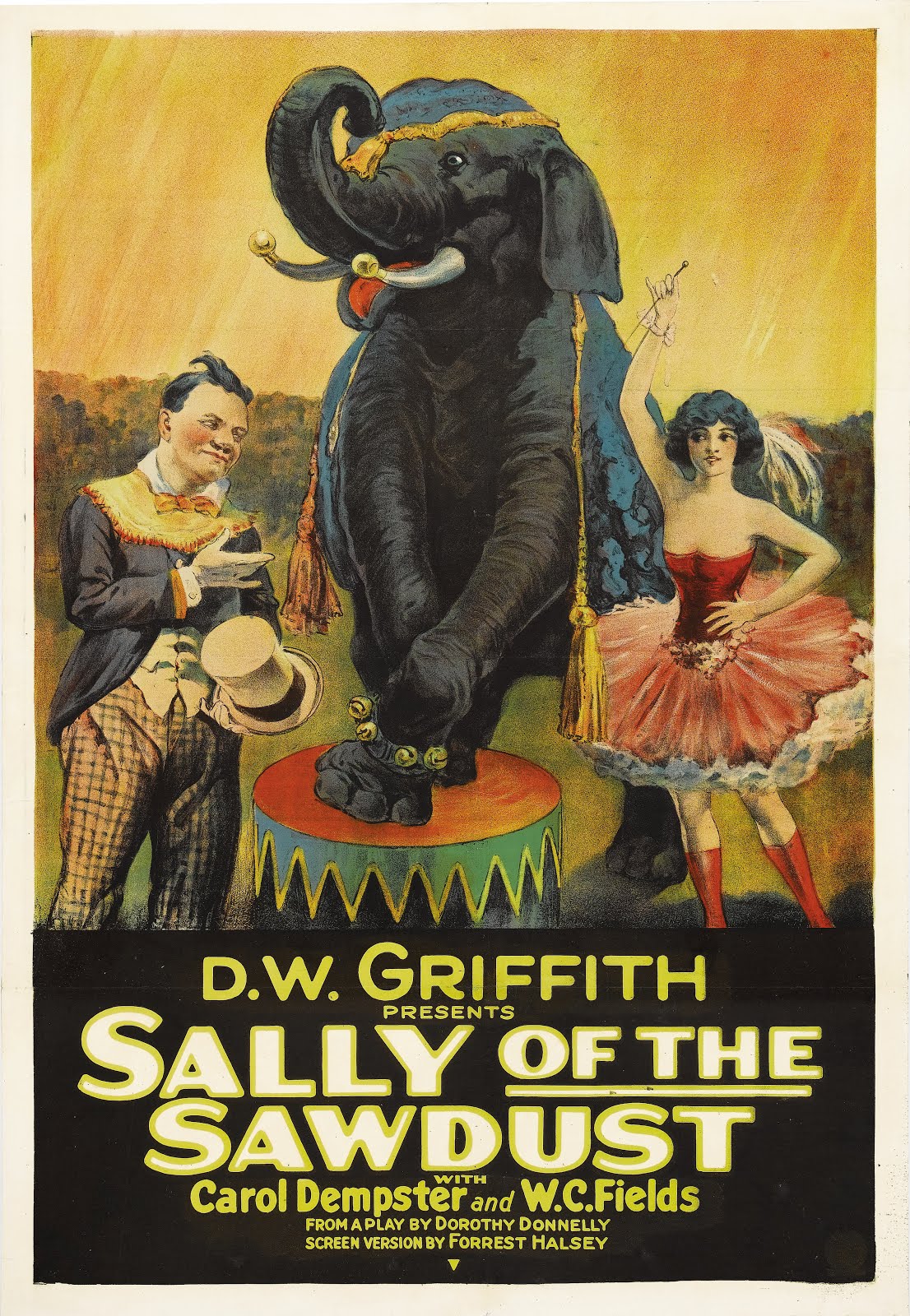
A mustachioed W.C. Fields cavorts with an elephant and starlet Carol Dempster in a poster that captures the atmosphere of 'Sally of the Sawdust' with all the subtlety of—well, the circus.

What happens when you put together a silent film director famous for historical epics with a comedian known primarily for his vocal inflections?

You get 'Sally of the Sawdust' (1925), a silent comedy/drama directed by none other than D.W. Griffith and starring none other than W.C. Fields.

This hybrid production is the next feature in our summer silent film series at the historic Leavitt Theatre in Ogunquit Maine. Showtime is Thursday, Aug. 15 at 8 p.m. By 'historic,' I mean the Leavitt has been showing movies since—well, since before 'Sally of the Sawdust' was released. (Since 1923, to be exact!)

And yes, it's thatW.C. Fields—he of the nasally twang and the racy byplay with Mae West.

Long before he was feuding with Charlie McCarthy on the radio, Fields was a very successful actor in silent films. It's surprising to most people, who would naturally think of W.C. Fields in the same category as, say, Groucho Marx. How could they do their stuff without words on a soundtrack?

But Fields had a long career as a vaudeville performer who specialized in comedy juggling and pantomime, so he had the chops needed to do the job in motion pictures before dialogue carried the day. Plus, he'd been a headliner all over the country for decades. So for most movie audiences, at least in the United States, he would not have been a complete stranger.

So it makes sense in that way, anyway. Besides, at the time, people didn't think of them as silent movies, but simply as the movies. No one would have expected to hear Fields' voice on the screen.

And D.W. Griffith directing a comedy? Well, why not? In some ways, comedy can be even more demanding that large-scale historical epics such as 'The Birth of a Nation' (1915) and 'Orphans of the Storm' (1922). So don't dismiss it as a day off.

But in this case, Griffith brought something to the table that not everyone had—a knack for telling a tale that sweeps the viewer along so you have to see how it ends. And that makes 'Sally of the Sawdust' more than just a typical 1920s comedy. Underneath it is a multi-generational dramatic story that makes the film a very satisfying experience, I think.

And turns out this is related to the stage as well. I read recently how Griffith's own failure as an upscale stage actor led indirectly to his later success in this kind of storytelling. Unable to make a living playing Hamlet, so to speak, Griffith was reduced to playing roles in lurid melodramas craved by small-town audiences.

No pretensions in this theater—if you didn't deliver, you'd be pelted with vegetables or run out of town on a rail. So anyone working in this environment honed an ability to know what satisfies an audience.

This experience gave Griffith an instinct that served him well when it came time for motion pictures to develop a mass audience. In his bones, Griffith knew what most people really expected from a night's entertainment. And he was able to transfer this knowledge to the motion picture screen at exactly the time (the 1910s) that the business was ready to flourish on a large scale.

Griffith's brand of moralistic storytelling went out of fashion as the 1920s progressed. But his melodramatic story-telling instincts never left him, and are on full display in 'Sally of the Sawdust,' carrying the tale along and leaving us helpless to resist.

And it says something about the universality of these skills, and about what audiences want, that a film such as 'Sally of the Sawdust' is constructed in such a way that we still respond to it as Griffith intended, even in this age of iPads and smart phones and hybrid cars.

See for yourself at our screening of 'Sally of the Sawdust' at the Leavitt Theatre on Thursday, Aug. 15 at 8 p.m. Tickets $10. Here's the text of the press release below...

* * *

W.C. Fields performs with Carol Dempster in 'Sally of the Sawdust.'

TUESDAY, JULY 30, 2013 / FOR IMMEDIATE RELEASE
Contact Jeff Rapsis • (603) 236-9237 • jeffrapsis@gmail.com

Leavitt Theatre to screen rare silent film
starring comic icon W.C. Fields


'Sally of the Sawdust' (1925), comedy/drama on tap for Thursday, Aug. 15, shows legendary comedian in earlier prime

OGUNQUIT, Maine—He was a performer who could be recognized just by the sound of his voice. But prior to reaching iconic fame in talking pictures, comedian W.C. Fields starred successfully in silent feature films for Paramount Pictures and other studios in the 1920s.

See the non-talking W.C. Fields for yourself in 'Sally of the Sawdust' (1925), one of Fields' most popular silent pictures, in a screening on Thursday, Aug. 15 at 8 p.m. at the historic Leavitt Theatre, 259 Main St., Route 1, Ogunquit, Maine.

Admission is $10 per person. Live music will be provided by accompanist Jeff Rapsis, a New Hampshire resident and one of the nation's leading silent film musicians.

W.C. Fields remains famous for his comic persona as a misanthropic curmudgeon with snarling contempt for dogs, children and women. Fields achieved lasting fame as a movie star in talking pictures of the 1930s, but his long career encompassed decades on the vaudeville stage as well as a series of silent film roles.

In 1925's 'Sally of the Sawdust,' Fields plays Professor Eustache McGargle, a good-natured circus juggler and con man who finds himself responsible for Sally (Carol Dempster), an orphaned girl whose mother has died. Raised by McGargle, Sally grows up to become a popular performer in the rough-and-tumble world of the circus. But when the show arrives in the town where her mother's relatives now live, Sally is forced to choose between the man who raised her and the wealthy family that wants to reclaim her as their own.

'Sally of the Sawdust,' based on the 1923 stage musical 'Poppy,' gives Fields ample opportunity to display his juggling talents, a staple of his vaudeville act. The film was directed by D.W. Griffith, a rare detour into comedy from a filmmaker known for pioneering epic dramas such as 'The Birth of a Nation' (1915) and 'Orphans of the Storm' (1921).

"People find it hard to think of W.C. Fields as a silent film performer, but he was quite successful," Rapsis said. "As a vaudeville performer and juggler, Fields specialized in visual comedy and pantomime that transferred well to the silent screen. Also, as a middle-aged man, he was able to play a family father figure—the kind of role that wasn't open to younger comic stars such as Charlie Chaplin or Buster Keaton.

In all, Fields starred in 10 silent features in the mid-1920s. Several of these films are lost; in those that survive, Fields sports a thick mustache, part of his vaudeville costume as a "vagabond juggler" which he dropped in later years.

The Leavitt, opened in 1923 as a summer-only seaside resort silent film house, now offers a wide variety of programming, including first-run films, live comedy, open mic nights, and more.

The Leavitt Theatre's silent film series aims to recreate the full silent film experience, with restored prints projected on the big screen, live music, and the presence of an audience. All these elements are essential to seeing silent films they way they were intended, Rapsis said.

"If you can put it all together again, these films still contain a tremendous amount of excitement," Rapsis said. "By staging these screenings of features from Hollywood's early days, you can see why people first fell in love with the movies."

Music is a key element of each silent film screening, Rapsis said. Silent movies were never shown in silence, but were accompanied by live music made right in each theater. Most films, including 'Sally of the Sawdust,' were not released with official scores, so it was up to local musicians to provide the soundtrack, which could vary greatly from theater to theater.

"Because there's no set soundtrack for most silent films, musicians are free to create new music as they see fit, even today," Rapsis said. "In bringing a film to life, I try to create original 'movie score' music that sounds like what you might expect in a theater today, which helps bridge the gap between today's audiences and silent films that are in some cases nearly 100 years old."

Other upcoming features in the Leavitt Theatre's 2013 silent film schedule include:

• Thursday, Aug. 29, 8 p.m.: 'Grandma's Boy' (1922), starring Harold Lloyd. Comedian Harold Lloyd's first starring feature finds him playing a mild-mannered young man forced to confront his chronic cowardice, with a little help from his beloved Grandma, who has a few family secrets up her sleeve. A delightful romp from one of the silent film era's most popular comics.

• Thursday, Sept. 19, 8 p.m.: 'Show People' (1928) starring Marion Davies, William Haines. A silent film about the silent film business! Young Peggy Pepper ventures to Hollywood to make her mark in drama, but finds an unexpected (and unwelcome) flair for slapstick comedy. King Vidor directed this entertaining valentine to a form that would soon be superceded by talking pictures.

• Saturday, Oct. 26, 8 p.m.: 'Nosferatu' (1922). Just in time for Halloween, see the original silent film adaptation of Bram Stoker's famous 'Dracula' story. Still spooky after all these years—in fact, some critics believe this version is not only the best ever done, but has actually become creepier with the passage of time. See for yourself, if you dare!

The next installment in the Leavitt Theatre's silent film series will be 'Sally of the Sawdust' (1925), to be screened with live music by Jeff Rapsis on Thursday, Aug. 15 at 8 p.m. at the Leavitt Theatre, 259 Main St., Route 1 in Ogunquit, Maine. Admission is $10 per person; for more info, call (207) 646-3123 or visit www.leavittheatre.com. For more information on the music, visit www.jeffrapsis.com.


Saturday, January 5, 2013

Coming up Thursday, Jan. 10 in Plymouth, N.H.:
W.C. Fields as you've never seen him

Fields as 'Eustache McGargle' with Carol Dempster in 'Sally of the Sawdust' (1925).

People are often surprised to hear that W.C. Fields was quite successful in silent films. How could his character's charm, so dependent on the distinctive nasal twang of his voice and the inimitable sting of his quips, work without sound?

Well, long before Fields was the lovable ne'er-do-well character we got to know later in his life, he was a vaudeville veteran and headliner specializing in juggling, pantomime, and other forms of visual comedy. He was an all-around actor and performer, and actually quite agile in his younger days.

For Fields, taking roles in silent films of the 1920s was entirely natural, especially if the role called for a middle-aged "frustrated father" figure type. Fields did fine work in several of these pictures.

To get a taste of the "no-talking" Fields, we're running 'Sally of the Sawdust' (1925), a comedy/melodrama in which he's paired with starlet Carol Dempster. The film was directed by D.W. Griffith, of all people. 'Sally of the Sawdust,' to be shown on Thursday, Jan, 10, 2013, will be our first feature of the New Year at The Flying Monkey Moviehouse and Performance Center, 39 South Main St., Plymouth, N.H.

Not sure how I'll score this, but we'll see. It'll be interesting to find a theme that works for Fields, a con man in a circus environment. I'm also curious to see if the Griffith touch, seen so strongly in pictures such as 'Way Down East' (1920) and 'Orphans of the Storm' (1921), remains in evidence.

The only way to know for sure is to screen the picture with an audience, which is what we intend to do. Hope you can join us!

Here's the press release with more info.

* * *


FRIDAY, DEC. 28, 2012 / FOR IMMEDIATE RELEASE
Contact Jeff Rapsis • (603) 236-9237 • jeffrapsis@gmail.com

Flying Monkey to screen rare silent film starring W.C. Fields


'Sally of the Sawdust' (1925), comedy/drama to be screened Thursday, Jan. 10, shows legendary comedian in his earlier prime

PLYMOUTH, N.H.—He was a performer who could be recognized just by the sound of his voice. But prior to reaching iconic fame in talking pictures, comedian W.C. Fields starred successfully in a popular series of silent feature films for Paramount Pictures and other studios in the 1920s.

See the non-talking W.C. Fields for yourself in 'Sally of the Sawdust' (1925), one of Fields' most highly regarded silent pictures, in a screening on Thursday, Jan. 10 at 6:30 p.m. at the Flying Monkey, 39 South Main St., Plymouth, N.H. General admission is $10 per person.

Live music will be provided by silent film accompanist Jeff Rapsis, a resident of Bedford, N.H. and one of the nation's leading silent film musicians.

W.C. Fields remains famous for his comic persona as a misanthropic and hard-drinking egotist who remained a sympathetic character despite his snarling contempt for dogs, children and women. Although Fields achieved lasting fame as a movie star in talking pictures of the 1930s, his long career encompassed decades on the vaudeville stage as well as a series of silent film roles.

"People find it hard to think of W.C. Fields in silent films, but he was actually quite successful in them," Rapsis said. "As a vaudeville performer and juggler, Fields cultivated a form of visual comedy and pantomime that transferred well to the silent screen. Also, as a middle-aged man, he was able to play a family father figure—the kind of role that wasn't open to younger comic stars such as Charlie Chaplin or Buster Keaton.

In all, Fields starred in 10 silent features in the mid-1920s. Several of these films are lost; in those that survive, Fields sports a thick mustache, part of his vaudeville costume as a "vagabond juggler" which he dropped in later years.

In 'Sally of the Sawdust,' Fields plays Professor Eustache McGargle, a good-natured circus juggler and con man who finds himself responsible for Sally (Carol Dempster), an orphaned girl whose mother is dead. Raised by McGargle, Sally grows up to become a popular performer in the rough-and-tumble world of the circus. But when the shows arrives in the town where her mother's family now lives, Sally is forced to choose between the man who raised her and the wealthy family that wants to reclaim her as their own.


'Sally of the Sawdust,' based on the 1923 stage musical 'Poppy,' gives Fields ample opportunity to display his juggling talents, a staple of his vaudeville act. The film was directed by D.W. Griffith, a rare detour into light comedy from a filmmaker known for pioneering epic dramas such as 'The Birth of a Nation' (1915) and 'Orphans of the Storm' (1921).

The Flying Monkey's silent film series aims to recreate the full silent film experience, with restored prints projected on the big screen, live music, and the presence of an audience. All these elements are essential to seeing silent films they way they were intended, Rapsis said.

"If you can put it all together again, these films still contain a tremendous amount of excitement," Rapsis said. "By staging these screenings of features from Hollywood's early days, you can see why people first fell in love with the movies."

Upcoming movies include a love story starring silent screen romantic idol Rudolph Valentino, Cecil B. DeMille's massive original 1923 version of 'The Ten Commandments,' and a spy thriller that was a forunner of all espionage movies to come.

The Flying Monkey originally opened a silent film moviehouse in the 1920s, and showed first-run Hollywood films to generations of area residents until closing several years ago. The theater has since been renovated by Alex Ray, owner of the Common Man restaurants, who created a performance space that hosts a wide variety of music acts.

Movies of all types, however, are still a big part of the Flying Monkey's offerings, and the silent film series is a way for the theater to remain connected to its roots.

Live music is a key element of each silent film screening, Rapsis said. Silent movies were never shown in silence, but were accompanied by live music made right in each theater. Most films were not released with official scores, so it was up to local musicians to provide the soundtrack, which could vary greatly from theater to theater.

"Because there's no set soundtrack for most silent films, musicians are free to create new music as they see fit, even today," Rapsis said. "In bringing a film to life, I try to create original 'movie score' music that sounds like what you might expect in a theater today, which helps bridge the gap between today's audiences and silent films that are in some cases nearly 100 years old."

Other upcoming features in the Flying Monkey's silent film series include:

• Thursday, Feb. 7, 2013, 6:30 p.m.: 'The Eagle' (1925). Just in time for Valentine' Day, see silent screen romantic idol Rudolph Valentino put the moves on Vilma Banky in this racy costume drama set in Imperial Russia. An intense romantic drama that heralded Valentino's comeback one year before his untimely death.

• Thursday, March 28, 2013, 6:30 p.m.: 'The Ten Commandments' (1923). Long before he directed Charlton Heston as Moses, filmmaker Cecil B. DeMille's original silent version wowed audiences the world over. The film that showed Hollywood how to tell stories from scripture on a grand scale, and a great way to celebrate Easter!

• Thursday, April 11, 2013, 6:30 p.m.: 'Dr. Jack' (1922), starring Harold Lloyd. A sparkling comedy starring Harold Lloyd as a country doctor with unorthodox methods that get results! But now comes his toughest case yet: a poor little rich girl (Mildred Davis), bed-ridden with a mysterious condition. Harold's cure is sure to make you smile!

• Thursday, May 9, 2013, 6:30 p.m.: 'Spies' (1928). Director Fritz Lang's tale of espionage was the forerunner of all movie spy sagas, packed with double agents, hi-tech gadgets, beautiful (and dangerous) women, and an evil genius with a plan to take over the world, mwah-ha-ha-ha! A terrificly paced film that set the stage for James Bond and beyond.

• Thursday, June 13, 2013, 6:30 p.m.: 'The Gaucho' (1927) starring Douglas Fairbanks Sr. The leader of a band of outlaws in Argentina must help save a religious shrine from being taken over and closed by a corrupt general. Entertaining action-adventure film widely regarded as Fairbanks' darkest role; made at the height of his 1920s stardom.

The next installment in the Flying Monkey's silent film series will be 'Sally of the Sawdust' (1925), to be screened with live music by Jeff Rapsis on Thursday, Jan. 10 at 6:30 p.m. at the Flying Monkey Moviehouse and Performance Center, 39 South Main St., Plymouth, N.H. Tickets are $10 per person. For more information, call (603) 536-2551 or visit www.flyingmonkeynh.com. For more information about the music, visit www.jeffrapsis.com.