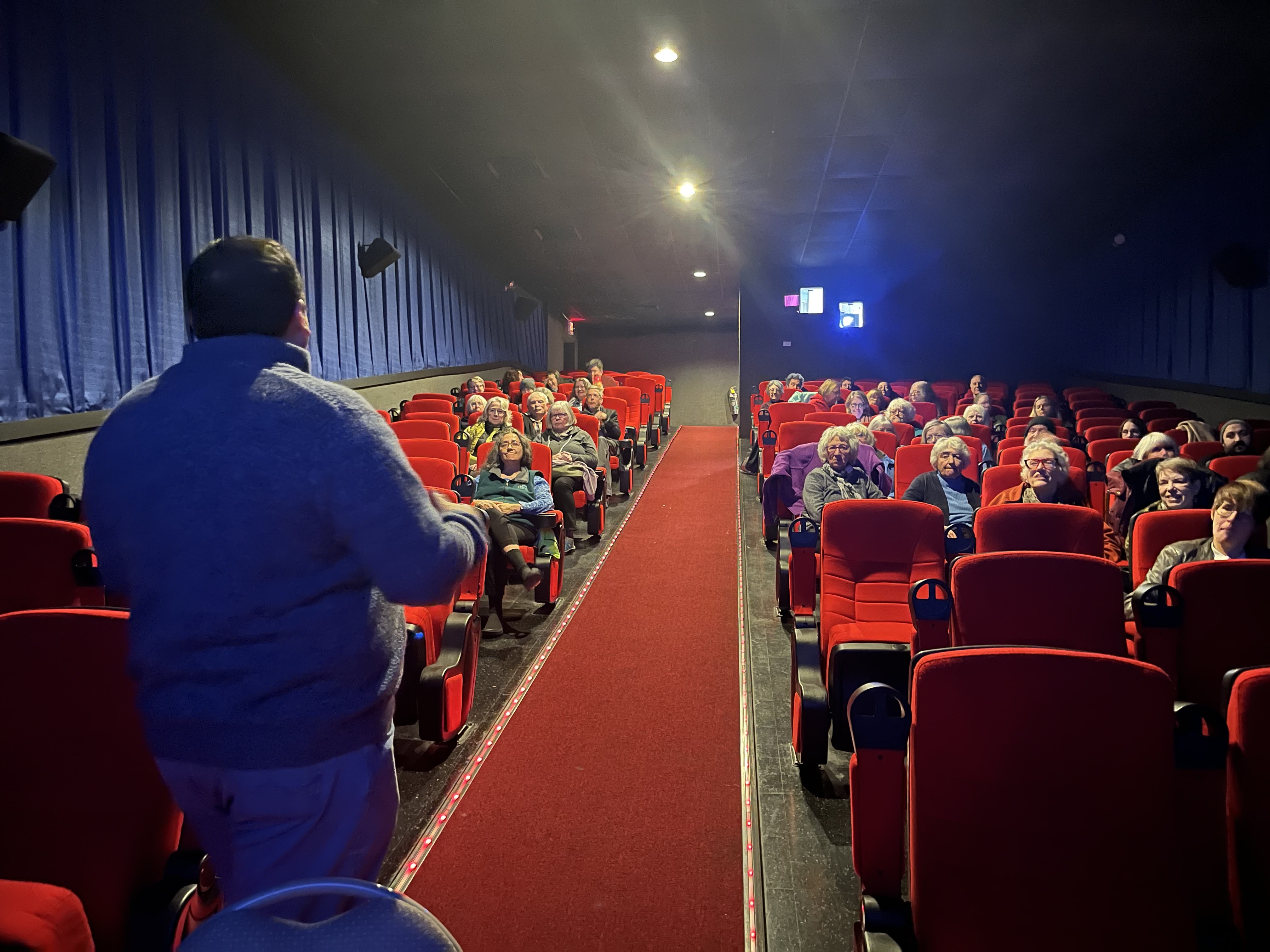
Showing posts with label Flying Monkey. Show all posts

Tuesday, August 11, 2026

Marking the 100th anniversary of Valentino's untimely death—but first, Buster Keaton's 'Steamboat Bill Jr.' at Flying Monkey in Plymouth, N.H. on Thursday, 8/13

Vilma Banky and Rudolph Valentino in 'The Son of the Sheik' (1926).

This month marks the 100th anniversary of the untimely death of silent screen icon Rudolph Valentino, who passed away on Aug. 23, 1926 at age 31.

This past Sunday, I accompanied the first of several screenings this month of 'The Son of the Sheik' (1926), Valentino's last film. I'm actually be doing it twice this weekend: on Saturday night in Brandon, Vt., and then on Sunday afternoon in Somerville, Mass.

(See the "Upcoming Silent Film Screenings" page for more details.) 

But before that, it's up to Plymouth, N.H. to accompany Buster Keaton's great comedy 'Steamboat Bill, Jr.' (1928), which is being screened on Thursday, Aug. 13 at 7 p.m. at the Flying Monkey Moviehouse and Performance Center.

Yes, this is the one where the side of a two-story house falls onto Buster, but he survive unhurt thanks to a strategically placed upper window.

More details about the screening and the film are in a press release below. See you at the movies!

*     *     *

Original promotional art for Buster Keaton's 'Steamboat Bill Jr.'

WEDNESDAY, JULY 15, 2026 / FOR IMMEDIATE RELEASE
Contact: Jeff Rapsis • (603) 236-9237 • jeffrapsis@gmail.com

Buster Keaton's 'Steamboat Bill Jr.' to screen on Thursday, Aug. 13 at Flying Monkey

Public welcome! Family-friendly classic silent film comedy to be shown with live music at historic venue in downtown Plymouth, N.H.

PLYMOUTH, N.H.— He never smiled on camera, earning him the nickname of "the Great Stone Face." But Buster Keaton's comedies rocked Hollywood's silent era with laughter throughout the 1920s.

See for yourself with a screening of 'Steamboat Bill Jr.' (1928), one of Keaton's landmark movies, on Thursday, Aug. 13 at 7 p.m. at the Flying Monkey Moviehouse and Performance Center, 39 S. Main St., Plymouth, N.H.

The screening, the latest in the Flying Monkey's silent film series, will feature live accompaniment by Jeff Rapsis, a New Hampshire-based composer who specializes in creating music for silent films.

General admission is $15 per person. Tickets may be purchased online at www.flyingmonkeynh.com or at the door.

The show is intended to give area movie-goers the opportunity to experience early cinema as it was intended: on the big screen, with live music, and with an audience.

Buster Keaton and Ernest Torrence as son and father in 'Steamboat Bill, Jr.'

In 'Steamboat Bill Jr.,' Buster plays the bumbling son of a gruff riverboat captain. When a rival brings a newer boat to the river, the family is forced to face competition, just as Buster is forced to ride out a cyclone threatening to destroy the community.

Can Buster save the day and win the hand of his girlfriend, who happens to be the daughter of his father's business rival?

The film includes the famous shot of an entire building front collapsing on Keaton, who is miraculously spared by a conveniently placed second-story window.

Keaton, who grew up performing with the family vaudeville act, was known for never smiling on camera, an important element of his comic identity. A trained acrobat who learned at an early age how to take falls, Keaton did all his own stunts on camera in the era before post-production special effects.

Buster braves the coming storm in 'Steamboat Bill, Jr.' 

Critics continue to hail Keaton’s timeless comedy as well as his intuitive filmmaking genius. In 2002, Roger Ebert wrote of Keaton that “in an extraordinary period from 1920 to 1929, he worked without interruption on a series of films that make him, arguably, the greatest actor-director in the history of the movies.”

Keaton, who never attended school, did not think of himself as an artist but as an entertainer using the new medium of motion pictures to tell stories and create laughter.

The screening of 'Steamboat Bill Jr.' will feature live accompaniment by Jeff Rapsis, a New Hampshire-based composer who specializes in creating music for silent film presentations.

Rapsis will create the accompaniment on the spot, improvising music as the movie unfolds to enhance the action on the screen as well respond to audience reactions. He will perform the music on a digital synthesizer capable of producing a wide range of theatre organ and orchestral textures.

"Live music was an integral part of the silent film experience," Rapsis said. "Because most films at the time weren't released with sheet music or scores, studios depended on local musicians to come up with an effective score that was different in every theater. At its best, this approach created an energy and a connection that added a great deal to a film's impact. That's what I try to recreate," Rapsis said.

Buster Keaton's classic comedy 'Steamboat Bill Jr.' (1928) will be screened with live music on Thursday, Aug. 13 at 7 p.m. at the Flying Monkey Moviehouse and Performance Center, 39 S. Main St., Plymouth, N.H.

General admission is $15 per person. Tickets may be purchased online at www.flyingmonkeynh.com or at the door. For more info, contact the Flying Monkey box office at (603) 536-2551.

Ernest Torrence and Buster Keaton in 'Steamboat Bill, Jr.' (1928) 

Monday, May 19, 2025

Up next: Harold Lloyd heads east in 'Speedy,' then reversing direction with Keaton's 'Go West'

An original poster promoting Harold Lloyd's 'Speedy' (1928).

Memorial Day weekend may be upon us, but there's no holiday in the silent film schedule.

Coming up, I'm doing music for three screenings in three different states, all of them comedies. (The films, not the states.)

On Thursday, May 22, it's Harold Lloyd's 'Speedy' (1928), which I'll accompany at the Flying Monkey Moviehouse and Performance Center in Plymouth, N.H.

More details about the film and the screening are in a press release pasted in below.

Then it's two screenings of Buster Keaton's comedy 'Go West' (1925).

The first is on Sunday, May 25, when I'll accompany it at the Center for the Arts in Natick, Mass.

Then, on Wednesday, May 28, the same film will serve as the opening night attraction of this year's silent film series at the Leavitt Theatre in Ogunquit, Maine.

The Leavitt is celebrating its 100th anniversary this season, so the silent film series will feature all films from 1925, the year it opened.

Lots more about that, and my theory on how 'Go West' is a parody of Chaplin's epic comedy 'The Gold Rush' (also from 1925), in a future post.

For now, I invite you to attend our screening of 'Speedy' (1928) at the Flying Monkey. Check out the press release below, and see you at the theater!

*     *     *

Harold Lloyd takes the subway to Coney Island in 'Speedy' (1928).

TUESDAY, APRIL 29, 2025 / FOR IMMEDIATE RELEASE
Contact Jeff Rapsis • (603) 236-9237 • jeffrapsis@gmail.com

Classic Harold Lloyd comedy 'Speedy' on Thursday, May 22 in Plymouth, N.H.

Screening features live music; 1920s rom-com filmed on location in NYC with cameo featuring Babe Ruth

PLYMOUTH, N.H.—He was the bespectacled boy next door whose road to success was often paved with perilous detours.

He was Harold Lloyd, whose fast-paced comedies made him the most popular movie star of Hollywood's silent film era.

See for yourself why Lloyd was the top box office attraction of the 1920s in a revival of 'Speedy' (1928), one of his most popular comedies.

The film, shot on location in New York City, will be screened on Thursday, May 22 at 7 p.m. at the Flying Monkey Moviehouse and Performance Center, 39 Main St., Plymouth, N.H.

General admission is $15 per person.

The screening will feature live accompaniment by Jeff Rapsis, a New Hampshire-based composer who specializes in creating music for silent films.

'Speedy,' Lloyd's final silent feature before the transition to talkies, finds Harold as a baseball-crazed youth who must rescue the city's last horse-drawn streetcar from gangsters bent on running it out of business.

Filmed almost entirely on location in New York, 'Speedy' features remarkable glimpses of the city at the end of the 1920s, including footage of Coney Island and the original Yankee Stadium in the Bronx.

The latter scenes include an extended appearance by Babe Ruth, then at the height of his career during the team's storied 1927 season.

"In 'Speedy,' New York City is practically a part of the cast," Rapsis said. "In filming it on location, Lloyd knew scenes of New York would give the picture added interest to audiences across the nation and around the world.

"But what he didn't anticipate was that today, the location shots now provide a fascinating record of how life was lived in the Big Apple in the 1920s," Rapsis said.
 
Harold Lloyd on location in Coney Island in 'Speedy' (1928).

Rapsis will improvise a musical score for 'Speedy' as the film is screened. In creating accompaniment for vintage classics, Rapsis tries to bridge the gap between silent film and modern audiences.

"Creating the music on the spot is a bit of a high-wire act, but it contributes a level of energy that's really crucial to the silent film experience," Rapsis said.
 
'Speedy' (1928) will be screened with live music on Thursday, May 22 at 7 p.m. at the Flying Monkey Moviehouse and Performance Center, 39 Main St., Plymouth, N.H. 

General admission is $15 per person. For more info, visit www.flyingmonkeynh.com or call (603) 536-2551. 


Monday, October 21, 2024

'Lost World' screening at Flying Monkey in Plymouth, N.H moved to Wednesday, Nov. 6

A scene from 'The Lost World' (1925).

This week's upcoming screening of 'The Lost World' (1925) at the Flying Monkey Moviehouse in Plymouth, N.H. has been moved to Wednesday, Nov. 6 due to UCITA.

That's the acronym for "Unforeseen Circumstances Involving The Accompanist."

Apologies to all who planned on attending this week's screening. I've been unexpectedly called out of town, which is what prompted the last-minute date change.

Many thanks to the folks at the Flying Monkey for their ability to quickly change course and arrange for an alternate date that's just two weeks later.

Everything else will be the same, as you'll see in the revised press release below. 

Again, sorry for the short-notice switcheroo, and I hope everyone who was planning to see 'The Lost World' will be able to make it on Wednesday, Nov. 6.

*    *    *

A trade publication ad promoting 'The Lost World' (1925).
 
MONDAY, OCT. 21, 2024 / FOR IMMEDIATE RELEASE
Contact Jeff Rapsis • (603) 236-9237 • jeffrapsis@gmail.com

Silent film classic 'The Lost World' at Flying Monkey on Wednesday, Nov. 6

Ground-breaking first-ever dinosaur thriller to be shown with live music; rescheduled from original October screening date

PLYMOUTH, N.H.—Before there was 'Jurassic Park' or 'Godzilla' or even 'King Kong,' there was 'The Lost World.'

The movie, a blockbuster hit when released in 1925, paved the way for Hollywood's enduring fascination with stories pitting mankind against larger-than-life creatures.

See for yourself when a restored version of 'The Lost World' is screened on Wednesday, Nov. 6 at 6:30 p.m. at the Flying Monkey Moviehouse and Performance Center, 39 Main St., Plymouth, N.H.

General admission is $10 per person.

The screening will feature live accompaniment by Jeff Rapsis, a New Hampshire-based composer who specializes in creating music for silent films.

The screening was originally scheduled for Wednesday, Oct. 23, but was moved to the new date of Wednesday, Nov. 6

'The Lost World' is a silent fantasy adventure film based on Arthur Conan Doyle's 1912 novel of the same name. The movie was produced by First National Pictures, a precursor to Warner Brothers, and stars Wallace Beery in the lead role as Professor Challenger.

An original release poster for 'The Lost World' (1925).

'The Lost World' tells the tale of a British exploration team that journeys to South America to confirm reports of long-extinct creatures still roaming a remote high plateau deep in the jungle.

The landscape they discover, filled with a wide range of dinosaurs and other fantastic creatures, was enough to astonish movie-goers when 'The Lost World' first hit movie screens in February 1925. Scenes of a brontosaurus on the loose in central London broke new ground in terms of cinema's visual story-telling possibilities.

Early viewers of the film were especially impressed by special effects breakthroughs that allowed live actors to appear simultaneously on-screen with stop motion models of prehistoric creatures. This led to rumors that the filmmakers had actually discovered living prehistoric creatures.

The film featured pioneering stop motion special effects by Willis O'Brien, who would go on to create the effects used to bring 'King Kong' to the screen in 1933.

Arthur Conan Doyle's novel and the movie version of 'The Lost World' proved so influential in the dinosaur genre that the title was borrowed by author Michael Crichton for his 1995 novel, and then used by director Steven Spielberg for 'The Lost World: Jurassic Park' (1997), the sequel to the original 'Jurassic Park' movie of 1993.

In 1998, the original 'The Lost World' (1925) was deemed "culturally, historically or aesthetically significant" by the Library of Congress and selected for preservation in the United States National Film Registry.

Touring London: a scene from 'The Lost World' (1925).

Despite the film's popularity, only incomplete copies of 'The Lost World' survived from its initial run in the silent era. In recent years, historians have been piecing together 'The Lost World' from fragments found scattered among the world's film archives.

The version to be shown at the Flying Monkey includes footage from eight different prints. At 93 minutes in length, it's the most complete version of 'The Lost World' available. The edition includes rare footage of Arthur Conan Doyle that has been missing from most prints since the film's original release.

To accompany the film, Rapsis will use a digital synthesizer to recreate the texture of a full orchestra. For each film, the score is created live in real time as the movie is screened.

Rather than focus on authentic music of the period, Rapsis creates new music for silent films that draws from movie scoring techniques that today's audiences expect from the cinema.

The restored 'The Lost World' will be shown on Wednesday, Nov. 6 at 6:30 p.m. at the Flying Monkey Moviehouse and Performance Center, 39 Main St., Plymouth, N.H.

General admission is $10 per person. For more info, visit www.flyingmonkeynh.com or call (603) 536-2551.

Monday, August 19, 2024

This week: music for MGM late silent 'The Pagan' (1929), then Murnau's 'The Last Laugh' (1924)

An original lobby card promoting MGM's 'The Pagan' (1929).

This week finds me creating music for a silent film I've never before accompanied, then two well-known favorites: one a drama, the other a comedy.

First up is 'The Pagan' (1929) a late MGM silent starring Ramon Novarro and Renée Adorée, which I'm accompanying on Wednesday, Aug. 21 at 6:30 p.m. at the Flying Monkey Moviehouse and Performance Center, 39 South Main St., Plymouth, N.H.

This is the one I've never done before. (By my count, it'll be #396 on my list of film titles I've accompanied in theatrical screenings.) It's an exotic tale of romance and adventure set in the South Pacific, which means plenty of opportunities for Novarro to go shirtless.

Like many late silents, 'The Pagan' was released with a recorded musical soundtrack (but without dialogue) that could be used by theater that had the ability to handle synchronized sound. 

Interestingly, the recorded soundtrack featured a tune called “Pagan Love Song” composed by Arthur Freed and Nacio Herb Brown, the same team responsible for “Singing in the Rain” and so many other popular songs of the era.

However, for the many theaters not yet "wired for sound," music was provided the same way it had been throughout the silent era: by live musicians playing whatever music they felt would help support what was on the screen.

That's what I'll be doing on Wednesday night for 'The Pagan,' a film I've never seen before. Despite the title, pray it goes well. 

Then, on Saturday, Aug. 24, it's up to Ludlow, Vt. for my annual appearance at 'Silent Film Night' at Ludlow Town Hall. This year's films is F.W. Murnau's 'The Last Laugh' (1924) starring Emil Jannings in a towering performance as a doorman who loses his job at a fancy downtown hotel.

Showtime for 'The Last Laugh' is 7 p.m.; more info in the press release below.

And on Sunday, Aug. 25, we turn to comedy with Buster Keaton's 'Spite Marriage' (1929), which I'm accompanying at the Town Hall Theatre in Wilton, N.H. Showtime there is 2 p.m. Admission is free, with donations welcome to support this independent theater.

All the best and enjoy this last stretch of summer before Labor Day weekend arrives!

*    *    *

Promotional poster for 'The Last Laugh' (1924) starring Emil Jannings.

WEDNESDAY, JULY 31, 2024 / FOR IMMEDIATE RELEASE
Contact Jeff Rapsis • (603) 236-9237 • jeffrapsis@gmail.com

'The Last Laugh' to screen with live music at Ludlow Town Hall on Saturday, Aug. 24

Oscar-winning actor Emil Jannings stars in ground-breaking 1924 silent drama from German director F.W. Murnau

LUDLOW, Vt.—'The Last Laugh' (1924), a German silent film drama about a hotel doorman demoted to washroom attendant, will be screened with live music on Saturday, Aug. 24 at 7 p.m. in Heald Auditorium in Ludlow Town Hall, 37 Depot St., Ludlow.

Presented by the Friends of Ludlow Auditorium, the screening will feature accompaniment by Jeff Rapsis, a New Hampshire-based composer who specializes in creating live music for silent film presentations.

Admission is free and all are welcome to this family-friendly event. Donations are accepted at the door to support the Friends of Ludlow Auditorium.

In 'The Last Laugh,' regarded as one of German director F.W. Murnau's best pictures, the story is told entirely in visual terms, without the use of title cards.

The film, a character study that chronicles the mental breakdown of an aging man who loses his position of authority, is also noted for its revolutionary use of camera movement.

Playing the lead role is Swiss/German actor Emil Jannings, widely recognized as one of the most versatile actors of early cinema.

Jannings would later move to Hollywood, where he earned the first-ever Best Actor Oscar at the inaugural Academy Awards for his towering performances in 'The Last Command' (1928) and 'The Patriot' (1928).

Critics and film writers regard 'The Last Laugh' as a landmark of early cinema.

" 'The Last Laugh' is a masterpiece of psychological study, perhaps the best ever portrayal of what goes through one man's mind under varying situations ... It is absolutely mind-boggling to see Emil Jannings age at least 10 or 15 years right in front of our eyes in the course of a couple of minutes," wrote author Robert K. Klepner in 'Silent Films' (2005).

Critic David Kehr of the Chicago Reader described 'The Last Laugh' as "the 1924 film in which F.W. Murnau freed his camera from its stationary tripod and took it on a flight of imagination and expression that changed the way movies were made."

The film's director of photography, Karl Freund, set new standards of cinematography in 'The Last Laugh,' setting up the camera to move through corridors and "see" action through a character's eye-view.

Freund's long career later included work in television in the 1950s in Hollywood, when he developed the "three camera" system for the "I Love Lucy" show, which became the standard format for shooting situation comedies.

'The Last Laugh' will be accompanied by live music by Jeff Rapsis, a New Hampshire-based silent film accompanist who performs at venues across the region and beyond.

"Films such as 'The Last Laugh' were created to be shown on the big screen and in a theater as a communal experience," Rapsis said. "With an audience and live music, they still come to life in the way their makers intended them to.

'The Last Laugh' (1924) will be screened with live music on Saturday, Aug. 24 at 7 p.m. in Heald Auditorium in Ludlow Town Hall, 37 Depot St., Ludlow.

Admission is free and all are welcome to this family-friendly event. Donations are accepted at the door to support the Friends of Ludlow Auditorium.
 
A scene from F.W. Murnau's 'The Last Laugh' (1924) starring Emil Jannings.

Sunday, June 9, 2024

Up next: 'Our Hospitality' (1923) on Wednesday, June 12 at Flying Monkey, Plymouth, N.H.

A lobby card for Buster Keaton's 'Our Hospitality' (1923).

Just back from a visit to Brandon, Vt. to accompany 'The Thief of Bagdad' (1924), and boy are my arms tired.

I know that sounds like a joke, but it isn't. I'm suffering from a pinched nerve, I think, which is causing issues with my right arm—specifically, the tendons in my right forearm and around the elbow .

It actually hurts to type this, and it hurt to accompany 'Thief,' which is 2½ hours long. I can try to take Advil to manage the pain, but let's just say I drove home with one hand last night.

The good news is that to address this, I need to visit my favorite healthcare professional: Dr. Bard, a chiropractor in Peterborough, N.H.

For personal health issues, I know it's up to me to take care of myself. When I have problems, I don't expect miracles. But that's what Dr. Bard delivers. 

He'll have me lay face down on his special adjustable chiropractic table, manipulate a few vertebrae, and then POW! 

Well, before that happens, I'll be accompanying another film: Buster Keaton's 'Our Hospitality' (1923), which is playing on Wednesday, June 12 at 6:30 p.m. at the Flying Monkey Moviehouse and Performance Center in Plymouth, N.H.

If you're in the area, come see it. And bring some Advil in case I run short.

*   *   *

Buster Keaton and friend in 'Our Hospitality' (1923).

MONDAY, JUNE 3, 2024 / FOR IMMEDIATE RELEASE
Contact Jeff Rapsis • (603) 236-9237 • jeffrapsis@gmail.com

Buster Keaton stars in 'Our Hospitality' on Wednesday, June 12 at Flying Monkey

Classic feature-length silent comedy to be screened on the big screen with live music

PLYMOUTH, N.H.—He never smiled on camera, earning him the nickname of "the Great Stone Face."

But Buster Keaton's comedies rocked Hollywood's silent era with laughter throughout the 1920s, and remain popular crowd-pleasers today.

See for yourself with a screening of 'Our Hospitality' (1923), one of Keaton's landmark features, on Wednesday, JUne 12 at 6:30 p.m. at the Flying Monkey Moviehouse and Performance Center, 39 Main St., Plymouth, N.H.

General admission is $10 per person.

The screening will feature live accompaniment by Jeff Rapsis, a New Hampshire-based composer who specializes in creating music for silent films.

Original promotional ad for 'Our Hospitality' (1923).

Set in the 1830s, 'Our Hospitality,' tells the tale of a young man (Keaton) raised in New York City but unknowingly at the center of a long-running backwoods family feud.

Resolving to return and claim his family homestead, he sets in motion a perilous cat-and-mouse game in which every move could be his last.

Highlights of the picture include Keaton's extended journey on a vintage train of the era, as well as a climatic river rescue scene.

The film stars Keaton's then-wife, Natalie Talmadge, as his on-screen love interest; their first child, newborn James Talmadge Keaton, makes a cameo appearance, playing Buster as an infant. Keaton's father also plays a role in the film.

'Our Hospitality' is part of the Flying Monkey's silent film series, which aims to show early movies as they were meant to be seen—in restored prints, on a large screen, with live music, and with an audience.

"All those elements are important parts of the silent film experience," said Rapsis, who will improvise a musical score for 'Our Hospitality.'

"Recreate those conditions, and the classics of early Hollywood leap back to life," he said.

Buster Keaton and wife Natalie Talmadge in 'Our Hospitality' (1923).

Keaton entered films in 1917 and was quickly fascinated with the then-new medium. After apprenticing with popular comedian Roscoe "Fatty" Arbuckle, Keaton set up his own studio in 1920, making short comedies that established him as one of the era's leading talents.

A remarkable pantomime artist, Keaton naturally used his entire body to communicate emotions from sadness to surprise. And in an era without special effects, Keaton's acrobatic talents enabled him to perform all his own stunts.

In 1923, Keaton made the leap into full-length films with 'Our Hospitality,' which proved popular enough for him to continue making features for the rest of the silent era.

Although not all of Keaton's films were box office successes, critics later expressed astonishment at the sudden leap Keaton made from short comedies to the complex story and technical demands required for full-length features.

Accompanist Jeff Rapsis will create a musical score for the film live during its screening, in the manner of theater organists during silent cinema's peak years in the 1920s.

"For most silent films, there was never any sheet music and no official score," Rapsis said. "So creating original music on the spot to help the film's impact is all part of the experience."

"That's one of the special qualities of silent cinema," Rapsis said. "Although the films themselves are often over a century old, each screening is a unique experience—a combination of the movie, the music, and the audience reaction."

‘Our Hospitality’ will be shown with live music on Wednesday, June 12 at 6:30 p.m. at the Flying Monkey Moviehouse and Performance Center, 39 Main St., Plymouth, N.H. General admission is $10 per person. For more info, visit www.flyingmonkeynh.com or call (603) 536-2551. 

Wednesday, November 8, 2023

Tonight in Plymouth, N.H.! All for one, one for all in 'The Three Musketeers' (1921) with live music

The original 'Three Musketeers' candy bar, introduced in 1932, contained three sections of flavoured nougat: one vanilla, one chocolate, and one strawberry, hence the name. The bar went all chocolate in 1945, but the name stayed the same.

I dare say it's one of the best opening sentences of any press release I've issued:

PLYMOUTH, N.H.—Long before it became a candy bar in the concession stand, 'The Three Musketeers' was on the big screen as a swashbuckling silent film, a major hit of 1921.

You won't get that in a press release from an AI chatbot no matter how generative its intelligence. 

Yes, tonight (Wednesday, Nov. 7) brings a screening of the early Douglas Fairbanks swashbuckler, with live music by me. Showtime is at 6:30 p.m.; lots more info about the film is in the press release pasted in below. 

First, a quick round-up of recent gigs.

Saturday, Nov. 4 saw my first post-pandemic appearance at the Niles Essanay Silent Film Museum, where they run silent film programs with live music every weekend all year round.

I've enjoyed helping out when I'm out there, and it was great to return and reconnect with everyone.

The evening's feature was the 1925 version of 'Raffles the Amateur Cracksman,' with actor House Peters in the title role. Yes, it's about crime, but the trick with a film like this, which at its heart is light-hearted, is to treat it very lightly.

That's what I did: mostly light cocktail/dance music, but always to underscore the action, highlight any emotional subtext (of which there was little), and keep things skipping along.

'Raffles' was preceded by two shorts: the 1912 Griffith classic 'The Musketeers of Pig Alley' (hey, there's that Musketeers theme again!) plus a Stan Laurel solo comedy. 

We were fortunate in that one person in the audience was a big and easy laugher. All it takes in one of these to help loosen up an audience, and that's what happened Saturday night in Niles. With one fearless soul leading the way, everyone else had permission to laugh.

At the Garden: owner/operator Isaac Mass unveils the venue's 2024 schedule of silent films.

Monday, Nov. 6 found me at the Garden Cinema in Greenfield, Mass. to accompany a screening of 'The Scarlet Letter' (1926), starring Lillian Gish, who also starred in the Griffith film shown at Niles.

To my surprise, 'The Scarlett Letter' drew 59 people on a Monday night. Wow! We've been doing silents in Greenfield on and off for a couple of years now, and an audience seems to be developing.

Yesterday afternoon I hauled myself down to Newport, R.I. to accompany a screening of Chaplin's 'The Gold Rush' (1925) at the Jane Pickens Theater.

The film was programmed as part of the town's 'Restaurant/Foodie Week' due primarily to its famous Thanksgiving scene in which Chaplin and co-star Mack Swain consume a shoe.

In introducing the film, I got a big laugh by saying: "The film is a surprising choice for restaurant week because it was inspired in part by cannabilism."

Then, looking at two little girls sitting close by with their parents, I couldn't resist saying into the microphone: "For you young folks, that's people eating other people."

And then I recounted the story of how Chaplin was looking at images of the ill-fated Donner party, etc. 

A bonus at last night's screening was the presence of a photographer on assignment from WBUR-FM, the Boston NPR station. They're doing a piece on me that I believe will air any day now. Stay tuned!

And that brings us to tonight; 'The Three Musketeers' (1921) at 6:30 p.m. at the Flying Monkey Moviehouse and Performance Center (like the candy bar, quite a mouthful). 

Press release is below. See you at the movies. 

*    *    *

All for one and one for all: a scene from 'The Three Musketeers' (1921).

WEDNESDAY, NOV. 1, 2023 / FOR IMMEDIATE RELEASE
Contact Jeff Rapsis • (603) 236-9237 • jeffrapsis@gmail.com

'Three Musketeers' with live music at Flying Monkey on Wednesday, Nov. 8

It's 'all for one and one for all' in classic silent film swashbuckler starring Douglas Fairbanks

PLYMOUTH, N.H.—Long before it became a candy bar in the concession stand, 'The Three Musketeers' was on the big screen as a swashbuckling silent film, a major hit of 1921.

And now, more than a century later, it returns: 'The Three Musketeers' (1921), starring Douglas Fairbanks Sr., will be shown with live music on Wednesday, Nov. 8 at 6:30 p.m. at the Flying Monkey Moviehouse and Performance Center, 39 Main St., Plymouth, N.H.

The program will feature live accompaniment by silent film musician Jeff Rapsis. Admission is $10 per person.

'The Three Musketeers,' adapted from the classic Alexandre Dumas novel and directed by Fred Niblo, is a costume drama set amid palace intrigue in 17th century France.

Fairbanks plays the leading role of D'Artagnan, who after challenging musketeers Athos (Leon Barry), Porthos (George Siegmann) and Aramis (Eugene Pallette) to a duel, joins forces with them in opposition of the scheming Cardinal Richelieu (Nigel De Brulier).

Plotting to discredit Queen Anne (Mary McLaren) in the eyes of her husband King Louis XIII (Adolphe Menjou), Richelieu dispatches Milady de Winter (Barbara La Marr) to pilfer the diamond brooch given by Anne to her British lover, the Duke of Buckingham (Thomas Holding).

Marguerite de la Motte and Douglas Fairbanks, Sr. in 'The Three Musketeers.'

With the help of the lovely Constance (Marguerite de la Motte), D'Artagnan and the Musketeers race against time to retrieve the brooch and save their Queen.

The athletic Douglas Fairbanks's one-handed handspring to grab a sword during a fight scene in 'The Three Musketeers' is considered as one of the great stunts of early cinema.

Critics point to 'The Three Musketeers' as a turning point in Fairbanks' career.

" 'The Three Musketeers' was the first of the grand Fairbanks costume films, filled with exemplary production values and ornamentation," wrote author Jeffrey Vance in 2008. "With 'The Three Musketeers,' he at last found his metier and crystallized his celebrity and his cinema."

Fairbanks, among the most popular stars of the 1920s, was the inspiration for the character of George Valentin in the Oscar-winning Best Picture 'The Artist' (2011). Fairbanks was known for films that used the then-new medium of motion pictures to transport audiences to historical time periods for grand adventures and athletic stunts.

He's often referred to as "Douglas Fairbanks Sr." to avoid confusion with his son, the actor Douglas Fairbanks Jr.

As early as it is, the Fairbanks version of 'Three Musketeers' was not the first big-screen adaptation of the classic Dumas tale. At least a half-dozen earlier versions were filmed in the U.S. and Europe. Over the years, at least 24 different adaptation of the 'Musketeer' saga have been released, attesting to the timeless popularity of Dumas' tale.

Douglas Fairbanks in 'The Three Musketeers' (1921).

Live music for 'The Three Musketeers' will be provided by silent film accompanist Jeff Rapsis, who uses a digital synthesizer to create a traditional full orchestra "movie score" sound.

"Seeing a Fairbanks picture in a theater with live music and an audience is a classic movie experience," Rapsis said.

Rapsis emphasized the unique value of seeing early cinema as it was originally presented.

"These films were designed for the big screen, live music, and large audiences. If you put it all together again, you get a sense of why people first fell in love with the movies," Rapsis said.

'The Three Musketeers' (1921) starring Douglas Fairbanks Sr., will be screened with live music on Wednesday, Nov. 8 at 6:30 p.m. at the Flying Monkey Moviehouse and Performance Center, 39 Main St., Plymouth, N.H.

General admission tickets are $10 at door or in advance by calling the box office at (603) 536-2551 or online at www.flyingmonkeynh.com.

Wednesday, October 18, 2023

Tonight: A double dose of Lon Chaney in 'The Unknown' and 'Zanzibar' in Plymouth, N.H.

Joan Crawford consoles an armless Lon Chaney in 'The Unknown' (1927).

Examples of perfect pairings:

• Wine and cheese. 

• Chocolate and peanut better. 

• 'The Unknown' (1927) and 'West of Zanzibar' (1928). 

Yes, two Tod Browning-directed thrillers that go together are films in which Lon Chaney is armless in one, and cannot use his legs in the other.

Wow! And that's what you'll get tonight at 6:30 p.m. in Plymouth, N.H. at our "Halloween Creepfest" double feature silent film program at the Flying Monkey Moviehouse. 

I'm especially excited because it's the first time I'll do music for the newly restored (and much longer) edition that was recently completed.

For years, I've play the only circulating version of 'The Unknown'—a slightly truncated version that runs less than 50 minutes. 

It's always been effective and enjoyable, but clearly some things were missing. Among other clues: MGM would never have released a feature film at that length. 

But a recent effort to scour archives for prints of 'The Unknown' uncovered enough "new" footage to boost the film's length up to 66 minutes. 

So that's a lot of unknown 'Unknown.' We'll see what it adds tonight at the Flying Monkey. (Somehow, I think director Browning would have appreciated a theater named 'The Flying Monkey.')\

Hope to see you there. More details in the press release below:

*    *    *

An original poster for 'West of Zanzibar' (1928), a thriller starring Lon Chaney.

MONDAY, OCT. 9, 2023 / FOR IMMEDIATE RELEASE
Contact Jeff Rapsis • (603) 236-9237 • jeffrapsis@gmail.com

Lon Chaney Halloween 'Creepfest' double feature at Flying Monkey on Wednesday, Oct. 18

Among Chaney's most challenging roles: In 'The Unknown,' he's without arms; in 'West of Zanzibar,' he's paralyzed from the waist down

PLYMOUTH, N.H.—Get into the Halloween spirit with classic silent horror films starring legendary actor Lon Chaney.

Two movies starring Chaney, 'The Unknown' (1927) and 'West of Zanzibar' (1928), combine for a creepy double feature on Wednesday, Oct. 18 at 6:30 p.m. at the Flying Monkey Moviehouse and Performance Center, 39 South Main St., Plymouth, N.H.

The program will feature live accompaniment by silent film musician Jeff Rapsis.

Admission is $10 per person.

'The Unknown' (1927) features Chaney as "Alonzo the Armless," a circus knife-thrower with a dark past who uses his feet to perform his act. The film co-stars a very young Joan Crawford.

In 'West of Zanzibar' (1929), Chaney plays a vaudeville magician who seeks revenge after becoming paralyzed from the waist down. The film co-stars Lionel Barrymore.

Both films were produced by MGM and directed by Tod Browning, who specialized in exploring the dark and creepy side of circus life. Browning's career later culminated with his bizarre early talkie film 'Freaks' (1932), starring a cast of deformed carnival performers.

Lon Chaney is today regarded as one of the most versatile and powerful actors of early cinema, renowned for his characterizations of tortured, often grotesque and afflicted characters, and his groundbreaking artistry with makeup.

Chaney remains famous for his starring roles in such silent horror films as 'The Hunchback of Notre Dame' (1923) and 'The Phantom of the Opera' (1925). His ability to transform himself using makeup techniques he developed earned him the nickname "The Man of a Thousand Faces."

But Chaney starred in dozens of other films throughout the silent era, many of them aimed at the growing appetite among movie audiences for the strange, macabre, or downright weird.

In 'The Unknown,' Chaney's character "Alonzo the Armless" is indeed without both arms. This forces him to use his feet to perform tasks that range from throwing knives in his circus act to smoking a cigarette. In one scene, Chaney uses his feet to strum a guitar.

Lon Chaney and Lionel Barrymore in 'West of Zanzibar' (1928).

'West of Zanzibar' requires Chaney to play his role without using his legs. When not using a wheelchair, he uses his hands and arms to crawl across floors.

To modern viewers, the passage of time has made these unusual films seem even more strange and otherworldly.

It's an atmosphere that silent film accompanist Jeff Rapsis will try to enhance by improvising live music on the spot for the screenings.

"Many of the Lon Chaney features seem to get creepier as more time goes by," said Rapsis, who is based in New Hampshire and ranks as one of the nation's leading silent film accompanists. "Today, they're a great way to celebrate Halloween and the power of silent film to transport audiences to strange and unusual places."

Both films are suitable for all family members, but the overall program may be too much for very young children to enjoy.

Modern critics say 'The Unknown' still packs a powerful cinematic punch.

The film "...revels in the seedy circus life, and creates some incredible set pieces, from Chaney's knife-throwing act to a sinister, cavernous doctor's lab,” wrote Jeffrey M. Anderson of Combustible Celluloid.

All movies in the Flying Monkey's silent film series were popular when first seen by audiences in the 1920s, but are rarely screened today in a way that allows them to be seen at their best. They were not made to be shown in the home. To revive them, organizers aim to show the films as they were intended—in top quality restored prints, on a large screen, with live music, and before a live audience.

"If you can put it all together again, these films still contain tremendous excitement," Rapsis said. "By staging these screenings of features from Hollywood's early days, you can see why people first fell in love with the movies."

'The Unknown’ (1927) and 'West of Zanzibar' (1928) will be shown on Wednesday, Oct. 18 at 6:30 p.m. at the Flying Monkey Moviehouse and Performance Center, 39 Main St., Plymouth, N.H.

General admission tickets are $10 at door or in advance by calling the box office at (603) 536-2551 or online at www.flyingmonkeynh.com.

Wednesday, September 13, 2023

Fight the French Revolution tonight in 'Scaramouche' (1923) at the Flying Monkey in Plymouth, N.H.

A scene from 'Scaramouche' (1923).

Tonight: Join me for two hours spent fighting the French Revolution! 

That's what you'll get with 'Scaramouche' (1923), a big Rex Ingram-directed swashbuckler that I've never accompanied before, but will this evening.

The show starts at 6:30 p.m. Lots more detail in the press release pasted in below.

Meanwhile, a report from this past weekend: I had a great time accompanying 'The Freshman' (1925) on Saturday night up in Brandon, Vt. (they cheered at the end!), and then 'The Fire Brigade' (1926) on Sunday at the Somerville Theatre in Somerville, Mass.

Top billing on the Somerville Theatre's marquee! 

'The Fire Brigade' was eventful in that to simulate the sound of a large fire bell being struck by a hammer (seen on-screen multiple times during the film), I borrowed a big mounted boxing bell from fellow silent film musician Ken Winokur, who happens to live not far from the Somerville Theatre.

The bell came with a little hammer for hitting it, which was attached to the base by a length of twine to keep the bell and hammer from ever separating. What could go wrong?

Well, during the film, the first time I went to strike the bell, the hammer's metal head flew off the handle (hey, is that where that expression comes from?) and landed out into the darkness somewhere in front of me.

So there went that plan! For the rest of 'The Fire Brigade,' the bell tolled for no one, for lack of a hammer. The now bell-free score, however, went fine, and afterwards I found the hammer head, reattached it to the handle, and packed the whole thing up to return to Ken via a box on his porch.

Well, the next day, Ken pinged me to ask about the hammer's little metal head, which somehow didn't make it back with the bell after all! 

So I checked and found it still in the back of my car. It had apparently fallen off (and out of the bag) during transit. 

 Well, yesterday I mailed the hammer head to Ken—but not before using it to knock some sense into my own head for this whole sorry escapade.

But that's all in the past. Let's now look ahead to the future, in the form of a 1923 film with a story set during the French Revolution. 

Wait—let me rephrase that...

*     *     *

An original lobby card promoting 'Scaramouche' (1923).

TUESDAY, AUG. 29, 2023 / FOR IMMEDIATE RELEASE
Contact: Jeff Rapsis • (603) 236-9237 • jeffrapsis@gmail.com

Silent swashbuckler 'Scaramouche' with live music at Flying Monkey on Wednesday, Sept. 13

Ramon Novarro stars in big budget adaptation of sprawling novel set during the French Revolution

PLYMOUTH, N.H.— It was a big story filmed on a big scale—a movie with a big budget and featuring a big star.

It was 'Scaramouche' (1923), a swashbuckler set during the French Revolution. Starring heartthrob Ramon Novarro, the picture ran into big problems during production, but went on to be one of the year's box office hits.

See for yourself with a screening of 'Scaramouche' on Wednesday, Sept. 13 at 6:30 p.m. at the Flying Monkey Moviehouse and Performance Center, 39 Main St., Plymouth, N.H.

The screening will feature live music for the movie by silent film accompanist Jeff Rapsis. General admission is $10 per person.

The show is the latest in the Flying Monkey's silent film series, which gives audiences the opportunity to experience early cinema as it was intended: on the big screen, with live music, and with an audience.

Alice Terry and Ramon Novarro in 'Scaramouche' (1923).

Based on a 1921 novel by Rafael Sabatini, 'Scaramouche' tells the story of Andre-Louis Moreau (Novarro), a young lawyer whose close friend is killed by a prominent and powerful aristocrat.

Vowing revenge, Moureau disguises himself and joins a theater troupe, where he plays the title role of Scaramouche while working to avenge his friend's untimely death.

Along the way, there are swordfights, plot twists, and scenes of French Revolution rioting staged on a massive scale. The film co-start Alice Terry and Lewis Stone.

Director Rex Ingram pioneered movie adaptations of large-scale stories, creating some of the first true Hollywood epics in the early 1920s while employed by Metro Studios, which later became part of Metro-Goldwyn-Mayer.

Prior to 'Scaramouche,' Ingram directed megahits 'Four Horsemen of the Apocalypse' (1921) starring Rudolph Valentino and 'The Prisoner of Zenda' (1922) which also featured Novarro and Stone.

'Scaramouche' was an elaborate and unwieldy production that suffered from delays and cost overruns.

Ingram had secured the rights to Sabatini's novel in September 1922, and worked on the project for seven months before the cameras rolled.

Extensive outdoor sets, representing 18th-century Paris, were built both on the Metro lot and at a separate site in the San Fernando Valley, and 1,500 extras were used.

An experimental sequence was shot in Technicolor, with the Technicolor company picking up the tab; the sequence proved unsatisfactory and was ultimately discarded.

Despite production problems and cost overruns, 'Scaramouche' went on to rank as one of the top-grossing films of 1923, earning more than $1 million at the box office—a phenomenal sum for the day.

Modern viewers find much to admire about 'Scaramouche.'

"Scaramouche is easily one of Rex Ingram’s best films," wrote reviewer Fritzi Kramer of 'Movies Silently' in 2013.

"It is big, bold and beautiful yet it never loses sight of its characters. Their hopes, dreams and hatreds work in tandem with history to drive the plot steadily onward.

"And, unlike some of Ingram’s works, it is never slow-moving. This is historical spectacle done right. You owe it to yourself to check this film out."

Accompanist Jeff Rapsis will improvise an original musical score for 'Scaramouche' live as the movie is shown, as was done during the silent film era.

"When the score gets made up on the spot, it creates a special energy that's an important part of the silent film experience," said Rapsis, who uses a digital synthesizer to recreate the texture of a full orchestra for the accompaniment.

With the Flying Monkey's screening of 'Scaramouche,' audiences will get a chance to experience silent film as it was meant to be seen—in a high quality print, on a large screen, with live music, and with an audience.

"All those elements are important parts of the silent film experience," Rapsis said. "Recreate those conditions, and the classics of early Hollywood leap back to life in ways that can still move audiences today."

‘Scaramouche’ (1923) starring Ramon Novarro will be shown with live music on Wednesday, Sept. 13 at 6:30 p.m. at the Flying Monkey Moviehouse and Performance Center, 39 Main St., Plymouth, N.H.

General admission tickets are $10 at door or in advance by calling the box office at (603) 536-2551 or online at www.flyingmonkeynh.com.


Tuesday, August 29, 2023

Up next: Mary Pickford's 'My Best Girl' (1927) on Wednesday, 8/30 at Flying Monkey, Plymouth, NH

An original release poster for 'My Best Girl' (1927) starring Mary Pickford. 

I've been off my game lately. 

Last week I couldn't find a film I thought I had on DVD, causing a last-minute title swap. Then I left a speaker cable at that venue, which I didn't realize until several days later when setting up for another gig. 

And then I drove two hours to another gig to find I forgot to bring my speakers. Fortunately, the venue had an acoustic piano that I could use, and the show went on.

And then my car's exhaust system gave out (after only 280,000 miles—can you believe it?) necessitating an unexpected shop visit and time on a bicycle. 

But that's all in the past! Time to look to the future, which holds...well, more films from the past.

Next up: 'My Best Girl' (1927), a rarely shown gem from the late silent years starring Mary Pickford and future husband Charles 'Buddy' Rogers. 

Now that the film is in the public domain as of this year, I've been pleased to present and accompany it several times already.

It's silent story-telling at its very best, with vivid and colorful characters and a tale that holds up well after nearly a century. 

Your next chance to see it is this week, on Wednesday, Aug. 30, when I'll accompany 'My Best Girl' at the Flying Monkey Moviehouse and Performance Center in Plymouth, N.H.

Showtime is 6:30 p.m. Lots more detail in the press release below.

Now, I just have to remember to get that speaker cable back...

*   *   *

Charles 'Buddy' Rogers and Mary Pickford in 'My Best Girl' (1927).

MONDAY, AUG. 14, 2023 / FOR IMMEDIATE RELEASE
Contact: Jeff Rapsis • (603) 236-9237 • jeffrapsis@gmail.com

Mary Pickford's 'My Best Girl' with live music at Flying Monkey on Wednesday, Aug. 30

Sparkling romantic comedy showcases talents of movie industry pioneer known as 'America's Sweetheart'

PLYMOUTH, N.H.— She was known as 'America's Sweetheart,' but often played assertive take-charge characters that made her a role model to movie-goers around the world.

She was Mary Pickford, who ruled the entertainment industry as the Queen of Hollywood during the silent era.

See for yourself with a screening of 'My Best Girl' (1927), one of Pickford's landmark feature films, on Wednesday, Aug. 30 at 6:30 p.m. at the Flying Monkey Moviehouse and Performance Center, 39 Main St., Plymouth, N.H.

The screening will feature live music for the movie by silent film accompanist Jeff Rapsis. General admission is $10 per person.

The show is the latest in the Flying Monkey's silent film series, which gives audiences the opportunity to experience early cinema as it was intended: on the big screen, with live music, and with an audience.

Set in a big city department store, 'My Best Girl' explores what happens when romance blossoms between a humble clerk and the wealthy store owner's son?

The result is a sparkling “rich man, poor girl” romantic comedy from 1927 starring Pickford alongside leading man Charles 'Buddy Rogers,' who would later become Pickford's real-life husband.

An industry pioneer who became Hollywood’s first movie star, Pickford enjoyed a cult-like popularity throughout the silent era that made her a national icon and an international celebrity.

Pickford also possessed a business savvy that gave her nearly total control of her creative output, with her own production company and a partnership in a major film distribution company, all before she was 30 years old.

Dubbed "America's Sweetheart" early in her screen career, the nickname was misleading, as Pickford's popularity was rooted in her portrayal of assertive women often forced to battle for justice in a male-dominated world.

After starring in hundreds of short dramas from 1910 to 1915, Pickford's popularity led to starring roles in feature films starting in the mid-1910s.

In 1919, she joined industry icons D.W. Griffith, Charlie Chaplin, and Douglas Fairbanks Sr. in creating the United Artists studio. In 1920, she married Fairbanks, with the pair reigning as Hollywood's royal couple for the remainder of the silent era.

In the 1920s, Pickford reduced her output to one picture per year. 'My Best Girl' was her last silent feature before the industry switched to talking pictures.

Pickford made several successful talking pictures, winning the Academy Award for Best Actress for the film 'Coquette' in 1929.

Pickford, however, chose to retire in 1933. She lived in semi-seclusion until her death in 1979.

Accompanist Jeff Rapsis will improvise an original musical score for 'The General' live as the movie is shown, as was done during the silent film era.

"When the score gets made up on the spot, it creates a special energy that's an important part of the silent film experience," said Rapsis, who uses a digital synthesizer to recreate the texture of a full orchestra for the accompaniment.

With the Flying Monkey's screening of 'My Best Girl,' audiences will get a chance to experience silent film as it was meant to be seen—in a high quality print, on a large screen, with live music, and with an audience.

"All those elements are important parts of the silent film experience," Rapsis said. "Recreate those conditions, and the classics of early Hollywood leap back to life in ways that can still move audiences today."

‘My Best Girl’ (1927) starring Mary Pickford and Charles 'Buddy' Rogers will be shown with live music on Wednesday, Aug. 30 at 6:30 p.m. at the Flying Monkey Moviehouse and Performance Center, 39 Main St., Plymouth, N.H.

General admission tickets are $10 at door or in advance by calling the box office at (603) 536-2551 or online at www.flyingmonkeynh.com.

Tuesday, July 18, 2023

Coming Wednesday, 7/19: 'The General' in Plymouth, N.H., plus notes about 'The Circle'

Buster Keaton catches cow in 'The General' (1926).

It's one of the great films of any era! 

It's Buster Keaton's 'The General' (1926). And your next chance to see it in a theater with live music (as it was meant to be seen) is on Wednesday, July 19 at the Flying Monkey Moviehouse and Performance Center in Plymouth, N.H.

Showtime is 6:30 p.m. Lots more info in the press release pasted in below.

I just did 'The General' last Saturday night in Brandon, Vt., with a crowd that was into it, which reminded me what a strong film it is in terms of audience response.

With good silent films, you're likely to get one or two moments where audiences spontaneously cheer or react in some way as one. 

With 'The General,' you get a dozen or more, if all goes well.

And by "goes well," I mean with the music. With 'The General,' as with other Keaton films and so many other comedies, I've learned to keep the music moving, but mostly light in texture. 

This enables an audience hear each other laughing or otherwise responding, which helps facilitate those "all at once" spontaneous reactions.

That's what happened in Brandon last Saturday night. One big moment after another—a good reminder of how these films can free up people to genuinely enjoy a shared experience.

'The General' on Saturday was followed by 'The Circle' (1925) on Sunday.


This Frank Borzage-directed MGM romantic comedy, adapted from a stage play by William Somerset Maugham, was a film I hadn't encountered before, and which surprised me.

How? By how it dealt with the cliché of young lovers eloping for romance. This situation, which ends so many stories, is only the very beginning of 'The Circle,' which attempts to answer the question "What next?"

And by "next," I mean 30 years later. And to see what time has wrought, and how Maugham works it into a contemporary love triangle heading in the same direction, is a very fun premise.

So I had high hopes for 'The Circle' and the screening this past Sunday at the Town Hall Theatre in Wilton, N.H. 

However, Sunday in our part of the world brought torrential downpours, plus flash flood and tornado warnings urging people to stay off the roads. 

This depressed attendance to just a handful of hardy film buffs (thank you!), which I suspect was not enough critical mass to start the "spontaneous chain reaction" of laughter that you sometimes get with larger audience—and such as I experienced the night before with 'The General.'

Well, I think I'll have to give 'The Circle' another chance. We ran it as part of a 'Not Known to be Shown' series, which showcases films that to our knowledge have never played at the Town Hall Theatre, where movies have been on the bill since 1912.

Let's hope it doesn't take another 98 years before we get around to showing it again.

Okay, more info about Wednesday night's screening of 'The General' is pasted in below. See you Wednesday evening in Plymouth, N.H.!

*    *    *

Buster Keaton and co-star in 'The General' (1926).

TUESDAY, JUNE 20, 2023 / FOR IMMEDIATE RELEASE
Contact: Jeff Rapsis • (603) 236-9237 • jeffrapsis@gmail.com

Buster Keaton's 'The General' with live music at Flying Monkey on Wednesday, July 19

Civil War railroading comedy/adventure film lauded as stone-faced comic moviemaker's masterpiece

PLYMOUTH, N.H.— He never smiled on camera, earning him the nickname of "the Great Stone Face." But Buster Keaton's comedies rocked Hollywood's silent era with laughter throughout the 1920s.

See for yourself with a screening of 'The General' (1926), one of Keaton's landmark feature films, on Wednesday, July 19 at 6:30 p.m. at the Flying Monkey Moviehouse and Performance Center, 39 Main St., Plymouth, N.H.

The screening will feature live music for the movie by silent film accompanist Jeff Rapsis. General admission is $10 per person.

The show is the latest in the Flying Monkey's silent film series, which gives audiences the opportunity to experience early cinema as it was intended: on the big screen, with live music, and with an audience.

An 'everything but the kitchen sink' lobby card promoting 'The General.'
 
'The General,' set during the U.S. Civil War, tells the story of a southern locomotive engineer (Keaton) whose engine (named 'The General') is hijacked by Northern spies with his girlfriend on board.

Keaton, commandeering another train, races north in pursuit behind enemy lines. Can he rescue his girl? And can he recapture his locomotive and make it back to warn of a coming Northern attack?

Critics call 'The General' Keaton's masterpiece, praising its authentic period detail, ambitious action and battle sequences, and its overall integration of story, drama, and comedy.

It's also regarded as one of Hollywood's great railroad films, with much of the action occurring on or around moving steam locomotives.

Accompanist Jeff Rapsis will improvise an original musical score for 'The General' live as the movie is shown, as was typically done during the silent film era.

"When the score gets made up on the spot, it creates a special energy that's an important part of the silent film experience," said Rapsis, who uses a digital synthesizer to recreate the texture of a full orchestra for the accompaniment.
 
Keaton on location in Oregon while shooting 'The General.'

With the Flying Monkey's screening of 'The General,' audiences will get a chance to experience silent film as it was meant to be seen—in a high quality print, on a large screen, with live music, and with an audience.

"All those elements are important parts of the silent film experience," Rapsis said. "Recreate those conditions, and the classics of early Hollywood leap back to life in ways that can still move audiences today."

Keaton, along with Charlie Chaplin and Harold Lloyd, stands today as one of the silent screen's three great clowns. Some critics regard Keaton as the best of all; Roger Ebert wrote in 2002 that "in an extraordinary period from 1920 to 1929, (Keaton) worked without interruption on a series of films that make him, arguably, the greatest actor-director in the history of the movies."

A remarkable pantomime artist, Keaton naturally used his whole body to communicate emotions from sadness to surprise. And in an era with no post-production special effects, Keaton's acrobatic talents enabled him to perform all his own stunts.

Critics review 'The General':

"The most insistently moving picture ever made, its climax is the most stunning visual event ever arranged for a film comedy."
—Walter Kerr, author of 'The Silent Clowns'

"An almost perfect entertainment!"
—Dave Kehr, Chicago Reader

"What makes the film so special is the way the timing, audacity and elegant choreography of its sight gags, acrobatics, pratfalls and dramatic incidents is matched by Buster's directorial artistry, his acute observational skills working alongside the physical élan and sweet subtlety of his own performance."
—Time Out (London)

The Keaton films are a great introduction to silent films for modern audiences, accompanist Rapsis said.

"Keaton's comedy is as fresh today as it was a hundred years ago — maybe more so, because his kind of visual humor is a lost art," Rapsis said.

‘The General’ (1926) starring Buster Keaton will be shown with live music on Wednesday, July 19 at 6:30 p.m. at the Flying Monkey Moviehouse and Performance Center, 39 Main St., Plymouth, N.H.

General admission tickets are $10 at door or in advance by calling the box office at (603) 536-2551 or online at www.flyingmonkeynh.com.