Showing posts with label Wilton Town Hall Theatre. Show all posts

Wednesday, May 6, 2026

Celebrate our 250th birthday (a little early) with D.W. Griffith's 'America' (1924) on Sunday, May 10

A poster promoting 'America' (1924) and highlighting the Midnight Ride of Paul Revere, which is depicted in the film.

This weekend, I'll be at the keyboard to accompany a screening of D.W. Griffith's historical epic 'America' (1924), a drama set during the American Revolution.

The film, which I've never scored before, will be shown on Sunday, May 10 at 2 p.m. at the Town Hall Theatre in Wilton, N.H. 

The screening is part of the town's slightly early multi-day celebration of the nation's upcoming 250th birthday. For more info about all of this weekend's events, visit https://www.wiltonnh250.com/.

(The showing of 'America' is described as "a silent film masterpiece meets a powerful live piano score." Well, I'll do my best.)

The fact that Sunday, May 10 is Mother's Day...well, I don't how that might affect attendance. Celebrate Mom's Big Day by taking her to a film about the War for Independence! 

But before moving ahead, here's a quick look back in the rear view mirror at recent screenings.

Selfie in front of Brandon (Vt.) Town Hall and Community Center.

Saturday, May 2 saw this year's Silent Film Series at the Brandon (Vt.) Town Hall and Community Center open with a screening of the MGM historical epic 'Annie Laurie' (1927) starring Lillian Gish and with live music by me.

I've worked up some strong material, I think, for this film, which is set in Scotland and includes lots of on-screen bagpipe playing. It's a challenge to create music that evokes the sound of bagpipes when called for, but also speaks to the story line which under pins it all. 

About 75 people enjoyed the program, which made for a strong start to this year's season of monthly silent film screenings, which runs through November. 

We saw an equally strong turnout for Buster Keaton's 'Steamboat Bill, Jr.' (1928), which I accompanied on Sunday, May 3 at the Town Hall Theatre in Wilton, N.H.

Audience reaction was strong throughout—I guess we could all use a laugh these days. But people were so into the experience, spontaneous applause and cheers erupted at two scenes: when a two-story building front falls onto Buster, who is saved by an open window; and when he pilots a riverboat into a floating structure to rescue his father. 

More shows coming up later in May. But for now, I hope you'll join us for a rare screening of D.W. Griffith's 'America' (1924) on Sunday, May 10 at 2 p.m. at the Town Hall Theatre, 40 Main St., Wilton, N.H. More details in the press release below.

 *     *     *

D.W. Griffith directing actors in costume during the filming of 'America' (1924).

MONDAY, APRIL 27, 2026 / FOR IMMEDIATE RELEASE
Contact: Jeff Rapsis • (603) 236-9237 • jeffrapsis@gmail.com

D.W. Griffith's epic 'America' (1924) to screen on Sunday, May 10 at Town Hall Theatre

In honor of the nation's 250th birthday! Revolutionary War drama to be shown with live music at historic venue in downtown Wilton, N.H.

WILTON, N.H.—It was among Hollywood's first attempts to bring the story of the American Revolution on the big screen.

It was 'America' (1924), a sprawling epic directed by D.W. Griffith, which thrilled audiences by recreating Paul Revere's midnight ride, the Boston Tea Party, and Washington's encampment at Valley Forge.

In honor of the nation's upcoming 250th birthday, the rarely screened film will be shown on Sunday, May 10 at 2 p.m. at the Town Hall Theatre, 40 Main St., Wilton, N.H.

The program is free and open to the public; a donation of $10 per person is suggested to support the Town Hall Theatre's silent film programming. The screening is part of the town's commemoration of the upcoming 250th anniversary of the signing of the Declaration of Independence in July 1776.

Live music will be provided by Jeff Rapsis, a New Hampshire-based silent film accompanist who performs regularly at silent film screenings around the nation.

The show is intended to give area movie-goers the opportunity to experience early cinema as it was intended: on the big screen, with live music, and with an audience.

Adapted from a 1905 novel 'The Reckoning' by Robert W. Chambers, 'America' tells the heroic story of events during the American Revolutionary War. The plot mainly centers on the Northern theatre of the war, with romance spliced into individual movie scenes.

'America' resulted from a 1923 petition by the Daughters of the American Revolution to Motion Picture Production Association President Will H. Hays to make a historical epic about the American Revolution. Hays convinced D.W. Griffith to direct the film. 'America' was produced by Griffith's New York-based studio and released by United Artists.

Griffith prepared for the film by visiting historic battlefields and meeting with historical societies such as the DAR, the Sons of the Revolution, the Smithsonian Institution, the New York Public Library, the Lexington Historical Society, the Mount Vernon Ladies' Association, and the Massachusetts Historical Society.

The first half of the film portrays the struggle of the under-armed, under-manned colonists against the British Redcoats at Lexington, Bunker Hill and Valley Forge. Other landmarks of the American Revolution shown include the Boston Tea Party, Paul Revere's midnight ride and Patrick Henry's inflammatory speeches to the VIrginia House of Burgesses. 

The battles of Lexington and Concord were staged with a wealth of authentic detail and enhanced by skillful editing. During the filming of a recreation of the Battle of Bunker Hill, a 19-year-old soldier's arm was blown off while reloading a cannon.

The second half dwells on the bloody Indian War of Mohawk Valley, and is highlighted by a "race to the rescue" action sequence, a Griffith specialty.

The film concludes with the surrender of Lord Cornwallis at the Siege of Yorktown in 1781 and the first inauguration of George Washington as president of the United States in 1789.

The parts are tied together by the troubled romance between a young patriot, Nathan Holden (played by Neil Hamilton) and Nancy Montague (Carol Dempster), the daughter of a Tory Judge.

Hamilton, a popular silent-era leading man, would many years later achieve fame as "Commissioner Gordon" in the 1960s 'Batman' television series.

Also in the cast is Lionel Barrymore, who plays an English Loyalist; decades later, he would play 'Old Man Potter' in Frank Capra's 'It's a Wonderful Life' (1946).

After completion, the film was screened to President Calvin Coolidge before its release, and the U.S. Army used it for recruitment purposes.

However, 'America' was not as successful as Griffith's previous films. Costing nearly $1 million to produce, box office for 'America' was a disappointing $1.8 million. Changing public tastes in the Roaring '20s meant this would be Griffith's last big-budget historical epic.

A battle scene from D.W. Griffith's 'America' (1924).

The screening of 'America' will feature live accompaniment by Jeff Rapsis, a New Hampshire-based composer who specializes in creating music for silent film presentations.

Rapsis will create the accompaniment on the spot, improvising music as the movie unfolds to enhance the action on the screen as well respond to audience reactions. He will perform the music on a digital synthesizer capable of producing a wide range of theatre organ and orchestral textures.

"Live music was an integral part of the silent film experience," Rapsis said. "Because most films at the time weren't released with sheet music or scores, studios depended on local musicians to come up with an effective score that was different in every theater. At its best, this approach created an energy and a connection that added a great deal to a film's impact. That's what I try to recreate," Rapsis said.

D.W. Griffith's epic drama 'America' (1924) will be screened with live music on Sunday, May 10 at 2 p.m. at the Town Hall Theatre, 40 Main St., Wilton, N.H.

The program, in honor of the nation's 250th birthday, is free and open to the public. A donation of $10 per person is suggested to support the Town Hall Theatre's silent film programming. For more information, call (603) 654-3456. 

Monday, December 8, 2025

A 10-minute 'Christmas Carol'? Early holiday silent films with live music on Sunday, Dec. 14 at Town Hall Theatre in Wilton, N.H.

A scene from Thomas Edison's early version of 'A Christmas Carol' (1910), which runs all of 10 minutes.

Alas, there's no silent film equivalent of 'It's a Wonderful Life' (1946), the Christmastime classic starring Jimmy Stewart and directed by Frank Capra.

But there are some films from a century ago that make use of the holiday setting to good effect. 

For comedy, there's Charley Chase in 'There Ain't No Santa Claus' (1926), or Laurel & Hardy trying to sell Christmas trees door to door in 'Big Business' (1929).

For drama, there's Tod Browning's 'The Unholy Three' (1925), an extremely twisted Lon Chaney crime thriller made all the more twisted by taking place at Christmas.

On Sunday, Dec. 14 at 2 p.m. at the Town Hall Theatre in Wilton, N.H., we'll take a peek at a selection of holiday-themed films from the silent era to see what people were watching before 'Rudolph the Red-Nosed Reindeer' mesmerized us all starting in 1964.

Call it a program of "B.R." cinema. (That's "Before Rudolph.") And yes, it includes such oddities as early short versions of 'A Christmas Carol' and 'Twas the Night Before Christmas,' as well as a Mary Pickford drama with a heart-warming holiday ending.

It's a great way to take a break from the hectic holiday season and look at things a little differently. More info in the press release below. In the meantime, Merry Christmas and happy holidays to all, and to all a good silent night!

*      *      *

Mary Pickford stars in 'Tess of the Storm Country' (1922).

MONDAY, DEC. 1, 2025 / FOR IMMEDIATE RELEASE
Contact Jeff Rapsis • (603) 236-9237 • jeffrapsis@gmail.com

'Christmas Past' silent film program at Town Hall Theatre on Sunday, Dec. 14

Celebrate the season with family-friendly holiday classics from a century ago, brought to life with live musical accompaniment

WILTON, N.H.—What did people watch before special holiday TV programs such as "Rudolph the Red-Nosed Reindeer" and "A Charlie Brown Christmas" made their debut in the 1960s?

See for yourself with a special program of holiday classics from way back during the silent film era, all accompanied by live music.

Included will be the first-ever film versions of such popular tales as 'A Christmas Carol' by Charles Dickens and 'Twas the Night Before Christmas,' the poem by Clement C. Moore; each are more than a century old and less than 10 minutes long.

The family-friendly program will be presented on Sunday, Dec. 14 at 2 p.m. at the Town Hall Theatre, 40 Main St., Wilton, N.H.

The program is free and open to the public; a donation of $10 per person is suggested to support the Town Hall Theatre's silent film programming.

Live music will be provided by Jeff Rapsis, a New Hampshire-based silent film accompanist who performs regularly at screenings around the nation.

The program will be highlighted by a screening of 'Tess of the Storm Country' (1922), a full-length drama starring Mary Pickford that features a special Christmas-oriented ending.
 
Mary Pickford in a lighter moment from 'Tess of the Storm Country' (1922).

"Even in the early days of cinema, the movies helped popularize classic holiday stories," Rapsis said. "So it's a real treat for us to turn back the clock and see where the tradition of holiday movies and TV specials first began."

The program will include the first known movie versions of 'A Christmas Carol' (1910) and 'Twas the Night Before Christmas' (1905).

The films each run less than 10 minutes long and were both produced as novelties by Thomas Edison, the inventor credited with pioneering the motion picture.

'Tess of the Storm County' (1922), a full-length feature, has been hailed as among Mary Pickford's best pictures.

The film tells a story of conflict between residents of a poor fishing village who live near the estate of a wealthy family.

As the feisty daughter of a village leader who is unjustly put in jail, Pickford plays a key role in a melodramatic plot that takes many surprising turns.

Pickford, a pioneering film superstar, was a major force in early Hollywood, helping establish the United Artists studio and serving as a founding member of the Academy of Motion Picture Arts and Sciences, which gives out the annual Oscar awards.

However, Pickford's films receive comparatively little attention today, in part due to the myth that Pickford often played wholesome and traditional female characters that conformed with society's expectations at the time.

In truth, Pickford's best movies often featured her in roles that required her to take action, challenge authority, and play strong roles uncommon for a woman of the era.

The "Christmas Past" Program at the Town Hall Theatre will give local audiences a chance to experience silent film as it was meant to be seen—on a large screen, with live music, and with an audience.

"All those elements are important parts of the silent film experience," said Rapsis, who improvises a movie's musical score live as it screens. "Recreate those conditions, and the classics of early Hollywood leap back to life in ways that can still move audiences today."

Rapsis performs on a digital keyboard that reproduces the texture of the full orchestra and creates a traditional "movie score" sound.

Critics review 'Tess of the Storm Country':

"The most insistently moving picture ever made, its climax is the most stunning visual event ever arranged for a film comedy."
—The New York Times

"The reason to watch is Pickford's elfin grace; she is at her criminally cutest here. Tess boasts rapturous pictorialism and an all-stops-out-climax."
—Richard Corliss, Film Comment

A 'Christmas Past' silent film program featuring Mary Pickford in 'Tess of the Storm Country' (1922) will be shown at the Town Hall Theatre, 40 Main St., Wilton, N.H. on Sunday, Dec. 14 at 2 p.m. 

The program is free and open to the public; a donation of $10 per person is suggested. For more information, call (603) 654-3456. 
 
An ambitious two-page trade journal spread promoting 'Tess of the Storm Country' (1922). Right-click to enlarge the image to see more detail.


Thursday, September 14, 2023

Coming Sunday, Sept. 17: 'Eagle of the Night,' partially lost silent aviation thriller, shown with live music in Wilton, N.H.

What does the Venus De Milo have to do with silent movies?

Like so much of cinema from the silent era, some key parts are missing!

And I think sooner or later, that's something you run into while exploring early film. 

First, remember that most films from the silent era have completely disappeared—something like 75 percent.

And of those that remain, many are missing significant footage.

Raymond Griffith's great comedy 'Paths to Paradise' (1925) is intact, but missing its final reel, or about the last 10 minutes. 

Same thing with Gloria Swanson's drama 'Sadie Thompson' (1928). 

Ditto some of the middle reels for 'Bardelys the Magnificant' (1926) starring John Gilbert. 

In each case, it would be great to have the entire picture as originally released. But we don't.

Yes, occasionally footage is found and restored. Some time ago, nearly a half-hour of footage missing form Fritz Lang's 'Metropolis' (1927) was recovered in Argentina. 

More recently, about 10 minutes worth of footage missing from circulating editions of Todd Browning's thriller 'The Unknown' (1927) was interpolated back into a version that will be released this fall.

But what about the hundreds of titles that are doomed to exist only in partial state—films with missing footage that's likely never to be recovered?

Well, we might start thinking in terms of the Venus De Milo. You could argue that the statue's missing arms prompts a viewer to imagine what they might really look like. 

And because of that—because of the need to collaborate with the sculptor to fill in what's missing—each of us imagines our own vision of perfection. And this makes the statue perhaps more perfect that it would ever be if the arms were still attached. 

Same thing with Schubert's 'Unfinished' Symphony, which contains only the first two movements out of what should have been four. It's more beautiful because of what's missing.

All of this is worth mentioning prior to a screening of 'Eagle of the Night' (1928), an aviation thriller which I'm accompanying on Sunday, Sept. 17 at 2 p.m. at the Town Hall Theatre in Wilton, N.H.

Originally released as a 10-chapter cliffhanging serial, a good chunk of the original material (including four whole chapters) has not survived.

What remains has been edited into a 110-minute movie that I'm told still holds the screen. Well, we'll find out together with we uncorked what's left of 'Eagle of the Night' this coming Sunday afternoon.

Hope to see you there! 

And I promise to bring my arms, as I need them to play the keyboard.

*     *     *

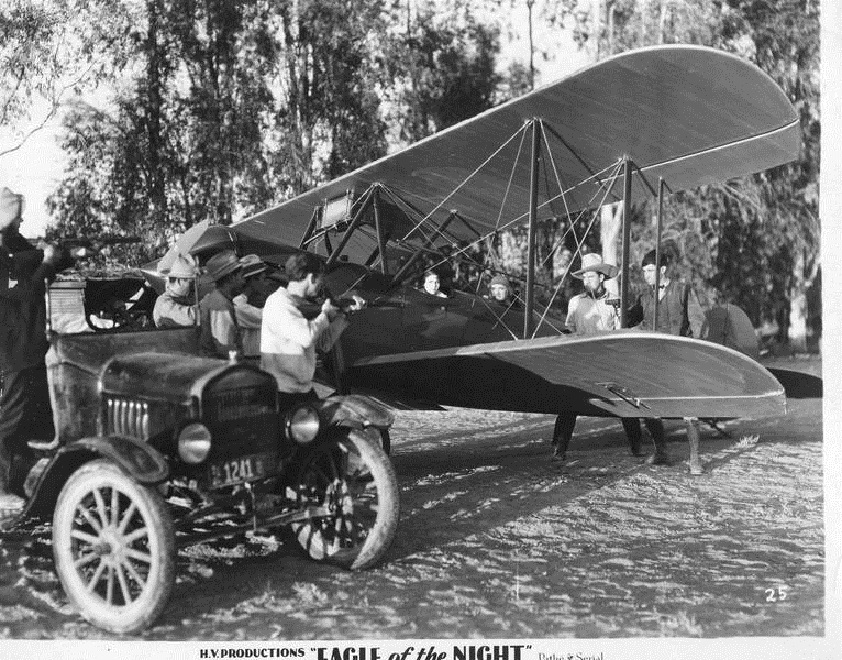
Car meets plane: a scene from 'Eagle of  the Night' (1928)

MONDAY, SEPT. 11, 2023 / FOR IMMEDIATE RELEASE
Contact Jeff Rapsis • (603) 236-9237 • jeffrapsis@gmail.com

Rare thriller 'Eagle of the Night' (1928) to screen with live music at Town Hall Theatre

Surviving footage of 10-part silent aviation drama starring stunt pilot Frank Clarke to run on Sunday, Sept. 17

WILTON, N.H.—Like the famous Venus de Milo sculpture, it's missing some parts.

But enough survives of 'Eagle of the Night,' a 1928 silent-era aviation adventure serial, for audiences to follow the story and enjoy the multi-part thriller.

What remains of the 10-chapter saga will be shown on Sunday, Sept. 17 at 2 p.m. at the Town Hall Theatre, 40 Main St., Wilton, N.H.

Admission is free, with a suggested donation of $10. Live music will be provided by silent film accompanist Jeff Rapsis.

The screening is part of "Not Known to be Shown," a series of early films that never played at the Wilton venue when originally released.

'Eagle of the Night' is a 1928 American drama film serial directed by James F. Fulton.

Dismissed when released and completely forgotten in the modern era, the 10-chapter aviation serial starred real-life aviator Frank Clarke, a stunt pilot whose talents were featured in better-known films of the era, including 'Wings' (1927) and 'Hell's Angels' (1930).

'Eagle of the Night' was one of the last silent film serials produced by Pathé Studios. The entire serial is not known to exist, with half of chapters 3 and 6, all of 7, 8, and 9, and the beginning of the 10th and final chapter considered lost.

The surviving footage runs about 1 hour and 50 minutes.

In 'Eagle of the Night,' unscrupulous smugglers are attempting to steal the "Magic Muffler," a device that can make an aircraft practically silent. Flying at night would make the smugglers and their forays across the border, impossible to detect.

The smugglers led by rancher Paul Murdock (Earl Metcalfe), capture the inventor, Professor Payson (Josef Swickard), holding him hostage until they get the secrets to his invention.

Unable to get Payson to make another device, the gang then kidnaps Professor Payson's daughter (Shirley Palmer) to force her father to work for them. Even faced with torture, she refuses to help the smugglers.

Secret Service Agent Frank Boyd (Frank Clarke) is called in to confront Murdock and his gang. With the Professor and his daughter on a speeding train, Frank manages to land his Curtiss "Jenny" aircraft on a flat car of the moving train, in time to effect a rescue and win the girl in the end.

The 'Not Known to be Shown' series runs through October and features obscure dramas, comedies, and adventure flicks from the silent era.

"In putting together this series, we wanted to give audiences a chance to see some rarely screened titles from the first years of motion pictures," Rapsis said.

"Also, they're all movies I've never scored before," Rapsis added. "So it's also a chance to work with 'new' material, although the films themselves are about 100 years old," Rapsis said.

Upcoming films in the Town Hall Theatre's 'Not Known to be Shown' series include:

• Sunday, Oct. 8, 2 p.m.: 'The Red Kimona' (1925). A small-town girl finds escape from her cruel home life in the arms of a handsome stranger, a situation that leads her to work as a prostitute in New Orleans.

What remains of 'Eagle of the Night' (1928), a 10-part silent adventure serial starring stunt pilot Frank Clarke, will be shown on Sunday, Sept. 17 at 2 p.m. at the Town Hall Theatre, 40 Main St., Wilton, N.H.

Admission is free, with a suggested donation of $10. For more information, call (603) 654-3456.

Tuesday, May 23, 2023

Coming up this weekend: Harold Lloyd (and Babe Ruth!) in 'Speedy' (1928) on Sunday, May 28

Harold Lloyd and Ann Christy visit Coney Island in 'Speedy' (1928).

A few years ago, I was looking for a parking spot in Brooklyn, N.Y. to attend a get-together of my Fordham University friends.

This was in the Williamsburg section of the borough, close to the East River. And I found myself on Kent Avenue.

I'd never been there before, but for some reason I knew that street name. 

Before I found a parking spot, I remembered—Kent Avenue plays a prominent role in 'Speedy' (1928), Harold Lloyd's silent comedy that was shot mostly on location in New York. 

You can see Kent Ave. (street sign and all) and a lot of other New York locations this weekend, when we run 'Speedy' at the Town Hall Theatre in Wilton, N.H.

It's the final installment of our silent tribute to the Big Apple. And in this case, I think you could argue that we've saved the best for last. 

More Coney Island action, shot on location at the height of the Roaring '20s.

Lloyd and his crew made the most of shooting on location, and 'Speedy' is filled with shots of NYC scenes from 100 years ago that add a huge layer of interest to the film, then and even more so now.

See for yourself by attending the screening on Sunday, May 28 at 2 p.m. See you there!

*     *     *

Harold rides the NYC subway in 'Speedy' (1928).

MONDAY, MAY 22, 2023 / FOR IMMEDIATE RELEASE
Contact Jeff Rapsis • (603) 236-9237 • jeffrapsis@gmail.com

Classic Harold Lloyd comedy 'Speedy' on Sunday, May 28 at Town Hall Theatre

Screening features live music; filmed on location in NYC with cameo by Babe Ruth

WILTON, N.H.—He was the bespectacled boy next door whose road to success was often paved with perilous detours.

He was Harold Lloyd, whose fast-paced comedies made him the most popular movie star of Hollywood's silent film era.

See for yourself why Lloyd was the top box office attraction of the 1920s in a revival of 'Speedy' (1928), one of his most popular comedies.

The film, shot on location in New York City, will be shown on Sunday, May 28 at 2 p.m. at the Town Hall Theatre, 40 Main St., Wilton, N.H.

The film will be shown with live music by silent film accompanist Jeff Rapsis.

Admission is free; a donation of $10 per person at each screening is suggested to help defray expenses.

The film is the last installment in the Town Hall Theatre's ongoing 'Silent New York' series.

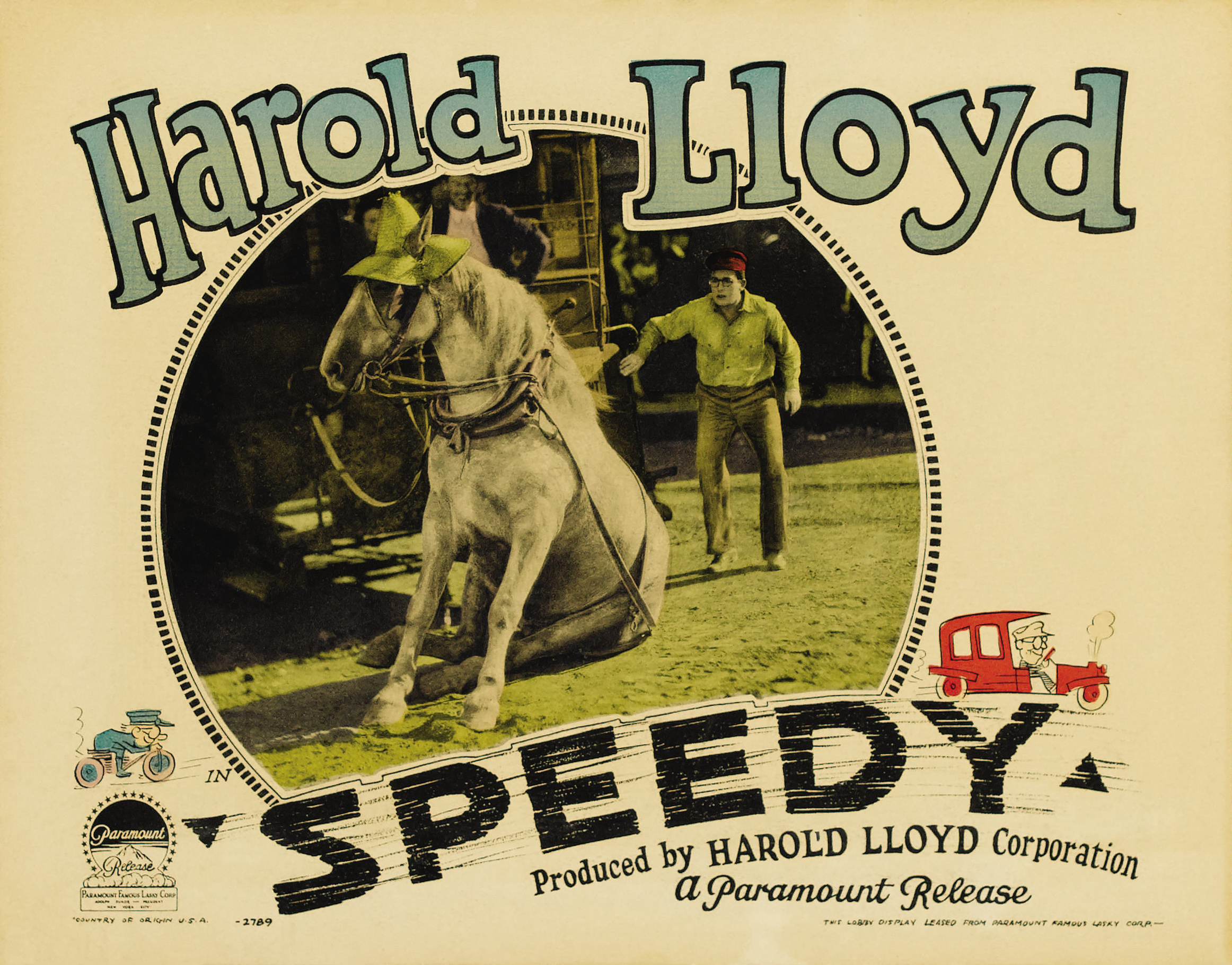
'Speedy,' Lloyd's final silent feature before the transition to talkies, finds Harold as a baseball-crazed youth who must rescue the city's last horse-drawn streetcar from gangsters bent on running it out of business.

Filmed almost entirely on location in New York, 'Speedy' features remarkable glimpses of the city at the end of the 1920s, including footage of Coney Island and the original Yankee Stadium in the Bronx.

The latter scenes include an extended appearance by Babe Ruth, then at the height of his career during the team's storied 1927 season.

"In 'Speedy,' New York City is practically a part of the cast," Rapsis said. "In filming it on location, Lloyd knew scenes of New York would give the picture added interest to audiences across the nation and around the world.

"But what he didn't anticipate was that today, the location shots now provide a fascinating record of how life was lived in the Big Apple in the 1920s," Rapsis said.

Rapsis will improvise a musical score for 'Speedy' as the film is screened. In creating accompaniment for vintage classics, Rapsis tries to bridge the gap between silent film and modern audiences.

"Creating the music on the spot is a bit of a high-wire act, but it contributes a level of energy that's really crucial to the silent film experience," Rapsis said.

'Speedy' (1928) will be screened on Sunday, May 28 at 2 p.m. at the Town Hall Theatre, 40 Main St., Wilton, N.H.

Admission is free; a donation of $10 per person is suggested to help defray expenses. For more information, call (603) 654-3456.

Thursday, January 12, 2023

Coming up on Sunday, Jan. 15 in Wilton, N.H.: Celebrate the 100th anniversary of 'Safety Last,' plus how the film relates to Beethoven's 5th

Harold Lloyd and the iconic image from 'Safety Last' (1923)

As we move through the decade of the 2020s, each year is now bringing a bumper crop of 100th anniversaries of great films worth celebrating—and screening, too!

For the still-new year of 2023, chief among the titles celebrating a centennial is Harold Lloyd's thrill comedy 'Safety Last.' 

In the coming months, I'll accompany more than a few screenings of this film—the first of which is this weekend, on Sunday, Jan. 15 at 2 p.m. at the Town Hall Theatre in Wilton, N.H.

As stated in the press release (which is pasted in below, and has all the details), the film is well-known even among people who've never seen any of Lloyd's work. 

That's a result, I suspect, of a single iconic image (see above), which over the decades has come to symbolize the "anything for a laugh" school of comedy that supposedly prevailed in the silent era.

And that's unfortunate—not just because it's incorrect, but it also shortchanges a wonderfully realized comedy that has a lot more going for it than just a guy hanging from a minute-hand.

What I mean from that is captured in some thoughts I posted seven years ago, in which I compared 'Safety Last' to Beethoven's 5th Symphony, of all things.

But with Safety Last turning 100, I think they're worth bringing up again. Here goes!

From Jan. 24, 2016...

With me, when I ponder 'Safety Last,' I often think of Beethoven's Fifth Symphony. You know? Da da da DUMMM!

Which prompts the question: What does a Jazz Age romantic comedy have in common with one the sternest, most serious pieces of classical music ever written?

Well, as with so much, it's personal. So forgive me as I briefly succumb to that malaise of middle age: the reminiscence.

I first got interested in silent film as a kid in the 1970s. At the time, if you really wanted to see silent film, you had to get the actual films and run them yourself.

Many were available (in 16mm and 8mm) from the public library, or could be ordered from Blackhawk Films of Davenport, Iowa, which I did.

And so I explored and learned about the silent films of Charlie Chaplin, of Buster Keaton, and so many others. Little by little, I came to understand the world of 1920s cinema.

But the films of one person were missing: Harold Lloyd. You could see some of his early short films, but all the big classic features just weren't available.

Of course I could read about Lloyd's films. In books, he was often labeled a "thrill" comedian in passages that were inevitably accompanied by the famous image at the top of this post.

Here it is again:


And that was that. As far as I knew, Lloyd was rooted in the frentic "anything for a laugh" school of comedy, as epitomized by that one photo, used over and over again.

Why was he hanging from a clock? There couldn't be any possible reason other than he was just trying to get laughs by being outrageous.

And that was my image of Lloyd for quite awhile.

At the same time (junior high school), I was beginning to explore the works of the great composers.

All along, I had known what Beethoven's Fifth Symphony was all about: da da da DUMMM, right?

But to my adolescent ears, it came as a a major discovery that 40 minutes of music followed: music that explored a vast emotional landscape ranging from the deepest valleys of despair to the highest summits of ecstasy.

I recall it was an RCA recording of Fritz Reiner leading the Chicago Symphony on an LP that was very "close-miked," meaning the voice of each instrument was clear and distinct, as opposed to the general sonic blur you sometimes get from an orchestra in a concert hall.

It was unlike anything I had ever heard before. And it was big news to find out all of what came after DUMMM.

The same thing happened with 'Safety Last.' After years of thinking of the film as just an excuse for Lloyd to go stunting willy-nilly on a tall building, I finally got to see the entire film. (This happened when the Lloyd films were shown on Public Television in the late 1970s.)

Just as with Beethoven, a whole world opened up to me. Turns out Lloyd wasn't just a clock-hanger! His films had plots, character, settings, and finely honed gag sequences that brought the art of visual comedy to places I had never seen before.

And 'Safety Last' wasn't just a flimsy excuse for Lloyd to do stunts on a building. No! It was laid out with a certain inexorable logic that leaves Lloyd's character no choice but to climb the building, floor by increasingly vertiginous floor, while frightened silly the whole way.

And as he does it, the film's story virtually requires us to root for him. And when he finally reaches the clockface—the one I'd seen in that picture so many times—the reaction generated is the result of all that has gone on before it.

I couldn't believe how well done it was. I finally knew how Lloyd came to hanging from that clockface, and it made all the sense in the world.

It also helped me begin to understand why Lloyd was so popular in the 1920s. His films were a lot more than da da da DUMM. They were actually made to a very high standard, designed to be experienced by a large audience, and still work like gangbusters when shown as intended.

So there! I hope that's enough to encourage you to venture out the the venerable (and venture-able, too!) Town Hall Theatre in Wilton, N.H. and join us for a screening of 'Safety Last' on Sunday, Jan. 15. More details in the press release below.

*    *    *

Harold Lloyd clocks in during 'Safety Last' (1923).

TUESDAY, DEC. 27, 2022 / FOR IMMEDIATE RELEASE
Contact Jeff Rapsis • (603) 236-9237 • jeffrapsis@gmail.com

Town Hall Theatre to celebrate 100th anniversary of silent film classic 'Safety Last'

Thrill comedy climaxed by Harold Lloyd's iconic building climb; matinee screening with live music on Sunday, Jan. 15

WILTON, N.H.—It's a cinematic image so powerful, people who've never seen the movie instantly recognize it.

The vision of Harold Lloyd hanging from the hands of a huge clock, from the climax of his silent comedy 'Safety Last,' (1923), has emerged as a symbol of early Hollywood and movie magic.

Celebrate the 100th anniversary of the film's original release with a screening of 'Safety Last' on Sunday, Jan. 15 at 2 p.m. at the Town Hall Theatre, 40 Main St., Wilton, N.H.

Admission is free; a donation of $10 per person at each screening is suggested to help defray expenses.

The screening will feature live music by silent film accompanist Jeff Rapsis.

'Safety Last' follows young go-getter Lloyd to the big city, where he hopes to make his mark in business, then send for his small town sweetheart.

His career at a downtown department store stalls, however, until he gets a chance to pitch a surefire publicity idea—hire a human fly to climb the building's exterior.

But when the human fly has a last-minute run-in with the law, Harold is forced to make the climb himself, floor by floor, with his sweetheart looking on.

The result is an extended sequence filmed without trick photography that blends comedy and terror, holding viewers spellbound.

Lloyd, along with Charlie Chaplin and Buster Keaton, is regarded as one of the silent screen's three great clowns.

Lloyd's character, an ambitious young man ready to struggle to win the day, proved hugely popular in the 1920s.

While Chaplin and Keaton were always favored by the critics, Lloyd's films reigned as the top-grossing comedies throughout the period.

Silent film at the Town Hall Theatre gives today's audiences the chance to experience early cinema as it was intended: on the big screen, with live music, and with an audience.

"Put the whole experience back together, and you can see why people first fell in love with the movies," said Rapsis, who practices the nearly lost art of live silent film accompaniment.

Rapsis performs on a digital synthesizer that reproduces the texture of the full orchestra, creating a traditional "movie score" sound.

"Seeing 'Safety Last' with an audience is one of the great thrill rides of the cinema of any era, silent or sound," Rapsis said. "Harold's iconic building climb, filmed without trick photography, continues to provoke audience responses nearly 100 years after film was first released."

Tributes to the clock-hanging scene have appeared in several contemporary films, most recently in Martin Scorsese's 'Hugo' (2011), which includes clips from 'Safety Last.'

Celebrate the 100th anniversary of Harold Lloyd's iconic thrill comedy 'Safety Last' (1923) with a screening on Sunday, Jan. 15 at 2 p.m. at the Town Hall Theatre, 40 Main St., Wilton, N.H.

Admission is free; a donation of $10 per person at each screening is suggested to help defray expenses. For more information, call the theater at (603) 654-3456.

CRITIC COMMENTS ON ‘SAFETY LAST’:

"Impossible to watch without undergoing visitations of vertigo, Safety Last's climactic sequence is all it's reputed to be.”
—TV Guide

"Harold Lloyd manages to make the characters sympathetic enough to carry the audience's concern on his journey of crazy stunts and mishaps. One of the best of this era."
—David Parkinson, Empire Magazine

"The climb has both comic and dramatic weight because it is both a thrilling exercise in physical humor and a thematically rich evocation of the pressures men feel to succeed, lest they be viewed as less than a man."
—James Kendrick, Q Network Film Desk


Saturday, April 16, 2022

This Sunday: Silent Shakespeare! And then 'Ben Hur,' then Cleveland, and then back to Boston!

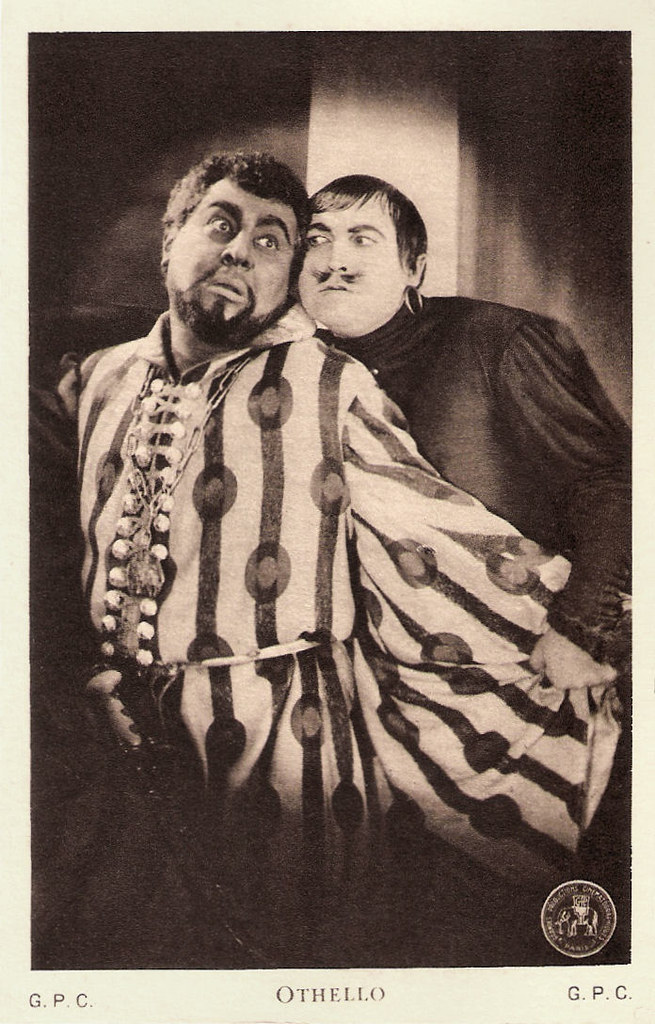
The moor, the not-so-merrier: Emil Jannings as 'Othello' (1922).

This weekend, things take a turn towards the literary—after which I take a turn to Ohio!

Up first: music for an early silent screen adaptation of Shakespeare's 'Othello' (1922), made in Germany and starring Emil Jannings in the title role. 

Yes, silent Shakespeare! See what you think: the screening is Sunday, April 17 at 2 p.m. at the Town Hall Theatre in Wilton, N.H. More detail in the press release below.

After that, it's music for big bad 'Ben Hur' (1925), screening on Thursday, April 21 at 7:30 p.m. at the Rex Theatre, 23 Amherst St., Manchester, N.H. 

And the next day finds me swinging out to Cleveland, Ohio, where I'll accompany two films at the Cleveland Cinematheque on Friday, April 22 and then join the fun at the annual 36-hour sci-fi marathon at nearby Case Western University.

At the Cinematheque, it's 'Nanook of the North' (1922) and then the recently reissued 'Straight is the Way' (1921), a curiosity set in my own home state of New Hampshire. 

At the sci-fi marathon, it's 'Der Golem' (1920), which will be screened about 20 hours into the big show. Looking forward to the reaction!

And then I scoot back to Boston to do music for the big MGM silent film version of 'La Bohéme' (1926) starring Lillian Gish and John Gilbert. Screening is Sunday, April 24 at 2 p.m. at the Somerville Theatre, and marks the restart of the venue's 'Silents, Please!' series.

But before any of that, it's time to brush up our Shakespeare this Sunday afternoon. Here's the press release. Happy Easter weekend and hope to see you at the movies!

*  *  * 

Actor Emil Jannings has a hard time competing with Werner Krauss' mustache in 'Othello' (1922).

MONDAY, APRIL 4, 2022 / FOR IMMEDIATE RELEASE
Contact Jeff Rapsis • (603) 236-9237 • jeffrapsis@gmail.com

Silent Shakespeare! Early film version of 'Othello' to screen on Sunday, April 17 in Wilton, N.H.

First-ever feature adaptation of Bard's classic tale to be screened with live music at Town Hall Theatre

WILTON, N.H.—His tales have been adapted for the big screen since the beginning of the movies.

He was playwright William Shakespeare, whose tragedy 'Othello' first appeared as a feature film via a movie made in Germany in 1922.

The silent 'Othello' will be shown with live music on Sunday, April 17 at 2 p.m. at the Town Hall Theatre, 40 Main St., Wilton, N.H.

Admission is free; a donation of $10 per person is suggested to help defray expenses.

The screening will be accompanied with live music by Jeff Rapsis.

The silent 'Othello' takes Shakespeare's dialogue-driven drama and transforms it into a story told visually.

'Othello' boasts two of the most celebrated German actors of the era: Emil Jannings in the title role, and Werner Krauss as his nemesis, Iago.

Jannings would relocate to Hollywood later in the 1920s, winning the first-ever Best Actor honors at the inaugural Academy Awards in 1929.

Krauss, a noted German stage actor, is best remembered for playing the title role in the film 'The Cabinet of Dr. Caligari' (1920).

The film closely follows Shakespeare's story of Othello, a Moorish general provoked to jealousy regarding his wife Desdemona.

The story opens with Othello choosing the loyal Cassio as his lieutenant. This arouses bitter jealousy in Iago, another soldier, who vows to scheme against his general.

Othello is soon sent to Cyprus to repel a Turkish invasion, and he arranges for Iago and his wife to bring Desdemona with them to Cyprus.

When Iago's wife learns of a treasured handkerchief that Othello gave to Desdemona, Iago hatches a plan that he hopes will destroy Othello by provoking him to jealousy.

The film, directed by Russian-born Dmitri Buchowetzki, is widely regarded as a successful adaptation of the Bard's story to the silent screen.

"Produced on an elaborate scale, Othello may not be true to the letter of Shakespeare, but is undeniably a smorgasbord of visual delights," according to a review on LetterboxDVD.com.

Live music for 'Othello' will be provided by silent film accompanist Jeff Rapsis, who uses a digital synthesizer to create a traditional full orchestra "movie score" sound.

Rapsis emphasized the unique value of seeing early cinema as it was originally presented.

"These films were designed for the big screen, live music, and large audiences. Put it all together, and you can get a sense of why people first fell in love with the movies," Rapsis said.

The screening of 'Othello' will precede the 458th anniversary of Shakespeare's birthday, which scholars believe to be April 23, 1564.

"It may seem counterintuitive for a Shakespearean play to be made into a silent film," Rapsis said.

"But stage dramas were a huge source of material for early cinema, and Shakespeare's stories were popular enough to warrant the attention of filmmakers right from the beginning," Rapsis said.

The screening is part of the Town Hall Theatre's ongoing series honoring the 100th anniversary of significant motion pictures from 1922.

Programs have included all of 1922's five highest-grossing titles, each shown on the big screen with live music, as well as century-old oddities, short films, cartoons, and more.

The silent 'Othello' will be shown with live music on Sunday, April 17 at 2 p.m. at the Town Hall Theatre, 40 Main St., Wilton, N.H.

Admission is free; a donation of $10 per person is suggested to help defray expenses.

For more info, visit www.wiltontownhalltheatre.com or call (603) 654-3456.

Wednesday, March 17, 2021

Biblical epic 'Noah's Ark' sails into Town Hall Theatre in Wilton, N.H. on Sunday, March 28

The ark under construction in 'Noah's Ark' (1928).

With 'Noah's Ark' (1928), we encounter the problem of how much to tell an audience beforehand. 

(And if you don't want to know anything, please skip to the press release below...)

For instance: should you tell people that extras drowned during the film's production? Do you mention this before, after—or not at all?

I'm thinking about this because I'm accompanying 'Noah's Ark' on Sunday, March 28. It's a sprawling late silent Biblical blockbuster, and just the thing to get you in the mood for Easter.

There's a lot more info in the press release (below), including how it's a part-talkie, and how we'll run the film with the recorded sound portions intact. 

But about the question of how much to tell an audience...

Some say a film should stand on its own merits. It should speak for itself—even a silent! It shouldn't need someone to "explain" it.

But for silents, I've found it really helps to give people some background. For many folks, it's such an unfamiliar experience—the stars, the studios, the story-telling conventions.

So I usually try to say a few things, with the emphasis on "few," as people have come to see a silent movie, not hear some guy go on and on.

I think Denise Morrison of the Kansas Silent Film Festival gets the balance just right: she gives audiences just enough to illuminate the world of the film and the people who created it. 

But in the case of 'Noah's Ark,' what about the purported drowning of three extras? 

Mention it beforehand, and it's all people think about when watching the film. And I don't think that's good, nor is it fair to the filmmakers.

Don't believe me? Consider the case of Harold Lloyd. 

Prior to a screening of his thrill comedy 'Safety Last' (1923), if you mention that Lloyd was missing two fingers from one hand, people can't forget that. 

And later, it greatly changes how an audience experiences the scenes of him hanging from cornices and clock hands high above Los Angeles. It serves to drain away any possibility of being swept away by the story or the characters or the moment. 

 Why? Because we can't forget those two missing fingers.

So in my introduction to 'Noah's Ark,' I won't mention the drownings. Let the audience discover the picture on its own terms. Afterwards, 

And for those of you reading this, I've already spoiled it. But come anyway. It's a big sprawling Biblical epic that will sweep you away...no, wait—let me rephrase that.

*  *  *


Dolores Costello and George O'Brien in 'Noah's Ark' (1928).

WEDNESDAY, MARCH 17, 2021 / FOR IMMEDIATE RELEASE
Contact: Jeff Rapsis • (603) 236-9237 • jeffrapsis@gmail.com

Celebrate Easter season at Town Hall Theatre with spectacular Biblical epic 'Noah's Ark'

Recreation of legendary flood highlights classic silent film with live music — one show only on Sunday, March 28

WILTON, N.H.—It was the last of the silent epics—released so late in the era that Warner Bros. added two brief talking sequences to it. It was 'Noah's Ark' (1928), an adaptation of the classic Biblical tale on a massive scale as only Hollywood could do.

To celebrate the Easter season, a restored print of 'Noah's Ark' will be screened with live music on Sunday, March 28 at 2 p.m. at the Town Hall Theatre, 40 Main St., Wilton, N.H.

The screening is free to the public; a donation of $10 per person is suggested to support the Town Hall Theatre's silent film series.

The Town Hall Theatre continues to observe procedures to comply with all state and CDC public health guidelines. Capacity is limited to 50 percent; patrons are required to maintain social distance and wear masks until seated.

Live music will be provided by Jeff Rapsis, a New Hampshire-based silent film accompanist.

A cost of thousands—most of whom made it through the production.

'Noah's Ark' actually combines two stories: the ancient tale of the flood is framed by a parallel "modern" story set during World War II.

The contemporary story plays out across war-torn Europe; 'Noah's Ark' seeks to apply the lessons of scripture via flashback to the Biblical tale of Noah building an ark to survive God's wrath and the great flood.

'Noah's Ark' was directed by Michael CUrtiz, who would later helm such Warner Bros. classics as 'Casablanca' (1942). It stars George O'Brien, Dolores Costello, and Noah Beery, who all play dual roles in both the Biblical and modern story.

'Noah's Ark' is highlighted by its spectacular flood scenes, which were staged on such a massive scale that several extras drowned during the production. The incident, which the studio kept out of the press, led to increased safety rules in the motion picture industry.

In an era when movie budgets rarely exceeded $250,000, 'Noah's Ark' cost Warner Bros. the then-unheard-of sum of $1 million to make. However, it earned more than $2 million worldwide, making it a triumph for the studio.

At the Town Hall Theatre, the version of 'Noah's Ark' will include the original talking sequences, which total about 20 minutes. The remainder of the film will be presented as silent with live musical accompaniment by Jeff Rapsis.

From 'Noah's Ark' (1928), a part-talking picture from Warner Bros.

"Because it's a part-talking picture, 'Noah's Ark' is an interesting hybrid in which you get to hear the actual voices of performers who are otherwise silent, with dialogue conveyed by title cards," Rapsis said. "It captures Hollywood in the midst of the chaotic changeover from silent to sound movies, which took place over two years starting in 1927."

Rapsis improvises scores for silent films using a digital synthesizer to recreate the texture of the full orchestra.

"It's a bit  of a high wire act," Rapsis said. "But the energy of live performance is an essential part of the silent film experience."

"These films were intended to be shown this way: in a theater, on the big screen, with an audience, and with live music. If you can put it all back together, you get a real sense of why people first fell in love with the movies," Rapsis said.

The silent Biblical epic 'Noah's Ark' will be screened with live music on Sunday, March 28 at 2 p.m. at the Town Hall Theatre, 40 Main St., Wilton, N.H. Free admission; a donation of $10 per person is suggested to support the Town Hall Theatre's silent film series.

For more information, visit www.wiltontownhalltheatre.com or call (603) 654-3456.


Wednesday, March 3, 2021

Not in Kansas anymore, at least this one time: the Kansas Silent Film Festival in New Hampshire

Last Sunday afternoon at the Town Hall Theatre in Wilton, N.H., prior to the silent 'The Wizard of Oz' (1925). Photo by Karl Mischler.

Like Dorothy, we weren't in Kansas. But instead of a cyclone, it was a pandemic that transported to another realm—in this case, not Oz but New Hampshire.

Still, last weekend we managed to conjure up a respectable version of the Kansas Silent Film Festival out here in the far-away Granite State, complete with hot pickles from Porubsky's Deli and much of my wardrobe coming from Topeka's fine thrift stores.

While acknowledging that the whole affair was definitely one of those "you had to be there" events (in-person screenings were the whole point of doing it), here's a brief report of what transpired for those of you unable to attend or who would like to relive favorite moments. 

To begin with: thanks to everyone at the Kansas Silent Film Festival for all their help in bringing about our ersatz version some 1,500 miles away. With their own festival going online this year due to the pandemic (thus me at home instead of in Topeka), organizers could not have been more supportive of our tribute. 

Just to name a few Sunflower State heroes: Denise Morrison for providing fantastic recorded introductions to all our films; Bill Shaffer for working with Denise and others to get the intros on disc and sending them to us; to Carol Yoho for doing a special "New Hampshire" version of the Kansas festival logo; to Bill again for taking the trouble to pack and ship two containers of the aforementioned hot pickles all the way to the Granite State. 

A special tip of the derby hat to Karl Mischler, who each year plays a major role in the Kansas festival, and who this year came up from New York to take photos, greet guests, and help recreate the spirit of the White Concert Hall at Washburn University in Topeka, where silent films are shown each February, except not this year. Thank you, Karl!

And thanks to everyone connected with the Kansas festival for being supportive of our crazy idea, which was truthfully just another extension of my ongoing silent film accompaniment self-therapy sessions. I'm getting better—really, I am. :)

We ran three double-feature programs, one each on Friday night, Saturday night, and then Sunday afternoon. The first two shows were lightly attended, but the Sunday afternoon program (featuring the silent 'Wizard of Oz' and Keaton's 'The Navigator') attracted about 60 people—the Town Hall Theatre's largest audience of any show since the pandemic settled in nearly a year ago.

It being an event for which we had appropriated the name and image and reputation of a highly regarded film festival, I dressed in my Sunday-go-to-meeting suit throughout. However, for each screening I sported a different tie from a spiffy selection I purchased for $3 at one of Topeka's thrift stores. I also unearthed a fur-lined raincoat I bought out there one year for $5 when I didn't bring an appropriate jacket for cold weather.

 Denise delivers a remote recorded intro on the Town Hall Theatre's big screen.

I kept my own pre-film remarks brief so as to give Denise the spotlight with her on-screen intros. More than anything else, the sound of her voice and her cadence as she walked us through the background on each of the films made what we were doing seem like the real thing. If it's Denise, it must be the Kansas Silent Film Festival. Close your eyes and you really could believe you were at Washburn University.

Our intermission feature was sample-sized portions of Porubsky's hot pickles, which met with general approval as far as I could tell. Unlike in the documentary made about the venerable neighborhood deli, there were no scenes of people spitting them out, at least openly. Maybe the winter here has been longer and colder than I thought.

One of the things we didn't have is anyone to review the films like long-time Kansas attendee Bruce Calvert (from Texas) usually does. So here's my attempt to record impressions from my viewpoint: below the screen, in front of the audience, and behind the keyboard.

Claire Windsor and Hobart Bosworth in 'Little Church.'

• Friday, Feb. 26: The Little Church Around the Corner (1923): a so-so transfer of a 16mm print of this early Warner Bros. melodrama held the screen well enough, generating genuine sympathy and suspense, and not just because of the jumpy splices. Starring Kansas-born Claire Windsor and featuring an appearance by New Hampshire-born tough guy Walter Long. I based the score on a simple diatonic tune that could be transformed into a hymn-like cadence when needed. Best part (for me) was during the extended underground rescue sequence, when the music fell into a nice steady build, using shifting chords over a steady and slow rhythm to build suspense, which became one of those "wow, I can't believe how well this is working" moments at the keyboard.

• Friday, Feb. 26: The Round-Up (1920) starring Kansas-born Fatty Arbuckle in a non-slapstick role left a lot of people scratching their heads. The print looked fantastic, full of distant vistas rendered in subtle grays. But the convoluted plot and the film's attempt-for-pathos ending ("Nobody loves a fat man") generated actual complaints afterwards from bewildered or disappointed viewers. Music was mostly faux Aaron Copland, with some faux Stephen Foster mixed in, plus faux Mussorgsky for the Injun scenes and a stock "bad guy" theme for Wallace Beery's bizarre Mexican half-breed character. Programmed because I'd never done music for it before; alas, unlikely to uncork this one again. Sorry, Roscoe! 

• Saturday, Feb. 27: The Showoff (1926), a comedy/drama starred Keystone veteran Ford Sterling without his old comic make-up, was a rewarding and delightful: characters that resonated, a fun story, and some good scenes that generated a lot of laughter even among our small audience. (And great location scenes of downtown Philadelphia, too!) Shown as a way to include Kansas native Louise Brooks (above right, in a supporting role), I took a different approach with the music, sticking with a "light orchestra" setting (no percussion or brass) for the entire film. Using a pair of melodic scraps, I just sort of bounced along with the action when it was upbeat, then shifted to a more somber mode when things got serious. All along, made use of a small piece of Julius Fucik's 'Entrance of the Gladiators' (the famous circus march) to underscore the bluster of Ford Sterling's character. To me, the most musically satisfying film of our program.

• Saturday, Feb. 27: Risky Business (1925), another comedy/drama, this time starring Vera Reynolds with Kansas-born Zasu Pitts in a supporting role. I had high hopes for this one, which I'd never encountered before but I think is one of those "why isn't this film better known?" titles that you sometimes come across, especially because of an unexpected twist that ties it all together. And it did generate a pretty good audience reaction—at least on par with 'The Showoff,' which preceded it. But musically, it might have been a case of me trying too hard, as I felt I couldn't settle down and kept shifting material mid-way through scenes, which took away from the film's effectiveness. The continual interaction with society girl Vera and a young girl who wants her to read the same book again and again has a lot of comic potential, and I felt I muffed it. Also, played too much (and too fast and busy) during the "party of dissipated wealthy people" scenes. So the one that got away, at least this time, but I'll program it elsewhere and try to bring better material to help make the case.

Larry, Dorothy, and Ollie in 'The Wizard of Oz.'

• Sunday, Feb. 28: The Wizard of Oz (1925), Larry Semon's very loose adaptation of L. Frank Baum's stories and characters, which are repurposed into reasons for people to fall into mudbaths, make leaps from tall towers, and other Semon trademarks. This film, included because of its Kansas setting, has a reputation for being just plain awful. But I've found that people actually come to see it, which is more than you can say for most silent titles. Also, if given the proper context (it does not star Judy Garland—setting expectations is so important!), people seem to enjoy it, not in spite of the film's disjointed nature but perhaps because of it. Whatever the cause, Larry's 'Wizard' (shown in the beautifully restored version included with a recent re-issue of the 1939 MGM classic) delivered once again: the laughs started early and kept coming, give or take a few shaky sequences. The music was based mostly on a child-like theme that underpinned all of Semon's on-screen efforts, either as the aged toy-maker or as the farmhand/scarecrow, plus some stock "evil guy" music for the Oz villains, although keeping it always light. 

• Sunday, Feb. 28: The Navigator (1924), our comic grand finale, ended things on a high note. Some thoughts: Buster Keaton's comedy style transcends its era, with today's audiences responding readily to his actions, antics, and attitudes. And with Keaton in top form in 'The Navigator,' it's really a question of how strong the audience reaction will be. Sunday afternoon's screening had the flavor of the full silent film experience: an audience responding together as the story and the gags unfold. 'The Navigator' contains two "moments of no return"—places where the response will indicate how the rest of the screening will go. The first is when he takes a limousine across the street to visit his would-be bride; the second is when the spooky picture lands outside his porthole. Both cases produced strong reaction, which continued throughout the film. For music, all Keaton for me is an exercise in "less is more," as you don't want to overpower the comedy or any other moments on screen. Hence my tendency to employ fairly simple "nursery rhyme" textures for long stretches of Keaton, as opposed to something like hot jazz or overly "comic" music. But you do want the music to point the audience in the right direction, if possible, by helping set up the laugh moments, which requires concentration on what the music is doing to support what's on screen. Less playing, more thinking. And sometimes that means just dropping out, as stopping the music can help cue audience laughter. Not that Keaton needs my help for his stuff to work, but music can make a difference, especially if it stays out of the way.

So, as Denise said each time in her "good night" message, there you have it. A good time was had by all, except a few people who had higher expectations for 'The Roundup' on Friday night. We'll have to program some Arbuckle two-reelers to make up for it and restore everyone's faith. 

Meanwhile, out in Kansas, this year's virtual edition features a lot of great stuff posted over two days. It'll remain up for a little while, so get thee over to their Vimeo site and check out the program. Among other highlights, it's probably the best place on the Internet to see pictures of Karl Mischler standing in a snowbank wearing only shorts. (That's Karl, above left, ceremonially opening the Aviation Museum of N.H. on Saturday morning during his visit.)

They already have dates for the 2022 festival, by the way: if you're keeping track, it's 359 days until showtime. But they keep saying "hopefully" they'll return to films shown on screen with an audience and live accompaniment. 

Hopefully? Hopefully? Wow. At that point, if we're still all social distancing and staying home, there won't be a New Hampshire version of the Kansas Silent Film Festival in 2022, because by then I'll be living in a reed hut in the upper reaches of the Irrawaddy River (somewhere north of Mandalay) smoking cheroots and with a pet iguana for company. 

Photo by Karl Mischler, who like Diane Arbus has a gift for using his lens to capture the essence of a subject's personality, which in this case appears to be a mix of Jerry Colonna, Emmett Kelly, and Chico Marx. If this pandemic keeps up any longer, cloth face masks worn under the chin could replace the bow tie as a fashion accessory.
 

Saturday, January 9, 2021

Next week: 'The Storytellers,' five days of film that pioneered the full-length motion picture

Showing on Tuesday, Jan. 12: D.W. Griffith's 'Intolerance' (1916).

I've known of D.W. Griffith as 'The Father of Film' since at least the 1970s, when I'd eagerly await my monthly Blackhawk Films catalog in the mail.

But for many years, I just didn't understand his work. The films—either the short dramas for Biograph, or the longer features—either weren't interesting, or left me cold. 

Okay, I thought: Griffith is the father of film. But as a teenager, I'd rather run my Super-8 print of Keaton's 'Cops' (1922) for the 80th time rather than sit through 'Way Down East' (1920), the legendary Griffith melodrama. (That's Lillian Gish on the ice floes below, at the climax of 'Way Down East.')

My first sense of what I was missing, however, came thanks to the Kansas Silent Film Festival, which I began attending back in 2000. Every year, they'd run at least one Griffith title (usually one of the Biograph shorts) in honor of his role as an industry pioneer.

So I got to see some of Griffith's work on the big screen, with an audience, and with live music—in other words, the way it was intended to be shown. And I found that under those circumstances, the Griffith films had a certain elemental quality that I hadn't picked up on until then.

By elemental, I mean they could hold a crowd. Through simple, basic stories, they got your attention quickly, and then held it.

Later, when I began accompanying silent film programs, I found a curious thing: the Griffith films—even the famous ones regarding as classics—seemed really lame when viewed in isolation to prepare for a screening. 

But in front of an audience in a theater, they leaped to life. People would hoot and holler at what they saw. They'd stamp their feet, totally engaged in what they were seeing unfold in front of them.

As I learned more about Griffith's background and career, I realized what as going on. Griffith was the father of film, yes, but not for technical innovations such as close-ups and such. It was because of his ability to lay out a story to get an audience's attention right away, and then keep them on the edge of their seats.

That, as demonstrated more or less throughout his work, I feel was Griffith's most valuable contribution to cinema. He showed how full-length feature films could hold an audience's attention throughout an entire evening-long narrative journey.

And he did it so well that the films still work today, if you can show them as intended. 

The big "Ancient Babylon" set for Griffith's 'Intolerance.'

I remember once when we ran 'Birth of a Nation' (1915), Griffith's incredibly racist blockbuster set in post-Civil War America. The film climaxes with the Ku Klux Klan riding to the rescue,  and I remember of friend of mine saying afterwards, "You're like, 'Yes, ride to the rescue,' and then 'But no, it's the Klan!' " Such was (and is) the elemental narrative power of Griffith's tales.

Of course this is evident only if one experiences the films as intended, of which there are precious few opportunities these days. But not next week, when the Town Hall Theatre in Wilton, N.H. presents 'The Storytellers,' a five-day festival of early films that still keep audiences on the edge of their seats.

The festival includes two big Griffith films: 'Intolerance' (1916) and 'Way Down East' (1920). We're also running two early films made in Germany by Fritz Lang: 'Destiny' (1921) and 'The Spiders' (1919).

For details, check out this info sheet for the series. 

Or you can peruse the press release below. Either way, I hope you'll join us for some or all of the series. It's a rare chance to see some terrific cinema that still holds up well if you experience it as intended—in a theater, with live music, and with an audience.

*    *    *


A scene from Fritz Lang's 'Destiny' (1921), being shown Monday, Jan. 11.

MONDAY, JAN. 4, 2021 / FOR IMMEDIATE RELEASE
Contact Jeff Rapsis • (603) 236-9237 • jeffrapsis@gmail.com

Week-long film series at Town Hall Theatre turns spotlight on early directors, great stories

'The Storytellers,' Jan. 11-15, highlights talent of D.W. Griffith, Fritz Lang to mesmerize movie audiences with terrific tales

WILTON, N.H.—Everyone loves a good story.

In early cinema, a talent for story-telling was a key factor in popularizing feature-length movies.

Pioneering directors such as D.W. Griffith in the U.S. and Fritz Lang in Germany helped transform the motion picture from a sideshow novelty into a major art form—and a big business.

See for yourself when the Town Hall Theatre presents a week-long series, 'The Storytellers,' designed to highlight filmmakers who told tales that kept early movie-goers coming back for more.

With programs every evening from Monday, Jan. 11 to Friday, Jan. 15, 'The Storytellers' will showcase five spectacular full-length movies that helped build the audience for feature films.

Two are directed by Griffith: the mega-epic 'Intolerance' (1916) and the melodrama 'Way Down East' (1920). Two are from Lang: the afterlife drama 'Destiny' (1921) and action-adventure film 'The Spiders' (1919).

Although produced in Germany, the Lang films will be shown with titles translated into English.

The series finishes with Wall Street comedy 'The Saphead' (1920), the first feature-length film starring Buster Keaton. (There's a poster at right, although without Buster in it.)

All shows in 'The Storytellers' begin each night at 7:30 p.m. Each screening will be accompanied by live music by Jeff Rapsis, a New Hampshire-based silent film musician.

Admission is free; a donation of $10 per person is suggested to support the Town Hall Theatre's silent film series.


The Town Hall Theatre ordinarily programs the latest first-run feature films. But the ongoing pandemic, plus Hollywood's resistance to releasing new material to theaters, has prompted the highly regarded venue to focus on alternative programming.

The aim of 'The Storytellers' is to highlight a factor in the rapid growth of the movie business that's often overlooked: the power of the narrative.

Early directors such as D.W. Griffith and Fritz Lang are often noted for their technical innovations or sense of visual design, which helped establish the basic grammar of cinema.

But another major factor in audiences returning for more was the story itself.

"In early cinema, the best directors had a knack for laying out a story that could keep people on their edges of their seats for an entire evening," Rapsis said. 

"Up until the mid 1910s, most movies were 10 or 20 minutes long," Rapsis said. "Griffith and Lang were among the directors who led the way to feature-length films, and their stories were the foundation of their success."

'The Storytellers' aims to highlight this enduring quality of the tales that brought cinema from a carnival sideshow attraction to an art form that would dominate the 20th century.

A scene from Fritz Lang's action-adventure 'The Spiders' (1919).

"The films were so well built with audience reaction in mind that they still work when shown as intended: on the big screen, with live music, and in a darkened theatre with other people joining in a shared experience," Rapsis said.

Among early directors, Griffith was uniquely positioned to understand how to engage an audience for an evening of story-telling.

Prior to his motion picture work, Griffith spent two decades directing stage melodramas in small towns across the U.S., where keeping an audience occupied was an essential skill.

"In Griffith's stage experience, if you didn't hook the crowd right away, and keep them hooked, they'd throw things at you—or worse," Rapsis said.

This experience honed his story-telling skills, which became essential when creating movies in studios where no audience was present during the filming and editing.

"Griffith knew in his bones how large crowds would react to a story, and built that into his most popular films," Rapsis said.

"His ability to hold an audience was based on a profound understanding of human nature, and how people react, especially when part of a crowd," Rapsis said. "Because of this, his films still work today when presented as intended, which we'll do at the Town Hall Theatre."

Lang exploited a similar knack for story-telling to expand the scope of full-length movies in his native Germany.

Lang was among the first to exploit the ability of cinema to take viewers to exotic places or to travel in time. This helped him craft stories that showed early audiences the power of cinema. 

A scene from Lang's 'Destiny' (1921), screening on Monday, Jan. 11.

'The Storytellers' will focus on five early feature films. It's a rare chance to experience them as intended: on the big screen, with live music, and in a darkened theater with an audience present:

• Monday, Jan. 11 at 7:30 p.m.: Fritz Lang's 'Destiny' (1921). Years before his classic 'Metropolis,' German director Fritz Lang brought this ground-breaking expressionist fantasy to the big screen. It's a powerful tale in which human lives are each represented by a candle, and a figure representing 'Death' grants a woman three chances to rescue her lover from a premature demise.

• Tuesday, Jan. 12 at 7:30 p.m.: D.W. Griffith's 'Intolerance' (1916). D.W. Griffith's early blockbuster about man's inhumanity to man weaves together four stories spanning four eras of civilization. Filmed on a vast scale, setting a new standard for Hollywood extravagance, and new levels of editing fluency in pulling together four story climaxes simultaneously. A movie made for the big screen.

• Wednesday, Jan. 13 at 7:30 p.m.: Fritz Lang's 'Spiders' (1919). Early Lang opus that anticipates Indiana Jones by three generations. An intrepid explorer looking for an Incan diamond must stay ahead of a criminal syndicate known as 'The Spiders,' which seeks it for nefarious purposes.

• Thursday, Jan. 14 at 7:30 p.m.: Griffith's 'Way Down East' (1920). One of the most popular films of the silent era features Lillian Gish as a wronged woman in old-time New England who can't escape her past. Still-thrilling climax on ice floes heading towards the falls was filmed on location on the Connecticut River.

• Friday, Jan. 15 at 7:30 p.m.: Buster Keaton in 'The Saphead' (1920). Buster Keaton's debut in a feature-length picture, although not a Keaton film. Rather, a stage adaptation in which the comedian was hired to play a role originated by Douglas Fairbanks Sr. A rare chance to see this seldom-screened landmark picture on the big screen.

The Town Hall Theatre continues to observe procedures to comply with all state and CDC public health guidelines, including reduced seating capacity.

For complete information about safety protocols, visit www.wiltontownhalltheatre.com

'The Storytellers,' a five-day series of early motion pictures from directors D.W. Griffith and Fritz Lang, will run from Monday, Jan. 11 through Friday, Jan. 15 at the Town Hall Theatre, 40 Main St., Wilton, N.H. Screenings start at 7:30 p.m.; live music will accompany each film. Admission is free; a donation of $10 per person is suggested to support the Town Hall Theatre's silent film series.

For more info, call (603) 654-3456 or visit www.wiltontownhalltheatre.com.