Showing posts with label Der Golem. Show all posts

Tuesday, April 26, 2022

To Cleveland and back: 3 days, 5 films, 1,650 miles—and Keaton's 'Butler' on Wednesday, 4/27

Buster shows off an old-time boxing stance in 'Battling Butler.' Get those gloves up, Keaton!

Ding!

Next up is Buster Keaton's boxing comedy 'Battling Butler' (1926), which I'm accompanying on Wednesday, April 27 at the Flying Monkey Moviehouse and Performance Center in Plymouth, N.H.

Hope you'll join us for this screening, part of a series of films released in 1926 that became public domain as of Jan. 1, 2022. 

You the public now own 'Battling Butler.' Aren't you interested in seeing it?

The complete press release with more info is at the bottom of this post. 

For now, a few thoughts about my recent three-day visit to Cleveland, Ohio. (I'd call it a "flying visit" but I actually drove out there and back—about 10 hours each way.)

The reason was the 47th annual sci-fi marathon at Case Western Reserve University, where I accompanied the early German film 'Der Golem' (1920). The festival usually takes place in January, but was postponed this year due to the Coronavirus spike at that time.

It got rescheduled to last weekend, and it worked out that I could get out there as planned. 

I then reached out to the folks at the Cleveland Cinematheque, where I've been privileged to accompany silents, with news that I'd be in town, and so they asked me to do 'Nanook of the North' (1922).

Thus I drove to Cleveland—out on Friday for shows that night at the Cinemathèque, then the next day at the sci-fi festival, then back east to arrive in time to accompany a 2 p.m. screening of the silent 'La Bohème' (1926) at the Somerville Theatre.

Why drive? Because I used my big-ass digital synthesizer at each of the venues, and it's really not practical to put that on a plane. 

Plus, even with gas more expensive and the absurdly high tolls on the New York State Thruway, it's cheaper to drive. That includes wear and tear on my Subaru Forester, which recently passed the 240,000 mile mark.

Plus, if I flew, I could not stop in Erie, Pennsylvania at the one Krispy Kreme donut franchise along the way. 

So it's silent film accompaniment, with a little bit of long haul trucking thrown in. Ah, the glamour of show biz!

The Cinematheque drew a respectable audience for 'Nanook,' for which I used a light texture (mostly harp) for the first 20 minutes but then switched to full orchestral sound for the sea lion hunt and then for the rest of the picture.

'Nanook' was preceded by a Buster Keaton short, 'The Frozen North,' thus creating a theme for the program. I wondered aloud if we should turn up the air conditioning.

As always, John Ewing and Genevieve Schwartz and everyone else at the Cinematheque were terrific hosts. As usual, I took the opportunity (as an outsider) to remind everyone how fortunate Cleveland was to have a theater committed to running such diverse programming all year round.

I had told John about 'Straight is the Way' (1921), the obscure Cosmopolitan Pictures comedy/drama set in my home state of New Hampshire and recently pried loose from the Library of Congress vaults via a Kickstarter project by Ed Lorusso.

So John decided to run it as an unofficial bonus feature following 'Nanook.' Only a few people stayed, but together we witnessed the "Midwest Re-Premiere" of a film that hasn't been seen anywhere for more than a century. 

An unknown film with no one famous in it does not make for great expectations. But once again, 'Straight is the Way' proved moderately entertaining, much to everyone's surprise. So I plan to keep programming it, and say thanks again to Ed L. for making the title available.

As for the sci-fi marathon: what a blast from the past! People getting together for a 36-hour shared experience—a real throwback to the era not just prior to the pandemic, but also before streaming and everything available at any time.

An attendee arrives at the sci-fi marathon with her Mystery Science Theatre 3000 companion. 

While I appreciate the convenience of digital-streaming-everything-on-demand-in-the-comfort-of-your-home-when-you-want-it, I remain a complete slave to cinema as a shared experience.

I think it's the best and most satisfying way to experience cinema, and especially films from the silent era. For me, it's certainly the most rewarding way to accompany them. And personally, I just like it better.  

So it did my heart good to see people fussing over film prints in a projection booth, setting up camp among the seats of Case Western's Strosacker Auditorium, and just generally being enthused at the idea of seeing favorite and not-so-favorite flicks on the big screen.

A peek inside the booth, with impromptu conference in progress.

Getting to be a rare sight: actual cans of actual film!

'Der Golem' was set for Saturday at 4:30 p.m., about halfway through the marathon. I arrived about halfway through the previous film. It was billed as a "surprise" and turned out to be an original 35mm release print of Star Wars (1977), now retitled "Episode 4: A New Hope."

So after readying all my stuff backstage for quick deployment, I went around and took a seat in back to catch the last 30 minutes of this film, which I hadn't seen in decades. Although the print was badly faded, people were into it. People were shouting comments and wisecracks, as often happens in this kind of setting, and which is all part of the fun. 

I then set up for 'Der Golem' and was once again thrilled to hear how good my beat-up Roland speakers sound when placed on the Strosacker's wooden stage. The music just leaps to life. After running through a few chord progressions, I heard someone behind me say, "Awesome!" 

After running through a Koko the Clown cartoon as a warm-up, we went straight into 'Der Golem' and I have to say, everything just fell into place. There was something about the silent image and the live music and that audience that gave everything a majesty and portentousness that otherwise would not have happened. 

Things got especially powerful during the amazing sequence when the Rabbi conjures up evil spirits to find the secret word to bring life to the inanimate. I used a steady 3/4 beat throughout, starting very simply, over which I wove increasingly frenetic figures until finally reaching something like the spirit of Ravel's "La Valse," described somewhere as a dance on the edge of a volcano. 

You could tell there was genuine audience engagement, especially when the creature begins to turn on its creators. Wow! You just can't experience tension, anticipation, and energy like that at home. And 'Der Golem' is a very satisfying film in that respect, as it all gets released in the film's climactic sequence. 

I was gratified to receive a hearty ovation, but gestured to the screen behind me, as that's what it's all about. 
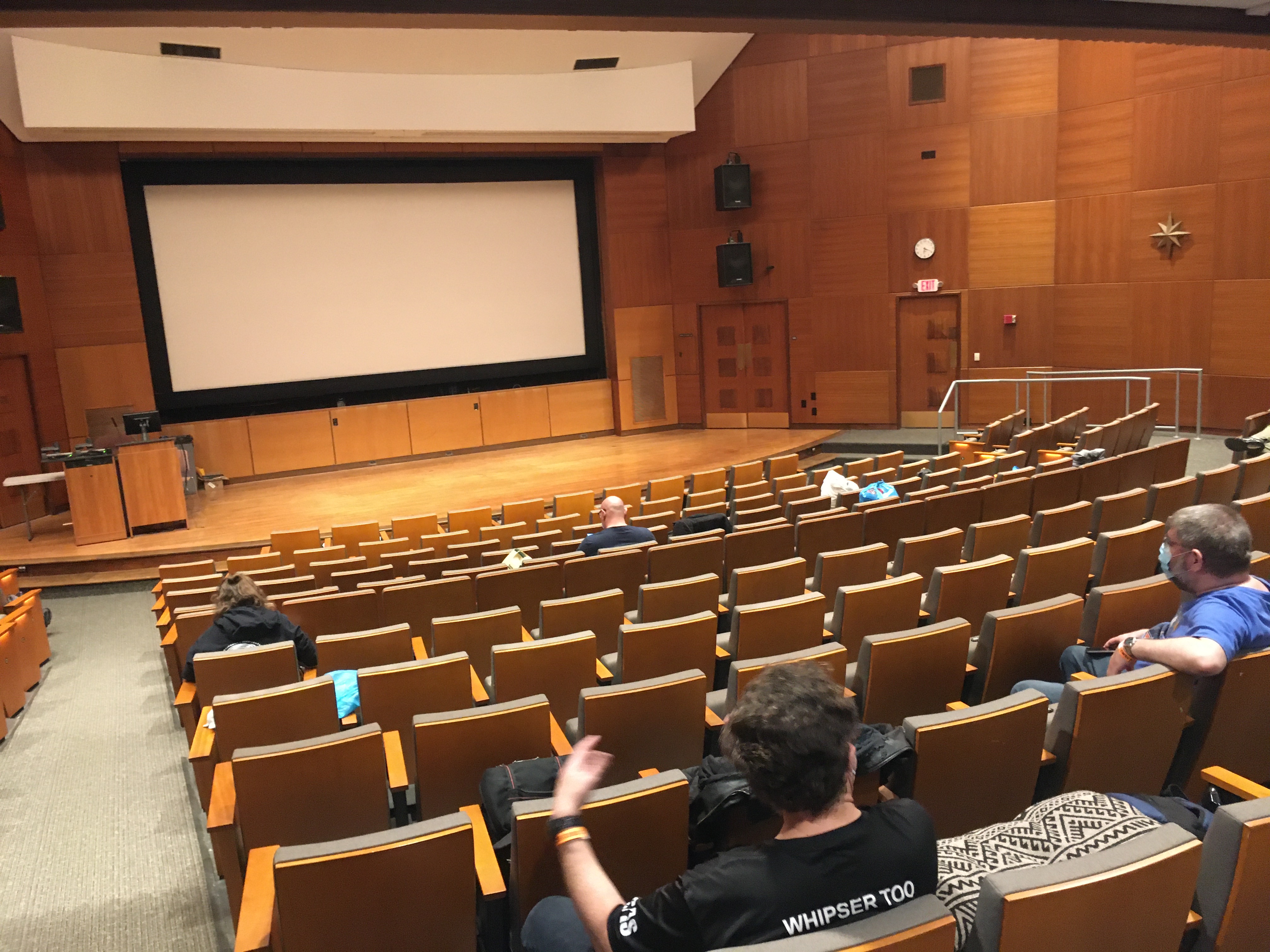
A view of the auditorium Friday afternoon, before most attendees arrived.

Alas, attendance at the sci-fi festival was clearly down from my last appearance here, in January 2020, just before the pandemic took hold. Then, for a screening of 'Aelita, Queen of Mars' (1924), we had to move people (and their sleeping bags) around to make room for my keyboard. This time, there were acres of open space. 

Yes, the pandemic has had an effect. And yes, times are changing. 

A stuffed cat in the Strosacker Auditorium.

But I hope the spirit that's part of the DNA of this festival and similar ones—the sense of wonder and love of cinema that prompted people to create such communal events in the era before VCRs and DVDs and everything-on-demand—will persist as we all march forward. 

Afterwards, I pointed the Subaru Forester east towards Boston, arriving in time (with an overnight stay in Syracuse, N.Y.) for the matinee of 'La Bohème' at the Somerville Theatre.

Silent film on the Somerville's big marquee! 

The screening marked the return of the venue's 'Silents, Please!' series after a long pandemic-induced hiatus. In welcoming back the audience, I recalled how the last silent at the Somerville was on Sunday, March 15, 2020, when the theater screened Rin Tin Tin in 'Clash of the Wolves' (1925) to a smaller-than-usual crowd. 

"I remember at the time talking with Ian Judge, the Somerville's manager, and thinking that this pandemic thing might cause theaters to have to close for as much as two weeks, or maybe even a month," I said, to knowing laughter. 

I also got laughs with an off-the-cuff remark about the music.

"If you're expecting to hear Puccini's immortal music, I'm afraid you're going to be disappointed," I said. "What I do will be mostly improvised, and I'm not Italian, so it wouldn't sound like Puccini even if I tried. I'm Polish and Lithuanian, so I might be able to go for Witold Lutosławski."

Of course it's a real question: for a silent film version of a famous opera such as  'La Bohème,' what role should music play? My answer: same as always. The accompaniment should support the story, the characters, the action, the emotions, the changes of mood, and everything else happening on the screen.

At its best, the music helps a silent film cast a spell on an audience—and that's true for 'La Bohème' as much as any other story. In fact, I think if I did try to channel Puccini, that would only take people out of the on-screen narrative, which would be a distraction.

So I didn't channel Puccini, nor Lutosławski, nor anyone else. I just reached into my own reservoir of strong feelings and emotions and tried to conjure music that helped the film connect. 

As usual, it was a mix of deliberate calculation and in-the-moment reaction. 

Prior to the screening, I had decided an all strings texture was right for this kind of film, which gives audiences a chance to soak in a prolonged emotional bath. 

But for those big moments with Lillian Gish and John Gilbert filling up the screen—where the soaring melody over lush chords came from, I really couldn't tell you.

It certainly wasn't the hotel in Syracuse.

Okay, enough about the road trip. Here's all you need to know about 'Battling Butler' on Wednesday, April 27 at the Flying Monkey. Hope to see you there!

*   *   *

Buster gets physical in 'Battling Butler' (1926).

TUESDAY, APRIL 12, 2022 / FOR IMMEDIATE RELEASE
Contact Jeff Rapsis • (603) 236-9237 • jeffrapsis@gmail.com

Buster Keaton's 'Battling Butler' at Flying Monkey Moviehouse on Wednesday, April 27

Silent film series continues with knockout boxing comedy focusing on the fight game, accompanied by live music

PLYMOUTH, N.H.—He never smiled on camera, earning him the nickname of "the Great Stone Face." But Buster Keaton's comedies rocked Hollywood's silent era with laughter throughout the 1920s.

Acclaimed for their originality, clever visual gags, and amazing stunts, Keaton's films remain popular crowd-pleasers today.

See for yourself with a screening of 'Battling Butler' (1926), one of Keaton's landmark feature films, on Wednesday, April 27 at 6:30 p.m. at the Flying Monkey Moviehouse and Performance Center, 39 Main St., Plymouth, N.H.

Admission is $10 per person. Live music will be provided by accompanist Jeff Rapsis, a New Hampshire-based performer who specializes in creating music for silent film presentations.

'Battling Butler' tells the story of pampered millionaire Alfred Butler (Keaton) who tries to impress the girl of his dreams (Sally O'Neil) by pretending to be a championship boxer with the same name.

The masquerade leads to knockout comedy both in and outside the ring, giving Keaton ample opportunity to display his gifts for physical and visual comedy.

The screening is the latest installment of the Flying Monkey's series showcasing the best films of 1926, all of which entered the public domain on Jan. 1, 2022.

In the 1920s, boxing rivaled baseball as the nation's most popular sport. Neighborhoods, communities, and ethnic groups all rooted for their favorite fighters, and heavyweight champion Jack Dempsey ranked as an international celebrity.

Because of this, boxing stories were popular with early movie audiences as well.

"As an elemental contest between two opponents, boxing inspired early filmmakers to do some great work," Rapsis said. "It's a visual sport that doesn't require a lot of dialogue or commentary to understand, and so was perfect for silent movies."

Keaton, along with Charlie Chaplin and Harold Lloyd, stands as one of the silent screen's three great clowns.

Many critics regard Keaton as the best of all; Roger Ebert wrote in 2002 that "in an extraordinary period from 1920 to 1929, (Keaton) worked without interruption on a series of films that make him, arguably, the greatest actor-director in the history of the movies." But while making films, Keaton never thought he was an artist, but an entertainer trying to use the then-new art of motion pictures to tell stories and create laughter.

All those talents are on display in 'Battling Butler,' which holds the distinction of being the top-grossing title of Keaton's silent features.

Buster on the ropes—literally—in 'Battling Butler' (1926).

The Flying Monkey's silent film screenings provide local audiences the opportunity to experience silent film as it was intended to be shown: on the big screen, in restored prints, with live music, and with an audience.

“These films are still exciting experiences if you can watch them as they were designed to be shown,” said Rapsis, accompanist for the screenings.

“There’s a reason people first fell in love with the movies, and we hope to recreate that spirit. At their best, silent films were communal experiences in which the presence of a large audience intensifies everyone’s reactions.”

The screening of 'Battling Butler' is the latest in the Flying Monkey's series celebrating films that recently entered the public domain.

Copyright protection for all U.S. films released in 1926 expired on Jan. 1, 2022.

To mark the occasion, the Flying Monkey is showcasing vintage 1926 comedies, dramas, and adventure films, all with live music, and all now in the public domain.

Upcoming screenings in the Flying Monkey's "Public Domain Extravaganza" series include:

• Wednesday, May 11, 2022, 6:30 p.m.: "Bardelys the Magnificent" (1926) starring John Gilbert. Gilbert tries his hand at swashbuckling in this big-budget MGM historical extravaganza about exploits of an unjustly disgraced French nobleman. A major film long thought lost until a single print was recently discovered in France.

• Wednesday, June 8, 2022, 6:30 p.m.: "The Black Pirate" (1926) starring Douglas Fairbanks, Sr. The original pirate swashbuckler, with Fairbanks sword-fighting his way through a period adventure tale set during the age of sailing ships.

"By 1926, the movies had matured enough to offer a wide range of great entertainment that still holds up today," Rapsis said. "Come see for yourself as we screen some of the year's best flicks, all of which recently entered the public domain and now belong to us all."

Buster Keaton stars in 'Battling Butler,' to be shown on Wednesday, April 27 at 6:30 p.m. at the Flying Monkey Moviehouse and Performance Center, 39 South Main St., Plymouth, N.H.

Admission is $10 per person. For more info, call (603) 536-2551 or visit www.flyingmonkeynh.com.

Wednesday, December 29, 2021

Announcing the '2022 Mid-Winter Lake Erie Silent Film Tour' in Detroit and Cleveland. Really!

'Spies' (1928), which I'm accompanying at Cinema Detroit on Thursday, Jan. 13.

Yes, really! Order the tour t-shirts before they're all gone.

Seriously: in mid-January, I'll be heading to the other side of the Appalachians to accompany silent film screenings at venues in Detroit and Cleveland. 

Pray for nice weather! Here's the line-up:

On Thursday, Jan. 13, it's Fritz Lang's 'Spies' (1928) at Cinema Detroit, an independent moviehouse in the Motor City.

On Friday, Jan. 14, I'll accompany Raymond Griffith in 'Hands Up!' (1926) and Ernst Lubitsch's 'The Marriage Circle' (1924) at the Cleveland Cinematheque.

And on Saturday, Jan. 15, it's music for 'Der Golem' (1920), the early German thriller that's part of this year's annual 36-hour (yes!) sci-fi marathon at Case Western University, also in Cleveland.

(More details on each screening are in the listings below.)

If you're within canoeing range of Lake Erie, please come join us for what promises to be a feast of worthy cinema. (Yes, I know Detroit isn't technically on Lake Erie, but close enough.)

Raymond Griffith demonstrates some up-to-date dance moves in 'Hands Up!' (1926), which I'm accompanying on Friday, Jan. 14 at the Cleveland Cinematheque.

This excursion represents something of a milestone. It's my first film accompaniment outing beyond New England since the pandemic hit back in March 2020.

And yes, it's all just an excuse for me to dine at L'Albatros in the University Heights neighborhood of Cleveland. Oh my God, the best French restaurant in North America! And probably South America.

Also, while in Cleveland I hope to hear local pianist George Foley and his colleagues play through uptempo 1930s tunes at one of their usual haunts. Nothing makes me happier than this kind of music played live. George, hope to see (and hear!) you.

Back to the movies: it's a great privilege to be hitting the road to do live music for such a strong line-up of titles. 

And in Detroit! And Cleveland! In January! How much glamour is one expected to cope with?

Well—not everyone can make it to the San Francisco Silent Film Festival or to Pordenone. So I'm delighted to help bring the silent film experience to the public in other places.

Many thanks to the venues for inviting me to perform, and for keeping silent film with live music as part of their programming.

A special thank you to the Case Western Reserve University Film Society, which got the ball rolling by agreeing to bring me back two years after I appeared in January 2020, just before the pandemic hit. 

That put me in Cleveland, where John Ewing of the Cinematheque was kind enough to program the Griffith and Lubitsch titles, which had been on the venue's schedule for spring 2020 before everything shut down.

And thanks to Paula Guthat of Cinema Detroit for taking a chance with Lang's sweeping espionage epic 'Spies' (1928), which I love accompanying and always plays like a house afire. People of Detroit: make a point of attending this one!

And I've got to hand it to Paula, as they're really promoting the heck out of 'Spies.' Check out their home page.

Okay, here's a detailed round-up of the "2022 Lake Erie Tour." Attend all four and you'll earn...the satisfaction of beating the odds. Plus I'll save you something from my charcuterie board at L'Albatross.

Until then, I'll be checking the long-term forecast. See you in the Midwest!

Thursday, Jan. 13, 2022, 7:30 p.m.: "Spies" (1928); Cinema Detroit, 4126 3rd Ave., Detroit, Mich.; (313) 482-9028; www.cinemadetroit.com. Tickets $15, $13 for members. Director Fritz Lang's tale of espionage was the forerunner of all movie spy sagas, packed with double agents, hi-tech gadgets, beautiful (and dangerous) women, and an evil genius with a plan to take over the world, mwah-ha-ha-ha! Made immediately after Lang filmed 'Metropolis,' the futuristic classic, with many of the same performers in the cast. Silent film with live music at Detroit's independent movie theater, located downtown in a former furniture store.

Friday, Jan. 14, 2022, 7 p.m.: "Hands Up!" (1926) starring Raymond Griffith; Cinematheque at the Cleveland Institute of Art, 11610 Euclid Ave., Cleveland, Ohio; (216) 421-7450. Uproarious comedy in which a southern spy must work every angle to prevent a shipment of western gold from reaching Union forces. Featuring the sublime pantomime skills of silent comic Raymond Griffith, who really couldn't talk in real life, and so developed a whole repertoire of gestures to communicate—excellent training for silent cinema! Silent film with live music at Cleveland's premier venue for great movies.

Friday, Jan. 14, 2022, 8:45 p.m.: "The Marriage Circle" (1924) directed by Ernst Lubitsch; Cinematheque at the Cleveland Institute of Art, 11610 Euclid Ave., Cleveland, Ohio; (216) 421-7450. It's the World According to Lubitsch: in Vienna, Dr. Franz Braun (Monte Blue) and his wife, Charlotte (Florence Vidor), are exceptionally happy in their marriage until Charlotte's best friend, Mitzi (Marie Prevost), starts flirting with Franz. Mitzi's suspicious husband, Professor Josef Stock (Adolphe Menjou), hires a detective to investigate her infidelities, and the inquiry soon begins to focus on Franz. Silent film with live music at Cleveland's premier venue for great movies.

Saturday, Jan. 15, 2022, approximately 6:30 p.m.: "Der Golem" (1920) at the 47th Annual Sci-Fi Marathon presented by the Case Western Reserve University Film Society, 10900 Euclid Ave., Cleveland, Ohio. Live music for 'Der Golem,' a featured attraction in this year's annual 36-hour (!) sci-fi marathon at Case Western Reserve University in Cleveland, Ohio. In 16th-century Prague, a Rabbi creates a giant creature from clay, called the Golem. Using sorcery, he brings the creature to life in order to protect the Jews of Prague from persecution, but then complications ensue. Early German fantasy movie based on Central European folklore anticipates Frankenstein story.

Monday, October 16, 2017

'Der Golem' (1920): a terrifying film today, but not for the reasons its makers intended

A scene from 'Der Golem' (1920).

Put this one in the category of "aging ungracefully."

It's 'Der Golem' (1920), a German silent film adaptation of the Jewish 'Golem' folk legend.

I'm doing music for 'Der Golem' later this week, at a screening on Thursday, Oct. 19 at 8 p.m. at the Capitol Theatre in Arlington, Mass. (More info in the press release below.)

And it's prompted some thoughts about how the film is indeed scary—but not for the reasons you might think.

Widely regarded as ancestor to the big screen version of 'Frankenstein' (1931), the silent 'Golem' enjoys a reputation as a pioneering horror film.

For those not up on Jewish folklore of 16th century Prague: the film tells the story of a local Rabbi who protects his people from persecution by creating a large soldier-like figure out of clay.

The Rabbi uses sorcery to bring the figure to life—but then things go wrong. Like the monster in Mary Shelley's 'Frankenstein' tale, unexpected consequences ensue.

'Der Golem' features weird expressionist visual designs, so it's always been a good movie for this time of year. It looks like a Halloween film.

But the big reason the film is truly chilling, I think, is how German filmmakers characterized Jews on screen in the decade leading up to Hitler's rise to power in 1933.

Consider: right at the start, the film's prologue repeats the anti-Semitic claim about how Jews were responsible for Christ's suffering and death on the cross.

And in the story, rabbis are depicted as wizards who wear pointy sorcerer hats and who traffic in astrological superstition, concoct magic potions, and have dealings with the underworld.

It's true that in 'Der Golem,' non-Jews don't come off much better: in one scene, crowds of Gentiles openly laugh at the story of Moses leading the Hebrews out of Egypt, which brings down immediate physical wrath.

But it's stunning to see how a film made in Germany at that time could depict Jews essentially as cartoon characters—not quite sub-human, but certainly "different" from the rest of "normal" people.

And to me, it's our knowledge of what would soon happen that makes 'Der Golem' really, really frightening. Watching it, and seeing the wild caricatures baked so casually into it, provides an unintentional first-hand look at attitudes that would fuel the coming Holocaust.

I realize 'Der Golem' was not intended as a propaganda film. Its agenda is not to dehumanize Jews. But that's exactly what makes it so frightening today—knowing what we know now, we see things that are far more telling that anything the filmmakers intended.

And it's really frightening: a vision of evil that shows how real it can be, and also how commonplace.

This is one of the great values of older cinema, I think: its ability to show us first-hand attitudes and ideas of a bygone era.

And one more point: although some may find the characterization of Judaism offensive in 'Der Golem,' that doesn't mean it shouldn't be shown.

On the contrary: nearly a century after its release, 'Der Golem' can help us understand past prejudices, and also help us examine our own times.

Just as the Rabbi breathes life into his clay figure, 'Der Golem' can breathe life into the commonplace nature of prejudice.

With our knowledge of history, we can see how it unknowingly depicts the circumstances and attitudes that would soon lead to one of humanity's worst episodes.

Having said all that, it's still a well-made film and worth catching, especially if you need to jump start your Halloween season.

I'd welcome your own thoughts and comments, either here or in person if you attend our screening this week. Details in the press release below:

* * *

From 'Der Golem': director Paul Wegener, who also plays the title role, encounters a little girl.

TUESDAY, OCT. 10, 2017 / FOR IMMEDIATE RELEASE
Contact Jeff Rapsis • (603) 236-9237 • jeffrapsis@gmail.com

Capitol Theatre to screen early silent horror classic 'The Golem' with live music


Prepare for Halloween with drama about man of clay brought to life; film was forerunner of 'Frankenstein'

ARLINGTON, Mass.—'The Golem' (1920), a German film about a man made of clay and brought to life, will be screened with live music on Thursday, Oct. 19 at 8 p.m. at the Capitol Theatre, 204 Massachusetts Ave., Arlington, Mass.

The film will be accompanied live by silent film musician Jeff Rapsis. Admission is $12 adults, $10 kids and seniors.

In 'The Golem,' set in 16th century Prague, a Rabbi creates a giant human-like figure from clay, called the Golem.

Using sorcery, the Rabbi brings the creature to life in order to protect local Jews from persecution.

But the experiment gets out of hand, with the Golem imperiling the very community he was created to protect.

"Taking in a film such as 'The Golem' is a good way to get in the mood for Halloween," Rapsis said.

'The Golem,' directed by Paul Wegener, uses surrealistic sets and lighting to create an eerie mood. The story is taken from a medieval Jewish legend.

In addition to directing, Wegener appears in the film as 'The Golem' when the clay creature is brought to life.

'The Golem' was sensational upon its release and has left a lasting legacy within the movie industry, alongside another early German expressionist horror film, 'The Cabinet Of Dr. Caligari' (1920).

Architect Hans Poelzig designed the sets, a reproduction of the medieval Jewish ghetto of Prague. He created them specifically for the movie camera, using highly expressionist imagery. The cinematography of Karl Freund, in collaboration with Poelzig and Wegener, is cited as one of the most outstanding examples of German Expressionism of Weimar period cinema.

The film anticipated many subsequent "monster" movies, including the original 'Frankenstein' (1931) starring Boris Karloff.

'The Golem' will be accompanied by live music by Jeff Rapsis, a New Hampshire-based silent film accompanist who performs at venues across the region and beyond.

Using a digital synthesizer to reproduce the texture of the full orchestra, Rapsis will improvise the score on the spot during the screening.

"Films such as 'The Golem' were created to be shown on the big screen and in a theater as a shared experience," Rapsis said. "With an audience and live music, they still come to life in the way their makers intended them to.

"So the Capitol Theatre's silent film screenings are a great chance for people to experience films that caused people to first fall in love with the movies," he said.

'The Golem' is the latest in an monthly series of great silent films with live music at the Capitol Theatre. The series provides local audiences the opportunity to experience silent film as it was intended to be shown: on the big screen, in good-looking prints, with live music, and with an audience.

'The Golem' (1920) will be shown on Thursday, Oct. 19 at 8 p.m. at the Capitol Theatre, 204 Massachusetts Ave., Arlington, Mass.

The film will be accompanied live by silent film musician Jeff Rapsis. Admission is $12 adults, $10 kids and seniors.