Showing posts with label Case Western Reserve University. Show all posts

Sunday, December 7, 2025

Coming up: a slate of pre-holiday silent film screenings, then a road trip to Cleveland

A lobby card for 'So's Your Old Man' (1926), which I'll accompany on Sunday, Jan. 18 at the Cleveland Cinematheque.

Welcome to the holiday preview edition of this blog, in which I try to catch up after several weeks of being just too busy to update it.

First, the big news is that the glamorous showbiz life of a silent film accompanist will take me to Cleveland, Ohio for a pair of screenings in January.

That's right! On Saturday, Jan. 17, I'll accompany the recently restored 'Algol: A Tragedy of Power' (1920) at the 51st Annual Sci-Fi Marathon, staged each year by the Case Western Reserve University Film Society.

Then, on Sunday, Jan. 18, I'll do music at the Cleveland Cinematheque, where they're screening a 35mm print of 'So's Your Old Man' (1926) starring a silent W.C. Fields. 

I encourage my fans in the area to check out both these events. I'm sure we can accommodate all two or three of you. More details of the "Cleveland Mid-Winter Lake Effect Silent Film Victory Tour" (get your T-shirts now!) can be found on my Upcoming Silent Film Screenings page. 

Also, while I'm in Cleveland, I encourage everyone to join me on Saturday, Jan. 17 for an early dinner at 'L'Albatros Brasserie,' my favorite restaurant in the entire Great Lakes basin. It's the not-so-secret reason I'm really making the trip to Cleveland in the dead of winter. 

Not sure of the time but seriously, if anyone would like to join in, email me at jeffrapsis@gmail.com and we'll make it happen.

But before any of that, December brings a bouquet (can you tell I'm already thinking of spring?) of silent film screenings closer to home:

• On Sunday, Dec. 7 (hey, that's today!) at 4 p.m., I'll accompany 'The Man Who Laughs' (1928) at the Natick Center for the Arts in Natick, Mass. More details about that screening are in the press release pasted in below.  

• On Tuesday, Dec. 9 at 7 p.m., I'll do music for a screening of Buster Keaton's great comedy/drama 'Our Hospitality' (1923) at the Coolidge Corner Theatre in Brookline, Mass.

• And on Sunday, Dec. 14 at 2 p.m. it's a holiday-themed program featuring Mary Pickford's 'Tess of the Storm Country' (1922) at the Town Hall Theatre in Wilton, N.H.

Hope you'll be able to make a silent film screening with live music part of your holiday season.

Okay, details of 'The Man Who Laughs' (1928) below. Happy holidays, and to all a 'Silent Night'!

*      *      *

An original lobby card promoting 'The Man Who Laughs' (1928).

MONDAY, DEC. 1, 2025 / FOR IMMEDIATE RELEASE
Contact Jeff Rapsis • (603) 236-9237 • jeffrapsis@gmail.com

'The Man Who Laughs' (1928) to screen with live music on Sunday, Dec. 7 in Natick, Mass.

Creepy silent film thriller anticipated 'Frankenstein' and 'Dracula,' inspired the look of Batman's nemesis 'The Joker'

NATICK, Mass. — Based on a Victor Hugo novel, it paved the way for early horror classics such as 'Dracula' (1931) and 'Frankenstein' (1931).

It was 'The Man Who Laughs' (1928), a silent film thriller that inspired the look of Batman's nemesis 'The Joker.'

The rarely screened film will be shown with live music on Sunday, Dec. 7 at 4 p.m. at TCAN Center for the Arts, 14 Summer St., Natick, Mass.

The screening, the latest in the Center for the Art's silent film series, will feature live accompaniment by Jeff Rapsis, a New Hampshire-based composer who specializes in creating music for silent films.

Admission is $12 per person for members; $14 for non-members. Tickets are available online at www.natickarts.org or at the door.

'The Man Who Laughs,' directed by Paul Leni and starring Conrad Veidt, is a silent thriller about a disfigured man forced to wear an insane grin all his life.

The movie was a popular and ground-breaking silent film adaptation of a sprawling Victor Hugo novel set in 17th century England. 

Veidt stars as Gwynplaine, a child born of English nobility. After his father is executed, a cruel King James II orders a royal surgeon to hideously disfigure young Gwynplaine's face into a permanent smile, so that he may always laugh at his father's foolishness.

Abandoned and shunned, young Gwynplaine is left to make his way on his own. He learns to conceal his face from strangers, befriending Dea, a blind girl who is not aware of his disfigurement.

The pair are then adopted and put to work by a traveling impresario, who makes use of Gwynplaine's startling face in his theatrical productions.

Gwynplaine and Dea grow to adulthood and eventually fall in love, but complications arise when Gwynplaine's noble lineage is revealed, entitling him to his father's estate—provided he marry another woman of noble birth.
 
Conrad Veidt and Olga Baclanova in a scene from 'The Man Who Laughs' (1928).

Veidt, who starred earlier in the German expressionist horror classic 'The Cabinet of Dr. Caligari' (1919), played the role of Gwynplaine by using a prosthetic device inside his mouth to force his face into a hideous grin and display outsized teeth.

This striking look was later adapted by Batman creator Bob Kane as a model for the physical appearance of iconic villain 'The Joker.'

Critics have praised 'The Man Who Laughs' for its dark visual style and daring story content.

"'The Man Who Laughs' is a melodrama, at times even a swashbuckler, but so steeped in Expressionist gloom that it plays like a horror film," wrote Roger Ebert in 2004. "The film is more disturbing than it might have been because of Leni's mastery of visual style."

Director Leni, originally trained as an artist, made ample use of shadows and darkness in 'The Man Who Laughs,' which set the stage for many legendary Universal horror classics soon to follow, including 'Dracula' (1931) and 'Frankenstein' (1931).

'The Man Who Laughs' (1928) will be screened with live music on Sunday, Dec. 7 at 4 p.m. at TCAN Center for the Arts, 14 Summer St., Natick, Mass.

Admission is $12 per person for members; $14 for non-members. Tickets available online at www.natickarts.org or at the door. For more info, call (508) 647-0097.

Wednesday, January 15, 2025

Off to Cleveland to accompany 'The Lost World' at Case Western Reserve's 50th annual sci-fi marathon; then 'Way Down East' in Wilton, N.H.

Original poster art for 'The Lost World' (1925).

This weekend takes me to the fair city of Cleveland, Ohio, where I'll accompany 'The Lost World' (1925) at this year's annual Sci-Fi Marathon at Case Western Reserve University.

It's the 50th annual edition of the Case Western Film Society's marathon, at which diehard movie buffs spend a mid-winter weekend watching sci-fi films of all types 30 to 36 hours non-stop.

And next month, I get to do music for a silent film at a similar event: the Boston Sci-Fi Marathon, also celebrating its 50th year on Presidents Day Weekend at the Somerville Theatre in Somerville, Mass.

The Boston folks have programmed an unusual title this time around: 'Algol: A Tragedy of Power' (1921), a German silent that I've never accompanied before.

I've done films at earlier editions of both marathons. What I love about them is that the audience is always so engaged. They may get into a "Mystery Science Theatre 3000" groove sometimes, but overall you won't find a more enthusiastic crowd than the sci-fi marathon audience.

If you're in the Cleveland area this weekend, I understand the Case Western marathon lets you buy tickets for individual screenings. 

Although I encourage you to take in the experience in its entirety, if you'd like to attend just 'The Lost World,' it's scheduled to run on Saturday, Jan. 18 at 3 p.m. (Start time subject to change due to the ebb and flow of the marathon schedule.)

For more information about attending, check out the marathon's webpage

Looking ahead: after a quiet start to 2025, things perk up with a cluster of screenings in late January and early February. 

I'm accompanying 'Way Down East' (1920) on Sunday, Jan. 26 in Wilton, N.H.; 'Wild Orchids' (1929) on Wednesday, Jan. 29 in Manchester, N.H.; 'Straight is the Way (1921) in Campton, N.H.; 'The Flying Ace' (1921) on Sunday, Feb. 2 in Somerville, Mass.; and 'Nanook of the North' (1922) on Monday, Feb. 3 in Greenfield, Mass.

Hoping for a good turnout for 'Way Down East,' as I've found a crowded theater always helps the Griffith films "click" with modern audiences.

Seen in isolation, the early pioneering features directed by D.W. Griffith really seem to drag. But shown with an audience, they spring to life. 

I think this has something to do with what Griffith did prior to the movies. For many years, he staged and directed melodramas for theatrical troupes that toured through small towns.

Back then, if you didn't entertain people, they'd throw things at you—or worse. So Griffith got very skilled at telling stories that would grab an audience early and then not let go. 

I believe that more than anything else, this was Griffith's superpower: to be able tell a story in such a way that an audience can't stop watching. 

Find out for yourself by being part of the experience when I accompany 'Way Down East' later this month at the Town Hall Theatre in Wilton, N.H. More details in the press release pasted in below.

*    *    *

Original promotional art for 'Way Down East' (1920).

MONDAY, JAN. 6, 2025 / FOR IMMEDIATE RELEASE
Contact Jeff Rapsis • (603) 236-9237 • jeffrapsis@gmail.com

Silent film classic 'Way Down East' at Town Hall Theatre on Sunday, Jan. 26

D.W. Griffith blockbuster starring Lillian Gish, filmed partly in New England, to be screened with live music

WILTON, N.H. — The iconic image of actress Lillian Gish trapped on an ice floe and headed straight for a waterfall will once again fill the big screen when 'Way Down East' (1920) is revived on Sunday, Jan. 26, 2025 at 2 p.m. at the Town Hall Theatre, 40 Main St., Wilton, N.H.

Live musical scoring will be provided by silent film accompanist Jeff Rapsis. Admission is free; donations are accepted, with $10 per person suggested to defray expenses.

The movie, a blockbuster melodrama directed by D.W. Griffith, is set in old-time rural New England, and was partly filmed on location in New Hampshire and Vermont. It stars Gish in an acclaimed performance as a wronged woman trying to make her way in an unforgiving world. Can she find love and redemption, or will she ride to her doom on the raging river's ice floes?

In 'Way Down East,' Gish stars as a poor New England country girl who travels to Boston to visit her rich relatives in the hopes of getting financial help. While there, she's dazzled by upper class society and romanced by a rich womanizer (Lowell Sherman) who takes advantage of her innocence by tricking her into bed with a fake marriage ceremony.

Lillian Gish on the ice-bound Connecticut River in 'Way Down East' (1920).

Convinced she's found the husband of her dreams, Gish returns home to the country, only to be abandoned. She informs her faux husband she's pregnant; he orders her to get an abortion. Instead, Gish goes into exile to have the baby, finds herself persecuted for giving birth out of wedlock, and flees into the rural countryside to seek refuge. The film was noteworthy in its time for addressing such topics as abortion and women's rights.

Modern critics hail 'Way Down East' for Gish's performance, which continues to mesmerize audiences nearly a century after the film's release. "Gish provides an abject lesson in screen acting and brings home the importance and effectiveness of seeing a film in a theater with a crowd," wrote Paul Brenner on www.filmcritic.com in 2007. "If you are not moved at the scene of Gish baptizing her dead baby, then you should check the obituaries of your local paper to see if you are listed."

The film also stars silent era heartthrob Richard Barthelmess. In the film's climax, Barthelmess must dash to rescue Gish from being carried away on the ice floes.

Lillian Gish on location near White River Junction, Vt.

Much of the acclaimed ice floe sequence was filmed in March 1920 on location on the Connecticut River in New Hampshire and the White River in Vermont, as the winter pack ice was breaking up. No process shots or post-production special effects were available to filmmakers at the time, so Griffith and his crew had no choice but to stage and shoot it all on a real river, with the players out on the ice. To get the floes to break up and float down the river, Griffith's crew dynamited pack ice upstream.

Gish later said that she suffered frostbite by following director Griffith's command to always keep one hand in the water during the shooting.

Despite such hardships, 'Way Down East' cemented Gish's reputation as one of the silent era's major stars. Gish would continue to work in films and, later, television, until the 1980s. She died in 1993 at age 99.

Accompanist Jeff Rapsis specializes in creating music that bridges the gap between an older film and the expectations of today's audiences. Using a digital synthesizer that recreates the texture of a full orchestra, he improvises scores in real time as a movie unfolds, so that the music for no two screenings is the same.

"It's kind of a high wire act, but it helps create an emotional energy that's part of the silent film experience," Rapsis said. "It's easier to follow the emotional line of the movie and the audience's reaction when I'm able to follow what's on screen, rather than be buried in sheet music," he said.

Because silent films were designed to be shown to large audiences in theaters with live music, the best way to experience them is to recreate the conditions in which they were first shown, Rapsis said.

"Films such as 'Way Down East' were created to be shown on the big screen to large audiences as a communal experience," Rapsis said. "With an audience and live music, silent films come to life in the way their makers intended. Not only are they entertaining, but they give today's audiences a chance to understand what caused people to first fall in love with the movies."

D.W. Griffith (in bowler hat) directs the cast of his blockbuster melodrama 'Way Down East' (1920).

'Way Down East' was based on a popular stage drama, for which director Griffith paid the then-astounding sum of $175,000 to turn into a movie. The picture proved to be a huge moneymaker, taking in $4.5 million, making it the fourth-highest grossing movie of the silent film era. 

'Way Down East' would be the last of Griffith's great blockbusters; tastes changed as the 1920s rolled on and Griffith's Victorian style fell out of favor. Receipts from 'Way Down East' kept Griffith's studio afloat during a subsequent series of box office flops.

"This picture was a monster hit when it was released," Rapsis said, "and it still holds up well today. As a melodrama, it's a great film for an audience to cheer on the good folks and boo and hiss the bad guys. But there's an additional level of interest now because the film captured a way of life that's long since disappeared."

'Way Down East' will be shown with live music on Sunday, Jan. 26 at 2 p.m. at the Town Hall Theatre, 40 Main St., Wilton, N.H.

Admission is free; donations are accepted, with $10 per person suggested to defray expenses. For more information, call the theater at (603) 654-3456.

Thursday, January 26, 2023

Head to class with Buster Keaton in 'College' (1927), screening Sunday, Jan. 29 in Wilton, N.H.


This weekend, Buster Keaton goes to 'College' (1927), with music by me, on Sunday, Jan. 29 at 2 p.m. at the Town Hall Theatre in Wilton, N.H. 

Don't miss this opportunity to chase away those mid-winter blahs with the silent comic's take on academic life. More info in the press release below.

For now, here's a brief recap on my recent whirlwind road trip last weekend to accompany silent film screenings in Detroit, Mich. and Cleveland, Ohio. 

Last Friday night it was Keaton's 'Battling Butler' (1926) at Cinema Detroit, which welcomed a nearly full house to enjoy Buster's boxing comedy.

In a sonic highlight, I got to use an authentic boxing bell that belongs to Ken Winokur, formerly of the Alloy Orchestra, who loaned it to me for the occasion. Thanks, Ken!

The next day it was off to Cleveland, where I accompanied the 1916 version of '20,000 Leagues Under the Sea' during the annual 36-hour sci-fi marathon at Case Western University.

For once I wasn't the most sleep-deprived person in the room. But actually, the audience was hugely responsive to what must have seemed like an antique curiosity to many viewers. 

By that I mean, the film doesn't exactly show silent cinema at its most eloquent. Alas, it's one of those titles that reinforces the idea of early movies as primitive ancestors of today's visual entertainment.

But it's still worth screening. And it DID keep the sci-fi marathon audience engaged throughout, inspiring shouted comments of the "Time to engage your willing suspension of disbelief!" variety.

Thanks to everyone at Cinema Detroit and the Case Western Reserve University Film Society 

And then it was back home to New England, where this past Monday I accompanied Alfred Hitchcock's early thriller 'The Lodger' (1927) at the Coolidge Corner Theatre in Brookline, Mass.

Which takes us up to the present, where I'm looking forward to accompanying Buster Keaton in 'College' (1927) at the Town Hall Theatre in Wilton, N.H.

Hope you'll enroll. See you at the theater!

*    *    *

Buster Keaton and Anne Cornwall attend 'College' (1927).

MONDAY, JAN. 16, 2023 / FOR IMMEDIATE RELEASE
For more info, contact: Jeff Rapsis • (603) 236-9237 • jeffrapsis@gmail.com

Buster Keaton comedy 'College' with live music on Sunday, 1/29 at Town Hall Theatre

Silent film series continues in Wilton, N.H. theater with screening of timeless classic send-up of campus life

WILTON, N.H.—He never smiled on camera, earning him the nickname of "the Great Stone Face." But Buster Keaton's comedies rocked Hollywood's silent era with laughter throughout the 1920s.

See for yourself with a screening of 'College' (1927), one of Keaton's landmark feature films, on Sunday, Jan. 29 at 2 p.m. at the Town Hall Theatre, 40 Main St., Wilton, N.H.

Admission is free; a donation of $10 per person is suggested to help defray expenses.

The screening will feature live music by silent film accompanist Jeff Rapsis.

'College' follows the story of a hapless university bookworm (Keaton) forced to become a star athlete to win the attention of his dream girl. Can Buster complete the transformation in time to woo her from his rival? And along the way, can he also rescue the campus from sports-related shame?

The film was released in 1927, at the crest of a national fascination with college life. In addition to being a great Keaton comedy, 'College' offers vintage glimpses into what higher education was like nearly a century ago.

Keaton, along with Charlie Chaplin and Harold Lloyd, stands today as one of the silent screen's three great clowns. Some critics regard Keaton as the best of all; Roger Ebert wrote in 2002 that "in an extraordinary period from 1920 to 1929, (Keaton) worked without interruption on a series of films that make him, arguably, the greatest actor-director in the history of the movies."

As a performer, Keaton was uniquely suited to the demands of silent comedy. Born in 1895, he made his stage debut as a toddler, joining his family's knockabout vaudeville act and learning to take falls and do acrobatic stunts at an early age.

A remarkable pantomime artist, Keaton naturally used his whole body to communicate emotions from sadness to surprise. And in an era with no post-production special effects, Keaton's acrobatic talents enabled him to perform all his own stunts, including some spectacular examples in 'College.'

In reviving Keaton's 'College,' the Town Hall Theatre aims to show silent film as it was meant to be seen—in restored prints, on a large screen, with live music, and with an audience.

"All those elements are important parts of the silent film experience," said Rapsis, who will accompany the film. "Recreate those conditions, and classics of early Hollywood such as 'College' leap back to life in ways that audiences still find entertaining."

Rapsis performs on a digital synthesizer that reproduces the texture of the full orchestra, creating a traditional "movie score" sound. He improvises the complete score in real time during the screening.

"Creating a movie score on the fly is kind of a high-wire act, but it can often make for more excitement than if everything is planned out in advance," Rapsis said.

Rapsis encouraged people unfamiliar with silent film to give 'College' a try.

"If you haven't seen a silent film the way it was intended to be shown, then you're missing a unique experience," Rapsis said. "At their best, silent films still connect with cinema-goers. They retain the power to cast a spell, engage an audience, tap into elemental emotions, and provoke strong reactions."

The Town Hall Theatre's silent film series was recently featured in the weekly HIppoPress in a story about discovering life-enriching activities and hobbies.

Buster Keaton's 'College' (1927) will be screened on Sunday, Jan. 29 at 2 p.m. at the Town Hall Theatre, 40 Main St., Wilton, N.H.

Admission is free; a donation of $10 per person is suggested to help defray expenses. For more information, call (603) 654-3456. 


Tuesday, April 26, 2022

To Cleveland and back: 3 days, 5 films, 1,650 miles—and Keaton's 'Butler' on Wednesday, 4/27

Buster shows off an old-time boxing stance in 'Battling Butler.' Get those gloves up, Keaton!

Ding!

Next up is Buster Keaton's boxing comedy 'Battling Butler' (1926), which I'm accompanying on Wednesday, April 27 at the Flying Monkey Moviehouse and Performance Center in Plymouth, N.H.

Hope you'll join us for this screening, part of a series of films released in 1926 that became public domain as of Jan. 1, 2022. 

You the public now own 'Battling Butler.' Aren't you interested in seeing it?

The complete press release with more info is at the bottom of this post. 

For now, a few thoughts about my recent three-day visit to Cleveland, Ohio. (I'd call it a "flying visit" but I actually drove out there and back—about 10 hours each way.)

The reason was the 47th annual sci-fi marathon at Case Western Reserve University, where I accompanied the early German film 'Der Golem' (1920). The festival usually takes place in January, but was postponed this year due to the Coronavirus spike at that time.

It got rescheduled to last weekend, and it worked out that I could get out there as planned. 

I then reached out to the folks at the Cleveland Cinematheque, where I've been privileged to accompany silents, with news that I'd be in town, and so they asked me to do 'Nanook of the North' (1922).

Thus I drove to Cleveland—out on Friday for shows that night at the Cinemathèque, then the next day at the sci-fi festival, then back east to arrive in time to accompany a 2 p.m. screening of the silent 'La Bohème' (1926) at the Somerville Theatre.

Why drive? Because I used my big-ass digital synthesizer at each of the venues, and it's really not practical to put that on a plane. 

Plus, even with gas more expensive and the absurdly high tolls on the New York State Thruway, it's cheaper to drive. That includes wear and tear on my Subaru Forester, which recently passed the 240,000 mile mark.

Plus, if I flew, I could not stop in Erie, Pennsylvania at the one Krispy Kreme donut franchise along the way. 

So it's silent film accompaniment, with a little bit of long haul trucking thrown in. Ah, the glamour of show biz!

The Cinematheque drew a respectable audience for 'Nanook,' for which I used a light texture (mostly harp) for the first 20 minutes but then switched to full orchestral sound for the sea lion hunt and then for the rest of the picture.

'Nanook' was preceded by a Buster Keaton short, 'The Frozen North,' thus creating a theme for the program. I wondered aloud if we should turn up the air conditioning.

As always, John Ewing and Genevieve Schwartz and everyone else at the Cinematheque were terrific hosts. As usual, I took the opportunity (as an outsider) to remind everyone how fortunate Cleveland was to have a theater committed to running such diverse programming all year round.

I had told John about 'Straight is the Way' (1921), the obscure Cosmopolitan Pictures comedy/drama set in my home state of New Hampshire and recently pried loose from the Library of Congress vaults via a Kickstarter project by Ed Lorusso.

So John decided to run it as an unofficial bonus feature following 'Nanook.' Only a few people stayed, but together we witnessed the "Midwest Re-Premiere" of a film that hasn't been seen anywhere for more than a century. 

An unknown film with no one famous in it does not make for great expectations. But once again, 'Straight is the Way' proved moderately entertaining, much to everyone's surprise. So I plan to keep programming it, and say thanks again to Ed L. for making the title available.

As for the sci-fi marathon: what a blast from the past! People getting together for a 36-hour shared experience—a real throwback to the era not just prior to the pandemic, but also before streaming and everything available at any time.

An attendee arrives at the sci-fi marathon with her Mystery Science Theatre 3000 companion. 

While I appreciate the convenience of digital-streaming-everything-on-demand-in-the-comfort-of-your-home-when-you-want-it, I remain a complete slave to cinema as a shared experience.

I think it's the best and most satisfying way to experience cinema, and especially films from the silent era. For me, it's certainly the most rewarding way to accompany them. And personally, I just like it better.  

So it did my heart good to see people fussing over film prints in a projection booth, setting up camp among the seats of Case Western's Strosacker Auditorium, and just generally being enthused at the idea of seeing favorite and not-so-favorite flicks on the big screen.

A peek inside the booth, with impromptu conference in progress.

Getting to be a rare sight: actual cans of actual film!

'Der Golem' was set for Saturday at 4:30 p.m., about halfway through the marathon. I arrived about halfway through the previous film. It was billed as a "surprise" and turned out to be an original 35mm release print of Star Wars (1977), now retitled "Episode 4: A New Hope."

So after readying all my stuff backstage for quick deployment, I went around and took a seat in back to catch the last 30 minutes of this film, which I hadn't seen in decades. Although the print was badly faded, people were into it. People were shouting comments and wisecracks, as often happens in this kind of setting, and which is all part of the fun. 

I then set up for 'Der Golem' and was once again thrilled to hear how good my beat-up Roland speakers sound when placed on the Strosacker's wooden stage. The music just leaps to life. After running through a few chord progressions, I heard someone behind me say, "Awesome!" 

After running through a Koko the Clown cartoon as a warm-up, we went straight into 'Der Golem' and I have to say, everything just fell into place. There was something about the silent image and the live music and that audience that gave everything a majesty and portentousness that otherwise would not have happened. 

Things got especially powerful during the amazing sequence when the Rabbi conjures up evil spirits to find the secret word to bring life to the inanimate. I used a steady 3/4 beat throughout, starting very simply, over which I wove increasingly frenetic figures until finally reaching something like the spirit of Ravel's "La Valse," described somewhere as a dance on the edge of a volcano. 

You could tell there was genuine audience engagement, especially when the creature begins to turn on its creators. Wow! You just can't experience tension, anticipation, and energy like that at home. And 'Der Golem' is a very satisfying film in that respect, as it all gets released in the film's climactic sequence. 

I was gratified to receive a hearty ovation, but gestured to the screen behind me, as that's what it's all about. 

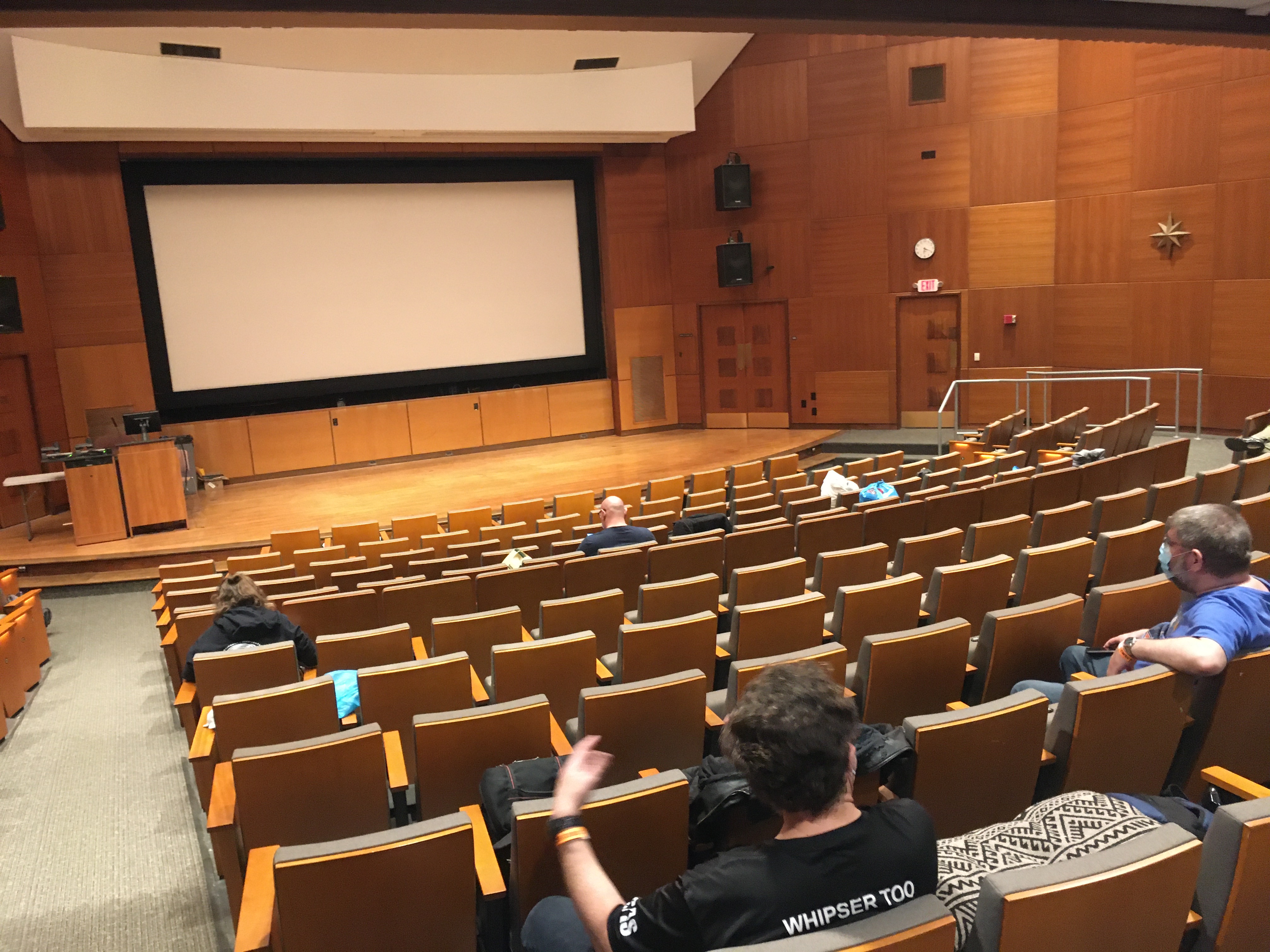
A view of the auditorium Friday afternoon, before most attendees arrived.

Alas, attendance at the sci-fi festival was clearly down from my last appearance here, in January 2020, just before the pandemic took hold. Then, for a screening of 'Aelita, Queen of Mars' (1924), we had to move people (and their sleeping bags) around to make room for my keyboard. This time, there were acres of open space. 

Yes, the pandemic has had an effect. And yes, times are changing. 

A stuffed cat in the Strosacker Auditorium.

But I hope the spirit that's part of the DNA of this festival and similar ones—the sense of wonder and love of cinema that prompted people to create such communal events in the era before VCRs and DVDs and everything-on-demand—will persist as we all march forward. 

Afterwards, I pointed the Subaru Forester east towards Boston, arriving in time (with an overnight stay in Syracuse, N.Y.) for the matinee of 'La Bohème' at the Somerville Theatre.

Silent film on the Somerville's big marquee! 

The screening marked the return of the venue's 'Silents, Please!' series after a long pandemic-induced hiatus. In welcoming back the audience, I recalled how the last silent at the Somerville was on Sunday, March 15, 2020, when the theater screened Rin Tin Tin in 'Clash of the Wolves' (1925) to a smaller-than-usual crowd. 

"I remember at the time talking with Ian Judge, the Somerville's manager, and thinking that this pandemic thing might cause theaters to have to close for as much as two weeks, or maybe even a month," I said, to knowing laughter. 

I also got laughs with an off-the-cuff remark about the music.

"If you're expecting to hear Puccini's immortal music, I'm afraid you're going to be disappointed," I said. "What I do will be mostly improvised, and I'm not Italian, so it wouldn't sound like Puccini even if I tried. I'm Polish and Lithuanian, so I might be able to go for Witold Lutosławski."

Of course it's a real question: for a silent film version of a famous opera such as  'La Bohème,' what role should music play? My answer: same as always. The accompaniment should support the story, the characters, the action, the emotions, the changes of mood, and everything else happening on the screen.

At its best, the music helps a silent film cast a spell on an audience—and that's true for 'La Bohème' as much as any other story. In fact, I think if I did try to channel Puccini, that would only take people out of the on-screen narrative, which would be a distraction.

So I didn't channel Puccini, nor LutosÅ‚awski, nor anyone else. I just reached into my own reservoir of strong feelings and emotions and tried to conjure music that helped the film connect. 

As usual, it was a mix of deliberate calculation and in-the-moment reaction. 

Prior to the screening, I had decided an all strings texture was right for this kind of film, which gives audiences a chance to soak in a prolonged emotional bath. 

But for those big moments with Lillian Gish and John Gilbert filling up the screen—where the soaring melody over lush chords came from, I really couldn't tell you.

It certainly wasn't the hotel in Syracuse.

Okay, enough about the road trip. Here's all you need to know about 'Battling Butler' on Wednesday, April 27 at the Flying Monkey. Hope to see you there!

*   *   *

Buster gets physical in 'Battling Butler' (1926).

TUESDAY, APRIL 12, 2022 / FOR IMMEDIATE RELEASE
Contact Jeff Rapsis • (603) 236-9237 • jeffrapsis@gmail.com

Buster Keaton's 'Battling Butler' at Flying Monkey Moviehouse on Wednesday, April 27

Silent film series continues with knockout boxing comedy focusing on the fight game, accompanied by live music

PLYMOUTH, N.H.—He never smiled on camera, earning him the nickname of "the Great Stone Face." But Buster Keaton's comedies rocked Hollywood's silent era with laughter throughout the 1920s.

Acclaimed for their originality, clever visual gags, and amazing stunts, Keaton's films remain popular crowd-pleasers today.

See for yourself with a screening of 'Battling Butler' (1926), one of Keaton's landmark feature films, on Wednesday, April 27 at 6:30 p.m. at the Flying Monkey Moviehouse and Performance Center, 39 Main St., Plymouth, N.H.

Admission is $10 per person. Live music will be provided by accompanist Jeff Rapsis, a New Hampshire-based performer who specializes in creating music for silent film presentations.

'Battling Butler' tells the story of pampered millionaire Alfred Butler (Keaton) who tries to impress the girl of his dreams (Sally O'Neil) by pretending to be a championship boxer with the same name.

The masquerade leads to knockout comedy both in and outside the ring, giving Keaton ample opportunity to display his gifts for physical and visual comedy.

The screening is the latest installment of the Flying Monkey's series showcasing the best films of 1926, all of which entered the public domain on Jan. 1, 2022.

In the 1920s, boxing rivaled baseball as the nation's most popular sport. Neighborhoods, communities, and ethnic groups all rooted for their favorite fighters, and heavyweight champion Jack Dempsey ranked as an international celebrity.

Because of this, boxing stories were popular with early movie audiences as well.

"As an elemental contest between two opponents, boxing inspired early filmmakers to do some great work," Rapsis said. "It's a visual sport that doesn't require a lot of dialogue or commentary to understand, and so was perfect for silent movies."

Keaton, along with Charlie Chaplin and Harold Lloyd, stands as one of the silent screen's three great clowns.

Many critics regard Keaton as the best of all; Roger Ebert wrote in 2002 that "in an extraordinary period from 1920 to 1929, (Keaton) worked without interruption on a series of films that make him, arguably, the greatest actor-director in the history of the movies." But while making films, Keaton never thought he was an artist, but an entertainer trying to use the then-new art of motion pictures to tell stories and create laughter.

All those talents are on display in 'Battling Butler,' which holds the distinction of being the top-grossing title of Keaton's silent features.

Buster on the ropes—literally—in 'Battling Butler' (1926).

The Flying Monkey's silent film screenings provide local audiences the opportunity to experience silent film as it was intended to be shown: on the big screen, in restored prints, with live music, and with an audience.

“These films are still exciting experiences if you can watch them as they were designed to be shown,” said Rapsis, accompanist for the screenings.

“There’s a reason people first fell in love with the movies, and we hope to recreate that spirit. At their best, silent films were communal experiences in which the presence of a large audience intensifies everyone’s reactions.”

The screening of 'Battling Butler' is the latest in the Flying Monkey's series celebrating films that recently entered the public domain.

Copyright protection for all U.S. films released in 1926 expired on Jan. 1, 2022.

To mark the occasion, the Flying Monkey is showcasing vintage 1926 comedies, dramas, and adventure films, all with live music, and all now in the public domain.

Upcoming screenings in the Flying Monkey's "Public Domain Extravaganza" series include:

• Wednesday, May 11, 2022, 6:30 p.m.: "Bardelys the Magnificent" (1926) starring John Gilbert. Gilbert tries his hand at swashbuckling in this big-budget MGM historical extravaganza about exploits of an unjustly disgraced French nobleman. A major film long thought lost until a single print was recently discovered in France.

• Wednesday, June 8, 2022, 6:30 p.m.: "The Black Pirate" (1926) starring Douglas Fairbanks, Sr. The original pirate swashbuckler, with Fairbanks sword-fighting his way through a period adventure tale set during the age of sailing ships.

"By 1926, the movies had matured enough to offer a wide range of great entertainment that still holds up today," Rapsis said. "Come see for yourself as we screen some of the year's best flicks, all of which recently entered the public domain and now belong to us all."

Buster Keaton stars in 'Battling Butler,' to be shown on Wednesday, April 27 at 6:30 p.m. at the Flying Monkey Moviehouse and Performance Center, 39 South Main St., Plymouth, N.H.

Admission is $10 per person. For more info, call (603) 536-2551 or visit www.flyingmonkeynh.com.

Tuesday, January 21, 2020

Up next: 'Underworld' on 1/23 in Plymouth; plus reports from three unusual recent shows

Evelyn Brent and Clive Brook in 'Underworld.' (1927).

It's one of the great silent dramas: 'Underworld' (1927), the gangster saga directed by Josef von Sternberg.

And I'm accompanying it on Thursday, Jan. 23 at 6:30 p.m. at the Flying Monkey Movie House in Plymouth, N.H.

Besides a small dramatic role by comedian Larry Semon (who would die just one year later), the film features a major part for Clive Brook, one of my favorite silent-era actors.

Brook plays 'Rolls Royce' Wentsel, an alcoholic attorney who becomes sidekick to gangster Bull Weed, played by George Bancroft.

It's a juicy role: a cultured, educated man who finds himself swept up in the world of hitmen and holdups.

It's kind of like the character of Tom Hagan, the "consigliere," that Robert Duvall played to Marlon Brando's Don Corleone in 'The Godfather' (1972).

More about 'Underworld' is in the press release below.

Here's a report on a trio of unusual silent film screenings that filled the recent three-day weekend:

Air mattresses being set up on stage for the 45th Annual Sci-Fi Marathon at Case Western Reserve University in Cleveland, Ohio.

Saturday, Jan. 18: I don't know what you were doing at 7:15 a.m., but I was trying to find a place to park in a snowstorm in the University Heights area of Cleveland, Ohio.

How did I get here? Mostly by Interstate 90 the day before, all in a single gulp from New Hampshire to Ohio. (It's about 10 hours.)

But the larger answer to that question was found in the Case Western Reserve University Film Society's 45th Annual Sci-Fi Marathon, which ran from Friday night into early Sunday morning.

I was there to do music for 'Aelita, Queen of Mars' (1924), an early Soviet fantasy film with sci-fi elements.

I arrived the night before, ending up on completely the wrong end of the beautifully maintained (and vehicle-free) Case Western campus.

But organizer Samuel Ramos was able to guide me by phone through security barriers to Strosacker Auditorium, where regulars were already packing the lobby waiting to get in and claim their turf for the 30-hour event.

Early-bird attendees about to enter Strosacker Auditorium for the sci-fi marathon. Passing through a security check, many with rolling luggage in tow, it was they were boarding an aircraft!

With the house due to open soon, we loaded in and set up my gear in record time. Because I wasn't playing until the next morning, we had to stow the keyboard and speakers backstage, but the trio of projectionists were able to tape down my cabling in place so we'd be ready to go quickly.

I was honored to find a young woman using painter's tape to mark the spot where my keyboard would go, including a big NO for emphasis.

I didn't get her name, but she was a CWRU grad who flew in from Texas each year to join in the marathon.

That's one thing I love about these types of events: they inspire a kind of fanatical devotion and spirit of community among attendees that's very special. No matter what else one does the year-round, when it's time for the CWRU Sci-Fi Marathon (or any other similar event), you know where you belong.

Here's a panorama shot from the stage as attendees began to enter and set up shop. Click to enlarge!


I woke up the next morning to find Cleveland enveloped in snow and sleet. I drove through deserted streets to find the Case Western campus shuttered, with no security people to open the gates. So I parked in a nearby hospital garage (FOR PATIENTS AND STAFF ONLY!) and trudged through the slush to arrive just in time for the 7:30 a.m. screening of 'Aelita,' which is the earliest start time I've ever played.

It was weird to return to an auditorium filled with people who'd been there all night. The sun hadn't actually come up yet, and people asked me not to refer to the actual time or the weather outside because they were still running on the illusion that it was just still kind of a late night.

But off we went, first with a surprise screening of a 'A Trip to Mars,' a 1924 Koko the Clown short cartoon, which got a nice reaction.

An example of Martian fashion in 'Aelita, Queen of Mars' (1924).

Then came Aelita, and when I saw from the titles it was a version that runs a little slow (almost two hours!), I braced myself. Would it be possible to keep a fatigued audience engaged in this esoteric early drama for that length of time?

I'd decided earlier to resist the temptation to use the synthesizer to make "space age" sounds. Instead, I went into my "Rachmaninoff/Shostakovich" mode, which I thought was only appropriate for a Russian film.

The only recognizable tune that got used was the old Czarist national anthem (the one heard in Tchaikovsky's 1812 Overture), which turned out to be exactly right, I felt, for the allegorical rulers/oppressed sequences set on Mars.

For the main character, a radio engineer obsessed with a mysterious signal that might just be from the Red Planet, I came up with a "signal" motif or repeated notes that kept recurring: two notes, three notes, and then four notes. DAH da. Da DAH da. Da DAH da da.

This, and a bunch of other stock themes for characters and situations, all came together to make a very effective score, I thought.

Audience reaction was strong throughout, with lots of shouted comments about the wild plot and strange images. I even got heckled at one big missed cue: a soldier character plays a small accordion on screen a couple of times, and at one point I misjudged when to have that sound ready—and he instead went over and hit a few notes on a piano!

"That's a funny sounding piano!" someone shouted. It sure was! I quickly went back to orchestra.

Gusev the soldier serenades a Martian gal with his pesky accordion late in 'Aelita.' (This time I was ready!)

To my surprise, people really did stay with it, and the film (as often happens) seemed to make a lot more sense in a theater with an audience. It holds up really well, with the only explanatory note necessary for modern audiences is to note that at the time, people with larger homes were compelled by the government to take in other people. All part of the glorious revolution, comrade!

The film ended with a rousing ovation for the accompanist, who couldn't stay because he was due back in New Hampshire the next day for a screening.

With the campus still closed and the snow still flying, I had to finally drive my car down some pedestrian walkways (sorry!) to get the service alley behind the auditorium to load in my gear.

Then off I went for the drive back to New Hampshire, only to find slow going due to the weather, which had shut down portions of the N.Y. State Thruway.

So an unexpected night in Syracuse, N.Y. and then an early morning departure put me back in the Granite State on Sunday in time for a 2 p.m. screening in Warner, N.H.

Warner (N.H.) Town Hall, which doubles as a movie theater.

Sunday, Jan. 19: This event was on behalf of the New Hampshire Telephone Museum ("Where History Talks!"), which this year is pursuing a "Telephone Goes To The Movies" theme.

Sunday's program was a nod to silent comedies that somehow feature the telephone: Harold Lloyd's short 'Number, Please' (1920) and Buster Keaton's feature 'Seven Chances; (1925).

Why 'Seven Chances?' Because the whole plot of the film depends on a missed phone call, plus it has several fun scenes in phone booths and with telephone switchboard operators.

The screening was held in Warner Town Hall, which I'd never been in before but which proved ideal for silent film screenings: wooden floors, great acoustics, a big built-in screen, big but not too big.

Laura French, executive director of the Telephone Museum, greets the audience.

And with the Patriots out of the playoffs, our Sunday afternoon start time attracted a full house, which surprised me for this kind of one-off screening.

One other surprise: as I drove into town on Route 103, a large portable sign used for highway directions had been commandeered to promote "SILENT FILM AND LIVE MUSIC WITH JEFF RAPSIS"' Wow, my name in lights, New Hampshire style! (Also, when I went back afterwards to get a photo, it had already been turned off. Frugality, New Hampshire style!)

Great response to both films, with lots of big laughs in all the right places. Thanks for Laura French and Graham Gifford of the Telephone Museum for organizing a stellar program!

Buster times an egg in 'The Navigator' (1924).

Monday, Jan. 20: And this was followed on Monday night with a screening of two nautical-themed comedies to benefit the Custom House Maritime Museum in Newburyport, Mass.

A silent film program there last year was popular enough for us to try another, this time moved to the nearby (and more spacious) Firehouse Center for the Arts.

On tap (a water reference!) was Buster Keaton's 'The Boat' (1921) followed by 'The Navigator' (1924).

Alas, when we booked this date some time ago, no one realized it was the third day of the three-day weekend caused by the observance of Martin Luther King Jr.'s birthday.

This might have cut into attendance somewhat. But still, about 40 people braved cold temperatures to see Buster on the high seas.

I had a good time doing music for 'The Navigator.' Using a handful of obvious sea-faring melodies (such as "Anchors Aweigh") to set the tone, I was able to build an entire score mostly out of variations of a simple tune that I've been developing as an all-purpose Keaton theme.

For the better part of an hour, the basic material of this melody was transformed in different ways into material that helped underline Buster's routines. Sometimes a graceful waltz, sometimes a steady march, sometimes arrhythmic doodlings — whatever seemed to suit the comedy on screen.

Afterwards, I received the highest complement possible: the museum's director told me for awhile she was so absorbed in the movie, she forgot the music was being made live.

So three days, three screenings in three very different settings, but which all seemed to hold the screen. Accompaniment in the year 2020 is so far off to a good start!

Next up is 'Underworld.' Here's the press release. Hope to see you there in Plymouth, N.H.!

* * *

Original promotional art for 'Underworld' (1927).

TUESDAY, JAN. 7, 2019 / FOR IMMEDIATE RELEASE
Contact Jeff Rapsis • (603) 236-9237 • jeffrapsis@gmail.com

'Underworld' to screen with live music at Plymouth's Flying Monkey on Thursday, Jan. 23


Oscar-winning silent crime drama directed by Josef von Sternberg was forerunner of Hollywood 'gangster' movies

PLYMOUTH, N.H.—'Underworld' (1927), a silent drama that spurred a boom in 'gangster' movies, will be screened with live music on Thursday, Jan. 23 at 6:30 p.m. at the Flying Monkey Moviehouse and Performance Center, 39 South Main St., Plymouth, N.H.

The film will be accompanied live by silent film musician Jeff Rapsis. General admission is $10 per person.

'Underworld,' directed by Josef von Sternberg and starring George Bancroft, is notable for being the first major motion picture to portray a criminal in a sympathetic light instead of as a villain. Its popularity touched off a Prohibition-era boom in Hollywood gangster pictures that reached its peak following the stock market crash of 1929.

The story of 'Underworld' follows gangster Bull Weed (George Bancroft), who becomes entangled in a love triangle involving a reformed drunkard, “Rolls Royce” (Clive Brook) whom he takes on as his right-hand man, and Bull’s girlfriend “Feathers” (Evelyn Brent). Bull Weed's imprisonment leads to a dramatic climax.

Bancroft's performance in 'Underworld' set the stage for memorable characterizations of gangster protagonists by Jimmy Cagney ('Public Enemy,' 1931), Paul Muni ('Scarface,' 1932), and Edward G. Robinson ('Little Caesar,' 1930), which all follow directly on from the model created by 'Underworld.'

The film's script, by Chicago newspaperman Ben Hecht, earned an Oscar for Best Screenwriting at the first-ever Academy Awards. The film is also noted for director von Sternberg's innovative use of black-and-white photography, which presaged many film noir techniques in following decades.

Director Von Sternberg was obsessed by light, and developed methods of “painting” his compositions with the arrangements of lamps, scrims, and reflectors on the set. Today he is remembered most for having used that skill in a series of films he made with Marlene Dietrich, starting with 'The Blue Angel' (1930) and continuing in six more star vehicles made in Hollywood, including 'Morocco' (1930) and 'Shanghai Express' (1932).

A promotional poster for 'Underworld' (1927).

'Underworld' will be accompanied by live music by Jeff Rapsis, a New Hampshire-based silent film accompanist who performs at venues across the region and beyond.

Using a digital synthesizer to reproduce the texture of the full orchestra, Rapsis will improvise the score on the spot during the screening.

"Films such as 'Underworld' were created to be shown on the big screen and in a theater as a shared experience," Rapsis said. "With an audience and live music, they still come to life in the way their makers intended them to.

"So silent film screenings at the Flying Monkey are a great chance for people to experience films that caused people to first fall in love with the movies," he said.

'Underworld' is the latest in an monthly series of great silent films with live music at the Flying Monkey. Upcoming programs include:

Wednesday, Feb. 12, 2020: 'The Navigator' (1924). Buster Keaton sets sail in his classic sea-faring comedy about a spoiled rich couple marooned all alone on a drifting ocean liner.

Wednesday, March 11, 2020: 'Wild Horse Mesa' (1925). Adaptation of Zane Grey novel about a bankrupt rancher who tries trapping wild horses using barbed wire, with unforeseen consequences.

Thursday, April 9, 2020: 'Ben Hur' (1925). In the Holy Land, a Jewish prince is enslaved by the occupying Romans; one of the great early Bibical epics, just in time for Easter!

Thursday, May 7, 2020: 'Why Worry?' (1923). Rich hypochondriac Harold Lloyd gets more than he bargained for on a recuperative visit to a banana republic undergoing revolution.

Thursday, June 18, 2020: Harry Houdini Double Feature. Rare surviving films from the great illusionist's brief movie career: 'Terror Island' (1920) and 'The Man From Beyond' (1922).

'Underworld' (1927) will be shown on Thursday, Jan. 23 at 6:30 p.m. at the Flying Monkey Moviehouse and Performance Center, 39 South Main St., Plymouth, N.H. Admission is $10 per person; for more info, call (603) 536-2551 or visit www.flyingmonkeynh.com.

Monday, January 13, 2020

Three sci-fi marathons in the next two months: Aelita; The Lost World; and Jekyll & Hyde

A scene from 'Aelita, Queen of Mars' (1924), which I'll be accompanying on Saturday morning at the Case Western Reserve University Film Society's annual Sci-Fi Marathon.

They say good things come in threes. And I'm fortunate to be doing silent film music at no less than three different sci-fi marathons in the next few weeks.

Silent film at a sci-fi marathon? Yes! And surprisingly, not one of them is 'Metropolis' (1927), Fritz Lang's famous pioneering epic of the genre.

For those of you keeping score, here's the line-up:

• On Saturday, Jan. 18, I'll accompany for 'Aelita, Queen of Mars' (1924) at the annual Case Western Reserve University Film Society Sci-Fi Marathon, now in its 45th year. For more info: http://films.cwru.edu/sfmarathon45/

• On Sunday, Feb. 16, I'll create music for the John Barrymore version of 'Dr. Jekyll & Mr. Hyde' (1920) at the annual Boston Sci-Fi Marathon at the Somerville Theatre in Somerville, Mass. More info: https://www.bostonscifi.com/

• And on Saturday, March 21, it's music for 'The Lost World' (1925) at the annual 24-Hour Ohio Science Fiction Marathon in Columbus, Ohio. Details: http://www.scifimarathon.com/

I first started playing silent films at sci-fi marathons in 2011, when the long-running Boston Sci-Fi Marathon screened a rare print of the original silent version of '20,000 Leagues Under the Sea.' I was asked to do live music.

The audience discovered a film so strange and old that it seemed new. And I discovered an audience unlike any other I'd played for: one that screamed and hooted and hollered and talked back at the screen and was generally having an all-out love affair with the whole experience.

Since then, I've functioned as the house accompanist for the Boston Sci-Fi Marathon. They don't show a silent every year. But when they do, it's always one of my favorite gigs of the year.

So I'm delighted to now be getting asked to appear at similar festivals, such as the two upcoming marathons in Ohio.

And it makes sense, I think. In an age of everything-instantly-available, the sci-fi marathon endures because it's a group experience that can't be reproduced in the home.

And within that framework, there's definitely a place for silent film with live music.

The next couple of months include other road bookings that'll bring me far from my home base:

• February finds me at the annual Kansas Silent Film Festival in Topeka, Kansas, where I'll score 'Soul of the Beast' (1923), 'The Student Prince in Old Heidelberg' (1926), as well as a passel of shorts. This year's event is Friday, Feb. 28 and Saturday, Feb. 29; it's my 21st consecutive year of attending.

• On Sunday, March 8, I'll travel out to Utica, N.Y., where I'm accompanying the recently restored 'Mothers of Men' (1917) as part of an exhibit on Women's Suffrage at the Munson-Williams-Proctor Arts Institute, a terrific small museum that boasts a solid art collection and innovative programming.

• And Sunday, March 22 finds me at the Cleveland Cinematheque, where I'll do music for Ernst Lubitsch’s 'The Marriage Circle' (1924) and 'Hands Up!' (1926) starring Raymond Griffith. Many thanks to long-time Cinematheque director John Ewing for continuing to include silent film with live music in the programming mix.

See you at the movies—or with all this road time, maybe on the N.Y. State Thruway!