Showing posts with label Cleveland Cinematheque. Show all posts

Sunday, December 7, 2025

Coming up: a slate of pre-holiday silent film screenings, then a road trip to Cleveland

A lobby card for 'So's Your Old Man' (1926), which I'll accompany on Sunday, Jan. 18 at the Cleveland Cinematheque.

Welcome to the holiday preview edition of this blog, in which I try to catch up after several weeks of being just too busy to update it.

First, the big news is that the glamorous showbiz life of a silent film accompanist will take me to Cleveland, Ohio for a pair of screenings in January.

That's right! On Saturday, Jan. 17, I'll accompany the recently restored 'Algol: A Tragedy of Power' (1920) at the 51st Annual Sci-Fi Marathon, staged each year by the Case Western Reserve University Film Society.

Then, on Sunday, Jan. 18, I'll do music at the Cleveland Cinematheque, where they're screening a 35mm print of 'So's Your Old Man' (1926) starring a silent W.C. Fields. 

I encourage my fans in the area to check out both these events. I'm sure we can accommodate all two or three of you. More details of the "Cleveland Mid-Winter Lake Effect Silent Film Victory Tour" (get your T-shirts now!) can be found on my Upcoming Silent Film Screenings page. 

Also, while I'm in Cleveland, I encourage everyone to join me on Saturday, Jan. 17 for an early dinner at 'L'Albatros Brasserie,' my favorite restaurant in the entire Great Lakes basin. It's the not-so-secret reason I'm really making the trip to Cleveland in the dead of winter. 

Not sure of the time but seriously, if anyone would like to join in, email me at jeffrapsis@gmail.com and we'll make it happen.

But before any of that, December brings a bouquet (can you tell I'm already thinking of spring?) of silent film screenings closer to home:

• On Sunday, Dec. 7 (hey, that's today!) at 4 p.m., I'll accompany 'The Man Who Laughs' (1928) at the Natick Center for the Arts in Natick, Mass. More details about that screening are in the press release pasted in below.  

• On Tuesday, Dec. 9 at 7 p.m., I'll do music for a screening of Buster Keaton's great comedy/drama 'Our Hospitality' (1923) at the Coolidge Corner Theatre in Brookline, Mass.

• And on Sunday, Dec. 14 at 2 p.m. it's a holiday-themed program featuring Mary Pickford's 'Tess of the Storm Country' (1922) at the Town Hall Theatre in Wilton, N.H.

Hope you'll be able to make a silent film screening with live music part of your holiday season.

Okay, details of 'The Man Who Laughs' (1928) below. Happy holidays, and to all a 'Silent Night'!

*      *      *

An original lobby card promoting 'The Man Who Laughs' (1928).

MONDAY, DEC. 1, 2025 / FOR IMMEDIATE RELEASE
Contact Jeff Rapsis • (603) 236-9237 • jeffrapsis@gmail.com

'The Man Who Laughs' (1928) to screen with live music on Sunday, Dec. 7 in Natick, Mass.

Creepy silent film thriller anticipated 'Frankenstein' and 'Dracula,' inspired the look of Batman's nemesis 'The Joker'

NATICK, Mass. — Based on a Victor Hugo novel, it paved the way for early horror classics such as 'Dracula' (1931) and 'Frankenstein' (1931).

It was 'The Man Who Laughs' (1928), a silent film thriller that inspired the look of Batman's nemesis 'The Joker.'

The rarely screened film will be shown with live music on Sunday, Dec. 7 at 4 p.m. at TCAN Center for the Arts, 14 Summer St., Natick, Mass.

The screening, the latest in the Center for the Art's silent film series, will feature live accompaniment by Jeff Rapsis, a New Hampshire-based composer who specializes in creating music for silent films.

Admission is $12 per person for members; $14 for non-members. Tickets are available online at www.natickarts.org or at the door.

'The Man Who Laughs,' directed by Paul Leni and starring Conrad Veidt, is a silent thriller about a disfigured man forced to wear an insane grin all his life.

The movie was a popular and ground-breaking silent film adaptation of a sprawling Victor Hugo novel set in 17th century England. 

Veidt stars as Gwynplaine, a child born of English nobility. After his father is executed, a cruel King James II orders a royal surgeon to hideously disfigure young Gwynplaine's face into a permanent smile, so that he may always laugh at his father's foolishness.

Abandoned and shunned, young Gwynplaine is left to make his way on his own. He learns to conceal his face from strangers, befriending Dea, a blind girl who is not aware of his disfigurement.

The pair are then adopted and put to work by a traveling impresario, who makes use of Gwynplaine's startling face in his theatrical productions.

Gwynplaine and Dea grow to adulthood and eventually fall in love, but complications arise when Gwynplaine's noble lineage is revealed, entitling him to his father's estate—provided he marry another woman of noble birth.
 
Conrad Veidt and Olga Baclanova in a scene from 'The Man Who Laughs' (1928).

Veidt, who starred earlier in the German expressionist horror classic 'The Cabinet of Dr. Caligari' (1919), played the role of Gwynplaine by using a prosthetic device inside his mouth to force his face into a hideous grin and display outsized teeth.

This striking look was later adapted by Batman creator Bob Kane as a model for the physical appearance of iconic villain 'The Joker.'

Critics have praised 'The Man Who Laughs' for its dark visual style and daring story content.

"'The Man Who Laughs' is a melodrama, at times even a swashbuckler, but so steeped in Expressionist gloom that it plays like a horror film," wrote Roger Ebert in 2004. "The film is more disturbing than it might have been because of Leni's mastery of visual style."

Director Leni, originally trained as an artist, made ample use of shadows and darkness in 'The Man Who Laughs,' which set the stage for many legendary Universal horror classics soon to follow, including 'Dracula' (1931) and 'Frankenstein' (1931).

'The Man Who Laughs' (1928) will be screened with live music on Sunday, Dec. 7 at 4 p.m. at TCAN Center for the Arts, 14 Summer St., Natick, Mass.

Admission is $12 per person for members; $14 for non-members. Tickets available online at www.natickarts.org or at the door. For more info, call (508) 647-0097.

Saturday, October 1, 2022

Silent Movie Day 2022: On the joys of combining silent film music with long-haul trucking

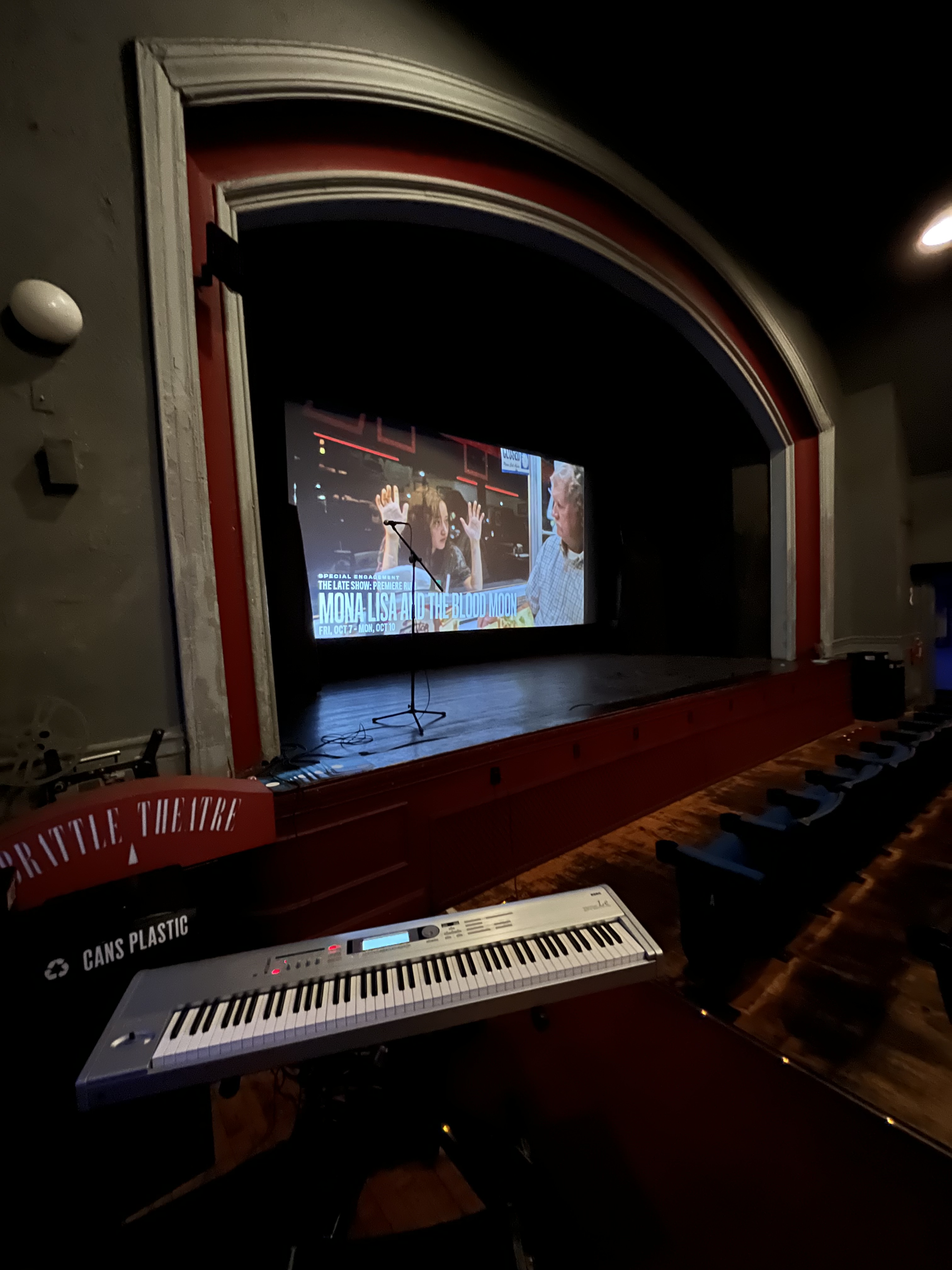
My set-up at the Brattle, just before embarking on a 4½-hour journey with Fritz Lang's 'Dr. Mabuse, Der Spieler.'

Well, that put the "odd" in odyssey!

I'm just back after a silent film swing that took me to screenings in Cambridge, Mass., Detroit and Cleveland, and then back again—all in less than three days.

This was all in support of this year's 'Silent Movie Day' on Thursday, Sept. 29, but which in my case also involved accompanying extra screenings on the days before and after it.

So for me, Silent Movie Day was actually three days in a row, each featuring a BIG (meaning lengthy) title.

First up: On Wednesday, Sept. 28, I left home in New Hampshire at 4 p.m. to make the one hour drive to Cambridge, Mass. 

That evening, the venerable Brattle Cinema (just off Harvard Square) screened Fritz Lang's 'Dr. Mabuse, The Gambler' (1922), the sprawling two-part crime thriller that clocks in at 4½ hours. Yes, I played for it all, starting at 6 p.m. and ending just before 11 p.m.

After that, I loaded my keyboard and sound gear back onto the Forester, then hopped on the Massachusetts Turnpike (a.k.a. I-90) and headed west for Detroit, Mich. Buoyed by a brief catnap at a rest area in Utica, N.Y., I pulled into the Motor City in mid-afternoon.

At Cinema Detroit, where masks are still required out of an abundance of caution.

That night (Thursday, Sept. 29), Cinema Detroit celebrated Silent Movie Day with another sprawling Lang epic, 'Woman in the Moon' (1929), with live accompaniment by me. Clocking in at 2¾ hours, it seemed like a short subject compared to 'Mabuse.'

The next day (Friday, Sept. 30), I backtracked to Cleveland, where that evening I did live music for the the Cleveland Cinematheque's screening of another silent epic: Erich von Stroheim's 'Greed' (1924).

Talk about length! Von Stroheim originally planned an eight-hour running time, and then created a four-our version before the studio finally took it from him and released a version that runs about 2½ hours, which is what we saw at the Cinematheque.

Strangely, at that length, 'Greed' turned out to be the shortest feature of the trip.

Also on the bill at Cleveland: a newly discovered industrial promotion film, 'The Heart of Cleveland' (1924), a half-hour commercial for the wonders of electricity that was filmed and shown in the city. 

What a surprise! Featuring shots of a family touring giant industrial facilities, it anticipated Dziga Vertov's 'Man With The Movie Camera' by several years. More on the film (and a link to the video) is here

The Cinematheque audience just before Friday night's screenings. Taken from the keyboard with the fisheye lens on my new iPhone 13.

Afterwards, I loaded my gear and pointed the Forester east on I-90 to take me back home via the N.Y. State Thruway. After a brief catnap (again in Utica, N.Y.), I arrived home at 10:30 a.m.—exactly 66½ hours and 1,705 miles later.

Out of those 66½ hours, I was at the keyboard improvising music for more than 10 of them. That's a lot of music to spin out in live performance over three days. 

The only concession to the sheer quantity of scoring needed was that I allowed myself to use some common motifs that worked for all three films. Usually I'd try to avoid recycling material,

What motifs? The most common was a simple sequence of three descending notes: D, C#, G, with the last being held. You can build amazing things with this! (Only now do I realize it's a slight twisting of the opening notes of Rachmaninoff's very familiar 'Prelude in C# minor.')

Okay, now for the big question: Why do a stunt like this? Why combine silent film accompaniment with the romance of long-haul trucking?

Well, partly to challenge myself, and to see if I really could do it. Did I have the mental and physical stamina to get through this marathon?

Turns out I did, mostly. Only twice did I catch myself going into a mild "swoon" state on the piano bench: once near the start of Part II of 'Dr. Mabuse' (about three hours into the movie), and then near the end of 'Greed.'

Both times I felt a wave of wooziness wash over me, and so did a mental check to make sure it wasn't the symptom of some larger Fred-Sanford-like attack coming on. ("It's the big one, Weezy, I'm coming to join yez!") 

In both cases, while being so absorbed in creating music, I had apparently stopped breathing. So I began breathing again, and all was well.

Otherwise, everything about this escapade fell into place quite nicely. No giant traffic delays, no car troubles, no unexpected weather.

The main cast of Fritz Lang's lunar voyage epic, 'Woman in the Moon' (1929).

The only concern came at Cinema Detroit, where the heat was cranked up prior to 'Woman in the Moon,' making the house way to warm for me to survive 2¾ hours in live improv mode. 

I was preparing to strategically disrobe if necessary, but they turned off the heat before the show started and all went fine.

Another reason to do this was to take advantage of 'Silent Movie Day' (which only started last year) to engineer something of a deep dive for myself: to do music for a series of longer films to see how that would affect the music-making, if at all.

I find a longer film of any type often affords enough running room to thoroughly explore whatever musical material I'm working with. With films that run two, three or four hours, you do things that just aren't possible with a film that runs an hour and change. 

Counter-intuitively, I find shorter films far more demanding to score effectively, as everything's more tightly wound, especially with comedies. Often there's just no slack to lose yourself and come up with natural and effective scoring, at least the way I do it.

Talk about trances: a scene from 'Dr. Mabuse, Der Spieler.'

So my mini-marathon of 10 hours was a chance to push myself as deeply as one can go into the wide open spaces of improv. And it did just that: near the end of Part 1 of  'Mabuse,' I was so completely absorbed when I realized I had no idea what the actual time was.

The Brattle has a wall clock up above where I was sitting, so I glanced up and saw: 8:35 p.m. So something like half-way through, with hours still to go. And I then dove back into the trance-like state, once again completely absorbed in translating images into music to help the film cast its spell.

I can't speak for other accompanists, but I love those rare times when a movie absorbs you so completely that you lose sight of the beginning and the end. You always know they're there, of course, but the movie is so big that both start and finish lie well beyond the horizon. 

It's those times when I feel free to do what I think is my best work—where all the second-guessing subsides and the music flows naturally, as if in a dream. It's always underpinned by constant calculating and anticipation and so on, but all that becomes second nature in a way that never happens when you're playing, say, a one-reel Snub Pollard comedy. 

So in terms of losing myself, I have to say I got ample doses of that with all three films. But 'Mabuse' stands out as unique, in that the sheer quantity of time to be playing live, and then knowing that I would launch myself westward in the wee hours of the morning, creating a sense of being alive and in the moment that made 'Silent Film Day' worth all the effort. 

A scene from 'Dr. Mabuse, Der Spieler.'

Audiences were generous with their reactions both during the screenings and afterwards. The Brattle Mabuse marathon attracted about 35 people (more than expected) who were welcomed by creative director Ned Hinkle as the "hard core."

Ned mentioned that he'd wanted to program the whole Mabuse saga in one big gulp, and the film's 100th anniversary plus Silent Film Day seemed to be the right occasion for it. 

However, at first he hadn't considered live music because he couldn't imagine anyone wanting to tackle the whole thing in one evening. Little did he know!

As far as I could tell, everyone at the Brattle stayed to the end, at which point they lustily cheered the film. In fact, we seem to have ended with significantly more people than when we started. 

Afterwards, I spoke with several people who had no idea they were in for such a long haul. It's one thing to see "270 minutes" in the listing, but quite another to do math.

I also talked with a young guy who turned out to be a visiting student from China who'd been in the U.S. for all of three weeks. He could not be more enthusiastic about the programming at the Brattle, which he's apparently attended every evening since his arrival.

I was glad to hear this, but couldn't help thinking he's not quite getting a very accurate impression of life in America.

At Cinema Detroit, a good-sized crowd remained engaged and reacted noisily throughout 'Woman in the Moon.' A high point was when the Walter Turner character played by Fritz Rasp does his "quick change" into another character and back again right before our eyes, which produced bursts of astonished laughter.

I think one thing that helped was that for the first time ever, I had a distinct musical signature for this character that I used only when he was on screen, and then never again except for that one moment when he reappears as if by magic. 

With its one-of-a-kind mix of prescient sci-fi and completely erroneous assumptions about space travel, 'Woman in the Moon' produced the "gaping mouths" reaction that only it can do. 

The one thing I forgot to mention beforehand was that although the film is a serious drama, it contains a great deal of comedy that was intended to break the tension. For modern audiences who often don't know what to make of what they're seeing, it helps to give people permission to laugh.

But the Cinema Detroit audience seemed to get this without any prompting. Several big laugh moments stand out in my mind as highlights of the communal experience.

In Cleveland, 'Greed' attracted something like 80 people, which Cinematheque director John Ewing observed was the largest in-person attendance of any screening since the pandemic. 

(That's John at left, at the podium, which renders him invisible where I sit below at the keyboard.)

Fortified by a meal at 'L'Albatross,' my favorite restaurant in all of North America (no kidding!), and knowing I was in the home stretch of my marathon, I pushed myself to rise to the challenge of scoring von Stroheim's legendary lost masterwork. 

And that's all I remember. Well, not really, but kinda sorta. It takes awhile to awaken from that dream state.

The next thing I knew, I was on I-90, heading east through Ashtabula, Ohio, and wondering if it had all been a dream. In other words, success!

Many thanks to the many people who made this Silent Movie Day oddysey possible, especially Ned Hinkle and Ivy Molan of the Brattle Cinema in Cambridge, Mass.; Paula and Tim Guthat at Cinema Detroit; and John Ewing and Genevieve Schwartz at the Cleveland Cinematheque. 

(And a special thanks to Genevieve for joining me on the L'Albatross pilgrimage, which included visiting a side street paved with wood.)

All of these people remain willing to include silent film with live music as part of their programming—not just on Silent Movie Day, but at any time. I think that's something worth celebrating all year long.

Well...after a phenomenally busy September full of challenging live performances, I'll be taking a bit of a break now. As I said earlier this month to the audience after doing live music for Louis Feuillade's 'Les Vampires' (1915), which is 7½ hours long: "I'm going to lie down now."

But look out, as here comes Halloween! This year's schedule is highlighted by numerous screenings of 'Nosferatu' (1922) to mark the 100th anniversary of its release.

There's also a rare three-screenings-in-one-day on Saturday, Oct. 29, when I'll do 'Nosferatu' in the afternoon in Jaffrey, N.H., then 'Der Golem' in the evening in Ogunquit, Maine, and then a midnight screening of the reconstructed 'London After Midnight' at the Coolidge Corner Cinema in Brookline, Mass. 

One day, three screenings, three states. 

Anyone want to book a morning screening in Rhode Island that day to make it four?

If we start at 6 a.m., we can fit in the entire 'Dr. Mabuse' saga, with plenty of time for lunch...

Friday, September 23, 2022

New on the schedule: 'Dr. Mabuse' epic on Wednesday, Sept. 28 at the Brattle Cinema

Rudolf Klein-Rogge stars as the title character in Frtiz Lang's 'Dr. Mabuse, The Gambler' (1922).

Greetings from Iola, Kansas, where I'm looking forward to this weekend's 'Buster Keaton Celebration.' More about that in just a bit.

Right now, I'm super-excited to announce that a last-minute addition turned this year's 'Silent Film Day' (coming up on Thursday, Sept. 29) into something of an event for this accompanist. 

Just yesterday, the venerable Brattle Cinema in Cambridge gave the go-ahead to add live music (by me) to their planned screening of 'Dr. Mabuse, the Gambler' (1922) on Wednesday, Sept. 28.

Yes! I was hoping they would, as Fritz Lang's first 'Mabuse' is rarely programmed (one reason: it's 4½ hours long!) and the chance to do live music for it is a rare opportunity for an accompanist.

But the call has come, and thus I'm spreading the word to one and all: join us on Wednesday, Sept. 28 at 6 p.m. (note the early start time) for a cinematic experience you will not forget. 

The full press release for the 'Dr. Mabuse' screening is pasted in below. There's a lot about this film that I find fascinating, and I hope you'll be on hand at the Brattle to experience it as intended: in a theater, on the big screen, with live music, and (most importantly!) an audience. 

 And 'Dr. Mabuse' is added to a 'Silent Movie Day' performance schedule that finds me at Cinema Detroit the very next day to do live music for another great Lang epic: 'Woman in the Moon' (1929). It's known as 'Frau im Mond' in German, as in the poster at right.

And at just 2¾ hours, it's a relative trifle compared to 'Mabuse.' 

Actually, it's another terrifically ambitious movie that will blow the minds of people who have not yet seen it. And it's full of wonderful opportunities for music to augment the story and add to the experience. The screening starts at 7 p.m.

And after that, on Friday, Sept. 30, I'm at the Cleveland Cinematheque to do music for Erich von Stroheim's legendary epic 'Greed' (1924), which the director planned to run 8 hours before the studio took control and cut it down to a more manageable 2½ hours. 

(Various edits and reconstructions of 'Greed' have been produced over the years. The version being shown in Cleveland runs a tight 109 minutes.)

Gilbert Gowland (center) stars in 'Greed' (1924).

The Cinematheque screening also includes a local curiosity: 'The Heart of Cleveland, a recently rediscovered silent promotional film in which some 1920s farm children living without modern conveniences outside of Cleveland travel to the big city to learn what electricity can do.

The Cleveland "re-premiere" of 'The Heart of Cleveland' starts at 6:30 p.m., with 'Greed' to follow at 7 p.m. 

You know your doing your part to honor Silent Film Day when, over three days, the shortest film you're accompanying is von Stroheim's 'Greed.'

So that's the news from Iola, where tomorrow I'll accompany two Keaton features: 'The Cameraman' (1928) and 'Steamboat Bill, Jr. (1928). If you're in the southeastern Kansas area, stop by! If you're anywhere else, you have a whole day to get here!

Here's the press release for the screening of 'Dr. Mabuse, Der Spieler' (1922) on Wednesday, Sept. 28, at 6 p.m. at the Brattle:

*   *   *

Pick a disguise: the many faces of Dr. Mabuse.

FRIDAY, SEPT. 23, 2022 / FOR IMMEDIATE RELEASE
Contact Jeff Rapsis • (603) 236-9237 • jeffrapsis@gmail.com

Live music added to Brattle Cinema's 9/28 screening of early epic thriller 'Dr. Mabuse'

Pioneering four-hour silent drama about criminal mastermind to run on Wednesday, Sept. 28 in honor of 'Silent Film Day'

CAMBRIDGE, Mass.—It's a story so big, it takes more than four hours to tell.

It's 'Dr. Mabuse, the Gambler,' a landmark crime thriller that pushed the boundaries of cinema and story-telling when it hit theaters in 1922.

The rarely screened early masterpiece from German director Fritz Lang will be presented at the Brattle Cinema on Wednesday, Sept. 28 starting at 6 p.m.

Admission is $14 per person; $12 for members, seniors, children, and students.

An original improvised musical score for 'Dr. Mabuse' will be performed by silent film accompanist Jeff Rapsis of Bedford, N.H.

"Live music makes any screening of a silent film a one-of-a-kind event," said Rapsis, who will play continuously during the four-hour-plus epic.

Rapsis aims to use music to bring out the story's many shifts and turns, and also enhance the dark atmosphere that permeates Lang's sprawling film.

The Brattle has scheduled 'Dr. Mabuse' as part of a three-day observance of this year's Silent Film Day, which falls on Thursday, Sept. 29.

Other screenings include a program of short comedies starring Buster Keaton on Thursday, Sept. 29 and the early horror classic 'Nosferatu' (1922) on Friday, Sept. 30.


'Dr. Mabuse' was a daring project by director Fritz Lang, who would later helm 'Metropolis' (1927) and a host of early screen classics, including two sequels to the Mabuse story.

Based on a contemporary novel by Norbert Jacques, 'Dr. Mabuse' (pronounced "ma-BOO-seh") tells the story of a criminal mastermind who uses disguises and hypnosis to defraud and control his wealthy victims.

Set in Germany after World War I, the movie aimed to capture the chaotic and unreal nature of life in Berlin at the time.

It also became the template for the criminal espionage film genre, with its atmosphere of intrigue, treachery and deceit among sophisticated high society.

'Dr. Mabuse' was created at a time when European cinema was not subject to now-accepted constraints of length or scope.

Lang's completed film runs an extraordinary 4½ hours and is divided into two parts.

The first part, 'The Great Gambler: A Picture of the Time,' introduces Dr. Mabuse and his criminal enterprises, which include extortion, stock market manipulation, and swindling the wealthy elite.

The second part, 'Inferno: A Game for the People of our Age,' continues the story, which includes assassination, a scene of mass hypnosis in a theater, a daring escape through sewers, and a melodramatic climax.

"This is filmmaking on a grand scale," said Rapsis, who will improvise a musical score using new material he's composed for the Brattle screening. .

"For movie fans, the rare chance to see Lang's ground-breaking film on the big screen with live music is not to be missed."

'Dr. Mabuse' stars actor Rudolf Klein-Rogge in the title role. Klein-Rogge frequently collaborated with Lang, playing the iconic role of scientist Rotwang in 'Metropolis' and criminal mastermind Haghi in Lang's 'Spies' (1928).

During production, 'Dr. Mabuse' had its share of behind-the-scenes drama. Lang began an affair with screenwriter Thea von Harbou, who at the time was married to Klein-Rogge. Her separation from Klein-Rogge was amicable, however, and did not interfere with the film. Ultimately, Lang married von Harbou; the three then worked on several subsequent films.

Upon its release, critics hailed 'Dr. Mabuse' as an example of cinema's story-telling and artistic potential.

The Berliner Zeitung called the first part "the attempt to create an image of our chaotic times" and went on to state that it "will give people fifty or one hundred years from now an idea of an age that they could hardly comprehend without such a document."

Film-Kurier praised Klein-Rogge's "brilliant performance" and Lang's "sensitive yet experienced" direction.

'Dr. Mabuse' wasn't released in the United States until 1927, and then only in an edited-down two-hour version that proved unsuccessful.

Today, contemporary critics recognize the original 'Dr. Mabuse' as Lang's earliest masterpiece and a lasting achievement.

"Mabuse remains memorable for the darkly brooding atmosphere that Lang creates, a disturbing compound of hysteria and fatalistic passivity.”
– John Wakeman, World Film Directors Volume 1.

Both parts of 'Dr. Mabuse, The Gambler' (1922) will be shown on Wednesday, Sept. 28 at 6 p.m. at the Brattle Cinema, 40 Brattle St., Cambridge, Mass. (Please note the early start time.)

Admission is $14 per person; $12 for members, seniors, children, and students. To buy tickets online, visit www.brattlefilm.org or contact the box office at (617) 876-6837.


Monday, January 17, 2022

Coming Sunday, 1/23: 'Nanook of the North' (1922), plus report from Detroit and Cleveland

'Spies' (1928), which received a memorable screening on Thursday, Jan. 13 at Cinema Detroit.

Just returned to home base in New Hampshire after a road-trip that took me 1,775 miles to performances in Detroit and Cleveland. 

Right now I feel more like a long-haul trucker than a silent film accompanist!

But the trip was well worth it, as each show was successful on several fronts.

Congrats to Cinema Detroit and the Cleveland Cinematheque for bringing their audiences the experience of silent cinema with live music.

And thanks to their audiences for coming out (during the recent pandemic spike, no less) in numbers healthy enough to make the whole effort worthwhile.

In Detroit, an audience of about 40 people turned out for Fritz Lang's espionage epic 'Spies' (1928), which just one person in the group had ever seen before. 

And that one person, a true Lang devotee, had never seen it in a theater with live music. 

So that's why he flew all the way from New York City just to experience it on the big screen, thus easily taking the "traveled the farthest" prize. (Not including the accompanist.)

Paula and Tim Guthat of Cinema Detroit pitched 'Spies' as an alternative to Lang's much-better-known 'Metropolis' (1927), which they feel has frequent screenings has rendered over-familiar, overshadowing his other work of the period.

I think they have a point. And Lang pulled through, with 'Spies' holding the screen for 2½ hours without a single person leaving. 

One reason for this is that 'Metropolis' and 'Spies' and another sprawling Lang late silent, 'Woman in the Moon' (1929), all share a common feature. 

Each is about very different things, but underneath they're all old-fashioned melodramas.

Yes! Despite their surface differences, each is driven by a pot-boiling page-turning barn-burner of a story. And like the D.W. Griffith epics, the narrative pulls the audience through. The story is structured so that you simply must keep watching. You can't help it. 

That's what happened last Thursday night (Jan. 13) at Cinema Detroit. You could tell—people were hooked. That, coupled with Lang's incredible visual story-telling, made for a memorable evening in a darkened theatre.

It went so well, the Guthats are thinking about screening another lesser-known Lang, such as the aforementioned 'Woman in the Moon.' I hope they do! 

Why? Not just because I would love to do music for it (although that's one reason), but also because the Lang pictures are great examples of films that really must be seen in a theatre with an audience for it to have its full effect. 

It was the same thing the next evening (Friday, Jan. 14) in Cleveland. 

Raymond Griffith shows off some dance steps in 'Hands Up!'

At the Cinematheque, a 35mm print of Raymond Griffith's 'Hands Up!' (1926) was greeted with continuous laughter right from the start. As with most silent comedy, being part of an audience that's enjoying the on-screen action gives you permission to laugh as well.

And if all goes well, you might just get that wonderful spontaneous combustion of laughter that's one of the great glories of the silent cinema, even today. 

And that's what we got at the Cinematheque. Once Griffith taught a tribe of Native Americans to forsake their wardance for the Charleston, there was no turning back. 

This was followed by a quieter but no less appreciative response for a screening of Ernst Lubitsch's 'The Marriage Circle' (1924), which I'd never accompanied before. 

In this case, I think audience members don't expect to find this kind of polished and sophisticated society comedy in silent pictures. For most people, silent comedy = Buster Keaton or the Keystone Cops.

But there it was! Long before Hollywood began cranking out so-called "screwball" comedies in the 1930s, it was producing polished society farces in quantity, starring the likes of Ronald Colman or (in 'The Marriage Circle') Adolphe Menjou. 

They just didn't have dialogue. But that didn't stop talented performers such as Colman or Menjou from saying all they needed via facial expressions, gestures, pantomine, and the artfully turned head or raised eyebrow. (And the occasional craftily-written intertitle.)

Both venues, by the way, were closed for 16 months (16 months!) starting in March 2020 at the pandemic's onset. Can you believe it?

That both endured the prolonged closure, and are now riding out the current surge with creative programming that includes silent pictures with live music, gives me a lot of confidence.

In an age where new options such as in-home streaming are gaining in popularity, I feel sure that as long as we have cinema, there will be an audience for motion pictures to be shown in a theater.

By the way, the reason I drove out there (rather than flew) is that for these performances I used my Korg digital synthesizer, which isn't exactly air-travel-friendly even with its sturdy (but monstrously heavy) carrying case.

And there's all the sound equipment and cabling I lug around. It's nothing I can't fit into my Subaru Forester with room to spare, but a LOT to send through the nation's air transport system. 

More to come, including a screening of 'Nanook of the North' later this month at the Town Hall Theatre in Wilton, N.H. to celebrate the 100th anniversary of the film's release. 

The film is showing on Sunday, Jan. 23 at 2 p.m. More info in the press release below. 

And there will be cake! 

*  *  *

A vintage poster for the documentary 'Nanook of the North' (1922).

MONDAY, JAN. 10, 2022 / FOR IMMEDIATE RELEASE

Contact Jeff Rapsis • (603) 236-9237 • jeffrapsis@gmail.com

Pioneering documentary 'Nanook of the North' to screen at Wilton Town Hall Theatre

Ground-breaking silent film to be shown with live music on Sunday, Jan. 23 to celebrate 100th anniversary of release

WILTON, N.H.—It's hailed as one of the first films to show the potential of the movie camera to take audiences to distant lands.

It's 'Nanook of the North' (1922), a ground-breaking movie about life among Eskimos above the Arctic Circle, to be screened on Sunday, Jan. 23 at 2 p.m. at the Town Hall Theatre, 40 Main St., Wilton, N.H.

Admission is free, with a suggested donation of $10 per person to help cover expenses.

The classic silent documentary will be shown with live music by silent film accompanist Jeff Rapsis.

Director Robert Flaherty’s film tells the story of Inuit hunter Nanook and his family as they struggle to survive in the harsh conditions of Canada’s Hudson Bay region.

Remarkably matter-of-fact in its depiction of the everyday struggle to stay alive in the Arctic hinterlands of Canada’s Hudson Bay, 'Nanook of the North' shows Flaherty’s interest in his Inuit subjects in each carefully framed shot.

'Nanook' was completed only after film from a previous expedition caught fire and was destroyed. Flaherty had to repeat his entire visit to the frozen north to reshoot the movie.

'Nanook' unfolds as a series of long takes interspersed by occasionally poetic intertitles, all of which serve to highlight seemingly mundane tasks required for survival in the frigid terrain.

Beyond its educational function, though, Flaherty’s profoundly empathetic intimacy with his subjects—the resilient, prodigious seal-and-walrus-hunter Nanook and his weathered clan—heightens what seems on the surface to be merely a dry informational pamphlet.

A scene from 'Nanook of the North' (1922).

To make the film, Flaherty built an ad-hoc film processing lab in the challenging Arctic conditions and trained his Inuit friends to be his technicians.

Immersed in the culture for over two years, Flaherty embraced the new art form as a way to show modern audiences that without all the complications and trappings of modern civilization, lives could be happily lived—even under nature’s harshest conditions.

Enormously popular when released in 1922, 'Nanook of the North' is a cinematic milestone that continues to enchant audiences.

In 1989, 'Nanook of the North' was one of the first 25 films to be selected for preservation in the U.S. National Film Registry by the Library of Congress as being "culturally, historically, or aesthetically significant."

The screening is part of the Town Hall Theatre's ongoing series honoring the 100th anniversary of significant motion pictures that debuted in 1922.

Programs will include all of 1922's five highest-grossing titles, each shown on the big screen with live music, as well as century-old oddities, short films, cartoons, and more.

"Putting these films back on the big screen is a great way to celebrate the 100th anniversaries of some terrific motion pictures," said Rapsis, the silent film accompanist who will create live music for all screenings.

"These are films that set the standard for Hollywood, and still retain their power to entertain, especially when shown in a theater with live music and an audience," Rapsis said.

Upcoming programs in the Town Hall's 100th anniversary series include:

• Sunday, Feb. 6, 2022 at 2 p.m.: Rudolph Valentino in 'Blood and Sand.' Film's 'Latin Lover' in his first starring role, as a sexy bullfighter in this 1922 romantic thriller.

• Sunday, Feb. 20, 2022 at 2 p.m.: 'When Knighthood was in Flower.' Marion Davies goes medieval in this epic big budget costume picture from 1922 that put her on the map as a top Hollywood star.

• Sunday, March 13, 2022 at 2 p.m.: Norma Talmadge in 'Smilin' Through.' In honor of St. Patrick's Day, a 1922 romantic drama set in the Emerald Isle.

• Sunday, March 27, 2022 at 2 p.m.: Douglas Fairbanks in 'Robin Hood.' Celebrate the 100th anniversary of this blockbuster adaptation. Massive sets, great action, and Doug Fairbanks in the lead made this the top grossing film of 1922!

• Sunday, April 3, 2022 at 2 p.m.: Chaney/Houdini Double Feature. In 'Flesh and Blood' (1922), escaped convict Lon Chaney hides out in Chinatown and plots revenge. In 'The Man From Beyond' (1922) illusionist Harry Houdini plays an Arctic adventurer frozen for 100 years!

• Sunday, April 17, 2022 at 2 p.m.: Emil Jannings in 'Othello' The Bard's immortal tragedy brought to the screen in this early German version. Silent Shakespeare in honor of the author's 458th birthday.

Following the screening of 'Nanook of the North,' cake will be offered on a first-come, first-served basis.

‘Nanook of the North' (1922) will be shown live music on Sunday, Jan. 23 at 2 p.m. at the Town Hall Theatre, 40 Main St., Wilton, N.H.

Admission is free, with a suggested donation of $10 per person to help defray expenses. For more info, call (603) 654-3456 or visit www.wiltontownhalltheatre.com.


Wednesday, December 29, 2021

Announcing the '2022 Mid-Winter Lake Erie Silent Film Tour' in Detroit and Cleveland. Really!

'Spies' (1928), which I'm accompanying at Cinema Detroit on Thursday, Jan. 13.

Yes, really! Order the tour t-shirts before they're all gone.

Seriously: in mid-January, I'll be heading to the other side of the Appalachians to accompany silent film screenings at venues in Detroit and Cleveland. 

Pray for nice weather! Here's the line-up:

On Thursday, Jan. 13, it's Fritz Lang's 'Spies' (1928) at Cinema Detroit, an independent moviehouse in the Motor City.

On Friday, Jan. 14, I'll accompany Raymond Griffith in 'Hands Up!' (1926) and Ernst Lubitsch's 'The Marriage Circle' (1924) at the Cleveland Cinematheque.

And on Saturday, Jan. 15, it's music for 'Der Golem' (1920), the early German thriller that's part of this year's annual 36-hour (yes!) sci-fi marathon at Case Western University, also in Cleveland.

(More details on each screening are in the listings below.)

If you're within canoeing range of Lake Erie, please come join us for what promises to be a feast of worthy cinema. (Yes, I know Detroit isn't technically on Lake Erie, but close enough.)

Raymond Griffith demonstrates some up-to-date dance moves in 'Hands Up!' (1926), which I'm accompanying on Friday, Jan. 14 at the Cleveland Cinematheque.

This excursion represents something of a milestone. It's my first film accompaniment outing beyond New England since the pandemic hit back in March 2020.

And yes, it's all just an excuse for me to dine at L'Albatros in the University Heights neighborhood of Cleveland. Oh my God, the best French restaurant in North America! And probably South America.

Also, while in Cleveland I hope to hear local pianist George Foley and his colleagues play through uptempo 1930s tunes at one of their usual haunts. Nothing makes me happier than this kind of music played live. George, hope to see (and hear!) you.

Back to the movies: it's a great privilege to be hitting the road to do live music for such a strong line-up of titles. 

And in Detroit! And Cleveland! In January! How much glamour is one expected to cope with?

Well—not everyone can make it to the San Francisco Silent Film Festival or to Pordenone. So I'm delighted to help bring the silent film experience to the public in other places.

Many thanks to the venues for inviting me to perform, and for keeping silent film with live music as part of their programming.

A special thank you to the Case Western Reserve University Film Society, which got the ball rolling by agreeing to bring me back two years after I appeared in January 2020, just before the pandemic hit. 

That put me in Cleveland, where John Ewing of the Cinematheque was kind enough to program the Griffith and Lubitsch titles, which had been on the venue's schedule for spring 2020 before everything shut down.

And thanks to Paula Guthat of Cinema Detroit for taking a chance with Lang's sweeping espionage epic 'Spies' (1928), which I love accompanying and always plays like a house afire. People of Detroit: make a point of attending this one!

And I've got to hand it to Paula, as they're really promoting the heck out of 'Spies.' Check out their home page.

Okay, here's a detailed round-up of the "2022 Lake Erie Tour." Attend all four and you'll earn...the satisfaction of beating the odds. Plus I'll save you something from my charcuterie board at L'Albatross.

Until then, I'll be checking the long-term forecast. See you in the Midwest!

Thursday, Jan. 13, 2022, 7:30 p.m.: "Spies" (1928); Cinema Detroit, 4126 3rd Ave., Detroit, Mich.; (313) 482-9028; www.cinemadetroit.com. Tickets $15, $13 for members. Director Fritz Lang's tale of espionage was the forerunner of all movie spy sagas, packed with double agents, hi-tech gadgets, beautiful (and dangerous) women, and an evil genius with a plan to take over the world, mwah-ha-ha-ha! Made immediately after Lang filmed 'Metropolis,' the futuristic classic, with many of the same performers in the cast. Silent film with live music at Detroit's independent movie theater, located downtown in a former furniture store.

Friday, Jan. 14, 2022, 7 p.m.: "Hands Up!" (1926) starring Raymond Griffith; Cinematheque at the Cleveland Institute of Art, 11610 Euclid Ave., Cleveland, Ohio; (216) 421-7450. Uproarious comedy in which a southern spy must work every angle to prevent a shipment of western gold from reaching Union forces. Featuring the sublime pantomime skills of silent comic Raymond Griffith, who really couldn't talk in real life, and so developed a whole repertoire of gestures to communicate—excellent training for silent cinema! Silent film with live music at Cleveland's premier venue for great movies.

Friday, Jan. 14, 2022, 8:45 p.m.: "The Marriage Circle" (1924) directed by Ernst Lubitsch; Cinematheque at the Cleveland Institute of Art, 11610 Euclid Ave., Cleveland, Ohio; (216) 421-7450. It's the World According to Lubitsch: in Vienna, Dr. Franz Braun (Monte Blue) and his wife, Charlotte (Florence Vidor), are exceptionally happy in their marriage until Charlotte's best friend, Mitzi (Marie Prevost), starts flirting with Franz. Mitzi's suspicious husband, Professor Josef Stock (Adolphe Menjou), hires a detective to investigate her infidelities, and the inquiry soon begins to focus on Franz. Silent film with live music at Cleveland's premier venue for great movies.

Saturday, Jan. 15, 2022, approximately 6:30 p.m.: "Der Golem" (1920) at the 47th Annual Sci-Fi Marathon presented by the Case Western Reserve University Film Society, 10900 Euclid Ave., Cleveland, Ohio. Live music for 'Der Golem,' a featured attraction in this year's annual 36-hour (!) sci-fi marathon at Case Western Reserve University in Cleveland, Ohio. In 16th-century Prague, a Rabbi creates a giant creature from clay, called the Golem. Using sorcery, he brings the creature to life in order to protect the Jews of Prague from persecution, but then complications ensue. Early German fantasy movie based on Central European folklore anticipates Frankenstein story.

Monday, August 5, 2019

On the road in Detroit, Cleveland and Buffalo: movies, skyscrapers, cheese, and canoes

Up next!

Greetings from Buffalo, where I'm awaiting tonight's screening of Buster Keaton's 'The Cameraman' (1928) at the Western N.Y. Film Expo.

It's my fourth year of handling the accompaniment chores at this multi-day festival, which took the vintage film baton from Syracuse Cinefest after that storied gathering ended its run in 2015.

Chief organizer Alex Bartosh has kept it going, with a dealers' room and no less than three separate venues for screening everything from silents to vintage TV show episodes.

This year, I got here by way of screenings at Cinema Detroit and the Cleveland Cinematheque, which ran silent film programs earlier this week. This allowed me to string together something like a Lake Erie Vintage Cinema Tour 2019. I should have had t-shirts made!

First, thank you to everyone for including silent film and live music in their programming: Paula and Tim Guthat at Cinema Detroit; John Ewing and Genevieve Schwartz at the Cleveland Cinematheque; and Alex Bartosh and Dave Barnes at the Western New York Expo.

Such support for keeping these films on screen gives local audiences access to a rich cinematic world. And it also gives audiences in my home area of New England a break from what I inflict on them.

Here's a brief run-down on the adventure so far:

Warming up while the Fisher Building looms over me.

- At Cinema Detroit, a Buster Keaton double feature took a surprising turn when the theater unexpectedly won a prized booking for the new Quentin Tarantino film.

"Once Upon a Time in Hollywood" had to run continuously. So what to do about the Keaton screenings planned for Wednesday, July 31?

Paula Guthat reached out to folks at New Center Park, an urban oasis in Detroit that happens to run a summertime outdoor movie program.

Could they host an evening of Buster Keaton?

Yes, they could. And so the whole program got moved outdoors to a park directly beneath the amazing Fisher Building, a 30-story 1920s Beaux Arts masterpiece from a much earlier era of prosperity.

This was all done about a week before the show, with Paula displaying improvisation skills worthy of any silent film accompanist.

Set-up was a snap, with me rolling into town that evening with my gear to be met by a park staff that knew exactly what to do. In no time at all, I was set up under a roofed structure with my keyboard hooked into a booming sound system.

The New Center Park Pavilion's custom-made screen, engineered by projectionist Jon Hudson, kneeling at right.

Even the weather cooperated, with evening temps falling into the 60s and a welcome breeze, which seemed to keep the bugs away. (They're always a hazard at outdoor screenings. I've had enormous beetles land on my arm that I'm sure that scientists have yet to catalogue.)

We had to wait until well after 9 p.m. for the show to start, as the sun sets much later here (in the Eastern Time Zone) than back home in New Hampshire.

I played for about an hour before the show, hoping to attract interest from the few passersby. I'm not sure if I actually scared them off, or if everyone was at the Democratic Presidential debate happening elsewhere in town.

Alas, by showtime only a relatively small group had assembled in the lawn chairs set out under the trees.

But we went ahead with what turned out to be a great show: a double bill of 'Our Hospitality' (1923) and 'Steamboat Bill, Jr.' (1928), Buster's first and last independent features.

'Steamboat Bill' was notable because in the film's final reels, as Buster rides out the film's climactic cyclone, a steady and stiff wind began blowing, knocking over my plastic cup of popcorn and causing a noticeable ripple in the park's huge outdoor screen. (An impressive and custom creation by projectionist Jon Hudson, complete with sturdy rigging to tie it down like on a sailboat.)

So it was 'Steamboat Bill' in Sensurround. This actually worked quite well! I recommend installing large fans in any theater that programs this picture.

But what really made it was that our audience included a family blessed with two young girls who greeted all of Buster's adventures with continuous and uproarious laughter. Really! They weren't that far from me and I could hear them clearly, and so could everyone else.

They contributed far more to the soundtrack of Buster than any mere accompanist could. What a joy to hear their joy of discovery. Our show ran almost to midnight, making me wonder what the kids were doing up so late, but no matter: they made my day, or night, and made the screening more compelling than anything I contributed with my keyboard.

John Ewing slices into the Cinematheque's birthday cake.

- The next day (Thursday, Aug. 1) brought me to the Cleveland Cinematheque, where long-time head honcho John Ewing was celebrating the theater's 33rd anniversary in part by screening a 35mm print of 'The Crowd' (1928), a title he'd never run before.

The print, from the Library of Congress, looked great, and a healthy crowd turned out to watch 'The Crowd.' I hadn't accompanied the film in awhile, so previewed it the week earlier to refresh my memory. The parts where protagonist John Sims plays his ukulele are tricky because he keeps starting and stopping, but it all seemed to come together nicely.

I greatly enjoy accompanying films at the Cinematheque because over the years the venue has cultivated a sophisticated audience for a wide range of cinema from all over the globe. Many are passionate silent film fans, and not afraid to let you know it.

With that in mind, it was not unexpected for 'The Crowd' to be followed by an extended Q & A session that covered a wide range of topics. I saw it as good practice for my upcoming seminar at Tanglewood later this month.

I sometimes joke that the main reason I return to the Cleveland Cinematheque is to eat at L'Albatross, a French restaurant not far from the venue.

But it's not entirely a joke. I mean, take a look at their cheese board:


Be honest: wouldn't you come to Cleveland to accompany silent films if this was around the corner?

- It wasn't around the corner, but about three hours up the lake: Buffalo, home of the Western N.Y. Film Expo and Movie Memorabilia Convention, an annual gathering for which I again served as resident accompanist.

You never know what kind of silent titles will be screened at this event, and last-minute schedule changes made that more true than ever this time around.

Originally, the schedule called for something like a half-dozen silent feature films, including Von Stroheim's 'The Wedding March' (1925), Eddie Cantor in 'Special Delivery' (1927), and Louise Brooks in G.W. Pabst's 'Pandora's Box' (1929) from Germany.

When the dust settled, however, the balance had shifted to several blocks of short comedies starring the greats and near-greats. The only features were W.C. Fields in 'The Old Army Game' (1926) and Buster Keaton's 'The Cameraman' (1928).

I didn't mind the free time, as it provided a chance to catch up with other attendees as well as see something of Buffalo, including this outdoor sculpture made entirely from aluminum canoes:


"Stainless Steel, Aluminum, Monochrome I, Built to Live Anywhere, at Home Here," was created in 2011 by artist Nancy Rudin and stands outside Buffalo's Albright-Knox Art Gallery.

This outrageous work spoke to me for a very personal reason: the canoes were the same make and model as my father's old canoe, which my older brother now has: an aluminum canoe made by the Grumman Aircraft Co. in the 1950s.

Inside the gallery I found several works by the American abstract artist Joan Mitchell, including "George Went Swimming in Barnes Hole, But It Got Too Cold" from 1957:


Just as the canoes out front remind me of my Dad, any work by Mitchell reminds me of the late May Gruber, a philanthropist and noted patron of the arts in my home area who purchased 'Cous Cous,' an enormous Mitchell canvas, directly from the artist in Paris, eventually donating it to the Currier Museum of Art in Manchester, where it's on permanent display.

Big paintings! But small world.

Okay, 'The Cameraman' beckons. And then it's back to home base in New Hampshire until the next "Lake Erie" tour. Perhaps next time I'll go by aluminum canoe.

Tuesday, September 4, 2018

Traveling through the centuries: film music at screenings in Detroit, Cleveland, and Buffalo


Just back from a mini-tour that took me silent film screenings to Detroit, Cleveland, and Buffalo.

And in terms of time travel, I created music for movies set in the 1500s, the 1600s, the 1800s, and the 1900s.

(Sorry, 1700s—maybe next time!)

But really, I'm grateful for the chance to do film accompaniment in so many places, and for so many periods, too. Here's a round-up:

Opening title for 'When Knighthood Was In Flower' (1922).

Wednesday, Aug. 29: Cinema Detroit. First time at this nifty independent theater. Local residents Paula and Tim Guthat opened Cinema Detroit five years ago, and have built it into a valuable cultural resource for the city. Housed in the back of a former furniture store, the cinema's two screening rooms offer a wide range of titles seven days a week.

It was a real honor to work with Tim and Paula on Cinema Detroit's first-ever program of silent film with live music. The movie: Marion Davies in 'When Knighthood Was In Flower' (1922), shown via DCP courtesy of Undercrank Productions and Ben Model, who was responsible for the film's recent restoration and re-release. Thanks, Ben!

For a first attempt, no one was sure how it would go, but interest turned out to be surprisingly strong. By showtime, Cinema Detroit's main screening room was about half-filled, which far exceeded expectations for a mid-week experiment. And audience response was strong throughout the film, showing that Marion can still hold the screen.

Paula speaks before the show.

And audience response was strong throughout 'Knighthood,' which is a real treat for an accompanist: many good scenes with characters interacting in ways that light underscoring can help sharpen, and also several well-staged swordfights and chases. And the final climax and chase builds during a storm, so there's a lot for an accompanist to work with.

Although 'Knighthood' is set during the reign of Henry VIII, I didn't play much "Middle Ages"-sounding music. I kept it light and breezy, which I felt help make it more Marion's film—one in which she was being her usual bubbly self, but which happened to be set during the 1500s.

So the keyboard was set for just standard orchestra (rather than something period-sounding like harpsichord), changing to a different texture only for one scene in which a guitar gets played on camera to accompany dancing. Overall, the improvised music was what I would call "classical neutral"—light opera stuff, but flexible enough to respond to the changing needs of the film's narrative.

It all seemed to work really well, with nearly everyone staying afterwards for a prolonged Q & A about the film, the music, and what might be next for silent film at Cinema Detroit. And afterwards I was taken to a great late night place, the Green Dot, that serves in sliders unlike any I've had at, say, White Castle.

Thanks very much to Paula and Tim for taking a chance on silent film and a silent film accompanist. I hope it's possible for Cinema Detroit to run more silent film/live music programs, and for us to work together again soon!

Lillian Gish and 'The Scarlet Letter' on the cover of this summer's Cleveland Cinematheque schedule.

Thursday, Aug. 30: Cleveland Cinematheque. For its ongoing "Second Look" series, the Cinematheque included MGM's 'The Scarlet Letter' (1926) starring Lillian Gish and Lars Hanson, and directed by Victor Seastrom—the same team that would strike cinematic gold in 'The Wind' two years later.

But 'Scarlet Letter' is no slouch. It's filled with strong performances as well as arresting visuals and creative camerawork, so I was thrilled to do music for the Cinematheque's screening of a 35mm print supplied by UCLA Film and Television Archive.

The film is an adaptation, of course, of Nathanial Hawthorne's novel about adultery in Puritanical Boston of the 1600s. Hawthorne's novel is deadly serious, so what's surprising about MGM's 'Scarlet' is how much comedy is in it. As I mentioned to the Cinematheque audience prior to the screening, any film with Karl Dane in the cast is bound to have a quotient of goofball humor from MGM's go-to guy for comedy relief.

I think it's an example of a studio hedging its bets on a big-budget high-profile picture by ensuring it had a little something for everyone, whether or not that fit with the original author's vision. So we get the 'Scarlet Letter' story, yes, but also some yuks at the expense of those Puritans and their wacky ideas about courtship.

For this film, I did go with a harpsichord setting, which I think fit the production's design and feel, and helped convey the period without drawing attention to itself. It just seemed to fit. And I lucked out by having several effective melodic "hooks" (meaning groups of just a few notes) that I felt helped convey the changing emotional temperature of the story as I worked with them.

The 35mm print from UCLA.

I felt the big musical challenge was how the film opens with all the townspeople being called to Sunday service. So the first five or six minutes is interspersed with shots of church bells ringing, implying that they're being heard throughout the sequence.

To evoke that, I used two brass handbells I travel with. Holding them both in my right hand, I rang them continuously from the opening titles all the way through to when the service starts and we see the bellringers stop pulling down on their ropes. It produced a nice "clangy" bell sound—nothing like a big cathedral bell, but close enough to evoke a colonial church service, I felt.

While ringing the bells, I tried to be aware of how the film was cutting between different locations in the town. Sometimes loud, sometimes soft, depending on the action and how far different people seemed to be from the church. As Hester Prynne, Lillian Gish is first seen chasing a songbird out into the woods, so the bells get faint at that point.

So that left my left hand for the keyboard, which was enough to do hymn-like cadences and other music to establish mood and get the film going. I wasn't sure how it came off, but afterwards people told me they didn't realize I was actually ringing actual bells as the movie got started. So it worked. Nice!

John Ewing and pianist George Foley give me a taste of the bells, bells, bells, bells, bells.

Audience response was strong here, too. Despite the comedy, 'The Scarlet Letter' gives Gish and Hanson ample opportunity to amp up the drama. For these moments, although I kept the harpsichord setting, I broke out of period-sounding music and went with more a more intense language that film scoring has developed since the silent era: some dissonance, some repeated notes, some dramatic silences.

Another great Q & A followed, with lots of interesting queries. Long-time Cinematheque director John Ewing was kind enough to comment on how he thought the music effectively tracked and underscored the film, which is high praise indeed! Thanks so much, John, for continuing to include silent film with live music in the Cinematheque's programming, and all you and your team have done to bring great cinema to Cleveland for more than three decades!

John Ewing checks the roster of digital titles in the booth of the Cinematheque as projectionist Mike Glazer looks on.

And afterwards, a late supper at L'Albatross, a nearby French restaurant that's to die for. We joke that the Albatross is the reason I actually visit Cleveland, and the screenings at the Cinematheque merely support my habit.

16mm prints of vintage films ready for their close-up.

Friday, Aug. 31 through Monday, Sept. 3: Western N.Y. Film Expo, Buffalo. My third year as accompanist for this festival found me doing music for silent features that ranged from well-known to unknown.

Among the well-known: Gloria Swanson and Lionel Barrymore in 'Sadie Thompson' (1928); Harold Lloyd in 'The Kid Brother' (1927); Buster Keaton in 'Battling Butler' (1926), and another Keaton, 'Sherlock Jr.' (1924), run as a last-minute substitute when Eddie Cantor's 'Special Delivery' (1927) didn't show. We should have paid for special delivery, har!

As for the unknown: not one but two Rod Larocque features that I'd never heard of before: 1925's 'Braveheart,' which I gathered was not the film with Mel Gibson in it, and 'The Coming of Amos,' also from 1925.

Both were screened via original 16mm Kodascope prints that showed some wear but maintained excellent visual quality, and so were a real treat to see. This, plus the sound of the 16mm projectors clacking away in the back, is one reason that festivals such as this are worth attending. It's a great atmosphere for vintage cinema.

A projectionist's view in the Western N.Y. Film Expo's screening room.

As you might expect, the Larocque films were pure hokum. 'Bravehart' starts out with Our Hero as a member of a Native American tribe battling western settlers over fishing rights.

The tribe's strategy: send him East to attend law school and then fight the White Oppressor on his own turf, in court.

But then for the next 30 minutes, 'Braveheart' becomes a college football film! Really—suddenly it's Harold Lloyd's 'The Freshman,' but without Lloyd. Rah, rah! Go team!

That required the music to shift gears, and it made for an unusual mix: native American modal chord progressions mixed with college fight songs.

'The Coming of Amos' was less mind-bending, but no less loopy. Our Hero starts out in rough-and-tumble Australian sheep country, but then he's brought to the sophisticated French Riviera due to an inheritance, where romance blooms with a mysterious Russian princess.

Noah Beery then shows up as a truly nasty villain whose plot to kidnap the princess includes forcing her to wear an oversized clown head so they can escape unnoticed during the annual carnival.

And the climax takes place on an enormous castle set that I found surprisingly impressive until someone afterwards pointed out the same exact set was used in 'Stand and Deliver,' another Rod Larocque picture we screened last year.

Doing music for so many films in rapid succession has its challenges. But with me, one good thing it does is break down all inhibitions and self-doubt and anything else that holds back the creative energy or blocks the place the music seems to come from.

So after awhile, it gets to the point where the music flows quite fluently and naturally.

At the Western New York Expo, this happened most notably for me when it was time to rattle off music for some short silent comedies I'd never seen before. For each, I hit on a melodic hook right away and stayed with it throughout, transforming it as needed to follow the story, set up the situation, punctuate the comedy, and amp up the excitement when needed.

I have no idea where these tunes came from, and can't recall them even now. But they were there when I needed them, and serve the films well. And for a short comedy, often that's all you need. As accompanist Jon Mirsalis has said, it's not what you play, but it's how you play it.

Of all the films, it's no surprise that Lloyd's 'The Kid Brother' got the strongest reaction, with people cheering and applauding at the climax. Lloyd's films were designed to work with an audience, and they still work: even with diehard film fans who've probably seen it any number of times already. That's pretty impressive!

Speaking of which: once again I was impressed by everyone who works to put this event together: the projectionists, the dealers, the film fans, and especially organizer Alex Bartosh. Thanks to everyone for a weekend well spent in the dark!

Up next: the restored 'Sherlock Holmes' (1916) on Friday, Sept. 7 in Brandon, Vt., and then I go out to Sioux City, Iowa to play the Orpheum Theatre's mighty Wurlitzer to accompany 'Wings' (1927) as part of the Sioux City International Film Festival.

More on those later this week!