Next up: I'm doing music for a screening of 'Ben Hur' (1925) on Thursday, April 21 at the Rex Theatre in downtown Manchester.
Hop into your chariot and join us! Showtime is 7:30 p.m. and a ton more info in the press release attached below.
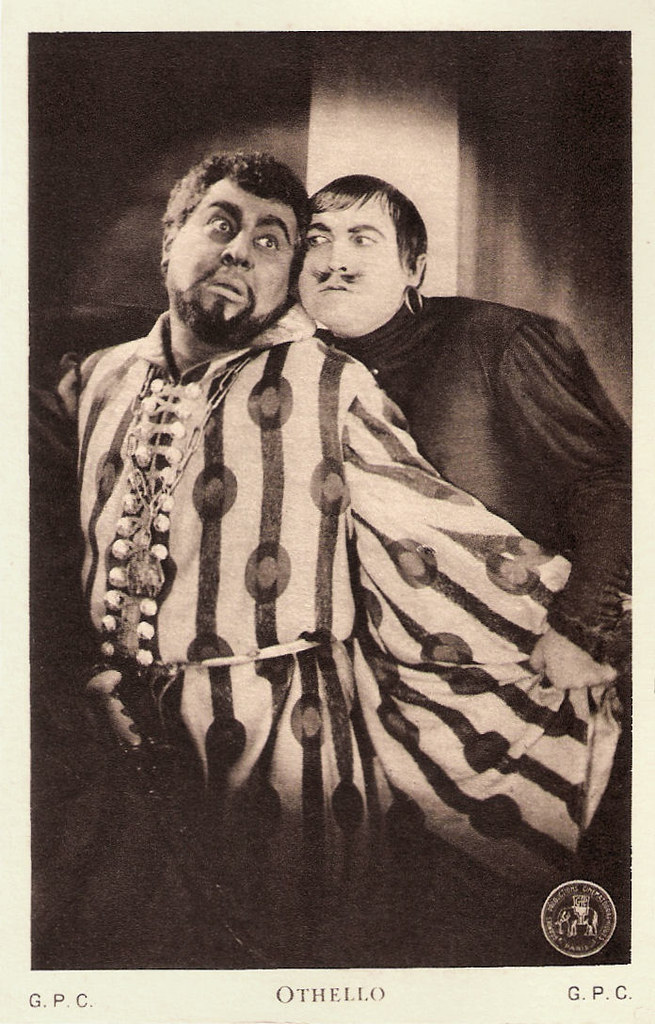
For now, a few thoughts about yesterday's screening of the silent film version of 'Othello' (1922) starring Emil Jannings in the title role.
Yes, Shakepeare without all those spoken words getting in the way!
It being Easter Sunday, the smaller-than-usual turnout was to be expected for our screening at the Town Hall Theatre in Wilton, N.H.
But what wasn't expected was for the film to have such an impact, which it did.
This was one reason for programming the film in the first place: I've found that even the most unlikely film can somehow leap to life when presented as intended: on a big screen, in a good print, with live music, and in a theater with an audience.
This, however, was different. We were about to give Shakespeare "the silent treatment."

Prior to the screening, the last in our four-month celebration of films celebrating their 100th birthday, I laid out the challenge before us.
I observed that Shakespeare is known primarily for the language of his playwriting. And here we are, proposing to take one of his most well-known tragedies, and present it without that key element of language.
Yes, there would be some words, presented in intertitles where needed. But only a tiny fraction of the 3,560 lines Shakespeare composed for his play would be used.
And to make it more of a challenge, the film was produced in Germany. So the text would have been originally in German, then translated back to English for a "foreign" release in English-speaking lands.
Also, Shakespeare's play can take 2½ to 3 hours to perform. The silent 'Othello' clocks in at about 75 minutes. So there's another thing to consider: without all those words to get through, the story might flow quite differently.
What's going on here, I said, is something of a test of the actual story that underlies Shakespeare's play. How much of the power of Shakespeare's 'Othello' rests in the Bard's cadences, and how much comes from the tale itself?
Stripping away all the words and telling the story visually—which is what silent film does—could be a good way to tell.

It's worth remembering, I said, that Shakespeare based nearly all of his writing on stories that already existed. He didn't so much write his plays from scratch as he did adapt stories for the stage.
In the case of Othello, his source was something called the "Hecatommithi," a collection of tales published in 1565 by Giraldi Cinthio, an Italian novelist and poet.
Odds are that there's something powerful in this tale, as evidenced by other adaptations of Othello—most notably, the big opera 'Otello' by Giuseppe Verdi, first staged in 1887, and which involved Shakespeare's play being rewritten as an opera libretto by Arrigo Boito.
But still—how well did Shakespeare choose his story? Seeing the silent 'Othello' might be a good way to tell.
Prior to the screening, I was asked what my strategy was as accompanist. I said it was really no different than any other silent drama: to try to come up with music that helped the film work, both on its own terms but also so that it would meet today's audience expectations.
Coming into it, for some reason I had in mind Beethoven's 'Coriolan Overture,' which I had heard recently on the radio, and which was written not for Shakespeare's play 'Coriolanus' but for a contemporary drama by Heinrich Joseph von Collins.
Still, that was what I was going for: a kind of taut classical texture capable of drama, but within certain restraints and limits.
I came up with two main motifs: a staccato four-note motto that proved very versatile, and a legato four-note "down the scale" phrase that was equally useful. These became the basic building blocks that helped it all come together.
So in the end, if our test had any validity, Shakespeare's tale passed with flying colors. He chose well.
Afterwards, a woman came up to me who said she was a Shakespeare buff who had helped start a "Shakespeare in the Park" program in Kentucky.
She'd come to the screening "out of curiosity" and not expecting much, but found she really enjoyed the film and found it true to the Bard's spirit, even with most of his words were missing.
Also, she confirmed that much of the language that did survive (via title cards) was indeed Shakepeare's own. (The only thing I could identify was Iago's famous "Put money in thy purse" exhortation.)
So it was enough to satisfy even a serious aficionado. Good show!

For the music, I don't intend on channeling Puccini, but will do my own stuff to support the film as best as I can. Will the story (and the star power of Lillian Gish and John Gilbert, at left) be enough to carry the day without the famous score?
Well—the tale was strong enough to support the contemporary hit musical 'Rent.' So that's encouraging.
But can it survive the test of the silent treatment? Come and find out!
Okay, here's the long-promised press release about 'Ben Hur' (1925) on Thursday, April 21 at the Rex Theatre in Manchester, N.H.
Vidi ibi an quadratus sit! (That's Latin for "See you there or be square!")
* * *

TUESDAY, APRIL 12, 2022 / FOR IMMEDIATE RELEASE
Contact Jeff Rapsis • (603) 236-9237 • jeffrapsis@gmail.com
Silent film epic ‘Ben Hur’ (1925) coming to Manchester's Rex Theatre on Thursday, 4/21
Celebrating Easter: Hollywood's original Biblical-era blockbuster to be screened with live music at newly resurrected venue
MANCHESTER,
N.H.—One of early Hollywood's greatest epics returns to the big screen
with a showing of 'Ben Hur, A Tale of The Christ' (1925) on Thursday,
April 21 at 7:30 p.m. at the Rex Theatre, 23 Amherst St., Manchester,
N.H.
The screening will feature live accompaniment by Jeff
Rapsis, a New Hampshire-based composer who specializes in creating music
for silent films.
Admission is $10 per person, general admission. Tickets are available online at www.palacetheatre.org or at the door.
'Ben
Hur,' starring Ramon Novarro and Francis X. Bushman, was among the
first Hollywood motion pictures to tell a Biblical-era story on a large
scale.
The film, which helped establish MGM as a leading studio,
employed a cast of thousands and boasted action sequences including a
large-scale sea battle.
The film is highlighted by a spell-binding chariot race that still leaves audiences breathless.
Set
in the Holy Land at the time of Christ's birth, 'Ben Hur' tells the
story of a Jewish family in Jerusalem whose fortune is confiscated by
the Romans and its members jailed.
The enslaved family heir,
Judah Ben Hur (played by Novarro, a leading silent-era heartthrob) is
inspired by encounters with Christ to pursue justice. This leads him to a
series of epic adventures in his quest to find his mother and sister
and restore his family fortune.
The film is particularly
appropriate for the season of Easter, which is celebrated on Sunday,
April 17. (Orthodox Easter falls on Sunday, April 24 in 2022.)
'Ben
Hur,' directed by Fred Niblo, was among the most expensive films of the
silent era, taking two years to make and costing between $4 million and
$6 million. When released in 1925, it became a huge hit for the newly
formed Metro-Goldwyn-Mayer studio.

The chariot race scene in 'Ben
Hur,' with Novarro and other cast members driving teams of horses at
high speed on a mammoth dirt racetrack in a gigantic replica of a Roman
stadium, was among the most complicated and dangerous sequences filmed
in the silent era. It remains noted for its tight editing, dramatic
sweep, and sheer cinematic excitement.
The chariot race was
re-created virtually shot for shot in MGM's 1959 remake, and more
recently imitated in the pod race scene in 'Star Wars Episode I: The
Phantom Menace.'
Besides Novarro in the title role, the film
stars Francis X. Bushman as Messala, the Roman soldier who imprisons the
Hur family; Betty Bronson as Mary, mother of Jesus; May McAvoy as Ben
Hur's sister Esther; and Claire McDowell as Ben Hur's mother.
'Ben
Hur' was based on the best-selling 1880 novel by General Lew Wallace,
which interwove the story of Christ's life with the Ben Hur clan, a
fictional Jewish merchant family.
Celebrity "extras" in the
chariot race scene included stars such as Douglas Fairbanks, Harold
Lloyd, Lionel Barrymore, John Gilbert, Joan Crawford, Lillian Gish, Mary
Pickford, and a very young Clark Gable.
The film was remade by
MGM in the 1950s in a color and wide-screen version starring Charlton
Heston that garnered 11 Academy Awards. Some critics believe the
original 1925 version offers superior drama and story-telling.
In
creating music for silent films, accompanist Jeff Rapsis performs on a
digital synthesizer that reproduces the texture of the full orchestra
and creates a traditional "movie score" sound.
For each film,
Rapsis improvises accompaniment using original themes created
beforehand. No music is written down; instead, the score evolves in real
time based on audience reaction and the overall mood as the movie is
screened.
'Ben Hur, A Tale of The Christ' (1925) will be shown on
Thursday, April 21 at 7:30 p.m. at the Rex Theatre, 23 Amherst St.,
Manchester, N.H.
General admission is $10 per person. Tickets available online at www.palacetheatre.org or at the door. For more information, call the Rex box office at (603) 668-5588.