Showing posts with label Ben Hur. Show all posts

Monday, April 18, 2022

On Thursday, 4/21: 'Ben Hur' in Manchester, N.H., plus giving Shakespeare 'the silent treatment'

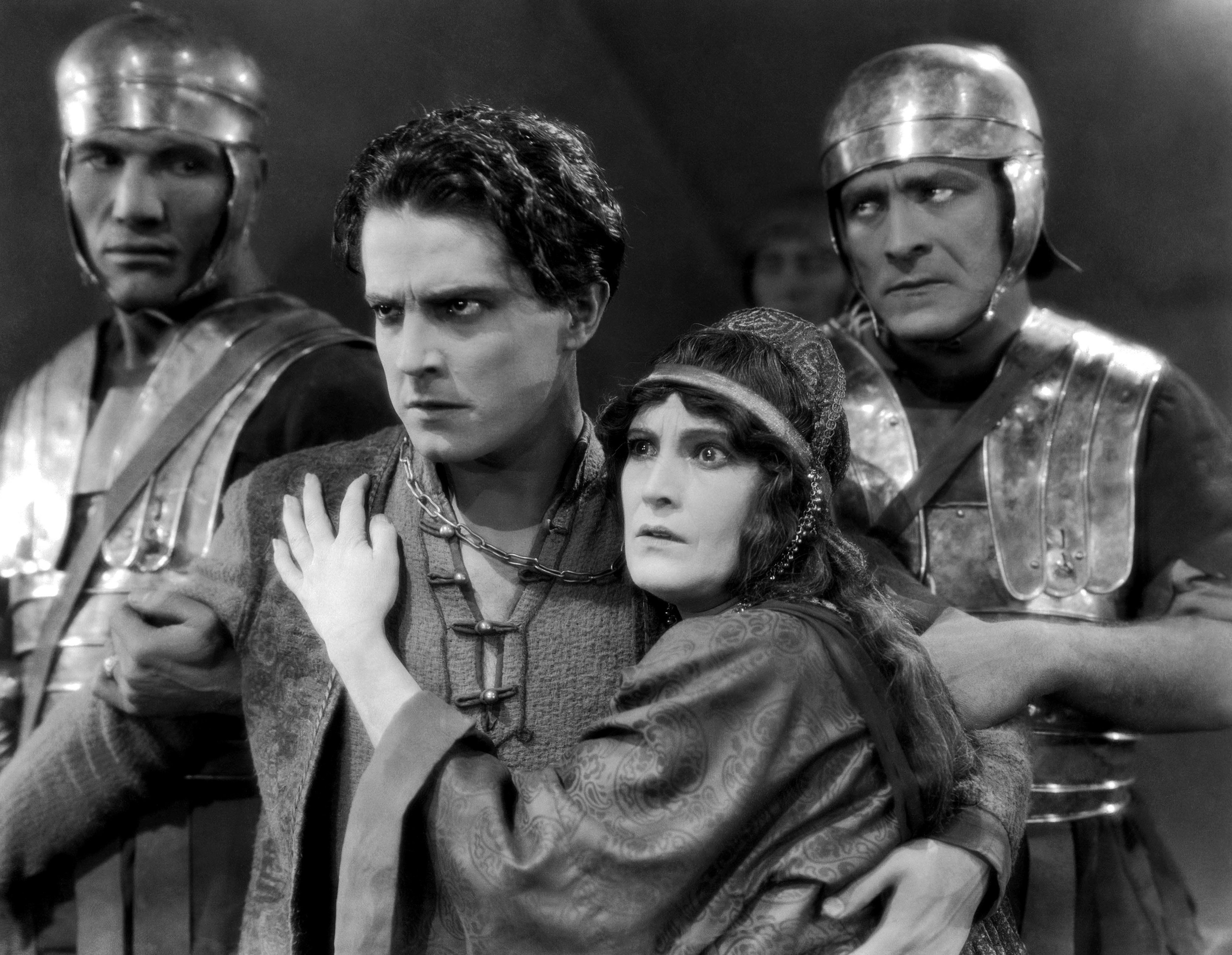
Ramon Novarro in the original silent film version of 'Ben Hur' (1925).

Next up: I'm doing music for a screening of 'Ben Hur' (1925) on Thursday, April 21 at the Rex Theatre in downtown Manchester.

Hop into your chariot and join us! Showtime is 7:30 p.m. and a ton more info in the press release attached below.

For now, a few thoughts about yesterday's screening of the silent film version of 'Othello' (1922) starring Emil Jannings in the title role.

Yes, Shakepeare without all those spoken words getting in the way!

It being Easter Sunday, the smaller-than-usual turnout was to be expected for our screening at the Town Hall Theatre in Wilton, N.H.

But what wasn't expected was for the film to have such an impact, which it did.

This was one reason for programming the film in the first place: I've found that even the most unlikely film can somehow leap to life when presented as intended: on a big screen, in a good print, with live music, and in a theater with an audience.

This, however, was different. We were about to give Shakespeare "the silent treatment."

A poster promoting the original German release of 'Othello' (1922).

Prior to the screening, the last in our four-month celebration of films celebrating their 100th birthday,  I laid out the challenge before us.

I observed that Shakespeare is known primarily for the language of his playwriting. And here we are, proposing to take one of his most well-known tragedies, and present it without that key element of language.

Yes, there would be some words, presented in intertitles where needed. But only a tiny fraction of the 3,560 lines Shakespeare composed for his play would be used.

And to make it more of a challenge, the film was produced in Germany. So the text would have been originally in German, then translated back to English for a "foreign" release in English-speaking lands.

Also, Shakespeare's play can take 2½ to 3 hours to perform. The silent 'Othello' clocks in at about 75 minutes. So there's another thing to consider: without all those words to get through, the story might flow quite differently.

What's going on here, I said, is something of a test of the actual story that underlies Shakespeare's play. How much of the power of Shakespeare's 'Othello' rests in the Bard's cadences, and how much comes from the tale itself?

Stripping away all the words and telling the story visually—which is what silent film does—could be a good way to tell.  

Emil Jannings and Werner Krauss in 'Othello' (1922).

It's worth remembering, I said, that Shakespeare based nearly all of his writing on stories that already existed. He didn't so much write his plays from scratch as he did adapt stories for the stage.  

In the case of Othello, his source was something called the "Hecatommithi," a collection of tales published in 1565 by Giraldi Cinthio, an Italian novelist and poet. 

Odds are that there's something powerful in this tale, as evidenced by other adaptations of Othello—most notably, the big opera 'Otello' by Giuseppe Verdi, first staged in 1887, and which involved Shakespeare's play being rewritten as an opera libretto by Arrigo Boito.

But still—how well did Shakespeare choose his story? Seeing the silent 'Othello' might be a good way to tell.

Prior to the screening, I was asked what my strategy was as accompanist. I said it was really no different than any other silent drama: to try to come up with music that helped the film work, both on its own terms but also so that it would meet today's audience expectations.

Coming into it, for some reason I had in mind Beethoven's 'Coriolan Overture,' which I had heard recently on the radio, and which was written not for Shakespeare's play 'Coriolanus' but for a contemporary drama by Heinrich Joseph von Collins.

Still, that was what I was going for: a kind of taut classical texture capable of drama, but within certain restraints and limits. 

I came up with two main motifs: a staccato four-note motto that proved very versatile, and a legato four-note "down the scale" phrase that was equally useful. These became the basic building blocks that helped it all come together. 

So in the end, if our test had any validity, Shakespeare's tale passed with flying colors. He chose well.

Afterwards, a woman came up to me who said she was a Shakespeare buff who had helped start a "Shakespeare in the Park" program in Kentucky.

She'd come to the screening "out of curiosity" and not expecting much, but found she really enjoyed the film and found it true to the Bard's spirit, even with most of his words were missing. 

Also, she confirmed that much of the language that did survive (via title cards) was indeed Shakepeare's own. (The only thing I could identify was Iago's famous "Put money in thy purse" exhortation.) 

So it was enough to satisfy even a serious aficionado. Good show!

A similar challenge awaits next Sunday (April 24), when I create music for MGM's silent film version of 'La Bohème' (1926), screening at 2 p.m. at the Somerville Theatre.

For the music, I don't intend on channeling Puccini, but will do my own stuff to support the film as best as I can. Will the story (and the star power of Lillian Gish and John Gilbert, at left) be enough to carry the day without the famous score? 

Well—the tale was strong enough to support the contemporary hit musical 'Rent.' So that's encouraging.

But can it survive the test of the silent treatment? Come and find out!

Okay, here's the long-promised press release about 'Ben Hur' (1925) on Thursday, April 21 at the Rex Theatre in Manchester, N.H. 

Vidi ibi an quadratus sit! (That's Latin for "See you there or be square!")

*    *    *

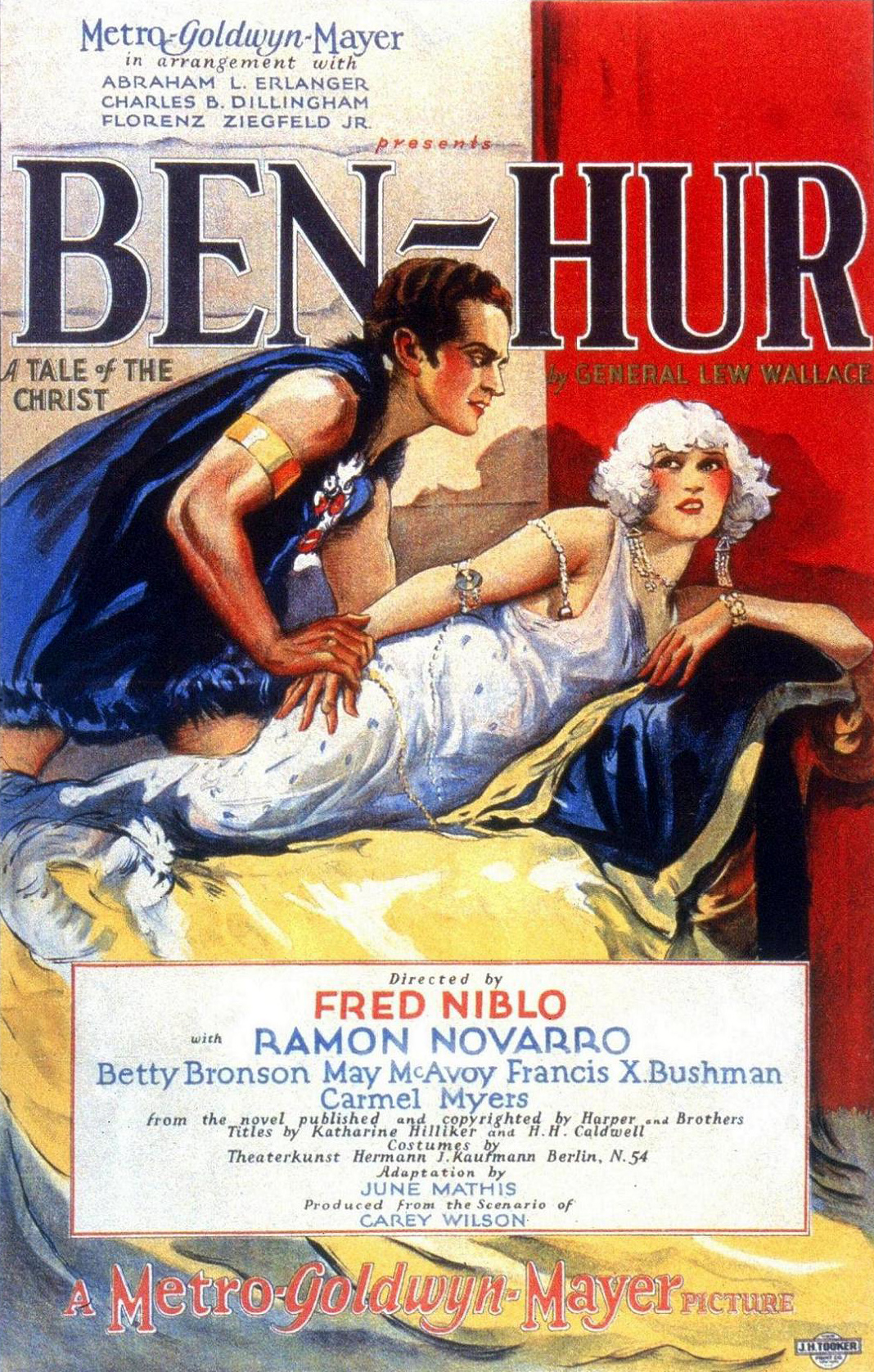
Colorful original release poster for 'Ben Hur; (1925).

TUESDAY, APRIL 12, 2022 / FOR IMMEDIATE RELEASE
Contact Jeff Rapsis • (603) 236-9237 • jeffrapsis@gmail.com

Silent film epic ‘Ben Hur’ (1925) coming to Manchester's Rex Theatre on Thursday, 4/21

Celebrating Easter: Hollywood's original Biblical-era blockbuster to be screened with live music at newly resurrected venue

MANCHESTER, N.H.—One of early Hollywood's greatest epics returns to the big screen with a showing of 'Ben Hur, A Tale of The Christ' (1925) on Thursday, April 21 at 7:30 p.m. at the Rex Theatre, 23 Amherst St., Manchester, N.H.

The screening will feature live accompaniment by Jeff Rapsis, a New Hampshire-based composer who specializes in creating music for silent films.

Admission is $10 per person, general admission. Tickets are available online at www.palacetheatre.org or at the door.

'Ben Hur,' starring Ramon Novarro and Francis X. Bushman, was among the first Hollywood motion pictures to tell a Biblical-era story on a large scale.

The film, which helped establish MGM as a leading studio, employed a cast of thousands and boasted action sequences including a large-scale sea battle.

The film is highlighted by a spell-binding chariot race that still leaves audiences breathless.

Set in the Holy Land at the time of Christ's birth, 'Ben Hur' tells the story of a Jewish family in Jerusalem whose fortune is confiscated by the Romans and its members jailed.

The enslaved family heir, Judah Ben Hur (played by Novarro, a leading silent-era heartthrob) is inspired by encounters with Christ to pursue justice. This leads him to a series of epic adventures in his quest to find his mother and sister and restore his family fortune.

The film is particularly appropriate for the season of Easter, which is celebrated on Sunday, April 17. (Orthodox Easter falls on Sunday, April 24 in 2022.)

'Ben Hur,' directed by Fred Niblo, was among the most expensive films of the silent era, taking two years to make and costing between $4 million and $6 million. When released in 1925, it became a huge hit for the newly formed Metro-Goldwyn-Mayer studio.

The chariot race scene in 'Ben Hur,' with Novarro and other cast members driving teams of horses at high speed on a mammoth dirt racetrack in a gigantic replica of a Roman stadium, was among the most complicated and dangerous sequences filmed in the silent era. It remains noted for its tight editing, dramatic sweep, and sheer cinematic excitement.

The chariot race was re-created virtually shot for shot in MGM's 1959 remake, and more recently imitated in the pod race scene in 'Star Wars Episode I: The Phantom Menace.'

Besides Novarro in the title role, the film stars Francis X. Bushman as Messala, the Roman soldier who imprisons the Hur family; Betty Bronson as Mary, mother of Jesus; May McAvoy as Ben Hur's sister Esther; and Claire McDowell as Ben Hur's mother.

'Ben Hur' was based on the best-selling 1880 novel by General Lew Wallace, which interwove the story of Christ's life with the Ben Hur clan, a fictional Jewish merchant family.

Celebrity "extras" in the chariot race scene included stars such as Douglas Fairbanks, Harold Lloyd, Lionel Barrymore, John Gilbert, Joan Crawford, Lillian Gish, Mary Pickford, and a very young Clark Gable.

The film was remade by MGM in the 1950s in a color and wide-screen version starring Charlton Heston that garnered 11 Academy Awards. Some critics believe the original 1925 version offers superior drama and story-telling.

In creating music for silent films, accompanist Jeff Rapsis performs on a digital synthesizer that reproduces the texture of the full orchestra and creates a traditional "movie score" sound.

For each film, Rapsis improvises accompaniment using original themes created beforehand. No music is written down; instead, the score evolves in real time based on audience reaction and the overall mood as the movie is screened.

'Ben Hur, A Tale of The Christ' (1925) will be shown on Thursday, April 21 at 7:30 p.m. at the Rex Theatre, 23 Amherst St., Manchester, N.H.

General admission is $10 per person. Tickets available online at www.palacetheatre.org or at the door. For more information, call the Rex box office at (603) 668-5588.


Monday, April 11, 2022

Keaton's 'The General' at Coolidge Corner on Wednesday, 4/13, plus a question of volume

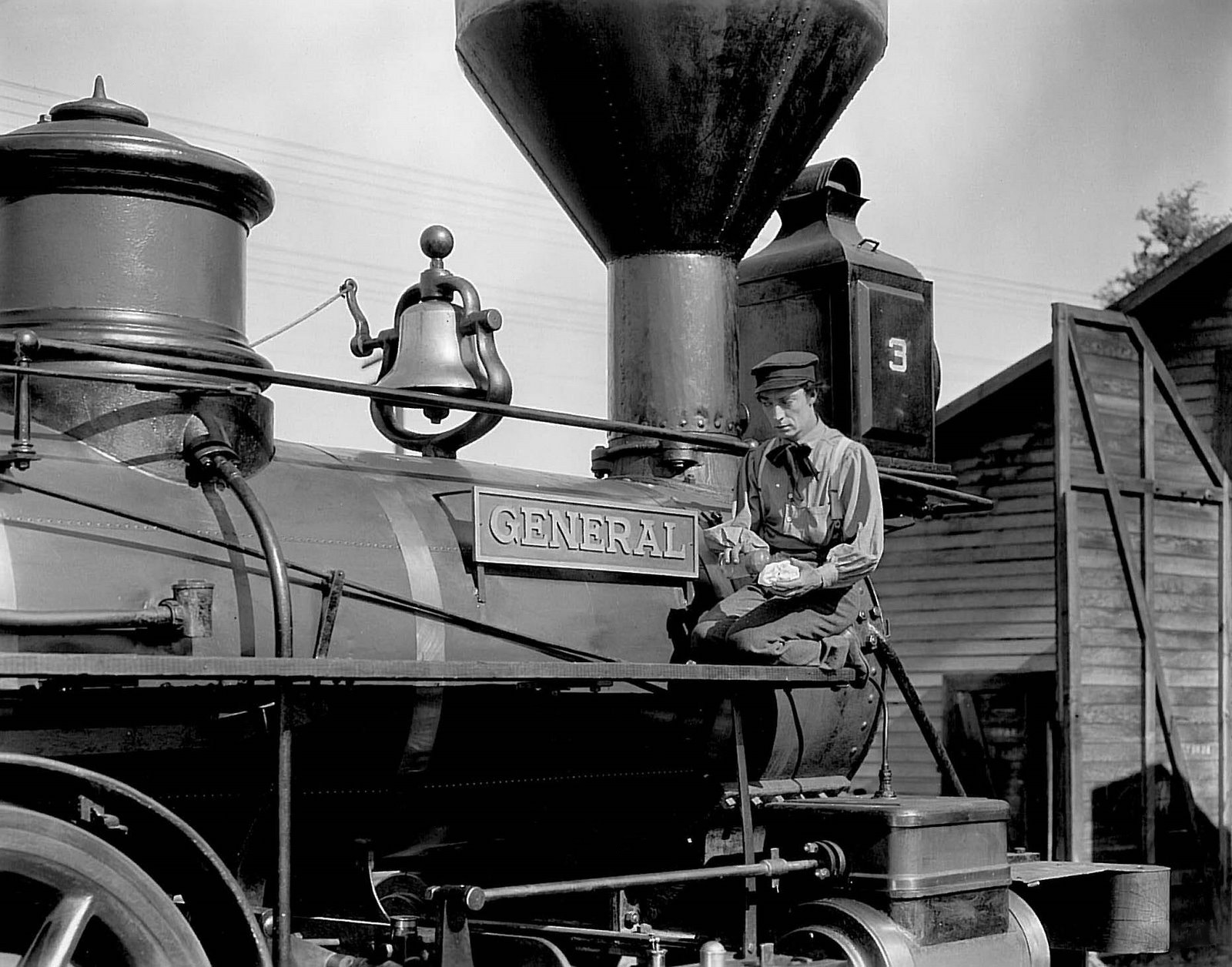
Buster and co-star in 'The General' (1926).

Coming up: I'll be doing live music for a screening of Buster Keaton's 'The General' (1926) at the Coolidge Corner Theatre on Wednesday, April 13. 

It's a special occasion because Slate film critic Dana Stevens, author of a new book on Keaton, will be on hand for a Q & A after the show. It'll be moderated by local film guru Ty Burr.

'Camera Man,' which came out a few months ago, has been rapturously received, and has led to a host of Keaton screenings this year. (I had the privilege of doing an earlier one with Stevens in Newport, R.I. this past February.)

So march on down to the Coolidge Corner to see Keaton's masterpiece on the big screen, and meet the author of a brand new book that puts Keaton's work in the context of his early-20th-century times.

More details in the press release below. 

For now, a few thoughts about volume inspired by yesterday's screening of 'Ben Hur' (1925) at the new Showroom venue of the Colonial Theatre in Keene, N.H.

This is a surprisingly touchy subject, as there's apparently a vast range of perceptions of what's appropriate volume for silent film accompaniment.

Yesterday, I arrived early to set up and work with the house tech to set the sound levels. Each house is different, and the Showroom is a venue I've only played once before, so it's important to take time to set up the audio.

Keeping my keyboard volume output at mid-range, we worked out the levels, checking each of my synth settings to make sure everything was acceptable in the house. I felt it sounded a bit dry, so just a touch of reverb was added to the main orchestral setting I planned to use. Great!

(The reason to keep my synth output at mid-range is because I need that level to make use of the various volume levels the touch-sensitive keyboard is capable of producing. I find I can't do that effectively if the output is below mid-range: level 5 out of 10.)

We also have to account for the fact that in most places with house sound (such as the Showroom), a good amount of sound volume passes over my head (down at front) and so audiences can sometimes receive significantly more volume than I hear.

Okay, fine. Because I work primarily in improv and create the accompaniment live and in the moment, it's my preference to sit at the keyboard for at least a half-hour before a show: warming up, working through material, and just getting into the zone. For me, it's hard to start a film just cold—it's not like pressing a button.

But because people are filing into the theater, during this time I've found it's helpful to temporarily take my volume output down to about 2 out of 10 as a courtesy. That way people can hear each other talking, while I can still do my thing, even though it's not the volume I'll be working with for the film.

The Colonial Theatre's new "Showroom" venue, set up for silent film.

So this is what I was doing yesterday when I noticed it was 10 minutes to showtime, and I hadn't thought to yet use the bathroom. (Very important in advance of a 2½-hour film.) So I switched to some synth-generated pattern music and got up to take care of business.

That's when someone from the theater came up to me with a concerned look on her face. People were complaining, she said, that the music was much too loud and that we needed to take the volume down somewhat.

Really? I've gotta tell you, I like to think I'm easy-going and welcome feedback and would do whatever it takes to accommodate an audience. But right in front of creating live music for a challenging and marathon-length film, this is not the thing to hear. 

(Even worse: a few years ago, someone came down to the keyboard in the middle of a show in progress at the Leavitt Theatre in Ogunquit, Maine and placed a folded-up note on the keyboard, for Pete's sake. Using one hand, I opened it to read "MUSIC TOO LOUD!")

Maybe it's a weakness on my part, but I find this kind of thing really throws me when it comes right before I'm about to commit to an improv accompaniment journey of some length, and which will require some concentration—especially after we've taken time to set levels that everyone agreed were acceptable. 

And it's especially discouraging when I've deliberately been playing at a quiet level as a courtesy, and then to be told it's still too loud

Would people stop a tightrope walker just before he or she steps out on the wire above Niagara Falls to tell them they don't approve of the type of wood being used in the balance pole?

I strive not to be the temperamental artist type, but jeez. This is me, baring my soul in music in hopes of bringing to life a worthy cinematic experience, and I'm being told to keep it down lest it interfere with someone's enjoyment of the film?

Well, why don't I just stop playing altogether? Maybe then everyone will be happy? 

Of course I didn't speak those words. I told the theater woman we'd see what we could do. In introducing the film, I addressed it openly: we'd had some complaints, but here's the situation. This is a BIG film, I said, and at times the music will be BIG as well. 

However, it's still a new venue to me, I said, so I'll do my best to keep things at a level we can all find generally acceptable. But people have to understand: this is not background music. At its best (if I'm doing it effectively) it's a crucial part of the experience.

I think I run into trouble when people new to the experience expect the accompaniment to be background music, or (even worse) something that's optional or just decoration.

Well, no. In silent film, although music generally shouldn't be noticed on its own, it's often a full player in the overall experience. That was true then, and it's still true now. 

So while it shouldn't gratuitously call attention to itself, the music should have a presence. And in some cases, it really should be pretty darned big and bold.

Take 'Ben Hur.' You really can't play quiet stuff during the sea battle scene or the famous chariot race. So if I'm at the keyboard, it's going to be loud, exciting, dramatic, and all that.

In the end, I was able to pull it together yesterday. No one covered their ears or walked out that I'm aware of, anyway. When it was over, we had nice comments and good questions. I made my usual joke about checking with the Diocese of Manchester to confirm that attending a screening of 'Ben Hur' did not count as attending Mass. Thank you and have a good night!

I don't know. Maybe I'm looking at this wrong way. Maybe I should really amp up the volume, and then supplement my income by selling over-priced ear plugs. Or possibly sell stationery so people can write me letters to be delivered in the middle of a performance.

Even if I go ahead with those ideas, they won't be ready in time for Wednesday's screening of 'The General' at the Coolidge Corner. Here's the promised press release with all the details!

*   *   *

Buster Keaton in 'The General.' 

MONDAY, APRIL 4, 2022 / FOR IMMEDIATE RELEASE
Contact Jeff Rapsis • (603) 236-9237 • jeffrapsis@gmail.com

Buster Keaton's 'The General' with live music at Coolidge Corner on Wednesday, April 13

Civil War railroading comedy/adventure film lauded as stone-faced comic moviemaker's masterpiece

Screening includes Q & A with Dana Stevens, author of 'Camera Man,' newly published Keaton book.

BROOKLINE, Mass.— He never smiled on camera, earning him the nickname of "the Great Stone Face." But Buster Keaton's comedies rocked Hollywood's silent era with laughter throughout the 1920s.

See for yourself with a screening of 'The General' (1926), one of Keaton's landmark feature films, on Wednesday, April 13 at 7 p.m. at the Coolidge Corner Theatre, 290 Harvard St., Brookline, Mass.

The screening will feature live music for the movie by silent film accompanist Jeff Rapsis. General admission is $23 per person.

The show is the latest in the Coolidge Corner's acclaimed 'Sounds of Silents' series, which gives audiences the opportunity to experience early cinema as it was intended: on the big screen, with live music, and with an audience.

The screening will be followed by a Q & A with Slate film critic Dana Stevens, author of 'Camera Man,' a newly published book exploring Keaton's work in the context of 20th century history.

Stevens’s book will be for sale after the screening, courtesy of Brookline Booksmith. The Q & A will be moderated by Boston-based critic Ty Burr.

'The General,' set during the U.S. Civil War, tells the story of a southern locomotive engineer (Keaton) whose engine (named 'The General') is hijacked by Northern spies with his girlfriend onboard.

Keaton, commandeering another train, races north in pursuit behind enemy lines. Can he rescue his girl? And can he recapture his locomotive and make it back to warn of a coming Northern attack?

Critics call 'The General' Keaton's masterpiece, praising its authentic period detail, ambitious action and battle sequences, and its overall integration of story, drama, and comedy.

It's also regarded as one of Hollywood's great railroad films, with much of the action occurring on or around moving steam locomotives.

Accompanist Jeff Rapsis will improvise an original musical score for 'The General' live as the film is shown.

"When the score gets made up on the spot, it creates a special energy that's an important part of the silent film experience," said Rapsis, who uses a digital synthesizer to recreate the texture of a full orchestra for the accompaniment.

With Center for the Art's screening of 'The General,' audiences will get a chance to experience silent film as it was meant to be seen—in a high quality print, on a large screen, with live music, and with an audience.

"All those elements are important parts of the silent film experience," Rapsis said. "Recreate those conditions, and the classics of early Hollywood leap back to life in ways that can still move audiences today."

Rapsis performs on a digital keyboard that reproduces the texture of the full orchestra and creates a traditional "movie score" sound.

Keaton, along with Charlie Chaplin and Harold Lloyd, stands today as one of the silent screen's three great clowns. Some critics regard Keaton as the best of all; Roger Ebert wrote in 2002 that "in an extraordinary period from 1920 to 1929, (Keaton) worked without interruption on a series of films that make him, arguably, the greatest actor-director in the history of the movies."

A remarkable pantomime artist, Keaton naturally used his whole body to communicate emotions from sadness to surprise. And in an era with no post-production special effects, Keaton's acrobatic talents enabled him to perform all his own stunts.

Critics review 'The General':

"The most insistently moving picture ever made, its climax is the most stunning visual event ever arranged for a film comedy."
—Walter Kerr, author of 'The Silent Clowns'

"An almost perfect entertainment!"
—Dave Kehr, Chicago Reader

"What makes the film so special is the way the timing, audacity and elegant choreography of its sight gags, acrobatics, pratfalls and dramatic incidents is matched by Buster's directorial artistry, his acute observational skills working alongside the physical élan and sweet subtlety of his own performance."
—Time Out (London)

‘The General’ (1926) starring Buster Keaton will be shown with live music on Wednesday, April 13 at 7 p.m. at the Coolidge Corner Theatre, 290 Harvard St., Brookline, Mass. as part of the theater's 'Sounds of Silents' series. Admission is $23 per person. For more info and to buy tickets, visit www.coolidge.org or call (617) 734-2500. For more about the music, visit www.jeffrapsis.com.

Wednesday, April 6, 2022

Up next: the original silent 'Ben Hur' (1925) on Sunday, April 10 at the Showroom in Keene, N.H.

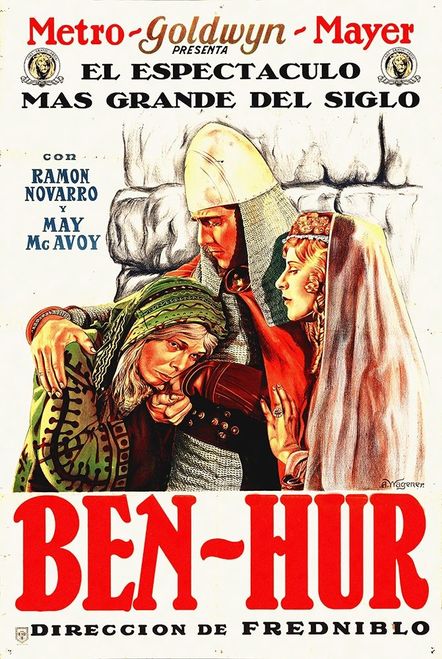
A Spanish language poster for MGM's 'Ben Hur' (1925).

Easter must be on its way, as this month's silent film schedule is thick with Biblical epics.

Coming up next: the original silent version of 'Ben Hur' (1925) on Sunday, April 10 in Keene, N.H. If there's a film you should try to see on the big screen, this is it. More details in the press release below.

For now, let me report that we enjoyed a healthy turnout for last Sunday's unusual double bill: Lon Chaney in 'Flesh and Blood' and Harry Houdini in 'The Man From Beyond,' both films from 1922.

The Chaney film, which I'd never done before, held up pretty well, with an escaped-prisoner-seeking-justice storyline that kept our audience engaged throughout. Large chunks of it are set in Chinatown, but I resisted the temptation to play pentatonic-scale-"Oriental"-sounding music.

Instead, I kept mostly to a piano & strings texture, except for a scene where a harmonium gets played, and then also when Chaney performs a sentimental tune on a solo violin. One wonders how musicians of the 1920s would have matched the on-screen action in this film.

The Houdini picture is a mind-bending affair about reincarnation that left most people scratching their heads. How can a guy become frozen in 1820, then thawed out 100 years later, to the point where he's riding around in automobiles and attending a wedding, and not realize it was a century later?

But the rousing waterfall rescue sequence that concludes the film, which was actually filmed at Niagara Falls, was enough to leave everyone satisfied.

Okay, here's the press release on 'Ben Hur.' Hope to see you this Sunday at 2 p.m. at the Colonial Theatre's new "Showroom" venue in Keene, N.H.!

*    *    *

An original release poster for MGM's silent epic 'Ben Hur' (1925).

MONDAY, APRIL 4, 2022 / FOR IMMEDIATE RELEASE
Contact Jeff Rapsis • (603) 236-9237 • jeffrapsis@gmail.com

Silent film epic ‘Ben Hur’ (1925) coming to Showroom in Keene on Sunday, April 10

Prelude to Easter: Hollywood's original Biblical-era blockbuster to be screened with live music at Colonial Theatre's new venue

KEENE, N.H.—One of early Hollywood's greatest epics returns to the big screen with a showing of 'Ben Hur, A Tale of The Christ' (1925) on Sunday, April 10 at 2 p.m. at the Colonial Theatre's Showroom, 20 Commercial St., Keene.

The screening will feature live accompaniment by Jeff Rapsis, a New Hampshire-based composer who specializes in creating music for silent films.

Admission is $15 per person, general admission. Tickets are available online at www.thecolonial.org or at the door.

'Ben Hur,' starring Ramon Novarro and Francis X. Bushman, was among the first Hollywood motion pictures to tell a Biblical-era story on a large scale.

The film, which helped establish MGM as a leading studio, employed a cast of thousands and boasted action sequences including a large-scale sea battle.

The film is highlighted by a spell-binding chariot race that still leaves audiences breathless.

Set in the Holy Land at the time of Christ's birth, 'Ben Hur' tells the story of a Jewish family in Jerusalem whose fortune is confiscated by the Romans and its members jailed.

The enslaved family heir, Judah Ben Hur (played by Novarro, a leading silent-era heartthrob) is inspired by encounters with Christ to pursue justice. This leads him to a series of epic adventures in his quest to find his mother and sister and restore his family fortune.

The film is particularly appropriate for the weeks leading up to Easter, which is celebrated on Sunday, April 17. (Orthodox Easter falls on Sunday, April 24 in 2022.)


'Ben Hur,' directed by Fred Niblo, was among the most expensive films of the silent era, taking two years to make and costing between $4 million and $6 million. When released in 1925, it became a huge hit for the newly formed Metro-Goldwyn-Mayer studio.

The chariot race scene in 'Ben Hur,' with Novarro and other cast members driving teams of horses at high speed on a mammoth dirt racetrack in a gigantic replica of a Roman stadium, was among the most complicated and dangerous sequences filmed in the silent era. It remains noted for its tight editing, dramatic sweep, and sheer cinematic excitement.

The chariot race was re-created virtually shot for shot in MGM's 1959 remake, and more recently imitated in the pod race scene in 'Star Wars Episode I: The Phantom Menace.'


Besides Novarro in the title role, the film stars Francis X. Bushman as Messala, the Roman soldier who imprisons the Hur family; Betty Bronson as Mary, mother of Jesus; May McAvoy as Ben Hur's sister Esther; and Claire McDowell as Ben Hur's mother.

'Ben Hur' was based on the best-selling 1880 novel by General Lew Wallace, which interwove the story of Christ's life with the Ben Hur clan, a fictional Jewish merchant family.

Celebrity "extras" in the chariot race scene included stars such as Douglas Fairbanks, Harold Lloyd, Lionel Barrymore, John Gilbert, Joan Crawford, Lillian Gish, Mary Pickford, and a very young Clark Gable.

The film was remade by MGM in the 1950s in a color and wide-screen version starring Charleton Heston that garnered 11 Academy Awards. Some critics believe the original 1925 version offers superior drama and story-telling.

In creating music for silent films, accompanist Jeff Rapsis performs on a digital synthesizer that reproduces the texture of the full orchestra and creates a traditional "movie score" sound.

For each film, Rapsis improvises accompaniment using original themes created beforehand. No music is written down; instead, the score evolves in real time based on audience reaction and the overall mood as the movie is screened.

'Ben Hur, A Tale of The Christ' (1925) will be shown on Sunday, April 10 at 2 p.m. at the Colonial Theatre's Showroom, 20 Commercial St., Keene.

General admission is $15 per person. Tickets are available online at www.thecolonial.org or at the door. For more information, call the Colonial box office at (603) 352-2033.

Thursday, August 5, 2021

Tonight: Original silent version of 'Ben Hur' with live music at Flying Monkey in Plymouth, N.H.

It's a world threatened by pandemic, climate change, and pharmaceutical commercials! What we need is a good old-fashioned Hollywood religious epic to give us hope.

And we'll get just that tonight (Thursday, Aug. 5) with the original silent version of 'Ben Hur' (1925) at the Flying Monkey Moviehouse and Performance Center in Plymouth, N.H.

The journey starts at 6:30 p.m. More details in the press release below. See you there!

*   *   *

An original poster for the original silent version of 'Ben Hur' (1925).

MONDAY, JULY 26, 2021 / FOR IMMEDIATE RELEASE
Contact Jeff Rapsis • (603) 236-9237 • jeffrapsis@gmail.com

Silent film epic ‘Ben Hur’ (1925) at Flying Monkey on Thursday, Aug. 5

Hollywood's original Biblical-era blockbuster to be screened with live music at historic venue

PLYMOUTH, N.H.—One of early Hollywood's greatest epics returns to the big screen with a showing of 'Ben Hur, A Tale of The Christ' (1925) on Thursday, Aug. 5 at 6:30 p.m. at the Flying Monkey Moviehouse and Performance Center, 39 South Main St., Plymouth.

The screening, the latest in the Flying Monkey's silent film series, will feature live accompaniment by Jeff Rapsis, a New Hampshire-based composer who specializes in creating music for silent films.

Admission is $10 per person, general admission. Tickets are available online at flyinghmonkeynh.com or at the door.

The silent version of 'Ben Hur' was originally slated for a screening earlier this year at the Flying Monkey, but was postponed to Thursday, Aug. 5.


'Ben Hur,' starring Ramon Novarro and Francis X. Bushman, was among the first motion pictures to tell a Biblical-era story on a large scale.

The film, which helped establish MGM as a leading Hollywood studio, employed a cast of thousands and boasted action sequences including a large-scale sea battle.

The film is highlighted by a spell-binding chariot race that still leaves audiences breathless with excitement.


Set in the Holy Land at the time of Christ's birth, 'Ben Hur' tells the story of a Jewish family in Jerusalem whose fortune is confiscated by the Romans and its members jailed.

The enslaved family heir, Judah Ben Hur (played by Novarro, a leading silent-era heartthrob) is inspired by encounters with Christ to pursue justice. This leads him to a series of epic adventures in his quest to find his mother and sister and restore his family fortune.

'Ben Hur,' directed by Fred Niblo, was among the most expensive films of the silent era, taking two years to make and costing between $4 million and $6 million. When released in 1925, it became a huge hit for the newly formed Metro-Goldwyn-Mayer studio.

The chariot race scene in 'Ben Hur,' with Novarro and other cast members driving teams of horses at high speed on a mammoth dirt racetrack in a gigantic replica of a Roman stadium, was among the most complicated and dangerous sequences filmed in the silent era. It remains noted for its tight editing, dramatic sweep, and sheer cinematic excitement.

The chariot race was re-created virtually shot for shot in MGM's 1959 remake, and more recently imitated in the pod race scene in 'Star Wars Episode I: The Phantom Menace.'

Besides Novarro in the title role, the film stars Francis X. Bushman (at right) as Messala, the Roman soldier who imprisons the Hur family; Betty Bronson as Mary, mother of Jesus; May McAvoy as Ben Hur's sister Esther; and Claire McDowell as Ben Hur's mother.

'Ben Hur' was based on the best-selling 1880 novel by General Lew Wallace, which interwove the story of Christ's life with the Ben Hur clan, a fictional Jewish merchant family.

Celebrity "extras" in the chariot race scene included stars such as Douglas Fairbanks, Harold Lloyd, Lionel Barrymore, John Gilbert, Joan Crawford, Lillian Gish, Mary Pickford, and a very young Clark Gable.

The film was remade by MGM in the 1950s in a color and wide-screen version starring Charleston Heston that garnered 11 Academy Awards. Some critics believe the original 1925 version offers superior drama and story-telling.

In creating music for silent films, accompanist Jeff Rapsis performs on a digital synthesizer that reproduces the texture of the full orchestra and creates a traditional "movie score" sound.

For each film, Rapsis improvises a music score using original themes created beforehand. No music is written down; instead, the score evolves in real time based on audience reaction and the overall mood as the movie is screened.

'Ben Hur, A Tale of The Christ' (1925) will be shown on  Thursday, Aug. 5 at 6:30 p.m. at the Flying Monkey Moviehouse and Performance Center, 39 South Main St., Plymouth, N.H. Admission is $10 per person general admission. Tickets are available online at flyingmonkeynh.com or at the door. For more information, call the Flying Monkey at (603) 536-2551.


Tuesday, March 30, 2021

Easter's on it's way, so is 'Ben Hur': silent epic with live music Thursday, 4/1 at Flying Monkey

I'm accompanying the great silent epic 'Ben Hur' (1925) on April Fool's Day, and that's no joke!

Just look at this poster, put together by graphic artist Lisa Landry:

So get thee up to the Flying Monkey Moviehouse in Plymouth, N.H. for a screening of this major hunk of cinema (and I don't mean just Ramon Novarro) seen the way it was intended — on the big screen, in a theater, with live music, and with a (socially distanced) audience.

Here's the press release with a lot more information. 

And I've corrected the spelling of "Charleton Heston," who was listed as "Charleston Heston" in the original release. 

But I'm sure he was a good dancer...

*  *  *

From the original silent version of 'Ben Hur' (1925).

MONDAY, MARCH 22, 2021 / FOR IMMEDIATE RELEASE
Contact Jeff Rapsis • (603) 236-9237 • jeffrapsis@gmail.com

Silent film epic ‘Ben Hur’ (1925) at Flying Monkey on Thursday, April 1

Prelude to Easter: Hollywood's original Biblical-era blockbuster to be screened with live music at historic venue

PLYMOUTH, N.H.—One of early Hollywood's greatest epics returns to the big screen with a showing of 'Ben Hur, A Tale of The Christ' (1925) on Thursday, April 1 at 6:30 p.m. at the Flying Monkey Moviehouse and Performance Center, 39 South Main St., Plymouth.

The screening, the latest in the Flying Monkey's silent film series, will feature live accompaniment by Jeff Rapsis, a New Hampshire-based composer who specializes in creating music for silent films.

Admission is $10 per person, general admission. Tickets are available online at flyinghmonkeynh.com or at the door.

'Ben Hur,' starring Ramon Novarro and Francis X. Bushman, was among the first motion pictures to tell a Biblical-era story on a large scale.

The film, which helped establish MGM as a leading Hollywood studio, employed a cast of thousands and boasted action sequences including a large-scale sea battle.

The film is highlighted by a spell-binding chariot race that still leaves audiences breathless.

Set in the Holy Land at the time of Christ's birth, 'Ben Hur' tells the story of a Jewish family in Jerusalem whose fortune is confiscated by the Romans and its members jailed.

The enslaved family heir, Judah Ben Hur (played by Novarro, a leading silent-era heartthrob) is inspired by encounters with Christ to pursue justice. This leads him to a series of epic adventures in his quest to find his mother and sister and restore his family fortune.

The film is particularly appropriate for the weeks leading up to Easter, which is celebrated on Sunday, April 4. (Orthodox Easter falls on Sunday, May 2 in 2021.)

'Ben Hur,' directed by Fred Niblo, was among the most expensive films of the silent era, taking two years to make and costing between $4 million and $6 million. When released in 1925, it became a huge hit for the newly formed Metro-Goldwyn-Mayer studio.


The chariot race scene in 'Ben Hur,' with Novarro and other cast members driving teams of horses at high speed on a mammoth dirt racetrack in a gigantic replica of a Roman stadium, was among the most complicated and dangerous sequences filmed in the silent era. It remains noted for its tight editing, dramatic sweep, and sheer cinematic excitement.

The chariot race was re-created virtually shot for shot in MGM's 1959 remake, and more recently imitated in the pod race scene in 'Star Wars Episode I: The Phantom Menace.'

Besides Novarro in the title role, the film stars Francis X. Bushman as Messala, the Roman soldier who imprisons the Hur family; Betty Bronson as Mary, mother of Jesus; May McAvoy as Ben Hur's sister Esther; and Claire McDowell as Ben Hur's mother.

'Ben Hur' was based on the best-selling 1880 novel by General Lew Wallace, which interwove the story of Christ's life with the Ben Hur clan, a fictional Jewish merchant family.

Celebrity "extras" in the chariot race scene included stars such as Douglas Fairbanks, Harold Lloyd, Lionel Barrymore, John Gilbert, Joan Crawford, Lillian Gish, Mary Pickford, and a very young Clark Gable.

The film was remade by MGM in the 1950s in a color and wide-screen version starring Charleton Heston that garnered 11 Academy Awards. Some critics believe the original 1925 version offers superior drama and story-telling.

In creating music for silent films, accompanist Jeff Rapsis performs on a digital synthesizer that reproduces the texture of the full orchestra and creates a traditional "movie score" sound.

For each film, Rapsis improvises a music score using original themes created beforehand. No music is written down; instead, the score evolves in real time based on audience reaction and the overall mood as the movie is screened.

A scene from 'Ben Hur, A Tale of the Christ.'

'Ben Hur, A Tale of The Christ' (1925) will be shown on Thursday, April 1 at 6:30 p.m. at the Flying Monkey Moviehouse and Performance Center, 39 South Main St., Plymouth, N.H. Admission is $10 per person general admission. Tickets are available online at flyingmonkeynh.com or at the door. For more information, call the Flying Monkey at (603) 536-2551.

Sunday, March 27, 2016

On scoring 'Ben Hur' (1925) on Easter Sunday
and also why silent film is like coin collecting

A poster for the international release of 'Ben Hur' (1925).

The great silent adaptation of 'Ben Hur' (1925) is in the rotation this year, and I'm playing for it again today (Easter Sunday) at 4:30 p.m.

The screening is at the Wilton (N.H.) Town Hall Theater and is free and open to the public. More details in the press release below.

Tackling 'Ben Hur' this time around was another chance to learn about the story and its author, Lew Wallace, who I find to be an interesting guy.

Wallace, a prominent 19th century American military officer and diplomat, serving in the U.S.-Mexican War and then as a general in Union Army during the Civil War.

Here are some things about Wallace that make him so interesting:

• As a Union commander under General U.S. Grant, Wallace was at the center of controversial troop movements leading up the Battle of Shiloh that led to higher-than-expected casualties.

• Wallace took to writing fiction to provide relief from his official duties. He wrote 'Ben Hur' as a way to more thoroughly educate himself on scripture, and to confirm his own personal commitment to Christianity.

• Having never visited the Holy Land, Wallace embarked on extensive research at the Library of Congress and other centers of learning to be able to write about life during the time of Jesus.

• Wallace served as the Territorial Governor of New Mexico from 1878 to 1881, and finished writing 'Ben Hur' in Santa Fe. While in office, he negotiated a plea bargain with Billy the Kid to testify against other outlaws, but then the Kid later escaped from jail and resumed his own murderous ways. Supporters of Kid continue to lobby New Mexico unsuccessfully for an official pardon stemming from Wallace's plea bargain, most recently in 2012.

• While later serving as U.S. Ambassador to the Ottoman Empire, Wallace did get to visit the Holy Land, and found he didn't have to change anything in 'Ben Hur.'

• When the Spanish-American War broke out in 1898, Wallace volunteered his services as an officer. Refused due to his age, he tried unsuccessfully to volunteer as an enlisted man.

Lots more, but you get the idea. This was one colorful dude who lived an interesting and consequential life, and not only because he wrote the best-selling American novel until 'Gone With the Wind' appeared in the 1930s.

And if it weren't for silent film, I probably wouldn't know much about him at all.

So in that sense, silent film is like coin collecting. Studying the money systems in place in other places and at other times is a window into geography, history, economics, culture, and so many other subjects.

Silent film opens the same doors, I think. As removed from reality as it sometimes can seem, it's a window into so much of human experience that went into making up the world we know today.

See for yourself by attending 'Ben Hur' this afternoon at the Wilton Town Hall Theatre. More info below!

* * *

The chariot race scene: a masterpiece of editing.

MONDAY, MARCH 7, 2016 / FOR IMMEDIATE RELEASE
Contact Jeff Rapsis • (603) 236-9237 • jeffrapsis@gmail.com

Silent film epic ‘Ben Hur’ (1925) at Town Hall Theatre on Easter Sunday, March 27


Hollywood's original Biblical-era blockbuster to be screened with live music

WILTON,N.H.—What better day than Easter Sunday to lose yourself in a big screen Biblical blockbuster from the glory days of early Hollywood?

Movie-worshipers can do just that at the Town Hall Theatre, which will screen the original epic silent film version of 'Ben Hur, A Tale of The Christ' (1925) on Sunday, March 27 at 4:30 p.m.

The program, the latest in the theater's silent film series, will be accompanied by live music performed by silent film composer Jeff Rapsis. Admission is free, with a suggested donation of $5 per person.

'Ben Hur,' starring Ramon Novarro and Francis X. Bushman, was among the first motion pictures to tell a Biblical-era story on an enormous scale.

The film, which helped establish MGM as a leading Hollywood studio, employed a cast of thousands and boasted action sequences including a large-scale sea battle. The film is highlighted by a spell-binding chariot race regarded as a masterpiece of editing and which still leaves audiences breathless.

Set in the Holy Land at the time of Christ's birth, 'Ben Hur' tells the story of a Jewish family in Jerusalem whose fortune is confiscated by the Romans and its members jailed.

The enslaved family heir, Judah Ben Hur (played by Novarro, a leading silent-era heartthrob) is inspired by encounters with Christ to pursue justice, which leads him to a series of epic adventures in his quest to find his mother and sister and restore his family fortune.

A poster for 'Ben Hur.'

The screening is the latest in the Town Hall Theatre's series of silent film screenings. The series aims to showcase the best of early Hollywood the way it was intended to be experienced: on the big screen, with live music, and in a theater with an audience.

"Put together those elements, and it's amazing how much power these films still have. You realize why these films caused people to first fall in love with the movies, said accompanist Jeff Rapsis, who will improvise a full score for the 2½-hour epic.

'Ben Hur,' directed by Fred Niblo, was among the most expensive films of the silent era, taking two years to make and costing between $4 million and $6 million. When released in 1925, it became a huge hit for the newly formed Metro-Goldwyn-Mayer studio.

The chariot race scene in 'Ben Hur,' with Novarro and other cast members driving teams of horses at high speed on a mammoth dirt racetrack in a gigantic replica of a Roman stadium, was among the most complicated and dangerous sequences filmed in the silent era. It remains noted for its tight editing, dramatic sweep, and sheer cinematic excitement.

The chariot race was re-created virtually shot for shot in MGM's 1959 remake, and more recently imitated in the pod race scene in 'Star Wars Episode I: The Phantom Menace.'

Besides Novarro in the title role, the film stars Francis X. Bushman as Messala, the Roman soldier who imprisons the Hur family; Betty Bronson as Mary, mother of Jesus; May McAvoy as Ben Hur's sister Esther; and Claire McDowell as Ben Hur's mother. 'Ben Hur' was based on the best-selling 1880 novel by General Lew Wallace, which interwove the story of Christ's life with the Ben Hur clan, a fictional Jewish merchant family.

Celebrity "extras" in the chariot race scene included stars such as Douglas Fairbanks, Harold Lloyd, Lionel Barrymore, John Gilbert, Joan Crawford, Lillian Gish, Mary Pickford, and a very young Clark Gable.

The film was remade by MGM in the 1950s in a color and wide-screen version starring Charleston Heston that garnered 11 Academy Awards. However, some critics believe the original 1925 version offers superior drama and story-telling.

MGM executives at the time, aware of the quality of the original version, attempted to destroy all prints of the 1925 'Ben Hur,' sending the FBI out to confiscate collector copies in the 1950s. However, the studio did preserve the negative of the 1925 version, so the film remains available today.

In creating music for silent films, Rapsis performs on a digital synthesizer that reproduces the texture of the full orchestra and creates a traditional "movie score" sound.

For each film, Rapsis improvises a music score using original themes created beforehand. None of the the music is written down; instead, the score evolves in real time based on audience reaction and the overall mood as the movie is screened.

'Ben Hur' (1925) will be screened with live music on Easter Sunday, March 27 at 4:30 p.m. at the Town Hall Theatre, 40 Main St., Wilton, N.H. The program is free and open to the public, with a suggested donation of $5 per person to help defray expenses. For more information, call the theater (603) 654-3456 or visit www.wiltontownhalltheatre.com. For more info on the music, visit www.jeffrapsis.com.

Tuesday, March 22, 2016

If it's Easter, it must be 'Ben Hur' (1925):
two screenings, Wednesday & Easter Sunday

It's not Peter Cottontail, but it does have Francis X. Bushman. This Easter, join us for screenings of the silent version 'Ben Hur' (1925) in Massachusetts and New Hampshire.

Peter Cottontail's annual trip down the Bunny Trail brings with it the chance to uncork some of the silent era's Biblical epics, and Easter 2016 is no exception.

This year, I'm doing music for two separate screenings of the original silent 'Ben Hur' (1925): on Wednesday, March 23 at 7 p.m. at Merrimack College at North Andover, Mass.; and then again on Sunday, March 27 (that's Easter Sunday, folks!) at 4:30 p.m. at the Wilton (N.H.) Town Hall Theatre.

Admission to either screening is free, although we actively encourage a donation of $5 per person for the Wilton screenings to help defray expenses. More details about Wednesday night's showing at Merrimack College is below; I'll post Wilton details later in the week.

Before we give ourselves wholly to Holy Week, here's a quick run-down of recent screenings. Some incredible accompaniment experiences filled the past few days, to wit:

Delay of train: 'Conductor 1492' (1924) will now be shown on Thursday, March 24.

Thursday, March 17: I had to postpone a planned St. Patrick's Day silent film program due to a sudden onset of flu that gave me a temperature that looked like today's high in Phoenix on any given day in July.

But the folks at the Flying Monkey in Plymouth, N.H. were kind enough to reschedule the show to one week later, meaning Thursday, March 24 at 6:30 p.m. That's when we'll celebrate the wearing o' the green, instead of my face just being that color.

Highlighting the program is 'Conductor 1492' (1924), an Irish-themed comedy starring Johnny Hines. This is one of those films that surprises everyone, including me, every time it's run.

Why? Because no one today has ever heard of Johnny Hines. And yet this film somehow bonds with audiences, and people end up loving him. He becomes our own little discovery, every time.

I'm sure it'll happen again on Thursday night, so I hope you can join us for the screening. Also on the bill: Buster Keaton's short 'My Wife's Relations.' Admission to the program is $10 per person.

A figure of riducule or sympathy? Emil Jannings in 'The Last Laugh' (1924).

Friday, March 18: In doing music for a screening of 'The Last Laugh' (1924) at Red River Theatres in Concord, N.H., I found our show competing with a 'Phantom of the Opera' sing-along in one of the other rooms.

Can you imagine the confusion that would have ensued if we'd somehow programmed the silent version of 'Phantom' at the same time as the sing-a-long? Now that would have been fun!

A modest turnout of about two dozen people took in the Murnau classic, which I love doing because it's another film no one's ever seen but which always provokes a strong reaction.

That was the case on Friday night, but not quite what I expected. In pre-screening remarks, I often encourage audience members to not be shy about reacting to what happens on screen.

"You'll notice we don't run a notice prior to the film saying No Talking," I say. "I encourage you to react any way you like, as that's all part of the experience."

Well, we had a few people on Friday who took that to mean they could talk among themselves throughout the screening, as if it was taking place in their own living room.

Also, they found Emil Jannings to be absolutely hilarious, which he can be in the lead role of a doorman who unexpectedly loses his job. But not all the time.

So here we were, going through some quite serious footage of Jannings first coming to grips that his life has changed, and these folks are just yukking it up big time, not taking the film seriously and seemingly spoiling it for others.

I kept wanting to say: That's not what I meant! But I kept going with the music, thinking I could quiet them down by playing (or not playing) at the keyboard.

Well, I couldn't. It was one long episode of Mystery Science 3000, more or less, and I really had only myself to blame for encouraging people to react.

Eventually the film asserted itself, starting with the fantasy sequence for the Jannings character. And it really isn't always quite so serious, so on the upside, I've never heard 'The Last Laugh' get as many laughs as it did last Friday night.

And by the time the film's "twist of fate" ending came along, Murnau had everyone eating out of his hand.

Despite the distractions, I pushed through with the music, keeping serious-stuff going where appropriate even if I was being drowned out by guffaws nearby. What else could I do?

Even so, I need to change my pitch: yes, react, but no running commentary, please.

Audience members at the Blazing Star Grange Hall wanted to know if Dick Sutherland (pictured here with Harold Lloyd) was related to Donald Sutherland. Anyone know?

Saturday, March 19 took me to Danbury, N.H., home of the Blazing Star Grange Hall, for a Saturday-night-at-the-movies program that turned out to be one of the highlights of the season so far.

Why? Because somehow word got out, and before we knew what was happening, the relatively small hall was packed to overflowing with kids, parents, grandparents, and everyone's aunt and uncle besides.

They were there for a good time, so there was a tremendous amount of energy to work with. Plus, a packed house always lends an air of excitement to the screening of even the shabbiest film.

But nothing shabby about Saturday night's program: Harold Lloyd in 'Never Weaken' (1921) and 'Grandma's Boy' (1922).

And it was just one of those perfect nights where explosive laughter greeted the first scene, and then never let up.

I kept the intro to a minimum, just introducing Lloyd and explaining how he came by hi place in the 1920s comedy pantheon—by hard work, mostly, which people could relate to.

And off we went. People loved discovering Harold and his world, and I had a blast creating music to help it all come to life and stick to the screen.

It being a Grange Hall, it was a perfect setting for 'Grandma's Boy' in particular, with its rural small-town atmosphere and its depiction of old-time ways.

So it was one of those magic nights where everything comes together, and the sum becomes something greater than the individual parts.

And me? The closest I think I'll ever come to being a rock star is the resounding ovation I got at the Blazing Star Grange Hall. It really took the chill out of the Saturday evening, let me tell you.

Stage actor William Gillette as the title character in 'Sherlock Holmes' (1916).

Sunday, March 20: a four-hour drive to the far side of Maine isn't a bad way to spend a Sunday. That's especially true if the weather's clear (which it was) and your destination is the Alamo Theatre in Bucksport, Maine—which for me, it was.

On the program: a 6 p.m. screening of the recently rediscovered original screen adaptation of 'Sherlock Holmes' (1916), which the Alamo was running to kick off its centennial celebration.

I was thrilled to do music for this restoration, which I first saw last year during the 'Mostly Lost' festival at the Library of Congress Packard Center in Culpeper, Va.

Because it was my first time scoring it, and also because it was heavy with possible sound effect cues, I actually sat down and prepared material in advance.

So after making my way through some of the most starkly beautiful countryside in New England (or anywhere, really), I arrived at the Alamo.

The exterior of the Alamo Theatre in Bucksport, Maine.

The Alamo, turning 100 years old this year, is the exhibition arm of Northeast Historic Film, an archive specializing in motion picture materials and which focuses on film of all types shot in northern New England.

After I set up my keyboard, Amber Bertin of Northeast was kind enough to take me on a tour of the facility, which consists of the vintage building housing the Alamo and a fairly new "archive" wing housing modern vaults, complete with climate control, fire suppression—the works!

The rear of Northeast Historic Film, where the modern storage facility was added a few years ago.

It's a fascinating place that does great work. And I hope to return there again soon, because the Alamo itself is a first-class facility for film of all types, including silent film.

And there seems to be an interest. We had probably 40 or 50 people attend the 'Sherlock' screening. It was the kick-off of a series of screenings designed to celebrate cinema throughout the century that Alamo has been in the picture business.

Musically, I thought things started strong, but then went into overdrive as the film progressed. It was one of those occasions where I had just the right themes and materials to work with as the film progressed, and they flexed and bent just enough in the heat of the moment for everything to fit perfectly, one scene after another.

So another rush, making it three nights in a row. As Sherlock hung up his pipe and the film ended, I was greeted by an ovation even louder and more raucous than that from the Grange the night before.

What a privilege to be able to create music to help this rediscovered piece of cinematic history come to life! In a real theater, with real people!

It's weekends like this that remind me why all the work has been worth it so far—that I have developed instincts that are enough to see me through three very different films with three very difference audiences in three different venues, and have them all come out well.

Four, if I hadn't missed St. Patrick's Day due to my fever.

We'll catch up on that one later this week. For now, the next screening is 'Ben Hur' (1925) tomorrow night at the Rogers Center for the Arts at Merrimack College in North Andover, Mass.

Here's a press release with all the details:

* * *

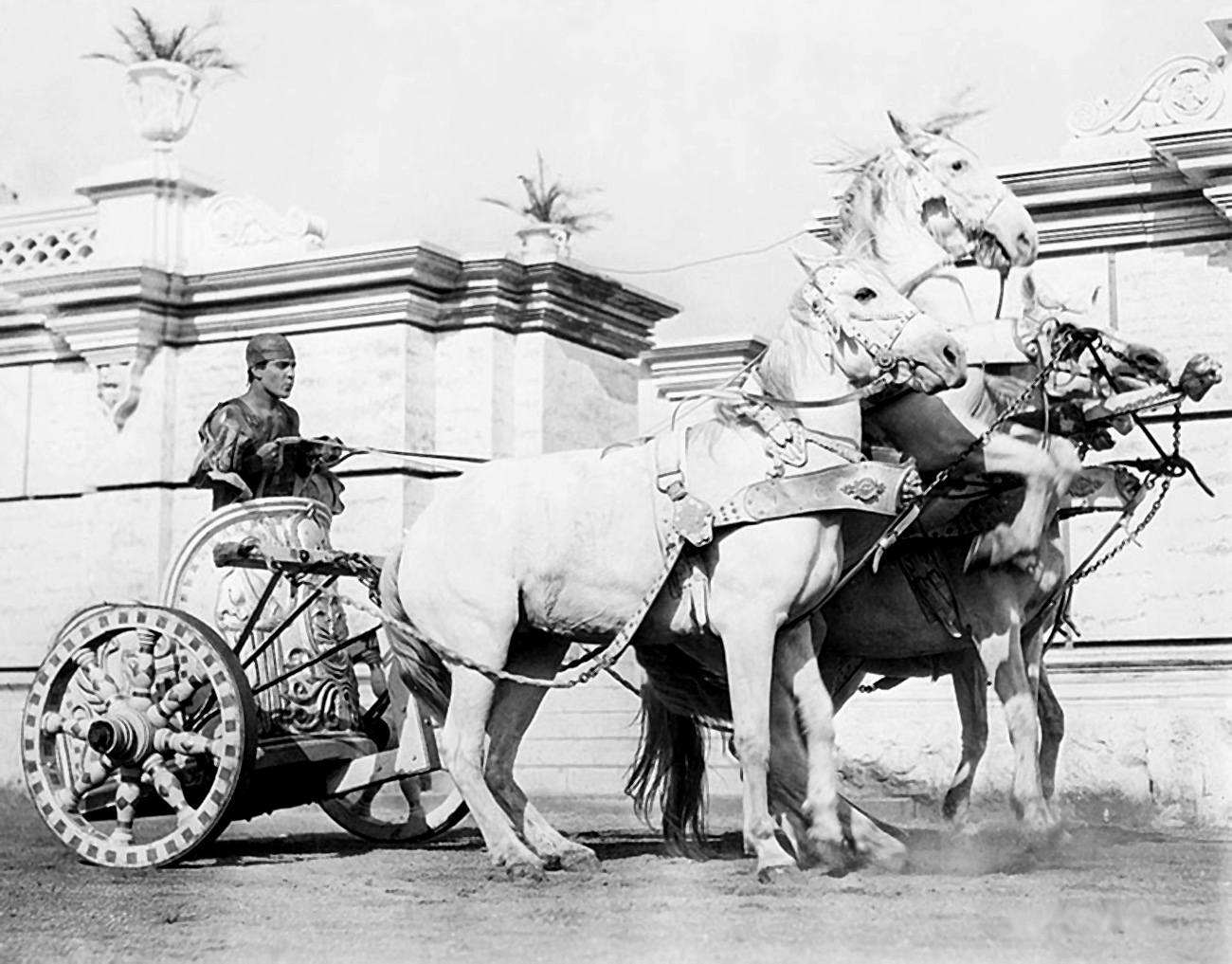
A still from the famous "chariot race" scene in 'Ben Hur' (1925).

MONDAY, MARCH 7, 2016 / FOR IMMEDIATE RELEASE
Contact Jeff Rapsis • (603) 236-9237 • jeffrapsis@gmail.com

Silent film epic ‘Ben Hur’ (1925) at Merrimack College on Wednesday, March 23


Hollywood's original Biblical-era blockbuster to be screened with live music at Rogers Center for the Arts

NORTH ANDOVER, Mass.—One of early Hollywood's greatest epics returns to the big screen with a showing of 'Ben Hur, A Tale of The Christ' (1925) at the Rogers Center for the Performing Arts at Merrimack College on Wednesday, March 23 at 7 p.m.

The program, the latest in the Rogers Center's silent film series, will be accompanied by live music performed by silent film composer Jeff Rapsis. Admission is free.

'Ben Hur,' starring Ramon Novarro and Francis X. Bushman, was among the first motion pictures to tell a Biblical-era story on an enormous scale.

The film, which helped establish MGM as a leading Hollywood studio, employed a cast of thousands and boasted action sequences including a large-scale sea battle. The film is highlighted by a spell-binding chariot race that still leaves audiences breathless.

Set in the Holy Land at the time of Christ's birth, 'Ben Hur' tells the story of a Jewish family in Jerusalem whose fortune is confiscated by the Romans and its members jailed.

The enslaved family heir, Judah Ben Hur (played by Novarro, a leading silent-era heartthrob) is inspired by encounters with Christ to pursue justice, which leads him to a series of epic adventures in his quest to find his mother and sister and restore his family fortune.

The film is particularly appropriate for the week leading up to Easter.

The screening is the latest in Rogers Center's series of silent film screenings. The series aims to showcase the best of early Hollywood the way it was intended to be experienced: on the big screen, with live music, and in a theater with an audience.

"Put together those elements, and it's amazing how much power these films still have. You realize why these films caused people to first fall in love with the movies, said accompanist Jeff Rapsis, who will improvise a full score for the 2½-hour epic.

'Ben Hur,' directed by Fred Niblo, was among the most expensive films of the silent era, taking two years to make and costing between $4 million and $6 million. When released in 1925, it became a huge hit for the newly formed Metro-Goldwyn-Mayer studio.

The chariot race scene in 'Ben Hur,' with Novarro and other cast members driving teams of horses at high speed on a mammoth dirt racetrack in a gigantic replica of a Roman stadium, was among the most complicated and dangerous sequences filmed in the silent era. It remains noted for its tight editing, dramatic sweep, and sheer cinematic excitement.

The chariot race was re-created virtually shot for shot in MGM's 1959 remake, and more recently imitated in the pod race scene in 'Star Wars Episode I: The Phantom Menace.'

Besides Novarro in the title role, the film stars Francis X. Bushman as Messala, the Roman soldier who imprisons the Hur family; Betty Bronson as Mary, mother of Jesus; May McAvoy as Ben Hur's sister Esther; and Claire McDowell as Ben Hur's mother. 'Ben Hur' was based on the best-selling 1880 novel by General Lew Wallace, which interwove the story of Christ's life with the Ben Hur clan, a fictional Jewish merchant family.

Celebrity "extras" in the chariot race scene included stars such as Douglas Fairbanks, Harold Lloyd, Lionel Barrymore, John Gilbert, Joan Crawford, Lillian Gish, Mary Pickford, and a very young Clark Gable.

The film was remade by MGM in the 1950s in a color and wide-screen version starring Charleston Heston that garnered 11 Academy Awards. Some critics believe the original 1925 version offers superior drama and story-telling.

MGM executives at the time, aware of the quality of the original version, attempted to destroy all prints of the 1925 'Ben Hur,' sending the FBI out to confiscate collector copies in the 1950s. However, the studio did preserve the negative of the 1925 version, so the film remains available today.

In creating music for silent films, Rapsis performs on a digital synthesizer that reproduces the texture of the full orchestra and creates a traditional "movie score" sound.

For each film, Rapsis improvises a music score using original themes created beforehand. None of the the music is written down; instead, the score evolves in real time based on audience reaction and the overall mood as the movie is screened.

Upcoming shows in this year's series include:

'Ben Hur' (1925) will be screened with live music on Wednesday, March 23 at 7 p.m. at the Rogers Center for the Arts, Merrimack College, 315 North Turnpike St., North Andover, Mass. The program is free and open to the public. For more information, call the Rogers box office at (978) 837-5355. For more info on the music, visit www.jeffrapsis.com.

For info on the music, visit www.jeffrapsis.com.


Thursday, August 20, 2015

Tonight: The spectacular silent version
of 'Ben Hur' in Ogunquit, Maine


A little late in getting this posted, but tonight (Thursday, Aug. 20) brings a screening of the epic silent version of 'Ben Hur' (1925) at the Leavitt Theatre in Ogunquit, Maine.

Showtime is 8 p.m. and tickets are $10 per person.

'Ben Hur' is a great film for music, highlighted by the spectacular chariot race and an equally impressive naval battle.

I have some good material for scoring this one, and I'm looking forward to tonight's screening.

Truth be told, I'm still recovering from last week's four-shows-in-four-days marathon, which wiped me out.

More on those in a post-to-come, including one show in an old barn where the screen was an actual bedsheet and some audience members sat in a vintage sleigh!

But I'll be back at full strength tonight. So here's the text of the 'Ben Hur' press release with more info on the show.

Hope to see you there, heathens!

* * *

The famous chariot race sequence in 'Ben Hur' contains some of the greatest editing of the silent era.

FRIDAY, AUG. 14, 2015 / FOR IMMEDIATE RELEASE
Contact Jeff Rapsis • (603) 236-9237 • jeffrapsis@gmail.com

Silent film epic ‘Ben Hur’ (1925) at Leavitt Theatre on Thursday, Aug. 20


Hollywood's original Biblical-era blockbuster to be screened with live musical accompaniment

OGUNQUIT, Maine—One of early Hollywood's greatest epics returns to the big screen with a showing of 'Ben Hur, A Tale of The Christ' (1925) on Thursday, Aug. 20 at the historic Leavitt Fine Arts Theatre in downtown Ogunquit, Maine.

The screening, with live music by silent film accompanist Jeff Rapsis, starts at 8 p.m. Admission is $10 per person.

'Ben Hur,' starring Ramon Novarro and Francis X. Bushman, was among the first motion pictures to tell a Biblical-era story on an enormous scale.

The film, which helped establish MGM as a leading Hollywood studio, employed a cast of thousands and boasted action sequences including a large-scale sea battle. The film is highlighted by a spell-binding chariot race that still leaves audiences breathless.

Set in the Holy Land at the time of Christ's birth, 'Ben Hur' tells the story of a Jewish family in Jerusalem whose fortune is confiscated by the Romans and its members jailed.

The enslaved family heir, Judah Ben Hur (played by Novarro, a leading silent-era heartthrob) is inspired by encounters with Christ to pursue justice, which leads him to a series of epic adventures in his quest to find his mother and sister and restore his family fortune.

The screening is the latest in the Leavitt's summer series of silent film screenings. The series aims to showcase the best of early Hollywood the way it was intended to be experienced: on the big screen, with live music, and in a theater with an audience.

"Put together those elements, and it's amazing how much power these films still have. You realize why these films caused people to first fall in love with the movies, said accompanist Jeff Rapsis, who will improvise a full score for the 2½-hour epic.

'Ben Hur,' directed by Fred Niblo, was among the most expensive films of the silent era, taking two years to make and costing between $4 million and $6 million. When released in 1925, it became a huge hit for the newly formed Metro-Goldwyn-Mayer studio.


The chariot race scene in 'Ben Hur,' with Novarro and other cast members driving teams of horses at high speed on a mammoth dirt racetrack in a gigantic replica of a Roman stadium, was among the most complicated and dangerous sequences filmed in the silent era. It remains noted for its tight editing, dramatic sweep, and sheer cinematic excitement.

The chariot race was re-created virtually shot for shot in MGM's 1959 remake, and more recently imitated in the pod race scene in 'Star Wars Episode I: The Phantom Menace.'

Besides Novarro in the title role, the film stars Francis X. Bushman as Messala, the Roman soldier who imprisons the Hur family; Betty Bronson as Mary, mother of Jesus; May McAvoy as Ben Hur's sister Esther; and Claire McDowell as Ben Hur's mother. 'Ben Hur' was based on the best-selling 1880 novel by General Lew Wallace, which interwove the story of Christ's life with the Ben Hur clan, a fictional Jewish merchant family.

Celebrity "extras" in the chariot race scene included stars such as Douglas Fairbanks, Harold Lloyd, Lionel Barrymore, John Gilbert, Joan Crawford, Lillian Gish, Mary Pickford, and a very young Clark Gable.

The film was remade by MGM in the 1950s in a color and wide-screen version starring Charleston Heston that garnered 11 Academy Awards. Some critics believe the original 1925 version offers superior drama and story-telling.

MGM executives at the time, aware of the quality of the original version, attempted to destroy all prints of the 1925 'Ben Hur,' sending the FBI out to confiscate collector copies in the 1950s. However, the studio did preserve the negative of the 1925 version, so the film remains available today.

The Leavitt, a summer-only moviehouse, opened in 1923 at the height of the silent film era, and has been showing movies to summertime visitors for nine decades.

The silent film series honors the theater's long service as a moviehouse that has entertained generations of area residents and visitors, in good times and in bad.

In creating music for silent films, Rapsis performs on a digital synthesizer that reproduces the texture of the full orchestra and creates a traditional "movie score" sound.

For each film, Rapsis improvises a music score using original themes created beforehand. None of the the music is written down; instead, the score evolves in real time based on audience reaction and the overall mood as the movie is screened.

Upcoming shows in this year's series include:

• Thursday, Sept. 17, 2015, 8 p.m.: 'Silent Comedy with Harry Langdon' Silent comedy featuring the unique style of Harry Langdon, whose innocent baby-faced character rocketed to fame late in the silent era on the strength of films directed by a very young Frank Capra. Rediscover Harry's quiet genius the way it was intended to be seen: on the big screen and with a live audience.

• Saturday, Oct 31, 2015, 8 p.m.: 'The Lodger' (1927). A serial killer is on the loose in fog-bound London. Will the murderer be caught before yet another victim is claimed? Just in time for Halloween, suspenseful British thriller directed by a very young Alfred Hitchcock. The program is subtitled 'Chiller Theater' due to the theater's lack of central heating.

'Ben Hur' (1925) will be screened with live music on Thurday, Aug. 20 at 8 p.m. at the Leavitt Theater, 259 Main St., Route 1, Ogunquit, Maine. Admission $10. For more information, call (207) 646-3123 or visit www.leavittheatre.com.