Showing posts with label Emil Jannings. Show all posts

Saturday, August 2, 2025

Why you should see Emil Jannings in 'The Last Command' (1928) on Sunday, 8/3 in Natick, Mass.

Original poster art promoting 'The Last Command' (1928).

If a person wants to experience a great example of the story-telling power of silent film, I would point said person to 'The Last Command' (1928).

It has everything: an imaginative story, inventive camera-work, intense drama, and a great cast highlighted by a towering performance by Emil Jannings that helped him win the first-ever Academy Award for Best Actor.

'The Last Command' is not an art film—it was a standard-issue drama on Paramount's 1928 release schedule. 

At the same time, it's an example of silent film technique at its height. As directed by Josef von Sternberg, the movie makes fluent use of the vocabulary of visual story-telling.

What's especially impressive to me is how the film uses its specific dramatic material to explore universal questions such as the nature of power, the value of loyalty, the meaning of patriotism, the role of chance, and many other issues people have grappled with throughout human experience.

In doing so, I think 'The Last Command' transcends mere entertainment and becomes timeless art. It's a great example of how the best silent cinema can stand alongside the best literature, paintings, sculpture, drama, and music. 

You may find this surprising due to silent film's limitations as an art form, such as no dialogue. But I think these limitations are what prompted the best silent filmmakers to produce work that "speaks" to us today.

If can't wait to experience this silent masterwork as intended—on the big screen, with live music, and with an audience—then you're in luck. It's screening on Sunday, Aug. 3 at 4 p.m. at the Center for the Arts in Natick, Mass., with me accompanying.

Press release is below with a lot more info about the film and the screening. Hope to see you there!

*    *    *

Emil Jannings romances Evelyn Brent in 'The Last Command' (1928).

TUESDAY, JULY 1, 2025 / FOR IMMEDIATE RELEASE
Contact Jeff Rapsis • (603) 236-9237 • jeffrapsis@gmail.com

Silent epic 'The Last Command' with live music at Natick Center for Arts on Sunday, Aug. 3

Josef von Sternberg's groundbreaking psychological drama won 'Best Actor' for Emil Jannings at first-ever Academy Awards

NATICK, Mass.—'The Last Command' (1928), a silent film drama that won Emil Jannings 'Best Actor' honors at the first-ever Academy Awards, will be screened with live music on Sunday, Aug. 3 at 4 p.m. at TCAN Center for the Arts, 14 Summer St., Natick, Mass.

The screening, the latest in the Center for the Art's silent film series, will feature live accompaniment by Jeff Rapsis, a New Hampshire-based composer who specializes in creating music for silent films.

Admission is $12 per person for members; $14 for non-members. Tickets are available online at www.natickarts.org or at the door.

'The Last Command,' directed by Josef von Sternberg, tells the sweeping story of a powerful general in Czarist Russia (Jannings) forced to flee his homeland during the Bolshevik Revolution. He emigrates to America, where he is reduced to living in poverty.

Finding work as an extra at a Hollywood studio, the former general lands the part of a commanding officer in a movie about the Revolution, causing flashbacks to his traumatic experiences. The conflict leads to a spectacular climax and a towering performance that earned Jannings 'Best Actor' honors.

The film takes audiences on a journey through big emotions as well as issues of history, time, power, and especially a man's duty to his country and to his fellow citizens—and what happens when the two obligations diverge.

'The Last Command' is also one of early Hollywood's most creative and challenging looks at the global conflicts that contributed to World War I.

The film also stars a young William Powell as a Hollywood movie director who crosses paths with the general during the Revolution, and 1920s starlet Evelyn Brent as a seductive Russian revolutionary.

Rapsis, the accompanist, will create the film's score live as the movie is shown.

"Making up the music on the spot is kind of a high wire act," Rapsis said. "But there's nothing like the energy and excitement that comes with improvised live performance, especially when accompanying a silent film."

Critic Leonard Maltin hailed 'The Last Command' as "a stunning silent drama...a fascinating story laced with keen observations of life and work in Hollywood." Time Out of London called it "the first Sternberg masterpiece, expertly poised between satire and 'absurd' melodrama. The cast are fully equal to it; Jannings, in particular, turns the characteristic role of the general into an indelible portrait of arrogance, fervor and dementia."

Director Sternberg, a master of lighting and black-and-white photography, created 'The Last Command' as a visual tour de force. The film is often cited as a prime example of the emotional range and visual accomplishment of silent films at their height, just prior to the coming of pictures with recorded soundtracks.

Rapsis said great silent film dramas such as 'The Last Command' told stories that concentrate on the "big" emotions such as Love, Despair, Anger, and Joy. Because of this, audiences continue to respond to them in the 21st century, especially if they're presented as intended—in a theater on the big screen, with a live audience and live music.

"Dramas such as 'The Last Command' were created to be consumed as a communal experience," Rapsis said. "With an audience and live music, they come to life as their creators intended them to. This screening at TCAN is a great chance to experience films that first caused people to fall in love with the movies."

'The Last Command' (1928) will be screened with live music on Sunday, Aug. 3 at 4 p.m. at TCAN Center for the Arts, 14 Summer St., Natick, Mass.

Admission is $12 per person for members; $14 for non-members. Tickets available online at www.natickarts.org or at the door. For more info, call (508) 647-0097. 

Saturday, February 8, 2025

This weekend: 'Sunrise' in Newport on Saturday, then 'Algol' at 50th annual Boston Sci-Fi Marathon

Emil Jannings as would-be world ruler Robert Herne in 'Algol' (1920).

It's a rare chance to see 'Sunrise' (1927) in the late afternoon.

That's because I'll accompany the Academy Award-winning silent drama on Saturday, Feb. 15 at 4:30 p.m. at the Jane Pickens Theatre in downtown Newport, R.I. 

More info about the film and the screening is in the press release pasted in below.

And the next day brings one of my most unusual gigs: the annual Boston Sci Fi Marathon, which starts on Sunday, Feb. 16 at noon and runs straight through to Monday, Feb. 17 at noon.

I'll be there to accompany 'Algol: Tragedy of Power' (1920), a bizarre German film thought lost for decades until it was rediscovered in recent years and is now available for viewing.

'Algol' is being shown late Sunday afternoon: not sure of the exact time as that depends on how far behind (or ahead) the marathon is running. 

It's the 50th year of this event, which I've appeared at several times before and it's always a hoot. There's no better audience for silent film that a theater fill of insomniac sci-fi fans.

Alas, tickets aren't available for individual films during the marathon, which is a $100 all-or-nothing proposition. But the line-up includes LOTS of great titles, and there's nothing like seeing them in this kind of communal environment.

Interested? Below are links, although I notice the online ticket portal incorrectly says the marathon starts at Sunday, Feb. 16 at 7 p.m. It really starts at noon—and there's also a pre-show scene of people lining up in front of the Somerville before doors open to get first dibs on favorite seats.

Boston Sci-Fi Marathon line-up

Tickets for Boston Sci-Fi Marathon

*     *     *

An original poster for 'Sunrise: A Song of Two Humans' (1927).
 
MONDAY, JAN. 20, 2025 / FOR IMMEDIATE RELEASE
Contact Jeff Rapsis • (603) 236-9237 • jeffrapsis@gmail.com

Academy Award-winning drama 'Sunrise' to screen on Saturday, Feb. 15 at Newport's Jane Pickens Theatre

Silent film won three honors at first-ever Academy Awards, including 'Best Actress' for Janet Gaynor; show features live musical accompaniment


NEWPORT, R.I.—Silent film on the big screen with live music returns to the Jane Pickens Theatre with the Academy Award-winning romantic drama 'Sunrise' (1927) on Saturday, Feb. 15 at 4:30 p.m.

The screening of 'Sunrise,' starring Janet Gaynor and George O'Brien, will take place at the Jane Pickens Film and Event Center, 49 Touro St. in historic downtown Newport.

Admission is $17 per person. Tickets available online at https://janepickens.com or at the door.

The screening will feature live music by Jeff Rapsis, the Jane Pickens Theatre's silent film accompanist.

Gaynor, a popular female star of the silent film era, won the first-ever Academy Award for Best Actress for her performance in 'Sunrise.' The movie took top honors in cinematography and was also recognized for "Unique and Artistic Production" at the inaugural awards.

'Sunrise' tells the story of a young country couple (played by Gaynor and O'Brien) whose marriage is threatened by the presence of a woman from the city (Margaret Livingston) who convinces the man to abandon his wife. Will the young husband go through with a plan to kill his wife? Will true love overcome the obstacles of temptation and the promise of short-term pleasure?

George O'Brien and Margaret Livingston in a scene from 'Sunrise' (1927).

'Sunrise' was directed by F. W. Murnau, a German filmmaker and one of the leading figures in German Expressionism, a style that uses distorted art design for symbolic effect. 'Sunrise' was made when Murnau was invited by studio chief William Fox to make a film in Hollywood.

The resulting movie features enormous stylized sets that create an exaggerated, fairy-tale world. The city street set alone reportedly cost over $200,000 to build, a huge sum at the time. Much of the exterior shooting was done at Lake Arrowhead, Calif.

Full of cinematic innovations, the groundbreaking cinematography (by Charles Rosher and Karl Struss) featured moving cameras and impressive tracking shots. Titles appear sparingly, with long sequences of pure action and most of the story told in Murnau's signature visual style. The extensive use of forced perspective is striking, particularly in a shot of the city with normal-sized people and sets in the foreground and smaller figures in the background by much smaller sets.

The story of 'Sunrise' is told as a visual allegory with few specific details. The characters have no names, and the setting is not named in order to make the tale more universal and symbolic.

Janet Gaynor and George O'Brien in a scene from 'Sunrise' (1927).

With a full title of 'Sunrise: A Song of Two Humans,' the film is regarded as one of the high points of the silent cinema. In 1988, it was selected for preservation in the National Film Registry of the U.S. Library of Congress for films that are "culturally, historically, or aesthetically significant." The Sight and Sound poll of 2012 for the British Film Institute named 'Sunrise' the fifth-best film in the history of motion pictures by critics, and 22nd by directors.

Critics continue to hail 'Sunrise' as one of the best films of all time.

"F.W. Murnau's 'Sunrise' conquered time and gravity with a freedom that was startling to its first audiences," wrote Roger Ebert in 2004. "To see it today is to be astonished by the boldness of its visual experimentation.

Rapsis, who uses original themes to improvise silent film scores, said great silent film dramas such as 'Sunrise' used their lack of dialogue to create stories that concentrated on the "big" emotions such as Love, Despair, Anger, and Joy. Because of this, audiences continue to respond to them in the 21st century, especially if they're presented as intended — with a live audience and live music.

"Dramas such as 'Sunrise' were created to be shown on the big screen as a communal experience," Rapsis said. "With an audience and live music, they come to life as their creators intended them to. So the screenings at Newport's Jane Pickens Theatre are a great chance to experience films that first caused people to fall in love with the movies," he said.

'Sunrise' will be shown with live music on Saturday, Feb. 15 at 4:30 p.m. at the Jane Pickens Film and Event Center, 49 Touro St. in historic downtown Newport.

Admission is $17 per person. Tickets available online at https://janepickens.com or at the door. 

 Janet Gaynor and George O'Brien in 'Sunrise' (1927).


Thursday, May 2, 2024

Next up: Emil Jannings in 'The Last Laugh' (1924) at Epsilon Spires on Friday, 5/10 in Brattleboro, Vt.

A French language poster for F.W. Murnau's film 'The Last Laugh' (1924).

April showers may bring May flowers, and May brings the start of two season series of silent film screenings. 

On Saturday, May 11, I return to Brandon Town Hall and Community Center in Brandon, Vt. for a 13th year of presenting silent films with live music. First up is Chaplin's 'The Gold Rush' (1925).

Later, on Wednesday, May 29, I'll be at the Leavitt Theatre in Ogunquit, Maine for the start of another season of silents with live music. First up: Buster Keaton in 'The General' (1926).

All the rest of each series are listed on my "Upcoming Silent Film Screenings" page, which is linked at the top right of this page.

But before any of that takes place, I'll be at Epsilon Spires in Brattleboro, Vt. on Friday, May 10, where I'll accompany F.W. Murnau's 'The Last Laugh' (1924).

More details on that screening in the press release below. Hope to see you there!

*    *    *

Emil Jannings wearing the uniform that plays such an important role in 'The Last Laugh' (1924)

MONDAY, APRIL 29, 2024 / FOR IMMEDIATE RELEASE
Contact Jeff Rapsis • (603) 236-9237 • jeffrapsis@gmail.com

'The Last Laugh' to screen with live music at Epsilon Spires on Friday, May 10

Oscar-winning actor Emil Jannings stars in ground-breaking 1924 silent drama from German director F.W. Murnau

BRATTLEBORO, Vt.—'The Last Laugh' (1924), a German silent film drama about a hotel doorman demoted to washroom attendant, will be screened with live music on Friday, May 10 at 8 p.m. at Epsilon Spires, 190 Main St., Brattleboro, Vt.

Admission is $20 per person. Tickets may be purchased in advance at www.epsilonspires.org or at the door.

The screening will feature live accompaniment on the venue's Estey pipe organ by Jeff Rapsis, a New Hampshire-based silent film musician.


In 'The Last Laugh,' regarded as one of German director F.W. Murnau's best pictures, the story is told entirely in visual terms, without the use of title cards.

The film, a character study that chronicles the mental breakdown of an aging man who loses his position of authority, is also noted for its revolutionary use of camera movement.

Playing the lead role is Swiss/German actor Emil Jannings, widely recognized as one of the most versatile actors of early cinema.

Jannings would later move to Hollywood, where he earned the first-ever Best Actor Oscar at the inaugural Academy Awards for his towering performances in 'The Last Command' (1928) and 'The Patriot' (1928).

Critics and film writers regard 'The Last Laugh' as a landmark of early cinema.

" 'The Last Laugh' is a masterpiece of psychological study, perhaps the best ever portrayal of what goes through one man's mind under varying situations ... It is absolutely mind-boggling to see Emil Jannings age at least 10 or 15 years right in front of our eyes in the course of a couple of minutes," wrote author Robert K. Klepner in 'Silent Films' (2005).

Critic David Kehr of the Chicago Reader described 'The Last Laugh' as "the 1924 film in which F.W. Murnau freed his camera from its stationary tripod and took it on a flight of imagination and expression that changed the way movies were made."

The film's director of photography, Karl Freund, set new standards of cinematography in 'The Last Laugh,' setting up the camera to move through corridors and "see" action through a character's eye-view.

Freund's long career later included work in television in the 1950s in Hollywood, when he developed the "three camera" system for the "I Love Lucy" show, which became the standard format for shooting situation comedies.


'The Last Laugh' will be accompanied by live music by Jeff Rapsis, a New Hampshire-based silent film accompanist who performs at venues across the region and beyond.

"Films such as 'The Last Laugh' were created to be shown on the big screen and in a theater as a communal experience," Rapsis said. "With an audience and live music, they still come to life in the way their makers intended them to.

'The Last Laugh' (1924) will be screened with live music on Friday, May 10 at 8 p.m. at Epsilon Spires, 190 Main St., Brattleboro, Vt.


Admission is $20 per person. Tickets may be purchased in advance at www.epsilonspires.org or at the door.

Monday, March 11, 2024

On Friday, 3/15: at the Cleveland Cinematheque to do music for 'The Last Command' (1928)

Original promotional art for Emil Jannings in 'The Last Command' (1928).

Just a few notes prior to heading out to Cleveland to do music this Friday for 'The Last Command' (1928), one of the greatest silents (in my opinion) and which, surprisingly, they've never run at the Cinematheque.

I say surprisingly because the guy who's managed the Cinematheque for nearly 40 years, John Ewing, has an encyclopedic knowledgeable about cinema and often includes silent film programs in the venue's schedule.

Somehow, director Josef von Sternberg's most powerful silent, featuring a towering performance by Emil Jannings that helped him win the very first Academy Award for Best Actor, never made it to the Cinematheque's screen.

Well, that omission will be rectified on Friday, March 15—and just in time, too, as John is retiring this spring after almost four decades of service to Cleveland-area cinephiles. 

It's been my pleasure to accompany Cinematheque programs over the years. And I appreciate the opportunity to head out for one last show during John's storied tenure.

Storied? Indeed—his impending retirement made headline news all over Ohio: here, and here, and here.

Happy trails, John! But not until I head out to Cleveland for one last round-up, which starts at 7 p.m. on Friday, March 15, and which includes not only 'The Last Command' but also a French film I've never heard of before: 'Menilmontant' (1926) from director Dimitri Kirsanoff.

Although it's my last screening under John's watch, it won't be my last visit to Cleveland as an accompanist. I'm already booked to do music on Saturday, Jan. 18, 2025 for 'The Lost World' (1925) at the 50th annual 36-hour sci-fi marathon at Case Western Reserve University, which is just a few blocks down Euclid Ave. from the Cinematheque. 

Okay, see you in Cleveland. But before I leave, a quick glance back at recent screenings, which included a seasonally and locationally appropriate showing of 'Way Down East' (1920) on Wednesday, March 6 at the Flying Monkey Moviehouse in Plymouth, N.H.

I saw "seasonally" because the film's climax takes place in New England at this time of year. And "locationally" because the Flying Monkey is not that far from the part of the Connecticut River Valley where the many of the film's exteriors were shot, including the sequence with Lillian Gish adrift on the ice floes.

We showed the 1931 re-release version of the film, which is about 40 minutes shorter than director D.W. Griffith's original cut. People seemed to enjoy it, and cheered when Gish was rescued by Richard Barthelmess just as she was about to go over the falls. 

But somehow, to me it lacked the full-length version's monumental quality. The climax seemed to come too fast. Once again, I'm reminded that Griffith really knew what he was doing.

In other news, a screening of the silent version of 'Peter Pan' (1924) in my hometown on Sunday, March 10 brought familiar faces to the Bedford (N.H.) Public Library. One woman asked me about a weekly column that I used to write for the local paper—which I stopped writing nearly 20 years ago now!

Pre-show remarks at the Blazing Star Grange Hall in Danbury, N.H.

But the real highlight of the past week was my now-annual appearance at the Blazing Star Grange Hall in Danbury, N.H., where a capacity crowd enjoyed Buster Keaton and Ernest Torrence in 'Steamboat Bill, Jr.' (1928).

New Hampshire towns are full of former Grange Hall buildings that no longer house Grange chapters. But not Danbury, where the local Grange still maintains its own hall, which I think looks very much like it might have 100 years ago.

Although the programming includes a silent film program each year at about mud season, that doesn't mean new ideas aren't welcome. In that vein, last Saturday night saw the debut of a new "soup and bread supper" option to go along with movie night.

I was busy setting up, and I'd already eaten, so I didn't get downstairs until most of the soup was gone. Here's the impressive line-up:

This one seemed especially ambitious. Or maybe it was just the high tech crockpot used to serve it.

 And if the soup didn't fill you up, a makeshift concessions counter upstairs was ready for movie-goers.

The paper bags contain popcorn, freshly popped. Alas, Grange members sold only a handful of bags—maybe because everyone was full of soup!

And it was a conversation after the screening that gave me confidence that this was one Grange chapter that hadn't lost touch with its agricultural base.

What would happen to the uneaten and unsold popcorn? "The pigs would love it!"

Tuesday, January 2, 2024

Coming up next: 'The Last Command' on Sunday, Jan. 21 at Town Hall Theatre in Wilton, N.H.

Evelyn Brent and Emil Jannings in 'The Last Command' (1928).

When asked which silent film is my favorite, I'm sometimes tempted to say 'The Last Command' (1928). For sheer story-telling audacity, there's nothing quite like it. 

Plus it's really something to see Emil Jannings go berzerk at the end of this movie. No surprise that he took home the first-ever 'Best Actor' Academy Award that year.

So I'm pleased to say that up next is 'The Last Command' (1928), which I'll be accompanying on Sunday, Jan. 21 at 2 p.m. at the Town Hall Theatre in Wilton, N.H. 

More details are in the press release below. For now, here's a report from the New Year's Day screening of Chaplin's 'The Gold Rush' (1925) that I accompanied at the Garden Cinemas in Greenfield, Mass.

You never know what kind of promotion will be in place for silent film screenings in Greenfield. Here, a sidewalk blackboard is of interest to a passing canine. Too bad it wasn't a Rin Tin Tin film!

We've been doing silent films in Greenfield for a couple of years now—enough to build up an audience to the point where we get 50 to 60 people for each screening. 

I wasn't sure if the pattern would hold for a screening on New Year's Day, but it did. What's more, they were not shy about reacting. Right from the start, at Chaplin's first entrance, the laughs came easily. 

One really cool thing is that after years of fumbling around, I stumbled on a way to effectively accompany the climactic "hanging cabin" sequence. 

To my way of thinking, the music should help support suspense and comedy at the same time, similar to what's called for when Harold Lloyd is climbing around the upper floors of that building in 'Safety Last.' What kind of music can communicate these contradictory moods?

Greenfield Garden Cinemas owner Isaac Mass welcomes audience members to our screening of 'The Gold Rush' (1925).

Last night, it occurred to me: the well-known "Morning Mood" melody from Grieg's Peer Gynt incidental music. As familiar and hackneyed as it is, it really does fit the scene when Chaplin and then Mack Swain awaken.

It could be that although we are aware of their predicament, they aren't. And so the music carries a double layer of meaning: a normal morning to them,anything but normal to us. The music is instantly ironic commentary.

But then, as Chaplin and Swain gradually discover the peril they're in, the "Morning Mood" melody can be transformed in various ways to continue heightening the tension. Sometimes faster, sometimes slower, sometimes in the minor key or other mode, sometimes with off notes in the harmony or punctuated with dissonant chords or ominous pedal tones.

And then there's always our good friend silence to really rivet an audience's attention. After which Grieg's melody can reassert itself in even creepier fashion.

All these elements combined to create a really satisfying accompaniment. I felt it augmented how Chaplin presented the sequence. Audience response to this sequence was the strongest that I can recall—for the first time in my experience, the film elicited shrieks and gasps among the laughs.

And the payoff: a hearty cheer (spoiler alert!) when Chaplin leaps from the cabin and lands on solid ground. Yes!

If you'd like to experience this for yourself, I'll be doing 'The Gold Rush' again on Saturday, Feb. 3 at the Campton (N.H.) Historical Society. For more info, check the listings under the 'Upcoming Silent Film Screenings' link on the upper right corner of this page.

The screening, by the way, is part of a pot luck supper—ironic for a film in which so much of the comedy stems from starvation. 

But for now, here's all you'll need to catch 'The Last Command' (1928) on Sunday, Jan. 21 in Wilton. See you there!

*  *  *  

Poster featuring Emil Jannings in 'The Last Command' (1928).
 
TUESDAY, JAN. 2, 2024 / FOR IMMEDIATE RELEASE
Contact Jeff Rapsis • (603) 236-9237 • jeffrapsis@gmail.com

Silent epic 'The Last Command' with live music at Town Hall Theatre on Sunday, Jan. 21

Josef von Sternberg's groundbreaking psychological drama won 'Best Actor' for Emil Jannings at first-ever Academy Awards

WILTON, N.H.—'The Last Command' (1928), a silent film drama that won Emil Jannings 'Best Actor' honors at the first-ever Academy Awards, will be screened with live music on Sunday, Jan. 21, 2024 at 2 p.m. at the Town Hall Theatre, 40 Main St., Wilton, N.H.

Admission is free; donations are accepted, with $10 per person suggested to defray expenses.

The screening, the latest in the venue's silent film series, will feature live accompaniment by Jeff Rapsis, a New Hampshire-based composer who specializes in creating music for silent films.

'The Last Command,' directed by Josef von Sternberg, tells the sweeping story of a powerful general in Czarist Russia (Jannings) forced to flee his homeland during the Bolshevik Revolution. He emigrates to America, where he is reduced to living in poverty.

Finding work as an extra at a Hollywood studio, the former general lands the part of a commanding officer in a movie about the Revolution, causing flashbacks to his traumatic experiences. The conflict leads to a spectacular climax and a towering performance that earned Jannings 'Best Actor' honors.

Emil Jannings in 'The Last Command' (1928).

The film takes audiences on a journey through big emotions as well as issues of history, time, power, and especially a man's duty to his country and to his fellow citizens—and what happens when the two obligations diverge.

'The Last Command' is also one of early Hollywood's most creative and challenging looks at the global conflicts that contributed to World War I.

The film also stars a young William Powell as a Hollywood movie director who crosses paths with the general during the Revolution, and 1920s starlet Evelyn Brent as a seductive Russian revolutionary.

Rapsis, the accompanist, will create the film's score live as the movie is shown.

"Making up the music on the spot is kind of a high wire act," Rapsis said. "But there's nothing like the energy and excitement that comes with improvised live performance, especially when accompanying a silent film."

Critic Leonard Maltin hailed 'The Last Command' as "a stunning silent drama...a fascinating story laced with keen observations of life and work in Hollywood." Time Out of London called it "the first Sternberg masterpiece, expertly poised between satire and 'absurd' melodrama. The cast are fully equal to it; Jannings, in particular, turns the characteristic role of the general into an indelible portrait of arrogance, fervor and dementia."

Director Sternberg, a master of lighting and black-and-white photography, created 'The Last Command' as a visual tour de force. The film is often cited as a prime example of the emotional range and visual accomplishment of silent films at their height, just prior to the coming of pictures with recorded soundtracks.

Rapsis said great silent film dramas such as 'The Last Command' told stories that concentrate on the "big" emotions such as Love, Despair, Anger, and Joy. Because of this, audiences continue to respond to them in the 21st century, especially if they're presented as intended—in a theater on the big screen, with a live audience and live music.

"Dramas such as 'The Last Command' were created to be consumed as a communal experience," Rapsis said. "With an audience and live music, they come to life as their creators intended them to. This screening at the Town Hall Theatre is a great chance to experience films that first caused people to fall in love with the movies."

'The Last Command' (1928) will be screened with live music on Sunday, Jan. 21, 2024 at 2 p.m. at the Town Hall Theatre, 40 Main St., Wilton, N.H.

Admission is free; donations are accepted, with $10 per person suggested to defray expenses. For more information, call the theater at (603) 654-3456.

Wednesday, October 19, 2022

Tonight in Plymouth, N.H.: Emil Jannings as 'Mephisto' in Murnau's dark epic 'Faust' (1926)

Emil Jannings doesn't hold back as 'Mephisto' (a.k.a. Satan) in 'Faust' (1926). 

As the days grow shorter, and the list of screenings for Halloween grows longer. 

Tonight, it's Murnau's 'Faust' (1926), which I'll accompany at the Flying Monkey Moviehouse and Performance Center in Plymouth, N.H.  Showtime is 6:30 p.m. 

See you there! Lots more info in the press release below.

For now, a brief report on the first of several 'Nosferatu' (1922) screenings coming up in the next two weeks.

With this year marking the 100th anniversary of the film's release, interest is heavier than usual.

Last Sunday afternoon, I accompanied 'Nosferatu' to the largest crowd we've attracted so far to the silent film series at the Center for the Arts in Natick, Mass.

The Center for the Arts screening room just before 'Nosferatu.'

About 40 people took in the film, with many staying afterwards for an extended question-and-answer session.

Most had never seen 'Nosferatu,' so I need to keep that in mind when I start thinking that the film gets programmed too often. 

'Faust' certainly doesn't run as often, so if you're interested in seeing Murnau's last film made in Germany prior to his move to Hollywood, join us this evening. 

Here's the press release:

*  *  *

An original German poster for F.W. Murnau's adaptation of 'Faust' (1926).

TUESDAY, SEPT. 20, 2022 / FOR IMMEDIATE RELEASE
Contact Jeff Rapsis • (603) 236-9237 • jeffrapsis@gmail.com

Rarely shown 'Faust' adaptation on Wednesday, Oct. 19 at Flying Monkey

Silent film thriller starring Emil Jannings to be shown on the big screen with live music for Halloween program

PLYMOUTH, N.H.—It's been a novel, a stage play, and an opera. When movies first appeared a century ago, it was only a matter of time before they tackled 'Faust,' the tale of a man who consigns his soul to the devil to obtain power in the present.

At the height of the silent era, German director F.W. Murnau created a cinematic version of 'Faust' filled with stunning images that maintain their power to astonish.

See for yourself with 'Faust' (1926), the original silent film adaptation of the classic legend, to be shown on Wednesday, Oct. 19 at 6:30 p.m. at the Flying Monkey Moviehouse and Performance Center, 39 Main St., Plymouth, N.H.

Admission is $10 per person, general seating.

'Faust' is a 1926 silent film produced by German studio UFA, directed by F. W. Murnau, starring Gösta Ekman as Faust, Emil Jannings as Mephisto, and Camilla Horn as Gretchen.

As the film opens, the demon Mephisto has a bet with an Archangel that he can corrupt a righteous man's soul and destroy in him what is divine. If he succeeds, the Devil will win dominion over earth.

A scene from F.W. Murnau's adaptation of 'Faust.'

The Devil delivers a plague to the village where Faust, an elderly alchemist, lives. Though he prays to stop the death and starvation, nothing happens. Disheartened, Faust throws his alchemy books in the fire, and then the Bible too. One book opens, showing how to have power and glory by making a pact with the Devil.

Faust goes to a crossroads as described in the book and conjures up the forces of evil. When Mephisto appears, he induces Faust to make a trial, 24-hour bargain. Faust will have Mephisto's service till the sand runs out in an hourglass, at which time the Devil will rescind the pact.

At first, Faust uses his new power to help the people of the village, but they shun him when they find out that he cannot face a cross. They stone him and he takes shelter in his home. Mephisto then uses the lure of restored youth and love to convince Faust to sign over his soul once and for all.

The remainder of the film follows the grim consequences for everyone, all depicted with vivid visual imagination in the last film Murnau made in Germany before making the move to Hollywood.

'Faust' continues to impress modern critics, including Roger Ebert.

"Murnau had a bold visual imagination, distinctive even during the era of German Expressionism with its skewed perspectives and twisted rooms and stairs," Ebert wrote in 2005. " 'Faust,' with its supernatural vistas of heaven and hell, is particularly distinctive in the way it uses the whole canvas."

A scene from F.W. Murnau's adaptation of 'Faust.'

In screening F.W. Murnau's version of 'Faust,' the Flying Monkey aims to recreate all essential elements of silent film experience: high quality prints shown on a large screen, with live music and an audience.

"These films caused people to fall in love with the movies for a very good reason," said Jeff Rapsis, who will improvise a musical score during the screening. "They were unique experiences, and if you can recreate the conditions under which they were shown, they have a great deal of life in them.

"Though they're the ancestors of today's movies, silent film is a very different art form than what you see at the multiplex today, so it's worth checking out as something totally different," Rapsis said.

Rapsis performs on a digital synthesizer that reproduces the texture of the full orchestra and creates a traditional "movie score" sound.

F.W. Murnau's ‘Faust' will be shown on Wednesday, Oct. 19 at 6:30 p.m. at the Flying Monkey Moviehouse and Performance Center, 39 Main St., Plymouth, N.H.

Admission is $10 per person. For more info, call (603) 536-2551 or visit www.flyingmonkeynh.com.

Monday, April 18, 2022

On Thursday, 4/21: 'Ben Hur' in Manchester, N.H., plus giving Shakespeare 'the silent treatment'

Ramon Novarro in the original silent film version of 'Ben Hur' (1925).

Next up: I'm doing music for a screening of 'Ben Hur' (1925) on Thursday, April 21 at the Rex Theatre in downtown Manchester.

Hop into your chariot and join us! Showtime is 7:30 p.m. and a ton more info in the press release attached below.

For now, a few thoughts about yesterday's screening of the silent film version of 'Othello' (1922) starring Emil Jannings in the title role.

Yes, Shakepeare without all those spoken words getting in the way!

It being Easter Sunday, the smaller-than-usual turnout was to be expected for our screening at the Town Hall Theatre in Wilton, N.H.

But what wasn't expected was for the film to have such an impact, which it did.

This was one reason for programming the film in the first place: I've found that even the most unlikely film can somehow leap to life when presented as intended: on a big screen, in a good print, with live music, and in a theater with an audience.

This, however, was different. We were about to give Shakespeare "the silent treatment."

A poster promoting the original German release of 'Othello' (1922).

Prior to the screening, the last in our four-month celebration of films celebrating their 100th birthday,  I laid out the challenge before us.

I observed that Shakespeare is known primarily for the language of his playwriting. And here we are, proposing to take one of his most well-known tragedies, and present it without that key element of language.

Yes, there would be some words, presented in intertitles where needed. But only a tiny fraction of the 3,560 lines Shakespeare composed for his play would be used.

And to make it more of a challenge, the film was produced in Germany. So the text would have been originally in German, then translated back to English for a "foreign" release in English-speaking lands.

Also, Shakespeare's play can take 2½ to 3 hours to perform. The silent 'Othello' clocks in at about 75 minutes. So there's another thing to consider: without all those words to get through, the story might flow quite differently.

What's going on here, I said, is something of a test of the actual story that underlies Shakespeare's play. How much of the power of Shakespeare's 'Othello' rests in the Bard's cadences, and how much comes from the tale itself?

Stripping away all the words and telling the story visually—which is what silent film does—could be a good way to tell.  

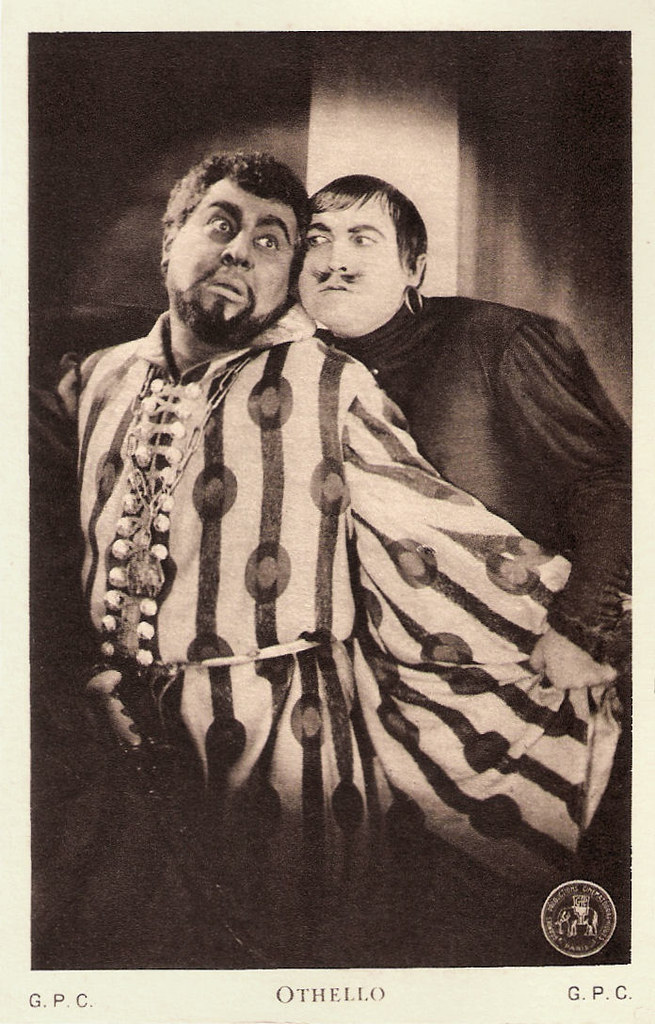
Emil Jannings and Werner Krauss in 'Othello' (1922).

It's worth remembering, I said, that Shakespeare based nearly all of his writing on stories that already existed. He didn't so much write his plays from scratch as he did adapt stories for the stage.  

In the case of Othello, his source was something called the "Hecatommithi," a collection of tales published in 1565 by Giraldi Cinthio, an Italian novelist and poet. 

Odds are that there's something powerful in this tale, as evidenced by other adaptations of Othello—most notably, the big opera 'Otello' by Giuseppe Verdi, first staged in 1887, and which involved Shakespeare's play being rewritten as an opera libretto by Arrigo Boito.

But still—how well did Shakespeare choose his story? Seeing the silent 'Othello' might be a good way to tell.

Prior to the screening, I was asked what my strategy was as accompanist. I said it was really no different than any other silent drama: to try to come up with music that helped the film work, both on its own terms but also so that it would meet today's audience expectations.

Coming into it, for some reason I had in mind Beethoven's 'Coriolan Overture,' which I had heard recently on the radio, and which was written not for Shakespeare's play 'Coriolanus' but for a contemporary drama by Heinrich Joseph von Collins.

Still, that was what I was going for: a kind of taut classical texture capable of drama, but within certain restraints and limits. 

I came up with two main motifs: a staccato four-note motto that proved very versatile, and a legato four-note "down the scale" phrase that was equally useful. These became the basic building blocks that helped it all come together. 

So in the end, if our test had any validity, Shakespeare's tale passed with flying colors. He chose well.

Afterwards, a woman came up to me who said she was a Shakespeare buff who had helped start a "Shakespeare in the Park" program in Kentucky.

She'd come to the screening "out of curiosity" and not expecting much, but found she really enjoyed the film and found it true to the Bard's spirit, even with most of his words were missing. 

Also, she confirmed that much of the language that did survive (via title cards) was indeed Shakepeare's own. (The only thing I could identify was Iago's famous "Put money in thy purse" exhortation.) 

So it was enough to satisfy even a serious aficionado. Good show!

A similar challenge awaits next Sunday (April 24), when I create music for MGM's silent film version of 'La Bohème' (1926), screening at 2 p.m. at the Somerville Theatre.

For the music, I don't intend on channeling Puccini, but will do my own stuff to support the film as best as I can. Will the story (and the star power of Lillian Gish and John Gilbert, at left) be enough to carry the day without the famous score? 

Well—the tale was strong enough to support the contemporary hit musical 'Rent.' So that's encouraging.

But can it survive the test of the silent treatment? Come and find out!

Okay, here's the long-promised press release about 'Ben Hur' (1925) on Thursday, April 21 at the Rex Theatre in Manchester, N.H. 

Vidi ibi an quadratus sit! (That's Latin for "See you there or be square!")

*    *    *

Colorful original release poster for 'Ben Hur; (1925).

TUESDAY, APRIL 12, 2022 / FOR IMMEDIATE RELEASE
Contact Jeff Rapsis • (603) 236-9237 • jeffrapsis@gmail.com

Silent film epic ‘Ben Hur’ (1925) coming to Manchester's Rex Theatre on Thursday, 4/21

Celebrating Easter: Hollywood's original Biblical-era blockbuster to be screened with live music at newly resurrected venue

MANCHESTER, N.H.—One of early Hollywood's greatest epics returns to the big screen with a showing of 'Ben Hur, A Tale of The Christ' (1925) on Thursday, April 21 at 7:30 p.m. at the Rex Theatre, 23 Amherst St., Manchester, N.H.

The screening will feature live accompaniment by Jeff Rapsis, a New Hampshire-based composer who specializes in creating music for silent films.

Admission is $10 per person, general admission. Tickets are available online at www.palacetheatre.org or at the door.

'Ben Hur,' starring Ramon Novarro and Francis X. Bushman, was among the first Hollywood motion pictures to tell a Biblical-era story on a large scale.

The film, which helped establish MGM as a leading studio, employed a cast of thousands and boasted action sequences including a large-scale sea battle.

The film is highlighted by a spell-binding chariot race that still leaves audiences breathless.

Set in the Holy Land at the time of Christ's birth, 'Ben Hur' tells the story of a Jewish family in Jerusalem whose fortune is confiscated by the Romans and its members jailed.

The enslaved family heir, Judah Ben Hur (played by Novarro, a leading silent-era heartthrob) is inspired by encounters with Christ to pursue justice. This leads him to a series of epic adventures in his quest to find his mother and sister and restore his family fortune.

The film is particularly appropriate for the season of Easter, which is celebrated on Sunday, April 17. (Orthodox Easter falls on Sunday, April 24 in 2022.)

'Ben Hur,' directed by Fred Niblo, was among the most expensive films of the silent era, taking two years to make and costing between $4 million and $6 million. When released in 1925, it became a huge hit for the newly formed Metro-Goldwyn-Mayer studio.

The chariot race scene in 'Ben Hur,' with Novarro and other cast members driving teams of horses at high speed on a mammoth dirt racetrack in a gigantic replica of a Roman stadium, was among the most complicated and dangerous sequences filmed in the silent era. It remains noted for its tight editing, dramatic sweep, and sheer cinematic excitement.

The chariot race was re-created virtually shot for shot in MGM's 1959 remake, and more recently imitated in the pod race scene in 'Star Wars Episode I: The Phantom Menace.'

Besides Novarro in the title role, the film stars Francis X. Bushman as Messala, the Roman soldier who imprisons the Hur family; Betty Bronson as Mary, mother of Jesus; May McAvoy as Ben Hur's sister Esther; and Claire McDowell as Ben Hur's mother.

'Ben Hur' was based on the best-selling 1880 novel by General Lew Wallace, which interwove the story of Christ's life with the Ben Hur clan, a fictional Jewish merchant family.

Celebrity "extras" in the chariot race scene included stars such as Douglas Fairbanks, Harold Lloyd, Lionel Barrymore, John Gilbert, Joan Crawford, Lillian Gish, Mary Pickford, and a very young Clark Gable.

The film was remade by MGM in the 1950s in a color and wide-screen version starring Charlton Heston that garnered 11 Academy Awards. Some critics believe the original 1925 version offers superior drama and story-telling.

In creating music for silent films, accompanist Jeff Rapsis performs on a digital synthesizer that reproduces the texture of the full orchestra and creates a traditional "movie score" sound.

For each film, Rapsis improvises accompaniment using original themes created beforehand. No music is written down; instead, the score evolves in real time based on audience reaction and the overall mood as the movie is screened.

'Ben Hur, A Tale of The Christ' (1925) will be shown on Thursday, April 21 at 7:30 p.m. at the Rex Theatre, 23 Amherst St., Manchester, N.H.

General admission is $10 per person. Tickets available online at www.palacetheatre.org or at the door. For more information, call the Rex box office at (603) 668-5588.


Saturday, April 16, 2022

This Sunday: Silent Shakespeare! And then 'Ben Hur,' then Cleveland, and then back to Boston!

The moor, the not-so-merrier: Emil Jannings as 'Othello' (1922).

This weekend, things take a turn towards the literary—after which I take a turn to Ohio!

Up first: music for an early silent screen adaptation of Shakespeare's 'Othello' (1922), made in Germany and starring Emil Jannings in the title role. 

Yes, silent Shakespeare! See what you think: the screening is Sunday, April 17 at 2 p.m. at the Town Hall Theatre in Wilton, N.H. More detail in the press release below.

After that, it's music for big bad 'Ben Hur' (1925), screening on Thursday, April 21 at 7:30 p.m. at the Rex Theatre, 23 Amherst St., Manchester, N.H. 

And the next day finds me swinging out to Cleveland, Ohio, where I'll accompany two films at the Cleveland Cinematheque on Friday, April 22 and then join the fun at the annual 36-hour sci-fi marathon at nearby Case Western University.

At the Cinematheque, it's 'Nanook of the North' (1922) and then the recently reissued 'Straight is the Way' (1921), a curiosity set in my own home state of New Hampshire. 

At the sci-fi marathon, it's 'Der Golem' (1920), which will be screened about 20 hours into the big show. Looking forward to the reaction!

And then I scoot back to Boston to do music for the big MGM silent film version of 'La Bohéme' (1926) starring Lillian Gish and John Gilbert. Screening is Sunday, April 24 at 2 p.m. at the Somerville Theatre, and marks the restart of the venue's 'Silents, Please!' series.

But before any of that, it's time to brush up our Shakespeare this Sunday afternoon. Here's the press release. Happy Easter weekend and hope to see you at the movies!

*  *  * 

Actor Emil Jannings has a hard time competing with Werner Krauss' mustache in 'Othello' (1922).

MONDAY, APRIL 4, 2022 / FOR IMMEDIATE RELEASE
Contact Jeff Rapsis • (603) 236-9237 • jeffrapsis@gmail.com

Silent Shakespeare! Early film version of 'Othello' to screen on Sunday, April 17 in Wilton, N.H.

First-ever feature adaptation of Bard's classic tale to be screened with live music at Town Hall Theatre

WILTON, N.H.—His tales have been adapted for the big screen since the beginning of the movies.

He was playwright William Shakespeare, whose tragedy 'Othello' first appeared as a feature film via a movie made in Germany in 1922.

The silent 'Othello' will be shown with live music on Sunday, April 17 at 2 p.m. at the Town Hall Theatre, 40 Main St., Wilton, N.H.

Admission is free; a donation of $10 per person is suggested to help defray expenses.

The screening will be accompanied with live music by Jeff Rapsis.

The silent 'Othello' takes Shakespeare's dialogue-driven drama and transforms it into a story told visually.

'Othello' boasts two of the most celebrated German actors of the era: Emil Jannings in the title role, and Werner Krauss as his nemesis, Iago.

Jannings would relocate to Hollywood later in the 1920s, winning the first-ever Best Actor honors at the inaugural Academy Awards in 1929.

Krauss, a noted German stage actor, is best remembered for playing the title role in the film 'The Cabinet of Dr. Caligari' (1920).

The film closely follows Shakespeare's story of Othello, a Moorish general provoked to jealousy regarding his wife Desdemona.

The story opens with Othello choosing the loyal Cassio as his lieutenant. This arouses bitter jealousy in Iago, another soldier, who vows to scheme against his general.

Othello is soon sent to Cyprus to repel a Turkish invasion, and he arranges for Iago and his wife to bring Desdemona with them to Cyprus.

When Iago's wife learns of a treasured handkerchief that Othello gave to Desdemona, Iago hatches a plan that he hopes will destroy Othello by provoking him to jealousy.

The film, directed by Russian-born Dmitri Buchowetzki, is widely regarded as a successful adaptation of the Bard's story to the silent screen.

"Produced on an elaborate scale, Othello may not be true to the letter of Shakespeare, but is undeniably a smorgasbord of visual delights," according to a review on LetterboxDVD.com.

Live music for 'Othello' will be provided by silent film accompanist Jeff Rapsis, who uses a digital synthesizer to create a traditional full orchestra "movie score" sound.

Rapsis emphasized the unique value of seeing early cinema as it was originally presented.

"These films were designed for the big screen, live music, and large audiences. Put it all together, and you can get a sense of why people first fell in love with the movies," Rapsis said.

The screening of 'Othello' will precede the 458th anniversary of Shakespeare's birthday, which scholars believe to be April 23, 1564.

"It may seem counterintuitive for a Shakespearean play to be made into a silent film," Rapsis said.

"But stage dramas were a huge source of material for early cinema, and Shakespeare's stories were popular enough to warrant the attention of filmmakers right from the beginning," Rapsis said.

The screening is part of the Town Hall Theatre's ongoing series honoring the 100th anniversary of significant motion pictures from 1922.

Programs have included all of 1922's five highest-grossing titles, each shown on the big screen with live music, as well as century-old oddities, short films, cartoons, and more.

The silent 'Othello' will be shown with live music on Sunday, April 17 at 2 p.m. at the Town Hall Theatre, 40 Main St., Wilton, N.H.

Admission is free; a donation of $10 per person is suggested to help defray expenses.

For more info, visit www.wiltontownhalltheatre.com or call (603) 654-3456.

Saturday, February 19, 2022

Tonight: Emil Jannings in 'The Last Command' at Epsilon Spires in Brattleboro, Vt., w/pipe organ

Original promotional art for Josef von Sternberg's 'The Last Command' (1928).

Quick post in advance of heading out to Brattleboro, Vt., where tonight I'll accompany the great Josef Sternberg drama 'The Last Command' (1928).

Come join us! The show starts at 8 p.m. at Epsilon Spires performance space, with music on the venue's Estey pipe organ augmented by digital synthesizer. 

It's worth attending, as the performance of Emil Jannings is one for the ages. Playing a deposed Czarist general forced to act out his personal drama on a Hollywood set, it's really something to see him go completely berzerk.

See for yourself. More info in the press release below.

For now, let me thank Leland Stein and the staff at the Regent Theater in Arlington, Mass. for their willingness to screen 'The Flying Ace' (1926) in observance of Black History Month.

Last night's show attracted a small audience, which surprised me. 'The Flying Ace' was recently added to the National Film Registry by the Library of Congress. As a rare surviving "race drama" intended for segregated movie theaters, you'd think it would be of more interest. After all these years, I think it has a lot to say to us

Well—I'll accompany it again on Wednesday, Feb. 23 up at Red River Theatres in Concord, N.H. But right now I have to hit the road to make it through snow squalls over the river (the Connecticut River) and through the woods to Brattleboro and 'The Last Command.' 

See you there tonight!

*   *   *

Evelyn Brent and Emil Jannings in 'The Last Command' (1928).
 
MONDAY, FEB. 7, 2022 / FOR IMMEDIATE RELEASE
Contact Jeff Rapsis • (603) 236-9237 • jeffrapsis@gmail.com

Silent epic 'The Last Command' with live pipe organ score at Epsilon Spires on Saturday, Feb. 19

Josef von Sternberg's groundbreaking psychological drama won 'Best Actor' for Emil Jannings at first-ever Academy Awards

BRATTLEBORO, Vt.—'The Last Command' (1928), a silent film drama that won Emil Jannings 'Best Actor' honors at the first-ever Academy Awards, will be screened with live music on Saturday, Feb. 19 at 8 p.m. at Epsilon Spires, 190 Main St., Brattleboro, Vt.

Admission is $15 per person. Tickets may be purchased in advance at www.epsilonspires.org or at the door.

The screening will feature live accompaniment on the venue's Estey pipe organ by Jeff Rapsis, a New Hampshire-based silent film musician.

'The Last Command,' directed by Josef von Sternberg, tells the sweeping story of a powerful general in Czarist Russia (Jannings) forced to flee his homeland during the Bolshevik Revolution. He emigrates to America, where he is reduced to living in poverty.

Finding work as an extra at a Hollywood studio, the former general lands the part of a commanding officer in a movie about the Revolution, causing flashbacks to his traumatic experiences. The conflict leads to a spectacular climax and a towering performance that earned Jannings 'Best Actor' honors.

The film takes audiences on a journey through big emotions as well as issues of history, time, power, and especially a man's duty to his country and to his fellow citizens—and what happens when the two obligations diverge.

'The Last Command' is also one of early Hollywood's most creative and challenging looks at the global conflicts that contributed to World War I.

The film also stars a young William Powell as a Hollywood movie director who crosses paths with the general during the Revolution, and 1920s starlet Evelyn Brent as a seductive Russian revolutionary.

Rapsis, the accompanist, will create the film's score live as the movie is shown by improvising on the venue's historic Estey pipe organ, built in Brattleboro and installed in 1906.

"Making up the music on the spot is kind of a high wire act," Rapsis said. "But there's nothing like the energy and excitement that comes with improvised live performance, especially when accompanying a silent film."

Critic Leonard Maltin hailed 'The Last Command' as "a stunning silent drama...a fascinating story laced with keen observations of life and work in Hollywood." Time Out of London called it "the first Sternberg masterpiece, expertly poised between satire and 'absurd' melodrama. The cast are fully equal to it; Jannings, in particular, turns the characteristic role of the general into an indelible portrait of arrogance, fervor and dementia."

Director Sternberg, a master of lighting and black-and-white photography, created 'The Last Command' as a visual tour de force. The film is often cited as a prime example of the emotional range and visual accomplishment of silent films at their height, just prior to the coming of pictures with recorded soundtracks.

Rapsis said great silent film dramas such as 'The Last Command' told stories that concentrate on the "big" emotions such as Love, Despair, Anger, and Joy. Because of this, audiences continue to respond to them in the 21st century, especially if they're presented as intended—in a theater on the big screen, with a live audience and live music.

"Dramas such as 'The Last Command' were created to be consumed as a communal experience," Rapsis said. "With an audience and live music, they come to life as their creators intended them to. This screening at Epsilon Spires is a great chance to experience films that first caused people to fall in love with the movies."

The non-profit Epsilon Spires, housed in Brattleboro's former Baptist church, builds connections between art and science by offering provocative performances and events, interactive art installations, and opportunities to engage in civil discourse by addressing current topics through the integration of diverse forms of expression. 

'The Last Command' (1928) will be screened with live music on Saturday, Feb. 19 at 8 p.m. at Epsilon Spires, 190 Main St., Brattleboro, Vt. Admission is $15 per person. Tickets may be purchased in advance at www.epsilonspires.org or at the door.


Tuesday, November 24, 2020

One movie, two very different plots: showing both versions of 'Varieté' on Sunday, Nov. 29

An original poster for 'Varieté,' renamed 'Variety' for its American release.

Talk about your multi-course meal!

On Sunday, Nov. 29, I'm accompanying 'Varieté' (1925), the silent German drama about love and fidelity among trapeze artists. 

An interesting thing about this one is that for years, the film circulated in a cut-down "American" edition, so named because distributor Paramount heavily edited the movie for U.S. release.

But archivists in Germany have since restored the original version, and what a difference! 

There's an art to trimming a movie: done right, it can improve a picture's overall effect, such as what happened the silent version of Harold Lloyd's 1929 comedy 'Welcome Danger.'

In the case of 'Varieté,' however, Paramount excised so much content that it fundamentally altered the plot, and the artistic point, of the picture.

So to finish off Thanksgiving weekend, on Sunday afternoon we'll explore what happened by seeing parts of the U.S. release of 'Varieté,' followed by the completely restored version.

For more details, check out the press release. Hope to see you this weekend, and happy Thanksgiving to one and all!

*   *   *

An original poster for the German drama 'Varieté.'

TUESDAY, NOV. 23, 2020 / FOR IMMEDIATE RELEASE
Contact Jeff Rapsis • (603) 236-9237 • jeffrapsis@gmail.com

At Town Hall Theatre on Sunday, Nov. 29: two versions of the same film


German silent drama 'Varieté' (1925), considered risqué, was heavily censored for its American release

WILTON, N.H.—What if censors cut so much from a movie that it completely changed the basic plot?

That's what happened with 'Varieté' (1925), a silent drama from Germany with a risqué story that ran counter to American standards of what was acceptable on movie screens.

So for U.S. distribution, Paramount Pictures heavily edited the film, removing major plot elements and entire characters.

In addition, censors in local communities often trimmed out additional footage, causing surviving prints of 'Varieté' to become further mutilated.

See the difference between the original and censored versions of 'Varieté' when the Town Hall Theatre screens the film with live music on Sunday, Nov. 29 at 2 p.m.

Admission is free and open to all; a donation of $10 per person is suggested to support the Town Hall Theatre's silent film series.

Original music for 'Varieté' will be performed live by silent film accompanist Jeff Rapsis of Bedford, N.H.

The Town Hall Theatre continues to observe procedures to comply with all state and CDC public health guidelines, including reduced seating capacity. For complete information about safety protocols, visit www.wiltontownhalltheatre.com

'Varieté,' a drama about love and infidelity among trapeze artists in the European carnival scene, was long recognized for its innovative camera work and intense performances.

The film stars Emil Jannings, a celebrated Swiss/German actor who would soon migrate to Hollywood, winning the very first Best Actor Academy Award in 1929.

For decades, the film circulated in the mutilated American version, which is notably shorter than the original German release prepared by director Ewald André Dupont. Among other changes, Paramount cut the entire first 10 minutes of  'Varieté.'

But in recent years, the original cut of 'Variety' has been reconstituted by scouring archives worldwide in search of the highest quality surviving materials.

Researchers succeeded in putting together a restored version of the film that reflects Dupont's vision.

At the Town Hall Theater, audiences will first see about 15 minutes of the heavily edited U.S. version of 'Varieté.'

Following that, the restored full-length version of 'Varieté' will be shown.

"This will vividly show how censors could completely change important aspects of a film," said Rapsis, the accompanist.

Rapsis said 'Variety' is a good example of the challenge of seeing early cinema in its original state.

"Film is not a permanent medium, and we've lost about three-quarters of all movies produced during the silent era.

"In some cases, often only heavily edited versions of films are available. So we're really fortunate that archivists were able to restore 'Varieté' to its original length."

In addition to its emotional intensity, 'Varieté' continues to receive positive reviews for its technical innovations.

"Impressionistic lighting, lingering expressionist imagery, and giddily mobile camerawork are all pushed to unprecedented extremes," noted Website DVD Beaver in 2017.

The complete restored 'Varieté' plus an excerpt of the U.S. version will be screened with live music on Sunday, Nov. 29 at 2 p.m. at the Town Hall Theatre, 40 Main St., Wilton, N.H. Admission is free; a donation of $10 per person is suggested to support the Town Hall Theatre's silent film series.

For more info, call (603) 654-3456 or visit www.wiltontownhalltheatre.com.