Showing posts with label Aelita Queen of Mars. Show all posts

Tuesday, January 21, 2020

Up next: 'Underworld' on 1/23 in Plymouth; plus reports from three unusual recent shows

Evelyn Brent and Clive Brook in 'Underworld.' (1927).

It's one of the great silent dramas: 'Underworld' (1927), the gangster saga directed by Josef von Sternberg.

And I'm accompanying it on Thursday, Jan. 23 at 6:30 p.m. at the Flying Monkey Movie House in Plymouth, N.H.

Besides a small dramatic role by comedian Larry Semon (who would die just one year later), the film features a major part for Clive Brook, one of my favorite silent-era actors.

Brook plays 'Rolls Royce' Wentsel, an alcoholic attorney who becomes sidekick to gangster Bull Weed, played by George Bancroft.

It's a juicy role: a cultured, educated man who finds himself swept up in the world of hitmen and holdups.

It's kind of like the character of Tom Hagan, the "consigliere," that Robert Duvall played to Marlon Brando's Don Corleone in 'The Godfather' (1972).

More about 'Underworld' is in the press release below.

Here's a report on a trio of unusual silent film screenings that filled the recent three-day weekend:

Air mattresses being set up on stage for the 45th Annual Sci-Fi Marathon at Case Western Reserve University in Cleveland, Ohio.

• Saturday, Jan. 18: I don't know what you were doing at 7:15 a.m., but I was trying to find a place to park in a snowstorm in the University Heights area of Cleveland, Ohio.

How did I get here? Mostly by Interstate 90 the day before, all in a single gulp from New Hampshire to Ohio. (It's about 10 hours.)

But the larger answer to that question was found in the Case Western Reserve University Film Society's 45th Annual Sci-Fi Marathon, which ran from Friday night into early Sunday morning.

I was there to do music for 'Aelita, Queen of Mars' (1924), an early Soviet fantasy film with sci-fi elements.

I arrived the night before, ending up on completely the wrong end of the beautifully maintained (and vehicle-free) Case Western campus.

But organizer Samuel Ramos was able to guide me by phone through security barriers to Strosacker Auditorium, where regulars were already packing the lobby waiting to get in and claim their turf for the 30-hour event.

Early-bird attendees about to enter Strosacker Auditorium for the sci-fi marathon. Passing through a security check, many with rolling luggage in tow, it was they were boarding an aircraft!

With the house due to open soon, we loaded in and set up my gear in record time. Because I wasn't playing until the next morning, we had to stow the keyboard and speakers backstage, but the trio of projectionists were able to tape down my cabling in place so we'd be ready to go quickly.

I was honored to find a young woman using painter's tape to mark the spot where my keyboard would go, including a big NO for emphasis.

I didn't get her name, but she was a CWRU grad who flew in from Texas each year to join in the marathon.

That's one thing I love about these types of events: they inspire a kind of fanatical devotion and spirit of community among attendees that's very special. No matter what else one does the year-round, when it's time for the CWRU Sci-Fi Marathon (or any other similar event), you know where you belong.

Here's a panorama shot from the stage as attendees began to enter and set up shop. Click to enlarge!


I woke up the next morning to find Cleveland enveloped in snow and sleet. I drove through deserted streets to find the Case Western campus shuttered, with no security people to open the gates. So I parked in a nearby hospital garage (FOR PATIENTS AND STAFF ONLY!) and trudged through the slush to arrive just in time for the 7:30 a.m. screening of 'Aelita,' which is the earliest start time I've ever played.

It was weird to return to an auditorium filled with people who'd been there all night. The sun hadn't actually come up yet, and people asked me not to refer to the actual time or the weather outside because they were still running on the illusion that it was just still kind of a late night.

But off we went, first with a surprise screening of a 'A Trip to Mars,' a 1924 Koko the Clown short cartoon, which got a nice reaction.

An example of Martian fashion in 'Aelita, Queen of Mars' (1924).

Then came Aelita, and when I saw from the titles it was a version that runs a little slow (almost two hours!), I braced myself. Would it be possible to keep a fatigued audience engaged in this esoteric early drama for that length of time?

I'd decided earlier to resist the temptation to use the synthesizer to make "space age" sounds. Instead, I went into my "Rachmaninoff/Shostakovich" mode, which I thought was only appropriate for a Russian film.

The only recognizable tune that got used was the old Czarist national anthem (the one heard in Tchaikovsky's 1812 Overture), which turned out to be exactly right, I felt, for the allegorical rulers/oppressed sequences set on Mars.
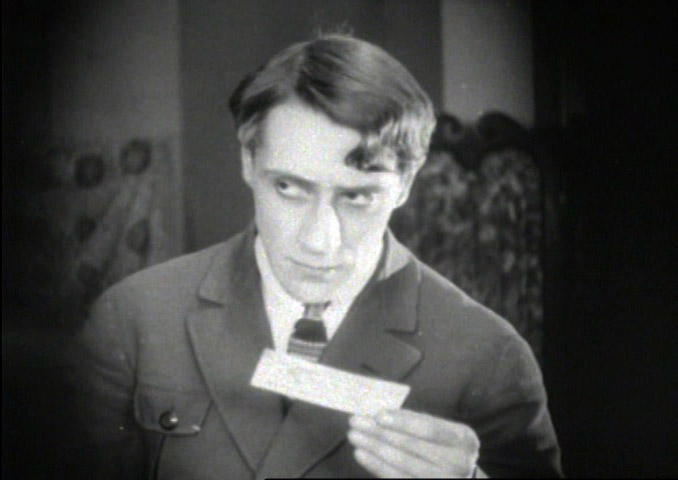
For the main character, a radio engineer obsessed with a mysterious signal that might just be from the Red Planet, I came up with a "signal" motif or repeated notes that kept recurring: two notes, three notes, and then four notes. DAH da. Da DAH da. Da DAH da da.

This, and a bunch of other stock themes for characters and situations, all came together to make a very effective score, I thought.

Audience reaction was strong throughout, with lots of shouted comments about the wild plot and strange images. I even got heckled at one big missed cue: a soldier character plays a small accordion on screen a couple of times, and at one point I misjudged when to have that sound ready—and he instead went over and hit a few notes on a piano!

"That's a funny sounding piano!" someone shouted. It sure was! I quickly went back to orchestra.

Gusev the soldier serenades a Martian gal with his pesky accordion late in 'Aelita.' (This time I was ready!)

To my surprise, people really did stay with it, and the film (as often happens) seemed to make a lot more sense in a theater with an audience. It holds up really well, with the only explanatory note necessary for modern audiences is to note that at the time, people with larger homes were compelled by the government to take in other people. All part of the glorious revolution, comrade!

The film ended with a rousing ovation for the accompanist, who couldn't stay because he was due back in New Hampshire the next day for a screening.

With the campus still closed and the snow still flying, I had to finally drive my car down some pedestrian walkways (sorry!) to get the service alley behind the auditorium to load in my gear.

Then off I went for the drive back to New Hampshire, only to find slow going due to the weather, which had shut down portions of the N.Y. State Thruway.

So an unexpected night in Syracuse, N.Y. and then an early morning departure put me back in the Granite State on Sunday in time for a 2 p.m. screening in Warner, N.H.

Warner (N.H.) Town Hall, which doubles as a movie theater.

• Sunday, Jan. 19: This event was on behalf of the New Hampshire Telephone Museum ("Where History Talks!"), which this year is pursuing a "Telephone Goes To The Movies" theme.

Sunday's program was a nod to silent comedies that somehow feature the telephone: Harold Lloyd's short 'Number, Please' (1920) and Buster Keaton's feature 'Seven Chances; (1925).

Why 'Seven Chances?' Because the whole plot of the film depends on a missed phone call, plus it has several fun scenes in phone booths and with telephone switchboard operators.

The screening was held in Warner Town Hall, which I'd never been in before but which proved ideal for silent film screenings: wooden floors, great acoustics, a big built-in screen, big but not too big.

Laura French, executive director of the Telephone Museum, greets the audience.

And with the Patriots out of the playoffs, our Sunday afternoon start time attracted a full house, which surprised me for this kind of one-off screening.

One other surprise: as I drove into town on Route 103, a large portable sign used for highway directions had been commandeered to promote "SILENT FILM AND LIVE MUSIC WITH JEFF RAPSIS"' Wow, my name in lights, New Hampshire style! (Also, when I went back afterwards to get a photo, it had already been turned off. Frugality, New Hampshire style!)

Great response to both films, with lots of big laughs in all the right places. Thanks for Laura French and Graham Gifford of the Telephone Museum for organizing a stellar program!

Buster times an egg in 'The Navigator' (1924).

• Monday, Jan. 20: And this was followed on Monday night with a screening of two nautical-themed comedies to benefit the Custom House Maritime Museum in Newburyport, Mass.

A silent film program there last year was popular enough for us to try another, this time moved to the nearby (and more spacious) Firehouse Center for the Arts.

On tap (a water reference!) was Buster Keaton's 'The Boat' (1921) followed by 'The Navigator' (1924).

Alas, when we booked this date some time ago, no one realized it was the third day of the three-day weekend caused by the observance of Martin Luther King Jr.'s birthday.

This might have cut into attendance somewhat. But still, about 40 people braved cold temperatures to see Buster on the high seas.

I had a good time doing music for 'The Navigator.' Using a handful of obvious sea-faring melodies (such as "Anchors Aweigh") to set the tone, I was able to build an entire score mostly out of variations of a simple tune that I've been developing as an all-purpose Keaton theme.

For the better part of an hour, the basic material of this melody was transformed in different ways into material that helped underline Buster's routines. Sometimes a graceful waltz, sometimes a steady march, sometimes arrhythmic doodlings — whatever seemed to suit the comedy on screen.

Afterwards, I received the highest complement possible: the museum's director told me for awhile she was so absorbed in the movie, she forgot the music was being made live.

So three days, three screenings in three very different settings, but which all seemed to hold the screen. Accompaniment in the year 2020 is so far off to a good start!

Next up is 'Underworld.' Here's the press release. Hope to see you there in Plymouth, N.H.!

* * *

Original promotional art for 'Underworld' (1927).

TUESDAY, JAN. 7, 2019 / FOR IMMEDIATE RELEASE
Contact Jeff Rapsis • (603) 236-9237 • jeffrapsis@gmail.com

'Underworld' to screen with live music at Plymouth's Flying Monkey on Thursday, Jan. 23


Oscar-winning silent crime drama directed by Josef von Sternberg was forerunner of Hollywood 'gangster' movies

PLYMOUTH, N.H.—'Underworld' (1927), a silent drama that spurred a boom in 'gangster' movies, will be screened with live music on Thursday, Jan. 23 at 6:30 p.m. at the Flying Monkey Moviehouse and Performance Center, 39 South Main St., Plymouth, N.H.

The film will be accompanied live by silent film musician Jeff Rapsis. General admission is $10 per person.

'Underworld,' directed by Josef von Sternberg and starring George Bancroft, is notable for being the first major motion picture to portray a criminal in a sympathetic light instead of as a villain. Its popularity touched off a Prohibition-era boom in Hollywood gangster pictures that reached its peak following the stock market crash of 1929.

The story of 'Underworld' follows gangster Bull Weed (George Bancroft), who becomes entangled in a love triangle involving a reformed drunkard, “Rolls Royce” (Clive Brook) whom he takes on as his right-hand man, and Bull’s girlfriend “Feathers” (Evelyn Brent). Bull Weed's imprisonment leads to a dramatic climax.

Bancroft's performance in 'Underworld' set the stage for memorable characterizations of gangster protagonists by Jimmy Cagney ('Public Enemy,' 1931), Paul Muni ('Scarface,' 1932), and Edward G. Robinson ('Little Caesar,' 1930), which all follow directly on from the model created by 'Underworld.'

The film's script, by Chicago newspaperman Ben Hecht, earned an Oscar for Best Screenwriting at the first-ever Academy Awards. The film is also noted for director von Sternberg's innovative use of black-and-white photography, which presaged many film noir techniques in following decades.

Director Von Sternberg was obsessed by light, and developed methods of “painting” his compositions with the arrangements of lamps, scrims, and reflectors on the set. Today he is remembered most for having used that skill in a series of films he made with Marlene Dietrich, starting with 'The Blue Angel' (1930) and continuing in six more star vehicles made in Hollywood, including 'Morocco' (1930) and 'Shanghai Express' (1932).

A promotional poster for 'Underworld' (1927).

'Underworld' will be accompanied by live music by Jeff Rapsis, a New Hampshire-based silent film accompanist who performs at venues across the region and beyond.

Using a digital synthesizer to reproduce the texture of the full orchestra, Rapsis will improvise the score on the spot during the screening.

"Films such as 'Underworld' were created to be shown on the big screen and in a theater as a shared experience," Rapsis said. "With an audience and live music, they still come to life in the way their makers intended them to.

"So silent film screenings at the Flying Monkey are a great chance for people to experience films that caused people to first fall in love with the movies," he said.

'Underworld' is the latest in an monthly series of great silent films with live music at the Flying Monkey. Upcoming programs include:

• Wednesday, Feb. 12, 2020: 'The Navigator' (1924). Buster Keaton sets sail in his classic sea-faring comedy about a spoiled rich couple marooned all alone on a drifting ocean liner.

• Wednesday, March 11, 2020: 'Wild Horse Mesa' (1925). Adaptation of Zane Grey novel about a bankrupt rancher who tries trapping wild horses using barbed wire, with unforeseen consequences.

• Thursday, April 9, 2020: 'Ben Hur' (1925). In the Holy Land, a Jewish prince is enslaved by the occupying Romans; one of the great early Bibical epics, just in time for Easter!

• Thursday, May 7, 2020: 'Why Worry?' (1923). Rich hypochondriac Harold Lloyd gets more than he bargained for on a recuperative visit to a banana republic undergoing revolution.

• Thursday, June 18, 2020: Harry Houdini Double Feature. Rare surviving films from the great illusionist's brief movie career: 'Terror Island' (1920) and 'The Man From Beyond' (1922).

'Underworld' (1927) will be shown on Thursday, Jan. 23 at 6:30 p.m. at the Flying Monkey Moviehouse and Performance Center, 39 South Main St., Plymouth, N.H. Admission is $10 per person; for more info, call (603) 536-2551 or visit www.flyingmonkeynh.com.

Monday, January 13, 2020

Three sci-fi marathons in the next two months: Aelita; The Lost World; and Jekyll & Hyde

A scene from 'Aelita, Queen of Mars' (1924), which I'll be accompanying on Saturday morning at the Case Western Reserve University Film Society's annual Sci-Fi Marathon.

They say good things come in threes. And I'm fortunate to be doing silent film music at no less than three different sci-fi marathons in the next few weeks.

Silent film at a sci-fi marathon? Yes! And surprisingly, not one of them is 'Metropolis' (1927), Fritz Lang's famous pioneering epic of the genre.

For those of you keeping score, here's the line-up:

• On Saturday, Jan. 18, I'll accompany for 'Aelita, Queen of Mars' (1924) at the annual Case Western Reserve University Film Society Sci-Fi Marathon, now in its 45th year. For more info: http://films.cwru.edu/sfmarathon45/

• On Sunday, Feb. 16, I'll create music for the John Barrymore version of 'Dr. Jekyll & Mr. Hyde' (1920) at the annual Boston Sci-Fi Marathon at the Somerville Theatre in Somerville, Mass. More info: https://www.bostonscifi.com/

• And on Saturday, March 21, it's music for 'The Lost World' (1925) at the annual 24-Hour Ohio Science Fiction Marathon in Columbus, Ohio. Details: http://www.scifimarathon.com/

I first started playing silent films at sci-fi marathons in 2011, when the long-running Boston Sci-Fi Marathon screened a rare print of the original silent version of '20,000 Leagues Under the Sea.' I was asked to do live music.

The audience discovered a film so strange and old that it seemed new. And I discovered an audience unlike any other I'd played for: one that screamed and hooted and hollered and talked back at the screen and was generally having an all-out love affair with the whole experience.

Since then, I've functioned as the house accompanist for the Boston Sci-Fi Marathon. They don't show a silent every year. But when they do, it's always one of my favorite gigs of the year.

So I'm delighted to now be getting asked to appear at similar festivals, such as the two upcoming marathons in Ohio.

And it makes sense, I think. In an age of everything-instantly-available, the sci-fi marathon endures because it's a group experience that can't be reproduced in the home.

And within that framework, there's definitely a place for silent film with live music.

The next couple of months include other road bookings that'll bring me far from my home base:

• February finds me at the annual Kansas Silent Film Festival in Topeka, Kansas, where I'll score 'Soul of the Beast' (1923), 'The Student Prince in Old Heidelberg' (1926), as well as a passel of shorts. This year's event is Friday, Feb. 28 and Saturday, Feb. 29; it's my 21st consecutive year of attending.

• On Sunday, March 8, I'll travel out to Utica, N.Y., where I'm accompanying the recently restored 'Mothers of Men' (1917) as part of an exhibit on Women's Suffrage at the Munson-Williams-Proctor Arts Institute, a terrific small museum that boasts a solid art collection and innovative programming.

• And Sunday, March 22 finds me at the Cleveland Cinematheque, where I'll do music for Ernst Lubitsch’s 'The Marriage Circle' (1924) and 'Hands Up!' (1926) starring Raymond Griffith. Many thanks to long-time Cinematheque director John Ewing for continuing to include silent film with live music in the programming mix.

See you at the movies—or with all this road time, maybe on the N.Y. State Thruway!

Sunday, February 17, 2013

Adventures in silent film accompaniment:
snowbanks, orgies, and missing sustain pedals

Coming off a busy stretch of accompaniment leading up to the Kansas Silent Film Festival later this week. Here's a few snapshots from the life of a silent film accompanist based in northern New England.


• Today's screening of 'Bardelys the Magnificent' (1926) at the Wilton (N.H.) Town Hall Theatre went well, except the side entrance that I use to load my equipment in and out was blocked by a large snowbank that had been pushed up against the building, covering the stairs and partially blocking the door. The perils of performing in mid-winter New Hampshire! Seriously, it looked like that scene in 'The Gold Rush' where Chaplin shovels a huge pile snow from one business to another.

A stiff wind and temps in the 20s didn't make things any more pleasant. Fortunately, I wore my sensible winter shoes, so it didn't matter that much when my feet plunged down to mid-thigh while struggling to muscle in my synthesizer. It takes three trips for me to carry everything in, and each time the stiff wind banged shut the outside door, forcing me to go all the way around to the theater's main entrance. Ah, the glamour of the movies!

About 40 people were on hand for my first attempt at 'Bardelys.' I can tell when I'm overscheduled because I start to show up at screenings with nothing really prepared. That, alas, was the case with Bardelys, which offers a lot of potential for music, but I just wasn't in the zone through most of the film. I lucked out with one good melody that came to me on the way in, and that carried most of the picture. A harpsichord setting I used seemed to stomp on any on-screen subtleties, and about two-thirds of the way through I switched over to my fallback orchestral setting.

The music all seemed pretty sloppy to my taste, and I was concerned that audience reaction seemed to die down quite a bit after John Gilbert met Eleanor Boardman. So, near the end, I was pleasantly surprised (and a bit relieved) when the room erupted in cheers during Gilbert's exuberant escape from the gallows. Even theater owner Dennis Markaverich said afterwards he "laughed my ass off" at Gilbert grabbing a curtain and using it as a parachute, something Douglas Fairbanks hadn't thought to do just yet.


• A much more satisfying screening took place on Valentine's Day (Thursday, Feb. 14), when we screened Harold Lloyd's 'Girl Shy' (1924) in 35mm at the Somerville Theatre in Somerville, Mass. About 100 people turned out for this show, which had Lloyd's short 'Never Weaken' (1921) as an opener. I knew we had them when, in 'Never Weaken,' they laughed uproariously at Lloyd consulting the dictionary to make sure his suicide note is spelled correctly. (It is a very funny scene.) Lloyd's subsequent antics on the steel skeleton of a skyscraper under construction produced shrieks and gasps just as he intended.

For the music, I used just a traditional organ setting for the short, in part to make the full orchestral settings for the feature seem that much more grand by comparison. For 'Never Weaken,' a jaunty tune I've used here and there proved all I needed to carry all the action up until the suicide sequence, which I punched up by turning serious (minor key, repeated notes) and then going silent to underscore his thinking and reactions, which made room for the laughs. And for the skyscraper sequence, I reverted back to the jaunty tune for the rooftop jazz band that gives Harold a rude awakening, but then kept it low for much of his mid-air antics, again to make sure the audience could hear itself react.

It all came together wonderfully, I thought, especially with me plugged into the Somerville's house sound system. I switched to the full orchestra for 'Girl Shy,' but muffed the beginning because it just came up so fast. But it came together nicely, with scene after scene falling into place. A few rough spots happened in the train sequence and when Jobyna Ralston's car breaks down, but by then the film had them and it didn't matter so much.

Things really got fun when Harold returns to the publisher and all the female office staff go crazy over him. What laughter! For underscoring, I just used the main rhythm and melody from the Habanara of Bizet's Carmen, which lent just the right touch of mockery to the scene, I thought. And the reaction was again strong when Harold receives an envelope in the mail that he thinks is a rejection letter, but which we know contains a check. As Harold motions to rip it, people behind me shouted "NO! DON'T DO IT!" When he actually did rip it, he was accompanied not by music, but by groans of anguish that filled the theater.

At this point, the energy never let up. Next thing you know, Harold and his uncle are piecing together the check. $3,000! Hooray! Then Harold looks at the newspaper and sees his sweetheart is getting married that day. Oh no! Then the man's "other wife" wanders in, sees the wedding announcement, and exclaims, "Someone should stop it for the girl's sake!" Guess who that someone is? Hooray again, as Harold dashes from the tailor shop, this time vowing to make it to the church on time.

I just can't describe the excitement in the theater by this time. It had built up to a point where I think it actually worked against some of Harold's gags early on in the chase, because we want him to be making progress. Example: the guy teaching his girl to drive, which causes frustration for Harold as they repeatedly stop and start and go in circles. The audience stopped laughing during this, and I think it's because everyone wanted him to just get going. It's the same reason Keaton cut the "underwater traffic cop" gag from 'The Navigator'—by that part of the story, the audience couldn't tolerate comedy just for comedy's sake, because the gal is in danger.

Harold quickly recovered, and so did the audience. And by the time he was whipping a horse-drawn wagon through downtown, everyone was totally into it. Scoring this was a ball—I was able to keep things relatively light for most of the time, which allowed audience members to hear each other and really helped the overall reaction, I think. For the last few minutes, people were spontaneously shouting at Harold to 'HURRY UP!' It just doesn't get any better than that, folks.

One challenge of 'Girl Shy' is the intercutting between Harold's mad dash and the placid pre-wedding scenes at the church. These happen at various intervals, and I did my best to "feel" them coming and change the music on the fly. (There's one particularly tough place where Harold is on a motorcycle and has gone through a grocery store, and we swap back and forth several times quite rapidly.) But once Harold is on the horse-drawn wagon, the cuts come so frequently that it wouldn't make sense to change the music, so instead I just kept pounding away, working my way up the keyboard with repeated notes in the left hand and Harold's driving melody in the bass. I think it makes for really effective cinema.

I'm pleased to say that after 'Girl Shy' finished, I got a bona fide standing ovation, and in Boston, too! It was totally thrilled and rewarding and gratifying, and I very much appreciated all the folks who came up afterwards to get my card, ask questions, and offer congratulations. One woman even asked if I would consider being part of a burlesque show! (To play music in, not dance.)

Afterwards, I dashed off a note to a friend that made me realize some things about the experience of doing live music like that. Get a load of this:
Wow, about last night. Wish you could have somehow been there. Things really fell into place, with a large audience that really reacted to the experience, and the music seemed to flow out of me so naturally and easily.

So to me, it was like this great communal orgy in which everyone kept their clothes on (as far as I know), but was in the dark and filled with intense physical releases such as laughing and shrieking.

At 'The End,' I finished with a bang as the lights came up, and then got a prolonged standing ovation! Wow, who doesn't want to receive a standing O after such an intimate experience? :)

Afterwards, I had a lot of people come up to say hi, including one woman who asked if I wanted to be in a burlesque show! She meant it in terms of playing music, but you can imagine what this whole conversation did to my already sexed-up imagination.
The only wrong note in the melody was that shortly after the start of 'Girl Shy,' I kicked my sustain pedal into the Somerville's cavernous orchestra pit. I was still attached to the synthesizer, but I had not way to retrieve it, other than ceasing to play and then hoisting it up. I decided I could do without it, and I did, but that's the first time it ever got away from me like that.

• Lots of other things. Our local television station, WMUR-TV Channel 9, is doing a piece on me for their half-hour feature program "New Hampshire Chronicle." This required me to spend four hours in the Wilton Town Hall Theatre on Tuesday, Feb. 12 to be interviewed, and for them to get scenes of me in action. I think they shot enough footage so that even Eric von Stroheim would be satisfied! But seriously, I'm looking forward to the segment, which I'm told will air sometime near the end of the month. We'll see how I feel after I said it. We'll see if what veteran CBS News reporter George Herman said about me is true: that I have "a good head for television."


• On Monday, Feb. 11, I had the pleasure of doing 'Metropolis' (1927) for students in a film history course at Southern New Hampshire University taught by my friend and colleague Bill Millios. This took place in a computer lab (all the school's theater-type classrooms were booked) but something about it clicked and it turned into one of the most satsifying scores I've produced in awhile. The students stayed with it from start to finish; one of them said in a note to Bill:
"And thank you for inviting Jeff Rapsis to come in and play live music for "Metropolis"; I've been interested in learning about the history of silent films, but this was the first time I've ever seen a feature-length silent film and I was completely blown away!

I think I was more wrapped up in "Metropolis" than I have ever been with any movie I've seen before; I think the live music really pulled me into the movie and helped draw me into the film's world. Thanks again!"
Wow, I'll have to tell Bill to give that gal an A.


• I had a ball doing music for 'Aelita, Queen of Mars' (1924) at Wellesley College, which was still digging itself out from under the Blizzard of 2013 at the time of our screening on Sunday, Feb. 10. What a crazy film! I would have to say that the last 20 minutes rank as some of the most bizarre filmmaking of the entire silent film era. Best intertitle: "Follow our example, comrades! Form the Federal Socialist Republic of Mars!"

One interesting thing at that screening was that a film print of the newly restored 'A Trip to the Moon' had not arrived due to the storm, so we showed an earlier restoration on the Flicker Alley DVD with recorded music, and then a 16mm print from Blackhawk (missing the full ending) with me doing live music. Never had to accompany the same film after recorded music, but there's a first time for everything, I guess.


• And then prior to that, I did Rudolph Valentino in 'The Eagle' at the Flying Monkey in Plymouth, N.H., and Gilbert and Garbo in 'Love' at the Manchester (N.H.) City Library, which was more than enough for Valentine's Day. Next year I think I'll counterprogram with a film like Keaton's 'Spite Marriage' (1929). And before that, there was a Keaton program for which the wife and I drove 300 miles to New York state and back. All that in February, and it's only the 17th. Sheesh!
