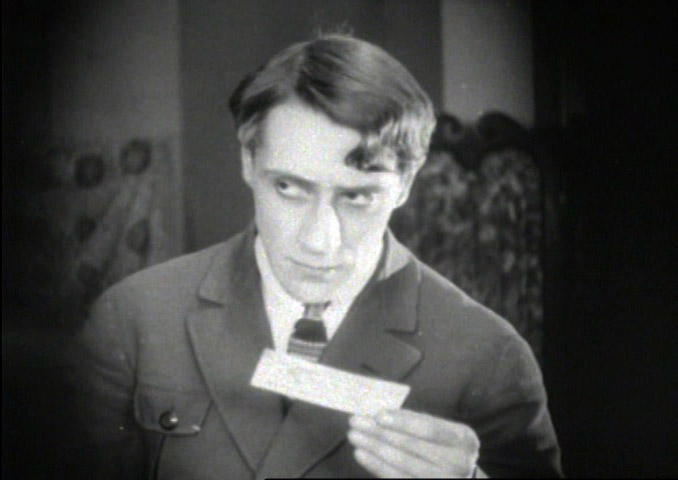
Evelyn Brent and Clive Brook in 'Underworld.' (1927).
It's one of the great silent dramas: 'Underworld' (1927), the gangster saga directed by Josef von Sternberg.
And I'm accompanying it on Thursday, Jan. 23 at 6:30 p.m. at the Flying Monkey Movie House in Plymouth, N.H.
Besides a small dramatic role by comedian Larry Semon (who would die just one year later), the film features a major part for Clive Brook, one of my favorite silent-era actors.
Brook plays 'Rolls Royce' Wentsel, an alcoholic attorney who becomes sidekick to gangster Bull Weed, played by George Bancroft.
It's a juicy role: a cultured, educated man who finds himself swept up in the world of hitmen and holdups.
It's kind of like the character of Tom Hagan, the "consigliere," that Robert Duvall played to Marlon Brando's Don Corleone in 'The Godfather' (1972).
More about 'Underworld' is in the press release below.
Here's a report on a trio of unusual silent film screenings that filled the recent three-day weekend:
Air mattresses being set up on stage for the 45th Annual Sci-Fi Marathon at Case Western Reserve University in Cleveland, Ohio.
•
Saturday, Jan. 18: I don't know what you were doing at 7:15 a.m., but I was trying to find a place to park in a snowstorm in the University Heights area of Cleveland, Ohio.
How did I get here? Mostly by Interstate 90 the day before, all in a single gulp from New Hampshire to Ohio. (It's about 10 hours.)
But the larger answer to that question was found in the Case Western Reserve University Film Society's 45th Annual Sci-Fi Marathon, which ran from Friday night into early Sunday morning.
I was there to do music for 'Aelita, Queen of Mars' (1924), an early Soviet fantasy film with sci-fi elements.
I arrived the night before, ending up on completely the wrong end of the beautifully maintained (and vehicle-free) Case Western campus.
But organizer Samuel Ramos was able to guide me by phone through security barriers to Strosacker Auditorium, where regulars were already packing the lobby waiting to get in and claim their turf for the 30-hour event.
Early-bird attendees about to enter Strosacker Auditorium for the sci-fi marathon. Passing through a security check, many with rolling luggage in tow, it was they were boarding an aircraft!
With the house due to open soon, we loaded in and set up my gear in record time. Because I wasn't playing until the next morning, we had to stow the keyboard and speakers backstage, but the trio of projectionists were able to tape down my cabling in place so we'd be ready to go quickly.
I was honored to find a young woman using painter's tape to mark the spot where my keyboard would go, including a big NO for emphasis.
I didn't get her name, but she was a CWRU grad who flew in from Texas each year to join in the marathon.
That's one thing I love about these types of events: they inspire a kind of fanatical devotion and spirit of community among attendees that's very special. No matter what else one does the year-round, when it's time for the CWRU Sci-Fi Marathon (or any other similar event), you
know where you belong.
Here's a panorama shot from the stage as attendees began to enter and set up shop. Click to enlarge!
I woke up the next morning to find Cleveland enveloped in snow and sleet. I drove through deserted streets to find the Case Western campus shuttered, with no security people to open the gates. So I parked in a nearby hospital garage (FOR PATIENTS AND STAFF ONLY!) and trudged through the slush to arrive just in time for the 7:30 a.m. screening of 'Aelita,' which is the earliest start time I've ever played.
It was weird to return to an auditorium filled with people who'd been there all night. The sun hadn't actually come up yet, and people asked me not to refer to the actual time or the weather outside because they were still running on the illusion that it was just still kind of a late night.
But off we went, first with a surprise screening of a 'A Trip to Mars,' a 1924 Koko the Clown short cartoon, which got a nice reaction.
An example of Martian fashion in 'Aelita, Queen of Mars' (1924).
Then came Aelita, and when I saw from the titles it was a version that runs a little slow (almost two hours!), I braced myself. Would it be possible to keep a fatigued audience engaged in this esoteric early drama for that length of time?
I'd decided earlier to resist the temptation to use the synthesizer to make "space age" sounds. Instead, I went into my "Rachmaninoff/Shostakovich" mode, which I thought was only appropriate for a Russian film.
The only recognizable tune that got used was the old Czarist national anthem (the one heard in Tchaikovsky's 1812 Overture), which turned out to be exactly right, I felt, for the allegorical rulers/oppressed sequences set on Mars.
For the main character, a radio engineer obsessed with a mysterious signal that might just be from the Red Planet, I came up with a "signal" motif or repeated notes that kept recurring: two notes, three notes, and then four notes. DAH da. Da DAH da. Da DAH da da.
This, and a bunch of other stock themes for characters and situations, all came together to make a very effective score, I thought.
Audience reaction was strong throughout, with lots of shouted comments about the wild plot and strange images. I even got heckled at one big missed cue: a soldier character plays a small accordion on screen a couple of times, and at one point I misjudged when to have that sound ready—and he instead went over and hit a few notes on a piano!
"That's a funny sounding piano!" someone shouted. It sure was! I quickly went back to orchestra.
Gusev the soldier serenades a Martian gal with his pesky accordion late in 'Aelita.' (This time I was ready!)
To my surprise, people really did stay with it, and the film (as often happens) seemed to make a lot more sense in a theater with an audience. It holds up really well, with the only explanatory note necessary for modern audiences is to note that at the time, people with larger homes were compelled by the government to take in other people. All part of the glorious revolution, comrade!
The film ended with a rousing ovation for the accompanist, who couldn't stay because he was due back in New Hampshire the next day for a screening.
With the campus still closed and the snow still flying, I had to finally drive my car down some pedestrian walkways (sorry!) to get the service alley behind the auditorium to load in my gear.
Then off I went for the drive back to New Hampshire, only to find slow going due to the weather, which had shut down portions of the N.Y. State Thruway.
So an unexpected night in Syracuse, N.Y. and then an early morning departure put me back in the Granite State on Sunday in time for a 2 p.m. screening in Warner, N.H.
Warner (N.H.) Town Hall, which doubles as a movie theater.
•
Sunday, Jan. 19: This event was on behalf of the
New Hampshire Telephone Museum ("Where History Talks!"), which this year is pursuing a "Telephone Goes To The Movies" theme.
Sunday's program was a nod to silent comedies that somehow feature the telephone: Harold Lloyd's short 'Number, Please' (1920) and Buster Keaton's feature 'Seven Chances; (1925).
Why 'Seven Chances?' Because the whole plot of the film depends on a missed phone call, plus it has several fun scenes in phone booths and with telephone switchboard operators.
The screening was held in Warner Town Hall, which I'd never been in before but which proved ideal for silent film screenings: wooden floors, great acoustics, a big built-in screen, big but not
too big.
Laura French, executive director of the Telephone Museum, greets the audience.
And with the Patriots out of the playoffs, our Sunday afternoon start time attracted a full house, which surprised me for this kind of one-off screening.
One other surprise: as I drove into town on Route 103, a large portable sign used for highway directions had been commandeered to promote "SILENT FILM AND LIVE MUSIC WITH JEFF RAPSIS"' Wow, my name in lights, New Hampshire style! (Also, when I went back afterwards to get a photo, it had already been turned off. Frugality, New Hampshire style!)
Great response to both films, with lots of big laughs in all the right places. Thanks for Laura French and Graham Gifford of the Telephone Museum for organizing a stellar program!
Buster times an egg in 'The Navigator' (1924).
•
Monday, Jan. 20: And this was followed on Monday night with a screening of two nautical-themed comedies to benefit the Custom House Maritime Museum in Newburyport, Mass.
A silent film program there last year was popular enough for us to try another, this time moved to the nearby (and more spacious) Firehouse Center for the Arts.
On tap (a water reference!) was Buster Keaton's 'The Boat' (1921) followed by 'The Navigator' (1924).
Alas, when we booked this date some time ago, no one realized it was the third day of the three-day weekend caused by the observance of Martin Luther King Jr.'s birthday.
This might have cut into attendance somewhat. But still, about 40 people braved cold temperatures to see Buster on the high seas.
I had a good time doing music for 'The Navigator.' Using a handful of obvious sea-faring melodies (such as "Anchors Aweigh") to set the tone, I was able to build an entire score mostly out of variations of a simple tune that I've been developing as an all-purpose Keaton theme.
For the better part of an hour, the basic material of this melody was transformed in different ways into material that helped underline Buster's routines. Sometimes a graceful waltz, sometimes a steady march, sometimes arrhythmic doodlings — whatever seemed to suit the comedy on screen.
Afterwards, I received the highest complement possible: the museum's director told me for awhile she was so absorbed in the movie, she forgot the music was being made live.
So three days, three screenings in three very different settings, but which all seemed to hold the screen. Accompaniment in the year 2020 is so far off to a good start!
Next up is 'Underworld.' Here's the press release. Hope to see you there in Plymouth, N.H.!
* * *
Original promotional art for 'Underworld' (1927).
TUESDAY, JAN. 7, 2019 / FOR IMMEDIATE RELEASE
Contact Jeff Rapsis • (603) 236-9237 • jeffrapsis@gmail.com
'Underworld' to screen with live music at Plymouth's Flying Monkey on Thursday, Jan. 23
Oscar-winning silent crime drama directed by Josef von Sternberg was forerunner of Hollywood 'gangster' movies
PLYMOUTH, N.H.—'Underworld' (1927), a silent drama that spurred a boom in 'gangster' movies, will be screened with live music on Thursday, Jan. 23 at 6:30 p.m. at the Flying Monkey Moviehouse and Performance Center, 39 South Main St., Plymouth, N.H.
The film will be accompanied live by silent film musician Jeff Rapsis. General admission is $10 per person.
'Underworld,' directed by Josef von Sternberg and starring George Bancroft, is notable for being the first major motion picture to portray a criminal in a sympathetic light instead of as a villain. Its popularity touched off a Prohibition-era boom in Hollywood gangster pictures that reached its peak following the stock market crash of 1929.
The story of 'Underworld' follows gangster Bull Weed (George Bancroft), who becomes entangled in a love triangle involving a reformed drunkard, “Rolls Royce” (Clive Brook) whom he takes on as his right-hand man, and Bull’s girlfriend “Feathers” (Evelyn Brent). Bull Weed's imprisonment leads to a dramatic climax.
Bancroft's performance in 'Underworld' set the stage for memorable characterizations of gangster protagonists by Jimmy Cagney ('Public Enemy,' 1931), Paul Muni ('Scarface,' 1932), and Edward G. Robinson ('Little Caesar,' 1930), which all follow directly on from the model created by 'Underworld.'
The film's script, by Chicago newspaperman Ben Hecht, earned an Oscar for Best Screenwriting at the first-ever Academy Awards. The film is also noted for director von Sternberg's innovative use of black-and-white photography, which presaged many film noir techniques in following decades.
Director Von Sternberg was obsessed by light, and developed methods of “painting” his compositions with the arrangements of lamps, scrims, and reflectors on the set. Today he is remembered most for having used that skill in a series of films he made with Marlene Dietrich, starting with 'The Blue Angel' (1930) and continuing in six more star vehicles made in Hollywood, including 'Morocco' (1930) and 'Shanghai Express' (1932).
A promotional poster for 'Underworld' (1927).
'Underworld' will be accompanied by live music by Jeff Rapsis, a New Hampshire-based silent film accompanist who performs at venues across the region and beyond.
Using a digital synthesizer to reproduce the texture of the full orchestra, Rapsis will improvise the score on the spot during the screening.
"Films such as 'Underworld' were created to be shown on the big screen and in a theater as a shared experience," Rapsis said. "With an audience and live music, they still come to life in the way their makers intended them to.
"So silent film screenings at the Flying Monkey are a great chance for people to experience films that caused people to first fall in love with the movies," he said.
'Underworld' is the latest in an monthly series of great silent films with live music at the Flying Monkey. Upcoming programs include:
•
Wednesday, Feb. 12, 2020: 'The Navigator' (1924). Buster Keaton sets sail in his classic sea-faring comedy about a spoiled rich couple marooned all alone on a drifting ocean liner.
•
Wednesday, March 11, 2020: 'Wild Horse Mesa' (1925). Adaptation of Zane Grey novel about a bankrupt rancher who tries trapping wild horses using barbed wire, with unforeseen consequences.
•
Thursday, April 9, 2020: 'Ben Hur' (1925). In the Holy Land, a Jewish prince is enslaved by the occupying Romans; one of the great early Bibical epics, just in time for Easter!
•
Thursday, May 7, 2020: 'Why Worry?' (1923). Rich hypochondriac Harold Lloyd gets more than he bargained for on a recuperative visit to a banana republic undergoing revolution.
•
Thursday, June 18, 2020: Harry Houdini Double Feature. Rare surviving films from the great illusionist's brief movie career: 'Terror Island' (1920) and 'The Man From Beyond' (1922).
'Underworld' (1927) will be shown on Thursday, Jan. 23 at 6:30 p.m. at the Flying Monkey Moviehouse and Performance Center, 39 South Main St., Plymouth, N.H. Admission is $10 per person; for more info, call (603) 536-2551 or visit www.flyingmonkeynh.com.