Chronicling the ongoing adventure of staging silent film screenings with live music in theaters in New England, USA and elsewhere, including once in remote East Greenland, well above the Arctic Circle. Now over 3,008,000 page views!
This week's upcoming screening of 'The Lost World' (1925) at the Flying Monkey Moviehouse in Plymouth, N.H. has been moved to Wednesday, Nov. 6 due to UCITA.
That's the acronym for "Unforeseen Circumstances Involving The Accompanist."
Apologies to all who planned on attending this week's screening. I've been unexpectedly called out of town, which is what prompted the last-minute date change.
Many thanks to the folks at the Flying Monkey for their ability to quickly change course and arrange for an alternate date that's just two weeks later.
Everything else will be the same, as you'll see in the revised press release below.
Again, sorry for the short-notice switcheroo, and I hope everyone who was planning to see 'The Lost World' will be able to make it on Wednesday, Nov. 6.
* * *
A trade publication ad promoting 'The Lost World' (1925).
Silent film classic 'The LostWorld' at Flying Monkey on Wednesday, Nov. 6
Ground-breaking first-ever dinosaur thriller to be shown with live music; rescheduled from original October screening date
PLYMOUTH, N.H.—Before there was 'Jurassic Park' or 'Godzilla' or even 'King Kong,' there was 'The LostWorld.'
The
movie, a blockbuster hit when released in 1925, paved the way for
Hollywood's enduring fascination with stories pitting mankind against
larger-than-life creatures.
See for yourself when a restored
version of 'The LostWorld' is screened on Wednesday, Nov. 6 at 6:30 p.m.
at the Flying Monkey Moviehouse and Performance Center,
39 Main St.,
Plymouth, N.H.
General admission is $10 per person.
The
screening will feature live accompaniment by Jeff Rapsis, a New
Hampshire-based composer who specializes in creating music for silent
films.
The screening was originally scheduled for Wednesday, Oct. 23, but was moved to the new date of Wednesday, Nov. 6
'The LostWorld' is a silent fantasy adventure film
based on Arthur Conan Doyle's 1912 novel of the same name. The movie was
produced by First National Pictures, a precursor to Warner Brothers,
and stars Wallace Beery in the lead role as Professor Challenger.
An original release poster for 'The Lost World' (1925).
'The
LostWorld' tells the tale of a British exploration team that journeys
to South America to confirm reports of long-extinct creatures still
roaming a remote high plateau deep in the jungle.
The landscape
they discover, filled with a wide range of dinosaurs and other fantastic
creatures, was enough to astonish movie-goers when 'The LostWorld'
first hit movie screens in February 1925. Scenes of a brontosaurus on
the loose in central London broke new ground in terms of cinema's visual
story-telling possibilities.
Early viewers of the film were
especially impressed by special effects breakthroughs that allowed live
actors to appear simultaneously on-screen with stop motion models of
prehistoric creatures. This led to rumors that the filmmakers had
actually discovered living prehistoric creatures.
The film
featured pioneering stop motion special effects by Willis O'Brien, who
would go on to create the effects used to bring 'King Kong' to the
screen in 1933.
Arthur Conan Doyle's novel and the movie version
of 'The LostWorld' proved so influential in the dinosaur genre that the
title was borrowed by author Michael Crichton for his 1995 novel, and
then used by director Steven Spielberg for 'The LostWorld: Jurassic
Park' (1997), the sequel to the original 'Jurassic Park' movie of 1993.
In
1998, the original 'The LostWorld' (1925) was deemed "culturally,
historically or aesthetically significant" by the Library of Congress
and selected for preservation in the United States National Film
Registry.
Touring London: a scene from 'The Lost World' (1925).
Despite the film's popularity, only incomplete copies
of 'The LostWorld' survived from its initial run in the silent era. In
recent years, historians have been piecing together 'The LostWorld'
from fragments found scattered among the world's film archives.
The
version to be shown at the Flying Monkey includes footage from eight
different prints. At 93 minutes in length, it's the most complete
version of 'The LostWorld' available. The edition includes rare footage
of Arthur Conan Doyle that has been missing from most prints since the
film's original release.
To accompany the film, Rapsis will use a
digital synthesizer to recreate the texture of a full orchestra. For
each film, the score is created live in real time as the movie is
screened.
Rather than focus on authentic music of the period,
Rapsis creates new music for silent films that draws from movie scoring
techniques that today's audiences expect from the cinema.
The
restored 'The LostWorld' will be shown
on Wednesday, Nov. 6 at 6:30 p.m.
at the Flying Monkey Moviehouse and Performance Center,
39 Main St.,
Plymouth, N.H.
General admission is $10 per person. For more
info, visit www.flyingmonkeynh.com or call (603) 536-2551.
A German poster for Chaplin's 'The Gold Rush' (1925).
This weekend brings one of my favorite gigs of the year: the annual mid-winter potluck dinner and silent movie program at the Campton (N.H.) Historical Society.
We've been doing this for more than 10 years now. And I've come to believe that there's no better way to experience a silent film than in the dead of winter, surrounded by snowy woods, in a warm meetinghouse filled with people who've just enjoyed a pot luck supper.
Join us and experience this for yourself. This year's edition, which features Chaplin's epic comedy 'The Gold Rush' (1925) will take place on Saturday, Feb. 3.
The pot luck supper (be sure to bring a dish!) starts at 5 p.m. The movie comes afterwards—we usually start by 6:15 p.m. or so.
More information is in the press release below. Hope to see you there!
* * *
Chaplin and his improvised foot warmer in 'The Gold Rush' (1925).
MONDAY, JAN. 15, 2024 / FOR IMMEDIATE RELEASE Contact Jeff Rapsis • (603) 236-9237 • jeffrapsis@gmail.com
Silent comedy masterpiece 'The Gold Rush' to screen with live music in Campton, N.H. on Saturday, Feb. 3
Dinner
and a movie: family-friendly Charlie Chaplin film is featured
attraction of local historical society's annual pot luck supper; public
welcome
CAMPTON, N.H.— He was a comedic icon of the silent era, and 'The Gold Rush' was the movie that he wished to be remembered for.
He was Charlie Chaplin, whose Little Tramp character was beloved by early film audiences and remains a global icon to this day.
See
for yourself how it all began when 'The Gold Rush' (1925), a
feature-length film regarded as a Chaplin masterpiece, is screened by
the Campton Historical Society on Saturday, Feb. 3.
The event, which is free and open to all, takes place at Old Campton Town Hall, 529 Route 175, Campton, N.H.
It starts with a pot luck dinner at 5 p.m., with the film program to begin at 6 p.m.
Those attending the pot luck dinner are asked to bring one of the following: soup, bread, salad, main dish, dessert or beverage.
Live music for the silent film program will be provided by silent film accompanist Jeff Rapsis.
'The
Gold Rush,' a landmark comedy and one of the top-grossing films of the
silent era, finds Chaplin's iconic 'Little Tramp' character journeying
to the frozen wastelands of the Yukon. There as a prospector, the
Tramp's search for gold turns into a pursuit of romance, but with plenty
of laughs along the way.
The film contains several famous
scenes, both comic and dramatic, including a starving Chaplin forced to
eat his shoe for Thanksgiving dinner and a heart-breaking New Year's Eve
celebration.
As a comedian, Chaplin emerged as the first
superstar in the early days of cinema. From humble beginnings as a
musical hall entertainer in England, he came to Hollywood and used his
talents to quickly rise to the pinnacle of stardom in the then-new
medium of motion pictures. His popularity never waned, and his image
remains recognized around the world to this day.
Shoe or Thanksgiving dinner? The definition of food changes according to how hungry you are.
'The Gold Rush,'
regarded by many critics as Chaplin's best film, is a prime example of
his unique talent for combining slapstick comedy and intense dramatic
emotion.
" 'The Gold Rush' is still an effective tear-jerker,"
wrote critic Eric Kohn of indieWIRE. "In the YouTube era, audiences —
myself included — often anoint the latest sneezing panda phenomenon as
comedic gold. Unless I’m missing something, however, nothing online has
come close to matching the mixture of affectionate fragility and
seamless comedic inspiration perfected by the Tramp."
Rapsis, who
uses original themes to improvise silent film scores, said the best
silent film comedies often used visual humor to create laughter out of
simple situations. Because of this, audiences continue to respond to
them in the 21st century, especially if they're presented as intended —
with an audience and live music.
"These comedies were created to
be shown on the big screen as a communal experience," Rapsis said. "With
an audience and live music, they still come to life as their creators
intended them to. So this screening is a great chance to experience
films that first caused people to fall in love with the movies," he
said.
Rapsis achieves a traditional movie score sound for silent
film screenings by using a digital synthesizer that reproduces the
texture of the full orchestra.
"Seeing a Charlie Chaplin film
with live music and an audience is one of the great experiences of the
cinema of any era," said Jeff Rapsis, a New Hampshire-based silent film
musician who will accompany the film.
"Films such as 'The Gold
Rush' were designed for a specific environment. If you can put those
conditions together again, you can get a sense of why people first fell
in love with the movies," Rapsis said.
'The Gold Rush' will be
screened with live music on Saturday, Feb. 3 at 6 p.m. at Old Campton
Town Hall, 529 Route 175, Campton, N.H.
The film will follow a
pot luck supper that starts at 5 p.m. Those attending the pot luck
dinner are asked to bring one of the following: soup, bread, salad, main
dish, dessert or beverage.
The event is free and open to all, with donations accepted to support the Campton Historical Society.
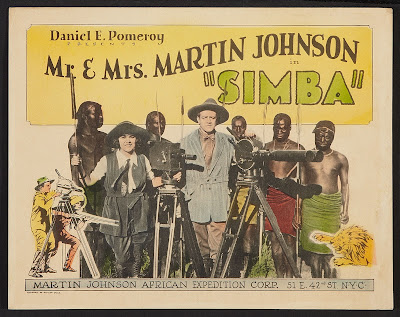
A lobby card for 'Simba' (1928), a wildlife documentary produced by Martin and Osa Johnson, who pioneered airborne wildlife photography.
Sometimes two of my many separate lives crash into each other—like tonight!
This evening, as executive director of the Aviation Museum of N.H., I'll present a lecture on the lives of Martin and Osa Johnson, pioneer wildlife photographers and aviators.
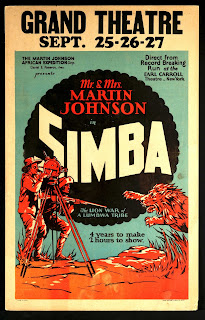
And then, as silent film accompanist, I'll create music for 'Simba: King of the Beasts' (1928) a documentary made by the Johnsons that mesmerized audiences around the world.
All this takes place at the Town Hall Theatre, 40 Main St. in Wilton, N.H. Showtime is 7:30 p.m.
However, I understand that tomorrow's edition of our statewide daily newspaper, The Union Leader, will carry a big feature on our program.
That's great, but the Town Hall Theatre is not exactly Radio City Music Hall in terms of capacity.
So if you plan to attend, come early!
And if you're not aware of the Johnsons, it's not surprising. Although they enjoyed worldwide fame a hundred years ago, their name has faded from public awareness.
I wasn't aware of them at all until just a few years ago, when the Kansas Silent Film Festival programmed 'Simba.' (The Johnsons hailed from the Sunflower state.)
Wow! I was impressed and intrigued at the time. It's no wonder the Johnsons were celebrities—their life of adventure maintains a strong pull even in our "we've seen it all" age.
Heck, maybe the appeal is even stronger today!
Well, find out for yourself by attending tonight's program. Admission $10 per person, with all proceeds to benefit the Aviation Museum's youth aviation education programs.
Press release is below. See you tonight in Wilton!
* * *
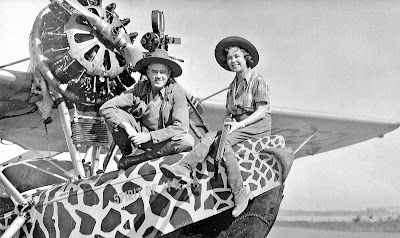
Martin and Osa Johnson with the Sikorsky S-39 float plane they flew around Africa in the 1930s to film exotic animals in their natural habitat.
WEDNESDAY, JAN. 19, 2022 / FOR IMMEDIATE RELEASE
Contact Jeff Rapsis • (603) 236-9237 • jrapsis@nhahs.org
Take off to adventure! Celebrating the Johnsons, pioneering aviators who captured first movies of African wildlife
Aviation museum program on Thursday, 1/27 spotlights globe-spanning adventures of Martin and Osa Johnson, whose plane had N.H. connection; includes screening of early documentary 'Simba: King of the Beasts' (1928) with live music
WILTON, N.H. — Want to see a century-old safari movie made in Africa by pioneering aviators whose special plane would later boast a Granite State connection?
Then take off to Wilton's Town Hall Theatre on Thursday, Jan. 27, when the Aviation Museum of N.H. presents 'Martin and Osa Johnson: Adventure's First Couple,' a combination lecture and movie screening.
The program starts at 7:30 p.m. and is open to the public. Tickets available at the door: $10 per person, general admission. All proceeds support the non-profit Aviation Museum's education programming.
The Town Hall Theatre is located at 40 Main St., Wilton, N.H. For directions, visit www.wiltontownhalltheatre.com.
The evening opens with a review of the extraordinary career of the Johnsons, a Kansas couple who gained worldwide fame in the early 20th century for far-flung exploits that combined adventure, aviation and wildlife photography.
Often wearing classic safari outfits and topped by pith helmets, the duo journeyed deep into Africa and Asia in the 1920s and 1930s, getting the first motion pictures of exotic wildlife in its native habitat.
Back home and in Europe, they achieved great popularity on the lecture circuit by recounting their exploits in foreign lands.
After Martin Johnson learned to fly, they used Sikorsky float planes painted with zebra and giraffe markings to reach remote regions of Africa and Asia, and also photograph wildlife from the air.
As filmmakers, the couple produced several wildlife documentary films chronicling their adventures. These also proved immensely popular, laying the groundwork for all wilderness filmmaking to follow.
The program will include with a screening of 'Simba: King of the Beasts" (1928), a documentary the Johnsons compiled from film they shot in Africa from 1923 to 1927. The silent film will be shown with live musical accompaniment.
The program will be presented by Jeff Rapsis, executive director of the Aviation Museum of N.H. Rapsis prepared the program with assistance from the Martin and Osa Johnson Safari Museum of Chanute, Kansas—Osa Johnson's hometown.
Rapsis, who moonlights as a silent film accompanist, will also provide the live music for the screening "Simba: King of the Beasts."
The 'Simba' documentary is not recommended for children due to graphic scenes of violence that include the shooting and killing of animals.
"Martin and Osa Johnson: Adventure's First Couple" is the first in a series of humanities programs planned for 2022 by the Aviation Museum of N.H.. The series is supported in part by Grappone Auto and the Sidore Foundation.
"The story of the Johnsons is one that combines aviation with so much else that humans find fascinating," Rapsis said. "Their work is worth looking at today because it's about topics that remain compelling: animals, wildlife, adventure, and exotic places."
"But now, so many decades later, their work has an added layer because it displays attitudes that prevailed a century ago in topics such as gender roles, treatment of animals, and race," Rapsis said. "As such, it can teach us a lot."
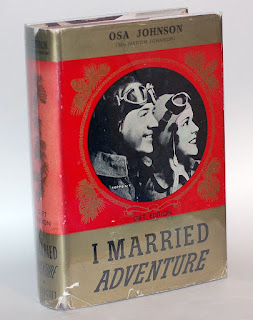
At the height of their fame, Martin Johnson was killed in 1937 in an airplane crash in California. Osa Johnson later wrote a best-selling book, "I Married Adventure," which recounted the couple's exotic and at-times dangerous expeditions.
Following her death in 1953, the couple's fame faded and their achievements were largely forgotten as new wilderness stars emerged in the television era, including Marlin Perkins (producer of 'Wild Kingdom') and undersea explorer Jacques Cousteau.
But one of the aircraft they used in their adventures—the Sikorsky S-39, a single-engine float plane—captured the imagination of Dick Jackson, a pilot and mechanic from Rochester, N.H.
Only 21 such aircraft were built in 1930-31, and by the early 1960s all had been lost or junked.
Looking for a project, in 1963 Jackson chose to restore a Sikorsky S-39 to flyable condition. The painstaking effort took more than four decades, but in 2003 Jackson completed the work and the world's only remaining S-39 made its maiden flight.
In honor of the Johnsons, the plane was painted in exactly the same giraffe pattern used by the famous couple during their African adventures. Today the aircraft remains airworthy, and is part of the collection housed at the "Fantasy of Flight" museum in Polk City, Fla.
The program will include recent scenes of the restored Sikorsky in flight—and on the water—in its Florida environs.
The Aviation Museum of N.H. is a non-profit 501(c)3 tax-exempt organization dedicated to celebrating New Hampshire's role in aviation history and inspiring tomorrow's pioneers, innovators and aerospace professionals.
For more information, visit www.aviationmuseumofnh.org or call (603) 669-4820. Follow the Aviation Museum on social media at www.facebook.com/nhahs.
A vintage print ad promoting 'Straight is the Way' for its 1921 release.
I'm thrilled to be doing live music for upcoming screenings of 'Straight is the Way,' a comedy/drama released in 1921 and not seen in theaters for a full century.
The film's "World Re-Premiere" will take place on Thursday, Dec. 9 at Red River Theatres in Concord, N.H. Showings are scheduled at 5:30 p.m. and 7:30 p.m.
For details about the screenings, check out the full press release pasted in below.
Why stage the premiere in New Hampshire? Because 'Straight is the Way' is set in fictional 'Hampton Center, N.H.' (It was apparently shot, however, just outside New York City.)
And why now? Because after languishing in obscurity for 100 years, the sole surviving print of 'Straight is the Way' was recently transferred to digital media and is now available.
The transfer was accomplished thanks to a successful crowd-funding effort (which I donated to) this summer led by Ed Lorusso, a Maine-based film buff. Ed has organized many such transfers of vintage films that survive in fragile one-of-a-kind film prints that otherwise wouldn't get shown.
Dig that vintage N.H. license plate!
So now 'Straight is the Way' is back among us. And although the transfer was done primarily to provide DVD copies to vintage film nerds, the movie's Granite State setting (as well as its 100th birthday) seemed to call for a theatrical run—to give this picture a chance to be seen once again on the big screen, and in a theater, with an audience and live music, as its makers envisioned it.
Thus, with Ed's blessing and the enthusiastic participation of Red River Theatres in Concord, N.H., we're giving the film its first known theatrical screenings in 100 years.
The return of 'Straight is the Way' to the big screen has captured some attention. Already we've received a big write-up in the Concord Monitor, the region's daily paper. Check it out here.
To me, the most interesting aspect of 'Straight is the Way' was its setting. When I learned the story took place in my home state of New Hampshire, I simply had to back the Kickstarter campaign, and couldn't wait to see the movie.
Very few movies, and almost NO silent films, are set specifically in New Hampshire. In terms of movie locales, the Granite State is pretty much off the map.
Maybe it's because we're so far away from Hollywood. And of the few movies that are set in New Hampshire, most get made somewhere else.
One big exception is 'On Golden Pond' (1981), starring Katherine Hepburn and Henry Fonda, which was filmed in the Squam Lake area. Also, scenes for the 1995 movie 'Jumanji' were shot in Keene, N.H.
From 'Jumanji': "looters" race through "Brantford, N.H.," a.k.a. Central Square in Keene, in a photo taken by my former colleague Michael Moore at the Keene Sentinel.
But more commonly, Granite State settings are subbed out to more other "stand-in" locations.
Take the 1991 comedy 'What About Bob?' with Bill Murray and Richard Dreyfuss. Set on New Hampshire's Lake Winnipesaukee, it was actually filmed at Smith Mountain Lake in Virginia.
How about 'To Die For' (1995), an adaptation of the Pam Smart murder-for-hire scandal? It was also set in New Hampshire, but filmed in Toronto, Canada.
It's not like we're without celebrity connections. (Name dropping alert!) Comedian Sarah Silverman grew up in Bedford, N.H. in a house on the same road as mine. Talk show host Seth Myers grew up in Bedford, too—for decades, his mother taught French in a middle school two houses from mine.
And from an earlier era...legendary actor Claude Rains is buried in Moultonborough, N.H. And back in Bedford, my own community was once home to a spa called "Belle Reve," a 1940s getaway that attracted the likes of Peter Lorre.
In the case of 'Straight is the Way,' the New York City scenes are clearly filmed on location in the Big Apple, where the studio was based.
For the "Hampton Center" scenes, Lorusso can find no evidence that any shooting took place in New Hampshire. It's most likely the scenes were shot outside New York, in either rural Long Island or New Jersey, a common practice at the time.
The one clue about the location is that the mansion in the film appears to be the Long Island summer home of Ethel Watts Mumford, who wrote 'The Manifestations of Henry Ort,' a story on which "Straight is the Way" is based.
But as they might say in Hampton Center, N.H., that don't make no never mind. It's a fun film that I think audiences will find enjoyable, especially if seen on the big screen with live music and an audience, as intended.
So thanks to Ed Lorusso for resurrecting this film, and for Red River Theatres for giving it a chance once again on the big screen a full century after its original release.
See you there! More information in the press release below.
* * *
A vintage 'Coming Attractions' slide promoting 'Straight is the Way' (1921).
MONDAY, NOV. 29, 2021 / FOR IMMEDIATE RELEASE Contact Jeff Rapsis • (603) 236-9237 • jeffrapsis@gmail.com
Vintage feature film with story set in N.H. to get first screening in 100 years
Rare surviving comedy/drama 'Straight is the Way' (1921) to be shown with live music at Concord's Red River Theatres
CONCORD,
N.H. — It's a film that hasn't played in theaters since its original
release exactly one century ago. And it's set in fictional 'Hampton
Center, N.H.,' a small town where a pair of big-city crooks hide out
from the law.
It's 'Straight is the Way,' a Paramount release that proved a modest box office success in the spring of 1921.
The film then completely disappeared—until now.
Next
month, Red River Theaters of Concord will host the world re-premiere of
'Straight is the Way,' which boasts a screenplay by two-time Academy
Award-winning writer Frances Marion.
The film will run twice on
Thursday, Dec. 9: once at 5:30 p.m., and again at 7:30 p.m. General
admission is $12 per person, $10 for Red River members.
Both
screenings will feature live music by Jeff Rapsis, a New Hampshire-based
silent film accompanist who arranged for permission to screen the
movie, which was transferred to digital media earlier this year.
The
story follows two burglars who flee to rural "Hampton Center, N.H." to
hide out in the unused wing of a mansion, where an impoverished family
faces eviction.
Exposed to small town values, the pair resolve to change their ways.
A Ouija board scene in 'Straight is the Way' (1921).
'Straight is the Way' was promoted with the tagline: "They came to lift the silver, but they stayed to lift the mortgage."
The film, a comedy/drama, features scenes in which a Ouija board is used to contact the spirits of long-dead relatives.
Ouija boards had become popular in the years following World War I, when 'Straight is the Way' was released.
How does a film disappear for 100 years, and then resurface?
Produced
by Cosmopolitan Pictures, 'Straight is the Way' was one of dozens of
titles on Paramount's 1921 release schedule. After its initial run, the
film was never reissued.
This was the fate of nearly all motion
pictures of the era, most of which were lost to neglect, decay, or
accident. Today, about 75 percent of all silent films no longer exist in
any form.
But 'Straight is the Way' is among the survivors. A
single 35mm print of the film is in the collection of the U.S. Library
of Congress. The print was part of a hoard of film material donated long
ago by 1920s star Marion Davies, whose pictures were produced by
Cosmopolitan.
However, the print is on fragile and flammable
nitrate cellulose film stock, meaning it can't be safely projected or
loaned out. To keep the film from deteriorating, the print is kept in
long-term storage at the Library of Congress media center in Culpeper,
Va.
In 2021, Maine-based film archivist Ed Lorusso organized an
online Kickstarter program to raise funds to transfer the surviving
print of 'Straight is the Way' to digital media. The fundraiser was
successful, and the transfer was completed earlier this year.
Lorusso
made the film available on DVD to fellow vintage film enthusiasts,
including accompanist Rapsis, who felt the film's Granite State setting
merited a theatrical revival, complete with live music.
"Very few
films are set in New Hampshire, then or now," Rapsis said. "What's
interesting about 'Straight is the Way' is that it shows how the state
was viewed at the time—a place of small towns and old-fashioned ways,
including a constable patrolling the town in a horse and buggy."
Although
'Straight is the Way' contains authentic details such as New Hampshire
license plates on the few autos that appear, Lorusso has found no
evidence that any part of the film was shot in the state.
Instead,
'Straight is the Way' was produced in New York City, where Cosmopolitan
Pictures was based, and which continued to host film production even
after most movie-making moved to California in the 1910s.
'Straight
is the Way' features several location shots of Manhattan scenes such as
Washington Square in Greenwich Village as it appeared in 1921.
Lorusso
believes the New Hampshire scenes were most likely filmed in the rural
countryside of Long Island or New Jersey, just outside the city, as was
common practice at the time.
Lorusso has identified one location:
the mansion shown in the film is the summer home of author Ethel Watts
Mumford in Sands Point, Long Island. Mumford wrote 'The Manifestations
of Henry Ort,' on which 'Straight is the Way' was based.
The screenplay was by Frances Marion, the one recognizable name associated with the production.
Marion,
a prolific writer, authored more than 300 screenplays in a career that
spanned three decades. Her credits include silent classics such as 'The
Wind' (1928); she would later win Academy Awards for writing the prison
drama 'The Big House' (1930) and the iconic boxing story 'The Champ'
(1931).
George Parsons as burglar "Loot" Follett in 'Straight is the Way' (1921).
'Straight is the Way' features a cast of solid
performers, all unknown today: Matt Moore, Mabel Bert, Gladys Leslie,
George Parsons, Henry Sedley, Van Dyke Brooke, and Emily Fitzroy.
The
film was directed by Robert Vignola; the following year, he would
direct Marion Davies in 'When Knighthood Was in Flower' (1922) a big
budget costume drama.
Rapsis said the Red River screening of
'Straight is the Way' is a rare chance to see the film as it was meant
to be experienced—on the big screen, with live music, and with an
audience.
"On the 100th anniversary of the film's release, I'm
delighted Red River will give New Hampshire audiences a chance to see
the film as it was intended to be shown, and also see how our state was
depicted in the early years of cinema." Rapsis said.
'Straight is
the Way' (1921), a silent comedy/drama set in New Hampshire, will be
screened with live music on Thursday, Dec. 9 at 5:30 p.m. and again at
7:30 p.m. at Red River Theatres, 11 South Main St. in Concord.
A
live score will be created by accompanist Jeff Rapsis, a New
Hampshire-based performer who specializes in music for silent film
presentations.
Tickets are general admission $12; Red River Theatres members $10. For more info and to purchase advance tickets, visit www.redrivertheatres.org or call (603) 224-4600.
The Colonial Theatre's new 'Showroom" venue in Keene, N.H.
Tonight it's back to comedy, with Buster Keaton's 'College' (1927) at Brandon Town Hall and Community Center in Brandon, Vt. And just in time, as we could all use a laugh.
More details in the press release below. For now, a few notes about two gargantuan back-to-back screenings I did music for in honor of Veterans Day.
On Wednesday, Nov. 10 at the Flying Monkey Moviehouse in Plymouth, N.H., I accompanied 'The Big Parade' (1925), King Vidor's sweeping drama following John Gilbert's journey through World War I.
And then on Thursday, Nov. 11 in the new "Showroom" venue of the Colonial Theatre in Keene, N.H., I accompanied Rudolph Valentino tangoing his way through 'The Four Horsemen of the Apocalypse' (1921), another sweeping drama.
That's a lot of sweeping in two days!
But that's the point: both films clock in at about 2½ hours, which gives an accompanist a lot of room to develop material and work with it as the film unfolds. To me, it's the best of all possible worlds: I get to lose myself in these long movies, so much so that the music ends up coming from I-know-not-where.
I've done both films before, and know their basic story arcs, but don't have any special material set aside for either of them. So in both cases, it was "sit down and see what happens."
What happened Wednesday with 'The Big Parade' was effective enough, I thought.
The comic scenes in the first half of the film failed to produce much real laughter, which was disappointing. But for the big transition scene, where the troops are finally called to the front, I was able to use a "love theme" to whip up quite a bit of drama.
Specifically, the tune featured a falling fifth, which I found relatively easy to transform to fit other needs: in this case, fear, anxiety, encroaching terror, and ultimately all the overwhelming emotions that cause Melisande to desperately keep holding onto the transport truck taking Johnny to the front.
But the real high point for me came with 'Four Horsemen.' You have to get quite far into the film before meeting the minor but key character of 'Tchernoff' (played by Nigel De Brulier), a kind of mystic who introduces the idea of the 'Horsemen.'
That's Nigel De Brulier hovering up left in 'Four Horsemen of the Apocalypse.'
I hadn't thought about how to handle him, but when he first appears, it just came to me: four chords that I felt perfectly captured his role in the movie. It's really a quite simple cycle: e minor / C Major / F# Major / B Major. (And then back to e minor, if you want.)
Depending on how you lay out the chords on the keyboard, the progression creates a sense of great power: either hidden and held back if played as a chorale, or great power unleashed if used to support energetic rhythms or busy melodic figurations swirling about.
But I found it most effective with more notes in the bass than is usually done: including small intervals in the right hand lent a kind of weight to each chord that really helped what was happening on screen, I thought.
So that was a keeper! So simple, but I'm liable to completely forget about it after a few more films, so I wrote it down in a notebook as a reminder. (I certainly don't expect to use it tonight with Buster Keaton, or tomorrow for a screening of Harold Lloyd's domestic comedy 'Hot Water,' although perhaps it might work for Harold's mother-in-law.)
The Colonial's new 'Showroom' venue (so named because it housed an auto dealership in the 1920s) was a delight to work in. They've already scheduled some screenings in 2022 and I look forward to returning!
But before any of that happens, it's Buster Keaton tonight in Brandon, Vt. With the foliage mostly gone and the sun now setting well before 5 p.m., what better place to be than a movie screening with a lot of other people in need of a laugh. See you there!
* * *
Buster Keaton on campus in 'College' (1927).
WEDNESDAY, NOV. 3, 2021 / FOR IMMEDIATE RELEASE Contact Jeff Rapsis • (603) 236-9237 • jeffrapsis@gmail.com
Buster Keaton comedy 'College' with live music on Saturday, 11/13 at Brandon Town Hall
2021 silent film series concludes with screening of timeless classic send-up of campus life
BRANDON,
Vt.—He never smiled on camera, earning him the nickname of "the Great
Stone Face." But Buster Keaton's comedies rocked Hollywood's silent era
with laughter throughout the 1920s.
Acclaimed for their originality, clever visual gags, and amazing stunts, Keaton's films remain popular crowd-pleasers today.
See
for yourself with a screening of 'College' (1927), one of Keaton's
landmark feature films, on Saturday, Nov. 13 at 7 p.m. at Brandon Town
Hall and Community Center, Conant Square/Route 7 in Brandon, Vt.
The
program will feature live music for the movie by silent film
accompanist Jeff Rapsis. Admission is free; donations are encouraged,
with all proceeds supporting ongoing restoration of the Town Hall.
'College'
follows the story of a hapless university bookworm (Keaton) forced to
become a star athlete to win the attention of his dream girl. Can Buster
complete the transformation in time to woo her from his rival? And
along the way, can he also rescue the campus from sports-related shame?
The
film was released in 1927, at the crest of a national fascination with
college life. In addition to being a great Keaton comedy, 'College'
offers vintage glimpses into what higher education was like nearly a
century ago.
Buster Keaton and Anne Cornwall in 'College' (1927).
Keaton, along with Charlie Chaplin and Harold Lloyd,
stands today as one of the silent screen's three great clowns. Some
critics regard Keaton as the best of all; Roger Ebert wrote in 2002 that
"in an extraordinary period from 1920 to 1929, (Keaton) worked without
interruption on a series of films that make him, arguably, the greatest
actor-director in the history of the movies."
As a performer,
Keaton was uniquely suited to the demands of silent comedy. Born in
1895, he made his stage debut as a toddler, joining his family's
knockabout vaudeville act and learning to take falls and do acrobatic
stunts at an early age.
A remarkable pantomime artist, Keaton
naturally used his whole body to communicate emotions from sadness to
surprise. And in an era with no post-production special effects,
Keaton's acrobatic talents enabled him to perform all his own stunts,
including some spectacular examples in 'College.'
The screening
is sponsored by local residents Lucy and Dick Rouse, Edward Loedding and
Dorothy Leysath, Sam and Sharon Glaser, Peter and Louise Kelley, and
Bar Harbor Bank and Trust.
In reviving Keaton's 'College,' the
Brandon Town Hall to show silent film as it was meant to be seen—in
restored prints, on a large screen, with live music, and with an
audience.
"All those elements are important parts of the silent
film experience," said Rapsis, who will accompany the film. "Recreate
those conditions, and classics of early Hollywood such as 'College' leap
back to life in ways that audiences still find entertaining."
Rapsis
performs on a digital synthesizer that reproduces the texture of the
full orchestra, creating a traditional "movie score" sound. He
improvises the complete score in real time during the screening.
"Creating
a movie score on the fly is kind of a high-wire act, but it can often
make for more excitement than if everything is planned out in advance,"
Rapsis said.
Rapsis encouraged people unfamiliar with silent film to give 'College' a try.
"If
you haven't seen a silent film the way it was intended to be shown,
then you're missing a unique experience," Rapsis said. "At their best,
silent films still do connect with cinema-goers. They retain a
tremendous power to cast a spell, engage an audience, tap into elemental
emotions, and provoke strong reactions."
Buster Keaton's
'College' (1927) will be screened on Saturday, Nov. 13 at 7 p.m. at
Brandon Town Hall and Community Center, Conant Square/Route 7 in
Brandon, Vt. The program will feature live music for the movie by silent
film accompanist Jeff Rapsis. Admission is free; donations are
encouraged, with all proceeds supporting ongoing restoration of the Town
Hall.
One of the scariest things about 'Dracula' (1931) at the Somerville Theatre: standing in the middle of Holland Street to get the requisite marquee shot.
Doing live music for 'Dracula' (1931) last night at the Somerville Theatre proved an interesting adventure in film underscoring.
After all, this wasn't a silent picture. True, there's no music. But it does have dialogue, sound effects, and a certain eerie quality that comes, in part, from the silence.
I didn't want to get in the way of any of that. So I knew going in that there were times when I couldn't —and shouldn't—play anything.
But once in the theater, I found it surprisingly difficult to resist the urge to play music. I accompany more than 100 films each year. And it was just really weird to be sitting there, with a film on the screen and a keyboard in front of me and an audience present, and not play.
As the film unspooled, I felt the character to whom I could most relate was Renfield, with his hunger for spiders representing my hunger to press the keys and make sounds.
But I didn't need to be restrained, and in the end I felt I had a good sense of when to stay out and when to come in, and when to come in strong.
Lugosi and victim in the unfinished basement of Carfax Abby.
Although I improvised the score, I did create a full-fledged 'Dracula' theme in advance, which came in handy and helped the whole thing hold together.
Perhaps the most successful sequence was when Dracula tried to hypnotize Professor Van Helsing.
On screen, played silent, it seems overlong and drawn out, with the quiet broken only by Bela Lugosi's commands to "Come here!"
But with music, I was told afterward that it turned into a scene of considerable dramatic suspense. Hooray!
And in the end, it all seemed to work, as I was glad to receive a thunderous ovation from the 200+ attendees, and with nothing thrown at me—not even the bag of garlic cloves I had given out as a door prize beforehand.
Well, Halloween may be over, but my ongoing silent film music marathon is not.
We go from Lugosi's 'Dracula' to 'Nosferatu' (1922), which I'm accompanying tonight (Monday, Nov. 1) at the Coolidge Corner Theater in Brookline, Mass.
It's ostensibly in honor of the 'Day of the Dead,' but you don't really need an excuse to screen Murnau's classic film. Just as the sign on the railroad tracks tell us that "Any time is train time," theaters should all have signs saying "Any time is Nosferatu time."
Any that's actually a concern. I've done music for 'Nosferatu' a half-dozen times this year. At some point, overexposure may diminish this film's special power over audiences.
So, to remedy that, when I'm appointed King, I will issue an edict that all theaters can only screen 'Nosferatu' unannounced, and only in the middle of other films that people would have come to see.
That would a way to make it really frightening. You would just never know. It would boost the film's reputation immensely, and help box office receipts, as people who wish to see it would have to keep buying tickets hoping to see Nosferatu. It would be like winning the lottery!
And people buy lottery tickets all the time. Why not apply the same logic to movie theaters with 'Nosferatu' the unexpected jackpot prize?
Well, until that happens, your best bet is to come to the Coolidge Corner tonight.
And for now, let me leave you with this unexpectedly amusing marquee shot from the Somerville Theatre: what a way to promote 'Dracula,' who can only come out at night!
* * *
MONDAY, OCT. 18, 2021 / FOR IMMEDIATE RELEASE Contact Jeff Rapsis • (603) 236-9237 • jeffrapsis@gmail.com
Creepy classic thriller 'Nosferatu' to screen at Coolidge Corner on Monday, Nov. 1
'Sounds of Silents' series to be revived with pioneer silent horror movie with live musical accompaniment by Jeff Rapsis
BROOKLINE, Mass.— An iconic local theater will bring its silent movie series back to life with a film about the undead.
'Nosferatu'
(1922), the first screen adaptation of Bram Stoker's novel 'Dracula,'
will be screened with live music on Monday, Nov. 1 at 7 p.m. at
the Coolidge Corner Theatre, 290 Harvard St., Brookline, Mass.
The screening will feature live music for the movie by silent film accompanist Jeff Rapsis. General admission is $23 per person.
The
show marks the resumption of the Coolidge's acclaimed 'Sounds of
Silents' series, which gives audiences the opportunity to experience
early cinema as it was intended: on the big screen, with live music, and
with an audience.
The series,
like all other Coolidge programming, was paused during the recent
pandemic. But with the theater now open, the series is returning.
On deck (almost): 'Nosferatu' at the Coolidge Corner Theatre this evening.
'Nosferatu'
(1922), directed by German filmmaker F.W. Murnau, remains a landmark
work of the cinematic horror genre.
To modern viewers, the passage of time has made this unusual movie seem even more strange and otherworldly.
It's
an atmosphere that silent film accompanist Jeff Rapsis will enhance in
improvising live music on the spot for the screening.
"The
original 'Nosferatu' is a film that seems to get creepier as more time
goes by," said Rapsis, a resident of Bedford, N.H. who accompanies
silent film screenings at venues across the nation.
In 'Nosferatu,' actor Max
Schreck portrays the title character, a mysterious count from
Transylvania who travels to the German city of Bremen to take up
residence.
In the town, a rise in deaths from the plague is
attributed to the count's arrival. Only when a young woman reads "The
Book of Vampires" does it become clear how to rid the town of this
frightening menace.
Director Murnau told the story with strange
camera angles, weird lighting, and special effects that include
sequences deliberately speeded up.
Although 'Nosferatu' is
suitable for all family members, the overall program may be too intense
for very young children to enjoy.
A shadowy character: Mr. Nosferatu comes a calling.
Modern critics say the original 'Nosferatu' still packs a powerful cinematic punch.
“Early
film version of Dracula is brilliantly eerie, full of imaginative
touches that none of the later films quite recaptured,” Leonard Maltin
wrote recently.
Critic Dave Kehr of the Chicago Reader called
'Nosferatu' "...a masterpiece of German silent cinema and easily the
most effective version of Dracula on record.”
Despite the status
of 'Nosferatu' as a landmark of early cinema, it was almost lost forever.
The film, shot in
1921 and released in 1922, was an unauthorized adaptation of Stoker's
novel, with names and other details changed because the studio could not
obtain rights to the novel.
Thus "vampire" became "Nosferatu"
and "Count Dracula" became "Count Orlok." After the film was released,
Stoker's widow filed a copyright infringement lawsuit and won; all known
prints and negatives were destroyed under the terms of settlement.
However,
intact copies of the film would surface later, allowing 'Nosferatu' to
be restored and screened today as audiences originally saw it.
The image
of actor Max Schreck as the vampire has become so iconic that it can be seen in a recent 'Sponge Bob Squarepants' episode.
The
Sounds of Silents series is made possible by the generous contributions
of Dr. Martin and Becki Norman, Dr. Thomas Gutheil, Susan Stoller, and
Elizabeth Driehaus.
‘Nosferatu’
will be shown on Monday, Nov. 1 at 7 p.m. at
the Coolidge Corner Theatre, 290 Harvard St., Brookline, Mass. as part
of the theater's 'Sounds of Silents' series. Admission is $23 per
person.
For more info and to buy tickets, visit www.coolidge.org or call (617) 734-2500.
Ready for the downbeat: Bela Lugosi in 'Dracula' (1931), to be shown with live music by me on Sunday, Oct. 31 at 7:30 p.m. at the Somerville Theatre.
Most posts on this blog are about what's coming up next on the silent film docket.
But today I'm skipping ahead all the way to month's end, to Sunday, Oct. 31. That's when I'm doing live music on Halloween night for the classic thriller 'Dracula' (1931).
The film will be shown in 35mm at the Somerville Theatre, among the best places to see a movie anywhere. More details in the press release pasted in below.
But wait—isn't 'Dracula' a talking picture? With a soundtrack and everything?
Yes. So what am I doing making live music for it?
Well, the thing is, 'Dracula' was released with virtually no musical score.
This often happened in the early days of talkies. If a film wasn't an actual musical, with singing and dancing on screen, studios would sometimes just not bother with musical underscoring.
After all, music had been left up to local musicians since movies began. Throughout the silent era, the studios regarded music as no different from popcorn: something best made right in the theater.
There were technical reasons for live music, of course. At the time, it wasn't easy to amplify a recording in a way that would work for a large theater.
But it was also just good box office for music to be done locally, so it could reflect prevailing styles and tastes depending on the location and the theater's audience.
During the silent era, if a director did use music, it was mostly to have it played on set, to create a mood or to establish a tempo for the performers.
Which brings us to 'Dracula' and its almost total lack of music. Other than a snatch of Tchaikovsky's 'Swan Lake' ballet score at the beginning, and a brief scene in an opera house, it's music-less.
Universal released the picture in 1931 without a score, in part because the traditional of a recorded score wasn't fully established at that time, and also to save money on production costs.
This certainly didn't harm the film, which proved a box office hit right from the beginning.
But over the years, various attempts have been made to add music to the film. Most notably, Philip Glass composed a score for string quartet in 1998, and the Kronos Quartet continues to tour with it to this day.
In my little world, I hadn't considered scoring 'Dracula' until recently, when I programmed a series of Tod Browning silent pictures at the Town Hall Theatre in Wilton, N.H.
It's currently underway—last Sunday, we screened 'White Tiger' (1923), an entertaining crime drama starring Wallace Beery, Priscilla Dean, and Raymond Griffith.
Browning, who directed 'Dracula,' had a prolific career in the silent era, directing a vast catalog of twisted melodramas, including many of Lon Chaney's greatest titles.
So I had Browning on the brain when the Somerville Theatre proposed a screening of 'Dracula' for Halloween, with me doing live music.
I hadn't considered this before, as I specialize in the unique world of silent cinema. Plus who would dare follow in the musical footsteps of Philip Glass, one of the most remarkable and original musical voices of our time?
But I thought about it: Browning's 'Dracula,' although a talkie, displayed many of Browning's techniques honed over the years in silent cinema. Long stretches unfold with no dialogue at all—sequences where the visuals carried the picture, as they had to in the silent era.
I decided it would be a worthwhile exercise to take my silent film scoring vocabulary and carry it forward to 'Dracula,' which, after all, was the product of one of the most distinctive silent-era directors.
I understand the Glass score (which I've deliberately avoided listening to since this project) runs pretty much throughout the movie, even during passages with dialogue, and works to create an overall texture.
As much as I admire Glass, my silent film accompaniment methods mean I'll take quite a different approach with 'Dracula.'
For one thing, the music won't be continuous. Instead, it will be broken into sections, and used only when I feel it enhances scenes as only music can.
Yes, it will at time evoke a general mood. But it will also serve to indicate significant changes in the emotional temperature of the narrative, to add motion to scenes that would benefit from it, and do all the things music can.
I also hope to preserve those moments where the silence worked so well to create the eerie other-worldly mood that's a big part of the original 'Dracula.'
Will it work? I hope you'll join me on Halloween night at the Somerville, and we'll all find out together!
* * *
Bela Lugosi as 'Dracula' entertains a friend in the catacombs of Carfax Abbey.
Halloween special: Lugosi's 'Dracula' on big screen in 35mm with new live score
Horror classic to be shown at the Somerville Theatre on Sunday, Oct. 31 for one screening only
SOMERVILLE, Mass. — Do you dare spend Halloween braving 'Dracula' on the big screen?
That's
the question at the Somerville Theatre, where the classic 1931 version
of 'Dracula' will run for one showing only on Sunday, Oct. 31.
The
movie, starring Bela Lugosi in the title role, will be shown using a
35mm film print from Universal Studios, which released the early horror
classic in 1931.
Showtime is 7:30 p.m. General admission tickets are $15, with senior/student discounts. Tickets are available online at somervilletheatre.com or at the box office.
The screening will feature live music by Jeff Rapsis, the Somerville Theatre's silent film accompanist.
Although
'Dracula' is a talking picture, it was released with virtually no
musical score, a common practice during the transition period from
silent to sound pictures.
Rapsis will perform original music live
during the screening using a digital keyboard to recreate the texture
of a full orchestra.
Directed by Tod Browning (at right), 'Dracula' was a
sensational box office success and has mesmerized movie audiences ever
since with its eerie visuals and Lugosi's iconic performance.
The
story opens in far-off Transylvania, where mysterious Count Dracula
hypnotizes a British soldier, Renfield (Dwight Frye), into becoming his
mindless slave.
Dracula then travels to England and takes up
residence in an old castle. Soon the Count begins to wreak havoc,
sucking the blood of young women and turning them into vampires.
When
he sets his sights on Mina (Helen Chandler), the daughter of a
prominent doctor, vampire-hunter Van Helsing (Edward Van Sloan) is
enlisted to put a stop to Dracula's never-ending bloodlust.
Located
in Davis Square, the Somerville Theatre is one of the few first-run
venues in the region committed to preserving the ability to screen
movies using 35mm film prints.
"We feel it's important to show
films on actual film when possible, the way classic movies were intended
to be shown," said Ian Judge, creative director of the Somerville
Theatre.
The Somerville recently reopened after a 17-month
hiatus for the pandemic, during which significant renovations were made
to the 1914 theater.
The Halloween screening of 'Dracula' will
include live music by Jeff Rapsis, a local composer and performer who
specializes in creating accompaniment for silent films.
'Dracula'
was released when Hollywood and movie theatres were still undergoing
the transition from the silent era to pictures with synchronized sound
and dialogue.
During the silent era, studios did not produce
official scores for most films. Instead, accompaniment was left up to
local musicians, and could vary greatly from one moviehouse to another.
When
studios converted to talking pictures, the tradition of recording a
musical score was not well established. In the case of 'Dracula,'
Universal omitted music in part to save production costs.
As a result, after the opening credits, the 1931 'Dracula' contains no music except for a brief scene in an opera house.
In
recent decades, composers have experimented with creating original
music for the movie—most notably Philip Glass, who composed a score in
1998 for the Kronos string quartet.
Rapsis sees 'Dracula' as closely linked to the silent-era tradition of films shown with live music.
"Tod
Browning was a prolific director of silent films, including many
thrillers that anticipate 'Dracula,' " Rapsis said. "So even though
'Dracula' is a talking picture, Browning's filmmaking style is strongly
rooted in the silent era, when it was assumed that local musicians would
be important collaborators in a picture's effect on an audience."
Unlike
the Glass score, which plays almost continuously during the movie,
Rapsis will use music only in certain places where he feels it will
either enhance the mood, heighten tension, or signify a change in the
emotional line of the story.
Although 'Dracula' is not a silent
film, there are definitely places where the silence speaks volumes and
remains very effective," Rapsis said. "I hope to leave those intact, but
enrich other parts of the film in the way that only music can."
Rapsis works largely by improvising as a film plays in the theater, in the tradition of theatre organists of the 1920s.
"There's
something very special about the in-the-moment energy of a live
improvised performance," Rapsis said. "It's never the same, and at its
best it really can help a film connect with an audience and make the
whole experience come together."
The original 'Dracula' (1931)
starring Bela Lugosi will be shown in 35mm and with live music for one
screening only on Halloween night, Sunday, Oct. 31 at 7:30 p.m. at the
Somerville Theatre, 55 Davis Square, Somerville, Mass.
Tickets are $15 per person, with discounts for students and seniors. For more info, call the theater at (617) 625-5700 or visit www.somervilletheatre.com. For more info on the music, visit www.jeffrapsis.com.
Proof I made it to Iola, Kansas—taken not at the Bowlus Fine Arts Center, but at a long-closed movie theater just off the town's main square.
There's nothing more American than a second act. Buster Keaton certainly enjoyed one, reinventing himself as a TV performer after falling from movie stardom.
So it's only fitting that an annual gathering bearing his name should have a second act as well.
I'm referring to the Buster Keaton Celebration, held each year in late September in the small town of Iola, Kansas, not far from Keaton's rural birthplace.
The annual gathering ground to a halt in 2017 after 24 years. It was good run—but nothing goes on forever, right?
However, this year saw the reemergence of the Keaton Celebration. What's more, organizers intend to resume holding the event on an annual basis.
They also plan to remake the event's format to involve the local community and create more interest among Keaton fans.
Can this be done? That remains to be seen. But for now, here's a report on this year's Celebration, which I attended on Friday and Saturday, Sept. 24 & 25.
As a silent film accompanist, I had been to several past Keaton Celebrations, including what everyone thought was the final one in 2017, where the mood was one of rueful acceptance.
In 2018, a one-off Keaton program was held in Kansas City. But it really wasn't a continuation of the Iola event. And after that, all was quiet on the Kansas Keaton front, at least publicly.
But behind the scenes, talks were underway to resume Iola's Keaton Celebration. The relaunch might have taken place in 2020 if not for the Covid-19 pandemic.
I didn't know about this until about a year ago (word travels slow from Kansas to New Hampshire), when I learned the event was being revived for 2021. Later, I was thrilled to be invited to accompany some of films, with the prestigious Mont Alto Motion Picture Orchestra also appearing.
Along the way, the lingering pandemic nearly torpedoed the 2021 gathering. For a time, organizers considered an all-virtual model.
But in the end, a hybrid approach was taken, with the Celebration going ahead as scheduled on Friday, Sept. 24 and Saturday, Sept. 25.
The program unfolded at its longtime Iola home, the Bowlus Fine Arts Center. At the same time, all events were streamed and available online for virtual attendees.
The theme? "Buster Keaton in Changing Times," with a classy logo done as always by the talented Carol Yoho, who has attended every Keaton Celebration since the very first one back in 1993.
What was it like? Here's a brief and idiosyncratic report from the perspective of a piano player invited to accompany some of the silent films on the program.
First, it was nice to be back. After the "last" Keaton Celebration in 2017, I thought I'd never see Iola again. But here I was, among landmarks such as the town square ("biggest west of the Mississippi River!") and the A&W Restaurant.
Iola, by the way, is home to an enormous facility that produces Russell Stover candies for shipment all over the nation. So if you've ever wondered where all those boxes of Whitman's Samplers at your local CVS come from, it's likely Iola.
Iola: Proud origin of Russell Stover candies!
I was eager to meet Dan Kays, director of the Bowlus Center, whose hiring in 2018 was an important step on the road to reviving the Keaton Celebration. Working with many long-time Celebration supporters, Dan has proposed a 10-year plan to help the event thrive and take it in new directions.
When I arrived at the Bowlus late Thursday afternoon, I didn't find Dan, but I did find my way (via an unlocked back door) into the darkened main auditorium, where the Celebration would take place. So I sat down and got reacquainted with the Henry Miller grand piano that lives in the "pit" area.
I'm glad I did. The Miller is a fine instrument, but its touch is really heavy, or at least heavier than I'm used to, and without the graceful action of a Steinway. So just working with it for a half-hour can go a long way toward calibrating one's playing, of which I would do a lot over the next two days.
Friday morning I arrived before the 9 a.m. start to find Dan up on the podium testing the sound system. Throughout the two days, Dan was a whirlwind of activity, dealing with all aspects of the Keaton program plus the whole online version, which turned out to be a real challenge.
In the small world department, turns out Dan's wife was recently an administrator at Mary Magdalen College, a small Catholic liberal arts school in Warner, N.H., where I've played for several silent film programs!
I was engaged primarily as the "day" pianist, brought in to provide live music for a grab bag of short comedies on Friday and Saturday. Rodney Sauer and Mont Alto handled the evening programs, although Rodney and I did swap around a bit.
Besides accompanying the movies, I also contributed occasional fill-in music for the program, such as playing "Hail to the Chief" when Iola's mayor took the podium.
Me at the Henry Miller. Photo by Jim Reid.
First up was Keaton's short 'The Playhouse' (1921), in celebration of the 100th anniversary of its release. You never quite know how things will go until a film starts, but I had good material ready and the music came together nicely, I thought.
What was really interesting, though, was a presentation after by Prof. Frank Scheide, longtime Keaton Celebration participant and chairman of the committee, who walked us all through the actual vaudeville acts that Buster was sending up in 'The Playhouse.'
'The Playhouse,' which I first became acquainted with via a Super-8mm print from Blackhawk Films in the 1970s, is funny on its own terms. But there's so much more to it when you learn about the well-known acts that Buster was parodying in his comedy, and which audiences of the day would have recognized.
Take the "Zouaves" precision marching act that appears in 'The Playhouse.' Totally unknown today, in the 1920s they were a popular vaudeville touring act, descended from a U.S. Civil War regiment that itself was based on French military units in Algeria during the 19th century.
Frank, who is on the University of Arkansas faculty, dug up a film of the original Zouave troupe going through its routines—and astonishingly, they were almost exactly as depicted in Keaton's comedy. (Although in 'The Playhouse,' things soon go disastrously wrong.)
The film was silent promotional footage, and after it started running, Frank beckoned to me from the stage: "Jeff, do you know any Zouave music?" So I hopped over to the piano and rattled off what I hoped was convincing Zouave music for the rest of the footage.
Later that morning, I jumped in again when the sound system failed to function for a live on-stage rendition of the famous "Nairobi Trio" routine of Ernie Kovacs. Involving three performers dressed as apes, the pantomime routine is always done to "Solfeggio," a bizarre Robert Maxwell 1950s recording for harp, singers, orchestra, and bongo drums.
A vintage video clip of the 'Nairobi Trio.'
The performers (wearing ape masks and heavy coats) entered and assumed their positions. But the music didn't happen. It wasn't clear at first what was going on, but after much confused gesturing, the troupe got up and left the stage.
As a lifelong Kovacs fan, I knew the routine well enough, and felt I could find my way on the piano, even without having ever played it before. So I volunteered to do it live, and Dan (who was at the podium) said okay, so off we went.
It didn't quite come out totally right, but was enough to get the players through most of the routine. I can't imagine how it came across to the online audience, but those at the Bowlus seemed to enjoy it.
The other short that morning was 'Backstage' (1919), one of the better Fatty Arbuckle comedies with Keaton in a supporting role. This one is full of dance, all of it played for pure comedy, so on the spur of the moment I started out with the famous 'Swan Lake' theme from Tchaikovsky's well-known ballet score.
I felt it provided a nice ironic introduction to all the wildness to come. And eventually, when thing did get wild, 'Swan Lake' returned in a rag-timey version with jacked-up tempo that I thought was pretty effective.
Another unexpected task came that afternoon. Rodney Sauer of Mont Alto gave a presentation on silent film scoring, and he asked me to demonstrate an improvised score to a short passage from King Vidor's 'The Patsy' (1928). So I did!
Rodney then ran the same sequence with Mont Alto's compiled score, and then again with a full orchestra taking a very different approach, underlining all the action with musical outbursts that's sometimes called "Mickey Mousing" in the accompaniment world.
Buster, best friend (at left) and mortal enemy in 'Our Hospitality.'
The evening's program was 'Our Hospitality' (1923) with music by Mont Alto. I was surprised to learn many attendees had never seen the film before! I think I've accompanied it four times this year so far, and seen it several other times with other music. It's as familiar to me as my back yard, but it's important to remember how this is definitely not the case for 99.9% of people.
The next day saw two more Keaton shorts in the morning: 'Convict 13' and 'Neighbors,' both from 1920. Both were a lot of fun, with a jazzy underscoring working well for Buster's prison scenes in 'Convict 13.'
A Saturday highlight was lunch with Rodney Sauer and well-known film collector Jim Reid, who came up from Dallas to attend the Celebration. We drove to, yes, the Iola A&W Restaurant, where we enjoyed root beer served in frosted glass mugs.
That evening, I got to do music for the Keaton short 'Cops' (1922), which I felt went okay. I really tried hard to take a "less is more" approach, using the simplest possible texture to start and then build gradually as Buster's misadventures spiral wider and wider.
Playing for 'Cops' (1922). The sheet music belongs to Rodney Sauer, who would lead Mont Alto in a compiled score for Keaton's 'Three Ages.'
Mont Alto then delivered a crackerjack score for Buster's feature 'Three Ages' (1923), and that was it. The 26th annual Keaton Celebration was in the books—thanks to the pandemic, not exactly what organizers had envisioned, but still revived and back in business.
But for how long? Dan Kays has spoken of a ten-year plan, and that's probably a good thing, because it takes time for a long-running event to evolve to reflect different needs and changing times.
So, in an effort to be helpful, here are some uninvited observations.
It's my observation that a lot of what drove the Keaton Celebration for its first 20 years was the special opportunity for attendees, both fans and scholars, to interact with major figures from the entertainment world who knew or worked with Keaton, who died in 1966.
Such folks were still around in quantity when the festival started in 1993. But time has passed, and almost anyone who knew or worked with Buster has
now joined him in the great Green Room in the Sky. That direction connection has faded.
Keaton family members also made regular appearances, which was always a special element of the Iola event. This continues: this year was attended in person by Keaton's nephew Harry Keaton Jr., while Buster's daughter-in-law Barbara Talmadge and granddaughter Melissa Talmadge Cox attended virtually.
Still, time is passing. Keaton's widow Eleanor attended the event twice in the 1990s before she passed away in 1998. Harry is now past 80. Barbara is 96. It would be great if Keaton family members continue to be involved, but the Celebration can't rely too heavily on that element year after year without it getting to seem a little repetitive.
On screen: Keaton's daughter-in-law Barbara Talmadge and her daughter Melissa Talmadge Cox, committee member Hooman Mehran, and emcee Bruce Symes; on stage, from left: Lisa Geisler, daughter of Keaton's nephew Harry Keaton Jr., and Frank Scheide.
At the same time: just as I have to remember that most people have never seen 'Our Hospitality' (1923), most people interested in Keaton have not had a chance to meet any members of his family. It's a rare treat (I remember how thrilled I was to take Melissa out to lunch one day about 10 years ago) and their tradition of being part of the Iola event is a strong card in the Celebration's hand.
So I think here it's really a question of striking the right balance.
One curious element of the Keaton Celebration is that for many years, it was supported financially by the Kansas Humanities Council. This meant it was always been heavy on lectures and talks from visiting academics, and panel discussions among experts—all worthwhile, but not as entertaining as a Keaton comedy on the screen.
As a relative newcomer to the event (first attending in 2012), I felt this need to structure it as something of a scholarly symposium, or at least to conform to an academic view of the humanities, was a curious way to put together a Buster Keaton Celebration.
Why? Because academic conferences are fine, but they're not ever going to draw or satisfying large general audiences. They really can't be the basis of a popular, well-attended event of this type. In this instance, less could be more.
However, the presentation by Frank Scheide on the vaudeville routines in 'The Playhouse' was lively and informative and really added value to the event. So there's a balance to be struck here too, it seems.
I was given an unexpected chance to speak during this year's Celebration, and the one point I tried to make was that the event has a future.
Me yakking from the piano bench. Another photo by Jim Reid. I didn't get a chance to take many photos, other than of the Russell Stover candy plant, so apologies for the lack of images.
Why? Because of Buster. His audience isn't shrinking or fading out. Rather, a century after what's recognized as his best work, his audience seems to be growing.
Really. I accompany more than 100 silent film programs each year, and the Keaton titles are the most frequently requested and the most well-attended.
Young people (who generally believe any film before 'Star Wars' is pre-history) love Keaton and respond readily to his work.
In this sense, it was great to see some high school students attend for a brief period on Friday afternoon. I think it would have been much better for them to see one of the Keaton features with live music, which is what young people really respond to, I've found. But it's a start.
So the Keaton Celebration holds another crucial card in its hand: Buster himself. If it can evolve to continue to showcase his work to new generations of fans, the event will thrive and prosper for a long time to come.
The proximity to his birthplace is great, and can always be used to keep a sense of "pilgrimage" associated with the event. It's a claim that no other event or place can make.
But more important are the basics: show Buster's films as they were intended to be shown: on a big screen, in the best restored prints, with live music, and—most importantly—an audience.
When I talked with him, Dan Kays spoke of future Keaton programs that involve the local community more, in keeping with the original mission of the Bowlus to serve as a cultural resource for the region.
So ideas for future Buster Keaton Celebrations include showcasing the work of local filmmakers, involving students from local high schools, and just finding ways for the Iola community to become engaged.
More of that, and the Keaton Celebration will not just be revived, but reinvented.
After all, Keaton's motion picture artistry is timeless. Why can't this annual event possess the same quality?
And let's finish off with some A&W root beer served in a frosty cold mug. Wonder if they get this in Pordenone?
Jeff Rapsis is executive director of the non-profit Aviation Museum of N.H. He's also a writer/editor, educator, and also a composer and performer who specializes in creating live musical scores for silent film screenings. He's also an award-winning journalist, newspaper publisher, and owner of multiple dogs. Contact: jeffrapsis (at) gmail.com