Showing posts with label Lionel Barrymore. Show all posts

Monday, September 16, 2024

Don't miss a rare chance to see Tod Browning's rediscovered thriller 'The Show' (1927) on Sunday, Sept. 22 at Wilton, N.H.

An original lobby promoting MGM's lurid backstage thriller 'The Show' (1927)

This weekend! On Saturday, Sept. 21 at 7 p.m. I'll accompany Harold Lloyd's beloved comedy 'Speedy' (1928) in Brandon, Vt. Hope you're able to make it!

If you're here due to coverage in this week's edition of 'Seven Day,' the big Vermont alternative paper, welcome! See you at Brandon Town Hall and Community Center. Admission is free; any donations support on-going upkeep and restoration of the circa 1860 Town Hall building.
 
Then, on Sunday, Sept. 22 at 2 p.m., it's 'The Show' (1927), a twisted backstage drama from director Tod Browning, which I'll accompany at the Town Hall Theatre in Wilton, N.H. Hope you can join us!
 
Below, I'm pasting in a press release about the rare screening of 'The Show,' which I've never done music for. Hope you can join us! Here goes...

*  *  *
 
Silent thriller 'The Show' revived at Town Hall Theatre on Sunday, Sept. 22
 
Twisted backstage drama stars John Gilbert, Lionel Barrymore; to be screened with live musical accompaniment.
 
WILTON, N.H.—A bizarre silent thriller featuring a cast of notables makes a rare return to the silver screen this month at the Town Hall Theatre.
 
'The Show,' (1927), a backstage drama featuring top MGM stars John Gilbert, Renée Adorée, and Lionel Barrymore, will be screened on Sunday, Sept. 22 at 2 p.m. at the Town Hall Theatre, 40 Main St., Wilton, N.H.
 
Admission is free; donations are accepted, with $10 per person suggested to defray expenses.
The screening, the latest in the venue's silent film series, will feature live accompaniment by Jeff Rapsis, a New Hampshire-based composer who specializes in creating music for silent films.
 
Directed by Tod Browning, 'The Show' explores the world of a Budapest carnival sideshow, where performers encounter love, greed, and murder.
 
John Gilbert and Renée Adorée in 'The Show' (1927).
 
Cock Robin (John Gilbert) is a sideshow barker in Budapest. He also participates in one of the acts; his former girlfriend Salome (Renée Adorée) dances before Herod in exchange for the head of "Jokanaan". As Jokanaan, Robin has his head seemingly chopped off and presented to the dancer on a platter, much to the audience's delight.
 
As 'The Show' unfolds, Salome yearns to get back together with Robin, but he has his sights set on Lena (Gertrude Short), the daughter of a well-off sheep merchant. He lets the smitten Lena buy him things.
 
The Greek (Lionel Barrymore), Salome's current boyfriend, becomes angered when he learns of her feelings. The Greek and his henchman, the Ferret, also try to steal Lena's father's money, but things get complicated when murder enters the picture.
 
'The Show' is the latest in a monthly series of silent films presented with live music at the Town Hall Theatre. The series provides local audiences the opportunity to experience silent film as it was intended to be shown: on the big screen, in good-looking prints, with live music, and with an audience.
 
"Put those elements together like we do at the Town Hall Theatre, and films from the silent era spring right back to life in a way that helps you understand why people first fell in love with the movies," Rapsis said.
 
Tod Browning's twisted thriller 'The Show' will be shown on Sunday, Sept. 22 at 2 p.m. at the Town Hall Theatre, 40 Main St., Wilton, N.H.
 
Admission is free; donations are accepted, with $10 per person suggested to defray expenses. For more information, call the theater at (603) 654-3456.

Friday, October 28, 2022

Tonight! Lionel Barrymore and Boris Karloff in 'The Bells' (1926) in Warner (N.H.) Town Hall

A lobby card promoting 'The Bells' (1926).

The pre-Halloween silent film marathon continues with a screening of 'The Bells' (1926) tonight (Friday, Oct. 28) at the old Town Hall in Warner, N.H.

Showtime is 7 p.m. for what's a fund-raiser for the Telephone Museum of New Hampshire, which is located in Warner. (Yes, New Hampshire has a Telephone Museum!)

And what better silent film to show in support of a telephone museum than one called 'The Bells'?

Live music (plus some nifty bell sound effects) will be provided by yours truly. 

The movie itself has nothing to do with telephones, nor does it concern the famous Edgar Allen Poe poem. 

Despite the A-list cast (which also includes silent film mainstay Gustav von Seyffertitz), the film is a low-budget murder thriller from obscure studio Chadwick Pictures. 

I recorded a score for it several years ago for a DVD reissue by Reel Classics Video. But tonight's music will all be freshly improvised.

For more information, check out the N.H. Telephone Museum Web site.

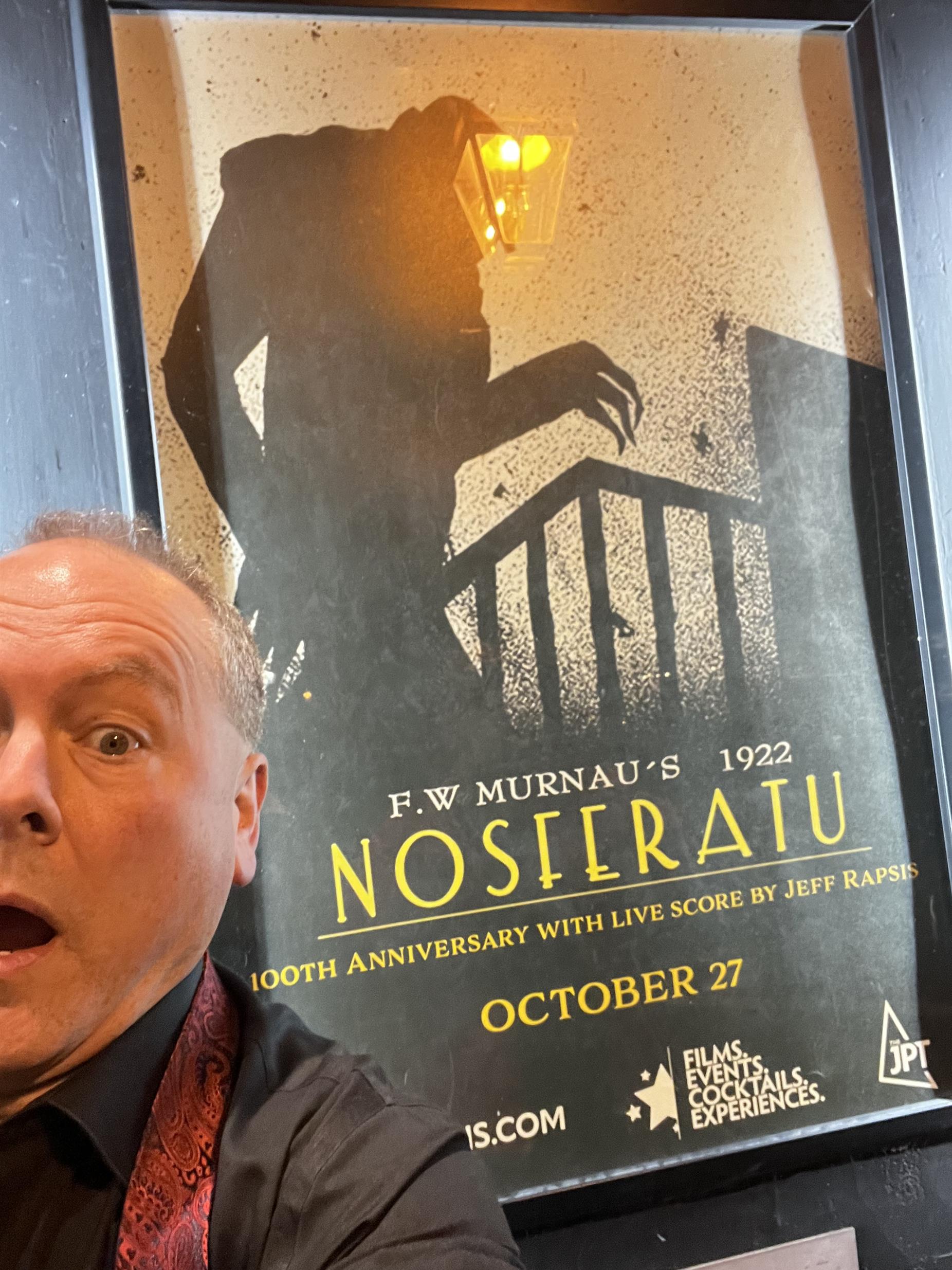
And while I'm at it, thanks to everyone who turned out to pack the Jane Pickens Theatre in Newport, R.I. for last night's 100th anniversary screening of 'Nosferatu' (1922).

A total of 216 tickets were sold—the most so far for any silent film program since I began performing in Newport earlier this year. 

Despite the DCP version of the film being noticeably different from the DVD transfer that I usually use, all went well. After a half-dozen 'Nosferatu' screenings in the past two weeks, I'm getting pretty good at synchronizing the chime noises when the clock strikes midnight. 

Your final chance to see 'Nosferatu' this Halloween season, at least with music by me, will by on Saturday, Oct. 29 at 2 p.m., when I accompany a screening at the Park Theatre in Jaffrey, N.H.

After that, the film goes back into its coffin until the next resurrection. 

Hope to see you at tonight's screening of 'The Bells' in Warner! In the meantime, enjoy some "atmosphere" shots from 'Nosferatu' last night in Newport, where they do quite a good job on the posters.


Wednesday, March 15, 2017

This Thursday: Gloria Swanson in a silent film
that accidentally created a new art form

Gloria and Lionel warming up for their big battle in 'Sadie Thompson.'

Up next: Gloria Swanson and Lionel Barrymore in 'Sadie Thompson' (1928), an intense drama made in Hollywood's final burst of silent film production.

It's screening on Thursday, March 16 at 6:30 p.m. at the Flying Monkey Moviehouse and Performance Center, 39 South Main St., Plymouth, N.H.

Admission is $10 per person.

There's a lot to like about this movie, which many feel contains Swanson's best performance. It may be.

But structurally, there's something very special about 'Sadie Thompson,' the story of which was adapted from Somerset Maughan's story 'Rain.'

What's special? Nothing that the people who made it intended to happen, but it's this: we're missing the last reel!

Yes—the last 10 minutes, which contain the climax, just don't exist.

And so, by accident, we have a situation that leads to an experience very different from what the filmmakers had in mind.

It would be great to have the footage, of course, and see what really happens when the battle between Gloria's fallen woman and Barrymore's tempted preacher reaches a boiling point.

But we don't. And unless the last reel is ever found, we can't.

Instead, we have what often happens when a vintage film exists with missing sequences. Stills and other materials are substituted, and the story is told through narrative titles and other techniques such as pan-and-scan of stills.

With about 70 percent of silent film missing, this happens more often than you might think. Among big films that I've accompanied that are missing entire reels are Raymond Griffith's 'Paths to Paradise' (1925); King Vidor's 'Bardelys the Magnificent' (1926), and Clara Bow's 'Get Your Man' (1927).

And you know what? In each case, I've found that such efforts to fill in missing film with other materials creates a kind of hybrid art form that can actually be quite effective in its own way.

Mainly, I think, because it leaves scenes to the imagination, which engages an audience in a completely different way that if everything's right there on the screen.

In pondering this, I've come to think this is not unlike what happens with other art from the past when things go missing.

Take the Venus de Milo, which lacks arms. Or Schubert's unfinished symphony, short by two movements.

And much of my public school education took place under the watchful eye of George Washington as depicted in Gilbert Stuart's famous unfinished painting.

Some critics feel such losses can actually enhance the stature of the work of art in question.

How? Because we don't know what the arms on the Venus de Milo look like, we're free to idealize them to a state of perfection—one that goes way beyond what any artist could actually achieve.

And that's because the absence allows us each to fill in our own personal visions of perfection. Such notions that are unique to us, and are thus uniquely gratifying or satisfying.

Gloria with director Raoul Walsh, who appears in 'Sadie Thompson' as "Handsome" Tim O'Hara.

Which brings us to 'Sadie Thompson.' Just as the battle between Gloria Swanson and Lionel Barrymore is about to reach its climax, the film stops!

And what starts up is a recreation of the final reel through stills, titles, and footage from a later remake.

To me, every time I've seen 'Sadie Thompson,' this feels exactly right. The animosity of the two characters grows so intense, the movie just can't contain it. It's like things are so hot, the film melts, or the story triggers infinity, or something.

And so we're left to visualize the climax on own, and because we all do that in our own individual ways, it has the potential to more terrifying and awesome than anything director Raoul Walsh could have put on celluloid.

So it's a motion picture, yes. But it's also something different. By virtue of its missing final reel, it's a hybrid—a new way of telling stories, really. Or at least a different way of rendering a film's climax.

I like it, and I think it's a technique that today's filmmakers might consider employing.

Well—until that happens, you can catch Gloria Swanson in 'Sadie Thompson' (1928) on Thursday, March 16 at 6:30 p.m. at the Flying Monkey Moviehouse and Performance Center, 39 S. Main St., Plymouth, N.H. Tickets are $10; for more info, call the box office at (603) 536-2551.

Sunday, October 26, 2014

Creepfest: actor Lon Chaney unmasked
on 10/26 at Wilton (N.H.) Town Hall Theatre

Lon Chaney as Phroso the Magician in 'West of Zanzibar' (1928). Chaney's the one on the left.

With Halloween next week, the screenings are piling up like the unraked leaves in my front yard.

Last night, we had a great turnout for 'Phantom of the Opera' (1925) at the Leavitt Theatre in Ogunquit, Maine.

But now I'm scurrying to post advance info about today's Lon Chaney "Creepfest" double feature at the Town Hall Theatre in Wilton, N.H.

The films are lesser-known Chaney pics but worth a look—especially at Halloween time, I think.

First up is 'The Unholy Three' (1925), followed by 'West of Zanzibar' (1928).

Both were directed by Tod Browning and have that weird circus-y vibe going. And both are quite dark and sinister: each delivers hefty servings of the Chaney/Browning themes of obsession, murder, and death.

But neither requires Chaney to don extensive face-altering make-up. So it's interesting to see the guy himself in action. (The poster at left makes Chaney look almost normal!)

True, 'The Unholy Three' has Chaney posing as a kindly old grandmother for a good part of the film. And 'West of Zanzibar' requires him to play a man paralyzed from the waist down.

But otherwise, both movies show Chaney unmasked.

So, in a season where masks are basic equipment, think of this bit of counter-programming as a tribute to the artistry of this legendary actor.

Known far and wide as "the man of 1,000 faces" for his willingness to play hideously disfigured characters, here's a bit of counter-programming that shows Chaney didn't need crazy get-ups to create characters just as memorable as Quasimodo in 'The Hunchback of Notre Dame' (1923) or Erik in 'The Phantom.'

The show starts today (Sunday, Oct. 26) at 4:30 p.m. at the Wilton (N.H.) Town Hall Theatre. More details are in the press release below!

* * *

Chaney and his accomplices in 'The Unholy Three' (1925).

TUESDAY, OCT. 14, 2014 / FOR IMMEDIATE RELEASE
Contact Jeff Rapsis • (603) 236-9237 • jeffrapsis@gmail.com

Creepfest of twisted silent horror films at Wilton Town Hall on Sunday, Oct. 26


Double feature of bizarre Lon Chaney movies to be shown on the big screen with live music

WILTON, N.H.—Get into the Halloween spirit with classic silent horror films starring legendary actor Lon Chaney!

Two movies starring Chaney, 'West of Zanzibar' (1928) and 'The Unholy Three' (1925), make up a creepy double feature on Sunday, Oct. 26 at the Wilton Town Hall Theatre in Wilton, N.H.

The late matinee program starts at 4:30 p.m. and will feature live music by silent film accompanist Jeff Rapsis.

Admission is free; a donation of $5 per person is suggested to help defray expenses.

'West of Zanzibar' (1927) features Chaney as a magician paralyzed in a brawl with a rival for his wife's love and who then vows revenge. The film co-stars Lionel Barrymore.

In 'The Unholy Three' (1925), Chaney plays a sideshow ventriloquist who joins forces with a midget and a circus strongman to unleash a crime spree on an unsuspecting town, with unexpected consequences.

Both films were produced by MGM and directed by Tod Browning, who specialized in exploring the dark and creepy side of circus and theater life. Browning's career later culminated with his bizarre early talkie film 'Freaks' (1932), starring a cast of deformed carnival performers.

Lon Chaney is today regarded as one of the most versatile and powerful actors of early cinema, renowned for his characterizations of tortured, often grotesque and afflicted characters, and his groundbreaking artistry with makeup.

Chaney remains famous for his starring roles in such silent horror films as 'The Hunchback of Notre Dame' (1923) and 'The Phantom of the Opera' (1925). His ability to transform himself using makeup techniques he developed earned him the nickname "The Man of a Thousand Faces."

But Chaney starred in dozens of other films throughout the silent era, many of them aimed at the growing appetite among movie audiences for the strange, macabre, or downright weird.

In 'West of Zanzibar,' Chaney's magician character "Phroso" suffers an accident that paralyzes him from the waist down. Most of the film's action takes place in the primitive jungles of Africa, where Phroso, now known as "Dead Legs Flint," uses magic tricks to control a native tribe.

'The Unholy Three' requires Chaney to play a ventriloquist—an unusual role for a film without dialogue. But the plot then requires Chaney to transform himself into a kindly old grandmother for portions of the movie.

Both films continue to mesmerize audiences as odd early thrillers about crime, twisted love, obsession, and bodily mutilation. To modern viewers, the passage of time has made these unusual films seem even more strange and otherworldly.

It's an atmosphere that silent film accompanist Jeff Rapsis will try to enhance in improvising live music on the spot for the screenings.

"Many of the Lon Chaney features seem to get creepier as more time goes by," said Rapsis, who is based in New Hampshire and ranks as one of the nation's leading silent film accompanists. "Today, they're a great way to celebrate Halloween and the power of silent film to transport audiences to strange and unusual places."

Both films are suitable for all family members, but the overall program may be too intense for very young children to enjoy.

Modern critics say 'West of Zanzibar' still packs a powerful cinematic punch.

"This is an absolutely brilliant—and economical—visual evocation of the relationship between sex and death, the erotic and the morbid...” wrote John Beifuss of the Memphis Commercial Appeal in 2012.

And 'The Unholy Three' continues to be recognized as among Chaney's best work.

"One of Lon Chaney's best movies and biggest hits, about a trio of sideshow 'freaks' who become criminals to get revenge on 'normal' society," wrote TV Guide.

All movies in the Town Hall Theatre's silent film series were popular when first seen by audiences in the 1920s, but are rarely screened today in a way that allows them to be seen at their best.

To revive them, organizers aim to show the films as they were intended—in top quality restored prints, on a large screen, with live music, and before a live audience.

"If you can put it all together again, these films still contain tremendous excitement," Rapsis said. "You can see why people first fell in love with the movies."

Upcoming films in the Town Hall Theatre's silent film series include:

• Sunday, Nov. 30, 2014, 4:30 p.m.: Buster Keaton in 'Seven Chances.' Finish off Thanksgiving weekend with a helping of laughter courtesy Buster Keaton. A pair of classic short comedies, then 'Seven Chances' (1925), a wild feature in which Buster has until sundown to get married or lose a fortune!

• Sunday, Dec. 28, 2014, 4:30 p.m.: Chaplin's Short Best Comedies. This Christmas, receive some laughs! Mark the 100th anniversary of Chaplin's iconic 'Little Tramp' character with a selection of his best short comedies. A great way for the whole family to cap off the holiday weekend.

• Sunday, Jan. 25, 2015, 4:30 p.m.: Silent Sci-Fi: 'Woman in the Moon.' An early sci-fi adventure epic about the first rocket ship to the moon, as imagined in 1929. Made on a grand scale; the rarely-screened final silent feature from German filmmaker Fritz Lang, director 'Metropolis.'

The Town Hall Theatre's 2014-15 season of silent film continues with a double feature of lurid and creepy Lon Chaney thrillers on Sunday, Oct. 26 at 4:30 p.m at the Wilton Town Hall Theatre, 40 Main St., Wilton, N.H. Live music will be provided by Jeff Rapsis. Admission is free, with a donation of $5 per person suggested to help defray expenses.

For more information, visit www.wiltontownhalltheatre.com or call 654-3456. For more info on the music, visit www.jeffrapsis.com.


Saturday, August 10, 2013

This weekend, at sea with Ramon Novarro
and Joan Crawford in 'Across to Singapore'

All cast members on deck! From left, Ernest Torrence, Joan Crawford, and Ramon Novarro in 'Across to Singapore' (1928).

So many sea stories, so little time. So, for our "Summer of Silent Swashbucklers Set at Sea" series at the Wilton Town Hall Theatre, we're adding an extra show this weekend.

On Sunday, Aug. 11 at 4:30 p.m., we're running 'Across to Singapore' (1928), a little known late silent from MGM that's blessed with a powerhouse cast: Ramon Novarro, Joan Crawford, and Ernest Torrence.

The film, like many near the end of the silent period, didn't get a lot of notice, as studios were already in the midst of the mad scramble to begin producing sound pictures in 1928 and 1929.

And in the case of 'Across to Singapore,' things got so careless that only a single print is known to survive. And this sole print had begun to decompose when it was copied to safety stock in the nick of time.

So it's available to us today only with several scenes marred by the fog of nitrate decomposition, which in some cases makes it look like cast members are playing their roles through a blizzard of static or an avalanche of mud.

But that makes 'Across to Singapore' even more interesting to me, and I hope to our audience on Sunday afternoon. Not only are the story and the performances of interest, but in this case you get to see first-hand what happened to so many pictures that are now lost.

In many cases, they literally crumbled to dust.

'Across to Singapore' almost joined them in oblivion, and the fact that we can present the complete picture tomorrow to an audience with live music and in a theater is something of a minor pop culture miracle, I think. I guess you'd have to call it "participatory archeology," an experience in which everyone plays a role in bringing the cultural "artifact" (in this case, a romantic drama of the seas from 1928) to life.

And it makes me think of works of art such as the Venus DeMilo (with its missing arms) and Schubert's 'Unfinished' Symphony, with only the first two movements (out of four) complete. Maybe there will come a time when motion pictures with missing footage will be regarded in the same way—as perhaps even more perfect because of what's not there.

I think that way already about 'Sadie Thompson' (1928), a great picture starring Gloria Swanson as a lady with a mysterious past who battles a sanctimonious preacher played by Lionel Barrymore. The conflict between the two builds up magnificently to the final reel, which is...missing!

Wow! Just as things reach the boiling point and we're going to get the big payoff we've been waiting for, the actual last 10 minutes of film is just not there for us. Talk about "dramatus interruptus!"

And yet 'Sadie Thompson' has been restored and reissued, with titles describing the missing action and pan-and-scan techniques on surviving stills to illustrate it. And at the every end, some footage from a later remake is used to help complete the tale.

I've done this film with live music and to me, the effect of the missing scenes is amazing. It almost seems as if mere film just wasn't able to contain the towering conflict between these two very strongb but very flawed characters.

And so we move into another realm, where the imagination of the audience is engaged at an even more personal level, supported by music and the materials on screen, in laying out the final battle and the picture's denouement. Somehow, it's more epic because of what's lacking, and what we as viewers must supply ourselves.

This is a total accident, but I think it's a very fortuitous one, made possible only by missing film.

It doesn't have to be a big climax, either. At the 2012 Cinefest in Syracuse, N.Y., I played music for 'Get Your Man' (1927), a recently restored Clara Bow feature that was missing either Reel 2 or Reel 3—I forget which.

Again, the action was summarized by titles and stills, and I did music to help follow the flow of the story as described onscreen, in the hopes of helping each member of the audience come up with his or her unique vision of what the scenes looked like. And I don't know about others, but it was a remarkable little moment that in some ways was better filmmaking that anything that could have actually been put on film.

Something to think about there.

Then there's Raymond Griffith's comedy 'Paths to Paradise' (1925), which ends perfectly at the end of a wild car chase and makes for a very satsifying film. But it's missing its final reel—one in which a plot twist requires the mad chase to be run all the way back to the beginning. That's one that I hope we discover one of these days.

Well, we do have the complete 'Across to Singapore' (1928), and I'm not complaining. I do hope you'll join us for this rarely screened feature on Sunday, along with a surprise comedy short that also has a nautical bent. For more details, here's the press release:

*   *   *


TUESDAY, JULY 30, 2013 / FOR IMMEDIATE RELEASE
Contact Jeff Rapsis • (603) 236-9237 • jeffrapsis@gmail.com

Sea adventure ‘Across to Singapore’ (1928) in Wilton, N.H. on Sunday, Aug. 11

Classic silent film drama starring Joan Crawford, Ramon Novarro to be screened with live music at Town Hall Theatre

WILTON, N.H.—It was among the first feature films to star a very young Joan Crawford, and it was almost lost in the period when Hollywood made the transition from silent films to soundtracks in the late 1920s.

But a single 35mm print of 'Across to Singapore' (1928) survived, allowing this timeless and ambitious tale of the sea to be rescued and enjoyed by today's moviegoers. To that end, 'Across to Singapore' will be revived with live musical accompaniment on Sunday, Aug. 11 at 4:30 p.m. at the Wilton Town Hall Theater, 40 Main St., in Wilton, N.H.

The show is free and open to the public. It's the latest installment in the Town Hall Theatre's summer-long series of silent films set at sea.

"In warmer weather, many people head to the ocean to cool off," said Jeff Rapsis, who provides musical accompaniment for the Wilton Town Hall Theatre's silent film screenings. "This summer, we're bringing the ocean to the theater, as we showcase the enduring romance between Hollywood and the sea."

Set in the 1800s during the era when wind-powered sailing ships still ruled the seas, 'Across to Singapore' tells the story of two sea-faring brothers whose long-standing love and respect for each other unravels over a woman.

Burly older brother Mark (played by Ernest Torrence), a tough sea captain, is unexpectedly betrothed to Priscilla Crowninshield (Crawford) during a brief visit to home port. But since childhood, Priscilla has had feelings for Mark's younger brother Joel (Ramon Novarro),now preparing to ship out with Mark on his first adventure.

Can Priscilla's love for Joel survive her forced marriage to his domineering older brother?

When the brothers set sail for Singapore, a gale stirs up the situation into a full-blown crisis that leads to mutiny, kidnapping, and a murder plot. Can the brothers overcome their bitter mistrust of each other, survive the storm, save the family shipping business, and do the right thing for the one woman that haunts both of their lives?

'Across to Singapore' (1928), directed by William Nigh, was among the last silent dramas produced by MGM, then the most prestigious studio in Hollywood. In addition to up-and-coming female star Joan Crawford, the film starred A-list actor Ramon Novarro, a heartthrob at the peak of his popularity, as well as gruff character actor Ernest Torrence.

However, like many late silent film releases, 'Across to Singapore' was not carefully preserved following its initial release as MGM rushed to convert to making talking pictures. The film's original negative was lost, and other materials fell victim to neglect and decomposition.

In later years, only a single 35mm print of 'Across to Singapore' was known to survive, and had begun to partially decompose before it was copied. Although some sequences remain marred by decomposition, the film is largely intact. It stands as an excellent example of silent film story-telling at its peak, just before the form was abandoned.

"We're thrilled at the chance to screen this picture, which was rescued from oblivion just in time," said accompanist Jeff Rapsis. "Because it's set at sea, we added an extra screening to our usual monthly schedule to fit it in as part of our summer series."

Music for 'Across to Singapore' will be created live by Rapsis, who specializes in improvising scores to classic silent films in live performance. For each film, Rapsis improvises a score from original musical material composed beforehand, using a digital synthesizer to recreate the sound and texture of a full orchestra.

"What I try to do," Rapsis said, "is create music that bridges the gap between a film that might be 80 or 90 years old, and the musical expectations of today's audiences."

Each of the silent films on this summer's Town Hall Theatre schedule offers a different porthole into the rich treasure trove of tales rooted in ocean-going traditions. Each also offers footage of scenes that in some cases are now quite historic, including images of ships and ship-board life that vanished long ago.

Upcoming screenings of silent film with a salty flavor at the Wilton Town Hall Theatre include:

• Sunday, Aug. 25, 4:30 p.m.: 'The Navigator' (1924). Set sail with Buster Keaton's classic comedy 'The Navigator,' which finds two wealthy socialites adrift all alone on a giant ocean liner. Chock full of unique visual gags; one of Buster's most popular features and the picture that helped establish the comedian as a top-tier star in the motion picture business.

This summer's nautical-themed movies are part of a monthly series of silent films presented with live music at the Wilton Town Hall Theatre. The series provides local audiences the chance to experience silent film as it was intended to be shown: on the big screen, in restored prints, with live music, and with an audience.

Looks like 'Across to Singapore' was playing as late as December, 1929 in Belgium, judging by this bilingual Flemish/French poster. 

The series will continue with a screening of 'Across to Singapore' (1928) on Sunday, Aug. 11 at 4:30 p.m. at the Wilton Town Hall Theatre, 40 Main St., Wilton, N.H. Admission is free, with donations of $5 per person encouraged to defray expenses. For more information, visit www.wiltontownhalltheatre.com; for more information on the music, visit www.jeffrapsis.com.

Friday, September 7, 2012

Notes on scoring 'The Bells' (1926)
for reissue by Reel Classic DVD

I recently got to do music for a new release of 'The Bells' (1926), an obscure melodrama with a cast featuring Lionel Barrymore and Boris Karloff, of all people. (There they are together in a frame capture!) The film, a feature from Chadwick Pictures (Slogan: Each Production an Accomplishment), was transferred from a 16mm print and just reissued by Mark Roth under his "Reelclassicdvd.com" label.

By the way, Mark's extensive catalog of public domain releases is worth browsing at www.reelclassicdvd.com, with a lot of interesting titles you won't find elsewhere. I have film scholar/archivist Bruce Lawton to thank for recommending me to Mark, who was great to work with. It was a fun project, and now that it's out, here are a few notes on the process of developing a score for 'The Bells.'

First, the obvious: Yes, I used bells in it. :)

About the film, which is set in 19th century Europe: Barrymore is great as a debt-laden small town businessman tempted to commit murder. But I was especially intrigued by Karloff as "the Mesmerizer," a creepy carnival hypnotist who gets drawn into the case. His role resonated with me because hypnosis (of a sort) plays an important role in silent film music, I think—at least the way I do it. So 'The Bells' was an especially appropriate picture for me to tackle.

The thing is, I have a very hard time with recording music. I'm much more of a "do it live" kind of guy. One barrier is practical: I just don't have a set-up that allows me to record anything conveniently or easily, and so must to rely on the indulgence of friends and acquaintances to lay down any tracks.

Also, I just don't do well when I know I'm being recorded. It leads to self-consciousness that's very difficult for me to overcome, and that makes it tough to do music that I think "sticks to the screen."

It's not like I'm nervous in front of people: I have no problem performing live for audiences, the bigger the better. Rather, the act of recording, or the knowledge that I'm being recorded, somehow short-circuits the process by which I get into a trance-like state that's conducive to effective scoring, at least with me.

I find that in doing music for films, I do my best work while "in the moment" improvising during a live performance. If all goes well, I get so absorbed by translating the film's action into music that my usual self-consciousness fades away, and the process of creating music flows naturally and without hesitation.

When I'm doing it, it almost seems like I stop thinking. Perhaps that's because there's just no time for thinking. Whatever the cause, when I'm "in the zone," it all becomes second nature, and that's when I find that the good stuff happens. Of course there is a lot of thinking going on, but it's all happening under the spell of the creative, artistic part of my mind that's in the driver's seat.

This state cannot be switched on and off. Rather, it is achieved by immersion, meaning that it takes awhile for me to settle down and reach it. It's kind of like a self-imposed trance. Hence my interest in the Karloff character in 'The Bells.'

On the other hand, when I'm recording something, I can't help but think of all the equipment around me and how something could go wrong, or I'm worried I'll mess up, or I'm wondering about synchronization, or just concerned about a dozen different things that might happen. It's times like this when I'd like to have someone like Karloff's "Mesmerizer" on hand to just put me under. After all, hypnosis was how a young Rachmaninoff got over the debacle of his first symphony. I'm no Rachmaninoff (my hair is too long), but if it worked for him...

Well, anyway, I keep saying yes to recording projects, in part because I hope I'll get accustomed to the process if I do it more, and also because I feel I should be able to handle it. Plus, it never hurts to have your name on a few commercial discs.

So when Mark first approached me back in January with 'The Bells,' I didn't hesitate. At the time, I prepping for a busy calendar of shows in February and March, so it would have to wait a bit. Then, at the end of March, my mother injured herself in a fall and that sort of took over things for awhile.

The next thing I knew, it was July, and Bruce Lawton was in town as guest projectionist for the 2012 Sons of the Desert international convention, held this year in Manchester, N.H. Bruce mentioned that Mark was still waiting but about ready to give up on me, which prompted me to make arrangements to finally get this done.

Without access to a recording studio, the best way I have to record anything in a useable format is to enlist the services of Bill Millios, a local independent filmmaker (Back Lot Films is his company) with whom I've worked in the past. Bill has a digital motion picture camera that allows for direct input of sound, which makes things easy: just hook it up to my Korg synthesizer and we're ready to go. (To record a sound file, the camera must be running, so somewhere there's a visual record of me playing the keyboard, which was yet another distraction.)

Bill is a busy guy, and so am I, so it worked out that we had only a single afternoon in August to get this done for Mark. Our date—Tuesday, Aug. 14—turned out to be hot and sticky, which was too bad for us, for we were recording in my non-air-conditioned home office. Because I need to hear myself, we couldn't run any fans, either, so it was pretty much sweat city right from the beginning.

I had watched 'The Bells' a couple of times—once back in January when I first got the work disc from Mark, and then again more recently to remind myself how it went. In terms of themes, I hadn't prepared anything elaborate, but the old "Dies Irae" melody from the Roman Catholic Mass for the Dead seemed to keep coming to me while watching it, so I would go with that.

As for texture, Mark had suggested some special underscoring involving bells, obviously a key element. I could do this easily enough on the synthesizer, but only for a few important sequences. For the balance of the film, I needed a sound that would contrast with the bells but also be versatile enough to evoke moods ranging from heavy drama to light comedy. I chose 'Romantic Piano,' which is mostly a resonant piano keyboard sound, but with strings underneath it that come out behind any sustained notes.

Then, the day before the recording session, I went through 'The Bells' on fast forward, just to note when I'd switch settings. I'd start with the bells over the main titles, but then go with piano until much later, when strange things start happening and Lionel Barrymore begins hearing the eponymous bells. I counted about a half-dozen spots where bells would be appropriate, each of them in a fairly obvious place, so I didn't feel the need to write anything down.

And that was it. Bill came over on Tuesday afternoon and we set things up. I popped the work disc in my small office player, and Bill turned his camera on, and off we went. Mark's work disc included a "countdown" to a tone signal, which he would use to synchronize the sound file to the video. Once that happened, there was no turning back. I knew that the only way I could get it done and not get bogged down with endless retakes and overthinking was just to do it in one gulp, just like a live performance, and hope for the best.

I have to admit, at first I was not very satisfied with what I was doing. My timing was off, the score wasn't setting right, and the music for another film seemed to be coming out of me. Plus, with our improvised recording set-up, it was hard for me to hear myself, even without a fan running. A couple of times I was close to stopping for a "Take 2," but I pressed on, with both Bill and I literally sweating it out while Lionel Barrymore did battle with his wife and creditors.

The usual process eventually kicked in, and after about 20 minutes I thought I was keeping up with 'The Bells' (1926) pretty well. A little motif of running eighth notes that I used right at the start proved versatile enough to show up again and again, signaling everything from foreboding to (in a major key) rural tranquility. And the Dies Irae fit nicely under a lot of other music as an internal harmony or a bass line.

And so it went, the intensity ramping up when Barrymore faces temptation that could change his life. I don't want to spoil it, so I'll leave it at that. The climax is a surreal dream sequence that sports a daring visual style, especially for a poverty row silent feature.

I've been doing this enough so that I think I have pretty reliable instincts about when to hold back, when to push, and when to pull out all the stops. 'The Bells' followed a pretty standard arc, and by the final scenes, I thought I had something that held together.

And so I finished with a dramatic flourish, playing a little long (after 'The End') to allow for a music credit, and then came the final chord. I then recorded another track for a companion short, 'Having Their Picture Took,' and that was that.

That night, Bill posted the .wav files on his Web site for downloading, which Mark did. And lo and behold, several weeks later, the films were in his online catalog and a copy of the DVD was in my mailbox.

I tend to avoid listening to recordings of music I do for the same reason I avoid making them. It's just not the same as doing it live. The permanence of it disturbs me—every time I hear something that sounds off, I regret the inability to do anything about it. But of course I was curious how 'The Bells' turned out, and the analytical side of my brain does realize that I can really learn a lot from hearing myself.

So in went the disc, and I was surprised when out came a score that worked pretty well, I thought. I did that? Even at the beginning, it held together and followed the exposition without being cloying. Nice! And it really did seem to get better as the film progressed. What was funny, too, was that even though I had recorded it only a few weeks earlier, I sometimes would have absolutely no recollection of playing the music that I was now hearing. Sometimes, knowing my instincts, I could anticipate what would come next. But I was often wrong!

It wasn't all peaches and cream, however. Throughout the film, I could clearly hear one bad habit that I need to work on. When in the middle of an idea that I'm working out in real time, I have a tendency to think ahead to where the phrase or melody will go next, which is all part of the process. However, that causes my fingers to rush what I'm playing, as if I've figured it out and so let's get this over with, shall we? This was really noticeable, and I need to work on it.

Also, I need to reacquaint myself with simple power of a single note, which can do so much to bring a scene to life. The music doesn't always have to be dense and moving, which seems to be my default mode. So many scenes would work effectively with spare accompaniment; as a bonus, it provides a nice contrast to when things really do get busy.

Finally, repeated notes. I use a lot of them, and some in 'The Bells' were rhythmically quite sloppy. So back to basics on that. I'll use Mr. Bean's synthesizer performance at the 2012 London Olympics as motivation.

But overall, the score for 'The Bells' turned out a lot better than I was prepared to expect. So thanks to Mark Roth for giving me the chance to work on something that not only turned out well, but helped me learn about stuff that will benefit what I do, I hope. I'd love to get your thoughts, so please hop on over to www.reelclassicdvd.com and order your copy today!