Showing posts with label Oliver Hardy. Show all posts

Tuesday, August 7, 2018

Elephants and Harold Lloyd: thoughts on
visiting Thailand, Laos, Cambodia, and China

Promoting the Kansas Silent Film Festival at Angkor Wat, Cambodia.

Just back from roaming the back roads of Southeast Asia since mid-July.

The trip wasn't about silent film music. But I did get chances to promote the Kansas Silent Film Festival (every February in Topeka, Kansas!) via t-shirt, as seen above at the Bayon Temple of Angkor Tom.

These spectacular ruins are part of the sprawling Khmer-era complex in Cambodia known collectively as "Angkor Wat."

Another place I plugged the Kansas festival was in Tianenanman Square, with Chairman Mao himself looking over my shoulder.

Not sure what effect this will have. But I'll tell the folks in Topeka to keep an eye out for inquiries from China or Cambodia. You never know!

I did find one historical antecedent to a famous silent film image. Doesn't this 12th century temple carving of an elephant under attack remind you of the "guns pointing at Harold Lloyd" still from the Lloyd short 'An Eastern Westerner'?


Okay, I start right back up with shows this Thursday (a private screening for a vintage dance group in Nahant, Mass.) and then back-to-back Laurel & Hardy screenings this weekend.

On Saturday, Aug. 11 at 7 p.m., it's Stan and Ollie in silent short subjects (and a few surprises!) at Brandon Town Hall in Brandon, Vt.

And then on Sunday, Aug. 12 at 2 p.m., it's an all-35mm silent Laurel & Hardy program at the Somerville Theatre, Davis Square, Somerville, Mass.

For more information, I've pasted in both press releases below. Hope to see you at a show real soon!

* * *

Laurel & Hardy demonstrate salesmanship in 'Big Business' (1929).

TUESDAY, JULY 10, 2018 / FOR IMMEDIATE RELEASE
Contact Jeff Rapsis • (603) 236-9237 • jeffrapsis@gmail.com

Laurel & Hardy silent comedies with live music in Brandon, Vt. on Saturday, Aug. 11


Program featuring 'Stan & Ollie' promises another fine mess, plus fun and laughter for the whole family

BRANDON, Vt.—Laughter for the whole family is on tap at Brandon Town Hall, where classic silent comedies starring Laurel & Hardy will be screened with live music on Saturday, Aug. 11. The show starts at 7 p.m.; admission is free, donations are encouraged.

The program, the latest in the Brandon Town Hall's summer silent film series, will feature short comedies made by the iconic comedy team prior to the advent talkies, where their popularity continued.

Music will be provided by Jeff Rapsis, a New Hampshire-based composer who specializes in improvising live accompaniment for silent films.

Stan Laurel and Oliver Hardy were already successful comic actors when they were teamed in 1927 during the twilight years of the silent film era.

The pair, sporting derby hats and a unique gift for slapstick incompetence, began starring in a series of short comedies that quickly rocketed them to worldwide fame.

Four of the duo's best early films are on the Aug. 11 program in Brandon, which will be highlighted by 'Big Business' (1929), recognized as one of the best short comedies ever produced.

In 'Big Business', while selling Christmas trees door to door in sunny California, Stan and Ollie do battle with an irate customer, producing mayhem that's quite the opposite of 'Peace on Earth.'

"The Laurel and Hardy silent comedies are fun to revive because they're so simple and basic," said Rapsis, who will accompany the films. "Audiences still love them, and it's refreshing, because their style of comedy is so timeless, and also so different from what's on television and in today's movies."

The Aug. 11 comedy program is the latest in the Brandon Town Hall's Summer Silent Film Series, which features monthly screenings of classic silent films with live music. All proceeds of the series will be used to support the historic town hall's ongoing renovations.

"All of these films were designed to be seen in theaters by large audiences, not on a small television screen by people sitting at home," Rapsis said. "In showing silent films at Brandon Town Hall, we aim to recreate the lost magic of early cinema comedy by bringing together crucial elements for its success—the best available prints, projection on the big screen, a live audience, and, in the case of silent films, live music."

Laurel & Hardy short comedies will be shown on Saturday, Aug. 11 at 7 p.m. at Brandon Town Hall and Community Center, Route 7, in Brandon, Vt. Admission is free; donations are encouraged, with proceeds to support ongoing renovation of the town hall. For more information, visit www.brandontownhall.org.

* * *

Would you buy a Christmas tree from these guys?

TUESDAY, JULY 10, 2018 / FOR IMMEDIATE RELEASE
Contact Jeff Rapsis • (603) 236-9237 • jeffrapsis@gmail.com

Laurel & Hardy silent comedies with live music at Somerville Theatre on Sunday, Aug. 12


Program featuring misadventures of 'Stan & Ollie' in 35mm promises multiple fine messes, but also fun and laughter

SOMERVILLE, Mass.—Laughter for the whole family is on tap at the Somerville Theatre, where classic silent comedies starring Laurel & Hardy will be screened with live music on Sunday, Aug. 12 at 2 p.m.

Live music will be provided by silent film accompanist Jeff Rapsis. Admission is $15 per person, $12 students/seniors.

The program includes four of the iconic duo's classic silent comedies, made before the transition to talkies: 'Call of the Cuckoos' (1927), 'You're Darn Tootin' (1928), 'The Finishing Touch' (1928), and 'Big Business' (1929).

All titles will be shown using 35mm prints on loan from the U.S. Library of Congress.

It's the latest installment of the Somerville's 'Silents, Please!' series, which gives movie-goers a chance to experience great pictures of the silent era as originally presented.

"Seeing these great pictures on actual 35mm film and in a theater with live music is an opportunity that's increasingly rare," said Ian Judge, manager of the Somerville Theatre.

Music will be provided by Jeff Rapsis, a New Hampshire-based composer who specializes in improvising live accompaniment for silent films.

Stan Laurel and Oliver Hardy were already successful comic actors when they were teamed in 1927 during the twilight years of the silent film era.

The pair, sporting derby hats and a unique gift for slapstick incompetence, began starring in a series of short comedies that quickly rocketed them to worldwide fame.

The Somerville program will be highlighted by 'Big Business' (1929), recognized as one of the best short comedies ever produced.

Selling Christmas trees door to door in sunny California, Stan and Ollie battle an irate customer, resulting in mayhem that's anything but 'Peace on Earth.'

"The Laurel and Hardy silent comedies are fun to revive because they're so simple and basic," said Rapsis, who will accompany the films. "Audiences still love them, and it's refreshing, because their style of comedy is so timeless, and also so different from what's on television and in today's movies."

Laurel & Hardy short comedies will be shown on Sunday, Aug. 12 at 2 p.m. at the Somerville Theatre, 55 Davis Square, Somerville, Mass. Tickets are $15 adults, $12 students/seniors. For more information, visit www.somervilletheatre.com or call (617) 625-4088.


Sunday, June 4, 2017

We're off to see the Wizard, but...
not the one with Judy Garland in it

Original promotional material for the silent film version of 'The Wizard of Oz.'

Some say it's enough to drive one to drink. So I'm glad we're showing it in a brewery.

It's the silent version of 'The Wizard of Oz' (1925), which I'm accompanying tonight (Sunday, June 4) at the Aeronaut Brewery, 14 Tyler St., Somerville, Mass.

Showtime is 7:30 p.m. Admission is $10 per person.

There's a press release below with more info on the film, which is nothing like the familiar 1939 MGM musical version starring Judy Garland.

Instead, the silent 'Wizard' was produced as a vehicle for comedian Larry Semon, who used the Oz characters to create a smorgasbord of slapstick.

The result was a picture that for years has been known as one of the silent era's great misfires. Its studio, Chadwick Pictures, ran into financial troubles the year it was released, and was unable to distribute prints to many locations. It fared poorly at the box office, and among the few who attended, it disappointed Oz fans due to scant resemblance to the stories by author L. Frank Baum.

Today, an interesting thing about the film is the reaction of people when they learn there is a silent 'Wizard of Oz.'

It's that same look of baffled puzzlement you get when you mention the silent films of W.C. Fields: How is that even possible?

But then you have to remember that so many stories got their first big-screen treatment during the silent era.

Among the more well known: 'Ben Hur' (1925) and 'Phantom of the Opera' (1925), both remade several times since.

Other examples abound. A lesser known one is the silent 'Peter Pan' (1924), created with input from author J.M. Barrie himself, and which still holds up well.

Heck, there were even performers in the silent era with the same names of later stars.

How about the silent Harrison Ford? (That's him on the right.) Or the silent James Mason, anyone?

But as so often happens, not every original screen adaptation hit the mark.

In the case of Semon's 'Wizard of Oz,' the film has come down to us with a reputation as a disappointment. And how could anything really compare to the magical musical version that Hollywood produced not much later?

But I included the silent 'Oz' in a recent program in Wilton, N.H., and was surprised to find it greeted by continuous hearty laughter and even applause. People really enjoyed it!

Maybe it's taken nine decades for the silent 'Oz' to find an audience. I don't know.

But I've decided to start trying it out in other venues, including the Aeronaut this evening.

We'll see if it provokes anything like the same reaction. And if it doesn't, there's always beer.

* * *

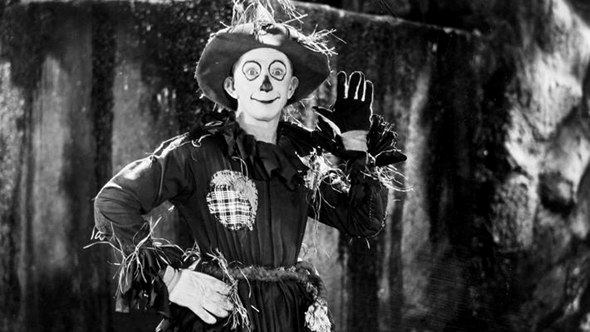
Larry Semon directed, and plays the Scarecrow, in 'The Wizard of Oz' (1925).

WEDNESDAY, MAY 10, 2017 / FOR IMMEDIATE RELEASE
Contact Jeff Rapsis • (603) 236-9237 • jeffrapsis@gmail.com

Rare silent film version of 'Wizard of Oz' at Aeronaut Brewing Co. on Sunday, June 4


Feature-length Oz epic released in 1925 includes comedian Oliver Hardy as the Tin Man; to be screened with live music

SOMERVILLE, Mass. — You won't find Judy Garland in this version of Oz, or much of anything else that's familiar. That's because it's the forgotten 1925 silent film version of the famous tale.

Long overshadowed by the immensely popular 1939 remake, the rarely seen silent version of 'The Wizard of Oz' (1925) will be screened one time only on Sunday, June 4 at 7:30 p.m. at the Aeronaut Brewing Co., 14 Tyler St., Somerville, Mass.

The program, which will include an earlier short Oz film also based on stories and characters of author L. Frank Baum, will be accompanied by Jeff Rapsis, a New Hampshire-based silent film musician.

Admission is $10 per person. Tickets are available online at www.eventbrite.com; search on "Aeronaut Brewery."

The silent version, released by long-forgotten Chadwick Pictures, was intended as a vehicle for slapstick comedian Larry Semon, who directed the picture and played the role of the scarecrow.

Dorothy is played by Dorothy Dwan, Semon's wife. Also in the cast is Oliver Hardy as the Tin Man. Prior to his teaming with comedian Stan Laurel later in the 1920s, Hardy often played Semon's comic foil.

Larry Semon, Dorothy Dwan, and Oliver Hardy in 'The Wizard of Oz' (1925).

The silent 'Wizard of Oz' bears little resemblance to the highly polished MGM musical released just 14 years later. However, due to the enduring worldwide popularity of Baum's 'Oz' characters and stories, the silent 'Wizard of Oz' remains an object of great curiosity among fans.

The film departs radically from the novel upon which it is based, introducing new characters and exploits. Along with a completely different plot, the film is all set in a world that is only barely recognizable as the Land of Oz from the books. The film focuses mainly upon Semon's character, who is analogous to Ray Bolger's Scarecrow character in the 1939 version.

The major departure from the book and film is that the Scarecrow, the Tin Man, and the Cowardly Lion are not actually characters, but are in fact disguises donned by three farm hands who find themselves swept into Oz by a tornado. Dorothy is here played by Dorothy Dwan — Semon's wife — as a young woman. In a drastic departure from the original book, the Tin Man (played by Oliver Hardy) is Semon's rival for Dorothy's affections.

Legend has it that Semon's version of 'Wizard' was so poorly received, Chadwick Studios was forced to file for bankruptcy while the picture was in theaters. In truth, the picture was a modest success, and Chadwick continued to release films through 1928, when the studio shut down prior to the industry's switch to synchronized sound.

Accompanist Jeff Rapsis specializes in creating music that bridges the gap between an older film and the expectations of today's audiences. Using a digital synthesizer that recreates the texture of a full orchestra, he improvises scores in real time as a movie unfolds, so that the music for no two screenings is the same.

"It's kind of a high wire act, but it helps create an emotional energy that's part of the silent film experience," Rapsis said. "It's easier to be in tune with the emotional line of the movie and the audience's reaction when I'm able to follow what's on screen, rather than be buried in sheet music," he said.

Because silent films were designed to be shown to large audiences in theaters with live music, the best way to experience them is to recreate the conditions in which they were first shown, Rapsis said.

"Films such as 'The Wizard of Oz' were created to be shown on the big screen to large audiences as a communal experience," Rapsis said. "With an audience and live music, silent films come to life in the way their makers intended. Not only are they entertaining, but they give today's audiences a chance to understand what caused people to first fall in love with the movies."

Dorothy Dwan and Larry Semon, real-life husband and wife, in 'The Wizard of Oz' (1925).

The silent version of 'The Wizard of Oz' (1925) and other Oz-related silent films will be shown on Sunday, June 4 at 7:30 p.m. at the Aeronaut Brewing Co., 14 Tyler St., Somerville, Mass. Admission is $10 per person. Tickets are available online at www.eventbrite.com; search on "Aeronaut Brewery." For more info about Aeronaut Brewing, visit www.aeronautbrewing.com. For more information about the music, visit www.jeffrapsis.com.

Saturday, March 25, 2017

Oliver Hardy plays the Tin Man, and other reasons to see the silent 'Wizard of Oz' (1925)

We're off to see the 'Wizard'—but not the one with Judy Garland in it.

Probably the most-requested silent film title I get is the 1925 version of 'The Wizard of Oz.'

Oz fans (and there are many) seem especially eager to see this early big-screen adaptation of the beloved fantasy.

And so far I've resisted.

Why? Because I've felt this version of the tale, concocted by comedian Larry Semon, can't help but disappoint audiences, and also reinforces stereotypes of silent film at its worst.

Held up against a familiar Hollywood classic, the 1925 'Wizard of Oz' not only can't compete, but diminishes the whole era that produced it.

So I've managed to avoid it for quite some time.

Until now. Tomorrow (Sunday, March 26) at 4:30 p.m., the Wilton (N.H.) Town Hall Theatre will run Semon's 'Wizard of Oz,' with music by me.

Expect a thoroughly Judy-Garland-free screening, with Dorothy played by Semon's wife Dorothy Dwan, Semon as the scarecrow, and yes, Semon's then-sidekick Oliver Hardy playing the Tin Man.

And that's about all the silent 'Wizard' has in common with Frank L. Baum's well-loved tale. Semon basically used the material as a jumping off point to create his specialty: cartoonish slapstick mayhem.

Larry Semon, Dorothy Dwan, and Oliver Hardy in the 1925 'Wizard of Oz.'

Audiences at the time didn't know what to make of Semon's 'Wizard.' With years of exposure to the 1939 MGM version, I can't imagine what viewers today will think.

Well, we'll find out soon enough. If you'd like to judge for yourself, please attend! More details are contained in the press release pasted below.

Before that, I want to thank Jessica Pappathan and everyone at the Aviation Museum of N.H. for inviting me in for a silent film program on Friday, March 24.

On the bill: a double feature of two obscure aviation thrillers, each full of aerial acrobatics and daring stunt pilot work.

'The Phantom Flyer' (1928), a Universal "Thrill Picture," which marries airplane derring-do with a melodramatic plot, got an especially big response.

And people readily cheered Champion the Dog in 'Sky Rider' (1928) as time and again he outsmarted all the humans in the picture.

Neither of these pictures are celebrated as classics or studied in film schools.

But run them on a big screen with live music and a receptive audience, and they still do what they were designed to do: keep eyes glued to the screen and stir a crowd to a frenzy.

I think part of the formula is matching the right pictures to the right audiences. In this cause, for a program at an aviation museum, vintage airplane melodramas were a natural.

I'll do a similar program in May at the Flying Monkey Moviehouse in Plymouth, N.H. To mark the annual Memorial Day running of the Indy 500, we're running the MGM drama 'Speedway' (1929), starring William Haines and Ernest Torrence.

The film was made on location at the actual Indianapolis 500 track, and is filled with scenes of period race cars zipping along at astonishing speeds of 90 mph or more!

And we're doing it at the request of a group of antique car enthusiasts, who are planning to hold their regular business meeting in the theater prior to the show.

So in programming these films, part of the fun is matching the right film with the right audience. It's great it happens!

Okay, here's more info on the silent film version of 'The Wizard of Oz' (1925), which we're running tomorrow in Wilton, N.H. Hope to see you there!

* * *

Larry Semon as the Scarecrow.

WEDNESDAY, MARCH 15, 2017 / FOR IMMEDIATE RELEASE
Contact Jeff Rapsis • (603) 236-9237 • jeffrapsis@gmail.com

Rare silent film version of 'Wizard of Oz' at Town Hall Theatre on Sunday, March 26

Feature-length Oz epic released in 1925 includes comedian Oliver Hardy as the Tin Man; to be screened with live music

WILTON, N.H. — You won't find Judy Garland in this version of Oz, or much of anything else that's familiar. That's because it's the forgotten 1925 silent film version of the famous tale.

Long overshadowed by the immensely popular 1939 remake, the rarely seen silent version of 'The Wizard of Oz' (1925) will be screened one time only on Sunday, March 26 at 4:30 p.m. at the Town Hall Theatre, 40 Main St., Wilton, N.H.

The program, which will include an earlier short Oz film also based on stories and characters of author L. Frank Baum, will be accompanied by Jeff Rapsis, a New Hampshire-based silent film musician.

The silent version, released by Chadwick Pictures, was intended as a vehicle for slapstick comedian Larry Semon, who directed the picture and played the role of the scarecrow.

Dorothy is played by Dorothy Dwan, Semon's wife. Also in the cast is Oliver Hardy as the Tin Man. Prior to his teaming with comedian Stan Laurel later in the 1920s, Hardy often played Semon's comic foil.

The silent 'Wizard of Oz' bears little resemblance to the highly polished MGM musical released just 14 years later. However, due to the enduring worldwide popularity of Baum's 'Oz' characters and stories, the silent 'Wizard of Oz' remains an object of great curiosity among fans.

The film departs radically from the novel upon which it is based, introducing new characters and exploits. Along with a completely different plot, the film is all set in a world that is only barely recognizable as the Land of Oz from the books. The film focuses mainly upon Semon's character, who is analogous to Ray Bolger's Scarecrow character in the 1939 version.

The major departure from the book and film is that the Scarecrow, the Tin Man, and the Cowardly Lion are not actually characters, but are in fact disguises donned by three farm hands who find themselves swept into Oz by a tornado. Dorothy is here played by Dorothy Dwan — Semon's wife - as a young woman. In a drastic departure from the original book, the Tin Man (played by Oliver Hardy) is a villain.

Some elements of the narrative have their roots in earlier adaptations of The Wizard of Oz. For example, Prime Minister Kruel has a predecessor in King Krewl, the antagonist of His Majesty, the Scarecrow of Oz. The note explaining Princess Dorothea's true heritage is signed "Pastoria", a name used for the exiled King of Oz in the 1902 stage version of The Wizard of Oz and for the father of Princess Ozma in The Marvelous Land of Oz and later Oz books.

Legend has it that Semon's version of 'Wizard' was so poorly received, Chadwick Studios was forced to file for bankruptcy while the picture was in theaters. In truth, the picture was a modest success, and Chadwick continued to release films through 1928, when the studio shut down prior to the industry's switch to synchronized sound.

Accompanist Jeff Rapsis specializes in creating music that bridges the gap between an older film and the expectations of today's audiences. Using a digital synthesizer that recreates the texture of a full orchestra, he improvises scores in real time as a movie unfolds, so that the music for no two screenings is the same.

"It's kind of a high wire act, but it helps create an emotional energy that's part of the silent film experience," Rapsis said. "It's easier to be in tune with the emotional line of the movie and the audience's reaction when I'm able to follow what's on screen, rather than be buried in sheet music," he said.

Because silent films were designed to be shown to large audiences in theaters with live music, the best way to experience them is to recreate the conditions in which they were first shown, Rapsis said.

"Films such as 'The Wizard of Oz' were created to be shown on the big screen to large audiences as a communal experience," Rapsis said. "With an audience and live music, silent films come to life in the way their makers intended. Not only are they entertaining, but they give today's audiences a chance to understand what caused people to first fall in love with the movies."

The silent version of 'The Wizard of Oz' (1925) and other Oz-related silent films will be shown on Sunday, March 26 at 4:30 p.m. at the Town Hall Theatre, 40 Main St., Wilton, N.H.

Admission is free; a donation of $5 per person is suggested to help defray expenses. For more info, visit www.wiltontownhalltheatre.com or call (603) 654-3456.

Wednesday, January 18, 2017

I can date my interest in vintage cinema
thanks to one man: Mr. Oliver Norvell Hardy

As I now know, this is Mr. Hardy, not Mr. Laurel.

When asked, I sometimes say I've enjoyed older movies my whole entire life.

But that's not quite accurate. To be precise, I would have to say my interest in vintage cinema dates from one exact day: Jan. 18, 1977.

Why then? Because that day happens to be the birthday of "Ollie," otherwise known as actor Oliver Norvell Hardy, one half of the comedy duo Laurel & Hardy.

And it was the announcement of Hardy's birthdate on a local radio station's almanac that morning that got my 7th-grade mind thinking.

Don't ask me why or how I remember this so clearly, but I do. I remember it was a Tuesday—and I just checked and it really was a Tuesday! So you know this is on the level. :)

I recall sitting at the kitchen counter in our home in Nashua, N.H. poking over a bowl of cereal before heading out for the loooong walk to yet another day at Spring Street Junior High School.

Spring Street Junior High in downtown Nashua, N.H., long since torn down.

The walk was long (about 1.2 miles) because we lived just inside the limits of the school's bus routes. But that's another story.

Like many households in my hometown at the time, the kitchen radio was glued to WSMN-AM 1590, a local station that broadcast local Weather, Sports, Music and News (get it?) all day long.

Unlike Spring Street Junior High, the radio station is still around: https://en.wikipedia.org/wiki/WSMN.

Back then, our morning routine was driven largely by the station's programming schedule. Example: If you were still home when the obituary report came on, you were late for school!

(Yes, they actually broadcast a daily obituary report, complete with organ music and a recording of 'The Old Rugged Cross.')

Anyway! Whoever was on air would occasionally read almanac items to fill time until the news, or the next commercial for Eddie's Bedding or Hammar Hardware.

And on that morning of Tuesday, Jan. 18, I learned that it was the birthday of noted film comedian Oliver Hardy, "born this date in 1892."

One reason that clicked was that the front entrance to Amherst Street Elementary School, where I'd just spent six years, had a big stone block embedded in it with that very date: 1892!

But there was more. I'd just discovered Laurel and Hardy through their films on Channel 38, a UHF station out of Boston that at the time was heavy on old-time programs: re-runs of sit-coms, the Three Stooges, and occasionally older stuff like the Laurel & Hardy shorts and features.

I enjoyed it all, just like any other TV-mesmerized kid of my generation.

But something about hearing that today was the birthday of one of the people I'd been watching—and the realization that he was a real person and not just some cartoon on TV—pushed my 13-year-old brain into curiosity mode.

Oliver Hardy. I remember actually thinking the fat one was "Laurel" because that sounded to me like what a fat guy would be named, and so the skinny guy must be Hardy. Was that right?

And if today was his birthday, and he was born in 1892, I figured he was now...87 years old! And I was 13, so together that made 100.

But did I have the right guy? Was he the fat one or the skinny one?

This led me to pick up the thick "1975 WORLD ALMANAC and BOOK OF FACTS" that was laying around (our version of Google in the pre-Internet era) and found a page on "Celebrity Births and Deaths."

Wow! I found a picture of the 1975 World Almanac AND paneling that's exactly like what was in our semi-finished basement and rumpus room!

And sure enough, there he was: Oliver Norvell Hardy, film comedian, 1892-1957. What? Mr. Hardy wasn't 87 years old. He was dead!

And I still wasn't sure if he was the fat one or the skinny one, but something about it started me on a journey that took me to the shelves of film books at the Nashua Public Library, which had a handful of books on comedy and yes, was able to get a much better idea of the lives of both Mr. Laurel and Mr. Hardy, including who was who.

Not long after that, a music teacher at Spring Street named Mr. Salvo began bringing in 16mm prints of the Chaplin Mutuals (his immortal two-reel comedies from 1916 and 1917) to run in study hall to entertain bored students.

Most students remained bored, but thanks to my research on Mr. Hardy, I was now ready to find out a lot more about Mr. Chaplin. Who was he? What was he like? What were his dates?

So back to the library I went. And journey of discovery, although put aside at times, has never really ended.

And so today, on Jan. 18, 2017—a full 40 years later to the day!—I say thank you, Ollie. And happy birthday once again!


Sunday, December 18, 2011

'The Circus' (1928) on New Year's Day in Wilton, N.H.

Chaplin's great silent comedy 'The Circus' presents an interesting musical conundrum.

When released in 1928, the film (like most other silents) did not have a soundtrack. And so during its initial run, audiences around the world would have heard accompaniment provided on the spot by local theater musicians. That's how cinema-goers experienced the film, which was a solid success for Chaplin and went on to be the seventh-highest grossing film of the silent era.

And then, four decades after the film's original run, Chaplin (then approaching 80 years of age) worked with late-in-life collaborator Eric James to put together music for a re-release. The resulting soundtrack, including a song that gets sung over the opening titles by Chaplin himself, accompanied the 1968 release. And since that time, it's the only score authorized by the Chaplin estate to accompany 'The Circus.'

Yes, Chaplin's score is quite effective, and there's a unique value in knowing what kind of music he preferred to go with certain types of scenes. (It's quite spartan in some places, but that makes sense for a comedy, I think.) However, keep in mind that the music is from a completely different time in his life—four decades distant! And while there's nothing wrong with Chaplin's score, I think an argument can be made for 'The Circus' to be open to other scoring approaches, too.

After all, audiences saw its original release without Chaplin's music. And I've come to think that one of the things that helps make silent film timeless is that the films themselves are open to fresh scoring approaches, both today and in the future. A good score can help bridge the gap between this now-unfamiliar visual form and today's audiences, I think.

Well, the folks who control the Chaplin films feel differently, and they really have no choice. Acting on the wishes of Chaplin (who died in 1977), they insist to this day that whenever 'The Circus' is screened, the recorded score from 1968 be used for accompaniment. No others can be used.

I'm conveying all this to let folks know why we're not doing live music for this film, to be screened on Sunday, Jan. 1 at 4:30 p.m. at the Wilton Town Hall Theatre. (Free admission!)

I do feel that live music is an important part of the silent film experience. But if we're going to show 'The Circus,' we need to follow Chaplin's wishes, at least as his estate interprets them. The good news is, yes, it's a fine score, and does provide a unique point of reference not available for most other silent film artists. What kind of music would Chaplin have preferred for this film? With the score he created, we don't have to guess.

However, how different would the music be if he'd done it in 1928, at the time of the film's initial release? That's something we'll never know. However, just a few years later, he did create a score for 'City Lights' (1931) for its initial release, and it's clearly the work of the same person behind the 'Circus' music much much later.

Well, back to our New Year's Day screening. We're leading off with two silent comedy shorts for which we will have live music: 'Big Business' (1929), starring Laurel & Hardy, is the perfect film for people tired of Christmas cheer, while Buster Keaton's 'One Week' (1920) is another timeless (but time-oriented) comedy to start 2012 off with some laughs.

Hope to see you there! Press release follows below...


MONDAY, DEC. 19, 2011 / FOR IMMEDIATE RELEASE
For more info, contact: Jeff Rapsis • (603) 236-9237 • jeffrapsis@gmail.com

Chaplin's classic comedy 'The Circus' to be screened on New Year's Day in Wilton, N.H.

Holiday weekend family-friendly screening includes silent Laurel & Hardy, Buster Keaton films with live music

WILTON, N.H.—Laugh your way into 2012 with Charlie Chaplin's classic comedy 'The Circus' (1928), to be screened on New Year's Day at the Wilton (N.H.) Town Hall Theatre. The program, part of the theater's monthly silent film series, will also include short silent comedies starring Laurel & Hardy and Buster Keaton, with live music by Jeff Rapsis.

'The Circus' will be shown on Sunday, Jan. 1 at 4:30 p.m. Admission to the family-friendly screening is free, with donations accepted to help defray costs.

Chaplin made 'The Circus' at the height of worldwide fame for his "Little Tramp" character. Set in an impoverished travelling circus, the film is noted for its mix of uproarious comedy and a dramatic story line. 'The Circus' features several classic sequences, including a high wire scene for which Chaplin actually learned to walk on a tight-rope.

In 'The Circus,' Chaplin's tramp plays an incompetent prop man who unwittingly becomes the show's comedy sensation. Offstage, he befriends a young lady horsetrainer (Merna Kennedy) who suffers mistreatment from her abusive father, the owner of the circus. Can the Little Tramp help her escape without losing his own job or ruining the show? And will she return the feelings that he's developing for her?

'The Circus' is a light-hearted romp, but the film was a behind-the-scenes nightmare for Chaplin. During production, he endured the death of his mother, a contentious divorce from his second wife, IRS allegations of unpaid taxes, and a disastrous studio fire that set shooting back months. Despite these obstacles, 'The Circus' went on to become one of Chaplin's most popular successes. It also earned Chaplin a special Academy Award for acting and directing at the very first Oscars in 1929.

Four decades after the original release of 'The Circus,' Chaplin at age 80 composed his own musical score for the picture and rereleased it in 1968 with a recorded soundtrack. The version with Chaplin's score is the only one licensed by the Chaplin Estate for exhibition, so the Wilton Town Hall Theatre's screening of 'The Circus' will feature recorded music rather than the usual live music.

A restored version of 'The Circus' was released again to arthouses in 2010 as part of a worldwide Chaplin retrospective, with contemporary critics praising the film's timeless qualities.

"It's a brilliant combination of light and darkness, tenderness and violence and, yes, laughter and tears," wrote Andrew O'Hehir for salon.com, while Keith Ulrich of Time Out New York wrote "There's an edge to 'The Circus' that suggests a man gazing deep into the void, laughing at the darkness and urging us to do the same."

In the Internet age, 'The Circus' gained notoriety when footage taken at the film's 1928 premiere seemed to show a woman talking on a cell phone. The footage, filmed outside Graumann's Chinese Theater in Los Angeles and included as an extra in a DVD release of 'The Circus,' quickly went viral and become a YouTube sensation. Explanations for the scene included the theory that the woman had traveled through time from the present day, although most observers believe she was using some kind of hearing aid.

At the Wilton screening, accompanist Jeff Rapsis will provide live music for two comedy short films on the program: 'Big Business' (1929) starring Stan Laurel and Oliver Hardy, and Buster Keaton's 'One Week' (1920).


'Big Business' finds Stan Laurel and Oliver Hardy as unsuccessful door-to-door Christmas tree salesmen. An encounter with one particularly unsympathetic customer (Jimmy Finlayson) escalates into a destructive battle sure to please anyone who's had enough of this year's holiday season. Made just before the comedy duo transitioned into sound films later in 1929, 'Big Business' stands as one of Laurel & Hardy's most popular comedies.

In 'One Week,' Buster Keaton and his new bride (Sybil Seeley) attempt to construct a do-it-yourself home, unaware than Buster's former rival for the girl has switched the numbers on the crates. The resulting home is just the beginning of Buster's misfortunes, which all lead to one of the all-time best comedy endings of any silent film.

'The Circus' and other short comedies will be screened on Sunday, Jan. 1 at 4:30 p.m. at the Wilton Town Hall Theatre, 40 Main St., Wilton, N.H. For more information, visit www.wiltontownhalltheatre.com or call (603) 654-3456. The Wilton Town Hall Theatre runs silent film programs with live music the last Sunday of every month. For more information about the music, visit www.jeffrapsis.com.

--- 30 ---


For more info, contact:
Jeff Rapsis • (603) 236-9237 • jeffrapsis@gmail.com
Images attached. More high-resolution digital images available upon request.