Showing posts with label Larry Semon. Show all posts

Saturday, May 19, 2018

We're off to Brandon, Vt. with 'Wizard of Oz,' where it's all about the audience

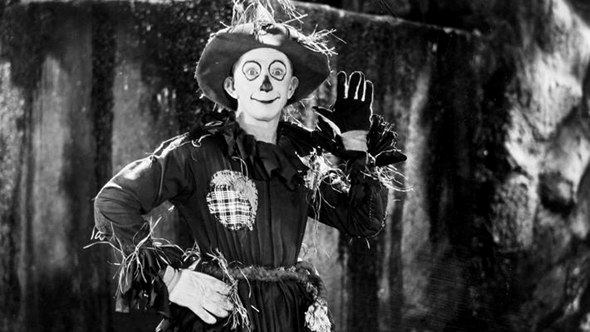
'The Wizard of Oz' (1925) as you've never seen it.

Tonight is opening night for another season of silent cinema with live music at Brandon Town Hall in Brandon, Vt.

It's the eighth year I've come up to Brandon for a monthly series of silent film programs. And one reason I keep doing it is the audience.

For some reason, silent film remains big news in Brandon, at least judging by the turnout.

We routinely get more than 100 people who pack into the Town Hall, a mid-19th century building never intended to be a movie theater.

But it works pretty well, and has especially good acoustics with its open stage and high ceiling and wooden floor.

The shows draw everyone from "tiny tots to octogenarians," to borrow a phrase from author Walter Kerr.

Attendance is important because any donations go to ongoing renovations to the facility, which lay abandoned for decades until its recent renaissance.

In the eight years I've been going there, the committee of volunteers has updated the bathrooms, added a heating system, worked on replacing the slate roof, and improved accessibility for the disabled.

But it's also important because a big and lively audience is an essential ingredient for the silent film experience.

You can have live music. You can have a beautiful print. You can have a big screen.

But without an audience, it's not the experience that prompted people to first fall in love with the movies.

And in working with an obsolete art form, I don't take attendance for granted.

Consider the turnout we had for a screening of 'The Black Pirate' this past Thursday night at the Capitol Theatre in Arlington, Mass.

This is an actual movie theater, and it's my privilege to do music for a monthly series there as well.

This is in the middle of world-class city known for its long-term affinity for the arts and culture, including cinema.

And for this screening, I'd snagged an on-air interview on WBZ-AM 1030, Boston's powerhouse news radio station and the most-listened-to radio station in New England.

And attendance for 'The Black Pirate' was...16 people. Wow! There were way more pirates on screen than people in the seats.

We still had a great time. And at least that was up from about a dozen we had last month for Buster Keaton's masterpiece 'The General.'

We enjoyed better numbers last year at the Capitol, so I'm not sure what's going on.

In talking with the management, theories range from "too many other silent film programs in the area" (which, alas, could be true) to "too many home entertainment options," a phenomenon that's affecting attendance at all movies, not just silents.

Maybe we could take a page from the Brandon playbook: somehow wreck the Capitol, and then get people to come in support of restoring it.

Heck, they could even charge people for taking swings at it with a sledgehammer. Anything to get people to the theater!

If this trend catches on, you heard it here first.

In the meantime, we're launching this year's Brandon series with a real curiosity: the silent film version of 'The Wizard of Oz' (1925).

I avoided this Larry Semon film for years, given its abysmal reputation among cinephiles.

But I finally ran it a year ago in Wilton, N.H., and was surprised at the strong (and strongly positive) reaction it got.

People enjoyed it. They actually applauded when Larry had his big moment with Dorothy Dwan near the end.

If you're in the area this evening (Brandon is about 20 minutes north of Rutland, Vt.), please come by and check it out!

Here's the press release for the show, which includes the line-up for the reason of the 2018 season. See you in Oz!

* * *

Larry Semon, Dorothy Dwan, and Oliver Hardy are off to see the Wizard...sort of.

TUESDAY, MAY 8, 2018 / FOR IMMEDIATE RELEASE
For more info, contact: Jeff Rapsis • (603) 236-9237 • jeffrapsis@gmail.com

Brandon Town Hall to host summer silent film series with live music


Schedule leads off on Saturday, May 19 with silent film version of 'The Wizard of Oz'

BRANDON, Vt.—Classics of the silent film era return to the big screen starting next month in Brandon Town Hall, which hosts another season of vintage cinema with live music in the historic facility.

It's the 8th year of the town hall's popular silent film series, which gives residents and visitors a chance to see great movies from the pioneering days of cinema as they were meant to be shown—on the big screen, with an audience, and accompanied by live music.

Screenings are held once a month on Saturday nights starting in May and running through October. Admission is free; donations are encouraged, with proceeds to benefit the Town Hall's ongoing restoration.

Over the years, silent film donations have helped support projects including handicapped access to the 19th century building; renovating the bathrooms; and restoring the structure's original slate roof.

Live music for each silent film program will be provided by Jeff Rapsis, a New Hampshire-based performer and composer who specializes in scoring silent films.

"It's great to be bringing silent film back to the big screen in Brandon for another series," Rapsis said. "Brandon Town Hall is a wonderful place for these movies to be seen at their best."

In accompanying silent films live, Rapsis uses a digital synthesizer to recreate the texture of the full orchestra. He improvises the music in real time, as the movie is shown.

First up in this season's line-up is the silent version of 'The Wizard of Oz,' the nearly forgotten 1925 silent film version of the famous tale.

Long overshadowed by the immensely popular 1939 remake, the rarely seen silent 'The Wizard of Oz' (1925) will be screened on Saturday, May 19 at 7 p.m. at Brandon Town Hall and Community Center, Route 7, in Brandon, Vt.

Released by Chadwick Pictures, 'The Wizard of Oz' was intended as a vehicle for slapstick comedian Larry Semon, who directed the picture and played the role of the scarecrow.

Dorothy is played by Dorothy Dwan, Semon's wife. Also in the cast is Oliver Hardy as the Tin Man. Prior to his teaming with comedian Stan Laurel later in the 1920s, Hardy often played Semon's comic foil.

The silent 'Wizard of Oz' bears little resemblance to the highly polished MGM musical released just 14 years later. However, due to the enduring worldwide popularity of Baum's 'Oz' characters and stories, the silent 'Wizard of Oz' remains an object of great curiosity among fans.

The film departs radically from the novel upon which it is based, introducing new characters and exploits. Along with a completely different plot, the film is all set in a world that is only barely recognizable as the Land of Oz from the books. The film focuses mainly upon Semon's character, who is analogous to Ray Bolger's Scarecrow character in the 1939 version.

Also on the program is an even earlier 'Wizard of Oz' film from 1910 that runs less than 10 minutes.

Because silent films were designed to be shown to large audiences in theaters with live music, the best way to experience them is to recreate the conditions in which they were first shown, Rapsis said.

"Films such as 'The Wizard of Oz' were created to be shown on the big screen to large audiences as a communal experience," Rapsis said. "With an audience and live music, silent films come to life in the way their makers intended. Not only are they entertaining, but they give today's audiences a chance to understand what caused people to first fall in love with the movies."

The program is sponsored by Pat Hanson.

Other shows in this year's Brandon silent film series include:

• Saturday, June 9: 'Steamboat Bill, Jr.' (1928) starring Buster Keaton. Pampered Buster returns home from college to help his father, a tough riverboat captain, battle to save the family business. Climaxed by an eye-popping cyclone sequence, 'Steamboat Bill' is crammed with classic Keaton gags and sequences. Silent comedy at its finest! Sponsored by Nancy and Gary Meffe.

• Saturday, June 30: 'The Adventures of Prince Achmed' (1926). Taken from 'The Arabian Nights,' the first full-length animated feature tells the story of a wicked sorcerer who tricks Prince Achmed into mounting a magical flying horse, sending him off to a series of wondrous and romantic adventures. Sponsored by Pam and Steve Douglass.

• Saturday, Aug. 11: 'Laurel & Hardy: A Silent Fine Mess.' The beloved comedy team got their start in silent film, and so celebrate their origins with a selection of their funniest short comedies. Get ready to laugh as Stan and Ollie made fine messes out of everything from a day in the country to a night on the town. Sponsored by the Brandon/Forestdale Lions Club.

• Saturday, Sept. 8: 'Sherlock Holmes' (1916) starring William Gillette. Recently discovered in France after being lost for nearly a century, see this original 1916 adaptation of Sherlock Holmes stories as performed by William Gillette, the actor who created the role on stage and performed it more than 1,000 times. Sponsored by Kathy and Bill Mathis, in memory of Maxine Thurston; also an anonymous donor.

• Saturday, Oct. 20: Chiller Theatre, 'Der Golem' (1920). In 16th-century Prague, a rabbi creates a giant creature from clay, called the Golem. Using sorcery, he brings the creature to life in order to protect the Jews of Prague from persecution, but then complications ensue. Early German fantasy movie anticipates Frankenstein story. Sponsored by Jan Coolidge, Lucy and Dick Rouse, Marc & Arlyn Briere, Dorothy Leyseth and Edward Loedding.

The silent version of 'The Wizard of Oz' (1925) will open this season's silent film series at Brandon Town Hall. The movie will be screened on Saturday, May 19 at 7 p.m. at the Brandon Town Hall and Community Center, Route 7, in Brandon, Vt. All are welcome to this family-friendly event. Admission is free, with free will donations accepted in support of ongoing Town Hall renovations.

For more information, visit www.brandontownhall.org.

Thursday, August 10, 2017

We're off to see the Wizard—and also Gloria Swanson, Buster Keaton, and the future

No, not the one with Judy Garland—it's Larry Semon's silent film version of the iconic tale, on screen at the Flying Monkey in Plymouth, N.H. on Thursday, Aug. 10.

Happy mid-August! The next four days bring four screenings in three states, and films that take us to Oz, France, the American West, and a city of the future.

Here's a quick round-up:

• Thursday, Aug. 10, 2017, 6:30 p.m.: "The Wizard of Oz" (1925) starring Larry Semon; The Flying Monkey Movie House and Performance Center, 39 South Main St., Plymouth, N.H.; (603) 536-2551; http://www.flyingmonkeynh.com/. Early silent film version of Frank L. Baum's immortal tales features silent comedian Larry Semon in a slapstick romp that also casts Oliver Hardy as the Tin Man. Oz as you've never seen it before! Part of a monthly silent film series at a newly restored moviehouse in Plymouth, N.H. Admission, $10 per person.

Some original promotional art for 'Zaza,' starring Gloria Swanson and H.B. Warner.

• Friday, Aug. 11, 2017, "Zaza" (1923) starring Gloria Swanson, H.B. Warner. Vintage Dance Weekend, Knights of Columbus Hall, Nahant, Mass. Private event not open to the general public. Romance set in France in which Swanson plays a hot-tempered provincial actress who gets entangled with a married diplomat. Swanson's ebullience in Zaza was unfeigned; she called it "the fastest, easiest, most enjoyable picture I ever made."

Buster Keaton and co-star Brown Eyes in 'Go West.'

• Saturday, Aug. 12, 2017, 7 p.m.: "Go West" (1925) starring Buster Keaton; Brandon Town Hall and Community Center, Main Street/Route 7, Brandon, Vt.; http://www.brandontownhall.org. Buster heads out to ranch country, where the stone-faced comedian encounters romance with—a cow! Can he save his love from a trip to the livestock yards? Rustle up some belly laughs as Buster must once again prove himself worthy to all those who doubt him. Join us for a series of silent films and live music in a wonderfully restored town hall in Brandon Vt. that features great acoustics. Admission free, donations accepted, with proceeds to help continuing preservation work.

From 'Metropolis': it just wouldn't be a city of the future without a giant mechanical gong!

• Sunday, Aug. 13, 2017, 7:30 p.m. "Metropolis" (1927) directed by Fritz Lang; Aeronaut Brewing Co., 14 Tyler St., Somerville, Mass. Admission $10 per person, limited seating. The eye-popping silent film sci-fi masterpiece of German filmmaker Fritz Lang is a vintage look at things to come. Restored version includes nearly a half-hour of lost footage that was rediscovered in Argentina in 2008. Seen in its entirety and with live music, 'Metropolis' stands as an stunning example of the power of silent film to tell a compelling story without words, and reach across the generations to touch movie-goers from the real future that came to pass: us! Part of the Aeronaut Brewery's commitment to showcase local music, art, and performance. Limited seating so reserve early; for more details on tickets, visit Aeronaut Brewing. online.

It would have been five screenings in five days, but I gave up a slot at the Harvard Film Archive on Monday, Aug. 14 so that fellow accompanist Andrew E. Simpson could make a much-anticipated visit to the Boston area.

If you're interested in hearing one of the most talented accompanists in the field, get thee to the Harvard Film Archive next Monday night to hear Andrew do his stuff for Ernst Lubitsch's 'The Wildcat.' Here's the listing:

• Monday, Aug. 14, 2017, 7 p.m.: "Die Bergkatze/The Wildcat" or "The Mountain Cat" (1921), directed by Ernst Lubitsch. Harvard Film Archive, 24 Quincy St., Cambridge, Mass. (617) 496-3211. Admission $9 per person, $7 for non-Harvard students, Harvard faculty and staff, and senior citizens; free for Harvard students. Part of a summer-long retrospective of the work of director Ernst Lubitsch. Amidst delightfully bizarre décor—framed by altering screen shapes—a stalwart bandit chaser falls for bandit’s daughter Pola Negri. Lubitsch’s German comedy masterpiece is "both an anti-militarist satire and a wonderful fairy tale" (John Gillett). For this screening, I'm pleased to have accompanist Andrew E. Simpson sit in at the keyboard!

And another special note: earlier this year, I was fortunate enough to be asked to do a piano score for Kino-Lorber's re-issue of 'Zaza.' The disc is now out, and just this week I received a box of copies that I can make available to fans at screenings.

And, thanks to the kind folks at Kino-Lorber, I'm able to make them available at a discount off the published retail price. But you can only get this deal by attending a screening!

So I'll have them with me until the stock runs out. If you'd like me to save one for you, please send me a note indicated standard DVD or Blu-ray and I'll set a copy aside.

P.S. This Sunday, I'm being interviewed by Harvard Magazine for a story about the art of silent film accompaniment. So I may not have made it into Harvard, but at least I'll be in the magazine!

Sunday, June 4, 2017

We're off to see the Wizard, but...
not the one with Judy Garland in it

Original promotional material for the silent film version of 'The Wizard of Oz.'

Some say it's enough to drive one to drink. So I'm glad we're showing it in a brewery.

It's the silent version of 'The Wizard of Oz' (1925), which I'm accompanying tonight (Sunday, June 4) at the Aeronaut Brewery, 14 Tyler St., Somerville, Mass.

Showtime is 7:30 p.m. Admission is $10 per person.

There's a press release below with more info on the film, which is nothing like the familiar 1939 MGM musical version starring Judy Garland.

Instead, the silent 'Wizard' was produced as a vehicle for comedian Larry Semon, who used the Oz characters to create a smorgasbord of slapstick.

The result was a picture that for years has been known as one of the silent era's great misfires. Its studio, Chadwick Pictures, ran into financial troubles the year it was released, and was unable to distribute prints to many locations. It fared poorly at the box office, and among the few who attended, it disappointed Oz fans due to scant resemblance to the stories by author L. Frank Baum.

Today, an interesting thing about the film is the reaction of people when they learn there is a silent 'Wizard of Oz.'

It's that same look of baffled puzzlement you get when you mention the silent films of W.C. Fields: How is that even possible?

But then you have to remember that so many stories got their first big-screen treatment during the silent era.

Among the more well known: 'Ben Hur' (1925) and 'Phantom of the Opera' (1925), both remade several times since.

Other examples abound. A lesser known one is the silent 'Peter Pan' (1924), created with input from author J.M. Barrie himself, and which still holds up well.

Heck, there were even performers in the silent era with the same names of later stars.

How about the silent Harrison Ford? (That's him on the right.) Or the silent James Mason, anyone?

But as so often happens, not every original screen adaptation hit the mark.

In the case of Semon's 'Wizard of Oz,' the film has come down to us with a reputation as a disappointment. And how could anything really compare to the magical musical version that Hollywood produced not much later?

But I included the silent 'Oz' in a recent program in Wilton, N.H., and was surprised to find it greeted by continuous hearty laughter and even applause. People really enjoyed it!

Maybe it's taken nine decades for the silent 'Oz' to find an audience. I don't know.

But I've decided to start trying it out in other venues, including the Aeronaut this evening.

We'll see if it provokes anything like the same reaction. And if it doesn't, there's always beer.

* * *

Larry Semon directed, and plays the Scarecrow, in 'The Wizard of Oz' (1925).

WEDNESDAY, MAY 10, 2017 / FOR IMMEDIATE RELEASE
Contact Jeff Rapsis • (603) 236-9237 • jeffrapsis@gmail.com

Rare silent film version of 'Wizard of Oz' at Aeronaut Brewing Co. on Sunday, June 4


Feature-length Oz epic released in 1925 includes comedian Oliver Hardy as the Tin Man; to be screened with live music

SOMERVILLE, Mass. — You won't find Judy Garland in this version of Oz, or much of anything else that's familiar. That's because it's the forgotten 1925 silent film version of the famous tale.

Long overshadowed by the immensely popular 1939 remake, the rarely seen silent version of 'The Wizard of Oz' (1925) will be screened one time only on Sunday, June 4 at 7:30 p.m. at the Aeronaut Brewing Co., 14 Tyler St., Somerville, Mass.

The program, which will include an earlier short Oz film also based on stories and characters of author L. Frank Baum, will be accompanied by Jeff Rapsis, a New Hampshire-based silent film musician.

Admission is $10 per person. Tickets are available online at www.eventbrite.com; search on "Aeronaut Brewery."

The silent version, released by long-forgotten Chadwick Pictures, was intended as a vehicle for slapstick comedian Larry Semon, who directed the picture and played the role of the scarecrow.

Dorothy is played by Dorothy Dwan, Semon's wife. Also in the cast is Oliver Hardy as the Tin Man. Prior to his teaming with comedian Stan Laurel later in the 1920s, Hardy often played Semon's comic foil.

Larry Semon, Dorothy Dwan, and Oliver Hardy in 'The Wizard of Oz' (1925).

The silent 'Wizard of Oz' bears little resemblance to the highly polished MGM musical released just 14 years later. However, due to the enduring worldwide popularity of Baum's 'Oz' characters and stories, the silent 'Wizard of Oz' remains an object of great curiosity among fans.

The film departs radically from the novel upon which it is based, introducing new characters and exploits. Along with a completely different plot, the film is all set in a world that is only barely recognizable as the Land of Oz from the books. The film focuses mainly upon Semon's character, who is analogous to Ray Bolger's Scarecrow character in the 1939 version.

The major departure from the book and film is that the Scarecrow, the Tin Man, and the Cowardly Lion are not actually characters, but are in fact disguises donned by three farm hands who find themselves swept into Oz by a tornado. Dorothy is here played by Dorothy Dwan — Semon's wife — as a young woman. In a drastic departure from the original book, the Tin Man (played by Oliver Hardy) is Semon's rival for Dorothy's affections.

Legend has it that Semon's version of 'Wizard' was so poorly received, Chadwick Studios was forced to file for bankruptcy while the picture was in theaters. In truth, the picture was a modest success, and Chadwick continued to release films through 1928, when the studio shut down prior to the industry's switch to synchronized sound.

Accompanist Jeff Rapsis specializes in creating music that bridges the gap between an older film and the expectations of today's audiences. Using a digital synthesizer that recreates the texture of a full orchestra, he improvises scores in real time as a movie unfolds, so that the music for no two screenings is the same.

"It's kind of a high wire act, but it helps create an emotional energy that's part of the silent film experience," Rapsis said. "It's easier to be in tune with the emotional line of the movie and the audience's reaction when I'm able to follow what's on screen, rather than be buried in sheet music," he said.

Because silent films were designed to be shown to large audiences in theaters with live music, the best way to experience them is to recreate the conditions in which they were first shown, Rapsis said.

"Films such as 'The Wizard of Oz' were created to be shown on the big screen to large audiences as a communal experience," Rapsis said. "With an audience and live music, silent films come to life in the way their makers intended. Not only are they entertaining, but they give today's audiences a chance to understand what caused people to first fall in love with the movies."

Dorothy Dwan and Larry Semon, real-life husband and wife, in 'The Wizard of Oz' (1925).

The silent version of 'The Wizard of Oz' (1925) and other Oz-related silent films will be shown on Sunday, June 4 at 7:30 p.m. at the Aeronaut Brewing Co., 14 Tyler St., Somerville, Mass. Admission is $10 per person. Tickets are available online at www.eventbrite.com; search on "Aeronaut Brewery." For more info about Aeronaut Brewing, visit www.aeronautbrewing.com. For more information about the music, visit www.jeffrapsis.com.

Saturday, March 25, 2017

Oliver Hardy plays the Tin Man, and other reasons to see the silent 'Wizard of Oz' (1925)

We're off to see the 'Wizard'—but not the one with Judy Garland in it.

Probably the most-requested silent film title I get is the 1925 version of 'The Wizard of Oz.'

Oz fans (and there are many) seem especially eager to see this early big-screen adaptation of the beloved fantasy.

And so far I've resisted.

Why? Because I've felt this version of the tale, concocted by comedian Larry Semon, can't help but disappoint audiences, and also reinforces stereotypes of silent film at its worst.

Held up against a familiar Hollywood classic, the 1925 'Wizard of Oz' not only can't compete, but diminishes the whole era that produced it.

So I've managed to avoid it for quite some time.

Until now. Tomorrow (Sunday, March 26) at 4:30 p.m., the Wilton (N.H.) Town Hall Theatre will run Semon's 'Wizard of Oz,' with music by me.

Expect a thoroughly Judy-Garland-free screening, with Dorothy played by Semon's wife Dorothy Dwan, Semon as the scarecrow, and yes, Semon's then-sidekick Oliver Hardy playing the Tin Man.

And that's about all the silent 'Wizard' has in common with Frank L. Baum's well-loved tale. Semon basically used the material as a jumping off point to create his specialty: cartoonish slapstick mayhem.

Larry Semon, Dorothy Dwan, and Oliver Hardy in the 1925 'Wizard of Oz.'

Audiences at the time didn't know what to make of Semon's 'Wizard.' With years of exposure to the 1939 MGM version, I can't imagine what viewers today will think.

Well, we'll find out soon enough. If you'd like to judge for yourself, please attend! More details are contained in the press release pasted below.

Before that, I want to thank Jessica Pappathan and everyone at the Aviation Museum of N.H. for inviting me in for a silent film program on Friday, March 24.

On the bill: a double feature of two obscure aviation thrillers, each full of aerial acrobatics and daring stunt pilot work.

'The Phantom Flyer' (1928), a Universal "Thrill Picture," which marries airplane derring-do with a melodramatic plot, got an especially big response.

And people readily cheered Champion the Dog in 'Sky Rider' (1928) as time and again he outsmarted all the humans in the picture.

Neither of these pictures are celebrated as classics or studied in film schools.

But run them on a big screen with live music and a receptive audience, and they still do what they were designed to do: keep eyes glued to the screen and stir a crowd to a frenzy.

I think part of the formula is matching the right pictures to the right audiences. In this cause, for a program at an aviation museum, vintage airplane melodramas were a natural.

I'll do a similar program in May at the Flying Monkey Moviehouse in Plymouth, N.H. To mark the annual Memorial Day running of the Indy 500, we're running the MGM drama 'Speedway' (1929), starring William Haines and Ernest Torrence.

The film was made on location at the actual Indianapolis 500 track, and is filled with scenes of period race cars zipping along at astonishing speeds of 90 mph or more!

And we're doing it at the request of a group of antique car enthusiasts, who are planning to hold their regular business meeting in the theater prior to the show.

So in programming these films, part of the fun is matching the right film with the right audience. It's great it happens!

Okay, here's more info on the silent film version of 'The Wizard of Oz' (1925), which we're running tomorrow in Wilton, N.H. Hope to see you there!

* * *

Larry Semon as the Scarecrow.

WEDNESDAY, MARCH 15, 2017 / FOR IMMEDIATE RELEASE
Contact Jeff Rapsis • (603) 236-9237 • jeffrapsis@gmail.com

Rare silent film version of 'Wizard of Oz' at Town Hall Theatre on Sunday, March 26

Feature-length Oz epic released in 1925 includes comedian Oliver Hardy as the Tin Man; to be screened with live music

WILTON, N.H. — You won't find Judy Garland in this version of Oz, or much of anything else that's familiar. That's because it's the forgotten 1925 silent film version of the famous tale.

Long overshadowed by the immensely popular 1939 remake, the rarely seen silent version of 'The Wizard of Oz' (1925) will be screened one time only on Sunday, March 26 at 4:30 p.m. at the Town Hall Theatre, 40 Main St., Wilton, N.H.

The program, which will include an earlier short Oz film also based on stories and characters of author L. Frank Baum, will be accompanied by Jeff Rapsis, a New Hampshire-based silent film musician.

The silent version, released by Chadwick Pictures, was intended as a vehicle for slapstick comedian Larry Semon, who directed the picture and played the role of the scarecrow.

Dorothy is played by Dorothy Dwan, Semon's wife. Also in the cast is Oliver Hardy as the Tin Man. Prior to his teaming with comedian Stan Laurel later in the 1920s, Hardy often played Semon's comic foil.

The silent 'Wizard of Oz' bears little resemblance to the highly polished MGM musical released just 14 years later. However, due to the enduring worldwide popularity of Baum's 'Oz' characters and stories, the silent 'Wizard of Oz' remains an object of great curiosity among fans.

The film departs radically from the novel upon which it is based, introducing new characters and exploits. Along with a completely different plot, the film is all set in a world that is only barely recognizable as the Land of Oz from the books. The film focuses mainly upon Semon's character, who is analogous to Ray Bolger's Scarecrow character in the 1939 version.

The major departure from the book and film is that the Scarecrow, the Tin Man, and the Cowardly Lion are not actually characters, but are in fact disguises donned by three farm hands who find themselves swept into Oz by a tornado. Dorothy is here played by Dorothy Dwan — Semon's wife - as a young woman. In a drastic departure from the original book, the Tin Man (played by Oliver Hardy) is a villain.

Some elements of the narrative have their roots in earlier adaptations of The Wizard of Oz. For example, Prime Minister Kruel has a predecessor in King Krewl, the antagonist of His Majesty, the Scarecrow of Oz. The note explaining Princess Dorothea's true heritage is signed "Pastoria", a name used for the exiled King of Oz in the 1902 stage version of The Wizard of Oz and for the father of Princess Ozma in The Marvelous Land of Oz and later Oz books.

Legend has it that Semon's version of 'Wizard' was so poorly received, Chadwick Studios was forced to file for bankruptcy while the picture was in theaters. In truth, the picture was a modest success, and Chadwick continued to release films through 1928, when the studio shut down prior to the industry's switch to synchronized sound.

Accompanist Jeff Rapsis specializes in creating music that bridges the gap between an older film and the expectations of today's audiences. Using a digital synthesizer that recreates the texture of a full orchestra, he improvises scores in real time as a movie unfolds, so that the music for no two screenings is the same.

"It's kind of a high wire act, but it helps create an emotional energy that's part of the silent film experience," Rapsis said. "It's easier to be in tune with the emotional line of the movie and the audience's reaction when I'm able to follow what's on screen, rather than be buried in sheet music," he said.

Because silent films were designed to be shown to large audiences in theaters with live music, the best way to experience them is to recreate the conditions in which they were first shown, Rapsis said.

"Films such as 'The Wizard of Oz' were created to be shown on the big screen to large audiences as a communal experience," Rapsis said. "With an audience and live music, silent films come to life in the way their makers intended. Not only are they entertaining, but they give today's audiences a chance to understand what caused people to first fall in love with the movies."

The silent version of 'The Wizard of Oz' (1925) and other Oz-related silent films will be shown on Sunday, March 26 at 4:30 p.m. at the Town Hall Theatre, 40 Main St., Wilton, N.H.

Admission is free; a donation of $5 per person is suggested to help defray expenses. For more info, visit www.wiltontownhalltheatre.com or call (603) 654-3456.

Friday, April 15, 2016

Celebrate Tax Day with gangster movie
'Underworld' at Red River on Friday, 4/15

Clive Brook and Evelyn Brent on a poster for 'Underworld.'

When programming a silent film series, I sometimes look for occasions to celebrate.

If a screening is around July 14 (Bastille Day), then that's a good reason to run 'Orphans of the Storm' (1922), D.W. Griffith's French Revolution epic.

So in putting together this year's schedule for Red River Theatres in Concord, N.H., I saw one of the dates was April 15.

April 15? Well, there's a day that's well-known to all U.S. residents, as it's the deadline for federal income tax filings.

What silent film would be appropriate for that? There's none about IRS agents that I can think of.

So I settled for a picture that would be something of a catharsis: a movie in which people battle government agents.

It's 'Underworld' (1927), a Josef von Sternberg drama set in the world of 1920s urban gangsters.

They're always one step ahead of the law, of course. What's more, the movie has extended shoot-outs with federal agents.

So what better way to blow off some steam after ponying up to the federal government to pay your share for all it does?

Clive Brook and Evelyn Brent in 'Underworld.'

Plus, it's one of those pictures I put in the category of "mature" silent film: the really polished productions that were hitting theaters in the last three or four years before talkies took over.

Well worth a look see. So pull the trigger and come join us this evening at Red River Theatres for 'Underworld.' You're sure to get a bang out of it.

More details? Check out the press release I've included below.

* * *

A color-enhanced still for 'Underworld.'

THURSDAY, APRIL 7, 2016 / FOR IMMEDIATE RELEASE
Contact Jeff Rapsis • (603) 236-9237 • jeffrapsis@gmail.com

'Underworld' to screen with live music at Concord's Red River Theatres on Friday, April 15


Oscar-winning silent crime drama directed by Josef von Sternberg was forerunner of Hollywood 'gangster' movies

CONCORD, N.H.—'Underworld' (1927), a silent drama that spurred a boom in 'gangster' movies, will be screened with live music on Friday, April 15 at 7 p.m. at Red River Theatres, 11 South Main St., Concord, N.H.

The film will be accompanied live by silent film musician Jeff Rapsis. Admission is $10 per person.

'Underworld,' directed by Josef von Sternberg and starring George Bancroft, is notable for being the first major motion picture to portray a criminal in a sympathetic light instead of as a villain. Its popularity touched off a Prohibition-era boom in Hollywood gangster pictures that reached its peak following the stock market crash of 1929.

"We figured a fitting way to mark the date our taxes are due was to screen a picture full of people battling federal agents," Rapsis said.

The story of 'Underworld' follows gangster Bull Weed (George Bancroft), who becomes entangled in a love triangle involving a reformed drunkard, “Rolls Royce” (Clive Brook) whom he takes on as his right-hand man, and Bull’s girlfriend “Feathers” (Evelyn Brent). Bull Weed's imprisonment leads to a dramatic climax.

Bancroft's performance in 'Underworld' set the stage for memorable characterizations of gangster protagonists by Jimmy Cagney ('Public Enemy,' 1931), Paul Muni ('Scarface,' 1932), and Edward G. Robinson ('Little Caesar,' 1930), which all follow directly on from the model created by 'Underworld.'

The film's script, by Chicago newspaperman Ben Hecht, earned an Oscar for Best Screenwriting at the first-ever Academy Awards. The film is also noted for director von Sternberg's innovative use of black-and-white photography, which presaged many film noir techniques in following decades.

Director Von Sternberg was obsessed by light, and developed methods of “painting” his compositions with the arrangements of lamps, scrims, and reflectors on the set. Today he is remembered most for having used that skill in a series of films he made with Marlene Dietrich, starting with 'The Blue Angel' (1930) and continuing in six more star vehicles made in Hollywood, including 'Morocco' (1930) and 'Shanghai Express' (1932).

'Underworld' will be accompanied by live music by Jeff Rapsis, a New Hampshire-based silent film accompanist who performs at venues across the region and beyond.

Using a digital synthesizer to reproduce the texture of the full orchestra, Rapsis will improvise the score on the spot during the screening.

"Films such as 'Underworld' were created to be shown on the big screen and in a theater as a shared experience," Rapsis said. "With an audience and live music, they still come to life in the way their makers intended them to.

"So Red River's silent film screenings are a great chance for people to experience films that caused people to first fall in love with the movies," he said.

'Underworld' is the latest in an monthly series of great silent films with live music at Red River. Upcoming programs include:

• Friday, May 13: 'The Golem' (1920), a pioneering German fantasy in which a rabbi brings a statue to life protect the Jews of 16th century Prague from persecution.

• Friday, June 10: 'The General' (1927), Buster Keaton's classic comic adventure epic of an Southern engineer and his locomotive during the U.S. Civil War.

• Friday, July 15: 'Bardelys the Magnificent' (1926) starring John Gilbert in a big MGM historical swashbuckling adventure thought lost for decades until a print was found recently in France.

Red River Theatres, an independent cinema, is a non-profit 501(c)(3) organization dedicated to screening a diverse program of first-run independent films, cult favorites, classics, local and regional film projects, and foreign films.

The member-supported theater’s mission is to present film and the discussion of film as a way to entertain, broaden horizons and deepen appreciation of life for New Hampshire audiences of all ages.

'Underworld' (1927) will be shown at Red River Theatres, 11 South Main St., Concord, N.H. on Friday, April 15 at 7 p.m. in the Jaclyn Simchik Screening Room at Red River Theatres, 11 South Main St., Concord, N.H. Admission is $10 per person; for more info, call (603) 224-4600 or visit www.redrivertheatres.org. For more information about the music, visit www.jeffrapsis.com.