Showing posts with label The Black Pirate. Show all posts

Thursday, June 9, 2022

By Jove! I think we've got 'It' (1927) on Friday, June 10 at Epsilon Spires in Brattleboro, Vt.

A poster promoting Clara Bow in 'It' (1927).

It's one of the shortest titles ever! (Except perhaps for Fritz Lang's 'M.') 

Up next, it's Clara Bow in 'It' (1927) on Friday, June 10 at Epsilon Spires in Brattleboro, Vt., accompanied by me on the venue's Estey pipe organ.

Showtime is 8 p.m. and hope to see you there! Plenty more info is in the press release below.

First, a few thoughts on my annual pilgrimage to Antrim (N.H.) Town Hall, where each June I do an end-of-the-school-year silent film program for kids at Great Brook School, which enrolls Grades 5-8.

This year it was yesterday, and here's what it looks like:

It's all organized by teacher Maryanne Cullinan (seen above), who uses the occasion to call each graduating 8th grader up and offer personal recollections and remembrances in front of their peers.

Wow! This is very different from my own experience attending Spring Street Jr. High in Nashua, N.H. At the end of the school year, the closest thing we got to this was when the bullies in "smoker's row" would pull my friends and me aside for one final beating before classes let out for the summer. 

We've been doing this for more than 10 years now, and over time the kids have made it clear that their preferred silent film star is Buster Keaton. 

So yesterday's program included the classic Keaton short comedy 'One Week' (a perennial favorite) followed by the full-length 'Go West' (1925), which we'd never showed before. 

 Prior to the film, I tried to pique their curiosity by saying it included one of the strangest love stories of the silent era. (That being the relationship between Buster and Brown Eyes the cow.)

I could tell they were growing a little restless during the feature. But interest perked up starting with the gunfight over the cattle-carrying train, and then the stampede through the streets of Los Angeles. 

The film's ending produced an avalanche of adolescent applause, with one kid yelling out "That was the best movie I ever saw, even though I slept through the first two-thirds of it!" which earned him a scolding for being rude.  

But I really enjoy this annual cannonball into the middle school swimming pool. Thanks to Ms. Cullinan and everyone at Great Brook School for inviting me once again and keeping this fine tradition going.

Later that day, I headed up to Plymouth, N.H. to do music for Douglas Fairbanks Sr. in 'The Black Pirate" (1926) at the Flying Monkey Moviehouse and Performance Center.

(The picture at left was taken just as I looked the receipt for a tank of gas.)

About 40 people turned out for this granddaddy of all pirate films, which we programmed as part of our series of 1926 films that just recently entered the public domain. 

A good time was has by all, except those in the movie terrorized by pirates. And for once, no one brought up the fact that sundials (featured prominently in the movie) don't work on a boat at sea.

And now, let's get on with 'It!' Please join me on Friday, June 10 at 8 p.m. for this iconic Jazz Age comedy. The press release is below!

*    *    *


Clara Bow and would-be beau Antonio Moreno in 'It' (1927).

TUESDAY, MAY 31, 2022 / FOR IMMEDIATE RELEASE
Contact Jeff Rapsis • (603) 236-9237 • jeffrapsis@gmail.com

Come and get 'It' with Clara Bow at Epsilon Spires on Friday, June 10

Performance venue to screen Jazz Age silent romantic comedy with live organ accompaniment

BRATTLEBORO, Vt.—A film that helped define an era returns to the big screen in June at Epsilon Spires.

'It' (1927), a romantic comedy that came to epitomize the Jazz Age of the 1920s, will be screened with live music on Friday, June 10 at 8 p.m. at Epsilon Spires, 190 Main St., Brattleboro, Vt.

Admission is $15 per person. Tickets may be purchased in advance at www.epsilonspires.org or at the door.

The screening will feature live accompaniment on the venue's Estey pipe organ by Jeff Rapsis, a New Hampshire-based silent film musician.

'It' tells the story of a shop girl who sets her sights on the handsome and wealthy boss of the department store where she works. The two are from completely different parts of society, but will attraction be strong enough to bridge the gap in their backgrounds?

The film made actress Clara Bow a major star, earning her the nickname of the 'It' girl. Released at the height of the Jazz Age, the movie was a hit with audiences all over the U.S., breaking box office records.

'It' is based on a novella written by Elinor Glyn and originally serialized in Cosmopolitan magazine. Glyn, whose writings popularized the concept of 'It' as a quality of attractiveness, has a cameo role as herself in the film.

'It' is also an early example of product placement, as Cosmopolitan magazine is featured prominently in a scene where a character reads Glyn's story and introduces it to the audience.

The picture was considered lost for many years, but a copy was found in Prague in the 1960s. In 2001, 'It' was selected for preservation in the U.S. National Film Registry by the Library of Congress as being "culturally, historically, or aesthetically significant."

To accompany 'It,' Rapsis will improvise a score created live in real time as the movie is screened, in the tradition of theatre organists during the silent era.

Rather than focus on authentic music of the period, Rapsis creates new music for silent films that draws from movie scoring techniques that today's audiences expect from the cinema.

The non-profit Epsilon Spires, housed in Brattleboro's former Baptist church, builds connections between art and science by offering provocative performances and events, interactive art installations, and opportunities to engage in civil discourse by addressing current topics through the integration of diverse forms of expression.

'It' (1927) will be screened with live music on Friday, June 10 at 8 p.m. at Epsilon Spires, 190 Main St., Brattleboro, Vt. Admission is $15 per person. Tickets may be purchased in advance at www.epsilonspires.org or at the door.

Monday, June 6, 2022

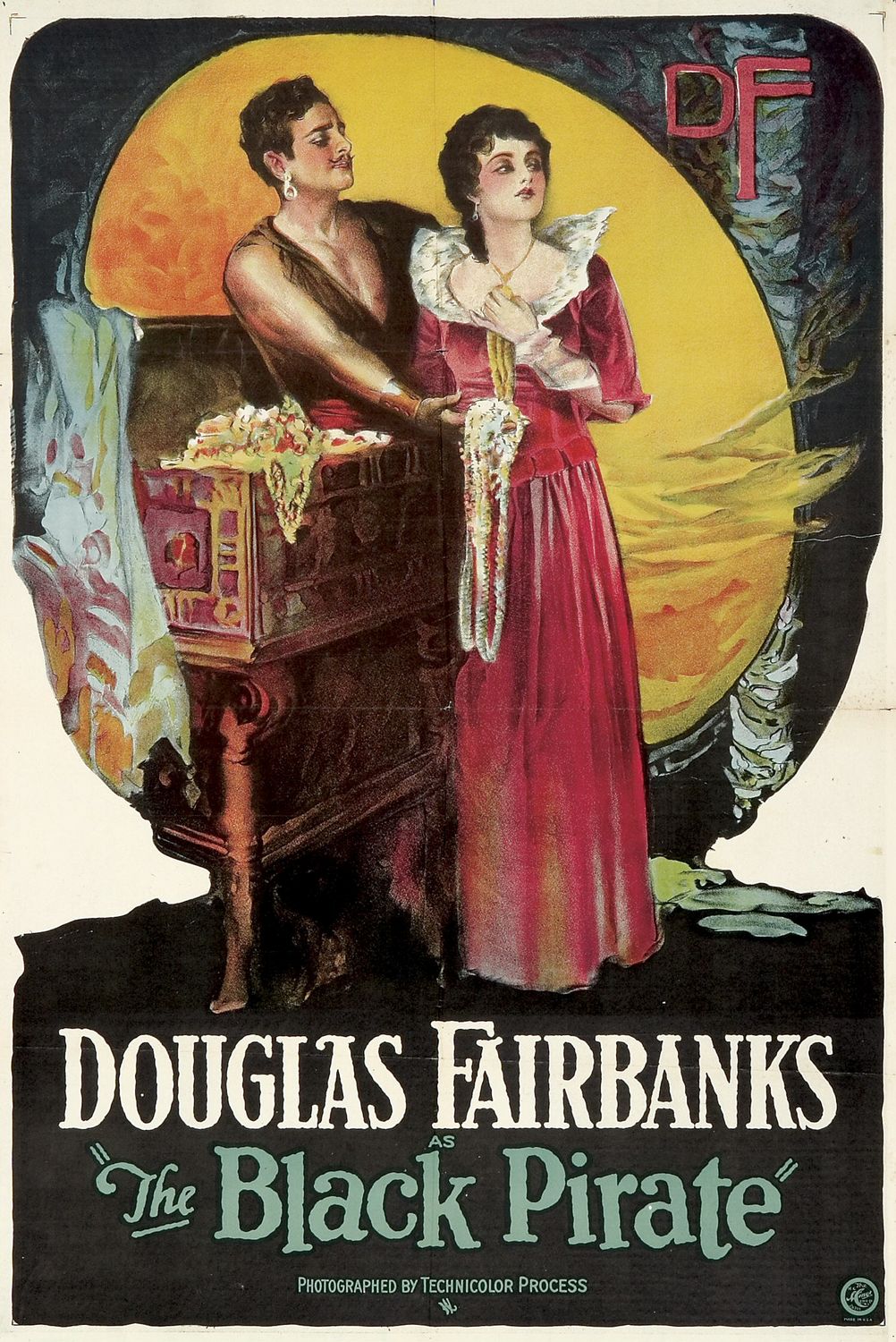
Set sail with Douglas Fairbanks Sr. in 'The Black Pirate' on Wednesday, June 8 in Plymouth, N.H.


I'm back at the keyboard after a twice-postponed visit to London, with a side trip to my old stomping grounds of Glasgow, Scotland.

Next up: music for 'The Black Pirate' (1926) starring Douglas Fairbanks, which is screening on Wednesday, June 8 at 6:30 p.m. at the Flying Monkey Moviehouse and Performance Center in Plymouth, N.H. 

More info and details are in the press release below. First, a few notes from "across the pond," where last week we scored a rare "triple," meaning three West End shows in one day. 

The line-up looked like this: 

- At 2 p.m., a new production of 'My Fair Lady' at the Coliseum on Charing Cross Road.

 - At 5:30 p.m., a cabaret-style revue called 'Six' that features the wives of Henry VIII, and which is playing at the Vaudeville Theatre at the Strand.

 - At 7:30 p.m., the new musical version of 'Back to the Future' that's playing at the Adelphi next door.

We didn't plan on this — it just happened. Tickets were available for all three;  the theaters were close enough for this to work, and there was that unusual 5:30 p.m. matinee of 'Six.'

We even got something to eat between 'Six' (which is just over one hour long) and 'Back to the Future.' 

The last time this happened was way back in the 1990s, when we caught a weird one-man play called 'Anorak of Fire' at an odd time, with a matinee before it and an evening show afterwards. So it's a rare bird indeed.

About 'Back to the Future': what was interesting to me was that even though it was full of new songs, much of the material was drawn from the score that Alan Silvestri composed for the 1985 film. 

There are a couple of really enduring licks in the 'Back to the Future' score, and Silvestri (who also worked on the musical) made the most of them in this stage reinterpretation.

The result was something you don't see very often: a stage musical that heavily relied on strong background music in the same way a movie action sequence might do. (Or, yes, a silent film score!)

This was especially true in the musical's Act 2, when Marty McFly must get the time-traveling DeLorean up to 88 mph just as lightning strikes the town's clock tower.

With no songs, just action and Silvestri's music galloping along, I totally, totally bought into it. And it was the music that did it, I think. 

The time-traveling car may have been powered by plutonium. But the real energy that held everything together and pushed it forward in an edge-of-your-seat frenzy was the score. 

So even though we were watching a stage production in 2022, it reminded me how much the right kind of music can add to a scene or sequence in a movie made in 1922. The challenge (for me, anyway) is to find those moments and make the most of them, and not overdo it at other times.

I'll next get a chance to find the balance this Wednesday, as we set sail with Douglas Fairbanks in 'The Black Pirate' (1926) at the Flying Monkey Moviehouse and Performance Center. 

Press release is below. See you on deck!

 *  *  *

Douglas Fairbanks Sr. buckles some swash in 'The Black Pirate.'
 
TUESDAY, MAY 31, 2022 / FOR IMMEDIATE RELEASE
Contact Jeff Rapsis • (603) 236-9237 • jeffrapsis@gmail.com

Silent film ‘The Black Pirate’ (1926) at Flying Monkey on Wednesday, June 8

Swashbuckling adventure flick stars Douglas Fairbanks, Hollywood’s original action hero; shown with live musical accompaniment

PLYMOUTH, N.H.—He was the Indiana Jones of his day, thrilling early film-goers with amazing stunts and feats of heroic derring-do.

He was Douglas Fairbanks Sr., one of Hollywood’s first megastars, and his timeless charisma can be seen again on Wednesday, June 8 at the Flying Monkey Moviehouse and Performance Center in Plymouth, N.H.

Featured attraction in June for the theater's monthly silent film series is ‘The Black Pirate’ (1926), an epic swashbuckling tale of the high seas that proved one of Fairbanks’ most popular blockbusters. The forerunner of all pirate movies, it was also one of the first Hollywood films to be released in color.

Showtime for 'The Black Pirate' is Wednesday, June 8 at 6:30 p.m. at the Flying Monkey Moviehouse and Performance Center, 39 Main St., Plymouth, N.H. General admission is $10 per person.

The screening, the latest in the Flying Monkey's silent film series, will feature live accompaniment by Jeff Rapsis, a New Hampshire-based composer who specializes in creating scores for silent films.

'The Black Pirate' tells the story of a ship's passenger (Douglas Fairbanks) who survives a pirate raid. Sworn to avenge his dead father, he takes command of the pirates responsible, and secretly strives to free the princess whom they have kidnapped.

Fairbanks, originally a stage actor, broke into films in the industry's early years. By 1920, starring roles in a romantic comedies established Fairbanks as a popular leading man. He then turned to historic adventure films, including ‘The Mark of Zorro’ (1920) and ‘The Three Musketeers’ (1921), which cemented his reputation for on-screen athleticism, heroism, and romance.

In 1920, Fairbanks’ marriage to fellow megastar Mary Pickford was one of the era’s biggest media events and resulted in Hollywood’s first celebrity power couple. They combined their last names to call their estate “Pickfair,” and massive crowds turned out everywhere during the couple’s European honeymoon.

At the peak of his popularity, pictures starring Fairbanks set the standard for Hollywood action adventure films, including such titles as ‘Robin Hood’ (1922), ‘The Thief of Bagdad’ (1924), and ‘The Black Pirate’ (1926), all of which were major box office successes.

When the silent film era ended in 1929, an aging Fairbanks found he was less enthusiastic about the effort required to make movies and retired from the screen. He died in 1939 at age 56 after suffering a heart attack; his now-famous last words were, “I’ve never felt better.”

The Fairbanks feature is the latest in a series of monthly silent film screenings at the Flying Monkey. The series aims to recreate the lost magic of early cinema by assembling the elements needed for silent film to be seen at its best: superior films in best available prints; projection on the big screen; live musical accompaniment; and a live audience.

“These films are still exciting experiences if you show them as they were designed to be screened,” said Rapsis, accompanist for the screenings. “There’s a reason people first fell in love with the movies, and we hope to recreate that spirit.”

For each film, Rapsis improvises a music score using original themes created beforehand. None of the music is written down; instead, the score evolves in real time based on audience reaction and the overall mood as the movie is screened.

‘The Black Pirate’ (1926) starring Douglas Fairbanks Sr. will be shown with live music on Wednesday, June 8 at 6:30 p.m. at the Flying Monkey Moviehouse and Performance Center, 39 Main St., Plymouth, N.H.

Admission is $10 per person. For more info, call (603) 536-2551 or visit www.flyingmonkeynh.com. For more info on the music, visit www.jeffrapsis.com.

Monday, May 14, 2018

Mother's Day and Steamboat Bill Jr; new piece for flute/piano, plus 'The Black Pirate' on 5/17

What about Mom? Buster Keaton and Ernest Torrence in 'Steamboat Bill Jr.' (1928).

Nice turnout yesterday for our Mother's Day screening of 'Steamboat Bill Jr.' (1928), the opening title in this year's "Silents, Please!" series at the Somerville Theatre.

I have to say, it was a curious choice for the occasion: a film about a riverboat captain and his son, with no wife/mother ever mentioned.

And the captain's business rival has a daughter, but there's no wife/mother figure present in that family either.

Maybe it's the absence of a maternal influence that's the point. Everything would have been fine but for the two male dolts and their testosterone-driven rivalry, which caused everyone's problems.

But by showing what can happen when no mother is present, perhaps 'Steamboat Bill Jr.' is actually a more fitting tribute than I first thought.

Bolstering this argument is something I had forgotten: one of the film's early gags involves a special Mother's Day promotion for carnations.


I won't give away the gag, but the promotion must have been hugely successful, as every man arriving on an out-of-town train is wearing one!

And it's interesting: after the screening, comments included several attendees who thought we chose 'Steamboat' specifically because of the Mother's Day reference. Wow!

But now from steamboats to pirate ships: on Thursday, May 17, I'm doing live music for 'The Black Pirate' (1926) starring Douglas Fairbanks.

Showtime is 8 p.m. at the Capitol Theatre in Arlington, Mass., which runs a monthly silent film series. More information in the press release below.

Before that happens, I'll have the privilege of hearing a read-through of a piece for flute and piano I wrote out this weekend.

It's at the Wednesday at the Manchester (N.H.) Community Music School, where flutist Aubrie Dionne and pianist Elizabeth Blood will tackle the six-minute piece.

I want to thank composer Romeo Melloni for asking me to contribute music to his monthly forum at the school.

If you're interested in what it sounds like, here's a link: Flute and Piano Duo

And below is all the info about 'The Black Pirate.' See you there, me 'arties!

* * *


SATURDAY, MAY 5, 2018 / FOR IMMEDIATE RELEASE
Contact Jeff Rapsis • (603) 236-9237 • jeffrapsis@gmail.com

Silent film ‘The Black Pirate’ (1926) at Capitol Theatre on Thursday, May 17

Adventure flick stars Douglas Fairbanks, Hollywood’s original action hero; shown with live musical accompaniment

ARLINGTON, Mass.—He was the Indiana Jones of his day, thrilling early filmgoers with amazing stunts and feats of heroic derring-do. He was Douglas Fairbanks Sr., one of Hollywood’s first megastars, and his timeless charisma can be seen again on Thursday, May 17 at the Capitol Theatre in Arlington, Mass.

Featured attraction for this month's silent film screening is ‘The Black Pirate’ (1926), an epic swashbuckling tale of the high seas that proved one of Fairbanks’ most popular blockbusters. The forerunner of all pirate movies, it was also one of the first Hollywood films to be released in color.

Showtime for 'The Black Pirate' is Thursday, May 17 at 8 p.m. at the Capitol Theatre, 204 Massachusetts Ave., Arlington, Mass. Admission is $12 adults, $10 kids and seniors.

The screening, the latest in the Capitol's silent film series, will feature live accompaniment by Jeff Rapsis, a New Hampshire-based composer who specializes in creating scores for silent films.

Fairbanks, originally a stage actor, broke into films in the industry's early years. By 1920, starring roles in a romantic comedies established Fairbanks as a popular leading man. He then turned to historic adventure films, including ‘The Mark of Zorro’ (1920) and ‘The Three Musketeers’ (1921), which cemented his reputation for on-screen athleticism, heroism, and romance.

In 1920, Fairbanks’ marriage to fellow megastar Mary Pickford was one of the era’s biggest media events and resulted in Hollywood’s first celebrity power couple. They combined their last names to call their estate “Pickfair,” and massive crowds turned out everywhere during the couple’s European honeymoon.

At the peak of his popularity, pictures starring Fairbanks set the standard for Hollywood action adventure films, including such titles as ‘Robin Hood’ (1922), ‘The Thief of Bagdad’ (1924), and ‘The Black Pirate’ (1926), all of which were major box office successes.

When the silent film era ended in 1929, an aging Fairbanks found he was less enthusiastic about the effort required to make movies and retired from the screen. He died in 1939 at age 56 after suffering a heart attack; his now-famous lasts words were, “I’ve never felt better.”

The Fairbanks feature is the latest in a series of monthly silent film screenings at the Capitol Theatre. The series aims to recreate the lost magic of early cinema by assembling the elements needed for silent film to be seen at its best: superior films in best available prints; projection on the big screen; live musical accompaniment; and a live audience.

“These films are still exciting experiences if you show them as they were designed to be screened,” said Rapsis, accompanist for the screenings. “There’s a reason people first fell in love with the movies, and we hope to recreate that spirit.”

For each film, Rapsis improvises a music score using original themes created beforehand. None of the the music is written down; instead, the score evolves in real time based on audience reaction and the overall mood as the movie is screened.

Upcoming titles in the Capitol's silent film series include:

• Thursday, June 14, 8 p.m.: 'The Iron Horse' (1924). Young director John Ford's breakthrough film tells the story of the building of the transcontinental railroad through the untamed West.

• Thursday, July 5, 8 p.m.: 'The Beloved Rogue' (1926) starring John Barrymore. Epic costume adventure based on the life of the 15th century French poet, François Villon

• Thursday, Aug. 16, 8 p.m.: 'Her Sister from Paris' (1925) starring Constance Talmadge, Ronald Colman. Talmadge in top form playing two very different sisters in this effervescent battle-of-the-sexes romantic comedy.

• Thursday, Sept. 13, 8 p.m.: 'The Last Laugh' (1924). In this ground-breaking character study from director F. W. Murnau, Emil Jannings delivers a tour-de-force performance as a doorman in a swanky Berlin hotel.

• Thursday, Oct 18, 8 p.m.: 'The Hunchback of Notre Dame' (1923). Just in time for Halloween: Lon Chaney stars as Quasimodo in this sprawling silent film adaptation of Victor Hugo's classic story.

‘The Black Pirate’ (1926) starring Douglas Fairbanks Sr. will be shown with live music on Thursday, May 17 at 8 p.m. Capitol Theatre, 204 Massachusetts Ave., Arlington, Mass. Admission is $12 adults, $10 kids and seniors. For more info, call (781) 648-6022 or visit www.capitoltheatreusa.com.