Showing posts with label Epsilon Spires. Show all posts

Thursday, November 9, 2023

Slow news day! Boston's WBUR-FM runs piece on my silent film accompaniment work; plus: 'Wings' in Brattleboro, Vt. on Friday, Nov. 10

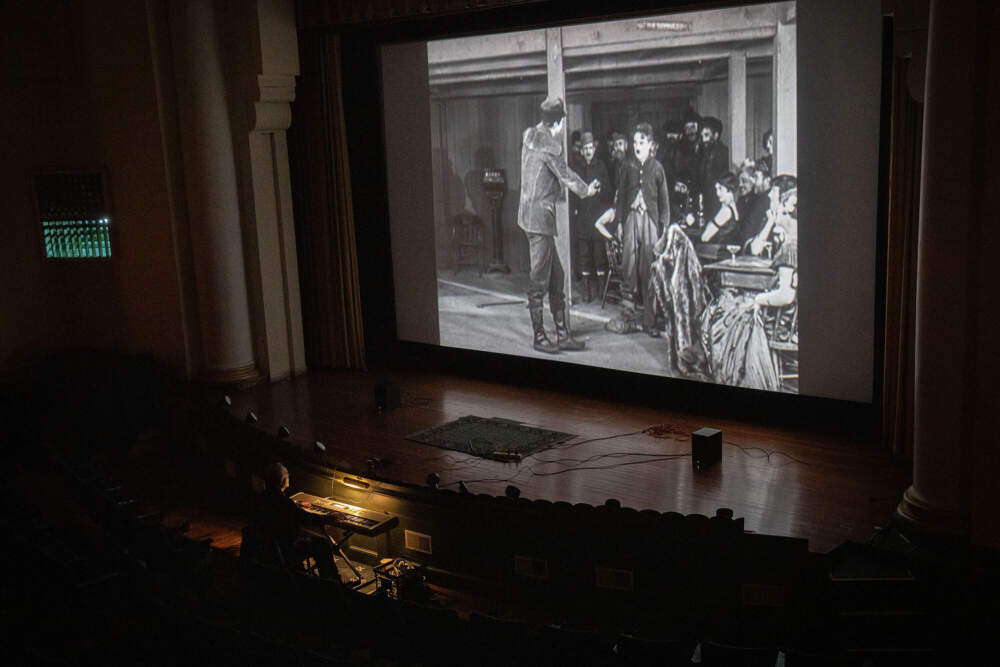
Accompanying 'The Gold Rush' at the Jane Pickens Theater in Newport, R.I. Photo by Robin Lubbock /WBUR 90.9 FM.

I want to thank Amelia Mason of WBUR 90.0 FM in Boston for all the effort that went into putting together a story about me that aired today during Morning Edition.

Amelia took the trouble to come all the way down to Newport for a recent screening of 'Phantom of the Opera' (1925) that I accompanied there. 

We talked a great deal, and she was somehow able to edit my rambling into a coherent story. 

She also got me talking about my larger life journey—about how I chose not to pursue music in college, but then came back to it decades later via silent film accompaniment.

Two weeks later, WBUR photographer Robin Lubbock came down to the same venue to photograph me doing music for the 1925 version of Chaplin's 'The Gold Rush.'

It's not easy to get usable images from inside a darkened theatre. Photo by Robin Lubbock /WBUR 90.9 FM. 

The result was a piece that went beyond the usual "live music for old movies" angle and instead explored how a person (me!) unexpectedly discovered a mid-life outlet for creative energy. 

So thanks to Amelia and Robin and all their colleagues at WBUR for taking time to put together a wonderful piece. Although the focus was on me, I hope it helps raise awareness for vintage cinema and all the people and venues that keep it before the public.

Here's a link to the audio file:

https://dcs-spotify.megaphone.fm/BUR9058007314.mp3

And here's a link to the online piece, which has significant differences from the radio story:

https://www.wbur.org/news/2023/11/09/silent-film-music-composer-jeff-rapsis

And as an added bonus, they spelled my name right! You'd be surprised how often that doesn't happen.


Me at the Jane Pickens Theater in Newport, R.I. Photo by Robin Lubbock /WBUR 90.9 FM

Today is a "day off" from silent film accompaniment, which I need because starting tomorrow it's four shows in three days—mostly screenings designed to salute Veterans Day, which is Saturday, Nov. 11.

After I do 'Wings' (1927) on Friday night in Brattleboro, Vt., then it's a 'two-fer' on Saturday: at 2 p.m., program of comedies at the Residence at Otter Creek, a retirement community in Middlebury, Vt., then at 7 p.m. it's 'The Big Parade' (1925) at 7 p.m. at Brandon (Vt.) Town Hall.

The weekend concludes with another 'Big Parade,' this one on Sunday, Nov. 12 at 2 p.m. at the Somerville Theatre in Davis Square, Somerville.

 The Somerville screening will be via a 35mm print from the Library of Congress. I've accompanied this print before and it's truly gorgeous. 

But next up: 'Wings' (1927) on Friday, Nov. 10 at 7:30 p.m. at Epsilon Spires, Brattleboro, Vt.

More info and details in the press release below. See you at the movies!

*     *     *

An original poster for Paramount's 'Wings' (1927).

SATURDAY, NOV. 4, 2023 / FOR IMMEDIATE RELEASE
Contact Jeff Rapsis • (603) 236-9237 • jeffrapsis@gmail.com

Epic silent film 'Wings' (1927) on Friday, Nov. 10 at Brattleboro's Epsilon Spires

Story of U.S. aviators in World War I won first-ever 'Best Picture'; screening to feature live organ accompaniment

BRATTLEBORO, Vt.—It won 'Best Picture' at the very first Academy Awards, with spectacular midair flying sequences and a dramatic story that still mesmerizes audiences today.

'Wings' (1927), a drama about U.S. pilots in the skies over Europe during World War I, will be shown with live music on Friday, Nov. 10 at 7:30 p.m. at Epsilon Spires, 190 Main St., Brattleboro, Vt.

Admission is $20 per person, with all veterans admitted free in honor of Veterans Day. Tickets may be purchased in advance at www.epsilonspires.org or at the door. Doors open at 7 p.m.

The screening will feature live accompaniment on the venue's Estey pipe organ by Jeff Rapsis, a New Hampshire-based silent film musician.

The show will allow audiences to experience 'Wings' the way its makers originally intended: on the big screen, with live music, and with an audience.

'Wings,' a blockbuster hit in its original release, recounts the adventures of U.S. pilots flying combat missions behind enemy lines at the height of World War I in Europe. 'Wings' stunned audiences with aerial dogfight footage, vivid and realistic battle scenes, and dramatic love-triangle plot.

'Wings' stars Clara Bow, Charles 'Buddy' Rogers, and Richard Arlen. The rarely-seen film also marked one of the first screen appearances of Gary Cooper, who plays a supporting role. 
 
Buddy Rogers, Gary Cooper, and Richard Arlen in 'Wings' (1927).

Directed by William Wellman, 'Wings' was lauded by critics for its gripping story, superb photography, and technical innovations.


'Wings' is notable as one of the first Hollywood films to take audiences directly into battlefield trenches and vividly depict combat action. Aviation buffs will also enjoy 'Wings' as the film is filled with scenes of vintage aircraft from the early days of flight.

Seen today, the film also allows contemporary audiences a window into the era of World War I, which was fought in Europe from 1914 to 1918.

" 'Wings' is not only a terrific movie, but seeing it on the big screen is also a great chance to appreciate what earlier generations of servicemen and women endured," accompanist Jeff Rapsis said.

"It's a war that has faded somewhat from our collective consciousness, but it defined life in the United States for a big chunk of the 20th century. This film captures how World War I affected the nation, and also shows in detail what it was like to serve one's country a century ago."

Rapsis, a composer who specializes in film music, will create a score for 'Wings' on the spot, improvising the music as the movie unfolds to enhance the on-screen action as well as respond to audience reactions. Rapsis performs the music on a digital synthesizer, which is capable of producing a wide range of theatre organ and orchestral textures.

"Live music was an integral part of the silent film experience," Rapsis said. "At the time, most films weren't released with sheet music or scores. Studios relied on local musicians to come up with an effective score that was different in every theater. At its best, this approach created an energy and a connection that added a great deal to a film's impact. That's what I try to recreate," Rapsis said.

'Wings' runs about 2½ hours and will be shown with one intermission. The film is a family-friendly drama but not suitable for very young children due to its length and intense wartime battle scenes.

‘Wings’ (1927) starring Clara Bow, Buddy Rogers and Richard Arlen will be shown with live music in honor of Veterans Day on Friday, Nov. 10 at 7:30 p.m. at Epsilon Spires, 190 Main St., Brattleboro, Vt.

Admission is $20 per person, with all veterans receiving free admission. Tickets may be purchased in advance at www.epsilonspires.org or at the door. Doors open at 7 p.m.

Monday, May 15, 2023

A busy musical weekend in store: two silent film programs in Vt., then a concert in N.H.

A scene from F.W. Murnau's 'Sunrise' (1927).

This coming weekend, it's two shows in Vermont followed by a concert in N.H. where some of my music is on the program.

First up: F.W. Murnau's acclaimed drama 'Sunrise' (1927) on Friday, May 19 at 8 p.m. at Epsilon Spires in Brattleboro, Vt. 

I'll be playing the venue's original Estey pipe organ to accompany the film. Lots more details in the press release below. 

Then on Saturday, May 20, it's opening night of the 12th season of silent film screenings at Brandon (Vt.) Town Hall. Showtime is at 7 p.m.; featured attraction is Chaplin's 1923 comedy 'The Pilgrim,' his last non-feature-length film and celebrating its 100th anniversary this year.

More on that, and a look at the whole season of silent films that I'll accompany, in a post a bit later this week. For now, you can browse the listings (via the 'Upcoming Silent Film Screenings' link at upper right) and see what's playing.

And then on Sunday, May 21, the N.H. Philharmonic is playing part of my 'Kilimanjaro Suite' for orchestra at its Spring Pops Concert, which is at 2 p.m. at Seifert Performing Arts Center, Salem High School, 44 Geremonty Drive, Salem, N.H.

I've been attending rehearsals during the past couple of weeks, and the orchestra sounds really good. To learn more about the piece, check out the 'Notes for Kilimanjaro Suite' link at upper right. And for tickets and more information, visit www.nhphil.org.

Hope to see you at some or all of these events!

*     *     *

A poster for the original release of 'Sunrise' (1927).

MONDAY, MAY 8, 2023 / FOR IMMEDIATE RELEASE
Contact Jeff Rapsis • (603) 236-9237 • jeffrapsis@gmail.com

Academy Award-winning drama 'Sunrise' to be screened on Friday, May 19 at Epsilon Spires, Brattleboro


Silent film won three honors at first-ever Academy Awards, including 'Best Actress'; show features live musical accompaniment

BRATTLEBORO, Vt.—Silent film on the big screen with live music returns to Epsilon Spires in Brattleboro with the Academy Award-winning romantic drama 'Sunrise' (1927) on Friday, May 19 at 8 p.m.

The screening of 'Sunrise,' starring Janet Gaynor and George O'Brien, will take place at Epsilon Spires, 190 Main St., Brattleboro, Vt.

Admission is $20 per person. Tickets may be purchased in advance at www.epsilonspires.org or at the door.

The screening will feature live accompaniment on the venue's Estey pipe organ by Jeff Rapsis, a New Hampshire-based silent film musician.

Gaynor, a popular female star of the silent film era, won the first-ever Academy Award for Best Actress for her performance in 'Sunrise.' The movie took top honors in cinematography and was also recognized for "Unique and Artistic Production" at the inaugural awards.

'Sunrise' tells the story of a young country couple (played by Gaynor and O'Brien) whose marriage is threatened by the presence of a woman from the city (Margaret Livingston) who convinces the man to abandon his wife. Will the young husband go through with a plan to kill his wife? Will true love overcome the obstacles of temptation and the promise of short-term pleasure?

Janet Gaynor and George O'Brien in 'Sunrise' (1927).

'Sunrise' was directed by F. W. Murnau, a German filmmaker and one of the leading figures in German Expressionism, a style that uses distorted art design for symbolic effect. 'Sunrise' was made when Murnau was invited by studio chief William Fox to make a film in Hollywood.

The resulting movie features enormous stylized sets that create an exaggerated, fairy-tale world. The city street set alone reportedly cost over $200,000 to build, a huge sum at the time. Much of the exterior shooting was done at Lake Arrowhead, Calif.

Full of cinematic innovations, the groundbreaking cinematography (by Charles Rosher and Karl Struss) featured moving cameras and impressive tracking shots. Titles appear sparingly, with long sequences of pure action and most of the story told in Murnau's signature visual style. The extensive use of forced perspective is striking, particularly in a shot of the city with normal-sized people and sets in the foreground and smaller figures in the background by much smaller sets.

The story of 'Sunrise' is told as a visual allegory with few specific details. The characters have no names, and the setting is not named in order to make the tale more universal and symbolic.

With a full title of 'Sunrise: A Song of Two Humans,' the film is regarded as one of the high points of the silent cinema. In 1988, it was selected for preservation in the National Film Registry of the U.S. Library of Congress for films that are "culturally, historically, or aesthetically significant." The Sight and Sound poll of 2012 for the British Film Institute named 'Sunrise' the fifth-best film in the history of motion pictures by critics, and 22nd by directors.

Critics continue to hail 'Sunrise' as one of the best films of all time.

"F.W. Murnau's 'Sunrise' conquered time and gravity with a freedom that was startling to its first audiences," wrote Roger Ebert in 2004. "To see it today is to be astonished by the boldness of its visual experimentation.

Rapsis (at right), who uses original themes to improvise silent film scores, said great silent film dramas such as 'Sunrise' used their lack of dialogue to create stories that concentrated on the "big" emotions such as Love, Despair, Anger, and Joy. 

Because of this, audiences continue to respond to them in the 21st century, especially if they're presented as intended — with a live audience and live music.

"Dramas such as 'Sunrise' were created to be shown on the big screen as a communal experience," Rapsis said. "With an audience and live music, they still come to life as their creators intended them to. So the screenings at Epsilon Spires are a great chance to experience films that first caused people to fall in love with the movies," he said.

'Sunrise' will be shown with live music on Friday, May 19 at 8 p.m. at Epsilon Spires, 190 Main St., Brattleboro, Vt.

Admission is $20 per person. Tickets may be purchased in advance at www.epsilonspires.org or at the door.

Thursday, June 9, 2022

By Jove! I think we've got 'It' (1927) on Friday, June 10 at Epsilon Spires in Brattleboro, Vt.

A poster promoting Clara Bow in 'It' (1927).

It's one of the shortest titles ever! (Except perhaps for Fritz Lang's 'M.') 

Up next, it's Clara Bow in 'It' (1927) on Friday, June 10 at Epsilon Spires in Brattleboro, Vt., accompanied by me on the venue's Estey pipe organ.

Showtime is 8 p.m. and hope to see you there! Plenty more info is in the press release below.

First, a few thoughts on my annual pilgrimage to Antrim (N.H.) Town Hall, where each June I do an end-of-the-school-year silent film program for kids at Great Brook School, which enrolls Grades 5-8.

This year it was yesterday, and here's what it looks like:

It's all organized by teacher Maryanne Cullinan (seen above), who uses the occasion to call each graduating 8th grader up and offer personal recollections and remembrances in front of their peers.

Wow! This is very different from my own experience attending Spring Street Jr. High in Nashua, N.H. At the end of the school year, the closest thing we got to this was when the bullies in "smoker's row" would pull my friends and me aside for one final beating before classes let out for the summer. 

We've been doing this for more than 10 years now, and over time the kids have made it clear that their preferred silent film star is Buster Keaton. 

So yesterday's program included the classic Keaton short comedy 'One Week' (a perennial favorite) followed by the full-length 'Go West' (1925), which we'd never showed before. 

 Prior to the film, I tried to pique their curiosity by saying it included one of the strangest love stories of the silent era. (That being the relationship between Buster and Brown Eyes the cow.)

I could tell they were growing a little restless during the feature. But interest perked up starting with the gunfight over the cattle-carrying train, and then the stampede through the streets of Los Angeles. 

The film's ending produced an avalanche of adolescent applause, with one kid yelling out "That was the best movie I ever saw, even though I slept through the first two-thirds of it!" which earned him a scolding for being rude.  

But I really enjoy this annual cannonball into the middle school swimming pool. Thanks to Ms. Cullinan and everyone at Great Brook School for inviting me once again and keeping this fine tradition going.

Later that day, I headed up to Plymouth, N.H. to do music for Douglas Fairbanks Sr. in 'The Black Pirate" (1926) at the Flying Monkey Moviehouse and Performance Center.

(The picture at left was taken just as I looked the receipt for a tank of gas.)

About 40 people turned out for this granddaddy of all pirate films, which we programmed as part of our series of 1926 films that just recently entered the public domain. 

A good time was has by all, except those in the movie terrorized by pirates. And for once, no one brought up the fact that sundials (featured prominently in the movie) don't work on a boat at sea.

And now, let's get on with 'It!' Please join me on Friday, June 10 at 8 p.m. for this iconic Jazz Age comedy. The press release is below!

*    *    *


Clara Bow and would-be beau Antonio Moreno in 'It' (1927).

TUESDAY, MAY 31, 2022 / FOR IMMEDIATE RELEASE
Contact Jeff Rapsis • (603) 236-9237 • jeffrapsis@gmail.com

Come and get 'It' with Clara Bow at Epsilon Spires on Friday, June 10

Performance venue to screen Jazz Age silent romantic comedy with live organ accompaniment

BRATTLEBORO, Vt.—A film that helped define an era returns to the big screen in June at Epsilon Spires.

'It' (1927), a romantic comedy that came to epitomize the Jazz Age of the 1920s, will be screened with live music on Friday, June 10 at 8 p.m. at Epsilon Spires, 190 Main St., Brattleboro, Vt.

Admission is $15 per person. Tickets may be purchased in advance at www.epsilonspires.org or at the door.

The screening will feature live accompaniment on the venue's Estey pipe organ by Jeff Rapsis, a New Hampshire-based silent film musician.

'It' tells the story of a shop girl who sets her sights on the handsome and wealthy boss of the department store where she works. The two are from completely different parts of society, but will attraction be strong enough to bridge the gap in their backgrounds?

The film made actress Clara Bow a major star, earning her the nickname of the 'It' girl. Released at the height of the Jazz Age, the movie was a hit with audiences all over the U.S., breaking box office records.

'It' is based on a novella written by Elinor Glyn and originally serialized in Cosmopolitan magazine. Glyn, whose writings popularized the concept of 'It' as a quality of attractiveness, has a cameo role as herself in the film.

'It' is also an early example of product placement, as Cosmopolitan magazine is featured prominently in a scene where a character reads Glyn's story and introduces it to the audience.

The picture was considered lost for many years, but a copy was found in Prague in the 1960s. In 2001, 'It' was selected for preservation in the U.S. National Film Registry by the Library of Congress as being "culturally, historically, or aesthetically significant."

To accompany 'It,' Rapsis will improvise a score created live in real time as the movie is screened, in the tradition of theatre organists during the silent era.

Rather than focus on authentic music of the period, Rapsis creates new music for silent films that draws from movie scoring techniques that today's audiences expect from the cinema.

The non-profit Epsilon Spires, housed in Brattleboro's former Baptist church, builds connections between art and science by offering provocative performances and events, interactive art installations, and opportunities to engage in civil discourse by addressing current topics through the integration of diverse forms of expression.

'It' (1927) will be screened with live music on Friday, June 10 at 8 p.m. at Epsilon Spires, 190 Main St., Brattleboro, Vt. Admission is $15 per person. Tickets may be purchased in advance at www.epsilonspires.org or at the door.

Sunday, February 20, 2022

'When Knighthood Was in Flower' (1922) on Sunday, 2/20 at Town Hall Theatre, Wilton, N.H.

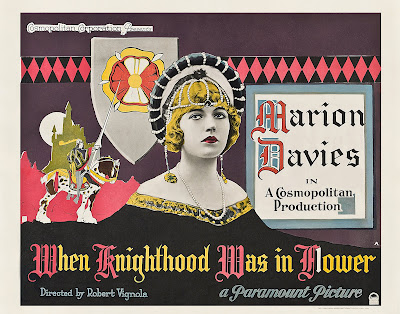
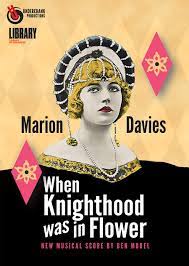
Promotional artwork for 'When Knighthood Was in Flower' (1922).

This afternoon's screening of 'When Knighthood in Flower' is the finale of a five-days-in-a-row series of screenings that saw me doing music for five films in venues across three states.

But what an ending! The Marion Davies costume epic, set during the reign of England's King Henry VIII, was produced on a grand scale. Released in 1922, it was the year's second-highest grossing film.

It's part of our ongoing series at the Town Hall Theatre in Wilton, N.H. celebrating the 100th anniversaries of motion pictures that came out that year. Lots more info in the press release I've pasted in below.

For now, let me report that last night's screening of 'The Last Command' (1928) in Brattleboro, Vt. resulted in some unexpected drama before the film could begin.

In late afternoon, a wall of heavy squalls moved across northern New England, laying down an unexpected coating of snow across the region. 

Brattleboro would normally be a 90-minute drive, so I left around 5 p.m. to arrive in time to set up for the screening, which was scheduled to start at 8 p.m. The snow had cleared out, so I figured that the timing had worked out well.

Well, it hadn't. The main highway (Route 101) across southern N.H. isn't far from my house, and almost immediately traffic on this busy road came to a complete stop. In a weird meteorological phenomenon, somehow the snow had adhered to the pavement, creating a coating of sheer ice that was impossible to drive on.

Seriously! Cars were off the road in both directions, and the rest of us were lined up and moving at a glacial pace, if at all. It took a half hour to just go a couple of miles. 

Stuck in this situation, with no real alternative routes that would be any better, I kept watching my arrival time slip further into the future.

I began pinging Jamie Mohr, who runs the Epsilon Spires venue where I would accompany 'The Last Command,' with updates, wondering if I would ever make it out there. (Jamie said she would get some Chinese food, which gave me confidence.)

My GPS indicated that conditions seemed normal for most of the route ahead, so I held out hope as I crawled along, trying not to slide off into the woods. After awhile, conditions did improve and traffic began to move at a more normal pace. 

Apparently the squalls had seen fit to sock just the area where I lived, as the rest of the ride to Brattleboro was uneventful. But the first five miles had taken 45 minutes, meaning I arrived with just enough time to set up things. 

And the next thing you know, I'm at the organ console, doing music for 'The Last Command,' aided by the digital synthesizer to produce drums and percussion where needed, plus a piano in a couple of key scenes. Oh—and also a brass school bell for when a bell is prominently rung in one scene.

The film, directed by Josef von Sternberg and starring Emil Jannings in an Academy Award-winning performance, drew the usual strong reaction—it's one of the truly great silent dramas, I think, produced when the form was at the peak of its eloquence. 

But this screening brought a new wrinkle: afterwards, people said it was a little unsettling to take in all the Russian military scenes as the present situation unfolds with Russia and Ukraine. I didn't see the parallel, but I could understand how it would be on people's minds.

Well, this afternoon's screening of 'When Knighthood Was in Flower' should provoke no such unease, as King Henry VIII has been off the throne for about 500 years.

I want to point out that the only reason we can show 'Knighthood' is because of the restoration recently released by Ben Model and Undercrank Productions. Ben and his colleagues did a terrific job.

Ben was recently in touch and shared a few notes about the effort that went into reissuing the film, which I had mistakenly called a transfer. I think it's worth including here, and I'll also mention it at this afternoon's screening:

"...the Undercrank edition is a restoration, and not a transfer. Stabilization and clean-up and grading was done on the nitrate scan. 

Also, the tints weren't added to look the way silents did – we reinstated the tinting and hand-coloring to exactly what was seen in theaters in 1922. There are tinting slugs at the heads and tails of several of the reels indicating "light pink", "amber", "light amber" and "blue tone/biscuit" (a combination of tinting and toning). 

We also found a review from Robert E. Sherwood that talks about the hand-coloring of the torches, and ads in the trades for the guy who did the hand-coloring; and so I got Jack Theakston to replicate this digitally, frame-by-frame.

So, you can tell your audience that they're seeing what people saw in the film's original release of the full-length road-show edition (the general release version was about 25 mins shorter). 

And, had Marion Davies not had a print struck of this in the mid-1930s, and then donated all her 35mm nitrate prints to the LoC in the 1950s, we would not be able to see this at all. :)

Who knew...Marion was also a film conservationist!

Thanks so much! Have a great show!

If you'd like more info about the restoration of 'Knighthood,' check out this post from Ben. 

Okay, hope your Sunday plans include a trip back to the splendors of medieval England via 'When Knighthood Was in Flower' starring Marion Davies. The show begins at 2 p.m. More info about the film in the press release below.

*   *   *

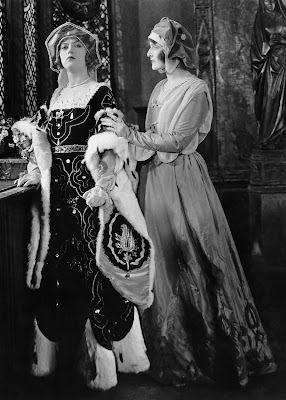
Marion Davies (left) in 'When Knighthood Was in Flower' (1922).

TUESDAY, FEB. 8, 2022 / FOR IMMEDIATE RELEASE
Contact Jeff Rapsis • (603) 236-9237 • jeffrapsis@gmail.com

Marion Davies costume epic 'When Knighthood Was in Flower' to screen at Wilton Town Hall Theatre

Set during the reign of Henry VIII, silent film blockbuster to be shown with live music on Sunday, Feb. 20 to celebrate 100th anniversary of release

WILTON, N.H.—It was a movie that transported audiences back to the reign of England's King Henry VIII, scoring an enormous box office success.

It was 'When Knighthood Was in Flower' (1922), a costume epic starring Marion Davies that became the year's second-highest-grossing film. 

See what all the royal fuss was about when the picture is shown with live music on Sunday, Feb. 20 at 2 p.m. at the Town Hall Theatre, 40 Main St., Wilton, N.H.

Admission is free, with a suggested donation of $10 per person to help support the theater's silent film series.

The classic Tudor-era drama will be shown with live music by silent film accompanist Jeff Rapsis.

In 'When Knighthood Was in Flower,' Marion Davies plays Mary Tudor, younger sister of England's King Henry VIII, who falls in love with a guardsman below her class.

Unfortunately, Mary is already betrothed to the aged King Louis XII of France. Her illicit romance thus touches off a furor with international complications.

Planned from the start as a big budget spectacle, 'When Knighthood Was in Flower' cost $1.8 million to produce, making it among the most expensive movies of the silent era.

The film was directed by Robert G. Vignola and based on a popular 1898 novel by Charles Major. 

A lobby card for 'When Knighthood Was in Flower.'

'When Knighthood Was in Flower' was produced by William Randolph Hearst (through his Cosmopolitan Productions) for Marion Davies and distributed by Paramount Pictures. 

Davies, longtime mistress of publishing magnate Hearst, would go on to become one of the most popular leading ladies of the silent era. 

For 'When Knighthood Was in Flower,' she spent four months learning to fence in order to convincingly perform her own on-screen swordfighting.

Although some exteriors were shot on location at England's Windsor Castle, most of the film was actually made in Connecticut and New York City, where Cosmopolitan was based at the time. 

Ziegfeld Follies designer Joseph Urban planned so many lavish sets, Hearst had to rent space at two other New York studios to complete the film and hire 3,000 extras for the crowd scenes. 
 
For Davies' 15 gowns, Urban's daughter, Gretl Urban Thurlow, duplicated outfits originally worn by Mary Tudor.

The edition of 'When Knighthood Was in Flower' that will be presented is a new digital restoration from Undercrank Productions/Library of Congress.

The screening is part of the Town Hall Theatre's ongoing series honoring the 100th anniversary of significant motion pictures that debuted in 1922.

Programs will include all of 1922's five highest-grossing titles, each shown on the big screen with live music, as well as century-old oddities, short films, cartoons, and more.

"Putting these films back on the big screen is a great way to celebrate the 100th anniversaries of some terrific motion pictures," said Rapsis, the silent film accompanist who will create live music for all screenings.

"These are films that set the standard for Hollywood, and still retain their power to entertain, especially when shown in a theater with live music and an audience," Rapsis said.

Upcoming programs in the Town Hall's 100th anniversary series include:

• Sunday, March 13, 2022 at 2 p.m.: Norma Talmadge in 'Smilin' Through' In honor of St. Patrick's Day, a 1922 romantic drama set in the Emerald Isle.

• Sunday, March 27, 2022 at 2 p.m.: Douglas Fairbanks in 'Robin Hood' Celebrate the 100th anniversary of this blockbuster adaptation. Massive sets, great action, and Doug Fairbanks in the lead made this the top grossing film of 1922!

• Sunday, April 3, 2022 at 2 p.m.: Chaney/Houdini Double Feature. In 'Flesh and Blood' (1922), escaped convict Lon Chaney hides out in Chinatown and plots revenge. In 'The Man From Beyond' (1922) illusionist Harry Houdini plays an Arctic adventurer frozen for 100 years!

• Sunday, April 17, 2022 at 2 p.m.: Emil Jannings in 'Othello' The Bard's immortal tragedy brought to the screen in this early German version. Silent Shakespeare in honor of the author's 458th birthday.

‘When Knighthood Was in Flower' (1922) will be shown live music on Sunday, Feb. 20 at 2 p.m. at the Town Hall Theatre, 40 Main St., Wilton, N.H.

Admission is free, with a suggested donation of $10 per person to help defray expenses. For more info, call (603) 654-3456 or visit www.wiltontownhalltheatre.com.

Saturday, February 19, 2022

Tonight: Emil Jannings in 'The Last Command' at Epsilon Spires in Brattleboro, Vt., w/pipe organ

Original promotional art for Josef von Sternberg's 'The Last Command' (1928).

Quick post in advance of heading out to Brattleboro, Vt., where tonight I'll accompany the great Josef Sternberg drama 'The Last Command' (1928).

Come join us! The show starts at 8 p.m. at Epsilon Spires performance space, with music on the venue's Estey pipe organ augmented by digital synthesizer. 

It's worth attending, as the performance of Emil Jannings is one for the ages. Playing a deposed Czarist general forced to act out his personal drama on a Hollywood set, it's really something to see him go completely berzerk.

See for yourself. More info in the press release below.

For now, let me thank Leland Stein and the staff at the Regent Theater in Arlington, Mass. for their willingness to screen 'The Flying Ace' (1926) in observance of Black History Month.

Last night's show attracted a small audience, which surprised me. 'The Flying Ace' was recently added to the National Film Registry by the Library of Congress. As a rare surviving "race drama" intended for segregated movie theaters, you'd think it would be of more interest. After all these years, I think it has a lot to say to us

Well—I'll accompany it again on Wednesday, Feb. 23 up at Red River Theatres in Concord, N.H. But right now I have to hit the road to make it through snow squalls over the river (the Connecticut River) and through the woods to Brattleboro and 'The Last Command.' 

See you there tonight!

*   *   *

Evelyn Brent and Emil Jannings in 'The Last Command' (1928).
 
MONDAY, FEB. 7, 2022 / FOR IMMEDIATE RELEASE
Contact Jeff Rapsis • (603) 236-9237 • jeffrapsis@gmail.com

Silent epic 'The Last Command' with live pipe organ score at Epsilon Spires on Saturday, Feb. 19

Josef von Sternberg's groundbreaking psychological drama won 'Best Actor' for Emil Jannings at first-ever Academy Awards

BRATTLEBORO, Vt.—'The Last Command' (1928), a silent film drama that won Emil Jannings 'Best Actor' honors at the first-ever Academy Awards, will be screened with live music on Saturday, Feb. 19 at 8 p.m. at Epsilon Spires, 190 Main St., Brattleboro, Vt.

Admission is $15 per person. Tickets may be purchased in advance at www.epsilonspires.org or at the door.

The screening will feature live accompaniment on the venue's Estey pipe organ by Jeff Rapsis, a New Hampshire-based silent film musician.

'The Last Command,' directed by Josef von Sternberg, tells the sweeping story of a powerful general in Czarist Russia (Jannings) forced to flee his homeland during the Bolshevik Revolution. He emigrates to America, where he is reduced to living in poverty.

Finding work as an extra at a Hollywood studio, the former general lands the part of a commanding officer in a movie about the Revolution, causing flashbacks to his traumatic experiences. The conflict leads to a spectacular climax and a towering performance that earned Jannings 'Best Actor' honors.

The film takes audiences on a journey through big emotions as well as issues of history, time, power, and especially a man's duty to his country and to his fellow citizens—and what happens when the two obligations diverge.

'The Last Command' is also one of early Hollywood's most creative and challenging looks at the global conflicts that contributed to World War I.

The film also stars a young William Powell as a Hollywood movie director who crosses paths with the general during the Revolution, and 1920s starlet Evelyn Brent as a seductive Russian revolutionary.

Rapsis, the accompanist, will create the film's score live as the movie is shown by improvising on the venue's historic Estey pipe organ, built in Brattleboro and installed in 1906.

"Making up the music on the spot is kind of a high wire act," Rapsis said. "But there's nothing like the energy and excitement that comes with improvised live performance, especially when accompanying a silent film."

Critic Leonard Maltin hailed 'The Last Command' as "a stunning silent drama...a fascinating story laced with keen observations of life and work in Hollywood." Time Out of London called it "the first Sternberg masterpiece, expertly poised between satire and 'absurd' melodrama. The cast are fully equal to it; Jannings, in particular, turns the characteristic role of the general into an indelible portrait of arrogance, fervor and dementia."

Director Sternberg, a master of lighting and black-and-white photography, created 'The Last Command' as a visual tour de force. The film is often cited as a prime example of the emotional range and visual accomplishment of silent films at their height, just prior to the coming of pictures with recorded soundtracks.

Rapsis said great silent film dramas such as 'The Last Command' told stories that concentrate on the "big" emotions such as Love, Despair, Anger, and Joy. Because of this, audiences continue to respond to them in the 21st century, especially if they're presented as intended—in a theater on the big screen, with a live audience and live music.

"Dramas such as 'The Last Command' were created to be consumed as a communal experience," Rapsis said. "With an audience and live music, they come to life as their creators intended them to. This screening at Epsilon Spires is a great chance to experience films that first caused people to fall in love with the movies."

The non-profit Epsilon Spires, housed in Brattleboro's former Baptist church, builds connections between art and science by offering provocative performances and events, interactive art installations, and opportunities to engage in civil discourse by addressing current topics through the integration of diverse forms of expression. 

'The Last Command' (1928) will be screened with live music on Saturday, Feb. 19 at 8 p.m. at Epsilon Spires, 190 Main St., Brattleboro, Vt. Admission is $15 per person. Tickets may be purchased in advance at www.epsilonspires.org or at the door.


Sunday, January 2, 2022

A century in the making: Town Hall Theatre to screen 1922's top five box office attractions

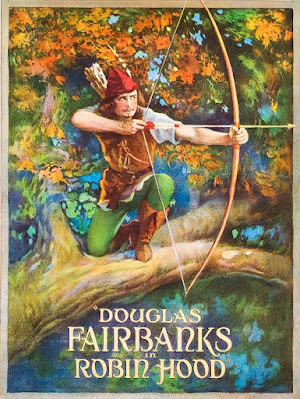
The #1 box office blockbuste of 1922: Douglas Fairbanks in 'Robin Hood.'

Get set for a four-month series exploring the top box office hits of 100 years ago!

It's at the Town Hall Theater in Wilton, N.H., and starts on Sunday, Jan. 9 at 2 p.m. with Harold Lloyd's comedy 'Grandma's Boy.'

More on that in the press release below. First, I'd like to recount my recent adventure with a pipe organ in the neighboring state of Vermont.

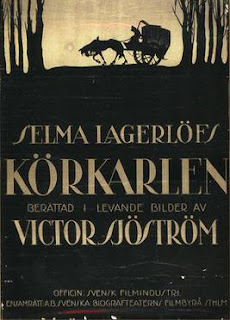
New Year's Day brought 2022's first screening: accompaniment for 'The Phantom Carriage' (1921) at Epsilon Spires, the Baptist Church-turned-performing arts venue in Brattleboro, Vt.

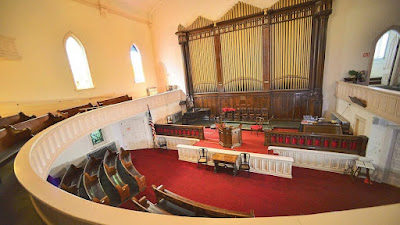
The interior of Epsilon Spires, which until recently was a Baptist Church.

Because it once was a church, it has an organ—in fact, an Estey organ built right there in Brattleboro and installed in 1906. 

 And that's what I used to do music for Victor Sjöström's influential drama. 

I don't get many chances to do live pipe organ accompaniment. So it was a real treat to start the new year working with the "king of instruments." 

The Estey, though technically a church organ rather than one built for movie accompaniment, is nevertheless up to the job of film accompaniment. 

It has a nice variety of stops, making possible a range of textures. And it can really rock the house when called for.

(And I've since learned that among the church's former congregants was Jacob Estey himself, who founded the organ-building company that bore his name.)

I augmented the organ's sound by using my digital synthesizer to add in percussion at key moments: timpani, bass drum, and cymbals. 

Although the organ was in tune with itself, I found it pitched about a half-tone lower than my synthesizer, which is defaulted to A = 440 Hz. So I had to pull the synth pitch down to about 415 Hz to compensate.

I've since read that this lowered pitch is standard practice for some instruments in playing music from the Baroque era. So much to learn!

One other odd thing is the Estey's pedal board—but in this case, it's me that's out of synch. 

The Allen organ I have at home is equipped with what's called a "Princess" pedalboard, meaning it's smaller than a full-sized pedalboard. 

Specifically, it's built to 3/4 size, I guess to make it easier to fit in a living room, which is where it would have been played back in the era of the home organ.

So my instincts regarding pedal location are off by a certain amount. It takes time to adjust to the different proportions of a full-sized pedalboard. Even so, I managed to hit most of the notes I aimed for. 

Accompanying the film on an unfamiliar instrument was a workout. 

But I have to say, from the standpoint of the accompanist, bringing a film to a conclusion with an organ is especially satisfying for some reason.

And it's not because I ended big—with 'The Phantom Carriage' (called 'Körkarlen' in Swedish'), I actually pulled a move from the ending of the Brahms Symphony No. 3, drawing up to a quiet close. 

Rather, in silent film accompaniment, there's something about the sound of an organ that helps the sum add up to more than the parts.

I want to thank Jamie Mohr and her colleagues at Epsilon Spires for the chance to work with the Estey and accompany 'The Phantom Carriage.' 

There's talk of follow-up screenings. I'd welcome that because it would mean to chance to really get to know the Estey.

Again, I just don't get a lot of chances to play pipe organ, so I'm excited about a venue with a working organ that's fairly close to home base.

As was once said in a non-silent movie, "This could be the beginning of a beautiful friendship."

Okay, onto the future, which in this case means heading back into the past.

On Sunday, Jan. 9, the Town Hall Theatre will begin a series of 100th anniversary screenings of the top box office hits of 1922.

First up is Harold Lloyd's breakthrough feature comedy 'Grandma's Boy,' which clocks in at No. 5 in the box office records. 

Plenty of other great pictures are lined up, too—but rather than have me prattle on about them here, check out the press release below.

Hope you'll join me in catching up on all the big hits of 1922 that for some reason you missed on their original runs!

*   *   *

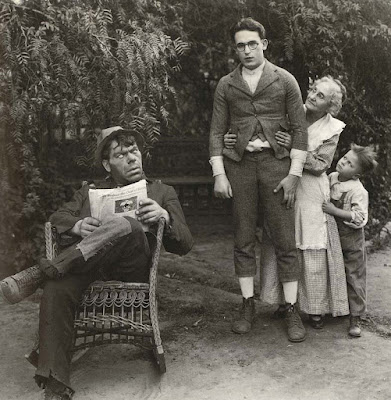
Harold Lloyd in 'Grandma's Boy' (1922).

MONDAY, DEC. 20, 2021 / FOR IMMEDIATE RELEASE
Contact Jeff Rapsis • (603) 236-9237 • jeffrapsis@gmail.com

Start 2022 with Hollywood's top box office hits from a century ago

Town Hall Theatre to embark on 100th anniversary screenings of 1922's most popular big screen attractions

WILTON, N.H. — It's a film series 100 years in the making!

Starting in January, the Town Hall Theatre will reset the clock and celebrate the top box office hits of 1922, when the movies were just coming into their own.

The program includes now-classic blockbusters such as Rudolph Valentino's bullfighting drama 'Blood and Sand' (1922); Marion Davies in the medieval romance 'When Knighthood was in Flower' (1922); and the year's highest-grossing film, 'Robin Hood' (1922) starring Douglas Fairbanks Sr.

First up is Harold Lloyd's uproarious comedy 'Grandma's Boy' (1922), to be screened on Sunday, Jan. 9 at 2 p.m. at the Town Hall Theatre, 40 Main St., Wilton, N.H.

Live music will be provided by silent film accompanist Jeff Rapsis. Admission is free, with a suggested donation of $10 per person to help cover expenses.

Subsequent programs will include all of 1922's five highest-grossing titles, each shown on the big screen with live music, as well as century-old oddities, short films, cartoons, and more.

"Putting these films back on the big screen is a great way to celebrate the 100th anniversaries of some terrific motion pictures," said Rapsis, the silent film accompanist who will create live music for all screenings.

"These are films that set the standard for Hollywood, and still retain their power to entertain, especially when shown in a theater with live music and an audience," Rapsis said.

'Grandma's Boy,' the first feature in the series, tells the story a cowardly young man (Harold Lloyd) who seeks the courage to battle a menacing tramp who terrorizes his small hometown.

Audiences loved 'Grandma's Boy.' The film grossed $1.1 million, making it the year's 4th-highest grossing picture and the year's most popular comedy. 

At the time, a successful feature film typically grossed $100,000. The picture helped establish Lloyd as a major star for the rest of the silent film era, and prompted rival comedians Charlie Chaplin and Buster Keaton to also make feature-length films.

In revival, 'Grandma's Boy' continues to delight movie-goers and serves as a great introduction to the magic of silent film. It also provides a window into small town American life as it was lived a century ago.

The Jan. 9 screening will include a special 100th anniversary cake to be enjoyed to movie-goers on a first-come, first-served basis.

Upcoming programs in the Town Hall's 100th anniversary series include:

• Sunday, Jan. 23, 2022 at 2 p.m.: 'Nanook of the North' Breakthrough 1922 documentary tells the story of Inuit hunter struggling to survive in far-north Canada.

• Sunday, Feb. 6, 2022 at 2 p.m.: Rudolph Valentino in 'Blood and Sand' Film's 'Latin Lover' in his first starring role, as a sexy bullfighter in this 1922 romantic thriller.

• Sunday, Feb. 20, 2022 at 2 p.m.: 'When Knighthood was in Flower' Marion Davies goes medieval in this epic big budget costume picture from 1922 that put her on the map as a top Hollywood star.

• Sunday, March 13, 2022 at 2 p.m.: Norma Talmadge in 'Smilin' Through' In honor of St. Patrick's Day, a 1922 romantic drama set in the Emerald Isle.

• Sunday, March 27, 2022 at 2 p.m.: Douglas Fairbanks in 'Robin Hood' Celebrate the 100th anniversary of this blockbuster adaptation. Massive sets, great action, and Doug Fairbanks in the lead made this the top grossing film of 1922!

• Sunday, April 10, 2022 at 2 p.m.: Chaney/Houdini Double Feature. In 'Flesh and Blood' (1922), escaped convict Lon Chaney hides out in Chinatown and plots revenge. In 'The Man From Beyond' (1922) illusionist Harry Houdini plays an Arctic adventurer frozen for 100 years!

• Sunday, April 24, 2022 at 2 p.m.: Emil Jannings in 'Othello' The Bard's immortal tragedy brought to the screen in this early German version. Silent Shakespeare in honor of the author's 458th birthday.

The 1922 series is made possible in part by the unlikely survival of so many of the year's top titles.

"With 80 percent of all films from the silent era lost or missing, we're fortunate to have all top five films from 1922 available to screen a full century after their release," Rapsis said.

"We invite all silent film fans, and also those who haven't experienced this type of cinema in a theater with an audience and live music, to come see the motion pictures that caused people to first fall in love with the movies," Rapsis said.

'Grandma's Boy' will be screened with live music on Sunday, Jan. 9 at 2 p.m. at the Wilton Town Hall Theatre, 40 Main St., Wilton, N.H. 

Admission is free, with a suggested donation of $10 per person to help defray expenses. For more info, call (603) 654-3456 or visit www.wiltontownhalltheatre.com.
 
P.S.: Check out this flyer promoting the series!