Showing posts with label Douglas Fairbanks. Show all posts

Thursday, November 28, 2024

Post Turkey Day screening: W.C. Fields in 'So's Your Old Man' on Sunday, Dec. 1 in Wilton, N.H.

Outside the Coolidge Corner's marquee prior to 'Thief of Bagdad.'

Happy Thanksgiving!

This year, among the many things I have to be thankful for is making it through 'The Thief of Bagdad' last Tuesday night. I accompanied the film just hours after having a stent removed following last week's kidney stone surgery.

'Bagdad' had been scheduled for the Coolidge Corner's 'Sounds of Silents' series long before the kidney stone decided to make an appearance. It just worked out that the stent removal (a follow-up to the surgery itself) wound up getting scheduled for the same day as the film.

But the show must go on! So driving into Boston, I was already thinking ahead to places in the film where I could set up an atmospheric loop on the synthesizer, which would enable me to quickly escape to the men's room if needed.

Well, turns out I had no problems. Actually, I think getting absorbed in doing music for this sprawling, ambitious picture helped minimize any distracting pain or lingering discomfort, which is a phenomenon I've noticed before.

If I'm suffering, say, a bad cold, whatever symptoms I have seem to recede or disappear entirely when I'm accompanying a film. They'll return afterwards, but during the time I'm at the keyboard it's like a reprieve.

Some say laughter is the best medicine. I say it's creating live music for a silent film screening!

And I'll get to do it again on Sunday, Dec. 1 when I accompany 'So's Your Old Man' (1926) at the Town Hall Theatre in Wilton, N.H. More info is in the press release pasted in below.

It's a silent comedy starring W.C. Fields, so lucky me: I'll get the therapeutic benefits of both laughter and silent film accompaniment.

Happy Thanksgiving and see you at the movies!

*    *    *

An original lobby card for 'So's Your Old Man' (1926) starring W.C. Fields.

MONDAY, NOV. 18, 2024 / FOR IMMEDIATE RELEASE
Contact Jeff Rapsis • (603) 236-9237 • jeffrapsis@gmail.com

Town Hall Theatre to screen rare silent film starring comic icon W.C. Fields

'So's Your Old Man' shows legendary performer as younger man; program on Sunday, Dec. 1 accompanied by live music

WILTON, N.H.—He was a performer who could be recognized by just the nasal twang of his voice.

But prior to reaching iconic fame in talking pictures, W.C. Fields successfully starred in a popular series of silent feature films for Paramount Pictures and other studios in the 1920s.

Rediscover the non-talking W.C. Fields in 'So's Your Old Man' (1926) one of his best silent pictures, in a Thanksgiving Day weekend screening on Sunday, Dec. 1 at 2 p.m. at the Town Hall Theatre, 40 Main St., Wilton, N.H.

Live musical scoring will be provided by silent film accompanist Jeff Rapsis. Admission is free; donations are accepted, with $10 per person suggested to defray expenses. 

In 'So's Your Old Man' (1926), Fields plays Sam Bisbee, inventor of a new shatter-proof windshield glass and regarded as a crackpot by the townsfolk.

After a demonstration of his glass to auto executives goes awry, he faces ridicule and shame. On the way home, Bisbee encounters a woman he thinks is trying to commit suicide, and so prevents her.
 
W.C. Fields (right) in a scene from 'So's Your Old Man' (1926).

The woman is really Princess Lescaboura, member of a family of European royalty, who later arrives in Bisbee's home town to thank him, upending Bisbee's life and setting the small town aflame with gossip. The film includes a version of Fields' famous "golf" routine.

The film was remade as a talkie in 1934, with W.C. Fields again starring, under the title 'You're Telling Me!' In 2008, 'So's Your Old Man' was added to the U.S. National Film Registry.

W.C. Fields remains famous today for his comic persona as a misanthropic and hard-drinking egotist with a snarling contempt for dogs, children and women.

Although Fields achieved lasting fame as a movie star in talking pictures of the 1930s, his long career encompassed decades on the vaudeville stage as well as a series of silent film roles in the 1920s.

"People find it hard to think of W.C. Fields in silent films, but he was actually quite successful," Rapsis said. "As a vaudeville performer and juggler, Fields cultivated a form of visual comedy and pantomime that transferred well to the silent screen.

"Also, as a middle-aged man during the silent film era, he was able to play a family father figure—the kind of role that wasn't open to younger comic stars such as Charlie Chaplin or Buster Keaton," Rapsis said.

In all, Fields starred in 10 silent features in the mid-1920s. Several are lost; in those that survive, Fields sports a thick mustache, part of his vaudeville costume as a "vagabond juggler" which he dropped in later years.

W.C. Fields (at right) includes his legendary golf routine in 'So's Your Old Man' (1926).

The film was made not in Hollywood, but at the Paramount studios in Astoria, Queens, a popular production facility for New York-based stage performers who also appeared in film.

For the music, Rapsis improvises in real time, while the film is running, using a digital synthesizer that allow him to recreate the "movie score" texture of a full orchestra.

"Improvising a score live is a bit of a high-wire act, but it allows me to follow and support the film a lot more effectively than if I was buried in sheet music," Rapsis said.

"Instead, I'm free to follow the film right in the moment. Each time it's different, which lends a certain energy and immediacy and excitement to the experience."

'So's Your Old Man,' a silent comedy starring W.C. Fields, will be screened with live music on Sunday, Dec. 1 at 2 p.m. at the Town Hall Theatre, 40 Main St., Wilton, N.H.

Admission is free; donations are accepted, with $10 per person suggested to defray expenses. For more information, call the theater at (603) 654-3456.

Thursday, May 30, 2024

Next up: 100th anniversary of Doug Fairbanks in 'Thief of Bagdad' on Saturday, 6/8 in Brandon, Vt

A promotional image for 'The Thief of Bagdad' (1924).

First, a quick thank you to everyone who contributed to this site recently reaching the milestone of 1 million page views

I've been keeping this running log about my silent film accompaniment adventures for about 15 years now. It's been fun and I'll continue to do so.

It's mostly to get the word out about upcoming screenings, such as 'The Thief of Bagdad' (1924), which I'm accompanying on Saturday, June 8 in Brandon, Vt. (See below!)

But occasionally I share more in-depth thoughts about the craft of accompanying, the silent era, the films themselves, or other idiosyncratic topics.

It's an intermittent diary of sorts, a record that helps me remember and keep track of the experiences I've had so far. 

Next up is a biggie: Douglas Fairbanks in 'The Thief of Bagdad,' which is celebrating its 100th anniversary this season. 

I hope you'll join me up in Brandon, Vt. on Saturday, June 8 for a screening of this timeless motion picture fantasy. More info in the press release below!

*     *     *

An original poster for 'The Thief of Bagdad; (1924)

Classic epic 'Thief of Bagdad' to screen Saturday, June 8 at Brandon Town Hall

Adventure/fantasy starring Douglas Fairbanks Sr. presented with live music in celebration of film's 100th anniversary

BRANDON, Vt.—It ranks among the first Hollywood epics to show the full potential for movies to depict entire worlds of fantasy. It was also one of the top grossing films of 1924.

It was 'The Thief of Bagdad,' a celebrated triumph for actor/director Douglas Fairbanks that stands as one of greatest achievements of cinema's silent era.

It's a film filled with images of flying carpets, exotic cities, underwater palaces, winged horses, fire-breathing dragons, and more!

See if for yourself with live music on Saturday, June 8 at 7 p.m. at Brandon Town Hall and Community Center. All are welcome to this family-friendly event. 

Admission is free, with free will donations accepted in support of ongoing Town Hall renovations.

This 100th anniversary screening of 'The Thief of Bagdad' will be accompanied with live music by Jeff Rapsis.

Douglas Fairbanks, star of 'The Thief of Bagdad,' was the Harrison Ford of his time—a pioneering action hero who was among the first to entertain movie audiences with thrilling adventures.

'The Thief of Bagdad' stands among his best work. It's a timeless fable on a grand scale, boasting a great story, spectacular sets, and magical special effects.

A bare-chested Fairbanks plays a crafty street-smart rogue who can easily steal anything his heart desires—except the love of a beautiful princess, daughter of the powerful Caliph of Bagdad.

To win her hand, he must not only change his ways, but also show his worthiness over many other highly placed suitors.

In making the film, Fairbanks spared no expense for what some critics still regard as the most lavish fantasy movie ever made, a show-stopping adaptation of the traditional "A Thousand and One Nights" Arabian legend. 

The result is an epic in which a flying carpet is just one of many eye-popping sights designed to astound movie audiences.
 
Douglas Fairbanks Sr. in costume for 'The Thief of Bagdad' (1924).

Fairbanks, swaggering through massive marketplace sets and cavernous throne rooms as an incorrigible pickpocket, scales towering walls (with the help of a magic rope) and leads merry chases through crowded bazaars in his pursuit of loot.

The jaunty opening is a preamble to the film's spectacular second half, in which the repentant thief embarks on an odyssey through caverns of fire, underwater palaces, and even outer space. 

Special effects range from a giant smoke-belching dragon to a magical flying horse, and still glow with a timeless sense of wonder from the early days of movies.

William Cameron Menzies's sets were among the largest ever created for a motion picture. Especially noteworthy is his design for a mythical Bagdad, a unique combination of Art Deco and Islamic elements—a dream city inspired by illustrations from story books.

Fairbanks, among the most popular stars of the 1920s, was the inspiration for the character of George Valentin in the Oscar-winning Best Picture 'The Artist' (2011). 

Fairbanks was known for films that used the then-new medium of motion pictures to transport audiences to historical time periods for grand adventures and athletic stunts. 

He's often referred to as "Douglas Fairbanks Sr." to avoid confusion with his son, the actor Douglas Fairbanks Jr.

A century after its premiere, 'The Thief of Bagdad' remains highly regarded. In 1996, the film was selected for preservation in the U.S. National Film Registry by the Library of Congress as being "culturally, historically, or aesthetically significant."

Live music for 'The Thief of Bagdad' will be provided by silent film accompanist Jeff Rapsis, who uses a digital synthesizer to create a traditional full orchestra "movie score" sound.

"Seeing a Fairbanks picture in a theater with live music and an audience is a classic movie experience," Rapsis said.

Rapsis emphasized the unique value of seeing early cinema as it was originally presented.

"These films were designed for the big screen, live music, and large audiences. If you put it all together again, you get a sense of why people first fell in love with the movies," Rapsis said.

The screening of 'The Thief of Bagdad' is sponsored by Kathy and Wayne Rausenberger, Donna Malewicki, Jean and Harold Somerset, Donald and Dolories Furnari, Gary and Nancy Meffe, and Pam and Steve Douglass.
 
Other films in this year's Brandon Town Hall silent film series include:

• Saturday, July 20, 2024, 7 p.m.: "The Cameraman" (1928) starring Buster Keaton. In 'The Cameraman,' Keaton tries to impress the gal of his dreams by working as a newsreel photographer. Can he get a break and get the girl? Classic visual comedy with Keaton at the peak of his creative powers; set in NYC and includes 1920s shots of Midtown Manhattan and the old Yankee Stadium.

• Saturday, Aug. 10, 2024, 7 p.m.: "Four Horsemen of the Apocalypse" (1921) starring Rudolph Valentino. Sweeping drama of a divided family with members caught up on opposites sides during World War I. Breakthrough film for Rudolph Valentino, introducing the sultry tango and launching him to stardom. The real deal! Shown both in honor of the 110th anniversary of World War I's outbreak and the anniversary of Valentino's untimely death in 1926.

• Saturday, Sept. 21, 2024, 7 p.m.: "Speedy" (1928) starring Harold Lloyd. Harold's final silent feature cis a tribute to New York City, baseball, and the idea that nice guys can indeed finish first, highlighted by one of the most exciting races to the finish in all silent cinema. Complete with an extended cameo from none other than Babe Ruth!

• Saturday, Oct. 19, 2024, 7 p.m.: "Phantom of the Opera" (1925) starring Lon Chaney. Long before Andrew Lloyd Webber created the hit stage musical, this silent film adaptation starring Lon Chaney put 'Phantom' firmly in the pantheon of both horror and romance. Just in time for Halloween!

• Saturday, Nov. 16, 2024, 7 p.m.: "Barbed Wire" (1927) starring Pola Negri, Clive Brook. During World War I, the French government commandeers a family farm for use as a camp for German POWs, setting the local population at each other. Intense drama about forbidden love and the human condition, with a special holiday twist.

See Douglas FairbanksSr.  in the 'The Thief of Bagdad' (1924) with live music on Saturday, June 8 at 7 p.m. at the Brandon Town Hall and Community Center, Route 7, in Brandon, Vt. All are welcome to this family-friendly event. Admission is free, with free will donations accepted in support of ongoing Town Hall renovations.

For information, visit www.brandontownhall.com.

Wednesday, November 8, 2023

Tonight in Plymouth, N.H.! All for one, one for all in 'The Three Musketeers' (1921) with live music

The original 'Three Musketeers' candy bar, introduced in 1932, contained three sections of flavoured nougat: one vanilla, one chocolate, and one strawberry, hence the name. The bar went all chocolate in 1945, but the name stayed the same.

I dare say it's one of the best opening sentences of any press release I've issued:

PLYMOUTH, N.H.—Long before it became a candy bar in the concession stand, 'The Three Musketeers' was on the big screen as a swashbuckling silent film, a major hit of 1921.

You won't get that in a press release from an AI chatbot no matter how generative its intelligence. 

Yes, tonight (Wednesday, Nov. 7) brings a screening of the early Douglas Fairbanks swashbuckler, with live music by me. Showtime is at 6:30 p.m.; lots more info about the film is in the press release pasted in below. 

First, a quick round-up of recent gigs.

Saturday, Nov. 4 saw my first post-pandemic appearance at the Niles Essanay Silent Film Museum, where they run silent film programs with live music every weekend all year round.

I've enjoyed helping out when I'm out there, and it was great to return and reconnect with everyone.

The evening's feature was the 1925 version of 'Raffles the Amateur Cracksman,' with actor House Peters in the title role. Yes, it's about crime, but the trick with a film like this, which at its heart is light-hearted, is to treat it very lightly.

That's what I did: mostly light cocktail/dance music, but always to underscore the action, highlight any emotional subtext (of which there was little), and keep things skipping along.

'Raffles' was preceded by two shorts: the 1912 Griffith classic 'The Musketeers of Pig Alley' (hey, there's that Musketeers theme again!) plus a Stan Laurel solo comedy. 

We were fortunate in that one person in the audience was a big and easy laugher. All it takes in one of these to help loosen up an audience, and that's what happened Saturday night in Niles. With one fearless soul leading the way, everyone else had permission to laugh.

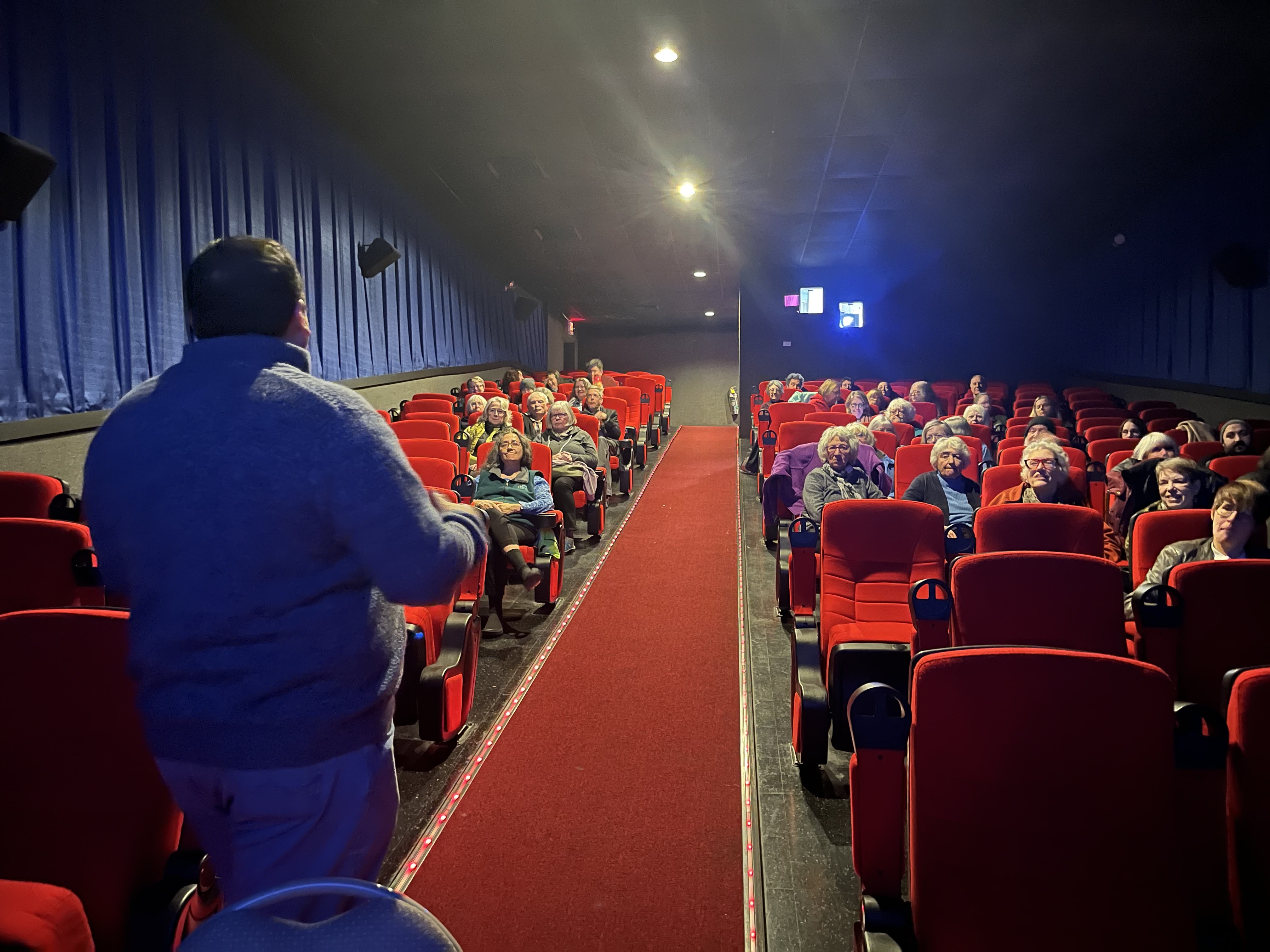
At the Garden: owner/operator Isaac Mass unveils the venue's 2024 schedule of silent films.

Monday, Nov. 6 found me at the Garden Cinema in Greenfield, Mass. to accompany a screening of 'The Scarlet Letter' (1926), starring Lillian Gish, who also starred in the Griffith film shown at Niles.

To my surprise, 'The Scarlett Letter' drew 59 people on a Monday night. Wow! We've been doing silents in Greenfield on and off for a couple of years now, and an audience seems to be developing.

Yesterday afternoon I hauled myself down to Newport, R.I. to accompany a screening of Chaplin's 'The Gold Rush' (1925) at the Jane Pickens Theater.

The film was programmed as part of the town's 'Restaurant/Foodie Week' due primarily to its famous Thanksgiving scene in which Chaplin and co-star Mack Swain consume a shoe.

In introducing the film, I got a big laugh by saying: "The film is a surprising choice for restaurant week because it was inspired in part by cannabilism."

Then, looking at two little girls sitting close by with their parents, I couldn't resist saying into the microphone: "For you young folks, that's people eating other people."

And then I recounted the story of how Chaplin was looking at images of the ill-fated Donner party, etc. 

A bonus at last night's screening was the presence of a photographer on assignment from WBUR-FM, the Boston NPR station. They're doing a piece on me that I believe will air any day now. Stay tuned!

And that brings us to tonight; 'The Three Musketeers' (1921) at 6:30 p.m. at the Flying Monkey Moviehouse and Performance Center (like the candy bar, quite a mouthful). 

Press release is below. See you at the movies. 

*    *    *

All for one and one for all: a scene from 'The Three Musketeers' (1921).

WEDNESDAY, NOV. 1, 2023 / FOR IMMEDIATE RELEASE
Contact Jeff Rapsis • (603) 236-9237 • jeffrapsis@gmail.com

'Three Musketeers' with live music at Flying Monkey on Wednesday, Nov. 8

It's 'all for one and one for all' in classic silent film swashbuckler starring Douglas Fairbanks

PLYMOUTH, N.H.—Long before it became a candy bar in the concession stand, 'The Three Musketeers' was on the big screen as a swashbuckling silent film, a major hit of 1921.

And now, more than a century later, it returns: 'The Three Musketeers' (1921), starring Douglas Fairbanks Sr., will be shown with live music on Wednesday, Nov. 8 at 6:30 p.m. at the Flying Monkey Moviehouse and Performance Center, 39 Main St., Plymouth, N.H.

The program will feature live accompaniment by silent film musician Jeff Rapsis. Admission is $10 per person.

'The Three Musketeers,' adapted from the classic Alexandre Dumas novel and directed by Fred Niblo, is a costume drama set amid palace intrigue in 17th century France.

Fairbanks plays the leading role of D'Artagnan, who after challenging musketeers Athos (Leon Barry), Porthos (George Siegmann) and Aramis (Eugene Pallette) to a duel, joins forces with them in opposition of the scheming Cardinal Richelieu (Nigel De Brulier).

Plotting to discredit Queen Anne (Mary McLaren) in the eyes of her husband King Louis XIII (Adolphe Menjou), Richelieu dispatches Milady de Winter (Barbara La Marr) to pilfer the diamond brooch given by Anne to her British lover, the Duke of Buckingham (Thomas Holding).

Marguerite de la Motte and Douglas Fairbanks, Sr. in 'The Three Musketeers.'

With the help of the lovely Constance (Marguerite de la Motte), D'Artagnan and the Musketeers race against time to retrieve the brooch and save their Queen.

The athletic Douglas Fairbanks's one-handed handspring to grab a sword during a fight scene in 'The Three Musketeers' is considered as one of the great stunts of early cinema.

Critics point to 'The Three Musketeers' as a turning point in Fairbanks' career.

" 'The Three Musketeers' was the first of the grand Fairbanks costume films, filled with exemplary production values and ornamentation," wrote author Jeffrey Vance in 2008. "With 'The Three Musketeers,' he at last found his metier and crystallized his celebrity and his cinema."

Fairbanks, among the most popular stars of the 1920s, was the inspiration for the character of George Valentin in the Oscar-winning Best Picture 'The Artist' (2011). Fairbanks was known for films that used the then-new medium of motion pictures to transport audiences to historical time periods for grand adventures and athletic stunts.

He's often referred to as "Douglas Fairbanks Sr." to avoid confusion with his son, the actor Douglas Fairbanks Jr.

As early as it is, the Fairbanks version of 'Three Musketeers' was not the first big-screen adaptation of the classic Dumas tale. At least a half-dozen earlier versions were filmed in the U.S. and Europe. Over the years, at least 24 different adaptation of the 'Musketeer' saga have been released, attesting to the timeless popularity of Dumas' tale.

Douglas Fairbanks in 'The Three Musketeers' (1921).

Live music for 'The Three Musketeers' will be provided by silent film accompanist Jeff Rapsis, who uses a digital synthesizer to create a traditional full orchestra "movie score" sound.

"Seeing a Fairbanks picture in a theater with live music and an audience is a classic movie experience," Rapsis said.

Rapsis emphasized the unique value of seeing early cinema as it was originally presented.

"These films were designed for the big screen, live music, and large audiences. If you put it all together again, you get a sense of why people first fell in love with the movies," Rapsis said.

'The Three Musketeers' (1921) starring Douglas Fairbanks Sr., will be screened with live music on Wednesday, Nov. 8 at 6:30 p.m. at the Flying Monkey Moviehouse and Performance Center, 39 Main St., Plymouth, N.H.

General admission tickets are $10 at door or in advance by calling the box office at (603) 536-2551 or online at www.flyingmonkeynh.com.

Monday, June 6, 2022

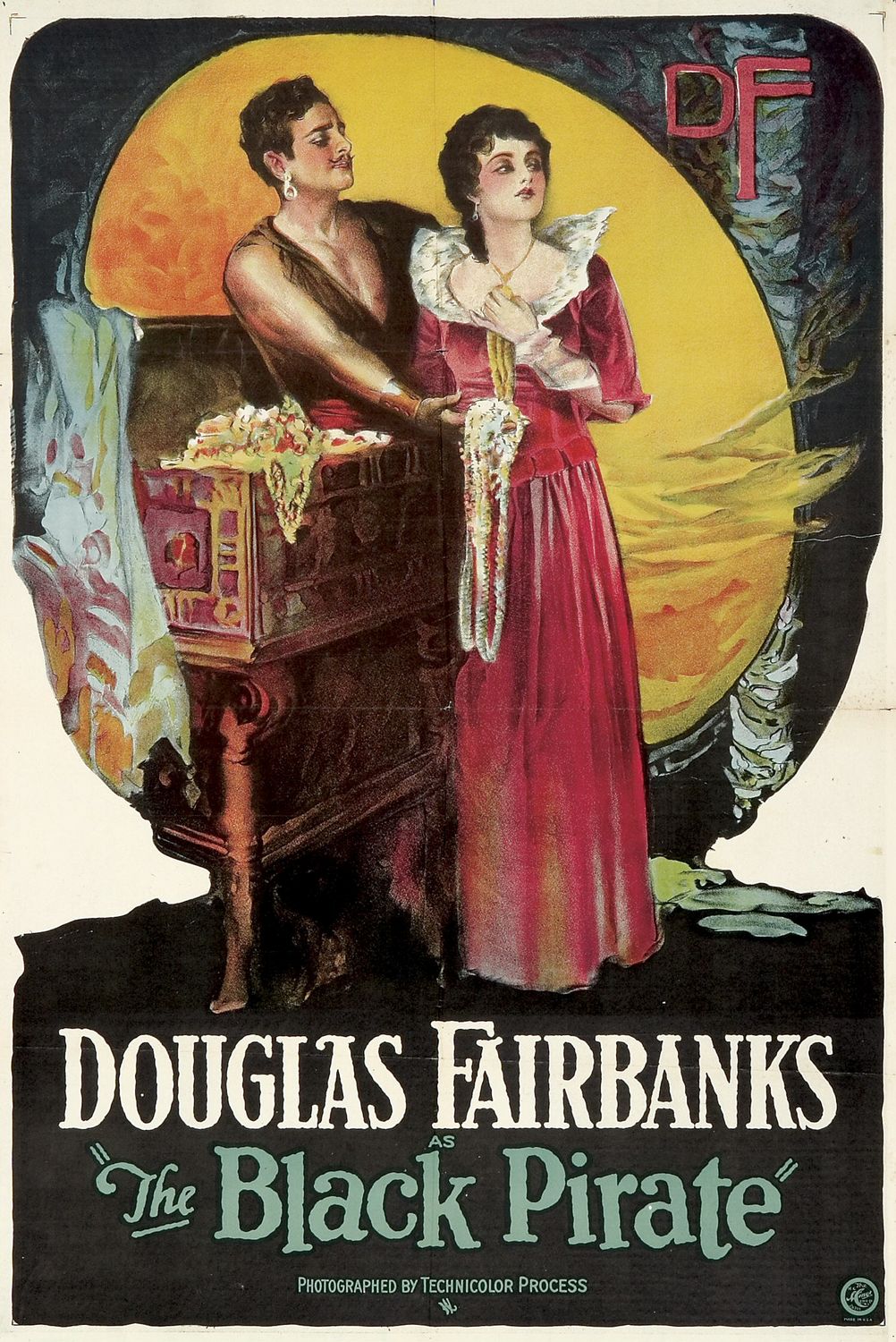
Set sail with Douglas Fairbanks Sr. in 'The Black Pirate' on Wednesday, June 8 in Plymouth, N.H.


I'm back at the keyboard after a twice-postponed visit to London, with a side trip to my old stomping grounds of Glasgow, Scotland.

Next up: music for 'The Black Pirate' (1926) starring Douglas Fairbanks, which is screening on Wednesday, June 8 at 6:30 p.m. at the Flying Monkey Moviehouse and Performance Center in Plymouth, N.H. 

More info and details are in the press release below. First, a few notes from "across the pond," where last week we scored a rare "triple," meaning three West End shows in one day. 

The line-up looked like this: 

- At 2 p.m., a new production of 'My Fair Lady' at the Coliseum on Charing Cross Road.

 - At 5:30 p.m., a cabaret-style revue called 'Six' that features the wives of Henry VIII, and which is playing at the Vaudeville Theatre at the Strand.

 - At 7:30 p.m., the new musical version of 'Back to the Future' that's playing at the Adelphi next door.

We didn't plan on this — it just happened. Tickets were available for all three;  the theaters were close enough for this to work, and there was that unusual 5:30 p.m. matinee of 'Six.'

We even got something to eat between 'Six' (which is just over one hour long) and 'Back to the Future.' 

The last time this happened was way back in the 1990s, when we caught a weird one-man play called 'Anorak of Fire' at an odd time, with a matinee before it and an evening show afterwards. So it's a rare bird indeed.

About 'Back to the Future': what was interesting to me was that even though it was full of new songs, much of the material was drawn from the score that Alan Silvestri composed for the 1985 film. 

There are a couple of really enduring licks in the 'Back to the Future' score, and Silvestri (who also worked on the musical) made the most of them in this stage reinterpretation.

The result was something you don't see very often: a stage musical that heavily relied on strong background music in the same way a movie action sequence might do. (Or, yes, a silent film score!)

This was especially true in the musical's Act 2, when Marty McFly must get the time-traveling DeLorean up to 88 mph just as lightning strikes the town's clock tower.

With no songs, just action and Silvestri's music galloping along, I totally, totally bought into it. And it was the music that did it, I think. 

The time-traveling car may have been powered by plutonium. But the real energy that held everything together and pushed it forward in an edge-of-your-seat frenzy was the score. 

So even though we were watching a stage production in 2022, it reminded me how much the right kind of music can add to a scene or sequence in a movie made in 1922. The challenge (for me, anyway) is to find those moments and make the most of them, and not overdo it at other times.

I'll next get a chance to find the balance this Wednesday, as we set sail with Douglas Fairbanks in 'The Black Pirate' (1926) at the Flying Monkey Moviehouse and Performance Center. 

Press release is below. See you on deck!

 *  *  *

Douglas Fairbanks Sr. buckles some swash in 'The Black Pirate.'
 
TUESDAY, MAY 31, 2022 / FOR IMMEDIATE RELEASE
Contact Jeff Rapsis • (603) 236-9237 • jeffrapsis@gmail.com

Silent film ‘The Black Pirate’ (1926) at Flying Monkey on Wednesday, June 8

Swashbuckling adventure flick stars Douglas Fairbanks, Hollywood’s original action hero; shown with live musical accompaniment

PLYMOUTH, N.H.—He was the Indiana Jones of his day, thrilling early film-goers with amazing stunts and feats of heroic derring-do.

He was Douglas Fairbanks Sr., one of Hollywood’s first megastars, and his timeless charisma can be seen again on Wednesday, June 8 at the Flying Monkey Moviehouse and Performance Center in Plymouth, N.H.

Featured attraction in June for the theater's monthly silent film series is ‘The Black Pirate’ (1926), an epic swashbuckling tale of the high seas that proved one of Fairbanks’ most popular blockbusters. The forerunner of all pirate movies, it was also one of the first Hollywood films to be released in color.

Showtime for 'The Black Pirate' is Wednesday, June 8 at 6:30 p.m. at the Flying Monkey Moviehouse and Performance Center, 39 Main St., Plymouth, N.H. General admission is $10 per person.

The screening, the latest in the Flying Monkey's silent film series, will feature live accompaniment by Jeff Rapsis, a New Hampshire-based composer who specializes in creating scores for silent films.

'The Black Pirate' tells the story of a ship's passenger (Douglas Fairbanks) who survives a pirate raid. Sworn to avenge his dead father, he takes command of the pirates responsible, and secretly strives to free the princess whom they have kidnapped.

Fairbanks, originally a stage actor, broke into films in the industry's early years. By 1920, starring roles in a romantic comedies established Fairbanks as a popular leading man. He then turned to historic adventure films, including ‘The Mark of Zorro’ (1920) and ‘The Three Musketeers’ (1921), which cemented his reputation for on-screen athleticism, heroism, and romance.

In 1920, Fairbanks’ marriage to fellow megastar Mary Pickford was one of the era’s biggest media events and resulted in Hollywood’s first celebrity power couple. They combined their last names to call their estate “Pickfair,” and massive crowds turned out everywhere during the couple’s European honeymoon.

At the peak of his popularity, pictures starring Fairbanks set the standard for Hollywood action adventure films, including such titles as ‘Robin Hood’ (1922), ‘The Thief of Bagdad’ (1924), and ‘The Black Pirate’ (1926), all of which were major box office successes.

When the silent film era ended in 1929, an aging Fairbanks found he was less enthusiastic about the effort required to make movies and retired from the screen. He died in 1939 at age 56 after suffering a heart attack; his now-famous last words were, “I’ve never felt better.”

The Fairbanks feature is the latest in a series of monthly silent film screenings at the Flying Monkey. The series aims to recreate the lost magic of early cinema by assembling the elements needed for silent film to be seen at its best: superior films in best available prints; projection on the big screen; live musical accompaniment; and a live audience.

“These films are still exciting experiences if you show them as they were designed to be screened,” said Rapsis, accompanist for the screenings. “There’s a reason people first fell in love with the movies, and we hope to recreate that spirit.”

For each film, Rapsis improvises a music score using original themes created beforehand. None of the music is written down; instead, the score evolves in real time based on audience reaction and the overall mood as the movie is screened.

‘The Black Pirate’ (1926) starring Douglas Fairbanks Sr. will be shown with live music on Wednesday, June 8 at 6:30 p.m. at the Flying Monkey Moviehouse and Performance Center, 39 Main St., Plymouth, N.H.

Admission is $10 per person. For more info, call (603) 536-2551 or visit www.flyingmonkeynh.com. For more info on the music, visit www.jeffrapsis.com.

Monday, March 14, 2022

Today's puzzler: What happens when you promote 'Smilin' Through' (1922) for St. Patrick's Day but then find out the film is not set in Ireland?

A poster for 'Smilin' Through,' a top box office attraction of 1922.

A few months ago, I scheduled the Norma Talmadge drama 'Smilin' Through' (1922) for this past Sunday in honor of St. Patrick's Day later this week. 

After all, what better way to mark the occasion, and honor my heritage (I'm one quarter Irish!) than a film set in the Emerald Isle?

And that was all great, except there was one little problem—it turned out the film wasn't set in Ireland!

To quote unsuccessful presidential candidate Rick Perry: Oops! 

Yes, a short flashback near the beginning of the film takes place in Ireland. But the bulk of the story happens in Dunstable, England, just north of London. 

I discovered this only after all the press releases had been out, and we'd gotten some nice exposure in the local media, promising everyone a fun and memorable way to mark St. Patrick's Day.

Faith and begorrah—I was off by only a couple of hundred miles!

What to do? Of course I fessed up to yesterday's audience, which was understanding and found the mix-up amusing. No pitchforks or lighted torches were evident. Whew!

But how to make up for this? The screening of 'Smilin' Through' was part of a series we're running celebrating the 100th anniversary of pictures released in 1922. ('Smilin' Through' was the No. 3 box office attraction that year.)

And for some programs, we liven things up with short films, newsreels, and other oddities from the same year.

So for Sunday's program, I took an "All in the Family" approach, inserting a short comedy starring Norma Talmadge's brother-in-law, Buster Keaton.

Lucky for me, one of Keaton's 1922 comedies was 'My Wife's Relations,' which contains a significant quotient of what I would call "Irish ethnic humor," which was fairly common at the time. 

So THAT was how we made good on the St. Patrick's Day crisis: Buster to the rescue!

'Smilin' Through,' although complete sentimental hogwash, proved to be very effective on the big screen. 

You can see why people bought tickets in such quantity in 1922: it's very well put together and has a great multi-hankie uplifting ending.

Ultimately, the film's message is quite dark: for many of us, the only real happiness we will ever experience is in the afterlife. Until then, we have to go "Smilin' Through" our earthly existence, knowing that a better time awaits in the great beyond.

Thinking about it, I'm not so sure I can buy into that whole idea.

Norma Talmadge, one of the silent era's most popular stars—and sister-in-law of Buster Keaton.

But to its credit, 'Smilin' Through' never really asks us to think. It's all about feeling. It's a 90-minute warm bath in emotion and sentiment—and a century after its release, maybe that's something we now need more than ever.

Alas, the film hasn't been reissued or ever been given a decent transfer. Of 1922's top five movies, 'Smilin' Through' proved to be the most difficult to source.

But because the film is public domain, leave it to low budget purveyor Alpha Video to have released the film on DVD as part of their "Lost Silent Classics" series. 

Surprisingly, Alpha's version looked pretty good on the big screen. In the print they used, two stretches showed evidence of serious decomposition, and whites were really blown out in some parts of the transfer. 

But way better than other Alphas I've seen, so we were fortunate it came out so well.

Next up in our 100th anniversary series: starring Douglas Fairbanks Sr., it's 1922 box office champ 'The Adventures of Robin Hood,' which will screen on Sunday, March 27 at the Town Hall Theatre.

Press release below. And with this one, I know it's set in England (mostly), so no geographic slip-ups expected.

*    *    *

Original poster art for 'The Adventures of Robin Hood,' the top-grossing film of 1922.

MONDAY, MARCH 14, 2022 / FOR IMMEDIATE RELEASE
Contact Jeff Rapsis • (603) 236-9237 • jeffrapsis@gmail.com

'Robin Hood' leaps into action at Town Hall Theatre on Sunday, March 27

It's off to Sherwood Forest for the 100th anniversary of legendary silent blockbuster, screened with live music

WILTON, N.H.—He robbed from the rich, gave to the poor, and was the top box office attraction of 1922.

He was Douglas Fairbanks Sr. starring in 'Robin Hood,' the original movie adaptation of the legendary tale.

See it for yourself on the big screen on Sunday, March 27 at 2 p.m. at the Town Hall Theatre in Wilton, N.H., 40 Main St., Wilton, N.H.

Admission is free; a donation of $10 per person is suggested to help defray expenses.

The screening will be accompanied with live music by Jeff Rapsis.

Set in medieval England, 'Robin Hood' tells the tale of the Earl of Huntingdon (Fairbanks), a dashing nobleman who joins King Richard the Lion-Hearted (Wallace Beery) on a Crusade to the Holy Land.

Huntingdon later returns to England to find Richard's cruel brother, Prince John (Sam De Grasse), falsely claiming the throne, enriching his aristocratic cronies and tyrannizing the citizenry.

Huntingdon takes to the woods and becomes 'Robin Hood,' soon joined by a band of merry men who undermine Prince John's reign by robbing from the rich and giving to the poor.

Douglas Fairbanks Sr. in the title role as 'Robin Hood.'

Can Robin Hood and his men vanquish their enemy, the High Sheriff of Nottingham (William Lowery)? And can they rescue Lady Marian Fitzwalter (Enid Bennett), Huntingdon's betrothed, from the evil clutches of Prince John?

Along the way, Fairbanks has ample opportunity to demonstrate his skills in archery, fencing, and acrobatics.

Directed by Allan Dwan, 'Robin Hood' amazed audiences with its enormous sets that recreated in full scale the castles and villages of medieval England.

At a time when $200,000 was a hefty movie budget, 'Robin Hood' cost $1 million to produce.

Directing 'Robin Hood': a big megaphone for a big production.

But the film proved an enormous hit, becoming the top box office attraction of 1922 and earning $2.5 million in its initial release through United Artists, the distribution company Fairbanks formed with fellow stars Charlie Chaplin, D.W. Griffith, and his wife, Mary Pickford.

Fairbanks, among the most popular stars of the 1920s, was the inspiration for the character of George Valentin in the Oscar-winning Best Picture 'The Artist' (2011). Fairbanks was known for films that used the then-new medium of motion pictures to transport audiences to historical time periods for grand adventures and athletic stunts.

He's often referred to as "Douglas Fairbanks Sr." to avoid confusion with his son, the actor Douglas Fairbanks Jr.

Also in the cast for 'Robin Hood' is Alan Hale Sr., who made such an impression at Little John that he was cast in the same role in the 1938 remake starring Errol Flynn. (Hale's son, Alan Hale Jr., played the role of the Skipper on the 1960s television series "Gilligan's Island.")

Live music for 'Robin Hood' will be provided by silent film accompanist Jeff Rapsis, who uses a digital synthesizer to create a traditional full orchestra "movie score" sound.

"Seeing a Fairbanks picture in a theater with live music and an audience is a classic movie experience," Rapsis said.

Rapsis emphasized the value of seeing early cinema as it was originally presented.

"These films were designed for the big screen, live music, and large audiences. Put it all together again, and you get a sense of why people first fell in love with the movies," Rapsis said.

The screening of 'Robin Hood' is part of the Town Hall Theatre's ongoing series honoring the 100th anniversary of significant motion pictures that debuted in 1922.

Programs will include 1922's five highest-grossing titles, each shown on the big screen with live music, as well as century-old oddities, short films, cartoons, and more.

Upcoming programs in the Town Hall's 100th anniversary series include:

• Sunday, April 3, 2022 at 2 p.m.: Chaney/Houdini Double Feature. In 'Flesh and Blood' (1922), escaped convict Lon Chaney hides out in Chinatown and plots revenge. In 'The Man From Beyond' (1922) illusionist Harry Houdini plays an Arctic adventurer frozen for 100 years!

• Sunday, April 17, 2022 at 2 p.m.: Emil Jannings in 'Othello' (1922). The Bard's immortal tragedy brought to the screen in this early German version. Silent Shakespeare in honor of the author's 458th birthday.

'Robin Hood' (1922) starring Douglas Fairbanks Sr., will be screened with live music on Sunday, March 27 at 2 p.m. at the Town Hall Theatre, 40 Main St., Wilton, N.H. Admission is free; a donation of $10 per person is suggested to defray expenses.

For more info, visit www.wiltontownhalltheatre.com or call (603) 654-3456. 

Friday, June 4, 2021

Back in Brandon, Vt. (finally!) with 'Zorro' on Saturday, June 5—and with new seats!

An original promotional poster for 'The Mark of Zorro' (1920). Can you tell who's the star?

Cue music. One year later...

This weekend not only marks the return of Zorro to the big screen, but the return of silent films with live music at Brandon Town Hall in Brandon, Vt.

Yes, we're running the pioneering 1920 action/adventure flick 'The Mark of Zorro' (with music by me) on Saturday, June 5 at Brandon Town Hall. 

Showtime is 7 p.m. More info is available in the press release pasted in below. 

The film was supposed to be the opening night attraction of last year's silent film series, when our intention was to celebrate the 100th anniversary of Zorro's original release.

But a year ago, the pandemic had caused the world to come down with a prolonged case of "silent filmus interruptus," so the screening (and the entire 2020 season) never happened.

Well, now we'll try again. And the return of silent film to Brandon Town Hall is not only a welcome development, it's apparently big news.

Check out this feature on the town's silent film series that aired recently on WCAX-TV out of Burlington, Vt.

One newsworthy aspect of this year's season that didn't make the TV segment is...new chairs!

Yes, the Town Hall is sporting nice new seats for this season, which I'm sure are at least a little more comfortable that the metal folder chairs used previously.

Thanks to everyone at the town hall for all the efforts to keep things going during the past year's prolonged intermission. It'll be great to be back. 

Although Covid-19 is loosening its grip, precautions will still be taken to minimize the risk of those still vulnerable. 

I know they're setting up the new seats in small groups instead of rows to help people keep their distance. Not sure about other things but just want people to be aware.

Here's the press release for 'The Mark of Zorro,' and hope to see you for a full season of silent cinema in Brandon, Vt.!

*  *  *

Douglas Fairbanks Sr. (left) makes with the swordplay in 'The Mark of Zorro' (1920). 

MONDAY, MAY 17, 2021 / FOR IMMEDIATE RELEASE
For more info, contact: Jeff Rapsis • (603) 236-9237 • jeffrapsis@gmail.com

Brandon Town Hall silent film series reboots with 'Zorro' on Saturday, June 5 

Swashbuckling adventure classic starring Douglas Fairbanks to be screened with live music

BRANDON, Vt.— It was the original swashbuckling blockbuster—the film that first brought 'Zorro' to the big screen, and also turned actor Douglas Fairbanks into Hollywood's first-ever action hero.

'The Mark of Zorro' (1920) will once again fill the silver screen, accompanied by live music, on Saturday, June 5 at 7 p.m. at the Brandon Town Hall and Community Center on Main Street in Brandon, Vt.

The screening — the first in this year's Brandon Town Hall silent film series — will feature live accompaniment by Jeff Rapsis, a New Hampshire-based composer who specializes in creating scores for silent films.

Admission is free and open to the public. Donations are gladly accepted, with all proceeds to support ongoing town hall renovations.

The Brandon Town Hall will follow all Covid-19 safety recommendations. Face coverings will be required, social distancing will be followed, and capacity limits will be observed.

For more details on safety precautions, visit www.brandontownhall.com.

'The Mark of Zorro,' a major hit when first released, tells the story of young Don Diego Vega, the son of a wealthy ranch owner in Spanish California of the early 19th century.

Witnessing the mistreatment of the poor by rich landowners and the oppressive colonial government, Don Diego assumes the identity of "Señor Zorro," a masked figure of great cunning and skill, and vows to bring justice to the region.
 
The film stars Douglas Fairbanks Sr., who until 'Zorro' had focused on playing traditional all-American leading roles in romantic comedies.

The success of 'Zorro' launched Fairbanks on a series of historical adventure films that went on to rank among the most popular spectacles of the silent era, including 'The Three Musketeers' (1921) and 'Robin Hood' (1922).

The original 'Zorro' film was so popular it inspired one of Hollywood's first big-budget sequels, 'Don Q, Son of Zorro' (1925), also starring Fairbanks.

Critics have praised 'The Mark of Zorro' for its tight story, fast pace, and exciting action sequences, which include many stunts performed by Fairbanks himself. Steven D. Greydanus of the Decent Films Guide wrote that the silent Zorro "...contains some of the most jaw-dropping stunts I’ve ever seen this side of Jackie Chan."

Film writer Leonard Maltin described 'Zorro' as a "silent classic with Fairbanks as the masked hero...perhaps Doug's best film...nonstop fun!"

This genre-defining swashbuckler was the first movie version of the Zorro legend. The story has since been remade and adapted many times, most recently in 1998 as 'The Mask of Zorro' starring Anthony Hopkins and Antonio Banderas.

'The Mark of Zorro' was the first film released by the newly formed United Artists studio, formed in 1920 by Fairbanks with fellow silent film superstars Mary Pickford, Charlie Chaplin, and director D.W. Griffith.

The silent version of 'Zorro' also played a key role in the formation of the DC Comics Batman character; in the original 1939 story, a young Bruce Wayne sees 'Zorro' on the same night that his parents are later murdered, which leads him to adopt Zorro's mask and cape as a basis for his own transformation into 'Batman.'

The screening of 'Zorro' is sponsored by local residents Gary and Nancy Meffe.

The screening will be accompanied by improvisation-based musical score created live by New Hampshire silent film accompanist Jeff Rapsis. Rapsis achieves a traditional "movie score" sound for silent film screenings by using a digital synthesizer to reproduce the texture of the full orchestra.

Originally set to open in May, this year's silent film series is now starting June for the 2021 season after being cancelled entirely last year due to the coronavirus pandemic.

The May start was pushed back one month out of an abundance of caution regarding Covid-19, said Dennis Marden of Brandon Town Hall.

The opening presentation of 'The Mark of Zorro' (1920) has been moved to Saturday, June 5, while the June screening of Harold Lloyd's classic comedy 'Girl Shy' (1924) is now on Saturday, June 19.

It's the 10th year of the town hall's popular silent film series, which gives residents and visitors a chance to see great movies from the pioneering days of cinema as they were meant to be shown—on the big screen, with an audience, and accompanied by live music.

"It's a real treat to return to Brandon for another season of great silent film," said accompanist Rapsis. "If you've never seen one of these movies in a theater, take a chance and check it out. You might be surprised."

Other films in this year's Brandon Town Hall silent film series include:

• Saturday, June 19, 7 p.m.: 'Girl Shy' (1924) starring Harold Lloyd. Celebrate spring with the original rom-com, a Harold Lloyd gem starring one of the masters of silent comedy and featuring an unforgettable race-to-the-church finish; sponsored by Peter and Louise Kelley, Harold and Jean Somerset.

• Saturday, July 17, 7 p.m.: Planes, Trains and Monty Banks. Rediscover forgotten silent comedian Monty Banks, born "Mario Bianchi" in Italy and who emigrated to America to become a popular 1920s Hollywood star; sponsored by Peter and Louise Kelley, Heritage Family Credit Union, John and Lynn Wilson.

• Saturday, Aug. 7, 7 p.m.: 'Wild Orchids' (1928) starring Greta Garbo. Steamy romantic thriller just in time for the humid doldrums of summer; sponsored by Tracy Holden and Kirk Thomas.

• Saturday, Sept. 18, 7 p.m.: 'Tramp, Tramp, Tramp' (1926) starring Harry Langdon. Rediscover forgotten comedian Harry Langdon in riotous visual comedy about a cross-country foot race; sponsored by Bill and Kathy Mathis in memory of Maxine Thurston.

• Saturday, Oct. 23, 7 p.m.: 'Hunchback of Notre Dame' (1923) starring Lon Chaney. Victor Hugo's classic novel about a deformed bellringer in medieval Paris, filled with classic scenes and capped with a thrilling climax; sponsored by Harold and Jean Somerset, Kathy and Wayne Rausenberger, Pat Hanson, and Brian and Stephanie Jerome.

• Saturday, Nov. 13, 7 p.m.: 'College' (1927) starring Buster Keaton. Head back to school with Buster, a bumbling freshman who discovers sports is the only sure-fire route to popularity; sponsored by Lucy and Dick Rouse, Edward Loedding and Dorothy Leysath, Sam and Sharon Glaser, Peter and Louise Kelley, Bar Harbor Bank and Trust.

See Douglas Fairbanks in the groundbreaking action/adventure 'The Mark of Zorro' (1920), to be shown on Saturday, June 5 at 7 p.m. at the Brandon Town Hall and Community Center, Route 7, in Brandon, Vt. All are welcome to this family-friendly event. Admission is free, with free will donations accepted in support of ongoing Town Hall renovations.

For more information and the latest updates on Covid-19 safety protocols at the Town Hall, visit www.brandontownhall.com. For more about the music, visit www.jeffrapsis.com.

Monday, August 31, 2020

The end of August, a very good month;
next up, Buster Keaton double feature on 9/20

Douglas Fairbanks Sr. protects the honor of Marguerite De La Motte in 'The Mark of Zorro' (1920).

This past weekend's double feature of 'The Mark of Zorro' (1920) and its sequel, 'Don Q, Son of Zorro' (1925), marked the end of a surprisingly busy month of silent film screenings. 

Altogether, August brought a total of 11 screenings, which is about on pace with what the performance schedule looks like in non-pandemic times. That's heartening, because the calendar was pretty much empty from March through July.

The bulk of these shows were at the Town Hall Theatre in Wilton, N.H., which gave up on first-run films (due to low attendance) and programmed an entire week of silent comedies, which actually did quite well!

The Zorro double feature was planned a long time ago to honor the 100th anniversary of the first film's 1920 release. Showing Zorro and its sequel back-to-back turned out to be a great ending for our summer series of silent swashbucklers starring Douglas Fairbanks Sr.

In accompanying both films, I challenged myself to come up with different musical material for each movie. After all, they're set in different places and involve a completely different story and characters. Only when the older Zorro appears in 'Don Q' did I let myself reuse some of the music from the earlier film.

This turned out to be pretty effective. After Sunday's screening of 'Don Q,' a women I'd never met before came up to say she really enjoyed how I brought back Saturday's music for Don Q's father, the original Zorro. Wow, someone noticed!

So in August, the Town Hall Theatre was where more than half the screenings took place, mostly due to the week of silent comedies. This counter-programming got another write-up in Box Office Pro, in case you're interested.

But I also had screenings at the Flying Monkey Moviehouse up in Plymouth, N.H., which has also reopened, plus the Center for the Arts in Natick, Mass., my first show south of the border since Covid-19 shut everything down earlier this year.

Things quiet back down considerably in September: just a few screenings at the end of the month, with still no action at regular venues such as the Brandon Town Hall in Brandon, Vt. or the Leavitt Theatre in Ogunquit, Maine or the Somerville Theatre in Somerville, Mass., all of which remain closed.  

Even Halloween — normally the busiest time of the year for me — looks pretty bleak, with just a handful of screenings on the calendar. You'd think it would be a good year for Nosferatu (1922), with its plague references. 

I might reach out to some venues that are open but not known for running silents and see if they'll try something different. The screenings I've done recently shows people will turn out. So we'll see.

For now, thanks to everyone at the theaters who have tried to make a go of it. Even in the age of limited capacities and social distancing, we've had some good screenings that successfully recreated the silent cinema experience.

Next up: nothing until a Keaton double feature at the Town Hall Theatre in Wilton, N.H. on Sunday, Sept. 20, although that could change. For now, here's the press release with all the details. Hope to see you there!

*    *    * 

Original promotional art for 'The Cameraman' starring Buster Keaton.

MONDAY, AUG. 31, 2020 / FOR IMMEDIATE RELEASE
Contact Jeff Rapsis • (603) 236-9237 • jeffrapsis@gmail.com

Buster Keaton double feature at Town Hall Theatre on Sunday, Sept. 20

Silent film comedy classics return to the big screen with live musical accompaniment; venue following procedures to be Covid-19 compliant

WILTON, N.H.—He never smiled on camera, earning him the nickname of "the Great Stone Face." But Buster Keaton's comedies rocked Hollywood's silent era with laughter throughout the 1920s.

See for yourself with a screening of 'Sherlock Jr.' (1924) and 'The Cameraman' (1928), two of Keaton's landmark feature films, on Sunday, Sept. 20 at 2 p.m. at the Town Hall Theatre, 40 Main St., Wilton, N.H.

The screening, the latest in the Town Hall Theatre's silent film series, will feature live accompaniment by Jeff Rapsis, a New Hampshire-based composer who specializes in creating music for silent films.

Admission is free; a donation of $10 per person is suggested to help defray expenses.

The Town Hall Theatre is observing procedures to comply with all state and CDC public health guidelines, including reduced seating capacity. For complete information about safety protocols, visit www.wiltontownhalltheatre.com

In 'Sherlock Jr.,' Buster plays a small-town movie projectionist who dreams of working as a detective. But then Buster's romantic rival frames him for stealing a watch from his girlfriend's father.

Fortunately, the situation mirrors the plot of the movie currently playing at Buster's theater. Inspired by the movie, can Buster find the real thief and win back his girl?

'The Cameraman' tells the story of a young man (Keaton) who tries to impress the girl of his dreams (Marceline Day) by working as a freelance newsreel cameraman.

His efforts fail spectacularly, but then a lucky break gives him an unexpected chance to make his mark. Can Buster parlay the scoop of the year into a secure job and successful romance?

Both films focus on exploring the potentials of the motion picture, then a brand-new medium.

In 'The Cameraman,' Keaton uses the movie business itself to create comedy that plays with the nature of film and reality.

Keaton, along with Charlie Chaplin and Harold Lloyd, stands as one of the three great clowns of the silent screen. Many critics regard Keaton as the most timeless; Roger Ebert wrote in 2002 that "in an extraordinary period from 1920 to 1929, (Keaton) worked without interruption on a series of films that make him, arguably, the greatest actor-director in the history of the movies."

As a performer, Keaton was uniquely suited to the demands of silent comedy. Born in 1895, he made his stage debut as a toddler, joining his family's knockabout vaudeville act and learning to take falls and do acrobatic stunts at an early age. He spent his entire childhood and adolescence on stage, attending school for exactly one day.

A remarkable pantomime artist, Keaton naturally used his whole body to communicate emotions ranging from sadness to surprise. In an era when movies had few special effects, Keaton's acrobatic talents enabled him to perform all his own stunts.

All those talents are on display in 'Sherlock Jr.' and 'The Cameraman,' which was selected in 2005 for preservation in the U.S. National Film Registry by the Library of Congress as being "culturally, historically, or aesthetically significant."

"These films are audience favorites, and people continue to be surprised at how engrossing and exhilarating they can be when shown as they were intended: in a theater, and with live music," said Rapsis, who accompanies more than 100 screenings each year at venues around the nation and abroad.

Rapsis, who lives in Bedford, N.H., improvises live scores for silent films using a digital synthesizer to recreate the texture of the full orchestra.

"It's kind of a high wire act," Rapsis said. "But for me, the energy of live performance is an essential part of the silent film experience."

'Sherlock Jr.' (1924) and 'The Cameraman' (1928) will be shown with live music on Sunday, Sept. 20 at 2 p.m. at the Town Hall Theatre, 40 Main St., Wilton, N.H. Admission is free; a donation of $10 per person is suggested. For more information, call (603) 654-3456 of visit www.wiltontownhalltheatre.com.


Wednesday, July 29, 2020

Douglas Fairbanks Sr. to the rescue!
Next up in Wilton, N.H.: 'Robin Hood' (1922)

Douglas Fairbanks Sr. as 'Robin Hood': robbing the the rich, giving to the poor, and saving local independent cinemas!

And now, news from the front lines of small independent cinemas.

Last week, the Town Hall Theatre of Wilton, N.H. stopped playing first-run movies or new releases.

Why? Lack of films, and also lack of film-goers.

Thanks to the coronavirus, Hollywood is holding back a lot of what's in the pipeline. Or, in the case of 'Hamilton,' bypassing theaters and going direct to streaming.

And theater-goers are staying away, due to the lack of on-screen excitement and also over lingering fears of joining strangers in close proximity for two hours or more.

For the Town Hall Theatre, an independent movie house that reopened in early July after a four-month closure, it's an equation that doesn't add up.

Dennis Markaverich, longtime owner/operator of the Town Hall Theatre, took every precaution prior to reopening, implementing procedures to follow all public health guidelines to the letter.

The Town Hall Theatre's main screening room, which normally seats 216 but is limited to 50 percent capacity, or 108.

But since opening in early July (after a four-month closure due to N.H.'s stay-at-home order), attendance has been abysmal. On many evenings, not a single person showed up for the films on his two screens.

I was there one night and the grand total for both theaters was one person. I got to hear Dennis report the evening's box office by phone, which he announced grandly:

"Tonight, five, as in five dollars. That's one senior admission!"

Well, you can't run a theater without movies and without movie-goers. So last week, Dennis reluctantly went back into what he calls "intermission mode," ceasing the screening of first-run films until better conditions prevail. That might be Labor Day weekend, but could be longer.

The one exception to the pattern has been the Town Hall's silent film series, which also restarted in early July when the theater reopened. On the program: a summertime series of silent swashbucklers (say that five times fast) starring Douglas Fairbanks Sr.!

Our first title, 'The Thief of Bagdad' (1924), brought in about 30 people. Our next one, Fairbanks in 'The Three Musketeers' (1921), had 50 people attend. Wow, a box office record!

Both Dennis and I remarked on the irony: even as today's Hollywood leaves independent theaters in the lurch, yesterday's Hollywood could outdraw today's product and still save the day at the box office. Douglas Fairbanks to the rescue!

So even though first-run films are on pause, the "Silent Film Sunday" series will continue with our Douglas Fairbanks swashbuckler series.

Next up is 'Robin Hood' (1922), to be screened on Sunday, Aug. 9 at 2 p.m. with live music by me. More details in the press release below.

And after that, we're cooking up something special: a whole week of silent film comedy to fill the void left by Hollywood's first-run failure.

More on that in a bit. For now, check your calendar and hope you can join us on Sunday, Aug. 9 as we travel back to medieval England and Sherwood Forest with Douglas Fairbanks Sr. in 'Robin Hood.'

* * *

Douglas Fairbanks plays the title role in 'Robin Hood' (1922).
TUESDAY, JULY 28, 2020 / FOR IMMEDIATE RELEASE
Contact Jeff Rapsis • (603) 236-9237 • jeffrapsis@gmail.com

'Robin Hood' leaps into action at Town Hall Theatre on Sunday, Aug. 9


It's off to Sherwood Forest as Douglas Fairbanks summer swashbuckler series continues, with live music

WILTON, N.H.—He robbed from the rich, gave to the poor, and was the top box office attraction of 1922.

He was Douglas Fairbanks Sr. starring in 'Robin Hood,' the original blockbuster movie adaptation of the legendary tale.

See it for yourself on the big screen on Sunday, Aug. 9 at 2 p.m. at the Town Hall Theatre in Wilton, N.H., 40 Main St., Wilton, N.H.

Admission is free; a donation of $10 per person is suggested to help defray expenses.

The screening will be accompanied with live music by Jeff Rapsis.

It's part of a summer season of silent swashbucklers starring the charismatic Fairbanks, one of early cinema's most popular stars.

Set in medieval England, 'Robin Hood' tells the tale of the Earl of Huntingdon (Fairbanks), a dashing nobleman who joins King Richard the Lion-Hearted (Wallace Beery) on a Crusade to the Holy Land.

Huntingdon later returns to England to find Richard's cruel brother, Prince John (Sam De Grasse), falsely claiming the throne, enriching his aristocratic cronies and tyrannizing the citizenry.

Enid Bennett as Lady Marian and Douglas Fairbanks playing the title role in 'Robin Hood' (1922).

Huntingdon takes to the woods and becomes 'Robin Hood,' soon joined by a band of merry men who undermine Prince John's reign by robbing from the rich and giving to the poor.

Can Robin Hood and his men vanquish their enemy, the High Sheriff of Nottingham (William Lowery)? And can they rescue Lady Marian Fitzwalter (Enid Bennett), Huntingdon's betrothed, from the evil clutches of Prince John?

Along the way, Fairbanks has ample opportunity to demonstrate his skills in archery, fencing, and acrobatics.

Directed by Allan Dwan, 'Robin Hood' amazed audiences with its enormous sets that recreated in full scale the castles and villages of medieval England.

At a time when $200,000 was a hefty movie budget, 'Robin Hood' cost $1 million to produce.

Douglas Fairbanks Sr. (center) and Allan Dwan directing scenes from 'Robin Hood' (1922).

But the film proved an enormous hit, becoming the top box office attraction of 1922 and earning $2.5 million in its initial release through United Artists, the distribution company Fairbanks formed with fellow stars Charlie Chaplin, D.W. Griffith, and his wife, Mary Pickford.

Fairbanks, among the most popular stars of the 1920s, was the inspiration for the character of George Valentin in the Oscar-winning Best Picture 'The Artist' (2011). Fairbanks was known for films that used the then-new medium of motion pictures to transport audiences to historical time periods for grand adventures and athletic stunts.

He's often referred to as "Douglas Fairbanks Sr." to avoid confusion with his son, the actor Douglas Fairbanks Jr.

Also in the cast for 'Robin Hood' is Alan Hale Sr., who made such an impression at Little John that he was cast in the same role in the 1938 remake starring Errol Flynn. (Hale's son, Alan Hale Jr., played the role of the Skipper on the 1960s television series "Gilligan's Island.")

Live music for 'Robin Hood' will be provided by silent film accompanist Jeff Rapsis, who uses a digital synthesizer to create a traditional full orchestra "movie score" sound.

"Seeing a Fairbanks picture in a theater with live music and an audience is a classic movie experience," Rapsis said.

Original promotional art for 'Robin Hood' (1922).

Rapsis emphasized the unique value of seeing early cinema as it was originally presented.

"These films were designed for the big screen, live music, and large audiences. Put it all together again, and you get a sense of why people first fell in love with the movies," Rapsis said.

'Robin Hood' continues a summer season of silent swashbucklers at the Town Hall Theatre, all starring Douglas Fairbanks. The series will conclude with a special Saturday/Sunday screening of 'The Mark of Zorro' (1920) and its sequel, 'Don Q, Son of Zorro' (1925) on the last weekend of August:

• Saturday, Aug. 29 at 2 p.m. 'The Mark of Zorro' (1920) starring Douglas Fairbanks, Sr. 100th anniversary of the break-through adventure film where Fairbanks discovered his talent for playing swashbuckling heroes of yore. Still pleasing crowds a century after it first hit theaters!

• Sunday, Aug. 30 at 2 p.m.: 'Don Q, Son of Zorro' (1925) starring Douglas Fairbanks, Sr. Action/adventure sequel to mega-hit 'Zorro' with Fairbanks playing both son and father, and having a ball in both roles. Builds on the original film to create a hugely entertaining swashbuckler that shows how far Hollywood had come in just five years.

For all screenings, accommodations will be made to keep Town Hall Theatre patrons safe in the Covid-19 era. Also, seating will be arranged to observe social distancing and masks will be required inside the theater until patrons are seated.

'Robin Hood' (1922) starring Douglas Fairbanks Sr., will be screened with live music on Sunday, Aug. 9 at 2 p.m. at the Town Hall Theatre, 40 Main St., Wilton, N.H. Admission is free; a donation of $10 per person is suggested to defray expenses.

For more info, visit www.wiltontownhalltheatre.com or call (603) 654-3456.