Thursday, November 9, 2023

Slow news day! Boston's WBUR-FM runs piece on my silent film accompaniment work; plus: 'Wings' in Brattleboro, Vt. on Friday, Nov. 10

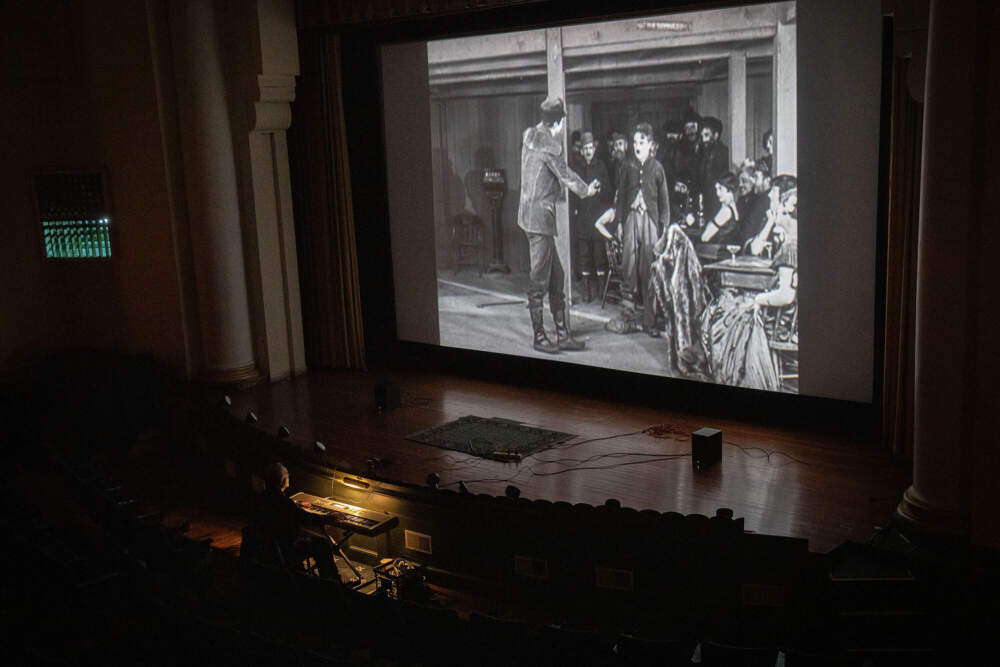
Accompanying 'The Gold Rush' at the Jane Pickens Theater in Newport, R.I. Photo by Robin Lubbock /WBUR 90.9 FM.

I want to thank Amelia Mason of WBUR 90.0 FM in Boston for all the effort that went into putting together a story about me that aired today during Morning Edition.

Amelia took the trouble to come all the way down to Newport for a recent screening of 'Phantom of the Opera' (1925) that I accompanied there. 

We talked a great deal, and she was somehow able to edit my rambling into a coherent story. 

She also got me talking about my larger life journey—about how I chose not to pursue music in college, but then came back to it decades later via silent film accompaniment.

Two weeks later, WBUR photographer Robin Lubbock came down to the same venue to photograph me doing music for the 1925 version of Chaplin's 'The Gold Rush.'

It's not easy to get usable images from inside a darkened theatre. Photo by Robin Lubbock /WBUR 90.9 FM. 

The result was a piece that went beyond the usual "live music for old movies" angle and instead explored how a person (me!) unexpectedly discovered a mid-life outlet for creative energy. 

So thanks to Amelia and Robin and all their colleagues at WBUR for taking time to put together a wonderful piece. Although the focus was on me, I hope it helps raise awareness for vintage cinema and all the people and venues that keep it before the public.

Here's a link to the audio file:

https://dcs-spotify.megaphone.fm/BUR9058007314.mp3

And here's a link to the online piece, which has significant differences from the radio story:

https://www.wbur.org/news/2023/11/09/silent-film-music-composer-jeff-rapsis

And as an added bonus, they spelled my name right! You'd be surprised how often that doesn't happen.


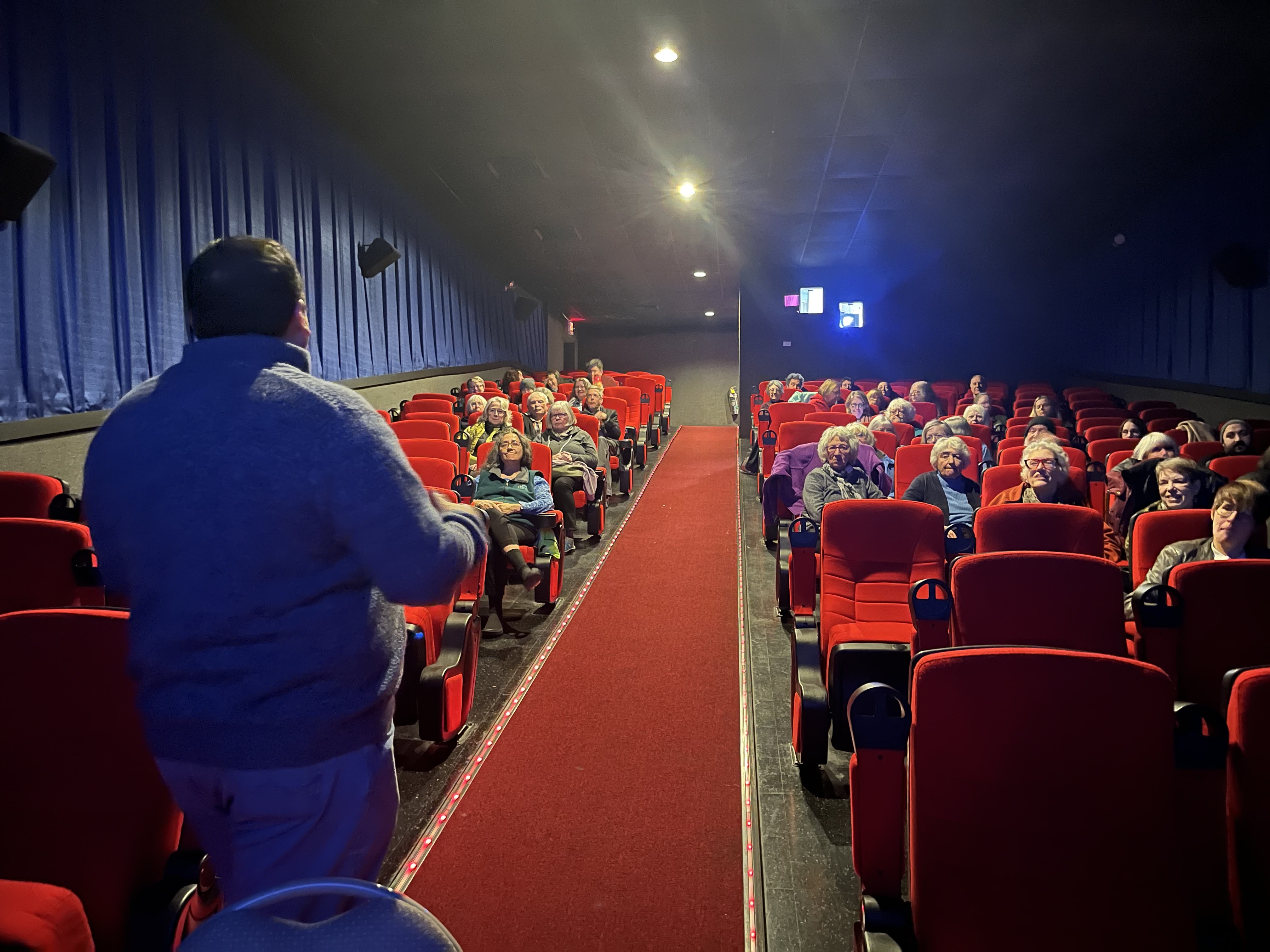
Me at the Jane Pickens Theater in Newport, R.I. Photo by Robin Lubbock /WBUR 90.9 FM

Today is a "day off" from silent film accompaniment, which I need because starting tomorrow it's four shows in three days—mostly screenings designed to salute Veterans Day, which is Saturday, Nov. 11.

After I do 'Wings' (1927) on Friday night in Brattleboro, Vt., then it's a 'two-fer' on Saturday: at 2 p.m., program of comedies at the Residence at Otter Creek, a retirement community in Middlebury, Vt., then at 7 p.m. it's 'The Big Parade' (1925) at 7 p.m. at Brandon (Vt.) Town Hall.

The weekend concludes with another 'Big Parade,' this one on Sunday, Nov. 12 at 2 p.m. at the Somerville Theatre in Davis Square, Somerville.

 The Somerville screening will be via a 35mm print from the Library of Congress. I've accompanied this print before and it's truly gorgeous. 

But next up: 'Wings' (1927) on Friday, Nov. 10 at 7:30 p.m. at Epsilon Spires, Brattleboro, Vt.

More info and details in the press release below. See you at the movies!

*     *     *

An original poster for Paramount's 'Wings' (1927).

SATURDAY, NOV. 4, 2023 / FOR IMMEDIATE RELEASE
Contact Jeff Rapsis • (603) 236-9237 • jeffrapsis@gmail.com

Epic silent film 'Wings' (1927) on Friday, Nov. 10 at Brattleboro's Epsilon Spires

Story of U.S. aviators in World War I won first-ever 'Best Picture'; screening to feature live organ accompaniment

BRATTLEBORO, Vt.—It won 'Best Picture' at the very first Academy Awards, with spectacular midair flying sequences and a dramatic story that still mesmerizes audiences today.

'Wings' (1927), a drama about U.S. pilots in the skies over Europe during World War I, will be shown with live music on Friday, Nov. 10 at 7:30 p.m. at Epsilon Spires, 190 Main St., Brattleboro, Vt.

Admission is $20 per person, with all veterans admitted free in honor of Veterans Day. Tickets may be purchased in advance at www.epsilonspires.org or at the door. Doors open at 7 p.m.

The screening will feature live accompaniment on the venue's Estey pipe organ by Jeff Rapsis, a New Hampshire-based silent film musician.

The show will allow audiences to experience 'Wings' the way its makers originally intended: on the big screen, with live music, and with an audience.

'Wings,' a blockbuster hit in its original release, recounts the adventures of U.S. pilots flying combat missions behind enemy lines at the height of World War I in Europe. 'Wings' stunned audiences with aerial dogfight footage, vivid and realistic battle scenes, and dramatic love-triangle plot.

'Wings' stars Clara Bow, Charles 'Buddy' Rogers, and Richard Arlen. The rarely-seen film also marked one of the first screen appearances of Gary Cooper, who plays a supporting role. 
 
Buddy Rogers, Gary Cooper, and Richard Arlen in 'Wings' (1927).

Directed by William Wellman, 'Wings' was lauded by critics for its gripping story, superb photography, and technical innovations.


'Wings' is notable as one of the first Hollywood films to take audiences directly into battlefield trenches and vividly depict combat action. Aviation buffs will also enjoy 'Wings' as the film is filled with scenes of vintage aircraft from the early days of flight.

Seen today, the film also allows contemporary audiences a window into the era of World War I, which was fought in Europe from 1914 to 1918.

" 'Wings' is not only a terrific movie, but seeing it on the big screen is also a great chance to appreciate what earlier generations of servicemen and women endured," accompanist Jeff Rapsis said.

"It's a war that has faded somewhat from our collective consciousness, but it defined life in the United States for a big chunk of the 20th century. This film captures how World War I affected the nation, and also shows in detail what it was like to serve one's country a century ago."

Rapsis, a composer who specializes in film music, will create a score for 'Wings' on the spot, improvising the music as the movie unfolds to enhance the on-screen action as well as respond to audience reactions. Rapsis performs the music on a digital synthesizer, which is capable of producing a wide range of theatre organ and orchestral textures.

"Live music was an integral part of the silent film experience," Rapsis said. "At the time, most films weren't released with sheet music or scores. Studios relied on local musicians to come up with an effective score that was different in every theater. At its best, this approach created an energy and a connection that added a great deal to a film's impact. That's what I try to recreate," Rapsis said.

'Wings' runs about 2½ hours and will be shown with one intermission. The film is a family-friendly drama but not suitable for very young children due to its length and intense wartime battle scenes.

‘Wings’ (1927) starring Clara Bow, Buddy Rogers and Richard Arlen will be shown with live music in honor of Veterans Day on Friday, Nov. 10 at 7:30 p.m. at Epsilon Spires, 190 Main St., Brattleboro, Vt.

Admission is $20 per person, with all veterans receiving free admission. Tickets may be purchased in advance at www.epsilonspires.org or at the door. Doors open at 7 p.m.

Wednesday, November 8, 2023

Tonight in Plymouth, N.H.! All for one, one for all in 'The Three Musketeers' (1921) with live music

The original 'Three Musketeers' candy bar, introduced in 1932, contained three sections of flavoured nougat: one vanilla, one chocolate, and one strawberry, hence the name. The bar went all chocolate in 1945, but the name stayed the same.

I dare say it's one of the best opening sentences of any press release I've issued:

PLYMOUTH, N.H.—Long before it became a candy bar in the concession stand, 'The Three Musketeers' was on the big screen as a swashbuckling silent film, a major hit of 1921.

You won't get that in a press release from an AI chatbot no matter how generative its intelligence. 

Yes, tonight (Wednesday, Nov. 7) brings a screening of the early Douglas Fairbanks swashbuckler, with live music by me. Showtime is at 6:30 p.m.; lots more info about the film is in the press release pasted in below. 

First, a quick round-up of recent gigs.

Saturday, Nov. 4 saw my first post-pandemic appearance at the Niles Essanay Silent Film Museum, where they run silent film programs with live music every weekend all year round.

I've enjoyed helping out when I'm out there, and it was great to return and reconnect with everyone.

The evening's feature was the 1925 version of 'Raffles the Amateur Cracksman,' with actor House Peters in the title role. Yes, it's about crime, but the trick with a film like this, which at its heart is light-hearted, is to treat it very lightly.

That's what I did: mostly light cocktail/dance music, but always to underscore the action, highlight any emotional subtext (of which there was little), and keep things skipping along.

'Raffles' was preceded by two shorts: the 1912 Griffith classic 'The Musketeers of Pig Alley' (hey, there's that Musketeers theme again!) plus a Stan Laurel solo comedy. 

We were fortunate in that one person in the audience was a big and easy laugher. All it takes in one of these to help loosen up an audience, and that's what happened Saturday night in Niles. With one fearless soul leading the way, everyone else had permission to laugh.

At the Garden: owner/operator Isaac Mass unveils the venue's 2024 schedule of silent films.

Monday, Nov. 6 found me at the Garden Cinema in Greenfield, Mass. to accompany a screening of 'The Scarlet Letter' (1926), starring Lillian Gish, who also starred in the Griffith film shown at Niles.

To my surprise, 'The Scarlett Letter' drew 59 people on a Monday night. Wow! We've been doing silents in Greenfield on and off for a couple of years now, and an audience seems to be developing.

Yesterday afternoon I hauled myself down to Newport, R.I. to accompany a screening of Chaplin's 'The Gold Rush' (1925) at the Jane Pickens Theater.

The film was programmed as part of the town's 'Restaurant/Foodie Week' due primarily to its famous Thanksgiving scene in which Chaplin and co-star Mack Swain consume a shoe.

In introducing the film, I got a big laugh by saying: "The film is a surprising choice for restaurant week because it was inspired in part by cannabilism."

Then, looking at two little girls sitting close by with their parents, I couldn't resist saying into the microphone: "For you young folks, that's people eating other people."

And then I recounted the story of how Chaplin was looking at images of the ill-fated Donner party, etc. 

A bonus at last night's screening was the presence of a photographer on assignment from WBUR-FM, the Boston NPR station. They're doing a piece on me that I believe will air any day now. Stay tuned!

And that brings us to tonight; 'The Three Musketeers' (1921) at 6:30 p.m. at the Flying Monkey Moviehouse and Performance Center (like the candy bar, quite a mouthful). 

Press release is below. See you at the movies. 

*    *    *

All for one and one for all: a scene from 'The Three Musketeers' (1921).

WEDNESDAY, NOV. 1, 2023 / FOR IMMEDIATE RELEASE
Contact Jeff Rapsis • (603) 236-9237 • jeffrapsis@gmail.com

'Three Musketeers' with live music at Flying Monkey on Wednesday, Nov. 8

It's 'all for one and one for all' in classic silent film swashbuckler starring Douglas Fairbanks

PLYMOUTH, N.H.—Long before it became a candy bar in the concession stand, 'The Three Musketeers' was on the big screen as a swashbuckling silent film, a major hit of 1921.

And now, more than a century later, it returns: 'The Three Musketeers' (1921), starring Douglas Fairbanks Sr., will be shown with live music on Wednesday, Nov. 8 at 6:30 p.m. at the Flying Monkey Moviehouse and Performance Center, 39 Main St., Plymouth, N.H.

The program will feature live accompaniment by silent film musician Jeff Rapsis. Admission is $10 per person.

'The Three Musketeers,' adapted from the classic Alexandre Dumas novel and directed by Fred Niblo, is a costume drama set amid palace intrigue in 17th century France.

Fairbanks plays the leading role of D'Artagnan, who after challenging musketeers Athos (Leon Barry), Porthos (George Siegmann) and Aramis (Eugene Pallette) to a duel, joins forces with them in opposition of the scheming Cardinal Richelieu (Nigel De Brulier).

Plotting to discredit Queen Anne (Mary McLaren) in the eyes of her husband King Louis XIII (Adolphe Menjou), Richelieu dispatches Milady de Winter (Barbara La Marr) to pilfer the diamond brooch given by Anne to her British lover, the Duke of Buckingham (Thomas Holding).

Marguerite de la Motte and Douglas Fairbanks, Sr. in 'The Three Musketeers.'

With the help of the lovely Constance (Marguerite de la Motte), D'Artagnan and the Musketeers race against time to retrieve the brooch and save their Queen.

The athletic Douglas Fairbanks's one-handed handspring to grab a sword during a fight scene in 'The Three Musketeers' is considered as one of the great stunts of early cinema.

Critics point to 'The Three Musketeers' as a turning point in Fairbanks' career.

" 'The Three Musketeers' was the first of the grand Fairbanks costume films, filled with exemplary production values and ornamentation," wrote author Jeffrey Vance in 2008. "With 'The Three Musketeers,' he at last found his metier and crystallized his celebrity and his cinema."

Fairbanks, among the most popular stars of the 1920s, was the inspiration for the character of George Valentin in the Oscar-winning Best Picture 'The Artist' (2011). Fairbanks was known for films that used the then-new medium of motion pictures to transport audiences to historical time periods for grand adventures and athletic stunts.

He's often referred to as "Douglas Fairbanks Sr." to avoid confusion with his son, the actor Douglas Fairbanks Jr.

As early as it is, the Fairbanks version of 'Three Musketeers' was not the first big-screen adaptation of the classic Dumas tale. At least a half-dozen earlier versions were filmed in the U.S. and Europe. Over the years, at least 24 different adaptation of the 'Musketeer' saga have been released, attesting to the timeless popularity of Dumas' tale.

Douglas Fairbanks in 'The Three Musketeers' (1921).

Live music for 'The Three Musketeers' will be provided by silent film accompanist Jeff Rapsis, who uses a digital synthesizer to create a traditional full orchestra "movie score" sound.

"Seeing a Fairbanks picture in a theater with live music and an audience is a classic movie experience," Rapsis said.

Rapsis emphasized the unique value of seeing early cinema as it was originally presented.

"These films were designed for the big screen, live music, and large audiences. If you put it all together again, you get a sense of why people first fell in love with the movies," Rapsis said.

'The Three Musketeers' (1921) starring Douglas Fairbanks Sr., will be screened with live music on Wednesday, Nov. 8 at 6:30 p.m. at the Flying Monkey Moviehouse and Performance Center, 39 Main St., Plymouth, N.H.

General admission tickets are $10 at door or in advance by calling the box office at (603) 536-2551 or online at www.flyingmonkeynh.com.

Wednesday, November 1, 2023

Monday, Nov. 6: Lillian Gish plus some Puritan-era hanky panky in 'The Scarlet Letter' (1926)

An original lobby card promoting Lillian Gish in 'The Scarlet Letter' (1926).

With Halloween in the rear view mirror, time for a break from the annual marathon of spooky silent film screenings. 

But not for long! 

The pace resumes again on Monday, Nov. 6, when I'll accompany the MGM's big-budget adaptation of 'The Scarlet Letter' (1926) at the Garden Cinemas in Greenfield, Mass. 

Showtime is 6:30 p.m. Lots more info about the film and the screening is in the press release pasted at the end of this post.

Then on Tuesday, it's Chaplin's 'The Gold Rush' (1925) in Newport, R.I., then 'The Three Musketeers' (1921) in Plymouth, N.H., then a total of four shows on the weekend around Veterans Day, including three biggies: one 'Wings' (1927) and two screenings of 'The Big Parade' (1925).

But before any of that, this weekend I have the privilege of sitting in as accompanist at the Niles Essanay Silent Film Museum in Niles, Calif. 

On Saturday, Nov. 4, I'll do live music for a program highlighted by the 1925 feature film 'Raffles, the Amateur Cracksman.' 

By the way, what a film this is for names. It stars "House Peters," which sounds like a name out of Monty Python's Flying Circus. And it's directed by "King Baggot," who was actually quite a big name in early cinema. 

The cast also includes Hedda Hopper and stalwart character actor Walter Long, a New Hampshire native.

It's the first time since the pandemic that I've gone out to Niles, which is in on the east side of San Francisco Bay, about halfway between Oakland and San Jose.

Prior to everything shutting down, I'd generally go out there twice a year to accompany programs. It's the only venue I know of that runs silent film programs each week all year round, so it's worth the pilgrimage to do my part. 

Let's hope this weekend's screening marks the resumption of this ritual. I like going out to San Francisco to do this. The whole area reminds me of the model railroad layouts I dreamed about as a child. And the ramen is much better than anything you can get in New England.

Speaking of which: I invite you to join me for MGM's adaptation of Nathaniel Hawthorne's classic novel set in 1600s Puritan Massachusetts Bay Colony on Monday, Nov. 6 at 6:30 a.m. 

*    *    *

Lillian Gish stars in 'The Scarlet Letter' (1926)

MONDAY, OCT. 30, 2023 / FOR IMMEDIATE RELEASE
Contact Jeff Rapsis • (603) 236-9237 • jeffrapsis@gmail.com

Greenfield's Garden Cinemas to screen 1926 silent film version of 'The Scarlet Letter'

Early adaptation of Nathanial Hawthorne classic tale of old New England features Lillian Gish in lead role; shown with live music on Monday, Nov. 6.

GREENFIELD, Mass.— It was a picture that MGM studio boss Louis B. Mayer didn't want to make, fearing the scandalous story of adultery in old New England would offend the movie-going public.

But silent screen star Lillian Gish, then at the height of her fame, insisted that 'The Scarlet Letter' by Nathaniel Hawthorne would be her next film.

Gish prevailed, and the result was MGM's splashy big budget adaptation of a classic literary tale anchored by Gish's landmark performance as Hester Prynne.

See it for yourself when 'The Scarlet Letter' (1926) will be shown with live music on Monday, Nov. 6 at 6:30 p.m. at the Greenfield Garden Cinemas, 361 Main St., Greenfield.

The screening will feature live accompaniment by Jeff Rapsis, a New Hampshire-based composer who specializes in creating music for silent films.

Admission is $10.50 adults, $8:50 for children, seniors, and students. Tickets are available online or at the door.

Adapted from Hawthorne's 1850 classic novel set in the Puritan Massachusetts Bay Colony from 1642 to 1649, 'The Scarlet Letter' featured Lillian Gish in the leading role as Hester Prynne.

Hester is married to Roger Prynne, whom she does not love. During her husband's long absence she walks in the woods with her pastor, the Rev. Arthur Dimmesdale, and they soon fall in love.

When a child is born to her, she is condemned to wear upon her breast the brand of Adulteress and is shunned when she refuses to divulge the name of the child's father.

The situation leads to a shattering climax in which a community is forced to confront its own hypocrisy and double standards.

'The Scarlet Letter' was directed by Victor Seastrom, a Swedish filmmaker brought to Hollywood by MGM.

Seastrom's talent for memorable visuals is evident throughout 'The Scarlet Letter.'

Film critic Paul Malcolm observed that “early in the film Gish, as Prynne, loses her bonnet chasing a songbird through a summer glade. When the wind catches her waist-long tresses, Gish appears for an instant as if she had stepped into a painting by Botticelli."

The film was the second that Gish made under her contract with MGM and a departure from the ingénue roles she had performed in service to director D.W. Griffith. 

Her first MGM picture was an adaption of 'La Bohème' with co-star John Gilbert, in which she played the pathetic consumptive Mimi.

Although 'The Scarlet Letter' cost MGM nearly $500,000 to make, it proved a solid box office hit, earning a profit of just under $300,000.

An exhibition trade ad promoting 'The Scarlet Letter' (1926).

In screening 'The Scarlet Letter,' the Garden Cinemas aim to recreate all essential elements of silent film experience: high quality prints shown on a large screen, with live music and an audience.

"These films caused people to fall in love with the movies for a very good reason," said Jeff Rapsis, who will improvise a musical score during the screening. "They were unique experiences, and if you can recreate the conditions under which they were shown, they have a great deal of life in them.

"Though they're the ancestors of today's movies, silent film is a very different art form than what you see at the multiplex today, so it's worth checking out as something totally different," Rapsis said.

Rapsis performs on a digital synthesizer that reproduces the texture of the full orchestra and creates a traditional "movie score" sound.

The Garden Theatre's silent film schedule features vintage Hollywood dramas, thrillers, and adventure flicks, all with live music. Upcoming shows include:

• Monday, Dec. 4 at 6:30 p.m.: 'Robin Hood' (1922). Douglas Fairbanks Sr. stars in the original big screen adaptation of 'Robin Hood,' one of the biggest box office hits of the silent era.

• Monday, Jan. 1 at 6:30 p.m.: 'The Gold Rush' (1925). Charlie Chaplin's beloved 'Little Tramp' character tries his hand at prospecting in the Yukon, finding romance instead. All-time classic comedy!

• Monday, Feb. 5 at 6:30 p.m.: 'Flesh and the Devil' (1926). Just in time for Valentine's Day! Garbo and Gilbert steam up the camera lens in this torrid romance set in 19th century European high society.

• Monday, March 4 at 6:30 p.m.: 'The Passion of Joan of Arc' (1928). Danish director Carl Dreyer's intense recreation of the trial of Joan of Arc set new standards for cinematography and expanded the language of film in new directions.

• Monday, April 1 at 6:30 p.m.: 'Safety Last' (1923). The iconic image of Harold Lloyd dangling from the hands of a downtown clock is only one small piece of a remarkable thrill comedy that has lost none of its power over audiences.

The silent film version of 'The Scarlet Letter' (1926) will be screened with live music on Monday, Nov. 6 at 6:30 p.m. at the Greenfield Garden Cinemas, 361 Main St., Greenfield.

The screening will feature live accompaniment by Jeff Rapsis, a New Hampshire-based composer who specializes in creating music for silent films.

Admission is $10.50 adults, $8:50 for children, seniors, and students. Tickets are at the door; advance tickets are available at www.gardencinemas.net. For more information, call the box office at (413) 774-4881.

Karl Dane provides some comic relief in 'The Scarlet Letter' (1926).
 

Monday, October 30, 2023

Tonight in Jaffrey, N.H.: Classic 'Dracula' (1931) with Bela Lugosi, live musical underscoring

A poster promoting the original release of 'Dracula' (1931).

And now for something completely different!

As the final installment this year's marathon of Halloween screenings, I'll do live music for 'Dracula' (1931) at the Park Theatre tonight (Monday, Oct. 30) at 7 p.m. at the Park Theatre, 19 Main St., in Jaffrey, N.H.

Wait? Isn't 'Dracula' one of them new-fangled talking pictures? 

Yes it is—which is why what I'll be doing is something completely different, at least for me.

Come join us! Lots more info and details in the press release pasted in below. 

For now, let me say that it's been a fun year for Halloween screenings, with a good mix of the big three with lesser known titles.

The big three: ''Phantom of the Opera' (1925); 'Hunchback of Notre Dame' (1923); and 'Nosferatu' (1922). I accompanied each twice in the past three weeks!

As for the lesser known films, this year marked my first encounter with 'The Magician' (1926), directed by Rex Ingram and based on a William Somerset Maugham tale.

I wasn't aware of this film until recently, and accompanied it yesterday afternoon for the first time at the Town Hall Theatre in Wilton, N.H., and wow! 

Starring Paul Wegener (of 'Der Golem' fame) and Alice Terry, the film makes for quite the Halloween creepfest. Elaborate visions of the underworld, plus the sight of Terry tied to a table as Wegener prepares to "operate," are just a few highlights of this disturbing picture.

I look forward to putting it in the rotation for future Halloweens!

Also, last night saw me do music for 'Nosferatu' (1922) at the Leavitt Theatre in Ogunquit, Maine.

The final screening of the Leavitt's 2023 season, it took place while the Leavitt still pretty much set up for the theater's annual 'Haunted House' promotion.

So the seats were filled with "guests" such as this:

My, they make for a handsome couple, don't they?

Well, I hope they (and you) can join us this evening for Tod Browning's 'Dracula' (1931) with live music. Press release is below...

*    *    *

Bela Lugosi stalks a victim in 'Dracula' (1931).
 
TUESDAY, OCT. 17, 2023 / FOR IMMEDIATE RELEASE
Contact Jeff Rapsis • (603) 236-9237 • jeffrapsis@gmail.com

Halloween special: Lugosi's 'Dracula' on big screen with new live score

Horror classic to be shown at Park Theatre in Jaffrey, N.H. on Monday, Oct. 30 for one screening only

JAFFREY, N.H. — Do you dare spend Halloween braving 'Dracula' on the big screen?

That's the question at the Park Theatre, where the classic 1931 version of 'Dracula' starring Bela Lugosi will run for one showing only on Monday, Oct. 30.

Showtime is 7 p.m. at the Park Theatre, located at 19 Main St., Jaffrey, N.H. 

 General admission tickets are $10. Tickets are available online at theparktheatre.org or at the box office.

The screening will feature live music by Jeff Rapsis, a New Hampshire musician who specializes in creating live musical accompaniment for silent film screenings.

Although 'Dracula' is a talking picture, it was released with virtually no musical score, a common practice during the transition period from silent to sound pictures.

Rapsis will perform original music live during the screening using a digital keyboard to recreate the texture of a full orchestra.

Directed by Tod Browning, 'Dracula' was a sensational box office success and has mesmerized movie audiences ever since with its eerie visuals and Lugosi's iconic performance.

The story opens in far-off Transylvania, where mysterious Count Dracula hypnotizes a British soldier, Renfield (Dwight Frye), into becoming his mindless slave.

Dracula then travels to England and takes up residence in an old castle. Soon the Count begins to wreak havoc, sucking the blood of young women and turning them into vampires.

When he sets his sights on Mina (Helen Chandler), the daughter of a prominent doctor, vampire-hunter Van Helsing (Edward Van Sloan) is enlisted to put a stop to Dracula's never-ending bloodlust.

'Dracula' was released when Hollywood and movie theatres were still undergoing the transition from the silent era to pictures with synchronized sound and dialogue.

During the silent era, studios did not produce official scores for most films. Instead, accompaniment was left up to local musicians, and could vary greatly from one moviehouse to another.

When studios converted to talking pictures, the tradition of recording a musical score was not well established. In the case of 'Dracula,' Universal omitted music in part to save production costs.

As a result, after the opening credits, the 1931 'Dracula' contains no music except for a brief scene in an opera house.

In recent decades, composers have experimented with creating original music for the movie—most notably Philip Glass, who composed a score in 1998 for the Kronos string quartet.

Rapsis sees 'Dracula' as closely linked to the silent-era tradition of films shown with live music.

"Tod Browning was a prolific director of silent films, including many thrillers that anticipate 'Dracula,' " Rapsis said. "So even though 'Dracula' is a talking picture, Browning's filmmaking style is strongly rooted in the silent era, when it was assumed that local musicians would be important collaborators in a picture's effect on an audience."

Unlike the Glass score, which plays almost continuously during the movie, Rapsis will use music only in certain places where he feels it will either enhance the mood, heighten tension, or signify a change in the emotional line of the story.

In the catacombs under Carfax Abbey. Hey, maybe we should have gotten the film sponsored by Carfax.

Although 'Dracula' is not a silent film, there are definitely places where the silence speaks volumes and remains very effective," Rapsis said. "I hope to leave those intact, but enrich other parts of the film in the way that only music can."

Rapsis works largely by improvising as a film plays in the theater, in the tradition of theater organists of the 1920s.

"There's something very special about the in-the-moment energy of a live improvised performance," Rapsis said. "It's never the same, and at its best it really can help a film connect with an audience and make the whole experience come together."

The original 'Dracula' (1931) starring Bela Lugosi will be shown with live music for one screening only on Monday, Oct. 30 at 7 p.m. at the Park Theatre, 19 Main St., Jaffrey, N.H.

Tickets are $10 per person. For more info, call the theater at (603) 532-9300 or visit www.theparktheatre.org.

Friday, October 27, 2023

Tonight in Vermont: 'Cat and the Canary,' then 'Nosferatu' and 'The Magician' on Sunday, Oct. 29

Outside the Jane Pickens Theatre last night in Newport, R.I.

As Halloween approaches, the silent film screenings build up to a fever pitch.

Next up: Tonight (Friday, Oct. 27), it's 'The Cat and the Canary' (1927) in Brandon, Vt. More details are in the press release pasted in below.

Last night, it was 'The Phantom of the Opera' (1925) in Newport, R.I. About 120 people piled into the Jane Pickens Theater to experience this classic. 

I got a big laugh when I introduced myself, saying: "If any of you have come here tonight to experience the soaring, passionate melodies of Andrew Lloyd Webber's magnificent score, I'm afraid you're going to be sadly disappointed."

One nice surprise was that the theater had actually put my name on the marquee. So I had to take a picture, even if it required me to point my phone directly at a streetlight:

The night before, it was an equally well-attended screening of 'The Hunchback of Notre Dame' (1923) in Manchester, N.H.—about 120 people at the Rex Theatre. 

Looking beyond tonight's screening of 'The Cat and the Canary' up in Brandon, Vt., it's a double-header on Sunday, Oct. 29.

At 2 p.m., I'll accompany 'The Magician' (1926) at the Town Hall Theatre in Wilton, N.H. It's a last-minute addition to their schedule and mine. 

'The Magician' concerns a scientist (Paul Wegener) who uses an ancient spell to reanimate a dead body. The secret missing ingredient is, of course, the blood of a virgin, making it a good bet for Halloween.

A Spanish language poster that captures the flavor of 'The Magician' (1926).

Directed by the great Rex Ingram (who helmed 'Four Horsemen of the Apocalypse' in 1921), 'The Magician' is a film I've never done before and only recently learned about. The theater was kind enough to add it to their schedule, so off we go.

Then on Sunday at 7 p.m., it's 'Nosferatu' (1922) out at the Leavitt Theatre in Ogunquit, Maine. And on Monday, Oct. 30 at the Park Theatre in Jaffrey, N.H., it's live underscoring for 'Dracula' (1931), the early talkie starring Bela Lugosi that was released without music. 

And the comes the finish line—Halloween itself!

I get a break for a few days, but then will be at the Niles Essanay Silent Film Museum out in Fremont, Calif. to sit in as accompanist for another film I've not accompanied before: 'Raffles, the Amateur Cracksman' (1925)

The museum has provided this helpful description and plot summary: 

"RAFFLES, THE AMATEUR CRACKSMAN (USA, 1925)  Raffles, the debonair society burglar, can’t resist a dare, when a noted criminologist claims that he would prevent a threatened theft in the home of an upper crust family. Of course, Raffles gets the pearls, but he promises the beautiful Lady Gwendolyn that he will return them and reform, which he does. With House Peters, Miss Du Pont, Hedda Hopper, Walter Long. Directed by King Baggot. (This is not to be confused with the John Barrymore version (1917), in which the story line is somewhat different.)

This is my first appearance at the Niles museum since they've reopened after the pandemic, so it'll be great to be back. 

And for those of you who, like me, never heard of King Baggot, I'm pleased to report that he had quite a career on stage in his youth and before the camera during the early days of cinema. 

Here's an excerpt of his entry in the always unimpeachable Wikipedia:

"The first individually publicized leading man in America, Baggot was referred to as 'King of the Movies,' 'The Most Photographed Man in the World' and 'The Man Whose Face Is As Familiar As The Man In The Moon.' "

Wow! It'll be an honor to be collaborating with the Man in the Moon.

So if you find yourself in the San Francisco Bay Area on Saturday, Nov. 4, drop by for what should be an interesting night at the movies.

And now, here's all the info about tonight's screening of 'The Cat and the Canary' up in Brandon, Vt. Hope you'll join us!

*   *   *

Tully Marshall in an awkward moment in 'The Cat and the Canary' (1927).

WEDNESDAY, OCT. 18, 2023 / FOR IMMEDIATE RELEASE
Contact Jeff Rapsis • (603) 236-9237 • jeffrapsis@gmail.com

'Cat and Canary' (1927) to play Brandon Town Hall with live music on Friday, Oct. 27

Just in time for Halloween: Creepy haunted house silent film thriller to be shown after sundown

BRANDON, Vt.—'The Cat and the Canary' (1927), a haunted house thriller from Hollywood’s silent film era, will be screened with live music on Friday, Oct. 27 at 7 p.m. at the Brandon Town Hall and Community Center, Route 7, in Brandon, Vt.

All are welcome to this family-friendly movie. Admission is free, with free will donations accepted in support of ongoing Town Hall renovations.

The screening, the latest in the venue's silent film series, will feature live accompaniment by Jeff Rapsis, a New Hampshire-based composer who specializes in creating music for silent films.

Please note that this program takes place on a Friday, rather than the usual Saturday night for most Brandon Town Hall silent film programs.


'The Cat and the Canary' stands as the original movie thriller—the first picture to feature the reading of a will in a haunted mansion complete with clutching hands, a masked killer, disappearing bodies, and secret passageways.

Silent film starlet Laura LaPlante leads the cast as a young heiress who must spend the night in the creepy old mansion, which is filled with relatives who all have motives to frighten her out of her wits. Meanwhile, a dangerous escaped lunatic is loose on the grounds. Can she and the others make it through the night?

Created for Universal Pictures by German filmmaker Paul Leni and based on a hit stage play, 'The Cat and the Canary' proved popular enough to inspire several remakes, including one starring Bob Hope. It was also the forerunner of all the great Universal horror classics of the 1930s and '40s.

The Brandon Town Hall screening will use a fully restored print that shows the film as audiences would have originally experienced it. 'The Cat and the Canary' will be accompanied by live music by New Hampshire composer Jeff Rapsis, who specializes in silent film scoring.

Rapsis will improvise the score on the spot during the screening.

"Silent film is all about the audience experience, and this one is a perfect Halloween crowd-pleaser," Rapsis said. "It has something for everyone—spooky scenes, some good comedy, and it's all fine for the whole family."

Critics praise the original 'Cat and the Canary' for its wild visual design and cutting edge cinematography.

Film reviewer Michael Phillips singled out the film for using "a fluidly moving camera and elaborate, expressionist sets and lighting to achieve some of the most memorable shots in silent film, from the amazing tracking shots down the curtain-lined main hallway to the dramatic zooms and pans that accompany the film's shocks."

Laura LaPlante in 'The Cat and the Canary' (1927). 
 
Leonard Maltin called the original 'Cat and the Canary' a "delightful silent classic, the forerunner of all "old dark house" mysteries."

The Brandon Town Hall screening of 'The Cat and the Canary' is sponsored by Pam and Steve Douglass.

Upcoming programs in the Brandon Town Hall's silent film series include:

• Saturday, Nov. 11, 7 p.m.: 'The Big Parade' (1925) starring John Gilbert. We salute Veterans Day with this sweeping saga about U.S. doughboys signing up and shipping off to France in 1917, where they face experiences that will change their lives forever—if they return. MGM blockbuster directed by King Vidor; one of the biggest box office triumphs of the silent era. Sponsored by Donald and Dolores Furnari; Jeanette Devino; and Lorrie Byrom.

'Cat and the Canary' will be shown on Friday, Oct. 27 at 7 p.m. at the Brandon Town Hall and Community Center, Route 7, in Brandon, Vt.

Admission is free, with free will donations accepted in support of ongoing Town Hall renovations.  For more info, visit www.brandontownhall.com.


Monday, October 23, 2023

Pre-Halloween parade continues with Lon Chaney starring in 'Hunchback of Notre Dame' on Wednesday, Oct. 25 at Rex Theatre in Manchester, N.H.

A poster for the 1923 release of 'Hunchback of Notre Dame.'

Up next: a 100th anniversary screening of 'The Hunchback of Notre Dame' (1923) on Wednesday, Oct. 25 at the Rex Theatre in Manchester, N.H.

As of this morning, the venue has sold 69 tickets, so should be a good crowd on hand—always a good thing for a silent film program!

Below is a press release with all the details. Come join us for this classic big screen adaptation of Victor Hugo's sprawling novel set in medieval Paris. 

*    *    *

The classic image: Lon Chaney as the Hunchback being comforted after his undeserved public flogging.

WEDNESDAY, OCT. 18, 2023 / FOR IMMEDIATE RELEASE
Contact Jeff Rapsis • (603) 236-9237 • jeffrapsis@gmail.com

Chaney as Quasimodo in 'Hunchback of Notre Dame' on Wednesday, Oct. 25 in Manchester, N.H.

Celebrate 100th anniversary of classic silent version with pre-Halloween screening at Rex Theatre; featuring live music by Jeff Rapsis

MANCHESTER, N.H.—It was a spectacular combination: Lon Chaney, the actor known as the "Man of 1,000 Faces," and Universal's big screen adaptation of Victor Hugo's sprawling tale of the tortured Quasimodo.

The result was the classic silent film version of 'The Hunchback of Notre Dame' (1923), to be shown with live music on Wednesday, Oct. 25 at 7 p.m. at the Rex Theatre, 23 Amherst St., Manchester, N.H.

General admission is $10 per person; tickets are available at the door or online at www.palacetheatre.org.

Live music for the movie will be provided by silent film accompanist Jeff Rapsis.

"We felt that with the upcoming reopening of Notre Dame Cathedral in 2024, audiences would appreciate a chance to see this film, which takes place throughout the iconic structure," Rapsis said.

The famous cathedral, a symbol of Paris and France, was severely damaged by fire in 2019.

The film is based on Victor Hugo's 1831 novel, and is notable for the grand sets that recall 15th century Paris as well as for Chaney's performance and make-up as the tortured hunchback Quasimodo.

The film elevated Chaney, already a well-known character actor, to full star status in Hollywood, and also helped set a standard for many later horror films, including Chaney's 'The Phantom of the Opera' in 1925.

While Quasimodo is but one of many interconnecting characters in the original Hugo novel, he dominates the narrative of this expensive Universal production.

Lon Chaney and Patsy Ruth Miller in 'The Hunchback of Notre Dame' (1923).

In the story, Jehan (Brandon Hurst), the evil brother of the archdeacon, lusts after a Gypsy named Esmeralda (Patsy Ruth Miller) and commands the hunchback Quasimodo (Chaney) to capture her.

Military captain Phoebus (Norman Kerry) also loves Esmeralda and rescues her, but the Gypsy is not unsympathetic to Quasimodo's condition, and an unlikely bond forms between them.

After vengeful Jehan frames Esmeralda for the attempted murder of Phoebus, Quasimodo's feelings are put to the test in a spectacular climax set in and around the Cathedral of Notre Dame.

As the hunchbacked bellringer Quasimodo, Chaney adorned himself with a special device that made his cheeks jut out grotesquely; a contact lens that blanked out one of his eyes; and, most painfully, a huge rubber hump covered with coarse animal fur and weighing anywhere from 30 to 50 pounds.

Chaney deeply identified with Quasimodo, the deformed bell-ringer at Notre Dame Cathedral who was deafened by his work. Chaney was raised by deaf parents and did a lot of his communication through pantomime.

“The idea of doing the picture was an old one of mine and I had studied Quasimodo until I knew him like a brother, knew every ghoulish impulse of his heart and all the inarticulate miseries of his soul,” Chaney told an interviewer with Movie Weekly magazine in 1923.

“Quasimodo and I lived together—we became one. At least so it has since seemed to me. When I played him, I forgot my own identity completely and for the time being lived and suffered with the Hunchback of Notre Dame.”

The film was a major box office hit for Universal Studios, and Chaney's performance continues to win accolades.

"An awe-inspiring achievement, featuring magnificent sets (built on the Universal backlot), the proverbial cast of thousands (the crowd scenes are mesmerizing) and an opportunity to catch Lon Chaney at his most commanding," wrote critic Matt Brunson of Creative Loafing in 2014.

Screening this classic version of 'Hunchback' provides local audiences the opportunity to experience silent film as it was intended to be shown: on the big screen, in restored prints, with live music, and with an audience.

"If you can put pieces of the experience back together again, it's surprising how these films snap back to life," said Rapsis, a New Hampshire-based silent film accompanist who creates music for silent film screenings at venues around the country.

"By showing the films as they were intended, you can really get a sense of why people first fell in love with the movies."

In creating music for silent films, Rapsis performs on a digital synthesizer that reproduces the texture of the full orchestra and creates a traditional "movie score" sound.

'The Hunchback of Notre Dame' (1923) starring Lon Chaney, will be screened with live music on Wednesday, Oct. 25 at 7 p.m. at the Rex Theatre, 23 Amherst St., Manchester, N.H.

General admission is $10 per person; tickets are available at the door or online at www.palacetheatre.org.

Thursday, October 19, 2023

Pre-Halloween spookfest: 'Nosferatu' on Sunday, Oct. 22 at Town Hall Theatre, Wilton, N.H.

Just one word today:

Nosferatu!

We're screening it on Sunday, Oct. 22 at 2 p.m. at the Town Hall Theatre in Wilton N.H.

More details in the press release below.

And remember—in silent film, no one can hear you scream!

*   *   *

A modern poster for 'Nosferatu' (1922).

WEDNESDAY, OCT. 18, 2023 / FOR IMMEDIATE RELEASE
Contact Jeff Rapsis • (603) 236-9237 • jeffrapsis@gmail.com

Creepy classic thriller 'Nosferatu' to screen at Town Hall Theatre on Sunday, Oct. 22

Prepare for Halloween with silent horror movie and live music—see it if you dare!

WILTON, N.H.— Get into the Halloween spirit with a classic silent film thriller.

'Nosferatu' (1922), the first screen adaptation of Bram Stoker's novel 'Dracula,' will be shown with live music on Sunday, Oct. 22 at 2 p.m. at the Town Hall Theatre, 40 Main St., Wilton, N.H.

Admission is free; donations are accepted, with $10 per person suggested to defray expenses.

The screening will feature live musical accompaniment by Jeff Rapsis, a New Hampshire-based silent film musician.

'Nosferatu' (1922), directed by German filmmaker F.W. Murnau, remains a landmark of the cinematic horror genre. It was among the first movies to use visual design to convey unease and terror.

To modern viewers, the passage of time has made 'Nosferatu' seem even more strange and otherworldly.

It's an atmosphere that silent film accompanist Jeff Rapsis will enhance by improvising live music on the spot for the screening.

"The original 'Nosferatu' is a film that seems to get creepier as more time goes by," said Rapsis, a resident of Bedford, N.H. who accompanies silent film screenings at venues across the nation.

"It's a great way to celebrate Halloween and the power of silent film to transport audiences to strange and unusual places," Rapsis said.

In 'Nosferatu,' actor Max Schreck portrays the title character, a mysterious count from Transylvania who travels to the German city of Bremen to take up residence.

In the town, a rise in deaths from the plague is attributed to the count's arrival. Only when a young woman reads "The Book of Vampires" does it become clear how to rid the town of this frightening menace.

Director Murnau told the story with strange camera angles, weird lighting, and special effects that include sequences deliberately speeded up.

Although 'Nosferatu' is suitable for all family members, the overall program may be too intense for very young children to enjoy.

From 'Nosferatu' (1922): a shadowy character.

Modern critics say the original 'Nosferatu' still packs a powerful cinematic punch.

“Early film version of Dracula is brilliantly eerie, full of imaginative touches that none of the later films quite recaptured,” Leonard Maltin wrote recently.

Critic Dave Kehr of the Chicago Reader called 'Nosferatu' "...a masterpiece of German silent cinema and easily the most effective version of Dracula on record.”

Despite the status of 'Nosferatu' as a landmark of early cinema, another scary aspect of the film is that it was almost lost forever.

The film, shot in 1921 and released in 1922, was an unauthorized adaptation of Stoker's novel, with names and other details changed because the studio could not obtain rights to the novel.

Thus "vampire" became "Nosferatu" and "Count Dracula" became "Count Orlok." After the film was released, Stoker's widow filed a copyright infringement lawsuit and won; all known prints and negatives were destroyed under the terms of settlement.

However, intact copies of the film would surface later, allowing 'Nosferatu' to be restored and screened today as audiences originally saw it. The image of actor Max Schreck as the vampire has become so well known that it appeared in a recent 'Sponge Bob Squarepants' episode.

Out of the box: A scene from 'Nosferatu' (1922).

In screening silent films at the Town Hall Theater, organizers aim to show early cinema as it was meant to be seen—in restored prints, on a large screen, with live music, and with an audience.

"All those elements are important parts of the silent film experience," said Rapsis, who will accompany the film. "Recreate those conditions, and classics of early cinema such as 'Nosferatu' leap back to life in ways that audiences still find entertaining."

Rapsis performs on a digital synthesizer that reproduces the texture of the full orchestra, creating a traditional "movie score" sound. He improvises the complete score in real time during the screening.

"Creating a movie score on the fly is kind of a high-wire act, but it can often make for more excitement than if everything is planned out in advance," Rapsis said.

The classic early horror thriller ‘Nosferatu’ will be shown with live music on Sunday, Oct. 22 at 2 p.m. at the Town Hall Theatre, 40 Main St., Wilton, N.H.

Admission is free; donations are accepted, with $10 per person suggested to defray expenses. For more information, call the theater at (603) 654-3456.


Wednesday, October 18, 2023

Tonight: A double dose of Lon Chaney in 'The Unknown' and 'Zanzibar' in Plymouth, N.H.

Joan Crawford consoles an armless Lon Chaney in 'The Unknown' (1927).

Examples of perfect pairings:

• Wine and cheese. 

• Chocolate and peanut better. 

• 'The Unknown' (1927) and 'West of Zanzibar' (1928). 

Yes, two Tod Browning-directed thrillers that go together are films in which Lon Chaney is armless in one, and cannot use his legs in the other.

Wow! And that's what you'll get tonight at 6:30 p.m. in Plymouth, N.H. at our "Halloween Creepfest" double feature silent film program at the Flying Monkey Moviehouse. 

I'm especially excited because it's the first time I'll do music for the newly restored (and much longer) edition that was recently completed.

For years, I've play the only circulating version of 'The Unknown'—a slightly truncated version that runs less than 50 minutes. 

It's always been effective and enjoyable, but clearly some things were missing. Among other clues: MGM would never have released a feature film at that length. 

But a recent effort to scour archives for prints of 'The Unknown' uncovered enough "new" footage to boost the film's length up to 66 minutes. 

So that's a lot of unknown 'Unknown.' We'll see what it adds tonight at the Flying Monkey. (Somehow, I think director Browning would have appreciated a theater named 'The Flying Monkey.')\

Hope to see you there. More details in the press release below:

*    *    *

An original poster for 'West of Zanzibar' (1928), a thriller starring Lon Chaney.

MONDAY, OCT. 9, 2023 / FOR IMMEDIATE RELEASE
Contact Jeff Rapsis • (603) 236-9237 • jeffrapsis@gmail.com

Lon Chaney Halloween 'Creepfest' double feature at Flying Monkey on Wednesday, Oct. 18

Among Chaney's most challenging roles: In 'The Unknown,' he's without arms; in 'West of Zanzibar,' he's paralyzed from the waist down

PLYMOUTH, N.H.—Get into the Halloween spirit with classic silent horror films starring legendary actor Lon Chaney.

Two movies starring Chaney, 'The Unknown' (1927) and 'West of Zanzibar' (1928), combine for a creepy double feature on Wednesday, Oct. 18 at 6:30 p.m. at the Flying Monkey Moviehouse and Performance Center, 39 South Main St., Plymouth, N.H.

The program will feature live accompaniment by silent film musician Jeff Rapsis.

Admission is $10 per person.

'The Unknown' (1927) features Chaney as "Alonzo the Armless," a circus knife-thrower with a dark past who uses his feet to perform his act. The film co-stars a very young Joan Crawford.

In 'West of Zanzibar' (1929), Chaney plays a vaudeville magician who seeks revenge after becoming paralyzed from the waist down. The film co-stars Lionel Barrymore.

Both films were produced by MGM and directed by Tod Browning, who specialized in exploring the dark and creepy side of circus life. Browning's career later culminated with his bizarre early talkie film 'Freaks' (1932), starring a cast of deformed carnival performers.

Lon Chaney is today regarded as one of the most versatile and powerful actors of early cinema, renowned for his characterizations of tortured, often grotesque and afflicted characters, and his groundbreaking artistry with makeup.

Chaney remains famous for his starring roles in such silent horror films as 'The Hunchback of Notre Dame' (1923) and 'The Phantom of the Opera' (1925). His ability to transform himself using makeup techniques he developed earned him the nickname "The Man of a Thousand Faces."

But Chaney starred in dozens of other films throughout the silent era, many of them aimed at the growing appetite among movie audiences for the strange, macabre, or downright weird.

In 'The Unknown,' Chaney's character "Alonzo the Armless" is indeed without both arms. This forces him to use his feet to perform tasks that range from throwing knives in his circus act to smoking a cigarette. In one scene, Chaney uses his feet to strum a guitar.

Lon Chaney and Lionel Barrymore in 'West of Zanzibar' (1928).

'West of Zanzibar' requires Chaney to play his role without using his legs. When not using a wheelchair, he uses his hands and arms to crawl across floors.

To modern viewers, the passage of time has made these unusual films seem even more strange and otherworldly.

It's an atmosphere that silent film accompanist Jeff Rapsis will try to enhance by improvising live music on the spot for the screenings.

"Many of the Lon Chaney features seem to get creepier as more time goes by," said Rapsis, who is based in New Hampshire and ranks as one of the nation's leading silent film accompanists. "Today, they're a great way to celebrate Halloween and the power of silent film to transport audiences to strange and unusual places."

Both films are suitable for all family members, but the overall program may be too much for very young children to enjoy.

Modern critics say 'The Unknown' still packs a powerful cinematic punch.

The film "...revels in the seedy circus life, and creates some incredible set pieces, from Chaney's knife-throwing act to a sinister, cavernous doctor's lab,” wrote Jeffrey M. Anderson of Combustible Celluloid.

All movies in the Flying Monkey's silent film series were popular when first seen by audiences in the 1920s, but are rarely screened today in a way that allows them to be seen at their best. They were not made to be shown in the home. To revive them, organizers aim to show the films as they were intended—in top quality restored prints, on a large screen, with live music, and before a live audience.

"If you can put it all together again, these films still contain tremendous excitement," Rapsis said. "By staging these screenings of features from Hollywood's early days, you can see why people first fell in love with the movies."

'The Unknown’ (1927) and 'West of Zanzibar' (1928) will be shown on Wednesday, Oct. 18 at 6:30 p.m. at the Flying Monkey Moviehouse and Performance Center, 39 Main St., Plymouth, N.H.

General admission tickets are $10 at door or in advance by calling the box office at (603) 536-2551 or online at www.flyingmonkeynh.com.

Monday, October 16, 2023

Make a date with the 'Phantom': tonight at the Coolidge Corner Theatre in Brookline, Mass.

An original poster for 'The Phantom of the Opera' (1925).

Doing music for 'Phantom of the Opera' (1925) tonight at the Coolidge Corner Theatre in Brookline, Mass. will be a bit of a homecoming for me, as it's the first silent film I tried accompanying in front of an audience.

Tonight's screening, by the way, starts at 7 p.m. at the Coolidge, a marvelous neighborhood theater at 290 Harvard St. in Brookline, Mass., close to the Green Line, with its trolleys clanging up and down Beacon Street.

Lots more details about the screening in the press release below.

My first 'Phantom' came about in the summer of 2006, when I noticed the schedule of a large theater in Manchester, N.H. was dark on Halloween Day that year. 

I suggested something like a screening of the classic Lon Chaney version of 'Phantom,' with me possibly putting together a score for some kind of live music. To my surprise, the theater readily agreed!

Plenty of time to knock together some kind of score, right? But then July because August, which then turned into September. And then the next thing you know it's October, and then it's the week of the show, and I hadn't prepared a single cue.

So with the show a few days away, I realized I'd have no choice to wing it on my digital synthesizer, which I'd used to create the score for 'Dangerous Crosswinds' (2005), an independent feature-length drama made here in my home state of New Hampshire.

Hauling my synthesizer into the theater, I didn't know what to expect. But it only took about 10 minutes for me to realize: "Hey, this is great!"

For me, it was a revelation. I could sit down at a keyboard and come up with music that reflected what was happening on screen. Not just that, but music that could anticipate, enhance, and comment on the action—almost as if it was part of the movie itself.

Which, of course, it was, if only for that moment. Although there were tentative moments and some things didn't work out as expected, it all came out quite polished and left me wanting to do more.

Which takes us to tonight. Join me for the original silent screen adaptation of 'The Phantom of the Opera' (1925) with Lon Chaney in the title role. More info in the press release below.

 *    *    *

Lon Chaney's iconic transformation into the Phantom!

MONDAY, OCT. 9, 2023 / FOR IMMEDIATE RELEASE
Contact Jeff Rapsis • (603) 236-9237 • jeffrapsis@gmail.com

'Phantom of the Opera' with live music at Coolidge Corner Theatre on Monday, Oct. 16

Just in time for Halloween: Pioneer classic silent horror flick starring Lon Chaney shown on the big screen with live music

BROOKLINE, Mass.—Get into the Halloween spirit with a timeless silent horror film!

'The Phantom of the Opera' (1925), the silent big screen adaptation of the classic thriller, will be shown with live music on Monday, Oct. 16 at 7 p.m. at the Coolidge Corner Theatre, 290 Harvard St., Brookline, Mass.

The screening will feature live accompaniment by Jeff Rapsis, a New Hampshire-based composer who specializes in creating music for silent films.

Tickets $23 per person general admission; students $20.

The show will allow audience members to experience the silent 'Phantom' the way it was intended to be seen: on the big screen, with live music, and with an audience.  

'The Phantom of the Opera,' starring legendary actor Lon Chaney in the title role, remains a landmark work of the cinematic horror genre. To modern viewers, the passage of time has made this unusual film seem even more strange and otherworldly.

It's an atmosphere that silent film accompanist Jeff Rapsis will enhance by improvising live music on the spot for the screening.

"The original 'Phantom' is a film that seems to get creepier as more time passes," said Rapsis, who frequently accompanies films throughout the nation. "It's a great way to celebrate Halloween, and also the power of silent film to transport audiences to strange and unusual places."

Lon Chaney menaces Mary Philbin in 'Phantom of the Opera' (1925).

'The Phantom of the Opera,' adapted from a 19th century novel by French author Gaston Leroux, featured Chaney as the deformed Phantom who haunts the opera house. The Phantom, seen only in the shadows, causes murder and mayhem in an attempt to force the opera's management to make the woman he loves into a star.

The film is most famous for Lon Chaney's intentionally horrific, self-applied make-up, which was kept a studio secret until the film's premiere.

Chaney transformed his face by painting his eye sockets black, creating a cadaverous skull-like visage. He also pulled the tip of his nose up and pinned it in place with wire, enlarged his nostrils with black paint, and put a set of jagged false teeth into his mouth to complete the ghastly deformed look of the Phantom.

Chaney's disfigured face is kept covered in the film until the now-famous unmasking scene, which prompted gasps of terror from the film's original audiences.

"No one had ever seen anything like this before," Rapsis said. "Chaney, with his portrayal of 'The Phantom,' really pushed the boundaries of what movies could do."

Chaney, known as the "Man of a Thousand Faces" due to his versatility with make-up, also played Quasimodo in the silent 'Hunchback of Notre Dame' (1923) and circus performer 'Alonzo the Armless' in Tod Browning's 'The Unknown' (1927).

The large cast of 'Phantom of the Opera' includes Mary Philbin as Christine Daaé, as the Phantom's love interest; character actor Snitz Edwards; and many other stars of the silent period.

'The Phantom of the Opera' proved so popular in its original release and again in a 1930 reissue that it led Universal Studios to launch a series of horror films, many of which are also regarded as true classics of the genre, including 'Dracula' (1931), 'Frankenstein' (1931), and 'The Mummy' (1932).

The silent film version of 'Phantom' also paved the way for numerous other adaptations of the story, up to and including the wildly successful Andrew Lloyd Webber musical from 1986 that continues to run on Broadway and in productions around the world.

‘The Phantom of the Opera’ (1925) will be shown on Monday, Oct. 16 at 7 p.m. at the Coolidge Corner Theatre, 290 Harvard St., Brookline, Mass. Tickets $23; students $20. For more information, call the box office at (617) 734-2501 or visit www.coolidge.org.