Showing posts with label Nosferatu. Show all posts

Tuesday, October 15, 2024

Let the spooky steeplechase begin! Accompanying 11 films in the 12 days before Halloween

Me looking spooked prior to a screening of 'Sherlock Holmes' (1916) earlier this month in Greenfield, Mass.

Let's see. It's three 'Phantoms,' two 'Nosferatus,' and a 'Golem,' a 'Bat,' a 'Lost World,' a Dracula,' and a Lon Chaney double bill.

That's the line-up for this year's pre-Halloween schedule, which tends to be the busiest time of the year for this silent film accompanist.

Altogether, I'll accompany 11 silent films in the 12 days prior to Halloween.

That may seem to be a lot, but it's actually a lighter schedule than in years past. This time around, for example, no "two shows in one day" bookings. 

A couple of years ago on the Saturday before Halloween, I actually accompanied three shows in three different states: afternoon in Jaffrey, N.H.; evening in Ogunquit, Maine, and then a midnight screening at the Coolidge in Boston. 

Still, 11 films in 12 days is a lot. But this is the time of year when general audiences seems most willing to sample a silent film with live music. So it's Business 101: Go where there's a market. 

 Perhaps it's the "otherworldliness" of the silent film experience. I do get a lot of knowing laughs when I say I collaborate with dead people. (That's me looking alarmed prior to a screening of Metropolis last week in Keene, N.H.)

Whatever the reason, the Halloween season is a great chance to get a few newbies curious about the art form and perhaps let it in, which can lead to attendance at future screenings.

That's a phrase I've been using a lot lately, especially since accompanying a marathon seven-hour screening of Able Gance's 'La Roue' (1923) last month: "Let it in."

Really. It seems to capture what a person needs to do today, at the most basic level, for the magic and wonder of early cinema to be experienced. So let it in. 

I could go on about this, and perhaps I will someday. (That's me still looking spooked prior to a screening of 'Cat and the Canary' (1927) last Sunday in Natick, Mass. Notice a theme here?)

But right now it's time to check the list of upcoming screenings and make sure I'll be in the right place at the right time. Hmm, if it's Tuesday, it must be 'Nosferatu.'

Below is the Cliff's Notes version of my schedule. For full film descriptions and more details, check the 'Upcoming Film Screenings' page. 

And after that, it's off to San Francisco to accompany a program at the Niles Essanay Silent Film Museum.

But for now, I hope you'll join me for some spooky cinema. And remember: in silent film, no one can hear you scream!

• Friday, Oct. 18, 2024, 7 p.m.: "Phantom of the Opera" (1925) starring Lon Chaney; First Congregational Church of Reading United Church of Christ, 25 Woburn St., Reading, Mass. Suggested donation $10 per person.

• Saturday, Oct. 19, 2024, 7 p.m.: "Phantom of the Opera" (1925) starring Lon Chaney; Brandon Town Hall and Community Center, Main Street/Route 7, Brandon, Vt.; http://www.brandontownhall.com. Admission free, donations accepted, with proceeds to help continuing preservation work.

• Sunday, Oct. 20, 2024, 2 p.m.: "Der Golem" (1920); Wilton Town Hall Theatre, Main Street, Wilton, N.H.; (603) 654-3456. Admission free, donations of $10 per person encouraged. 

• Wednesday, Oct. 23, 2024, 6:30 p.m.: "The Lost World" (1925) starring Wallace Beery; The Flying Monkey Movie House and Performance Center, 39 South Main St., Plymouth, N.H.; (603) 536-2551. Admission $10 per person.

• Thursday, Oct. 24, 2024, 7 p.m.: "Nosferatu" (1922) directed by F.W. Murnau; West Newton Cinema, 1296 Washington St., West Newton, Mass.; (617) 964-8074. Admission price $15 per person.

• Friday, Oct. 25, 2024, 7 p.m.: "Nosferatu" (1922) directed by F.W. Murnau; Derry Opera House, 29 W. Broadway, Derry; sponsored by Derry Public Library.  Free admission! For more information, contact the Derry Public Library at (603) 432-6140. 

• Sunday, Oct. 27, 2024, 2 p.m.: "The Bat" (1927), directed by Roland West; Somerville Theatre, 55 Davis Square, Somerville, Mass. For more info, call the theater box office at (617) 625-5700.  Tickets $17.

Monday, Oct. 28, 2024, 7 p.m.: "Phantom of the Opera" (1925) starring Lon Chaney; Leavitt Theatre, 259 Main St. Route 1, Ogunquit, Maine; (207) 646-3123. Tickets $15 general admission.  

• Tuesday, Oct. 29, 2024, 7:30 p.m.: "Dracula" (1931) starring Bela Lugosi; The Jane Pickens Theatre, 49 Touro St., Newport, R.I.; (401) 846-5474; https://janepickens.com/. Tickets $17 per person.

• Wednesday, Oct. 30, 7 p.m.: Lon Chaney Halloween Creepfest! "The Unknown" (1927) and "West of Zanzibar" (1928), both starring Lon Chaney and directed by Todd Browning; The Rex Theatre, 23 Amherst St., Manchester, N.H.; (603) 574-4826. Tickets $10 per person.

Thursday, October 19, 2023

Pre-Halloween spookfest: 'Nosferatu' on Sunday, Oct. 22 at Town Hall Theatre, Wilton, N.H.

Just one word today:

Nosferatu!

We're screening it on Sunday, Oct. 22 at 2 p.m. at the Town Hall Theatre in Wilton N.H.

More details in the press release below.

And remember—in silent film, no one can hear you scream!

*   *   *

A modern poster for 'Nosferatu' (1922).

WEDNESDAY, OCT. 18, 2023 / FOR IMMEDIATE RELEASE
Contact Jeff Rapsis • (603) 236-9237 • jeffrapsis@gmail.com

Creepy classic thriller 'Nosferatu' to screen at Town Hall Theatre on Sunday, Oct. 22

Prepare for Halloween with silent horror movie and live music—see it if you dare!

WILTON, N.H.— Get into the Halloween spirit with a classic silent film thriller.

'Nosferatu' (1922), the first screen adaptation of Bram Stoker's novel 'Dracula,' will be shown with live music on Sunday, Oct. 22 at 2 p.m. at the Town Hall Theatre, 40 Main St., Wilton, N.H.

Admission is free; donations are accepted, with $10 per person suggested to defray expenses.

The screening will feature live musical accompaniment by Jeff Rapsis, a New Hampshire-based silent film musician.

'Nosferatu' (1922), directed by German filmmaker F.W. Murnau, remains a landmark of the cinematic horror genre. It was among the first movies to use visual design to convey unease and terror.

To modern viewers, the passage of time has made 'Nosferatu' seem even more strange and otherworldly.

It's an atmosphere that silent film accompanist Jeff Rapsis will enhance by improvising live music on the spot for the screening.

"The original 'Nosferatu' is a film that seems to get creepier as more time goes by," said Rapsis, a resident of Bedford, N.H. who accompanies silent film screenings at venues across the nation.

"It's a great way to celebrate Halloween and the power of silent film to transport audiences to strange and unusual places," Rapsis said.

In 'Nosferatu,' actor Max Schreck portrays the title character, a mysterious count from Transylvania who travels to the German city of Bremen to take up residence.

In the town, a rise in deaths from the plague is attributed to the count's arrival. Only when a young woman reads "The Book of Vampires" does it become clear how to rid the town of this frightening menace.

Director Murnau told the story with strange camera angles, weird lighting, and special effects that include sequences deliberately speeded up.

Although 'Nosferatu' is suitable for all family members, the overall program may be too intense for very young children to enjoy.

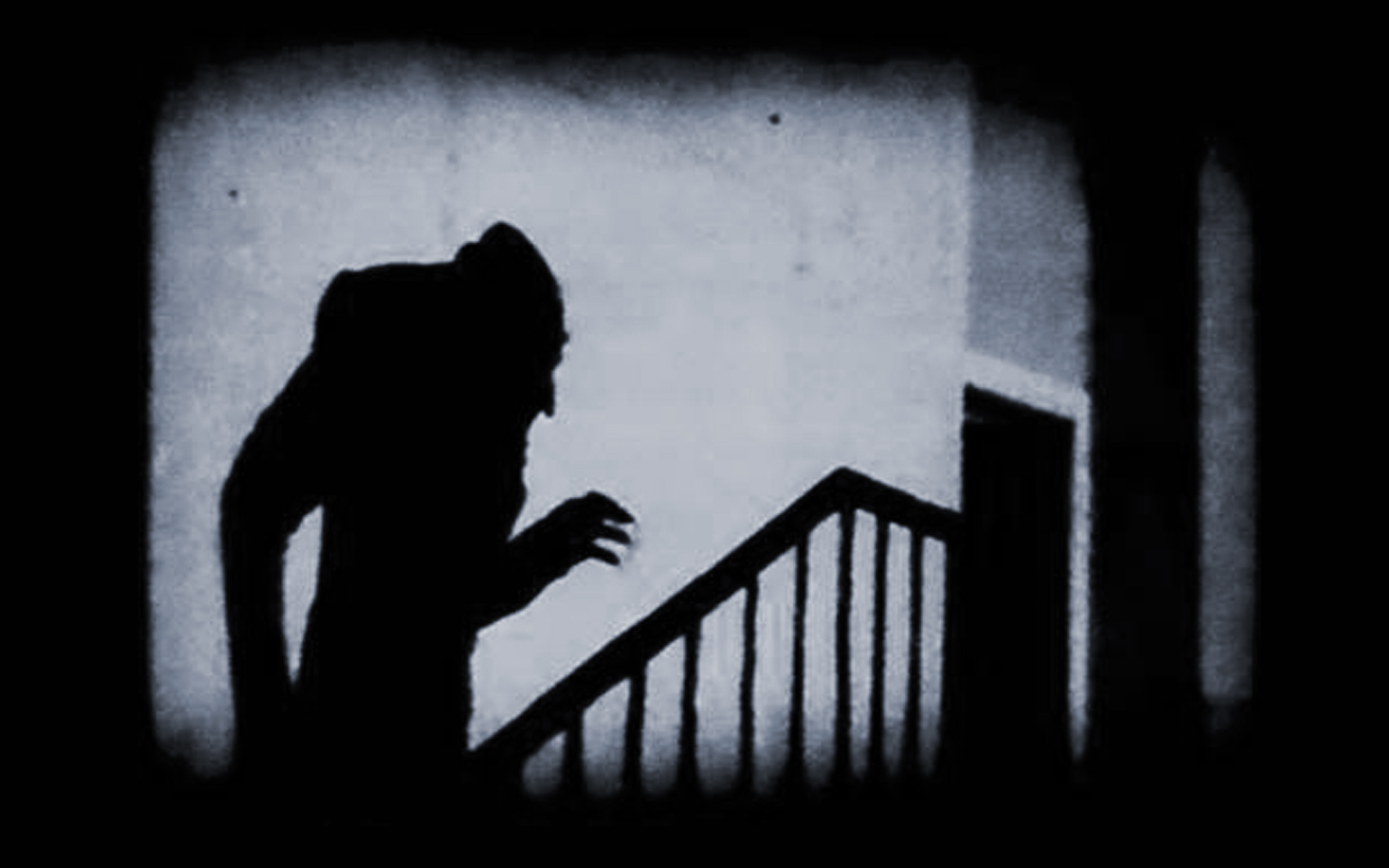
From 'Nosferatu' (1922): a shadowy character.

Modern critics say the original 'Nosferatu' still packs a powerful cinematic punch.

“Early film version of Dracula is brilliantly eerie, full of imaginative touches that none of the later films quite recaptured,” Leonard Maltin wrote recently.

Critic Dave Kehr of the Chicago Reader called 'Nosferatu' "...a masterpiece of German silent cinema and easily the most effective version of Dracula on record.”

Despite the status of 'Nosferatu' as a landmark of early cinema, another scary aspect of the film is that it was almost lost forever.

The film, shot in 1921 and released in 1922, was an unauthorized adaptation of Stoker's novel, with names and other details changed because the studio could not obtain rights to the novel.

Thus "vampire" became "Nosferatu" and "Count Dracula" became "Count Orlok." After the film was released, Stoker's widow filed a copyright infringement lawsuit and won; all known prints and negatives were destroyed under the terms of settlement.

However, intact copies of the film would surface later, allowing 'Nosferatu' to be restored and screened today as audiences originally saw it. The image of actor Max Schreck as the vampire has become so well known that it appeared in a recent 'Sponge Bob Squarepants' episode.

Out of the box: A scene from 'Nosferatu' (1922).

In screening silent films at the Town Hall Theater, organizers aim to show early cinema as it was meant to be seen—in restored prints, on a large screen, with live music, and with an audience.

"All those elements are important parts of the silent film experience," said Rapsis, who will accompany the film. "Recreate those conditions, and classics of early cinema such as 'Nosferatu' leap back to life in ways that audiences still find entertaining."

Rapsis performs on a digital synthesizer that reproduces the texture of the full orchestra, creating a traditional "movie score" sound. He improvises the complete score in real time during the screening.

"Creating a movie score on the fly is kind of a high-wire act, but it can often make for more excitement than if everything is planned out in advance," Rapsis said.

The classic early horror thriller ‘Nosferatu’ will be shown with live music on Sunday, Oct. 22 at 2 p.m. at the Town Hall Theatre, 40 Main St., Wilton, N.H.

Admission is free; donations are accepted, with $10 per person suggested to defray expenses. For more information, call the theater at (603) 654-3456.


Tuesday, November 15, 2022

Checking in after a busy Halloween season; silent W.C. Fields on Wednesday night, Plymouth, N.H.

An original lobby card promoting W.C. Fields in 'So's Your Old Man' (1926).

Up next: I'll accompany a screening of 'So's Your Old Man' (1926), a terrific W.C. Fields silent comedy, on Wednesday, Nov. 16 at the Flying Monkey Moviehouse and Performance Center in Plymouth, N.H.

Showtime is 6:30 p.m. and yes, it's a silent film starring W.C. Fields. You won't hear his nasal twang and he sports a mustache, but give it a chance. I've found from experience that the Fields silents (those that survive, anyway) are great for audience response.

More about 'So's Your Old Man' in the press release below. Hope to see you in Plymouth on Wednesday night!

For now, here's a brief report of this year's Halloween marathon of silent film screenings, which reached a crescendo with three separate screenings in three states on the Saturday prior to spook day. 

It got so busy that I really didn't have time to update the blog day-by-day. Hence this attempt to catch up.

The pre-show set-up in 'The Showroom' in Keene, N.H.

Let's see...on Tuesday, Oct. 25, it was 'Nosferatu' (1922) at the new Showroom venue of the Colonial Theatre in Keene, N.H. It's called the "showroom" because it actually was originally the showroom of a car dealer!

I've been doing 'Nosferatu' pretty regularly for a long time, and everything clicked that night. Great reaction from an enthusiastic audience made of mostly first-timers for the silent film/live music experience. 

Tools of the trade: the "dingy bell" I use to match the clock chimes in 'Nosferatu.'

I got specific kudos from a young boy for the way I matched the bell chimes for the two times in 'Nosferatu' that a clock strikes midnight. It's a little tricky because both times characters on screen hear the clock before it's seen on camera. 

 If I do it just right, I can get 12 chimes exactly, and that's what happened, thus helping me build the pre-teen fan base for the silent film experience.

Pre-show poster posing at the Rex Theatre in Manchester, N.H.

On Wednesday, Oct. 26, it was 'The Cat and the Canary' (1927) at the Rex Theatre in downtown Manchester, N.H. Another strong turnout for this lesser-known but entertaining comedy-thriller—people seemed to get what director Paul Leni was going for, and reacted strongly throughout.

In introducing the film, in order to demonstrate the "fame is fleeting" principle, I asked if any members of the Laura LaPlante club were present. Two hands went up immediately!

This is another film in which a clock striking midnight is featured prominently. In this case, it's a big old grandfather clock, and when the hour comes, Leni fills the screen with a prolonged montage of hammers hitting various coils to make the sounds.

No mere dingy bell will do this justice, so instead I switch the synthesizer to a setting named 'Valerian Bells,' which sounds like something from 'The Exorcist.' Once again I won after-screening praise for my bell effects! I thought "Heck, I'm on a roll." 

But fate, and perhaps the spirit of Edgar Allen Poe, had other plans for me and my bells, bells, bells...

Loved this series poster at the Jane Pickens Theatre in Newport, R.I.

On Thursday, Oct. 27, it was down to Newport, R.I., where the Jane Pickens Theatre was running 'Nosferatu.' To everyone's surprise and delight, well over 200 people crowded into the venerable venue to take in the vampire's exploits.

Having only started doing silent films this year in Newport, there's a great sense of discovery there, even with a film as familiar (to me, anyway) as 'Nosferatu.' The majority of attendees were first-timers, not just for 'Nosferatu' but for any silent film in a theater with live music.

Another poster in Newport. The Jane Pickens Theatre does a great job promoting screenings.

And so audience reaction was intense and gratifying. They even laughed at my weak joke about preparing by means of braving the scary traffic getting through Boston on Route 128. Har!

And the music once again came together to support, I hope, what F.W. Murnau and his collaborators had put into the film so long ago. Altogether, it was one of highlights of the season: a packed house and that in-the-moment feeling that a film is really connecting, creating a shared experience by everyone present. Wow!

Pre-show inside the Jane Pickens Theatre. My little Roland speakers (seen on stage) do a great job, filling this sized house with a big sound when needed.

Alas, it was this screening in which the bells got the best of me. After a half-dozen screenings of 'Nosferatu,' I screwed up both cues! Each time, I went to hit the dingy bell button, and literally missed the bell. 

The first time, I succeeded in nearly knocking the bell off the chair, and so managed to get maybe only six dings before the movie moved on. That unnerved me enough to muff the second cue as well. It was a case of "not saved by the bell."

Friday, Oct. 28 saw me up at Warner, N.H. to accompany 'The Bells' (1926), an obscure thriller from obscure Chadwick Pictures that benefited from performances by the not-so-obscure Lionel Barrymore and Boris Karloff.

The screening, a fund-raiser for the Telephone Museum of N.H. (Yes, New Hampshire has a telephone museum. Doesn't your state?) and so 'The Bells' seemed an appropriate title. 

Not the largest turnout of the season but the hall was pretty full and the film worked in spite of my clumsy attempts to integrate some toy sleigh bells into the score when needed.

This is where the bells got the best of me—fittingly in a film called 'The Bells.' 

The bells referred to in the title are not telephone bells, but sleigh bells, the sound of which symbolize a murder that's committed during the picture.  

Well, the best I could do in advance of this screening was to find a set of toy bells glued to felt that we found in my basement with a lot of old Christmas stuff. 

I didn't have a chance to really test them out, and it turned out they were not even close to being up to the job. As I tried to shake them while playing keyboard with the other, they made virtually no sound. Instead of menacing, they sounded pathetic, at least to my ears.

Finally, one shake too many caused them to fly out of my hand and hit the floor, where I left them, getting my sleigh bell effects from the keyboard from then on. Strangely, a woman afterwards complimented me on how effective that was!

Dear Santa: please bring me a set of real sleigh bells. Also, while we're on the subject, a real boxing bell would be nice as well.

Saturday, Oct. 29 was the true one-day marathon: another 'Nosferatu,' this time a matinee at the newly opened Park Theatre in Jaffrey, N.H., then an evening screening of 'Der Golem' (1920) at the Leavitt Theatre in Ogunquit, Maine, followed then by a midnight screening of the reconstructed 'London After Midnight' (1927) at the Coolidge Corner Cinema in Brookline, Mass., just over the line from Boston. 

The Leavitt Theatre, like all of Ogunquit, does not do Halloween halfway.

Three states, three screenings, in 12 hours! And I had time for a piping hot bowl of bibimbap (see below) at the Korean Restaurant around the corner from the Coolidge, which thankfully stays open late on Saturday nights.

During this steeplechase, as far as the music goes, I was in kind of a trance. Sitting at the keyboard, it just flowed out of me. For 'Nosferatu,' it was a synthesis of all the material I'd been developing at the six previous screenings of the film I'd accompanied in the previous two weeks. 

For 'Der Golem,' it was largely a riff on the theme from Bach's "Little Fugue in G minor." And 'London After Midnight' was total seat-of-the-pants improv based on three descending notes, which I have to say became thrillingly effective as the film progressed.

Risky selfie of me and the distinctive Coolidge marquee, obtained by stepping into Harvard Street in front of the theater.

Besides the Korean food, it was powered by the adrenaline rush from seeing so many people in costume lined up for the Coolidge's annual Halloween overnight marathon, for which 'London After Midnight' was the opening film. 

Adding to that was the sight of several large rats outside my car! Really—after the crowd had filed in, the rats came out of a dumpster area in an alley behind the theater and were apparently scavenging spilled popcorn and soda.

Me with the line of Coolidge marathon attendees stretching back into the alley, the end of which is where I later encountered rats guarding my car.

This happened to be right where I parked my car for the load-in. Rather than be alarmed, my reaction was: "How cool to see this at Halloween!" Still, I had the presence of mind to make hissing noises to scare them off before moving the car out of there. 

It was well past 1 a.m., but I couldn't miss the Coolidge Corner's costume contest! 

And then Sunday, Oct. 29 saw me accompanying a non-Halloween program at a new venue: the Gloucester Meetinghouse in Gloucester, Mass., an imposing structure that rises majestically out of the seaport's crowded old center. 

The venue's silent film programs are usually accompanied by celebrated Boston-based organist Peter Krasinski, a good friend and colleague. But Peter was out of town and recommended me to fill in (thanks, Peter!) for a program of comedies: shorts by Charlie Chaplin and Buster Keaton, and then Chaplin's feature 'The Kid' (1921).

A beautiful fall afternoon with the Gloucester Meetinghouse in Gloucester, Mass.

Weatherwise, it was a spectacular late October Sunday, but attendance was strong. One odd thing was that the church interior was noticeably warmer than it was outside. This was the result of a group using the building the night before accidentally leaving the heat cranked up to 85 all night long!

But the accidental combo of silent film and bikram-style yoga didn't stop the audience from enjoying the program, with many people afterwards praising 'The Kid' for its powerful emotional impact. Nice!

I perhaps lingered a bit too long, because I then found myself high-tailing it on Route 128 back to New Hampshire, where I just barely made it to the Town Hall Theatre in Wilton, N.H. for a 7:30 p.m. screening of Alfred Hitchcock's 'The Lodger' (1927).

For this one, I know the film somewhat, but hadn't done it in a long time. And coming at the end of a long series of screenings, there just wasn't an opportunity to view it or a chance to prepare anything in advance.

But at the same time, I'd been doing films nearly every day for the past three weeks. So in my favor was a state of unusual fluency, I'd have to say, that comes from sitting at a keyboard and creating music several hours in a row day after day.

And with 'The Lodger,' I just plunged in with a kind of aggressively syncopated jazz motif that turned out to be remarkably versatile in catching the various ups and downs of Hitchcock's first real 'Hitchcock' film: a tale of murder, false leads, misdirection, blonde women, and all the other Hitchcockian tropes we cherish.  

It worked, and became one of the most satisfying accompaniment experiences of a busy stretch. No bells in this picture, but something similar: a cuckoo clock sounds twice, in close-up, at key moments, and both times I was ready. 

I think overall, this spooky steeplechase reaffirmed one of the basic principles of silent film accompaniment, at least the way I do it. For me, the only way to develop and maintain fluency at improv-based accompaniment is to do it a lot. 

When I do it a lot, I notice a difference. I'm able to get inside (and stay ahead) of a film in a way that seems almost effortless. The music just comes, and I find if I'm in that "zone" I can shape it to fit what the film seems to need at any given time.

But you can't keep this pace up indefinitely. So after 'The Lodger'—nothing! A whole note rest! The next week, including the weekend, I had no screenings—the first time since Labor Day. 

Now, two weeks later, I'm back at it: I accompanied a benefit screening of 'Wings' last Thursday for the Aviation Museum of N.H. (of which I'm director), and this past Sunday did music for the silent version of 'All Quiet on the Western Front' (1930) at the Town Hall Theatre in Wilton, N.H.

The screening, in honor of Veterans Day, was well attended and the music came together in spectacular fashion. It was one of those shows where you're just in synch with everything—where an accompanist can feel the rhythm of the scenes and the editing and can anticipate, say, when there's a shell blast and can capture it as a big scene unfolds.

I had never scored the filim and had only previewed it once. But that was enough to be ready for a couple of big moments where the music seemed to really work well. One example: the scene where Raymond Griffith plays a dying French soldier.

Once he perishes, a character continues speaking to him, saying with increasing desperation he should have died instead. While that was going on, I kept to a moody ostinato in E minor.

But every so often, the camera cuts to Griffith's immobile face, just staring blankly ahead. And each time, I hit a C minor chord about an octave above, and held it for the duration of the shot. 

It happens three times, and each time I pushed the volume a bit, and also added notes to the top of the chord. (It ended up being C minor with G Major on top.) I have to say, it made my hair stand on end, and I knew what was coming. I hope it had a similar affect on the audience. 

And that's it for catching up. During the holiday season, the performance schedule often thins out, but not this year—I'm booked at venues pretty regularly into the next year, including two more gigs at the Coolidge in December and January. (No costumes, but more Korean food!)

But next up: it's W.C. Fields in 'So's Your Old Man' tomorrow night at the Flying Monkey. Press release is below. Hope to see you there!

*    *    *

A production still from 'So's Your Old Man' (1926).

TUESDAY, NOV. 8, 2022 / FOR IMMEDIATE RELEASE
Contact Jeff Rapsis • (603) 236-9237 • jeffrapsis@gmail.com

Flying Monkey to screen rare silent film starring comic icon W.C. Fields

'So's Your Old Man' shows legendary performer as younger man; program on Wednesday, Nov. 16 accompanied by live music

PLYMOUTH, N.H.—He was a performer who could be recognized by just the nasal twang of his voice.

But prior to reaching iconic fame in talking pictures, W.C. Fields successfully starred in a popular series of silent feature films for Paramount Pictures and other studios in the 1920s.

Rediscover the non-talking W.C. Fields in 'So's Your Old Man' (1926) one of his best silent pictures, in a screening on Wednesday, Nov. 16 at 6:30 p.m. at the Flying Monkey Moviehouse and Performance Center, 39 Main St., Plymouth, N.H.

General admission is $10 per person, general seating. Live musical scoring will be provided by silent film accompanist Jeff Rapsis.

In 'So's Your Old Man' (1926), Fields plays Sam Bisbee, inventor of a new shatter-proof windshield glass and regarded as a crackpot by the townsfolk.

After a demonstration of his glass to auto executives goes awry, he faces ridicule and shame. On the way home, Bisbee encounters a woman he thinks is trying to commit suicide, and so prevents her.

The woman is really Princess Lescaboura, member of a family of European royalty, who later arrives in Bisbee's home town to thank him, upending Bisbee's life and setting the small town aflame with gossip. The film includes a version of Fields' famous "golf" routine.

The film was remade as a talkie in 1934, with W.C. Fields again starring, under the title 'You're Telling Me!' In 2008, 'So's Your Old Man' was added to the U.S. National Film Registry.

W.C. Fields remains famous today for his comic persona as a misanthropic and hard-drinking egotist with a snarling contempt for dogs, children and women.

Although Fields achieved lasting fame as a movie star in talking pictures of the 1930s, his long career encompassed decades on the vaudeville stage as well as a series of silent film roles in the 1920s.

"People find it hard to think of W.C. Fields in silent films, but he was actually quite successful," Rapsis said. "As a vaudeville performer and juggler, Fields cultivated a form of visual comedy and pantomime that transferred well to the silent screen.

"Also, as a middle-aged man during the silent film era, he was able to play a family father figure—the kind of role that wasn't open to younger comic stars such as Charlie Chaplin or Buster Keaton," Rapsis said.

In all, Fields starred in 10 silent features in the mid-1920s. Several are lost; in those that survive, Fields sports a thick mustache, part of his vaudeville costume as a "vagabond juggler" which he dropped in later years.

The film was made not in Hollywood, but at the Paramount studios in Astoria, Queens, a popular production facility for New York-based stage performers who also appeared in film.

For the music, Rapsis improvises in real time, while the film is running, using a digital synthesizer that allow him to recreate the "movie score" texture of a full orchestra.

"Improvising a score live is a bit of a high-wire act, but it allows me to follow and support the film a lot more effectively than if I was buried in sheet music," Rapsis said.

"Instead, I'm free to follow the film right in the moment. Each time it's different, which lends a certain energy and immediacy and excitement to the experience."

'So's Your Old Man,' a silent comedy starring W.C. Fields, will be screened with live music on Wednesday, Nov. 16 at 6:30 p.m. at the Flying Monkey Moviehouse and Performance Center, 39 Main St., Plymouth, N.H.

Admission is $10 per person. For more info, call (603) 536-2551 or visit www.flyingmonkeynh.com.


Thursday, October 27, 2022

Tonight: 'Nosferatu' flies into the Jane Pickens Theatre in Newport, R.I. for 100th anniversary

 
The vampire mounts the stairs in 'Nosferatu' (1922.)

 If you're looking for the "big audience" experience of silent film, look no further than tonight's screening of 'Nosferatu' (1922) at the Jane Pickens Theatre in Newport, R.I.

I'm told that already well over 100 tickets have been sold for tonight's show. Wow! So it should be a packed house, which I think always makes for a screening.

The fun starts at 7:30 p.m.; more details in the press release below.


Last night's screening of 'The Cat and the Canary' (1927) drew a good-sized crowd to the Rex Theatre in downtown Manchester, N.H.

Most had never seen (or heard of) the film; indeed many were first-timers at the Rex, which was recently renovated and reopened by the Palace Theatre, the city's main downtown performing arts organization.

For this film, I make a point of describing it as it was originally promoted: as a "comedy thriller." 

I think it's important for people to know that's what director Paul Leni was going for, thus giving them permission to laugh. Which they did!

Okay, here's info on tonight's screening of 'Nosferatu' in Newport, R.I. 

By the way, yesterday's Newport Daily News carried an extensive write-up of the screening. Nice job by writer Robert Duguay!

And I can't help but observe that for me, it's the second-to-last 'Nosferatu' of this 100th anniversary Halloween season.

Accompanying it repeatedly is beginning to feel like silent film aerobics: "Two more, one more..."

*    *    *

The creature emerges: Nosferatu disembarks from his shipboard accommodations..

MONDAY, OCT. 3, 2022 / FOR IMMEDIATE RELEASE
Contact Jeff Rapsis • (603) 236-9237 • jeffrapsis@gmail.com

Creepy classic thriller 'Nosferatu' to screen at Jane Pickens Theater on Thursday, Oct. 27

Prepare for Halloween with 100-year-old silent horror movie with live music—see it if you dare!

NEWPORT, R.I.— Get into the Halloween spirit with a classic silent horror film celebrating the 100th anniversary of its release.

'Nosferatu' (1922), the first screen adaptation of Bram Stoker's novel 'Dracula,' will be shown with live music on Thursday, Oct. 27 at 7:30 p.m. at the Jane Pickens Theatre and Event Center, 49 Touro St., Newport.

General admission $15; members $13. Tickets available online or at the door.

The screening will feature live musical accompaniment by Jeff Rapsis, a New Hampshire-based silent film musician.

'Nosferatu' (1922), directed by German filmmaker F.W. Murnau, remains a landmark of the cinematic horror genre. It was among the first movies to use visual design to convey unease and terror.

To modern viewers, the passage of time has made this unusual film seem even more strange and otherworldly.

It's an atmosphere that silent film accompanist Jeff Rapsis will enhance in improvising live music on the spot for the screening.

"The original 'Nosferatu' is a film that seems to get creepier as more time goes by," said Rapsis, a resident of Bedford, N.H. who accompanies silent film screenings at venues across the nation.

"It's a great way to celebrate Halloween and the power of silent film to transport audiences to strange and unusual places," Rapsis said.

In 'Nosferatu,' actor Max Schreck portrays the title character, a mysterious count from Transylvania who travels to the German city of Bremen to take up residence.

In the town, a rise in deaths from the plague is attributed to the count's arrival. Only when a young woman reads "The Book of Vampires" does it become clear how to rid the town of this frightening menace.

Director Murnau told the story with strange camera angles, weird lighting, and special effects that include sequences deliberately speeded up.

Although 'Nosferatu' is suitable for all family members, the overall program may be too intense for very young children to enjoy.

Modern critics say the original 'Nosferatu' still packs a powerful cinematic punch.

“Early film version of Dracula is brilliantly eerie, full of imaginative touches that none of the later films quite recaptured,” Leonard Maltin wrote recently.

Critic Dave Kehr of the Chicago Reader called 'Nosferatu' "...a masterpiece of German silent cinema and easily the most effective version of Dracula on record.”

Despite the status of 'Nosferatu' as a landmark of early cinema, another scary aspect of the film is that it was almost lost forever.

The film, shot in 1921 and released in 1922, was an unauthorized adaptation of Stoker's novel, with names and other details changed because the studio could not obtain rights to the novel.

Thus "vampire" became "Nosferatu" and "Count Dracula" became "Count Orlok." After the film was released, Stoker's widow filed a copyright infringement lawsuit and won; all known prints and negatives were destroyed under the terms of settlement.

However, intact copies of the film would surface later, allowing 'Nosferatu' to be restored and screened today as audiences originally saw it. The image of actor Max Schreck as the vampire has become so well known that it appeared in a recent 'Sponge Bob Squarepants' episode.

In screening silent films at the Jane Pickens Theater, organizers aim to show early cinema as it was meant to be seen—in restored prints, on a large screen, with live music, and with an audience.

"All those elements are important parts of the silent film experience," said Rapsis, who will accompany the film. "Recreate those conditions, and classics of early cinema such as 'Nosferatu' leap back to life in ways that audiences still find entertaining."

Rapsis performs on a digital synthesizer that reproduces the texture of the full orchestra, creating a traditional "movie score" sound. He improvises the complete score in real time during the screening.

"Creating a movie score on the fly is kind of a high-wire act, but it can often make for more excitement than if everything is planned out in advance," Rapsis said.

The classic early horror thriller ‘Nosferatu’ will be shown with live music on Thursday, Oct. 27 at 7:30 p.m. at the Jane Pickens Theater and Event Center, 49 Touro St., Newport.

General admission $15; members $13. Tickets available online at www.janepickens.com or at the door. For more information about the JPT Film & Event Center, call (401) 846-5474. 

Have a nice trip!

Wednesday, October 19, 2022

Tonight in Plymouth, N.H.: Emil Jannings as 'Mephisto' in Murnau's dark epic 'Faust' (1926)

Emil Jannings doesn't hold back as 'Mephisto' (a.k.a. Satan) in 'Faust' (1926). 

As the days grow shorter, and the list of screenings for Halloween grows longer. 

Tonight, it's Murnau's 'Faust' (1926), which I'll accompany at the Flying Monkey Moviehouse and Performance Center in Plymouth, N.H.  Showtime is 6:30 p.m. 

See you there! Lots more info in the press release below.

For now, a brief report on the first of several 'Nosferatu' (1922) screenings coming up in the next two weeks.

With this year marking the 100th anniversary of the film's release, interest is heavier than usual.

Last Sunday afternoon, I accompanied 'Nosferatu' to the largest crowd we've attracted so far to the silent film series at the Center for the Arts in Natick, Mass.

The Center for the Arts screening room just before 'Nosferatu.'

About 40 people took in the film, with many staying afterwards for an extended question-and-answer session.

Most had never seen 'Nosferatu,' so I need to keep that in mind when I start thinking that the film gets programmed too often. 

'Faust' certainly doesn't run as often, so if you're interested in seeing Murnau's last film made in Germany prior to his move to Hollywood, join us this evening. 

Here's the press release:

*  *  *

An original German poster for F.W. Murnau's adaptation of 'Faust' (1926).

TUESDAY, SEPT. 20, 2022 / FOR IMMEDIATE RELEASE
Contact Jeff Rapsis • (603) 236-9237 • jeffrapsis@gmail.com

Rarely shown 'Faust' adaptation on Wednesday, Oct. 19 at Flying Monkey

Silent film thriller starring Emil Jannings to be shown on the big screen with live music for Halloween program

PLYMOUTH, N.H.—It's been a novel, a stage play, and an opera. When movies first appeared a century ago, it was only a matter of time before they tackled 'Faust,' the tale of a man who consigns his soul to the devil to obtain power in the present.

At the height of the silent era, German director F.W. Murnau created a cinematic version of 'Faust' filled with stunning images that maintain their power to astonish.

See for yourself with 'Faust' (1926), the original silent film adaptation of the classic legend, to be shown on Wednesday, Oct. 19 at 6:30 p.m. at the Flying Monkey Moviehouse and Performance Center, 39 Main St., Plymouth, N.H.

Admission is $10 per person, general seating.

'Faust' is a 1926 silent film produced by German studio UFA, directed by F. W. Murnau, starring Gösta Ekman as Faust, Emil Jannings as Mephisto, and Camilla Horn as Gretchen.

As the film opens, the demon Mephisto has a bet with an Archangel that he can corrupt a righteous man's soul and destroy in him what is divine. If he succeeds, the Devil will win dominion over earth.

A scene from F.W. Murnau's adaptation of 'Faust.'

The Devil delivers a plague to the village where Faust, an elderly alchemist, lives. Though he prays to stop the death and starvation, nothing happens. Disheartened, Faust throws his alchemy books in the fire, and then the Bible too. One book opens, showing how to have power and glory by making a pact with the Devil.

Faust goes to a crossroads as described in the book and conjures up the forces of evil. When Mephisto appears, he induces Faust to make a trial, 24-hour bargain. Faust will have Mephisto's service till the sand runs out in an hourglass, at which time the Devil will rescind the pact.

At first, Faust uses his new power to help the people of the village, but they shun him when they find out that he cannot face a cross. They stone him and he takes shelter in his home. Mephisto then uses the lure of restored youth and love to convince Faust to sign over his soul once and for all.

The remainder of the film follows the grim consequences for everyone, all depicted with vivid visual imagination in the last film Murnau made in Germany before making the move to Hollywood.

'Faust' continues to impress modern critics, including Roger Ebert.

"Murnau had a bold visual imagination, distinctive even during the era of German Expressionism with its skewed perspectives and twisted rooms and stairs," Ebert wrote in 2005. " 'Faust,' with its supernatural vistas of heaven and hell, is particularly distinctive in the way it uses the whole canvas."

A scene from F.W. Murnau's adaptation of 'Faust.'

In screening F.W. Murnau's version of 'Faust,' the Flying Monkey aims to recreate all essential elements of silent film experience: high quality prints shown on a large screen, with live music and an audience.

"These films caused people to fall in love with the movies for a very good reason," said Jeff Rapsis, who will improvise a musical score during the screening. "They were unique experiences, and if you can recreate the conditions under which they were shown, they have a great deal of life in them.

"Though they're the ancestors of today's movies, silent film is a very different art form than what you see at the multiplex today, so it's worth checking out as something totally different," Rapsis said.

Rapsis performs on a digital synthesizer that reproduces the texture of the full orchestra and creates a traditional "movie score" sound.

F.W. Murnau's ‘Faust' will be shown on Wednesday, Oct. 19 at 6:30 p.m. at the Flying Monkey Moviehouse and Performance Center, 39 Main St., Plymouth, N.H.

Admission is $10 per person. For more info, call (603) 536-2551 or visit www.flyingmonkeynh.com.

Monday, November 1, 2021

On live scoring 'Dracula' at the Somerville, plus a new way to show 'Nosferatu' to keep it scary


One of the scariest things about 'Dracula' (1931) at the Somerville Theatre: standing in the middle of Holland Street to get the requisite marquee shot.

Doing live music for 'Dracula' (1931) last night at the Somerville Theatre proved an interesting adventure in film underscoring.

After all, this wasn't a silent picture. True, there's no music. But it does have dialogue, sound effects, and a certain eerie quality that comes, in part, from the silence. 

I didn't want to get in the way of any of that. So I knew going in that there were times when I couldn't —and shouldn't—play anything. 

But once in the theater, I found it surprisingly difficult to resist the urge to play music. I accompany more than 100 films each year. And it was just really weird to be sitting there, with a film on the screen and a keyboard in front of me and an audience present, and not play.

As the film unspooled, I felt the character to whom I could most relate was Renfield, with his hunger for spiders representing my hunger to press the keys and make sounds. 

But I didn't need to be restrained, and in the end I felt I had a good sense of when to stay out and when to come in, and when to come in strong. 

Lugosi and victim in the unfinished basement of Carfax Abby. 

Although I improvised the score, I did create a full-fledged 'Dracula' theme in advance, which came in handy and helped the whole thing hold together.

Perhaps the most successful sequence was when Dracula tried to hypnotize Professor Van Helsing. 

On screen, played silent, it seems overlong and drawn out, with the quiet broken only by Bela Lugosi's commands to "Come here!"

But with music, I was told afterward that it turned into a scene of considerable dramatic suspense. Hooray!

And in the end, it all seemed to work, as I was glad to receive a thunderous ovation from the 200+ attendees, and with nothing thrown at me—not even the bag of garlic cloves I had given out as a door prize beforehand.

Well, Halloween may be over, but my ongoing silent film music marathon is not.

We go from Lugosi's 'Dracula' to 'Nosferatu' (1922), which I'm accompanying tonight (Monday, Nov. 1) at the Coolidge Corner Theater in Brookline, Mass.

It's ostensibly in honor of the 'Day of the Dead,' but you don't really need an excuse to screen Murnau's classic film. Just as the sign on the railroad tracks tell us that "Any time is train time," theaters should all have signs saying "Any time is Nosferatu time." 

Any that's actually a concern. I've done music for 'Nosferatu' a half-dozen times this year. At some point, overexposure may diminish this film's special power over audiences.

So, to remedy that, when I'm appointed King, I will issue an edict that all theaters can only screen 'Nosferatu' unannounced, and only in the middle of other films that people would have come to see.

That would a way to make it really frightening. You would just never know. It would boost the film's reputation immensely, and help box office receipts, as people who wish to see it would have to keep buying tickets hoping to see Nosferatu. It would be like winning the lottery!

And people buy lottery tickets all the time. Why not apply the same logic to movie theaters with 'Nosferatu' the unexpected jackpot prize?

Well, until that happens, your best bet is to come to the Coolidge Corner tonight. 

And for now, let me leave you with this unexpectedly amusing marquee shot from the Somerville Theatre: what a way to promote 'Dracula,' who can only come out at night!

*  *  *

MONDAY, OCT. 18, 2021 / FOR IMMEDIATE RELEASE
Contact Jeff Rapsis • (603) 236-9237 • jeffrapsis@gmail.com

Creepy classic thriller 'Nosferatu' to screen at Coolidge Corner on Monday, Nov. 1

'Sounds of Silents' series to be revived with pioneer silent horror movie with live musical accompaniment by Jeff Rapsis

BROOKLINE, Mass.— An iconic local theater will bring its silent movie series back to life with a film about the undead.

'Nosferatu' (1922), the first screen adaptation of Bram Stoker's novel 'Dracula,' will be screened with live music on Monday, Nov. 1 at 7 p.m. at the Coolidge Corner Theatre, 290 Harvard St., Brookline, Mass.

The screening will feature live music for the movie by silent film accompanist Jeff Rapsis. General admission is $23 per person.

The show marks the resumption of the Coolidge's acclaimed 'Sounds of Silents' series, which gives audiences the opportunity to experience early cinema as it was intended: on the big screen, with live music, and with an audience.

The series, like all other Coolidge programming, was paused during the recent pandemic. But with the theater now open, the series is returning.

On deck (almost): 'Nosferatu' at the Coolidge Corner Theatre this evening.

'Nosferatu' (1922), directed by German filmmaker F.W. Murnau, remains a landmark work of the cinematic horror genre.

To modern viewers, the passage of time has made this unusual movie seem even more strange and otherworldly.

It's an atmosphere that silent film accompanist Jeff Rapsis will enhance in improvising live music on the spot for the screening.

"The original 'Nosferatu' is a film that seems to get creepier as more time goes by," said Rapsis, a resident of Bedford, N.H. who accompanies silent film screenings at venues across the nation.

In 'Nosferatu,' actor Max Schreck portrays the title character, a mysterious count from Transylvania who travels to the German city of Bremen to take up residence.

In the town, a rise in deaths from the plague is attributed to the count's arrival. Only when a young woman reads "The Book of Vampires" does it become clear how to rid the town of this frightening menace.

Director Murnau told the story with strange camera angles, weird lighting, and special effects that include sequences deliberately speeded up.

Although 'Nosferatu' is suitable for all family members, the overall program may be too intense for very young children to enjoy.
A shadowy character: Mr. Nosferatu comes a calling.

Modern critics say the original 'Nosferatu' still packs a powerful cinematic punch.

“Early film version of Dracula is brilliantly eerie, full of imaginative touches that none of the later films quite recaptured,” Leonard Maltin wrote recently.

Critic Dave Kehr of the Chicago Reader called 'Nosferatu' "...a masterpiece of German silent cinema and easily the most effective version of Dracula on record.”

Despite the status of 'Nosferatu' as a landmark of early cinema, it was almost lost forever.

The film, shot in 1921 and released in 1922, was an unauthorized adaptation of Stoker's novel, with names and other details changed because the studio could not obtain rights to the novel.

Thus "vampire" became "Nosferatu" and "Count Dracula" became "Count Orlok." After the film was released, Stoker's widow filed a copyright infringement lawsuit and won; all known prints and negatives were destroyed under the terms of settlement.

However, intact copies of the film would surface later, allowing 'Nosferatu' to be restored and screened today as audiences originally saw it.

The image of actor Max Schreck as the vampire has become so iconic that it can be seen in a recent 'Sponge Bob Squarepants' episode.

The Sounds of Silents series is made possible by the generous contributions of Dr. Martin and Becki Norman, Dr. Thomas Gutheil, Susan Stoller, and Elizabeth Driehaus.

‘Nosferatu’ will be shown on Monday, Nov. 1 at 7 p.m. at the Coolidge Corner Theatre, 290 Harvard St., Brookline, Mass. as part of the theater's 'Sounds of Silents' series. Admission is $23 per person. For more info and to buy tickets, visit www.coolidge.org or call (617) 734-2500.

Saturday, October 30, 2021

Three screenings, two states, one day: Chaney in afternoon, then Nosferatu at night

Tonight: Cue the theme from 'The Love Boat.' Not.

The spooky steeplechase continues!

Today's scheduled includes live music for three silent features: at 2 p.m., a double bill of Lon Chaney thrillers in Wilton, N.H., and then this evening it's another 'Nosferatu,' this time in Ogunquit, Maine. 

More on tonight's 'Nosferatu' is in the press release below. 

This afternoon's Chaney features, 'Outside the Law' (1920) and 'The Unholy Three' (1925), are a continuation of a mini-marathon at the Town Hall Theatre that began last night with a screening of 'The Blackbird' (1926), a film I'd never accompanied before.

Lon Chaney as 'The Bishop' in 'The Blackbird' (1926).

Like all the Chaney MGM melodramas directed by Tod Browning, the plot and interaction of the characters build to a level of drama that's almost operatic, even though it's a silent film.

Because of that intensity, 'The Blackbird' does well with music that can rise to the moments when needed. 

At last night's screening, I began with a quiet vamp in a minor key, meant to evoke the seedy music halls of old London in which so much of 'The Blackbird' is set.

As the film progressed, I found the vamp, without any accompanying melody, was able to be transformed in a multitude of ways to support the drama: by turns menacing, sinister, joyous, and/or exhilarating when needed.

Ultimately, with some dissonant notes held above it, the vamp was entirely capable of carrying the great "moment of truth" scenes always found in the Chaney/Browning collaborations.

Let's hope the same magic happens with today's two features, and with 'Where East is East' (1929), which I'm scoring tomorrow (Sunday, Oct. 31) at 2 p.m. at the Town Hall Theatre to finish out the Chaney series on Halloween.

And then I head down to Boston to create live music for the Browning-directed 'Dracula' (1931) at the Somerville Theatre on Sunday night—something I've never done before and about which I'm very excited.

But first things first! See this afternoon for two Chaneys, and then this evening for 'Nosferatu' at the Leavitt Theater in Ogunquit, Maine. More details in the press release below.

*    *    *

MONDAY, OCT. 4, 2021 / FOR IMMEDIATE RELEASE

Contact Jeff Rapsis • (603) 236-9237 • jeffrapsis@gmail.com

Creepy classic thriller 'Nosferatu' to screen at Leavitt Theatre on Saturday, Oct. 30

Celebrate Halloween with pioneer silent horror movie on the big screen with live music—see it if you dare!

OGUNQUIT, Me.— Get into the Halloween spirit with a classic silent horror film.

'Nosferatu' (1922), the first screen adaptation of Bram Stoker's novel 'Dracula,' will be screened with live music on Saturday, Oct. 30 at 7 p.m. at the Leavitt Theatre, 259 Main St., Route 1, Ogunquit, Maine.

The screening will feature live music for the movie by silent film accompanist Jeff Rapsis. General admission is $12 per person. Costumes are encouraged!

'Nosferatu' (1922), directed by German filmmaker F.W. Murnau, remains a landmark work of the cinematic horror genre. It was among the first movies to use visual design to convey unease and terror.

To modern viewers, the passage of time has made this unusual film seem even more strange and otherworldly.

It's an atmosphere that silent film accompanist Jeff Rapsis will enhance in improvising live music on the spot for the screening.

"The original 'Nosferatu' is a film that seems to get creepier as more time goes by," said Rapsis, a resident of Bedford, N.H. who accompanies silent film screenings at the Leavitt and venues across the nation.

"It's a great way to celebrate Halloween and the power of silent film to transport audiences to strange and unusual places," Rapsis said.

In 'Nosferatu,' actor Max Schreck portrays the title character, a mysterious count from Transylvania who travels to the German city of Bremen to take up residence.

In the town, a rise in deaths from the plague is attributed to the count's arrival. Only when a young woman reads "The Book of Vampires" does it become clear how to rid the town of this frightening menace.

Director Murnau told the story with strange camera angles, weird lighting, and special effects that include sequences deliberately speeded up.

Although 'Nosferatu' is suitable for all family members, the overall program may be too intense for very young children to enjoy.

Modern critics say the original 'Nosferatu' still packs a powerful cinematic punch.

“Early film version of Dracula is brilliantly eerie, full of imaginative touches that none of the later films quite recaptured,” Leonard Maltin wrote recently.

Critic Dave Kehr of the Chicago Reader called 'Nosferatu' "...a masterpiece of German silent cinema and easily the most effective version of Dracula on record.”

Despite the status of 'Nosferatu' as a landmark of early cinema, another scary aspect of the film is that it was almost lost forever.

The film, shot in 1921 and released in 1922, was an unauthorized adaptation of Stoker's novel, with names and other details changed because the studio could not obtain rights to the novel.

Thus "vampire" became "Nosferatu" and "Count Dracula" became "Count Orlok." After the film was released, Stoker's widow filed a copyright infringement lawsuit and won; all known prints and negatives were destroyed under the terms of settlement.

However, intact copies of the film would surface later, allowing 'Nosferatu' to be restored and screened today as audiences originally saw it. The image of actor Max Schreck as the vampire has become so well known that it appeared in a recent 'Sponge Bob Squarepants' episode.

The historic Leavitt Theatre opened in 1923 as a summer-only silent movie house. Now approaching 100 years of operation, it continues to show movies, but also functions as a restaurant, bar, and lounge.

In reviving 'Nosferatu,' the Leavitt Theatre aims to show silent film as it was meant to be seen—in restored prints, on a large screen, with live music, and with an audience.

"All those elements are important parts of the silent film experience," said Rapsis, who will accompany the film. "Recreate those conditions, and classics of early cinema such as 'Nosferatu' leap back to life in ways that audiences still find entertaining."

Rapsis performs on a digital synthesizer that reproduces the texture of the full orchestra, creating a traditional "movie score" sound. He improvises the complete score in real time during the screening.

"Creating a movie score on the fly is kind of a high-wire act, but it can often make for more excitement than if everything is planned out in advance," Rapsis said.

The classic early horror thriller ‘Nosferatu’ will be shown on Saturday, Oct. 30 at 7 p.m. at the Leavitt Theatre, 259 Main St., Route 1 in Ogunquit. Admission $12 per person; tickets available at the door.

For more information, call (207) 646-3123 or visit www.leavittheatre.com.

Thursday, October 28, 2021

Tonight: 'Nosferatu' in Manchester, N.H. Plus, this Halloween, bringing theaters back from the dead

'Nosferatu': traveling by sea is so relaxing!

Halloween approach-eth!

Tonight I'm doing music for 'Nosferatu' (1922) at the Rex Theatre in downtown Manchester, N.H. 

More details are below in the press release pasted into the bottom of this post.

But now, a few words about an appropriate subject for Halloween: bringing back theaters from the dead.

Example: last night's screening of 'Phantom of the Opera' (1925) in the recently opened Park Theatre in Jaffrey, N.H. 

The brand new venue is a recreation of the original Park Theatre, which operated from 1922 to 1976.

Now it's back, in the form of a completely new building with great acoustics. Bravo!


The newly rebuilt Park Theatre in Jaffrey, N.H.

And tonight's 'Nosferatu' is at the Rex, an old theater in downtown Manchester that was recently renovated and transformed into a modern venue for music, film, and comedy.

And then there was last week's screening of 'Phantom' at the Flying Monkey Moviehouse in Plymouth, N.H., which about 10 years ago was rescued from oblivion and turned into a vibrant venue for live music and film.

And just before that, I accompanied 'Dr Jekyll & Mr. Hyde' (1920) at the Center for the Arts in Natick, Mass., which is housed in a beautifully renovated 19th century firehouse. 

Up in Brandon, Vt., my monthly screenings at the venerable Town Hall and Community Center produce income to support the ongoing restoration of this 19th century meeting hall.

And the Somerville Theatre (where I'm doing music for 'Dracula' (1931) on Halloween night) just reopened after restoring its original Crystal Ballroom to active duty as an events space.

And the Leavitt Theatre in Ogunquit, Maine—where I'll accompany 'Nosferatu' on Saturday night—was recently transformed by the addition of a restaurant and bar inside the theater.

So here in my corner of the world, we're particularly blessed with venues that, one way or another, have been rescued from oblivion and turned into community gathering places.

I am grateful for that—but that's a sentiment more appropriate for Thanksgiving, and I'm still in the midst of working on Halloween here.

So come out to the Rex tonight and take in 'Nosferatu' with live music by me. More info in the press release below...

*   *   *

A scene from 'Nosferatu' (1922), screaming er, screening tonight at the Rex Theatre.

MONDAY, OCT. 4, 2021 / FOR IMMEDIATE RELEASE 

Contact Jeff Rapsis • (603) 236-9237 • jeffrapsis@gmail.com

Creepy classic thriller 'Nosferatu' to screen at Rex Theatre on Thursday, Oct. 28

Celebrate Halloween with pioneer silent horror movie on the big screen with live music—see it if you dare!

MANCHESTER, N.H.— Get into the Halloween spirit with a classic silent horror film.

'Nosferatu' (1922), the first screen adaptation of Bram Stoker's novel 'Dracula,' will be screened with live music on Thursday, Oct. 28 at 7:30 p.m. at the Rex Theatre, 23 Amherst St., Manchester, N.H.

The screening will feature live music for the movie by silent film accompanist Jeff Rapsis. General admission is $10 per person.

'Nosferatu' (1922), directed by German filmmaker F.W. Murnau, remains a landmark work of the cinematic horror genre. It was among the first movies to use visual design to convey unease and terror.

To modern viewers, the passage of time has made this unusual film seem even more strange and otherworldly.

It's an atmosphere that silent film accompanist Jeff Rapsis will enhance in improvising live music on the spot for the screening.

"The original 'Nosferatu' is a film that seems to get creepier as more time goes by," said Rapsis, a resident of Bedford, N.H. who accompanies silent film screenings at venues across the nation. "It's a great way to celebrate Halloween and the power of silent film to transport audiences to strange and unusual places."
 

In 'Nosferatu,' actor Max Schreck portrays the title character, a mysterious count from Transylvania who travels to the German city of Bremen to take up residence.

In the town, a rise in deaths from the plague is attributed to the count's arrival. Only when a young woman reads "The Book of Vampires" does it become clear how to rid the town of this frightening menace.

Director Murnau told the story with strange camera angles, weird lighting, and special effects that include sequences deliberately speeded up.

Although 'Nosferatu' is suitable for all family members, the overall program may be too intense for very young children to enjoy.

Modern critics say the original 'Nosferatu' still packs a powerful cinematic punch.

“Early film version of Dracula is brilliantly eerie, full of imaginative touches that none of the later films quite recaptured,” Leonard Maltin wrote recently.

Critic Dave Kehr of the Chicago Reader called 'Nosferatu' "...a masterpiece of German silent cinema and easily the most effective version of Dracula on record.”

Despite the status of 'Nosferatu' as a landmark of early cinema, another scary aspect of the film is that it was almost lost forever.

The film, shot in 1921 and released in 1922, was an unauthorized adaptation of Stoker's novel, with names and other details changed because the studio could not obtain rights to the novel.

Thus "vampire" became "Nosferatu" and "Count Dracula" became "Count Orlok." After the film was released, Stoker's widow filed a copyright infringement lawsuit and won; all known prints and negatives were destroyed under the terms of settlement.

However, intact copies of the film would surface later, allowing 'Nosferatu' to be restored and screened today as audiences originally saw it. The image of actor Max Schreck as the vampire has become so well known that it appeared in a recent 'Sponge Bob Squarepants' episode.

The Rex Theatre's silent film series is intended to give local audiences a chance to experience the best of early Hollywood the way it was meant to be seen—on the big screen, with live music, and with an audience.

"These films weren't intended to be shown on a laptop," Rapsis said. "It's worth putting the whole experience together, because you can still see why audiences first fell in love with the movies," Rapsis said.

Upcoming screenings include:

• Thursday, Feb. 17, 2022, 7:30 p.m.: 'Girl Shy' (1924) starring Harold Lloyd. Celebrate Valentine's Day with the original rom-com, a Harold Lloyd gem starring one of the masters of silent comedy and featuring an unforgettable race-to-the-church finish.

• Thursday, April 21, 2022, 7:30 p.m.: 'Ben Hur' (1925) starring Ramon Novarro and a cast of thousands. In the Holy Land, a Jewish prince is enslaved by the occupying Romans; inspired by encounters with Jesus, he lives to seek justice. One of the great religious epics of Hollywood's silent film era, including a legendary chariot race that's lost none of its power to thrill.

‘Nosferatu’ will be shown on Thursday, Oct. 28 at 7:30 p.m. at the Rex Theatre, 23 Amherst St., Manchester, N.H. Admission is $10 per person. For more info and to buy tickets, visit www.palacetheatre.org or call (603) 668-5588.