Showing posts with label Douglas Fairbanks Sr.. Show all posts

Monday, May 12, 2025

Up next: Douglas Fairbanks in 'Zorro' on Tuesday, May 13 then 'The Gaucho' on Sunday, May 18

An original lobby card for Douglas Fairbanks in 'The Gaucho' (1927).

The silent film programming gods are smiling on Douglas Fairbanks Sr. of late.

This week, I'll accompany a screening of 'The Mark of Zorro' (1920) on Tuesday, May 13 at the Coolidge Corner Theatre in Brookline, Mass. (It's part of a package in which I'll accompany the sequel, 'Don Q: Son of Zorro' (1925) on Tuesday, June 17.)

Then, on Sunday, May 18, I'll do music for 'The Gaucho' (1927), another Douglas Fairbanks swashbuckler that's less frequently screened but regarded by some critics as his best film of all. 

Come see for yourself—the screening is at 2 p.m. at the Town Hall Theatre in Wilton, N.H. For more info, check out the press release below, and see you at the movies!

*     *     *

Lupe Velez and Douglas Fairbanks Sr. dance the tango in 'The Gaucho' (1927).

MONDAY, MAY 12, 2025 / FOR IMMEDIATE RELEASE
Contact Jeff Rapsis • (603) 236-9237 • jeffrapsis@gmail.com

'The Gaucho' (1927) to screen with live music on Sunday, May 18 at Town Hall Theatre

Set in Argentina: Douglas Fairbanks Sr. stars as legendary outlaw and ladies man in classic silent adventure film

WILTON, N.H. — He was the Harrison Ford of his time—an action hero who entertained movie audiences with thrilling on-screen adventures.

He was silent screen idol Douglas Fairbanks Sr., whose best work includes 'The Gaucho' (1927), a timeless adventure film with a great story, spectacular settings, and memorable performances.

'The Gaucho' will be shown with live music on Sunday, May 18 at 2 p.m. at the Town Hall Theatre, 40 Main St., Wilton, N.H.


Admission is free; a donation of $10 per person is suggested to defray expenses and support the Town Hall Theatre's silent film series.

The screening will feature live music by Jeff Rapsis, the Town Hall Theatre's silent film accompanist.

'The Gaucho' opens in dramatic fashion, with a young girl saved by a miracle after falling from a high cliff in the Argentine Andes. She is blessed with healing powers, causing a shrine to be built on the site. A city grows around it, rich with gold from grateful worshipers.

The wealth eventually catches the eye of bandits, including the Gaucho (Fairbanks), charismatic leader of a legendary band of mountain outlaws. The Gaucho, who spurns religion, makes plans to plunder the treasure.

But then the city is overtaken by Ruiz, an evil and sadistic general, who closes the shrine, confiscates the gold, and brings oppression to the pilgrims.

Can the Gaucho and his band ride to the rescue? And can the love of a woman help the Gaucho find meaning and inspiration in good deeds as well as the spirituality he once spurned?

Written by Fairbanks and directed by F. Richard Jones, 'The Gaucho' set new standards for visual design in the movies, with action scenes taking place in stylized mountain passes that looked spectacular on screen.

'The Gaucho' also marked a departure for Fairbanks, who until then had played characters with virtue on their side throughout each film. 

In 'The Gaucho,' however, Fairbanks portrayed a genuine outlaw who, as the story progresses, must grapple with serious moral questions about his life and his beliefs.

'The Gaucho' is "one of the best, most mature and most interesting films in his career," wrote critic Sean Axmaker following a screening at the San Francisco Silent Film Festival in 2009.

Fairbanks took the role in part because as he entered middle age, he needed to broaden and deepen the complexity of the characters he portrayed.

The film is also highlighted by the screen debut of actress Lupe Velez, playing a mountain girl whom the Gaucho romances.  

Their spats are "amazing, she all tempestuous, hot-blooded, impulsive, a star-struck fan turned jealous sex-kitten, he the smiling bandit king with a playful spirit and a patronizing attitude that tolerates and even appreciates her tantrums," wrote Axmaker.

Rounding out the cast is actress Eve Southern as the Girl of the Shrine.

Live music for 'The Gaucho' will be provided by silent film accompanist Jeff Rapsis, who uses a digital synthesizer to recreate the sound and texture of the full orchestra.

"'The Gaucho' is a terrific film for music," said Rapsis, who improvises accompaniment using themes or melodies he composes beforehand. "The dramatic settings, especially the scenes in the South American Andes, lend themselves to some evocative scoring to heighten the drama and tension."

'The Gaucho' is appropriate for family audiences, although it includes intense scenes that may frighten very small children.

The screening of 'The Gaucho' is part of the Town Hall Theatre's monthly silent film series, which gives today's audiences a chance to experience the great films of Hollywood's early years as they were intended: in restored prints, in a theater on the big screen, and with live music and an audience.

"If you've never seen a silent film in a theater with live music and an audience, this is a great way to experience the medium at its best," Rapsis said. "When you put all the elements together, silent film still has an ability to stir up an audience in a way that no other medium can."

'The Gaucho' (1927) will be screened with live music on Sunday, May 18 at 2 p.m. at the Town Hall Theatre, 40 Main St., Wilton, N.H.

Admission is free; a donation of $10 per person is suggested to defray expenses.

For more info, visit www.wiltontownhalltheatre.com or call (603) 654-3456.

Friday, March 28, 2025

This weekend: 'Zorro' still on, but 'Straight is the Way' (1921) postponed to Saturday, April 5 due to weather

I'm sorry to report that due to incoming inclement weather, members of the Blazing Star Grange of Danbury, N.H. have decided to postponed a screening of 'Straight is the Way' (1921) from Saturday, March 29 to Saturday, April 5.

I'm pasting in the revised text of the press release with the new date. Hope you'll be able to make it to the screening, which includes a "soup and bread" supper. So whether you're hungry for silent cinema or just plain hungry, this event as something for everyone.

However, this weekend's planned screening of the two Douglas Fairbanks 'Zorro' films is still a go at the Town Hall Theatre in Wilton, N.H.. On Saturday, March 29 at 2 p.m., we'll run 'The Mark of Zorro' (1920); and then on Sunday, March 30 at 2 p.m., it's the sequel 'Don Q, Son of Zorro' (1925).

It's a great chance to see the two films back-to-back. Not only can you appreciate the many connections between the two, but you can also see how much the technique of movie-making had advanced in just five years.

Okay, below is info on 'Straight is the Way.' Hope to see you at the movies!

*     *     *

A scene from 'Straight is the Way' (1921), a film with a story set in 'Hampton Falls, N.H.'
 
FRIDAY, MARCH 28, 2025 / FOR IMMEDIATE RELEASE
Contact Jeff Rapsis • (603) 236-9237 • jeffrapsis@gmail.com

Vintage feature film with story set in Granite State to be screened in Danbury, N.H. on Saturday, April 5

Rare surviving silent comedy/drama 'Straight is the Way' (1921) to be shown with live music at Blazing Star Grange

DANBURY, N.H. — It's a film not seen in theaters since its original release more than a century ago. And it's set in fictional 'Hampton Center, N.H.,' a small town where a pair of big-city crooks hide out from the law.

It's 'Straight is the Way,' a Paramount release that proved a modest box office success in the spring of 1921.

The film then completely disappeared—until now.

On Saturday, April 5, the Blazing Star Grange of Danbury, N.H. will host a screening of 'Straight is the Way,' which boasts a screenplay by two-time Academy Award-winning writer Frances Marion.

The event takes place at the Blazing Star Grange Hall, 15 North Road in Danbury, N.H.

The evening begins with a "soup and bread dinner" served at 6 p.m., cost $5 per person.

The film starts at 7 p.m. Admission is free, with donations gladly accepted; suggested amount is $5 per person.

Live music for the silent film program will be provided by silent film accompanist Jeff Rapsis.

The story of 'Straight is the Way' follows two burglars who flee to rural "Hampton Center, N.H." to hide out in the unused wing of a mansion, where an impoverished family faces eviction.

Exposed to small town values, the pair resolve to change their ways.

'Straight is the Way' was promoted with the tagline: "They came to lift the silver, but they stayed to lift the mortgage."

"It should be a fun screening because the filmmakers depict 'Hampton Center' as a small rural Granite State community—rather like Danbury today," Rapsis said.

The film, a comedy/drama, features scenes in which a Ouija board is used to contact the spirits of long-dead relatives.

Ouija boards had become popular in the years following World War I, when 'Straight is the Way' was released.

How does a film disappear for 100 years, and then resurface?

Produced by Cosmopolitan Pictures, 'Straight is the Way' was one of dozens of titles on Paramount's 1921 release schedule. After its initial run, the film was never reissued or re-released.

This was the fate of nearly all motion pictures of the era, most of which were lost to neglect, decay, or accident. Today, about 75 percent of all silent films no longer exist in any form.

But 'Straight is the Way' is among the survivors. A single 35mm print of the film is in the collection of the U.S. Library of Congress. The print was part of a hoard of film material donated long ago by 1920s star Marion Davies, whose pictures were produced by Cosmopolitan.

However, the print is on fragile and flammable nitrate cellulose film stock, meaning it can't be safely projected or loaned out. To keep the film from deteriorating, the print is kept in long-term storage at the Library of Congress media center in Culpeper, Va.
 
The "Ouija Board" scene in 'Straight is the Way' (1921).

In 2021, Maine-based film archivist Ed Lorusso organized an online Kickstarter program to raise funds to transfer the surviving print of 'Straight is the Way' to digital media. The fundraiser was successful, and the transfer was completed earlier this year.

Lorusso made the film available on DVD to fellow vintage film enthusiasts, including accompanist Rapsis, who felt the film's Granite State setting merited a revival, complete with live music.

The film's "world re-premiere" took place in December 2021 at Red River Theatres in Concord, N.H., which hosted the first theatrical showing of the film since its original run.

"Very few films are set in New Hampshire, then or now," Rapsis said. "What's interesting about 'Straight is the Way' is that it shows how the state was viewed at the time—a place of small towns and old-fashioned ways, including a constable patrolling the town in a horse and buggy."

Although 'Straight is the Way' contains authentic details such as New Hampshire license plates on the few autos that appear, Lorusso has found no evidence that any part of the film was shot in the state.

Instead, 'Straight is the Way' was produced in New York City, where Cosmopolitan Pictures was based, and which continued to host film production even after most movie-making moved to California in the 1910s.

'Straight is the Way' features several location shots of Manhattan scenes such as Washington Square in Greenwich Village as it appeared in 1921.

Lorusso believes the New Hampshire scenes were most likely filmed in the rural countryside of Long Island or New Jersey, just outside the city, as was common practice at the time.

Lorusso has identified one location: the mansion shown in the film is the summer home of author Ethel Watts Mumford in Sands Point, Long Island. Mumford wrote 'The Manifestations of Henry Ort,' on which 'Straight is the Way' was based.

The screenplay was by Frances Marion, the one recognizable name associated with the production.

Marion, a prolific writer, authored more than 300 screenplays in a career that spanned three decades. Her credits include silent classics such as 'The Wind' (1928); she would later win Academy Awards for writing the prison drama 'The Big House' (1930) and the iconic boxing story 'The Champ' (1931).
 
A trade publication ad promoting 'Straight is the Way' (1921).

'Straight is the Way' features a cast of solid performers, all unknown today: Matt Moore, Mabel Bert, Gladys Leslie, George Parsons, Henry Sedley, Van Dyke Brooke, and Emily Fitzroy.

The film was directed by Robert Vignola; the following year, he would direct Marion Davies in 'When Knighthood Was in Flower' (1922) a big budget costume drama.

Rapsis said the Blazing Star Grange screening of 'Straight is the Way' is a rare chance to see the film as it was meant to be experienced—on the big screen, with live music, and with an audience.

'Straight is the Way' (1921), a silent comedy/drama set in New Hampshire, will be screened with live music on Saturday, April 5 at 7 p.m. at the Blazing Star Grange Hall, 15 North Road in Danbury, N.H.

The evening begins with a "soup and bread dinner" served at 6 p.m., cost $5 per person. The film starts at 7 p.m. Admission is free, with donations gladly accepted; suggested amount is $5 per person.

Thursday, November 21, 2024

Pre-Thanksgiving cinematic feast: Creating music for 'The Thief of Bagdad' 100th anniversary screening on Tuesday, Nov. 26 at Coolidge Corner in Brookline, Mass.

A poster promoting 'The Thief of Bagdad' (1924).

Is Thanksgiving is all about giving thanks for abundance?

If so, I can't think of a better silent film to prepare one for the upcoming holiday than 'The Thief of Bagdad' (1924), an epic adventure/fantasy starring Douglas Fairbanks Sr.

I'll accompany a 100th anniversary screening of 'Thief' on Tuesday, Nov. 26 (two days prior to Turkey Day) at the Coolidge Corner Theater in Brookline, Mass.

More about the film and screening in the press release below.

But wait—how does a film set in a mythical Bagdad (resplendent in Art Deco design accents, no less) and based on exotic tales from long ago have anything to do with Thanksgiving?

Douglas Fairbanks Sr. plays the title role in 'Thief of Bagdad' (1924).

I think the key is abundance. 'The Thief of Bagdad' contains more of everything that almost any picture made up until then.

More scenery! More thrills! More intrigue! More eye-popping visuals! 

More Douglas Fairbanks, who dances through the film in a performance that's more—well, Fairbanksian than ever before!

But chiefly it's an abundance of ambition that drives 'Thief' to heights never quite achieved until then. 

Fairbanks, at the top of his game, was ready to put everything he knew, and everything the movies could then do, into something truly grand—a motion picture to transport audiences to another realm in the same way the film's flying carpet transports characters in the story.

It all paid off with one of the greatest fantasies produced in the silent era: a picture that captivated audiences when first released, and which still has that effect today.

And that, I think, is something to be thankful for!

So don't be a turkey! Come join us on Tuesday, Nov. 26 at the Coolidge for a 100th anniversary screening of 'The Thief of Bagdad.'  Details in the press release below.

*     *     *


Douglas Fairbanks Sr. and Julanne Johnston in 'The Thief of Bagdad' (1924).

MONDAY, NOV. 11, 2024 / FOR IMMEDIATE RELEASE
Contact Jeff Rapsis • (603) 236-9237 • jeffrapsis@gmail.com

Flying carpets, fire-breathing dragons, underwater palaces, and more!

Classic epic 'Thief of Bagdad' to screen Tuesday, Nov. 26 at Coolidge Corner Theatre

Adventure/fantasy starring Douglas Fairbanks presented with live music in celebration of film's 100th anniversary

BROOKLINE, Mass.—It ranks among the first Hollywood epics to show the full potential for movies to depict entire worlds of fantasy. It was also one of the top grossing films of 1924.

It was 'The Thief of Bagdad,' a celebrated triumph for actor/director Douglas Fairbanks that stands as one of greatest achievements of cinema's silent era.

It's a film filled with images of flying carpets, exotic cities, underwater palaces, winged horses, fire-breathing dragons, and more!

See if for yourself with live music on Tuesday, Nov. 26 at 7 p.m. at the Coolidge Corner Theatre,  290 Harvard St., Brookline, Mass.

Vintage handbill promoting the original release of 'Thief of Bagdad.'

This 100th anniversary screening of 'The Thief of Bagdad' , the latest in the Coolidge's 'Sounds of Silents' series, will feature live accompaniment by Jeff Rapsis, a New Hampshire-based composer who specializes in creating music for silent films.

Tickets $23 per person general admission; students $21.

Douglas Fairbanks, star of 'The Thief of Bagdad,' was the Harrison Ford of his time—a pioneering action hero who was among the first to entertain movie audiences with thrilling adventures.

'The Thief of Bagdad' stands among his best work. A timeless fable on a grand scale, it boasts a great story, spectacular sets, and magical special effects.

A bare-chested Fairbanks plays a crafty street-smart rogue who can easily steal anything his heart desires—except the love of a beautiful princess, daughter of the powerful Caliph of Bagdad.

To win her hand, he must not only change his ways, but also show his worthiness over many other highly placed suitors.

In making the film, Fairbanks spared no expense for what some critics still regard as the most lavish fantasy movie ever made, a show-stopping adaptation of the traditional "A Thousand and One Nights" Arabian legend.

The result is an epic in which a flying carpet is just one of many eye-popping sights designed to astound movie audiences.


Fairbanks, swaggering through massive marketplace sets and cavernous throne rooms as an incorrigible pickpocket, scales towering walls (with the help of a magic rope) and leads merry chases through crowded bazaars in his pursuit of loot.

The jaunty opening is a preamble to the film's spectacular second half, in which the repentant thief embarks on an odyssey through caverns of fire, underwater palaces, and even outer space.

Special effects range from a giant smoke-belching dragon to a magical flying horse, and still glow with a timeless sense of wonder from the early days of movies.

William Cameron Menzies's sets were among the largest ever created for a motion picture. Especially noteworthy is his design for a mythical Bagdad, a unique combination of Art Deco and Islamic elements—a dream city inspired by illustrations from story books.

Fairbanks, among the most popular stars of the 1920s, was the inspiration for the character of George Valentin in the Oscar-winning Best Picture 'The Artist' (2011).

Fairbanks was known for films that used the then-new medium of motion pictures to transport audiences to historical time periods for grand adventures and athletic stunts.

He's often referred to as "Douglas Fairbanks Sr." to avoid confusion with his son, the actor Douglas Fairbanks Jr.

A century after its premiere, 'The Thief of Bagdad' remains highly regarded. In 1996, the film was selected for preservation in the U.S. National Film Registry by the Library of Congress as being "culturally, historically, or aesthetically significant."

Live music for 'The Thief of Bagdad' will be provided by silent film accompanist Jeff Rapsis, who uses a digital synthesizer to create a traditional full orchestra "movie score" sound.

"Seeing a Fairbanks picture in a theater with live music and an audience is a classic movie experience," Rapsis said.

Rapsis emphasized the unique value of seeing early cinema as it was originally presented.

"These films were designed for the big screen, live music, and large audiences. If you put it all together again, you get a sense of why people first fell in love with the movies," Rapsis said.

See Douglas Fairbanks Sr. in the 'The Thief of Bagdad' (1924) with live music on Tuesday, Nov. 26 at 7 p.m. at the Coolidge Corner Theatre,  290 Harvard St., Brookline, Mass.

Tickets $23 per person general admission; students $21. For more information, call the box office at (617) 734-2501 or visit www.coolidge.org. 


Thursday, May 30, 2024

Next up: 100th anniversary of Doug Fairbanks in 'Thief of Bagdad' on Saturday, 6/8 in Brandon, Vt

A promotional image for 'The Thief of Bagdad' (1924).

First, a quick thank you to everyone who contributed to this site recently reaching the milestone of 1 million page views

I've been keeping this running log about my silent film accompaniment adventures for about 15 years now. It's been fun and I'll continue to do so.

It's mostly to get the word out about upcoming screenings, such as 'The Thief of Bagdad' (1924), which I'm accompanying on Saturday, June 8 in Brandon, Vt. (See below!)

But occasionally I share more in-depth thoughts about the craft of accompanying, the silent era, the films themselves, or other idiosyncratic topics.

It's an intermittent diary of sorts, a record that helps me remember and keep track of the experiences I've had so far. 

Next up is a biggie: Douglas Fairbanks in 'The Thief of Bagdad,' which is celebrating its 100th anniversary this season. 

I hope you'll join me up in Brandon, Vt. on Saturday, June 8 for a screening of this timeless motion picture fantasy. More info in the press release below!

*     *     *

An original poster for 'The Thief of Bagdad; (1924)

Classic epic 'Thief of Bagdad' to screen Saturday, June 8 at Brandon Town Hall

Adventure/fantasy starring Douglas Fairbanks Sr. presented with live music in celebration of film's 100th anniversary

BRANDON, Vt.—It ranks among the first Hollywood epics to show the full potential for movies to depict entire worlds of fantasy. It was also one of the top grossing films of 1924.

It was 'The Thief of Bagdad,' a celebrated triumph for actor/director Douglas Fairbanks that stands as one of greatest achievements of cinema's silent era.

It's a film filled with images of flying carpets, exotic cities, underwater palaces, winged horses, fire-breathing dragons, and more!

See if for yourself with live music on Saturday, June 8 at 7 p.m. at Brandon Town Hall and Community Center. All are welcome to this family-friendly event. 

Admission is free, with free will donations accepted in support of ongoing Town Hall renovations.

This 100th anniversary screening of 'The Thief of Bagdad' will be accompanied with live music by Jeff Rapsis.

Douglas Fairbanks, star of 'The Thief of Bagdad,' was the Harrison Ford of his time—a pioneering action hero who was among the first to entertain movie audiences with thrilling adventures.

'The Thief of Bagdad' stands among his best work. It's a timeless fable on a grand scale, boasting a great story, spectacular sets, and magical special effects.

A bare-chested Fairbanks plays a crafty street-smart rogue who can easily steal anything his heart desires—except the love of a beautiful princess, daughter of the powerful Caliph of Bagdad.

To win her hand, he must not only change his ways, but also show his worthiness over many other highly placed suitors.

In making the film, Fairbanks spared no expense for what some critics still regard as the most lavish fantasy movie ever made, a show-stopping adaptation of the traditional "A Thousand and One Nights" Arabian legend. 

The result is an epic in which a flying carpet is just one of many eye-popping sights designed to astound movie audiences.
 
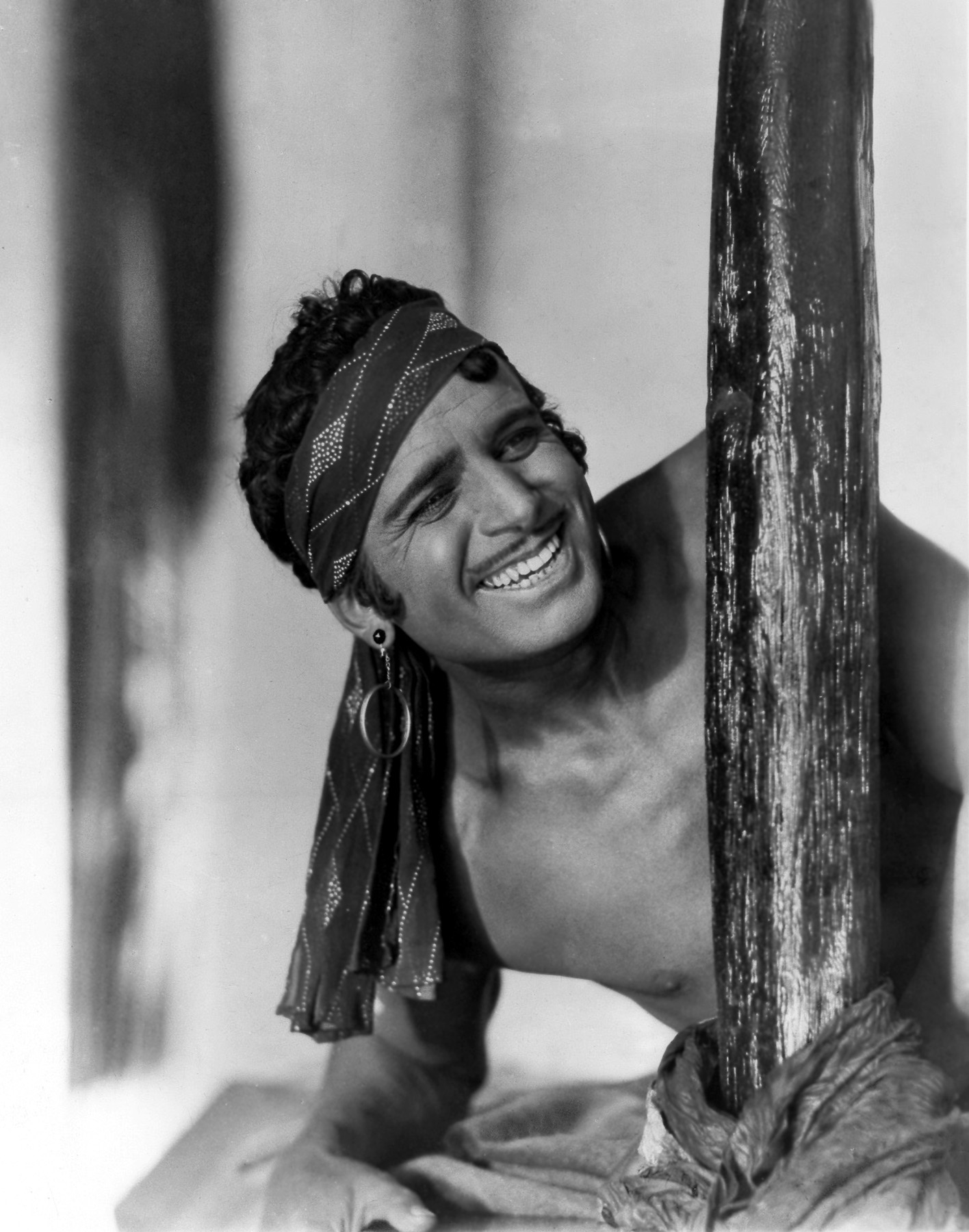
Douglas Fairbanks Sr. in costume for 'The Thief of Bagdad' (1924).

Fairbanks, swaggering through massive marketplace sets and cavernous throne rooms as an incorrigible pickpocket, scales towering walls (with the help of a magic rope) and leads merry chases through crowded bazaars in his pursuit of loot.

The jaunty opening is a preamble to the film's spectacular second half, in which the repentant thief embarks on an odyssey through caverns of fire, underwater palaces, and even outer space. 

Special effects range from a giant smoke-belching dragon to a magical flying horse, and still glow with a timeless sense of wonder from the early days of movies.

William Cameron Menzies's sets were among the largest ever created for a motion picture. Especially noteworthy is his design for a mythical Bagdad, a unique combination of Art Deco and Islamic elements—a dream city inspired by illustrations from story books.

Fairbanks, among the most popular stars of the 1920s, was the inspiration for the character of George Valentin in the Oscar-winning Best Picture 'The Artist' (2011). 

Fairbanks was known for films that used the then-new medium of motion pictures to transport audiences to historical time periods for grand adventures and athletic stunts. 

He's often referred to as "Douglas Fairbanks Sr." to avoid confusion with his son, the actor Douglas Fairbanks Jr.

A century after its premiere, 'The Thief of Bagdad' remains highly regarded. In 1996, the film was selected for preservation in the U.S. National Film Registry by the Library of Congress as being "culturally, historically, or aesthetically significant."

Live music for 'The Thief of Bagdad' will be provided by silent film accompanist Jeff Rapsis, who uses a digital synthesizer to create a traditional full orchestra "movie score" sound.

"Seeing a Fairbanks picture in a theater with live music and an audience is a classic movie experience," Rapsis said.

Rapsis emphasized the unique value of seeing early cinema as it was originally presented.

"These films were designed for the big screen, live music, and large audiences. If you put it all together again, you get a sense of why people first fell in love with the movies," Rapsis said.

The screening of 'The Thief of Bagdad' is sponsored by Kathy and Wayne Rausenberger, Donna Malewicki, Jean and Harold Somerset, Donald and Dolories Furnari, Gary and Nancy Meffe, and Pam and Steve Douglass.
 
Other films in this year's Brandon Town Hall silent film series include:

• Saturday, July 20, 2024, 7 p.m.: "The Cameraman" (1928) starring Buster Keaton. In 'The Cameraman,' Keaton tries to impress the gal of his dreams by working as a newsreel photographer. Can he get a break and get the girl? Classic visual comedy with Keaton at the peak of his creative powers; set in NYC and includes 1920s shots of Midtown Manhattan and the old Yankee Stadium.

• Saturday, Aug. 10, 2024, 7 p.m.: "Four Horsemen of the Apocalypse" (1921) starring Rudolph Valentino. Sweeping drama of a divided family with members caught up on opposites sides during World War I. Breakthrough film for Rudolph Valentino, introducing the sultry tango and launching him to stardom. The real deal! Shown both in honor of the 110th anniversary of World War I's outbreak and the anniversary of Valentino's untimely death in 1926.

• Saturday, Sept. 21, 2024, 7 p.m.: "Speedy" (1928) starring Harold Lloyd. Harold's final silent feature cis a tribute to New York City, baseball, and the idea that nice guys can indeed finish first, highlighted by one of the most exciting races to the finish in all silent cinema. Complete with an extended cameo from none other than Babe Ruth!

• Saturday, Oct. 19, 2024, 7 p.m.: "Phantom of the Opera" (1925) starring Lon Chaney. Long before Andrew Lloyd Webber created the hit stage musical, this silent film adaptation starring Lon Chaney put 'Phantom' firmly in the pantheon of both horror and romance. Just in time for Halloween!

• Saturday, Nov. 16, 2024, 7 p.m.: "Barbed Wire" (1927) starring Pola Negri, Clive Brook. During World War I, the French government commandeers a family farm for use as a camp for German POWs, setting the local population at each other. Intense drama about forbidden love and the human condition, with a special holiday twist.

See Douglas FairbanksSr.  in the 'The Thief of Bagdad' (1924) with live music on Saturday, June 8 at 7 p.m. at the Brandon Town Hall and Community Center, Route 7, in Brandon, Vt. All are welcome to this family-friendly event. Admission is free, with free will donations accepted in support of ongoing Town Hall renovations.

For information, visit www.brandontownhall.com.

Thursday, June 23, 2022

'Robin Hood' (1922) 100th anniversary screening Wednesday, June 29 in Ogunquit, Maine

Douglas Fairbanks Sr. in the title role of 'Robin Hood' (1922).

Up next on Wednesday, June 29: a 100th anniversary screening of Douglas Fairbanks Sr. in 'Robin Hood' (1922) at the Leavitt Theatre in Ogunquit, Maine.

Details in the press release below. But first, a report from last night's screening of Harold Lloyd's 'The Kid Brother' (1927) at the Coolidge Corner Theatre in Brookline, Mass.

Shown via DCP provided by the Harold Lloyd Trust, to my eyes the film never looked better. Really! Every subtle background detail was rendered perfectly on the big screen in the Coolidge's main auditorium.

All the exquisitely framed views of life in small town America (in the film, Hickoryville) got me thinking: in what year, exactly, is 'The Kid Brother' set?

Jobyna Ralston and Harold Lloyd share the somewhat ambiguous atmosphere in 'The Kid Brother.'

I don't think I've ever encountered any solid information about this, and the film itself offers few clues. One thing to note: not a single automobile appears on screen. Does that mean it was in the pre-auto 19th century? But then again, would a car-less landscape be that unommon in truly rural small-town America of the 1920s?

Contrast this ambiguity with 'Speedy' (1928), Lloyd's next film, in which the time and place plays a leading role. 'Speedy' was definitely set in New York City of the 1920s—the film's story could not have worked otherwise, not to mention Babe Ruth's cameo appearance.

Although 'The Kid Brother' no hard evidence of a specific year such as calendars or dates on paperwork. Of the two official documents concerning the village dam, one is undated, and the other simply reads "May 6."

Maybe that lack of specificity is what Lloyd was going for? However it came about, Lloyd and his team set the story in an idealized version of small town America in the then-just-recent past: no specific year, just close enough to be familiar and distant enough to evoke a kind of nostalgia. 

The setting of 'The Kid Brother' seems to be designed to evoke simpler times of not-too-long ago: within our experience, but not current. At the time of the film's release (1927), it would have worked for adult viewers of any age, from knowing young folks of the Roaring '20s to people who grew up before the Civil War.

And now, almost a hundred years later, it still works. Whether or not we notice the lack of automobiles or other signs of certain eras, 'The Kid Brother' is not of today, but of a kind of idealized past.

This, I think, helps create just the right environment for the story to unfold, and for us to embrace it each in our own individual way, even as we're sitting there together in a theater enjoying what's ultimately a communal experience.

So it's a little like how F.W. Murnau's 'Sunrise' is set not in a specific time or place, but depicts an abstract vision of country life and city streets. Even the characters don't have names! But their anonymity contributes to the timelessness and universality of the story.

There's something similar about 'The Kid Brother.' Although the characters do have names, there's an ambiguity about time and place that seems deliberate. Time? We don't really know, exactly. Place? Like Springfield in the Simpsons, it's never clear in what state Hickoryville is located.

Nearly 100 years after 'The Kid Brother' was released, it still works. To audiences today, Hickoryville still looks like a place we ourselves might imagine if asked to envision a community from time when things were simpler and more innocent—like what might appear in a storybook from our childhood.

Many thanks to Martin and Becky Normand, and all the supporters of the Coolidge's 'Sounds of Silence,' for the opportunity to create live music for a timeless masterpiece that's among Lloyd's greatest achievements. 

Next up for me at the Coolidge: live music for a midnight screening (!) on Saturday, July 30 of 'The Cabinet of Dr. Caligari' (1920), which I understand is part of an ongoing carnival-themed horror film series. Hope you'll stay up late and join us.

But coming up sooner, it's 'Robin Hood' (1922) on Wednesday, June 29 at the Leavitt in Ogunquit. More info in the press release below:


*   *   *

Original poster promoting 'Robin Hood,' the top-grossing film of 1922.

MONDAY, JUNE 13, 2022 / FOR IMMEDIATE RELEASE
Contact Jeff Rapsis • (603) 236-9237 • jeffrapsis@gmail.com

'Robin Hood' leaps into action at Leavitt Theatre on Wednesday, June 29

It's off to Sherwood Forest for the 100th anniversary of legendary silent blockbuster, screened with live music

OGUNQUIT, Maine—He robbed from the rich, gave to the poor, and was the top box office attraction of 1922.

He was Douglas Fairbanks Sr. starring in 'The Adventures of Robin Hood,' the original movie adaptation of the legendary tale.

See it for yourself on the big screen on Wednesday, June 29 at 7 p.m. at the Leavitt Theatre, 259 Main St., Ogunquit.

Admission is $12 per person. Live music for the silent 'Robin Hood' will be provided by Jeff Rapsis, a New Hampshire-based performer and composer who specializes in scoring and presenting silent films.

Set in medieval England, 'Robin Hood' tells the tale of the Earl of Huntingdon (Fairbanks), a dashing nobleman who joins King Richard the Lion-Hearted (Wallace Beery) on a Crusade to the Holy Land.

Huntingdon later returns to England to find Richard's cruel brother, Prince John (Sam De Grasse), falsely claiming the throne, enriching his aristocratic cronies and tyrannizing the citizenry.

Huntingdon takes to the woods and becomes 'Robin Hood,' soon joined by a band of merry men who undermine Prince John's reign by robbing from the rich and giving to the poor.

Can Robin Hood and his men vanquish their enemy, the High Sheriff of Nottingham (William Lowery)? And can they rescue Lady Marian Fitzwalter (Enid Bennett), Huntingdon's betrothed, from the evil clutches of Prince John?

Along the way, Fairbanks has ample opportunity to demonstrate his skills in archery, fencing, and acrobatics.

Big film, big megaphone: Allan Dwan directs 'Robin Hood,' with an out-of-costume Fairbanks standing by.

Directed by Allan Dwan, 'Robin Hood' amazed audiences with its enormous sets that recreated in full scale the castles and villages of medieval England.

At a time when $200,000 was a hefty movie budget, 'Robin Hood' cost $1 million to produce.

But the film proved an enormous hit, becoming the top box office attraction of 1922 and earning $2.5 million in its initial release through United Artists, the distribution company Fairbanks formed with fellow stars Charlie Chaplin, D.W. Griffith, and his wife, Mary Pickford.

Fairbanks, among the most popular stars of the 1920s, was the inspiration for the character of George Valentin in the Oscar-winning Best Picture 'The Artist' (2011). Fairbanks was known for films that used the then-new medium of motion pictures to transport audiences to historical time periods for grand adventures and athletic stunts.

He's often referred to as "Douglas Fairbanks Sr." to avoid confusion with his son, the actor Douglas Fairbanks Jr.

Lady Marian (Enid Bennett) is romanced by Douglas Fairbanks in 'Robin Hood' (1922).

Also in the cast for 'Robin Hood' is Alan Hale Sr., who made such an impression at Little John that he was cast in the same role in the 1938 remake starring Errol Flynn. (Hale's son, Alan Hale Jr., played the role of the Skipper on the 1960s television series "Gilligan's Island.")

Live music for 'Robin Hood' will be provided by silent film accompanist Jeff Rapsis, who uses a digital synthesizer to create a traditional full orchestra "movie score" sound.

"Seeing a Fairbanks picture in a theater with live music and an audience is a classic movie experience," Rapsis said.

Rapsis emphasized the unique value of seeing early cinema as it was originally presented.

"These films were designed for the big screen, live music, and large audiences. Put it all together again, and you get a sense of why people first fell in love with the movies," Rapsis said.

The Leavitt's silent film series runs through October, concluding with a Halloween screening of 'Der Golem' (1920) on Saturday, Oct. 29.

A total of nine programs will be offered, including Buster Keaton in 'Battling Butler' and 'The Temptress (1926), a Greta Garbo drama with two very different endings.

The Leavitt, a summer-only moviehouse, opened in 1923 at the height of the silent film era, and has been showing movies to summertime visitors for nearly a century.

The silent film series honors the theater's long service as a moviehouse that has entertained generations of Seacoast residents and visitors, in good times and in bad.

Following 'Robin Hood' on Wednesday, June 29 at 7 p.m., other programs in this year's Leavitt silent film series include:

• Wednesday, July 13 at 7 p.m.: Buster Keaton in 'Battling Butler' (1926). Keaton plays Alfred Butler, a pampered rich idler with the same name as a feared boxing champion. When a girl he's pursuing thinks he's the fighter, Keaton has no choice but to start training. Uproarious 1926 comedy!

• Wednesday, July 27 at 7 p.m.: Greta Garbo in 'The Temptress' (1926). MGM drama with Garbo destroying the lives of men everywhere. Unusual in that the film was made with two very different endings per order of studio boss Louis B. Mayer; both will be screened.

• Wednesday, Aug. 10 at 7 p.m.: Clara Bow stars in 'Mantrap' (1926). Battle-of-the-sexes comedy; city boy Richard Dix tries to win his girlfriend by taking up the rugged cowboy life, only to find it not so rugged. Rarely screened comedic gem from the height of the silent era.

• Wednesday, Aug. 17 at 7 p.m.: 'Blood and Sand' (1922). Rudolph Valentino in his first starring role, as a sexy bullfighter in this romantic thriller. Will Rudy choose the pure love of Carmen, or the sinister charms of the exotic Doña Sol? And will he survive the choice?

• Wednesday, Sept. 14 at 7 p.m.: Rare race drama: 'The Flying Ace' (1926). All-Black motion picture added to the National Film Registry last year. Rare example of 'race' cinema, produced for audiences in black-only theaters commonly found in segregated parts of the nation.

• Wednesday, Sept. 28 at 7 p.m.: F.W. Murnau's 'The Last Laugh' (1924). Towering performance by Emil Jannings as aging doorman at posh city hotel whose unexpected change of jobs robs him of self-respect and identity. Directed by Murnau as a purely visual tale, no dialogue intertitles.

• Saturday, Oct. 29 at 7 p.m.: 'Der Golem' (1920). Prepare for Halloween with one very weird flick! In 16th-century Prague, a rabbi creates a giant creature from clay, called the Golem. Using sorcery, he brings the creature to life in order to protect the Jews of Prague from persecution.

'Robin Hood' (1922) starring Douglas Fairbanks Sr., will be screened with live music on Wednesday, June 29 at 7 p.m. at the Leavitt Fine Arts Theatre, 259 Main St. Route 1, Ogunquit, Maine. Tickets $12 per person, general seating.

For more info, call (207) 646-3123 or visit www.leavittheatre.com.

Saturday, June 11, 2022

Tonight! It's off to Sherwood Forest—or Brandon, Vt.—for 100th anniversary of 'Robin Hood' (1922)

It's a hit! Douglas Fairbanks Sr. takes aim in 'The Adventures of Robin Hood' (1922).

Tonight! It's up to Brandon, Vt. to do live music for a 100th anniversary screening of 'The Adventures of Robin Hood' (1922) starring Douglas Fairbanks Sr.

If you're anywhere near the area, come on out tonight for what promises to be a grand time at the movies. After all, it was only the #1 top box office attraction that year!

For more information, let's get right to the press release:

*    *    *

On the set of 'Robin Hood': A big film merits a big megaphone!
 
MONDAY, MAY 31, 2022 / FOR IMMEDIATE RELEASE
Contact Jeff Rapsis • (603) 236-9237 • jeffrapsis@gmail.com

'Robin Hood' leaps into action at Town Hall Theatre on Saturday, June 11

It's off to Sherwood Forest for the 100th anniversary of legendary silent blockbuster, screened with live music

BRANDON, Vt.—He robbed from the rich, gave to the poor, and was the top box office attraction of 1922.

He was Douglas Fairbanks Sr. starring in 'The Adventures of Robin Hood,' the original movie adaptation of the legendary tale.

See it for yourself on the big screen on Saturday, June 11 at 7 p.m. at the Brandon Town Hall and Community Center, on Route 7 in Brandon, Vt.

Admission is free; donations are welcome to help support ongoing Town Hall renovation efforts.

Live music for the silent 'Robin Hood' will be provided by Jeff Rapsis, a New Hampshire-based performer and composer who specializes in scoring and presenting silent films.

Set in medieval England, 'Robin Hood' tells the tale of the Earl of Huntingdon (Fairbanks), a dashing nobleman who joins King Richard the Lion-Hearted (Wallace Beery) on a Crusade to the Holy Land.

Huntingdon later returns to England to find Richard's cruel brother, Prince John (Sam De Grasse), falsely claiming the throne, enriching his aristocratic cronies and tyrannizing the citizenry.

Huntingdon takes to the woods and becomes 'Robin Hood,' soon joined by a band of merry men who undermine Prince John's reign by robbing from the rich and giving to the poor.


Can Robin Hood and his men vanquish their enemy, the High Sheriff of Nottingham (William Lowery)? And can they rescue Lady Marian Fitzwalter (Enid Bennett), Huntingdon's betrothed, from the evil clutches of Prince John?

Along the way, Fairbanks has ample opportunity to demonstrate his skills in archery, fencing, and acrobatics.

Directed by Allan Dwan, 'Robin Hood' amazed audiences with its enormous sets that recreated in full scale the castles and villages of medieval England.

At a time when $200,000 was a hefty movie budget, 'Robin Hood' cost $1 million to produce.

But the film proved an enormous hit, becoming the top box office attraction of 1922 and earning $2.5 million in its initial release through United Artists, the distribution company Fairbanks formed with fellow stars Charlie Chaplin, D.W. Griffith, and his wife, Mary Pickford.

Fairbanks, among the most popular stars of the 1920s, was the inspiration for the character of George Valentin in the Oscar-winning Best Picture 'The Artist' (2011). Fairbanks was known for films that used the then-new medium of motion pictures to transport audiences to historical time periods for grand adventures and athletic stunts.

He's often referred to as "Douglas Fairbanks Sr." to avoid confusion with his son, the actor Douglas Fairbanks Jr.

Also in the cast for 'Robin Hood' is Alan Hale Sr., who made such an impression at Little John that he was cast in the same role in the 1938 remake starring Errol Flynn. (Hale's son, Alan Hale Jr., played the role of the Skipper on the 1960s television series "Gilligan's Island.")

Live music for 'Robin Hood' will be provided by silent film accompanist Jeff Rapsis, who uses a digital synthesizer to create a traditional full orchestra "movie score" sound.

"Seeing a Fairbanks picture in a theater with live music and an audience is a classic movie experience," Rapsis said.

An original lobby card of 'The Adventures of Robin Hood' (1922).

Rapsis emphasized the unique value of seeing early cinema as it was originally presented.

"These films were designed for the big screen, live music, and large audiences. Put it all together again, and you get a sense of why people first fell in love with the movies," Rapsis said.

It's the 11th year of Brandon's popular silent film series, which gives residents and visitors a chance to see great movies from the pioneering days of cinema as they were meant to be shown—on the big screen, with an audience, and accompanied by live music.

Screenings are held once a month on Saturday nights from May through November. Admission is free; donations are encouraged, with proceeds to benefit the Town Hall's ongoing restoration.

Over the years, silent film donations have helped support projects including handicapped access to the 19th century building; renovating the bathrooms; and restoring the structure's original slate roof.

The screening of 'Robin Hood' is sponsored by Bruce Ness and Nancy Spalding-Ness.

Other films in this year's Brandon Town Hall silent film series include:

• Saturday, July 23, 7 p.m.: 'Sherlock Jr.' (1924) and 'Battling Butler' (1926). A Buster Keaton double feature showing the stone-faced comedian at the peak of his physical comedy powers. Sponsored by Kathy and Bill Mathis in memory of Maxine Thurston.

• Saturday, Aug. 13, 7 p.m.: 'Blood and Sand' (1922) starring Rudolph Valentino in his first starring role, as a sexy bullfighter in this romantic thriller. Celebrating its 100th anniversary! Sponsored by Edward Loedding and Dorothy Leysath, the Hanson Family in memory of Pat Hanson, and Sally Wood.

• Saturday, Sept. 10, 7 p.m.: 'The Flying Ace' (1926), rare example of movies produced for black-only theaters in segregated parts of the nation; added to the National Film Registry in 2021. Sponsored by Nancy and Gary Meffe.

• Saturday, Oct. 22, 7 p.m.: 'Nosferatu' (1922) Just in time for Halloween! Celebrate the 100th anniversary of F.W. Murnau's original adaptation of Bram Stoker's 'Dracula' story. Sponsored by Bar Harbor Bank and Trust.

• Saturday, Nov. 19, 7 p.m.: 'Her Sister from Paris' (1925) starring Constance Talmadge, Ronald Colman. The scene: Europe. The cast: Rich people. Effervescent battle-of-the-sexes comedy. Sponsored by Harold & Jean Somerset.

'Robin Hood' (1922) starring Douglas Fairbanks Sr., will be screened with live music on Saturday, June 11 at 7 p.m. at the Brandon Town Hall and Community Center, Route 7, in Brandon, Vt. All are welcome to this family-friendly event. Admission is free, with free will donations accepted in support of ongoing Town Hall renovations.

Wednesday, March 30, 2022

Chaney and Houdini in double feature at Town Hall Theatre in Wilton, N.H. on Sunday, 4/3

Harry Houdini and company on location at Niagara Falls shooting 'The Man From Beyond' (1922).

If two heads are better than one, then two famous people from the 1920s whose names are still recognized a full century later must really something. 

The two people: actor Lon Chaney and illusionist Harry Houdini. They're both performers who, alas, died at relatively young ages, but whose names live on today in the 21st century.

On Sunday, April 3 at 2 p.m., I'll accompany films starring Chaney and Houdini at the Town Hall Theatre in Wilton, N.H. 

For Chaney, it's 'Flesh and Blood' (1922), a rarely screened crime drama made just before he tackled the title role in 'The Hunchback of Notre Dame' the next year. 

For for Houdini, it's 'The Man From Beyond' (1922), a very strange film about a man frozen in the Arctic ice for 100 years who's revived and brought back to civilization. 

More info about both films is in the press release below. You may notice they're both from 1922, as they're part of an ongoing series at the Town Hall Theatre celebrating the 100th anniversary pictures from that year.

Starting last January, we've already screened the year's top five box office hits, culminating in last week's showing of Douglas Fairbanks Sr. in 'Robin Hood' (1922) the year's top attraction.

Speaking of 'Robin Hood': the Fairbanks swashbucklers are often singled out for their lavish sets and production values, with Doug himself noted for his on-screen athleticism and forceful personality. 

All of that's true. But I think Fairbanks doesn't get nearly enough credit for the true strength underpinning his most successful pictures, including 'Robin Hood': story construction.

Really! The sets and stunts are great. But no one would care if there wasn't a powerful story at work to pull an audience forward, then and now. 

Fairbanks (who co-wrote 'Robin Hood' under the pseudonym 'Elton Thomas') had a knack for spinning a great yarn—one that hooks you right away, and which you just can't stop following until the inevitably satisfying conclusion. 

Original poster art promoting 'Robin Hood' (1922) starring Douglas Fairbanks Sr.

With 'Robin Hood,' I can attest to the strength of the story because 100 years later, it still mesmerized our audience at the Town Hall Theater. 

Here it was 2022, and people were cheering Fairbanks as he robbed from the rich to steal from the poor, and spontaneously hissing Prince John, the movie's principle villain. 

That's engagement at a powerful level—enough to cause people to fall in love with the movies, then and now. 

Just look at how the opening scenes in 'Robin Hood' establish the characters: we must root for Fairbanks as Lord Huntingdon for his prowess in jousting, his loyalty to King Richard, but most of all his disarmingly charming fear of...women!

For the bad guys, there's Sir Guy, clearly a sourpuss, already attempting to cheat at jousting and forcing himself on Lady Marian. And Prince John with his evil falcon—one look and you just know there's going to be trouble.

King Richard (in one of the better roles of the ubiquitous Wallace Beery) is firmly established as a life-loving and beloved ruler of his people, plus we meet Huntingdon's loyal squire and get to see Lady Marian in the most positive possible light.

There! In an opening scene of less than 10 minutes, Fairbanks establishes the relationships that will carry us through the next two hours. It worked in 1922, and it still works in 2022, and I imagine it will continue to work in 2122 and beyond.

Will audience response for Chaney and Houdini match that of Fairbanks? Only one way to find out—come join us on Sunday, April 3 and see for yourself. 

*     *     *

An original release poster for 'Flesh and Blood' (1922) starring Lon Chaney.

 MONDAY, MARCH 28, 2022 / FOR IMMEDIATE RELEASE
Contact Jeff Rapsis • (603) 236-9237 • jeffrapsis@gmail.com

Films starring Lon Chaney and Harry Houdini at Town Hall Theatre on Sunday, April 3

Legendary performers return to the silver screen in double bill celebrating 100th anniversary of 1922 releases, with live music.

WILTON, N.H.—A century after their heyday, 'Houdini' and 'Chaney' are still known as the names of legendary entertainers.

See them both on the big screen again on Sunday, April 3 at 2 p.m. at the Town Hall Theatre, 40 Main St., Wilton, N.H.

Admission is free; a donation of $10 per person is suggested to help defray expenses.

The screenings will be accompanied with live music by Jeff Rapsis.

The double bill features Lon Chaney in the crime drama 'Flesh and Blood,' while Houdini stars in the adventure film 'The Man From Beyond.'

Released in 1922, both films celebrate their 100th anniversaries this year.

In 'Flesh and Blood,' a rarely screened crime drama, Chaney plays an escaped convict who hides out in Chinatown and plots revenge.

Chaney, known as the "Man of a Thousand Faces" due to his versatility with make-up, was a major star during Hollywood's silent era.

Iconic performances included the title roles in the blockbuster silent versions of 'The Hunchback of Notre Dame' (1923) and 'The Phantom of the Opera' (1925).

A lobby card promoting Harry Houdini's 'The Man From Beyond' (1922).

In 'The Man From Beyond,' illusionist and escape artist Harry Houdini plays an Arctic adventurer frozen for 100 years. Discovered and thawed out, he searches for his reincarnated lost love.

Houdini was a Hungarian-born, American-Jewish illusionist and stunt performer noted for his sensational escape acts.  

His repertoire included escaping from ropes slung from skyscrapers, from straitjackets under water, and from inside a sealed milk can with water in it.

Chaney began as a stage actor, but moved exclusively to films in the mid-1910s and remained before the cameras for the balance of his career.

Houdini, at the height of his fame, starred in a series of adventure films in the early 1920s, but continued to focus on live performance.

Both men died relatively young: Chaney from throat cancer in 1930 at age 47; Houdini from a ruptured appendix in 1926 at age 52.

A scene from 'Flesh and Blood' (1922) starring Lon Chaney.

Live music for both films will be provided by silent film accompanist Jeff Rapsis, who uses a digital synthesizer to create a traditional full orchestra "movie score" sound.

Rapsis emphasized the unique value of seeing early cinema as it was originally presented.

"These films were designed for the big screen, live music, and large audiences. Put it all together, and you can get a sense of why people first fell in love with the movies," Rapsis said.

The double feature is part of the Town Hall Theatre's ongoing series honoring the 100th anniversary of significant motion pictures that debuted in 1922.

Programs have included all of 1922's five highest-grossing titles, each shown on the big screen with live music, as well as century-old oddities, short films, cartoons, and more.

The Town Hall's 100th anniversary series will conclude with 'Othello' (1922) on Sunday, April 17 at 2 p.m.

The Bard's immortal tragedy is brought to the screen in this early German version starring legendary actor Emil Jannings. Silent Shakespeare in honor of the author's 458th birthday.

'Flesh and Blood' starring Lon Chaney and 'The Man From Beyond' starring Harry Houdini will be shown with live music on Sunday, April 3 at 2 p.m. at the Town Hall Theatre, 40 Main St., Wilton, N.H. Admission is free; a donation of $10 per person is suggested to defray expenses.

For more info, visit www.wiltontownhalltheatre.com or call (603) 654-3456


Wednesday, August 26, 2020

Two Zorros are better than one: Original, sequel with live music on Aug. 29 & 30 in Wilton, N.H.

Douglas Fairbanks fails to demonstrate proper face-covering technique in 'The Mark of Zorro' (1920).

This weekend brings a two-fer: the original big screen 'Zorro' (1920) on Saturday, Aug. 29, followed by its sequel, 'Don Q, Son of Zorro' (1925) on Sunday, Aug. 30. Live music by you-know-who.

Screenings are at 2 p.m. the Town Hall Theatre, 40 Main St., Wilton, N.H. Admission is free, with donations of $10 per person suggested to help support the silent film series. 

 It's a rare chance to see these two related films back-to-back, which allows film-goers to appreciate the connections between the pair, but also to see how far movies had come in just five years.

A lot more info about the films and the screenings is in the press release, which I've pasted into this post a bit further down.

Before that, however, let me report that Harold Lloyd's comedy 'Why Worry?' was greeted this evening by uproarious laughter from a good-sized crowd at the Flying Monkey Moviehouse and Performance Center up in Plymouth, N.H.

They must have not had enough R's, L's, or Y's to spell Harold Lloyd in 'Why Worry?' 

It's the closest to a "normal" silent film screening I've experienced since the Coronavirus pandemic shut down live performances back in March.

Since I started accompanying screenings again last month, attendance has been hit-or-miss: a lot of people are cautious about congregating and still feel pretty vulnerable. 

But tonight's screening of 'Why Worry?' checked all the boxes: large crowd (for the Covid-19 era); genuinely funny film; generous audience response; a unique shared experience — needed now more than ever!

So I can say the silent film experience is still alive and well, at least in this corner of the planet. And if you're in the same corner, I invite you to check out 'Zorro' and 'Son of Zorro' this weekend in Wilton, N.H. Here's the press release...

*   *   *

Douglas Fairbanks Sr. plays the son of Zorro, or Zorro Jr. Confused?

MONDAY, AUG. 17, 2020 / FOR IMMEDIATE RELEASE
For more info, contact: Jeff Rapsis • (603) 236-9237 • jeffrapsis@gmail.com

Town Hall to screen 'Zorro' and sequel 'Son of Zorro' over a single weekend Aug. 29 & 30

Swashbuckling silent adventure films starring Douglas Fairbanks Sr. to be shown with live music for 100th anniversary of Zorro's release

WILTON, N.H.—It's a rare chance to see the classic silent adventure 'The Mark of Zorro' and its popular sequel, 'Son of Zorro' all in one weekend.

On Saturday, Aug. 29, the Town Hall Theatre will present 'The Mark of Zorro' (1920) starring Douglas Fairbanks Sr. to mark the 100th anniversary of the film's original release.

Then, on Sunday, Aug. 30, the theatre will run 'Don Q, Son of Zorro' (1925), a continuation of the Zorro story and Hollywood's first-ever big budget sequel.

In 'Don Q, Son of Zorro,' Fairbanks plays dual roles: his original sword-brandishing 'Zorro' character and also his whip-wielding son.

Both screenings start at 2 p.m. and will be accompanied by live music performed by Jeff Rapsis.

Admission is free; a donation of $10 per person is suggested to defray expenses and support the Town Hall Theatre's silent film series.

"These two films were among the most popular of the 1920s, and there are many links between them," Rapsis said. "It's a rare chance to see them both together, although each is entertaining and enjoyable on its own."

Douglas Fairbanks Sr., an immensely popular star whose career peaked in the 1920s, served as the model for the George Valentin character in 'The Artist,' the recent silent film that recently won multiple Academy Awards, including the Oscar for Best Picture.

'The Mark of Zorro,' to be screened on Saturday, Aug. 29, tells the story of young Don Diego Vega, the son of a wealthy ranch owner in Spanish California of the early 19th century.

Witnessing the mistreatment of the poor by rich landowners and the oppressive colonial government, Don Diego assumes the identity of "Señor Zorro," a masked figure of great cunning and skill, and vows to bring justice to the region.

The film stars Fairbanks, who until 'Zorro' had focused on playing traditional all-American leading roles in romantic comedies.

The success of 'Zorro' launched Fairbanks on a series of historical adventure films that went on to rank among the most popular spectacles of the silent era, including 'The Three Musketeers' (1921) and 'Robin Hood' (1922).

The enduring popularity of 'Zorro' led Fairbanks to film the sequel, which continues the story to another generation.


In 'Don Q, Son of Zorro,' Fairbanks plays Don Cesar de Vega, Zorro's grown son, a prodigy with the whip who is visiting the family's Spanish homeland to finish his education.

The trip is no dull semsester abroad: Cesar duels with Don Sebastian of the Queen's Guard (soon to be his rival for the hand of lovely Dolores de Muro), makes love to a general's daughter, and befriends the visiting Archduke of Austria.

But a quarrel ending in violence gives Don Sebastian the chance to dispose of his rival by framing him for murder! Feigning suicide, Zorro's whip-wielding son escapes to the family's abandoned castle, where he makes plans to clear the family name.

Both screenings will be accompanied live by silent film musician Jeff Rapsis.

Rapsis achieves a "movie score" sound for silent film screenings by using a digital synthesizer to reproduce the texture of the full orchestra.

"Each of the 'Zorro' films are terrific movies on their own, but the chance to see the original and then the sequel is a great way to present these two films as they were intended to be seen: on the big screen, with live music, and with an audience," said Rapsis, who provides live music accompaniment for silent film screenings across New England and beyond.

'The Mark of Zorro' (1920) will be screened with live music on Saturday, Aug. 29 at 2 p.m. Its sequel, 'Don Q, Son of Zorro' (1925) will be screened with live music on Sunday, Aug. 30 at 2 p.m. Each screening is free and open to the public; a donation of $10 per person is suggested to defray expenses.

Both screenings take place at the Town Hall Theatre, 40 Main St., Wilton, N.H. For more info, visit www.wiltontownhalltheatre.com or call (603) 654-3456.

Thursday, August 6, 2020

In which I get featured in my own newspaper! Plus: 'Robin Hood' (1922) on 8/9 in Wilton, N.H.

Who is that masked man? He's the accompanist, enjoying the rare sight of his name in lights.

Let me put it this way: last night's screening of Buster Keaton's 'Three Ages' did not run into problems with social distancing.

The screening, which restarted the long-running silent film/live music series at the Flying Monkey Moviehouse in Plymouth, N.H., did not exactly break attendance records.

How many people were on hand? Well, if someone had brought a dozen donuts, there'd more than enough for everyone.

But off we went, working to reestablish the audience for old Hollywood, since new Hollywood doesn't seem to give a damn about small independent theaters these days.

Really! Looks like everything is going direct to streaming from now on. At least that's how the local owner/operators see it. Movie theaters are morphing into a sort of antiquated cultural experience.

In Plymouth, we'll try to build attendance by sticking with comedy (the silent film gateway drug) for our next screening: on Wednesday, Aug. 26, it's Harold Lloyd in 'Why Worry?' (1923). Talk about timely marketing. Can you name a title that's more appropriate for the age we live in today?

And that's just the beginning. At another local venue, we're "leaving the 21st century entirely," as one news report put it.

At the Town Hall Theatre in Wilton, N.H., this coming Sunday marks the beginning of an entire week of silent films with live music, all in the big house and in primetime matinee or evening slots. No first-run films at all.

Instead, we have...well, let give the floor over to the Hippo, our region's arts & entertainment weekly newspaper, which summarized it like this:
At Wilton Town Hall Theatre, first run movies are being put on hold and silent films from the 1920s are taking over the screens. This Sunday, Aug. 9, at 2 p.m., you can catch 1921's Robin Hood and then next week, starting with Buster Keaton in The General from 1926 on Monday, Aug. 10, at 7:30 p.m., catch a series of silent film era comedies (a different one each night through Friday, Aug. 14, at 7:30 p.m.). The movies will all feature live musical accompaniment by Jeff Rapsis (who is also a Hippo associate publisher). Angie Sykeny talks to Jeff on page 6 in this week's issue.
Why, yes, that's me, appearing in a newspaper of which I'm co-owner. And like all good newspapers, we maintain a strict wall between news content and the business/advertising operations. So it's very unusual for me to get featured like this, and I'm grateful for the attention.

You can check out the interview online. Angie S. did a great job making sense of my inchoate ramblings.

But it's funny: the Town Hall Theatre's wholesale abdication of contemporary movies in favor of century-old classics has received a good amount of attention. How about this from BoxOfficePro? Or this from the Monadnock Ledger-Transcript, a local paper?

Well, first up is Douglas Fairbanks Sr. in 'Robin Hood' (1922), which is Sunday, Aug. 9 at 2 p.m. Hope you'll be able to join us in using past greatest to bring current life to an independent theater. Press release with more detail is below. (And more about our week of silent comedy in a later post.)

*  *  * 

Original promotional poster art for Douglas Fairbanks Sr. in 'Robin Hood' (1922).

TUESDAY, JULY 28, 2020 / FOR IMMEDIATE RELEASE
Contact Jeff Rapsis • (603) 236-9237 • jeffrapsis@gmail.com

'Robin Hood' leaps into action at Town Hall Theatre on Sunday, Aug. 9


It's off to Sherwood Forest as Douglas Fairbanks summer swashbuckler series continues, with live music

WILTON, N.H.—He robbed from the rich, gave to the poor, which helped make him the top box office attraction of 1922.

He was Douglas Fairbanks Sr. starring in 'Robin Hood,' the original blockbuster movie adaptation of the legendary tale.

See it for yourself on the big screen on Sunday, Aug. 9 at 2 p.m. at the Town Hall Theatre in Wilton, N.H., 40 Main St., Wilton, N.H.

Admission is free; a donation of $10 per person is suggested to help defray expenses.

The screening will be accompanied with live music by Jeff Rapsis.

It's part of a summer season of silent swashbucklers starring the charismatic Fairbanks, one of early cinema's most popular stars.

Set in medieval England, 'Robin Hood' tells the tale of the Earl of Huntingdon (Fairbanks), a dashing nobleman who joins King Richard the Lion-Hearted (Wallace Beery) on a Crusade to the Holy Land.

Huntingdon later returns to England to find Richard's cruel brother, Prince John (Sam De Grasse), falsely claiming the throne, enriching his aristocratic cronies and tyrannizing the citizenry.

Huntingdon takes to the woods and becomes 'Robin Hood,' soon joined by a band of merry men who undermine Prince John's reign by robbing from the rich and giving to the poor.

Can Robin Hood and his men vanquish their enemy, the High Sheriff of Nottingham (William Lowery)? And can they rescue Lady Marian Fitzwalter (Enid Bennett), Huntingdon's betrothed, from the evil clutches of Prince John?

Along the way, Fairbanks has ample opportunity to demonstrate his skills in archery, fencing, and acrobatics.

Directed by Allan Dwan, 'Robin Hood' amazed audiences with its enormous sets that recreated in full scale the castles and villages of medieval England.

At a time when $200,000 was a hefty movie budget, 'Robin Hood' cost $1 million to produce.

But the film proved an enormous hit, becoming the top box office attraction of 1922 and earning $2.5 million in its initial release through United Artists, the distribution company Fairbanks formed with fellow stars Charlie Chaplin, D.W. Griffith, and his wife, Mary Pickford.

Fairbanks, among the most popular stars of the 1920s, was the inspiration for the character of George Valentin in the Oscar-winning Best Picture 'The Artist' (2011). Fairbanks was known for films that used the then-new medium of motion pictures to transport audiences to historical time periods for grand adventures and athletic stunts.

He's often referred to as "Douglas Fairbanks Sr." to avoid confusion with his son, the actor Douglas Fairbanks Jr.

Also in the cast for 'Robin Hood' is Alan Hale Sr., who made such an impression at Little John that he was cast in the same role in the 1938 remake starring Errol Flynn. (Hale's son, Alan Hale Jr., played the role of the Skipper on the 1960s television series "Gilligan's Island.")

Live music for 'Robin Hood' will be provided by silent film accompanist Jeff Rapsis, who uses a digital synthesizer to create a traditional full orchestra "movie score" sound.

"Seeing a Fairbanks picture in a theater with live music and an audience is a classic movie experience," Rapsis said.

Rapsis emphasized the unique value of seeing early cinema as it was originally presented.

"These films were designed for the big screen, live music, and large audiences. Put it all together again, and you get a sense of why people first fell in love with the movies," Rapsis said.

'Robin Hood' continues a summer season of silent swashbucklers at the Town Hall Theatre, all starring Douglas Fairbanks. The series will conclude with a special Saturday/Sunday screening of 'The Mark of Zorro' (1920) and its sequel, 'Don Q, Son of Zorro' (1925) on the last weekend of August:

• Saturday, Aug. 29 at 2 p.m. 'The Mark of Zorro' (1920) starring Douglas Fairbanks, Sr. 100th anniversary of the break-through adventure film where Fairbanks discovered his talent for playing swashbuckling heroes of yore. Still pleasing crowds a century after it first hit theaters!

• Sunday, Aug. 30 at 2 p.m.: 'Don Q, Son of Zorro' (1925) starring Douglas Fairbanks, Sr. Action/adventure sequel to mega-hit 'Zorro' with Fairbanks playing both son and father, and having a ball in both roles. Builds on the original film to create a hugely entertaining swashbuckler that shows how far Hollywood had come in just five years.

For all screenings, accommodations will be made to keep Town Hall Theatre patrons safe in the Covid-19 era. Also, seating will be arranged to observe social distancing and masks will be required inside the theater until patrons are seated.

'Robin Hood' (1922) starring Douglas Fairbanks Sr., will be screened with live music on Sunday, Aug. 9 at 2 p.m. at the Town Hall Theatre, 40 Main St., Wilton, N.H. Admission is free; a donation of $10 per person is suggested to defray expenses.

For more info, visit www.wiltontownhalltheatre.com or call (603) 654-3456.