Showing posts with label Coolidge Corner. Show all posts

Thursday, November 28, 2024

Post Turkey Day screening: W.C. Fields in 'So's Your Old Man' on Sunday, Dec. 1 in Wilton, N.H.

Outside the Coolidge Corner's marquee prior to 'Thief of Bagdad.'

Happy Thanksgiving!

This year, among the many things I have to be thankful for is making it through 'The Thief of Bagdad' last Tuesday night. I accompanied the film just hours after having a stent removed following last week's kidney stone surgery.

'Bagdad' had been scheduled for the Coolidge Corner's 'Sounds of Silents' series long before the kidney stone decided to make an appearance. It just worked out that the stent removal (a follow-up to the surgery itself) wound up getting scheduled for the same day as the film.

But the show must go on! So driving into Boston, I was already thinking ahead to places in the film where I could set up an atmospheric loop on the synthesizer, which would enable me to quickly escape to the men's room if needed.

Well, turns out I had no problems. Actually, I think getting absorbed in doing music for this sprawling, ambitious picture helped minimize any distracting pain or lingering discomfort, which is a phenomenon I've noticed before.

If I'm suffering, say, a bad cold, whatever symptoms I have seem to recede or disappear entirely when I'm accompanying a film. They'll return afterwards, but during the time I'm at the keyboard it's like a reprieve.

Some say laughter is the best medicine. I say it's creating live music for a silent film screening!

And I'll get to do it again on Sunday, Dec. 1 when I accompany 'So's Your Old Man' (1926) at the Town Hall Theatre in Wilton, N.H. More info is in the press release pasted in below.

It's a silent comedy starring W.C. Fields, so lucky me: I'll get the therapeutic benefits of both laughter and silent film accompaniment.

Happy Thanksgiving and see you at the movies!

*    *    *

An original lobby card for 'So's Your Old Man' (1926) starring W.C. Fields.

MONDAY, NOV. 18, 2024 / FOR IMMEDIATE RELEASE
Contact Jeff Rapsis • (603) 236-9237 • jeffrapsis@gmail.com

Town Hall Theatre to screen rare silent film starring comic icon W.C. Fields

'So's Your Old Man' shows legendary performer as younger man; program on Sunday, Dec. 1 accompanied by live music

WILTON, N.H.—He was a performer who could be recognized by just the nasal twang of his voice.

But prior to reaching iconic fame in talking pictures, W.C. Fields successfully starred in a popular series of silent feature films for Paramount Pictures and other studios in the 1920s.

Rediscover the non-talking W.C. Fields in 'So's Your Old Man' (1926) one of his best silent pictures, in a Thanksgiving Day weekend screening on Sunday, Dec. 1 at 2 p.m. at the Town Hall Theatre, 40 Main St., Wilton, N.H.

Live musical scoring will be provided by silent film accompanist Jeff Rapsis. Admission is free; donations are accepted, with $10 per person suggested to defray expenses. 

In 'So's Your Old Man' (1926), Fields plays Sam Bisbee, inventor of a new shatter-proof windshield glass and regarded as a crackpot by the townsfolk.

After a demonstration of his glass to auto executives goes awry, he faces ridicule and shame. On the way home, Bisbee encounters a woman he thinks is trying to commit suicide, and so prevents her.
 
W.C. Fields (right) in a scene from 'So's Your Old Man' (1926).

The woman is really Princess Lescaboura, member of a family of European royalty, who later arrives in Bisbee's home town to thank him, upending Bisbee's life and setting the small town aflame with gossip. The film includes a version of Fields' famous "golf" routine.

The film was remade as a talkie in 1934, with W.C. Fields again starring, under the title 'You're Telling Me!' In 2008, 'So's Your Old Man' was added to the U.S. National Film Registry.

W.C. Fields remains famous today for his comic persona as a misanthropic and hard-drinking egotist with a snarling contempt for dogs, children and women.

Although Fields achieved lasting fame as a movie star in talking pictures of the 1930s, his long career encompassed decades on the vaudeville stage as well as a series of silent film roles in the 1920s.

"People find it hard to think of W.C. Fields in silent films, but he was actually quite successful," Rapsis said. "As a vaudeville performer and juggler, Fields cultivated a form of visual comedy and pantomime that transferred well to the silent screen.

"Also, as a middle-aged man during the silent film era, he was able to play a family father figure—the kind of role that wasn't open to younger comic stars such as Charlie Chaplin or Buster Keaton," Rapsis said.

In all, Fields starred in 10 silent features in the mid-1920s. Several are lost; in those that survive, Fields sports a thick mustache, part of his vaudeville costume as a "vagabond juggler" which he dropped in later years.

W.C. Fields (at right) includes his legendary golf routine in 'So's Your Old Man' (1926).

The film was made not in Hollywood, but at the Paramount studios in Astoria, Queens, a popular production facility for New York-based stage performers who also appeared in film.

For the music, Rapsis improvises in real time, while the film is running, using a digital synthesizer that allow him to recreate the "movie score" texture of a full orchestra.

"Improvising a score live is a bit of a high-wire act, but it allows me to follow and support the film a lot more effectively than if I was buried in sheet music," Rapsis said.

"Instead, I'm free to follow the film right in the moment. Each time it's different, which lends a certain energy and immediacy and excitement to the experience."

'So's Your Old Man,' a silent comedy starring W.C. Fields, will be screened with live music on Sunday, Dec. 1 at 2 p.m. at the Town Hall Theatre, 40 Main St., Wilton, N.H.

Admission is free; donations are accepted, with $10 per person suggested to defray expenses. For more information, call the theater at (603) 654-3456.

Thursday, November 21, 2024

Pre-Thanksgiving cinematic feast: Creating music for 'The Thief of Bagdad' 100th anniversary screening on Tuesday, Nov. 26 at Coolidge Corner in Brookline, Mass.

A poster promoting 'The Thief of Bagdad' (1924).

Is Thanksgiving is all about giving thanks for abundance?

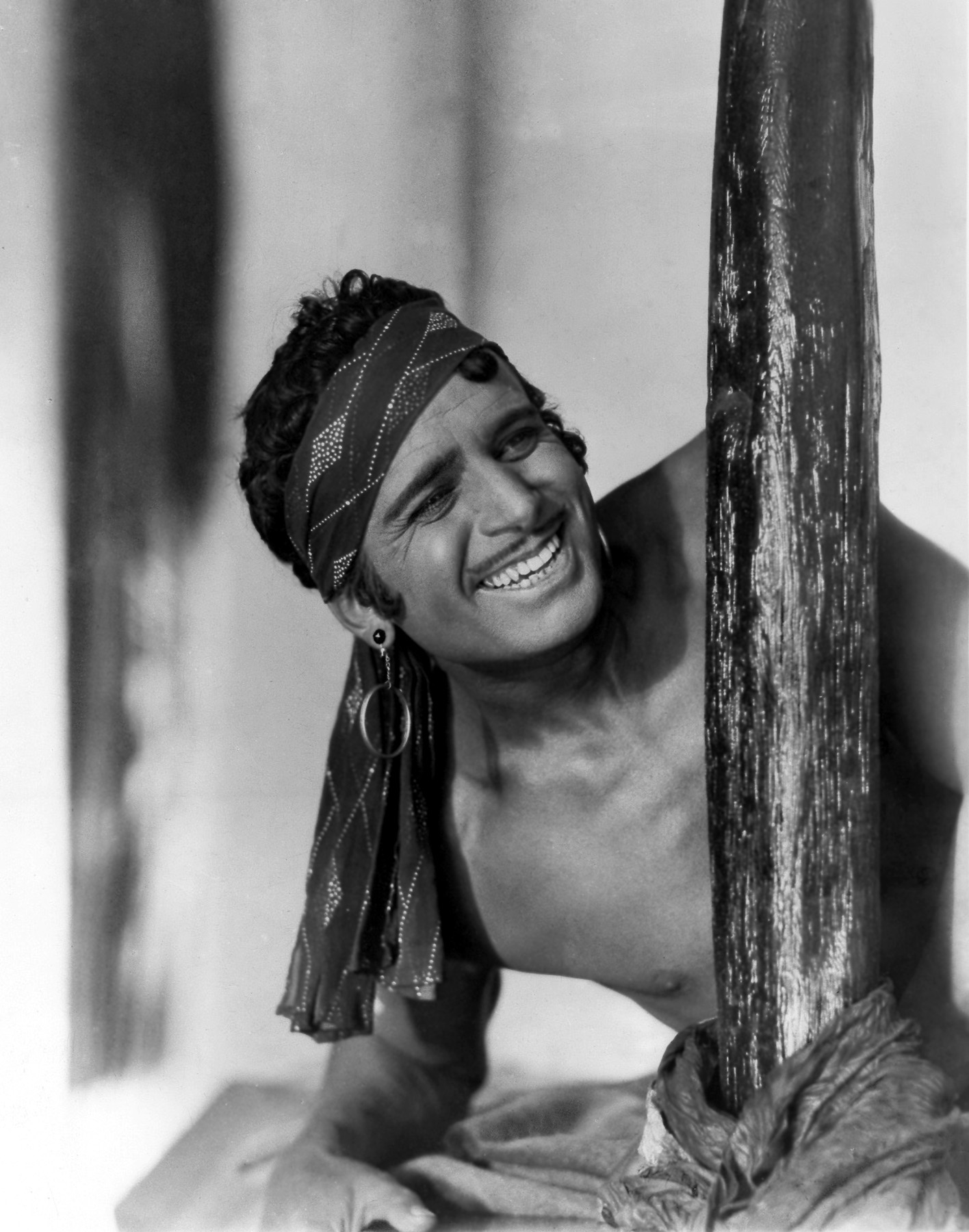
If so, I can't think of a better silent film to prepare one for the upcoming holiday than 'The Thief of Bagdad' (1924), an epic adventure/fantasy starring Douglas Fairbanks Sr.

I'll accompany a 100th anniversary screening of 'Thief' on Tuesday, Nov. 26 (two days prior to Turkey Day) at the Coolidge Corner Theater in Brookline, Mass.

More about the film and screening in the press release below.

But wait—how does a film set in a mythical Bagdad (resplendent in Art Deco design accents, no less) and based on exotic tales from long ago have anything to do with Thanksgiving?

Douglas Fairbanks Sr. plays the title role in 'Thief of Bagdad' (1924).

I think the key is abundance. 'The Thief of Bagdad' contains more of everything that almost any picture made up until then.

More scenery! More thrills! More intrigue! More eye-popping visuals! 

More Douglas Fairbanks, who dances through the film in a performance that's more—well, Fairbanksian than ever before!

But chiefly it's an abundance of ambition that drives 'Thief' to heights never quite achieved until then. 

Fairbanks, at the top of his game, was ready to put everything he knew, and everything the movies could then do, into something truly grand—a motion picture to transport audiences to another realm in the same way the film's flying carpet transports characters in the story.

It all paid off with one of the greatest fantasies produced in the silent era: a picture that captivated audiences when first released, and which still has that effect today.

And that, I think, is something to be thankful for!

So don't be a turkey! Come join us on Tuesday, Nov. 26 at the Coolidge for a 100th anniversary screening of 'The Thief of Bagdad.'  Details in the press release below.

*     *     *


Douglas Fairbanks Sr. and Julanne Johnston in 'The Thief of Bagdad' (1924).

MONDAY, NOV. 11, 2024 / FOR IMMEDIATE RELEASE
Contact Jeff Rapsis • (603) 236-9237 • jeffrapsis@gmail.com

Flying carpets, fire-breathing dragons, underwater palaces, and more!

Classic epic 'Thief of Bagdad' to screen Tuesday, Nov. 26 at Coolidge Corner Theatre

Adventure/fantasy starring Douglas Fairbanks presented with live music in celebration of film's 100th anniversary

BROOKLINE, Mass.—It ranks among the first Hollywood epics to show the full potential for movies to depict entire worlds of fantasy. It was also one of the top grossing films of 1924.

It was 'The Thief of Bagdad,' a celebrated triumph for actor/director Douglas Fairbanks that stands as one of greatest achievements of cinema's silent era.

It's a film filled with images of flying carpets, exotic cities, underwater palaces, winged horses, fire-breathing dragons, and more!

See if for yourself with live music on Tuesday, Nov. 26 at 7 p.m. at the Coolidge Corner Theatre,  290 Harvard St., Brookline, Mass.

Vintage handbill promoting the original release of 'Thief of Bagdad.'

This 100th anniversary screening of 'The Thief of Bagdad' , the latest in the Coolidge's 'Sounds of Silents' series, will feature live accompaniment by Jeff Rapsis, a New Hampshire-based composer who specializes in creating music for silent films.

Tickets $23 per person general admission; students $21.

Douglas Fairbanks, star of 'The Thief of Bagdad,' was the Harrison Ford of his time—a pioneering action hero who was among the first to entertain movie audiences with thrilling adventures.

'The Thief of Bagdad' stands among his best work. A timeless fable on a grand scale, it boasts a great story, spectacular sets, and magical special effects.

A bare-chested Fairbanks plays a crafty street-smart rogue who can easily steal anything his heart desires—except the love of a beautiful princess, daughter of the powerful Caliph of Bagdad.

To win her hand, he must not only change his ways, but also show his worthiness over many other highly placed suitors.

In making the film, Fairbanks spared no expense for what some critics still regard as the most lavish fantasy movie ever made, a show-stopping adaptation of the traditional "A Thousand and One Nights" Arabian legend.

The result is an epic in which a flying carpet is just one of many eye-popping sights designed to astound movie audiences.


Fairbanks, swaggering through massive marketplace sets and cavernous throne rooms as an incorrigible pickpocket, scales towering walls (with the help of a magic rope) and leads merry chases through crowded bazaars in his pursuit of loot.

The jaunty opening is a preamble to the film's spectacular second half, in which the repentant thief embarks on an odyssey through caverns of fire, underwater palaces, and even outer space.

Special effects range from a giant smoke-belching dragon to a magical flying horse, and still glow with a timeless sense of wonder from the early days of movies.

William Cameron Menzies's sets were among the largest ever created for a motion picture. Especially noteworthy is his design for a mythical Bagdad, a unique combination of Art Deco and Islamic elements—a dream city inspired by illustrations from story books.

Fairbanks, among the most popular stars of the 1920s, was the inspiration for the character of George Valentin in the Oscar-winning Best Picture 'The Artist' (2011).

Fairbanks was known for films that used the then-new medium of motion pictures to transport audiences to historical time periods for grand adventures and athletic stunts.

He's often referred to as "Douglas Fairbanks Sr." to avoid confusion with his son, the actor Douglas Fairbanks Jr.

A century after its premiere, 'The Thief of Bagdad' remains highly regarded. In 1996, the film was selected for preservation in the U.S. National Film Registry by the Library of Congress as being "culturally, historically, or aesthetically significant."

Live music for 'The Thief of Bagdad' will be provided by silent film accompanist Jeff Rapsis, who uses a digital synthesizer to create a traditional full orchestra "movie score" sound.

"Seeing a Fairbanks picture in a theater with live music and an audience is a classic movie experience," Rapsis said.

Rapsis emphasized the unique value of seeing early cinema as it was originally presented.

"These films were designed for the big screen, live music, and large audiences. If you put it all together again, you get a sense of why people first fell in love with the movies," Rapsis said.

See Douglas Fairbanks Sr. in the 'The Thief of Bagdad' (1924) with live music on Tuesday, Nov. 26 at 7 p.m. at the Coolidge Corner Theatre,  290 Harvard St., Brookline, Mass.

Tickets $23 per person general admission; students $21. For more information, call the box office at (617) 734-2501 or visit www.coolidge.org. 


Tuesday, December 13, 2022

This Wednesday night! It's Rin Tin Tin to the rescue Dec. 14 at the Coolidge Corner Theatre

An original poster promoting Rin Tin Tin in 'The Night Cry' (1926).

I'm delighted to be doing live music this week for what I feel is one of the unknown gems of the silent era:'The Night Cry' (1926), an action-adventure featuring canine star Rin Tin Tin.

The film is being screened on Wednesday, Dec. 14 at 7 p.m. at the Coolidge Corner Theatre, 290 Harvard St., Brookline, Mass. More info in the press release below.

The Rin Tin Tin silents were all immensely popular starting with the first releases in 1922, after which Warner Bros. started churning them out as fast as possible. 

But 'The Night Cry' has a special quality that comes from the studio searching for fresh ways for their dog star to face peril and keep audiences coming.

As a result, in this picture 'Rinty' (his nickname at the time) faces off against one of the most unusual villains in movie history: a giant California condor! 

Yes—in 'The Night Cry,' it's not enough for Rin Tin Tin to battle a community of sheep ranchers who unjustly accuse him of killing newborn lambs. (One guess as to who's actually responsible.)

No—he must also battle the enormous bird of prey, source of the film's title and also any number of life-or-death encounters for our four-legged star as he strives to prove his innocence.

So with all this going for it, 'The Night Cry' is a great example of the kind of fast-paced melodramatic picture that prompted audiences all over the world to first fall in love with motion pictures. And it still has a slightly over-the-top sensibility that still causes audiences to gasp and cheer nearly a century after its release.

I encourage you to attend tomorrow night's screening to recapture the sense of wonder that cinema once provided in such abundance. 

Plus you get to see a dog match wits with a giant bird!

*   *   *

A production still from 'The Night Cry' (1926) starring Rin Tin Tin.

TUESDAY, DEC. 6, 2022 / FOR IMMEDIATE RELEASE
For more info, contact: Jeff Rapsis • (603) 236-9237 • jeffrapsis@gmail.com

Rin Tin Tin leaps back into action on Wednesday, Dec. 14 at Coolidge Corner Theatre

Legendary dog star races to the rescue, battles giant condor in 'The Night Cry' silent adventure film, presented with live music

BROOKLINE, Mass. — He couldn't speak. But that was no handicap during the silent film era.

He was Rin Tin Tin, the legendary German Shepherd dog whose popularity rivaled that of any human performer when the movies were brand new.

See for yourself on Wednesday, Dec. 14 at 7 p.m., when the Coolidge Corner Theatre screens a vintage Rin Tin Tin silent adventure film with live music.

In 'The Night Cry' (1926), Rin Tin Tin must clear his name after being accused of killing sheep, all while battling an unusual non-human nemesis—a giant California condor!

'The Night Cry' will be shown at the Coolidge Corner Theatre, 290 Harvard St., Brookline, Mass. Admission in $23 per person; tickets available at the door or via www.coolidge.org

The film—the latest installment in the Coolidge's 'Sounds of Silents' series—will be shown with live musical accompaniment by Jeff Rapsis, a composer and performer who specializes in scoring silent film.

Rin Tin Tin films were produced by the then-struggling Warner Bros. studio. They proved immensely popular around the world, with audiences marveling at the then-new German Shepherd breed's feats of derring-do as he outsmarted his human co-stars.

At the time, studio executives referred to Rin Tin Tin "the mortgage lifter" because the dog's pictures helped rescue the ailing studio from bankruptcy.

A lobby card promoting 'The Night Cry' (1926) starring Rin Tin Tin.

Rin Tin Tin became so popular, he was named "Best Actor" at the first-ever Academy Awards in 1929—until officials opted for a re-vote in favor of human performer Emil Jannings.

'The Night Cry' is unusual in that "Rinty" (the dog's nickname) battles not just human foes, but also a murderous California condor.

The original promotional copy for 'The Night Cry' captures the excitement that made Rin Tin Tin a box office sensation:

"A story of tense thrills and tenderness, of a dog's loyalty and man's cruelty—tense with the thrills of a terrifying fight between a giant condor and a Shepherd dog."

To improvise a live musical score for 'The Night Cry,' silent film musician Jeff Rapsis will use a digital synthesizer to recreate the texture of a full orchestra.

"The Rin Tin Tin films are great pictures for audience reaction, even today," Rapsis said. "They're full of fast-paced action, great stunts—and they really move!"

Rin Tin Tin remained popular throughout the silent film era and until his death in 1932, which made headlines around the globe. But his progeny went on to star in later films and TV shows, keeping the name before the public for generations.

Rin Tin Tin's descendants are still bred, continuing the bloodline to the present day. The ongoing Rin Tin Tin phenomenon inspired a recent book, "Rin Tin Tin: The Life and the Legend" by New Yorker writer Susan Orlean.

'The Night Cry' will be screened with live music on Wednesday, Dec. 14 at 7 p.m. at the Coolidge Corner Theatre, 290 Harvard St., Brookline, Mass. as part of the theater's 'Sounds of Silents' series.

The screening will feature live music for the movie by silent film accompanist Jeff Rapsis. General admission is $23 per person.

For more info and to buy tickets, visit www.coolidge.org or call (617) 734-2500.

Wednesday, August 3, 2022

This Friday, 'Safety Last' in Newport R.I.; last Saturday, 'Caligari' in Brookline, Mass.

Accompanying a midnight screening of 'The Cabinet of Dr. Caligari' (1920) at the Coolidge Corner Theatre.

It's down to Rhode Island this Friday to accompany a screening of 'Safety Last' (1923) at the Jane Pickens Theatre in downtown Newport. 

Showtime is 7 p.m.; lots more detail in the press release below.

But before going onward to the Ocean State, let us go backward to the Bay State, where this past weekend I accompanied a midnight screening of 'The Cabinet of Dr. Caligari' (1920). 

It was at the Coolidge Corner Theatre in Brookline, Mass. (right outside of Boston), and to everyone's surprise, attendance was strong—something like 150 people, most of whom had never seen the film before.

I had a few simple motifs in mind, and enjoyed playing with them to help support the film. I don't "Mickey Mouse" the action, but I do tend to track pretty closely to the film's changing moods, which I think helps a modern audience stay with the film.

The film is divided into six "acts," which give the accompanist a chance to reset the music and signal that something different is coming. I don't know 'Caligari' that well, but I managed to reach some kind finality at the end of each act, and then went off in a total different direction, even if I wasn't sure what was coming next. It worked!

One thing no one expected was my big brass handbell, which I use exactly three times during the movie, when Caligari uses one to summon spectators. 

Great comments afterwards, which mean it was 2 a.m. and I'm not sure how coherent I was. (I'm never that coherent right after a film. Or before.) But I was delighted to find out that the sequence I picked to really build the music to a big climax—when Caligari hears voices saying he "must be Caligari"—was enough to send shivers up the spine of one attendee. Nice!

Shivers of a different kind are in store for those who attend Harold Lloyd's 'Safety Last' on Friday in Newport, R.I. Hope to see you there! If you're in California, an early morning flight into Providence, R.I. will get you there in plenty of time. 

So there's no excuse. What are you waiting for?

*    *    *

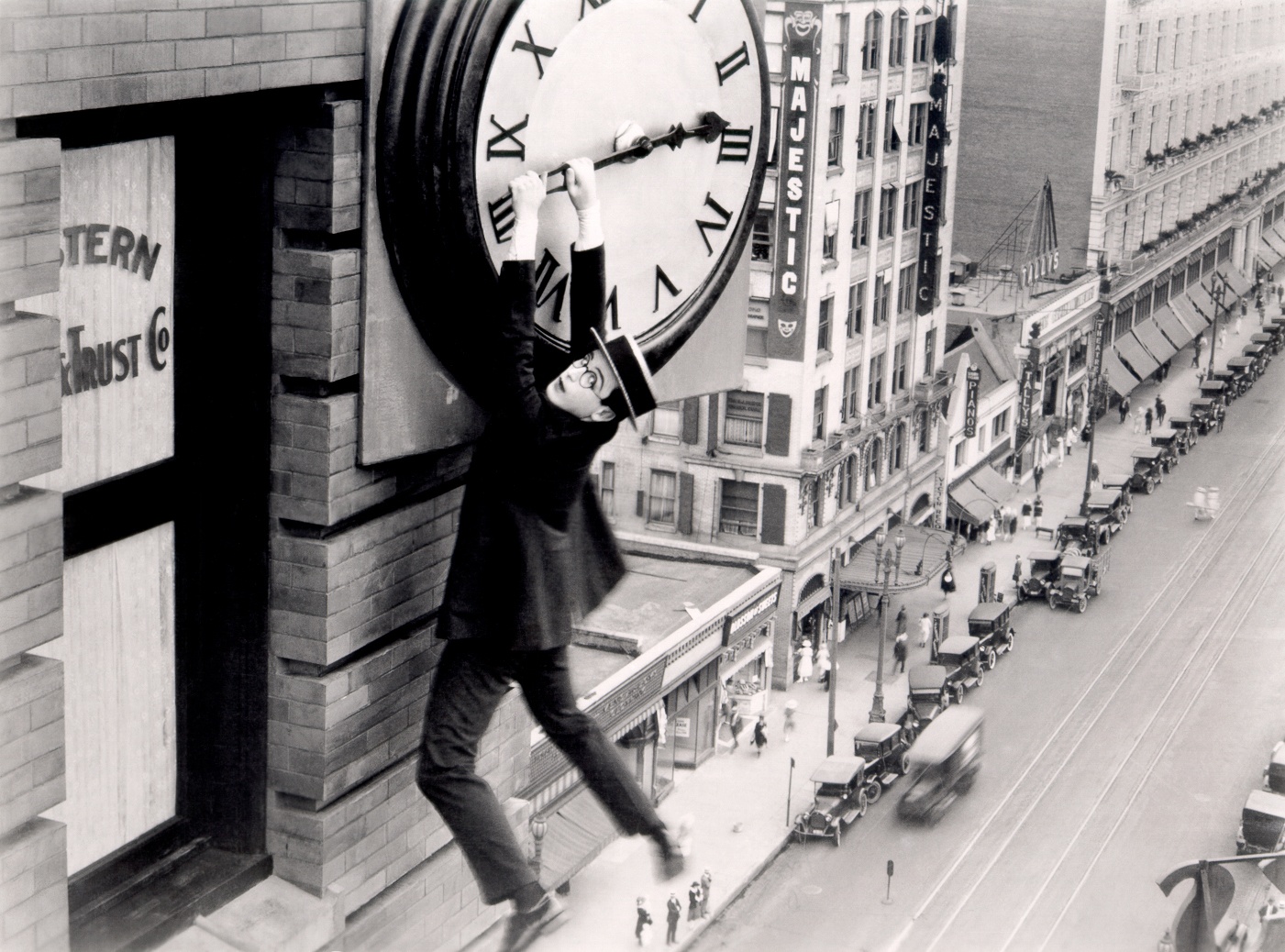
From 'Safety Last': the image everyone remembers.

MONDAY, JULY 11, 2022 / FOR IMMEDIATE RELEASE
Contact Jeff Rapsis • (603) 236-9237 • jeffrapsis@gmail.com

Silent film classic 'Safety Last' on Friday, Aug. 5 at Jane Pickens Theatre

Thrill comedy climaxed by Harold Lloyd's iconic building climb; shown with live music

NEWPORT, R.I.—It's a cinematic image so powerful, people who've never seen the movie instantly recognize it.

The vision of Harold Lloyd hanging from the hands of a huge clock, from the climax of his silent comedy 'Safety Last,' (1923), has emerged as a symbol of early Hollywood and movie magic.

See how Harold gets into his high-altitude predicament with a screening of 'Safety Last,' one of Lloyd's classic comedies, on Friday, Aug. 5 at 7:30 p.m. at the Jane Pickens Theatre and Event Center, 49 Touro St., Newport.

General admission $15; members $13. Tickets available online or at the door.

The screening will feature live musical accompaniment by Jeff Rapsis, a New Hampshire-based silent film musician.

'Safety Last' follows young go-getter Lloyd to the big city, where he hopes to make his mark in business and send for his small town sweetheart.

His career at a downtown department store stalls, however, until he gets a chance to pitch a surefire publicity idea—hire a human fly to climb the building's exterior.

However, when the human fly has a last-minute run-in with the law, Harold is forced to make the climb himself, floor by floor, with his sweetheart looking on.

The result is an extended sequence blending comedy and terror that holds viewers spellbound.

Lloyd, along with Charlie Chaplin and Buster Keaton, is regarded as one of the silent screen's three great clowns.

Lloyd's character, a young go-getter ready to struggle to win the day, proved hugely popular in the 1920s.

While Chaplin and Keaton were always favored by the critics, Lloyd's films reigned as the top-grossing comedies throughout the period.

Silent film at the Jane Pickens Theatre gives today's audiences the chance to experience early cinema as it was intended: on the big screen, with live music, and with an audience.

"Put the whole experience back together, and you can see why people first fell in love with the movies," said Rapsis, who practices the nearly lost art of silent film accompaniment.

Rapsis performs on a digital synthesizer that reproduces the texture of the full orchestra, creating a traditional "movie score" sound.

"Seeing 'Safety Last' with an audience is one of the great thrill rides of the cinema of any era, silent or sound," Rapsis said. "Harold's iconic building climb, filmed without trick photography, continues to provoke audience responses nearly 100 years after film was first released."

Tributes to the clock-hanging scene have appeared in several contemporary films, most recently in Martin Scorsese's 'Hugo' (2011), which includes clips from 'Safety Last.'

See Harold Lloyd's iconic thrill comedy 'Safety Last' (1923) on Friday, Aug. 5 at 7:30 p.m. at the Jane Pickens Theatre and Event Center, 49 Touro St., Newport.

General admission $15; members $13. Tickets available online at www.janepickens.com or at the door. For more information about the JPT Film & Event Center, call (401) 846-5474.

Nearing the top.

CRITIC COMMENTS ON ‘SAFETY LAST’:

"Impossible to watch without undergoing visitations of vertigo, Safety Last's climactic sequence is all it's reputed to be.”
—TV Guide

"Harold Lloyd manages to make the characters sympathetic enough to carry the audience's concern on his journey of crazy stunts and mishaps. One of the best of this era."
—David Parkinson, Empire Magazine

"The climb has both comic and dramatic weight because it is both a thrilling exercise in physical humor and a thematically rich evocation of the pressures men feel to succeed, lest they be viewed as less than a man."
—James Kendrick, Q Network Film Desk

Thursday, July 28, 2022

Stay up late this Saturday, July 30 for midnight screening of 'Dr. Caligari' at Coolidge Corner

Stay awake to see Cesar the Somnambulist in 'The Cabinet of Dr. Caligari' (1920)

I'm looking forward to this weekend's midnight screening of 'The Cabinet of Dr. Caligari' (1920) at the Coolidge Corner Theater in Brookline, Mass.

For those who've never experienced this very important (and very strange) piece of early cinema, I can't think of a better environment in which to do so.

In a theater? Check! With live music? Check! With an audience? Check! 

And finally, the middle of the night? Check and double check!

Really: semi-drowsiness might be the ideal state to appreciate the dream-like visual world in which 'Caligari' takes place. 

So hope to see you at the Coolidge on Saturday, July 30 when the clock strikes 12! More details in the press release below...

*     *     *

'Caligari' takes place entirely in a dream-like visual world.

MONDAY, JULY 25, 2022 / FOR IMMEDIATE RELEASE
Contact Jeff Rapsis • (603) 236-9237 • jeffrapsis@gmail.com

Coolidge to unleash late night silent film horror classic on Saturday, July 30

Midnight screening of breakthrough thriller 'Cabinet of Dr. Caligari' to feature live musical accompaniment

BROOKLINE, Mass.—A creepy silent film regarded as the forerunner of all horror movies will be shown at a midnight screening at the Coolidge Corner Theatre, 290 Harvard St., Brookline, Mass.

'The Cabinet of Dr. Caligari' (1920) will be shown at midnight on Saturday, July 30 as part of the Coolidge's ongoing 'Carnival of Horror' series.

The screening will feature live music by silent film accompanist Jeff Rapsis. General admission is $15.50 per person.
 
Set in an insane asylum, 'The Cabinet of Dr. Caligari,' is considered a landmark in early cinema. Nearly a century after its release, the film still has the capacity to creep out audiences.

"A case can be made that 'Caligari' was the first true horror film, critic Roger Ebert wrote in 2007.

'Caligari,' made in Germany after World War I and directed in expressionist style by Robert Wiene, stars Werner Krauss and Conrad Veidt.

The film employs stylized sets, with abstract, jagged buildings painted on canvas backdrops and flats.

To add to its strange visual design, the actors used an exaggerated technique that employed jerky and dancelike movements.

The movie is also cited as having introduced the surprise "twist" ending to cinema.
 
Conrad Veidt and Werner Krauss, two big names of early German cinema, star in 'Cabinet.'
 
"Silents such as 'Dr. Caligari' are films that first caused people to fall in love with the movies," Rapsis said. "The aim is to present them as they were originally intended to be shown: in a theater, on a big screen, with live music, and with an audience. If you can put all those elements together, these films leap to life."

In scoring 'The Cabinet of Dr. Caligari,' Rapsis plans to augment the traditional orchestral sound with the vocabulary of film music from later eras.

"Because I improvise the music, it's hard to know what will happen until the film actually starts running," Rapsis said.

'Caligari,' a forerunner of the 'film noir' genre, has influenced generations of movie-makers.

A sequel of sorts was released in the 1980s with the film 'Dr. Caligari,' which dealt with the granddaughter of the original Dr. Caligari and her illegal experiments on her patients in an asylum.

The Coolidge Corner Theatre is an independent, nonprofit cinema and cultural institution. Since 1933, audiences in the greater Boston area have relied on the Coolidge for contemporary independent film, repertory, and educational programming.

'The Cabinet of Dr. Caligari' (1920) will be shown with live music at midnight on Saturday, July 30 as part of an ongoing "Carnival of Horror" series at the Coolidge Corner Theatre, 290 Harvard St., Brookline, Mass. General admission $15.50; for more info and to buy tickets, visit www.coolidge.org or call (617) 734-2500.

Monday, June 20, 2022

Wednesday, June 22: Live music for Lloyd's 'The Kid Brother' (1927) at Coolidge Corner Theatre

The interior of the Leavitt Theatre in Ogunquit, Maine, which will be 100 years old next year.

Back at the blog after a busy stretch that included screenings of Harold Lloyd's comedy 'For Heaven's Sake' (1926) at the Leavitt Theater in Ogunquit, Maine and Mabel Normand in 'Mickey' (1918) at the Town Hall Theater in Wilton, N.H. 

If you've ever wondered what the interior of the Leavitt Theatre looks like, the above picture tells the story. (My new iPhone camera is pretty good in low light; before this, photos never really turned out well.)

The interior, shown here as the audience for 'For Heaven's Sake' begins filtering in, hasn't changed much since 1923. The wooden floor is raked at a steep angle, and many of the seats are original, with thick wire loops underneath so gentlemen can stow their hats!

One difference: originally, back in the era of 1:1.33 aspect ratio and carbon arc projection, the proscenium would have been filled by a giant, brilliant image! However, nowadays the theater is configured for wide screen ratios, so only the bottom 3/5 of the screen area is used. Pity.

This week it's more Harold Lloyd, as I'll be accompanying 'The Kid Brother' (1927) on Wednesday, June 22 at the Coolidge Corner Theatre in Brookline, Mass.

Showtime is 7 p.m. Lots more info in the press release below:

*  *  *

Harold Lloyd hangs on in 'The Kid Brother' (1927).

MONDAY, JUNE 13, 2022 / FOR IMMEDIATE RELEASE
Contact Jeff Rapsis • (603) 236-9237 • jeffrapsis@gmail.com

Coolidge Corner to screen silent comedy masterpiece 'The Kid Brother' with live music on Wednesday, June 22

Harold Lloyd program latest in theater's popular 'Sounds of Silence' series spotlighting silent films with live accompaniment

BROOKLINE, Mass.—He was the most popular film star of the 1920s, routinely outpacing comic rivals Charlie Chaplin and Buster Keaton at the box office.

He was Harold Lloyd, the boy next door who could wind up hanging from the hands of a clock high atop a skyscraper. Audiences loved Lloyd's mix of visual comedy and thrilling adventures, making him one of the most recognized icons of early Hollywood.

See for yourself when 'The Kid Brother' (1927), a feature-length film regarded as Lloyd's masterpiece, is screened on Wednesday, June 22 at 7 p.m. at the Coolidge Corner Theatre, 290 Harvard St., Brookline, Mass.

The screening will feature live music for the movie by silent film accompanist Jeff Rapsis. General admission is $23 per person.

The show is the latest in the Coolidge Corner's acclaimed 'Sounds of Silents' series, which gives audiences the opportunity to experience early cinema as it was intended: on the big screen, with live music, and with an audience.

In 'The Kid Brother,' meek country boy Harold Hickory (Lloyd) looks up to his tough father, but is overshadowed by two burly older brothers. When a traveling circus and medicine show brings trouble to town and possible disgrace to the Hickory clan, can Harold save the family name?

From that simple situation, Lloyd weaves a roller coaster of a tale that critics and film historians say show him at the height of his powers as a filmmaker and comedian.

"The first silent film I ever saw that made me actually stand up and cheer," wrote critic Steven D. Greydanus of The Decent Films Guide. "As a first introduction to silent film, I would pick 'The Kid Brother' over the best of Chaplin or Keaton every time."

"Unlike Chaplin’s Little Tramp, who was as much defined by his bizarre eccentricities as his bowler and cane, Lloyd’s character, with his trademark spectacles, was an instantly likable, sympathetic boy-next-door type, a figure as winsome and approachable as Jimmy Stewart or Tom Hanks," Greydanus wrote.

Jobyna Ralston and Harold Lloyd in 'The Kid Brother.'

The film co-stars Jobyna Ralston, Walter James, Eddie Boland, and Constantine Romanoff.

Harold Lloyd, along with Chaplin and Keaton, stands as one of the three masters of silent comedy. Though Lloyd's reputation later faded due to unavailability of his movies, the recent re-release of most of his major films on home media has spurred a reawakening of interest in his work and a renewed interest in theatrical screenings.

"Seeing a Harold Lloyd film in a theater with live music and an audience is one of the great experiences of the cinema of any era," said Jeff Rapsis, a New Hampshire-based silent film musician who will accompany the film.

"Films such as 'The Kid Brother' were designed for a specific environment. If you can put those conditions together again, you can get a sense of why people first fell in love with the movies," Rapsis said.

'The Kid Brother' will be screened with live music on Wednesday, June 22 at 7 p.m. at the Coolidge Corner Theatre, 290 Harvard St., Brookline, Mass. as part of the theater's 'Sounds of Silents' series.

The screening will feature live music for the movie by silent film accompanist Jeff Rapsis. General admission is $23 per person.

For more info and to buy tickets, visit www.coolidge.org or call (617) 734-2500.

Monday, April 11, 2022

Keaton's 'The General' at Coolidge Corner on Wednesday, 4/13, plus a question of volume

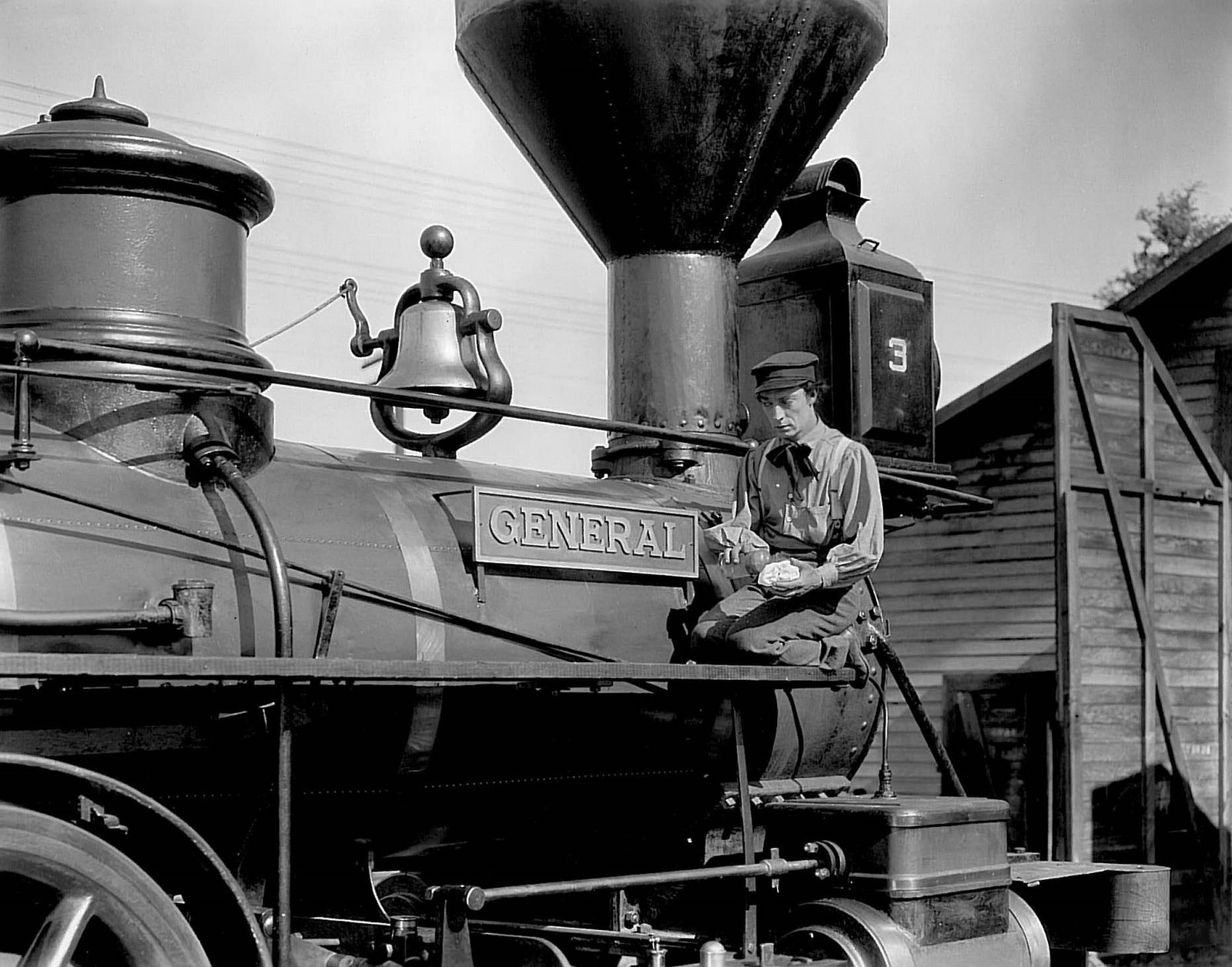
Buster and co-star in 'The General' (1926).

Coming up: I'll be doing live music for a screening of Buster Keaton's 'The General' (1926) at the Coolidge Corner Theatre on Wednesday, April 13. 

It's a special occasion because Slate film critic Dana Stevens, author of a new book on Keaton, will be on hand for a Q & A after the show. It'll be moderated by local film guru Ty Burr.

'Camera Man,' which came out a few months ago, has been rapturously received, and has led to a host of Keaton screenings this year. (I had the privilege of doing an earlier one with Stevens in Newport, R.I. this past February.)

So march on down to the Coolidge Corner to see Keaton's masterpiece on the big screen, and meet the author of a brand new book that puts Keaton's work in the context of his early-20th-century times.

More details in the press release below. 

For now, a few thoughts about volume inspired by yesterday's screening of 'Ben Hur' (1925) at the new Showroom venue of the Colonial Theatre in Keene, N.H.

This is a surprisingly touchy subject, as there's apparently a vast range of perceptions of what's appropriate volume for silent film accompaniment.

Yesterday, I arrived early to set up and work with the house tech to set the sound levels. Each house is different, and the Showroom is a venue I've only played once before, so it's important to take time to set up the audio.

Keeping my keyboard volume output at mid-range, we worked out the levels, checking each of my synth settings to make sure everything was acceptable in the house. I felt it sounded a bit dry, so just a touch of reverb was added to the main orchestral setting I planned to use. Great!

(The reason to keep my synth output at mid-range is because I need that level to make use of the various volume levels the touch-sensitive keyboard is capable of producing. I find I can't do that effectively if the output is below mid-range: level 5 out of 10.)

We also have to account for the fact that in most places with house sound (such as the Showroom), a good amount of sound volume passes over my head (down at front) and so audiences can sometimes receive significantly more volume than I hear.

Okay, fine. Because I work primarily in improv and create the accompaniment live and in the moment, it's my preference to sit at the keyboard for at least a half-hour before a show: warming up, working through material, and just getting into the zone. For me, it's hard to start a film just cold—it's not like pressing a button.

But because people are filing into the theater, during this time I've found it's helpful to temporarily take my volume output down to about 2 out of 10 as a courtesy. That way people can hear each other talking, while I can still do my thing, even though it's not the volume I'll be working with for the film.

The Colonial Theatre's new "Showroom" venue, set up for silent film.

So this is what I was doing yesterday when I noticed it was 10 minutes to showtime, and I hadn't thought to yet use the bathroom. (Very important in advance of a 2½-hour film.) So I switched to some synth-generated pattern music and got up to take care of business.

That's when someone from the theater came up to me with a concerned look on her face. People were complaining, she said, that the music was much too loud and that we needed to take the volume down somewhat.

Really? I've gotta tell you, I like to think I'm easy-going and welcome feedback and would do whatever it takes to accommodate an audience. But right in front of creating live music for a challenging and marathon-length film, this is not the thing to hear. 

(Even worse: a few years ago, someone came down to the keyboard in the middle of a show in progress at the Leavitt Theatre in Ogunquit, Maine and placed a folded-up note on the keyboard, for Pete's sake. Using one hand, I opened it to read "MUSIC TOO LOUD!")

Maybe it's a weakness on my part, but I find this kind of thing really throws me when it comes right before I'm about to commit to an improv accompaniment journey of some length, and which will require some concentration—especially after we've taken time to set levels that everyone agreed were acceptable. 

And it's especially discouraging when I've deliberately been playing at a quiet level as a courtesy, and then to be told it's still too loud? 

Would people stop a tightrope walker just before he or she steps out on the wire above Niagara Falls to tell them they don't approve of the type of wood being used in the balance pole?

I strive not to be the temperamental artist type, but jeez. This is me, baring my soul in music in hopes of bringing to life a worthy cinematic experience, and I'm being told to keep it down lest it interfere with someone's enjoyment of the film?

Well, why don't I just stop playing altogether? Maybe then everyone will be happy? 

Of course I didn't speak those words. I told the theater woman we'd see what we could do. In introducing the film, I addressed it openly: we'd had some complaints, but here's the situation. This is a BIG film, I said, and at times the music will be BIG as well. 

However, it's still a new venue to me, I said, so I'll do my best to keep things at a level we can all find generally acceptable. But people have to understand: this is not background music. At its best (if I'm doing it effectively) it's a crucial part of the experience.

I think I run into trouble when people new to the experience expect the accompaniment to be background music, or (even worse) something that's optional or just decoration.

Well, no. In silent film, although music generally shouldn't be noticed on its own, it's often a full player in the overall experience. That was true then, and it's still true now. 

So while it shouldn't gratuitously call attention to itself, the music should have a presence. And in some cases, it really should be pretty darned big and bold.

Take 'Ben Hur.' You really can't play quiet stuff during the sea battle scene or the famous chariot race. So if I'm at the keyboard, it's going to be loud, exciting, dramatic, and all that.

In the end, I was able to pull it together yesterday. No one covered their ears or walked out that I'm aware of, anyway. When it was over, we had nice comments and good questions. I made my usual joke about checking with the Diocese of Manchester to confirm that attending a screening of 'Ben Hur' did not count as attending Mass. Thank you and have a good night!

I don't know. Maybe I'm looking at this wrong way. Maybe I should really amp up the volume, and then supplement my income by selling over-priced ear plugs. Or possibly sell stationery so people can write me letters to be delivered in the middle of a performance.

Even if I go ahead with those ideas, they won't be ready in time for Wednesday's screening of 'The General' at the Coolidge Corner. Here's the promised press release with all the details!

*   *   *

Buster Keaton in 'The General.' 

MONDAY, APRIL 4, 2022 / FOR IMMEDIATE RELEASE
Contact Jeff Rapsis • (603) 236-9237 • jeffrapsis@gmail.com

Buster Keaton's 'The General' with live music at Coolidge Corner on Wednesday, April 13

Civil War railroading comedy/adventure film lauded as stone-faced comic moviemaker's masterpiece

Screening includes Q & A with Dana Stevens, author of 'Camera Man,' newly published Keaton book.

BROOKLINE, Mass.— He never smiled on camera, earning him the nickname of "the Great Stone Face." But Buster Keaton's comedies rocked Hollywood's silent era with laughter throughout the 1920s.

See for yourself with a screening of 'The General' (1926), one of Keaton's landmark feature films, on Wednesday, April 13 at 7 p.m. at the Coolidge Corner Theatre, 290 Harvard St., Brookline, Mass.

The screening will feature live music for the movie by silent film accompanist Jeff Rapsis. General admission is $23 per person.

The show is the latest in the Coolidge Corner's acclaimed 'Sounds of Silents' series, which gives audiences the opportunity to experience early cinema as it was intended: on the big screen, with live music, and with an audience.

The screening will be followed by a Q & A with Slate film critic Dana Stevens, author of 'Camera Man,' a newly published book exploring Keaton's work in the context of 20th century history.

Stevens’s book will be for sale after the screening, courtesy of Brookline Booksmith. The Q & A will be moderated by Boston-based critic Ty Burr.

'The General,' set during the U.S. Civil War, tells the story of a southern locomotive engineer (Keaton) whose engine (named 'The General') is hijacked by Northern spies with his girlfriend onboard.

Keaton, commandeering another train, races north in pursuit behind enemy lines. Can he rescue his girl? And can he recapture his locomotive and make it back to warn of a coming Northern attack?

Critics call 'The General' Keaton's masterpiece, praising its authentic period detail, ambitious action and battle sequences, and its overall integration of story, drama, and comedy.

It's also regarded as one of Hollywood's great railroad films, with much of the action occurring on or around moving steam locomotives.

Accompanist Jeff Rapsis will improvise an original musical score for 'The General' live as the film is shown.

"When the score gets made up on the spot, it creates a special energy that's an important part of the silent film experience," said Rapsis, who uses a digital synthesizer to recreate the texture of a full orchestra for the accompaniment.

With Center for the Art's screening of 'The General,' audiences will get a chance to experience silent film as it was meant to be seen—in a high quality print, on a large screen, with live music, and with an audience.

"All those elements are important parts of the silent film experience," Rapsis said. "Recreate those conditions, and the classics of early Hollywood leap back to life in ways that can still move audiences today."

Rapsis performs on a digital keyboard that reproduces the texture of the full orchestra and creates a traditional "movie score" sound.

Keaton, along with Charlie Chaplin and Harold Lloyd, stands today as one of the silent screen's three great clowns. Some critics regard Keaton as the best of all; Roger Ebert wrote in 2002 that "in an extraordinary period from 1920 to 1929, (Keaton) worked without interruption on a series of films that make him, arguably, the greatest actor-director in the history of the movies."

A remarkable pantomime artist, Keaton naturally used his whole body to communicate emotions from sadness to surprise. And in an era with no post-production special effects, Keaton's acrobatic talents enabled him to perform all his own stunts.

Critics review 'The General':

"The most insistently moving picture ever made, its climax is the most stunning visual event ever arranged for a film comedy."
—Walter Kerr, author of 'The Silent Clowns'

"An almost perfect entertainment!"
—Dave Kehr, Chicago Reader

"What makes the film so special is the way the timing, audacity and elegant choreography of its sight gags, acrobatics, pratfalls and dramatic incidents is matched by Buster's directorial artistry, his acute observational skills working alongside the physical élan and sweet subtlety of his own performance."
—Time Out (London)

‘The General’ (1926) starring Buster Keaton will be shown with live music on Wednesday, April 13 at 7 p.m. at the Coolidge Corner Theatre, 290 Harvard St., Brookline, Mass. as part of the theater's 'Sounds of Silents' series. Admission is $23 per person. For more info and to buy tickets, visit www.coolidge.org or call (617) 734-2500. For more about the music, visit www.jeffrapsis.com.

Monday, November 1, 2021

On live scoring 'Dracula' at the Somerville, plus a new way to show 'Nosferatu' to keep it scary


One of the scariest things about 'Dracula' (1931) at the Somerville Theatre: standing in the middle of Holland Street to get the requisite marquee shot.

Doing live music for 'Dracula' (1931) last night at the Somerville Theatre proved an interesting adventure in film underscoring.

After all, this wasn't a silent picture. True, there's no music. But it does have dialogue, sound effects, and a certain eerie quality that comes, in part, from the silence. 

I didn't want to get in the way of any of that. So I knew going in that there were times when I couldn't —and shouldn't—play anything. 

But once in the theater, I found it surprisingly difficult to resist the urge to play music. I accompany more than 100 films each year. And it was just really weird to be sitting there, with a film on the screen and a keyboard in front of me and an audience present, and not play.

As the film unspooled, I felt the character to whom I could most relate was Renfield, with his hunger for spiders representing my hunger to press the keys and make sounds. 

But I didn't need to be restrained, and in the end I felt I had a good sense of when to stay out and when to come in, and when to come in strong. 

Lugosi and victim in the unfinished basement of Carfax Abby. 

Although I improvised the score, I did create a full-fledged 'Dracula' theme in advance, which came in handy and helped the whole thing hold together.

Perhaps the most successful sequence was when Dracula tried to hypnotize Professor Van Helsing. 

On screen, played silent, it seems overlong and drawn out, with the quiet broken only by Bela Lugosi's commands to "Come here!"

But with music, I was told afterward that it turned into a scene of considerable dramatic suspense. Hooray!

And in the end, it all seemed to work, as I was glad to receive a thunderous ovation from the 200+ attendees, and with nothing thrown at me—not even the bag of garlic cloves I had given out as a door prize beforehand.

Well, Halloween may be over, but my ongoing silent film music marathon is not.

We go from Lugosi's 'Dracula' to 'Nosferatu' (1922), which I'm accompanying tonight (Monday, Nov. 1) at the Coolidge Corner Theater in Brookline, Mass.

It's ostensibly in honor of the 'Day of the Dead,' but you don't really need an excuse to screen Murnau's classic film. Just as the sign on the railroad tracks tell us that "Any time is train time," theaters should all have signs saying "Any time is Nosferatu time." 

Any that's actually a concern. I've done music for 'Nosferatu' a half-dozen times this year. At some point, overexposure may diminish this film's special power over audiences.

So, to remedy that, when I'm appointed King, I will issue an edict that all theaters can only screen 'Nosferatu' unannounced, and only in the middle of other films that people would have come to see.

That would a way to make it really frightening. You would just never know. It would boost the film's reputation immensely, and help box office receipts, as people who wish to see it would have to keep buying tickets hoping to see Nosferatu. It would be like winning the lottery!

And people buy lottery tickets all the time. Why not apply the same logic to movie theaters with 'Nosferatu' the unexpected jackpot prize?

Well, until that happens, your best bet is to come to the Coolidge Corner tonight. 

And for now, let me leave you with this unexpectedly amusing marquee shot from the Somerville Theatre: what a way to promote 'Dracula,' who can only come out at night!

*  *  *

MONDAY, OCT. 18, 2021 / FOR IMMEDIATE RELEASE
Contact Jeff Rapsis • (603) 236-9237 • jeffrapsis@gmail.com

Creepy classic thriller 'Nosferatu' to screen at Coolidge Corner on Monday, Nov. 1

'Sounds of Silents' series to be revived with pioneer silent horror movie with live musical accompaniment by Jeff Rapsis

BROOKLINE, Mass.— An iconic local theater will bring its silent movie series back to life with a film about the undead.

'Nosferatu' (1922), the first screen adaptation of Bram Stoker's novel 'Dracula,' will be screened with live music on Monday, Nov. 1 at 7 p.m. at the Coolidge Corner Theatre, 290 Harvard St., Brookline, Mass.

The screening will feature live music for the movie by silent film accompanist Jeff Rapsis. General admission is $23 per person.

The show marks the resumption of the Coolidge's acclaimed 'Sounds of Silents' series, which gives audiences the opportunity to experience early cinema as it was intended: on the big screen, with live music, and with an audience.

The series, like all other Coolidge programming, was paused during the recent pandemic. But with the theater now open, the series is returning.

On deck (almost): 'Nosferatu' at the Coolidge Corner Theatre this evening.

'Nosferatu' (1922), directed by German filmmaker F.W. Murnau, remains a landmark work of the cinematic horror genre.

To modern viewers, the passage of time has made this unusual movie seem even more strange and otherworldly.

It's an atmosphere that silent film accompanist Jeff Rapsis will enhance in improvising live music on the spot for the screening.

"The original 'Nosferatu' is a film that seems to get creepier as more time goes by," said Rapsis, a resident of Bedford, N.H. who accompanies silent film screenings at venues across the nation.

In 'Nosferatu,' actor Max Schreck portrays the title character, a mysterious count from Transylvania who travels to the German city of Bremen to take up residence.

In the town, a rise in deaths from the plague is attributed to the count's arrival. Only when a young woman reads "The Book of Vampires" does it become clear how to rid the town of this frightening menace.

Director Murnau told the story with strange camera angles, weird lighting, and special effects that include sequences deliberately speeded up.

Although 'Nosferatu' is suitable for all family members, the overall program may be too intense for very young children to enjoy.
A shadowy character: Mr. Nosferatu comes a calling.

Modern critics say the original 'Nosferatu' still packs a powerful cinematic punch.

“Early film version of Dracula is brilliantly eerie, full of imaginative touches that none of the later films quite recaptured,” Leonard Maltin wrote recently.

Critic Dave Kehr of the Chicago Reader called 'Nosferatu' "...a masterpiece of German silent cinema and easily the most effective version of Dracula on record.”

Despite the status of 'Nosferatu' as a landmark of early cinema, it was almost lost forever.

The film, shot in 1921 and released in 1922, was an unauthorized adaptation of Stoker's novel, with names and other details changed because the studio could not obtain rights to the novel.

Thus "vampire" became "Nosferatu" and "Count Dracula" became "Count Orlok." After the film was released, Stoker's widow filed a copyright infringement lawsuit and won; all known prints and negatives were destroyed under the terms of settlement.

However, intact copies of the film would surface later, allowing 'Nosferatu' to be restored and screened today as audiences originally saw it.

The image of actor Max Schreck as the vampire has become so iconic that it can be seen in a recent 'Sponge Bob Squarepants' episode.

The Sounds of Silents series is made possible by the generous contributions of Dr. Martin and Becki Norman, Dr. Thomas Gutheil, Susan Stoller, and Elizabeth Driehaus.

‘Nosferatu’ will be shown on Monday, Nov. 1 at 7 p.m. at the Coolidge Corner Theatre, 290 Harvard St., Brookline, Mass. as part of the theater's 'Sounds of Silents' series. Admission is $23 per person. For more info and to buy tickets, visit www.coolidge.org or call (617) 734-2500.

Wednesday, November 14, 2018

Scoring 'The City Without Jews' (1924) tonight
and then Buster Keaton later this week

Expressionism on screen in 'The City Without Jews' (1924).

Tonight marks my debut at the highly regarded Coolidge Corner Theatre in Brookline, Mass. The big time!

I'll be accompanying 'The City Without Jews' (1924), a recently restored Austrian film being presented by the Boston Jewish Film Festival.

The screening is at 6:30 p.m. and tickets are available at the door. They're $36 per person for non-passholders, which I know is a little steep.

But the movie is worth it, plus the program includes a conversation with Lisa Silverman, an Associate Professor of History and Jewish Studies at the University of Wisconsin-Milwaukee.

Title card from the film, which was recently fully restored after a nearly complete copy surfaced in a Parisian garage sale.

'The City Without Jews' is a challenging film to score in that to my eye, it blends several genres: there's some drama, comedy, romance, satire, expressionist terror, and so on. So I've been puzzling how best to create a score that respects all these elements and still holds it all together.

What I've decided is to limit myself to a palette of strings only. For one thing, the Korg I use actually has some very good string patches that don't sound too synthesizer-y.

But I also feel that when faced with a film that mixes in so many approaches to what is fundamentally a very serious topic (in hindsight, perhaps more than the filmmakers themselves could have realized), a limited and "monochromatic" sound world allows me a platform on which I can improvise freely and lessens the risk of over-doing it or over-emphasizing any one element at the expense of another.

So I can acknowledge the comedy, and score the drama, and heighten the expressionism in some scenes, but all the while creating something that holds together and builds an effective soundscape for this challenging film.

Does that make any sense? Well, we'll find out at 6:30 p.m. tonight.

In the meantime, many thanks to Ariana Cohen-Halberstam and Nyssy Clark of the Boston Jewish Film Festival for their invitation to be part of this year's screenings, and their help in booking me at the Coolidge.

Things lighten up considerably later this week with a Buster Keaton double feature on Friday, Nov. 16 at the Flying Monkey Moviehouse and Performance Center in Plymouth, N.H.

We're running the "Movies about Movies" program, meaning back-to-back screenings of 'Sherlock Jr.' (1924) and 'The Cameraman' (1928), Buster's two features in which he explores the nature of film itself.

It's quite a meta program, which suits me fine. I've never met a meta that I didn't like.

Showtime is 6:30 p.m. and admission is $10 per person. More details in the press release I've pasted in below.

Hope to see you at one or 'tother screenings. Or both!

* * *

Original promotional art for 'The Cameraman.'

MONDAY, OCT. 29, 2018 / FOR IMMEDIATE RELEASE
Contact Jeff Rapsis • (603) 236-9237 • jeffrapsis@gmail.com

Buster Keaton double feature at Flying Monkey on Friday, Nov. 16


Classic silent film comedy classics to be screened with live musical accompaniment

PLYMOUTH, N.H.—He never smiled on camera, earning him the nickname of "the Great Stone Face." But Buster Keaton's comedies rocked Hollywood's silent era with laughter throughout the 1920s.

See for yourself with a screening of 'Sherlock Jr.' (1924) and 'The Cameraman' (1928), two of Keaton's landmark feature films, at the Flying Monkey Moviehouse and Performance Center, 39 South Main St., Plymouth, N.H. on Friday, Nov. 16 at 6:30 p.m.

The program will be accompanied by live music performed by silent film composer Jeff Rapsis. Admission is $10 per person.

In 'Sherlock Jr.,' Buster plays a small-town movie projectionist who dreams of working as a detective. But then Buster's romantic rival frames him for stealing a watch from his girlfriend's father. Fortunately, the situation mirrors the plot of the movie currently playing at Buster's theater. Inspired by the movie, can Buster find the real thief and win back his girl?

'The Cameraman' tells the story of a young man (Keaton) who tries to impress the girl of his dreams (Marceline Day) by working as a freelance newsreel cameraman. His efforts result in spectacular failure, but then a lucky break gives him an unexpected chance to make his mark. Can Buster parlay the scoop of the year into a secure job and successful romance?

Both films focus on exploring the potentials of the motion picture, then a brand-new medium.

Buster in 'The Cameraman.'

In 'The Cameraman,' Keaton uses the movie business itself to create comedy that plays with the nature of film and reality.

Keaton, along with Charlie Chaplin and Harold Lloyd, stands as one of the three great clowns of the silent screen. Many critics regard Keaton as the best of all; Roger Ebert wrote in 2002 that "in an extraordinary period from 1920 to 1929, (Keaton) worked without interruption on a series of films that make him, arguably, the greatest actor-director in the history of the movies."

As a performer, Keaton was uniquely suited to the demands of silent comedy. Born in 1895, he made his stage debut as a toddler, joining his family's knockabout vaudeville act and learning to take falls and do acrobatic stunts at an early age. He spent his entire childhood and adolescence on stage, attending school for exactly one day.

A remarkable pantomime artist, Keaton naturally used his whole body to communicate emotions ranging from sadness to surprise. In an era when movies had few special effects, Keaton's acrobatic talents meant he performed all his own stunts.

All those talents are on display in 'Sherlock Jr.' and 'The Cameraman,' which was selected in 2005 for preservation in the U.S. National Film Registry by the Library of Congress as being "culturally, historically, or aesthetically significant."

"These films are audience favorites, and people continue to be surprised at how engrossing and exhilarating they can be when shown as they were intended: in a theater, and with live music," said Rapsis, who accompanies more than 100 screenings each year at venues around the nation and abroad.

Rapsis, who lives in Bedford, N.H., improvises live scores for silent films using a digital synthesizer to recreate the texture of the full orchestra.

"It's kind of a high wire act," Rapsis said. "But for me, the energy of live performance is an essential part of the silent film experience."

'Sherlock Jr.' (1924) and 'The Cameraman' (1928) will be shown with live music at the Flying Monkey Moviehouse and Performance Center, 39 South Main St., Plymouth, N.H. on Friday, Nov. 16 at 6:30 p.m. Admission is $10; for more info, call (603) 536-2551 or visit www.flyingmonkeynh.com.