That's me on stage, caressing the big Steinway grand during a slide presentation about Kansas-born actress Claire Windsor.
Last weekend brought my 16th annual trip to the Kansas Silent Film Festival, to which I've made pilgrimages each year since the turn of the century.
As I say: in February, some folks go to Aruba. I go to Topeka!
But I do it gladly, because the Kansas Silent Film Festival is one of those rare events set up to run mainstream silent films (as opposed to obscure rarities) to large audiences of just plain folks, rather than just plain film buffs. (Who are all nice people, by the way.)
One reason it attracts big crowds is the magical four-letter word: FREE! No admission is charged, so there's no barrier to the curious. There's no registration or badge required, and no tickets, either. You can come and go as you please.
The result is an environment that I find probably mimics the conditions under which silent films were really intended to be shown: on the big screen, with live music, and with a large audience.
And the White Concert Hall at Washburn University, where the films are screened on Friday nights and all day Saturday, is big enough to hold even an enormous turnout. Big crowds do turn up, depending on the program. So far, no capacity constraints.
And there's the people. Too many staffers and volunteers to list here, but all terrific folks who assemble each year, Brigadoon-like, to bring forth this event. You know who you are, and you're all great. (Many thanks to Carol Yoho for most of the photos used in this post.)
Another reason to go is the music. Usually, it's a rare chance to hear the Mont Alto Motion Picture Orchestra live for several titles in one go, not to mention other regulars such as long-time theater organist Marvin Faulwell and his percussionist sidekick Bob Keckeisen.
Marvin Faulwell and Bob Keckeisen in action on Friday night.
This year, Mont Alto couldn't attend. But organizers brought in an equally compelling guest performer: accompanist (and film collector) Jon Mirsalis. Jon is one of the big names in silent film music, and his accompaniment style is one that I really respond to. So I was thrilled that he'd be part of this year's festival. More on Jon in a moment.
My own involvement is to provide piano accompaniment as needed for all manner of odds and ends, with the occasional feature thrown in.
This time around, my big number was 'The Little Church Around the Corner' (1923), an early Warner Bros. melodrama starring Claire Windsor, a Kansas native who attended Washburn University for a time.
Prior to the Saturday morning screening, I got together with percussionist Bob K. and worked out some key moments when his services would add oomph to the proceedings. Any film that features a mine collapse could stand some extra help from the percussion department, and Bob came through in spades.
He also used his crash box to nail a brick thrown through a glass window (another key scene), and also got some nice suspended cymbal action underneath some of the big emotional moments at the keyboard. Bravo, Bob!
'Little Church' turned out to be a good match for the material I'd selected: a big gushing emotional theme for the dramatic moments, a percussive dirge for mining and labor sequences, and some hymn-like chord progressions for the spiritual and religious scenes.
Heading down into the collapsed mine. Yes, that's a canary they're taking with them.
The picture had an unusual structure. The climactic mine collapse actually happens probably about two-thirds through the picture, after which there's an extended sequence showing the townspeople waiting to find out who, if anyone, survived.
For that, I drew back from the big "collapse" music to just playing quiet but steady repeated notes, some high up in the treble, but always simply, like a clock ticking, while the bass wandered slowly below, creating weird tonal relationships that added tension as the sequence progressed. To my delight, I found it becoming one of those impossible-to-plan-for times when everything comes together surprisingly well.
But then out came the gushing emotional theme for the rescue, and then the percussive dirge whipped up into a busy agitato for labor strife. And then the hymn-like music when an unexpected miracle takes place (don't let me spoil it for you) and then more gushing emotional theme for the inevitable happy ending.
A display of Claire Windsor artifacts included 'Little Church' sheet music! Which I didn't see until after the film!
I was really pleased with how it came out. Unlike short comedies, a feature like that gives an accompanist room to work with the material and develop it as the story progresses. I was thrilled to have some long-time film buffs tell me afterwards that they thought it was outstanding. Nice! Yay for me!
But the real highlight of the festival for me was Jon Mirsalis, who did music for three features during the festival: Harold Lloyd's 'Grandma's Boy' (1922) on Friday night; the first part of 'The Birth of a Nation' (1915) on Saturday afternoon, and then 'The Seahawk' (1924) on Saturday night.
Jon brought with him his Kurzweil synthesizer/keyboard—yes, actually checked as baggage for the flight from San Francisco, the first time he ever took it on a plane, he said.
Carrying the Kurzweil across the White Concert Hall stage.
We happened to arrive at the Kansas City airport on Thursday afternoon at the same time Jon came in, and so were assigned duty to pick up him—and the keyboard—and drive them both to Topeka.
I have to say it was a real treat to bring Jon to Topeka, and then act as his chauffeur for much of his time there.
Jon has been into vintage film for a long time, and is just bursting with stories and lore from decades worth of accompanying, collecting, and obsessing over early cinema.
So get him talking, and there's no end to all the experiences and adventures he's willing to share. He's funny, articulate, and opinionated in the best kind of way.
But music is what he came to Kansas to make. And his work in creating live music for three very different films showed a level of musicianship and a sense of narrative that for my money is just unequaled.
Jon introduces his print of 'The Seahawk' on Saturday night.
And it's not that the Kurzweil can produce a wide variety of orchestral textures that all sounded pretty impressive in the White Concert Hall. (In fact, he used the house piano, a marvelous Steinway concert grand, for most of 'Grandma's Boy.')
No—Jon has a recognizable style that he can adapt effortlessly, it seems, to whatever is happening on screen, lending it just what it needs at the time: profundity, wistfulness, rhythmic energy, tension, relief, you name it.
It's nearly always right, I think—not just in the moment, but also in the context of the entire film. Jon knows when to go big, when to draw back, when to come to the foreground, and when to disappear. When he plays for a film, it's an ongoing magic act that we were all privileged to enjoy at this year's Kansas Silent Film Festival.
Another highlight was seeing 'The Birth of a Nation' very close to the film's actually 100th anniversary. I know festival organizers were a little nervous about screening this title and all its racist baggage, even making sure a few security guards were on hand just in case.
But as it turned out, there was no controversy that I could detect. Alas, I think attendance was actually down slightly for the afternoon segment in which the film ran.
How can you go wrong with 'Birth of a Nation' action figures?
A panel discussion following the film was lively, but had to end prematurely due to time limits, I thought. For my part, all I could do was make wisecracks about the irony of screening 'Birth' in the White Concert Hall. Har!
Chaplin stress test: One new wrinkle this time around was a one-day outreach program that found the musicians fanning out on Friday to do impromptu silent film programs.
For my part, I rode shotgun with festival organizer Bill Shaffer about 20 minutes west of Topeka to Auburn Elementary School in Auburn, Kansas for a morning assembly.
It's a great-looking modern school, and much larger than I expected for rural Kansas. (Turns out it draws students from a huge area.)
We were in the gym, and everyone couldn't be nicer as hundreds of kids orderly filed in and sat on the floor, eventually filling up nearly the entire basketball court.
But our screening of Chaplin's two-reeler 'The Rink' (1916) unexpectedly turned into a good example of how you just need to be ready to make the best of whatever you're given to work with.
In this case, it was an upright piano with an unusual handicap: for all keys below middle C, the piano's sustain mechanism was stuck in the "on" position, and couldn't be released. Press a note, and it would sound for as long as the strings vibrate, like a gong. Bonnnnnnnnnnnnnnngggggggggggggggggg!
Bill Shaffer and me working the elementary school circuit.
I opened up the piano and tried to figure out what was wrong—maybe a pencil had been dropped into it? But I could NOT get it fixed, and then it was showtime, and off we went.
And so the music for 'The Rink' (1916) was quite a bit more "rinky-tink" than usual, in that I had to be very sparing on the low notes, lest their sound accumulate into a kind of sonic welter.
Also, the gig demonstrated one of the pitfalls of screening films in the digital age. When you use a laptop to run a DVD, it seems there's a very good chance that the player will not be up to the task of reading or transmitting data at a steady rate. And so you get variations in rendering where the on-screen image slows down for a bit and then speeds back up to catch up.
In a comedy such as 'The Rink,' where timing and motion are its chief merits, this can really diminish a film's impact. Not to mention the "bonging" piano.
But you know what? None of this seemed to interfere with the ability of 'The Rink' and Chaplin to capture the attention of youngsters nearly a full century after it was made. As soon as the film started running, the reaction was immediate.
So consider it a kind of stress test. Can silent film appeal to kids in the age of digital distraction and instant gratification, even when hampered by a handicapped piano and an unsteady image speed?
The answer, as I witnessed in Auburn, Kansas on Friday, Feb. 27, is a resounding YES.
At the annual Cinema Dinner: characteristic pose with open mouth.
Property note: During a few spare moments on Saturday morning, we went looking at real estate. The local market seems like another planet compared to New England. In Topeka, you can get a substantial house and lot for just over $30,000!
I was curious to see what a $30,000 house looked like, so we went and found one. It needed work, but didn't seem half bad!
Maybe we could buy the place for our annual Topeka sojourn, and rent it out the rest of the year. I could then add "Topeka Slumlord" to my resume.
Publicity notes: Well, back home I've just enjoyed an unexpected burst of what they call "earned media."
Last night, our local ABC affiliate (WMUR-TV Channel 9 in Manchester, N.H.) re-ran a feature segment they produced a year ago about me and silent film music.
Why again? I can only guess something else fell through. Either that, or there's a continuing shortage of interesting people to profile in these parts.
Then this morning, the Concord (N.H.) Monitor ran a pretty extensive profile of yours truly. This lavish write-up led the front of the D section, but also had a teaser right on the front page!
Well, if you're going to be on the front page, it might as well be for playing the piano. As the Car Talk guys would say: "It could be worse!"
If you're interested, here's a link to the story online.
Pretty good, considering I used to be night editor of the paper some (well, many) years ago.
It really is a small state I live in.
Showing posts with label Jon Mirsalis. Show all posts
Thursday, March 5, 2015
Saturday, March 22, 2014
Finishing out March with a comedy,
a drama, and then another comedy
See 'The Wind' (1928) on Thursday, March 27 at 7 p.m. at Keene State College in Keene, N.H.
March is supposed to go out like a lion, so maybe it's appropriate we're screening the great MGM silent drama 'The Wind' (1928) on Thursday, March 27 at 7 p.m. at Keene State College in Keene, N.H. (In addition to having a weather-related title, it begins with Leo, the MGM lion, in silent roar.)
This Lillian Gish classic will be bookended by screenings of two Harry Langdon films: 'The Strong Man' (1926) on Wednesday, March 26 at 7 p.m. at Merrimack College in North Andover, Mass., and then the rarely screened 'Long Pants' (1927) on Sunday, March 30 at 4:30 p.m. at the Wilton Town Hall Theatre in Wilton, N.H.
Right now, I'm in the post-tour let-down period following appearances in the past month at the Kansas Silent Film Festival in Topeka, Kansas and then Cinefest in Syracuse, N.Y. In recent years, these two back-to-back festivals have served as the annual climax of my accompaniment calendar. It's a lot of film to accompany, and now that's it's over, I kinda feel like smoking a cigarette.
Accompanist Rodney Sauer and I showed up at the Kansas Silent Film Festival in nearly identical performing garb, with me furthering the illusion with eyewear borrowed from festival director Bill Shaffer.
These festivals cut both ways. Because I get to hear other accompanists, see films that are new to me, and interact with a lot of people, they inspire me to want to improve my craft. But the stress of performing in unfamiliar places, and sometimes to films that I've never seen (five different features at Cinefest!), wears me out for a time.
The four accompanists at Cinefest 2014: me, Makia Matsumura, Judy Rosenberg, and Jon Mirsalis. Thanks for the photo, Makia!
The calendar beckons, however, with places to go and shows to do, and silent films to help bring to life for today's audiences. And so I soldier on, having already done music for 'The Lost World' (1925) this past Thursday at the Flying Monkey Moviehouse and Performance Center in Plymouth, N.H. And now these three upcoming shows to finish out the month.
(If you'd like more info on the Langdon films or 'The Wind,' check out the "Upcoming Screenings" page on this site. I haven't had time for press releases just yet.)
Coming out of this period, I feel the need to do fewer screenings, and work a bit more on material for screenings that I do commit to. Until now, I wanted to do as many shows as possible, if only so the feel of performing live would become second nature, and to get experience winging it if I had to.
Okay, so I'm not always relaxed and in control at the keyboard.
I think I've gotten where I want to in that area. Now the challenge, I believe, is to work at further forging my own personal musical language for silent film accompaniment, which has developed somewhat but has a long way to go.
The main way to do that, I sense, is by taking time to work up consciously new material even for films I've done many times before. Less winging it, more careful preparation prior to sitting down on the bench, even though I'll still be mostly improvising during the actual screening.
In the coming months, I'd like to develop a suite of melodic material built on elements that I'm attracted to: the call of the sharped fourth or the flatted seventh is beckoning. And I'd like to get better at producing material on demand that reflects this language.
Plus I might acquire a real piano to replace the spinet I've been pounding for well nigh 40 years now. And the Korg synth and speakers are showing their age, too. We'll see about upgrading them as well.
Lots to do, but the main thing is—fewer gigs, and a little more time spent preparing for each. I'm really looking forward to it!
March is supposed to go out like a lion, so maybe it's appropriate we're screening the great MGM silent drama 'The Wind' (1928) on Thursday, March 27 at 7 p.m. at Keene State College in Keene, N.H. (In addition to having a weather-related title, it begins with Leo, the MGM lion, in silent roar.)
This Lillian Gish classic will be bookended by screenings of two Harry Langdon films: 'The Strong Man' (1926) on Wednesday, March 26 at 7 p.m. at Merrimack College in North Andover, Mass., and then the rarely screened 'Long Pants' (1927) on Sunday, March 30 at 4:30 p.m. at the Wilton Town Hall Theatre in Wilton, N.H.
Right now, I'm in the post-tour let-down period following appearances in the past month at the Kansas Silent Film Festival in Topeka, Kansas and then Cinefest in Syracuse, N.Y. In recent years, these two back-to-back festivals have served as the annual climax of my accompaniment calendar. It's a lot of film to accompany, and now that's it's over, I kinda feel like smoking a cigarette.
Accompanist Rodney Sauer and I showed up at the Kansas Silent Film Festival in nearly identical performing garb, with me furthering the illusion with eyewear borrowed from festival director Bill Shaffer.
These festivals cut both ways. Because I get to hear other accompanists, see films that are new to me, and interact with a lot of people, they inspire me to want to improve my craft. But the stress of performing in unfamiliar places, and sometimes to films that I've never seen (five different features at Cinefest!), wears me out for a time.
The four accompanists at Cinefest 2014: me, Makia Matsumura, Judy Rosenberg, and Jon Mirsalis. Thanks for the photo, Makia!
The calendar beckons, however, with places to go and shows to do, and silent films to help bring to life for today's audiences. And so I soldier on, having already done music for 'The Lost World' (1925) this past Thursday at the Flying Monkey Moviehouse and Performance Center in Plymouth, N.H. And now these three upcoming shows to finish out the month.
(If you'd like more info on the Langdon films or 'The Wind,' check out the "Upcoming Screenings" page on this site. I haven't had time for press releases just yet.)
Coming out of this period, I feel the need to do fewer screenings, and work a bit more on material for screenings that I do commit to. Until now, I wanted to do as many shows as possible, if only so the feel of performing live would become second nature, and to get experience winging it if I had to.
Okay, so I'm not always relaxed and in control at the keyboard.
I think I've gotten where I want to in that area. Now the challenge, I believe, is to work at further forging my own personal musical language for silent film accompaniment, which has developed somewhat but has a long way to go.
The main way to do that, I sense, is by taking time to work up consciously new material even for films I've done many times before. Less winging it, more careful preparation prior to sitting down on the bench, even though I'll still be mostly improvising during the actual screening.
In the coming months, I'd like to develop a suite of melodic material built on elements that I'm attracted to: the call of the sharped fourth or the flatted seventh is beckoning. And I'd like to get better at producing material on demand that reflects this language.
Plus I might acquire a real piano to replace the spinet I've been pounding for well nigh 40 years now. And the Korg synth and speakers are showing their age, too. We'll see about upgrading them as well.
Lots to do, but the main thing is—fewer gigs, and a little more time spent preparing for each. I'm really looking forward to it!
Tuesday, March 18, 2014
Some notes from Cinefest 2014;
and next up, 'The Lost World' (1925)
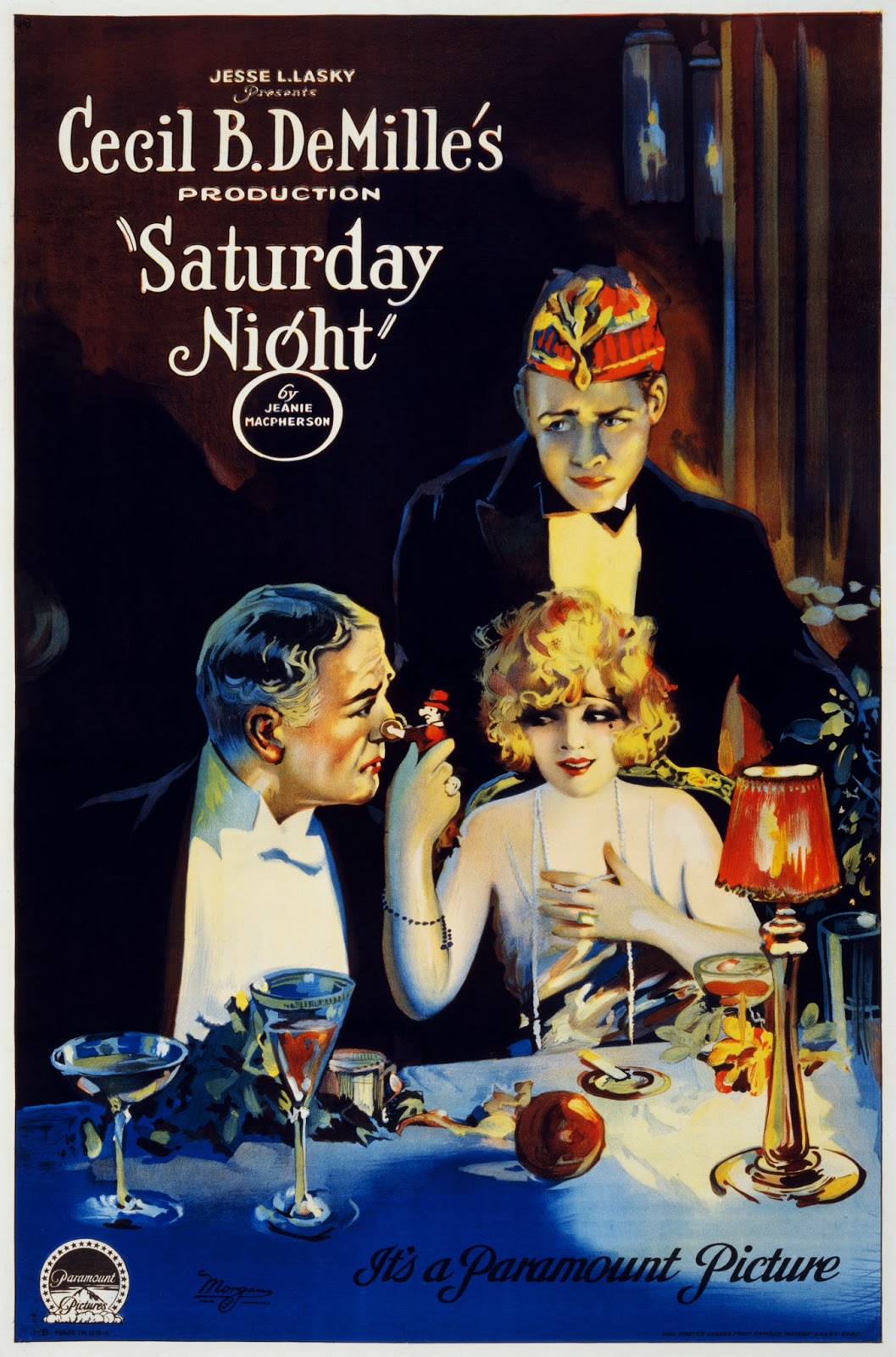
'Saturday Night' (1922), shown on Thursday morning, was the opening silent at this year's Cinefest.
I've just come back from Cinefest in Syracuse. And although I didn't fly, boy are my arms tired!
Well, not really, even though I accompanied six feature films in four days. I just couldn't resist the chance to give new life to humor from another era.
And that captures the spirit of Cinefest, I think: giving life (on screen, anyway) to older motion pictures that otherwise aren't screened anywhere. By "older," I mean features and short films from the silent and early talkie era, up until about World War II.
Some are surprisingly compelling. Others turn out to be real turkeys. But all get a chance to live again, shown as they were intended: on a big screen, with an attentive audience, and with live music for the silent films.
The more I think about it, the more important I realize such events are in terms of understanding the impact that early motion pictures had on the culture of their era. Much of their energy and excitement comes from the effect they produced on an audience, and the people who created them had this in mind all along.
They were never intended to be consumed in private or in solitude, either on a screen in someone's basement or, God help us, on a cell phone.
So the chance to see older pictures, good or bad, with an audience, can be a revelation in that a key element of their original power is restored. To see any motion picture from before World War II without an audience is like standing outside the Louvre Museum in Paris and saying you've experienced the Mona Lisa.
This year's Cinefest, which ran from Thursday, March 13 through Sunday, March 16, 2014, offered a wonderfully mixed grabbag of titles, including a group of a half-dozen Fox talkies from the early 1930s and a bigger-than-normal proportion of silent films.
In fact, the silent schedule was heavy enough for this year's Cinefest to have four accompanists on hand to supply music, rather than the usual three. And that was good news for me, because one of the big attractions of Cinefest is the chance to hear other accompanists ply the trade in live performance for a lot of different films.
This year, my colleagues were Makia Matusmura, a highly regarded New York-based accompanist whom I'd never had the chance to hear before; Judy Rosenberg, a wonderful accompanist from San Francisco whose recorded work I've long admired but whom I also hadn't heard in live performance; and the great Jon Mirsalis, also from the San Francisco area, whose style and approach I think makes him one of the most effective accompanists in the field.
All three turned in multiple memorable performances—in fact, there was so much music and so many movies, at this point I would be hard-pressed single out one moment over another. There was also a richness to the accompaniment in that everyone was able to adapt quite readily to all the different styles and genres of the many silents on the program.
Even accompanist Ben Model was on hand for his "undercranking" presentation, and sat in to play for many of the comedy short subject programs, so I got to hear him in action as well. Five accompanists in one spot must be some kind of record.
I always learn so much, I think, from hearing what other accompanists do and now they approach the task. It's one of the great pleasures of being part of Cinefest these past three years.
As for me, I had some good moments, but also some weak stretches. Compiling a log of what I did might help me tie together what I got out of the experience, so here goes. (Keep in mind that there's no chance to preview these films, so they're played "cold" by the accompanists.)
• Thursday, March 13: 'Saturday Night' (1922): The very first silent feature of this year's Cinefest was this Cecil B. DeMille society comedy/drama that went pretty well. I had good material to accompany the constrasting worlds of the upper and lower class characters, and the story flowed quite naturally, so the music stayed on target, I thought. The best thing about it was that you could see the comedy scenes coming from a mile away, so I was able to get music under them that was pretty effective, I thought. It wasn't hard to capture even small details, such as how the elevated train ran right outside a tenement flat.
• Thursday, March 13: 'Fanchon, the Cricket' (1915): This recently restored early Mary Pickford feature was another effort that held together well, I thought. Unusual in that it was set in a kind of medieval fantasy world, which I tried to match with a light "music box" style of accompaniment that seemed to do the trick.Kind of a weak film in that I found it hard to find much to be sympathetic about in Mary's character or situation, but I did my best to "cast a spell" and help put the film over.
Fannie Ward and Jack Dean in 'For the Defense' (1916)
• Friday, March 14: 'For the Defense' (1916): This early Paramount drama was perhaps my favorite of those I accompanied, in that it was totally unknown to me, but somehow I felt in synch with it right from the start. The material I chose seemed to fit well, I could follow the story with ease, and I paced it right so that the last 20 minutes of the film seemed to be very effective. No less a person than film preservation guru David Shepard said I did a good job "heightening the dramatic tension" of the film's climax. High praise indeed! It also won the award for the best intertitle of the festival: "I have to tell you ..... I murdered a man.... and I love you."
• Friday, March 14: 'Buck Privates' (1928): No, not the Abbott and Costello film, but a silent World War I army comedy about doughboys in Europe. I tried to keep it light, which was the right approach, but somehow the material I had didn't seem to help the film jell. (The fact that the film started just before midnight might have been a factor.) However, a frantic chase finale came as a nice surprise, allowing me to kick the material I'd been using into high velocity mode. Too bad so few attendees were on hand for it! But this served as a great example to me of how comedy is harder to do effectively. A chance to see this beforehand would have really helped with the pacing, as the humor was not as easily discerned on sight as in, say, 'Saturday Night.'
• Saturday, March 15: 'The Live Wire' (1925): This Johnny Hines comedy should have been a highlight of the festival, but it produced only sparse reaction, I think in part because the material I chose just wasn't a great fit for the film, and also I couldn't seem to get in synch with the film's spirit. Because of this, I began pushing tempos too soon, further confusing things and leaving me with nowhere to go when the climax finally did play out. Leonard Maltin, sitting right behind me for the screening, commented afterwards that I had "set quite a pace for myself" on that one. Definitely my weakest entry, I felt, and not helped by two cups of wine I had earlier in the evening. :)
• Sunday, March 16: 'The Devil Horse' (1926): I considered this action-packed Western drama starring Rex the Wonder Horse my grand finale, and so got permission to hook up the digital synthesizer and speakers to go all out. Everyone seemed really impressed, if only because the palette of the full orchestra (including big percussion, appropriate for a horse opera full of scenes of "injuns" on the warpath) was undoubtedly a constrast to the piano texture that is otherwise the soundtrack for silents at Cinefest. However, like 'The Live Wire,' I felt out of synch with this one as well, and found myself playing too much too soon. All went okay, however, despite a blown projection bulb during the climactic battle to save the fort. I pushed forward in the darkness, playing underscoring that vamped us until the movie started up again—now tinted pink because the new bulb hadn't warmed up yet!
What did I learn? Take your time. Resist the temptation to overplay. And don't drink wine prior to accompanying. A continuous line of melody can be better than abrupt transitions. Matching the right material is important, so don't be afraid to abandon music that's not working and go with something else. Avoid AUI, or Accompanying Under the Influence.
Cinefest follows a pattern of inviting accompanists for a three-year commitment on a rotating basis. And because this was my third year, 'The Devil Horse' really was the grand finale of my involvement for now, at least as an accompanist. It's been a great experience, as I've learned a lot and made contacts that will help me continue to pursue this unusual craft.
So I want to thank everyone associated with this grand affair for the chance to contribute music and get to know some wonderful people. Thanks especially to Joe Yranski for first inviting me as an accompanist, and to organizers Rick Scheckman and Gerry Orlando for all they do it getting the films programmed and the festival planned, and also to the projection and house crew in the theater who make it easy to concentrate on the music alone—something that's quite a luxury for me. :)
And now...looking ahead! A screening of 'The Lost World' (1925) will take place on Thursday, March 20 at 6:30 p.m. at the Flying Monkey Moviehouse and Performance Center in Plymouth, N.H. Tickets are $10 and hoping for a good crowd to be on hand for this grandpappy of all dinosaur movies.
I've been so busy that I haven't had a chance to get out a press release on this one, which is a shame, because I think it has a natural audience, given the enduring popularity of our prehistoric friends. Still, hope to see you there!
I've just come back from Cinefest in Syracuse. And although I didn't fly, boy are my arms tired!
Well, not really, even though I accompanied six feature films in four days. I just couldn't resist the chance to give new life to humor from another era.
And that captures the spirit of Cinefest, I think: giving life (on screen, anyway) to older motion pictures that otherwise aren't screened anywhere. By "older," I mean features and short films from the silent and early talkie era, up until about World War II.
Some are surprisingly compelling. Others turn out to be real turkeys. But all get a chance to live again, shown as they were intended: on a big screen, with an attentive audience, and with live music for the silent films.
The more I think about it, the more important I realize such events are in terms of understanding the impact that early motion pictures had on the culture of their era. Much of their energy and excitement comes from the effect they produced on an audience, and the people who created them had this in mind all along.
They were never intended to be consumed in private or in solitude, either on a screen in someone's basement or, God help us, on a cell phone.
So the chance to see older pictures, good or bad, with an audience, can be a revelation in that a key element of their original power is restored. To see any motion picture from before World War II without an audience is like standing outside the Louvre Museum in Paris and saying you've experienced the Mona Lisa.
This year's Cinefest, which ran from Thursday, March 13 through Sunday, March 16, 2014, offered a wonderfully mixed grabbag of titles, including a group of a half-dozen Fox talkies from the early 1930s and a bigger-than-normal proportion of silent films.
In fact, the silent schedule was heavy enough for this year's Cinefest to have four accompanists on hand to supply music, rather than the usual three. And that was good news for me, because one of the big attractions of Cinefest is the chance to hear other accompanists ply the trade in live performance for a lot of different films.
This year, my colleagues were Makia Matusmura, a highly regarded New York-based accompanist whom I'd never had the chance to hear before; Judy Rosenberg, a wonderful accompanist from San Francisco whose recorded work I've long admired but whom I also hadn't heard in live performance; and the great Jon Mirsalis, also from the San Francisco area, whose style and approach I think makes him one of the most effective accompanists in the field.
All three turned in multiple memorable performances—in fact, there was so much music and so many movies, at this point I would be hard-pressed single out one moment over another. There was also a richness to the accompaniment in that everyone was able to adapt quite readily to all the different styles and genres of the many silents on the program.
Even accompanist Ben Model was on hand for his "undercranking" presentation, and sat in to play for many of the comedy short subject programs, so I got to hear him in action as well. Five accompanists in one spot must be some kind of record.
I always learn so much, I think, from hearing what other accompanists do and now they approach the task. It's one of the great pleasures of being part of Cinefest these past three years.
As for me, I had some good moments, but also some weak stretches. Compiling a log of what I did might help me tie together what I got out of the experience, so here goes. (Keep in mind that there's no chance to preview these films, so they're played "cold" by the accompanists.)
• Thursday, March 13: 'Saturday Night' (1922): The very first silent feature of this year's Cinefest was this Cecil B. DeMille society comedy/drama that went pretty well. I had good material to accompany the constrasting worlds of the upper and lower class characters, and the story flowed quite naturally, so the music stayed on target, I thought. The best thing about it was that you could see the comedy scenes coming from a mile away, so I was able to get music under them that was pretty effective, I thought. It wasn't hard to capture even small details, such as how the elevated train ran right outside a tenement flat.
• Thursday, March 13: 'Fanchon, the Cricket' (1915): This recently restored early Mary Pickford feature was another effort that held together well, I thought. Unusual in that it was set in a kind of medieval fantasy world, which I tried to match with a light "music box" style of accompaniment that seemed to do the trick.Kind of a weak film in that I found it hard to find much to be sympathetic about in Mary's character or situation, but I did my best to "cast a spell" and help put the film over.
Fannie Ward and Jack Dean in 'For the Defense' (1916)
• Friday, March 14: 'For the Defense' (1916): This early Paramount drama was perhaps my favorite of those I accompanied, in that it was totally unknown to me, but somehow I felt in synch with it right from the start. The material I chose seemed to fit well, I could follow the story with ease, and I paced it right so that the last 20 minutes of the film seemed to be very effective. No less a person than film preservation guru David Shepard said I did a good job "heightening the dramatic tension" of the film's climax. High praise indeed! It also won the award for the best intertitle of the festival: "I have to tell you ..... I murdered a man.... and I love you."
• Friday, March 14: 'Buck Privates' (1928): No, not the Abbott and Costello film, but a silent World War I army comedy about doughboys in Europe. I tried to keep it light, which was the right approach, but somehow the material I had didn't seem to help the film jell. (The fact that the film started just before midnight might have been a factor.) However, a frantic chase finale came as a nice surprise, allowing me to kick the material I'd been using into high velocity mode. Too bad so few attendees were on hand for it! But this served as a great example to me of how comedy is harder to do effectively. A chance to see this beforehand would have really helped with the pacing, as the humor was not as easily discerned on sight as in, say, 'Saturday Night.'
• Saturday, March 15: 'The Live Wire' (1925): This Johnny Hines comedy should have been a highlight of the festival, but it produced only sparse reaction, I think in part because the material I chose just wasn't a great fit for the film, and also I couldn't seem to get in synch with the film's spirit. Because of this, I began pushing tempos too soon, further confusing things and leaving me with nowhere to go when the climax finally did play out. Leonard Maltin, sitting right behind me for the screening, commented afterwards that I had "set quite a pace for myself" on that one. Definitely my weakest entry, I felt, and not helped by two cups of wine I had earlier in the evening. :)
• Sunday, March 16: 'The Devil Horse' (1926): I considered this action-packed Western drama starring Rex the Wonder Horse my grand finale, and so got permission to hook up the digital synthesizer and speakers to go all out. Everyone seemed really impressed, if only because the palette of the full orchestra (including big percussion, appropriate for a horse opera full of scenes of "injuns" on the warpath) was undoubtedly a constrast to the piano texture that is otherwise the soundtrack for silents at Cinefest. However, like 'The Live Wire,' I felt out of synch with this one as well, and found myself playing too much too soon. All went okay, however, despite a blown projection bulb during the climactic battle to save the fort. I pushed forward in the darkness, playing underscoring that vamped us until the movie started up again—now tinted pink because the new bulb hadn't warmed up yet!
What did I learn? Take your time. Resist the temptation to overplay. And don't drink wine prior to accompanying. A continuous line of melody can be better than abrupt transitions. Matching the right material is important, so don't be afraid to abandon music that's not working and go with something else. Avoid AUI, or Accompanying Under the Influence.
Cinefest follows a pattern of inviting accompanists for a three-year commitment on a rotating basis. And because this was my third year, 'The Devil Horse' really was the grand finale of my involvement for now, at least as an accompanist. It's been a great experience, as I've learned a lot and made contacts that will help me continue to pursue this unusual craft.
So I want to thank everyone associated with this grand affair for the chance to contribute music and get to know some wonderful people. Thanks especially to Joe Yranski for first inviting me as an accompanist, and to organizers Rick Scheckman and Gerry Orlando for all they do it getting the films programmed and the festival planned, and also to the projection and house crew in the theater who make it easy to concentrate on the music alone—something that's quite a luxury for me. :)
And now...looking ahead! A screening of 'The Lost World' (1925) will take place on Thursday, March 20 at 6:30 p.m. at the Flying Monkey Moviehouse and Performance Center in Plymouth, N.H. Tickets are $10 and hoping for a good crowd to be on hand for this grandpappy of all dinosaur movies.
I've been so busy that I haven't had a chance to get out a press release on this one, which is a shame, because I think it has a natural audience, given the enduring popularity of our prehistoric friends. Still, hope to see you there!
Monday, March 10, 2014
We raised $3,000 for the Town Hall Theatre;
Now, on to Cinefest in Syracuse, N.Y.
The Wilton Town Hall Theatre occupies the second floor of the old town hall in downtown Wilton, N.H.
I'm pleased to report that yesterday's screening of 'Wings' (1927) at the Wilton (N.H.) Town Hall Theatre raised more than $3,000 towards the facility's conversion to digital for first-run movies.
I want to thank the generosity of silent film fans who turned out for this $20-per-ticket event, many of whom made additional donations to the theater yesterday.
The Wilton Town Hall Theatre is one of the great things about living in our part of the world. It's also where I got my start accompanying silent films live in front of an audience, and I still consider it my "home base" with the monthly screenings I continue to do there.
So I was really pleased to see such a great response to this fund-raiser. Many familiar faces, and some new folks as well, and a lot of kind comments after the show.
Ironically, we showed 'Wings' in the same theater where '12 Years a Slave' is currently playing. So on Sunday, movie-goers in Wilton had a choice between the very first and the most recent Best Picture. That can't happen very often.
The screening of 'Wings' also served as a kind of "final exam" prior to heading off to Syracuse, N.Y. later this week for Cinefest, a four-day annual gathering of vintage film buffs. As part of the festivities, silent and early sound movies are screened pretty much continuously each day from 9 a.m. until after midnight. (No, they're not totally crazy. On Sunday, they stop about 6 p.m.)
That's so much film that they actually bring in no less than three accompanists to handle the music. Pianists are generally given a three-year stint, and this time marks my third (and final) year in the rotation.
I love going there, but I'll be honest: for me, it's a fairly challenging event because I'm playing alongside the likes of Phil Carli, Jon Mirsalis, Andrew Simpson, and other terrific accompanists with long-established national reputations.
This year, my co-conspirators at the keyboard are Makia Matusmura and Judy Rosenberg, both fantastic accompanists that I'm looking forward to meeting and hearing. And I understsand Ben Model and Jon Mirsalis will be coming in for some things as well, too.
Each time I go, I'm thrilled (and amazed) to hear what these other accompanists can do. I'm also forced to consider my own way of accompanying, which is good, because it inspires me to continue to try to improve my craft. So that means everything from Hanon technical exercises (the classic piano player's finger-training exercises) to working through chord progressions that I can file away for future use, and also making a concious effort to make full use of all 88 keys. (Sometimes I seem to forget about the upper third of a piano keyboard.)
Another challenge is mastering the considerable difference between an acoustic piano (such as that used at Cinefest) and the Korg digital synthesizer I often use in my own shows. Though the keyboard itself might look the same, each requires a whole different style of playing.
Well, I do work at it, but there's only so far that work (and any natural talent) can get you. And in recent months, I've become increasingly comfortable with a sense that my own strength as an accompanist lies not in flying all over the keyboard, but with keeping things small and in control, and using that to maximize an audience's experience of the film. Use the tools you have.
I may never be Vladimir Horowitz, but I do have a definite sense of drama and a good feel of how music can augment many different types of cinematic story-telling. (Comedy, yes, is still the toughest to pull off effectively.) I may not have the ability to rattle off, say, a Chopin polonaise at will. But I'm not likely to go off on a showy tangent when accompanying a film. All I seem to be able to do is organic film music that's not intended to be anything else.
And Phil Carli himself, one of the most impressive keyboard players I've ever witnessed, has said that one of the cardinal sins of accompaniment is "overplaying," or trying to play beyond one's ability. It's a tendency I notice in myself, because I do get carried away by a film, and also with trying to do what other accompanists sometimes do. It's a basic human motivation: peer pressure. Hey, I want to be like them!
And this feeds a cycle where I tend to push too hard too soon, which sometimes can lead to overplaying, which is when things are most likely to fall apart. Worse, it give me nowhere to go when a film really demands it. This has happened several times at past Cinefests, where the audience of vintage film specialists tends to fuel my desire to make a big impression. I really want this film to work, dammit! With me, that often results in less-than-optimal accompaniment.
I've had some good moments at Cinefest, too. But they seem to happen mostly when I'm able to keep the music from spinning out of control and stay within my range. Strangely, it seems that the longer I can maintain this control during a picture, the more my confidence grows, and so I actually am able to make the most of the big moments when they come. That's exactly what happened last year with 'The Foundling' (1915), a Mary Pickford feature I played for.
I'm now running the risk of overthinking all this, so I'll stop here. Let's just say it's a delicate balance, but I'm starting to understand the contours of how that balance works and how best to manage it so that a film gets the best score I can give it.
So this Cinefest, I'm going to make a deliberate effort to just be myself and do what I do best: start slow, don't be afraid to keep things simple, and work hard to rein in things so that big moments have a chance at feeling authentically big. This will require actual courage on my part, as the temptation to "go big" is huge. But more than ever I understand how important it is for me to do the best I can in my own style.
And after Cinefest, the schedule lightens up a bit, which is good. That's because I would like to take time to push my scoring technique in directions that, yes, build on my strengths and continue to improve my technique, as much as possible. I get a sense that I'm maybe about a third of the way to the point where I have my own authentic vocabulary for scoring silent films. So there's still a lot of work to do.
In the past few years, I've booked a great number of screenings with the idea that what I needed most was experience in front of a live audience. That's been helpful, but I now find I'm often drawing upon the same bank of material rather than creating new stuff, which is where the musical vocabulary truly gets forged. I need to spend more time in the lab, so to speak.
So I'm moving into a phase where I hope to prepare more new material for screenings and see how I can push things in that direction. Though it's always exciting to accompany a film live, doing 'Steamboat Bill Jr.' (1928) yet again using the same tunes I've been using for years is beginning to wear a little thin.
Something new seems called for. Stay tuned.
I'm pleased to report that yesterday's screening of 'Wings' (1927) at the Wilton (N.H.) Town Hall Theatre raised more than $3,000 towards the facility's conversion to digital for first-run movies.
I want to thank the generosity of silent film fans who turned out for this $20-per-ticket event, many of whom made additional donations to the theater yesterday.
The Wilton Town Hall Theatre is one of the great things about living in our part of the world. It's also where I got my start accompanying silent films live in front of an audience, and I still consider it my "home base" with the monthly screenings I continue to do there.
So I was really pleased to see such a great response to this fund-raiser. Many familiar faces, and some new folks as well, and a lot of kind comments after the show.
Ironically, we showed 'Wings' in the same theater where '12 Years a Slave' is currently playing. So on Sunday, movie-goers in Wilton had a choice between the very first and the most recent Best Picture. That can't happen very often.
The screening of 'Wings' also served as a kind of "final exam" prior to heading off to Syracuse, N.Y. later this week for Cinefest, a four-day annual gathering of vintage film buffs. As part of the festivities, silent and early sound movies are screened pretty much continuously each day from 9 a.m. until after midnight. (No, they're not totally crazy. On Sunday, they stop about 6 p.m.)
That's so much film that they actually bring in no less than three accompanists to handle the music. Pianists are generally given a three-year stint, and this time marks my third (and final) year in the rotation.
I love going there, but I'll be honest: for me, it's a fairly challenging event because I'm playing alongside the likes of Phil Carli, Jon Mirsalis, Andrew Simpson, and other terrific accompanists with long-established national reputations.
This year, my co-conspirators at the keyboard are Makia Matusmura and Judy Rosenberg, both fantastic accompanists that I'm looking forward to meeting and hearing. And I understsand Ben Model and Jon Mirsalis will be coming in for some things as well, too.
Each time I go, I'm thrilled (and amazed) to hear what these other accompanists can do. I'm also forced to consider my own way of accompanying, which is good, because it inspires me to continue to try to improve my craft. So that means everything from Hanon technical exercises (the classic piano player's finger-training exercises) to working through chord progressions that I can file away for future use, and also making a concious effort to make full use of all 88 keys. (Sometimes I seem to forget about the upper third of a piano keyboard.)
Another challenge is mastering the considerable difference between an acoustic piano (such as that used at Cinefest) and the Korg digital synthesizer I often use in my own shows. Though the keyboard itself might look the same, each requires a whole different style of playing.
Well, I do work at it, but there's only so far that work (and any natural talent) can get you. And in recent months, I've become increasingly comfortable with a sense that my own strength as an accompanist lies not in flying all over the keyboard, but with keeping things small and in control, and using that to maximize an audience's experience of the film. Use the tools you have.
I may never be Vladimir Horowitz, but I do have a definite sense of drama and a good feel of how music can augment many different types of cinematic story-telling. (Comedy, yes, is still the toughest to pull off effectively.) I may not have the ability to rattle off, say, a Chopin polonaise at will. But I'm not likely to go off on a showy tangent when accompanying a film. All I seem to be able to do is organic film music that's not intended to be anything else.
And Phil Carli himself, one of the most impressive keyboard players I've ever witnessed, has said that one of the cardinal sins of accompaniment is "overplaying," or trying to play beyond one's ability. It's a tendency I notice in myself, because I do get carried away by a film, and also with trying to do what other accompanists sometimes do. It's a basic human motivation: peer pressure. Hey, I want to be like them!
And this feeds a cycle where I tend to push too hard too soon, which sometimes can lead to overplaying, which is when things are most likely to fall apart. Worse, it give me nowhere to go when a film really demands it. This has happened several times at past Cinefests, where the audience of vintage film specialists tends to fuel my desire to make a big impression. I really want this film to work, dammit! With me, that often results in less-than-optimal accompaniment.
I've had some good moments at Cinefest, too. But they seem to happen mostly when I'm able to keep the music from spinning out of control and stay within my range. Strangely, it seems that the longer I can maintain this control during a picture, the more my confidence grows, and so I actually am able to make the most of the big moments when they come. That's exactly what happened last year with 'The Foundling' (1915), a Mary Pickford feature I played for.
I'm now running the risk of overthinking all this, so I'll stop here. Let's just say it's a delicate balance, but I'm starting to understand the contours of how that balance works and how best to manage it so that a film gets the best score I can give it.
So this Cinefest, I'm going to make a deliberate effort to just be myself and do what I do best: start slow, don't be afraid to keep things simple, and work hard to rein in things so that big moments have a chance at feeling authentically big. This will require actual courage on my part, as the temptation to "go big" is huge. But more than ever I understand how important it is for me to do the best I can in my own style.
And after Cinefest, the schedule lightens up a bit, which is good. That's because I would like to take time to push my scoring technique in directions that, yes, build on my strengths and continue to improve my technique, as much as possible. I get a sense that I'm maybe about a third of the way to the point where I have my own authentic vocabulary for scoring silent films. So there's still a lot of work to do.
In the past few years, I've booked a great number of screenings with the idea that what I needed most was experience in front of a live audience. That's been helpful, but I now find I'm often drawing upon the same bank of material rather than creating new stuff, which is where the musical vocabulary truly gets forged. I need to spend more time in the lab, so to speak.
So I'm moving into a phase where I hope to prepare more new material for screenings and see how I can push things in that direction. Though it's always exciting to accompany a film live, doing 'Steamboat Bill Jr.' (1928) yet again using the same tunes I've been using for years is beginning to wear a little thin.
Something new seems called for. Stay tuned.
Tuesday, March 19, 2013
From the piano: 33rd Annual Cinefest
vintage film confab March 14-17, 2013
My usual state between films at Cinefest.
What happens when several hundred movie buffs get together to enjoy four straight days of obscure vintage cinema?
By "straight," I mean from 9 a.m. to midnight Thursday through Saturday, followed by a lighter schedule of just 9 hours of viewing on Sunday. And by "vintage," I mean little-known flicks from way back in the silent and early sound era.
What happens is you get Cinefest, one of the high points of the vintage entertainment calendar. Every March, the film faithful gather at a Holiday Inn outside Syracuse, N.Y. for a multi-day buffet of comedies, dramas, westerns, thrillers, propaganda films, musicals, home movies of Curly Howard, and more. They're often bizarre, but they're always interesting.
To learn more about this annual confab, check out a write-up by critic and author Leonard Maltin, who attends every year with his wife Alice.
Hey! That's me with Leonard Maltin and Alice.
But for a more limited view—my perspective from the piano bench as one of the accompanists, or just wandering the halls—read on.
It might seem a little disjointed, but that's what happens when you score five completely different films (and plenty of shorts) in a few days. Reality begins blurring with what occurred on screen. Also, the place where the music comes from is tapped so often and steadily that it becomes hard to turn off, or starts to behave like a leaky faucet. You begin imagining music while, say, walking across the parking lot to the pharmacy to buy beer or headache tablets.
• Thursday, March 14: Day One of Cinefest was proceeded by the previous night's customary trip to the hospitality suite, where I scarfed a couple of sandwiches and helped carry in Leonard Maltin's luggage across the hall. Ah, show business.
Also in the musical line-up: Andrew Simpson, who was here last year, and Jon Mirsalis, one of the big names in the field and someone whose work I really admire. What a privilege to be playing on the same program with two heavy hitters!
And also a little intimidating. But I've found that my own style is what it is. So I can't get too self-conscious or try to be something I'm not — specifically, a concert pianist. Heck, I'd even make a lousy rehearsal pianist! Helpfully, Jon recounted how he felt he was terrible when he started out, which I actually found comforting.
On Thursday morning, accompaniment duties began at 10:45 a.m. with the first installment of 'Lame Brains and Lunatics,' a program of obscure silent short comedies from the Library of Congress compiled by Rob Stone and Steve Massa. Andrew took the lead on this; I followed along with tunes for a couple of shorts in between. Jon had asked to be excused from playing for silent film comedies, which seem to be pretty low on his list of good ways to spend what time we have on this planet, and I can understand.
After lunch, I got to hear Jon play (for me, the first time live) for 'Wild Beauty' (1926), an absurd horse drama that Jon's music transformed into compelling cinema. In live performance, Jon's style and musical vocabulary are instantly recognizable. I kept thinking: present at the creation. It's why people visit Niagara Falls in person rather just look at pictures of it. I was especially impressed with some deep and consistent rumbling that Jon produced for a stampede sequence — it all seemed to be coming from the bottom octave of the keyboard. Later, Jon said the effect was produced by "a lot of notes."
Andrew drew a difficult drama, 'The Whip,' (1917), another horse-related story (more about the humans) but a hodgepodge of scenes that didn't quite make sense and in some cases were clearly in the wrong order. He made it bearable with some great playing, I thought. Things fell together for him much more naturally in 'My Boy' (1921), a melodrama featuring child star Jackie Coogan, then fresh off his triumph in Chaplin's 'The Kid' the year before.
Andrew, with his quadro-textured Italian suitcoat, warms up for 'My Boy' on Thursday afternoon. Note the four buttons in different colors on his coat sleeve.
As cute as Coogan is as a child actor, my problem is that I can't help thinking of him as Uncle Fester in old 'The Addams Family' TV show. (As seen on right.) But Andrew's music helped sweep all that away, creating a score that wrung maximum emotional value from the film.
When the lights came up at the end, I was surprised to see Andrew in tears! How great to witness such genuine emotion, for a silent film or for anything, really. He mentioned that thoughts of his own two-year-old son prompted the response, and the film really got to him. Wow! In the presence of some powerful stuff there.
And me? I'd just spent the whole day listening to two masterful accompanists, with occasional breaks to wonder what I was doing on the same program.
But there I was. And my first at-bat came Thursday night after dinner, with music for a program of seldom-screened Mary Pickford pics: the short 'So Near and Yet So Far' (1912) and the early feature 'The Foundling' (1916), an unusual film because it was made twice — the original footage burned in a fire before the picture was released, so they went back and shot it all over again!
Alas, I was really all over the place for the short. Neither film nor accompanist seemed to settle down. But I had some "A List" ideas ready for 'The Foundling,' and once it started, I was relieved when things came together pretty quickly. The film was easy to follow, so I never lost the story thread, which makes a big difference. Things kept clicking, with one nice moment after another. As we approached the two-thirds mark, I got the feeling I was nailing it, and so headed into the last part playing with confidence.
And yes, at the big climax, I uncorked the full treatment of my main theme, cycling the first two bars of it (C Major and E minor) until Mary revealed her true identity to her father, which was my cue to push the melody forward to what Rachmaninoff would identify as the "purple moment," that one high point that everything else is leading to, in one way or another. It was one of those moments that worked out in a way that would have been impossible to plan for in advance, and I thought it was a fitting way to handle what was clearly the big emotional moment.
As the film ended, I rolled into a closing cadence and finished with a flourish. Lights up, generous applause, and the great relief that in my initial outing, I'd hit a home run. So many nice comments afterwards, especially from the Pickford people, who hadn't realized I was improvising the score and had never seen the picture before. And I was especially pleased when Jon Miralis said he thought the music was "haunting." Wow!
Afterwards, a kindly older gentleman complimented me on the way I had used a theme from a Schubert string quartet. This was surprising because I hadn't used one—well, at least not that I was aware of. But it's entirely possible that some fragment of melody I heard long ago lodged somewhere in my head and was only jarred loose by Mary Pickford's curls. You never know. Hey, with only 12 notes to work with, things are bound to sound similar once in awhile.
Andrew and Jon during the first day.
• Friday, March 15: Long day for me, making up for the drought on Thursday: two features plus another round of short comedies from the Library of Congress under the 'Lame Brains and Lunatics' banner. I lucked out on the first feature, 'Ladies of Leisure' (1926), a generally light comedy with a few serious scenes salted in, but ultimately played for laughs. The material I picked for this seemed to fit well, and also got to do some faux-minimalist stuff during the dramatic scenes, which were pretty predictable. When the distraught woman hails a streetcar that says "To Brooklyn Bridge," you know what's going to happen. So the score held together, but just barely. By the ending, I was ready for lunch.
For that, we hauled down the road to Heidi's of Liverpool, an iconic hot dog stand, where I accidentally stuck my foot in wet cement in fine silent comedy style. After that adventure, I was next up for 'Bolshevism on Trial' (1919), a strange propaganda film for which I had high hopes. But entering the darkened room about 15 minutes before showtime, I was thrown when I found the audience watching a silent film being projected with no music! What?! Was I supposed to be up there? What was happening?
I made my way up to the front, thinking I'd somehow disappointed everyone by not being on hand, and was just about to sit down at the keyboard when the film clip ended, and then started again, this time with recorded sound. I immediately realized that the previous clip was unrestored film that lacked the synchronized discs, and was just being shown to give audiences an idea of what the materials looked like before they were put back together.
Still, it was enough to rattle me so that I had trouble finding my groove for the propaganda film. It ought to have been easy to play for, as the plot was transparent and the action entirely predictable. But the material I'd chosen to work with just wasn't a good match, and my efforts todo things like twist around phrases of the Star-Spangled Banner didn't generate much energy, either. I was glad when it ended, and felt it had been my low point so far. (Three features down, two to go.)
The highlight of Friday, I thought, was Jon Mirsalis playing for 'The Ice Flood' (1926), a Universal drama centered on exactly that: a big ice jam in logging country in the Pacific Northwest. Not any kind of classic, but the kind of picture you can imagine people getting really excited about when this was first released. It's in the same category of the fire film that Kevin Brownlow uses to start off his great "Pioneers" documentary of silent film.
Film archivist Bruce Lawton and me in the sprawling dealers' room.
After dinner, another session of 'Lame Brains and Lunatics' short comedies, and I wasn't happy with how this worked out, either. Andrew is a natural for this sort of thing, spinning out honky-tonk accompaniment without apparent effort, and I gain a lot from hearing what he does. I think I just need to sit and do one or two of these a day just to get into the habit of responding to them. Maybe it's just nerves—the unfamiliar room and the big and knowledgeable audience made it that much harder to forget myself and get inside these films.
Friday night gabfast in the Holiday Inn lobby. In plaid is Rob Stone from the Library of Congress; at his left is silent comedy guru Steve Massa, about to be author of 'Lame Brains and Lunatics,' a newly published book on the field.
• Saturday, March 16: An early day. Hearty breakfast at Carl's Kountry Kitchen on Teall Avenue, then fellow accompanist Andrew Simpson and I arrived at the Palace Theater on James Street at 8 a.m. for a day of 35mm prints. Me, I was in what I can now identify as my 'mid-Cinefest funk' — that place where you feel you've done your best work and it's going to be tough to try to summon up the energy (and the ideas) to equal or surpass the mark.
As organizer Joe Yranski jokes, a theater sporting the name 'Palace' is often anything but. And yes, the Palace on James Street is far from grand. It's a modest one-screen affair in a funky neighborhood that somehow endured into the age of the multiplex, and only this past May ceased running first-run films when the economics finally gave out.
But I like the place, which wears the understated quirkiness of another era. Inside, there's just enough architectural schmaltz to make it endearing without being ridiculous. And the 38th anniversary wishes to Leonard and Alice Maltin on the marquee was a nice touch.
However, since they pulled the plug on first-run shows, the projection booth discipline has apparently deteriorated somewhat. We had films out of order and appear when they weren't supposed to, including one I was supposed to play, 'Come On Over,' a 1922 Colleen Moore vehicle about a gal from the Emerald Isle. 'Come On Over' started in the middle of a collection of technicolor fragments that Jon Mirsalis was playing. When it came on, Jon sat and waited, but when it was apparent the Moore film wasn't going to stop, he invited me to jump in, which I did.
Not the best set-up for effective film scoring, but I had some material in mind and was surprised when I picked up the film no problem and things began to jell. (I later joked that I'm one-quarter Irish, and the score reflected about that ratio.) I kept it light, as the film itself was light as a feather, driven by misunderstandings and with no real villain. Plot threads were tied up without much drama, and then it was time to party.
Joe Yranski had tipped me off in advance that 'Come On Over' contained an Irish jig near the end. Sure enough, when the old guy with the bagpipes was brought in, I was ready with open fifths droning in the bass and 6/8 figures whirling above, with a sharped fourth to add a little sparkle to the racket.
What surprised me, however, was the jig was not just a scene, but turned out to be the actual ending of the film. I didn't expect this, but as it unfolded and kept going, it became increasingly clear that we were done with the story and now it was time for everyone to dance. And one by one, they each got a turn—young folks, old folks, everyone. It was structured like a Bollywood movie!
This realization dawned on me at about the time the Colleen Moore character brought out a door to dance on as her final statement of jig superiority. This is the film's real climax! I had been holding back, but at that point I sensed it was time to amp things up, so began building to a climax, with the right hand working its way up the keyboard.
And sure enough, just as I got the place where there ain't no place else to go, the frantic jig scene faded out to 'The End.' So I poured on what little I had left, keeping the energy going for a few more bars to finish out with a clanging 6/8 flourish, tone clusters and all, including that sharped fourth. And as I realized I'd nailed it, I was overcome with a happiness and satisfaction that's hard to describe. But I can say that it ranks as one of the most satisfying moments I've had in accompanying silent films.
I even ended with a showy downward glissando!
And before I move on, let me tip my non-existent cap to Andrew Simpson, who opened the morning with a completely polished and totally compelling score for 'Three Women' (1924), a sophisticated Ernst Lubitsch drama. I thought this was Andrew's very best stuff of the event, a flawless match of music and movie.
After 'Come On Over,' we then played round robin for the Library of Congress 'Mostly Lost' presentation, with me drawing a Hank Mann comedy and a fragment of a Western that I thought was a comedy for the first few minutes until I realized it was being played straight. Luckily, I had chosen a strategy of "straight music" instead of comic in the hopes that it would bring out the comedy, so I wasn't in too bad a place when the comedy never came.
I went back to the hotel for the afternoon, and so missed one of the great moments of Cinefest 2013. Jon Mirsalis was accompanying the Norma Talmadge drama 'The Woman Disputed' (1928), and during a climactic battle scene, somehow the lamp fell off the keyboard. Not only that — it crashed onto the microphone that had been set up behind the keyboard, causing the bulb to break with a resounding smash that was broadcast to the entire theater.
Amazingly, all this happened in exact synchronization with a huge on-screen explosion, making it one of the most well-timed technical disasters in the history of live film scores. When we reconvened at the hotel on Saturday night, I had the honor of saying a few words to the crowd, and presented Jon a new bulb to make up for the one lost during his performance.
Accompanist Jon Mirsalis holds up his replacement light bulb.
Back at the hotel that night, my last feature was 'Partners Again' (1926), a "middle class Jewish" comedy that I don't think I had the right material for. But I kept things light and staccato throughout, which helped, and then did my best to lend some high velocity thrills to an airborne climax that seemed to last about five minutes longer than really necessary. Later, I was amazed to learn that I was playing for the first public screening of this film since its original release in 1926!
Still, I sensed I wasn't quite pulling off the approach I had chosen, so not the most satisfying experience of the event. As Groucho Marx said, "Sorry folks, they can't all be gems."
But afterwards, I was surprised when no less a film authority than Scott Margolin, who leads the Vitaphone Project, came over and congratulated me on what he said was a superb performance! I was grateful for his remarks, which were a reminder that people hear and respond to a score in many different ways.
Jon then sat down for a bravura score to 'Behind the Door' (1919), an intense 'atrocity' film from the Ince studios. Highlighted by incredible photography (especially at sea) and appallingly gruesome subject matter, Jon's music to this was the highlight of the festival for me.
Andrew finished the night with 'The Quarterback' (1926), a college football comedy starring Richard Dix and Esther Ralston. Andrew had started the day at 8:30 a.m. at the Palace, and here he was playing the last flick of the day, starting after 11 p.m. At some point this ceases to be fun, and as the opening titles rolled for 'The Quarterback,' I got the sense that we'd reached that spot. Still, Andrew turned in an energetic "rah rah" football score, which really impressed me with its effectiveness as well as its musicianship.
Your three accompanists: Jon, Andrew, and someone who should know better than to wear that much black. (Festival organizer Gerry Orlando is in back.)
• Sunday, March 17: I had to get an early start back to home base in New Hampshire, so bid everyone goodbye without attending events of screenings. (Jon handled the one silent film that afternoon.) Surprisingly, I found myself reluctant to leave. Despite the ups and downs of wrestling with accompaniment, I had come to feel at home in this environment. What if this was really my job and I had to do this every day? If it was like the most recent Cinefest, I wouldn't mind at all!
But for now, I'll have to wait until March 13, 2014 to return for the final installment of my three-year engagement. Better start practicing.
What happens when several hundred movie buffs get together to enjoy four straight days of obscure vintage cinema?
By "straight," I mean from 9 a.m. to midnight Thursday through Saturday, followed by a lighter schedule of just 9 hours of viewing on Sunday. And by "vintage," I mean little-known flicks from way back in the silent and early sound era.
What happens is you get Cinefest, one of the high points of the vintage entertainment calendar. Every March, the film faithful gather at a Holiday Inn outside Syracuse, N.Y. for a multi-day buffet of comedies, dramas, westerns, thrillers, propaganda films, musicals, home movies of Curly Howard, and more. They're often bizarre, but they're always interesting.
To learn more about this annual confab, check out a write-up by critic and author Leonard Maltin, who attends every year with his wife Alice.
Hey! That's me with Leonard Maltin and Alice.
But for a more limited view—my perspective from the piano bench as one of the accompanists, or just wandering the halls—read on.
It might seem a little disjointed, but that's what happens when you score five completely different films (and plenty of shorts) in a few days. Reality begins blurring with what occurred on screen. Also, the place where the music comes from is tapped so often and steadily that it becomes hard to turn off, or starts to behave like a leaky faucet. You begin imagining music while, say, walking across the parking lot to the pharmacy to buy beer or headache tablets.
• Thursday, March 14: Day One of Cinefest was proceeded by the previous night's customary trip to the hospitality suite, where I scarfed a couple of sandwiches and helped carry in Leonard Maltin's luggage across the hall. Ah, show business.
Also in the musical line-up: Andrew Simpson, who was here last year, and Jon Mirsalis, one of the big names in the field and someone whose work I really admire. What a privilege to be playing on the same program with two heavy hitters!
And also a little intimidating. But I've found that my own style is what it is. So I can't get too self-conscious or try to be something I'm not — specifically, a concert pianist. Heck, I'd even make a lousy rehearsal pianist! Helpfully, Jon recounted how he felt he was terrible when he started out, which I actually found comforting.
On Thursday morning, accompaniment duties began at 10:45 a.m. with the first installment of 'Lame Brains and Lunatics,' a program of obscure silent short comedies from the Library of Congress compiled by Rob Stone and Steve Massa. Andrew took the lead on this; I followed along with tunes for a couple of shorts in between. Jon had asked to be excused from playing for silent film comedies, which seem to be pretty low on his list of good ways to spend what time we have on this planet, and I can understand.
After lunch, I got to hear Jon play (for me, the first time live) for 'Wild Beauty' (1926), an absurd horse drama that Jon's music transformed into compelling cinema. In live performance, Jon's style and musical vocabulary are instantly recognizable. I kept thinking: present at the creation. It's why people visit Niagara Falls in person rather just look at pictures of it. I was especially impressed with some deep and consistent rumbling that Jon produced for a stampede sequence — it all seemed to be coming from the bottom octave of the keyboard. Later, Jon said the effect was produced by "a lot of notes."
Andrew drew a difficult drama, 'The Whip,' (1917), another horse-related story (more about the humans) but a hodgepodge of scenes that didn't quite make sense and in some cases were clearly in the wrong order. He made it bearable with some great playing, I thought. Things fell together for him much more naturally in 'My Boy' (1921), a melodrama featuring child star Jackie Coogan, then fresh off his triumph in Chaplin's 'The Kid' the year before.
Andrew, with his quadro-textured Italian suitcoat, warms up for 'My Boy' on Thursday afternoon. Note the four buttons in different colors on his coat sleeve.
As cute as Coogan is as a child actor, my problem is that I can't help thinking of him as Uncle Fester in old 'The Addams Family' TV show. (As seen on right.) But Andrew's music helped sweep all that away, creating a score that wrung maximum emotional value from the film.
When the lights came up at the end, I was surprised to see Andrew in tears! How great to witness such genuine emotion, for a silent film or for anything, really. He mentioned that thoughts of his own two-year-old son prompted the response, and the film really got to him. Wow! In the presence of some powerful stuff there.
And me? I'd just spent the whole day listening to two masterful accompanists, with occasional breaks to wonder what I was doing on the same program.
But there I was. And my first at-bat came Thursday night after dinner, with music for a program of seldom-screened Mary Pickford pics: the short 'So Near and Yet So Far' (1912) and the early feature 'The Foundling' (1916), an unusual film because it was made twice — the original footage burned in a fire before the picture was released, so they went back and shot it all over again!
Alas, I was really all over the place for the short. Neither film nor accompanist seemed to settle down. But I had some "A List" ideas ready for 'The Foundling,' and once it started, I was relieved when things came together pretty quickly. The film was easy to follow, so I never lost the story thread, which makes a big difference. Things kept clicking, with one nice moment after another. As we approached the two-thirds mark, I got the feeling I was nailing it, and so headed into the last part playing with confidence.
And yes, at the big climax, I uncorked the full treatment of my main theme, cycling the first two bars of it (C Major and E minor) until Mary revealed her true identity to her father, which was my cue to push the melody forward to what Rachmaninoff would identify as the "purple moment," that one high point that everything else is leading to, in one way or another. It was one of those moments that worked out in a way that would have been impossible to plan for in advance, and I thought it was a fitting way to handle what was clearly the big emotional moment.
As the film ended, I rolled into a closing cadence and finished with a flourish. Lights up, generous applause, and the great relief that in my initial outing, I'd hit a home run. So many nice comments afterwards, especially from the Pickford people, who hadn't realized I was improvising the score and had never seen the picture before. And I was especially pleased when Jon Miralis said he thought the music was "haunting." Wow!
Afterwards, a kindly older gentleman complimented me on the way I had used a theme from a Schubert string quartet. This was surprising because I hadn't used one—well, at least not that I was aware of. But it's entirely possible that some fragment of melody I heard long ago lodged somewhere in my head and was only jarred loose by Mary Pickford's curls. You never know. Hey, with only 12 notes to work with, things are bound to sound similar once in awhile.
Andrew and Jon during the first day.
• Friday, March 15: Long day for me, making up for the drought on Thursday: two features plus another round of short comedies from the Library of Congress under the 'Lame Brains and Lunatics' banner. I lucked out on the first feature, 'Ladies of Leisure' (1926), a generally light comedy with a few serious scenes salted in, but ultimately played for laughs. The material I picked for this seemed to fit well, and also got to do some faux-minimalist stuff during the dramatic scenes, which were pretty predictable. When the distraught woman hails a streetcar that says "To Brooklyn Bridge," you know what's going to happen. So the score held together, but just barely. By the ending, I was ready for lunch.
For that, we hauled down the road to Heidi's of Liverpool, an iconic hot dog stand, where I accidentally stuck my foot in wet cement in fine silent comedy style. After that adventure, I was next up for 'Bolshevism on Trial' (1919), a strange propaganda film for which I had high hopes. But entering the darkened room about 15 minutes before showtime, I was thrown when I found the audience watching a silent film being projected with no music! What?! Was I supposed to be up there? What was happening?
I made my way up to the front, thinking I'd somehow disappointed everyone by not being on hand, and was just about to sit down at the keyboard when the film clip ended, and then started again, this time with recorded sound. I immediately realized that the previous clip was unrestored film that lacked the synchronized discs, and was just being shown to give audiences an idea of what the materials looked like before they were put back together.
Still, it was enough to rattle me so that I had trouble finding my groove for the propaganda film. It ought to have been easy to play for, as the plot was transparent and the action entirely predictable. But the material I'd chosen to work with just wasn't a good match, and my efforts todo things like twist around phrases of the Star-Spangled Banner didn't generate much energy, either. I was glad when it ended, and felt it had been my low point so far. (Three features down, two to go.)
The highlight of Friday, I thought, was Jon Mirsalis playing for 'The Ice Flood' (1926), a Universal drama centered on exactly that: a big ice jam in logging country in the Pacific Northwest. Not any kind of classic, but the kind of picture you can imagine people getting really excited about when this was first released. It's in the same category of the fire film that Kevin Brownlow uses to start off his great "Pioneers" documentary of silent film.
Film archivist Bruce Lawton and me in the sprawling dealers' room.
After dinner, another session of 'Lame Brains and Lunatics' short comedies, and I wasn't happy with how this worked out, either. Andrew is a natural for this sort of thing, spinning out honky-tonk accompaniment without apparent effort, and I gain a lot from hearing what he does. I think I just need to sit and do one or two of these a day just to get into the habit of responding to them. Maybe it's just nerves—the unfamiliar room and the big and knowledgeable audience made it that much harder to forget myself and get inside these films.
Friday night gabfast in the Holiday Inn lobby. In plaid is Rob Stone from the Library of Congress; at his left is silent comedy guru Steve Massa, about to be author of 'Lame Brains and Lunatics,' a newly published book on the field.
• Saturday, March 16: An early day. Hearty breakfast at Carl's Kountry Kitchen on Teall Avenue, then fellow accompanist Andrew Simpson and I arrived at the Palace Theater on James Street at 8 a.m. for a day of 35mm prints. Me, I was in what I can now identify as my 'mid-Cinefest funk' — that place where you feel you've done your best work and it's going to be tough to try to summon up the energy (and the ideas) to equal or surpass the mark.
As organizer Joe Yranski jokes, a theater sporting the name 'Palace' is often anything but. And yes, the Palace on James Street is far from grand. It's a modest one-screen affair in a funky neighborhood that somehow endured into the age of the multiplex, and only this past May ceased running first-run films when the economics finally gave out.
But I like the place, which wears the understated quirkiness of another era. Inside, there's just enough architectural schmaltz to make it endearing without being ridiculous. And the 38th anniversary wishes to Leonard and Alice Maltin on the marquee was a nice touch.
However, since they pulled the plug on first-run shows, the projection booth discipline has apparently deteriorated somewhat. We had films out of order and appear when they weren't supposed to, including one I was supposed to play, 'Come On Over,' a 1922 Colleen Moore vehicle about a gal from the Emerald Isle. 'Come On Over' started in the middle of a collection of technicolor fragments that Jon Mirsalis was playing. When it came on, Jon sat and waited, but when it was apparent the Moore film wasn't going to stop, he invited me to jump in, which I did.
Not the best set-up for effective film scoring, but I had some material in mind and was surprised when I picked up the film no problem and things began to jell. (I later joked that I'm one-quarter Irish, and the score reflected about that ratio.) I kept it light, as the film itself was light as a feather, driven by misunderstandings and with no real villain. Plot threads were tied up without much drama, and then it was time to party.
Joe Yranski had tipped me off in advance that 'Come On Over' contained an Irish jig near the end. Sure enough, when the old guy with the bagpipes was brought in, I was ready with open fifths droning in the bass and 6/8 figures whirling above, with a sharped fourth to add a little sparkle to the racket.
What surprised me, however, was the jig was not just a scene, but turned out to be the actual ending of the film. I didn't expect this, but as it unfolded and kept going, it became increasingly clear that we were done with the story and now it was time for everyone to dance. And one by one, they each got a turn—young folks, old folks, everyone. It was structured like a Bollywood movie!
This realization dawned on me at about the time the Colleen Moore character brought out a door to dance on as her final statement of jig superiority. This is the film's real climax! I had been holding back, but at that point I sensed it was time to amp things up, so began building to a climax, with the right hand working its way up the keyboard.
And sure enough, just as I got the place where there ain't no place else to go, the frantic jig scene faded out to 'The End.' So I poured on what little I had left, keeping the energy going for a few more bars to finish out with a clanging 6/8 flourish, tone clusters and all, including that sharped fourth. And as I realized I'd nailed it, I was overcome with a happiness and satisfaction that's hard to describe. But I can say that it ranks as one of the most satisfying moments I've had in accompanying silent films.
I even ended with a showy downward glissando!
And before I move on, let me tip my non-existent cap to Andrew Simpson, who opened the morning with a completely polished and totally compelling score for 'Three Women' (1924), a sophisticated Ernst Lubitsch drama. I thought this was Andrew's very best stuff of the event, a flawless match of music and movie.
After 'Come On Over,' we then played round robin for the Library of Congress 'Mostly Lost' presentation, with me drawing a Hank Mann comedy and a fragment of a Western that I thought was a comedy for the first few minutes until I realized it was being played straight. Luckily, I had chosen a strategy of "straight music" instead of comic in the hopes that it would bring out the comedy, so I wasn't in too bad a place when the comedy never came.
I went back to the hotel for the afternoon, and so missed one of the great moments of Cinefest 2013. Jon Mirsalis was accompanying the Norma Talmadge drama 'The Woman Disputed' (1928), and during a climactic battle scene, somehow the lamp fell off the keyboard. Not only that — it crashed onto the microphone that had been set up behind the keyboard, causing the bulb to break with a resounding smash that was broadcast to the entire theater.
Amazingly, all this happened in exact synchronization with a huge on-screen explosion, making it one of the most well-timed technical disasters in the history of live film scores. When we reconvened at the hotel on Saturday night, I had the honor of saying a few words to the crowd, and presented Jon a new bulb to make up for the one lost during his performance.
Accompanist Jon Mirsalis holds up his replacement light bulb.
Back at the hotel that night, my last feature was 'Partners Again' (1926), a "middle class Jewish" comedy that I don't think I had the right material for. But I kept things light and staccato throughout, which helped, and then did my best to lend some high velocity thrills to an airborne climax that seemed to last about five minutes longer than really necessary. Later, I was amazed to learn that I was playing for the first public screening of this film since its original release in 1926!
Still, I sensed I wasn't quite pulling off the approach I had chosen, so not the most satisfying experience of the event. As Groucho Marx said, "Sorry folks, they can't all be gems."
But afterwards, I was surprised when no less a film authority than Scott Margolin, who leads the Vitaphone Project, came over and congratulated me on what he said was a superb performance! I was grateful for his remarks, which were a reminder that people hear and respond to a score in many different ways.
Jon then sat down for a bravura score to 'Behind the Door' (1919), an intense 'atrocity' film from the Ince studios. Highlighted by incredible photography (especially at sea) and appallingly gruesome subject matter, Jon's music to this was the highlight of the festival for me.
Andrew finished the night with 'The Quarterback' (1926), a college football comedy starring Richard Dix and Esther Ralston. Andrew had started the day at 8:30 a.m. at the Palace, and here he was playing the last flick of the day, starting after 11 p.m. At some point this ceases to be fun, and as the opening titles rolled for 'The Quarterback,' I got the sense that we'd reached that spot. Still, Andrew turned in an energetic "rah rah" football score, which really impressed me with its effectiveness as well as its musicianship.
Your three accompanists: Jon, Andrew, and someone who should know better than to wear that much black. (Festival organizer Gerry Orlando is in back.)
• Sunday, March 17: I had to get an early start back to home base in New Hampshire, so bid everyone goodbye without attending events of screenings. (Jon handled the one silent film that afternoon.) Surprisingly, I found myself reluctant to leave. Despite the ups and downs of wrestling with accompaniment, I had come to feel at home in this environment. What if this was really my job and I had to do this every day? If it was like the most recent Cinefest, I wouldn't mind at all!
But for now, I'll have to wait until March 13, 2014 to return for the final installment of my three-year engagement. Better start practicing.
Subscribe to:
Posts (Atom)