Showing posts with label Ben Model. Show all posts

Tuesday, February 28, 2023

About this year's Kansas Silent Film Festival:
Give me more, please!

Denise Morrison at the podium during this year's Kansas Silent Film Festival, held Friday, Feb. 24 and Saturday, Feb. 25 at Washburn University in Topeka, Kansas.

Is it just me, or is the Kansas Silent Film Festival each time going by faster and faster?

Really—in recent years, it seems like things have just barely gotten started when the musicians get called up for the final end-of-show bows.

It didn't used to be that way. When I began attending the Kansas festival (on a whim back in 2000, and every year ever since), the event was confined to Saturdays only. But with one movie after another, the day seemed to stretch to infinity. 

Now it's two days (and last year was three!), but it still seems to zip by at a more rapid pace every time I head out to Topeka.

My theory about this: it has to do with how we perceive time as time itself goes by. 

As an example: remember those long endless summer days when you were a kid? Now, it seems we're no sooner done with Memorial Day when the Fourth of July whizzes past, and wait—there goes Labor Day, and it's over.

What happened? You got older, which changes your perception of time. When you were young, a single summer was a good percentage of your entire life experience. Now, many years later, a single summer is just one of many you've lived through, and proportionally a much smaller part of your overall life experience.

Familiarity may or may not breed contempt. But certainly breeds acceleration. 

In the same way, attending the Kansas Silent Festival two dozen times in a row means each time is proportionately a smaller part of the whole. And I think as the iterations accumulate, it has an effect on how each additional one is experienced.

And by and large, it seems to speed it up, even if the elapsed time is the same as always. A similar thing happens on a smaller scale when you drive somewhere new. Doesn't the drive home often seem shorter? 

Well, all of this is kind of a backhanded way of giving the Kansas Silent Film Festival a compliment. What I'm saying is, "It's over too fast. I wish there was more!"

And isn't it one of the eternal truths of show business to always leave them wanting more?

And so it is with me. I want more films with live accompaniment by the likes of Ben Model and Marvin Faulwell and Rodney Sauer and Bill Beningfield.

I want to play the White Concert Hall's gorgeous Steinway D concert grand (the best piano I play all year) more, especially as a long feature film unfolds on the big screen and I have time to develop and really work with material. 

I want to do more last-minute collaborations with percussionist Bob Keckeisen such as what we did this year with Douglas MacLean's 'Bell Boy 13,' working a sprightly tune with dingy bell punctuation into the score.

I want more ridiculously friendly Kansas hospitality. I want more breaded fried pickle spears at the Hanover Pancake House. (This year's serving is at right.) I want to browse local real estate listings and laugh at the inexpensive housing. (Compared to New England.) I want to buy more ties at Topeka's many fine thrift stores.

I want to sit in the dark and lose myself in films I've never seen before. (Even after nearly a quarter century — almost as long as the silent era itself — they always program titles I've not seen before.) I want to hear the big audience reaction, such a rare thing to behold these days but an essential element of the silent film experience.

I want to spend more time with the festival volunteers—people I see online all the time, but I actually see just once a year. 

I want to hog the attention of festival guests such as this year's Lara Gabrielle (at left), author of the recently published 'Captain of Her Soul: The Life of Marion Davies,' which I am now devouring. It's a terrific book.

In this last case, I may get my wish, as Lara is open to coming out to New England for screenings/book signings if we can arrange it. Stay tuned! 

I also want more time to take photos. This time, I managed to only get a handful, in between watching films and chatting with people out front and at the cinema dinner and running on-stage to pound the horse teeth for yet another short comedy or drama. 

It's a good thing that several volunteers never fail to take a huge number of images during the festival. They'll get edited and posted pretty soon at the festival's Web site: http://www.kssilentfilmfest.org/

Am I being selfish to just want more, more, more? (Or just sounding like Daffy Duck?)

Well—lucky for me, and for all of us, they've already set the dates for the next one. Mark your calendars for Friday, Feb. 23 and Saturday, Feb. 24, 2024. Only 361 days to go!

Seriously: thanks to everyone at the Kansas Silent Film Festival for making me, a once-a-year blow-in, feel like part of the family. 

There are just too many to name without the risk of leaving someone out. I thank you all for a creating a brief but important ritual that has become a mainstay of my annual calendar.

Which brings us back to where we started: at the end. I've come to think it's unfair, kind of, that only the musicians get to take a bow at the festival's conclusion. 

The dozens and dozens of people who work all year to make this festival possible should all take a bow, too. 

I know that would add time to the festival...but with it flying by so fast, that would suit me just fine!

And in a final nod to time flying, how about something unexpected? I discovered that the Hanover Pancake House had just taken on board its first-ever robotic server. Check out the video:


Wednesday, February 15, 2023

Up next: William Haines plays polo in 'The Smart Set' (1928) on Wednesday, 2/15 in Plymouth, N.H.

In front of the Jane Pickens Theater last Saturday in Newport, R.I., where I accompanied 'The Temptress' (1926) starring Greta Garbo.

I'm Number 8! I'm Number 8!

Really. I just came across a recent list of the top 25 silent film blogs, and was totally surprised to find that this here blog came in as No. 8.

Really?

Yes. I'm positioned right between internationally famous silent film accompanist Ben Model (at #7) and internationally famous silent film location sleuth John Bengtson (#9). 

Wow! Pretty amazing company. Check it out for yourself: https://blog.feedspot.com/silent_movies_blogs/

What's going on, of course, is that the list seems to be one of many at this particular site that's assembled by an algorithm, and which then makes the rounds as a sort of clickbait.

Today it's the top 25 silent film blogs. Tomorrow it might be the top 25 blogs about serial killers. 

Wonder what number I'll turn up on that list?

Before we're likely to find out, I'm heading up to the Flying Monkey Moviehouse in Plymouth, N.H., where tonight I'll accompany a silent film set in the high-stakes world of competitive polo.

Yes, polo! The film is 'The Smart Set' (1928), an MGM romantic comedy starring William Haines and Alice Day. I've never done music for it, and I'm curious to see what kind of audience reaction it gets.

And that's where you come in. Join us this evening for a rarely-screened chestnut from the MGM vault that gives you an idea of what the upper class were up to just before the Great Depression.

Showtime is 6:30 p.m. Lots more info in the press release below:

*   *   * 

A vintage lobby card promoting 'The Smart Set' (1928).

TUESDAY, JAN. 10, 2023 / FOR IMMEDIATE RELEASE
For more info, contact: Jeff Rapsis • (603) 236-9237 • jeffrapsis@gmail.com

The lost world of 1920s privilege, ponies and polo captured in MGM's 'The Smart Set'

Romantic comedy featuring silent-era superstar William Haines to be screened with live music on Wednesday, Feb. 15 at Flying Monkey

PLYMOUTH, N.H.—Get ready to ride in a romantic comedy set in the rarefied world of 1920s championship polo.

That's the setting of 'The Smart Set,' a rarely screened film released near the end of Hollywood's silent era—and the end of the Roaring '20s as well.

'The Smart Set,' starring William Haines and Alice Day, will be shown with live music on Wednesday, Feb. 15 at 6:30 p.m. at the Flying Monkey Moviehouse and Performance Center, 39 Main St., Plymouth, N.H.

Admission is $10 per person, general seating. Live musical scoring will be provided by silent film accompanist Jeff Rapsis.

William Haines (left) stars with other people and horses in 'The Smart Set' (1928).

In 'The Smart Set,' Arrogant aristocrat Tommy Van Buren (William Haines) calls himself "America's gift to polo," while his female fans think he's the most gorgeous creature on four legs.

The one exception is plucky Polly (Alice Day), who first responds to Tommy's amorous advances by using her car to run him off the road.

Polly has yet more reasons to loathe Tommy when he replaces her father on the polo squad—although after an evening's dalliance, even she yields to the champ's charms.

But when Tommy's alcohol-fueled antics get him tossed from the team, he'll have to stop horsing around to win the big match against England—and Polly's heart.

'The Smart Set' was released by MGM in 1928, the final year of full-scale production of silent films in Hollywood. Spurred by the success of Warner Bros.' 'The Jazz Singer,' studios and theaters were rapidly converting to "talking" pictures.

A year after 'The Smart Set' hit theaters, the stock market crash of October 1929 ushered in the Great Depression, wiping out much of the polo-playing wealthy class.

"'The Smart Set' is a real chestnut from a lost age of privilege, ponies, and polo that flourished in the Roaring '20s," said Jeff Rapsis, the silent film musician who will accompany the screening at the Flying Monkey.

"Taking in a silent romantic comedy with live music is a great way to celebrate Valentine's Day," Rapsis said.

For the music, Rapsis improvises in real time, while the film is running, using a digital synthesizer that allow him to recreate the "movie score" texture of a full orchestra.

"Improvising a score live is a bit of a high-wire act, but it allows me to follow and support the film a lot more effectively than if I was buried in sheet music," Rapsis said.

"Instead, I'm free to follow the film right in the moment. Each time it's different, which lends a certain energy and immediacy and excitement to the experience."

'The Smart Set,' a silent romantic comedy starring William Haines and Alice Day, will be screened with live music on Wednesday, Feb. 15 at 6:30 p.m. at the Flying Monkey Moviehouse and Performance Center, 39 Main St., Plymouth, N.H.

Admission is $10 per person. For more info, call (603) 536-2551 or visit www.flyingmonkeynh.com.

William Haines recuperates from all the excitement in 'The Smart Set' (1928).
 

Tuesday, May 10, 2022

Once-lost swashbuckler 'Bardelys' this week in Plymouth; report on 'The Kid' in Newport, R.I.

Portrait of the artist taking a photo of the poster for 'The Kid.' I'm visible as a reflection at left. 

This week it's off to Plymouth, N.H., where I'll accompany a screening of the lost-but-rediscovered MGM swashbuckler 'Bardelys the Magnificent' (1926) on Wednesday, May 11.

Show time is 6:30 p.m. I'd forgotten how much fun this film was, as I hadn't seen it since it was re-issued about 10 years ago after a nearly complete print was discovered in France. 

Lots more info in the press release below. For now, a few thoughts about a screening of 'The Kid' (1921) in Newport, R.I. and the excitement of performing for an audience where silent films aren't a regular part of the programming.

In Newport, the screening of Chaplin's 'The Kid' at the historic Jane Pickens Theatre (a single screen downtown moviehouse 100 years old this year!) was a direct outgrowth of a screening of 'The General' last February.

The venue ran Keaton's Civil War epic in partnership with a local bookstore, which had brought in author Dana Stevens to speak about her new book 'Camera Man.' I came down to do live music, and so made my first-ever visit to Newport, despite being a life-long New Englander. (I'm more of a "North of the Mass. Pike" kind of guy, but that's another story.)

Although the "JPT" (as it's called) runs all kinds of film (first-run, classics, foreign, independent), it seems silents with live music haven't been on the menu, despite the console of the venue's original theater organ still in place. (The pipes are still there as well, mummified in the walls.)

But 'The General' was so well-received, manager Alex Whitney was open to the idea of running other silent-era titles. He readily programmed a screening of 'Nosferatu' next October, right before Halloween, which I can't wait to accompany and which I'm sure will fill the house. 

So we talked about perhaps other silents in between, with me making the case that such programming was in keeping with the theater's roots as a silent movie house, but also an experience that can't be duplicated at home or via streaming. I also advocated for some kind of regular series as a way to build an audience over time.

My fellow silent film accompanist Ben Model often speaks of "audience preservation," a big part of keeping the silent film experience going. In the case of Newport, it's "audience development"—trying to create and sustain enough interest in the form so that it's worth it for a theater to program.

The marquee showing eclectic programming typical of the Jane Pickens Theatre in Newport, R.I.

Alex wasn't ready to commit to a regular slate of silents, but he was intrigued enough to program 'The Kid,' with everyone crossing their fingers that an audience would materialize, even without the added attraction of a book-signing. 

And I'm pleased to report that it did: about 60 paid admissions. The result was an audience that responded strongly throughout Chaplin's comedy/drama, and was full of questions before and after the show. Most had never experienced a silent film with live music. 

And the questions were really basic, ground-level inquiries (Where do you get these films? Are you playing the original score?) that reminded me that many attendees were right at the beginning of a wonderful journey of discovery, if they chose to pursue it.

Comedies such as 'The Kid' were the "gateway drug," I said, to a world of cinema that is of course not new anymore, but is new to us. It's a different kind of cinema that at its best is a very different movie-going experience that what you're used to—with stories told visually (by necessity) that tend to be more abstract and universal and more about the big emotions such as Love (with a capital L) or Fear or Joy or Jealously, and with no dialogue to get in the way, and with music helping stir your own reactions to the story as it unfolds on-screen, and with not just comedies, but dramas, thrillers, adventures, and more, and all with the added bonus today of showing us (in many films) what life was life for ordinary people just living their day-to-day life, but in narratives underpinned by stories driven by universal elements of the human experience that speak to us even today, because we're still human beings. And so on.

Wow! Didn't mean to go all William Faulkner there, but that's what happens when I get excited. And how exciting to think that the Newport film-going community was on the threshold of experiencing a world of movies—silent ones—but which can still speak to us today.

And it helped that the Jane Pickens has excellent acoustics for what I do and how I do it. The sound from my two ancient Roland speakers bounces right off the wooden stage floor and really fills the house. Nice!

You could tell by the questions that people were into it. The back-and-forth continued in the theater long after the public Q & A finished. One gentleman (another Jeff) came up with greetings from film accompanist Donald Sosin, an old school chum of his with whom he keeps in touch, and who was on the other coast at the San Francisco Silent Film Festival. I considered that a good omen for Newport.

So what's next? Other than 'Nosferatu' in October, nothing specific right now. But we've managed to build regular silent film series in locations as disparate as Brandon, Vt. (our 11th season starts this weekend!) Ogunquit, Maine (another seaside community with a vintage theater) and Plymouth, N.H., where I'm accompanying 'Bardelys the Magnificent' tomorrow night.

So I'm hoping Newport can be a good home for silent cinema, too. Time will tell.

And now it's time for info about 'Bardelys the Magnificent'—the press release is below, and hope to see you at the Flying Monkey in Plymouth, N.H.

*     *     *


John Gilbert, Eleanor Boardman, and executioner in 'Bardelys the Magnificent' (1926).

MONDAY, MAY 2, 2022 / FOR IMMEDIATE RELEASE
Contact Jeff Rapsis • (603) 236-9237 • jeffrapsis@gmail.com

Rediscovered silent film swashbuckler to 're-premier' in Plymouth, N.H. on Wednesday, May 11

'Bardelys the Magnificent' (1926), long thought lost until a copy was found in Europe, to be screened with live music

PLYMOUTH, N.H.—A major Hollywood feature—considered lost for decades until a copy surfaced in France in 2006—will soon return to the big screen.

'Bardelys the Magnificent' (1926), a big-budget MGM release starring John Gilbert and Eleanor Boardman, will be screened on Wednesday, May 11 at 6:30 p.m. at the Flying Monkey Moviehouse and Performance Center, 39 South Main St., Plymouth, N.H.

Live music for the movie will be provided by silent film accompanist Jeff Rapsis. Admission to the screening is $10 per person.

Based on a novel by prolific Italian/English author Rafael Sabatini, 'Bardelys the Magnificent' is a tale of romance, honor, and derring-do set during the reign of King Louis XIII of France.

The story follows the adventures of French nobleman Bardelys, who assumes the identity of a dead man to be close to the woman he loves.

The ruse backfires, however, when it turns out the dead man is wanted for treason against the King. This propels Bardelys into a series of swashbuckling adventures as he must avoid being caught and executed, all the while pursuing his beloved.

The title role is played by legendary leading man John Gilbert, then at the height of his 1920s stardom and popular for his good looks, magnetic personality, and athletic stunts.

Actress Eleanor Boardman plays Roxalanne, his love interest; the huge cast includes many silent film-era stars and supporting players.

'Bardelys the Magnificent' was directed by King Vidor, who was responsible for several well-known silent-era classics, including 'The Big Parade' (1925), 'The Crowd' (1928), and 'Show People' (1928).

The picture was a solid hit in its original release, making money and enhancing the reputations of everyone involved.

Later, MGM's rights to the Sabatini novel expired in 1936, and the studio destroyed all copies per the licensing agreement. It was only later that archivists realized that no other copies of the film were known to have survived anywhere.
 
For seven decades, the only footage of 'Bardelys the Magnificent' known to exist was in the form of a brief clip included in a movie theater scene in 'Show People,' another Vidor picture. 'Bardelys' was regarded as a major lost feature film from the silent era.

Then, in 2006, researchers in France discovered an almost complete copy of 'Bardelys the Magnificent' in a private collection. The print was missing about 10 minutes of footage, but was otherwise intact and in excellent condition. 

The missing footage is replaced with still photos taken on the set, written descriptions, and by footage recovered from a 'Coming attractions' trailer for the film.

Restoration was completed in 2008; the film was subsequently released on DVD, and has since been screened at several festivals around the country.

Silent films were produced until 1929, when talkies arrived. About 80 percent of all movies made during the silent era are now lost due to decomposition, carelessness, fire, or neglect.

But copies of "missing" films still occasionally turn up in archives and collections around the world, so researchers and archivists continue to make discoveries.

Jailhouse love scene from 'Bardelys the Magnificent' (1926).

For 'Bardelys the Magnificent,' Rapsis will improvise a score using original musical material that he creates beforehand. For a movie score to support 'Bardelys,' Rapsis will use a digital synthesizer to recreate the sound and texture of a full orchestra.

"What I try to do," Rapsis said, "is create music that bridges the gap between a film that might be 90 or 100 years old, and the musical expectations of today's audiences."

The screening of 'Bardelys the Magnificent' is the latest in the Flying Monkey's series celebrating films that recently entered the public domain.

Copyright protection for all U.S. films released in 1926 expired on Jan. 1, 2022.

To mark the occasion, the Flying Monkey is showcasing vintage 1926 comedies, dramas, and adventure films, all with live music, and all now in the public domain.

Upcoming screenings in the Flying Monkey's "Public Domain Extravaganza" series include:

• Wednesday, June 8, 2022, 6:30 p.m.: "The Black Pirate" (1926) starring Douglas Fairbanks, Sr. The original pirate swashbuckler, with Fairbanks sword-fighting his way through a period adventure tale set during the age of sailing ships.

"By 1926, the movies had matured enough to offer a wide range of great entertainment that still holds up today," Rapsis said. "Come see for yourself as we screen some of the year's best flicks, all of which recently entered the public domain and now belong to us all."

'Bardelys the Magnificent' will be shown on Wednesday, May 11 at 6:30 p.m. at the Flying Monkey Moviehouse and Performance Center, 39 South Main St., Plymouth, N.H.

Admission is $10 per person. For more info, call (603) 536-2551 or visit www.flyingmonkeynh.com.

Monday, March 7, 2022

Neither snow, nor kidney stones, nor talking cars, kept me from the 2022 Kansas Silent Film Festival

After more than two decades, I remain a big fan of the "biohazard" pattern of the carpeting in the White Concert Hall at Washburn University.

This year's Kansas Silent Film Festival was memorable in part for a few things I hope to soon forget.

For me, it was two things in particular: a pair of kidney stones, which made their unexpected presence known the day before I planned to depart for Kansas.

The announcement came in the form of intense pain coming from the lower right part of my abdomen. Ouch!

I thought it was my appendix. Whatever it was, the pain quickly grew to where I just wanted it to stop.

So instead of heading for the airport to fly out to Kansas, I went to the emergency room. Tests and a scan revealed the culprits: two stones making their way from kidney to bladder.

In no condition to travel, I reached out to festival director Bill Shaffer and let him know I'd be unable to make it this year.

Although really disappointed in myself for not being able to honor a commitment, I knew that the other accompanists there could cover the films I'd been assigned.

It wouldn't be the first time this happened—in 2013, members of the Mont Alto group made it only about half way across Kansas before a blizzard forced them to turn back to their Colorado home.

So the rest of us divvied up their films and the festival went on as scheduled.

How is this possible at the last minute? Well, live film accompaniment encompasses a lot of approaches, and that includes the “I hadn't planned on playing for this title but I'll give it a go” school of music.

At this year's Kansas festival, I knew that my fellow accompanist Ben Model would be on hand. (He'd bring both his hands, actually. Har!) I was hoping Ben would be willing to cover for me, and was glad to hear that he would. 


Accompanists Marvin Faulwell, Bill Beningfield, and Ben Model at the console of the White Concert Hall's organ.

The festival is blessed with other musicians who would fill in as well: longtime music director and organist Marvin Faulwell and his sidekick, percussionist Bob Keckeisen; organist Bill Beningfield; and Rodney Sauer, director of the Mont Alto Motion Picture Orchestra.

So I stayed home that Thursday, dosed with Toredal to numb the pain, and also ameliorate the unhappiness of missing my first Kansas Silent Film Festival since first attending in 2000.

But then Thursday turned into Friday, and I felt much better. The pain was gone. It snowed all day in New Hampshire, making travel difficult. But by late afternoon I felt well enough to make a break for it. Turned out Southwest Airlines was still running flights out of Manchester, and I could get the last out of the day (to Chicago Midway, connecting to Kansas City) at 6:30 p.m.

That would put me in Topeka really late Friday night, but at least I'd be on hand for the whole day Saturday, when the bulk of my films (and the one feature) were scheduled to screen.

Proud of myself for making the effort, we were about a half-hour from landing at Midway when the pain happened again. It put me on the floor of an airport gate area, pretending to stretch but actually trying to find a position to lessen the agony.

Here I was, 800 miles from home and writhing in pain. I'd taken the opioid they'd given me in case the pain came back, but it didn't seem to be working. What to do? There was a flight back to Manchester at a nearby gate, so I went over to find that boarding had completed and the plane was already pushing back.

I was close to calling my in-laws (who live in Chicago) to get me to an emergency room (no way was I paying for an ambulance—that would cause a different and more lasting kind of pain) when the boarding announcement was made for the Kansas City flight.

Rising up, I felt a little better, so decided to board. (What I would do when I got there, I had no idea.) Once seated, the pain returned with a vengeance. A song lyric started going through my mind: "Should I stay or should I go?"

I finally just had to get up, as sitting was intolerable, and made my way to the rear of the plane. I explained what was going on to two flight attendants, who could not have been more sympathetic. They said we had about a half-hour before departure, so a decision didn't have to be made right away.

They let me walk up and down the aisle, which helped, although I'm sure my fellow passengers concluded they were flying to Kansas City with a lunatic. Even the captain got involved, wanting to know what drugs I'd taken and making sure I wasn't an in-flight medical liability, which of course is his job. (I passed—although the kidney stones hadn't.)

Finally it came time to leave, and I chose to tough it out. Once the door closed, there was no turning back. "Prepare to build some character," I thought to myself, as we pushed back from the gate. At least I was next to an empty seat, enabling me to writhe and contort myself within the limits of a seat belt.

How long would this last? Well, I guess the opioid finally kicked in, as the pain began to lessen during the flight. By the time we landed it had mostly subsided. Maybe I would make it after all. 

But what would I do when I got there? What if this happened during a film? Well, we'd find out.

As I sat on the bus to the rental car center, I contemplated one remaining challenge: it was after midnight, and I still had to drive an hour to Topeka, opioids and all.

And then I dodged a bullet. It was so late that all the rental car desks were shut except one: Avis—by some stroke of divine magic, the company I'd booked with. They gave me a brand new (less than 300 miles) Kia Soul, which was equipped with nanny software that bings at you if it doesn't like how you change lanes.

"Consider taking a break!" read a dashboard display panel, with a coffee cup icon complete with little heat lines rising above it.

"Mind your own business," I responded, looking for the switch to disable this annoying feature.

Bing bing bing! "32 degrees! Watch for ice ahead!" said the display, which included pictures of snowflakes falling.  

"Stop hounding me!," I shot back. "How do I turn you off?"


My ride. I never did figure out how to turn off the nanny function.

I got on the Kansas Turnpike (I-70) and headed west to Topeka, being extra careful to keep at the speed limit. The last thing the Kansas Silent Film Festival needed was a headline like:

VISITING MUSICIAN JAILED FOR OPIOID POSSESSION AND YELLING AT CAR

Why am I telling you all this? Maybe it's a window into the ups and downs of the glamorous life of a silent film accompanist. Maybe it'll prompt you to take better care of yourself: drink more water, don't lapse into winter inactivity, and cut down on the cheese!

But I made it, and by the time I pulled into the parking lot of the Hyatt in Topeka, the pain was gone. For now. That's the thing. I'd had two episodes of intense pain. When might it happen again?

Next thing I knew, it was the next morning and I was downstairs at breakfast chatting with Rodney Sauer of Mont Alto and greeting all the familiar folks who are such a huge part of why even malfunctioning kidneys can't keep me from coming back to this festival.

And I found that I my problems were minor indeed when compared to what others had faced or were facing. 

Like how? Rodney's house in Colorado just missed being burned to the ground last year in a wildfire. (A cellist he knows lost everything.) Long-time festival supporter Paul Post had been severely injured in a bicycle accident earlier that week and was hospitalized. (He continues to recover.) Festival attendee Jim Reid made it all the way up from Texas (in an ice storm) only to slip on the hotel walkway, landing on his face. (He seemed to be doing okay.)

So Saturday's festival activities started up, and I was able to get through each film I'd been assigned. Ben Model later mentioned the syndrome of how the body seems to somehow postpone problems during a performance, and I've found that to be true. 


From Oscar Micheaux's drama 'Within Our Gates' (1920).

My big film was the one feature I'd been assigned: The Oscar Micheaux drama 'Within Our Gates' (1921), a 90-minute drama that closed the afternoon program. I asked Ben to stand by, or at least be in the hall somewhere, during this screening in case I wasn't able to get through it.

But the film started, and I pressed a big "C" in four octaves on the White Concert Hall's wonderful Steinway grand, and off we went. Before long, I'd become completely engaged—it's actually a tough film to score and requires concentration to bring it off.

Because of that, I completely forgot that less than 24 hours ago I was face down on the carpeted floor of a gate area in Chicago. Another example of how silent film can transport a viewer to an alternate (and pain-free) state of mind.

(For an excellent essay on 'Within Our Gates,' check out this piece by Shari Kizirian from the San Francisco Silent Film Festival.)

Well—if you'd like a run-down of this year's Kansas Silent Film Festival, attendee and adviser Bruce Calvert always posts a write-up of what screened. It's posted on Nitrateville and I encourage you to check it out.

Many thanks to festival director Bill Shaffer for putting up with my last-minute plan changes. We joke that at the Kansas Silent Film Festival, sometimes there's more drama off-screen than on.

And thanks to everyone at the festival for their kind comments and wishes of good health—too many folks to mention by name for fear of leaving someone out, but all very much appreciated.

As Stan says to Ollie in 'Blockheads' (1938): I'm better now. Truth is, although my two stones are still "in transit," I haven't had any more severe attacks since this year's visit to Topeka.

So we can add that to the many reasons the Kansas Silent Film Festival is worth attending: "Known to Reduce Kidney Stone Pain."

Now—if only I could have gotten that car to shut up.

Sunday, February 20, 2022

'When Knighthood Was in Flower' (1922) on Sunday, 2/20 at Town Hall Theatre, Wilton, N.H.

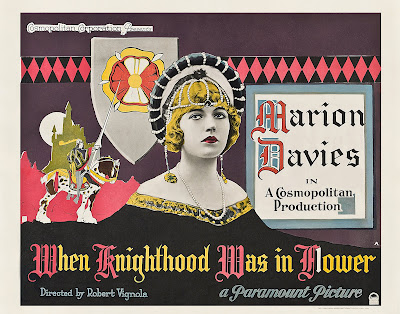
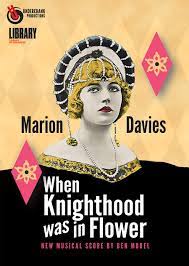
Promotional artwork for 'When Knighthood Was in Flower' (1922).

This afternoon's screening of 'When Knighthood in Flower' is the finale of a five-days-in-a-row series of screenings that saw me doing music for five films in venues across three states.

But what an ending! The Marion Davies costume epic, set during the reign of England's King Henry VIII, was produced on a grand scale. Released in 1922, it was the year's second-highest grossing film.

It's part of our ongoing series at the Town Hall Theatre in Wilton, N.H. celebrating the 100th anniversaries of motion pictures that came out that year. Lots more info in the press release I've pasted in below.

For now, let me report that last night's screening of 'The Last Command' (1928) in Brattleboro, Vt. resulted in some unexpected drama before the film could begin.

In late afternoon, a wall of heavy squalls moved across northern New England, laying down an unexpected coating of snow across the region. 

Brattleboro would normally be a 90-minute drive, so I left around 5 p.m. to arrive in time to set up for the screening, which was scheduled to start at 8 p.m. The snow had cleared out, so I figured that the timing had worked out well.

Well, it hadn't. The main highway (Route 101) across southern N.H. isn't far from my house, and almost immediately traffic on this busy road came to a complete stop. In a weird meteorological phenomenon, somehow the snow had adhered to the pavement, creating a coating of sheer ice that was impossible to drive on.

Seriously! Cars were off the road in both directions, and the rest of us were lined up and moving at a glacial pace, if at all. It took a half hour to just go a couple of miles. 

Stuck in this situation, with no real alternative routes that would be any better, I kept watching my arrival time slip further into the future.

I began pinging Jamie Mohr, who runs the Epsilon Spires venue where I would accompany 'The Last Command,' with updates, wondering if I would ever make it out there. (Jamie said she would get some Chinese food, which gave me confidence.)

My GPS indicated that conditions seemed normal for most of the route ahead, so I held out hope as I crawled along, trying not to slide off into the woods. After awhile, conditions did improve and traffic began to move at a more normal pace. 

Apparently the squalls had seen fit to sock just the area where I lived, as the rest of the ride to Brattleboro was uneventful. But the first five miles had taken 45 minutes, meaning I arrived with just enough time to set up things. 

And the next thing you know, I'm at the organ console, doing music for 'The Last Command,' aided by the digital synthesizer to produce drums and percussion where needed, plus a piano in a couple of key scenes. Oh—and also a brass school bell for when a bell is prominently rung in one scene.

The film, directed by Josef von Sternberg and starring Emil Jannings in an Academy Award-winning performance, drew the usual strong reaction—it's one of the truly great silent dramas, I think, produced when the form was at the peak of its eloquence. 

But this screening brought a new wrinkle: afterwards, people said it was a little unsettling to take in all the Russian military scenes as the present situation unfolds with Russia and Ukraine. I didn't see the parallel, but I could understand how it would be on people's minds.

Well, this afternoon's screening of 'When Knighthood Was in Flower' should provoke no such unease, as King Henry VIII has been off the throne for about 500 years.

I want to point out that the only reason we can show 'Knighthood' is because of the restoration recently released by Ben Model and Undercrank Productions. Ben and his colleagues did a terrific job.

Ben was recently in touch and shared a few notes about the effort that went into reissuing the film, which I had mistakenly called a transfer. I think it's worth including here, and I'll also mention it at this afternoon's screening:

"...the Undercrank edition is a restoration, and not a transfer. Stabilization and clean-up and grading was done on the nitrate scan. 

Also, the tints weren't added to look the way silents did – we reinstated the tinting and hand-coloring to exactly what was seen in theaters in 1922. There are tinting slugs at the heads and tails of several of the reels indicating "light pink", "amber", "light amber" and "blue tone/biscuit" (a combination of tinting and toning). 

We also found a review from Robert E. Sherwood that talks about the hand-coloring of the torches, and ads in the trades for the guy who did the hand-coloring; and so I got Jack Theakston to replicate this digitally, frame-by-frame.

So, you can tell your audience that they're seeing what people saw in the film's original release of the full-length road-show edition (the general release version was about 25 mins shorter). 

And, had Marion Davies not had a print struck of this in the mid-1930s, and then donated all her 35mm nitrate prints to the LoC in the 1950s, we would not be able to see this at all. :)

Who knew...Marion was also a film conservationist!

Thanks so much! Have a great show!

If you'd like more info about the restoration of 'Knighthood,' check out this post from Ben. 

Okay, hope your Sunday plans include a trip back to the splendors of medieval England via 'When Knighthood Was in Flower' starring Marion Davies. The show begins at 2 p.m. More info about the film in the press release below.

*   *   *

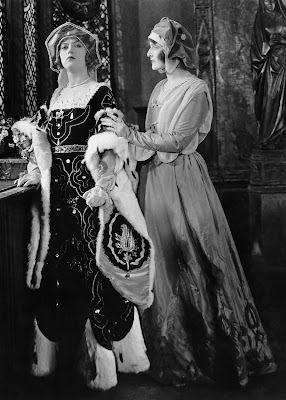
Marion Davies (left) in 'When Knighthood Was in Flower' (1922).

TUESDAY, FEB. 8, 2022 / FOR IMMEDIATE RELEASE
Contact Jeff Rapsis • (603) 236-9237 • jeffrapsis@gmail.com

Marion Davies costume epic 'When Knighthood Was in Flower' to screen at Wilton Town Hall Theatre

Set during the reign of Henry VIII, silent film blockbuster to be shown with live music on Sunday, Feb. 20 to celebrate 100th anniversary of release

WILTON, N.H.—It was a movie that transported audiences back to the reign of England's King Henry VIII, scoring an enormous box office success.

It was 'When Knighthood Was in Flower' (1922), a costume epic starring Marion Davies that became the year's second-highest-grossing film. 

See what all the royal fuss was about when the picture is shown with live music on Sunday, Feb. 20 at 2 p.m. at the Town Hall Theatre, 40 Main St., Wilton, N.H.

Admission is free, with a suggested donation of $10 per person to help support the theater's silent film series.

The classic Tudor-era drama will be shown with live music by silent film accompanist Jeff Rapsis.

In 'When Knighthood Was in Flower,' Marion Davies plays Mary Tudor, younger sister of England's King Henry VIII, who falls in love with a guardsman below her class.

Unfortunately, Mary is already betrothed to the aged King Louis XII of France. Her illicit romance thus touches off a furor with international complications.

Planned from the start as a big budget spectacle, 'When Knighthood Was in Flower' cost $1.8 million to produce, making it among the most expensive movies of the silent era.

The film was directed by Robert G. Vignola and based on a popular 1898 novel by Charles Major. 

A lobby card for 'When Knighthood Was in Flower.'

'When Knighthood Was in Flower' was produced by William Randolph Hearst (through his Cosmopolitan Productions) for Marion Davies and distributed by Paramount Pictures. 

Davies, longtime mistress of publishing magnate Hearst, would go on to become one of the most popular leading ladies of the silent era. 

For 'When Knighthood Was in Flower,' she spent four months learning to fence in order to convincingly perform her own on-screen swordfighting.

Although some exteriors were shot on location at England's Windsor Castle, most of the film was actually made in Connecticut and New York City, where Cosmopolitan was based at the time. 

Ziegfeld Follies designer Joseph Urban planned so many lavish sets, Hearst had to rent space at two other New York studios to complete the film and hire 3,000 extras for the crowd scenes. 
 
For Davies' 15 gowns, Urban's daughter, Gretl Urban Thurlow, duplicated outfits originally worn by Mary Tudor.

The edition of 'When Knighthood Was in Flower' that will be presented is a new digital restoration from Undercrank Productions/Library of Congress.

The screening is part of the Town Hall Theatre's ongoing series honoring the 100th anniversary of significant motion pictures that debuted in 1922.

Programs will include all of 1922's five highest-grossing titles, each shown on the big screen with live music, as well as century-old oddities, short films, cartoons, and more.

"Putting these films back on the big screen is a great way to celebrate the 100th anniversaries of some terrific motion pictures," said Rapsis, the silent film accompanist who will create live music for all screenings.

"These are films that set the standard for Hollywood, and still retain their power to entertain, especially when shown in a theater with live music and an audience," Rapsis said.

Upcoming programs in the Town Hall's 100th anniversary series include:

• Sunday, March 13, 2022 at 2 p.m.: Norma Talmadge in 'Smilin' Through' In honor of St. Patrick's Day, a 1922 romantic drama set in the Emerald Isle.

• Sunday, March 27, 2022 at 2 p.m.: Douglas Fairbanks in 'Robin Hood' Celebrate the 100th anniversary of this blockbuster adaptation. Massive sets, great action, and Doug Fairbanks in the lead made this the top grossing film of 1922!

• Sunday, April 3, 2022 at 2 p.m.: Chaney/Houdini Double Feature. In 'Flesh and Blood' (1922), escaped convict Lon Chaney hides out in Chinatown and plots revenge. In 'The Man From Beyond' (1922) illusionist Harry Houdini plays an Arctic adventurer frozen for 100 years!

• Sunday, April 17, 2022 at 2 p.m.: Emil Jannings in 'Othello' The Bard's immortal tragedy brought to the screen in this early German version. Silent Shakespeare in honor of the author's 458th birthday.

‘When Knighthood Was in Flower' (1922) will be shown live music on Sunday, Feb. 20 at 2 p.m. at the Town Hall Theatre, 40 Main St., Wilton, N.H.

Admission is free, with a suggested donation of $10 per person to help defray expenses. For more info, call (603) 654-3456 or visit www.wiltontownhalltheatre.com.

Tuesday, April 6, 2021

Meet the 'Man with the Million Dollar Smile' on Sunday, 4/11 at Town Hall Theater, Wilton, N.H.

Douglas MacLean works on that million dollar smile in 'One A Minute' (1921).

It's a great privilege to create music for the great classic silent comedies that audiences like to see again and again. 

But it's also fun to venture off and poke around the enormous quantity of lesser-known material that's out there in silent film land.

To go exploring!

And that's what we'll do on Sunday, April 11, when I accompany a double feature of comedies starring the "Man With The Million Dollar Smile," Mr. Douglas MacLean.

Wait—Douglas who?

Well, if you haven't heard of him, you're not alone. MacLean, a popular performer a century ago, is today no longer exactly on the tip of anyone's tongue.

Fame is fleeting.

But this weekend, for one afternoon at the Town Hall Theater, he'll be back on the big screen, thanks in large part to my silent film accompaniment colleague Ben Model and our friends at the Library of Congress.

The Library of Congress has several of MacLean's titles preserved via 35mm prints in their archives. (Now that's a use of my tax dollars worth supporting!) But preserving the prints doesn't mean showing them, and that's where Ben came in.

A few years ago, Ben launched a Kickstarter campaign to have two MacLean films scanned to digital media and, for the first time in 100 years, make them available to the viewing public. 

Douglas MacLean (left) in the romantic comedy 'Bell Boy 13.' 

The campaign was successful; as a result, two of MacLean's features, 'One a Minute' (1921) and 'Bell Boy 13' (1923), are featured on "The Douglas MacLean Collection," a DVD produced by Ben's Undercrank Productions label.

And so we're able to present a pair of Mr. MacLean's films they way they were made to be shown: in a theater, on the big screen, with live music, and—most importantly—with an audience.

And that's where you come in. (Besides through the lobby, that is.) 

I've actually done one of the films before: I accompanied 'Bell Boy 13' when a 16mm print of it was shown about 10 years ago at the Cinefest vintage film convention in Syracuse, N.Y.

I recall it got a strong reaction. So we may be in for a treat on Sunday. As I've learned from poking around the odd corners of silent film, just because a film is forgotten doesn't mean it's no good.

And if nothing else, the visual quality of 'One a Minute' is stunning. As I say in the press release (below), it looks like it was filmed yesterday.

So it's a great chance to see the kind of on-screen quality that audiences of the 1920s expected. They wouldn't have been satisfied with scratchy recopied prints. And neither should the cinema of that period be judged that way.

More info in the press release below. It went out a bit late (like just now), so please make an extra effort to join us for this one. Do it for Doug! Wherever he is now, let's give him a reason to show that Million Dollar Smile once again.

*   *   *

Douglas MacLean (left) stars in 'One A Minute' (1921).

TUESDAY, APRIL 6, 2021 / FOR IMMEDIATE RELEASE
Contact: Jeff Rapsis • (603) 236-9237 • jeffrapsis@gmail.com

Rediscover the 'Man with a Million Dollar Smile'

Forgotten silent film comic Douglas MacLean featured in rare screenings at Town Hall Theater on Sunday, April 11

WILTON, N.H.—His fans never heard his voice. But he still made them laugh throughout his 1920s heyday.

He was Douglas MacLean, a silent film comedian who charmed audiences with his "million dollar smile" a century ago, when the movies were a brand new form of entertainment.

MacLean, almost entirely forgotten today, returns to the silver screen with a rare showing of two of his most popular comedies, to be shown with live music on Sunday, April 11 at 2 p.m. at the Town Hall Theatre, 40 Main St., Wilton, N.H.

The screening is free to the public; a donation of $10 per person is suggested to support the Town Hall Theatre's silent film series.

The Town Hall Theatre continues to observe procedures to comply with all state and CDC public health guidelines. Capacity is limited to 50 percent; patrons are required to maintain social distance and wear masks until seated.

Live music will be provided by Jeff Rapsis, a New Hampshire-based silent film accompanist.

MacLean, originally a stage actor, entered films in 1914, playing small roles at first but gradually winning recognition and larger parts and becoming a popular contract player at the Thomas H. Ince studios.

Douglas MacLean (seated) in 'Bell Boy 13' (1923).

From 1922 to 1929, MacLean starred in 14 other features for Paramount and First National, all maintaining the standard light romantic comedy formula that continued to prove successful for him.

During his film career, MacLean was often billed as "The Man With the Million Dollar Smile." He frequently played energetic and industrious young men, very much like his contemporary Douglas Fairbanks Sr.

The Town Hall program features two of MacLean's most popular surviving films.

'One a Minute' (1921), a satire on the patent medicine business, finds drug store owner MacLean unexpectedly inventing a cure-all for virtually every malady known to man, with unexpected results.

In 'Bell Boy 13' (1923), MacLean plays a promising college graduate ready to marry over his rich uncle's objections, but forced to take a menial job in hotel after being disinherited.

Preserved by the Library of Congress, both films were recently made available for public viewing by silent film accompanist and historian Ben Model via Undercrank Productions.

MacLean retired from acting in 1929, at the end of the silent era. He later worked behind the scenes in Hollywood as a writer and producer, dying in 1967 at age 77.

"MacLean's films are rarely shown today, but this is a chance to see his work as it was meant to be seen: in a theater, with live music, and an audience," said accompanist Jeff Rapsis, who will improvise musical scores for both MacLean features.

" 'One a Minute' is particularly interesting because it shows what the consumer drug business was like a century ago, and also because the surviving print is in a remarkable state of preservation," Rapsis said. "It looks like it was filmed yesterday."

The goal of Sunday's rare screenings is to see if MacLean's work still holds up.

"You really can't tell how good a silent film is until you put it up on the screen with an audience," Rapsis said. "So in a sense, we'll all be collaborators in bringing MacLean's work back to life."

'One a Minute' (1921) and 'Bell Boy 13' (1923) starring Douglas MacLean will be screened with live music on Sunday, April 11 at 2 p.m. at the Town Hall Theatre, 40 Main St., Wilton, N.H. Free admission; a donation of $10 per person is suggested to support the Town Hall Theatre's silent film series.

For more information, visit www.wiltontownhalltheatre.com or call (603) 654-3456.

Monday, February 25, 2019

Ben and Ken and Marvin and Bob and Bill
and me and the Talking Heads, too:
Music at this year's Kansas Silent Film Festival

Ken and Ben: The Alloy Orchestra's Ken Winokur and silent film accompanist Ben Model embrace backstage at this year's Kansas Silent Film Festival.

This year's Kansas Silent Film Festival was highlighted by some great films, special guests, and also a personal milestone.

For me, the 2019 gathering marked 20 consecutive years of attending this event, which is held each February at Washburn University in Topeka, Kansas.

Twenty years? Other than being married, and breathing, I haven't done anything for 20 years. Heck, it's a run nearly as long as the silent film era itself.

More below. But about this year's festival..

Ben Model and festival music director Marvin Faulwell at the organ console at Washburn University's White Concert Hall.

It was a special privilege to hear and collaborate with fellow silent film musicians, including regulars Marvin Faulwell, Bob Keckeisen, and Bill Beningfield, and guests Ben Model and members of the Alloy Orchestra: Ken Winokur, Terry Donahue, and Roger Miller.

Highlights included the Alloy Orchestra's pounding accompaniment for 'Metropolis' (1927); Marvin and Bob's controlled and evocative score for 'The Daughter of the Dawn' (1920); and Ben Model doing his music for 'When Knighthood was in Flower' (1922), a film he reissued on DVD on his Undercrank label.

Ben also gave a slightly abbreviated edition of his talk on undercranking and film speeds in use during the silent era. Below is an underexposed photo of his uncranking talk, but I liked it because of how Ben's pose mirrors the action on screen.


Film speed is just one of many issues that can prove troublesome when presenting films from the silent era to modern audiences. It's hard for people to grasp that in early cinema, for many years there was no standard film speed, either for photographing action (called "taking speed") or projecting it in a theater.

But Ben's presentation shows this aspect of silent cinema was well-known by filmmakers, who would deliberately incorporate various taking speeds into what they did.

I remember reading about this practice in books such as Walter Kerr's 'The Silent Clowns.' But Ben has really gone into the archives and sussed out hard evidence of how extensive the practice was, how filmmakers made use of it, and what a difference it made.

Most amazing are statements from silent-era stars such as Milton Sills, who wrote in detail how an actor had to gauge his or her movements to allow for the way they would appear on screen, which was almost always at a slightly brisker pace than reality.

So film speed, and specifically undercranking, is one of the foundations of early filmmaking technique. Bravo to Ben for helping us all understand its impact!

As the festival's utility musician (I'm listed in the program as "staff pianist"), this time around I was asked to provide scores for five movies: three short films and two features.

All went well, generally. I was most pleased with an unusual film, 'Venus of the South Seas' (1924) starring Australian swimming champion Annette Kellerman in her only surviving film.

For this very lightweight drama, percussionist Bob Keckeisen and I collaborated on a score that tried to stay on the shimmery side, just like the sparkling water that appears throughout the film.

So I developed material that mirrored early minimalism that first started being heard in the 1970s. I was running through some of it in a practice room, and I'm told someone on the piano faculty wanted to know who was playing the Philip Glass music!

Not to get too technical, but this was very much a "sharped 4th" score: one in which all melodies are built on a scale in which the fourth note is the one between "fa" and "so". I guess you could say it's "fo."

But that one little note makes all the difference, as it lends a shimmering quality to any run of notes. So that's what I played with throughout the film, while Bob contributed sounds ranging from the sawing of a metal file to calls on an underwater horn.

It all fell together quite effectively, I thought, considering that Bob and I spoke about 'Venus of the South Seas' for all of about a half-hour the day before.


But it was enough to work in some good cues. Most impressive was a quick scene in London, which saw Bob ringing out the "Big Ben" chimes in C major. (A tribute to Ben Model, too!) It worked and sounded pretty good, I thought.

For any water or swimming scenes, I had a riff of repeated notes that I'd play for as long as it made sense to do so. Occasionally I'd vary the harmony, but mostly it was a nice steady tapping that fit the on-screen action and helped it move along.

So it was most satisfying when I landed on just the right moment near the end to start this up again and slowly build to a nice finish. And Bob K. caught this wave as well, hitting the suspended cymbal softly at first but then growing as I pushed the volume on my repeating chord.

And we both built to a nice level as 'The End' appeared on screen, and kept it there for what felt just the right amount of time before going out on one final bump up.

Wow! Few accompaniment experiences have been as satisfying as that!

So thanks to Bill Shaffer and everyone (too numerous to name, but you know who you are) who make this festival work.

And by work, I mean they work year-round, and thus make it easy for an out-of-towner like me to just show up on the big weekend and do my thing.

It's been enough to keep me coming back for 20 years, and was a big influence in getting me to start pursuing silent film accompaniment myself.

And after 20 years, I find myself thinking about the Talking Heads, one of the few pop music groups I know anything about.

"You may find yourself at the Kansas Silent Film Festival for the 20th year in a row. And you may yourself, how did I get here?"
How? It wasn't letting the days go by. It was getting placed on leave from a job teaching middle school English. (Yes, I washed out in my attempt to teach middle school kids.)

This led to a plan to write a book about silent film, and this led to the idea of going somewhere so I could recover the magic of this art form.

Recover? Yes! As a teenager, I had a passionate interest in the silent film era. But it faded due to a misguided attempt to behave and act like an adult. (Big mistake!)

In March 2000, I wanted to reconnect and see if anything was there. So I used this new thing called the Internet to see if any festivals were happening soon.

There was: something called the Kansas Silent Film Festival. And a pair of Delta Airlines 'Friends and Family' passes would get me there and back.

Next thing I knew, I was sitting in the White Concert Hall at Washburn University, with the Mont Alto orchestra doing live music to Keaton's 'The Cameraman' (1928).

The distinctive "bio-hazard" design of the White Concert Hall's carpeting, which last year I was told would be replaced. Returning this year, I was thrilled to see it still there.

I was reminded of what I loved about silent film. But as I watched that magical "dolly back" in 'The Cameraman' that reveals the monkey to be cranking the newsreel camera, I immediately sensed something was going on that would be a big part of my future.

(I had seen the picture before, but not since college. Seeing it again, I recall feeling excited at how much fresh creative energy Keaton was finding in the silent cinema even as it was ending. It was as if he was saying, "Look at what we can still do with this!")

It took awhile for me to figure out that silent film would lead not to a book, but to silent film accompaniment, would eventually become the main outlet for my creative energy.

But back at that first-for-me Kansas Silent Film Festival, I found more than just silent film. Visiting from the far-off East, I found myself welcomed by friendly people who by rights I never should have met. But I'm glad I did.

Next thing I knew, I was putting 16mm prints in the trunk of my rental car and getting directions to the afterglow at the old Holidome on Fairlawn Boulevard. And there we were, enjoying drinks and eating Doritos as Rodney Sauer of Mont Alto played ragtime on the lounge piano while a few bemused barflies looked on.

I came to that festival uncertain of what was next for me. Unexpectedly, I came away with a renewed sense that anything was still possible: that I could start a business (which I did), that I could find a creative outlet (I have), that I still had a lot to do and give and experience in this life.

So I returned the next year, and the year after, and every year since. Each time, I'm reminded of that same feeling I got the first time: that life continues to offer possibilities as rich as those shown by Keaton in 'The Cameraman.'

And so, at last night's 'Cinema Dinner,' when festival director Bill Shaffer asked if anyone had attended 20 years in a row, I thought to myself: "I'm ready for my close-up, Mr. Shaffer!"

But I didn't say anything. Instead, I just stood and took a bow.

Thanks to everyone at the Kansas Silent Film Festival for keeping it going all these years.

Only 52 weeks and five days until the next one. Next year's festival, already on the calendar, is Feb. 28-29.

So get ready to celebrate Leap Day in Topeka.

And the burning question is: will they program the Fatty Arbuckle feature 'Leap Year' (1920)?

Friday, October 6, 2017

Celebrating the Celebration: Thoughts on the
final Buster Keaton Celebration in Iola, Kansas

From the stage: attendees of the 24th and last-ever Buster Keaton Celebration in Iola, Kansas on Saturday, Sept. 30, 2017.

They still called it a "Celebration," same as always.

But it was also the end of a tradition. So something else was at work—something unspoken, and on the edges, but definitely present.

That was the mood, I felt, at the final Buster Keaton Celebration, a long-running annual gathering held each September in Iola, Kansas, not far from Buster's birthplace.

It's been my privilege to attend several past editions of this festival. And for this final year, it was a special honor to be invited to accompany some of the films being shown.

But after a quarter-century of celebrating the most silent of the great silent clowns, this was it—as it says at the finish of nearly every movie: "The End."

So here's my own idiosyncratic wrap-up of a special annual gathering that for years materialized Brigadoon-like on the prairie on the last weekend of each September, but will do so no more.

And let me say right at the start: this post runs on for a bit, but there's simply no way to mention or do justice to so many people who are part of this event. I apologize in advance for not highlighting everyone's contributions in an appropriate manner.

* * *

This year's program.

Why no more Keaton Celebration?

A long-running festival closes up shop for many reasons. But to sum up: things change.

In this case, I understand a key factor was the future unavailability of the Bowlus Center, a marvelous arts venue that you wouldn't expect to find in a town the size of Iola, pop. 5,704.

But the Bowlus has served as a terrific host for the Keaton Celebration since the very first one in 1993, according to an online history by co-founder Clyde Toland.

The history, by the way, captures the upbeat spirit that got the Celebration going, and saw it quickly mushroom into an annual gathering that brought hundreds of people to Iola.

That still happens. But I gather financial considerations have taken their toll behind the scenes, especially lately. One sign: after long being free and open to all, in recent year a registration fee has been charged for some of the programming.

It's not my place to draw any conclusions in this area, other than to observe that such events take a lot of resources to pull off. And, alas, we are not in an age of generous financial support for arts-related activities.

* * *

Even with the final curtain ready to fall, this year's Celebration was full of good cheer and fun right from the beginning.

I wasn't sure what to expect, as a big part of the attraction and charm of this event, in my eyes, is its reliable predictability. Once a year, no matter what else happens, it's great to see old friends, make new ones, and know we'll see each other again next year.

Curiously, that dynamic still seemed to be active, even without the promise of another actual Celebration. From the time I arrived, it was great to see everyone, and to make new friends such as well-known writers Scott Eyman and Lynn Kalber, with whom I had pizza the first night.

I arrived on Thursday, in time to take in a pre-Celebration screening that evening of 'Bender,' a film about the notorious family of serial killers in 1870s Kansas.

Shot on location in Kansas and shown at the Bowlus, the film featured actor James Karen in the lead role of John "Pa" Bender. (Celebration organizer Bill Shaffer also appeared as an extra!)

Karen, who as a young man worked with Keaton, is a long-time friend of the Celebration, frequently attending and sharing recollections and good cheer.

Alas, he's now 93, and couldn't be on hand this year.

But seeing him on screen, not in person, prompted thoughts of how few people are around now with any direct connection to Buster, who died in 1966.

That's more than a half-century ago. And that's another factor in the arc of this Celebration's life.

At the start, I don't think anyone imagined it would evolve into such a major deal, attracting fans and scholars from all around the country and, indeed, the globe.

But it grew to where actual Keaton friends and family members began attending, lending the gatherings a richness and closeness to Buster that was truly unique in its spirit and scope.

Now, time was inevitably fraying those threads.

Yes, this year's attendees included Keaton's granddaughter Melissa, her mother (and Keaton's daughter-in-law) Barbara Talmadge, and nephew Harry Keaton, all of whom generously shared recollection of Buster and the family.

But the ranks of the Buster's direct acquaintances are thinning, thus dimming a unique aspect of the Keaton Celebration. Increasingly, it was a reunion that people weren't able to attend.

Maybe this is how things work, I thought. New generations of fans need to find their own way to celebrate—but I'm getting ahead of myself.

* * *

On Friday morning, I had to work (the curse of remote access) and so wasn't able to join the annual pilgrimage to Buster's actual birthplace: in Piqua (pronounced "Pick-way"), a rural crossroads a few miles west of Iola on Route 54.

The house Buster where Buster made his first appearance (in 1895) is no longer standing. But the community boasts a Keaton museum, and each year it's been a tradition to open the Celebration with a visit and group picture.

I joined attendees back at the Bowlus for a thank you lunch organized by executive director Susan Raines and her staff. (No, thank you!)

In terms of programming, past Celebrations often paired Keaton with other film stars as a jumping off point: Chaplin or Fatty Arbuckle, and sometimes less obvious choices such as television pioneer Ernie Kovacs.

But this year's event, subtitled "Celebrating 100 Years of Laughter," was all Keaton. Programming was light on the on-stage forums and panels, and heavy on the movies.
Consider: four full-length features, a half-dozen shorts, and other material that needed live music. Hence the need for three accompanists: me, the accomplished Ben Model of New York, and local stalwart Marvin Faulwell of Kansas City, a regular at silent film events in this part of the country.

Three musicians: Ben Model, Marvin Faulwell, and me.

It's funny: some people seem to think there's some kind of rivalry among accompanists, but that's not my experience at all. Rather, we seem to go out of our way to support one another.

And I love events where more than one musician or group is on the program, as it provides a chance to hear how other people practice the craft and also to enjoy some film just like any other audience member. So for me, that was one of the best elements of the weekend: to hear music done by others live in a darkened theater.

Let me take a moment now to tip my metaphorical hat to the crew at the Bowlus, who could not have been more helpful to me and the other musicians.

When I arrived on Thursday, a beautifully maintained Henry F. Miller grand piano was already in position after being freshly tuned that day. (Nice, but won't last long with me banging away, I thought.)

And the tech crew were happy to let me in early to position the instrument, set up lights, position the lid, and run through some exercises to check volume levels and get a feel for the piano.

At the Celebration's Friday afternoon opening, I had drawn the first film: 'The Butcher Boy' (1917), a Fatty Arbuckle two-reeler in which Keaton makes his very first screen appearance.

So I was sitting at the keyboard during an opening video (done by Celebration organizer Keith Goering) welcoming everyone, and was surprised to find the recorded music used for it was an orchestral version of Chopin's well-known "Military Polonaise" for piano.

Weird! It's exactly the piece I happen to be working on right now, and which I had been running though earlier just for practice. What are the odds?

So I tried a few chords and the recording was in the same key, and the piano's tuning matched the orchestral pitch. So I was able to help kick things off with a little keyboard obbligato, playing along with the Chopin, which might have made me seem a much more competent musician than I really am. Well, a good start, anyway.

After welcoming remarks, we went right into 'The Butcher Boy,' which I tried not to butcher. With a slapstick short like this, I tend to treat the piano like the percussion instrument that it is.

For this film, as with the others, I used a couple of pre-planned themes to draw upon and improvise my way through the action.

Buster's first appearance and his "molasses" routine with Arbuckle get all the attention, and deservedly so. But I think the second half, in which both Fatty and Al St. John impersonate young girls, is the best stuff in the picture.

* * *

Stone Age Buster takes a bath in 'Three Ages.'

This was followed by 'Cops,' which Marvin accompanied on a digital keyboard he'd brought and which was hooked into the Bowlus sound system.

Marvin did an inspired job with this familiar classic, and his keyboard settings often reminded me of the sound of the Mont Alto Motion Picture Orchestra, for years a mainstay of the Keaton Celebration but not on the program this year.

I don't know if Marvin intended this as a tribute to the group, but it came off as an elegant one to me.

And there the program rocketed right along. And maybe that's one reason why the Celebration was as much fun as always: there simply wasn't time to ponder the end.

Soon Ben Model was at the keyboard, bringing to life the first feature of the weekend (and Keaton's first as well), 'Three Ages' (1923).

Ben doesn't often use recognizable tunes in his scoring, as it can be argued that they take the audience out of the movie. I tend to agree with him.

So when a Roman-era Keaton looks at his team of tired horses and imagines them in blankets labeled "Sparkplug," I was surprised, and very much delighted, when Ben launched into a spirited snippet of the old "Barney Google" novelty song.

I'm not sure how many people would make the connection of Barney Google and Sparkplug, his hapless steed, but it really served to underline the joke effectively and make it pop.

To me, it was great example of an accompanist knowing when to break his own self-imposed rules if the film and the circumstances of the joke, merited it. Nice!

Ben's 'Three Ages' music earned a well-deserved ovation.

But I thought he then topped it with improv music for a selection of rare Keaton clips that followed.

Provided by archivist Rob Arkus, the collection started with silent-era materials that Ben brought to life quite effectively.

It then transitioned into some later television-era clips. This part started with a sequence with an aging Keaton dancing the tango, and came with recorded sound, so Ben turned off the piano light.

But the sound didn't come. So after a few moments of silence, Ben clicked the light back on and started tango-ing it up.

And it worked really well—the audience, me included, roared at the sight of Keaton playing Valentino on the dance floor.

Before long, the screen went dark as the tech crew attempted to access a different file that did have the soundtrack. And during this time, Ben had to do what all accompanists are fated to do, I think: entertain the crowd during "Please Stand By" technical difficulties.

Prior to this weekend in Iola, the best example I'd ever witnessed of this was some years back at Cinefest in Syracuse (another festival now gone, alas), when accompanist Andrew E. Simpson filled in during a projection booth mishap by channeling his inner Chico Marx, pistol-shooting finger technique and all. (That's Chico, not Andrew, in the photo.)

Talk about knowing your audience—there's probably no better way to endear one's self to a room of classic film buffs!

But on Friday afternoon in Iola, Ben at least equaled that with ragtime that quickly evolved into a full-scale rendition of a tune some know as Gershwin's "Rialto Ripples," but which Keaton Celebration attendees immediately recognized as the Ernie Kovacs theme music.

True Keaton fanatics, such as those those filled the Bowlus, appreciated with Kovacs connection and Ben's ties to his wife Edie Adams, so well-deserved cheers rang out. Nice!

Funny thing was, when we got the tango-dancing Keaton with recorded sound, I found it not nearly as compelling as it was the first time around, with just acoustic music. And this wasn't because I'd already seen it—I genuinely sense it didn't work as well.

Well, maybe there's something to the idea that Keaton's way of performing was so grounded in the silent era technique, that there really was something different about synchronized sound that diluted his effectiveness.

So even what's regarded as "lesser" silent Keaton, such as 'Spite Marriage' (1929), is a different species (and perhaps on a different plane) than anything he did with synchronized sound, brilliant or otherwise. The silent medium just suited his comedy much better.

More on 'Spite Marriage' below, as it was shown later in the Celebration.

Dinner break found a big group of us crowding into El Charro, a Mexican place a few blocks up the street that's been a Keaton Celebration mainstay for many years.

And it's worth mentioning here the important role that lunch and dinner breaks played at the Keaton Celebration. Chance encounters at the hotel, also—these are where you got to meet and chat with people who were likely to become lifetime friends.

In Kurt Vonnegut's book 'Cat's Cradle' (1963), one of the tenets of a made-up religion is: "Peculiar traveling suggestions are dancing lessons from God." Well, in Iola, going out to eat with total strangers was the catalyst for discovering friends you didn't know you had.

And it was, as we all tried the limited venues that Iola had to accommodate visitors: the B & B Cafe for breakfast (way too much food for $6); the vintage A&W restaurant (what, is it 1963 again?); Rookie's Sports Bar (how many of you?); Dudley's Done-Right BBQ (again, way too much food), and so many other familiar gathering places.

I never thought life would get me to the point where I could made informed restaurant recommendations for Iola, Kansas. But if you're going through town, give me a call.

* * *

Original promotional art for 'The Cameraman.'

Back at the Bowlus, Friday night was my big time at bat: doing music for Keaton's feature 'The Cameraman' (1928).

This was a special assignment, I felt, for 'The Cameraman' was the film that got me back into silent film some years ago after a long absence.

How? Because in the last days of winter in the year 2000, I made my way out to the Kansas Silent Film Festival (held each year in Topeka), primarily to hear the Mont Alto Motion Picture Orchestra perform live.

And the first film they played for was Keaton's 'Cameraman.' And that Saturday morning, all at once it seemed to triggered infinity and reignite something that had been dormant within me.

What a film! Made right at the end of the silent era, to me it was proof that the medium was still ripe for creative approaches that filmmakers were only just beginning to realize. What a celebration of possibility and creativity and so much else!

And then the whole medium was gone. But what way to go out! And for me, Rodney Sauer and Mont Alto were a part of that.

So here I was at the Bowlus, 17 years later, preparing to do 'The Cameraman.' And this seemed odd to me, as the Mont Alto group were a Keaton Celebration mainstay until recent years, when (I guess) tight budgets and other factors prevented them from attending.

Well, off I went, and it all came together pretty well, I thought. It's hard to judge from the keyboard, but audience reaction was strong, and I felt the thematic material I was using made for some nice moments.

At the film's ending, response was generous. Photographer Steve Friedman tried to engineer a shot from the stage with people applauding (presumably) behind me, but after the film the lights never came up in the Bowlus, so it'll be interesting to see what Friedman's blinding flash captured.

* * *

Dorothy Sebastian and Buster in 'Spite Marriage.'

Saturday brought a full day of Keaton films and forums. But musically, my heavy lifting was done. Ben and Marvin would do the features ('College' in the morning for Marvin, and 'Spite Marriage' for Ben that night). All I had was afternoon improv for more rare Keaton materials, these contributed by archivist Paul Gierucki.

One surprise was to find that Ben wasn't too sure about 'Spite Marriage,' the Celebration's final Keaton feature. MGM released the film (Keaton's last silent) to theaters in 1929 with what's widely regarded as an annoying recorded score. So it's always had a reputation as "lesser" Keaton.

In my efforts to work through the entire Keaton output, I had programmed 'Spite' some years ago with a "let's get this over with" attitude. To my surprise, the film killed! The audience, not aware they were seeing "lesser" anything, laughed uproariously at one comic set piece after another. My respect for the film increased.

I related this to Ben, who seemed surprised. In his 30-plus years of doing film music, he'd never had a chance to accompany 'Spite Marriage,' and really wasn't sure how it would go over. Well, I hope I gave him at least some encouragement for that night's performance.

For me, the big deal of Saturday was the first-ever screening of 'To Be Funny' (2017), a new documentary exploring the phenomenon of Keaton's continued popularity 100 years after his 'Butcher Boy' walk-on.

Filmmakers Jess Roseboom and Gavin Rosenberg approached me several years ago about filming some of my New Hampshire performances and talking with audience members. So they came up, sat me down before a camera, and got me yakking.

They then pursued the project at Keaton screenings and gatherings all across the nation, including a visit to Iola. They also came back to New Hampshire to film me presenting a Keaton program to students of Great Brook Middle School in Antrim, N.H.

After a Kickstarter campaign and a lot of other work, they'd finished the film. And now it was time to enter it into festivals and do all the things you can do with a documentary of this type.

And as it turned out, the very first screening of the film would be here, at the very last Keaton Celebration at the Bowlus Center in Iola.

I thought it was kind of poetic, in a way, that this final event would host the premiere of a documentary highlighting Keaton's enduring—indeed, growing—popularity.

Because the filmmakers couldn't be there, they asked me to introduce it and say a few words.

Introducing 'To Be Funny' onstage at the Bowlus. Photo by Carol Yoho.

So I took the occasion to say it was an honor to present this film, as to me it showed that although the Keaton Celebration may be winding down, it was part of a larger continuity that would continue on, in part because of what had taken place in Iola.

Everything has a season, and we should all take heart that the love for Keaton which brought so many people to Iola and to each other would continue to do so far into the future.

Or something like that. And then I sat down to watch the film.

And you know, you couldn't have asked for a better venue or occasion to screen this film. It looked great on the big Bowlus screen—razor sharp with vibrant colors, making the lingering landscape shots appear just gorgeous.

And yes, everything in it seemed to validate all the energy and affection that had gone into staging the Keaton Celebration for lo these many years. It was a great summing up, with a hard spin to a hopeful future.

Of course it was a kick to see the scenes they shot in Iola—the annual trip to Piqua, the group photo, and also the Mont Alto group playing for 'Battling Butler' back at the Bowlus.

It was, frankly, mortifying to see my face 15 feet high on a screen and hear myself drone on. But they had questions, and I tried to answer them. I hope my appearance at least had the effect of making the other interviewees look smarter as a result.

But any bumbling on my part was more than made up for, I felt, by the moments of community and shared passion that the filmmakers captured around the nation. I never thought watching shots of people who themselves were watching movies would be so—well, moving.

But they were, and more than once I was honestly choked up by how it all came together for me—there, at the Bowlus, at the Keaton Celebration, immersed in an on-screen celebration of something that was so important to so many people all around me. What a great way to celebration the Celebration.

Wow!

* * *

Iola's huge town square, billed as "America's largest."

There was another meal after this (surprise!)—a wonderful impromptu gathering at Rookie's Sports Bar, on Iola's enormous town square. (Equal to four full blocks!)

What kind of people attend the Keaton Celebration? The kind of people who, when they find out it happens to be your 22nd wedding anniversary, insist on calling your wife back in New Hampshire to inform her that you're having a Chicago-style hotdog in honor of her hometown.

(For the record, she couldn't attend because she had to work, and we had already celebrated. Also, Iola's version of a "Chicago" hot dog, heavy on grilled peppers, was something I don't think you'd find in the Windy City. But it was good!)

Carol Yoho and I sample Porubsky's hot pickles fresh from the cardboard box. Photo by Jane Bartholomew.

These are the same people, by the way, who went all the way to Porubsky's Deli in Topeka (about two hours away) to bring me an order of their famous hot pickles, which I really enjoy. Thanks, Jane and Karl!

And then the final evening program featuring 'Spite Marriage' with Ben at the keyboard.

People roared at the movie. You could tell this rarely screened title was a discovery for many. What a great choice to end with!

The final final film was a curiously truncated version of 'A Funny Thing Happened on the Way to the Forum' (1966), which was Buster's last big-screen appearance.

The sprawling musical was edited down to 50 minutes (from 1½ hours) to highlight Buster's sporadic appearances as 'Erronius.'

But it worked, and we all laughed a lot.

And then the lights went up, and then back down, and we were then treated to another wonderful montage (again created by Keith Goering) of Keaton Celebration imagery, this time set to the old tune 'We'll Meet Again.'

Then it was off the afterglow and more food and drinks and laughter, as always.

And then I blinked, and suddenly it was Sunday morning. And it was over.

Very clever of those Keaton Celebration folks—to pack the schedule with so much good stuff that there wasn't time to give in to feelings of sadness that were lurking just at the edges of this year's events.

That potential sadness was the unspoken part. And how fitting, at this celebration honoring a silent film clown, for it to never get a chance to raise its voice at all.

Thanks to everyone who over the years made it possible for so many people to come to Iola, Kansas and share our appreciate for Buster and his world.

That world includes Iola, and in my mind it always will, Celebration or not.