Showing posts with label Judy Rosenberg. Show all posts

Saturday, March 22, 2014

Finishing out March with a comedy,
a drama, and then another comedy

See 'The Wind' (1928) on Thursday, March 27 at 7 p.m. at Keene State College in Keene, N.H.

March is supposed to go out like a lion, so maybe it's appropriate we're screening the great MGM silent drama 'The Wind' (1928) on Thursday, March 27 at 7 p.m. at Keene State College in Keene, N.H. (In addition to having a weather-related title, it begins with Leo, the MGM lion, in silent roar.)

This Lillian Gish classic will be bookended by screenings of two Harry Langdon films: 'The Strong Man' (1926) on Wednesday, March 26 at 7 p.m. at Merrimack College in North Andover, Mass., and then the rarely screened 'Long Pants' (1927) on Sunday, March 30 at 4:30 p.m. at the Wilton Town Hall Theatre in Wilton, N.H.

Right now, I'm in the post-tour let-down period following appearances in the past month at the Kansas Silent Film Festival in Topeka, Kansas and then Cinefest in Syracuse, N.Y. In recent years, these two back-to-back festivals have served as the annual climax of my accompaniment calendar. It's a lot of film to accompany, and now that's it's over, I kinda feel like smoking a cigarette.

Accompanist Rodney Sauer and I showed up at the Kansas Silent Film Festival in nearly identical performing garb, with me furthering the illusion with eyewear borrowed from festival director Bill Shaffer.

These festivals cut both ways. Because I get to hear other accompanists, see films that are new to me, and interact with a lot of people, they inspire me to want to improve my craft. But the stress of performing in unfamiliar places, and sometimes to films that I've never seen (five different features at Cinefest!), wears me out for a time.

The four accompanists at Cinefest 2014: me, Makia Matsumura, Judy Rosenberg, and Jon Mirsalis. Thanks for the photo, Makia!

The calendar beckons, however, with places to go and shows to do, and silent films to help bring to life for today's audiences. And so I soldier on, having already done music for 'The Lost World' (1925) this past Thursday at the Flying Monkey Moviehouse and Performance Center in Plymouth, N.H. And now these three upcoming shows to finish out the month.

(If you'd like more info on the Langdon films or 'The Wind,' check out the "Upcoming Screenings" page on this site. I haven't had time for press releases just yet.)

Coming out of this period, I feel the need to do fewer screenings, and work a bit more on material for screenings that I do commit to. Until now, I wanted to do as many shows as possible, if only so the feel of performing live would become second nature, and to get experience winging it if I had to.

Okay, so I'm not always relaxed and in control at the keyboard.

I think I've gotten where I want to in that area. Now the challenge, I believe, is to work at further forging my own personal musical language for silent film accompaniment, which has developed somewhat but has a long way to go.

The main way to do that, I sense, is by taking time to work up consciously new material even for films I've done many times before. Less winging it, more careful preparation prior to sitting down on the bench, even though I'll still be mostly improvising during the actual screening. 

In the coming months, I'd like to develop a suite of melodic material built on elements that I'm attracted to: the call of the sharped fourth or the flatted seventh is beckoning. And I'd like to get better at producing material on demand that reflects this language.

Plus I might acquire a real piano to replace the spinet I've been pounding for well nigh 40 years now. And the Korg synth and speakers are showing their age, too. We'll see about upgrading them as well.

Lots to do, but the main thing is—fewer gigs, and a little more time spent preparing for each. I'm really looking forward to it!

Tuesday, March 18, 2014

Some notes from Cinefest 2014;
and next up, 'The Lost World' (1925)

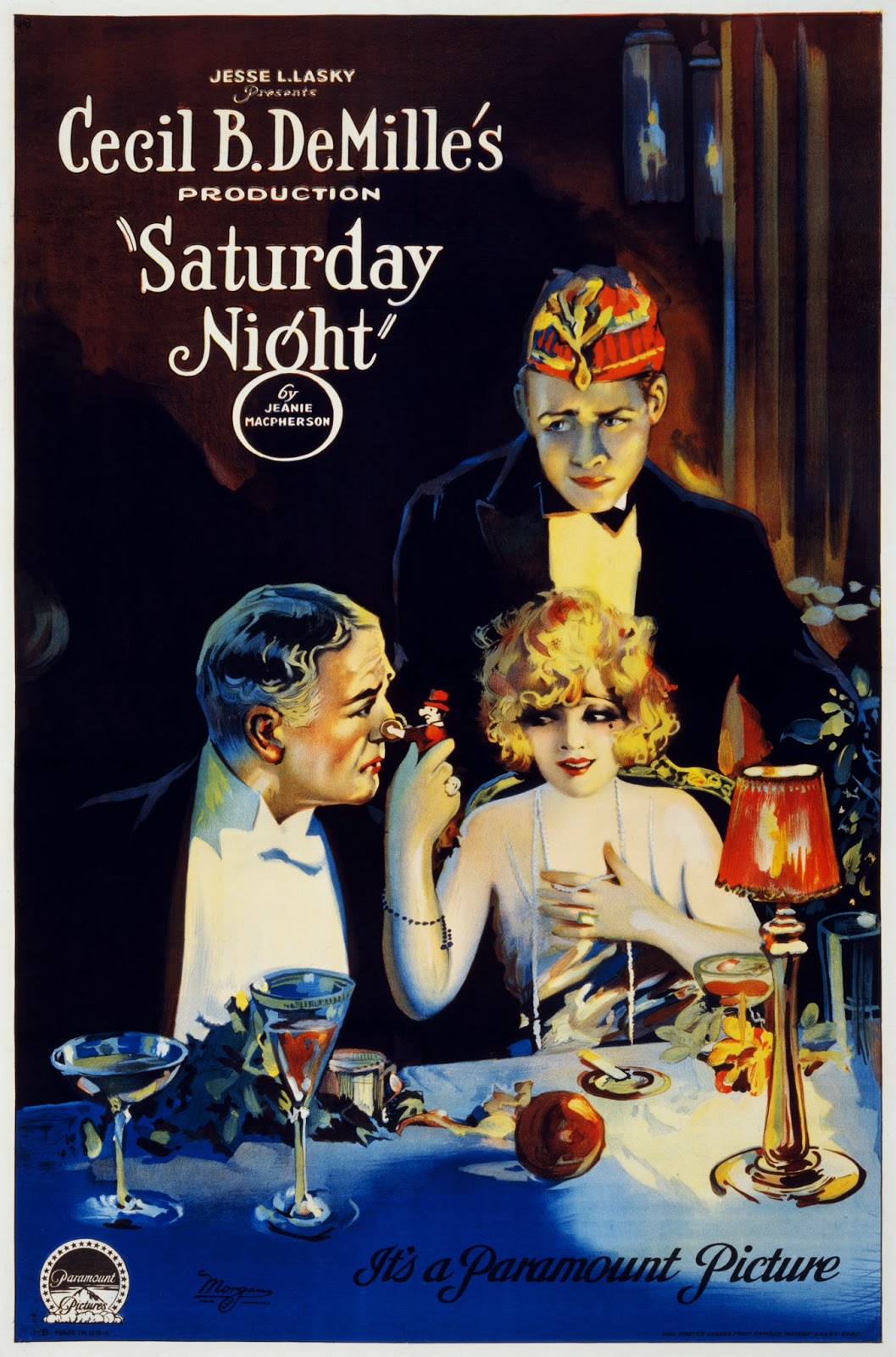
'Saturday Night' (1922), shown on Thursday morning, was the opening silent at this year's Cinefest.

I've just come back from Cinefest in Syracuse. And although I didn't fly, boy are my arms tired!

Well, not really, even though I accompanied six feature films in four days. I just couldn't resist the chance to give new life to humor from another era.

And that captures the spirit of Cinefest, I think: giving life (on screen, anyway) to older motion pictures that otherwise aren't screened anywhere. By "older," I mean features and short films from the silent and early talkie era, up until about World War II.

Some are surprisingly compelling. Others turn out to be real turkeys. But all get a chance to live again, shown as they were intended: on a big screen, with an attentive audience, and with live music for the silent films.

The more I think about it, the more important I realize such events are in terms of understanding the impact that early motion pictures had on the culture of their era. Much of their energy and excitement comes from the effect they produced on an audience, and the people who created them had this in mind all along.

They were never intended to be consumed in private or in solitude, either on a screen in someone's basement or, God help us, on a cell phone.

So the chance to see older pictures, good or bad, with an audience, can be a revelation in that a key element of their original power is restored. To see any motion picture from before World War II without an audience is like standing outside the Louvre Museum in Paris and saying you've experienced the Mona Lisa.

This year's Cinefest, which ran from Thursday, March 13 through Sunday, March 16, 2014, offered a wonderfully mixed grabbag of titles, including a group of a half-dozen Fox talkies from the early 1930s and a bigger-than-normal proportion of silent films.

In fact, the silent schedule was heavy enough for this year's Cinefest to have four accompanists on hand to supply music, rather than the usual three. And that was good news for me, because one of the big attractions of Cinefest is the chance to hear other accompanists ply the trade in live performance for a lot of different films.

This year, my colleagues were Makia Matusmura, a highly regarded New York-based accompanist whom I'd never had the chance to hear before; Judy Rosenberg, a wonderful accompanist from San Francisco whose recorded work I've long admired but whom I also hadn't heard in live performance; and the great Jon Mirsalis, also from the San Francisco area, whose style and approach I think makes him one of the most effective accompanists in the field.

All three turned in multiple memorable performances—in fact, there was so much music and so many movies, at this point I would be hard-pressed single out one moment over another. There was also a richness to the accompaniment in that everyone was able to adapt quite readily to all the different styles and genres of the many silents on the program.

Even accompanist Ben Model was on hand for his "undercranking" presentation, and sat in to play for many of the comedy short subject programs, so I got to hear him in action as well. Five accompanists in one spot must be some kind of record.

I always learn so much, I think, from hearing what other accompanists do and now they approach the task. It's one of the great pleasures of being part of Cinefest these past three years.

As for me, I had some good moments, but also some weak stretches. Compiling a log of what I did might help me tie together what I got out of the experience, so here goes. (Keep in mind that there's no chance to preview these films, so they're played "cold" by the accompanists.)

• Thursday, March 13: 'Saturday Night' (1922): The very first silent feature of this year's Cinefest was this Cecil B. DeMille society comedy/drama that went pretty well. I had good material to accompany the constrasting worlds of the upper and lower class characters, and the story flowed quite naturally, so the music stayed on target, I thought. The best thing about it was that you could see the comedy scenes coming from a mile away, so I was able to get music under them that was pretty effective, I thought. It wasn't hard to capture even small details, such as how the elevated train ran right outside a tenement flat.

• Thursday, March 13: 'Fanchon, the Cricket' (1915): This recently restored early Mary Pickford feature was another effort that held together well, I thought. Unusual in that it was set in a kind of medieval fantasy world, which I tried to match with a light "music box" style of accompaniment that seemed to do the trick.Kind of a weak film in that I found it hard to find much to be sympathetic about in Mary's character or situation, but I did my best to "cast a spell" and help put the film over.

Fannie Ward and Jack Dean in 'For the Defense' (1916)

• Friday, March 14: 'For the Defense' (1916): This early Paramount drama was perhaps my favorite of those I accompanied, in that it was totally unknown to me, but somehow I felt in synch with it right from the start. The material I chose seemed to fit well, I could follow the story with ease, and I paced it right so that the last 20 minutes of the film seemed to be very effective. No less a person than film preservation guru David Shepard said I did a good job "heightening the dramatic tension" of the film's climax. High praise indeed! It also won the award for the best intertitle of the festival: "I have to tell you ..... I murdered a man.... and I love you."

• Friday, March 14: 'Buck Privates' (1928): No, not the Abbott and Costello film, but a silent World War I army comedy about doughboys in Europe. I tried to keep it light, which was the right approach, but somehow the material I had didn't seem to help the film jell. (The fact that the film started just before midnight might have been a factor.) However, a frantic chase finale came as a nice surprise, allowing me to kick the material I'd been using into high velocity mode. Too bad so few attendees were on hand for it! But this served as a great example to me of how comedy is harder to do effectively. A chance to see this beforehand would have really helped with the pacing, as the humor was not as easily discerned on sight as in, say, 'Saturday Night.'

• Saturday, March 15: 'The Live Wire' (1925): This Johnny Hines comedy should have been a highlight of the festival, but it produced only sparse reaction, I think in part because the material I chose just wasn't a great fit for the film, and also I couldn't seem to get in synch with the film's spirit. Because of this, I began pushing tempos too soon, further confusing things and leaving me with nowhere to go when the climax finally did play out. Leonard Maltin, sitting right behind me for the screening, commented afterwards that I had "set quite a pace for myself" on that one. Definitely my weakest entry, I felt, and not helped by two cups of wine I had earlier in the evening. :)

• Sunday, March 16: 'The Devil Horse' (1926): I considered this action-packed Western drama starring Rex the Wonder Horse my grand finale, and so got permission to hook up the digital synthesizer and speakers to go all out. Everyone seemed really impressed, if only because the palette of the full orchestra (including big percussion, appropriate for a horse opera full of scenes of "injuns" on the warpath) was undoubtedly a constrast to the piano texture that is otherwise the soundtrack for silents at Cinefest. However, like 'The Live Wire,' I felt out of synch with this one as well, and found myself playing too much too soon. All went okay, however, despite a blown projection bulb during the climactic battle to save the fort. I pushed forward in the darkness, playing underscoring that vamped us until the movie started up again—now tinted pink because the new bulb hadn't warmed up yet!

What did I learn? Take your time. Resist the temptation to overplay. And don't drink wine prior to accompanying. A continuous line of melody can be better than abrupt transitions. Matching the right material is important, so don't be afraid to abandon music that's not working and go with something else. Avoid AUI, or Accompanying Under the Influence. 

Cinefest follows a pattern of inviting accompanists for a three-year commitment on a rotating basis. And because this was my third year, 'The Devil Horse' really was the grand finale of my involvement for now, at least as an accompanist. It's been a great experience, as I've learned a lot and made contacts that will help me continue to pursue this unusual craft.

So I want to thank everyone associated with this grand affair for the chance to contribute music and get to know some wonderful people. Thanks especially to Joe Yranski for first inviting me as an accompanist, and to organizers Rick Scheckman and Gerry Orlando for all they do it getting the films programmed and the festival planned, and also to the projection and house crew in the theater who make it easy to concentrate on the music alone—something that's quite a luxury for me. :)

And now...looking ahead! A screening of 'The Lost World' (1925) will take place on Thursday, March 20 at 6:30 p.m. at the Flying Monkey Moviehouse and Performance Center in Plymouth, N.H. Tickets are $10 and hoping for a good crowd to be on hand for this grandpappy of all dinosaur movies.

I've been so busy that I haven't had a chance to get out a press release on this one, which is a shame, because I think it has a natural audience, given the enduring popularity of our prehistoric friends. Still, hope to see you there!

Monday, March 10, 2014

We raised $3,000 for the Town Hall Theatre;
Now, on to Cinefest in Syracuse, N.Y.

The Wilton Town Hall Theatre occupies the second floor of the old town hall in downtown Wilton, N.H.

I'm pleased to report that yesterday's screening of 'Wings' (1927) at the Wilton (N.H.) Town Hall Theatre raised more than $3,000 towards the facility's conversion to digital for first-run movies.

I want to thank the generosity of silent film fans who turned out for this $20-per-ticket event, many of whom made additional donations to the theater yesterday.

The Wilton Town Hall Theatre is one of the great things about living in our part of the world. It's also where I got my start accompanying silent films live in front of an audience, and I still consider it my "home base" with the monthly screenings I continue to do there.

So I was really pleased to see such a great response to this fund-raiser. Many familiar faces, and some new folks as well, and a lot of kind comments after the show.

Ironically, we showed 'Wings' in the same theater where '12 Years a Slave' is currently playing. So on Sunday, movie-goers in Wilton had a choice between the very first and the most recent Best Picture. That can't happen very often.

The screening of 'Wings' also served as a kind of "final exam" prior to heading off to Syracuse, N.Y. later this week for Cinefest, a four-day annual gathering of vintage film buffs. As part of the festivities, silent and early sound movies are screened pretty much continuously each day from 9 a.m. until after midnight. (No, they're not totally crazy. On Sunday, they stop about 6 p.m.)

That's so much film that they actually bring in no less than three accompanists to handle the music. Pianists are generally given a three-year stint, and this time marks my third (and final) year in the rotation.


I love going there, but I'll be honest: for me, it's a fairly challenging event because I'm playing alongside the likes of Phil Carli, Jon Mirsalis, Andrew Simpson, and other terrific accompanists with long-established national reputations.

This year, my co-conspirators at the keyboard are Makia Matusmura and Judy Rosenberg, both fantastic accompanists that I'm looking forward to meeting and hearing. And I understsand Ben Model and Jon Mirsalis will be coming in for some things as well, too.

Each time I go, I'm thrilled (and amazed) to hear what these other accompanists can do. I'm also forced to consider my own way of accompanying, which is good, because it inspires me to continue to try to improve my craft. So that means everything from Hanon technical exercises (the classic piano player's finger-training exercises) to working through chord progressions that I can file away for future use, and also making a concious effort to make full use of all 88 keys. (Sometimes I seem to forget about the upper third of a piano keyboard.)

Another challenge is mastering the considerable difference between an acoustic piano (such as that used at Cinefest) and the Korg digital synthesizer I often use in my own shows. Though the keyboard itself might look the same, each requires a whole different style of playing.

Well, I do work at it, but there's only so far that work (and any natural talent) can get you. And in recent months, I've become increasingly comfortable with a sense that my own strength as an accompanist lies not in flying all over the keyboard, but with keeping things small and in control, and using that to maximize an audience's experience of the film. Use the tools you have.

I may never be Vladimir Horowitz, but I do have a definite sense of drama and a good feel of how music can augment many different types of cinematic story-telling. (Comedy, yes, is still the toughest to pull off effectively.) I may not have the ability to rattle off, say, a Chopin polonaise at will. But I'm not likely to go off on a showy tangent when accompanying a film. All I seem to be able to do is organic film music that's not intended to be anything else.

And Phil Carli himself, one of the most impressive keyboard players I've ever witnessed, has said that one of the cardinal sins of accompaniment is "overplaying," or trying to play beyond one's ability. It's a tendency I notice in myself, because I do get carried away by a film, and also with trying to do what other accompanists sometimes do. It's a basic human motivation: peer pressure. Hey, I want to be like them!

And this feeds a cycle where I tend to push too hard too soon, which sometimes can lead to overplaying, which is when things are most likely to fall apart. Worse, it give me nowhere to go when a film really demands it. This has happened several times at past Cinefests, where the audience of vintage film specialists tends to fuel my desire to make a big impression. I really want this film to work, dammit! With me, that often results in less-than-optimal accompaniment.

I've had some good moments at Cinefest, too. But they seem to happen mostly when I'm able to keep the music from spinning out of control and stay within my range. Strangely, it seems that the longer I can maintain this control during a picture, the more my confidence grows, and so I actually am able to make the most of the big moments when they come. That's exactly what happened last year with 'The Foundling' (1915), a Mary Pickford feature I played for.

I'm now running the risk of overthinking all this, so I'll stop here. Let's just say it's a delicate balance, but I'm starting to understand the contours of how that balance works and how best to manage it so that a film gets the best score I can give it.

So this Cinefest, I'm going to make a deliberate effort to just be myself and do what I do best: start slow, don't be afraid to keep things simple, and work hard to rein in things so that big moments have a chance at feeling authentically big. This will require actual courage on my part, as the temptation to "go big" is huge. But more than ever I understand how important it is for me to do the best I can in my own style.

And after Cinefest, the schedule lightens up a bit, which is good. That's because I would like to take time to push my scoring technique in directions that, yes, build on my strengths and continue to improve my technique, as much as possible. I get a sense that I'm maybe about a third of the way to the point where I have my own authentic vocabulary for scoring silent films. So there's still a lot of work to do.

In the past few years, I've booked a great number of screenings with the idea that what I needed most was experience in front of a live audience. That's been helpful, but I now find I'm often drawing upon the same bank of material rather than creating new stuff, which is where the musical vocabulary truly gets forged. I need to spend more time in the lab, so to speak.

So I'm moving into a phase where I hope to prepare more new material for screenings and see how I can push things in that direction. Though it's always exciting to accompany a film live, doing 'Steamboat Bill Jr.' (1928) yet again using the same tunes I've been using for years is beginning to wear a little thin.

Something new seems called for. Stay tuned.