Monday, October 23, 2023

Pre-Halloween parade continues with Lon Chaney starring in 'Hunchback of Notre Dame' on Wednesday, Oct. 25 at Rex Theatre in Manchester, N.H.

A poster for the 1923 release of 'Hunchback of Notre Dame.'

Up next: a 100th anniversary screening of 'The Hunchback of Notre Dame' (1923) on Wednesday, Oct. 25 at the Rex Theatre in Manchester, N.H.

As of this morning, the venue has sold 69 tickets, so should be a good crowd on hand—always a good thing for a silent film program!

Below is a press release with all the details. Come join us for this classic big screen adaptation of Victor Hugo's sprawling novel set in medieval Paris. 

*    *    *

The classic image: Lon Chaney as the Hunchback being comforted after his undeserved public flogging.

WEDNESDAY, OCT. 18, 2023 / FOR IMMEDIATE RELEASE
Contact Jeff Rapsis • (603) 236-9237 • jeffrapsis@gmail.com

Chaney as Quasimodo in 'Hunchback of Notre Dame' on Wednesday, Oct. 25 in Manchester, N.H.

Celebrate 100th anniversary of classic silent version with pre-Halloween screening at Rex Theatre; featuring live music by Jeff Rapsis

MANCHESTER, N.H.—It was a spectacular combination: Lon Chaney, the actor known as the "Man of 1,000 Faces," and Universal's big screen adaptation of Victor Hugo's sprawling tale of the tortured Quasimodo.

The result was the classic silent film version of 'The Hunchback of Notre Dame' (1923), to be shown with live music on Wednesday, Oct. 25 at 7 p.m. at the Rex Theatre, 23 Amherst St., Manchester, N.H.

General admission is $10 per person; tickets are available at the door or online at www.palacetheatre.org.

Live music for the movie will be provided by silent film accompanist Jeff Rapsis.

"We felt that with the upcoming reopening of Notre Dame Cathedral in 2024, audiences would appreciate a chance to see this film, which takes place throughout the iconic structure," Rapsis said.

The famous cathedral, a symbol of Paris and France, was severely damaged by fire in 2019.

The film is based on Victor Hugo's 1831 novel, and is notable for the grand sets that recall 15th century Paris as well as for Chaney's performance and make-up as the tortured hunchback Quasimodo.

The film elevated Chaney, already a well-known character actor, to full star status in Hollywood, and also helped set a standard for many later horror films, including Chaney's 'The Phantom of the Opera' in 1925.

While Quasimodo is but one of many interconnecting characters in the original Hugo novel, he dominates the narrative of this expensive Universal production.

Lon Chaney and Patsy Ruth Miller in 'The Hunchback of Notre Dame' (1923).

In the story, Jehan (Brandon Hurst), the evil brother of the archdeacon, lusts after a Gypsy named Esmeralda (Patsy Ruth Miller) and commands the hunchback Quasimodo (Chaney) to capture her.

Military captain Phoebus (Norman Kerry) also loves Esmeralda and rescues her, but the Gypsy is not unsympathetic to Quasimodo's condition, and an unlikely bond forms between them.

After vengeful Jehan frames Esmeralda for the attempted murder of Phoebus, Quasimodo's feelings are put to the test in a spectacular climax set in and around the Cathedral of Notre Dame.

As the hunchbacked bellringer Quasimodo, Chaney adorned himself with a special device that made his cheeks jut out grotesquely; a contact lens that blanked out one of his eyes; and, most painfully, a huge rubber hump covered with coarse animal fur and weighing anywhere from 30 to 50 pounds.

Chaney deeply identified with Quasimodo, the deformed bell-ringer at Notre Dame Cathedral who was deafened by his work. Chaney was raised by deaf parents and did a lot of his communication through pantomime.

“The idea of doing the picture was an old one of mine and I had studied Quasimodo until I knew him like a brother, knew every ghoulish impulse of his heart and all the inarticulate miseries of his soul,” Chaney told an interviewer with Movie Weekly magazine in 1923.

“Quasimodo and I lived together—we became one. At least so it has since seemed to me. When I played him, I forgot my own identity completely and for the time being lived and suffered with the Hunchback of Notre Dame.”

The film was a major box office hit for Universal Studios, and Chaney's performance continues to win accolades.

"An awe-inspiring achievement, featuring magnificent sets (built on the Universal backlot), the proverbial cast of thousands (the crowd scenes are mesmerizing) and an opportunity to catch Lon Chaney at his most commanding," wrote critic Matt Brunson of Creative Loafing in 2014.

Screening this classic version of 'Hunchback' provides local audiences the opportunity to experience silent film as it was intended to be shown: on the big screen, in restored prints, with live music, and with an audience.

"If you can put pieces of the experience back together again, it's surprising how these films snap back to life," said Rapsis, a New Hampshire-based silent film accompanist who creates music for silent film screenings at venues around the country.

"By showing the films as they were intended, you can really get a sense of why people first fell in love with the movies."

In creating music for silent films, Rapsis performs on a digital synthesizer that reproduces the texture of the full orchestra and creates a traditional "movie score" sound.

'The Hunchback of Notre Dame' (1923) starring Lon Chaney, will be screened with live music on Wednesday, Oct. 25 at 7 p.m. at the Rex Theatre, 23 Amherst St., Manchester, N.H.

General admission is $10 per person; tickets are available at the door or online at www.palacetheatre.org.

Thursday, October 19, 2023

Pre-Halloween spookfest: 'Nosferatu' on Sunday, Oct. 22 at Town Hall Theatre, Wilton, N.H.

Just one word today:

Nosferatu!

We're screening it on Sunday, Oct. 22 at 2 p.m. at the Town Hall Theatre in Wilton N.H.

More details in the press release below.

And remember—in silent film, no one can hear you scream!

*   *   *

A modern poster for 'Nosferatu' (1922).

WEDNESDAY, OCT. 18, 2023 / FOR IMMEDIATE RELEASE
Contact Jeff Rapsis • (603) 236-9237 • jeffrapsis@gmail.com

Creepy classic thriller 'Nosferatu' to screen at Town Hall Theatre on Sunday, Oct. 22

Prepare for Halloween with silent horror movie and live music—see it if you dare!

WILTON, N.H.— Get into the Halloween spirit with a classic silent film thriller.

'Nosferatu' (1922), the first screen adaptation of Bram Stoker's novel 'Dracula,' will be shown with live music on Sunday, Oct. 22 at 2 p.m. at the Town Hall Theatre, 40 Main St., Wilton, N.H.

Admission is free; donations are accepted, with $10 per person suggested to defray expenses.

The screening will feature live musical accompaniment by Jeff Rapsis, a New Hampshire-based silent film musician.

'Nosferatu' (1922), directed by German filmmaker F.W. Murnau, remains a landmark of the cinematic horror genre. It was among the first movies to use visual design to convey unease and terror.

To modern viewers, the passage of time has made 'Nosferatu' seem even more strange and otherworldly.

It's an atmosphere that silent film accompanist Jeff Rapsis will enhance by improvising live music on the spot for the screening.

"The original 'Nosferatu' is a film that seems to get creepier as more time goes by," said Rapsis, a resident of Bedford, N.H. who accompanies silent film screenings at venues across the nation.

"It's a great way to celebrate Halloween and the power of silent film to transport audiences to strange and unusual places," Rapsis said.

In 'Nosferatu,' actor Max Schreck portrays the title character, a mysterious count from Transylvania who travels to the German city of Bremen to take up residence.

In the town, a rise in deaths from the plague is attributed to the count's arrival. Only when a young woman reads "The Book of Vampires" does it become clear how to rid the town of this frightening menace.

Director Murnau told the story with strange camera angles, weird lighting, and special effects that include sequences deliberately speeded up.

Although 'Nosferatu' is suitable for all family members, the overall program may be too intense for very young children to enjoy.

From 'Nosferatu' (1922): a shadowy character.

Modern critics say the original 'Nosferatu' still packs a powerful cinematic punch.

“Early film version of Dracula is brilliantly eerie, full of imaginative touches that none of the later films quite recaptured,” Leonard Maltin wrote recently.

Critic Dave Kehr of the Chicago Reader called 'Nosferatu' "...a masterpiece of German silent cinema and easily the most effective version of Dracula on record.”

Despite the status of 'Nosferatu' as a landmark of early cinema, another scary aspect of the film is that it was almost lost forever.

The film, shot in 1921 and released in 1922, was an unauthorized adaptation of Stoker's novel, with names and other details changed because the studio could not obtain rights to the novel.

Thus "vampire" became "Nosferatu" and "Count Dracula" became "Count Orlok." After the film was released, Stoker's widow filed a copyright infringement lawsuit and won; all known prints and negatives were destroyed under the terms of settlement.

However, intact copies of the film would surface later, allowing 'Nosferatu' to be restored and screened today as audiences originally saw it. The image of actor Max Schreck as the vampire has become so well known that it appeared in a recent 'Sponge Bob Squarepants' episode.

Out of the box: A scene from 'Nosferatu' (1922).

In screening silent films at the Town Hall Theater, organizers aim to show early cinema as it was meant to be seen—in restored prints, on a large screen, with live music, and with an audience.

"All those elements are important parts of the silent film experience," said Rapsis, who will accompany the film. "Recreate those conditions, and classics of early cinema such as 'Nosferatu' leap back to life in ways that audiences still find entertaining."

Rapsis performs on a digital synthesizer that reproduces the texture of the full orchestra, creating a traditional "movie score" sound. He improvises the complete score in real time during the screening.

"Creating a movie score on the fly is kind of a high-wire act, but it can often make for more excitement than if everything is planned out in advance," Rapsis said.

The classic early horror thriller ‘Nosferatu’ will be shown with live music on Sunday, Oct. 22 at 2 p.m. at the Town Hall Theatre, 40 Main St., Wilton, N.H.

Admission is free; donations are accepted, with $10 per person suggested to defray expenses. For more information, call the theater at (603) 654-3456.


Wednesday, October 18, 2023

Tonight: A double dose of Lon Chaney in 'The Unknown' and 'Zanzibar' in Plymouth, N.H.

Joan Crawford consoles an armless Lon Chaney in 'The Unknown' (1927).

Examples of perfect pairings:

• Wine and cheese. 

• Chocolate and peanut better. 

• 'The Unknown' (1927) and 'West of Zanzibar' (1928). 

Yes, two Tod Browning-directed thrillers that go together are films in which Lon Chaney is armless in one, and cannot use his legs in the other.

Wow! And that's what you'll get tonight at 6:30 p.m. in Plymouth, N.H. at our "Halloween Creepfest" double feature silent film program at the Flying Monkey Moviehouse. 

I'm especially excited because it's the first time I'll do music for the newly restored (and much longer) edition that was recently completed.

For years, I've play the only circulating version of 'The Unknown'—a slightly truncated version that runs less than 50 minutes. 

It's always been effective and enjoyable, but clearly some things were missing. Among other clues: MGM would never have released a feature film at that length. 

But a recent effort to scour archives for prints of 'The Unknown' uncovered enough "new" footage to boost the film's length up to 66 minutes. 

So that's a lot of unknown 'Unknown.' We'll see what it adds tonight at the Flying Monkey. (Somehow, I think director Browning would have appreciated a theater named 'The Flying Monkey.')\

Hope to see you there. More details in the press release below:

*    *    *

An original poster for 'West of Zanzibar' (1928), a thriller starring Lon Chaney.

MONDAY, OCT. 9, 2023 / FOR IMMEDIATE RELEASE
Contact Jeff Rapsis • (603) 236-9237 • jeffrapsis@gmail.com

Lon Chaney Halloween 'Creepfest' double feature at Flying Monkey on Wednesday, Oct. 18

Among Chaney's most challenging roles: In 'The Unknown,' he's without arms; in 'West of Zanzibar,' he's paralyzed from the waist down

PLYMOUTH, N.H.—Get into the Halloween spirit with classic silent horror films starring legendary actor Lon Chaney.

Two movies starring Chaney, 'The Unknown' (1927) and 'West of Zanzibar' (1928), combine for a creepy double feature on Wednesday, Oct. 18 at 6:30 p.m. at the Flying Monkey Moviehouse and Performance Center, 39 South Main St., Plymouth, N.H.

The program will feature live accompaniment by silent film musician Jeff Rapsis.

Admission is $10 per person.

'The Unknown' (1927) features Chaney as "Alonzo the Armless," a circus knife-thrower with a dark past who uses his feet to perform his act. The film co-stars a very young Joan Crawford.

In 'West of Zanzibar' (1929), Chaney plays a vaudeville magician who seeks revenge after becoming paralyzed from the waist down. The film co-stars Lionel Barrymore.

Both films were produced by MGM and directed by Tod Browning, who specialized in exploring the dark and creepy side of circus life. Browning's career later culminated with his bizarre early talkie film 'Freaks' (1932), starring a cast of deformed carnival performers.

Lon Chaney is today regarded as one of the most versatile and powerful actors of early cinema, renowned for his characterizations of tortured, often grotesque and afflicted characters, and his groundbreaking artistry with makeup.

Chaney remains famous for his starring roles in such silent horror films as 'The Hunchback of Notre Dame' (1923) and 'The Phantom of the Opera' (1925). His ability to transform himself using makeup techniques he developed earned him the nickname "The Man of a Thousand Faces."

But Chaney starred in dozens of other films throughout the silent era, many of them aimed at the growing appetite among movie audiences for the strange, macabre, or downright weird.

In 'The Unknown,' Chaney's character "Alonzo the Armless" is indeed without both arms. This forces him to use his feet to perform tasks that range from throwing knives in his circus act to smoking a cigarette. In one scene, Chaney uses his feet to strum a guitar.

Lon Chaney and Lionel Barrymore in 'West of Zanzibar' (1928).

'West of Zanzibar' requires Chaney to play his role without using his legs. When not using a wheelchair, he uses his hands and arms to crawl across floors.

To modern viewers, the passage of time has made these unusual films seem even more strange and otherworldly.

It's an atmosphere that silent film accompanist Jeff Rapsis will try to enhance by improvising live music on the spot for the screenings.

"Many of the Lon Chaney features seem to get creepier as more time goes by," said Rapsis, who is based in New Hampshire and ranks as one of the nation's leading silent film accompanists. "Today, they're a great way to celebrate Halloween and the power of silent film to transport audiences to strange and unusual places."

Both films are suitable for all family members, but the overall program may be too much for very young children to enjoy.

Modern critics say 'The Unknown' still packs a powerful cinematic punch.

The film "...revels in the seedy circus life, and creates some incredible set pieces, from Chaney's knife-throwing act to a sinister, cavernous doctor's lab,” wrote Jeffrey M. Anderson of Combustible Celluloid.

All movies in the Flying Monkey's silent film series were popular when first seen by audiences in the 1920s, but are rarely screened today in a way that allows them to be seen at their best. They were not made to be shown in the home. To revive them, organizers aim to show the films as they were intended—in top quality restored prints, on a large screen, with live music, and before a live audience.

"If you can put it all together again, these films still contain tremendous excitement," Rapsis said. "By staging these screenings of features from Hollywood's early days, you can see why people first fell in love with the movies."

'The Unknown’ (1927) and 'West of Zanzibar' (1928) will be shown on Wednesday, Oct. 18 at 6:30 p.m. at the Flying Monkey Moviehouse and Performance Center, 39 Main St., Plymouth, N.H.

General admission tickets are $10 at door or in advance by calling the box office at (603) 536-2551 or online at www.flyingmonkeynh.com.

Monday, October 16, 2023

Make a date with the 'Phantom': tonight at the Coolidge Corner Theatre in Brookline, Mass.

An original poster for 'The Phantom of the Opera' (1925).

Doing music for 'Phantom of the Opera' (1925) tonight at the Coolidge Corner Theatre in Brookline, Mass. will be a bit of a homecoming for me, as it's the first silent film I tried accompanying in front of an audience.

Tonight's screening, by the way, starts at 7 p.m. at the Coolidge, a marvelous neighborhood theater at 290 Harvard St. in Brookline, Mass., close to the Green Line, with its trolleys clanging up and down Beacon Street.

Lots more details about the screening in the press release below.

My first 'Phantom' came about in the summer of 2006, when I noticed the schedule of a large theater in Manchester, N.H. was dark on Halloween Day that year. 

I suggested something like a screening of the classic Lon Chaney version of 'Phantom,' with me possibly putting together a score for some kind of live music. To my surprise, the theater readily agreed!

Plenty of time to knock together some kind of score, right? But then July because August, which then turned into September. And then the next thing you know it's October, and then it's the week of the show, and I hadn't prepared a single cue.

So with the show a few days away, I realized I'd have no choice to wing it on my digital synthesizer, which I'd used to create the score for 'Dangerous Crosswinds' (2005), an independent feature-length drama made here in my home state of New Hampshire.

Hauling my synthesizer into the theater, I didn't know what to expect. But it only took about 10 minutes for me to realize: "Hey, this is great!"

For me, it was a revelation. I could sit down at a keyboard and come up with music that reflected what was happening on screen. Not just that, but music that could anticipate, enhance, and comment on the action—almost as if it was part of the movie itself.

Which, of course, it was, if only for that moment. Although there were tentative moments and some things didn't work out as expected, it all came out quite polished and left me wanting to do more.

Which takes us to tonight. Join me for the original silent screen adaptation of 'The Phantom of the Opera' (1925) with Lon Chaney in the title role. More info in the press release below.

 *    *    *

Lon Chaney's iconic transformation into the Phantom!

MONDAY, OCT. 9, 2023 / FOR IMMEDIATE RELEASE
Contact Jeff Rapsis • (603) 236-9237 • jeffrapsis@gmail.com

'Phantom of the Opera' with live music at Coolidge Corner Theatre on Monday, Oct. 16

Just in time for Halloween: Pioneer classic silent horror flick starring Lon Chaney shown on the big screen with live music

BROOKLINE, Mass.—Get into the Halloween spirit with a timeless silent horror film!

'The Phantom of the Opera' (1925), the silent big screen adaptation of the classic thriller, will be shown with live music on Monday, Oct. 16 at 7 p.m. at the Coolidge Corner Theatre, 290 Harvard St., Brookline, Mass.

The screening will feature live accompaniment by Jeff Rapsis, a New Hampshire-based composer who specializes in creating music for silent films.

Tickets $23 per person general admission; students $20.

The show will allow audience members to experience the silent 'Phantom' the way it was intended to be seen: on the big screen, with live music, and with an audience.  

'The Phantom of the Opera,' starring legendary actor Lon Chaney in the title role, remains a landmark work of the cinematic horror genre. To modern viewers, the passage of time has made this unusual film seem even more strange and otherworldly.

It's an atmosphere that silent film accompanist Jeff Rapsis will enhance by improvising live music on the spot for the screening.

"The original 'Phantom' is a film that seems to get creepier as more time passes," said Rapsis, who frequently accompanies films throughout the nation. "It's a great way to celebrate Halloween, and also the power of silent film to transport audiences to strange and unusual places."

Lon Chaney menaces Mary Philbin in 'Phantom of the Opera' (1925).

'The Phantom of the Opera,' adapted from a 19th century novel by French author Gaston Leroux, featured Chaney as the deformed Phantom who haunts the opera house. The Phantom, seen only in the shadows, causes murder and mayhem in an attempt to force the opera's management to make the woman he loves into a star.

The film is most famous for Lon Chaney's intentionally horrific, self-applied make-up, which was kept a studio secret until the film's premiere.

Chaney transformed his face by painting his eye sockets black, creating a cadaverous skull-like visage. He also pulled the tip of his nose up and pinned it in place with wire, enlarged his nostrils with black paint, and put a set of jagged false teeth into his mouth to complete the ghastly deformed look of the Phantom.

Chaney's disfigured face is kept covered in the film until the now-famous unmasking scene, which prompted gasps of terror from the film's original audiences.

"No one had ever seen anything like this before," Rapsis said. "Chaney, with his portrayal of 'The Phantom,' really pushed the boundaries of what movies could do."

Chaney, known as the "Man of a Thousand Faces" due to his versatility with make-up, also played Quasimodo in the silent 'Hunchback of Notre Dame' (1923) and circus performer 'Alonzo the Armless' in Tod Browning's 'The Unknown' (1927).

The large cast of 'Phantom of the Opera' includes Mary Philbin as Christine DaaƩ, as the Phantom's love interest; character actor Snitz Edwards; and many other stars of the silent period.

'The Phantom of the Opera' proved so popular in its original release and again in a 1930 reissue that it led Universal Studios to launch a series of horror films, many of which are also regarded as true classics of the genre, including 'Dracula' (1931), 'Frankenstein' (1931), and 'The Mummy' (1932).

The silent film version of 'Phantom' also paved the way for numerous other adaptations of the story, up to and including the wildly successful Andrew Lloyd Webber musical from 1986 that continues to run on Broadway and in productions around the world.

‘The Phantom of the Opera’ (1925) will be shown on Monday, Oct. 16 at 7 p.m. at the Coolidge Corner Theatre, 290 Harvard St., Brookline, Mass. Tickets $23; students $20. For more information, call the box office at (617) 734-2501 or visit www.coolidge.org.
 

Friday, September 29, 2023

Ring a bell for 'Silent Movie Day' with Lon Chaney in the 'The Hunchback of Notre Dame' (1923) this evening in Derry, N.H.


Happy Silent Movie Day!

I'm celebrating this not-quite-Hallmark holiday (yet) by accompanying a screening of 'The Hunchback of Notre Dame' (19230 starring Lon Chaney.

Showtime is tonight (Friday, Sept. 29) at 7 p.m. at the Derry Opera House. Details in the press release below.

And talk about celebrating—this evening's screening comes in the middle of a run of six screenings in six days!

Last Wednesday, it was Buster Keaton's 'Seven Chances' (1925) at the Rex Theatre in Manchester, N.H.; then yesterday is was Keaton's 'Our Hospitality' (1923) for a retirement community in Concord, N.H. 

Tomorrow, I'll be down in Cambridge, Mass. to accompany a screening of Keaton's 'Three Ages' (1923) at the Brattle Cinema; then it's another 'Hunchback' on Sunday, Oct. 1 in Natick, Mass., and then on Monday, Oct. 2 it's the John Barrymore 'Dr. Jekyll & Mr. Hyde' (1920) at the Garden Cinemas out in Greenfield, Mass. 

So as we observe Silent Movie Day 2023, I hope you'll join me for a silent film screening or two (or six) near you!

Here's the press release for tonight's 'Hunchback' screening:

*    *    *

Lon Chaney in the title role of 'The Hunchback of Notre Dame' (1923).

THURSDAY, SEPT. 21, 2023 / FOR IMMEDIATE RELEASE
Contact Jeff Rapsis • (603) 236-9237 • jeffrapsis@gmail.com

Chaney as Quasimodo in 'Hunchback of Notre Dame' on Friday, Sept. 29 in Derry, N.H.

Celebrate 100th anniversary of classic silent version with screening at Derry Opera House; featuring live music by Jeff Rapsis

DERRY, N.H.—It was a spectacular combination: Lon Chaney, the actor known as the "Man of 1,000 Faces," and Universal's big screen adaptation of Victor Hugo's sprawling tale of the tortured Quasimodo.

The result was the classic silent film version of 'The Hunchback of Notre Dame' (1923), to be shown with live music on Friday, Sept. 29 at 7 p.m. at the Derry Opera House, 29 West Broadway, Derry, N.H.

The special 100th anniversary screening will be accompanied with live music by silent film musician Jeff Rapsis.

The screening is organized by the Derry Public Library. Admission is free and the program is open to all.

"We felt that with the upcoming reopening of Notre Dame Cathedral in 2024, audiences would appreciate a chance to see this film, which takes place throughout the iconic structure," Rapsis said.

The famous cathedral, a symbol of Paris and France, was severely damaged by fire in 2019.

The film is based on Victor Hugo's 1831 novel, and is notable for the grand sets that recall 15th century Paris as well as for Chaney's performance and make-up as the tortured hunchback Quasimodo.

The film elevated Chaney, already a well-known character actor, to full star status in Hollywood, and also helped set a standard for many later horror films, including Chaney's 'The Phantom of the Opera' in 1925.

While Quasimodo is but one of many interconnecting characters in the original Hugo novel, he dominates the narrative of this expensive Universal production.

A scene from 'The Hunchback of Notre Dame' (1923).

In the story, Jehan (Brandon Hurst), the evil brother of the archdeacon, lusts after a Gypsy named Esmeralda (Patsy Ruth Miller) and commands the hunchback Quasimodo (Chaney) to capture her.

Military captain Phoebus (Norman Kerry) also loves Esmeralda and rescues her, but the Gypsy is not unsympathetic to Quasimodo's condition, and an unlikely bond forms between them.

After vengeful Jehan frames Esmeralda for the attempted murder of Phoebus, Quasimodo's feelings are put to the test in a spectacular climax set in and around the Cathedral of Notre Dame.

As the hunchbacked bellringer Quasimodo, Chaney adorned himself with a special device that made his cheeks jut out grotesquely; a contact lens that blanked out one of his eyes; and, most painfully, a huge rubber hump covered with coarse animal fur and weighing anywhere from 30 to 50 pounds.

Chaney deeply identified with Quasimodo, the deformed bell-ringer at Notre Dame Cathedral who was deafened by his work. Chaney was raised by deaf parents and did a lot of his communication through pantomime.

“The idea of doing the picture was an old one of mine and I had studied Quasimodo until I knew him like a brother, knew every ghoulish impulse of his heart and all the inarticulate miseries of his soul,” Chaney told an interviewer with Movie Weekly magazine in 1923.

“Quasimodo and I lived together—we became one. At least so it has since seemed to me. When I played him, I forgot my own identity completely and for the time being lived and suffered with the Hunchback of Notre Dame.”

A scene from 'The Hunchback of Notre Dame' (1923).

The film was a major box office hit for Universal Studios, and Chaney's performance continues to win accolades even today.

"An awe-inspiring achievement, featuring magnificent sets (built on the Universal backlot), the proverbial cast of thousands (the crowd scenes are mesmerizing) and an opportunity to catch Lon Chaney at his most commanding," wrote critic Matt Brunson of Creative Loafing in 2014.

Screening this classic version of 'Hunchback' provides local audiences the opportunity to experience silent film as it was intended to be shown: on the big screen, in restored prints, with live music, and with an audience.

"If you can put pieces of the experience back together again, it's surprising how these films snap back to life," said Rapsis, a New Hampshire-based silent film accompanist who creates music for silent film screenings at venues around the country.

"By showing the films as they were intended, you can really get a sense of why people first fell in love with the movies."

In creating music for silent films, Rapsis performs on a digital synthesizer that reproduces the texture of the full orchestra and creates a traditional "movie score" sound.

'The Hunchback of Notre Dame' (1923) starring Lon Chaney, will be screened with live music on Friday, Sept. 29 at 7 p.m. at the Derry Opera House, 29 West Broadway, Derry, N.H.

Admission is free. For more info, visit www.derrypl.org or call (603) 432-6140.

Monday, September 25, 2023

Classic Buster Keaton comedy 'Seven Chances' (1925) to screen with live music on Wednesday, 9/27 at Rex Theatre in Manchester, N.H.

A Swedish poster for Buster Keaton's 'Seven Chances' (1925).

Up next: I accompany a screening of Buster Keaton's 'Seven Chances' (1925) on Wednesday, Sept. 27 at 7 p.m. at the Rex Theatre, 23 Amherst St. in Manchester, N.H. 

This is the one where Keaton and his team couldn't really figure out a memorable finish.

Then, during a preview, they noticed the audience perked up near the very end, when a fleeing Buster dislodged a few rocks while running down a hill.

The rocks began rolling after Buster, who had to speed up to avoid them.

This prompted Keaton and company to back to the open country outside Los Angeles and shoot one of the most memorable sequences in all of silent comedy.

What it is? Come see for yourself on Wednesday night at the Rex. Plenty more information is in the press release pasted in below.

Author Lara Gabrielle and me at the Town Hall Theatre in Wilton, N.H. on Friday, Sept. 22.

For now, I'm pleased to report that the just-completed New England book-signing tour of Lara Gabrielle went off smashingly.

Starting last Thursday, Gabrielle, author of the recently published Marion Davies biography 'Captain of Her Soul,' toured with me to venues in four states in four days. 

For the record: the Jane Pickens Theatre in Newport, R.I.; the Town Hall Theatre in Wilton, N.H.; the Harbor Theater in Boothbay Harbor, Maine; and the Somerville Theatre in Somerville, Mass.

Each appearance featured a screening of 'Show People' (1928) starring Davies, which I had the privilege of accompanying.

It was Lara's first visit to New England, other than a trip to Connecticut for an interview connected with the book. 

Audiences in all venues asked great questions and thoroughly enjoyed a chance to meet the author. And many books were sold and signed!

Thank you to all the theater managers and booksellers who helped make this tour possible.

Thanks also to Lara, who trekked all the way from her home in Oakland, Calif. to take part in a four-day odyssey to promote 'Captain of Her Soul,' which she worked on for 10 years.

Also, I'm pleased to report she gave thumbs up to coffee milk (a Rhode Island favorite) and also Moxie, Maine's contribution to the carbonated beverage world.  

More photos of the tour are posted on Facebook. Check it out!

And mark your calendars for Wednesday, Sept. 27, when I hope you'll join me for Buster Keaton's 'Seven Chances' at the Rex Theater in downtown Manchester. More info below!

 *   *   *

Buster and would-be brides in 'Seven Chances' (1925).

THURSDAY, SEPT. 21, 2023 / FOR IMMEDIATE RELEASE
Contact Jeff Rapsis • (603) 236-9237 • jeffrapsis@gmail.com

Buster Keaton comedy 'Seven Chances' (1925) on Wednesday, Sept. 27 at Rex Theatre

Silent film presentation with live music features classic race-to-the-finish romantic farce

MANCHESTER, N.H.—He never smiled on camera, earning him the nickname of "the Great Stone Face." But Buster Keaton's comedies rocked Hollywood's silent era with laughter.

See for yourself with a screening of 'Seven Chances' (1925), one of Keaton's landmark feature films, on Wednesday, Sept. 27 at 7 p.m. at the Rex Theatre, 23 Amherst St., Manchester, N.H.

General admission is $10 per person; tickets are available at the door or online at www.palacetheatre.org.

Live music for the movie will be provided by silent film accompanist Jeff Rapsis.

Adapted from a stage play, 'Seven Chances' finds Buster learning that he'll inherit $7 million if he's married by 7 p.m. on his 27th birthday—that very day!

Buster's hurried attempts to tie the knot on his own go awry. But then a newspaper story changes the game, creating an avalanche of would-be brides who relentlessly pursue Buster as he searches for his one true love before the deadline.

'Seven Chances' was the first screen adaptation of the now-familiar story, since used in movies ranging from the Three Stooges in 'Brideless Groom' (1947) to Gary Sinyor's 'The Bachelor' (1999), a romantic comedy starring Chris O'Donnell and Renee Zellwinger.

Keaton, along with Charlie Chaplin and Harold Lloyd, stands today as one of the silent screen's three great clowns. Some critics regard Keaton as the best of all; Roger Ebert wrote in 2002 that "in an extraordinary period from 1920 to 1929, (Keaton) worked without interruption on a series of films that make him, arguably, the greatest actor-director in the history of the movies."

A remarkable pantomime artist, Keaton naturally used his whole body to communicate emotions from sadness to surprise. And in an era with no post-production special effects, Keaton's acrobatic talents enabled him to perform all his own stunts, including some spectacular examples in 'Seven Chances.'

The historic Rex Theatre opened in 1940, and was recently renovated into a modern performing arts space. Now affiliated with Manchester's Palace Theatre, the Rex hosts a busy schedule of live music, comedy shows, movie screenings, and more.

In reviving Keaton's 'Seven Chances,' the Rex aims to show silent film as it was meant to be seen—in restored prints, on a large screen, with live music, and with an audience.

"All those elements are important parts of the silent film experience," said Rapsis, who will accompany the film. "Recreate those conditions, and classics of early Hollywood such as 'Seven Chances' leap back to life in ways that audiences still find entertaining."

Rapsis performs on a digital synthesizer that reproduces the texture of the full orchestra, creating a traditional "movie score" sound. He improvises the complete score in real time during the screening.

"Creating a movie score on the fly is kind of a high-wire act, but it can often make for more excitement than if everything is planned out in advance," Rapsis said.

Other upcoming films in the Rex Theatre's silent film series includes:

• Wednesday, Oct. 25, 2023, 7 p.m. 'The Hunchback of Notre Dame' (1923). A 100th anniversary screening of the original screen adaptation of Victor Hugo's classic novel about a deformed bellringer in medieval Paris.

• Wednesday, Feb. 14, 2024, 7 p.m. 'Speedy' (1928). Celebrate Valentine's Day with this Harold Lloyd rom-com filmed on location in New York City—with a cameo appearance by Babe Ruth!

• Thursday, March 28, 2024, 7 p.m. 'The Ten Commandments' (1923). Long before Charlton Heston played Moses in Technicolor, director Cecil B. DeMille filmed this silent blockbuster on a grand scale.

Buster Keaton's 'Seven Chances' (1925) will be screened with live music on Wednesday, Sept. 27 at 7 p.m. at the Rex Theatre, 23 Amherst St., Manchester, N.H.

General admission is $10 per person; tickets are available at the door or online at www.palacetheatre.org.

For more information, call (603) 668-5588 or visit www.palacetheatre.org.

Tuesday, September 19, 2023

This week: The 'Marion Davies Late Summer Four-Places-in-New England Book Tour' with author Lara Gabrielle plus 'Show People' (1928) with live music


It's here! This week brings the New England book tour of author Lara Gabrielle, whose long-awaited Marion Davies biography 'Captain of Her Soul' came out last year and is winning raves.

Lara will host four book-signing/screening events starting Thursday, Sept. 21. Each will include a screening of 'Show People' (1928), one of Marion's most celebrated silent film hits, with live music by me.

Here's a quick run-down of each of Lara's appearances, which are (in order) in Rhode Island, New Hampshire, Maine, and Massachusetts:

• Thursday, Sept. 21, 2023, 7:30 p.m.: The Jane Pickens Theatre, 49 Touro St., Newport, R.I.; (401) 846-5474; https://janepickens.com/. Tickets $16 per person, available online or at the door. Screening and author book-signing in partnership with Charter Books, 8 Broadway, Newport, R.I.; (401) 236-8678.

• Friday, Sept. 22, 2023, 7:30 p.m.: Town Hall Theatre, 40 Main St., Wilton, N.H.; (603) 654-3456; www.wiltontownhalltheatre.com. Admission free, donations of $10 per person encouraged. Screening and author book-signing in partnership with Balin Books, Somerset Plaza, 375 Amherst St./Route 101A, Nashua, N.H.; (603) 417-7981.

• Saturday, Sept. 23, 2023, 2 p.m.: Harbor Theater, 185 Harbor Avenue, Boothbay Harbor, Maine; 207-633-0438; https://boothbaycinema.org/. Admission $10; members $8. Screening and author book-signing in partnership with Sherman's Books of Boothbay Harbor, 5 Commercial St., Boothbay Harbor, Maine.

• Sunday, Sept. 24, 2023, 2 p.m.: Somerville Theatre, 55 Davis Square, Somerville, Mass.; http://www.somervilletheatreonline.com. Tickets $16 adults, $12 seniors/students; on sale at the door or in advance online. For more info, call the theater box office at (617) 625-5700. Screening and author book-signing in partnership with Porter Square Books, Porter Square Shopping Center, 25 White St., Cambridge, Mass.

I first met Lara when she was the featured speaker at this year's Kansas Silent Film Festival back in February. She's done a great job crafting this long overdue comprehensive biography of Davies, one of the brightest stars of early Hollywood but whose career and life story have been neglected by critics and scholars. 

But don't take my word for it. Here's what critic and film historian Leonard Maltin had to say:

“Author Gabrielle has given us a gift: an honest biography of a woman whose life and career have long been misunderstood. . . .  In short, this is the book Marion Davies has always deserved.”

I think you'll find Lara is an eloquent advocate for all of Marion's accomplishments, both on screen and off. I'm thrilled that she agreed to include New England in her travels to promote the book. It's a real privilege to be working with her.

Each stop on the tour will include opening remarks from Lara to put Marion and her career in context. We'll then screen 'Show People' (1928), a crackerjack Davies comedy for which I'll provide live accompaniment. 

Afterwards, Lara will answer questions, then sign copies of her book, which will be on sale by local bookstores at each appearance. 

For more detail, here's the text of the press release that went out promoting the tour. (Details for each screening are above, if you missed them.) 

*   *   *   

William Haines and Marion Davies meet Charlie Chaplin in 'Show People' (1928).

Author Lara Gabrielle to embark on four-stop New England tour in September to promote new Davies biography

She was among Hollywood's top box office stars of the 1920s. But for many fans, her best-known role was longtime companion of media tycoon William Randolph Hearst.

She was Marion Davies, an actress (and later philanthropist) whose pioneering professional and personal journey was as remarkable as any role she played during a highly successful film career.

Davies's full life story is told for the first time in a new comprehensive biography, 'Captain of Her Soul: The Life of Marion Davies' by author Lara Gabrielle. Published by University of California Press in 2022, the book was the result of a decade of research and writing.

Gabrielle will travel to New England in September for a four-stop book tour that will include screenings of 'Show People' (1928), a popular MGM comedy showing Davies at the peak of her stardom.

Gabrielle will speak about Davies' multi-faceted life, which included significant work in the fields of entertainment, business, and charity. She will also sign copies of her new Davies biography, 'Captain of Her Soul,' in partnership with local independent bookstores at each appearance.

In writing the biography, Gabrielle removed layers of rumor and mistruth that have clung to the actress, who grappled with a stutter and rarely gave interviews. 

The story of Davies' life has long been overshadowed by her relationship with legendary press baron William Randolph Hearst.

Many movie buffs believe that the character of Susan Alexander in Orson Welles' landmark film 'Citizen Kane' (1941) was based on Davies, an assumption that has distorted Davies's reputation for decades. Gabrielle addresses and clarifies this idea in 'Captain of Her Soul,' bringing Davies back into view as she truly was.

"There's a common misconception that Marion Davies allowed Hearst to manipulate her work and her image," Gabrielle explains. "But in fact, Marion overhauled her whole persona when she felt it wasn't working for her, and became one of the greatest comedians of the silent era, entirely on her own. She was an independent, hard-working, exceptionally intelligent woman whose generosity knew no bounds. It's been an immense honor to tell her true life story."

According to the publisher, the book "reveals a woman who navigated disability and social stigma to rise to the top of a young Hollywood dominated by powerful men."

"The title of my book is 'Captain of Her Soul,'" says Gabrielle, "and that comes from a quote that Marion Davies said about herself. She took charge of her own career, negotiated her own contracts, and lived her life, her way."
 
A scene from 'Show People' (1928).
 
'Show People,' directed by King Vidor, shows Davies at the height of her 1920s popularity as a screen icon. The light-hearted story follows Peggy Pepper (Marion Davies), a beauty queen from small-town Georgia who hopes to break into the movies as a dramatic actress. William Haines plays Billy Boone, lead actor at a slapstick comedy studio where Pepper lands her first opportunity.

Can a young actress yearning for drama survive the indignity of pies in the face? When her big chance finally comes, will it mean sacrificing her growing friendship with Billy? Will low comedy win out over high drama?

In pursuing those questions, 'Show People' pokes fun at Hollywood phoniness and the culture of celebrity worship that had emerged by the 1920s. 

'Show People' also offers rare behind-the-scenes glimpses of movie-making at the very end of the silent period, when studios were rushing to prepare for sound.

"They knew an era was ending, and 'Show People' is kind of a Valentine to the whole silent film experience," said Rapsis, who will accompany the screening. "It's a love letter to the movie business."
 
A scene from 'Show People' (1928).

'Show People' features cameos by dozens of major stars of the period, including Charlie Chaplin, Douglas Fairbanks, Sr., William S. Hart, and John Gilbert.

In 2003, 'Show People' was selected for preservation in the United States National Film Registry by the Library of Congress as being "culturally, historically, or aesthetically significant."

For more information about 'Captain of Her Soul: The Life of Marion Davies' and author Marion Davies, visit www.mariondaviesbook.com.

About Lara Gabrielle: Lara Gabrielle is a biographer and researcher, whose work on Marion Davies has been featured in Alta, The San Francisco Chronicle, The Missouri Review, The Wall Street Journal, and on PBS’s American Experience. Gabrielle has spoken at film festivals and retrospectives worldwide, and is acknowledged as the leading authority on Davies’s life and legacy, serving as a consultant on Marion Davies for books, dissertations, and film projects. Gabrielle’s biography, Captain of Her Soul: The Life of Marion Davies, has been included on many top book lists for 2022. She lives in Oakland, California.

Sunday, September 17, 2023

Blockbuster 'The Ten Commandments' (1923) up next on Wednesday, Sept. 20 in Ogunquit, Maine

Take two and call me in the morning: an original release posted for 'The Ten Commandments' (1923).

Thou shalt not miss it!

On Wednesday, Sept. 20, I'll accompany the original silent version of 'The Ten Commandments' (1923) at the Leavitt Theatre, 259 Main St., Ogunquit.

Showtime is 6 p.m. Lots more info in the press release below.

Abbreviated post due to prep for the upcoming 'Early Fall Four-State 'Captain of Her Soul' book-signing with author Lara Gabrielle, which runs from Sept. 21-24.

Stay tuned. And see you in Ogunquit for 'The Ten Commandments' on Wednesday evening. More info below!

*    *    *

Getting ready to part some waters in 'The Ten Commandments' (1923).

MONDAY, SEPT. 11, 2023 / FOR IMMEDIATE RELEASE
Contact Jeff Rapsis • (603) 236-9237 • jeffrapsis@gmail.com

Original 'Ten Commandments' movie to screen at Leavitt Theatre

Silent film Biblical blockbuster to be shown on 100th anniversary with live music on Wednesday, Sept. 20

OGUNQUIT, Maine—Decades before he directed Charlton Heston as Moses, filmmaker Cecil B. DeMille's original silent version of 'The Ten Commandments' (1923) wowed audiences the world over during the early years of cinema.

DeMille's pioneering Biblical blockbuster will be screened on Wednesday, Sept. 20 at 6 p.m. at the historic Leavitt Theatre, 259 Main St., Route 1 in Ogunquit.

Admission is $12 per person. Doors open at 5 p.m.; the Leavitt's full dinner menu and bar service will be available during the program.

The screening, the latest in the Leavitt's silent film series, will feature live accompaniment by Jeff Rapsis, a New Hampshire-based composer who specializes in creating music for silent films.

DeMille's original 'Ten Commandments' was among the first Hollywood films to tackle stories from scripture on a grand scale. The picture was a popular hit in its original release, and served as a blueprint for DeMille's later remake in 1956.

Despite the silent original's epic scale, the Moses story takes up only about the first third of the film. After that, the tale changes to a modern-day melodrama about living by the lessons of the Commandments.

An original release poster for 'The Ten Commandments' (1923).

In the McTavish family, two brothers make opposite decisions: one, John, to follow his mother's teaching of the Ten Commandments and become a poor carpenter, and the other, Danny, to break every one of them and rise to the top. The film shows his unchecked immorality to be momentarily gainful, but ultimately disastrous.

A contrast is made between the carpenter brother and his mother. The mother reads the story of Moses and emphasizes strict obedience and fear of God. The carpenter, however, reads from the New Testament story of Jesus' healing of lepers. His emphasis is on a loving and forgiving God. The film also shows the mother's strict lawful morality to be flawed in comparison to her son's version.

The other brother becomes a corrupt contractor who builds a church with shoddy concrete, pocketing the money saved and becoming very rich. One day, his mother comes to visit him at his work site, but the walls are becoming unstable due to the shaking of heavy trucks on nearby roads. One of the walls collapses, with tragic results. This sends the brother on a downward spiral as he attempts to right his wrongs and clear his conscience.

Throughout the film, the visual motif of the tablets of the Commandments appears in the sets, with a particular Commandment appearing on them when it is relevant to the story.

'The Ten Commandments' boasts an all-star cast of 1920s performers, including Theodore Roberts as Moses; Charles de Rochefort as Rameses; Estelle Taylor as Miriam, the Sister of Moses; Edythe Chapman as Mrs. Martha McTavish; Richard Dix as John McTavish, her son; Rod La Rocque as Dan McTavish, her other son; and Leatrice Joy as Mary Leigh.

The Exodus scenes were filmed at Nipomo Dunes, near Pismo Beach, Calif., in San Luis Obispo County, which is now an archaeological site. The film location was originally chosen because its immense sand dunes provided a superficial resemblance to the Egyptian desert.

After the filming was complete, the massive sets—which included four 35-foot-tall Pharaoh statues, 21 sphinxes, and gates reaching a height of 110 feet, which were built by an army of 1,600 workers — were dynamited and buried in the sand. 

However, the burial location at Nipomo Dunes is exposed to relentless northwesterly gales year-round, and much of what was buried is now exposed to the elements, as the covering sand has been blown away.

The visual effect of keeping the walls of water apart while Moses and the Israelites walked through the Red Sea was accomplished with a slab of gelatin that was sliced in two and filmed close up as it jiggled. This shot was then combined with live-action footage of actors walking into the distance, creating a vivid illusion.

Live music is a key element of each silent film screening, said Jeff Rapsis, accompanist for the Leavitt Theatre's silent film screenings. Silent movies were not shown in silence, but were accompanied by live music made right in each theater. Most films were not released with official scores, so it was up to local musicians to provide the soundtrack, which could vary greatly from theater to theater.

"Because there's no set soundtrack for most silent films, musicians are free to create new music as they see fit, even today," Rapsis said. "In bringing a film to life, I try to create original 'movie score' music that sounds like what you might expect in a theater today, which helps bridge the gap between today's audiences and silent films that are in some cases more than 100 years old."

‘The Ten Commandments’ (1923) will be shown with live music by Jeff Rapsis on Wednesday, Sept. 20 at the historic Leavitt Theatre, 259 Main St., Route 1 in Ogunquit.

Admission is $12 per person. Doors open at 5 p.m.; the Leavitt's full dinner menu and bar service will be available during the program.

For more info, call (207) 646-3123 or visit www.leavittheatre.com. 

Thursday, September 14, 2023

Coming Sunday, Sept. 17: 'Eagle of the Night,' partially lost silent aviation thriller, shown with live music in Wilton, N.H.

What does the Venus De Milo have to do with silent movies?

Like so much of cinema from the silent era, some key parts are missing!

And I think sooner or later, that's something you run into while exploring early film. 

First, remember that most films from the silent era have completely disappeared—something like 75 percent.

And of those that remain, many are missing significant footage.

Raymond Griffith's great comedy 'Paths to Paradise' (1925) is intact, but missing its final reel, or about the last 10 minutes. 

Same thing with Gloria Swanson's drama 'Sadie Thompson' (1928). 

Ditto some of the middle reels for 'Bardelys the Magnificant' (1926) starring John Gilbert. 

In each case, it would be great to have the entire picture as originally released. But we don't.

Yes, occasionally footage is found and restored. Some time ago, nearly a half-hour of footage missing form Fritz Lang's 'Metropolis' (1927) was recovered in Argentina. 

More recently, about 10 minutes worth of footage missing from circulating editions of Todd Browning's thriller 'The Unknown' (1927) was interpolated back into a version that will be released this fall.

But what about the hundreds of titles that are doomed to exist only in partial state—films with missing footage that's likely never to be recovered?

Well, we might start thinking in terms of the Venus De Milo. You could argue that the statue's missing arms prompts a viewer to imagine what they might really look like. 

And because of that—because of the need to collaborate with the sculptor to fill in what's missing—each of us imagines our own vision of perfection. And this makes the statue perhaps more perfect that it would ever be if the arms were still attached. 

Same thing with Schubert's 'Unfinished' Symphony, which contains only the first two movements out of what should have been four. It's more beautiful because of what's missing.

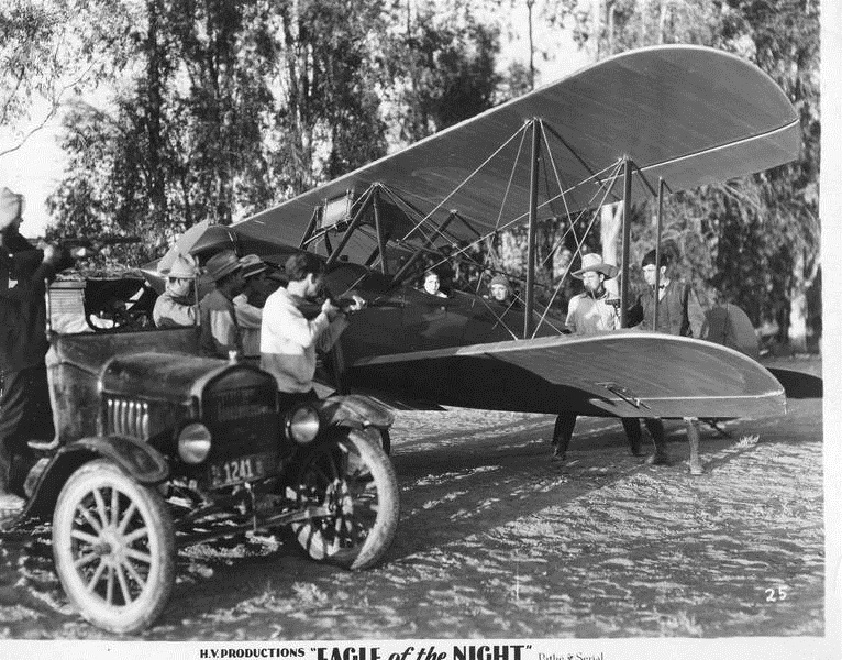
All of this is worth mentioning prior to a screening of 'Eagle of the Night' (1928), an aviation thriller which I'm accompanying on Sunday, Sept. 17 at 2 p.m. at the Town Hall Theatre in Wilton, N.H.

Originally released as a 10-chapter cliffhanging serial, a good chunk of the original material (including four whole chapters) has not survived.

What remains has been edited into a 110-minute movie that I'm told still holds the screen. Well, we'll find out together with we uncorked what's left of 'Eagle of the Night' this coming Sunday afternoon.

Hope to see you there! 

And I promise to bring my arms, as I need them to play the keyboard.

*     *     *

Car meets plane: a scene from 'Eagle of  the Night' (1928)

MONDAY, SEPT. 11, 2023 / FOR IMMEDIATE RELEASE
Contact Jeff Rapsis • (603) 236-9237 • jeffrapsis@gmail.com

Rare thriller 'Eagle of the Night' (1928) to screen with live music at Town Hall Theatre

Surviving footage of 10-part silent aviation drama starring stunt pilot Frank Clarke to run on Sunday, Sept. 17

WILTON, N.H.—Like the famous Venus de Milo sculpture, it's missing some parts.

But enough survives of 'Eagle of the Night,' a 1928 silent-era aviation adventure serial, for audiences to follow the story and enjoy the multi-part thriller.

What remains of the 10-chapter saga will be shown on Sunday, Sept. 17 at 2 p.m. at the Town Hall Theatre, 40 Main St., Wilton, N.H.

Admission is free, with a suggested donation of $10. Live music will be provided by silent film accompanist Jeff Rapsis.

The screening is part of "Not Known to be Shown," a series of early films that never played at the Wilton venue when originally released.

'Eagle of the Night' is a 1928 American drama film serial directed by James F. Fulton.

Dismissed when released and completely forgotten in the modern era, the 10-chapter aviation serial starred real-life aviator Frank Clarke, a stunt pilot whose talents were featured in better-known films of the era, including 'Wings' (1927) and 'Hell's Angels' (1930).

'Eagle of the Night' was one of the last silent film serials produced by PathƩ Studios. The entire serial is not known to exist, with half of chapters 3 and 6, all of 7, 8, and 9, and the beginning of the 10th and final chapter considered lost.

The surviving footage runs about 1 hour and 50 minutes.

In 'Eagle of the Night,' unscrupulous smugglers are attempting to steal the "Magic Muffler," a device that can make an aircraft practically silent. Flying at night would make the smugglers and their forays across the border, impossible to detect.

The smugglers led by rancher Paul Murdock (Earl Metcalfe), capture the inventor, Professor Payson (Josef Swickard), holding him hostage until they get the secrets to his invention.

Unable to get Payson to make another device, the gang then kidnaps Professor Payson's daughter (Shirley Palmer) to force her father to work for them. Even faced with torture, she refuses to help the smugglers.

Secret Service Agent Frank Boyd (Frank Clarke) is called in to confront Murdock and his gang. With the Professor and his daughter on a speeding train, Frank manages to land his Curtiss "Jenny" aircraft on a flat car of the moving train, in time to effect a rescue and win the girl in the end.

The 'Not Known to be Shown' series runs through October and features obscure dramas, comedies, and adventure flicks from the silent era.

"In putting together this series, we wanted to give audiences a chance to see some rarely screened titles from the first years of motion pictures," Rapsis said.

"Also, they're all movies I've never scored before," Rapsis added. "So it's also a chance to work with 'new' material, although the films themselves are about 100 years old," Rapsis said.

Upcoming films in the Town Hall Theatre's 'Not Known to be Shown' series include:

• Sunday, Oct. 8, 2 p.m.: 'The Red Kimona' (1925). A small-town girl finds escape from her cruel home life in the arms of a handsome stranger, a situation that leads her to work as a prostitute in New Orleans.

What remains of 'Eagle of the Night' (1928), a 10-part silent adventure serial starring stunt pilot Frank Clarke, will be shown on Sunday, Sept. 17 at 2 p.m. at the Town Hall Theatre, 40 Main St., Wilton, N.H.

Admission is free, with a suggested donation of $10. For more information, call (603) 654-3456.

Wednesday, September 13, 2023

Fight the French Revolution tonight in 'Scaramouche' (1923) at the Flying Monkey in Plymouth, N.H.

A scene from 'Scaramouche' (1923).

Tonight: Join me for two hours spent fighting the French Revolution! 

That's what you'll get with 'Scaramouche' (1923), a big Rex Ingram-directed swashbuckler that I've never accompanied before, but will this evening.

The show starts at 6:30 p.m. Lots more detail in the press release pasted in below.

Meanwhile, a report from this past weekend: I had a great time accompanying 'The Freshman' (1925) on Saturday night up in Brandon, Vt. (they cheered at the end!), and then 'The Fire Brigade' (1926) on Sunday at the Somerville Theatre in Somerville, Mass.

Top billing on the Somerville Theatre's marquee! 

'The Fire Brigade' was eventful in that to simulate the sound of a large fire bell being struck by a hammer (seen on-screen multiple times during the film), I borrowed a big mounted boxing bell from fellow silent film musician Ken Winokur, who happens to live not far from the Somerville Theatre.

The bell came with a little hammer for hitting it, which was attached to the base by a length of twine to keep the bell and hammer from ever separating. What could go wrong?

Well, during the film, the first time I went to strike the bell, the hammer's metal head flew off the handle (hey, is that where that expression comes from?) and landed out into the darkness somewhere in front of me.

So there went that plan! For the rest of 'The Fire Brigade,' the bell tolled for no one, for lack of a hammer. The now bell-free score, however, went fine, and afterwards I found the hammer head, reattached it to the handle, and packed the whole thing up to return to Ken via a box on his porch.

Well, the next day, Ken pinged me to ask about the hammer's little metal head, which somehow didn't make it back with the bell after all! 

So I checked and found it still in the back of my car. It had apparently fallen off (and out of the bag) during transit. 

 Well, yesterday I mailed the hammer head to Ken—but not before using it to knock some sense into my own head for this whole sorry escapade.

But that's all in the past. Let's now look ahead to the future, in the form of a 1923 film with a story set during the French Revolution. 

Wait—let me rephrase that...

*     *     *

An original lobby card promoting 'Scaramouche' (1923).

TUESDAY, AUG. 29, 2023 / FOR IMMEDIATE RELEASE
Contact: Jeff Rapsis • (603) 236-9237 • jeffrapsis@gmail.com

Silent swashbuckler 'Scaramouche' with live music at Flying Monkey on Wednesday, Sept. 13

Ramon Novarro stars in big budget adaptation of sprawling novel set during the French Revolution

PLYMOUTH, N.H.— It was a big story filmed on a big scale—a movie with a big budget and featuring a big star.

It was 'Scaramouche' (1923), a swashbuckler set during the French Revolution. Starring heartthrob Ramon Novarro, the picture ran into big problems during production, but went on to be one of the year's box office hits.

See for yourself with a screening of 'Scaramouche' on Wednesday, Sept. 13 at 6:30 p.m. at the Flying Monkey Moviehouse and Performance Center, 39 Main St., Plymouth, N.H.

The screening will feature live music for the movie by silent film accompanist Jeff Rapsis. General admission is $10 per person.

The show is the latest in the Flying Monkey's silent film series, which gives audiences the opportunity to experience early cinema as it was intended: on the big screen, with live music, and with an audience.

Alice Terry and Ramon Novarro in 'Scaramouche' (1923).

Based on a 1921 novel by Rafael Sabatini, 'Scaramouche' tells the story of Andre-Louis Moreau (Novarro), a young lawyer whose close friend is killed by a prominent and powerful aristocrat.

Vowing revenge, Moureau disguises himself and joins a theater troupe, where he plays the title role of Scaramouche while working to avenge his friend's untimely death.

Along the way, there are swordfights, plot twists, and scenes of French Revolution rioting staged on a massive scale. The film co-start Alice Terry and Lewis Stone.

Director Rex Ingram pioneered movie adaptations of large-scale stories, creating some of the first true Hollywood epics in the early 1920s while employed by Metro Studios, which later became part of Metro-Goldwyn-Mayer.

Prior to 'Scaramouche,' Ingram directed megahits 'Four Horsemen of the Apocalypse' (1921) starring Rudolph Valentino and 'The Prisoner of Zenda' (1922) which also featured Novarro and Stone.

'Scaramouche' was an elaborate and unwieldy production that suffered from delays and cost overruns.

Ingram had secured the rights to Sabatini's novel in September 1922, and worked on the project for seven months before the cameras rolled.

Extensive outdoor sets, representing 18th-century Paris, were built both on the Metro lot and at a separate site in the San Fernando Valley, and 1,500 extras were used.

An experimental sequence was shot in Technicolor, with the Technicolor company picking up the tab; the sequence proved unsatisfactory and was ultimately discarded.

Despite production problems and cost overruns, 'Scaramouche' went on to rank as one of the top-grossing films of 1923, earning more than $1 million at the box office—a phenomenal sum for the day.

Modern viewers find much to admire about 'Scaramouche.'

"Scaramouche is easily one of Rex Ingram’s best films," wrote reviewer Fritzi Kramer of 'Movies Silently' in 2013.

"It is big, bold and beautiful yet it never loses sight of its characters. Their hopes, dreams and hatreds work in tandem with history to drive the plot steadily onward.

"And, unlike some of Ingram’s works, it is never slow-moving. This is historical spectacle done right. You owe it to yourself to check this film out."

Accompanist Jeff Rapsis will improvise an original musical score for 'Scaramouche' live as the movie is shown, as was done during the silent film era.

"When the score gets made up on the spot, it creates a special energy that's an important part of the silent film experience," said Rapsis, who uses a digital synthesizer to recreate the texture of a full orchestra for the accompaniment.

With the Flying Monkey's screening of 'Scaramouche,' audiences will get a chance to experience silent film as it was meant to be seen—in a high quality print, on a large screen, with live music, and with an audience.

"All those elements are important parts of the silent film experience," Rapsis said. "Recreate those conditions, and the classics of early Hollywood leap back to life in ways that can still move audiences today."

‘Scaramouche’ (1923) starring Ramon Novarro will be shown with live music on Wednesday, Sept. 13 at 6:30 p.m. at the Flying Monkey Moviehouse and Performance Center, 39 Main St., Plymouth, N.H.

General admission tickets are $10 at door or in advance by calling the box office at (603) 536-2551 or online at www.flyingmonkeynh.com.