Showing posts with label Newport. Show all posts

Tuesday, September 19, 2023

This week: The 'Marion Davies Late Summer Four-Places-in-New England Book Tour' with author Lara Gabrielle plus 'Show People' (1928) with live music


It's here! This week brings the New England book tour of author Lara Gabrielle, whose long-awaited Marion Davies biography 'Captain of Her Soul' came out last year and is winning raves.

Lara will host four book-signing/screening events starting Thursday, Sept. 21. Each will include a screening of 'Show People' (1928), one of Marion's most celebrated silent film hits, with live music by me.

Here's a quick run-down of each of Lara's appearances, which are (in order) in Rhode Island, New Hampshire, Maine, and Massachusetts:

• Thursday, Sept. 21, 2023, 7:30 p.m.: The Jane Pickens Theatre, 49 Touro St., Newport, R.I.; (401) 846-5474; https://janepickens.com/. Tickets $16 per person, available online or at the door. Screening and author book-signing in partnership with Charter Books, 8 Broadway, Newport, R.I.; (401) 236-8678.

• Friday, Sept. 22, 2023, 7:30 p.m.: Town Hall Theatre, 40 Main St., Wilton, N.H.; (603) 654-3456; www.wiltontownhalltheatre.com. Admission free, donations of $10 per person encouraged. Screening and author book-signing in partnership with Balin Books, Somerset Plaza, 375 Amherst St./Route 101A, Nashua, N.H.; (603) 417-7981.

• Saturday, Sept. 23, 2023, 2 p.m.: Harbor Theater, 185 Harbor Avenue, Boothbay Harbor, Maine; 207-633-0438; https://boothbaycinema.org/. Admission $10; members $8. Screening and author book-signing in partnership with Sherman's Books of Boothbay Harbor, 5 Commercial St., Boothbay Harbor, Maine.

• Sunday, Sept. 24, 2023, 2 p.m.: Somerville Theatre, 55 Davis Square, Somerville, Mass.; http://www.somervilletheatreonline.com. Tickets $16 adults, $12 seniors/students; on sale at the door or in advance online. For more info, call the theater box office at (617) 625-5700. Screening and author book-signing in partnership with Porter Square Books, Porter Square Shopping Center, 25 White St., Cambridge, Mass.

I first met Lara when she was the featured speaker at this year's Kansas Silent Film Festival back in February. She's done a great job crafting this long overdue comprehensive biography of Davies, one of the brightest stars of early Hollywood but whose career and life story have been neglected by critics and scholars. 

But don't take my word for it. Here's what critic and film historian Leonard Maltin had to say:

“Author Gabrielle has given us a gift: an honest biography of a woman whose life and career have long been misunderstood. . . .  In short, this is the book Marion Davies has always deserved.”

I think you'll find Lara is an eloquent advocate for all of Marion's accomplishments, both on screen and off. I'm thrilled that she agreed to include New England in her travels to promote the book. It's a real privilege to be working with her.

Each stop on the tour will include opening remarks from Lara to put Marion and her career in context. We'll then screen 'Show People' (1928), a crackerjack Davies comedy for which I'll provide live accompaniment. 

Afterwards, Lara will answer questions, then sign copies of her book, which will be on sale by local bookstores at each appearance. 

For more detail, here's the text of the press release that went out promoting the tour. (Details for each screening are above, if you missed them.) 

*   *   *   

William Haines and Marion Davies meet Charlie Chaplin in 'Show People' (1928).

Author Lara Gabrielle to embark on four-stop New England tour in September to promote new Davies biography

She was among Hollywood's top box office stars of the 1920s. But for many fans, her best-known role was longtime companion of media tycoon William Randolph Hearst.

She was Marion Davies, an actress (and later philanthropist) whose pioneering professional and personal journey was as remarkable as any role she played during a highly successful film career.

Davies's full life story is told for the first time in a new comprehensive biography, 'Captain of Her Soul: The Life of Marion Davies' by author Lara Gabrielle. Published by University of California Press in 2022, the book was the result of a decade of research and writing.

Gabrielle will travel to New England in September for a four-stop book tour that will include screenings of 'Show People' (1928), a popular MGM comedy showing Davies at the peak of her stardom.

Gabrielle will speak about Davies' multi-faceted life, which included significant work in the fields of entertainment, business, and charity. She will also sign copies of her new Davies biography, 'Captain of Her Soul,' in partnership with local independent bookstores at each appearance.

In writing the biography, Gabrielle removed layers of rumor and mistruth that have clung to the actress, who grappled with a stutter and rarely gave interviews. 

The story of Davies' life has long been overshadowed by her relationship with legendary press baron William Randolph Hearst.

Many movie buffs believe that the character of Susan Alexander in Orson Welles' landmark film 'Citizen Kane' (1941) was based on Davies, an assumption that has distorted Davies's reputation for decades. Gabrielle addresses and clarifies this idea in 'Captain of Her Soul,' bringing Davies back into view as she truly was.

"There's a common misconception that Marion Davies allowed Hearst to manipulate her work and her image," Gabrielle explains. "But in fact, Marion overhauled her whole persona when she felt it wasn't working for her, and became one of the greatest comedians of the silent era, entirely on her own. She was an independent, hard-working, exceptionally intelligent woman whose generosity knew no bounds. It's been an immense honor to tell her true life story."

According to the publisher, the book "reveals a woman who navigated disability and social stigma to rise to the top of a young Hollywood dominated by powerful men."

"The title of my book is 'Captain of Her Soul,'" says Gabrielle, "and that comes from a quote that Marion Davies said about herself. She took charge of her own career, negotiated her own contracts, and lived her life, her way."
 
A scene from 'Show People' (1928).
 
'Show People,' directed by King Vidor, shows Davies at the height of her 1920s popularity as a screen icon. The light-hearted story follows Peggy Pepper (Marion Davies), a beauty queen from small-town Georgia who hopes to break into the movies as a dramatic actress. William Haines plays Billy Boone, lead actor at a slapstick comedy studio where Pepper lands her first opportunity.

Can a young actress yearning for drama survive the indignity of pies in the face? When her big chance finally comes, will it mean sacrificing her growing friendship with Billy? Will low comedy win out over high drama?

In pursuing those questions, 'Show People' pokes fun at Hollywood phoniness and the culture of celebrity worship that had emerged by the 1920s. 

'Show People' also offers rare behind-the-scenes glimpses of movie-making at the very end of the silent period, when studios were rushing to prepare for sound.

"They knew an era was ending, and 'Show People' is kind of a Valentine to the whole silent film experience," said Rapsis, who will accompany the screening. "It's a love letter to the movie business."
 
A scene from 'Show People' (1928).

'Show People' features cameos by dozens of major stars of the period, including Charlie Chaplin, Douglas Fairbanks, Sr., William S. Hart, and John Gilbert.

In 2003, 'Show People' was selected for preservation in the United States National Film Registry by the Library of Congress as being "culturally, historically, or aesthetically significant."

For more information about 'Captain of Her Soul: The Life of Marion Davies' and author Marion Davies, visit www.mariondaviesbook.com.

About Lara Gabrielle: Lara Gabrielle is a biographer and researcher, whose work on Marion Davies has been featured in Alta, The San Francisco Chronicle, The Missouri Review, The Wall Street Journal, and on PBS’s American Experience. Gabrielle has spoken at film festivals and retrospectives worldwide, and is acknowledged as the leading authority on Davies’s life and legacy, serving as a consultant on Marion Davies for books, dissertations, and film projects. Gabrielle’s biography, Captain of Her Soul: The Life of Marion Davies, has been included on many top book lists for 2022. She lives in Oakland, California.

Saturday, February 11, 2023

One film, two endings: Greta Garbo in 'The Temptress' (1926) this afternoon in Newport, R.I.

An original lobby card for MGM's 'The Temptress' (1926) starring Greta Garbo.

What better way to get in the mood for Valentine's Day than watching Greta Garbo lure men to their doom?

That's what you'll get with 'The Temptress' (1926), a relatively unknown MGM drama that I've found plays surprisingly well with contemporary audiences.

I'm doing live music for 'The Temptress' today (Saturday, Feb. 11) at 4:30 p.m. at the Jane Pickens Theatre in Newport, R.I. More info about the screening is in the press release pasted in below.

For one thing, 'The Temptress' does what all the best movies do, I think: it transports us to places we would almost never visit on our own. (In this case, it's the rough Argentinian back country, with some Parisian high society thrown in for contrast.)

Plus, it has a great cast, a strong story, and a series of dramatic encounters that sizzle with intensity but don't cross the line into parody. It still works.

And, like some pictures from that era, it has two very different endings. As the story goes, MGM studio boss Louis B. Mayer wasn't happy with the story's original tragic ending, and so ordered a new one.

Both survive, with the "happy" ending used for release prints in the U.S., while the "tragic" denouement was used in Europe. 

We'll show them both this afternoon so you can decide for yourself. More details below. Hope to see you in Newport!

*   *   *

Greta Garbo and Antonio Moreno in 'The Temptress' (1926).

WEDNESDAY, JAN. 25, 2023 / FOR IMMEDIATE RELEASE
For more info, contact: Jeff Rapsis • (603) 236-9237 • jeffrapsis@gmail.com

Greta Garbo stars in 'The Temptress' (1926), a film with two endings, on Saturday, Feb. 11 in Newport

Both conclusions to be shown when steamy silent romantic drama is screened with live music at Jane Pickens Theatre; perfect for Valentine's Day

NEWPORT, R.I. — It's a film with two completely different endings: one sad and tragic, and the other uplifting and positive.

It's 'The Temptress' (1926), an MGM romantic drama starring Greta Garbo, then just starting a legendary Hollywood career.

Studio boss Louis B. Mayer found the original ending to 'The Temptress' so depressing, he ordered a second—and much happier—conclusion.

See both endings when 'The Temptress' is screened with live music on Saturday, Feb. 11 at 4:30 p.m. at the Jane Pickens Theatre Film and Event Center, 49 Touro St., Newport, R.I.

The screening, the latest in the venue's silent film series, will feature live accompaniment by Jeff Rapsis, a New Hampshire-based composer who specializes in creating music for silent films.

Admission is $15 per person; members $13. Tickets are available online or at the door.

"A silent romantic drama is a great way to celebrate Valentine's Day," Rapsis said. "At their best, these movies celebrated the big emotions, including love, and they still speak to us today."

In 'The Temptress,' Garbo plays Elena, the wife of Monsieur Canterac (Lionel Barrymore) and the mistress of rich Parisian banker Monsieur Fontenoy (Marc MacDermott).

When the banker's friend Robledo (Antonio Moreno), a dynamic young engineer building a massive dam in Argentina, visits Paris, the fickle Elena immediately falls in love with him.

Elena follows Robledo to Argentina, where her presence leads to a whip duel between Robledo and his rival, Manos Duros (Roy D'Arcy).

She then indirectly causes the collapse of Robledo's dam, which is where the two versions of the film diverge.

In the original version, Elena returns to Paris and the movie concludes tragically.

The revised version sees the film end in Argentina on a much happier note.

Both endings will be screened at the Jane Pickens Theatre: first the original "tragic" conclusion, then the more optimistic ending.

Garbo, who first won notice in her native Sweden, came to Hollywood at age 19. 'The Temptress,' her second film for MGM, helped establish her as a major star.

Initially, the director of 'The Temptress' was Garbo's mentor-lover, the brilliant Mauritz Stiller. But he was replaced halfway through by Fred Niblo, giving 'The Temptress' two different styles.

Silent film accompanist Jeff Rapsis will improvise a musical score to 'The Temptress' in real time as the movie is screened.

In creating music for 'The Temptress' and other vintage classics, Rapsis tries to bridge the gap between silent film and modern audiences.

"Live music adds an element of energy to a silent film screening that's really crucial to the experience," Rapsis said.

The romantic drama ‘The Temptress’ starring Greta Garbo will be shown with live music on Saturday, Feb. 11 at 4:30 p.m. at the Jane Pickens Theatre Film and Event Center, 49 Touro St., Newport, R.I.

Admission is $15 per person; members $13. Tickets are available online at www.janepickens.com or at the door. For more information, call the box office at (401) 846-5474.

Saturday, December 17, 2022

Ending 2022 with yesterday's vision of tomorrow: Metropolis in Newport, R.I. on Tuesday, Dec. 27

Original poster art for 'Metropolis.'

One more to go in 2022, and it's a biggie: 'Metropolis' (1927), for which I'll be doing music on Tuesday, Dec. 27 at the Jane Pickens Theatre in Newport, R.I.

Showtime is 7 p.m.; lots more info in the press release below.

Looking ahead, 2023 beckons as another busy post-pandemic year of silent film music. 

Besides a full dance card of local shows, a pair of out-of-town performing trips are already on the calendar.

In January, I'll be playing for film programs at Cinema Detroit in Detroit, Mich., and Case Western Reserve University in Cleveland.

And then in February, it's my annual pilgrimage to the Kansas Silent Film Festival at Washburn University in Topeka, Kansas.

I don't do personal New Year's resolutions as I don't ever seem to change. I'll soon be 60 years old, but I'm still bedeviled by teenage habits and personality trains, with a big helping of the Seven Deadly Sins mixed in.

But in terms of silent film accompaniment, according to my running list of silent feature films that  I've accompanied (maintained elsewhere on this blog), right now the total stands at 373.

So that means if I make an effort, 2023 may be the year the total crosses 400. Well, that's a big round number!

So, in between repeat screenings of popular titles that comprise the bulk of my work, I'll try to salt in a few obscure titles I've never before tackled. If I do an average of one every two weeks, I should make it!

One good sign: in planning its 2023 calendar, the Somerville Theatre has booked no less than four silent features that I've never played for before, including Lillian Gish in 'Annie Laurie'; Mary Pickford's early 'Cinderella;' the recently restored MGM blockbuster 'The Fire Brigade'; and Thomas Meighan in 'The Canadian.'

All are via 35mm prints from the Library of Congress—your tax dollars at work!

In the meantime, 'Metropolis' is up next. Hope you'll join us during that strange in-limbo week between Christmas and New Year's Day.

And a Happy New Year!

*  *  *

A scene from 'Metropolis' (1927).

TUESDAY, DEC. 6, 2022 / FOR IMMEDIATE RELEASE
For more info, contact: Jeff Rapsis • (603) 236-9237 • jeffrapsis@gmail.com

Restored classic sci-fi epic 'Metropolis' to screen in Newport on Tuesday, Dec. 27

Landmark early futuristic fantasy, with half-hour of rediscovered footage, to be shown with live music at Jane Pickens Theatre

NEWPORT, R.I.—A silent film hailed as the grandfather of all science fiction fantasy movies will be screened with live music in Newport during the upcoming holiday vacation week.

'Metropolis' (1927), an epic adventure set in a futuristic world, will be shown on Tuesday, Dec. 27 at 7 p.m. at the Jane Pickens Theatre Film and Event Center, 49 Touro St., Newport, R.I.

The screening, the latest in the venue's silent film series, will feature live accompaniment by Jeff Rapsis, a New Hampshire-based composer who specializes in creating music for silent films.

Admission is $15 per person; members $13. Tickets are available online or at the door.

'Metropolis' (1927), regarded as German director Fritz Lang's masterpiece, is set in a society where a privileged elite pursue lives of leisure while the masses toil on vast machines and live in poverty.

The film, with its visions of futuristic factories and underground cities, set new standards for visual design and inspired generations of dystopian fantasies from Ridley Scott's 'Blade Runner' to Terry Gilliam's 'Brazil.'

In reviving 'Metropolis' and other great films of cinema's early years, the Jane Pickens Theatre aims to show silent movies as they were meant to be seen—in high quality prints, on a large screen, with live music, and with an audience.

"All those elements are important parts of the silent film experience," said Rapsis, who will improvise an original live score for 'Metropolis' on the spot. "Recreate those conditions, and the classics of early cinema leap back to life."

In 'Metropolis,' the story centers on an upper class young man who falls in love with a woman who works with the poor. The tale encompasses mad scientists, human-like robots, underground spiritual movements, and industrial espionage, all set in a society divided between haves and have-nots.

From 'Metropolis' (1927).

The version of 'Metropolis' to be screened at the Jane Pickens Theatre is a newly restored edition that includes nearly a half-hour of missing footage cut following the film's premiere in 1927.

The lost footage, discovered in 2008 in an archive in Argentina, has since been added to the existing 'Metropolis,' allowing plot threads and characters to be developed more fully.

When first screened in Berlin, Germany on Jan. 10, 1927, the sci-fi epic ran an estimated 153 minutes. After its premiere, the film's distributors (including Paramount in the U.S.) drastically shortened 'Metropolis' to maximize the film's commercial potential. By the time it debuted in the U.S. later that year, the film was only about 90 minutes long.

Even in its shortened form, 'Metropolis' became a cornerstone of science fiction cinema. Due to its enduring popularity, the film has undergone numerous restorations in the intervening decades in attempts to recover Lang's original vision.

The restoration work has continued in recent years. In 2008, the curator of the Buenos Aires Museo del Cine discovered a 16mm dupe negative of 'Metropolis' that was considerably longer than any existing print.

It included not merely a few additional snippets, but 25 minutes of "lost" footage, about a fifth of the film, that had not been seen since its Berlin debut.

The discovery led to a 2½-hour version that debuted in 2010 to widespread acclaim. It's this fully restored edition that will be screened at the Jane Pickens Theatre.

" 'Metropolis' stands as an stunning example of the power of silent film to tell a compelling story without words, and reach across the generations to touch movie-goers from the real future, which means us," said accompanist Jeff Rapsis, who provides live music for silent film screenings throughout New England and beyond.

To accompany a silent film, Rapsis uses a digital synthesizer to recreate the texture of the full orchestra. The score is created live in real time as the movie is screened.

Rather than focus exclusively on authentic music of the period, Rapsis creates new music for silent films that draws from movie scoring techniques that today's audiences expect from the cinema.

The restored 'Metropolis' will be shown on Tuesday, Dec. 27 at 7 p.m. at the Jane Pickens Theatre Film and Event Center, 49 Touro St., Newport, R.I. Admission is $15 per person; members $13. Tickets are available online at www.janepickens.com or at the door. For more information, call the box office at (401) 846-5474.

Wednesday, August 3, 2022

This Friday, 'Safety Last' in Newport R.I.; last Saturday, 'Caligari' in Brookline, Mass.

Accompanying a midnight screening of 'The Cabinet of Dr. Caligari' (1920) at the Coolidge Corner Theatre.

It's down to Rhode Island this Friday to accompany a screening of 'Safety Last' (1923) at the Jane Pickens Theatre in downtown Newport. 

Showtime is 7 p.m.; lots more detail in the press release below.

But before going onward to the Ocean State, let us go backward to the Bay State, where this past weekend I accompanied a midnight screening of 'The Cabinet of Dr. Caligari' (1920). 

It was at the Coolidge Corner Theatre in Brookline, Mass. (right outside of Boston), and to everyone's surprise, attendance was strong—something like 150 people, most of whom had never seen the film before.

I had a few simple motifs in mind, and enjoyed playing with them to help support the film. I don't "Mickey Mouse" the action, but I do tend to track pretty closely to the film's changing moods, which I think helps a modern audience stay with the film.

The film is divided into six "acts," which give the accompanist a chance to reset the music and signal that something different is coming. I don't know 'Caligari' that well, but I managed to reach some kind finality at the end of each act, and then went off in a total different direction, even if I wasn't sure what was coming next. It worked!

One thing no one expected was my big brass handbell, which I use exactly three times during the movie, when Caligari uses one to summon spectators. 

Great comments afterwards, which mean it was 2 a.m. and I'm not sure how coherent I was. (I'm never that coherent right after a film. Or before.) But I was delighted to find out that the sequence I picked to really build the music to a big climax—when Caligari hears voices saying he "must be Caligari"—was enough to send shivers up the spine of one attendee. Nice!

Shivers of a different kind are in store for those who attend Harold Lloyd's 'Safety Last' on Friday in Newport, R.I. Hope to see you there! If you're in California, an early morning flight into Providence, R.I. will get you there in plenty of time. 

So there's no excuse. What are you waiting for?

*    *    *

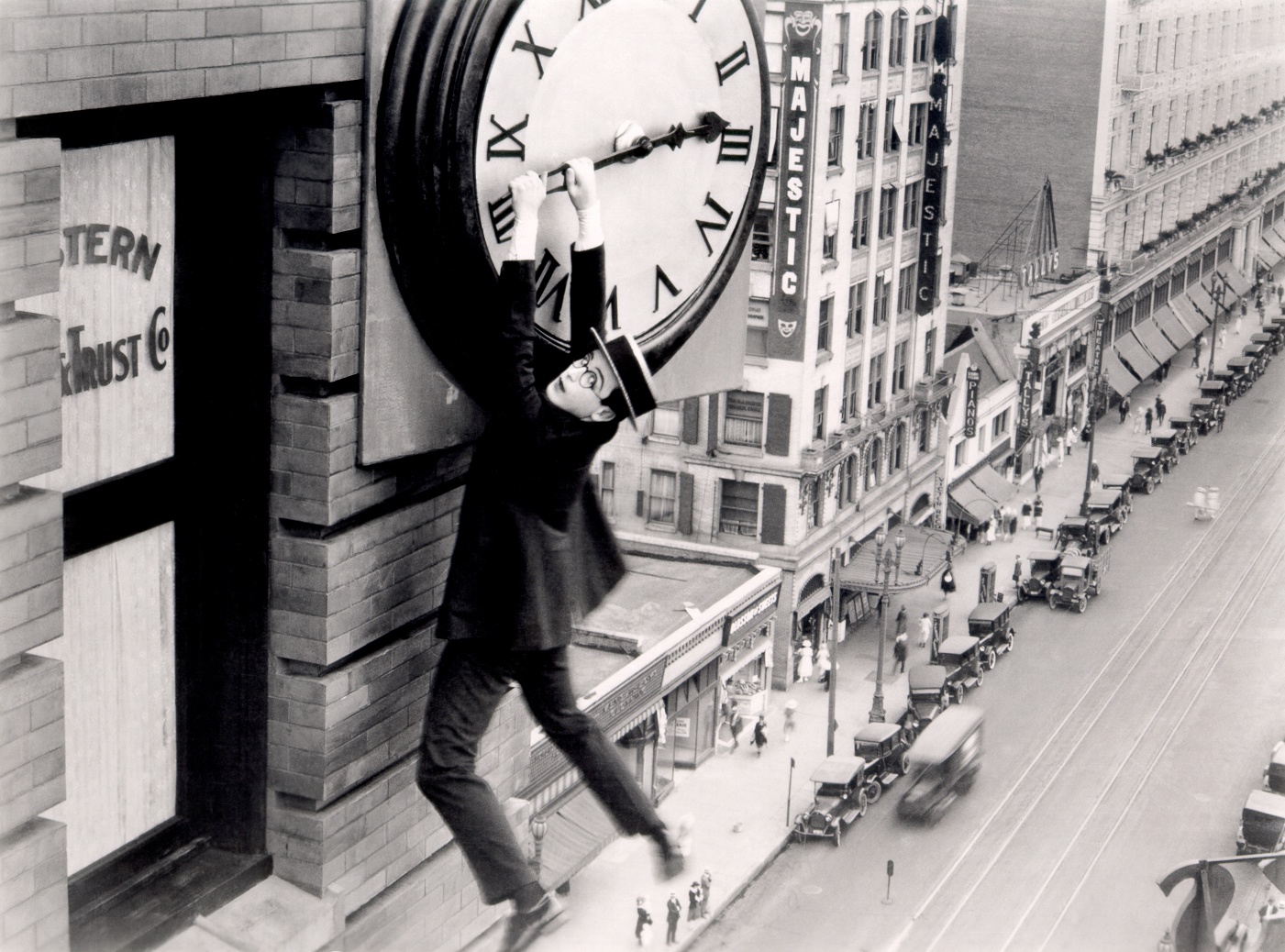
From 'Safety Last': the image everyone remembers.

MONDAY, JULY 11, 2022 / FOR IMMEDIATE RELEASE
Contact Jeff Rapsis • (603) 236-9237 • jeffrapsis@gmail.com

Silent film classic 'Safety Last' on Friday, Aug. 5 at Jane Pickens Theatre

Thrill comedy climaxed by Harold Lloyd's iconic building climb; shown with live music

NEWPORT, R.I.—It's a cinematic image so powerful, people who've never seen the movie instantly recognize it.

The vision of Harold Lloyd hanging from the hands of a huge clock, from the climax of his silent comedy 'Safety Last,' (1923), has emerged as a symbol of early Hollywood and movie magic.

See how Harold gets into his high-altitude predicament with a screening of 'Safety Last,' one of Lloyd's classic comedies, on Friday, Aug. 5 at 7:30 p.m. at the Jane Pickens Theatre and Event Center, 49 Touro St., Newport.

General admission $15; members $13. Tickets available online or at the door.

The screening will feature live musical accompaniment by Jeff Rapsis, a New Hampshire-based silent film musician.

'Safety Last' follows young go-getter Lloyd to the big city, where he hopes to make his mark in business and send for his small town sweetheart.

His career at a downtown department store stalls, however, until he gets a chance to pitch a surefire publicity idea—hire a human fly to climb the building's exterior.

However, when the human fly has a last-minute run-in with the law, Harold is forced to make the climb himself, floor by floor, with his sweetheart looking on.

The result is an extended sequence blending comedy and terror that holds viewers spellbound.

Lloyd, along with Charlie Chaplin and Buster Keaton, is regarded as one of the silent screen's three great clowns.

Lloyd's character, a young go-getter ready to struggle to win the day, proved hugely popular in the 1920s.

While Chaplin and Keaton were always favored by the critics, Lloyd's films reigned as the top-grossing comedies throughout the period.

Silent film at the Jane Pickens Theatre gives today's audiences the chance to experience early cinema as it was intended: on the big screen, with live music, and with an audience.

"Put the whole experience back together, and you can see why people first fell in love with the movies," said Rapsis, who practices the nearly lost art of silent film accompaniment.

Rapsis performs on a digital synthesizer that reproduces the texture of the full orchestra, creating a traditional "movie score" sound.

"Seeing 'Safety Last' with an audience is one of the great thrill rides of the cinema of any era, silent or sound," Rapsis said. "Harold's iconic building climb, filmed without trick photography, continues to provoke audience responses nearly 100 years after film was first released."

Tributes to the clock-hanging scene have appeared in several contemporary films, most recently in Martin Scorsese's 'Hugo' (2011), which includes clips from 'Safety Last.'

See Harold Lloyd's iconic thrill comedy 'Safety Last' (1923) on Friday, Aug. 5 at 7:30 p.m. at the Jane Pickens Theatre and Event Center, 49 Touro St., Newport.

General admission $15; members $13. Tickets available online at www.janepickens.com or at the door. For more information about the JPT Film & Event Center, call (401) 846-5474.

Nearing the top.

CRITIC COMMENTS ON ‘SAFETY LAST’:

"Impossible to watch without undergoing visitations of vertigo, Safety Last's climactic sequence is all it's reputed to be.”
—TV Guide

"Harold Lloyd manages to make the characters sympathetic enough to carry the audience's concern on his journey of crazy stunts and mishaps. One of the best of this era."
—David Parkinson, Empire Magazine

"The climb has both comic and dramatic weight because it is both a thrilling exercise in physical humor and a thematically rich evocation of the pressures men feel to succeed, lest they be viewed as less than a man."
—James Kendrick, Q Network Film Desk

Tuesday, February 8, 2022

Small state, big occasion: Accompanying 'The General' in Rhode Island at Keaton book-signing

Buster leans into his art in 'The General' (1926), to be screened on Thursday, Feb. 10 in Newport, R.I.

I sometimes think that Buster Keaton's feature films have become the Beethoven symphonies of silent cinema. 

Individually, each has its own characteristics and place in Keaton's body of work. Taken as a whole, they form a rich world—one that had a major influence on what followed.

In Beethoven's case, his influence was on concert music, and the overall "romantic" movement in the general sense. (The General! Ha!) With Keaton, it was movies, up to and including Jackie Chan films.

And if all that's true, then 'The General' is probably the equivalent of Beethoven's 5th: the one everyone seems to know about, and which gets played most frequently. 

And so it is that I've been asked to head down to Newport, R.I. to accompany 'The General' as part of a book tour event promoting Camera Man: Buster Keaton, the Dawn of Cinema, and the Invention of the Twentieth Century, a recently published Buster Keaton book by critic Dana Stevens.

The event, organized by Charter Books of Newport and held at the Jane Pickens Theatre, includes an on-stage interview with the author. It's Thursday, Feb. 10 at 7:30 p.m. I encourage you to attend if you're in the area. 

First up will be 'The General,' followed by an on-stage conversation between Stevens and Prof. Matt Ramsey, head of the film department at Salve Regina University. Admission is $12; for $40, you also get a signed copy of the book. The theater is at 49 Touro St. in Newport.  

From what I understand, Stevens' book is a look at Keaton in the context of the rapidly changing world of the early 20th century. It's gotten good reviews, and I'm looking forward to reading it.

The Stevens book is one of two recently published about Keaton. The other, a more traditional biography, is 'Buster Keaton: A Filmmaker's Life' by James Curtis that's due out mid-February. I'm looking forward to this one as well.

For more info, here's a recent New York Times review of both volumes.

Two Buster Keaton books at once! I guess I know what I'll be doing when not watching or accompanying films at the upcoming Kansas Silent Film Festival in Topeka later this month. 

And so if Buster's 'The General' is the equivalent of Beethoven's 5th Symphony, which of Buster's films is the Keaton equivalent of Beethoven's 9th?

Your comments, please.