Showing posts with label Wilton. Show all posts

Wednesday, September 9, 2026

Tackling Theda Bara—well, not literally—in 'A Fool There Was' on Sunday, Sept. 13

Theda Bara in 'A Fool There Was' (1915).

They say there's a first time for everything. And this Sunday will be my first time with Theda Bara.

And that seems surprising. After all, I've been doing silent film music for 20 years. In the hundreds of movies I've accompanied, you'd think the list might have included ONE Theda Bara film.   

But nope! A combination of scarcity (very few of her films survive) plus lack of availability of good-looking prints has led to a prolonged Theda Bara drought in my performance schedule.

Well, that changes this weekend! On Sunday, Sept. 13, I'll have the privilege of accompanying 'A Fool There Was' (1915), one of the iconic star's few intact surviving films, at the Town Hall Theatre in Wilton, N.H. 

Showtime is 2 p.m. Admission is free; a donation of $10 per person is suggested to support the Town Hall Theatre's silent film series. 

For all the Theda Bara groupies out there, here's a rare chance to see one of the mysterious star's surviving films on the big screen and with live music. 

And yes, there are Theda Bara groupies. Her reputation as a "vamp"—and one of Hollywood's earliest sex symbols—has stood the test of time, even if most of her films haven't. 

And about that title: 'A Fool There Was.' Sounds like Yoda came up with that one!

Well, weird syntax or not, lots more info about the screening and film can be found in the press release below:

*     *     * 


MONDAY, AUG. 24, 2026 / FOR IMMEDIATE RELEASE
Contact: Jeff Rapsis • (603) 236-9237jeffrapsis@gmail.com

Most of Theda Bara’s films are lost. See one that survived.

Silent screen’s original sex symbol stars in rare 1915 thriller ‘A Fool There Was,’ screening Sept. 13 in Wilton with live music

WILTON, N.H.—She was one of the biggest movie stars in the world. She became one of cinema’s first sex symbols. She made more than 40 films.

And almost all of them are gone.

Theda Bara, the legendary “vamp” of the silent screen, returns to the big screen in one of her rare surviving films when 'A Fool There Was' (1915) is shown on Sunday, Sept. 13 at 2 p.m. at the Town Hall Theatre, 40 Main St., Wilton, N.H.

The melodramatic thriller will be presented with live music by silent film accompanist Jeff Rapsis, recreating the way audiences experienced movies when Bara was an international sensation more than a century ago.

Admission is free. Donations are gladly accepted to support the venue's silent film series, with $10 per person suggested.

For film fans, 'A Fool There Was' offers something increasingly rare: the chance to see an authentic performance by one of the first superstars of the motion picture era.

 
Theda Bara and costar Edward José in 'A Fool There Was' (1915).

Bara appeared in more than 40 films during a career that made her among the most recognizable faces of the 1910s. But because of nitrate deterioration, fires, neglect, and the wholesale disappearance of early motion pictures, only a handful of her films survive in substantially complete form.

That makes 'A Fool There Was' much more than an antique curiosity. It is a survivor.

And it’s the film that created the Theda Bara legend.

In 'A Fool There Was', Bara plays a mysterious seductress who ensnares a respectable married man and systematically brings about his downfall.

The role turned Bara into cinema’s original 'vamp'—a woman whose sexual magnetism proved irresistible and potentially fatal to the men around her.

Audiences had seen nothing quite like her.

With her darkly exotic appearance, heavy eye makeup, revealing costumes, and brazen sexuality, Bara became one of Hollywood’s earliest sex symbols before Hollywood itself had fully emerged as the center of the movie industry.

Theda Bara in 'A Fool There Was' (1915).

Her studio heightened the sensation by concocting an outrageous publicity campaign that portrayed the Cincinnati-born actress as an exotic woman of mystery, supposedly born in the shadow of the Sphinx.

The public ate it up.

Bara became a phenomenon, and the 'vamp' became a permanent character in American popular culture.

But unlike Charlie Chaplin, Buster Keaton, and other silent-era stars whose work remains widely available, Bara today is largely a legend without films.

The vast majority of her screen appearances have vanished. Audiences can read about her extraordinary fame and see her famous publicity photographs, but they have few opportunities to actually watch the woman who once fascinated millions.

'A Fool There Was' is the great exception.

Original promotional artwork for 'A Fool There Was' (1915).

The Wilton screening offers a chance not merely to watch the film, but to experience it in the environment for which it was created: on a big screen, with live music, and surrounded by an audience.

Silent movies were never intended to be silent. In their original theatrical runs, films were accompanied by musicians who supplied everything from atmosphere and emotion to rhythm and dramatic punctuation.

For the Wilton screening, Rapsis will improvise a complete score live as the film unfolds.

And the audience is part of the experience.

A century ago, movies were intensely communal entertainment. People laughed, gasped, applauded, and reacted together. With a good-sized crowd and live music, that same chemistry can still happen today.

The result is something streaming at home cannot reproduce: a century-old film suddenly becoming a live event.

And in the case of Theda Bara, it’s also a chance to encounter a performer whose work came perilously close to disappearing altogether.

Most of Theda Bara’s movies are gone forever.

On Sunday, Sept. 13, one of them gets another afternoon on the big screen.

'A Fool There Was' (1915), starring Theda Bara, will be shown with live musical accompaniment by Jeff Rapsis on Sunday, Sept. 13 at 2 p.m. at the Town Hall Theatre, 40 Main St., Wilton, N.H.

Admission is free, with donations gladly accepted to support the silent film series. A donation of $10 per person is suggested.


Tuesday, September 19, 2023

This week: The 'Marion Davies Late Summer Four-Places-in-New England Book Tour' with author Lara Gabrielle plus 'Show People' (1928) with live music


It's here! This week brings the New England book tour of author Lara Gabrielle, whose long-awaited Marion Davies biography 'Captain of Her Soul' came out last year and is winning raves.

Lara will host four book-signing/screening events starting Thursday, Sept. 21. Each will include a screening of 'Show People' (1928), one of Marion's most celebrated silent film hits, with live music by me.

Here's a quick run-down of each of Lara's appearances, which are (in order) in Rhode Island, New Hampshire, Maine, and Massachusetts:

• Thursday, Sept. 21, 2023, 7:30 p.m.: The Jane Pickens Theatre, 49 Touro St., Newport, R.I.; (401) 846-5474; https://janepickens.com/. Tickets $16 per person, available online or at the door. Screening and author book-signing in partnership with Charter Books, 8 Broadway, Newport, R.I.; (401) 236-8678.

• Friday, Sept. 22, 2023, 7:30 p.m.: Town Hall Theatre, 40 Main St., Wilton, N.H.; (603) 654-3456; www.wiltontownhalltheatre.com. Admission free, donations of $10 per person encouraged. Screening and author book-signing in partnership with Balin Books, Somerset Plaza, 375 Amherst St./Route 101A, Nashua, N.H.; (603) 417-7981.

• Saturday, Sept. 23, 2023, 2 p.m.: Harbor Theater, 185 Harbor Avenue, Boothbay Harbor, Maine; 207-633-0438; https://boothbaycinema.org/. Admission $10; members $8. Screening and author book-signing in partnership with Sherman's Books of Boothbay Harbor, 5 Commercial St., Boothbay Harbor, Maine.

• Sunday, Sept. 24, 2023, 2 p.m.: Somerville Theatre, 55 Davis Square, Somerville, Mass.; http://www.somervilletheatreonline.com. Tickets $16 adults, $12 seniors/students; on sale at the door or in advance online. For more info, call the theater box office at (617) 625-5700. Screening and author book-signing in partnership with Porter Square Books, Porter Square Shopping Center, 25 White St., Cambridge, Mass.

I first met Lara when she was the featured speaker at this year's Kansas Silent Film Festival back in February. She's done a great job crafting this long overdue comprehensive biography of Davies, one of the brightest stars of early Hollywood but whose career and life story have been neglected by critics and scholars. 

But don't take my word for it. Here's what critic and film historian Leonard Maltin had to say:

“Author Gabrielle has given us a gift: an honest biography of a woman whose life and career have long been misunderstood. . . .  In short, this is the book Marion Davies has always deserved.”

I think you'll find Lara is an eloquent advocate for all of Marion's accomplishments, both on screen and off. I'm thrilled that she agreed to include New England in her travels to promote the book. It's a real privilege to be working with her.

Each stop on the tour will include opening remarks from Lara to put Marion and her career in context. We'll then screen 'Show People' (1928), a crackerjack Davies comedy for which I'll provide live accompaniment. 

Afterwards, Lara will answer questions, then sign copies of her book, which will be on sale by local bookstores at each appearance. 

For more detail, here's the text of the press release that went out promoting the tour. (Details for each screening are above, if you missed them.) 

*   *   *   

William Haines and Marion Davies meet Charlie Chaplin in 'Show People' (1928).

Author Lara Gabrielle to embark on four-stop New England tour in September to promote new Davies biography

She was among Hollywood's top box office stars of the 1920s. But for many fans, her best-known role was longtime companion of media tycoon William Randolph Hearst.

She was Marion Davies, an actress (and later philanthropist) whose pioneering professional and personal journey was as remarkable as any role she played during a highly successful film career.

Davies's full life story is told for the first time in a new comprehensive biography, 'Captain of Her Soul: The Life of Marion Davies' by author Lara Gabrielle. Published by University of California Press in 2022, the book was the result of a decade of research and writing.

Gabrielle will travel to New England in September for a four-stop book tour that will include screenings of 'Show People' (1928), a popular MGM comedy showing Davies at the peak of her stardom.

Gabrielle will speak about Davies' multi-faceted life, which included significant work in the fields of entertainment, business, and charity. She will also sign copies of her new Davies biography, 'Captain of Her Soul,' in partnership with local independent bookstores at each appearance.

In writing the biography, Gabrielle removed layers of rumor and mistruth that have clung to the actress, who grappled with a stutter and rarely gave interviews. 

The story of Davies' life has long been overshadowed by her relationship with legendary press baron William Randolph Hearst.

Many movie buffs believe that the character of Susan Alexander in Orson Welles' landmark film 'Citizen Kane' (1941) was based on Davies, an assumption that has distorted Davies's reputation for decades. Gabrielle addresses and clarifies this idea in 'Captain of Her Soul,' bringing Davies back into view as she truly was.

"There's a common misconception that Marion Davies allowed Hearst to manipulate her work and her image," Gabrielle explains. "But in fact, Marion overhauled her whole persona when she felt it wasn't working for her, and became one of the greatest comedians of the silent era, entirely on her own. She was an independent, hard-working, exceptionally intelligent woman whose generosity knew no bounds. It's been an immense honor to tell her true life story."

According to the publisher, the book "reveals a woman who navigated disability and social stigma to rise to the top of a young Hollywood dominated by powerful men."

"The title of my book is 'Captain of Her Soul,'" says Gabrielle, "and that comes from a quote that Marion Davies said about herself. She took charge of her own career, negotiated her own contracts, and lived her life, her way."
 
A scene from 'Show People' (1928).
 
'Show People,' directed by King Vidor, shows Davies at the height of her 1920s popularity as a screen icon. The light-hearted story follows Peggy Pepper (Marion Davies), a beauty queen from small-town Georgia who hopes to break into the movies as a dramatic actress. William Haines plays Billy Boone, lead actor at a slapstick comedy studio where Pepper lands her first opportunity.

Can a young actress yearning for drama survive the indignity of pies in the face? When her big chance finally comes, will it mean sacrificing her growing friendship with Billy? Will low comedy win out over high drama?

In pursuing those questions, 'Show People' pokes fun at Hollywood phoniness and the culture of celebrity worship that had emerged by the 1920s. 

'Show People' also offers rare behind-the-scenes glimpses of movie-making at the very end of the silent period, when studios were rushing to prepare for sound.

"They knew an era was ending, and 'Show People' is kind of a Valentine to the whole silent film experience," said Rapsis, who will accompany the screening. "It's a love letter to the movie business."
 
A scene from 'Show People' (1928).

'Show People' features cameos by dozens of major stars of the period, including Charlie Chaplin, Douglas Fairbanks, Sr., William S. Hart, and John Gilbert.

In 2003, 'Show People' was selected for preservation in the United States National Film Registry by the Library of Congress as being "culturally, historically, or aesthetically significant."

For more information about 'Captain of Her Soul: The Life of Marion Davies' and author Marion Davies, visit www.mariondaviesbook.com.

About Lara Gabrielle: Lara Gabrielle is a biographer and researcher, whose work on Marion Davies has been featured in Alta, The San Francisco Chronicle, The Missouri Review, The Wall Street Journal, and on PBS’s American Experience. Gabrielle has spoken at film festivals and retrospectives worldwide, and is acknowledged as the leading authority on Davies’s life and legacy, serving as a consultant on Marion Davies for books, dissertations, and film projects. Gabrielle’s biography, Captain of Her Soul: The Life of Marion Davies, has been included on many top book lists for 2022. She lives in Oakland, California.

Thursday, July 13, 2023

Saturday, 7/15: 'The General' in Brandon, Vt.;
Sunday, 7/16: 'The Circle' in Wilton, N.H.

Vintage original glass slide promoting 'The Circle' (1925), complete with show dates added by hand.

Interesting pair of films this weekend: one I've never seen or accompanied before, and another that I've done perhaps more than any other single film.

First up: it's Buster Keaton's 'The General' (1926), screening on Saturday, July 15 at 7 p.m. at Brandon Town Hall and Community Center in Brandon, Vt.

That's the one I've done so many times I've lost count. More details are in the press release below. 

'The General' was actually the very first film I scored in Brandon (back in 2011), prompting a monthly silent film series that continues to this day.

We generally run one Keaton program each year. With more than 10 years now under our belts (and having shown all the other Keaton silent features), 'The General' is our first repeat.

And yes, 'The General' is one of the most frequently screened silents, with only 'Nosferatu' (1921) perhaps vying for the crown. In the spirit of 'Nosferatu,' one could say they're neck and neck. 

And then on Sunday, July 16, it's 'The Circle' (1925), a romantic comedy directed by Frank Borzage and based on a play by William Somerset Maugham.

The film is screening at 2 p.m. at the Town Hall Theatre, 40 Main St., Wilton, N.H. Admission is free, with $10 donation suggested to support the Town Hall's silent film series.

I don't have any press release to share because I apparently didn't send one out last month prior to leaving for two weeks in France. Oops!

So time for some last-minute promotion. How about this for a slogan?

DON'T BE SQUARE! SEE 'THE CIRCLE'!

'The Circle' has two big names in it: Eleanor Boardman and a very young Joan Crawford. And Creighton Hale (a familiar name to silent film fans) also shows up.

The plot? Here's a one-sentence summary from the Internet Movie Database: "An unhappy woman considers leaving her dull husband for another man."

I don't know any more than that, which is as it should be. 'The Circle' is the first in a series of films that we've never shown before in Wilton, and which I've never accompanied. 

The series runs through October. For a preview, download the flier.

And for now, I invite you to join us this Saturday in Brandon, Vt. for a screening of Buster Keaton's classic comedy 'The General' (1926). Details below:

*   *   *

Buster Keaton in 'The General' (1926).

TUESDAY, JUNE 20, 2023 / FOR IMMEDIATE RELEASE
Contact: Jeff Rapsis • (603) 236-9237 • jeffrapsis@gmail.com

Buster Keaton's 'The General' with live music at Brandon Town Hall on Saturday, July 15

Civil War railroading comedy/adventure film lauded as stone-faced comic moviemaker's masterpiece

BRANDON, Vt.— He never smiled on camera, earning him the nickname of "the Great Stone Face." But Buster Keaton's comedies rocked Hollywood's silent era with laughter throughout the 1920s.

See for yourself with a screening of 'The General' (1926), one of Keaton's landmark feature films, on Saturday, July 15 at 7 p.m. at the Brandon Town Hall and Community Center, Route 7, in Brandon, Vt.

All are welcome to this family-friendly event. Admission is free, with free will donations accepted in support of ongoing Town Hall renovations.

The screening, the latest in the venue's silent film series, will feature live accompaniment by Jeff Rapsis, a New Hampshire-based composer who specializes in creating music for silent films.

'The General,' set during the U.S. Civil War, tells the story of a southern locomotive engineer (Keaton) whose engine (named 'The General') is hijacked by Northern spies with his girlfriend on board.

Keaton, commandeering another train, races north in pursuit behind enemy lines. Can he rescue his girl? And can he recapture his locomotive and make it back to warn of a coming Northern attack?

Critics call 'The General' Keaton's masterpiece, praising its authentic period detail, ambitious action and battle sequences, and its overall integration of story, drama, and comedy.
 
Buster Keaton with his namesake locomotive in 'The General' (1926).

It's also regarded as one of Hollywood's great railroad films, with much of the action occurring on or around moving steam locomotives.

Accompanist Jeff Rapsis will improvise an original musical score for 'The General' live as the movie is shown, as was typically done during the silent film era.

"When the score gets made up on the spot, it creates a special energy that's an important part of the silent film experience," said Rapsis, who uses a digital synthesizer to recreate the texture of a full orchestra for the accompaniment.

With the Brandon Town Hall's screening of 'The General,' audiences will get a chance to experience silent film as it was meant to be seen—in a high quality print, on a large screen, with live music, and with an audience.

"All those elements are important parts of the silent film experience," Rapsis said. "Recreate those conditions, and the classics of early Hollywood leap back to life in ways that can still move audiences today."
 
Keaton and his co-star in 'The General' (1926).

Keaton, along with Charlie Chaplin and Harold Lloyd, stands today as one of the silent screen's three great clowns. Some critics regard Keaton as the best of all; Roger Ebert wrote in 2002 that "in an extraordinary period from 1920 to 1929, (Keaton) worked without interruption on a series of films that make him, arguably, the greatest actor-director in the history of the movies."

A remarkable pantomime artist, Keaton naturally used his whole body to communicate emotions from sadness to surprise. And in an era with no post-production special effects, Keaton's acrobatic talents enabled him to perform all his own stunts.

The screening of 'The General' is sponsored by Gary and Nancy Meffe; Ben and Claudette Lawton; Bertram D. Coolidge; Frank and Ettie Spezzano; Ronald, Carolyn and Rickly Hayes; and Hayes Pallets.

Other films in this year's Brandon Town Hall silent film series include:

• Friday, Aug. 18, 7 p.m.: 'The Ten Commandments' (1923) directed by Cecil B. DeMille. Long before Charlton Heston played Moses in Technicolor, director Cecil B. DeMille filmed this silent blockbuster on a grand scale. Many say it surpasses the remake—see for yourself as we celebrate the 100th anniversary of the film's original release. Sponsored by Bruce Ness and Nancy Spaulding-Ness

• Saturday, Sept. 9, 7 p.m.: 'The Freshman' (1925) starring Harold Lloyd, Jobyna Ralston. We welcome football season with Harold Lloyd's blockbuster hit about a college boy who dreams of gridiron greatness. One of Lloyd's all-time best! Sponsored by Frank Mazza and Linda Zaragoza; Kathy and Wayne Rausenberger; Edward Loedding and Dorothy Leysath.

• Saturday, Oct. 7, 7 p.m.: 'My Best Girl' (1927) starring Mary Pickford, Charles 'Buddy' Rogers. In a big city department store, romance blossoms between a humble stockroom clerk and the store owner's son—who is already engaged! A sparkling “rich man, poor girl” romantic comedy from 1927 starring screen icon Mary Pickford and Charles 'Buddy Rogers,' her future real-life husband. Sponsored by Harold and Jean Somerset; Fyles Brothers, Inc.; and Jeanette Devino.

• Friday, Oct. 27, 7 p.m.: 'The Cat and the Canary' (1927). Can a group of distant relatives survive the night in a haunted house to learn the secret of a madman's will? Find out in the original Gothic thriller from silent film director Paul Leni. Just in time for Halloween, a movie filled with deep shadows, dark secrets, and a surprisingly timeless mix of humor and horror that will keep you guessing. Sponsored by Pam and Steve Douglass.

• Saturday, Nov. 11, 7 p.m.: 'The Big Parade' (1925) starring John Gilbert. We salute Veterans Day with this sweeping saga about U.S. doughboys signing up and shipping off to France in 1917, where they face experiences that will change their lives forever—if they return. MGM blockbuster directed by King Vidor; one of the biggest box office triumphs of the silent era. Sponsored by Donald and Dolores Furnari; Jeanette Devino; and Lorrie Byrom.

Critics review 'The General':

"The most insistently moving picture ever made, its climax is the most stunning visual event ever arranged for a film comedy."
—Walter Kerr, author of 'The Silent Clowns'

"An almost perfect entertainment!"
—Dave Kehr, Chicago Reader

"What makes the film so special is the way the timing, audacity and elegant choreography of its sight gags, acrobatics, pratfalls and dramatic incidents is matched by Buster's directorial artistry, his acute observational skills working alongside the physical élan and sweet subtlety of his own performance."
—Time Out (London)

The Keaton films are a great introduction to silent films for modern audiences, accompanist Rapsis said.

"Keaton's comedy is as fresh today as it was a hundred years ago — maybe more so, because his kind of visual humor is a lost art," Rapsis said.

‘The General’ (1926) starring Buster Keaton will be shown with live music on Saturday, July 15 at 7 p.m. at the Brandon Town Hall and Community Center, Route 7, in Brandon, Vt.

Admission is free, with free will donations accepted in support of ongoing Town Hall renovations. For more info, visit www.brandontownhall.com.

Friday, June 9, 2023

Lillian Gish and 'The Wind' blowing into Wilton, N.H. on Sunday, June 11 with live music

An original release poster for 'The Wind' (1928).

The weekend forecast calls for 'The Wind' (1928) to be felt on Sunday, June 11 in Wilton, N.H.

There, at the Town Hall Theatre, at 2 p.m., the MGM classic silent drama starring Lillian Gish will be screened with live music by me. 

Lots more info on the press release pasted in below. For now, a few thoughts on recent screenings—and then a confession.

Last Wednesday, I had the privilege of accompanying the original silent version '20,000 Leagues Under the Sea' (1916) at the Flying Monkey Moviehouse and Performance Center in Plymouth, N.H.

The screening attracted a lively crowd of nearly 100 people—quite large by the standards of the monthly screenings I've done there for more than 10 years now.

Pre-show at the Flying Monkey Moviehouse and Performance Center.

By "lively," I mean very reactive to what was on the screen. Because of the somewhat primitive nature of the movie-making to today's eyes, people were prone to laugh at some of the drama—at scenes and sequences that weren't going for laughs, but were getting them.

I remember early on in this adventure of creating music for silent film screenings, it bothered me when accompanying a film intended to be serious, but which audiences treated as hilarious.

Was I doing something wrong?

I specifically remember a screening of 'Phantom of the Opera' around Halloween one year, at which Mary Philbin's broad gestures produced belly laughs worthy of Mack Swain. 

It seemed to spin the whole experience away from the deeply felt communion with big emotions that's one of the great things about silent cinema, I think. And it helped spoil it for everyone else.

What to do? Well, over the years, in speaking before film screenings, I've learned to try to set expectations by not over emphasizing the "audience participation" element of the experience. Feel free to react. But try to let the film in and do what its makers wanted it to do.

Yes, the audience is a crucial element of the silent film experience. However, the show should really be mostly on the screen, and not among your fellow theater-goers. 

But for '20,000 Leagues'—well, it's such a trippy film to modern eyes, I bowed to the inevitable. After making sure everyone know this was NOT the Disney version from the 1950s with James Mason as Captain Nemo, I said it was okay to treat it as a kind of "Mystery Science Theater 3000" experience.

And many did! And in this case, it seemed to be okay. Yes, there was a lot of hooting and hollering at the film's more implausible elements, all the way up to the bizarre flashback ending, described as a story "Jules Verne never told."

But there was also genuine emotion present throughout the film. There was wonder at the primitive underwater photography. (Because the undersea scenes were viewed behind a big glass window in Nemo's 'Nautilus,' I felt justified in playing Philip Glass music during these sequences.)

There was also heartbreak at Nemo's own backstory. It was still there, not washed away by the laughter but somehow still present to be savored. Maybe the laughter helped unlock the way to more tender emotions. Anyway, it worked.

Another interesting experience occurred last week, when I played the same film to two very different audiences. It was Buster Keaton's 'Our Hospitality' (1923), first to a gymnasium filled with 400 middle schoolers, then two days later to an audience of about 40 senior citizens.

The audience at Great Brook Middle School in Antrim, N.H.

In both cases, Keaton killed. The young kids were into it, and the older folks, too. How amazing that a 100-year-old entertainment can still have such broad appeal and speak to such a wide range of people after so much time.

Finally, there was Greta Garbo in 'The Temptress' (1926), a little-regarded drama that I've found has a mesmerizing effect on modern audiences. 

We screened it last Saturday in Brandon, Vt., and it literally stunned the audience into silence. The film ended with mouths agape. Applause seemed to be an afterthought, or somehow inappropriate. 

This might have been because people were waiting for the second "happy" ending, which we showed after a pause to change digital reels, so to speak. After that, applause came forth.

However, a quick post-film poll indicated that virtually everyone present preferred the original "tragic" ending. So much for Louis B. Mayer's faith in Hollywood-style happy endings!

And now, the confession. As a former journalist and editor, I take pride in composing press releases that I think reflect a fairly high standard within the profession. I take time to research and synthesize and write. I put them together to be easy-to-use by harried editors. It's the one useful skill I have!

So it's with some trepidation that I reveal that the press release below was actually composed by generative AI—specifically, the ChatGPT application that's been in the news so much lately.

Not long ago I scoffed at this, vowing to never make use of AI in this fashion. But after experimenting with it for innocuous purposes, such as writing celebratory limericks for co-worker and colleagues, I got curious about what AI could do in the press release department.

The result is below. What it produced is definitely not what I would have written, but it wasn't bad. There was some unnecessary hyperbole that I edited out, but it did a pretty good job capturing the film's importance and why people might want to see it.

It also got the who-what-when correct, prompting me to fill in any missing but necessary information.

So I sent it out, and yes—it was picked up by some of the few remaining local news outlets we have in this part of the country. 

I don't think I'll make a habit out this. But I'm here to say the future is now, even in the arcane field of silent film press releases.

Sounds like another story Jules Verne never wrote!

*   *   *

Classic still of Lillian Gish losing her grip in 'The Wind' (1928).

TUESDAY, MAY 30, 2023 / FOR IMMEDIATE RELEASE
Contact Jeff Rapsis • (603) 236-9237 • jeffrapsis@gmail.com

Lillian Gish stars in silent classic 'The Wind' on Sunday, June 11 at Town Hall Theatre

Screening features live music; rare chance to see renowned MGM drama on big screen

WILTON, N.H.—The Town Hall Theatre is delighted to announce a special screening of the timeless classic silent film, 'The Wind,' starring the legendary Lillian Gish. This remarkable cinematic experience will take place on Sunday, June 11, at 2 p.m. at the Town Hall Theatre, 40 Main St., Wilton, N.H.

Admission is free, with a suggested donation of $10. Attendees will also have the pleasure of enjoying live music accompaniment by Jeff Rapsis.

Directed by Victor Sjöström and released in 1928, 'The Wind' has long been regarded as a masterpiece of early silent cinema.

The film tells the gripping story of a young woman named Letty Mason (Lillian Gish) who moves to a desolate Texas prairie, where she battles against the relentless forces of nature and confronts her own internal demons.

Gish's exceptional performance, coupled with Sjöström's visionary direction, has secured 'The Wind' a place in film history as one of the most significant and haunting films of its time.

Lillian Gish and suitor Montagu Love in 'The Wind' (1928).

The screening of 'The Wind' at the Town Hall Theatre presents a rare opportunity for cinephiles and film enthusiasts to experience the magic of silent cinema in its purest form.

The film's powerful narrative, combined with Gish's mesmerizing acting, will transport the audience to the stark landscapes of the Texas prairie, allowing attendees to feel the turmoil and struggle faced by the characters.

In 1993, the film was selected for preservation in the U.S. National Film Registry by the Library of Congress as being "culturally, historically, or aesthetically significant."

Adding to the enchantment of the event, acclaimed silent film accompanist Jeff Rapsis will provide a live musical score, enriching the viewing experience with his talent for capturing the mood and emotion of each scene.

The Town Hall Theatre invites the community to join them on Sunday, June 11, at 2 p.m., for this unique cinematic event.

While admission is free, a suggested donation of $10 will support the preservation and restoration of classic films and the continuation of such captivating screenings in the future. Don't miss this extraordinary opportunity to witness a silent film masterpiece with live music accompaniment!

For more information contact the theater at (603) 654-3456. 

 Hey! That thing may be loaded!

Tuesday, March 21, 2023

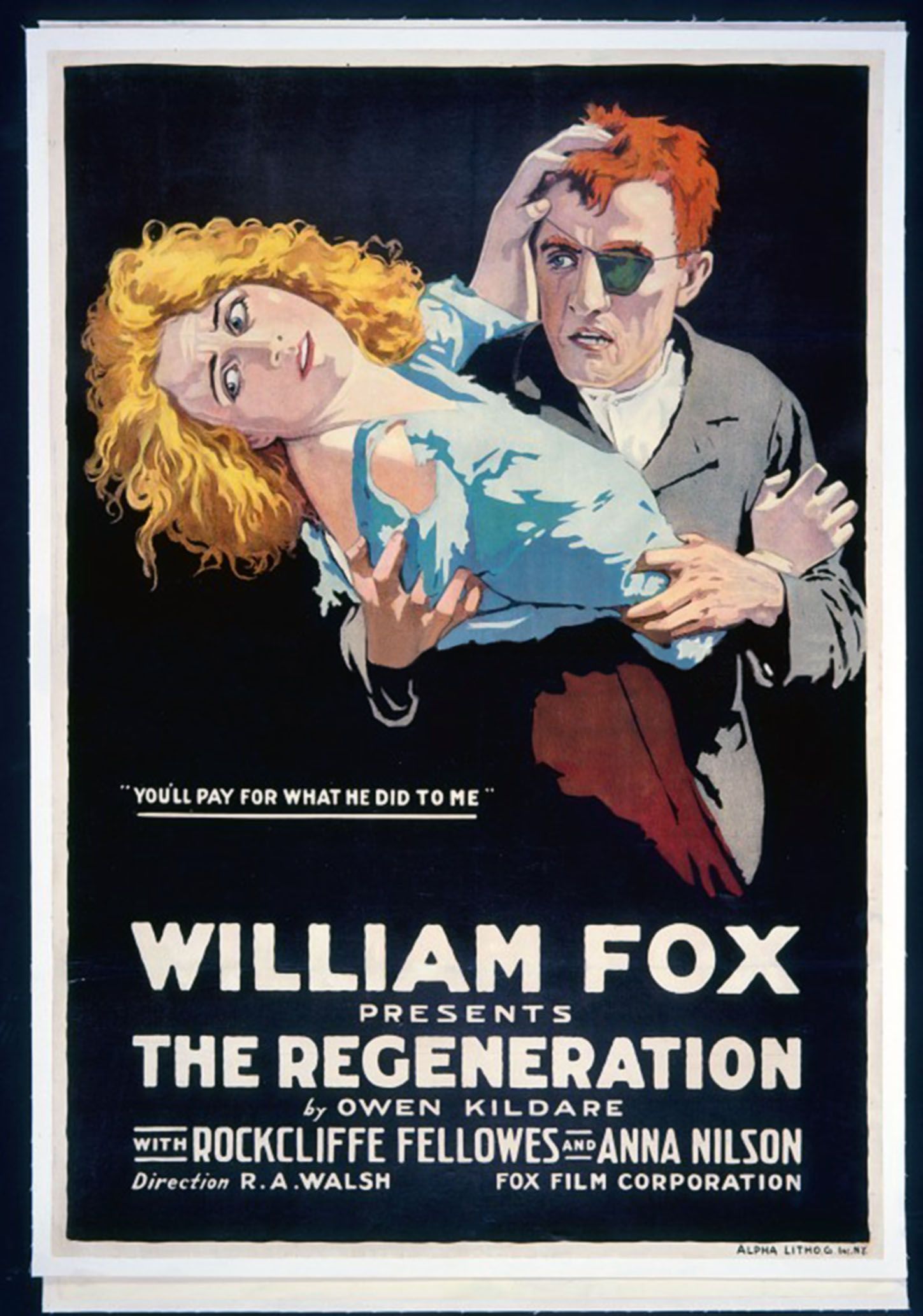
Coming Sunday, 3/26 at Town Hall Theatre: 'The Regeneration' (1915), part of silent N.Y. series

Original promotional poster for 'The Regeneration' (1915).

This Sunday, I invite you to take in a rarely screened early crime drama.

It's 'The Regeneration' (1915), which we're running on Sunday, March 26 at 2 p.m. as part of the "Salute to Silent New York" series at the Town Hall Theatre in Wilton, N.H.

I'll accompany the film, which I last played for in 2015 at the Niles Essanay Silent Film Museum in Niles, Calif.

I remember not expecting much, as early films tend to be a bit stagy and awkward. 

But 'The Regeneration' surprised me, as it really held the screen and produced a lot of dramatic tension.

It's no wonder that it was a box office smash, and still worth seeing today.

Also, 'The Regeneration' was filmed in the tenements and slums of New York City's Lowest East Side. Today, in addition to telling a strong story, it's an eye-opening look at what life in that area more than a century ago. 

More details in the press release below. Hope to see you Sunday afternoon!

*    *    *

Anna Q. Nilson and Rockliffe Fellowes star in 'The Regeneration.'

MONDAY, MARCH 20, 2023 / FOR IMMEDIATE RELEASE
For more info, contact: Jeff Rapsis • (603) 236-9237 • jeffrapsis@gmail.com

Silent crime drama 'The Regeneration' to continue Town Hall Theatre salute to the Big Apple

Early feature film to be shown Sunday, March 26 with live music; latest in series of vintage movies set in New York City.

WILTON, N.H.—Start spreadin' the news! New York City is the star of the Town Hall Theatre's series of vintage silent feature films all set in the Big Apple.

Next up is 'The Regeneration,' (1915), an early feature-length crime drama filmed on location among the slums and tenements of the city's Lower East Side.

'The Regeneration' will be shown on Sunday, March 26 at 2 p.m. at the Town Hall Theatre, 40 Main St., Wilton, N.H.

The film will be shown with live music by silent film accompanist Jeff Rapsis.

Admission is free; a donation of $10 per person at each screening is suggested to help defray expenses.

Set in New York City, 'The Regeneration' was shot on location in New York City's Lower East Side and used real prostitutes, gangsters and homeless people as extras. It was the first movie produced by Fox Film Corporation, a forerunner of the 20th Century Fox.

Cited as one of the first full-length gangster films, 'The Regeneration' tells the story of a poor orphan who rises to control the mob until he meets a woman for whom he wants to change.

The film was adapted from the autobiography of Owen Frawley Kildare, then known as "the Kipling of the Bowery."

The story follows the life of Owen (Rockliffe Fellowes), a young Irish American boy who is forced into a life of poverty after his mother dies.

As a result, Owen is forced to live on the street eventually turning to a life of crime.

Owen is eventually reformed, however, by the benevolent social worker Marie Deering (Anna Q. Nilsson). Also featured is a fire aboard an excursion ferry, much like the General Slocum disaster of 1904.

'The Regeneration' was the first film directed by Raoul Walsh, an actor whose previous roles included John Wilkes Booth in D.W. Griffith's epic 'The Birth of a Nation' (1915). Walsh would go on to direct more than 140 motion pictures.

The film was released in September 1915 to critical acclaim and was a box office hit.

In 2000, 'The Regeneration' was selected for preservation in the United States National Film Registry by the Library of Congress as being "culturally, historically or aesthetically significant."

The Town Hall Theatre's 'Silent New York' series will run on selected Sunday afternoons from March through May.

The movies range from 'The Docks of New York' (1928), a gritty melodrama set in New York's waterfront, to 'Speedy' (1928), an uproarious Harold Lloyd comedy filmed throughout New York City, and which includes a cameo by Babe Ruth.

Featured stars range from versatile actress Marion Davies to deadpan comedian Buster Keaton.

All films will be shown with live music by silent film accompanist Jeff Rapsis.

"Each of these films is a great way to see what life in New York City was like 100 years ago or more," Rapsis said. "Today, in addition to being great entertainment, they're also a vivid window into the past."

Other films in the series include:

• Sunday, April 23, 2023 at 2 p.m.: 'Lights of Old Broadway' (1925) starring Marion Davies. Set in late 19th century NYC, Davies plays twins orphaned in childhood who grow up unaware of each other but whose lives intertwine much later on, with comic and dramatic results. Lavishly produced MGM release preserved by the Library of Congress. (Originally scheduled for April 16.)

• Sunday, April 30, 2023 at 2 p.m.: 'Speedy' (1928) starring Harold Lloyd. Lloyd's final silent feature finds him at the peak of his career playing a baseball-crazed go-getter forced to rescue the business of his girlfriend's father from being destroyed by thugs. Filled with great scenes of 1920s NYC, with notable cameo by baseball's Babe Ruth.

• Sunday, May 14, 2023 at 2 p.m.: 'The Docks of New York' (1928). Set in late 19th century New York, roughneck stoker Bill Roberts gets into unexpected trouble during a brief shore leave when he falls hard for Mae, a wise and weary dance-hall girl. Intense and moving silent drama from legendary director Josef von Sternberg.

• Sunday, May 21, 2023 at 2 p.m.: 'The Cameraman' (1928) starring Buster Keaton. Keaton tries to impress the gal of his dreams by working as a newsreel photographer. Can he get a break and get the girl? Classic visual comedy with Keaton at the peak of his creative powers; set in NYC and includes 1920s shots of Midtown Manhattan and the old Yankee Stadium.

The Town Hall Theatre strives to show silent film as it was intended to be seen—in restored prints, on a large screen, with live music, and with an audience.

"All those elements are important parts of the silent film experience," said Rapsis, who will accompany the films. "Recreate those conditions, and classics of early Hollywood leap back to life in ways that audiences find surprising."

Rapsis performs on a digital synthesizer that reproduces the texture of the full orchestra, creating a traditional "movie score" sound. He improvises the complete score in real time during the screening.

"Creating a movie score on the fly is kind of a high-wire act, but it can often make for more excitement than if everything is planned out in advance," Rapsis said.

Rockliffe Fellowes stars in 'The Regeneration' (1915).

Rapsis encouraged people unfamiliar with silent film to give it a try.

"If you haven't seen a silent film the way it was intended to be shown, then you're missing a unique experience," Rapsis said. "At their best, silent films still connect with cinema-goers. They retain the power to cast a spell, engage an audience, tap into elemental emotions, and provoke strong reactions. They may be from another time, but they're new to us."

'Regeneration' (1915) will be screened on Sunday, March 26 at 2 p.m. at the Town Hall Theatre, 40 Main St., Wilton, N.H.

Admission is free; a donation of $10 per person is suggested to help defray expenses. For more information, call (603) 654-3456.

Sunday, March 12, 2023

Start spreadin' the news: 'Silent New York' series begins Sunday, 3/12 in Wilton, N.H. with screening of Marion Davies in 'Little Old New York'

Dennis at the Town Hall Theatre's popcorn machine.

This month marks a major milestone: the 50th anniversary of Dennis Markevarich taking over the stewardship of his hometown moviehouse, the Town Hall Theatre of Wilton N.H.

His tenure opened in grand style with a re-release screening of 'Gone with the Wind' (1939). And he's been at it ever since—through ups and downs, the industry's conversation to digital and, more recently, the pandemic.

Movies had been shown on and off in the old town hall since 1912. But it's unlikely that anyone will match Markevarich's record of five decades and counting of continuous service.

Exterior of the Town Hall Theatre in Wilton, N.H. No, that's not a red carpet, just a crosswalk painted for safety.

In honor of this achievement, we're honoring Dennis with a cinematic tribute to the one place he adores just as much as Wilton, N.H.

It's New York City. Starting this weekend, we're running a series of a half-dozen silent pictures set in the Big Apple, a town that blew young Markevarich's mind when he first visited on the local high school senior class trip.

It was 1964, the year of the World's Fair. And if that wasn't enough, there was Radio City Music Hall, and so much else besides.

First up is 'Little Old New York' (1923) starring Marion Davies (at left), one of 1923's top-grossing films that also happens to be celebrating the 100th anniversary of its original release.

And the only reason we can show 'Little Old New York' is because the film's transfer to digital media was accomplished via a Kickstarter campaign to which Town Hall Theatre silent film patrons contributed!

The film screens today (Sunday, March 12) at 2 p.m. Join us for a vintage historical drama set in New York City of the early 19th century. More info about 'Little Old New York' and the rest of the series is in the press release below.

 *  *  *

An original release poster for 'Little Old New York' (1923).

MONDAY, MARCH 6, 2023 / FOR IMMEDIATE RELEASE
For more info, contact: Jeff Rapsis • (603) 236-9237 • jeffrapsis@gmail.com

'Little Old New York' to open Town Hall Theatre salute to the Big Apple

Top-grossing film of 1923 starring Marion Davies to be shown Sunday, March 12 with live music; first in series of vintage movies set in New York City.

WILTON, N.H.—It's played a starring role in the movies since they were first made.

It's New York City, and the Big Apple is ready for its close-up in the Town Hall Theatre's series of six vintage silent feature films all set in America's largest city, then and now.

First up is 'Little Old New York,' (1923), a historical drama starring Marion Davies that was among the top-grossing films of 1923.

'Little Old New York' will be shown on Sunday, March 12 at 2 p.m. at the Town Hall Theatre, 40 Main St., Wilton, N.H.

The film will be shown with live music by silent film accompanist Jeff Rapsis.

Admission is free; a donation of $10 per person at each screening is suggested to help defray expenses.

In 'Little Old New York,' an Irish girl comes to early 19th century New York disguised as a boy to claim a fortune left to her brother, who has died. 

Marion Davies (at right) masquerades as a young man in 'Little Old New York.'

Lavish production values helped place the film among 1923's highest grossing pictures; the story of an Irish immigrant family makes it a great way to celebrate St. Patrick's Day.

The movie was a triumph for Marion Davies, and she was named "Queen of the Screen" and the #1 female box-office star of 1923 at the annual theater owners ball.

The rarely screened film was recently transferred from a surviving 35mm print held by the Library of Congress via a Kickstarter campaign supported in part by Town Hall Theatre patrons.

The Town Hall Theatre's 'Silent New York' series will run on selected Sunday afternoons from March through May.

The movies range from 'Regeneration' (1915), a gritty melodrama filmed on location in the slums of the Lower East Side, to 'Speedy' (1928), an uproarious Harold Lloyd comedy filmed throughout New York City, and which includes a cameo by Babe Ruth.

Featured stars range from versatile actress Marion Davies to deadpan comedian Buster Keaton.

All films will be shown with live music by silent film accompanist Jeff Rapsis.

"Each of these films is a great way to see what life in New York City was like 100 years ago or more," Rapsis said. "Today, in addition to being great entertainment, they're also a vivid window into the past."

Other films in the series include:

• Sunday, March 26, 2023 at 2 p.m.: 'The Regeneration' (1915). A powerful slum melodrama shot on location on New York's lower East Side, with a gaggle of authentic low-life types performing alongside professional actors. Directed by Raoul Walsh; one of the first U.S. feature-length films, released the same year as D.W. Griffith's 'The Birth of a Nation.'

• Sunday, April 23, 2023 at 2 p.m.: 'Lights of Old Broadway' (1925) starring Marion Davies. Set in late 19th century NYC, Davies plays twins orphaned in childhood who grow up unaware of each other but whose lives intertwine much later on, with comic and dramatic results. Lavishly produced MGM release preserved by the Library of Congress. (Originally scheduled for Sunday, April 16 but moved due to conflict.)

• Sunday, April 30, 2023 at 2 p.m.: 'Speedy' (1928) starring Harold Lloyd. Lloyd's final silent feature finds him at the peak of his career playing a baseball-crazed go-getter forced to rescue the business of his girlfriend's father from being destroyed by thugs. Filled with great scenes of 1920s NYC, with notable cameo by baseball's Babe Ruth.

• Sunday, May 14, 2023 at 2 p.m.: 'The Docks of New York' (1928). Set in late 19th century New York, roughneck stoker Bill Roberts gets into unexpected trouble during a brief shore leave when he falls hard for Mae, a wise and weary dance-hall girl. Intense and moving silent drama from legendary director Josef von Sternberg.

• Sunday, May 21, 2023 at 2 p.m.: 'The Cameraman' (1928) starring Buster Keaton. Keaton tries to impress the gal of his dreams by working as a newsreel photographer. Can he get a break and get the girl? Classic visual comedy with Keaton at the peak of his creative powers; set in NYC and includes 1920s shots of Midtown Manhattan and the old Yankee Stadium.

The Town Hall Theatre strives to show silent film as it was intended to be seen—in restored prints, on a large screen, with live music, and with an audience.

"All those elements are important parts of the silent film experience," said Rapsis, who will accompany the films. "Recreate those conditions, and classics of early Hollywood leap back to life in ways that audiences find surprising."

Rapsis performs on a digital synthesizer that reproduces the texture of the full orchestra, creating a traditional "movie score" sound. He improvises the complete score in real time during the screening.

"Creating a movie score on the fly is kind of a high-wire act, but it can often make for more excitement than if everything is planned out in advance," Rapsis said.

Rapsis encouraged people unfamiliar with silent film to give it a try.

"If you haven't seen a silent film the way it was intended to be shown, then you're missing a unique experience," Rapsis said. "At their best, silent films still connect with cinema-goers. They retain the power to cast a spell, engage an audience, tap into elemental emotions, and provoke strong reactions."

'Little Old New York' (1923) will be screened on Sunday, March 12 at 2 p.m. at the Town Hall Theatre, 40 Main St., Wilton, N.H.

Admission is free; a donation of $10 per person is suggested to help defray expenses. For more information, call (603) 654-3456.

Thursday, January 26, 2023

Head to class with Buster Keaton in 'College' (1927), screening Sunday, Jan. 29 in Wilton, N.H.


This weekend, Buster Keaton goes to 'College' (1927), with music by me, on Sunday, Jan. 29 at 2 p.m. at the Town Hall Theatre in Wilton, N.H. 

Don't miss this opportunity to chase away those mid-winter blahs with the silent comic's take on academic life. More info in the press release below.

For now, here's a brief recap on my recent whirlwind road trip last weekend to accompany silent film screenings in Detroit, Mich. and Cleveland, Ohio. 

Last Friday night it was Keaton's 'Battling Butler' (1926) at Cinema Detroit, which welcomed a nearly full house to enjoy Buster's boxing comedy.

In a sonic highlight, I got to use an authentic boxing bell that belongs to Ken Winokur, formerly of the Alloy Orchestra, who loaned it to me for the occasion. Thanks, Ken!

The next day it was off to Cleveland, where I accompanied the 1916 version of '20,000 Leagues Under the Sea' during the annual 36-hour sci-fi marathon at Case Western University.

For once I wasn't the most sleep-deprived person in the room. But actually, the audience was hugely responsive to what must have seemed like an antique curiosity to many viewers. 

By that I mean, the film doesn't exactly show silent cinema at its most eloquent. Alas, it's one of those titles that reinforces the idea of early movies as primitive ancestors of today's visual entertainment.

But it's still worth screening. And it DID keep the sci-fi marathon audience engaged throughout, inspiring shouted comments of the "Time to engage your willing suspension of disbelief!" variety.

Thanks to everyone at Cinema Detroit and the Case Western Reserve University Film Society 

And then it was back home to New England, where this past Monday I accompanied Alfred Hitchcock's early thriller 'The Lodger' (1927) at the Coolidge Corner Theatre in Brookline, Mass.

Which takes us up to the present, where I'm looking forward to accompanying Buster Keaton in 'College' (1927) at the Town Hall Theatre in Wilton, N.H.

Hope you'll enroll. See you at the theater!

*    *    *

Buster Keaton and Anne Cornwall attend 'College' (1927).

MONDAY, JAN. 16, 2023 / FOR IMMEDIATE RELEASE
For more info, contact: Jeff Rapsis • (603) 236-9237 • jeffrapsis@gmail.com

Buster Keaton comedy 'College' with live music on Sunday, 1/29 at Town Hall Theatre

Silent film series continues in Wilton, N.H. theater with screening of timeless classic send-up of campus life

WILTON, N.H.—He never smiled on camera, earning him the nickname of "the Great Stone Face." But Buster Keaton's comedies rocked Hollywood's silent era with laughter throughout the 1920s.

See for yourself with a screening of 'College' (1927), one of Keaton's landmark feature films, on Sunday, Jan. 29 at 2 p.m. at the Town Hall Theatre, 40 Main St., Wilton, N.H.

Admission is free; a donation of $10 per person is suggested to help defray expenses.

The screening will feature live music by silent film accompanist Jeff Rapsis.

'College' follows the story of a hapless university bookworm (Keaton) forced to become a star athlete to win the attention of his dream girl. Can Buster complete the transformation in time to woo her from his rival? And along the way, can he also rescue the campus from sports-related shame?

The film was released in 1927, at the crest of a national fascination with college life. In addition to being a great Keaton comedy, 'College' offers vintage glimpses into what higher education was like nearly a century ago.

Keaton, along with Charlie Chaplin and Harold Lloyd, stands today as one of the silent screen's three great clowns. Some critics regard Keaton as the best of all; Roger Ebert wrote in 2002 that "in an extraordinary period from 1920 to 1929, (Keaton) worked without interruption on a series of films that make him, arguably, the greatest actor-director in the history of the movies."

As a performer, Keaton was uniquely suited to the demands of silent comedy. Born in 1895, he made his stage debut as a toddler, joining his family's knockabout vaudeville act and learning to take falls and do acrobatic stunts at an early age.

A remarkable pantomime artist, Keaton naturally used his whole body to communicate emotions from sadness to surprise. And in an era with no post-production special effects, Keaton's acrobatic talents enabled him to perform all his own stunts, including some spectacular examples in 'College.'

In reviving Keaton's 'College,' the Town Hall Theatre aims to show silent film as it was meant to be seen—in restored prints, on a large screen, with live music, and with an audience.

"All those elements are important parts of the silent film experience," said Rapsis, who will accompany the film. "Recreate those conditions, and classics of early Hollywood such as 'College' leap back to life in ways that audiences still find entertaining."

Rapsis performs on a digital synthesizer that reproduces the texture of the full orchestra, creating a traditional "movie score" sound. He improvises the complete score in real time during the screening.

"Creating a movie score on the fly is kind of a high-wire act, but it can often make for more excitement than if everything is planned out in advance," Rapsis said.

Rapsis encouraged people unfamiliar with silent film to give 'College' a try.

"If you haven't seen a silent film the way it was intended to be shown, then you're missing a unique experience," Rapsis said. "At their best, silent films still connect with cinema-goers. They retain the power to cast a spell, engage an audience, tap into elemental emotions, and provoke strong reactions."

The Town Hall Theatre's silent film series was recently featured in the weekly HIppoPress in a story about discovering life-enriching activities and hobbies.

Buster Keaton's 'College' (1927) will be screened on Sunday, Jan. 29 at 2 p.m. at the Town Hall Theatre, 40 Main St., Wilton, N.H.

Admission is free; a donation of $10 per person is suggested to help defray expenses. For more information, call (603) 654-3456. 


Saturday, April 30, 2022

On Sunday, May 1 in Wilton, N.H.: 'Man With A Movie Camera,' innovative silent documentary filmed in Ukraine

A Russian-language poster for the documentary 'Man With A Movie Camera' (1929), shot largely in Ukraine. 

This Sunday, it's a double-header!

First, at 2 p.m., a screening of the silent documentary 'Man With A Movie Camera' (1929) at the Town Hall Theatre of Wilton, N.H. Lots more about that in the press release below.

After that, I scoot over Temple Mountain to the Park Theatre of Jaffrey, N.H., where I'll accompany Harold Lloyd's 'Grandma's Boy' (1922) for the venue's 100th birthday celebration, which starts at 5 p.m. 

More info about the Park's big celebration (it's a fund-raising, with tickets $50 each) is online here.

But first, kudos to the audience for last night's screening of 'Old Ironsides' (1926) at the Custom Home Maritime Museum in Newburyport, Mass.

Packed into an upstairs exhibit room that became an impromptu movie theater, the Friday night crowd was with the picture right from the start, with big reactions throughout. 

Everyone seemed to really get into the tale of the early days of the U.S.S. Constitution, which remains afloat a short distance down the coast in Boston Harbor. People cheered the action, gasped at the love story, and roared at the comedy.

George Bancroft and Esther Ralston at the wheel in 'Old Ironsides' (1926).

Why? Well, sometimes it just clicks. In this case, I think it was a combination of the right space (small, but nearly standing room only for the 40 attendees, which creates energy and excitement) and a really good match of subject matter and audience interest.

In this case, 'Old Ironsides' formed a celebration of sailing ships from long ago, which you'd have to expect would go over well at a maritime museum.

During one of the picture's extended battle scenes, one very nice lady contributed to the sonic mayhem by having her cell phone go off repeatedly. I didn't mind this, once I realized her ring-tone was not coming from my synthesizer. 

But still. Note to self: don't neglect to tell people to turn off their devices. Pacemakers excepted.

About Sunday's screening of 'Man With A Movie Camera'—most of this ground-breaking documentary (it's more like an early music video, actually) was shot in and around Kiev and Odessa, then part of the Ukrainian Soviet Socialist Republic, and now part of the independent nation of Ukraine.

A lot of the sickening destruction going on in Ukraine involves these cities and the people living in them. Because 'Man With A Movie Camera' celebrates these people and their lives, I felt it was only appropriate to get the film on the screen right now.

Seeing it will remind us, I hope, of the huge human tragedy that's unfolding there right now. These are real people in a real place with a long and proud history.

At the risk of sounding flippant, here's what I didn't put in the press release. 

I felt it was only appropriate to show the film on May Day, which back in the days of the Soviet Union (which Vladimir Putin would like to return to) was often an occasion for parades of military hardware through Red Square. 

Instead, let's use the day to celebrate images of ordinary daily life in Ukraine, even if they're from long ago, as a way to thumb our collective noses at the inhumane bastard in the Kremlin.

*  *  *


A scene from Dziga Vertov's eye-opening film 'Man With A Movie Camera' (1929).

MONDAY, APRIL 18, 2022 / FOR IMMEDIATE RELEASE
Contact Jeff Rapsis • (603) 236-9237 • jeffrapsis@gmail.com

Filmed in Ukraine: 'Man With A Movie Camera' with live music on Sunday, May 1 in Wilton, N.H.

Feature-length silent documentary made in Kiev, Odessa regarded as world's first extended music video; May Day screening is "gesture of defiance"

WILTON, N.H.—It has no story, but it tells everyone's story. It's a silent film, but it's the world's first music video. It has no actors because the star is you, the audience.

It's 'Man With A Movie Camera' (1929), director Dziga Vertov's celebration of city life in Ukraine via a dizzying collage of images and kinetic cinematography that's left audiences breathless for nearly a century.

The film was shot largely in Kiev and Odessa, cities that were then in the Soviet Union but which are today part of an independent Ukraine.

'Man With A Movie Camera' will be shown on Sunday, May 1 at 2 p.m. at the Town Hall Theatre, 40 Main St., Wilton, N.H.

Admission is free; a donation of $10 per person is suggested to help defray expenses.

The screening will feature live accompaniment by Jeff Rapsis, a New Hampshire-based composer who specializes in creating scores for silent films.

Dziga's experimental documentary caused a sensation when it was released at the end of the 1920s, when motion pictures were still a new artistic medium.

Even with no story and no actors, 'Man With A Movie Camera' was filled with eye-popping visuals that anticipated later music/image films such as 'Koyaanisqatsi.'

Today, the scenes of ordinary life in Kiev and Odessa possess a special poignance due to recent and ongoing Russian military attacks.

"In the Soviet Union, May Day (May 1) was a holiday used to promote solidarity, with military parades a common feature," Rapsis said.

"We chose to program 'Man With a Movie Camera' on this day as a symbolic gesture of defiance against Vladimir Putin's aim to reestablish a Soviet-style empire of client states, including Ukraine," he said.

The screening will include a display of authentic Soviet-era propaganda posters and banners that Rapsis collected during visits to the region in 1991 and 1992, when the Soviet Union was collapsing.

Although no official score was composed for the silent feature, director Vertov specified the type of music that he wanted played wherever the film was screened. Rapsis will create music that follows those guidelines.

"Vertov wanted a kind of kinetic, energetic music to be played with the film, rather than background music," Rapsis said. "The goal is to create music that acts as an equal partner in conveying a kind of exhilaration that I think Vertov was going for."

Filmed mostly in the bustling Ukrainian cities of Kiev and Odessa in the late 1920s, the film features a wide range of slice-of-life scenes showing everything from streetcars to sports contests. Vertov took his camera everywhere, from a birth hospital to a divorce court.

Most spectacularly, Vertov experimented with filming ordinary scenes (such as a crowded public square) at a very slow frame rate. When run at a normal speed, the result was a speeded-up view of reality that few had ever seen or studied before.

He also experimented in the other direction: scenes of athletic events are shown in extreme slow motion, so the human form can be observed in ways never before possible.

Yelizaveta Svilova seen in the film editing the film we're seeing. Figure that one out!

Vertov's wife, Yelizaveta Svilova, was an equal partner in creating 'Man With A Movie Camera,' editing the film. She also appears in the film, editing it as we're watching it.

"It's a film filled with self-referential puzzles and meta moments," Rapsis said. "It also plays like a piece of visual music, with fast sequences followed by slow ones and moods that often change."

"Although 'Man With A Movie Camera' has some dark scenes, ultimately it's a celebration—of life in what was then the fast-changing Soviet Union, but also in a way that speaks to life regardless of time or place," Rapsis said.

"That's what I'll try to capture in the musical score, which will be performed live and will be largely improvised," Rapsis said.

‘Man With A Movie Camera’ will be shown with live music on Sunday, May 1 at 2 p.m. at the Town Hall Theatre, 40 Main St., Wilton, N.H.

Admission is free; a donation of $10 per person is suggested to help defray expenses.

For more info, visit www.wiltontownhalltheatre.com or call (603) 654-3456.