Showing posts with label Brattle Cinema. Show all posts

Sunday, September 27, 2026

Up next: 'Sunrise' at the Brattle Theatre in Cambridge for Silent Movie Day on 9/29

George O'Brien and Margaret Livingstone in 'Sunrise' (1927) directed by F.W. Murnau.

There's still no Hallmark greeting cards yet, but this Tuesday marks yet another Silent Movie Day. 

This year, I'm marking the occasion by accompanying 'Sunrise: A Song of Two Humans' (1927) at the venerable Brattle Theatre in Cambridge, Mass. 

Alas, the Brattle is the only venue in the Boston area that I know of that observes 'Silent Movie Day' with at least some silent film programming. 

Two years ago, the good folks at the Brattle let me accompany the restored version of Abel Gance's 'La Roue' (1923)—all seven hours of it in one day! We started at noon and, with some brief breaks between the four parts, finished at about 8:30 p.m. 

The celebration this year is a bit more modest: the Brattle ran some Chaplin shorts last Friday, and then on Tuesday it's me accompanying 'Sunrise' in a new restoration. 

Show your support for Silent Movie Day by journeying to the Brattle and joining us. Showtime is at 6:30 p.m.—ironically, at about dusk.

More info about the film and the screening is found in press release below.

*     *     * 

Original poster for the release of 'Sunrise' (1927).

TUESDAY, SEPT. 15, 2026 / FOR IMMEDIATE RELEASE
Contact Jeff Rapsis • (603) 236-9237 • jeffrapsis@gmail.com

Academy Award-winning drama 'Sunrise' to screen on Tuesday, Sept. 29 at Brattle Theatre

Silent film won three honors at first-ever Academy Awards, including 'Best Actress' for Janet Gaynor; show features live musical accompaniment

CAMBRIDGE, Mass.—Silent film on the big screen with live music returns to the Brattle Theatre, 40 Brattle St., Cambridge, with the Academy Award-winning romantic drama 'Sunrise' (1927) on Tuesday, Sept. 29 at 6:30 p.m.

The screening of 'Sunrise,' starring Janet Gaynor and George O'Brien, is in honor of international 'Silent Movie Day,' which is celebrated each year on Sept. 29.

Admission is $15.50; $13.50 for members/students/seniors. Tickets available online at brattlefilm.org or at the door.

The screening will feature live music by Jeff Rapsis, a New Hampshire-based musician who specializes in live accompaniment for silent films.

Gaynor, a popular female star of the silent film era, won the first-ever Academy Award for Best Actress for her performance in 'Sunrise.' The movie took top honors in cinematography and was also recognized for "Unique and Artistic Production" at the inaugural awards.

Janet Gaynor and George O'Brien in a happier moment in 'Sunrise' (1927).

'Sunrise' tells the story of a young country couple (played by Gaynor and O'Brien) whose marriage is threatened by the presence of a woman from the city (Margaret Livingston) who convinces the man to abandon his wife. Will the young husband go through with a plan to kill his wife? Will true love overcome the obstacles of temptation and the promise of short-term pleasure?

'Sunrise' was directed by F. W. Murnau, a German filmmaker and one of the leading figures in German Expressionism, a style that uses distorted art design for symbolic effect. 'Sunrise' was made when Murnau was invited by studio chief William Fox to make a film in Hollywood.

The resulting movie features enormous stylized sets that create an exaggerated, fairy-tale world. The city street set alone reportedly cost over $200,000 to build, a huge sum at the time. Much of the exterior shooting was done at Lake Arrowhead, Calif.

Janet Gaynor and George O'Brien in 'Sunrise' (1927).

Full of cinematic innovations, the groundbreaking cinematography (by Charles Rosher and Karl Struss) featured moving cameras and impressive tracking shots. Titles appear sparingly, with long sequences of pure action and most of the story told in Murnau's signature visual style. The extensive use of forced perspective is striking, particularly in a shot of the city with normal-sized people and sets in the foreground and smaller figures in the background by much smaller sets.

The story of 'Sunrise' is told as a visual allegory with few specific details. The characters have no names, and the setting is not named in order to make the tale more universal and symbolic.

With a full title of 'Sunrise: A Song of Two Humans,' the film is regarded as one of the high points of the silent cinema. In 1988, it was selected for preservation in the National Film Registry of the U.S. Library of Congress for films that are "culturally, historically, or aesthetically significant." The Sight and Sound poll of 2012 for the British Film Institute named 'Sunrise' the fifth-best film in the history of motion pictures by critics, and 22nd by directors.

An original poster promoting 'Sunrise' (1927).

Critics continue to hail 'Sunrise' as one of the best films of all time.

"F.W. Murnau's 'Sunrise' conquered time and gravity with a freedom that was startling to its first audiences," wrote Roger Ebert in 2004. "To see it today is to be astonished by the boldness of its visual experimentation.

Rapsis, who uses original themes to improvise silent film scores, said great silent film dramas such as 'Sunrise' used their lack of dialogue to create stories that concentrated on the "big" emotions such as Love, Despair, Anger, and Joy. Because of this, audiences continue to respond to them in the 21st century, especially if they're presented as intended — with a live audience and live music.

"Dramas such as 'Sunrise' were created to be shown on the big screen as a communal experience," Rapsis said. "With an audience and live music, they come to life as their creators intended them to. So the screening of 'Sunrise' on Silent Movie Day 2026 is a great chance to experience films that first caused people to fall in love with the movies," he said.

'Sunrise' will be shown with live music on Tuesday, Sept. 29 at 6:30 p.m.at the Brattle Theatre, 40 Brattle St., Cambridge, Mass.

Admission is $15.50; $13.50 for members/students/seniors. Tickets available online at brattlefilm.org or at the door.For more info, call (617) 876-6837.


Saturday, October 1, 2022

Silent Movie Day 2022: On the joys of combining silent film music with long-haul trucking

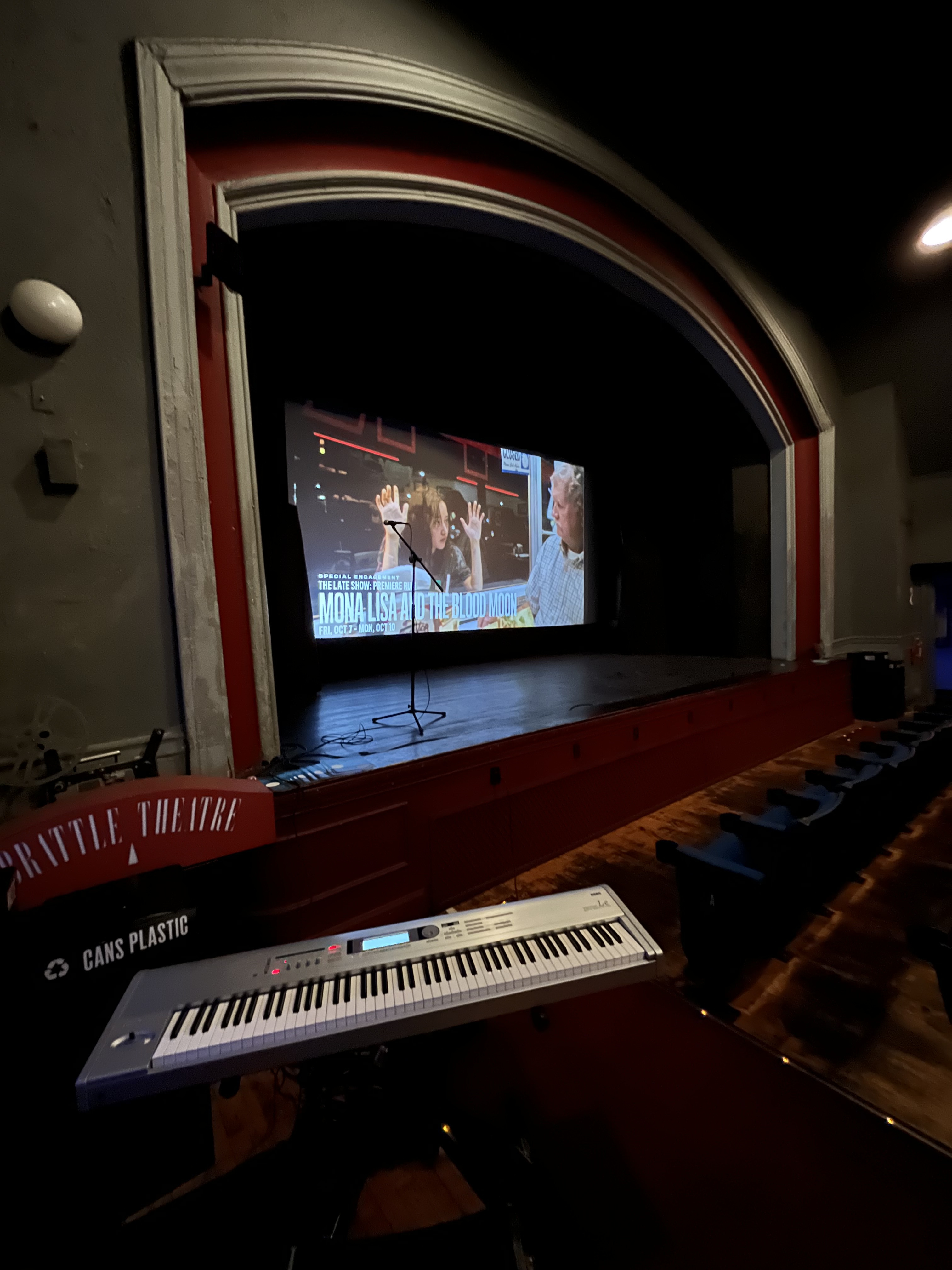
My set-up at the Brattle, just before embarking on a 4½-hour journey with Fritz Lang's 'Dr. Mabuse, Der Spieler.'

Well, that put the "odd" in odyssey!

I'm just back after a silent film swing that took me to screenings in Cambridge, Mass., Detroit and Cleveland, and then back again—all in less than three days.

This was all in support of this year's 'Silent Movie Day' on Thursday, Sept. 29, but which in my case also involved accompanying extra screenings on the days before and after it.

So for me, Silent Movie Day was actually three days in a row, each featuring a BIG (meaning lengthy) title.

First up: On Wednesday, Sept. 28, I left home in New Hampshire at 4 p.m. to make the one hour drive to Cambridge, Mass. 

That evening, the venerable Brattle Cinema (just off Harvard Square) screened Fritz Lang's 'Dr. Mabuse, The Gambler' (1922), the sprawling two-part crime thriller that clocks in at 4½ hours. Yes, I played for it all, starting at 6 p.m. and ending just before 11 p.m.

After that, I loaded my keyboard and sound gear back onto the Forester, then hopped on the Massachusetts Turnpike (a.k.a. I-90) and headed west for Detroit, Mich. Buoyed by a brief catnap at a rest area in Utica, N.Y., I pulled into the Motor City in mid-afternoon.

At Cinema Detroit, where masks are still required out of an abundance of caution.

That night (Thursday, Sept. 29), Cinema Detroit celebrated Silent Movie Day with another sprawling Lang epic, 'Woman in the Moon' (1929), with live accompaniment by me. Clocking in at 2¾ hours, it seemed like a short subject compared to 'Mabuse.'

The next day (Friday, Sept. 30), I backtracked to Cleveland, where that evening I did live music for the the Cleveland Cinematheque's screening of another silent epic: Erich von Stroheim's 'Greed' (1924).

Talk about length! Von Stroheim originally planned an eight-hour running time, and then created a four-our version before the studio finally took it from him and released a version that runs about 2½ hours, which is what we saw at the Cinematheque.

Strangely, at that length, 'Greed' turned out to be the shortest feature of the trip.

Also on the bill at Cleveland: a newly discovered industrial promotion film, 'The Heart of Cleveland' (1924), a half-hour commercial for the wonders of electricity that was filmed and shown in the city. 

What a surprise! Featuring shots of a family touring giant industrial facilities, it anticipated Dziga Vertov's 'Man With The Movie Camera' by several years. More on the film (and a link to the video) is here. 

The Cinematheque audience just before Friday night's screenings. Taken from the keyboard with the fisheye lens on my new iPhone 13.

Afterwards, I loaded my gear and pointed the Forester east on I-90 to take me back home via the N.Y. State Thruway. After a brief catnap (again in Utica, N.Y.), I arrived home at 10:30 a.m.—exactly 66½ hours and 1,705 miles later.

Out of those 66½ hours, I was at the keyboard improvising music for more than 10 of them. That's a lot of music to spin out in live performance over three days. 

The only concession to the sheer quantity of scoring needed was that I allowed myself to use some common motifs that worked for all three films. Usually I'd try to avoid recycling material,

What motifs? The most common was a simple sequence of three descending notes: D, C#, G, with the last being held. You can build amazing things with this! (Only now do I realize it's a slight twisting of the opening notes of Rachmaninoff's very familiar 'Prelude in C# minor.')

Okay, now for the big question: Why do a stunt like this? Why combine silent film accompaniment with the romance of long-haul trucking?

Well, partly to challenge myself, and to see if I really could do it. Did I have the mental and physical stamina to get through this marathon?

Turns out I did, mostly. Only twice did I catch myself going into a mild "swoon" state on the piano bench: once near the start of Part II of 'Dr. Mabuse' (about three hours into the movie), and then near the end of 'Greed.'

Both times I felt a wave of wooziness wash over me, and so did a mental check to make sure it wasn't the symptom of some larger Fred-Sanford-like attack coming on. ("It's the big one, Weezy, I'm coming to join yez!") 

In both cases, while being so absorbed in creating music, I had apparently stopped breathing. So I began breathing again, and all was well.

Otherwise, everything about this escapade fell into place quite nicely. No giant traffic delays, no car troubles, no unexpected weather.

The main cast of Fritz Lang's lunar voyage epic, 'Woman in the Moon' (1929).

The only concern came at Cinema Detroit, where the heat was cranked up prior to 'Woman in the Moon,' making the house way to warm for me to survive 2¾ hours in live improv mode. 

I was preparing to strategically disrobe if necessary, but they turned off the heat before the show started and all went fine.

Another reason to do this was to take advantage of 'Silent Movie Day' (which only started last year) to engineer something of a deep dive for myself: to do music for a series of longer films to see how that would affect the music-making, if at all.

I find a longer film of any type often affords enough running room to thoroughly explore whatever musical material I'm working with. With films that run two, three or four hours, you do things that just aren't possible with a film that runs an hour and change. 

Counter-intuitively, I find shorter films far more demanding to score effectively, as everything's more tightly wound, especially with comedies. Often there's just no slack to lose yourself and come up with natural and effective scoring, at least the way I do it.

Talk about trances: a scene from 'Dr. Mabuse, Der Spieler.'

So my mini-marathon of 10 hours was a chance to push myself as deeply as one can go into the wide open spaces of improv. And it did just that: near the end of Part 1 of  'Mabuse,' I was so completely absorbed when I realized I had no idea what the actual time was.

The Brattle has a wall clock up above where I was sitting, so I glanced up and saw: 8:35 p.m. So something like half-way through, with hours still to go. And I then dove back into the trance-like state, once again completely absorbed in translating images into music to help the film cast its spell.

I can't speak for other accompanists, but I love those rare times when a movie absorbs you so completely that you lose sight of the beginning and the end. You always know they're there, of course, but the movie is so big that both start and finish lie well beyond the horizon. 

It's those times when I feel free to do what I think is my best work—where all the second-guessing subsides and the music flows naturally, as if in a dream. It's always underpinned by constant calculating and anticipation and so on, but all that becomes second nature in a way that never happens when you're playing, say, a one-reel Snub Pollard comedy. 

So in terms of losing myself, I have to say I got ample doses of that with all three films. But 'Mabuse' stands out as unique, in that the sheer quantity of time to be playing live, and then knowing that I would launch myself westward in the wee hours of the morning, creating a sense of being alive and in the moment that made 'Silent Film Day' worth all the effort. 

A scene from 'Dr. Mabuse, Der Spieler.'

Audiences were generous with their reactions both during the screenings and afterwards. The Brattle Mabuse marathon attracted about 35 people (more than expected) who were welcomed by creative director Ned Hinkle as the "hard core."

Ned mentioned that he'd wanted to program the whole Mabuse saga in one big gulp, and the film's 100th anniversary plus Silent Film Day seemed to be the right occasion for it. 

However, at first he hadn't considered live music because he couldn't imagine anyone wanting to tackle the whole thing in one evening. Little did he know!

As far as I could tell, everyone at the Brattle stayed to the end, at which point they lustily cheered the film. In fact, we seem to have ended with significantly more people than when we started. 

Afterwards, I spoke with several people who had no idea they were in for such a long haul. It's one thing to see "270 minutes" in the listing, but quite another to do math.

I also talked with a young guy who turned out to be a visiting student from China who'd been in the U.S. for all of three weeks. He could not be more enthusiastic about the programming at the Brattle, which he's apparently attended every evening since his arrival.

I was glad to hear this, but couldn't help thinking he's not quite getting a very accurate impression of life in America.

At Cinema Detroit, a good-sized crowd remained engaged and reacted noisily throughout 'Woman in the Moon.' A high point was when the Walter Turner character played by Fritz Rasp does his "quick change" into another character and back again right before our eyes, which produced bursts of astonished laughter.

I think one thing that helped was that for the first time ever, I had a distinct musical signature for this character that I used only when he was on screen, and then never again except for that one moment when he reappears as if by magic. 

With its one-of-a-kind mix of prescient sci-fi and completely erroneous assumptions about space travel, 'Woman in the Moon' produced the "gaping mouths" reaction that only it can do. 

The one thing I forgot to mention beforehand was that although the film is a serious drama, it contains a great deal of comedy that was intended to break the tension. For modern audiences who often don't know what to make of what they're seeing, it helps to give people permission to laugh.

But the Cinema Detroit audience seemed to get this without any prompting. Several big laugh moments stand out in my mind as highlights of the communal experience.

In Cleveland, 'Greed' attracted something like 80 people, which Cinematheque director John Ewing observed was the largest in-person attendance of any screening since the pandemic. 

(That's John at left, at the podium, which renders him invisible where I sit below at the keyboard.)

Fortified by a meal at 'L'Albatross,' my favorite restaurant in all of North America (no kidding!), and knowing I was in the home stretch of my marathon, I pushed myself to rise to the challenge of scoring von Stroheim's legendary lost masterwork. 

And that's all I remember. Well, not really, but kinda sorta. It takes awhile to awaken from that dream state.

The next thing I knew, I was on I-90, heading east through Ashtabula, Ohio, and wondering if it had all been a dream. In other words, success!

Many thanks to the many people who made this Silent Movie Day oddysey possible, especially Ned Hinkle and Ivy Molan of the Brattle Cinema in Cambridge, Mass.; Paula and Tim Guthat at Cinema Detroit; and John Ewing and Genevieve Schwartz at the Cleveland Cinematheque. 

(And a special thanks to Genevieve for joining me on the L'Albatross pilgrimage, which included visiting a side street paved with wood.)

All of these people remain willing to include silent film with live music as part of their programming—not just on Silent Movie Day, but at any time. I think that's something worth celebrating all year long.

Well...after a phenomenally busy September full of challenging live performances, I'll be taking a bit of a break now. As I said earlier this month to the audience after doing live music for Louis Feuillade's 'Les Vampires' (1915), which is 7½ hours long: "I'm going to lie down now."

But look out, as here comes Halloween! This year's schedule is highlighted by numerous screenings of 'Nosferatu' (1922) to mark the 100th anniversary of its release.

There's also a rare three-screenings-in-one-day on Saturday, Oct. 29, when I'll do 'Nosferatu' in the afternoon in Jaffrey, N.H., then 'Der Golem' in the evening in Ogunquit, Maine, and then a midnight screening of the reconstructed 'London After Midnight' at the Coolidge Corner Cinema in Brookline, Mass. 

One day, three screenings, three states. 

Anyone want to book a morning screening in Rhode Island that day to make it four?

If we start at 6 a.m., we can fit in the entire 'Dr. Mabuse' saga, with plenty of time for lunch...

Friday, September 23, 2022

New on the schedule: 'Dr. Mabuse' epic on Wednesday, Sept. 28 at the Brattle Cinema

Rudolf Klein-Rogge stars as the title character in Frtiz Lang's 'Dr. Mabuse, The Gambler' (1922).

Greetings from Iola, Kansas, where I'm looking forward to this weekend's 'Buster Keaton Celebration.' More about that in just a bit.

Right now, I'm super-excited to announce that a last-minute addition turned this year's 'Silent Film Day' (coming up on Thursday, Sept. 29) into something of an event for this accompanist. 

Just yesterday, the venerable Brattle Cinema in Cambridge gave the go-ahead to add live music (by me) to their planned screening of 'Dr. Mabuse, the Gambler' (1922) on Wednesday, Sept. 28.

Yes! I was hoping they would, as Fritz Lang's first 'Mabuse' is rarely programmed (one reason: it's 4½ hours long!) and the chance to do live music for it is a rare opportunity for an accompanist.

But the call has come, and thus I'm spreading the word to one and all: join us on Wednesday, Sept. 28 at 6 p.m. (note the early start time) for a cinematic experience you will not forget. 

The full press release for the 'Dr. Mabuse' screening is pasted in below. There's a lot about this film that I find fascinating, and I hope you'll be on hand at the Brattle to experience it as intended: in a theater, on the big screen, with live music, and (most importantly!) an audience. 

 And 'Dr. Mabuse' is added to a 'Silent Movie Day' performance schedule that finds me at Cinema Detroit the very next day to do live music for another great Lang epic: 'Woman in the Moon' (1929). It's known as 'Frau im Mond' in German, as in the poster at right.

And at just 2¾ hours, it's a relative trifle compared to 'Mabuse.' 

Actually, it's another terrifically ambitious movie that will blow the minds of people who have not yet seen it. And it's full of wonderful opportunities for music to augment the story and add to the experience. The screening starts at 7 p.m.

And after that, on Friday, Sept. 30, I'm at the Cleveland Cinematheque to do music for Erich von Stroheim's legendary epic 'Greed' (1924), which the director planned to run 8 hours before the studio took control and cut it down to a more manageable 2½ hours. 

(Various edits and reconstructions of 'Greed' have been produced over the years. The version being shown in Cleveland runs a tight 109 minutes.)

Gilbert Gowland (center) stars in 'Greed' (1924).

The Cinematheque screening also includes a local curiosity: 'The Heart of Cleveland, a recently rediscovered silent promotional film in which some 1920s farm children living without modern conveniences outside of Cleveland travel to the big city to learn what electricity can do.

The Cleveland "re-premiere" of 'The Heart of Cleveland' starts at 6:30 p.m., with 'Greed' to follow at 7 p.m. 

You know your doing your part to honor Silent Film Day when, over three days, the shortest film you're accompanying is von Stroheim's 'Greed.'

So that's the news from Iola, where tomorrow I'll accompany two Keaton features: 'The Cameraman' (1928) and 'Steamboat Bill, Jr. (1928). If you're in the southeastern Kansas area, stop by! If you're anywhere else, you have a whole day to get here!

Here's the press release for the screening of 'Dr. Mabuse, Der Spieler' (1922) on Wednesday, Sept. 28, at 6 p.m. at the Brattle:

*   *   *

Pick a disguise: the many faces of Dr. Mabuse.

FRIDAY, SEPT. 23, 2022 / FOR IMMEDIATE RELEASE
Contact Jeff Rapsis • (603) 236-9237 • jeffrapsis@gmail.com

Live music added to Brattle Cinema's 9/28 screening of early epic thriller 'Dr. Mabuse'

Pioneering four-hour silent drama about criminal mastermind to run on Wednesday, Sept. 28 in honor of 'Silent Film Day'

CAMBRIDGE, Mass.—It's a story so big, it takes more than four hours to tell.

It's 'Dr. Mabuse, the Gambler,' a landmark crime thriller that pushed the boundaries of cinema and story-telling when it hit theaters in 1922.

The rarely screened early masterpiece from German director Fritz Lang will be presented at the Brattle Cinema on Wednesday, Sept. 28 starting at 6 p.m.

Admission is $14 per person; $12 for members, seniors, children, and students.

An original improvised musical score for 'Dr. Mabuse' will be performed by silent film accompanist Jeff Rapsis of Bedford, N.H.

"Live music makes any screening of a silent film a one-of-a-kind event," said Rapsis, who will play continuously during the four-hour-plus epic.

Rapsis aims to use music to bring out the story's many shifts and turns, and also enhance the dark atmosphere that permeates Lang's sprawling film.

The Brattle has scheduled 'Dr. Mabuse' as part of a three-day observance of this year's Silent Film Day, which falls on Thursday, Sept. 29.

Other screenings include a program of short comedies starring Buster Keaton on Thursday, Sept. 29 and the early horror classic 'Nosferatu' (1922) on Friday, Sept. 30.


'Dr. Mabuse' was a daring project by director Fritz Lang, who would later helm 'Metropolis' (1927) and a host of early screen classics, including two sequels to the Mabuse story.

Based on a contemporary novel by Norbert Jacques, 'Dr. Mabuse' (pronounced "ma-BOO-seh") tells the story of a criminal mastermind who uses disguises and hypnosis to defraud and control his wealthy victims.

Set in Germany after World War I, the movie aimed to capture the chaotic and unreal nature of life in Berlin at the time.

It also became the template for the criminal espionage film genre, with its atmosphere of intrigue, treachery and deceit among sophisticated high society.

'Dr. Mabuse' was created at a time when European cinema was not subject to now-accepted constraints of length or scope.

Lang's completed film runs an extraordinary 4½ hours and is divided into two parts.

The first part, 'The Great Gambler: A Picture of the Time,' introduces Dr. Mabuse and his criminal enterprises, which include extortion, stock market manipulation, and swindling the wealthy elite.

The second part, 'Inferno: A Game for the People of our Age,' continues the story, which includes assassination, a scene of mass hypnosis in a theater, a daring escape through sewers, and a melodramatic climax.

"This is filmmaking on a grand scale," said Rapsis, who will improvise a musical score using new material he's composed for the Brattle screening. .

"For movie fans, the rare chance to see Lang's ground-breaking film on the big screen with live music is not to be missed."

'Dr. Mabuse' stars actor Rudolf Klein-Rogge in the title role. Klein-Rogge frequently collaborated with Lang, playing the iconic role of scientist Rotwang in 'Metropolis' and criminal mastermind Haghi in Lang's 'Spies' (1928).

During production, 'Dr. Mabuse' had its share of behind-the-scenes drama. Lang began an affair with screenwriter Thea von Harbou, who at the time was married to Klein-Rogge. Her separation from Klein-Rogge was amicable, however, and did not interfere with the film. Ultimately, Lang married von Harbou; the three then worked on several subsequent films.

Upon its release, critics hailed 'Dr. Mabuse' as an example of cinema's story-telling and artistic potential.

The Berliner Zeitung called the first part "the attempt to create an image of our chaotic times" and went on to state that it "will give people fifty or one hundred years from now an idea of an age that they could hardly comprehend without such a document."

Film-Kurier praised Klein-Rogge's "brilliant performance" and Lang's "sensitive yet experienced" direction.

'Dr. Mabuse' wasn't released in the United States until 1927, and then only in an edited-down two-hour version that proved unsuccessful.

Today, contemporary critics recognize the original 'Dr. Mabuse' as Lang's earliest masterpiece and a lasting achievement.

"Mabuse remains memorable for the darkly brooding atmosphere that Lang creates, a disturbing compound of hysteria and fatalistic passivity.”
– John Wakeman, World Film Directors Volume 1.

Both parts of 'Dr. Mabuse, The Gambler' (1922) will be shown on Wednesday, Sept. 28 at 6 p.m. at the Brattle Cinema, 40 Brattle St., Cambridge, Mass. (Please note the early start time.)

Admission is $14 per person; $12 for members, seniors, children, and students. To buy tickets online, visit www.brattlefilm.org or contact the box office at (617) 876-6837.


Monday, January 21, 2013

Coming up next in Boston:
'Faust' on Wednesday, Jan. 23 at the Brattle

The great Emil Jannings in extreme make-up as Mephisto in 'Faust' (1926).

Although I generally favor good over evil, it's my honor to play a part in the Brattle Theatre's ongoing "Dead of Winter: Satan on Screen" series.

To that end, I'll be providing live music for a screening of the great F.W. Murnau film 'Faust' (1926) on Wednesday, Jan. 23 at 7 p.m. Alas, this was just arranged last week, so there hasn't been time for a lot of advance publicity.

Still, Satan always draws a crowd, so I'm looking forward to helping bring the devil to life this week at the Cambridge revival house, which continues to offer great film of all eras all year round on the big screen in a theater.

I'm coming off a recent spurt of silent film activity -- a 10-day period that saw five separate shows in widely varying venues. Here's a summary of what I learned.

- W.C. Fields remains enough of an iconic figure for today's audiences to respond readily to his silent films. A screening of 'Sally of the Sawdust' (1925) on Thursday, Jan. 10 in Plymouth, N.H. draw a warm response from a crowd of about 50 people. I think D.W. Griffith's ability to structure a story for maximum audience response was a big help, but Fields himself really carried the picture. People really seemed to like Carol Dempster as well. I found the music for this really fell together nicely.

- A screening of 'Battling Butler' (1926) on Tuesday, Jan. 15 showed that even "lesser" Keaton has the power to hold an audience. I hadn't done this one before (it's the last of Keaton's features that I'd yet to tackle) and I was curious what the reaction would be, as it lacks the usual Keaton all-outdoors climax on a grand scale. Our audience of about 40 people at the Manchester (N.H.) City Library enjoyed it thoroughly, although the opening scenes of Buster ineptly hunting did not create nearly the reaction I thought they would. However, the training sequences in the boxing camp (which I've always thought were pretty routine) produced gales of laughter. Go figure. And, surprise again, Keaton's fight-in-close-quarters climax actually works very well in a theater. I liked the music for this, as I was able to invent a "rah rah" sports march that was useful throughout the score.

- Our encore showing of Fritz Lang's forgotten epic 'Woman in the Moon' (1929) on Wednesday, Jan. 16 attracted about 30 people to the screening room of Red River Theatres in Concord, N.H., where a screening on New Year's Eve had been sold out. Musically, I think I had better material on hand this time around, and so it was more satisfying on that score. This film continues to amaze me, and our audience seemed astonished, too. Even after a three-hour movie, we had a lively question-and-answer session.

- On Friday, Jan. 18, I made the trek to one of my favorite events: the annual "Arisia" science fiction and fantasy convention, held at the Westin Hotel in downtown Boston. This four-day event attracts more than 3,000 attendees, many dressed in elaborate costumes, and is diverse enough to include a silent film screening with live music. This year's entry was 'The Lost World' (1925), in the form of a truncated 16mm show-at-home print that still managed to hold the audience of about 50 people in a large conference room that doubled as the convention's film theater. (Four full days of film, much of it in 35mm!) With all the distractions of trying to unload my gear, get it up to the theater, find parking, etc., it was not easy to pull my head together for the score, but I felt it held together well enough. What really made it worthwhile, however, was the crowd reaction: lively from the start, it peaked with applause at the scenes of the dinosaur wreaking havoc on the streets of London. The images are truly iconic, and they've fired my desire to program the fully restored version of this film in future programs.

- Finally, a screening of Paul Leni's 'The Man Who Laughs' (1928) at the Wilton (N.H.) Town Hall Theatre on Sunday, Jan. 20 drew only a lower-than-expected turnout due to football playoffs happening at the same time. I think we had about 40 people (usually we get at least double that) for this picture, which I think has a lot to offer. Alas, I hadn't had much time to prepare for it, and after a week of pushing myself, the score that I came up with was a little random and not very focused, I'm afraid. It was all recycled material, which sometimes happens when I don't have time to ponder a film and let new ideas germinate. I guess given the improvisatory nature of my accompaniment, I need to be careful not to overdo it. Still, people seemed appreciative

One thing I've noticed recently is that if I make time to eat a full and good meal prior to a performance, I seem to do better. I did that for 'Sally' in Plymouth and 'Woman in the Moon' in Concord, and both scores fell together quite well. On the other hand, I was frazzled with a dozen errands and distractions prior to today's screening of 'The Man Who Laughs,' and the music seemed to suffer. So there's definitely a pattern here. Something to keep in mind as I figure out the right balance of too much and not enough to stay in the zone of good silent film scoring.

Alas, on Wednesday, I teach a course in Manchester, N.H. just prior to racing down to Cambridge, Mass for 'Faust,' with just barely enough time to set up before showtime, so I won't have a chance to nourish myself in the big city. Perhaps I'll pack a dinner and eat it in the car on the way down. Ah, the glamour of show biz!

Sunday, January 13, 2013

My Mid-Winter Big City Tour:
A quartet of silent films in Beantown


In my part of the world, the big city is BOSTON. It's about an hour south of here by car, unless you're driving there during the morning rush, in which case you should budget three hours. (No kidding! Just look at the bus schedules.)

As I've tried to build my proficiency at creating live music for silent films, I've become more eager to get gigs down in Boston, otherwise known to us as Beantown or, more grandly, "the HUB of the UNIVERSE."

Whatever you call it, around here it's the big time—New England's world-class city, a center of finance, culture, education, research, medicine, technology, and hopelessly obsessed sports fans. (And starting last year, non-stop flights to Tokyo on the new 787, when the plane isn't catching fire.)

I've had a few gigs in Boston. But for some reason, recently the stars came together to bring me no less than four screenings in four separate venues in the coming month. A quartet of silent film diversity! And though it wasn't planned this way, I'm thinking of it as my "Mid-Winter Big City Tour," with silent films filling up that dead space in the calendar between MLK Day and Valentines Day.

Truth by told, even if this had actually been planned, it would seem pretty random. But still, I was impressed enough by the synchronicity of the bookings (they just happened!) to send out a press release today to the Boston media that reads like this:

* * *

Bessie Love is menaced by a prehistoric creature in 'The Lost World' (1925), a silent film to be screened with live music by Jeff Rapsis on Friday, Jan. 18 at the Westin Boston Waterfront as part of the 2013 Arisia Science Fiction and Fantasy Convention.

SUNDAY, JAN. 13, 2013 / FOR IMMEDIATE RELEASE
Contact Jeff Rapsis • (603) 236-9237 • jeffrapsis@gmail.com

On the big (and silent) screen: Dinosaurs, Satan, Mars, and Romance


In mid-winter Boston area tour, silent film musical accompanist to bring four rarely seen movies to life

BOSTON—When silent film musician Jeff Rapsis sits down to accompany a feature film, there's a reason he brings no sheet music.

That's because Rapsis improvises complete movie scores from scratch, making up the music on the spot as the film runs. As a result, he's never sure how the music will go until the movie is run in real time with an audience.

"It's a high wire act, but I find that improvising music live adds a special kind of energy and immediacy to a silent film," Rapsis said. "It helps bridge the gap between a film that's eight or nine decades old and today's audiences."

In the coming weeks, Rapsis will take his brand of improvisational silent film scoring to four separate Boston area venues for screenings of a quartet of classics from cinema's silent era. The films include Hollywood's first "dinosaur" feature, an adaptation of the 'Faust' legend from director F.W. Murnau, a Russian science fiction film involving a rebellion on Mars, and a rollicking romantic comedy from Harold Lloyd to be screened on Valentine's Day in 35mm.

"They're four very different movies," Rapsis said. "But having them all available for viewing in the next month is a rare chance for Boston-area film fans to experience the breadth and range of early cinema as it was intended: on the big screen, with live music, and with an audience."

The screenings will take place in four locations as diverse as the films themselves:

• On Friday, Jan. 18 at 10 p.m., Rapsis will accompany the original 1925 silent film version of 'The Lost World,' Arthur Conan Doyle's story of a land where prehistoric animals still roam. The screening is a highlight of the film program at this year's Arisia Science Fiction and Fantasy Convention, which runs from Friday, Jan. 18 to Monday, Jan. 21 at the Westin Boston Waterfront.

'The Lost World' will be shown in 16mm in the Weston's Harborside Ballroom 3, which will function as the convention's cinema. The screening is open to registered Arisia attendees; more information can be found at www.arisia.org.

Emil Jannings stars as Mephisto in 'Faust' (1926), a silent feature directed by F.W. Murnau to be shown with live music by Jeff Rapsis on Wednesday, Jan. 23 as part of the 'Dead of Winter: Satan on Screen' series at the Brattle Cinema, 40 Brattle St., Cambridge, Mass.

• On Wednesday, Jan. 23 at 7 p.m., Rapsis will accompany F.W. Murnau's 'Faust' (1926) at the Brattle Cinema, 40 Brattle St., Cambridge, Mass. 'Faust,' an ambitious and visually stunning adaptation of the Faust legend, stars Emil Jannings and was the last film that Murnau directed in Germany before moving to Hollywood in 1927.

'Faust,' part of the Brattle's ongoing "Dead of Winter: Satan on Screen" series, will be paired with a screening of 'Witchcraft Through the Ages,' to be shown at 5:15 p.m. and repeated at 9:30 p.m. 'Faust' will be screened from a remastered digital transfer. Admission for the double feature is $12 general admission. For more information, call the Brattle at (617) 876-6837 or visit www.brattlefilm.org.

• On Sunday, Feb. 10 at 3 p.m., Rapsis will accompany 'Aelita, Queen of Mars' (1924), a Russian science fiction film as part of the 'Cinephile Sunday' series at Wellesley College in Wellesley, Mass. 'Aelita,' directed by Soviet filmmaker Yakov Protazanov, is notable for it constructivist sets; its design influenced pictures ranging from 'Metropolis' (1927) to the Flash Gordon serials.

The program also includes the short French film 'A Trip to the Moon' (1902) by pioneer moviemaker George Méliès. The screenings will take place in Collins Cinema, located in the Davis Museum complex of Wellesley College, 106 Central St., Wellesley, Mass. The program is free and open to the public.


Harold Lloyd takes matters into his onw hands in 'Girl Shy' (1924), a silent romantic comedy to be screened in 35mm with live music by Jeff Rapsis on Valentine's Day, Thursday, Feb. 14 at 7:30 p.m. at the Somerville Theatre, 55 Davis Square, Somerville, Mass.

• On Thursday, Feb. 14 at 7:30 p.m., Rapsis will accompany 'Girl Shy' (1924), Harold Lloyd's effervescent romantic comedy, in the main theater of the Somerville Theatre, 55 Davis Square, Somerville, Mass. 'Girl Shy,' one of Lloyd's most popular features, will be screened with Lloyd's 'Never Weaken' (1921), a short comedy. Both films will be shown in 35mm. General admission is $15 per person. For more info, call the Somerville at (617) 625-5700 or visit www.somervilletheatreonline.com.

In accompanying films, Rapsis tries to subvert the stereotype of silent movie music as "rinky-tink" melodies played on an out-of-tune piano. Instead, he uses a digital synthesizer to recreate the texture of a full orchestra, and aims to create music that sounds like what today's audiences expect to hear when they attend a movie.

"I don't limit myself to authentic music of the silent film era," Rapsis said. "Today, we've all grown up hearing movie music by composers such as Bernard Hermann, John Williams and so many others. In bringing a silent film to life for modern audiences, I try to use the full vocabulary of scoring that's developed over time. I think this helps today's audiences really connect with a silent film, instead of regarding it as a museum piece or a mere curiosity of bygone days."

Rapsis, a resident of Bedford, N.H., performs at about 80 screenings each year, mostly around his home base in Northern New England but also at events such as the Kansas Silent Film Festival (February 2013), the Cinefest Vintage Film Festival in Syracuse, N.Y. (March 2013), and the Carnegie Center for the Performing Arts in Covington, Ky. (May 2013).

A lifelong silent film buff, Rapsis believes that the true value of Hollywood's early films can only be appreciated if they're screened as originally intended: on the big screen, with live music, and with an audience present.

"These factors were baked into the films by the people who conceived and created them," Rapsis said. "They weren't designed to be watched alone or on a home entertainment center. They were intended to be communal experiences. The bigger the audience, the better."

Rapsis said his accompaniment experiences have convinced him of how essential all these elements are to silent film.

"And I've seen it happen again and again—a film that seems only mildly interesting when viewed alone just leaps to life on the big screen, with live music and an audience," he said. "Somehow the comedy seems funnier, the drama seems more dramatic, and the action scenes seem more exciting. It was really all part of the experience, which is quite different from what today's movies offer."

Each of the four films being screened in the Boston area —'The Lost World' (1925), 'Faust' (1926), 'Aelita, Queen of Mars' (1924) and 'Girl Shy' (1924) — are proven crowd-pleasers when they're shown they way they were intended, Rapsis said.

"There's still a lot of excitement and power in these early films, if they're shown under the right conditions," Rapsis said. "And it's worth doing because the films are entertaining and in many cases ripe for rediscovery. Also, they provide a sense of why people first fell in love with the movies. Also, with the passage of time, they've become a window to the recent past of a few generations ago — a way to see how much we've changed, and how much we haven't."